Introduction
Tension pneumothorax (TPx) occurs as a consequence of progressive accumulation of air within the pleural space. The increasing intrapleural pressure compromises hemodynamics, resulting in obstructive shock, and if left untreated, death. An infrequent cause of modern civilian trauma death, TPx is the second leading cause of possibly preventable combat death after exsanguinating extremity hemorrhage, accounting for 33% of all preventable deaths.Reference Leigh-Smith and Harris1,Reference Bellamy2 As a consequence of this finding, current military Tactical Combat Casualty Care (TCCC) guidelines emphasize the recognition and management of TPx as a treatment priority.Reference Butler, Hagman and Butler3,Reference McSwain, Frame and Salomone4 This skill is deemed so important that it is taught to non-medical personnel, designated combat lifesavers, in order to augment unit combat medical capabilities.
Civilian law enforcement is an inherently dangerous profession. In 2010, 139 officers died in the line of duty. According to US Department of Justice Statistics, 56 of these officers died as a result of felonious assault; 55 (98.2%) were killed by firearms. On average, an officer was feloniously assaulted while on-duty every 9.2 minutes. Faced with these statistics, and a lack of law enforcement-specific medical training, police agencies have turned to the US military experience for medical care guidelines when providing care under circumstances of violent threat.
A previous study of law enforcement line of duty deaths (LODDs) indicated apparent discrepancies between law enforcement and military injury patterns.Reference Sztajnkrycer5 Only two of 341 officers died from exsanguinating extremity hemorrhage, in contrast to the 31 predicted based upon military data. During the same period, 90 officers died as a consequence of penetrating chest trauma. This discrepancy suggested a possible critical role for TPx recognition and management in law enforcement medical training.
As part of the Violence Against Law Officer Research (VALOR) Project, the current study was conducted to determine the incidence of tension pneumothorax in officers dying from penetrating truncal trauma.
Methods
The format for this study was retrospective analysis of autopsy reports of officers killed in the line of duty from 1998–2007 (inclusive), as determined from open source data available through the U.S. Federal Bureau of Investigation (FBI). This study was reviewed by the Mayo Foundation Institutional Review Board and determined to be exempt.
Open Source FBI Data Set
Under the Uniform Crime Reporting (UCR) program, the FBI obtains data from nearly 17,000 law enforcement agencies across the United States and its protectorates and territories. The FBI receives information on LODDs via multiple sources, including direct agency participation in the UCR program; FBI field division reports; and data provided through the Bureau of Justice Assistance, the Public Safety Officers’ Benefits Program, and non-profit organizations. Upon notification of a LODD, FBI Law Enforcement Officers Killed and Assaulted (LEOKA) staff contact the fallen officer’s employing agency, and request additional details about the incident. Data is compiled and presented in an annual UCR LEOKA report; the majority of LODDs in the report also include a brief de-identified narrative summary of events, including nature of injury. Open-source LEOKA reports were accessed on-line at www.fbi.gov/ucr/ucr.htm#leoka.
Re-Identification and Department Contact
UCR LEOKA narratives are de-identified at publication, but provide information regarding the date of the LODD, the department involved, the age and gender of the officer, and the nature of the incident. Using this data, cases were re-identified temporarily using open source information available at the Officer Down Memorial Page (www.odmp.org). After case identification, letters were sent to the departments of victim officers explaining the nature of the research and requesting autopsy reports.
Included in the study were re-identified decedent officers if: (1) they were on duty at the time of their fatal wounding; (2) died within one hour from time of wounding; and (3) the cause of death was identified as penetrating upper body (trunk) trauma (chest and/or upper back).
Data reports were abstracted into a secured Microsoft Excel for Mac, Version 12.3.1 database (Microsoft Corporation, Redmond, WA, USA). Final data entries in the database were de-identified. Descriptive statistics were performed.
Results
Of the 533 line of duty deaths reported during the study period for which LEOKA narratives were available, a total of 108 met inclusion criteria (Figure 1). Ninety cases involved penetrating chest trauma, while 18 involved the upper back. Four cases were excluded due to inability to re-identify the decedents. Eighty-seven departments responded to written requests for autopsy reports (83.7%). Reports were provided for 70 officers, of which a further 10 were excluded. Sixty cases (57.7%) remained in the final analysis.
Case exclusion criteria for final study analysis

All sixty officers died as a consequence of gunshot wounds. The average number of wounds sustained by each officer was 3.1 (range 1–24). Forty-two officers were wearing ballistic armor at the time of wounding. Fifteen officers wearing armor died from isolated wounds through the axilla, bypassing the protection afforded by the armor.
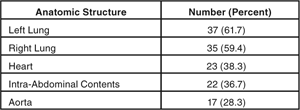
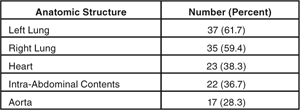
The most commonly injured structures noted on autopsy are listed in Table 1. Isolated pulmonary injury was noted in seven officers. Associated hemothorax was noted in six of these cases; no comment was made about the presence or absence of hemothorax in the seventh case. No mention of associated pneumothorax was recorded in any decedent. No coroner or medical examiner specifically identified tension pneumothorax as either a direct cause of death or a contributing factor (95% CI, 0.00%-5.96%).
Prehospital treatment protocol
Resuscitative efforts were performed in 45 (75%) cases. The most common resuscitative measures were airway management (n = 38, 63.3%) and intravenous access (n = 36, 60%). Six officers (13.3%) received needle decompression as part of resuscitative efforts. None of the six officers sustained isolated pulmonary injury.
Five of these officers had pulmonary injury, although none was specifically identified as having a pneumothorax; the sixth had isolated intra-abdominal trauma. Two of the six officers sustained penetrating cardiac trauma, two sustained aortic trauma, one sustained subclavian artery trauma, and three sustained intra-abdominal injuries.
Discussion
Tension pneumothorax is an uncommon cause of death in modern civilian trauma.1 In contrast, TPx is an important cause of possibly preventable death in combat.2 Data from the Wound Data and Munitions Effectiveness Team (WDMET) study indicated that tension pneumothorax was responsible for five percent of total combat deaths during the Vietnam era, representing 33% of possibly preventable combat deaths. A more recent analysis suggested that TPx was present in 3.9% of casualties who died from penetrating chest trauma. This again represented 33% of all soldiers dying from a fatal chest wound, and 48% of those with a fatal lung wound.Reference McPherson, Feigin and Bellamy6
Based upon WDMET data, the US military revised its approach to combat medical care. This new paradigm, designated tactical combat casualty care (TCCC), was predicated on the premise that medical care in combat is simply another tactical decision.Reference Butler, Hagman and Butler3,Reference McSwain, Frame and Salomone4 TCCC focused specifically upon rapid identification and management of possibly preventable causes of death at the point of wounding, emphasizing control of exsanguinating isolated extremity hemorrhage and needle decompression of presumed TPx over airway management and intravenous access. This approach has proven very effective, and continues to save lives in combat.Reference Butler, Holcomb, Giebner, McSwain and Baglan7–Reference Tien, Jung, Rizoli, Acharrya and McDonald9
Law enforcement is an inherently dangerous profession, resulting in an average of 53 deaths annually from felonious assault. Currently, no law enforcement-specific medical training exists. In order to fill this void, law enforcement has turned to the military and the TCCC program to develop tactical medical training. In contrast to the evidence-driven military experience, however, little is known about actual causes of law enforcement death while under conditions of active threat and assault.
A previous study reviewed the anatomic location of all law enforcement deaths reported to the Federal Bureau of Investigation through the Law Enforcement Officers Killed and Assaulted (LEOKA) program over a 10-year period.5 This study limited analysis to penetrating trauma and deaths occurring within one hour from point of wounding in order to evaluate the utility of the TCCC skill set for law enforcement personnel. Of the 341 officers included in the study, 198 (58.1%) died from head trauma. These deaths were deemed non-preventable after the fact. By comparison, only 31% of deaths in combat are secondary to central nervous system trauma.Reference Bellamy2
The second most common anatomic cause of death among law enforcement officers was chest trauma, accounting for 90 (26.4%) deaths. Another 18 (5.3%) officers died from upper back trauma and 19 (5.6%) died of penetrating abdominal trauma. These figures were more in keeping with military fatality data, in which 40% of soldiers died from penetrating truncal trauma.Reference Bellamy2 However, although the study identified the anatomic location of the fatal wound, the actual cause of death remained unknown. Using available military data, as many as 30 of these officers would be predicted to have died from TPx, representing possible preventable deaths.Reference Bellamy2,Reference McPherson, Feigin and Bellamy6
Despite this prediction, no coroner or medical examiner specifically identified TPx as either a direct cause of death or a contributing factor in the current study (95% CI, 0.00%-5.96%). In the majority of cases analyzed, the officers succumbed to non-compressible, truncal hemorrhage involving the heart, great vessels, or intra-abdominal organs. In seven cases, isolated pulmonary injury occurred; in six of these cases, associated hemothorax was noted on autopsy, but no comment was made regarding the presence of pneumothorax or tension pneumothorax. Using the military estimate that 48% of individuals with fatal lung wounds succumbed to TPx, at most three officers in the current study died from a tension pneumothorax over a ten-year period.Reference McPherson, Feigin and Bellamy6
Limitations
This study suffers from the limitations encountered in retrospective case series analyses, and has several important additional limitations. First, the FBI LEOKA database does not capture all law enforcement deaths, and was never developed as a medical investigative tool. However, it does capture 90% of law enforcement deaths, and is the best tool currently available for such research. In contrast to the military, which has developed a robust trauma registry, none exists in law enforcement. This is an area of need for future development.
The results of the current study were based upon autopsy reports. Autopsy reports were available for only 60 officers. As such, information is missing on 42% of identified cases. All 60 cases involved gunshot wounds. During the study period, one officer died from stab wounds to the chest. The nature of these injuries remains unknown.
The most important limitation of the current study is selection bias. The study analyzed only officers who died of their wounds. It did not capture those officers who sustained penetrating chest trauma, but survived. The time to death from TPx is poorly described. Reports range from minutes to greater than 16 hours.1 Given the robust Emergency Medical Services (EMS) in the continental United States, the lack of identified cases of TPx in the decedent officers in the current study may reflect the delivery of life-saving interventions, including needle decompression, by EMS. The actual incidence of TPx in all officers sustaining penetrating chest trauma is unknown. Centralized collection of regional trauma registry data, and rapid identification of police officers within the registry, would allow further assessment of prehospital interventions performed, and therefore identify those with possible utility as part of a law enforcement-specific medical skill set.
Conclusion
Penetrating chest trauma is the second leading cause of early death in police officers feloniously assaulted in the line of duty. In contrast with the military experience, the current study suggests that tension pneumothorax is not a common cause of preventable death in police officers. Given finite training resources in terms of both time and money, routine law enforcement training in TPx recognition and needle decompression techniques may not be reasonable from a cost-benefit standpoint. Further study of non-fatal “near miss” events will be required to determine the actual need for law enforcement-specific medical training in the recognition and management of TPx.
Acknowledgement
The authors are indebted to Ms Ardis Forland for her assistance in departmental contact communications.
Abbreviations:
FBI = US Federal Bureau of Investigation
LEOKA = Law Enforcement Officers Killed and Assaulted
LODD = line of duty death
TCCC = tactical combat casualty care
TPx = tension pneumothorax
UCR = Uniform Crime Reporting
VALOR = Violence Against Law Officer Research
WDMET = Wound Data and Munitions Effectiveness Team