Over the last 20 years, several attempts have been made to engage hospital patients in programs to improve healthcare worker (HCW) compliance with infection control strategies, namely hand hygiene (HH), to reduce the burden of healthcare-associated infections (HAIs). As a first step to establishing whether patient empowerment strategies would be accepted in Australian hospitals, we undertook a cross-sectional survey of patients to ascertain patients’ knowledge of, risk awareness of, and attitude toward HAIs and common infection control strategies, as well as their perceptions of participating in an engagement program aimed at preventing HAIs.
A cross-sectional survey was undertaken in a tertiary referral public hospital in Sydney, Australia, between May and December 2013. Adult patients (aged 18 years and older) admitted into the hospital, along with those waiting to be admitted and day patients, were directly approached by a study investigator. No eligibility criteria were placed on the length of stay; patients had to be in the hospital prior to the study. The study was carried out using a self-administered anonymous survey that contained a combination of open and closed questions.
Data analysis was conducted using SPSS version 22.0 (SPSS, Inc., Chicago, IL). Descriptive statistics of the responses, expressed as absolute and relative frequencies, were generated. Univariate and multivariate logistic regression analyses were used to identify the demographic predictors for the following outcomes: ability to define what an HAI is, risk perception of catching a HAI during a hospital stay, perceived willingness to ask doctors and nurses whether they have washed their hands, comfort in asking a nurse or doctor to move away if they are coughing, and comfort in asking a nurse or doctor to wear masks and gloves. These outcomes were included as binary variables in the logistic regression. In addition, the following independent variables were included in the regression models: gender, qualification and employment status, previous hospital admissions, previous surgeries, history of HAIs, information about HAIS acquired in the past, willingness to participate in the hospital’s infection control program, and attitudes regarding whether HCWs can infect patients in hospitals. Independent variables that had a P value ≤.25 in the univariate analysis were further tested with multivariate analysis. Odds ratios (ORs) and their corresponding 95% confidence intervals (CIs) were used to measure the magnitude of the association between predictors of interest and outcomes. The result was considered statistically significant at a 2-tailed P value ≤.05.
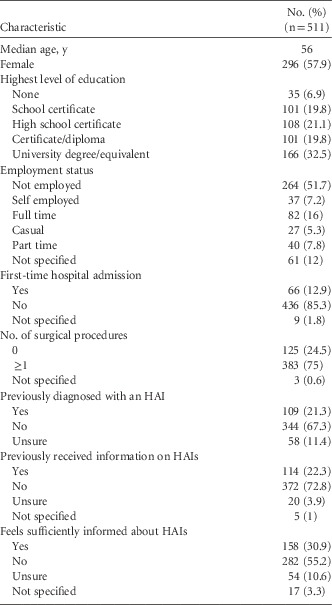
A total of 713 patients were approached and screened; 87 were deemed ineligible for the following reasons: insufficient English skills (n=41), cognitive impairment (n=21), emotional distress (n=21), visual and hearing impairment (n=3), and not meeting the age criteria (n=1). A further 115 patients declined to be surveyed. A total of 511 participants completed the full survey (response rate, 71.7%). Participants ranged in age from 18 to 93 years (median, 56 years); 57.9% were female (n=296) and 64.2% were born in Australia (n=328). These and other demographic characteristics are outlined in Table 1.
Characteristics and Past Experiences of Participants

NOTE. HAI, healthcare-associated infection.
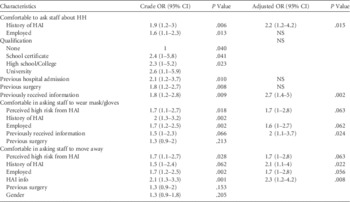
A total of 282 of these patients (55.2%) felt that their knowledge of HAIs was lacking; only 114 (22.3%) stated that they had previously received some information. However, a slightly higher proportion (66.9%; n=342) were able to correctly define the term HAI from a list of options. Several variables were significantly associated with correct knowledge of HAIs: being aged >60 years, having a university degree, and being employed. However, after multivariate logistic adjustment, only employment status significantly predicted HAI knowledge. Patients who were employed were more likely to correctly define the term HAI (OR, 2.4; 95% CI, 1.5–3.7; P<.0001; Table 2). Just less than half (49.3%) were interested in knowing the hospital’s HAI statistics prior to admission, whereas 75% highlighted their need for additional information on HAIs. Key areas of interest included (1) general background information, (2) prevention methods, (3) incidence/trends and current outbreaks, and (4) advice on how to speak to staff about infection control without causing offense. In hindsight, it would have been interesting to explore how patients use the information they receive about infections/infection control strategies. In future studies, it will be useful to explore whether receiving general information about HAI risks versus personalized risk information would have any impact on compliance with infection control recommendations or engagement with staff members.
Predictors of Comfort in Asking HCWs about their Infection Control Practices

NOTE: HCW, healthcare worker; HH, hand hygiene; OR, odds ratio; HAI, healthcare-associated infection; NS, not significant.
The majority of respondents stated that they would be willing to help HCWs prevent infections while at the hospital (88.5%; n=452). When asked to rate their level of comfort, 91.2% (n=466) reported that they would be ‘comfortable’ or ‘very comfortable’ asking HCWs general questions about medical care, while ~50% stated that they would be comfortable asking an HCW to wear gloves or move away when coughing or sneezing. However, when questioned about asking HCWs to perform hand hygiene, only 44.8% reported that they would be comfortable (n=229).
Results of the multiple logistic adjustments showed that patients who were exposed to an HAI in the past (OR, 2.2; 95% CI, 1.2–4.2; P=.015) or who had received information on HAIs (OR, 2.7; 95% CI, 1.4–5; P=.002) were more likely to report that they were comfortable in asking a nurse or doctor to wash their hands before touching them. Similarly, patients were more comfortable asking a doctor or nurse to wear gloves and masks if they had received information about HAIs (OR, 2; 95% CI, 1.1–3.7; P=.024). Patients who were exposed to an HAI in the past (OR, 2.1; 95% CI, 1.1–4; P=.022) and those who had received some information about HAIs (OR, 2.3; 95% CI, 1.2–4.2; P=.008) were also more likely to ask an HCW to move away if he or she were coughing or sneezing (Table 2).
In the literature, the vast majority of patients believe that they can help prevent medical errors. Among our study participants, a similar proportion reported that they would be willing to cooperate with HCWs to prevent infections (88.5%) or to make inquiries about their medical care (91.2%; n=466). However, when asked whether they wanted to be involved in promoting HCW compliance with HH, levels of support varied from 41.8% to 79%.Reference Longtin, Sax, Allegranzi, Hugonnet and Pittet 1 – Reference Wu, Lee and Chen 3 Available data showed that, unless promotional interventions were in place, the proportion of patients who had actually asked HCWs to perform HH varied between 5% and 40%.Reference Longtin, Sax, Allegranzi, Hugonnet and Pittet 1 , Reference Waterman, Gallagher, Garbutt, Waterman, Fraser and Burroughs 4 , Reference Pittet, Panesar and Wilson 5 However, the proportion of patients willing to engage with staff increased significantly to ~80% if they received an explicit invitation from the HCW.Reference Longtin, Sax, Leape, Sheridan, Donaldson and Pittet 6 For example, after an intervention was introduced that encouraged patient participation by directly telling patients that it is beneficial for everyone to enquire about HH, patients became much more willing to ask (21.1%–52% vs 55.8%–75%) and acted on their intentions more often (5%–29% vs 45%–57%).Reference McGuckin, Waterman and Portena 7 – Reference Lent, Eckstein, Cameron, Budavich, Eckstein and Donskey 10 The simple act of the HCW encouraging patients contributed to breaking down the perceived power differential between the patients and their HCWs and reassured the patients that they had an important role to play. Communication cues should be developed among staff members to assist them with this approach.
Our study had a number of limitations. First, we surveyed patients from a single institution using a convenient sample size. As a result, the generalizability of our findings may be limited. In addition, we excluded 41 patients with insufficient command of the English language; therefore, the perspective of patients from non–English-speaking backgrounds was lost. We did not conduct a medical record review to confirm patients’ health histories, nor did we record their lengths of stay. Our study explored perceived willingness to act rather than readiness to engage.
The majority of our participants stated that they would be willing to help hospital staff with HAI prevention. This particular finding is encouraging; it indicates that, overall, patients might be inclined to cooperate with HCWs when new collaborative infection control programs are developed and implemented. However, further exploration of patient knowledge and attitudes is needed to develop appropriate and relevant patient education materials and programs to promote patient participation in HAI prevention. In addition, further work needs to be conducted to ascertain whether Australian hospital staff members will accept and engage in a patient empowerment program aimed at reducing HAIs as well as what support institutions will provide.
Acknowledgments
The authors would like to thank all the participants who gave their time to take part in the study.
Financial support: None reported.
Potential conflicts of interest: Dr. Holly Seale previously received funding for investigator-driven research and invitations to present from GlaxoSmithKline, Bio-CSL, and Sanofi-Pasteur. This funding was not used for this study. All other authors report no conflicts of interest relevant to this article.