Introduction
The development of the fifth edition of the Diagnostic Manual of Mental Disorders has fueled the discussion about whether schizophrenia is a valid and useful entity (Kendell & Jablensky, Reference Kendell and Jablensky2003; Keller et al. Reference Keller, Fischer and Carpenter2011). Several authors have favored a combination of a dimensional and categorical approach in which patients have more or less psychopathology rated on several symptom dimensions (Cuesta & Peralta, Reference Cuesta and Peralta2008; van Os, Reference van Os2009; van Os & Kapur, Reference van Os and Kapur2009; Tandon & Carpenter, Reference Tandon and Carpenter2012). Symptom dimensions may constitute more homogeneous entities with similar symptom patterns, etiology, prognosis and possibly treatment. They may thus be interesting phenotypes both for molecular genetic studies and for revealing patterns of unique liability specifically associated with single symptom dimensions. Liddle (Reference Liddle1987) describes a three-factor solution (positive, negative and disorganization). Dikeos et al. (Reference Dikeos, Wickham, McDonald, Walshe, Sigmundsson, Bramon, Grech, Toulopoulou, Murray and Sham2006) conclude that a five-factor structure is the best fit describing the distribution of symptoms across Kraepelinian divisions (mania, reality distortion, depression, disorganization and negative symptoms). McGrath et al. (Reference McGrath, Nestadt, Liang, Lasseter, Wolyniec, Fallin, Thornquist, Luke and Pulver2004, Reference McGrath, Avramopoulos, Lasseter, Wolyniec, Fallin, Liang, Nestadt, Thornquist, Luke, Chen, Valle and Pulver2009) report nine- and five-factor solutions, both including negative and positive symptom factors. Thus, several symptom dimensions have been found with factor analyses (Liddle, Reference Liddle1987; Buchanan & Carpenter, Reference Buchanan and Carpenter1994; Lindenmayer et al. Reference Lindenmayer, Bernstein-Hyman and Grochowski1994; McGrath et al. Reference McGrath, Nestadt, Liang, Lasseter, Wolyniec, Fallin, Thornquist, Luke and Pulver2004, Reference McGrath, Avramopoulos, Lasseter, Wolyniec, Fallin, Liang, Nestadt, Thornquist, Luke, Chen, Valle and Pulver2009; Dikeos et al. Reference Dikeos, Wickham, McDonald, Walshe, Sigmundsson, Bramon, Grech, Toulopoulou, Murray and Sham2006; Jablensky, Reference Jablensky2006; Villalta-Gil et al. Reference Villalta-Gil, Vilaplana, Ochoa, Dolz, Usall, Haro, Almenara, Gonzalez and Lagares2006), with the positive and negative symptom dimension being the most prominent.
The theoretical background for this positive–negative dichotomy dates back to the 1970s to 1980s, where positive and negative symptoms (Strauss et al. Reference Strauss, Carpenter and Bartko1974), type I versus type II (Crow, Reference Crow1980) and deficit- versus non-deficit schizophrenia (Carpenter et al. Reference Carpenter, Heinrichs and Wagman1988) were first described, with coinciding construction of rating scales assessing this dichotomy (Andreasen & Olsen, Reference Andreasen and Olsen1982; Kay et al. Reference Kay, Fiszbein and Opler1987; Kirkpatrick et al. Reference Kirkpatrick, Buchanan, McKenney, Alphs and Carpenter1989). The positive (or ‘reality distortion’) symptom dimension typically constitutes delusions, hallucinations and positive formal thought disorder. The negative (or ‘psychomotor poverty’) dimension comprises problems with emotion experience (e.g. anhedonia, avolition, apathy) and emotion expression (e.g. blunted/restricted affect). Positive symptoms typically fluctuate over time periods of hours and even minutes whereas negative symptoms are thought to be fairly stable over time.
For the negative symptom dimension, a modest but consistent correlation has been found with cognitive impairments (Keefe et al. Reference Keefe, Bilder, Harvey, Davis, Palmer, Gold, Meltzer, Green, Miller, Canive, Adler, Manschreck, Swartz, Rosenheck, Perkins, Walker, Stroup, McEvoy and Lieberman2006; Dominguez et al. Reference Dominguez, Wichers, Lieb, Wittchen and van Os2011; Lataster et al. Reference Lataster, Shazad, Henquet and Quee2012). Reports on possible risk factors for the positive symptoms of psychosis are less consistent. Aberrations in social cognition have been suggested. However, mixed results have been reported (Freeman, Reference Freeman2007; Versmissen et al. Reference Versmissen, Janssen, Johns, McGuire, Drukker, à Campo, Myin-Germeys, van Os and Krabbendam2007; Lincoln et al. Reference Lincoln, Lange, Burau, Exner and Moritz2010). Alternatively, increased reactivity to the environment has been suggested.
It is well established that environmental stresses, such as life events (Bebbington et al. Reference Bebbington, Wilkins, Sham, Jones, van Os, Murray, Toone and Lewis1996), childhood trauma (Bebbington et al. Reference Bebbington, Bhugra, Brugha, Singleton, Farrell, Jenkins, Lewis and Meltzer2004; Janssen et al. Reference Janssen, Krabbendam, Bak, Hanssen, Vollebergh, de Graaf and van Os2004; Varese et al. Reference Varese, Smeets, Drukker, Lieverse, Lataster, Viechtbauer, Read, van Os and Bentall2012) or bullying (Lataster et al. Reference Lataster, van Os, Drukker, Henquet, Feron, Gunther and Myin-Germeys2006), play a role in the development of psychotic disorder. Neuroticism questionnaires are often used to assess an individual's stress sensitivity, and it has been shown that people with schizophrenia report higher levels of neuroticism (Horan et al. Reference Horan, Subotnik, Reise, Ventura and Nuechterlein2005). Moreover, neuroticism scores have been associated with positive symptoms (Lysaker et al. Reference Lysaker, Lancaster, Nees and Davis2003; Barrantes-Vidal et al. Reference Barrantes-Vidal, Ros-Morente and Kwapil2009) and with increased risk for psychosis at both the clinical and subclinical level (van Os & Jones, Reference van Os and Jones2001; Krabbendam et al. Reference Krabbendam, Janssen, Bak, Bijl, de Graaf and van Os2002). In one experimental study using a speech stress task, higher levels of trait arousability (an individual's emotional and physiological reactivity to novel events) were found to be associated with positive and affective symptoms (Dinzeo et al. Reference Dinzeo, Cohen, Nienow and Docherty2004). However, these findings were only partly replicated (i.e. a significant association for affective but not positive symptoms) in a later study (Dinzeo et al. Reference Dinzeo, Cohen, Nienow and Docherty2008). Docherty et al. (Reference Docherty, St-Hilaire, Aakre and Seghers2009) found that trait arousability moderated the association between life events and positive symptoms, with a significant association between life events and positive symptoms for patients with high but not low levels of trait arousability. It has been suggested, however, that the subtler daily hassles also impact on psychosis outcome. In a series of studies by Myin-Germeys and colleagues (for a review see Myin-Germeys & van Os, Reference Myin-Germeys and van Os2007), an attempt was made to assess daily life stress reactivity in an ecologically valid manner using a structured diary technique, the experience sampling method (ESM). It was shown that patients with psychosis and their first-degree relatives are increasingly emotionally reactive to stress in the context of daily life (Myin-Germeys et al. Reference Myin-Germeys, van Os, Schwartz, Stone and Delespaul2001). Moreover, it was found that subtle everyday stresses are accompanied by an exacerbation of psychotic symptoms (Myin-Germeys et al. Reference Myin-Germeys, Delespaul and van Os2005). The results of two more recent studies further contribute to the notion that stress reactivity is, in part, a genetically determined risk factor for psychotic disorder, and more specifically for the positive symptom dimension (Lataster et al. Reference Lataster, Wichers, Jacobs, Mengelers, Derom, Thiery, van Os and Myin-Germeys2009, Reference Lataster, Collip, Lardinois, van Os and Myin-Germeys2010).
The aim of this study was to investigate whether the positive and negative symptom dimensions of psychotic disorder moderate the association between everyday stressful events and negative affect (NA), known as stress reactivity. Based on findings from previous studies, we hypothesized that high levels of positive symptoms would be specifically associated with this reactivity to stress in daily life.
Method
Subjects
The sample consisted of 77 patients with a diagnosis of a non-affective psychotic disorder. In selected representative geographical areas in The Netherlands and Belgium, patients were identified through representative clinicians working in regional psychotic disorder services whose case loads were screened for inclusion criteria. Subsequently, a group of patients presenting consecutively at these services as either out-patients or in-patients were recruited for the study.
Two trained research assistants and two psychologists conducted all of the interviews. The Positive and Negative Syndrome Scale (PANSS; Kay et al. Reference Kay, Fiszbein and Opler1987) was used to assess current psychiatric symptoms. The PANSS interviewers took part in an inter-rater reliability evaluation as part of a large Dutch national project on psychotic disorder (Korver et al. Reference Korver, Quee, Boos, Simons and de Haan2012), where intra-class correlations (ICCs) were calculated based on scores of 16 randomly selected raters who rated four videotaped interviews (ICC PANSS positive subscale score: 0.96; ICC PANSS negative subscale score: 0.91). The Comprehensive Assessment of Symptoms and History (CASH; Andreasen et al. Reference Andreasen, Flaum and Arndt1992) was completed to assess lifetime symptom history, yielding DSM-IV diagnoses (APA, 1994).
Inclusion criteria were: (1) lifetime occurrence of non-affective psychotic symptoms, according to DSM-IV criteria, (2) age 16–60 years and (3) sufficient command of the Dutch language. Exclusion criteria were: (1) brain disease, (2) history of head injury with loss of consciousness, (3) substance-related psychosis and (4) psychosis with a known organic cause. Written informed consent, conforming to local ethics committee guidelines, was obtained from all subjects.
ESM
The ESM was used to measure the emotional reaction to stress in the flow of daily life, called ‘stress reactivity’. ESM is a within-day, momentary self-assessment technique (Myin-Germeys et al. Reference Myin-Germeys, Oorschot, Collip, Lataster, Delespaul and van Os2009; Oorschot et al. Reference Oorschot, Kwapil, Delespaul and Myin-Germeys2009). Subjects received a digital wristwatch and self-assessment forms collated in a booklet for each day. Ten times a day on 6 consecutive days, the watch emitted a signal (beep) at unpredictable moments between 07:30 and 22:30 hours. Subjects were asked to report immediately after each beep their thoughts, current context (activity, persons present, location), appraisals of the current situation, and mood. All self-assessments were rated on seven-point Likert scales. The ESM procedure was explained to the participants in an initial briefing session of about 45 min, where a practice form was completed to confirm that subjects were able to understand all questions and the seven-point Likert scale format. To minimize memory distortion, subjects were instructed to complete their reports immediately after the beep, and to record the time at which they completed the form. In the actual sampling week, participants were called by research staff to further ensure that they were complying with the instructions. The time the watch emitted a signal was compared to the time participants completed the report to ensure reliability of the completed reports. All reports completed more than 15 min after the beep were excluded from the analyses because previous research (Delespaul, Reference Delespaul1995) has shown that reports completed after this interval are less reliable and consequently less valid. For the same reason, subjects with less than 20 valid reports (out of 60) were excluded from the analysis (Delespaul, Reference Delespaul1995).
Assessment of mood and stress
Measures of mood and stress were derived from the ESM reports as follows.
Assessment of mood
ESM NA was assessed at each beep with six mood-related adjectives (down, guilty, insecure, lonely, anxious, angry/irritated) rated on seven-point Likert scales (1 = not at all, 7 = very). Mean scores on these six mood questions were used as a measure of NA in the analyses (Cronbach's α = 0.85).
Assessment of stress
In accordance with previous work, stress was conceptualized as the subjectively appraised stressfulness of distinctive events (event-related stress) (Lataster et al. Reference Lataster, Collip, Lardinois, van Os and Myin-Germeys2010). To measure event-related stress, the subject was asked to report, after each beep, the most important event that had happened between the current and the previous report. This event was subsequently rated on a bipolar Likert scale (−3 = very unpleasant, 0 = neutral, 3 = very pleasant). The responses were recoded to allow high scores to reflect high levels of stress (−3 = very pleasant, 0 = neutral, 3 = very unpleasant).
Assessment of symptoms
Current positive and negative symptoms
All subjects were assessed with the PANSS (Kay et al. Reference Kay, Fiszbein and Opler1987) at the end of the ESM week (assessment period of 2 previous weeks, thereby also covering the ESM week). The PANSS comprises positive, negative and general symptom scales. For the present study we used the positive and negative symptom scales, each of which include seven items scored on a seven-point scale (1 = absent, 7 = extreme). The mean scores on both the positive and negative scales were used. In addition, the momentary ESM items ‘I feel suspicious’, ‘I see things’ and ‘I hear voices’ were combined into one mean ESM positive symptom score.
Lifetime positive and negative symptoms
The lifetime occurrence of positive and negative symptoms of schizophrenia was measured with the CASH (Andreasen et al. Reference Andreasen, Flaum and Arndt1992). A mean score on CASH section 6 (delusions) and section 7 (hallucinations) formed the positive symptom score (Cronbach's α = 0.75) used for the analyses. The negative symptom variable (Cronbach's α = 0.60) comprised scores on items assessing lifetime emotion experience (section 11 ‘apathy’, section 12 ‘anhedonia’) and current problems with emotion expression as observed by the interviewer (section 15 ‘observation of flattened affect’). All scores on sections 11, 12 and 15 used for the negative symptom variable were recoded to match the 0/1 coding of the items that comprised the positive symptom variable (0 = absent and 1–5 = present).
Analyses
ESM data have a multi-level structure: multiple observations (level 1) are nested within subjects (level 2), who were in some cases (n = 8) part of sib pairs (level 3). To take the three-level grouping structure of the data (ESM beep level observations, subject, sib pair) into account, multi-level random regression analysis (Snijders & Bosker, Reference Snijders and Bosker1999) was applied in Stata version 11.2 (StataCorp, 2009), using the xtmixed command. Mixed models are characterized as containing both fixed and random effects. All analyses were conducted with standardized dependent variables using the std command in Stata, yielding standardized values for each specified variable with mean (0) and standard deviation (1).
Association between stress reactivity and positive and negative symptoms
Multi-level linear regression analyses were conducted to examine the moderating effect of the positive and negative symptoms of schizophrenia, measured with the CASH, PANSS and ESM, on the association between daily life event-related stress and NA. For these analyses, NA was entered in the model as the dependent variable and mean scores on CASH and PANSS positive and negative symptoms and ESM positive symptoms, the ratings on event-related stress and their interactions (stress × symptoms) were the independent variables (general model: NA=B0+B1event-stress+B2symptoms+B3event-stress × symptoms + residual). The interaction term was the focus of these analyses because the hypothesis required testing whether positive and negative symptoms moderated the association between stressful events and NA intensity. In the case of significant interaction effects, stratified analyses were performed using the margins command in Stata to calculate the effect sizes of the interactions between symptoms (see the section on sensitivity analyses for details on how symptom scores were stratified) on the one hand and stress on NA on the other.
Sensitivity analyses
To test whether the moderating effect of positive symptoms on the association between event-stress and NA was stronger in those subjects with predominantly positive symptoms, the multi-level linear regression analyses were repeated comparing those subjects who scored high on positive symptoms and low on negative symptoms assessed with the CASH (CASH high positive: 1 if positive symptom score ⩾0.5 and negative symptom score <0.5, n = 14; 0 in all other cases, n = 50) and the PANSS (PANSS high positive: 1 if positive symptom score ⩾2 and negative symptom score <2, n = 13; 0 in all other cases, n = 51). For the PANSS, we tested whether moderating effects of negative symptoms on the stress–NA association was different for those subjects with high negative and low positive symptoms (PANSS high negative: 1 if negative symptom score ⩾2 and positive symptom score <2, n = 7; 0 in all other cases, n = 57). For the ESM-psychosis variable, stratification was chosen at the beep level, comparing the association between event-stress and NA on those beeps where scores on ESM psychosis were high (score ⩾2.5, n = 224 beeps) versus all beeps where ESM psychosis was low (score <2.5, n = 2342 beeps).
To test the relative independence of the moderating effect of positive symptoms on the stress–NA association, two multi-level linear regression models were fitted (for CASH lifetime and PANSS current symptoms) with the stress × positive symptoms and stress × negative symptoms interaction terms entered simultaneously in the model.
Results
Subjects and descriptives
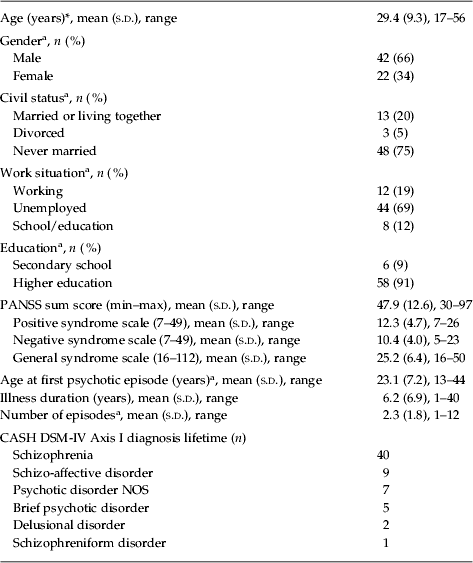
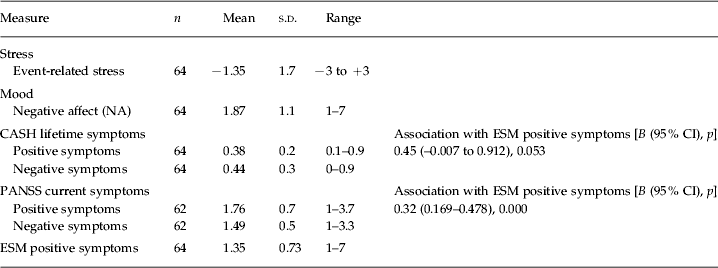
The final sample consisted of 77 patients; of these, five dropped out of the study before finishing the ESM reports and 72 completed the ESM reports. A further eight subjects were excluded because they had less than 20 valid ESM self-reports or a large number of missing values on event-related stress (also leading to less than 20 valid ESM reports for the analyses; i.e. 64 subjects remained), yielding a total of 2568 beeps with a mean of 40 beeps per subject. Demographic and clinical statistics of the sample are shown in Table 1, and the mean scores for the independent and dependent variables are shown in Table 2.
Demographic and clinical characteristics

PANSS, Positive and Negative Syndrome Scale; CASH, Comprehensive Assessment of Symptoms and History; NOS, not otherwise specified; s.d., standard deviation.
a None of these variables were significantly associated with the main outcome (negative affect), and were therefore not included as confounders in the regression models.
Mean scores on the (non-standardized) dependent and independent variables
CASH, Comprehensive Assessment of Symptoms and History; PANSS, Positive and Negative Syndrome Scale; ESM, experience sampling method; B, standardized regression coefficient; CI, confidence interval; n, number of subjects included in the analyses; s.d., standard deviation.
Association between stress reactivity and positive and negative psychotic symptoms
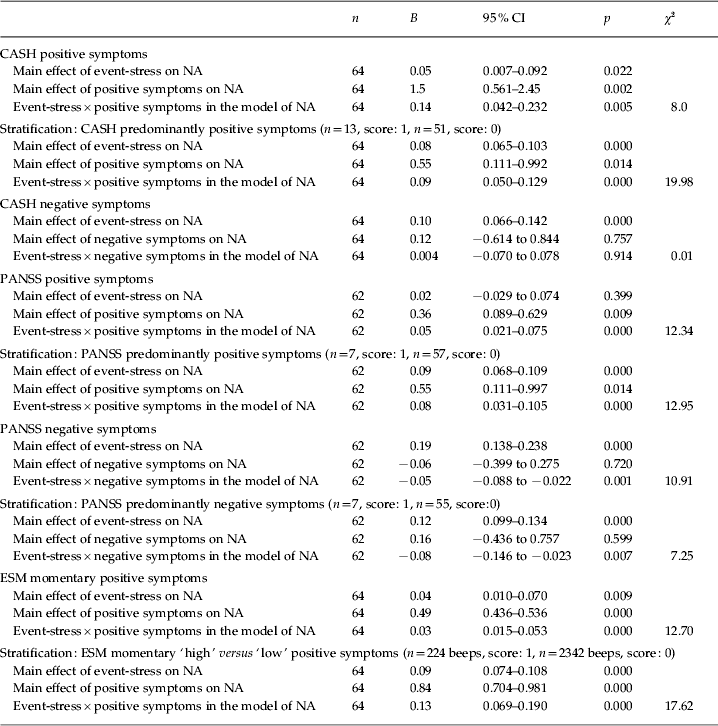
The multi-level random regression analyses conducted to examine the associations between CASH, PANSS and ESM positive and negative symptom scores on the one hand and the association between stress and NA (i.e. ‘stress reactivity’) on the other, showed significant positive interaction effects for current (PANSS and ESM) and lifetime (CASH) positive symptoms, and a significant negative or inverse interaction effect for current negative symptoms as measured with the PANSS. No significant interaction effect was found for lifetime negative symptoms as measured with the CASH (Table 3).
Multi-level linear regression analyses assessing the moderating effect of CASH lifetime positive and negative symptoms, PANSS current positive and negative symptoms, and ESM momentary positive symptoms on the association between event-stress and NA (i.e. stress reactivity)
CASH, Comprehensive Assessment of Symptoms and History; PANSS, Positive and Negative Syndrome Scale; ESM, experience sampling method; NA, negative effect; CI, confidence interval; n, number of subjects included in the analyses; B, standardized regression coefficient. For the stratified analyses the B values represent the magnitude of the difference in effect between the high (1) versus low category (0).
Sensitivity analyses
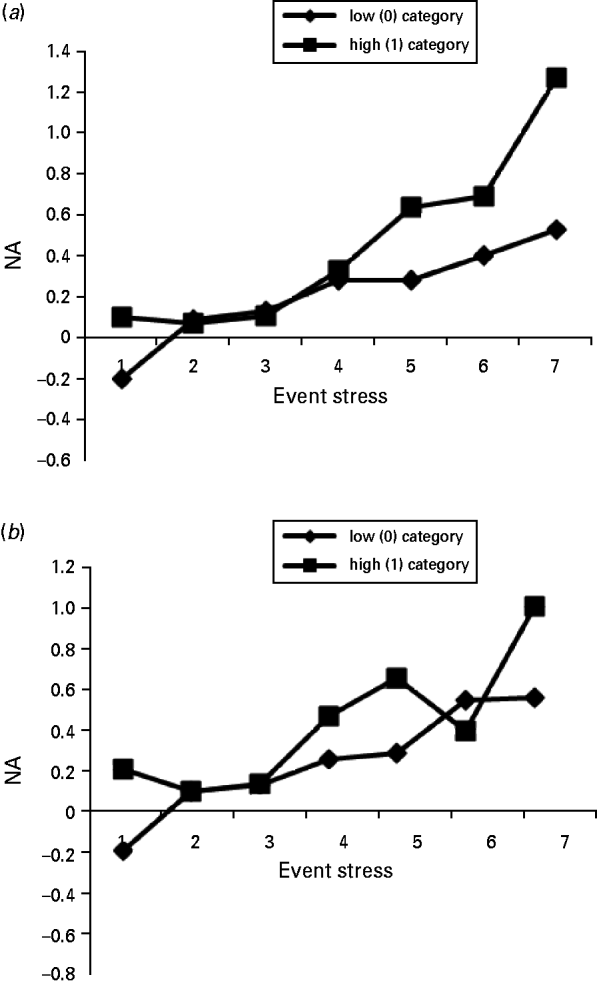
Stratified analyses showed that the association between event-stress and NA was stronger for those subjects who scored high on CASH, PANSS or ESM positive symptoms and low on negative symptoms (Table 3). By contrast, subjects who scored high on PANSS negative symptoms but low on PANSS positive symptoms showed a weaker association between event-stress and NA (Table 3).
The multi-level linear regression models with the two interactions (stress × positive symptoms and stress × negative symptoms) entered simultaneously in the model showed that the moderating effect of positive symptoms on the stress–NA association remains significant after controlling for the moderating effect of negative symptoms on this association [CASH lifetime: B = 0.14, 95% confidence interval (CI) 0.045–0.238, p = 0.004; and PANSS current: B = 0.06, 95% CI 0.028–0.082, p = 0.000], supporting the relative independence of the stress × positive symptom interaction in the NA model.
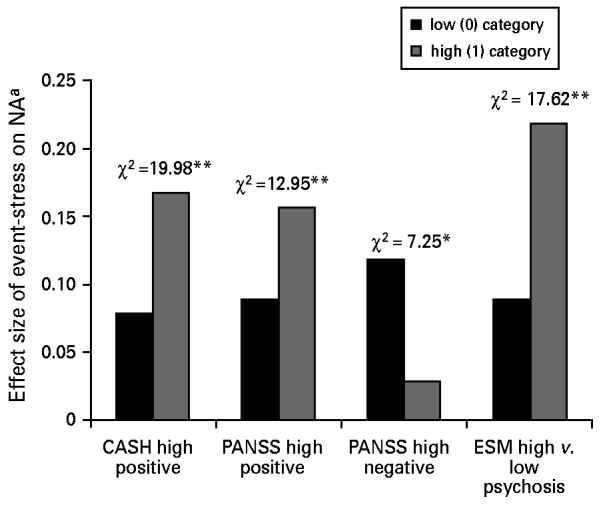
The results of these stratified analyses showing effect sizes of stress on NA for the different subject categories (e.g. ‘high positive’) are shown in Figs 1 and 2.
Stratified analyses assessing the association between stress and negative effect (NA) for subjects with predominantly positive symptoms on the Comprehensive Assessment of Symptoms and History (CASH), the Positive and Negative Syndrome Scale (PANSS) or the experience sampling method (ESM) and predominantly negative symptoms on the PANSS compared to subjects with low scores respectively. Note that no stratified analyses were performed for CASH negative symptoms because the main interaction was not significant. ‘CASH high positive’ high (1) category: 95% confidence interval (CI) 0.140–0.208, p = 0.000; ‘CASH high positive’ low (0) category: 95% CI 0.065–0.103, p = 0.000; ‘PANSS high positive’ high (1) category: 95% CI 0.126–0.188, p = 0.000; ‘PANSS high positive’ low (0) category: 95% CI 0.068–0.109, p = 0.000; ‘PANSS high negative’ high (1) category: 95% CI −0.027 to 0.091, p = 0.293; ‘PANSS high negative’ low (0) category: 95% CI 0.099–0.134, p = 0.000; ‘ESM psychosis high’: 95% CI 0.162–0.279, p = 0.000 versus ‘ESM psychosis low’: 95% CI 0.074–0.108, p = 0.000. a These are the ‘absolute’ B values (regression coefficients) per category as opposed to the B values representing the magnitude of the difference in effect between the high versus low category as presented in Table 3. * p < 0.01, ** p < 0.001.
The association between event-stress and negative effect (NA) for the ‘high’ and ‘low’ symptom categories of (a) Comprehensive Assessment of Symptoms and History (CASH) lifetime positive symptoms and (b) Positive and Negative Syndrome Scale (PANSS) current positive symptoms.
Discussion
In this study, a direct moderating effect of current and lifetime positive symptoms on the association between stressful events and NA (i.e. stress reactivity) was found in the context of daily life. No such association was found for lifetime negative symptoms, and current negative symptoms as measured with the PANSS were even found to be negatively associated with stress reactivity (i.e. higher levels of current negative symptoms showing a weaker moderating effect on the stress–NA association). More important, the results show that the association is particularly strong for those subjects who have predominantly positive symptoms.
Findings
The finding that high levels of positive symptoms moderate the stress–NA association is in accordance with previous studies showing an association between trait arousability and positive symptom scores (Dinzeo et al. Reference Dinzeo, Cohen, Nienow and Docherty2004; Docherty et al. Reference Docherty, St-Hilaire, Aakre and Seghers2009). It also extends the finding of a momentary stress-induced increase in the intensity of positive psychotic experiences (Myin-Germeys et al. Reference Myin-Germeys, Delespaul and van Os2005) to a global pattern of increased stress reactivity in participants showing higher levels of positive symptoms. Moreover, the findings of this study suggest that negative symptoms have a significant beneficial effect on stress reactivity (i.e. higher levels of negative symptoms associated with a weaker effect of stress on NA). This is in accordance with the study by Scholten et al. (Reference Scholten, van Honk, Aleman and Kahn2006) showing that high activity of the Behavioral Inhibition System (BIS), a neural system that is sensitive to cues of threat, is associated with low levels of negative symptoms, and a more recent finding that patients with high levels of negative symptoms have a lower risk for post-traumatic stress disorder (Strauss et al. Reference Strauss, Duke, Ross and Allen2011). The findings of the current study fit within an affective pathway to psychosis, suggesting that altered stress reactivity may be an independent and specific vulnerability marker for the positive symptom dimension of psychosis (Myin-Germeys & van Os, Reference Myin-Germeys and van Os2007).
An alternative explanation for the current results is that positive symptoms (delusions and hallucinations) increase the emotional reactivity to stress in daily life, rather than the other way around. However, post-hoc analysis showed no significant main effect of CASH and PANSS positive symptoms on event-stress. Similarly, the use of antipsychotic medication or presence of depression in these patients may have influenced the results, especially those regarding negative symptoms. However, controlling for these possible confounders did not substantially change the results.
How might stress reactivity contribute to psychosis?
Biological mechanisms
There are several biological models that can account for the relationship between positive psychotic symptoms and increased emotional reactivity to stress. A possible interpretation of the association is that minor stressors cause an increase in psychosis intensity. As this effect would suggest an enduring increase in the behavioral response to environmental stress, it could be described as behavioral sensitization (Myin-Germeys et al. Reference Myin-Germeys, Delespaul and van Os2005). Accordingly, post-hoc analyses showed that those patients with a longer illness duration (as a proxy for longer exposure to stress, coded as 0 = illness duration <5 years and 1 = illness duration ⩾5 years) show larger increases in NA with everyday stressful events (i.e. a difference in effect size of 0.06, χ2 = 10.3, p = 0.001). It has been suggested that exposure to environmental stressors resulting in a chronic heightened glucocorticoid release may cause permanent changes in the hypothalamic–pituitary–adrenal (HPA) axis. In line with this, it was shown that siblings of patients with a psychotic disorder have higher diurnal cortisol levels and increased cortisol reactivity to negative daily events relative to controls (Collip et al. Reference Collip, Nicolson, Lardinois, Lataster, van Os and Myin-Germeys2011). Moreover, there is evidence suggesting that cortisol secretion is increased in patients prior to the onset of a first psychotic episode (Walker et al. Reference Walker, Brennan, Esterberg, Brasfield, Pearce and Compton2010). Such a stress-induced dysregulation of the HPA axis may give rise to increased subcortical dopamine (DA) receptor densities and DA release and may underlie the dopaminergic abnormalities that are generally thought to be involved in psychosis (van Winkel et al. Reference van Winkel, Stefanis and Myin-Germeys2008; Walker et al. Reference Walker, Mittal and Tessner2008). Additionally, a dysregulated, subcortical hyperdopaminergic state may lead to stimulus-independent release of DA, which may take over the normal process of contextually driven salience attribution and lead to aberrant assignment of salience to external objects and internal representations (Kapur, Reference Kapur2003; Howes & Kapur, Reference Howes and Kapur2009). In accordance with this, there is evidence for increased dopamine synthesis in patients prior to onset of the first psychotic episode (Howes et al. Reference Howes, Bose, Turkheimer, Valli, Egerton, Valmaggia, Murray and McGuire2011).
Psychological mechanisms
Psychological models suggest that triggering events may lead to the development of positive psychotic symptoms. These models posit that victimization experiences may lead to the formation of negative schemas about the self and the world (e.g. beliefs about the self as vulnerable to threat, or about others as dangerous) that facilitate external attributions, which may lead to the development of paranoid delusions (Bentall et al. Reference Bentall, Corcoran, Howard, Blackwood and Kinderman2001; Garety et al. Reference Garety, Kuipers, Fowler, Freeman and Bebbington2001, Reference Garety, Bebbington, Fowler, Freeman and Kuipers2007). Additionally, several affective processes, in particular neuroticism, depression and anxiety, have been hypothesized to play a role in the formation of psychotic symptoms (Bentall et al. Reference Bentall, Corcoran, Howard, Blackwood and Kinderman2001; Birchwood et al. Reference Birchwood, Iqbal and Upthegrove2005). Although findings on the association between neuroticism and specific symptoms are inconclusive (Horan et al. Reference Horan, Blanchard, Clark and Green2008), some studies suggest a specific association with the positive symptom dimension (van Os & Jones, Reference van Os and Jones2001; Krabbendam et al. Reference Krabbendam, Janssen, Bak, Bijl, de Graaf and van Os2002; Lysaker et al. Reference Lysaker, Lancaster, Nees and Davis2003; Horan et al. Reference Horan, Subotnik, Reise, Ventura and Nuechterlein2005; Laroi et al. Reference Laroi, Van der Linden, DeFruyt, van Os and Aleman2006). Moreover, one study reported a moderating effect of neuroticism on the association between positive schizotypy and measures of psychopathology and functioning in a non-clinical sample (Barrantes-Vidal et al. Reference Barrantes-Vidal, Ros-Morente and Kwapil2009). The results of the current study would suggest that small daily events trigger the type of affective disturbances that may facilitate the process whereby anomalous experiences become psychotic symptoms.
Clinical implications
The current results suggest that stress reactivity may be a vulnerability marker underlying the positive symptoms of psychosis. Clearly, these results are still a long way from offering direct therapeutic insight. However, if stress reactivity can truly be considered a specific area of vulnerability, it may be useful to tailor treatment aimed at reducing reactivity to stress in daily life. One possible way to do so is by reducing stress in the social environment of the patient (Pilling et al. Reference Pilling, Bebbington, Kuipers, Garety, Geddes, Orbach and Morgan2002). Training patients to apply self-relaxation or self-distraction techniques seems to improve emotional well-being in chronic schizophrenia patients but not in early psychosis (Hodel et al. Reference Hodel, Brenner, Merlo and Teuber1998). Previous studies have shown that cognitive behavioral therapy (CBT) reduces psychotic symptoms (Pilling et al. Reference Pilling, Bebbington, Kuipers, Garety, Geddes, Orbach and Morgan2002) and also reduces distress caused by psychotic symptoms (Valmaggia et al. Reference Valmaggia, van der Gaag, Tarrier, Pijnenborg and Slooff2005), and there are some studies suggesting that it might reduce relapse rates (Gumley et al. Reference Gumley, Karatzias, Power, Reilly, McNay and O'Grady2006). The results of a more recent study suggest, however, that CBT helps in depression and emotional distress but not in psychosis relapse (Garety et al. Reference Garety, Fowler, Freeman, Bebbington, Dunn and Kuipers2008). Extending this therapy in such a way that treatment is additionally focused on emotional reactivity to stress in daily life may thus have positive effects on depression and distress that are experienced with psychotic symptoms. Of interest, the newest generation of CBT puts high emphasis on the context (hence the name ‘contextual CBT’), and uses stress-reduction techniques (e.g. elements from mindfulness or acceptance and commitment therapy) to create a more ‘open, active, and aware approach to living’ (for a review see Hayes et al. Reference Hayes, Villatte, Levin and Hildebrandt2011).
Methodological issues
The results should be viewed in the light of several methodological issues. First, the ESM measurements are based on subjective reports. Therefore, it can be argued that the results are not psychometrically precise. However, although subjective reports are considered less reliable (e.g. do all subjects interpret or answer the questions identically?), previous research indicates that subjective reports can be valid, and that the validity of objective reports should not be taken for granted (Strauss, Reference Strauss1994).
Second, ESM is a daily life assessment technique in which subjects have to comply with a paper-and-pencil diary protocol without the researcher being present. However, some authors have cast doubt on the reliability and subject compliance in paper-and-pencil ESM studies, favoring the use of electronic devices (Stone et al. Reference Stone, Shiffman, Schwartz, Broderick and Hufford2002; Broderick et al. Reference Broderick, Schwartz, Shiffman, Hufford and Stone2003). In a comparative study, Green et al. (Reference Green, Rafaeli, Bolger, Shrout and Reis2006) concluded that both methods yielded similar results. In addition, a study using a signal-contingent random time sampling procedure with multiple observations per day, similar to the protocol used in the current study, found evidence that underscores the validity of the paper-and-pencil random time self-report data in the current study (Jacobs et al. Reference Jacobs, Nicolson, Derom, Delespaul, van Os and Myin-Germeys2005). Third, it is possible that our negative finding for lifetime negative symptoms is a consequence of the way these symptoms were assessed with the CASH, with a limited set of items. It has been suggested that the assessment of negative symptoms with the instruments available to date is complex and often unreliable (Horan et al. Reference Horan, Kring and Blanchard2006; Blanchard et al. Reference Blanchard, Kring, Horan and Gur2011) because they rely heavily on interviewer observations and on the patient's reflective capacity. Following this, our positive results showing a significant, but inverse, effect of current negative symptoms in the stress–NA association should be interpreted with caution. Fortunately, more reliable negative symptom measures are currently being developed, taking into account the patient's subjective needs and, for example, assessing in-the-moment flattening of affect by telling a joke and observing the patient's response to it (i.e. the Clinical Assessment Interview for Negative Symptoms; Blanchard et al. Reference Blanchard, Kring, Horan and Gur2011).
Finally, stress reactivity has been defined as the emotional reaction to subjective stress. The current results are based on cross-sectional analyses and therefore the possibility of reverse causality cannot be excluded. There is a possibility that increased NA or increased levels of positive or negative symptoms influence the subjective appraisal of the environment. However, the individual would still experience psychosis or distress with an environmental event.
Conclusions
The results of the present study show a direct moderating effect of the positive symptoms of psychosis on the association between stressful events and NA in the everyday life of patients with a psychotic disorder (i.e. stress reactivity). This association seems to be particularly strong for those subjects who have predominantly positive symptoms rather than negative symptoms. This study shows that stress reactivity is a core risk factor within the affective pathway leading to a psychotic syndrome with high levels of positive symptoms.
Acknowledgments
This work was supported by the Royal Dutch Academy of Scientific Research (VWF/DA/977 to T. Lataster), the Dutch Medical Council (Vidi grant to I. Myin-Germeys) and a National Alliance for Research on Schizophrenia and Depression (NARSAD) 2006 Young Investigator Award (to I. Myin-Germeys); and was sponsored by the Dutch Organization for Scientific Research through the Genetic Risk and Outcome in Psychosis (GROUP) project and the European Community's Seventh Framework Program under grant arrangement HEALTH-F2-2009-241909 (EU-GEI consortium).
Declaration of Interest
Professor van Os is/has been an unrestricted research grant holder with, or has received financial compensation as an independent symposium speaker from, Eli Lilly, BMS, Lundbeck, Organon, Janssen-Cilag, GSK, AstraZeneca, Pfizer and Servier. Professor Myin-Germeys has received financial compensation as an independent symposium speaker from BMS and Janssen-Cilag.