Introduction
There is growing concern about the effect of military deployments to Iraq and Afghanistan on the psychological well-being of service personnel (Milliken et al. Reference Milliken, Auchterlonie and Hoge2007; Smith et al. Reference Smith, Ryan, Wingard, Slymen, Sallis and Kritz-Silverstein2008; Iversen et al. Reference Iversen, van Staden, Hughes, Browne, Hull, Hall, Greenberg, Rona, Hotopf, Wessely and Fear2009; Fear et al. Reference Fear, Jones, Murphy, Hull, Iversen, Coker, Machell, Sundin, Woodhead, Jones, Greenberg, Landau, Dandeker, Rona, Hotopf and Wessely2010). There has been a particular focus in the media on violent behaviour in those returning home from deployment (Caesar, Reference Caesar2010). The existing literature on post-deployment violence and antisocial behaviour has derived from predominantly USA-based research. Studies of returnees of the Vietnam war and latterly the 1990–1991 Gulf war have demonstrated correlations between post-deployment violence and both combat exposure (Yesavage, Reference Yesavage1983; Yager et al. Reference Yager, Laufer and Gallops1984; Black et al. Reference Black, Carney, Peloso, Woolson, Letuchy and Doebbeling2005) and post-traumatic stress disorder (PTSD) (McFall et al. Reference McFall, Fontana, Raskind and Rosenheck1999; Taft et al. Reference Taft, Kaloupek, Schumm, Marshall, Panuzio, King and Keane2007a ). Pre-enlistment antisocial behaviour has been shown to be an important risk factor (Resnick et al. Reference Resnick, Foy, Donahoe and Miller1989; Fontana & Rosenheck, Reference Fontana and Rosenheck2005). However, much of this research is limited by the use of highly selected samples or the collection of information many years after the deployment in question. This study investigates violence on homecoming by UK military personnel returning from deployment in Iraq, a subject not studied previously.
The primary aim of the study is to determine the prevalence of violence in the weeks following return from deployment in a randomly selected representative sample of UK military personnel and to explore the association of violence with deployment-related factors. The relationship of violence on homecoming with potential confounders such as sociodemographic and military characteristics and pre-service antisocial behaviour is also considered. Last, we explore the association of violence on homecoming with post-deployment mental health problems such as symptoms of PTSD and alcohol misuse.
Method
Sample
The study population was a randomly selected representative sample of personnel who were serving in the UK armed forces as at March 2003. Participants were identified by the UK Ministry of Defence's Defence Analytical Services and Advice (DASA, 2003). Special forces and high-security personnel were excluded. Details of the study have been previously described (Hotopf et al. Reference Hotopf, Hull, Fear, Browne, Horn, Iversen, Jones, Murphy, Bland, Earnshaw, Greenberg, Hacker Hughes, Tate, Dandeker, Rona and Wessely2006). A total of 10 272 military personnel responded after three mailings and intensive follow-up (61% of the original sample). The main reason for non-response was an inability to contact personnel (Iversen et al. Reference Iversen, Fear, Simonoff, Hull, Horn, Greenberg, Hotopf, Rona and Wessely2007). We compared the characteristics of the overall sample with the composition of the UK military at April 2003 to ensure that the demographic characteristics of our cohort were representative. The distribution of age, gender, rank and engagement type was similar (data not shown). Our sample had proportionally more Army personnel (67%) than the UK military population (54%). However, this was expected, as our sample included those likely to be deployed on operations and the Army would make up a larger proportion of those deployed or trained and ready to deploy than of the entire military population.
Of those who responded, 5869 had been deployed on operation (OP) TELIC 1–6 (TELIC is the UK military code name for the conflict in Iraq, with each phase lasting approximately 6 months). A further 4403 were serving in the military, but did not deploy to Iraq on OP TELIC and were, therefore, not included in the current analysis. For the purpose of these analyses, we also restricted our sample to regular personnel, since we have previously shown an interaction between reservist status and deployment (Hotopf et al. Reference Hotopf, Hull, Fear, Browne, Horn, Iversen, Jones, Murphy, Bland, Earnshaw, Greenberg, Hacker Hughes, Tate, Dandeker, Rona and Wessely2006; Browne et al. Reference Browne, Hull, Horn, Jones, Murphy, Fear, Greenberg, French, Rona and Wessely2007). The final sample for these analyses consisted of 4928 OP TELIC-deployed regular personnel.
All study participants completed a self-report questionnaire following their return from deployment (between June 2004 and March 2006) which collected data on sociodemographics, military characteristics, experiences while on deployment, experiences in the weeks following homecoming, life-style factors and physical and mental health.
Variables used
Measure of violence on homecoming
Questions concerning violence on homecoming were asked as part of a series of questions on homecoming experiences with the common stem ‘In the weeks after I came home…’, (i) ‘I was involved in physical fights outside my family’, or (ii) ‘I was physically violent towards a family member’. Personnel were categorized as displaying post-deployment violence if they answered ‘agree’ to either of these questions. Participants were asked to recall violence in the weeks following homecoming. At the time of completing the questionnaire, the participants may have just returned from deployment in Iraq or they may have returned up to 2 years previously. Some may have left the military prior to participating in the study.
Exposure variables
Information on the following deployment-related factors was collected: length of deployment within the last 3 years; phase of deployment (i.e. phase of TELIC); role on deployment; and experiences whilst deployed, such as having discharged their weapon in direct combat, having had thoughts one might be killed, and experience of a range of traumatic events (which included handling bodies, aiding the wounded and seeing personnel wounded or killed, experiencing landmine attacks, coming under mortar or artillery fire, or experiencing hostility from civilians).
Role on deployment was labelled as combat, combat support or combat support services based on what each personnel member reported to be their main role in theatre. They could endorse any of a range of activities such as combat, logistics, air crew, military police, communications, catering, medical, administration, which were then assigned to the aforementioned three categories accordingly. The question about discharging a weapon in combat was considered a further marker of direct active combat. The question about whether a participant had thoughts one might be killed was aimed at assessing perception of risk to self.
Potential confounding factors
In addition to sociodemographic factors, such as age, gender, marital status and level of education achieved, the questionnaire asked for information on military characteristics, such as service, rank and serving status. Information on pre-enlistment antisocial behaviour was collected as part of a series of questions on childhood adversity (Iversen et al. Reference Iversen, Fear, Simonoff, Hull, Horn, Greenberg, Hotopf, Rona and Wessely2007). Participants were asked to give a true or false response to 16 questions which followed the stem statement ‘When I was growing up…’ (Iversen et al. Reference Iversen, Fear, Simonoff, Hull, Horn, Greenberg, Hotopf, Rona and Wessely2007). Participants were defined as having pre-enlistment antisocial behaviour if they answered ‘true’ to ‘I used to get into physical fights at school’ plus one of the following; ‘I often used to play truant at school’ or ‘I was suspended or expelled from school’ or ‘I did things that should have got me (or did get me) into trouble with the police’. It was decided that fighting would be a necessary factor in the measure of pre-enlistment antisocial behaviour, as this was intended to be a marker of predisposition to aggressive antisocial behaviour.
Mental health variables
Symptoms of common mental disorder in the past month were defined as present using a cut-off score of four or above on the General Health Questionnaire-12 (GHQ-12) (Goldberg, Reference Goldberg1972; Goldberg et al. Reference Goldberg, Gater, Sartorius, Ustun, Piccinnelli, Gureje and Rutter1997). Cases of PTSD in the last month (labelled here as symptoms of PTSD) were defined using a cut-off score of 50 or above on the 17-item National Center for PTSD Checklist (PCL-C) (Blanchard et al. Reference Blanchard, Jones-Alexander, Buckley and Forneris1996). Alcohol misuse in the last year was defined as present if an individual scored ⩾16 on the World Health Organization's Alcohol Use Disorders Identification Test (AUDIT) (Babor et al. Reference Babor, Higgins-Biddle, Saunders and Monteiro2001; Fear et al. Reference Fear, Iversen, Meltzer, Workman, Hull, Greenberg, Barker, Browne, Earnshaw and Horn2007).
Statistical analyses
Univariable logistic regression analyses (Clayton & Hills, Reference Clayton and Hills1993) were performed to examine the relationship between violence on homecoming and a number of ‘a priori’ potential confounding factors such as sociodemographic and military characteristics and pre-military antisocial behaviour. Those factors that were found to be independently associated with post-deployment violence were then adjusted for in multiple regression analyses examining the relationship between post-deployment violence and deployment-related factors and post-deployment health outcomes. Odds ratios, 95% confidence intervals and two-sided p values are presented.
In order to assess the impact of non-response to questions on post-deployment violence, all analyses were repeated, first inputting responses which confirm the occurrence of violence for all those who did not respond to the violence questions, and then inputting responses which do not report the occurrence of violence for the non-responders to these questions.
All analyses were performed using the statistical software package Stata version 10.0 (StataCorp LP, USA) and statistical significance was defined as p<0.05.
Results
Characteristics of sample
The sample of 4928 regular deployed military personnel was predominantly male (92.6%), young (mean age 32 years) and married or in a long-term relationship (75.8%). Nearly half (46.8%) had attained Ordinary Levels (O levels) or equivalent. The largest group was in the Army (65.7%), followed by 19.4% in the Royal Air Force (RAF) and 14.9% in the Royal Navy. Of the sample, 29.1% had served in a combat role during deployment. Of the total 4928 participants who met the inclusion criteria, 4609 (93.5%) answered at least one question on violence. Characteristics associated with those who did not respond to the violence questions included having no formal educational qualifications, no history of self-reported pre-enlistment antisocial behaviour, and having fulfilled a combat or combat support role on deployment (data available from the authors).
Prevalence of post-deployment violence
Of the 4609 participants who responded to the violence questions, 581 (12.6%) reported having been physically violent to either a member of their family and/or someone outside of their family in the weeks after they came home. Of these, 493 reported violence outside of the family and 186 reported violence towards a member of their family, with 98 reporting both. The time elapsed between returning from deployment and completion of the questionnaire was not found to be significantly associated with reporting of violence.
Sociodemographic, pre-military and military factors associated with post-deployment violence
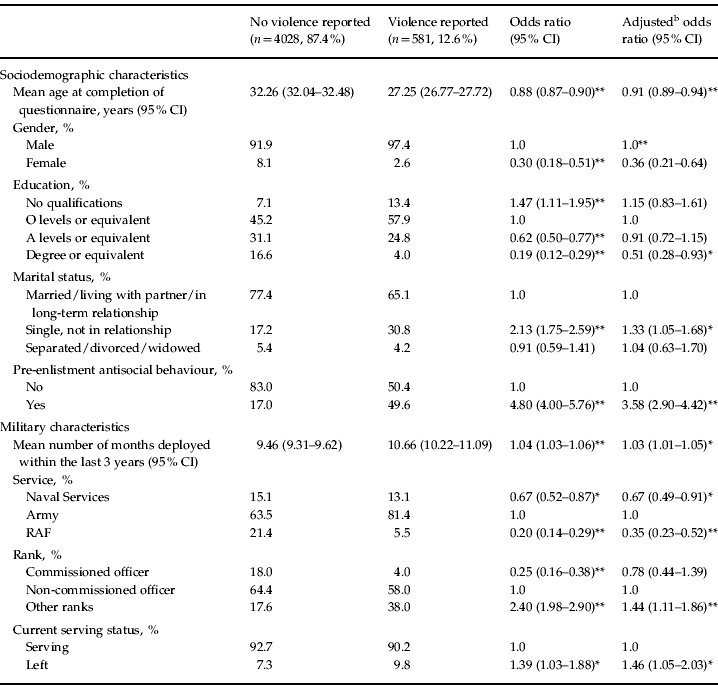
Violence on homecoming from deployment showed the strongest association with pre-enlistment antisocial behaviour. It was also associated with being male, of younger age, being single and of lower educational attainment (Table 1). Military characteristics associated with post-deployment violence included being in the Army, holding a non-officer rank, and having left service. Increased length of deployment within the last 3 years was also significantly associated with post-deployment violence.
Sociodemographic and military characteristics of respondents who did or did not report violence (either towards family or non-family members)Footnote a

CI, Confidence interval; O levels, Ordinary levels; A levels, Advanced levels; RAF, Royal Air Force.
Data are given as mean (95% CI) for continuous variables or as percentage for categorical variables.
a Data are weighted to allow for sample weights.
b Adjusted for age, gender, educational status, marital status, presence of pre-enlistment antisocial behaviour, service, rank, serving status and number of months deployed in the last 3 years.
* p<0.05, ** p<0.001.
Combat experiences associated with post-deployment violence
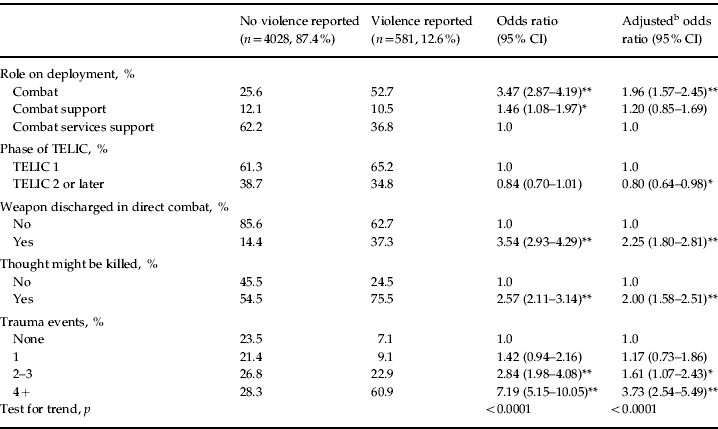
Violence on homecoming from deployment was strongly associated with having served in a combat (i.e. in direct combat with enemy) or combat support role (e.g. an engineer) on deployment compared with those in a combat service support role (e.g. medical or administrative services) (Table 2). Self-reported deployment experiences were also strongly associated with violence on homecoming: discharging a weapon in direct combat; thinking one might be killed; and experiencing two or more traumatic events. Following adjustment for sociodemographic characteristics, military factors and pre-enlistment antisocial behaviour, the variables of having a combat role, being deployed on phase 1 of TELIC rather than phase 2 or later, discharging a weapon in direct combat, thinking one might be killed and experiencing two or more traumatic events remained significantly associated with violence following homecoming.
Deployment experiences of respondents who did or did not report violence (either towards family or non-family members)Footnote a

CI, Confidence interval; TELIC, UK military code name for the conflict in Iraq.
Data are given as mean (95% CI) for continuous variables or as percentage for categorical variables.
a Data presented are weighted to allow for sample weights.
b Adjusted for age, gender, educational status, marital status, pre-enlistment antisocial behaviour, service, rank, serving status and number of months deployed in the last 3 years.
* p<0.05, ** p<0.001.
Mental health experiences associated with violence on homecoming
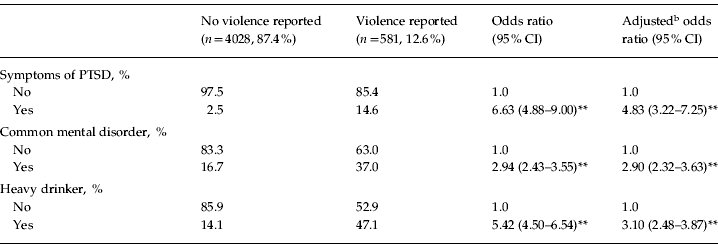
Symptoms of PTSD, reporting symptoms of a common mental health disorder and heavy drinking were all shown to be strongly associated with post-deployment violence (Table 3).
Health experiences of respondents who did or did not report violence (either towards family or non-family members)Footnote a

CI, Confidence interval; PTSD, post-traumatic stress disorder.
a Data presented are weighted to allow for sample weights.
b Adjusted for age, gender, educational status, marital status, pre-enlistment antisocial behaviour, service, rank, serving status and number of months deployed in the last 3 years.
** p<0.001.
Non-response to post-deployment violence questions
To assess the potential impact of non-response to the violence questions, we repeated all analyses first assigning responses endorsing violence to all those who did not respond to the violence questions, and second assigning responses which did not endorse violence as described in the Method section. The results were not notably altered by either analysis (data not shown).
Discussion
In this sample of members of the UK Armed Forces, the prevalence of violence on homecoming from deployment was 12.6%. It was associated with pre-enlistment antisocial behaviour and other sociodemographic factors that are associated with violence in the general population. It was also shown to be associated with fulfilling a combat role, discharging a weapon in combat, having thoughts that one might be killed and experiencing multiple traumatic events.
Prevalence of post-deployment violence in the military
In a recent study, researchers surveyed US troops 3 and 12 months following return from deployment in Iraq using a similar question to that used in our study about getting into a fight with someone and hitting the person (Thomas et al. Reference Thomas, Wilk, Riviere, McGurk, Castro and Hoge2010). They found that 17.7% reported interpersonal violence at 3 months and this remained roughly the same at 18.4% at 9 months later (Thomas et al. Reference Thomas, Wilk, Riviere, McGurk, Castro and Hoge2010). Considering their use of a similar self-report measure of physical violence over a similar time-frame, the prevalence of violence post-deployment in our study appears low in comparison. A number of factors may make an impact on the level of reported violence among US troops such as the increased average length of deployment (1 year for the US military compared with 6 months in the UK military), an increased proportion of troops experiencing combat exposure or more traumatic combat experiences (Fear et al. Reference Fear, Jones, Murphy, Hull, Iversen, Coker, Machell, Sundin, Woodhead, Jones, Greenberg, Landau, Dandeker, Rona, Hotopf and Wessely2010).
It is of note that the average age of our study population was 32 years (37 years for officers and 32 years for other ranks), which is slightly older than expected for the average age of regular personnel in the UK military (37 years for officers and 29 years for other ranks) (DASA, 2003). It should therefore be acknowledged that, given that violent behaviour is associated with younger age, this age difference may lead to a slight underestimation of the true prevalence of homecoming violence in UK military personnel.
Sociodemographic and pre-military factors
In this study the demographic factors associated with violence on homecoming were the same as those known to be associated with antisocial behaviour in the general population. Pre-enlistment antisocial behaviour was found to have the strongest association with post-deployment violence indicating that, from a life-course perspective, those already demonstrating antisocial behaviour prior to joining the military are more likely to continue on this trajectory. We have previously shown that self-reported pre-enlistment antisocial behaviour is associated with later negative behavioural outcomes in military personnel, including aggression, alcohol abuse and dangerous driving (MacManus et al. Reference MacManus, Dean, Iversen, Hull, Jones, Fahy, Wessely and Fear2011). This is an important potential source of confounding, as it is well known that recruitment to the military in the UK is not random. Historically, many recruits have come from socially disadvantaged inner-city areas where rates of social problems, including crime, are high (Johnstone, Reference Johnstone1978). Some studies from the USA have demonstrated that pre-adult antisocial behaviour predicted antisocial behaviour in the military as well as or better than combat trauma or wartime experiences (Resnick et al. Reference Resnick, Foy, Donahoe and Miller1989; Fontana & Rosenheck, Reference Fontana and Rosenheck2005). In this study we show that even though pre-enlistment antisocial behaviour had a stronger association with violence on homecoming than all other variables, when we controlled for the confounding effect of pre-enlistment antisocial behaviour, combat exposure and traumatic experiences during deployment were still strongly associated with violence following deployment.
Military factors
Violence on homecoming from deployment was higher for Army personnel. It is noteworthy that the reporting of violence on homecoming from deployment was more common in those who had left the military compared with those still in service. Woodhead et al. (Reference Woodhead, Rona, Iversen, MacManus, Hotopf, Dean, McManus, Meltzer, Brugha, Jenkins, Wessely and Fear2011) also recently reported that post-National Service veterans (largely of the Cold War era) report more violent behaviours than non-veteran males of the same age. On first reading this may not be surprising, since there has been considerable recent media attention regarding the problems faced by ex-service personnel around reintegration back into ‘civvy’ life, such as mental health problems, substance misuse, unemployment, relationship problems and violent crime (King, Reference King2009; James, Reference James2010). However, the questionnaire used in the present study asked participants to report on violence in the immediate post-deployment period, i.e. in the weeks following homecoming, not after leaving the services. The time lag between returning from deployment until completing the questionnaire could vary from 1 month to a maximum of 2 years. There are, therefore, several interpretations of our finding. First, if the observation is accurate, then it could be the result of confounding. Violence on homecoming from deployment and leaving the services could both be associated with a common factor, of which the most likely candidates are pre-enlistment factors such as social adversity. Second, it may be the result of reverse causality, i.e. that violence on homecoming from deployment led to premature leaving (including being compulsorily discharged from the military). Third, the observed results may be the result of recall bias. If ex-service personnel are going through a difficult transition back into civilian life after leaving the armed forces, experiencing more social adversity and engaging in more violent behaviour, they may be more inclined to report violence in the immediate post-deployment period too. Finally, a different recall bias may be operating if those who are still serving perceive it as potentially stigmatizing or detrimental to their career to admit to violent behaviour (even though the study was conducted independently of the military). However, we did control for serving status, i.e. whether personnel were still serving or had left the military, in all the analyses.
Combat experiences
Serving in a combat role during deployment, discharging a weapon in direct combat, experiencing multiple traumatic events and having thoughts that one might be killed were strongly associated with violence on homecoming from deployment. Studies of US Vietnam and Gulf war veterans have shown an association between violent and criminal behaviour in military personnel and combat experience (Yesavage, Reference Yesavage1983; Yager et al. Reference Yager, Laufer and Gallops1984; Black et al. Reference Black, Carney, Peloso, Woolson, Letuchy and Doebbeling2005; Killgore et al. Reference Killgore, Cotting, Thomas, Cox, McGurk, Vo, Castro and Hoge2008). Booth-Kewley et al. (Reference Booth-Kewley, Larson, Highfill-McRoy, Garland and Gaskin2010b ) published a recent paper which aimed to examine factors associated with antisocial behaviour in combat veterans using a sample of Marines enlisted in the US armed forces who had been deployed to Iraq or Afghanistan between 2002 and 2007. They found that combat exposure was positively and significantly associated with antisocial behaviour after adjustment for a range of potential confounders. Killgore et al. (Reference Killgore, Cotting, Thomas, Cox, McGurk, Vo, Castro and Hoge2008) surveyed 1252 Operation Iraqi Freedom veterans regarding different combat experiences immediately on return from deployment and again 3 months later. They controlled for the confounding effects of age, gender and other relevant sociodemographic factors. They found that exposure to combat and high levels of trauma were predictive of greater risk-taking propensity after homecoming. They also found that these combat experiences were predictive of actual risk-related behaviours in the preceding month, including greater alcohol use and increased verbal and physical aggression towards others. This is consistent with the idea that some combatants may develop an ‘invincibility complex’. Anecdotally, military personnel have come back from war with feelings of invincibility. These may be evidenced through increased risk taking, binge drinking, drug use, getting into fights and other antisocial behaviours (Vaughan, Reference Vaughan2006). However, more research is required to help determine whether this is mainly a product of their combat experiences or pre-existing characteristics of the individual.
Armed forces personnel are of course trained to inflict violence when necessary, albeit in a controlled, disciplined fashion. These individuals go through specific training to develop the necessary skills and strengths required for combat, such as ‘targeted aggression’. The results from this study emphasize the association of combat and combat trauma with aggressive behaviour in military personnel post-deployment and suggest that these experiences have an association over and above that of previous aggressive behaviour or socio-economic factors. One problem, however, is that combat is not random. Those in combat roles are invariably younger, for example. It is also possible, and indeed probable, that those in combat roles are more likely to be risk takers, and perhaps have a greater propensity for violence. Educational levels may also differ. In the UK, regiments that are traditionally and for good reason associated with an increased aggressiveness, such as the Parachute Regiment, and who are as a result more often deployed on dangerous combat missions, are also more likely to recruit from areas of social disadvantage and where the recruits are likely to have lower educational attainment. Indeed, we do know that those with a history of pre-enlistment antisocial behaviour are more likely to perform in a combat role on deployment (MacManus et al. Reference MacManus, Dean, Iversen, Hull, Jones, Fahy, Wessely and Fear2011) and whether this is through self-selection or being selected by their seniors/trainers we cannot comment. Some confounders, such as age, can be dealt with statistically, but others, such as temperament, risk taking and propensity to violence, are less amenable to analysis. The possibility that residual confounding accounts for the association between combat exposure and offending remains a real one.
Symptoms of PTSD, common mental disorders and heavy alcohol use
We also found that symptoms of PTSD and common mental disorder were strongly associated with post-deployment violence even when all other factors were controlled for. Whilst it has been suggested on one hand that combat exposure is associated with aggression partly due to the reinforcement and modelling of violence in the military (Gimbel & Booth, Reference Gimbel and Booth1994), several studies have indicated that combat exposure is associated with aggression primarily through its relationship with PTSD symptoms (Byrne & Riggs, Reference Byrne and Riggs1996, Orcutt et al. Reference Orcutt, King and King2003). A recent meta-analysis revealed a strong relationship between PTSD and anger and hostility among trauma-exposed adults (Orth & Wieland, Reference Orth and Wieland2006) and combat exposure showed a stronger association with PTSD compared with other traumatic events. This suggested that PTSD is an important mediator in the association between combat (trauma) and antisocial behaviour. It has been consistently shown that male veterans with PTSD report higher rates of violence and aggressive behaviour than those without PTSD (Kulka et al. Reference Kulka, Schlenger, Fairbank, Hough, Jordan, Marmar and Weiss1990; Lasko et al. Reference Lasko, Gurvits, Kuhne, Orr and Pitman1994; Beckham et al. Reference Beckham, Feldman, Kirby, Hertzberg and Moore1997; Taft et al. Reference Taft, Vogt, Marshall, Panuzio and Niles2007b ). In our study, 14.6% of those who reported violence on homecoming also reported symptoms of PTSD in the month prior to questionnaire completion; this is in comparison with 2.5% of those who did not report violence, suggesting almost a five times increased risk of violence in those with PTSD symptoms compared with those without.
So it appears that there is a relationship between PTSD and violence among military personnel. However, this link is not straightforward. The concept of PTSD is complex and studies have found different aspects of the symptomatology to be specifically related to post-deployment violence, such as hyperarousal (McFall et al. Reference McFall, Fontana, Raskind and Rosenheck1999; Taft et al. Reference Taft, Vogt, Marshall, Panuzio and Niles2007b ), avoidance/numbing symptoms (McFall et al. Reference McFall, Fontana, Raskind and Rosenheck1999), or co-morbid dysphoria (Taft et al. Reference Taft, Vogt, Marshall, Panuzio and Niles2007b ). Elbogen et al. (Reference Elbogen, Wagner, Fuller, Calhoun, Kinneer and Beckham2010) explored the correlates of anger and hostility in Iraq and Afghanistan war veterans. They found that aggressive impulses or urges, difficulty managing anger and perceived problems controlling violent behaviour were each significantly associated with PTSD hyperarousal symptoms. Other PTSD symptoms were less strongly and less consistently linked to anger and hostility (Elbogen et al. Reference Elbogen, Wagner, Fuller, Calhoun, Kinneer and Beckham2010).
Fear et al. (Reference Fear, Jones, Murphy, Hull, Iversen, Coker, Machell, Sundin, Woodhead, Jones, Greenberg, Landau, Dandeker, Rona, Hotopf and Wessely2010) recently showed that the prevalence of PTSD in UK military personnel who had been deployed to Iraq or Afghanistan (since 2003) was low, only 4.0%. This suggests that the amount of violence in the UK military population which could be attributable to PTSD (if causality were to be assumed) would be low. Of course, given the cross-sectional nature of the data collection, we cannot assume causality nor can we dismiss the possibility of reverse causality, i.e. the risk of PTSD symptoms following violent behaviour. The authors are unaware of any studies to date that address the question of causality. In order to do this, prospective data are required to establish the temporal sequence of the combat trauma, development of PTSD and subsequent violent behaviour. All of the studies to date have collected data cross-sectionally and cannot therefore address this issue.
In contrast to the low rates of PTSD, Fear et al. (Reference Fear, Jones, Murphy, Hull, Iversen, Coker, Machell, Sundin, Woodhead, Jones, Greenberg, Landau, Dandeker, Rona, Hotopf and Wessely2010) found that 19.7% of UK military personnel who had been deployed in Iraq or Afghanistan reported symptoms of common mental disorders. In our study, 37% of those who reported violence reported symptoms of common mental disorder in comparison with 16.7% of those who did not report violence (odds ratio 2.90). Given the estimated prevalence of symptoms of common mental disorder in the deployed UK military personnel, such symptoms may be important to consider in the assessment of post-deployment violence. Booth-Kewley et al. (Reference Booth-Kewley, Highfill-McRoy, Larson and Garland2010a ) recently published findings from a longitudinal study of US Marines which found that one of the strongest predictors of antisocial behaviour by military personnel was a psychiatric diagnosis and the relationship was even stronger if that diagnosis was given post-combat.
Similarly, we have demonstrated a strong association between heavy alcohol consumption and post-deployment violence. Almost half of those who reported violence also reported heavy alcohol use in the last year compared with 14.1% of those who did not report violence. Fear et al. (Reference Fear, Iversen, Meltzer, Workman, Hull, Greenberg, Barker, Browne, Earnshaw and Horn2007) previously showed that excessive alcohol consumption is more common in the UK armed forces than in the general population. We know from a large body of research in non-military populations that alcohol misuse is an important risk factor for violence (Swartz et al. Reference Swartz, Swanson, Hiday, Borum, Wagner and Burns1998). This has been shown to be the result of a rather complex interaction of biochemical, psychological, situational and cultural factors. Recent research has shown that risk-related behaviours including both heavier alcohol use and increased verbal and physical aggression towards others were associated with previous combat experience (Killgore et al. Reference Killgore, Cotting, Thomas, Cox, McGurk, Vo, Castro and Hoge2008). This suggests that the impact of military service on subsequent aggression and violence can be mediated indirectly via increased alcohol consumption but that it can also have a direct effect through combat exposure.
Strengths and limitations
The major strength of this study is that it utilized data from a large randomly selected sample of UK military personnel. It is the only study of its kind in the UK and the comprehensive range of information collected enables the exploration of a wide range of factors of interest to the study of aggression and violence in this group of individuals.
This study is based on data obtained from a self-report measure of violence, which introduces the potential for misclassification error. Similarly, the self-report measure of pre-enlistment antisocial behaviour is prone to recall bias. However, while all methods of violence measurement have their limitations with regard to measurement error, self-report has been shown to capture a greater prevalence of violence than other methods (Lidz et al. Reference Lidz, Mulvey and Gardner1993). An objective measure such as violent offending records would have been a useful additional outcome measure. However, offending records exclude violence that did not come to the attention of the police and therefore these measures may underestimate the problem. Similarly, offending records may not reflect childhood or adolescent antisocial behaviour. Therefore, while recognizing their limitations, self-report measures are useful and informative estimates of both post-deployment violence and pre-enlistment antisocial behaviour in this study. The violence outcome measure was also limited, as it did not record details about the violence other than whether it occurred or not. It did not record the level of severity of the violence, the context of the violence, or whether or not it was associated with alcohol intoxication.
The response rate of the military study was 61% and factors associated with non-response were being male and of younger age. Both of these factors are known to be associated with aggression and violence, which suggests that the prevalence of violence identified in this study may be an underestimation of the true prevalence in the reference population. The number of participants who did not answer the violence questions (n=319, 6.5%) is also a potential source of bias. However, we repeated our analyses to examine the possible extent of the bias and there was no notable change to the results.
Finally, cross-sectional data have a number of inherent limitations and we are unable to draw any causal inferences from our analyses, particularly where reverse causality cannot be excluded, as in the case of mental health status and post-deployment violence. Prospective data from the ongoing cohort study will enable these issues to be resolved.
Conclusions
Self-reported post-deployment violence is prevalent in the UK military. The findings suggest that it is a phenomenon that is strongly associated with pre-military antisocial behaviour and is also associated with a variety of sociodemographic and military variables. However, even when adjustment is made for these confounders, military personnel's experiences of combat and traumatic events and the perception of being at risk of death while on deployment still increase their risk of violent behaviour post-deployment. It is important to note that we cannot at this stage comment on what impact this increased risk of violence among military personnel returned from deployment has on society. What type of violence does this reflect: low-level violence and fighting amongst young highly charged men that do not come to the attention of the police, or more serious interpersonal or sexual violence? Further research is required to further explore this important issue.
We have also shown that post-deployment experience of symptoms of PTSD, common mental disorder and alcohol misuse are associated with increased post-deployment violence. This multi-factorial model must be recognized when professionals are assessing personnel following deployment with regard to both risk of violence and treatment needs. The same factors are likely to apply whether that individual is in a military environment or has left the services and is seeking help from the National Health Service (NHS) in their local community or has ended up in the criminal justice system.
Acknowledgements
The UK Ministry of Defence funded this project. The authors' work was independent of the UK Ministry of Defence, which had no role in the analysis, interpretation or decision to submit this paper. We disclosed the paper to the Ministry of Defence at the point we submitted it for publication.
Declaration of Interest
S. W. is Honorary Consultant Advisor in Psychiatry to the British Army, a trustee of Combat Stress and partially funded by the South London and Maudsley NHS Foundation Trust/Institute of Psychiatry/National Institute of Health Research Biomedical Research Centre.