Introduction
Water shortage and land degradation pose challenges for land users in arid, semi-arid and even subhumid areas, and make the land in these areas prone to desertification. Land and water degradation have become a global concern and are expected to intensify in dry areas of resource-poor countries as a result of anthropogenic interventions and increasing extreme weather events due to climate changeReference Qadir, Noble and Cartres1. Numerous assessments have shown that in many dryland areas the functionality of land resources in terms of providing goods and services, such as food, forage, fuel and fiber, is significantly decliningReference Bossio, Critchley, Geheb, van Lynden, Mati and Molden2. Simultaneously, the pressure on marginal land with unfavorable agricultural conditions in terms of steep slopes, poor soils, unreliable precipitation and remoteness is increasing in dryland areas under population pressure. Climate change, combined with increased demands for land and land products, add further urgency to the need for effective use of marginal land resources. Intensification and expansion of land use in marginal areas often have a negative impact, in particular on the water balance in the fields. A deteriorated water balance is characterized by increased water losses through runoff, drainage and evaporation, while plant-available water is reduced, leading to less transpiration and less primary production. This leaves the soil exposed, and a fewer crop residues return into the soil. Physical soil properties such as infiltration capacity and water-holding capacity start to deteriorate, triggering a negative spiral toward less and less biomass production and, eventually, desertificationReference Stroosnijder3. Especially eroded stony slopes are at risk of never reverting back to sufficient vegetal production, even if protected for a long time, as examples from Spain have shownReference García-Ruiz4.
In order to effectively mitigate land degradation and desertification, sustainable land management (SLM) in drylands must first and foremost tackle water scarcity. The focus of SLM options should therefore be on improving infiltration and reducing soil moisture losses. The amount of water lost through evaporation in dryland areas is generally underestimatedReference Njeru5. Thus, SLM aims to conserve water as much as it seeks to conserve soil. Research in dryland areas also suggests that nutrients are even more critical to production than waterReference Stroosnijder, Beukes, de Villeirs, Mkize, Sally and van Rensburg6–Reference Molden, Oweis, Steduto, Bindraban, Hanjra and Kijne8. Responding to these insights, conservation agriculture—that is, the combination of crop rotation, minimal soil disturbance and soil cover maintenance—is a promising concept and an SLM practice is now widely recognized and steadily spreading throughout the worldReference Derpsch, Goddard, Zoebisch, Gan, Ellis, Watson and Sombatpanit9. But conservation agriculture adoption in drylands faces critical challenges linked to water scarcity and drought hazard, low biomass production, and acute competition between conflicting uses including soil cover, animal fodder, cooking/heating fuel and othersReference Rockström, Kaumbutho, Mwalley, Nzabi, Temesgen, Mawenya, Barron, Mutua and Damgaard-Larsen7, Reference Kassam and Friedrich10.
The EU-funded DESIRE research project (www.desire-project.eu) sought strategies to combat desertification in 17 study sites around the Mediterranean and in other regions of the world with similar climates. All sites went through a participatory process to choose the SLM option considered the most promising in their specific natural and human environment for subsequent test implementationReference Schwilch, Bachmann and Liniger11, Reference Schwilch, Bachmann and de Graaff12. The Moroccan DESIRE study site was located in the commune of Sehoul, about 30 km south-east of the national capital of Rabat, in an area where desertification poses a threat to marginal and often stony slopes. The use of marginal land by the local population of Sehoul became necessary due to increased poverty, and because the best stretches of land had been occupied by outsiders—initially, during Morocco's colonization, by Frenchmen, and later by new owners from the cities. Before that, marginal land had been used only for grazing. The new state ownership of the forest since 1917, with restrictions on forest use for grazing and the use of flat and high-potential areas for crop production, led to an increase of the pressure on the remaining grazing areas.
In North Africa, conservation agriculture practices have been promoted particularly in Morocco and Tunisia. By 2009 they covered no more than 4000 and 6000 ha, respectivelyReference Derpsch, Friedrich, Kassam and Li13. Nonetheless, promising experiences with no-tillage practices in some areas of Morocco have motivated the Moroccan government to promote conservation agriculture throughout the country from the mid-1990s onwardReference Mrabet, Goddart, Zoebisch, Gan, Ellis, Watson and Sombatpanit14. Long-term experiments have shown that conservation agriculture improves soil properties, that it out-yields conventional agriculture, especially in dry years, and that it is highly profitable, because it usually saves costs due to reduced use of machinery and lower operating expenses, while at the same time increasing crop performanceReference Mrabet, Goddart, Zoebisch, Gan, Ellis, Watson and Sombatpanit14. In light of its environmental advantages, it is thus viewed as an appropriate means to combat desertification as well as enhance climate change adaptation.
Recognizing that livestock are an essential component of Moroccan semi-arid rainfed agricultural systems, Moroccan researchers have suggested a 3-year rotation of wheat/barley, forage and fallow, which simultaneously satisfies needs regarding water storage, wheat/barley yields and soil fertilityReference Mrabet, Goddart, Zoebisch, Gan, Ellis, Watson and Sombatpanit14. However, the success of conservation agriculture depends on the combination of crop rotation, minimal soil disturbance and soil cover. Crop rotation alone, as it was observed in some parts of Sehoul, fails to maintain soil organic matter, which continues to decline due to continuing conventional tillageReference Ibno Namr and Mrabet15. Prior to the present study, conservation agriculture in Morocco had not yet been tested on sloping and marginal land, where its application was likely to be more difficult due to steepness and deteriorated soil conditions. The present study aimed to narrow this gap and contribute to the ongoing discussion about these issues.
This paper presents some insights into the potential of conservation agriculture applied on marginal and stony slopes in Sehoul. It evaluates its applicability and tests whether better soil cover and minimized soil disturbance specifically lead to increased production and an improved water balance. On-farm trial results are assessed and discussed based on stakeholders’ criteria. These were defined during the participatory process of selecting an appropriate SLM option, and integrate the ecological, economic and socio-cultural dimensions of sustainability.
Materials and Methods
Study site
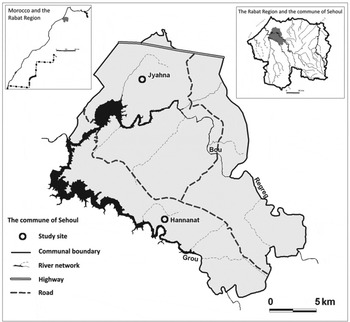
The research was conducted in the commune of Sehoul in the Rabat-Salé-Zenmour-Zaer Region south-east of Rabat, at two locations known as Hannanat and Jyahna (Fig. 1). The Sehoul plateau with its incised valleys, which is part of the Palaeozoic Atlantic Meseta, is located between the Mamora forest in the north and the Grou valley in the south-west. The area has a semi-arid Mediterranean climate, with an annual average rainfall of 400–500 mm, mainly falling during late autumn, winter and early spring.
Study site locations in Hannanat and Jyahna, near Sehoul, Morocco.

The original land uses were open cork oak forest on the leached soils of the plateau, and conifers (Tetraclinis articulate) associated with olea on the slopes; the latter were used for charcoal supply and grazing. Grazing land was largely converted to crop production in the 1930s, in the course of colonization. French expatriates, followed by Moroccan city dwellers, began to occupy the better and flatter areas for commercial cereal production, while the traditionally agro-pastoralist local population was forced to give up cultivation of the good-quality land on gentle slopes and cultivate the steeper slopes on its margins, instead. Population growth and contracts between local farmers and investors from the cities led to an increase in the number of sheep and goats, which added pressure on the natural resources of cultivated land as well as forest and shrublandReference Laouina, Aderghal, Al Karkouri, Chaker, Machmachi, Machouri and Sfa16.
At present, cropping is dominated by rainfed winter cereals, with minor areas of spring crops such as corn and beans. Fallow periods are diminishing. Eighty-two percent of the land users are small-scale farmers (i.e., farmers with less than 10 ha; they use 43% of the land in the area). They mostly use animal traction for ploughing on slopes. Fertilizer application is rare, and crop residues and grains are used as feed. Free grazing—which plays a role in fertilizing the land—disappeared progressively with the increasing use of fences, the spread of irrigation and permanent occupation of land by city dwellers. Many valley bottoms that had been used for summer grazing were recently lost to water storage dams, further increasing the pressure on the remaining marginal slopes. Intensification of agriculture based on fruit plantations, modern breeding and irrigation of vegetables are options reserved for large-scale farmers with sufficient financial resources.
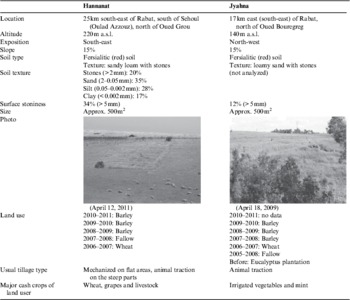
In a participatory process, local stakeholders and researchers jointly identified the most promising SLM technologies to address SLM needs in the area, and selected several of them for subsequent test implementation (see process description below for more details). Two farmers—one in Hannanat and one in Jyahna—agreed to have tests carried out on their fields. An action research approach was chosen to design the experimental setup. This resulted in a number of important constraints. For example, in order to minimize economic risks, experiments were conducted only in marginal areas. These were characterized by steep slopes, high stone contents and an advanced degradation status. However, given that such marginal slopes are widespread in the area, the experiment can still be considered representative; moreover, it allowed testing the efficiency of the chosen SLM measures on highly degraded land. For details regarding the test plots analyzed and presented in this paper, see Table 1.
Characteristics of the two study sites near Sehoul, Morocco.

Treatments and measurements
We tested two components of the conservation agriculture technology: minimal soil disturbance (no-tillage and minimum tillage) and increased soil cover (enclosure).
1. Minimal soil disturbance consisted of direct seeding with no-tillage and minimum tillage. The aims were to enhance soil organic matter, soil structure, and soil fauna and flora. The resulting increased porosity is expected to improve the soil's capacity to absorb and retain water for enhanced plant growth. Special machinery is usually required for direct seeding. We used a special animal traction seeder provided by the National Agronomic Research Institute (INRA) of Settat, which had been constructed specifically for demonstration purposes. Seeding was preceded by herbicide application. Minimum tillage was carried out using a traditional plough. The control situation for this component was conventional ploughing.
2. Increased soil cover consisted of fencing to prevent grazing (area enclosure). The aim was to keep a high level of vegetation cover throughout the dry season and to reduce the erosive effects of the first rains in autumn. Leaving minimum soil cover in the dry season is generally expected to increase infiltration and reduce runoff and evaporation during the next rainy season. This applies especially in cases where the farmer decides to leave the field fallow during the cropping season. Soil properties may improve as a result of the additional organic matter, improved infiltration and water conservation. Despite these expected benefits, farmers usually prefer to plough or burn residues to avoid weed propagation. The control situation for this component was open grazing of residues.
The setup of the treatments was challenging due to various factors, including bureaucratic and other hurdles in obtaining support from experts (e.g., from national research institutions or agricultural services), time constraints, changing local researchers and the reluctance of one of the farmers to collaborate. The relationship with this farmer remained tense, as he feared to lose ownership of the land, presumed cash flows from the international experts and generally mistrusted researchers. All these constraints led to a minimized setup and limited replication of treatments and measurements (Table 2).
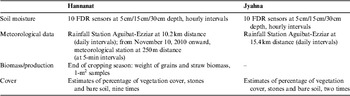
Description of plots and dynamic uses of the land (2009–2011) at the two study sites near Sehoul, Morocco.

1 Dry season: May–November.
2 Cropping season: December–April.
3 Farmer refused further cooperation.
The three and four treatments at the two sites, respectively, were monitored using a total of 20 soil water measurement points at three soil depths (5, 15 and 30 cm). The monitoring points were distributed randomly, but mostly in the middle of the treatment plot. Soil moisture was recorded at an hourly interval. We used the low-budget, pre-calibrated EC-5 frequency-domain reflectometer (FDR) sensors of Decagon Devices (Pullman, WA). These sensors measure the volumetric water content of the soil by measuring the dielectric constant of the soil, which is a sensitive measure of water content. The installation of these sensors was complicated by the high stone content of the soil and the related air gaps. However, evidence found in the literature indicates that measurements of the dielectric constant in a coarse textured soil with a high stone content hardly deviate from measurements in a mineral soilReference Drungil, Abt and Gish17. Daily precipitation data were obtained from a nearby (10 km) rainfall station until a new meteorological station was installed at the Hannanat site in November 2010. Cover estimates were made at irregular time intervals, and production was assessed based on yield weighing. Details of all parameters measured are presented in Table 3.
Measurements at the two study sites near Sehoul, Morocco.

Participatory process
The on-farm test implementation was embedded in a process of participatory identification, assessment and decision-making. The overall methodology applied in all DESIRE study sites consisted of three parts: initial joint identification of problems and existing SLM solutions in a first stakeholder workshop (Part I); evaluation and documentation of the identified locally available SLM technologies (Part II); participatory decision support in a second stakeholder workshop for the selection of potential SLM options for subsequent test implementation (Part III). The overall methodology and a thorough analysis of experiences from all DESIRE study sites are presented in Schwilch et al.Reference Schwilch, Bachmann and Liniger11, Reference Schwilch, Bachmann and de Graaff12, Reference Schwilch, Bachmann, Valente, Coelho, Moreira, Laouina, Chaker, Aderghal, Santos and Reed18. The process is solution-oriented from beginning to end, emphasizing SLM rather than land degradation and combining a local participatory process with global experience. Feedbacks from users and positive outcomes have confirmed the methodology's capacity to successfully guide decision-focused participatory processesReference Schwilch, Bachmann and de Graaff12.
After the initial stakeholder workshop (Part I) in Sehoul, a number of SLM technologies were selected for further assessment (Part II) using the WOCAT questionnaires (www.wocat.net). The technologies assessed in this way included fruit tree plantations along the contours, separated by strips of legumes and cereals; fodder cultivation and pasture improvement; and gully rehabilitation with eucalyptus plantations and check dams.
Based on these evaluations, the participants of the second stakeholder workshop (Part III) selected the most promising options for local test implementation. Land users generally preferred options that would not drastically change their current practices of cereal cropping and grazing. The final choice, therefore, included SLM technologies to improve grazing and cropland, namely plantation of fodder shrubs (Atriplex halimus) for gully rehabilitation on grazing slopes, permanent grass strips between annual cropping, and a combination of crop residues and minimum tillageReference Laouina, Chaker, Aderghal, Al Karkouri, Machouri and Nafaa19. The field experimentation of the latter is the example discussed in this paper.
Prior to the DESIRE project, the Sehoul region had benefited from a Development Project for Rainfed Agriculture (Projet de Mise en Valeur des Terres en Bour—PMVB). This had given rise to somewhat excessive expectations among farmers toward the government or other programs, although the technologies suggested by the PMVB were not applied. As a result, it was fairly difficult to find land users who were both willing and interested to collaborate with a research project that did not offer any clear prospective economic benefits.
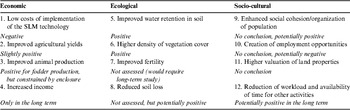
The criteria for selecting the most promising technology as identified by the stakeholders during the second workshop are presented in Table 4. They served as a basis for evaluating the success of the tested SLM technology. Based on the scope of this paper, one of the ecological criteria—namely soil water retention—is considered more closely than the others.
Criteria (numbered) for sustainable land management (SLM) technology selection as identified by stakeholders in Sehoul, Morocco. Italicized entries present the qualitative outcome of the field trials (see the Results section).

Data gathered during the participatory process consisted of workshop reportsReference Laouina, Chaker, Aderghal, Al Karkouri, Machouri and Nafaa19, Reference Laouina, Chaker, Nafaa, Al Karkouri, Aderghal, Antari and Nouria20; semi-structured interviews with ten stakeholders conducted in order to analyze the overall three-part methodology (as described in Schwilch et al.Reference Schwilch, Bachmann, Valente, Coelho, Moreira, Laouina, Chaker, Aderghal, Santos and Reed18); numerous conversations with farmers, technicians and researchers during field visits and meetings at administrative offices; participatory observation during stakeholder workshops and field trials; DESIRE project documents (posters at meetings, annual reports, etc.); and WOCAT questionnaires filled in after trial implementation.
Data analyses
Analysis was performed on two types of data:
1. Data from on-farm trials: soil moisture, precipitation, cover, production, etc. (for details see section ‘Treatments and measurements’, above);
2. Supporting data collected during the participatory process: workshop reports, documentation of SLM technologies and approaches, participatory observations, and collaboration with farmers and institutions (for details see section ‘Participatory process’, above)
Analysis was constrained by the above-mentioned limitations in the setup and in replication. However, replications over time during the running time of the experiments, that is, from May 2009 until September 2011, allowed identifying patterns of soil wetting and drying under different treatments.
Seasonal averages of the soil moisture content (SMC) (θ) per depth and treatment as well as the total water in millimeters for the top 40 cm of soil were calculated in order to compare the various dry-season and cropping-season treatments. To analyze the evolution of soil moisture in more detail, two-monthly graphs were produced for autumn (end of dry season, October–December), winter (early cropping season, January–February) and spring (late cropping season, March–April).
The increase in water content from the onset of rain and the decrease of water content after the peak were calculated for each rainfall event over the whole observation period. Four values per event for θ min (before rainfall), θ max (maximum soil moisture after rainfall), θ end24 (24 h after the onset of rain) and θ end48 (48 h after the onset of rain) were manually extracted from the data files. The timing of the θ end readings was determined based on visual data interpretation at the point where the decrease of soil moisture after rain had diminished to almost zero (after 48 h). These soil moisture changes during and after rainfall events were statistically analyzed using the R open-source software package (www.r-project.org/). One-way independent ANOVAs were used to test the significance of the difference between treatments in soil moisture changes during and after rainfall (with a confidence value of 0.05).
Content analysis was used for qualitative analysis of the data on the participatory process. Most of the results from the workshop reports and the semi-structured interviews were presented in Schwilch et al.Reference Schwilch, Bachmann, Valente, Coelho, Moreira, Laouina, Chaker, Aderghal, Santos and Reed18. Some of them are used here and complemented with other sources as listed above.
The analysis of the field trial results presented in the ‘Results’ section was based on the selection criteria as identified by the stakeholders (see Table 4). This had the advantage that stakeholder opinions were taken into account throughout the monitoring and analysis phase, and that all three dimensions of sustainability were considered for evaluation.
Results
Process of identification, appraisal and selection of SLM options
The main problems of degradation as identified by the local stakeholders during the first workshop included the followingReference Laouina, Chaker, Nafaa, Al Karkouri, Aderghal, Antari and Nouria20:
• Delayed precipitation in autumn and early dryness in spring led to a decrease in water availability, a shorter growing season, and a reduction of grain yields and vegetation cover.
• Intense and heavy rainfall in autumn, at a time when the soil is completely bare, caused severe soil erosion.
• Overexploitation of wells and increased runoff on the fields caused the water table to decline.
• The vegetation cover was reduced and degraded inside the forest as well, and cork oak degraded beyond regeneration.
The participatory process revealed that farmers in Sehoul are primarily interested in animal husbandry. For this reason, for example, crop residues compete with fodder, and cover management is only an option in years with sufficient biomass production; otherwise any plant biomass is completely used up for the animals. The farmers also perceive more ploughing, especially repeated ploughing before seeding, resulting in higher production. Thus, their opinion was initially in contradiction to the philosophy of minimum tillage.
Alternatives include producing vegetables or fruit for the market. Vegetables require irrigation, better soil and less steep land, and fruit trees such as olives or figs demand high initial investment and fairly good soils. Both alternatives require fencing to avoid grazing. Although the nearby city market of Rabat-Salé provides scope for such investments, at the same time, farmers are becoming increasingly detached from their land: they see their future in the city rather than in agriculture. This renders the promotion of SLM under current land use virtually impossible. Farmers close to Rabat hope to sell their land to rich urban inhabitants. Only wealthier farmers with access to water and capital might consider using their land for high-value horticultural crops under drip irrigation.
Participatory observation and numerous conversations with farmers and local researchers revealed another precarious development in this regard: although many rural children receive a school education, they lag behind their age-mates from the city regarding professional education and, therefore, have minimal chances in the urban job market. Still, the city is where they are drawn to by the prospects of modern life and welfare. At the same time, they are no longer engaged on their parents’ farms and lose their agricultural background and skills while ‘oscillating on their mopeds’ between the city and their home farms.
Field testing of the SLM technology
Application of direct seeder
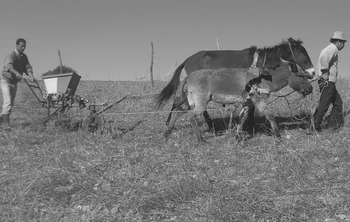
In May 2009, when the experiments started, the fields at both sites were briefly grazed, allowing the sheep to eat the grains and part of the residues, but still leaving a full soil cover and stubbles about 50 cm in height. In December, prior to the onset of the first rains—which were delayed in 2009—the remaining vegetation was treated with herbicides. A mixture of half a liter of the herbicide Roundup with 0.25 kg of ammonium sulfate and 25 l of water was applied with a backpack sprayer on 250 m2. Six days before herbicide application there was a rainfall of 19 mm, while 9 days later 15 mm were recorded (data from Aguibat-Ezziar meteo station, 10 km away). Barley seeds were then sown together with an NP-fertilizer (nitrogen 18%, phosphor 46%) 5 days after the herbicide application, using an animal-drawn no-tillage plough (Fig. 2).
Seeding barley using an animal-drawn direct seeder in Sehoul, Morocco (photo by Mohamed Sfa).

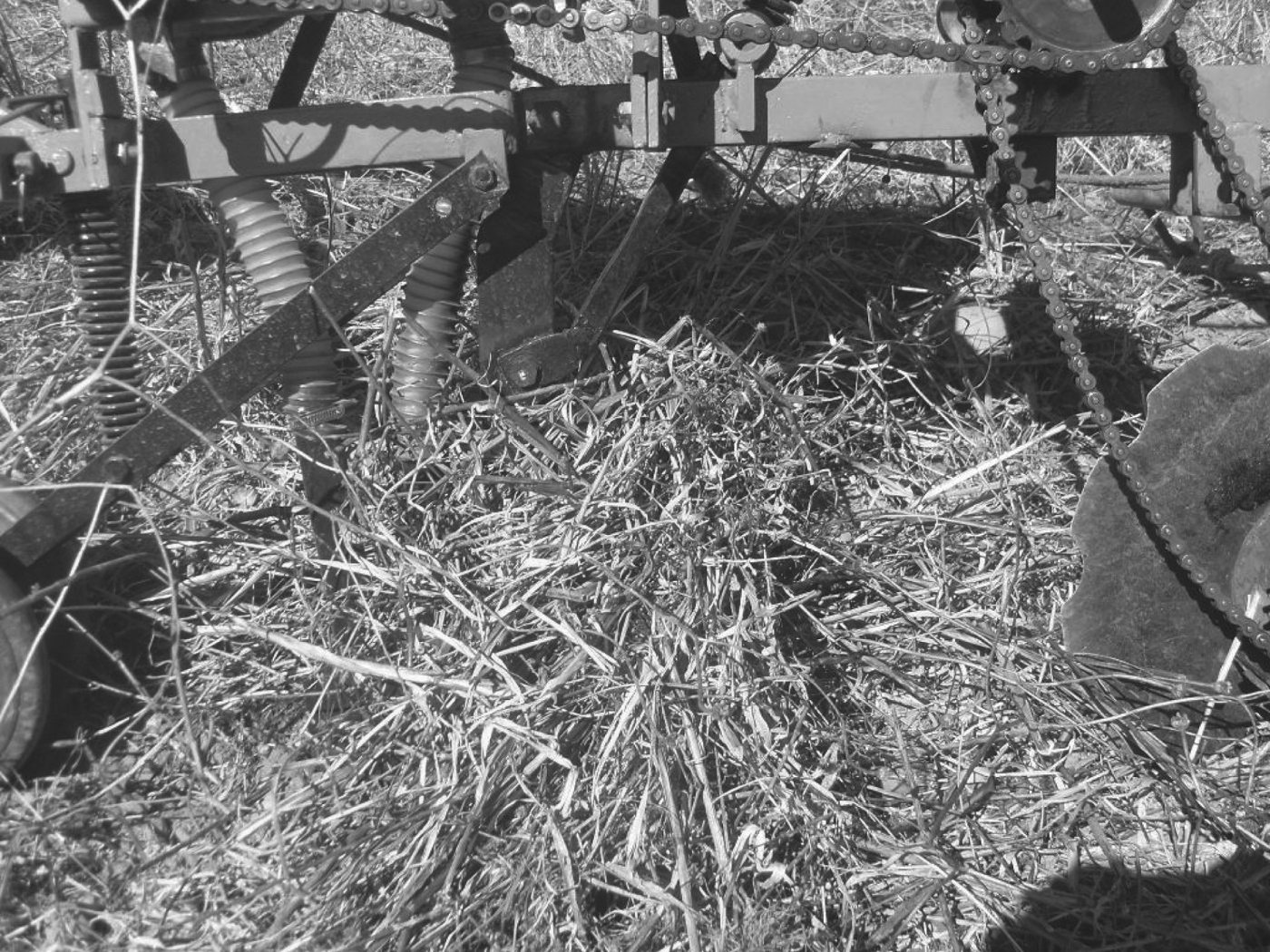
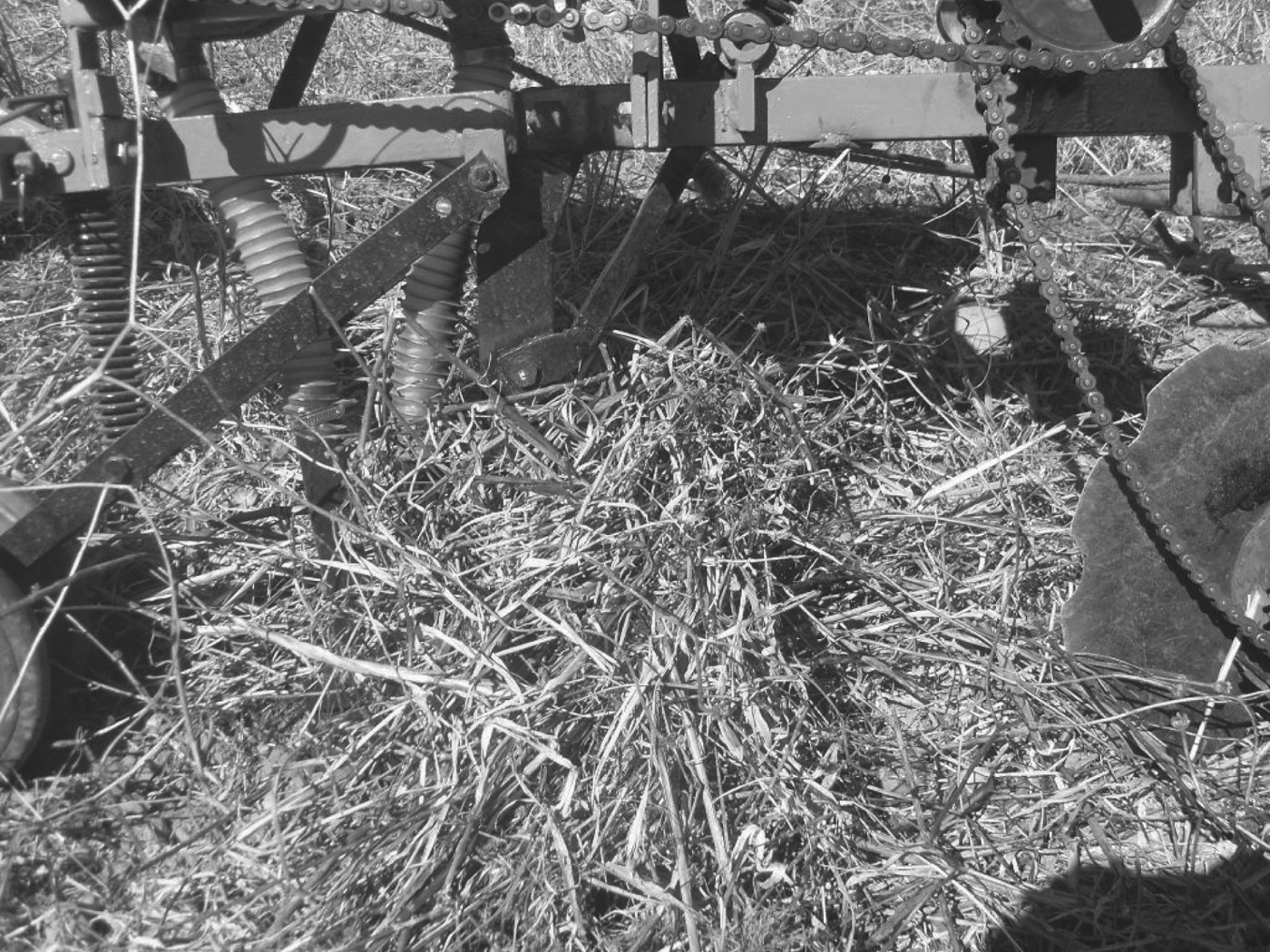
Seeding in this way posed several challenges. The seeder itself kept ‘jumping’ due to the stoniness of the soil; the large amount of mulch material (straw) caused this material to accumulate underneath the seeder, hampering and frequently blocking it, as shown in Figure 3.
Straw accumulations beneath the direct seeder (photo by Mohamed Sfa).
These factors resulted in numerous seeds remaining on top of the soil or straw, exposed to birds. In addition, the test plots were seeded slightly earlier than the surrounding fields, causing the birds to exceptionally concentrate precisely on those fields and thus leading to a significant loss. However, seeding was successful in some sections of both test plots. Owing to the above-mentioned problems using the direct seeder, it was decided to modify the trial from no-tillage to minimum tillage in the second cropping period (December 2010–April 2011) at the Hannanat site.
Soil water retention (selection criterion 5)
Enclosure versus grazing
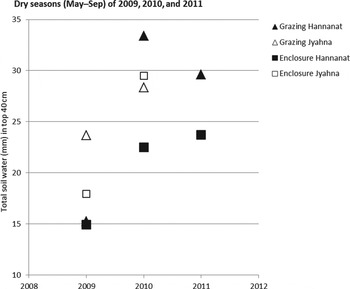
To obtain a rough comparison of the effects of enclosure and of grazing at the two sites, we calculated seasonal averages of SMC for the top 40 cm layer (Fig. 4).
Total soil water (mm) in the top 40 cm of the soil profile in grazed and enclosed fields, averaged over the dry seasons, for Hannanat and Jyahna, near Sehoul, Morocco.

A higher SMC was recorded under grazing than under enclosure, where the previous crop had been left as mulch and grazing had been prevented. This seemingly paradox can be explained by the development of certain perennial grasses (see also Fig. 11), which evaporated the water and dried out the soil in the enclosed areas. In the grazed field, the soil was bared and transpiration stopped. This suggests that grazing can help to conserve water.
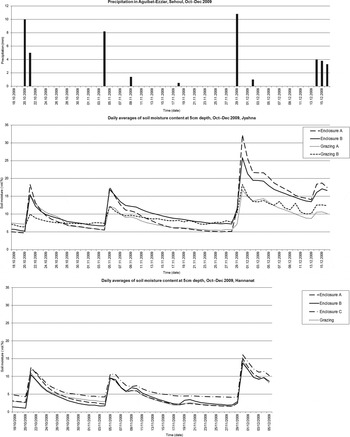
A delayed start of the rainy season with scattered small and medium showers (Fig. 5) forced the farmers to wait until mid-December to plough and seed their fields.
Soil moisture content (SMC) development at 5 cm depth at the beginning of the 2009–2010 cropping season (before sowing), in Jyahna (top) and Hannanat (below), near Sehoul, Morocco.

The development of SMC at 5 cm depth gives an indication of the possible effects of enclosure and of grazing on the infiltration of the first rains in autumn, as presented in Figure 5. At the Jyahna site, the soil moisture situation under enclosure was clearly preferable compared to grazing, particularly with respect to the impacts of the November showers. In Hannanat, no clear differences could be observed. Under enclosure, crop residues (and weeds) from the previous seasons were more or less intact, protecting the soil against raindrop impact. Under grazing there was less protecting biomass; however, observations suggested that the presence of cattle and sheep had both negative and positive consequences for the soil surface. On the one hand, it was compacted as a result of trampling, but, on the other hand, animal droppings appeared to have stimulated soil fauna burrowing activities, which created macro pores and thus improved infiltration capacity.
The water infiltrated after these first showers quickly reached a depth of 5 cm, but was insufficient to wet the soil at 30 cm depth at the Hannanat site. The difference between the two sites might be due to differences in runoff and/or in rainfall, as rainfall may vary over the distance from the rain gauge to both sites. However, the reaction of the SMC sensor at 5 cm depth suggests that runoff was low. Although no runoff measurements were available to validate this assumption, runoff amounts can be expected to be small, since small to medium showers are usually not very intensive. After being wetted, the soil at 5 cm depth started drying out at an almost exponentially decreasing rate. This confirms evaporation theory with its first and second stages of dryingReference Stroosnijder21. The gradient of exponential decay varies slightly between treatments, but no firm conclusion can be drawn in this regard. The expected effect of enclosure and grazing on infiltration during the first rains could be observed at Jyahna, but not at Hannanat. Additional consideration must be given to the fact that, by comparison to what had been observed in other years, an abundance of fodder after the exceptionally wet winter of 2008/2009 relieved the situation of overgrazing for the reference situation in autumn 2009.
No-tillage/minimum tillage versus conventional tillage
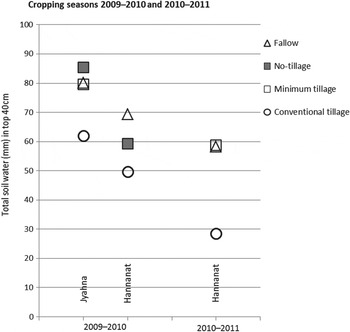
For this comparison, as well, the first step was to calculate seasonal averages of SMC for the top 40 cm layer to obtain a rough overview of the effects of the various treatments. Figure 6 suggests that no or minimum tillage was more favorable regarding SMC than conventional tillage. A permanent cover reducing soil evaporation caused no-tillage/minimum tillage to perform in a similar way as fallow.
Total soil water (mm) in the top 40 cm of the soil profile per treatment and averaged over the cropping seasons for Hannanat and Jyahna, near Sehoul, Morocco.

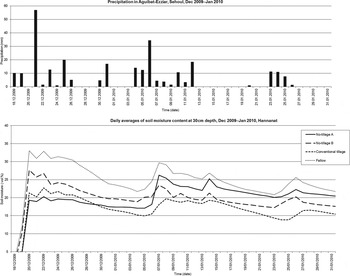
Figure 7 presents the development of SMC during the first phase of early crop growth (December 2009–January 2010). The diagram shows that substantial rainfall occurred at the end of December 2009. SMC at 5 and 15 cm depth quickly reached Field Capacity (FC) values. FC values were not determined directly, but can be interpreted from the dynamic curves. FC at 5 cm is about 20 vol.%, at 15 cm about 22 vol.% (curves not shown), and at 30 cm about 30 vol.%. The latter value can be observed in Figure 7 for the fallow case. The difference in FC is due to clay content increasing with depth. If the top 40 cm of the soil has reached FC, there will be about 100 mm of stored water. This is about equal to the amount of rain at the end of December. Figure 7 confirms the finding from the seasonal averages that conventional tillage led to lower SMC than the other treatments. The difference between the fallow and the no-tillage treatments suggests that water might be lost as runoff under no-tillage.
Soil moisture content (SMC) development at 30 cm depth during the 2009–2010 cropping season in Hannanat, Morocco.

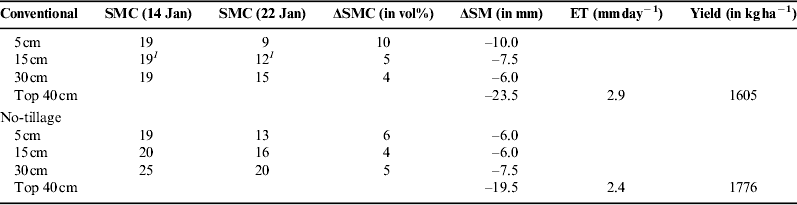
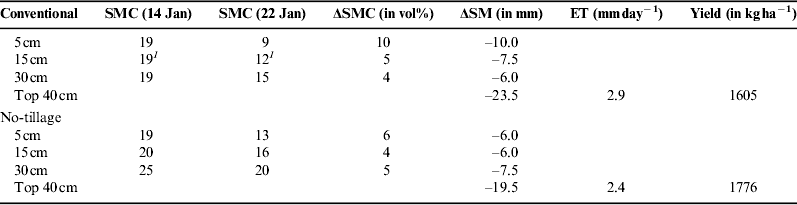
Between January 14 and 22, 2010 there was no rain at all. This allows using the measured decrease in SMC to estimate daily evapotranspiration (ET). Table 5 shows that ET under conventional tillage was about 2.9 mm day−1, while under no-tillage it was only 2.4 mm day−1. Since ET is a composite value of plant transpiration (T) and soil evaporation (E), E can only be concluded if T is known. Although T was not measured directly, its value can be inferred from the measured yield. Since the yield under no-tillage was higher than under conventional tillage (see below), it is safe to assume that E under no-tillage is lower than under conventional tillage.
Estimation of evapotranspiration (ET) using dynamic soil moisture content (SMC) data at 5, 15, and 30 cm depth in Hannanat, Morocco.
1 Interpolated.
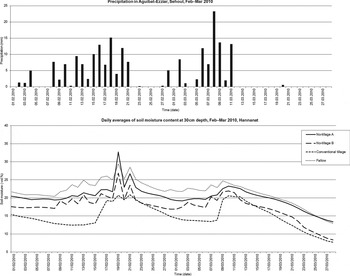
Figure 8 shows dynamic SMC during the last phase of the rainy season. At first, SMC increased steadily due to abundant rainfall in the second and third weeks of February. Under no-tillage treatment, FC was surpassed, followed by rapid drainage. Under conventional tillage, less moisture reached a depth of 30 cm. Field observations suggested that more runoff was generated in the fields under conventional tillage due to soil crusting. This effect was mitigated under no-tillage since the soil had been better protected with soil cover. Estimation of ET after 10 days of dry weather was repeated for the time between March 12 and 22, 2010. Conventional tillage showed considerably higher ET (3.8 mm day−1) than no-tillage (2.8 mm day−1). These values were higher than in January because the crop was further developed. Based on an estimation of the daily growth rate, it can be assumed that less than 1 mm was lost through T, while the remainder of soil water loss can be attributed to E. No-tillage therefore seems to reduce the loss of precious soil water via soil evaporation.
Soil moisture content (SMC) development at 30 cm depth at the end of the 2009–2010 cropping season in Hannanat, Morocco.

In general, the situation of conventional tillage is the one with the lowest SMC throughout the cropping season and at all depths. Fallow often shows a higher absolute moisture content, but with more rapid declines after rainfalls.
Overall, the observations regarding SMC development at various soil depths can be summarized as follows:
• At 5 cm: No-tillage and minimum tillage resulted in higher SMC than conventional tillage and fallow in most cases, except during the cropping season of 2010–2011 at Hannanat, when fallow performed best
• At 15 cm: Hardly any differences observed
• At 30 cm: No-tillage and minimum tillage resulted in higher SMC than conventional tillage; at Hannanat, fallow often performed best, whereas conventional tillage was clearly worst.
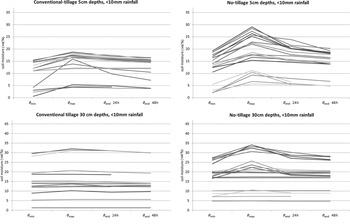
Another option for providing evidence of the influence of the treatments on SMC is to look at the reaction of SMC to single rainfall events. The increase in water content from the onset of rain and the decrease of water content after the peak both give an indication of various soil–water-related functions, such as infiltration, soil evaporation and water-holding capacity. These magnitudes were plotted for all rainfall events during the observation period (cropping seasons only) and for the various treatments. Differences were most obvious in the case of small rainfall events below 10 mm and for the comparison of conventional tillage with no-tillage (Fig. 9). The steepness of the lines in Figure 9 gives an indication of the response of soil moisture to rainfall (increase), as well as of water retention 24 h after the onset of rain (initial section of decrease) and 48 h after the onset of rain (second section of decrease). Figure 9 suggests a better response to small rainfall events in no-tillage areas, both at 5 and at 30 cm depth, compared to conventional tillage.
Changes in soil moisture content (SMC) at depths of 5 cm (top) and 30 cm (bottom) for events with less than 10 mm of rainfall during the cropping season, comparing conventional tillage (left) with no-tillage (right) for Sehoul, Morocco; θ min, soil moisture before rainfall; θ max, maximum soil moisture after rainfall; θ end 24 h, soil moisture 24 h after onset of rain; θ end 48 h, soil moisture 48 h after onset of rain.

To evaluate whether the treatments had a significant influence, the increases in SMC were analyzed for the various rainfall regimes (<10, 10–20, 20–50, >50 mm) and are shown in Figure 10.
Box plots of soil moisture increase after rainfall events of <10 mm (top left), 10–20 mm (top right), 20–50 mm (bottom left) and >50 mm (bottom right) for Sehoul, Morocco; ConvTill, conventional tillage; MinTill, minimum tillage; NoTill, no-tillage.

Soil moisture increases from the onset of the rainfall to the peak of soil moisture (θ max−θ min) revealed the following:
• At 5 cm depth and with little rainfall (<10 mm), no-tillage and minimum tillage both achieved significantly greater increases in moisture compared to conventional tillage (confidence value of 0.01). For 10–20 mm rainfall events, no-tillage still performed clearly better than conventional tillage (confidence value of 0.05). No significant difference could be found between treatments in the case of larger rainfall events, as well as between the fallow treatment and any of the other treatments for rainfall events of all magnitudes.
• At 30 cm depth, a significant difference was found between no-tillage and conventional tillage in cases where rainfall was below 10 mm (confidence value of 0.05).
Although these results relate to fairly small rainfall amounts (<20 mm), they might nonetheless be important for crop performance, as 11 of the 30 rainfall events recorded during the analyzed cropping seasons ranged below 10 mm, and another ten ranged below 20 mm.
Vegetation cover (selection criterion 6)
Vegetation cover was considerably higher within the fenced plots, especially at the end of the dry season, when the surroundings were completely grazed. Figure 11 presents a comparison of the fenced plot in Hannanat, where the crop residues from the previous cropping season acted as mulch, with its grazed surroundings. The increase in perennial herbs also resulted in a higher biodiversity, with 20 species m−2 in the mulch plot compared to 13 species m−2 in the grazed area.
The improved cover on the fenced plots at the end of the dry season proved important in protecting the soil against the first rains in October–December, which are usually heavy and intenseReference Laouina, Aderghal, Al Karkouri, Chaker, Machmachi, Machouri and Sfa16. This observation is supported by the above soil moisture data. Further confirmation was received from the farmers. One of them stated that ‘crop residues (straw) keep the soil open. Usually, the soil is closed [at the end of the dry season]. The straw cover allows infiltration. I have observed this here, especially this year when there was a lot of rain. Next to the enclosed plot numerous rills developed and this shows me that the straw cover is protecting the soil’ (oral communication, June 12, 2010).
Soil cover at Hannanat, Morocco, at the end of the dry season, for grazed and ungrazed fields.

Agricultural yields and animal production (selection criteria 2 and 3)
Crops produced on marginal slopes are normally used as animal fodder only. For this reason, the analysis focuses on the production of both grains and straw biomass (total biomass). Production after the first growing season (2009–2010) exhibited small differences between the various treatments. On the no-tillage plot at Hannanat, production amounted to 544 kg ha−1 of barley grains and 1232 kg ha−1 of straw biomass, while the plot under conventional tillage produced 503 kg ha−1 of barley grains and 1102 kg ha−1 of straw biomass. These measurements are based on 1-m2 samples taken where crop growth was satisfactory (i.e., not where the seeds had been eaten by birds, see above). The better performance of no-tillage was also visible in the field, as the grains were bigger and the plants higher than on the conventionally ploughed plot. In addition, there were fewer weeds under no-tillage due to the herbicide applied before seeding. On the conventionally tilled plot, the weeds had been ploughed into the soil, but had shown strong and immediate regrowth. Overall, production values on the test plots were very low compared to a nearby wheat field on non-degraded flat land with good-quality soil, which achieved 1130 kg ha−1 of grains and 3611 kg ha−1 of straw biomass—that is, triple the amounts produced on the test plots.
It has to be noted at this point that the owner of one of the test plots for these experiments, supported by a local agricultural engineer, expressed the fear that crop residues ploughed into the soil cause fungal attacks in the soil, necessitating subsequent treatment. This problem, however, can be avoided by crop rotation, as noted by the owner of the test plot at the other site (oral communications, March 18, 2009 and November 21, 2009).
Animal production not only benefits from increased fodder production, but at the same time also suffers from the exclusion, due to fencing, from areas previously used for grazing. Given the small size of the trial plots, this did not pose a problem for the participating farmers and their livestock. If fencing were upscaled, however, this might even increase the pressure on other natural resources in the area, such as the oak forest on the plateau.
Costs and socio-cultural results (selection criteria 1, 4, and 9–12)
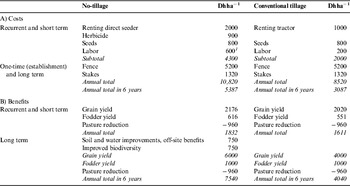
Table 6 presents costs and benefits for the no-tillage experiment. It is evident that the fencing costs of 6520 Dirham (587 EUR) make this technology an expensive one. However, fencing was only necessary for the experimental plot and would not be required if farmers decided to apply the technology on larger fields, in which case grazing would be controlled through social agreement. Owing to fencing, the cost–benefit ratio of the experiment was clearly negative for the first year. But even if fencing costs are excluded from the calculation, no-tillage still remains more expensive than conventional tillage. This is due to the higher costs of renting the direct seeder and purchasing the herbicide, as well as the additional labor input for herbicide application and as a result of difficulties in seeding. In terms of costs, therefore, the no-tillage technology is unfavorable under the given conditions with stony slopes and poor access to direct-seeding machinery. Only when the costs are weighed against the longer-term benefits of an estimated gradual yield increase up to the level achieved on the surrounding better-quality land, as well as other long-term benefits, such as improvements in soil structure and soil water, soil loss reduction and improved biodiversity, does the balance for no-tillage become beneficial compared to conventional tillage or fallow:
• No-tillage: 2153 Dh ha−1 yr−1
• Conventional tillage: 953 Dh ha−1 yr−1
• Grazed fallow: 960 Dh ha−1 yr−1
Costs and benefits for the field trials at the two study sites near Sehoul, Morocco (in Moroccan Dirham; 1 Dh=0.09 EUR).

1 Due to herbicide application and difficulties in working with the direct seeder.
Based on the research presented in this paper, little can be said about the test results regarding the four socio-cultural criteria (for details, see Table 4). The workload under no or minimum tillage might be reduced as a result of no or less ploughing, although this has not been the case in the field trial due to the difficulties posed by the stony slope. All other criteria can only be assessed in the long term and if the technology is applied more widely. Social cohesion and organization could potentially increase, if land users cooperate in purchasing direct-seeding machinery for shared use. While this would decrease on-farm employment opportunities (criterion 10), it would be positive for criterion 12 (freeing up time for off-farm activities). An increased awareness of degradation and enhanced conservation knowledge, however, was noted during the evaluation of technologies based on WOCAT questionnaires. This has been attributed to the participatory approach of the study.
Discussion
Although the results are limited in scope and clarity, some evidence nonetheless emerges (see summarized qualitative outcome presented in Table 4). Compared to conventional tillage, the no-tillage and minimum tillage experiments mostly showed an improved soil water balance. This is especially the case at 5 cm depth and for small rainfall events (below 20 mm). A possible conclusion from these results is that soil infiltration was enhanced under no-tillage and minimum tillage compared to conventional tillage. It is also possible, however, that no-tillage and minimum tillage reduced evaporation, better conserving the water in the topsoil, whereas the soil under conventional tillage might have dried out more rapidly, thereby preventing small showers from reaching a depth of 5 cm.
However, fallow had positive effects on soil water as well, owing to an important herb cover being retained throughout the year; stones might have functioned as an additional protective cover (stone mulch) against soil water evaporation. The disadvantage of fallow, which meant that the land was heavily grazed during the dry season, was that in autumn, when rainfall is most intense, it had a reduced infiltration rate and generated more runoff due to soil sealing. Previous studies in the same area showed that fallow land produces more runoff but less soil loss than cropped landReference Laouina, Chaker and Nafaa22.
Leaving mulch on the fields and protecting the area from grazing were expected to preserve soil moisture and allow infiltration and storage of the important first rains. Nevertheless, at the beginning of the cropping season, high moisture content was also observed in fallow land, as it had remained undisturbed. We can therefore conclude that it is this undisturbed condition that also renders the no-tillage technology clearly more profitable regarding soil water than conventional tillage. This is true even when considering the observation that ploughing along the contour under conventional tillage led to the formation of small ridges, leaving a rough surface that enabled infiltration. Similar findings resulted from studies in East and Southern Africa, which showed that the non-inversion tillage strategy, whether implemented as no-tillage or as minimum tillage, is most effective in terms of in situ moisture conservation and is therefore the most important component of conservation agriculture in dryland agro-ecosystems, actually constituting a kind of water harvesting strategyReference Rockström, Kaumbutho, Mwalley, Nzabi, Temesgen, Mawenya, Barron, Mutua and Damgaard-Larsen7. Especially in dry years, yields were also reported to be higher under no or minimum tillage in semi-arid regions of Mediterranean EuropeReference Farooq, Flower, Jabran, Wahid and Siddique23. It should further be noted that the beneficial effects of no or minimum tillage—such as improved soil structure or higher organic matter contents—evolve gradually, becoming measurable only after 4–5 years.
Despite indications that soil water content is generally improved as a result of area enclosure in the dry season, the extent of this improvement might not be sufficient to have an impact on production. Studies in Ethiopia have shown that although mulching generally improves soil water content, it does not increase yields or improve the efficiency of rainwater useReference Araya and Stroosnijder24. In drylands with distinct dry periods of several months, increased cover is not necessarily required during the dry period. Research from Australia confirms that high potential ET and low rainfall over these months prevents improved cover from retaining soil moisture, and its impact on the evaporation rate lasts for a maximum of a few days after rainfallReference Ward, Flower, Cordingley, Weeks and Micin25. Against this background, it is not justifiable to exclude considerable amounts of precious fodder material from use, leaving it to decay in the scorching sun, while the soil is dried out completely all the same. This is confirmed by another study which states that ‘in many African mixed farming systems, particularly in the semi-arid areas where livestock are of great importance, the costs of retaining crop residues as a mulch may be too great in relation to the potential benefits that are often difficult to quantify’Reference Giller, Witter, Corbeels and Tittonell26. On the other hand, it is important for the soil to be protected by some kind of cover at the end of the dry season, when the first rains hit the ground. In other studies, as well, farmers were encouraged to leave crop residue as mulch or to introduce leguminous intercrops, but neither mulch nor any significant cover crop was successfully achievedReference Rockström, Kaumbutho, Mwalley, Nzabi, Temesgen, Mawenya, Barron, Mutua and Damgaard-Larsen7. Even though the authors of these studies showed that conservation agriculture ‘can work in water scarcity prone farming systems without full mulch cover’Reference Rockström, Kaumbutho, Mwalley, Nzabi, Temesgen, Mawenya, Barron, Mutua and Damgaard-Larsen7, they admit that it remains an important component.
One of the greatest constraints on no-tillage on these marginal lands is the slope gradient and the high presence of stones. These prevent the direct seeder from correctly placing the seeds in the soil and closing the seed rill after passing. As a result, the success rate of the seeds is heavily reduced, and seeds are left accessible to birds. For this reason, the circumstances seem to require some form of tillage; minimum tillage, however, might be sufficient. The results achieved under minimum tillage look promising with regard to both seed establishment and soil moisture. Nevertheless, land users were not really convinced by the results. The small increase in grain and straw yield was not sufficient for them, and the soil showed no visible improvement after so short a time. Moreover, the need for fencing was perceived as a major threat and was met with strong objections, since free grazing is a traditionally enforced right. There is, however, already an increasing tendency toward fencing in the Sehoul region to confirm ownership as well as to establish fruit tree plantations. This further increases the pressure to graze livestock on the more marginal slopes, and might therefore be one of the reasons why land users in Sehoul are afraid of losing these marginal grazing lands.
These findings call for a broader perspective than an individual farmer's plot. This need is confirmed by long-term research in India, which has shown that sustainable production is possible in dryland agriculture if it integrates soil and water conservation with livestock nutrient management at the catchment scaleReference Sahrawat, Wani, Pathak and Rego27. Large-scale application of minimum tillage would entail a complete revision of land management in Sehoul, including strategies such as controlled grazing (with or without fencing) and cut-and-carry harvesting of fodder. Furthermore, it would also require use regulations for the remaining natural forest areas in order to prevent increased pressure as a result of reduced access elsewhere.
To date, no variables have been found which could satisfactorily explain the adoption of conservation agricultureReference Knowler and Bradshaw28 or soil and water conservation in generalReference de Graaff, Amsalu, Bodnár, Kessler, Posthumus and Tenge29. For this reason, efforts to promote conservation agriculture have to be tailored to the locations and contexts in question. However, de Graaff et al.Reference de Graaff, Amsalu, Bodnár, Kessler, Posthumus and Tenge29 found that farmers who have some knowledge about natural resource management invest significantly more time in soil and water conservation measures. This competence was inadequate in Sehoul prior to the study presented in this paper, but has apparently increased owing to the participatory approach taken in this study, as several stakeholders have reported. The involvement of a variety of stakeholders in identifying land management problems and solutions allowed conducting the research trials in close collaboration with partners engaged in the dissemination of SLM technologies. This proved to be successful in other similar action research projects, as presented by Rockström et al.Reference Rockström, Kaumbutho, Mwalley, Nzabi, Temesgen, Mawenya, Barron, Mutua and Damgaard-Larsen7.
Conclusions
Owing to the limited setup of this study, the indicative conclusions drawn above require further and longer-term research in order to be developed into more strongly grounded and evidence-based recommendations. However, the embedded nature of the study and the close collaboration with stakeholders successfully ensured that the results reflected land users’ requirements and expectations.
The results show that better soil cover and minimized soil disturbance improve the water balance and production under some circumstances only. A major limitation is the stony nature of the soils, which proved to be unsuitable for no-tillage with direct seeding and also created difficulties for minimum tillage. Another limitation is the need to retain crop residues as mulch. As expressed by various stakeholders, the land users’ priorities lie with animal husbandry, and they are reluctant to change the current grazing system.
Although the results indicate that conservation agriculture has beneficial ecological impacts, the socio-economic impacts are insufficient. The nearby city is currently seen as a threat due to its dazzling alternative job options—which, however, are not really accessible to the illiterate rural poor. The younger generations in particular appear to be losing their agricultural knowledge before gaining a foothold in the city's job market. At the same time, the vicinity of a city implies access to markets and to agricultural inputs and services. Moreover, the agro-climatic conditions of Sehoul are favorable compared to other drylands in the world, with adequate rainfall in many years.
Overall, conservation agriculture remains a challenge in this context characterized by degraded and stony slopes, the temptations of the nearby city, and a strong preference for the traditional agro-pastoral system. Thus, the search for suitable SLM technologies has to be continued in this region, involving key stakeholders. Investments might be required to improve advisory services and government support, or to establish rewarding schemes for compensating ecosystem services.
Acknowledgements
The research presented in this paper was conducted within the framework of the EC-DG RTD, 6th Framework Research Program (sub-priority 1.1.6.3), Research on Desertification, project DESIRE (037046): Desertification Mitigation and Remediation of Land—a global approach for local solutions. The authors would like to specifically thank the land users and local partners in Morocco. A special acknowledgement goes to Engineer Dr Oussama El Gharras of INRA in Settat, who brought the special seeder and shared his knowledge about direct seeding. We also thank Mohamed Aderghal, Jamal al Karkouri, Yousra Lagazhi, Issam Machmachi, and Reddad Hadana. We are grateful to Erik van den Elsen of Alterra (WUR) for field work support in using the soil moisture sensors. Thanks also go to Abdallah Alaoui of GIUB and Hanspeter Liniger of CDE, both at the University of Bern, for their valuable comments on data analysis. Thanks to Marlène Thibault for English language editing.