Introduction
Borderline personality disorder (BPD; APA, 1994), also known as ‘emotionally unstable personality disorder, borderline type’ (WHO, 1994), is a common psychiatric disorder and the most frequent personality disorder in clinical settings. It affects about 1–6% of the general population and 10–25% of psychiatric in-patients (Lieb et al. Reference Lieb, Zanarini, Schmahl, Linehan and Bohus2004b; Leichsenring et al. Reference Leichsenring, Leibing, Kruse, New and Leweke2011). Although its etiology is only partially known, most studies recognize a range of possible determinants, including genetic, neurobiological and psychosocial factors, that interact at various levels (Lieb et al. Reference Lieb, Zanarini, Schmahl, Linehan and Bohus2004b). Twin studies have estimated the heritability of BPD and BPD traits to be 30–40% (Distel et al. Reference Distel, Trull, Derom, Thiery, Grimmer, Martin, Willemsen and Boomsma2008; Torgersen et al. Reference Torgersen, Czajkowski, Jacobson, Reichborn-Kjennerud, Roysamb, Neale and Kendler2008), but a high prevalence of environmental risk factors is also reported consistently by patients with BPD. The majority of borderline patients report various types of adverse childhood experiences, such as sexual abuse, physical maltreatment and emotional neglect (Zanarini et al. Reference Zanarini, Gunderson, Marino, Schwartz and Frankenburg1989; Lobbestael et al. Reference Lobbestael, Arntz and Bernstein2010).
However, genetic liability and a history of childhood trauma may not be the only risk factors for BPD: during the past two decades, a large body of evidence emerged, suggesting that prenatal adversity is an important risk factor for the psychopathology of BPS (Swanson & Wadhwa, Reference Swanson and Wadhwa2008; Schlotz & Phillips, Reference Schlotz and Phillips2009). It has been reported that prenatal maternal stress, drugs, tobacco smoking or medical complications may lead to intrauterine growth restriction and to impaired fetal development (Seckl & Holmes, Reference Seckl and Holmes2007; Cottrell & Seckl, Reference Cottrell and Seckl2009; El Marroun et al. Reference El Marroun, Jaddoe, Hudziak, Roza, Steegers, Hofman, Verhulst, White, Stricker and Tiemeier2012). In the long run, these factors may increase the risk for somatic and mental disorders in adulthood, a phenomenon known as ‘prenatal programming’ (Barker, Reference Barker2004; Phillips, Reference Phillips2007;Harris & Seckl, Reference Harris and Seckl2011). Furthermore, the exposure to an adverse fetal environment is related to abnormal behavioral outcomes in infants, such as emotional and cognitive deficits in early life (Brand et al. Reference Brand, Engel, Canfield and Yehuda2006; Bergman et al. Reference Bergman, Sarkar, O'Connor, Modi and Glover2007).
Prenatal adversity has been associated with mental disorders such as schizophrenia, depression, post-traumatic stress disorder and attention deficit hyperactivity disorder (ADHD) (Schlotz & Phillips, Reference Schlotz and Phillips2009; Nosarti et al. Reference Nosarti, Reichenberg, Murray, Cnattingius, Lambe, Yin, Maccabe, Rifkin and Hultman2012). Although it is now widely recognized that the exposure to an adverse fetal environment can have persisting effects on an individual's physiology and mental health, this association has not yet been studied systematically in BPD.
We hypothesized that, compared to healthy controls, patients with BPD may be exposed more often to prenatal adverse events and that prenatal adversity may constitute a risk factor for the diagnosis of BPD. Furthermore, we aimed to identify particular prenatal risk factors to predict single subdomains of the borderline symptomatology.
Method
Sample
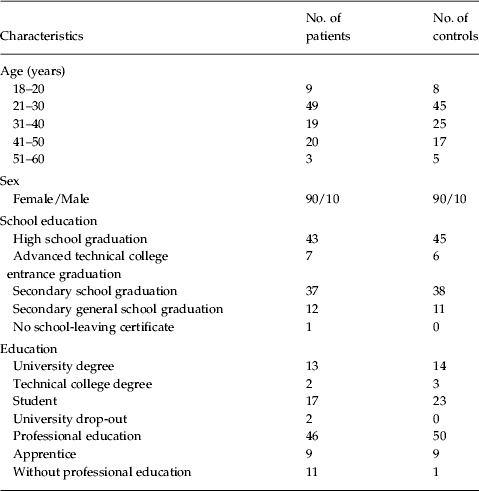
A total of 100 patients who met the DSM-IV criteria for BPD (APA, 1994) and 100 healthy control subjects participated in the study. Patients and controls were matched for sex, age and education (see Table 1). Patients were recruited from university hospitals [University Medical Center Mainz (n=39), University Hospital Freiburg (n=17)], public psychiatric hospitals [Wiesbaden (n=7), Klingenmünster (n=3), Alzey (n=2)], psychiatric and psychotherapeutic practices (n=10), support groups (n=3) and through internet announcements (n=19) in Germany. The internet announcements contained relevant information about the study (topic, aim, procedure) and a reply address for interested participants. The patient sample consisted of 22 (22%) in-patients, 52 (52%) out-patients and 26 (26%) patients without current treatment. All patients were aware of their diagnosis. In the patient group, 86% (n=86) showed at least one co-morbid DSM-IV Axis I disorder and 68% (n=68) of patients were diagnosed as having at least one co-morbid DSM-IV Axis II disorder (see Supplementary Table S1). After an initial screen by telephone, 106 patients and 113 controls were invited to participate in the study. Of these, six patients were excluded because they did not fulfil the diagnostic criteria for BPD (n=2) or could not provide sufficient information about the time of pregnancy (n=4). The control subjects were recruited through flyers and notices and by personal contact and were matched to the patient sample for sex, age and education. The mean age of the patients (31.63 years, s.d.=9.73) and controls (32.02 years, s.d.=10.25) did not differ significantly. The distribution of male and female participants was identical in patients and controls (see Table 1). The third matching criterion was the participants' high school education. The patient and control groups did not differ significantly in their educational degree. We also took into account the participants' level of further education, such as university degree or professional education. From the originally recruited 113 controls, 11 were excluded because they did not meet the required matching criteria [sex (n=3), age (n=6), education (n=2)]; one had a history of a severe mental disorder and was excluded; and one refused participation. The recruitment was completed when 100 subjects in each group fulfilled the inclusion criteria and confirmed participation. A detailed description of the demographic variables of patients and controls is presented in Table 1.
Demographic variables

Procedure
After a full description of the research procedure, written informed consent was obtained from all subjects. The study protocol was approved by the local ethics committee. The investigation was conducted in accordance with the guidelines described in the Declaration of Helsinki.
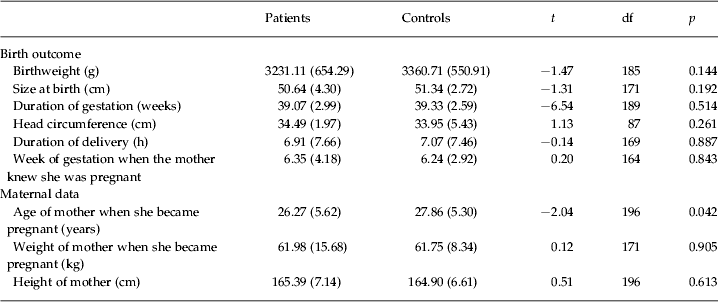
All patients and controls were diagnosed with the SCID (Wittchen et al. Reference Wittchen, Zaudig and Fydrich2007). The diagnostic interviews were conducted by a trained psychologist with extensive clinical and research experience. Subsyndromes of the BPD symptomatology (e.g. impulsivity, affective instability and dissociation) were assessed in detail by additional instruments: the Impulsive Behavior Scale (UPPS; Schmidt et al. Reference Schmidt, Gay, d'Acremont and Van der Linden2008), the Affective Lability Scale (ALS; Harvey et al. Reference Harvey, Greenberg and Serper1989), the Identity Disturbance Questionnaire (IDQ; Wilkinson-Ryan & Westen, Reference Wilkinson-Ryan and Westen2000), the German version of the Dissociative Experience Scale (FDS; Spitzer et al. Reference Spitzer, Stieglitz and Freyberger2004), the Sensation Seeking Scale V (SSS-V; Beauducel et al. Reference Beauducel, Strobel and Brocke2003), the Borderline Symptom List (BSL; Bohus et al. Reference Bohus, Limberger, Frank, Sender, Gratwohl and Stieglitz2001) and the Borderline Personality Disorder Severity Inventory (BPDSI; Arntz et al. Reference Arntz, van den Hoorn, Cornelis, Verheul, van den Bosch and de Bie2003). Prenatal adversity was assessed using a semi-structured interview about pre-, peri- and postnatal life events, based on Neuropattern Diagnostics (Hellhammer & Hellhammer, Reference Hellhammer and Hellhammer2008; Hellhammer et al. Reference Hellhammer, Hero, Gerhards and Hellhammer2012). One part of the Neuropattern instrument is the Pre/Postnatal Stress Questionnaire (NPQ-PSQ), which assesses pre-, peri- and postnatal adverse events (e.g. prenatal maternal stressors), fetal exposure to toxins (e.g. nicotine, alcohol or drugs), prenatal maternal illness or infection, maternal malnutrition, birth risk factors, perinatal complications and childhood adversity. It also contains a rating scale that assesses the level of perceived stress by the mother. Detailed information on the NPQ-PSQ and the other instruments can be found in the Supplementary Material (subheading ‘Instruments’). The participants were instructed to review the interview questions together with their mothers prior to the interview. Mothers of participants were asked to fill in the NPQ-PSQ and to provide objective information about maternal age at birth, length of gestation, duration of delivery and subject's weight, height and head circumference at birth (Table 2). These data were obtained from prenatal medical records that are handed to the mother by the obstetrician during her first prenatal visit. All interviews were conducted personally by trained health professionals. The raters were supervised regularly.
Birth outcome and maternal data
df, Degrees of freedom.
Values given as mean (standard deviation).
Information about prenatal adversity was obtained from 180 (90.5%) mothers of participants (83% patients, 98% controls), 73 (36.7%) fathers or other close relatives (39% patients, 34.3% controls) and 75 (37.5%) prenatal medical records (37% patients, 38% controls). Participants were excluded if they had no access to information about birth parameters, prenatal adversity, birth complications and childhood trauma. Further exclusion criteria were acute suicidality, acute intoxication (alcohol, drugs), a history or a current episode of schizophrenia, bipolar disorder I, mental disorders due to a medical condition or intellectual disability.
Statistical analysis
The data are expressed as percentages or mean values and standard deviations. Differences between groups were tested for significance using the Student t test, Fisher's exact test and the Mann–Whitney U test, where appropriate. The point biserial correlation coefficient (r pb) was used to assess correlations between metric and dichotomous variables.
To determine the predictive value of the prenatal risk factors, a logistic regression analysis was performed that contains the diagnosis of BPD as the dependent variable and 15 prenatal risk factors as independent variables (see Table 3 for a complete list). In the next step we applied a hierarchical logistic regression model to control for childhood trauma and parental socio-economic status (SES). In the first block, we controlled for sexual abuse, physical maltreatment and emotional neglect and in the second block for maternal education (see also Supplementary Table S2) and parental monthly income (1=low, 2=average, 3=high). We then constructed multiple linear regression models (stepwise) to identify the predictive value of the prenatal risk factors in specific subdomains of borderline symptomatology. All regression models were adjusted for maternal mental disorders. Statistical significance was set at 0.05. All analyses were carried out using SPSS version 18.0 (SPSS Inc., USA).
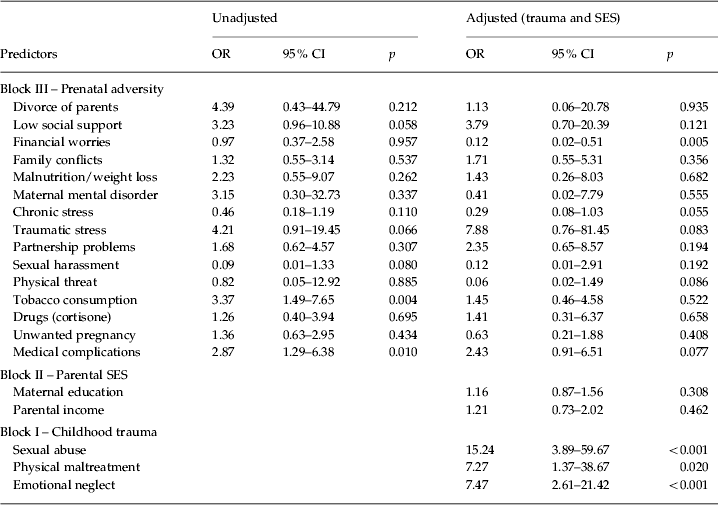
Prenatal adversity: logistic regression analysis
OR, Odds ratio; CI, confidence interval; SES, socio-economic status.
Results
Prenatal adversity
We found evidence of a high prevalence of prenatal adversity in BPD. The number of prenatal adverse events, measured by the PSQ adversity score, differed highly significantly between the patient and the control groups (t 198=3.79, p<0.001). On average, borderline patients reported 4.94 (s.d.=2.95) prenatal adverse events whereas the control group reported 3.52 (s.d.=2.31) prenatal adverse events. Furthermore, mothers of borderline patients perceived their pregnancy as significantly more stressful than mothers of healthy controls [BPD: 4.24 (s.d.=3.13); controls: 3.35 (s.d.=3.05); t 196=2.02, p=0.044]. The perceived stress scale was highly correlated with the PSQ adversity score (r=0.760, p<0.001).
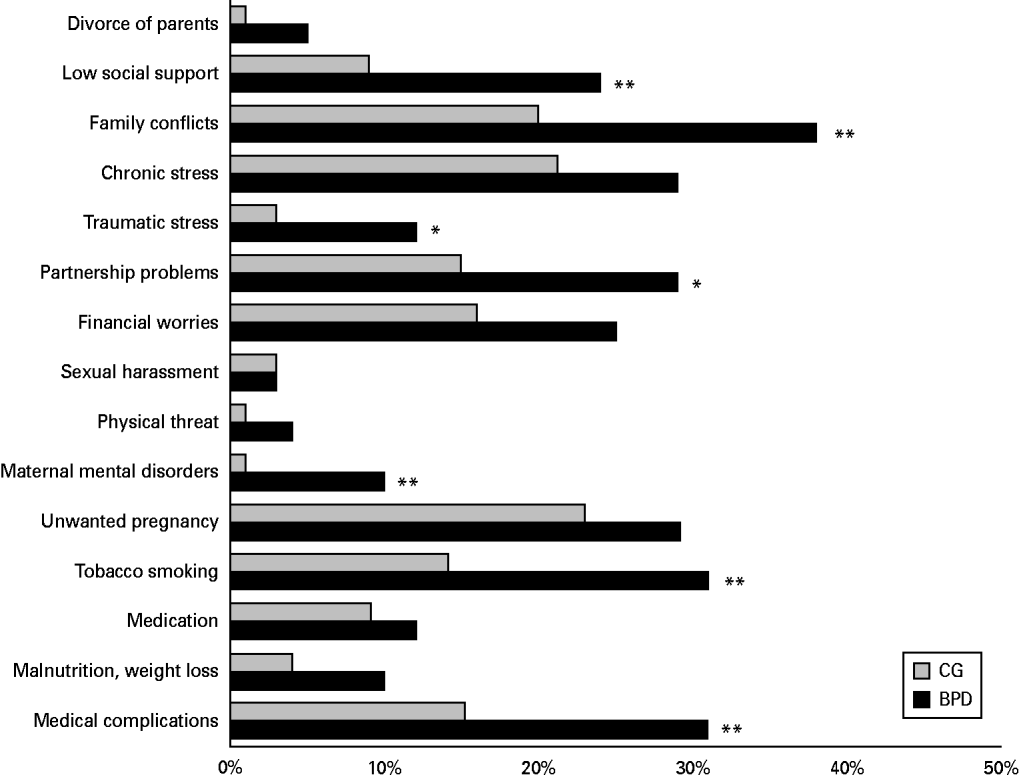
Further analyses revealed that mothers of borderline patients were exposed significantly more often to severe traumatic stress during pregnancy (p=0.015), such as death or suicide of a close relative, death of a child, severe material loss or rape during pregnancy. They reported significantly more often severe familial conflicts (p=0.004) and partnership problems during gestation (p=0.014) in addition to low social support by others (p=0.004).
Mothers of BPD patients smoked tobacco significantly more often during pregnancy (p=0.004). Medical complications, such as preterm contractions, preterm opening of the cervix, bleeding, nausea and vomiting with weight loss or pelvic presentation, emerged more often in pregnancies of BPD patients compared to healthy controls (p=0.008). Mothers of BPD patients also self-reported more often a psychiatric diagnosis during pregnancy (e.g. depression, alcohol abuse, BPD, schizophrenia; p=0.005). No significant differences were found with respect to malnutrition, weight loss, intake of medication (e.g. cortisone), financial situation or diverse psychosocial stressors (e.g. sexual harassment, physical threat). The differences in prenatal adverse events in BPD patients and healthy controls are presented in Fig. 1.
Prenatal adversity in patients with borderline personality disorder (BPD) and the healthy control group (CG). ** p<0.01, * p<0.05.
Postnatal adversity
We found a high prevalence of postnatal adversity and childhood trauma in patients with BPD. Borderline patients reported significantly more often childhood sexual abuse (p<0.001), physical maltreatment (p<0.001) and emotional neglect (p<0.001) compared to healthy controls. For further details see ‘Postnatal Adversity’ in the Supplementary Material.
Birth outcome and maternal data
There were no significant differences in birth outcomes between borderline patients and healthy controls (Table 2). However, mothers of BPD patients were slightly younger and had a lower level of education (see Table S2 and ‘Birth Outcome and Maternal Data’ in the Supplementary Material).
Prenatal adversity as a predictor for the diagnosis of BPD
In the initial, uncorrected logistic regression analysis, 25.7% of the variance of the diagnosis of BPD was explained by prenatal adversity. Prenatal maternal tobacco smoking [odds ratio (OR) 3.37, 95% confidence interval (CI) 1.49–7.65, p=0.004] and medical complications (OR 2.87, 95% CI 1.29–6.38, p=0.010) turned out to be significant predictors for the diagnosis of BPD. Trend findings were obtained for stress-related variables, such as ‘low social support during pregnancy’ (p=0.058), ‘traumatic maternal stress’ (p=0.066) and ‘sexual harassment during pregnancy’ (p=0.080).
Delineating prenatal from postnatal risk factors
To delineate prenatal from postnatal risk factors, a hierarchical logistic regression analysis was performed, where we controlled for postnatal adversity and parental SES. Childhood trauma alone accounted for 48.4% of the variance for the diagnosis of BPD whereas parental SES accounted for 0.8% of the variance. After controlling for childhood adversity and parental SES, prenatal risk factors still accounted for 10.4% of the variance for the diagnosis of BPD. On the basis of the single factors, those prenatal predictors that became significant in the first analysis lost significance after adjustment (Table 3).
Subdomains of BPD
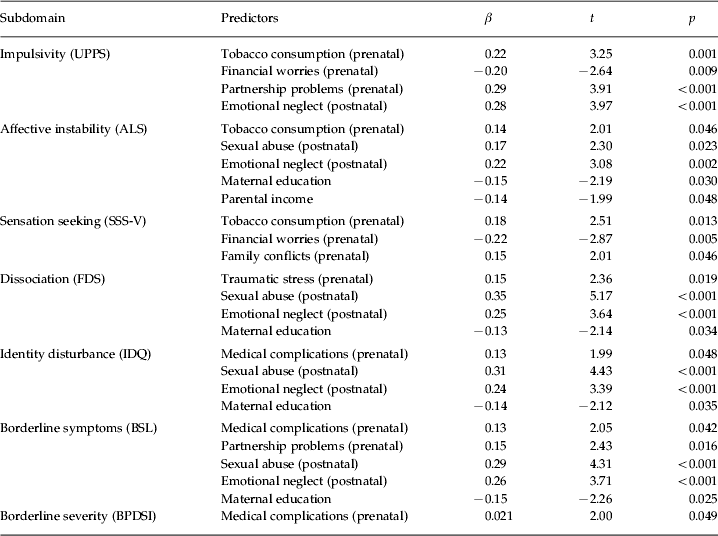
In the next step we tested which specific risk factors predicted particular borderline subdomains, such as impulsivity, affective instability, dissociation, identity disturbance, sensation seeking and severity of borderline symptoms. The regression models revealed that the variables ‘prenatal maternal smoking’ and ‘prenatal medical complications’ again constituted important risk factors (Table 4). Tobacco smoking during pregnancy turned out to be a significant predictor for the subdomains ‘impulsive behavior’ (p=0.001), ‘affective instability’ (p=0.046) and ‘sensation-seeking behavior’ (p=0.013). Separate analyses revealed that these results were not an effect of a co-morbid diagnosis of ADHD because prenatal tobacco exposure remained a significant predictor in the group of borderline patients without co-morbid ADHD: impulsivity [BPD without ADHD (n=69): p=0.034; BPD with ADHD (n=28): p=0.284]; affective instability [BPD without ADHD (n=69): p=0.039; BPD with ADHD (n=28): p=0.660].
Subdomains of borderline personality disorder (BPD): stepwise linear regression analysis
UPPS, Impulsive Behavior Scale; ALS, Affective Lability Scale; Sensation Seeking Scale V SSS-V; FDS, German version of the Dissociative Experience Scale; IDQ, Identity Disturbance Questionnaire; BSL, Borderline Symptom List; BPDSI, Borderline Personality Disorder Severity Inventory.
Because 31 (31%) patients and 14 (14%) controls were either only prenatally or pre- and postnatally exposed to tobacco smoke and 30 (30%) patients and 18 (18%) controls were only postnatally exposed to tobacco smoke, we adjusted for postnatal tobacco exposure in the stepwise linear regression models. The effects of prenatal maternal smoking remained stable in impulsivity (p=0.001), affective instability (p=0.046) and sensation-seeking behavior (p=0.002).
The variable ‘prenatal medical complications’ emerged as predictor for borderline symptomatology in general, and also for the general severity of borderline symptoms. Furthermore, medical complications act as predictor for identity disturbances (see Table 4).
Discussion
To the best of our knowledge, this is the first study to systematically and comprehensively assess prenatal adversity as a potential risk factor in the etiology of BPD. This research may be of importance in terms of elucidating another potential component in the multifactorial genesis of BPD. Prenatal adversity has been assessed extensively in a large, carefully matched and reliably diagnosed sample of 200 participants. We obtained objective and subjective information from participants and from their mothers and/or close relatives.
Our aims were to investigate whether borderline patients were exposed more often to prenatal adverse events compared to healthy controls and to test which risk factors might play a role in the etiology of BPD. We also aimed to identify particular prenatal risk factors that might predict single subdomains of borderline symptomatology.
We found that borderline patients and their mothers reported adverse intrauterine conditions significantly more often than healthy controls. Significant group differences emerged in several stress-related variables, such as ‘traumatic stress’, ‘familial conflicts’, ‘partnership problems’ or ‘low social support’ and also in the variables ‘tobacco exposure during pregnancy’ and ‘prenatal medical complications’. Analogous to the high number of prenatal adverse events, mothers of borderline patients perceived their pregnancy as significantly more stressful than mothers of healthy controls.
Prenatal risk factors account for a substantial percentage of 25.7% of the variance of the diagnosis of BPD. Prenatal tobacco exposure and prenatal medical complications emerged as the most important predictors. These findings could be confirmed in relevant borderline subdomains, such as impulsivity, affective instability, sensation-seeking behavior, identity disturbance and severity of borderline symptoms.
Earlier studies in BPD (Soloff & Millward, Reference Soloff and Millward1983;Bandelow et al. Reference Bandelow, Krause, Wedekind, Broocks, Hajak and Ruther2005) investigated childhood trauma and developmental histories, but assessed only some birth risk factors or single prenatal adverse events. Neither study assessed prenatal variables in detail, such as maternal psychosocial stressors, prenatal tobacco, alcohol or drug exposure, maternal illness or infection, malnutrition or parental socio-economic variables. They consulted no, or only a few, family informants and used smaller sample sizes.
Prenatal tobacco exposure
In the present study, prenatal tobacco exposure turned out to be a significant predictor for the diagnosis of BPD. In particular, the subdomains ‘impulsivity’, ‘affective instability’ and ‘sensation-seeking behavior’ are closely associated with prenatal maternal smoking.
Several studies have shown that maternal tobacco consumption during pregnancy is also an important risk factor for the diagnosis of ADHD (Froehlich et al. Reference Froehlich, Lanphear, Auinger, Hornung, Epstein, Braun and Kahn2009), a disorder whose symptomatology (especially impulsivity, affective instability and sensation-seeking behavior) strongly overlaps with borderline psychopathology. These findings may suggest a common prenatal pathogenetic pathway of both disorders, which may be reflected in the high co-morbidity rates of BPD and ADHD (Philipsen, Reference Philipsen2006). However, the effects of prenatal tobacco exposure remained stable even after controlling for a co-morbid ADHD diagnosis.
Human and animal studies suggest an association between prenatal tobacco exposure and structural and neurobiological changes in the offspring brain. These alterations include smaller volumes of specific brain structures (Paus et al. Reference Paus, Nawazkhan, Leonard, Perron, Pike, Pitiot, Richer, Veillette and Pausova2008), cortical thinning (Toro et al. Reference Toro, Leonard, Lerner, Lerner, Perron, Pike, Richer, Veillette, Pausova and Paus2008), disruptions of white matter microstructure (Jacobsen et al. Reference Jacobsen, Picciotto, Heath, Frost, Tsou, Dwan, Jackowski, Constable and Mencl2007) and alterations in receptor density in specific brain regions (Slotkin et al. Reference Slotkin, MacKillop, Rudder, Ryde, Tate and Seidler2007). It is possible that the structural and functional brain abnormalities seen in BPD, such as volume reductions in frontolimbic and parietal areas (Tebartz van Elst et al. Reference Tebartz van Elst, Hesslinger, Thiel, Geiger, Haegele, Lemieux, Lieb, Bohus, Hennig and Ebert2003), impaired connectivity (Berlin et al. Reference Berlin, Rolls and Iversen2005) or impaired inferior frontal white matter microstructure (Rusch et al. Reference Rusch, Weber, Il'yasov, Lieb, Ebert, Hennig and van Elst2007), may be co-determined by pre- and/or postnatal tobacco exposure. One underlying mechanism may be mediated by nicotine, binding to fetal nicotinic acetylcholine receptors and exhibiting profound effects on neurodevelopment. Nicotine and other components in tobacco smoke may thus cause structural and functional changes that contribute to behavioral abnormalities (Heath et al. Reference Heath, King, Gotti, Marks and Picciotto2010), altered stress reactivity (Huijbregts et al. Reference Huijbregts, van Berkel, Swaab-Barneveld and van Goozen2011), altered temperamental traits (Ruckinger et al. Reference Ruckinger, Rzehak, Chen, Sausenthaler, Koletzko, Bauer, Hoffmann, Kramer, Berdel, von Berg, Bayer, Wichmann, von Kries and Heinrich2010; Huijbregts et al. Reference Huijbregts, van Berkel, Swaab-Barneveld and van Goozen2011) and elevated risk for mental disorders later in life (Ekblad et al. Reference Ekblad, Gissler, Lehtonen and Korkeila2010). Our results suggest that future brain imaging studies should control for pre- and postnatal tobacco exposure because alterations in the central nervous system may be mediated in part by the deleterious effects of early smoke exposure.
Prenatal medical complications
In our sample, 30.9% of mothers of borderline patients reported medical complications during pregnancy. These complications may reflect a poor fetal environment, which has been shown to be linked with adverse health outcomes in offspring later in life. In the present study, ‘prenatal medical complications’ were not only associated with the borderline diagnosis itself but also predicted a more severe phenotype according to BSL and BPDSI total scores. Our data correspond with numerous human and animal studies that identified behavioral problems after exposure to prenatal maternal stress, tobacco smoke and medical complications (Swanson & Wadhwa, Reference Swanson and Wadhwa2008; Lupien et al. Reference Lupien, McEwen, Gunnar and Heim2009; Harris & Seckl, Reference Harris and Seckl2011). However, after controlling for postnatal trauma and parental SES, the effects of medical complications and other prenatal risk factors became smaller and non-significant. Possibly, these prenatal predictors may have remained significant when assessed in a larger sample with more statistical power.
Prenatal maternal stress
In the present study, mothers of BPD patients reported significantly more often psychosocial stress during pregnancy compared with mothers of healthy controls. Possible underlying mechanisms of adverse health outcomes after exposure to prenatal adversity may be based on alterations in brain structure and function during specific sensitive periods of brain development (Lupien et al. Reference Lupien, McEwen, Gunnar and Heim2009; Harris & Seckl, Reference Harris and Seckl2011). Affected are, among others, brain structures that underlie emotional processing and endocrine responses to stress, such as the fetal hypothalamic–pituitary–adrenal (HPA) axis, whose maladaptation makes the individual hypersensitive to stress and susceptible to stress-related disorders in adulthood (Schlotz & Phillips, Reference Schlotz and Phillips2009). Remarkably, an elevated vulnerability and reactivity to stress along with a maladapted HPA axis has also been described in patients with BPD (Lieb et al. Reference Lieb, Rexhausen, Kahl, Schweiger, Philipsen, Hellhammer and Bohus2004a), which might indicate a potential prenatal programming effect. Accordingly, in the present study, mothers of borderline patients perceived their pregnancy as significantly more stressful compared to mothers of healthy controls. They reported significantly more often severe stress during pregnancy, including severe traumatic stress, familial conflicts, partnership problems and low social support. Several studies suggest that not only ‘objective’ stressors but also more ‘subjective’ adversity, such as perceived stress and anxiety during pregnancy, may impact offspring behavior. Thus, it has been reported that infants of mothers who self-report antenatal stress and anxiety showed elevated irritability, more emotional problems, hyperactive behavior and more attention deficits compared with offspring of non-anxious mothers (de Weerth et al. Reference de Weerth, van Hees and Buitelaar2003; Linnet et al. Reference Linnet, Dalsgaard, Obel, Wisborg, Henriksen, Rodriguez, Kotimaa, Moilanen, Thomsen, Olsen and Jarvelin2003; Van den Bergh et al. Reference Van den Bergh, Mulder, Mennes and Glover2005; Wurmser et al. Reference Wurmser, Rieger, Domogalla, Kahnt, Buchwald, Kowatsch, Kuehnert, Buske-Kirschbaum, Papousek, Pirke and von Voss2006).
For some stress-related variables (e.g. sexual harassment during pregnancy or physical threat), we found effects in the reverse direction. Possibly, these effects were due to the very low number of mothers who answered these questions in the affirmative. Furthermore, these variables did not seem to play a role in the following analyses (see Table 4). In the stepwise linear regression model we detected, at first glance, a counterintuitive effect for the variable ‘financial worries’, which seems to have effects in the opposite direction. A possible explanation for this effect could be that the expectant mother starts to feel responsible for her unborn child and begins to worry about the financial supply for her offspring. The variable ‘financial worries’ may thus possibly more reflect the mother's feelings of responsibility towards the child than the fact that there may be real financial constraints. This assumption is supported by the results of the hierarchical regression analysis, where we controlled for the actual financial situation during pregnancy, which had no effect on the variable ‘financial worries’.
Specificity of the findings and possible underlying mechanisms
Prenatal adversity is a general risk factor for behavioral alterations, altered temperamental traits and later psychopathology (Schlotz & Phillips, Reference Schlotz and Phillips2009). Those associations have been amply demonstrated in experimental animal studies and in some human studies (Schlotz & Phillips, Reference Schlotz and Phillips2009). Given that prenatal adversity increases the risk for diverse pathologies, it does not seem to be a specific risk factor for the diagnosis of BPD. Instead, prenatal adversity seems to generally increase the vulnerability for later psychopathology and may, in association/interaction with other risk factors, promote the borderline symptomatology later in life. One plausible underlying mechanism may be the prenatal programming of the amygdala, a key structure that mediates affective states and that is, in patients with BPD, characterized by increased activity and smaller volumes (Beblo et al. Reference Beblo, Driessen, Mertens, Wingenfeld, Piefke, Rullkoetter, Silva-Saavedra, Mensebach, Reddemann, Rau, Markowitsch, Wulff, Lange, Berea, Ollech and Woermann2006; Schmahl & Bremner, Reference Schmahl and Bremner2006; Minzenberg et al. Reference Minzenberg, Fan, New, Tang and Siever2007; Koenigsberg et al. Reference Koenigsberg, Fan, Ochsner, Liu, Guise, Pizzarello, Dorantes, Guerreri, Tecuta, Goodman, New and Siever2009; Weniger et al. Reference Weniger, Lange, Sachsse and Irle2009). In rats, prenatal programming of the amygdala has been shown to lead to ‘hyper-emotional states’ (Welberg et al. Reference Welberg, Seckl and Holmes2000), which are also core symptoms of BPD (Lieb et al. Reference Lieb, Zanarini, Schmahl, Linehan and Bohus2004b). Recent human studies even suggest an association of high maternal stress hormone levels during pregnancy and altered amygdala volumes in addition to affective problems in the offspring later in life (Buss et al. Reference Buss, Davis, Shahbaba, Pruessner, Head and Sandman2012). Processes of early life programming may furthermore contribute to alterations in brain circuits, such as the frontolimbic network, which is thought to underlie the emotional dysregulation in BPD. For instance, Heath et al. (Reference Heath, King, Gotti, Marks and Picciotto2010) described the corticothalamic circuit in rodents to be vulnerable to nicotine exposure during early development. Because borderline patients show pronounced hyperactivity of the amygdala along with frontolimbic dysregulation, which is associated with hyper-affective states and recurrent fear and anxiety, prenatal programming processes might act here as a plausible underlying mechanism.
There is increasing evidence that effects of prenatal programming are mediated by epigenetic mechanisms that have the potential to permanently alter an individual's gene expression. Early life environmental factors, for instance exposure to excess maternal glucocorticoids or tobacco smoke, have been shown to be associated with altered DNA methylation patterns and behavioral abnormalities later in life (Weaver et al. Reference Weaver, Cervoni, Champagne, D'Alessio, Sharma, Seckl, Dymov, Szyf and Meaney2004; Oberlander et al. Reference Oberlander, Weinberg, Papsdorf, Grunau, Misri and Devlin2008; Toledo-Rodriguez et al. Reference Toledo-Rodriguez, Lotfipour, Leonard, Perron, Richer, Veillette, Pausova and Paus2010; Harris & Seckl, Reference Harris and Seckl2011; Radtke et al. Reference Radtke, Ruf, Gunter, Dohrmann, Schauer, Meyer and Elbert2011). Some studies suggest that gene regulation due to DNA methylation may determine the risk for psychiatric disorders in adulthood (McGowan et al. Reference McGowan, Sasaki, D'Alessio, Dymov, Labonte, Szyf, Turecki and Meaney2009; Murgatroyd et al. Reference Murgatroyd, Patchev, Wu, Micale, Bockmuhl, Fischer, Holsboer, Wotjak, Almeida and Spengler2009). Because borderline patients were exposed to a range of adverse environmental risk factors, it is plausible that epigenetic changes, mediated by early life programming, may constitute another vulnerability factor in the multifactorial genesis of BPD (Schwarze et al., unpublished observations).
Genetic factors and postnatal adversity
Although there is clear evidence for an association of prenatal adversity with later mental health problems, it is important to take other risk factors, such as childhood abuse, into account when assessing prenatal adversity. In particular, BPD is a disorder that is characterized by a high prevalence of childhood adversity (Zanarini et al. Reference Zanarini, Williams, Lewis, Reich, Vera, Marino, Levin, Yong and Frankenburg1997). We confirmed the high rates of childhood trauma in BPD and found highly significant effects that seemed to be much stronger than the effects of prenatal adversity. To face that issue, we controlled for postnatal adversity in all of the applied analyses. However, it is possible that postnatal adverse experiences may occur more frequently when the individual is made vulnerable by prenatal adverse influences. Thus, Pawlby et al. (Reference Pawlby, Hay, Sharp, Waters and Pariante2011) reported an increased risk of childhood maltreatment and psychopathology in the offspring following exposure to prenatal maternal depression. Plant et al. (Reference Plant, Barker, Waters, Pawlby and Pariante2012) found that offspring of mothers who experienced prenatal maternal depression were also exposed significantly more often to childhood maltreatment later in life.
Another issue that deserves consideration is the fact that the associations we found may potentially be confounded by genetic factors. Thus, genetic factors may account for maternal health-related behavior during pregnancy in addition to psychopathological outcome in the offspring. However, existing studies suggest that the effects of prenatal adversity on behavioral problems later in life cannot be accounted for by genetic factors alone (van Os et al. Reference van Os, Wichers, Danckaerts, Van Gestel, Derom and Vlietinck2001; Hultman et al. Reference Hultman, Torrang, Tuvblad, Cnattingius, Larsson and Lichtenstein2007). A major topic of future research should be the separation of genetic and fetal environmental effects (see Thapar et al. Reference Thapar, Harold, Rice, Ge, Boivin, Hay, van den Bree and Lewis2007) and the assessment of possible gene–environment correlations, which may also increase the risk for BPD later in life. A detailed discussion on these topics is presented in the Supplementary Material.
Limitations
With respect to limitations of the present study, it has to be considered that the findings are based on retrospective self-report data that bear the risk of a possible recall bias or response shift bias (see Jaspers et al. Reference Jaspers, de Meer, Verhulst, Ormel and Reijneveld2010). To minimize possible recall effects, we attempted to collect information that was as objective as possible. Therefore, we gathered information about medical complications, birth risk factors, birth outcome and maternal data from prenatal medical records. Information on pre- and perinatal life events was based primarily on mothers' statements in the NPQ-PSQ (90.5% of mothers). To further ensure objectivity, we applied strict exclusion criteria: if participants were not able to provide information at first hand, they were excluded from the study. However, this exclusion criterion may have led to a possible underestimation of early risk factors because patients who broke up the contact to their attachment figures often show a more severe history of early adversity.
All participants were instructed to review the interview questions carefully together with their mothers prior to the interview. However, medical records were available in only 35.7% of cases and some of the variables assessed were not documented in those records. Thus, we cannot exclude the possibility of retrospective effects remaining. On the contrary, there may be a possible confounding by genetic factors or potential effects of gene–environment correlations. On an individual level it is not yet possible to fully disentangle environmental from genetic risk factors. Possible genetic factors should be kept in mind when interpreting these data.
In the present study we controlled strictly for parental socio-economic variables, but we cannot exclude a possible confounding by residual socio-economic factors. Finally, human studies have a limited feasibility to disentangle the effects of pre- and postnatal adversity along with ongoing adversity that may act on the offspring, both pre- and postnatally. It is possible that the effects of prenatal adversity may even be suppressed because of the adjustment for postnatal factors. Future prospective studies should focus on the interplay of pre- and postnatal environmental risk factors in addition to genetic risk factors in a longitudinal design. In the previous sections and also in the Supplementary Material, we have discussed these issues in depth and presented examples of how we dealt with the possible confounding effects.
Conclusions
Taken together, an adverse prenatal environment has the potential to alter brain structure and function along with endocrine systems during specific sensitive periods of fetal development. These alterations may lead to increased stress vulnerability and to a greater susceptibility to diverse psychopathologies. Stressful life events could thus be aggravated in individuals who show an enhanced vulnerability due to prenatal adversity. Prenatal adversity may even precede the occurrence of postnatal trauma. A combination of prenatal risk factors and childhood adversity may thus contribute substantially to the developmental origins of BPD.
Our findings suggest that prenatal risk factors, such as tobacco exposure, medical complications and prenatal maternal stress, may play a role in the pathogenesis of BPD. Neurobiological studies should consider prenatal risk factors as possible underlying agents for alterations in brain structure and function. Future prospective longitudinal studies are essential to verify the impact of the observed potential prenatal risk factors.
Supplementary material
For supplementary material accompanying this paper visit http://dx.doi.org/10.1017/S0033291712002140.
Acknowledgments
We thank all patients and controls for taking part in this study. This study was funded by the research budget of the Department of Psychiatry and Psychotherapy, University Medical Center Mainz, Germany.
Declaration of Interest
None.