1 Introduction
Binomials are pairs of coordinated words from the same word class, such as law and order, up and down, or rich and famous. What has struck both laypeople and linguists alike most about binomials is their order: just why do we say rich and famous and not famous and rich? Linguists have answered the question by suggesting a considerable number of constraints that appear to govern binomial order, depending on semantics, phonology and word frequency. The present article contributes to the evaluation of the validity of these constraints by testing them against a large number of high-frequency binomials systematically extracted from a representative corpus. It also goes further, however, in considering the reversibility of those binomials. For example, the sequence rich and famous is indeed the more typical one in the corpus, but it is possible to say famous and rich as well – as is attested by one occurrence in the corpus. Other binomials are reversible to a much larger degree, such as knowledge and skills, respectively skills and knowledge, with both sequences occurring equally frequently. Previous research, proposing and testing ordering constraints, has either analysed (allegedly) irreversible binomials only or has ignored the reversibility status of the word pairs. Here, we will test ordering constraints across the whole scale of reversibility and also examine whether constraints perform better in predicting binomial order towards the more irreversible end of the continuum. Reversibility is operationalised in terms of the relative proportions of the corpus-attested frequency of the preferred and non-preferred binomial sequences. A binomial is irreversible if only one of the two possible sequences occurs in the corpus, and is reversible to different degrees depending on how much more frequently the preferred order occurs.
The structure of the article is as follows. The phenomenon of the reversibility of binomials is introduced in section 2, referring to both previous research and new corpus data. Section 3 then focuses on the ordering constraints that have previously been suggested and introduces the specific constraints tested in the present study. The findings from the empirical study, applying the constraints to over 500 high-frequency English binomials, are presented in section 3.3, analysing the predictive success of the ordering constraints and proposing a hierarchy of constraints governing binomial order. Section 4 finally lays out the results on the relationship between constraint adherence and reversibility: evidence will be presented to support the conclusion that adherence to some (though not all) of the constraints indeed contributes to a more irreversible status of binomials.
2 The reversibility of binomials
Malkiel (Reference Malkiel1959: 113) introduced the definition of binomials that remains valid today; he calls a binomial
the sequence of two words pertaining to the same form-class, placed on an identical level of syntactic hierarchy, and ordinarily connected by some kind of lexical link.
He emphasises the existence of a reversibility scale, with some binomials being frozen and others reversible to different degrees (1959: 116), noting that binomials that are irreversible today were historically once reversible. Even though the bulk of Malkiel's paper then goes on to discuss possible factors in the ordering of irreversible binomials (which may also be called freezes) only, he is thus to be credited for drawing attention to the reversibility scale, which has only rarely been taken up since. Most classical sources on binomials also focus on irreversibles, adding no more than side comments on reversible binomials (e.g. Abraham Reference Abraham1950; Cooper & Ross Reference Cooper, Ross, Grossman, James San and Vance1975; Pinker & Birdsong Reference Pinker and Birdsong1979; Müller Reference Müller1997).
The only study so far to focus entirely on the reversibility of binomials is Gustafsson (Reference Gustafsson1976). Gustafsson analyses 68 ‘common’ binomials occurring in three small corpora, but is hampered by the small database. For instance, she claims that reversible binomials are very rare, since she only found few doublets (i.e. the same binomial in reverse order). However, this result is almost certainly due to the fact that there are only a few total occurrences of the individual binomials (frequently below five) in her data, so that a larger corpus would have yielded more doublets, especially if a binomial is reversible, but nevertheless strongly prefers a certain order (as will be established below). Gustafsson can conclude from her data that there are more pairs of adverbs and of prepositions among the most frequent binomials than among the less frequent ones, but it is questionable whether the most frequent binomials are also the most frozen ones, as she assumes. If her data had been extensive enough to calculate reliable reversibility scores for the binomials, she would not have had to use frequency as a proxy for degree of frozenness. Doubtless, a large corpus needs to be consulted on such matters.
In order to gain an empirical picture of the reversibility of binomials, the most frequent binomial types (upwards of fifty occurrences) in the 100-million-word British National Corpus (BNC) were selected. The reason for focusing on high-frequency binomials was that only these allow for a reliable reversibility score to be computed. The frames searched for were pairs of nouns, verbs, adjectives, adverbs, prepositions and conjunctions coordinated by and (with the search syntax of the type ‘[n*] and [n*]’). While some previous research has also included binomials coordinated by other coordinators, we concentrate here on and exclusively in order to achieve homogeneity in the data, since other coordinators (such as or or but) may well display different patterns of binomial order. In addition, and is by far the most frequent of the binomial coordinators: there are 14,336 binomials (with more than five occurrences) coordinated by and in the BNC, followed by 1,888 binomials coordinated by or.
From the file of the high-frequency binomials in the BNC verbal pairs of the types come and V, go and V and try and V were excluded, since they are not reversible from a morphological (Makkai Reference Makkai1972: 157) and a conceptual point of view, as opposed to binomials like law and order, which are theoretically reversible. Furthermore, echoic binomials (more and more, again and again, so and so) needed to be excluded as they cannot reasonably form part of an analysis of reversibility. All other binomials remained in the file, including name pairs, resulting in a database of 544 binomial types (representing over 85,000 tokens). In order to ensure that these did not include a significant number of false positives in the sense that the two lexical elements stemmed from different levels of the syntactic hierarchy (as in the hypothetical example Everything was in good order and law was upheld, which would yield a false positive for the binomial order and law), a random sample of 500 concordance lines was examined. No false positives were found.
For all the binomials, both frequency and reverse frequency (the frequency of the binomial that results from exchanging elements A and B) were derived from the corpus, making the calculation of a reversibility score possible. The reversibility score is computed as follows: reversibility = [freq / (freq + revfreq)] × 100, with freq representing the frequency of the more frequent binomial order, and revfreq representing the frequency of the less frequent binomial order. For example, time and money occurs in the BNC 265 times, the reverse order money and time only 29 times. The preferred order is thus used in 90.14 per cent of cases in which either order was used, so that the reversibility score for time and money is 90.14. The values for the reversibility score may range from 100, meaning that only one of the two possible orders occurs in the BNC, as for profit and loss, to 50, meaning that both variants are equally frequent, as in values and beliefs / beliefs and values.
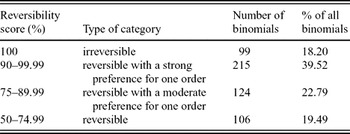
Of the 544 binomials in the file, 99 (18.20 per cent) have a reversibility score of 100, meaning that they never occur in the reverse order. As many as 314 (57.72 per cent) have a score of over 90, meaning that they occur in the more frequent order in more than 90 per cent of cases, and 72.24 per cent of all binomials in the data have a score of over 80. These figures show that while only a small minority of binomials is entirely frozen, most binomials have a more or less strongly preferred order. In addition, it needs to be mentioned that the size of the group of irreversible binomials may even be overestimated here, since binomials that in reality have a very high preference for one order may, by chance, appear to be frozen in our corpus – larger corpora might well yield instances of the reverse order that does not occur in the BNC.
For the analysis of the interaction between reversibility and adherence to ordering constraints in section 4 it is conducive to divide the binomials into categories of reversibility. While it is of course possible to simply divide them into equally large groups (e.g. quartiles), a different categorisation is proposed here, with admittedly arbitrary cut-off points, which do, however, intuitively make sense. The author thought it indispensable, firstly, to maintain the group of freezes as a separate category. In the rest of the file, dividing lines were drawn at reversibility scores of 90 per cent and 75 per cent, giving us categories of what will be called binomials with a strong ordering preference (scores of 90–99.99 per cent), binomials with a moderate ordering preference (scores of 75–89.99 per cent) and binomials which are relatively reversible (scores of 50–74.99 per cent). The categories are summed up in table 1.
Reversibility categories and their representation in the sample from the BNC

Previous literature, by concentrating mainly on freezes, has thus neglected the majority of binomials. Future research ought to be directed towards finding the factors that distinguish more or less reversible binomials from frozen ones. The present study contributes to this agenda by addressing the question of whether the satisfaction or violation of certain semantic, metrical, phonological and frequency principles plays a role. These principles are described in the following section.
3 Constraints on the ordering of binomials
3.1 Review of previous work
Explanations for the specific order in which binomials are typically encountered have been given for more than a century. For example, Behaghel (Reference Behaghel1909) introduced the rule that shorter words are placed first (in what will be called the ‘A’ slot in this article) in the binomial. The principle is accordingly known as Behaghel's law (originally ‘das Gesetz der wachsenden Glieder’, literally translated as ‘the law of increasing constituents’; Behaghel Reference Behaghel1909: 139), yet Behaghel emphasises that this law is not absolute, but rather a strong statistical tendency. For example, in a small corpus of German prose, he counts 72 coordinations that comply with the rule, compared to eleven violations. As we will see in the following, none of the ordering principles that have since been postulated is able to claim compliance from the complete class of English binomials either.
All sources after Behaghel's contribution that suggest ordering principles for binomials incorporate syllable number as one of the possible constraints, but frequently introduce further formal (phonological or metrical) constraints, as well as a new class of constraints, those based on semantics. Abraham (Reference Abraham1950) discusses syllable number as a factor, but emphasises semantic factors in that
the desirable usually precedes the undesirable, the more important the less important, the light the dark, the masculine the feminine, the positive the negative, the principal the subsidiary, the greater the smaller, the near the far, the top the bottom, the present the future. (1950: 284)
Similarly, Malkiel (Reference Malkiel1959) names word length as a formal constraint and adds three further semantic-pragmatic ones: chronological priority, social priority and the priority of the stronger of two polarised traits.
All semantic ordering principles have famously been subsumed under one general rule by Cooper & Ross (Reference Cooper, Ross, Grossman, James San and Vance1975), which they term the ‘Me First’ principle: ‘First conjuncts refer to those factors which describe the prototypical speaker (whom we will sometimes refer to as “Me”)’ (1975: 67). The ‘Me First’ principle includes among others the precedence of what is here and now, of adults and of men, but also of what is positive, animate, agentive, living, friendly and patriotic (as in cowboys and Indians versus Indians and cowboys). Cooper & Ross (Reference Cooper, Ross, Grossman, James San and Vance1975: 79) are also the first authors to provide phonological ordering constraints other than the number of syllables. All in all, they introduce seven principles presented in a hierarchy from strong to weak, established through the analysis of a sample of irreversible binomials: (1) word A has fewer syllables than word B, (2) the vowel in A is shorter than the one in B, (3) A displays fewer initial consonants than B, (4) if both A and B have only one initial consonant, this is more obstruent in B, (5) the vowel in A is more front than the one in B, (6) A has fewer final consonants, and (7) if both A and B have only one final consonant, this is less obstruent in B. Ross (Reference Ross1980: 46) has since modified criterion (6) to predict more final consonants in A. Criterion (5), predicting more back vowels in slot B, has been doubted by Ross (Reference Ross1980: 45), who is uncertain whether vowel height or a combination of vowel height and vowel backness (front vowels preceding back vowels, but within the back vowels, high vowels preceding low vowels) describes the data best. Recently, Benor & Levy (Reference Benor and Levy2006) have additionally proposed a number of phonological constraints, mainly representing their hypothesis that B will be more stressed than A, which will be discussed in more detail in section 3.2, listing the ordering principles researched in the present study.
While the proposed ordering constraints were conceived by comparing different binomials and analysing which potential rules are complied with or violated in a majority of cases, an empirical, quantitative test of each individual rule's strength is of course desirable, and has fortunately been undertaken by Fenk-Oczlon (Reference Fenk-Oczlon1989), Sobkowiak (Reference Sobkowiak1993) and Benor & Levy (Reference Benor and Levy2006). Fenk-Oczlon and Sobkowiak both analysed a list of apparently irreversible binomials which they adopted from previous treatments on freezes, while Benor & Levy base their work on corpus data. Fenk-Oczlon (Reference Fenk-Oczlon1989) focuses on the role of word frequency as an ordering factor, which correctly predicts the order of 84 per cent of the binomials in her data (the remaining 16 per cent being accounted for by iconicity). She suggests that frequency actually underlies many other proposed ordering constraints such as unmarked before marked or short before long, and should thus replace the other constraints. Sobkowiak (Reference Sobkowiak1993), analysing to some extent the same data as Fenk-Oczlon, prefers to subsume his results under the primary constraint of unmarked before marked, of which frequency is just one facet in his view. In fact, using a different word frequency list than Fenk-Oczlon, he arrives at a success rate for the frequency constraint of only 64 per cent. He finds three constraints to be significant: words in slot A are more frequent than the ones in slot B, they are shorter and contain more voiceless obstruents (he argues that obstruents are phonologically unmarked as opposed to sonorants).
The common disadvantage of both Fenk-Oczlon's and Sobkowiak's studies is not that they examine only freezes – this is a perfectly valid undertaking, even though (as the present analysis will show) it is interesting to compare irreversible binomials to more reversible ones. The drawback lies in the fact that they, like the authors before them researching binomials non-quantitatively, do not establish empirically whether a certain binomial is indeed irreversible. Instead, lists of binomials that were once intuitively categorised by one linguist as a freeze have been handed down the decades. The first quantitative study to break this pattern is Benor & Levy's (Reference Benor and Levy2006), which, being directly comparable to the first part of the present analysis, will be discussed in more detail in section 3.2 below. However, their meticulous analysis of corpus-derived binomials across a broad range of ordering constraints does not address the differences between more and less reversible binomials either. Instead, they analyse binomials irrespective of their reversibility status, since they do not assume this factor to play a role: ‘If the principles posited by Cooper and Ross (Reference Cooper, Ross, Grossman, James San and Vance1975) to govern frozen-binomial order are productive, they should also be evident among nonfrozen binomials’ (Benor & Levy Reference Benor and Levy2006: 234). However, there may be a factor that explains the distribution of binomials along the reversibility cline. We hope to show that this factor is differential adherence to ordering principles.
Finally, it needs to be mentioned that different constraints have also been tested psycholinguistically, by asking subjects which order they prefer or which sounds more natural to them. Tests like this have been conducted by Bolinger (Reference Bolinger1962) on the avoidance of ultimate stress in binomials, Pinker & Birdsong (Reference Pinker and Birdsong1979) and Oden & Lopes (Reference Oden and Lopes1981) on all of Cooper & Ross's (Reference Cooper, Ross, Grossman, James San and Vance1975) phonological principles, Oakeshott-Taylor (Reference Oakeshott-Taylor1984) on vowel quantity and vowel quality and Parker (Reference Parker2003) on sonority. Their results are considered in the following section whenever appropriate, but studies on authentic language material are considered to be of more relevance to the present study, focusing on the same type of data. Nevertheless, the psycholinguistic experiments on artificial binomials of the type gligy and glagy or boof and kaboof (Pinker & Birdsong Reference Pinker and Birdsong1979: 501) are valuable in that they allow us to examine the effects of individual constraints purely, without skewing effects from other constraints, thus giving us good theoretical models of constraint hierarchies which can then be tested on real binomials.
Having briefly reviewed the history of research on principles that are thought to govern the ordering in binomials, let us now proceed to an empirical test of these principles, firstly based on our whole sample of irreversible and reversible binomials alike (replicating to some extent Benor & Levy's Reference Benor and Levy2006 study), and secondly focusing on the influence of reversibility on the adherence to the principles (or vice versa).
3.2 The ordering constraints
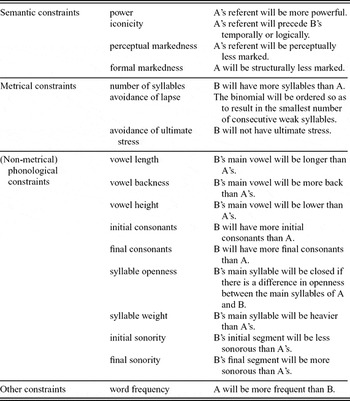
The ordering constraints previously assumed to govern binomial order were proposed and tested on the basis of anecdotal lists of binomials and have only more recently been subject to analysis on a quantitative basis. The most comprehensive study to do so is Benor & Levy (Reference Benor and Levy2006), both in terms of the sheer amount of possible ordering factors researched and the multitude of statistical procedures applied. In fact, since all the ordering constraints that have been discussed in the relevant literature are covered by Benor & Levy, their list will be adopted in the present study, apart from a few exceptions, which will be explained in the following. Following Müller (Reference Müller1997), the constraints are divided into semantic, metrical and (non-metrical) phonological ones.
3.2.1 Semantic constraints
Power. The power constraint predicts that the element whose real-world referent is the more powerful or central in society appears first, in slot A. It has formerly been suggested by Malkiel (Reference Malkiel1959: 145), and by Cooper & Ross (Reference Cooper, Ross, Grossman, James San and Vance1975: 65) as part of their semantic ‘Me First’ principle. Classic examples given here include pairs of people of different genders (the male is mentioned first, as in men and women) or different age groups (the older is mentioned first, as in mother and child), as well as object pairs in which the object more central to society receives the first slot (e.g. food and drink).
Iconicity. The iconic sequencing constraint, iconicity in short, predicts that if the real-world referents of the two elements can be perceived to be in some chronological or cause-and-effect order, the linguistic elements will retain this order in the binomial, as predicted by Malkiel (Reference Malkiel1959: 143). Examples from the BNC include born and bred, trial and error and spring and summer.
Perceptual markedness. The perceptual markedness constraint predicts that semantically less marked elements precede more marked ones. Perceptual markedness is a further component of Cooper & Ross's (Reference Cooper, Ross, Grossman, James San and Vance1975: 67) ‘Me First’ principle that Benor & Levy (Reference Benor and Levy2006: 238) have chosen to analyse independently, applying Mayerthaler's (Reference Mayerthaler1981) categories of perceptual markedness (e.g. animate before inanimate, positive before negative, concrete before abstract, front before back, above before below). Benor & Levy (Reference Benor and Levy2006: 238) here also include Cooper & Ross's (Reference Cooper, Ross, Grossman, James San and Vance1975: 65) categorisation of proximal before distal, which would explain the ordering of binomials of the type Britain and America in the BNC. Further examples that conform to the perceptual markedness constraint in the present data are head and shoulders, direct and indirect and top and bottom.
Formal markedness. The formal markedness constraint is the only purely linguistic of the semantic constraints, predicting the formally less marked element to appear in slot A. Benor & Levy (Reference Benor and Levy2006: 237), following Battistella (Reference Battistella1990), posit that
[l]ess marked items tend to: a. have a broader, more general meaning; b. have a greater freedom of distribution; c. have a larger number of subcategorical distinctions; d. be structurally more simple.
In practice, the formal markedness constraint serves to predict the binomial order of near-synonymous pairs. BNC examples include: tried and tested, rules and regulations and health and fitness.
3.2.2 Metrical constraints
Number of syllables. The syllable number constraint predicts that the element in slot A has fewer syllables than the one in slot B. This is one possible operationalisation of Behaghel's law (Reference Behaghel1909), which has been reiterated by Malkiel (Reference Malkiel1959: 149). The reasoning behind such a constraint of word length is typically a striving for end weight. Consider examples from the BNC such as assets and liabilities, past and present and out and about.
Avoidance of lapse. The lapse avoidance constraint stipulates that the binomial will be ordered in the way in which we find the smallest number of consecutive unstressed syllables. It is linked to Jespersen's (Reference Jespersen1905: 233) claim that disyllabic words will follow monosyllabic ones in order to maintain a regular rhythm, but of course lapse avoidance has been discussed more generally in phonological theory as well (e.g. Selkirk Reference Selkirk1984). Examples of binomial orders that minimise the number of consecutive weak syllables in the data are part and parcel, strengths and weaknesses and economic and monetary.
Avoidance of ultimate stress. This constraint predicts that an order that avoids element B to have a final stressed syllable will be chosen over one that does entail ultimate stress. Bolinger (Reference Bolinger1962) introduced the constraint, arguing on the basis of experimental evidence that in adnominal binomials ultimate stress will be avoided in order to prevent lapse with the following elements. This explanation may not hold generally since binomials are in fact often found towards the end of the sentence (Gustafsson Reference Gustafsson1975: 37, 41), but indeed the principle applies to many examples in the BNC, e.g. time and energy, gas and electricity and intents and purposes.
3.2.3 (Non-metrical) phonological constraints
Vowel length. The vowel length constraint predicts that the vowel of the primarily stressed syllable is longer in slot B than in slot A. Cooper & Ross (Reference Cooper, Ross, Grossman, James San and Vance1975: 71) view this as the second most important phonological ordering factor (after number of syllables). Benor & Levy (Reference Benor and Levy2006: 244) generally hypothesise that B will bear greater stress than A and connect vowel length to this hypothesis. Vowel length is here categorised phonemically. Examples for binomials with a longer vowel in the B slot are rank and file, fisheries and food and books and articles.
Vowel backness. The vowel backness constraint predicts the vowel of the primarily stressed syllable of B to be more back than that of A. The constraint is disputed since the openness of vowels may in some cases be confounded with vowel backness. Therefore, Benor & Levy (Reference Benor and Levy2006: 246) suggest that both vowel backness and vowel height independently need to be tested as potential constraints. The following vowels are considered to be back: /uː, ʊ, ɜː, ɔː, ˄, ɒ, ɑː, əʊ, aʊ, aɪ, ɔɪ, ʊə/ all others as non-back. Examples from the data include: inner and outer, regional and local and women and girls.
Vowel height: The vowel height constraint predicts that the vowel of the primarily stressed syllable of B is lower than that of A. The hierarchy from high to low is here taken to be /iː, uː, ɪ, ʊ, ɪə, ʊə/ > /e, ɔː, ɜː, eə, eɪ, əʊ/ > /æ, ˄, ɒ, ɑː, ɔɪ, aɪ, aʊ/ e.g. horse and cart, hip and thigh and deaf and dumb.
Initial consonants. The initial consonant constraint predicts that B will have more initial consonants than A. This constraint is again one of Cooper & Ross's (Reference Cooper, Ross, Grossman, James San and Vance1975: 75), exemplified by words and phrases, coal and steel and ups and downs.
Final consonants. The final consonant constraint predicts that B will have more final consonants than A. In this constraint, we follow Benor & Levy (Reference Benor and Levy2006: 248), who argue for more final consonants in B on the basis that it is compatible with their hypothesis of greater stress for B, also citing Pinker & Birdsong's (Reference Pinker and Birdsong1979) experiment as backup. Cooper & Ross (Reference Cooper, Ross, Grossman, James San and Vance1975: 71) predict the opposite, A having more final consonants. Examples in which B indeed has more final consonants are design and development, policy and resources and for and against.
Syllable openness. The syllable openness constraint predicts that the primarily stressed syllable of B will be closed and A's will be open if there is differential syllable openness in the two slots. This is a constraint introduced by Benor & Levy (Reference Benor and Levy2006: 248) as part of their prediction that B generally attracts greater stress. Examples from the BNC in alignment with this constraint are: profit and loss, beginning and end and day and age.
Syllable weight. The syllable weight constraint predicts that B's primarily stressed syllable will be heavier than A's. Again, this criterion is new in Benor & Levy's (Reference Benor and Levy2006: 249) work, implying greater stress of B. Non-heavy syllables are assumed to contain short vowels in the nucleus and only ambisyllabic consonants in the coda; heavy syllables contain either short vowels and non-ambisyllabic consonants or long vowels without a coda, while extra-heavy syllables consist of long vowels with one or more consonants in the coda. As for syllable openness, syllable boundaries were established according to the maximum onset principle. Examples for heavier main syllables in B include: May and June, City and Guilds and before and after.
Initial sonority. The initial sonority constraint predicts that B's initial segment is less sonorant than A's, following Cooper & Ross (Reference Cooper, Ross, Grossman, James San and Vance1975: 71) and Pinker & Birdsong (Reference Pinker and Birdsong1979: 506). The sonority hierarchy adopted by Benor & Levy (Reference Benor and Levy2006: 250) lacks fine-grained distinctions, especially between voiced and voiceless consonants, so Parker's (Reference Parker2003) experimentally based sonority hierarchy is applied here: vowels > /h/ > /j,w/ > /r/ > /l/ > nasals > voiced fricatives > voiceless fricatives > voiced stops and affricates > voiceless stops and affricates. This results in complying cases such as here and there, bits and pieces and fish and chips.
Final sonority. The final sonority constraint predicts B's final segment to be more sonorant than A's. Again, this constraint was suggested by Cooper & Ross (Reference Cooper, Ross, Grossman, James San and Vance1975: 71), accounting for examples such as well and truly, rich and famous and as and when.
3.2.4 Other constraints
Word frequency. The word frequency constraint predicts that the individual word frequency of A will be higher than that of B. Fenk-Oczlon (Reference Fenk-Oczlon1989), as mentioned above, proposes that most constraints apart from iconicity may in fact be accounted for by an underlying preference for the more frequent element to occur first. Word frequency in this study is based on the word form frequency collected from the BNC. Examples illustrating the constraint in the data include: time and effort, up and down and small and medium-sized.
Finally, three constraints that Benor & Levy researched were omitted in the present analysis. Alphabetic order was tested, but was found to accurately predict binomial word order in less than 50 per cent of cases, and was disregarded for further analysis, not least because it is a theoretically implausible constraint. Secondly, Benor & Levy included the phonetic length of the main vowel as a second way of measuring the vowel length constraint, but since they subsequently found (Reference Benor and Levy2006: 255) a very high intercorrelation between phonetic and phonemic length, the analysis was here restricted to just one of the two measures. Thirdly, Benor & Levy (Reference Benor and Levy2006: 241) named a fifth semantic constraint, which they termed the pragmatic constraint, to account for cases in which a word appears in the A slot because it has recently occurred (outside the binomial formula) in the context. However, this factor operates on the level of individual tokens of binomials, while the present analysis focuses on binomial types only (the 544 types in our sample are represented by over 85,000 tokens, Benor & Levy's 411 types are represented by 692 tokens).
All the constraints presently analysed are summed up in table 2.
Summary of ordering constraints

3.3 Ordering constraints empirically tested
Benor & Levy's (Reference Benor and Levy2006) study serves as a yardstick for the first part of the present analysis, gauging the influence that the different potential ordering constraints have on the actual order of binomials as found in the BNC. However, apart from the fact that Benor & Levy ignore the dimension of the reversibility of binomials, which will be the main focus of section 4, a critical point needs to be made regarding their data selection. Benor & Levy (Reference Benor and Levy2006: 235) base their analysis on data from three corpora: the spoken Switchboard Corpus, the written Brown Corpus and the written Wall Street Journal Corpus, totalling approximately 5 million words of American English. All in all, the corpora contained 3,680 different binomials of the types ‘N and N’, ‘V and V’, ‘Adj and Adj’ and ‘Adv and Adv’, out of which the authors selected 411 binomials for analysis. The selection of binomials did not proceed according to frequency (as is the case in the present study) or randomly. Instead, Benor & Levy used ‘the beginnings and ends of each corpus's search results’ (Reference Benor and Levy2006: 235), unfortunately not further clarifying the selection criteria or how they arrived at the number of 411 types to be analysed.
A replication of Benor & Levy's (Reference Benor and Levy2006) analysis is thus called for, this time based on the most frequent binomials to be found in a representative corpus of British English (all binomials that occur fifty times or more in the BNC; see section 2). In the following, the results of this analysis are presented, evaluating the success rates of the different ordering constraints in predicting the preferred order of binomials and presenting a rough hierarchy of constraints. Section 4 will then go beyond this constraint hierarchy (and beyond what Benor & Levy Reference Benor and Levy2006 focused on), considering the link between constraint adherence and the reversibility scores of binomials.
3.3.1 Findings: success rates of constraints compared
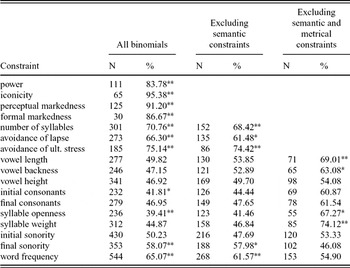
The most important results concern the success rates of the individual constraints, i.e. the extent to which they correctly predict the binomial order that is the more frequent one in the BNC. The procedure was to code for each binomial whether its preferred order was aligned with the constraint or not. In many binomials, however, a constraint was not active at all, i.e. was unable to predict an order in the first place. For example, the power constraint cannot predict the order of a binomial such as when and how or intents and purposes, and is thus considered to be inactive in cases like these. Likewise, a phonological constraint such as the vowel length constraint (B's main vowel will be longer than A's) is inactive when the main vowels of both A and B are either short or long (bread and butter, day and night). In fact, the only ordering constraint that was active for all the binomials in the sample was word frequency. Thus, the success rates computed for each constraint and reported in table 3 are based on those binomials in which the constraint is active, the number of which is given in the table as N. The success rate (% in the table) gives the percentage of aligned binomials among those for which the constraint was active. Levels of significance were received, following Benor & Levy (Reference Benor and Levy2006: 251) for the sake of comparability, from a test for binomial distributionFootnote 2 with a parameter of 0.50 (meaning that the null hypothesis assumes a symmetric binomial distribution with a success rate of 50 per cent for all constraints).
The success rates of the ordering constraints

Notes: N = number of binomials in which the constraint is active; % = percentage of cases in which the constraint predicts the actual order correctly; **p<0.01, *p<0.05.
The left-hand double column of table 3, which shows success rates for all constraints based on all binomials in the sample, indicates that the semantic factors lead the ranking, as was expected from Cooper & Ross's (Reference Cooper, Ross, Grossman, James San and Vance1975) and Müller's (Reference Müller1997) predictions, as well as from Benor & Levy's (Reference Benor and Levy2006: 252) results. Iconicity is almost always observed (a 95 per cent success rate), followed by perceptual markedness, formal markedness and power, all of them highly significant. The three metrical constraints follow in the ranking, all with highly significant results, well above a 50 per cent success rate. Word frequency is next in the list with a success rate of 65 per cent, and the different phonological constraints are grouped at the bottom of the ranking, with seven out of nine not even exceeding the 50 per cent threshold, which means that they are violated more often than they are adhered to in the data. All in all, the hierarchy of semantic before metrical before phonological constraints is even more clearly demonstrated here than in Benor & Levy's table, where semantic and metrical factors are not clearly divided.
Since the semantic factors appear to be so prominent in the ordering of binomials, Benor & Levy sensibly suggest also analysing those cases in which binomial order is not semantically motivated, in order to find true hierarchies of the other constraints. Excluding all binomials that are aligned with one or more semantic factors (see the middle double column of table 3), however, does not increase the success rates for the metrical constraints and does not overall and markedly increase the success rates for the phonological constraints. However, if both semantically and metrically aligned binomials are excluded, the success rates for the phonological factors improve drastically, with all but one passing the 50 per cent threshold. This means that semantic and metrical factors operate at the same (highest) level, even though semantic constraints appear to trump metrical ones. It may also be that the word frequency constraint operates on this same level, as its success rate decreases as semantic and metrical principles are excluded – this will be examined further below. The phonological principles, on the other hand, clearly operate on a subordinate level and only have influence on binomial order in the absence of the other, more important factors. The only phonological constraint that loses explanatory power as higher-ranking constraints are excluded is final sonority. This, however, is due to the fact that it is highly significantly intercorrelated with all three metrical factors. Consequently, final sonority ought probably not to be considered as a constraint in its own right.
One note regarding the influence of word frequency needs to be made. As mentioned above, Fenk-Oczlon (Reference Fenk-Oczlon1989) saw word frequency as the main factor driving binomial order, accounting for 84 per cent of the freezes she considered. In the ranking according to success rates computed here, however, frequency merely lies in the middle, with all semantic and metrical factors predicting binomial order better. This difference is easily explained. Fenk-Oczlon analysed her data not in terms of success rates, but in terms of the absolute number of binomials that were aligned with any specific constraint. If the same were to be done with the present data, word frequency would indeed win the first spot in the ranking, followed by initial sonority, number of syllables and final sonority. Such a ranking, however, strongly reflects the degree of activity of a constraint. In our data, the word frequency constraint correctly predicts the preferred order in 354 binomials. The iconicity constraint, as an opposite example, only predicts the preferred order correctly in 62 binomials. According to Fenk-Oczlon's measure, word frequency would thus far better explain binomial order than iconicity. Here, however, as in Benor & Levy (Reference Benor and Levy2006), the success rate is seen as a more reliable measure for ranking constraints. In our data, word frequency is active for all 544 binomials, so that alignment in 354 cases also means that only 65 per cent of active cases are correctly predicted. Iconicity correctly predicts the preferred order for 95 per cent of the 65 binomials in which it is active, which is here seen to be the more decisive measure. Therefore, we conclude that Fenk-Oczlon, by considering absolute numbers of constraint alignment, may have overstated the importance of word frequency. Furthermore, Fenk-Oczlon postulated that the other proposed constraints are merely an epiphenomenon of the underlying factor of word frequency. If this were the case, then word frequency ought to be highly significantly intercorrelated with the other constraints (even though the direction of influence would still not be ascertained). In our data, word frequency is only significantly correlated with two other principles: formal markedness (r = 0.61, p = 0.00**), which is unsurprising since one criterion of formal unmarkedness is greater frequency, and the number of syllables (r = 0.2, p = 0.00**), which is a reflection of Zipf's law (Zipf Reference Zipf1936: 38; shorter words are more frequent). All in all, the superior role that Fenk-Oczlon accorded the word frequency constraint cannot be confirmed.
3.3.2 Findings: ranking constraints hierarchically
The hierarchical ordering of semantic before metrical before frequency before phonological constraints that becomes visible in the table of success rates (table 3) is also confirmed by an analysis of clash cases, i.e. of those binomials which violate one principle but satisfy another. If clashes between two constraints are in the majority of cases resolved in favour of one principle, then this is concluded to rank higher in the hierarchy.
Beginning at the top of the hierarchy, clashes between semantic factors are very rare. The only four cases all involve gender pairs which from the perspective of power should place the male first, but from the perspective of perceptual markedness place the female first, in the cases of Mum and Dad, Mummy and Daddy and mother and father because the mother is typically more central in the parental role, and in the case of bride and groom because the bride is more salient in a wedding. As power is the only semantic criterion that is trumped by another semantic criterion, and also has the lowest success rate among them, the hierarchy is assumed to begin as in (1):
(1) iconicity, perceptual markedness, formal markedness > power
The data also show that when semantic and metrical ordering factors clash (a binomial is not aligned with any metrical constraint, but aligned with one or more semantic ones and vice versa), it is the semantic factors that more frequently account for the observed preferred order of the binomial. Of the 45 clash cases, 34 are resolved in favour of the semantic constraints, and only 11 in favour of the metrical ones, again demonstrating the primacy of semantic factors. Regarding the clashes between metrical constraints, there were 20 cases (excluding all semantically aligned binomials), which do not, however, lead to a straightforward ranking of the metrical factors, since the pairs of constraints exhibit almost equal numbers of winning and losing clashes against each other. The hierarchy is thus assumed to continue with the three metrical constraints grouped together as in (2) (unlike in Benor & Levy's (Reference Benor and Levy2006: 263) analysis, in which avoidance of ultimate stress clearly trumps number of syllables, which in turn clearly trumps avoidance of lapse).
(2) iconicity, perceptual markedness, formal markedness > power > number of syllables, avoidance of lapse, avoidance of ultimate stress
Moreover, word frequency is also included on the same level as the metrical constraints as in (3) since the 66 clash cases are resolved in favour of metrical factors 34 times, and in favour of frequency 32 times, the difference being insignificant. Word frequency, is however, clearly subordinate to the semantic factors (87 out of 99 clashes are won by semantic constraints).
(3) iconicity, perceptual markedness, formal markedness > power > number of syllables, avoidance of lapse, avoidance of ultimate stress, word frequency
A parallel clash case analysis for the phonological constraints was of course also conducted, but a hierarchy is harder to assemble here due to the high number of principles involved with some criss-crossing of patterns. Several hierarchy models were tested and the one with the least fine-grained distinctions was found to violate the smallest number of clash-resolving patterns. This model distinguishes two groups of phonological variables, as in (4), and is confirmed by the fact that the three lowest-ranked principles (vowel height, initial sonority and final sonority) also exhibit the lowest success rates in table 3. The complete hierarchy presented in (4) was also tested by pairwise t-tests of all constraints, showing that the differences in predicting binomial order between constraints on the same hierarchy level are not significant, but those between constraints on different hierarchy levels are.
(4) iconicity, perceptual markedness, formal markedness > power > number of syllables, avoidance of lapse, avoidance of ultimate stress, word frequency > syllable weight, vowel length, syllable openness, vowel backness, final consonants, initial consonants > vowel height, initial sonority, final sonority
This hierarchy roughly confirms Benor & Levy's (Reference Benor and Levy2006: 263) similarly derived hierarchyFootnote 3 in which the semantic factors precede all metrical ones, followed by frequency, initial consonants and all other factors. Their ranking of the initial consonants constraint as the primary phonological principle, however, is questioned by the data presented here. To sum up, if the two elements of a binomial may be ordered according to the semantic factors of iconicity, perceptual markedness or formal markedness, and to a slightly lesser degree also power, they will in all likelihood be. If semantic factors do not apply, metrical factors and/or word frequency will decide on the order that is more likely. Finally, only in the absence of the higher-ranking principles may phonological factors take over. Here, constraints connected with syllable structure generally outrank those concerned with phonetic quality, which indeed are almost as frequently violated as they are satisfied and might therefore be excluded from a list of true ordering principles.
4 Ordering constraints and reversibility
Section 2 has shown that among the most frequent binomials in the BNC we find only 18 per cent irreversible pairs, with the remaining 82 per cent being distributed on a cline of reversibility from complete exchangeability of elements to a very strong preference for one of the two possible orders. Malkiel (Reference Malkiel1959: 116) suggests that irreversible binomials are the result of freezing, a process which some reversible pairs may be undergoing currently to become future freezes. Cooper & Ross, the first proponents of a hierarchy of constraints governing binomial order (semantic factors in the form of the ‘Me First’ principle ranking before phonological constraints, which are in themselves hierarchically ordered), deem the constraints to play an important part in the freezing process:
principles such as . . . Me First, and the various other phonological and syntactic principles that will be developed below, are like adaptive mutations – traits which will assist any construction possessing them, to stand the test of time, to become conventional. (Cooper & Ross Reference Cooper, Ross, Grossman, James San and Vance1975: 70)
This would mean, then, that the more closely a binomial adheres to the constraint ranking, the higher its chances to attain irreversibility. Operationalising Cooper & Ross's hypothesis, we would expect to find the highest success rates for the constraints in the category of irreversible binomials, followed by binomials with a strong preference for one order, and then those with a moderate preference. We will test this assumption in what follows.
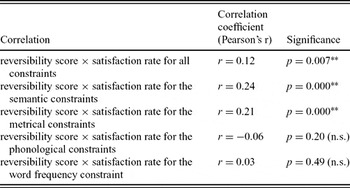
Before consulting success rates, however, consider the correlations between the reversibility score on the one hand and the satisfaction rates of the binomials on the other, as reported in table 4. The satisfaction rate represents the proportion of satisfied constraints among all active constraints for any given binomial. For example, four constraints are active in the binomial January and February. Three are satisfied (iconicity, initial sonority and word frequency), and one is violated (vowel height), giving us a satisfaction rate of 75 per cent. Satisfaction rates of this type were computed for all binomials regarding both all the constraints taken together and the different groups of constraints. Table 4 shows us that the correlation between reversibility and the general satisfaction rate is highly significant, but as the previous section has led us to expect, there are differences between the different constraint groups to be found. The correlations with both the satisfaction rates for semantic and metrical constraints are high and indeed as significant as they can be. However, the satisfaction rates of phonological constraints and of the word frequency constraint are not significantly correlated with the reversibility score at all (neither in the whole file, as reported here, nor when both semantically and metrically aligned binomials are excluded). Cooper & Ross's hypothesis thus witnesses a first corroboration: it does appear that binomials towards the irreversible end of the reversibility scale are better models of constraint satisfaction, at least as far as semantic and metrical constraints are concerned. Whether the other constraints are satisfied appears at first glance not to play a role.
Correlations between reversibility score and satisfaction rates for constraints

Concerning the correlations between reversibility score and the individual constraints, however, it is surprising that among the semantic constraints, only power is significantly correlated with reversibility (r = 0.43, p = 0.000**). All three metrical constraints are also highly significantly correlated with reversibility (number of syllables: r = 0.21, p = 0.000**; avoidance of lapse: r = 0.17, p = 0.005**; avoidance of final stress: r = 0.28, p = 0.000**), while word frequency is uncorrelated with reversibility, like all of the phonological constraints.
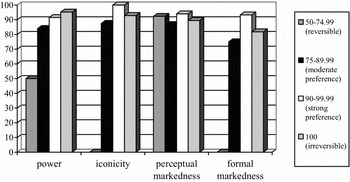
We will now look at the groups of constraints and their success rates across the four categories of reversibility (irreversible, reversible with a strong preference for one order, reversible with a moderate preference for one order, and reversible) individually, beginning with the semantic constraints. The question why only the power constraint exhibits a significant correlation with reversibility is answered by breaking up the success rates into reversibility groups (see figure 1). The power constraint is the only one that displays a clear increase in success rate towards the irreversible end of the scale, suggesting that adherence to the power constraint may indeed facilitate (or even cause?) freezing.
Success rates of semantic constraints in the four reversibility categories

The success rate of perceptual markedness, in contrast, fluctuates only marginally and insignificantly. It appears to have no influence on the reversibility status of a binomial, but is in all groups almost always satisfied. Ordering binomials according to perceptual markedness is thus a universal tendency that is hardly ever violated at all.
The remaining two semantic constraints, iconicity and formal markedness, exhibit parallel patterns. Both are not active in a single binomial in the reversible group, and they show a steep incline in success rate from the group with a moderate preference to the one with a strong preference, a trend line that is consistent with Cooper & Ross's hypothesis. What is not expected is that the irreversible group does not have the highest success rates for these two constraints – this will be discussed in more detail towards the end of the section. The empty columns for the reversible group in the two constraints point us to an important difference between iconicity and formal markedness on the one hand and power and perceptual markedness on the other. The latter two are equally active in all reversibility categories (measured as the percentage of binomials per category for which a constraint is either violated or satisfied), whereas iconicity and formal markedness both increase their activity sharply and continuously towards the irreversible group.
To sum up our results for semantic constraints so far: binomials ordered according to power are more likely to be frozen; if they are not ordered according to power, they are more likely to be more reversible. Perceptual markedness is a universal ordering factor unrelated to the freezing process. Binomials which may be ordered according to iconicity or formal markedness have an increased likelihood to be less reversible, and satisfaction of these two constraints is also related to a greater degree of frozenness (even if there is a slightly higher proportion of violations among the freezes).
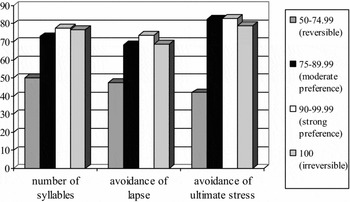
Let us now turn to the metrical constraints. Figure 2 again shows the success rates for each reversibility category, showing similar patterns for all three metrical constraints to those of iconicity and formal markedness. We see an increase in success rate from the reversible binomials to those displaying a preference for one order (differences between the moderate and strong preferences being very small), but again we find a small decline towards the irreversible category. Unlike iconicity and formal markedness, however, all three metrical factors are equally active in all four groups. The conclusion to be drawn, then, is that adherence to the metrical constraints is correlated with frozenness, even if there may be proportionately more violations among those binomials that are completely frozen.
Success rates of metrical constraints in the four reversibility categories

A further constraint that needs mentioning is, of course, word frequency. Its behaviour resembles most closely that of perceptual markedness, since the fluctuations of success rate across the reversibility categories are negligible (ranging from 62 to 66 per cent). It thus appears to be unrelated to the freezing process. The phonological factors, finally, have already been shown to not be significantly correlated with reversibility, and a closer look at how the success rates are distributed across the four categories, whether considering success rates for all binomials or only those that are not semantically or metrically motivated, confirms this fact. The fluctuations for the phonological factors across the reversibility groups are either not significant or represent haphazard patterns that are not repeated in any other constraint. The conclusion must thus be that phonological constraints are more often than not adhered to (if a binomial is not motivated by a higher-ranking constraint), but whether they are adhered to or not has no influence on the reversibility status of a binomial.
To sum up, then, one ordering constraint is clearly related to the reversibility status of binomials; this is the power constraint. Two further semantic constraints, iconicity and formal markedness, as well as the three metrical constraints (number of syllables, avoidance of lapse and avoidance of ultimate stress) also exhibit the expected trend lines, even if the irreversible group behaves somewhat unexpectedly (the reasons for which are discussed in the following paragraph). So far, we have been careful to report mere correlations between the degree of reversibility of binomials and their adherence to the constraints, yet now we would like to risk a statement on the potential direction of causation, even if this is not directly deducible from the mere fact that a correlation exists. Theoretically, two directions of causation may pertain between the reversibility score and the degree of adherence to the reported semantic and metrical constraints. Firstly, a higher degree of constraint adherence may cause a higher degree of frozenness, i.e. binomials that satisfy the relevant constraints have higher chances of freezing, as Cooper & Ross's (Reference Cooper, Ross, Grossman, James San and Vance1975: 70) hypothesis suggested in stating that the constraints are ‘traits which will assist any construction possessing them, to stand the test of time, to become conventional’. The second possibility would be for the higher degree of frozenness to cause a higher degree of constraint adherence. This, however, is inconceivable due to the simple fact that the degree of constraint adherence is a fixed characteristic of any binomial sequence and cannot be changed by a second factor. The reversibility score of binomials, on the contrary, is variable and may change over time. A third possibility would be for a third factor to be the real driving force behind both the rising degree of frozenness and the rising degree of constraint adherence. Again, no plausible factor presents itself, so that we are led to conclude that adherence to the power constraint as well as (to a lesser degree) of two other semantic constraints and three metrical constraints, facilitates or even causes freezing.
Finally, we need to speculate on why we find a pattern for five different constraints (iconicity, formal markedness, number of syllables, avoidance of lapse and avoidance of ultimate stress) in which an increasing trend line of constraint adherence from reversible to less reversible is followed by a decline for the irreversible group, which shows more violations than expected. How is this possible? One reason could be sampling errors, in that we may have included in the category of freezes some binomials which truly show a mere very strong preference which would only be picked up in larger-scale corpora (see section 2). However (or additionally), the answer may lie in the special composition of the group of freezes. First of all, some freezes may have attained irreversibility a long time ago and may thus preserve ordering preferences no longer active and/or no longer explicable today. For example, why it is that back and forth instead of forth and back became irreversible, violating both perceptual markedness and iconicity, but satisfying a number of phonological constraints (vowel length, vowel backness and syllable weight) can only be speculated about. A further explanation, put forward by Malkiel (Reference Malkiel1959: 153), is that some irreversible binomials may have entered the language as loan translations, being irreversible from the beginning, but preserving an order that is preferred in another language (e.g. milk and honey from Biblical Hebrew). Benor & Levy (Reference Benor and Levy2006: 269) additionally discuss the possibility that binomials may freeze as a result of popularisation from song lyrics or poems, in which the binomial order may be determined by formal requirements such as rhythm or rhyme. One final explanation that has so far remained unexplored is that the group of freezes (at least in the data analysed here) includes a number of technical terms or names whose order may originate from some bureaucratic hierarchy that is not always transparent to the linguist. These include City and Guilds, censuses and surveys, securities and investments and postage and packing, all either violating semantic constraints or, semantic constraints being inactive, metrical ones.
Whatever the precise explanation, the category of freezes certainly includes some idiosyncratic cases for which the ordering principles are less applicable. If we accept these as historical anomalies, however, and focus on the freezing process rather than on the final product, the freezes, then we can conclude that Cooper & Ross (Reference Cooper, Ross, Grossman, James San and Vance1975: 70) were right in suggesting a relationship between the satisfaction of ordering constraints and reversibility, even if only for some of the constraints.
5 Conclusion
The factors that govern the preferred order of binomials have long been the subject of linguistic discussion, as the overview in section 3.1 has shown. Large-scale corpora and modern quantitative methodology have made it possible to test the predictive value of those long-discussed factors empirically. Our findings here confirm previous studies in the conclusion that a clear hierarchy of constraints exists: semantic factors explain the preferred order of binomials to the greatest degree, followed by metrical ones, word frequency and some phonological factors. Analysing success rates of individual constraints and the resolution of clash cases, where different types of constraints predict different orders, has allowed for the suggestion of a clear constraint hierarchy which operates for binomials. The second focus of the article, however, was to introduce the so far neglected factor of reversibility into the discussion. It was shown in section 2 that the vast majority of binomials are not irreversible, even though most tend towards a preferred order. The hypothesis that reversibility is related to the satisfaction of the ordering constraints, first voiced by Cooper & Ross in Reference Cooper, Ross, Grossman, James San and Vance1975, could be confirmed for the constraints of power, iconicity, formal markedness, number of syllables, avoidance of lapse and avoidance of final stress. Why the group of freezes behaves slightly against the trend with somewhat more frequent violations of almost all of these constraints than expected was explained with reference to a number of special cases to be found in the category.
All in all, we hope to have shown convincingly that in discussing constraints on binomial order, the reversibility of binomials should not be disregarded. Less reversible binomials (like rich and famous) are more likely to satisfy important semantic and metrical constraints than more reversible ones (like knowledge and skills). Thus, for the first time, we have been able to gain some insight into the freezing process of binomial expressions. If we go further and view binomials as just one type of multi-word unit (which may be more or less frozen), we may be able to draw some general conclusions. It appears to be accepted wisdom in phraseological research that one important correlate of the frozenness of multi-word units is their frequency (Bybee Reference Bybee2005; Ellis Reference Ellis2002; Hoey Reference Hoey2005): the more frequently a multi-word unit is encountered, the more likely it is that it will become fixed in our mind and stored and processed as a single unit instead of as a free combination of words. This is likely to hold true for the special case of binomials as well, even though the concept of frequency should here be applied to the reversibility score: the more frequently a binomial is encountered in just the one sequence X and Y, but not the other, Y and X (i.e. the higher the reversibility score is), the more likely it is that sequence X and Y will become fixed in our mind and stored and processed as a single unit. As a consequence, we can assume that freezing is a self-energising process in the sense that once a certain threshold of reversibility score is reached, enough speakers will have internalised this sequence X and Y as a chunk and will produce it exclusively, so that in turn even more speakers are exclusively confronted with X and Y and internalise it as well – until it is completely frozen. This characterisation of the freezing process, however, fails to specify the original impetus that activates the process, tilting the scale, if ever so slightly, in favour of X and Y at the expense of Y and X. The present study has shown that at least one of these original factors, if not the original factor, is a certain degree of well-formedness according to semantic and metrical principles. To take up the question posed in the introduction: just why do we say rich and famous and not famous and rich?, we can now answer that the closer adherence to semantic and/or metrical principles by this binomial sequence has initiated a freezing process.