Ventricular septal defect and aortic arch obstruction are usually associated with a small left ventricular outflow tract.Reference Kreutzer and Van Praagh 1 This could be due to left ventricular outflow tract obstruction and left-to-right shunt at the atrial or ventricular level.Reference Krauser, Rutkowski and Phoon 2 The aims of the present study were to investigate the growth of the left ventricular outflow tract after ventricular septal defect and aortic arch repair, and to identify risk factors that may predict the need for future surgical repair of left ventricular outflow tract obstruction.
Materials and methods
All patients who underwent ventricular septal defect and aortic arch repair, either coarctation of the aorta or interrupted aortic arch repair, at King Abdulaziz Cardiac Center, Riyadh, Saudi Arabia, in the period between July, 2002 and June, 2013, were reviewed retrospectively.
Echocardiographic recordings and reports were reviewed at the time of diagnosis and at the last clinic visit or before the second surgical procedure if the patient required another surgical re-intervention for left ventricular outflow tract obstruction.
We measured the left ventricular outflow tract below the aortic valve, the aortic valve annulus, and the ascending aorta diameter in the parasternal long-axis view. The mitral valve annulus was measured in the apical four-chamber view at the hinge points. The pulmonary valve annulus was measured in the parasternal short-axis view.
The echocardiographic data were stored and analysed using Xcelera software (version 4.1), Philips, the Netherlands. The measurements were indexed on the basis of the built-in Z-score system in Xcelera. We also indexed the aortic valve annulus to body surface area, the aortic valve annulus to the pulmonary valve annulus, the left ventricular outflow tract area to body surface area, and the left ventricular outflow tract to the ascending aorta.
We evaluated the growth rate of the left ventricular outflow tract and the mitral valve and the need for re-intervention.
Data were expressed as means and standard deviations for normally distributed data and as medians with ranges for skewed data. All statistical analyses were performed using Statistical Package for the Social Sciences for Windows, version 16.0, Chicago, SPSS Inc.
Results
A total of 89 patients with ventricular septal defect and aortic arch obstruction – coarctation or interrupted aortic arch – were included in this study. At the time of surgery, the median age was 23 days (range 4–320 days). Only eight patients (8.9%) were operated after the age of 3 months. The mean weight was 3.2±1 kg (median 3.1 kg, range 1.9–8.9 kg). Among all, 42 patients (47%) were males, 63 cases (71%) had coarctation, and 26 cases (29%) had interrupted aortic arch (Table 1). Out of 63 patients, 28 cases (44%) with coarctation were repaired at two stages – initially aortic arch repair was carried out followed by ventricular septal defect closure. Only two of them had pulmonary artery banding at the time of arch repair. The median interval between arch repair and ventricular septal defect closure was 56 days (range 2–661 days). Fortunately, none of the patients died or were lost follow-up during the study period.
Type of required re-interventions.

IAA=interrupted aortic arch; LVOT=left ventricular outflow tract; VSD=ventricular septal defect.
A significant left ventricular outflow tract growth was noticed after repair of ventricular septal defect and aortic arch obstruction. Preoperatively, the mean left ventricular outflow tract Z-score was −1.46±1 (range −5.5 to 1.1) and increased to a mean value of −0.7±1.3 (range −2.7 to 3.2) at last follow-up (p=0.0001) (Fig 1).
Left ventricular outflow tract Z-score(LVOT-Z) and mitral valve Z-score (MV-Z) at diagnosis and at last follow-up. CI=confidence interval.

None of the patients had significant mitral valve hypoplasia at diagnosis. The mean mitral valve Z-score at diagnosis was −0.2±1 (range −2.8 to 1.8) and at last follow-up −0.56±1 (range −2.4 to 1.7) (p=0.013). Interestingly, the observed good left ventricular outflow tract growth was not accompanied by a similar rate of mitral valve growth (Fig 1).
Out of 89 patients, 22 (25%) had left ventricular outflow tract Z-scores less than −2 at the time of diagnosis. Among them, one patient had the smallest left ventricular outflow tract Z-score of −5.5, whereas the other 21 patients had Z-scores in the range of −2.1 to −3.4. Only three out of these 22 patients required surgical re-intervention. Surprisingly, 12 patients with left ventricular outflow tract Z-score less than −2.5 at the time of diagnosis showed good growth of their left ventricular outflow tract and did not require any surgical re-intervention. At the last follow-up of those 12 patients, the mean left ventricular outflow tract Z-score was −0.7±1.3 (range −2.1 to 3.1). This indicates good growth of the left ventricular outflow tract after primary repair in these patients with a small left ventricular outflow tract.
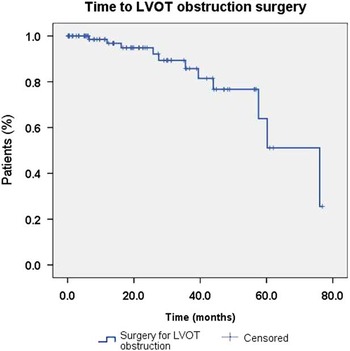
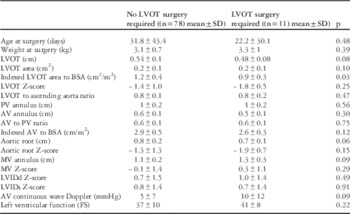
After primary repair, 11 patients (12.3%) required re-intervention with surgical repair for left ventricular outflow tract obstruction after a mean period of 36±21 months (median 35 months, range 6–76 months) (Fig 2). Only 3/11 patients had left ventricular outflow tract Z-scores less than −2 at the time of diagnosis. Their left ventricular outflow tract Z-scores were −2.4, −2.2, and −2.2, respectively. At the time of re-intervention, four patients had left ventricular outflow tract Z-scores less than −2, and the lowest was −2.7 (Tables 2 and 3).
Time interval between primary surgical repair and surgical re-intervention for left ventricular outflow tract (LVOT) obstruction.

Data before primary repair, comparing patients who required left ventricular outflow tract (LVOT) surgery after the primary repair for ventricular septal defect and aortic arch obstruction and those who remained free of surgery during follow-up.

AV=aortic valve; BSA=body surface area; FS=fractional shortening; LVIDd=left ventricular internal diameter during diastole; LVIDs=left ventricular internal diameter during systole; MV=mitral valve; n=number; PV=pulmonary valve.
Characteristics of 11 patients who required re-intervention for repair of left ventricular outflow tract (LVOT) obstruction (at the time of surgery).

AV=aortic valve; BSA=body surface area; FS=fractional shortening; LVIDd=left ventricular internal diameter during diastole.
The main reason for surgical re-intervention was left ventricular outflow tract obstruction with an estimated maximum echocardiographic peak instantaneous gradient of more than 60 mmHg; one patient had an estimated peak gradient of 40 mmHg, but he still underwent surgical re-intervention because of depressed left ventricle function. Surgical re-intervention was in the form of subaortic membrane resection in eight patients, modified Konno procedure in two patients, and modified Konno and aortic valve replacement in one patient.
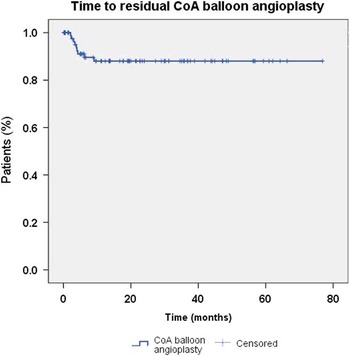
In our cohort, some of the patients required re-intervention for the aortic valve or the aortic arch. Among all, two patients (2.2%) required aortic valve balloon dilatation – one of them had a concomitant left ventricular outflow tract obstruction and underwent the modified Konno procedure. There were nine patients (10.1%) who had residual coarctation and required coarctation balloon dilatation after a median period of 3.9 months (range 2–9 months) (Fig 3). None of them required re-do surgical repair for residual coarctation, but 4/9 (44%) patients required re-do surgical repair for left ventricular outflow tract obstruction.
Time interval between primary surgical repair and re-intervention for residual coarctation (CoA).

There was no significant difference in the mean left ventricular outflow tract Z-score between those who required left ventricular outflow tract surgical repair and those who did not. The mean left ventricular outflow tract Z-score was −1.4±1 and −1.8±0.5 in those who were free from re-intervention and those who had surgical re-intervention, respectively (p=0.25). There were no significant differences between the two groups with regard to age, weight, aortic valve annulus, indexed aortic valve annulus to body surface area, aortic valve-to-pulmonary valve ratio, left ventricular outflow tract-to-ascending aorta ratio, and indexed left ventricular outflow tract area to body surface area (Table 2).
Discussion
This study reviewed a group of patients with a unique pathology of ventricular septal defect and aortic arch obstruction. These patients lack normal left ventricle growth due to left ventricular outflow tract obstruction and left-to-right shunt, at the atrial or the ventricular level.Reference Krauser, Rutkowski and Phoon 2 Kreutzer and Van PraaghReference Kreutzer and Van Praagh 1 described that posterior malalignment of the conal septum with a conoventricular septal defect is significantly more prevalent with interrupted aortic arch (93%) than with coarctation (47%), and considered this to be the anatomical cause of left ventricular outflow tract obstruction in this patient population. Similar findings in postmortem cases were reported by Shiokawa.Reference Shiokawa and Becker 3
Standardisation of the subaortic diameter has been accomplished by indexing it to the descending aortaReference Bove, Minich and Pridjian 4 – Reference Luciani, Ackerman, Chang, Wells and Starnes 6 and body surface areaReference Geva, Hornberger, Sanders, Jonas, Ott and Colan 7 , Reference Apfel, Levenbraun, Quaegebeur and Allan 8 or by calculating Z-scores.Reference Apfel, Levenbraun, Quaegebeur and Allan 8 , Reference Jonas, Quaegebeur, Kirklin, Blackstone and Daicoff 9 A small left ventricular outflow tract in these cases – ventricular septal defect and coarctation or interrupted aortic arch – can be crucial and challenging with regard to proper decision making for biventricular repair. Previous studies have suggested the possibility of postnatal growth of left-sided cardiac structures in patients with critical aortic stenosis and/or hypoplastic left ventricles.Reference Rhodes, Colan, Perry, Jonas and Sanders 10 – Reference Minich, Tani, Hawkins and Shaddy 12 In 55 cases of coarctation and small aortic valve or mitral valve with Z-score less than −2, there was significant growth of both the aortic valve and the mitral valve.Reference Puchalski, Williams, Hawkins, Minich and Tani 13 Left ventricular outflow tract growth was also reported after aortic arch repair and pulmonary artery banding.Reference Kawahira, Kishimoto and Iio 14 The growth of the left ventricular outflow tract was clearly demonstrated in our results as well; however, we did not observe significant growth of the mitral valve. Considering this significant growth of the left ventricular outflow tract after surgical repair for aortic arch obstruction with ventricular septal defect, biventricular repair may be considered in patients even when the left ventricular outflow tract Z-score is significantly below normal.
Many reports of small case series have tried to identify predictive risk factors associated with future left ventricular outflow tract obstruction after repair for ventricular septal defect and aortic arch obstruction – coarctation or interrupted aortic arch – by using the following parameters: aortic root size <6.5 mm,Reference Chen, Cubberley and Reyes 15 small aortic valve with an annulus <4.5 mm or Z-score less than −5,Reference Salem, Starnes and Wells 16 indexed left ventricular outflow tract cross-sectional area <0.7 cm2/m2,Reference Geva, Hornberger, Sanders, Jonas, Ott and Colan 7 small left ventricular outflow tract diameter,Reference Apfel, Levenbraun, Quaegebeur and Allan 8 left ventricular outflow tract-to-ascending aortic diameter ratio <0.6,Reference Iwahara, Ino and Nishimoto 17 and mitral valve Z-score less than −1.Reference Levine, Sanders, Colan, Jonas and Spevak 18 None of the above-listed parameters, however, was associated with higher incidence of left ventricular outflow tract obstruction in our patients (Table 2). Although indexed left ventricular outflow tract area to body surface area had a p-value of 0.03 in our data, this proved to be irrelevant when we performed the receiver operating characteristic test. The correlation was not high enough, as the area under the curve was only 0.7. This was also the finding by Sell et al.,Reference Sell, Jonas, Mayer, Blackstone, Kirklin and Castaneda 19 who could not identify any correlation between left ventricular outflow tract diameter and outcome after interrupted aortic arch and ventricular septal defect repair.
In another series of 38 patients with ventricular septal defect and interrupted aortic arch or coarctation, an aortic valve annulus smaller than the weight (kg) of the infant +1.5 mm was found to be a risk factor for future left ventricular outflow tract obstruction.Reference Hirata, Quaegebeur, Mosca, Takayama and Chen 20 In our sample, 9/89 (10%) patients had an aortic valve annulus less than “weight+1.5”, but only one patient underwent surgical repair for left ventricular outflow tract obstruction. Thus, statistically, it was difficult to link this parameter as a risk factor for future left ventricular outflow tract obstruction in our series.
After a thorough revision of all the variables in our patients, there was no definitive factor that could be identified as a predictive risk factor for future left ventricular outflow tract obstruction that would require surgical re-intervention. Further, the incidence of left ventricular outflow tract obstruction requiring surgery was only 12% in our patients, whereas this was reported to reach up to 30% of the patients in other series.Reference Apfel, Levenbraun, Quaegebeur and Allan 8
Limitations
The retrospective, descriptive nature of this study with a relatively small number of patients is a limitation. A multicentre study with a higher number of patients would probably allow stronger conclusions. Our archiving echocardiography system does not provide a Z-score for aortic valve annulus. Thus, we instead used the indexed aortic valve to body surface area and the ratio of the aortic valve to the pulmonary valve for our statistical analysis.
Conclusions
A significant left ventricular outflow tract growth is expected after repair for ventricular septal defect and aortic arch obstruction. In these cases, a small aortic valve and a small left ventricular outflow tract at diagnosis are not risk factors to predict the need of surgical re-intervention for left ventricular outflow tract obstruction in future.
Acknowledgement
Special thanks to Professor Talat Mesud Yelbuz for critical revision of this manuscript.
Financial Support
This research received no specific grant from any funding agency, commercial, or not-for-profit sectors.
Conflicts of Interest
None.