Emotional security theory posits that children's difficulties preserving a sense of security in the interparental relationship is a key process that explains how and why witnessing interparental conflict increases their vulnerability to psychopathology (Cummings & Davies, Reference Cummings and Davies1996; Davies & Cummings, Reference Davies and Cummings1994). Employing a variety of methodological designs (e.g., longitudinal, experimental, and daily diary), research has documented that interparental conflict is associated with subsequent increases in overt signs that children are concerned about their sense of security, including high levels of fearful distress, involvement, and avoidance responses to interparental conflict (e.g., Buehler, Lange, & Franck, Reference Buehler, Lange and Franck2007; Davies, Myers, Cummings, & Heindel, Reference Davies, Myers, Cummings and Heindel1999; Goeke-Morey, Papp, & Cummings, Reference Goeke-Morey, Papp and Cummings2013). In turn, these specific signs of insecurity have been shown to predict a wide array of subsequent psychological problems even after taking into account covariates and putative mechanisms in other theories (e.g., self-blame or hostility; e.g., Buehler et al., Reference Buehler, Lange and Franck2007; Davies, Harold, Goeke-Morey, & Cummings, Reference Davies, Harold, Goeke-Morey and Cummings2002; El-Sheikh, Cummings, Kouros, Elmore-Staton, & Buckhalt, Reference El-Sheikh, Cummings, Kouros, Elmore-Staton and Buckhalt2008). Despite the utility of emotional security as a risk mechanism, the conventional practice of creating linear, additive composites or latent constructs consisting of a wide array of inherently negative responses to interparental conflict hinders the ability to identify diverse patterns of children's reactions. According to the reformulated version of emotional security theory (EST-R; Davies & Martin, Reference Davies and Martin2013; Davies & Sturge-Apple, Reference Davies and Sturge-Apple2007), the modest to moderate magnitude of interrelationships among the various dimensions of children's responses to interparental conflict signifies the existence of qualitatively different profiles of children's security. Moreover, in helping to account for the vast array of negative sequelae associated with single linear composites of insecurity, research has shown that analyses of these higher order profiles of children's responding predict distinctive patterns of psychological functioning (Davies, Martin, Sturge-Apple, Ripple, & Cicchetti, Reference Davies, Martin, Sturge-Apple, Ripple and Cicchetti2015).
EST-R distinguishes between different patterns of child reactivity to interparental conflict that are concealed in the broad, linear composites of general insecurity. A primary assumption of EST-R is that children's concerns about security in the face of interparental conflict are largely organized by the social defense system (SDS), a behavioral system that developed over our phylogenetic history to identify social signals indicative of potential threat and organize behavioral strategies to neutralize interpersonal threat. Because relationship difficulties between parental figures can have threatening implications for children and the family as a whole, the SDS and its goal of protecting oneself from interpersonal harm is posited to organize children's response patterns to interparental conflict. Although virtually all children are conceptualized as having an SDS system designed to defend against interpersonal threat, individual differences in how the system operates to defuse threat are proposed to develop from different developmental conditions and have distinct repercussions for children's mental health. As a step toward delineating the developmental conditions underlying differences between children in SDS functioning, the goal of this study was to identify child temperament attributes that serve as precursors to these different profiles of responding to interparental conflict.
The pattern-based taxonomy in EST-R specifically distinguishes between four SDS profiles of reactivity based on both their form and function (Davies & Martin, Reference Davies and Martin2013, Reference Davies and Martin2014). First, the secure profile is designed to organize children's efforts to neutralize threat only in the context of clear, direct danger (e.g., interparental verbal aggression or high hostility, proliferation of distress to include the child). The secure pattern is characterized by the efficient coordination of SDS resources to contend with interparental challenges, balanced by open attention to social and exploratory opportunities as threats in the relationship subside. Thus, in the face of interparental conflict, secure children possess an underlying confidence that parents will effectively manage the dispute in a way that maintains family harmony. At a phenotypic level, the efficiency of the SDS is reflected in mild, well-regulated displays of negative affect, low impulses to regulate their exposure to the conflict, and quick resumption of normal (e.g., play) activities following any aversive bouts of interparental discord (Davies & Martin, Reference Davies and Martin2013). In support of the existence of this pattern of responding, research has identified a profile of responding to interparental and adult conflict characterized by mild distress, well-regulated involvement, and empathic concern (e.g., Davies & Forman, Reference Davies and Forman2002; Maughan & Cicchetti, Reference Maughan and Cicchetti2002).
Second, the mobilizing profile of responding is proposed to serve the function of investing considerable resources toward actively defending oneself while also remaining vigilant for limited opportunities to maintain social ties in the family (Trower, Gilbert, & Sherling, Reference Trower, Gilbert, Sherling and Leitenberg1990). For mobilizing children, behaviors designed to achieve these objectives are commonly expressed in demonstrative displays of vulnerability (e.g., fear or distress), conciliatory forms of involvement (e.g., caretaking), submissiveness, ingratiation, and/or overbright behavior (Davies & Sturge-Apple, Reference Davies and Sturge-Apple2007; Gilbert, Reference Gilbert, Sloman and Gilbert2000). Previous findings provide support for the occurrence of this pattern of responding to interparental conflict. For example, a consistent profile of responding to conflict characterized by prolonged, intense distress, involvement, and avoidance was identified in two separate samples using cluster analytic approaches (Davies & Forman, Reference Davies and Forman2002).
Third, the dominant pattern is designed to directly defeat the threat accompanying interparental conflict through the enactment of domineering tactics with parents (Davies & Martin, Reference Davies and Martin2013). Boldly confronting threat requires both a keen identification of aversive stimuli and the minimization of vulnerable emotions (e.g., fear or submissiveness). Thus, the dominant pattern and its function of confronting threat in a way that preserves or regains power in the family is commonly expressed through high vigilance, affective indifference, and demanding, coercive (e.g., aggression or hostility), and controlling behaviors (Dixon, Reference Dixon1998; Gilbert, Reference Gilbert2002). The existence of a dominant profile is supported by the empirical identification of a pattern of children's reactivity to interparental and adult conflict characterized by high levels of vigilance, hostility (e.g., aggression, insults), and coercive (e.g., demanding, controlling) behaviors (Davies & Forman, Reference Davies and Forman2002; Maughan & Cicchetti, Reference Maughan and Cicchetti2002).
Fourth, the function of the demobilizing profile is to reduce children's salience as targets of hostility from members of the social group (Gilbert, Reference Gilbert2001; Marks & Nesse, Reference Marks and Nesse1994; Sloman, Farvolden, Gilbert, & Price, Reference Sloman, Farvolden, Gilbert and Price2006). Behavioral indicators of this “lay low” strategy commonly include vigilance, camouflaging reactions (e.g., quiet disengagement or freezing), submissiveness (e.g., downward gaze or inexplicable smiling when attention of angry parents is directed toward them), and dysphoria (e.g., anhedonia, helplessness, lethargy, or downtrodden behaviors; Sloman et al., Reference Sloman, Farvolden, Gilbert and Price2006). Comparable patterns of responding to interparental or interadult conflict have been identified in prior research. For example, research on children's reactions to simulations of interadult anger has documented the existence of an “unresponsive” pattern that closely resembles high levels of camouflaging and submissive behaviors (Maughan & Cicchetti, Reference Maughan and Cicchetti2002). Likewise, previous studies indicate that dysphoric facial expressions, postural slumping, and fatigue are common responses of children coping with interparental conflict (e.g., Crockenberg & Langrock, Reference Crockenberg, Langrock, Grych and Fincham2001; Cummings, Goeke-Morey, & Papp, Reference Cummings, Goeke-Morey and Papp2003).
The existence of the four SDS profiles has been supported by preliminary research. For example, across two independent samples with different methodological designs, cluster analytic techniques of children's reactions to interparental conflict consistently yielded patterns of responding to interparental conflict that resembled (a) a secure profile characterized by minimal or mild distress and low levels of involvement in the conflicts; (b) a “dismissing” pattern that closely resembled the dominant strategy of exhibiting vigilance, anger, and coerciveness; and (c) a preoccupied style, which was consistent with the mobilizing pattern, consisted of children who experienced prolonged, intense distress, involvement, and avoidance. Additional research also supports the existence of demobilizing responses to interparental conflict that are reflected in dysphoric facial expressions, postural slumping, and the experience of sadness (Crockenberg & Langrock, Reference Crockenberg, Langrock, Grych and Fincham2001; Cummings et al., Reference Cummings, Goeke-Morey and Papp2003). As a first step toward testing the developmental value of the EST-R taxonomy, our previous research was designed to test its ability to more precisely predict the sequelae of children's responses to interparental conflict beyond the nondescript, pathogenic meaning of insecurity and its long list of negative outcomes. In highlighting the utility of EST-R, results of a multistudy investigation using observational assessments of children's reactivity supported hypotheses on the precise advantages and costs of the four SDS profiles (Davies et al., Reference Davies, Martin, Sturge-Apple, Ripple and Cicchetti2015). Whereas the secure profile predicted lower levels of psychopathology and greater social competence, children high in the dominant profile exhibited greater susceptibility to a bold, risky psychological orientation characterized by high externalizing problems and sociability. Although children high in mobilizing experienced comparable advantages of high sociability to the children who were more dominant, they exhibited a unique pattern of psychological problems characterized by emotional (i.e., internalizing), behavioral (i.e., externalizing), self-regulation, and social (i.e., poor social competence) difficulties. Finally, children with demobilizing tendencies of responding to conflict were more likely to experience a restrained inhibited pattern (e.g., internalizing symptoms) of psychological problems with developmental benefits in the form of better self-regulation.
From a clinical perspective, the findings on the value of identifying the distinctive sequelae of children's different patterns of responding to interparental conflict offer greater prognostic value than the single linear composite approaches to assessing security. However, identifying the developmental precursors of each SDS profile is a critical next step toward fully understanding the genesis of each SDS profile and, ultimately, their trade-off of costs and benefits. Toward this goal, EST-R proposes that individual differences in children's temperamental dispositions calibrate the SDS system toward different levels of sensitivity and enactment of strategies over time (Davies & Martin, Reference Davies and Martin2013). Thus, the objective of this paper is to provide a first test of the temperamental precursors of subsequent change in the SDS profiles.
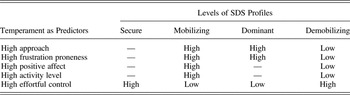
According to EST-R, the developmental roots of the four SDS profiles can be parsimoniously differentiated from each other based on key temperamental attributes reflecting their levels of approach, frustration proneness, positive affect, activity level, and effortful control. Table 1 outlines the hypotheses derived from EST-R on the relationship between temperamental traits and the SDS profiles. Efficiency in the SDS system for the secure profile hinges, in part, on children's abilities to successfully regulate their negative affect and fight-or-flight impulses. Therefore, effortful control, or children's deliberate ability to enact internally guided responses to stimuli, is proposed to foster mild, well-regulated, and brief negative responses to conflict (Rothbart & Bates, Reference Rothbart, Bates, Damon and Eisenberg1998). In contrast, high stakes in guarding against threat and cultivating connectedness evident in the mobilizing profile is theorized to be amplified by high sensitivity to both aversive and rewarding stimuli, reflected in temperamental traits of frustration proneness, approach behaviors, and positive mood (Davies & Martin, Reference Davies and Martin2013). Children's preexisting high activity levels and impairments in effortful control are further proposed to bias the SDS system toward arousing, high-energy behavioral reactions characteristic of a mobilizing pattern.
Synopsis of hypotheses for the relationship between levels of temperamental traits and subsequent changes in the dimensional ratings of SDS reactivity profiles to interparental conflict

Note: SDS, Social defense system; (—), no hypothesized relationship between the temperament characteristic and the SDS profile.
As the hallmark of dominant forms of reactivity to conflict, directly defeating threat posed by parents is theorized to require bold, temperamental tendencies to approach environmental stimuli. Moreover, low frustration tolerance and impairments in the ability to regulate impulses (i.e., poor effortful control) are further proposed in EST-R to calibrate the SDS system toward a dominant strategy in contexts of interparental conflict (Davies & Martin, Reference Davies and Martin2013). Finally, EST-R proposes that the lay-low function of the demobilizing pattern of reactivity may emerge, in part, from early dispositions to experience high sensitivity to punishment and low approach tendencies. Thus, children with low levels of temperamental positive affect and approach are hypothesized to experience increases in demobilizing tendencies over time (Davies & Martin, Reference Davies and Martin2013; Ellis, Jackson, & Boyce, Reference Ellis, Jackson and Boyce2006; Korte, Koolhaas, Wingfield, & McEwen, Reference Korte, Koolhaas, Wingfield and McEwen2005; Sih & Bell, Reference Sih and Bell2008). These same evolutionary models posit that low temperamental activity levels may also facilitate lay-low strategies (e.g., limited movement and expressivity) and, as a result, further bias the SDS system toward a demobilizing profile of reactivity. However, in highlighting that not all negative experiences are necessarily linked with demobilizing patterns, EST-R further proposes that the skillful ability to downregulate reflexive, automatic expressions of overt distress may also be supported by some relatively intact capacities of effortful control and frustration tolerance (Davies, Cicchetti, Hentges, & Sturge-Apple, Reference Davies, Cicchetti, Hentges and Sturge-Apple2013; Sih & Bell, Reference Sih and Bell2008).
To test these theoretically guided hypotheses, we examined whether children's temperamental dispositions predicted their displays of each of the four SDS profiles in response to interparental conflict during the preschool period. Early childhood is a salient developmental period for examining the antecedents of children's patterns of defending against the threat posed by interparental conflict. Compared to older children, preschool and early school age children are predisposed to experience: fear, aggression, and feelings of threat in response to conflict; low levels of perceived competence in coping; and a limited ability to enlist coping strategies to regulate negative affect (El-Sheikh & Cummings, Reference El-Sheikh and Cummings1995; Kitzmann, Gaylord, Holt, & Kenny, Reference Kitzmann, Gaylord, Holt and Kenny2003). Increases in perspective taking and concerns about the welfare of the parents are also proposed to precipitate intraindividual changes in children's reactivity patterns to interparental conflict during preschool and the early school years (Cummings & Davies, Reference Cummings and Davies2010). In order to have sustainable and potent implications for changes in SDS profiles of reactivity over relatively long periods (i.e., 1 year), individual differences in children's temperamental dimensions should evidence some stability across time and context. Consistent with this assumption, prior research has shown moderate to high continuity in the full range of temperamental dimensions explored in this paper, including emotionality (e.g., positive and negative mood), activity level, approach, and effortful control (Durbin, Hayden, Klein, & Olino, Reference Durbin, Hayden, Klein and Olino2007; Kochanska & Knaack, Reference Kochanska and Knaack2003; Pedlow, Sanson, Prior, & Oberklaid, Reference Pedlow, Sanson, Prior and Oberklaid1993). Thus, the temporal consistency of individual differences in these temperament traits during the preschool period may provide a stable developmental base for progressively altering how children respond to the threat posed by interparental conflict over time.
Given the theoretical and empirical support for the existence four SDS profiles, our objective was to develop an observational system for assessing the four profiles. Based on several conceptual and empirical considerations, we created a pattern-based coding approach designed to assess the degree to which children's higher order organization of multiple behaviors corresponds with each of the SDS profiles along 9-point dimensional scales. First, in spite of the prevalence of categorical assessments of higher order profiles in developmental psychopathology, dimensional approaches are increasingly being used to effectively capture distinctive multivariate patterns of behavior (see Fraley & Spieker, Reference Fraley and Spieker2003). Second, ethological and evolutionary models have usefully conceptualized and assessed distinctive patterns of behavior through the use of dimensional ratings (Fraley & Spieker, Reference Fraley and Spieker2003; Owen & Cox, Reference Owen and Cox1997). For example, dimensional assessments of parent–child attachment patterns (e.g., security or disorganization) and responses to family adversity (e.g., preoccupied or dismissing) have been used in the literature (e.g., Forman & Davies, Reference Forman and Davies2005; Fraley & Spieker, Reference Fraley and Spieker2003; Owen & Cox, Reference Owen and Cox1997). Moreover, use of dimensional ratings offers significantly greater measurement precision and analytic power than categorical approaches (Fraley & Spieker, Reference Fraley and Spieker2003; Seifer, Reference Seifer1995). Third, consistent with other ethological theories (e.g., Belsky & Pluess, Reference Belsky and Pluess2009; Korte et al., Reference Korte, Koolhaas, Wingfield and McEwen2005), the sensitivity, organization, and function of the SDS system is proposed to change incrementally in ways that yield dimensional distributions of individual differences in SDS profiles (Davies & Martin, Reference Davies and Martin2013). For some children, developmental and experiential histories are proposed to increase the tendency to exhibit a blend of multiple profiles of reactivity to conflict that can only be captured by dimensional ratings of each SDS pattern.
In summary, the current investigation is designed to test, for the first time, the temperamental antecedents of dimensional ratings of children's SDS reaction patterns to interparental conflict based on hypotheses generated by EST-R. Latent constructs of the temperament dimensions were specified using structural equation modeling (SEM) to capture common variance across multiple methods, informants, and contexts of assessment. As the primary temperament dimensions, approach, frustration proneness, positive mood, activity level, and effortful control were each examined as predictors of change in observer ratings of children's SDS reactivity profiles to interparental conflict over a 1-year period. From a statistical perspective, analysis of whether temperament predicts subsequent change in children's SDS profiles is a more rigorous test of temperament as a precursor than analyses that only include static (i.e., single) assessments of outcomes (Cole & Maxwell, Reference Cole and Maxwell2003). Moreover, as is characteristic of many relational constructs (e.g., attachment; Belsky, Campbell, Cohn, & Moore, Reference Belsky, Campbell, Cohn and Moore1996), EST-R proposes that strategies of coping with threat in the interparental relationship evidence plasticity, particularly during the early childhood years (Davies & Martin, Reference Davies and Martin2013). Thus, in accord with conceptualizations of temperament as precursors of changes in coping with stress (e.g., Korte et al., Reference Korte, Koolhaas, Wingfield and McEwen2005; Zalewski, Lengua, Wilson, Trancik, & Bazinet, Reference Zalewski, Lengua, Wilson, Trancik and Bazinet2011), EST-R posits that changes in children's SDS profiles emerge, in part, from their preexisting temperamental dispositions. Given the potential role of third variables, each SEM also specified several covariates, including children's exposure to interparental conflict in the home and lab, child gender, family income, and parental occupational prestige.
Methods
Participants
Participants included 243 families (i.e., mother, intimate partner, and child) recruited through multiple agencies in a moderate-sized metropolitan area in the Northeast. To obtain a sample from diverse demographic backgrounds, our specific recruitment streams included, but were not limited to local preschools, Head Start agencies, public and private daycare providers, and Internet sites serving children and families from a variety of racial and ethnic backgrounds. Criteria for inclusion in the study included (a) adult caregivers were raising the child together as an intimate couple and had frequent contact with each other (i.e., at least 2 to 3 days a week for a year); (b) adult caregivers and child were all willing to participate; (c) at least one of the adults was the biological parent of the target child; (d) the child was 4 or 5 years old; and (e) the child had no significant cognitive, sensory, or motor defects that may compromise the validity of assessments. The longitudinal design consisted of two annual measurement occasions beginning when children were in their last year of preschool, with a retention rate of 97%.
The average age of children at Wave 1 was 4.6 years (SD = 0.44), with 56% of the sample consisting of girls. Median household income of the families was $36,000 per year (range = $2,000–$121,000), with most families (69%) receiving public assistance. Approximately 19% of the parents did not earn a high school diploma or GED, with the median education for the sample consisting of a GED or high school diploma. Almost half of the families were Black or African American (48%), followed by smaller percentages of families who identified as White (43%), multiracial (6%), or another race (3%). Approximately 16% of the family members were Latino. At Wave 1, 99% of the mothers and 74% of their partners were biological parents. Parents lived together an average of 3.36 years and had, on average, daily contact with each other and the child (range = daily to 2 or 3 days a week). About half of the adults (48%) were married, with the remaining couples designating their relationship status as intimate partners (42%) or engaged to be married (10%). Some changes in interparental relationship status were evident across the two waves: 6% of the primary caregivers who were living together with their partners were separated or single at Wave 2; 3% of the married couples were divorced or separated at Wave 2; and 1% of the couples who were living together were married at Wave 2.
Procedures
Parents and children participated in two visits to a research center laboratory at each of two annual waves of data collection. All research procedures were approved by the Institutional Review Board prior to conducting the study. Families were compensated monetarily for their participation, and children received small toys at each visit.
Interparental conflict task
To obtain observational assessments of children's behavioral reactivity to interparental conflict at Waves 1 and 2, mothers and their partners participated in an interparental interaction task in which they discussed common, problematic disagreements in their relationship. As with prior interparental interaction tasks (Gordis, Margolin, & John, Reference Gordis, Margolin and John2001; Grych, Reference Grych and Bornstein2002), parents were informed during consent and prior to the interaction that their children would join them in the room as they discussed the issues. While the child was in a separate room, parents first selected two or three problematic issues to discuss so they could move on to another topic if they finished discussing a previous one within the 10 min. Because the objective of the task was to maximize the ecological validity of the assessment of children's reactivity to interparental conflict, parents were free to discuss any disagreement topic they viewed as problematic for their relationship as long as they were both comfortable discussing it in front of their child. Consistent with previous research (e.g., Cummings, Schermerhorn, Davies, Goeke-Morey, & Cummings, Reference Cummings, Schermerhorn, Davies, Goeke-Morey and Cummings2006; Du Rocher Schudlich & Cummings, Reference Du Rocher Schudlich and Cummings2007), this procedure generated an array of disagreement topics that were discussed during the task (e.g., money issues, in-laws, division of household responsibilities, and differences in child-rearing philosophies). To maximize privacy and comfort of the parents during the task, experimenters did not inquire about the topics of disagreements selected by the parents. After parents selected issues that they were comfortable discussing, an experimenter escorted the child into the room and showed them a set of toys. The parents then engaged in the interparental exchange after the experimenter left the room. The task was video recorded for subsequent coding.
Temperament tasks
At Wave 1, children participated in a series of procedures designed to capture different dimensions of temperament. First, assessments of temperamental indices of approach, positive affect, frustration proneness, and activity level were derived from the black boxes task (e.g., van Brakel, Muris, & Bogels, Reference van Brakel, Muris and Bogels2004), a game in which children are asked to identify or guess objects that were concealed from view in three black boxes based on touch. Children were instructed to approach each box in a fixed order during the first pass through the game but were free to do it at their own pace and could revisit the boxes in any order after the first pass. The boxes contained, in sequential order, a prickly head of a broom; a plastic pterodactyl that shrieked when touched or moved; and a dish filled with Floam®, a water-soluble, Styrofoam substance that feels slimy. Second, the lock box task from the Laboratory Temperament Assessment Battery was used to assess temperamental dimensions of approach, positive affect, frustration proneness, and activity level (Goldsmith, Reilly, Lemery, Longley, & Prescott, Reference Goldsmith, Reilly, Lemery, Longley and Prescott1999). In the task, the child is prompted to retrieve an attractive toy gift locked inside a transparent box after the experimenter leaves the room but is given the wrong set of keys. After 4 min, the experimenter returned to the room to give the child the correct key to open the box. Third, as an assessment of effortful control, children participated in the peg tapping task, in which they were instructed to enact the rule of tapping a peg once on the table when the experimenter tapped it twice and vice versa over 16 trials (Bierman et al., Reference Bierman, Domitrovich, Nix, Gest, Welsh and Greenberg2008; Diamond & Taylor, Reference Diamond and Taylor1996). All three tasks were video recorded for subsequent coding. To guard against inflated associations between ratings across tasks, different sets of trained coders rated each of the temperament tasks.
In the final task, children completed the Pokémon go/no-go task at each wave to assess their ability to marshal effortful control as a way of focusing and sustaining attention in a lengthy task (Durston, Mulder, Casey, Ziermans, & van Engeland, Reference Durston, Mulder, Casey, Ziermans and van Engeland2006; Durston et al., Reference Durston, Thomas, Yang, Uluğ, Zimmerman and Casey2002). Modeled after the Continuous Performance Test (Conners, Reference Conners2000), the Pokémon go/no-go task is designed for use with younger children (i.e., preschool and younger children) through modifications to the presentation of stimuli (e.g., fewer trials and use of Pokémon characters rather than letters). Children were instructed to watch a series of Pokémon characters appear on the computer screen and “catch” all the characters except for “Meowth.” For the go conditions not containing Meowth, children caught the Pokémon characters by clicking a child-sized computer mouse. In the no-go condition containing the presentation of Meowth, children were asked to refrain from clicking the computer mouse. Each character is displayed on the screen for 500 ms, with an interstimulus interval of 3500 ms. After a 16-trial practice run, children completed three blocks containing 57 trials each. To prevent children from learning a predesignated pattern to the go and no-go trials, trials in the task were presented in a pseudorandomized order in which the number of consecutive go trails preceding a no-go trial varied from one to five.
Experimenter reports of temperament
At Wave 1, the experimenter overseeing the visit for the child, but who was not privy to the children's reactions during the interparental conflict task, completed the California Child Q-Set (CCQ) to obtain assessments of child personality and adjustment (Block, Reference Block2008). Raters sorted 100 CCQ descriptors of children's psychological functioning into nine predesignated piles ranging from “extremely uncharacteristic” to “extremely characteristic.” To aid them in this task, experimenters kept detailed written records on child functioning based on an average of 5 hr of cumulative contact with children during the visit tasks, transition periods, and in some cases, transportation between homes and the research center (SD = 1 hr, range = 3 to 8 hr).
Maternal reports
At Wave 1, mothers completed an interview to assess demographic characteristics and questionnaires designed to assess children's exposure to interparental conflict.
Measures
Children's SDS patterns of reactivity to interparental conflict
Although observational systems designed to identify profiles have commonly used mutually exclusive categorical taxonomies, substantial losses of information, variability, and statistical power are well-documented pitfalls of this approach (MacCallum, Zhang, Preacher, & Rucker, Reference MacCallum, Zhang, Preacher and Rucker2002; Royston, Altman, & Sauerbrei, Reference Royston, Altman and Sauerbrei2006). To address these concerns, researchers are increasingly calling for and adopting dimensional approaches to assessing constructs that have traditionally been quantified into categorical systems (e.g., attachment; Fraley & Spieker, Reference Fraley and Spieker2003; Owen & Cox, Reference Owen and Cox1997). Accordingly, our coding scheme was designed to overcome the limitations of categorical approaches through the use of a dimensional rating system. Coders carefully reviewed the audiovisual records with the objective of providing dimensional ratings reflecting the degree to which the organization (or profile) of children's behaviors during the interaction corresponded with each of the four functional SDS profiles along 9-point scales. At one extreme, ratings of 1 (not at all characteristic) were designated for children who did not display any definitive signs of the target SDS pattern. At the other extreme, ratings of 9 (highly characteristic) were reserved for strong, prototypical signs of the SDS pattern in the absence of responses that are inconsistent with the specific reaction pattern.
The pattern-based coding system contained detailed descriptions of each SDS profile. A secure profile reflected the tendency for children to efficiently regulate their exposure to conflict. Specific manifestations of security included negligible or mild levels of fearful distress and attempts to regulate exposure to interparental problems (e.g., minimal or mild avoidance or intervention) followed by quick resumption of normal activities in the aftermath of parental anger. In contrast, high ratings on the mobilizing dimension were reserved for children who displayed unvarnished, blatant, and demonstrative expressions of arousing distress that are commonly accompanied by high involvement in the conflict (e.g., comfort seeking or attempts to side with one parent that fall short of directly disparaging the other parent), active forms of flight or avoidance (e.g., quickly moving away from the conflict, plugging ears, or making a great deal of noise), or both. Reaction patterns highly characteristic of a dominant profile were defined by children's tendencies to be vigilant of the threat accompanying interparental conflict. However, unlike the mobilizing pattern, overt expressions are vulnerability (e.g., fear or worry) are minimized to permit the enactment of demanding, coercive, and aggressive posturing (e.g., insulting or denigrating parent, yelling at parents to stop talking, temper tantrums, or active defiance of parental commands) as a way of directly defeating interpersonal threat. Finally, a demobilizing pattern consisted of a constellation of behaviors that served to reduce children's salience as potential targets of hostility. The lay-low function of this profile is reflected in prolonged instances of veiled, but highly arousing, fearful distress (e.g., freezing) and subtle disengagement (e.g., standing with head down, gingerly moving away from parent, becoming quiet and immobile, or reduced play). Two trained coders independently rated over 20% of the videos at each wave to assess interrater reliability. Intraclass correlation coefficients ranged from 0.85 to 0.97.
Child temperamental approach
Three measures were designed to capture a dimensional assessment of approach. The first two measures consisted of coder ratings of children's approach during the black boxes and lock box tasks. Guided by prior coding schemes (e.g., Putnam & Stifter, Reference Putnam and Stifter2005), approach was indexed by the extent to which the children actively approached unfamiliar objects or people, with the pattern of behavior reflecting anticipation of some positive incentive (rather than punishment) in engaging with the novel stimuli. Along the 9-point scale, ratings of 1 (no approach) reflected no initiative on the child's part to approach the stimuli, whereas ratings of 9 (intense approach) were defined by displays of quick, enthusiastic approach behaviors with no hesitation or reticence. For each task, two coders independently rated at least 20% of each of the tasks to calculate interrater reliability. Intraclass correlation coefficients were 0.79 and 0.84 for the black boxes and lock box tasks, respectively. As the third measure, the extraversion (versus social inhibition) scale was derived from the experimenter CCQ ratings (Block, Reference Block2008; John, Caspi, Robins, Moffitt, & Stouthamer-Loeber, Reference John, Caspi, Robins, Moffitt and Stouthamer-Loeber1994). In providing an assessment of the surgency/extraversion component in conceptualizations of temperamental approach (e.g., Garstein & Rothbart, Reference Garstein and Rothbart2003), the CCQ extraversion scale contains nine items assessing the degree to which children are outgoing, talkative, and assertive (e.g., “Is a talkative child”; α = 0.91).
Child frustration proneness
Children's proneness to frustration was assessed through three observation scales in the temperament tasks. Because both the lock box and the black boxes tasks are designed to be challenging and stressful, we followed previous practices of coding both tasks for proneness to frustration (Dougherty, Klein, Olino, Dyson, & Rose, Reference Dougherty, Klein, Olino, Dyson and Rose2009; Durbin, Klein, Hayden, Buckley, & Moerk, Reference Durbin, Klein, Hayden, Buckley and Moerk2005). Thus, for the first two indices of frustration, coders of each of the tasks specifically rated the level of frustration, anger, and hostility along molar scales ranging from 1 (no signs of frustration and anger) to 9 (multiple signs of frustration and anger, including multiple intense signs that often take a dysregulated form; e.g., throwing objects, kicking the door, or hitting the boxes). The third assessment consisted of molar observational ratings on a 9-point coping scale during the lock box task. Coping was defined as the degree to which children could tolerate the stress and frustration of the task. At one extreme (1), no coping ability is characterized by a quick breakdown under stress resulting in prolonged dysregulation (e.g., crying, screaming, or throwing objects). At the other extreme (9), high coping ability ratings were reserved for children who stayed organized and involved throughout the lock box task despite the great challenge and frustration. Intraclass correlation coefficients, based on independent coders ratings of at least 20% of the videos, were 0.92 for lock box frustration, 0.68 for black boxes frustration, and 0.89 for lock box coping.
Child positive affect
Children's positive affect was assessed through separate coder observational ratings in the black boxes and lock box tasks. Ratings on the 9-point scales were based on the intensity, frequency, and duration of positive emotionality displays in facial expressions, positive vocalizations, and gestures. The lowest rating (1) was reserved for children who exhibited no positive affect during the task, while the highest rating (9) reflected consistent child cheerfulness throughout the task with, in many cases, intense and demonstrative displays of positive affect (e.g., laughing or giggling). Interrater reliability, as calculated by intraclass correlation coefficients, was 0.83 for each task. Because researchers have not created a prototype or scale for positive emotionality for the CCQ, we selected a priori two items from the CCQ experimenter ratings to create a third measure based on their correspondence with our coding definitions of positive affect (i.e., “Is cheerful” or “Responds to humor”; α = 0.63).
Child activity level
Two measures of children's activity level were derived from observational ratings of activity along 9-point molar scales in the lock box and black boxes tasks. Guided by earlier coding schemes (e.g., Putnam & Stifter, Reference Putnam and Stifter2005), activity level was determined based on duration, frequency, and intensity, paying particular attention to unstructured and transitional parts of the tasks. Whereas no activity (1) codes were reserved for children who were completely or virtually still the entire segment, intense activity (9) was characterized by high activity throughout the task, including several instances of intense gross motor movement (e.g., running around the room). Calculated from independent coder ratings on at least 20% of the videos in each task, interrater reliabilities as indexed by intraclass correlation coefficients were 0.87 for black boxes and 0.88 for the lock box episode.
Child effortful control
We obtained three indicators of children's effortful control, defined as the deliberate capacity to organize reflective, purposeful, internally guided responses to stimuli (Kochanska, Murray, & Harlan, Reference Kochanska, Murray and Harlan2000; Rothbart & Bates, Reference Rothbart, Bates, Damon and Eisenberg1998). First, the number of correct responses to the peg tapping task over the 16 trials was used as an indicator of children's ability to suppress an automatic response in favor of a subdominant, contextually appropriate response (Bierman et al., Reference Bierman, Domitrovich, Nix, Gest, Welsh and Greenberg2008; Diamond & Taylor, Reference Diamond and Taylor1996). Second, to assess children's abilities to maintain more effortful behaviors, children's errors of omission on go trials in the Pokémon go/no-go task were calculated (Durston et al., Reference Durston, Thomas, Yang, Uluğ, Zimmerman and Casey2002). Higher errors of omission in a task that is designed to be long and tedious reflect an inability to sustain attention (Conners, Reference Conners2000). Third, experimenter Q-sort ratings on the nine-item CCQ conscientiousness scale were designed to assess children's planful and organized behaviors (e.g., “Is attentive and able to concentrate” and “Is planful, thinks ahead”; α = 0.81).
Covariate: Interparental conflict history
To assess children's history of exposure to interparental conflict at Wave 1, mothers completed the frequency, verbal aggression, mild physical aggression, severe physical aggression, and cooperation subscales from the Conflict and Problem-Solving Scales—Violence Form at Wave 1 (CPS-V; Kerig, Reference Kerig1996). The frequency subscale assesses the number of times parents engaged in minor and major conflicts over the past year, with response alternatives ranging from 1 (once a year or less) to 6 (just about every day). Items on the remaining four scales are rated along 4-point scales (0 = never, 3 = often), reflecting the frequency with which mother and partner engage in: (a) verbally aggressive conflict tactics (verbal aggression subscale, 20 items; e.g., “Use name-calling, cursing, insulting”); (b) moderate acts of physical aggression (physical aggression: moderate subscale, 10 items; e.g., “Throw something”); (c) severe forms of violence (physical aggression: severe subscale, 16 items; e.g., “Beat partner severely”); and (d) collaborative efforts to solve the problem in a respectful way (cooperation subscale, 12 items; e.g., “Try to understand what partner is really feeling”). Internal consistencies for the five CPS-V scales ranged from α = 0.71 to 0.93. Previous research supports the validity of the CPS-V subscales (e.g., Fosco & Grych, Reference Fosco and Grych2008; Kerig, Reference Kerig1996). To form a single parsimonious composite of children's destructive conflict history, we calculated the mean of the standardized scores on the five scales after reverse scoring the cooperation scale so that higher scores reflected less cooperation (α = 0.79 for the five scale composite).
Covariate: Proximal interparental conflict
As an assessment of children's level of exposure to destructive conflict during the interparental conflict task at Wave 1, two trained coders rated the video records of the entire 10-min interaction along molar scales to assess three maternal and paternal conflict dimensions: anger, aggression, and support. Each molar scale ranged from 1 (not at all characteristic) to 9 (mainly characteristic). Whereas the anger scale was designed to assess facial expressions, verbalizations, and postural and gestural displays of irascibility and frustration, the aggression scale indexed verbalizations and behaviors that were intended to harm the partner either physically or psychologically (e.g., demeaning, insulting, name calling, or threatening). Conversely, the support scale is designed to assess parental appreciation and validation of the partner. Interrater reliability coefficients, which were calculated based on two coders' independent ratings of 20% of the interactions, ranged from 0.62 to 0.85 (M = 0.78) across maternal and partner anger, aggression, and support codes. After reverse scoring the maternal and paternal support ratings, the six observational ratings were standardized and aggregated to form a single composite indexing proximal interparental conflict (α = 0.80).
Covariates: Demographic characteristics
Three covariates were derived from the maternal demographic interview: (a) children's gender (1 = girls, 2 = boys); (b) household income per capita, calculated by dividing the total annual income of the family unit by the number of individuals living in the home; and (c) parental occupational prestige based on the 9-point occupational scale (1 = farm laborers/menial service workers; 9 = higher executives, proprietors of large businesses, and major professionals) from the Hollingshead Four Factor Index of Social Status (Hollingshead, Reference Hollingshead1975).
Results
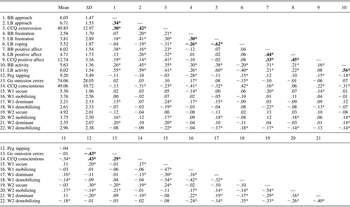
Table 2 presents the means and standard deviations for the primary variables in the study. As denoted by the bolded coefficients in the table, correlations among the indicators of each of the higher order temperament constructs were all significant (ps < .001), in the expected direction, and moderate to strong in magnitude (M = 0.40).
Means, standard deviations, and correlations for the primary variables in the analyses

Note: BB, Black boxes task; LB, lock box task; CCQ, California Child Q-Sort; W1, Wave 1; W2, Wave 2. Bold coefficients denote correlations between the indicators of each of the higher-order temperament constructs.
*p < .05.
Overview of analysis plan
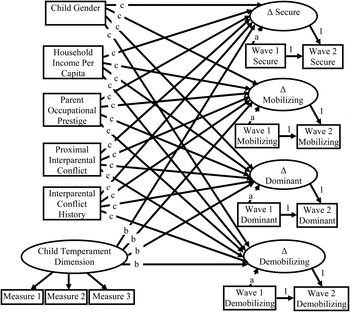
We used latent difference score (LDS) modeling to examine temperament dimensions at Wave 1 as predictors of individual differences in intraindividual change in SDS profiles from Waves 1 to 2 (McArdle, Reference McArdle2009). Figure 1 provides a conceptual illustration of the structural paths in the LDS model specifications. The two components of our LDS change model consisted of (a) a growth parameter indexing change in level of the variable across the two measurement occasions (i.e., latent Δ indices in Figure 1) and (b) an autoregressive estimate of the effect of the initial status of the variable on change in the variable across the two time points (i.e., “a” paths in Figure 1). Thus, by integrating the advantages of latent growth curve and autoregressive analyses, the LDS model provides a rigorous way of capturing change in levels of a variable while controlling for the effects of initial status of the variable on change over time.
A conceptual illustration of the latent difference score model of children's temperament predicting latent change in their social defense system (SDS) profiles of reactivity to interparental conflict. (a) autoregressive paths controlling for the initial level of the variable on the latent change of each SDS profile, (b) structural paths between the temperament dimension and each SDS profile, and (c) the demographic covariate paths predicting the SDS profiles.

Our analytic objective was to characterize the dimensions of temperament that help to account for why children develop different SDS patterns of reactivity to interparental conflict. Given our focus on characterizing the sets of temperamental traits underlying the SDS profiles, we examined each of the five temperament dimensions in successive SEM as predictors of the latent change in the four SDS profiles (i.e., “b” paths in Figure 1). Finally, sex of child, parental occupational prestige, annual household income per capita, proximal (i.e., lab) interparental conflict exposure, and interparental conflict history in the home were included as covariates in each of the models (“c” paths in Figure 1). Although not shown in the figure for clarity, correlations were also specified among (a) Wave 1 temperament and each of the covariates, (b) the predictors (i.e., temperament and covariates) and Wave 1 SDS profiles, and (c) the latent change indices of the SDS profiles. All models were conducted through AMOS 22.0 software (Arbuckle, Reference Arbuckle2013). Missing data (Mdn = 0.4%, range = 0%–16%) were estimated using full information maximum likelihood to retain the full sample for analyses (Schlomer, Bauman, & Card, Reference Schlomer, Bauman and Card2010). For succinctness, our description of findings focuses specifically on the structural paths in Figure 1.
Primary analyses
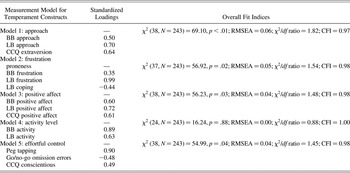
Table 3 shows the standardized loadings of the manifest indicators onto their latent constructs and the overall fit indices for the five models depicting each temperament dimension as a predictor of SDS profiles. Standardized loadings were all significant (ps < .001), in the expected direction, and moderate to strong in magnitude (mean absolute value = 0.64; range = 0.35–0.99). Moreover, fit indices for the models were all in the good to excellent range (see Table 3; Browne & Cudeck, Reference Browne, Cudeck, Bollen and Long1993). The mean and range of key fit indices across the five analytic models were as follows: (a) mean χ2/df ratio = 1.43 (range = 0.88–1.82), (b) mean RMSEA = 0.04 (range = 0.00–0.06), and (c) mean CFI = 0.98 (range = 0.97–1.00).
Standardized loadings for the latent temperament dimensions and overall fit indices for the five analytic models

Note: RMSEA, Root mean square error of approximation; CFI, comparative fit index; BB, Black boxes task; LB, lock box task; CCQ, California Child Q-Sort.
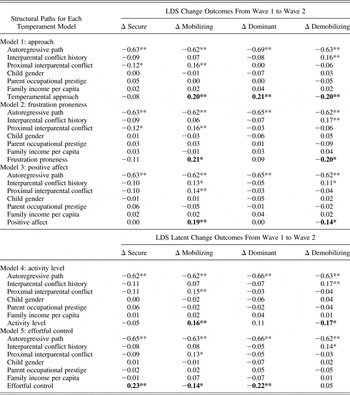
Table 4 shows the results of the structural paths running from the covariates and temperament predictors to latent changes in the four SDS profiles. Consistent with prior associations between initial level and change in psychological functioning (e.g., King, King, McArdle, Shalev, & Doron-LaMarca, Reference King, King, McArdle, Shalev and Doron-LaMarca2009), the specification of the autoregressive path revealed that Wave 1 levels of each SDS profile were all negatively and significantly correlated with its subsequent change over time. For the predictive paths involving the covariates, only proximal interparental conflict and interparental conflict history were significant predictors of SDS profiles. Proximal (i.e., observational) indices of destructive interparental conflict were associated with subsequent increases in mobilizing profiles in all five models and decreases in the secure profile in two of the five analyses. Histories of exposure to interparental conflict predicted subsequent increases in demobilizing patterns of reactivity in all five analyses and mobilizing patterns of reactivity in one of the analyses. In the remaining sections, our description of the findings from the primary analyses focuses concisely on the structural paths among the children's temperamental traits and changes in their SDS profiles.
Results of the structural paths for the five LDS models of children's temperament as predictors of children's social defense profiles of reactivity to interparental conflict

Note: For clarity, significant structural paths between the temperament factors and the social defense system; profiles are in bold. LDS, Latent difference score.
*p ≤ .05. **p ≤ .01.
Approach
Model 1 results in Table 4 show that children's temperamental approach was a significant predictor of increases in mobilizing (β = 0.20, p < .01) and dominant (β = 0.21, p < .01) patterns of reactivity to interparental conflict. In contrast, lower levels of approach predicted rises in the demobilizing profile of reactivity across the 1-year span of the study (β = –0.20, p < .01).
Frustration proneness
The structural paths for the SDS profiles in Model 2 (see Table 4) indicate that children's dispositions to experience frustration were prospectively associated with subsequent increases in mobilizing reactivity (β = 0.21, p < .05) and decreases in demobilizing responses (β = –0.20, p < .05) to interparental conflict.
Positive affect
As shown in the Model 3 results of Table 4, higher levels of positive emotionality at Wave 1 predicted increases in mobilizing patterns of reactivity over a period of 1 year (β = 0.19, p < .01). In contrast, positive emotionality was prospectively associated with subsequent decreases in demobilizing responses over time (β = –0.14, p = .05).
Activity level
Inspection of the structural paths for children's activity level as a predictor was consistent with the pattern of results for frustration proneness and positive affect (see Model 4 results in Table 4). Children's activity level was related to significant decreases in demobilizing patterns of conflict reactivity from Wave 1 to Wave 2 (β = –0.17, p = .01). Conversely, activity level was a significant predictor of subsequent increases in mobilizing profiles of responding (β = 0.16, p < .05).
Effortful control
Model 5 results in Table 4 reveal that greater effortful control predicted significant decreases in dominant (β = –0.22, p < .01) and mobilizing (β = –0.14, p < .05) patterns of reactivity to conflict from Waves 1 to 2. In contrast, effortful control was prospectively associated with increases in secure patterns of responding to interparental conflict (β = 0.23, p < .01).
Stability of associations as a function of gender
Because it was possible that child gender served as a moderator in associations between children's temperamental characteristics and their SDS profiles (Davies & Lindsay, Reference Davies, Lindsay, Grych and Fincham2001), our final set of analyses examined if the predictive role of each temperamental attribute varied as a function of gender. To test this possibility, we conducted multiple group comparisons of boys and girls for each of the five analytic models in Table 4. Multiple group comparisons for the structural paths consisted of comparing a model in which all parameters were allowed to vary freely with a model in which comparable paths for the boys and girls were constrained to equality. For the five models, comparisons of the fully constrained and free to vary models only revealed one difference in fit for the frustration proneness group comparison, χ2 (4, N = 234) = 20.75, p < .01. However, follow-up pairwise parameter comparison tests examining whether specific structural paths involving frustration proneness and each SDS profile differed for boys and girls failed to identify a significant moderating effect, with z < 1.55 and p > .12 for all comparisons. Therefore, the primary findings did not vary as a function of child gender.
Discussion
Previous research has supported the developmental and clinical value of the EST-R pattern-based taxonomy for distinguishing between profiles of children's reactivity to interparental conflict on the basis of both the form and function of their responses. In a previous report, secure, mobilizing, dominant, and demobilizing patterns of responding to interparental conflict each predicted a unique portfolio of mental health benefits and costs over a 1-year period that were largely consistent with EST-R hypotheses (Davies et al., Reference Davies, Martin, Sturge-Apple, Ripple and Cicchetti2015). However, studies have yet to identify the developmental roots of these specific patterns of coping with conflict between parents. To address this gap, the goal of this investigation was to test theoretically guided hypotheses on the temperamental origins of SDS profiles of children's reactivity to interparental conflict. In accord with many of the hypotheses, the results indicated that subsequent changes in children's secure, mobilizing, dominant, and demobilizing patterns of responding over a 1-year period were predicted by unique configurations of temperament dimensions encompassing approach, frustration proneness, positive affect, activity level, and effortful control.
Hypotheses generated by EST-R underscore the significance of effortful control as a temperamental antecedent of the secure profile. Supporting this prediction, greater effortful control was a significant predictor of increases in security over the span of 1 year. Interpreted within the framework of EST-R (Davies & Martin, Reference Davies and Martin2013; Davies & Sturge-Apple, Reference Davies and Sturge-Apple2007), effortful control may promote a secure profile in several interrelated ways. As a primary facet of effortful control (e.g., Kochanska et al., Reference Kochanska, Murray and Harlan2000; Rothbart & Bates, Reference Rothbart, Bates, Damon and Eisenberg1998), the ability to inhibit prepotent reflexive impulses when responding to stimuli may allow children to effectively manage the natural negative emotions that commonly accompany exposure to interparental conflict. Effortful control also consists of an excitatory component that facilitates the enactment of a deliberate, subdominant response. Thus, this aspect of the regulation process may enable children to more easily initiate alternative activities (e.g., exploration or affiliation) to overcome the “better safe than sorry” tendency of the SDS to remain a salient organizer of behavior well after threat subsides. Part of this process may also reflect superior abilities to shift attention away from the conflict and focus on other activities in a sustained way that limits the initial activation of the SDS.
Consistent with hypotheses, increases in mobilizing tendencies were predicted by a distinctive set of temperament dimensions characterized by high activity level, approach tendencies, frustration proneness, positive affect, and poor effortful control. EST-R proposes that the function of the mobilizing pattern of actively managing interpersonal threat and social opportunities emerges, in part, from temperamental reactivity to both rewarding and aversive qualities of stimuli (Davies & Martin, Reference Davies and Martin2013). Thus, our empirical identification of the mobilizing profile as following from behavioral indicators of sensitivity to adversity (i.e., frustration proneness) and potential reward (i.e., approach or positive affect) is in keeping with this proposal. Prospective associations between high activity level and mobilizing reactivity to conflict were also consistent with EST-R and its assumption that proneness to high energy expenditure facilitates the active vigilance and behavioral regulation of both threat and resources (e.g., flight responses or overt displays of distress to garner emotional support) during interparental conflict. In addition, the EST-R pattern-based taxonomy postulates that preexisting problems inhibiting reflexive affective responses in favor of planned, regulated responses engender trademark mobilizing responses characterized by demonstrative, unvarnished displays of fear and vulnerability. Consistent with this hypothesis, our findings showed that subsequent increases in mobilizing reactivity were predicted by poor effortful control, as indexed by the inability to regulate reflexive impulses and enact deliberate, contextually flexible responses.
In contrast to the mobilizing profile, the dominant profile is designed to directly defeat the threat accompanying interparental conflict by boldly challenging parental power and authority. Although both mobilizing and dominant profiles involve proactively managing threat, heightened activity levels or sensitivity to both aversive and rewarding stimuli is unlikely to provide any reliable temperamental foundation for successfully enacting the more circumscribed, dominant function of directly defeating threat. Rather, EST-R postulates that successfully confronting dominant adults engrossed in conflict requires a high degree of brashness that has its strongest temperamental roots in children's fearless approach tendencies and impulsive dispositions (Bell, Reference Bell2007; Davies & Martin, Reference Davies and Martin2013; Korte et al., Reference Korte, Koolhaas, Wingfield and McEwen2005). In support of this hypothesis, the two significant predictors of increases in dominant responding to interparental conflict consisted of high approach and poor effortful control. Conversely, our findings did not support the prediction that children with high frustration proneness would be more prone to developing dominant profiles of reactivity over time. However, more research is needed before drawing definitive conclusions. For example, it is possible that frustration proneness serves as an antecedent of dominant reactivity during a different developmental period. Although it is still speculative, the significant concomitant correlations between the dominant profile and indices of frustration in Table 2 may be a product of the impact of earlier individual differences in frustration on SDS functioning.
Relative to children who display other SDS profile tendencies, children high in the demobilizing profile are distinguishable based on a passive coping pattern characterized by high levels of freezing, camouflaging behaviors, submissiveness, inactivity, and helplessness in the face of interparental conflict. Although empirical work on the origins of demobilizing patterns in children is scarce, evolutionary models have proposed that the demobilizing pattern may develop from diminished reward sensitivity and heightened sensitivity to punishment (Davies & Martin, Reference Davies and Martin2013; Korte et al., Reference Korte, Koolhaas, Wingfield and McEwen2005; Sih & Bell, Reference Sih and Bell2008). At a behavioral level, this temperamental disposition may be exhibited in dampened approach, activity, and positive affect. Consistent with this hypothesis, low levels of approach, activity, and positive affect were temperamental predictors of increases in children's demobilizing tendencies over a period of a year. Evolutionary models have also proposed that trademark demobilizing patterns of successfully inhibiting blatant forms of distress may also be facilitated by high levels of effortful control and the ability to tolerate and cope with distress and frustration. Supporting this thesis, increased demobilizing reactivity to interparental conflict was predicted by greater ability to tolerate and cope with frustration-inducing tasks.
However, running counter to predictions, effortful control was not a significant predictor of demobilizing reactivity. Although caution should be exercised in interpreting null findings, a deeper analysis of the composition of effortful control suggests that modification of some of the theory-guided hypotheses in EST-R may be warranted. Effortful control has specifically been defined as consisting of two components: an inhibitory component that functions to inhibit reflexive behavior and an excitatory component that serves to initiate a deliberate, alternative action that is more sensitive to contextual cues (Kochanska et al., Reference Kochanska, Murray and Harlan2000; Rothbart & Bates, Reference Rothbart, Bates, Damon and Eisenberg1998). In accord with this definition, our measures were designed to capture both the inhibitory and excitatory components of effortful control. However, the demobilizing pattern of reactivity is largely characterized by passivity and inaction (e.g., freezing, lethargy, camouflaging, and anhedonia). Interpreted through this lens, initiation of action, as a defining component of effortful control, may not be associated with a demobilizing profile of responding to interparental conflict. It is also possible that the inhibitory processes characteristic of the demobilizing profile differ from those that are generally considered to be a component of effortful control. In developmental models, the inhibitory component of effortful control has been defined by purposeful, explicit efforts to deter a proponent, reflexive response. However, as the cornerstone feature of the demobilizing profile, the capacity to inhibit demonstrative displays of fear and distress may instead be rooted in an implicit, reflexive system for regulating the processing and responding to affectively charged events (MacDonald, Reference MacDonald2008).
Several limitations warrant discussion in order to fully interpret the results. First, although our study contained a demographically (e.g., parent education level and family income), racially, and ethnically diverse sample, efforts to generalize the results to atypical populations (e.g., clinical samples and affluent families) will require additional research. Second, given that our study was focused on early childhood, testing developmental precursors of children's SDS profiles in other developmental periods is an important direction for future research. Third, even though our selection of the five temperament characteristics as predictors of SDS profiles was guided by theory, our measurement battery did not comprehensively assess all dimensions of temperament. Therefore, inclusion of a wider array of temperament characteristics may help to further delineate the developmental roots of the four SDS patterns. As a case in point, the finding that effortful control was the only predictor of the secure profile highlights the potential of expanding the search for temperament variables that might facilitate the enactment of a secure profile of responding to interparental conflict. For example, given that fearful reactivity is a central component of the operation of the SDS, more precise measures of temperamental fear may offer greater leverage in predicting the trademark efficiency of secure children in defending against threat. Fourth, the temperament dimensions were generally modest to moderate predictors of changes in children's profiles of reactivity to interparental conflict. Nonetheless, even modest associations are interpreted in EST-R as being substantively meaningful in the context of the multiple-method, multiple-informant longitudinal design and a broader conceptual model that delegates temperament factors as one part of a constellation (e.g., history of exposure to forms of interparental conflict) of developmental precursors (Davies & Martin, Reference Davies and Martin2013; Davies & Sturge-Apple, Reference Davies and Sturge-Apple2007). With additional progress in identifying the primary temperamental precursors, a critical future empirical direction is to test interactions between temperamental attributes and family characteristics in predicting children's SDS profiles.
Despite these limitations, the results of this study offer important insights into the developmental pathways of children's strategies of defending against the stressfulness of witnessing interparental conflict. Earlier empirical work revealed that distinguishing among secure, mobilizing, dominant, and demobilizing patterns of responding to interparental conflict was useful in predicting distinctive profiles of psychological outcomes over time (Davies et al., Reference Davies, Martin, Sturge-Apple, Ripple and Cicchetti2015). In light of the evidence for the utility of the EST-R taxonomy (Davies & Martin, Reference Davies and Martin2013), the goal of this study was to explore the early antecedents of these pathways of coping by identifying temperamental precursors of the SDS profiles. Consistent with theory, each of the four profiles of reactivity were predicted by distinctive temperamental patterns characterizing approach, frustration proneness, positive affect, activity level, and effortful control.