1 Introduction
This paper is concerned with determining the semantic relations (‘SRs’) in English noun compounds (‘NCs’) as a means of representing the semantic connection between the head noun and modifier(s) of the NC. In this paper we use the term noun compound to refer to a sequence of two or more nouns, and refer to the individual nouns in the NC as ‘components’. NC semantic relations are notoriously nuanced in nature; for example, apple juice is interpreted as ‘juice made from apple(s)’, while the superficially highly similar morning juice means ‘juice (drunk) in the morning’ and box juice means ‘juice that is contained in a box’.
Disambiguating NCs with SRs has a long history in Natural Language Processing due to the allure of a richer semantic representation to build off in applications such as question-answering and machine translation (Lauer Reference Lauer1995; Venkatapathy and Joshi Reference Venkatapathy and Joshi2006). However, due to difficulties such as high productivity, interaction between the interpretation and context of use, and semantic delineation of a discrete SR set (Downing Reference Downing1977; Spärck Jones Reference Spärck Jones1983; Lapata and Keller Reference Lapata and Keller2004), interpreting SRs has been found to be a challenging task for Natural Language Processing (Butnariu and Veale Reference Butnariu and Veale2008; Nakov Reference Nakov2008; Baldwin and Kim Reference Baldwin, Kim, Indurkhya and Damerau2009; Ó Séaghdha Reference Ó Séaghdha2009; Tratz and Hovy Reference Tratz and Hovy2010).
As detailed in Section 2, recent attempts at automatic NC interpretation have taken two basic approaches: analogy-based interpretation (Rosario and Hearst Reference Rosario and Hearst2001; Girju et al. Reference Girju, Moldovan, Tatu and Antohe2005; Kim and Baldwin Reference Kim and Baldwin2005; Turney and Littman Reference Turney and Littman2005; Girju Reference Girju2007; Ó Séaghdha and Copestake Reference Ó Séaghdha and Copestake2007; Ó Séaghdha Reference Ó Séaghdha2009; Tratz and Hovy Reference Tratz and Hovy2010) and semantic disambiguation relative to an underlying predicate or paraphrase (Vanderwende Reference Vanderwende1994; Lapata Reference Lapata2002; Kim and Baldwin Reference Kim and Baldwin2006; Nakov and Hearst Reference Nakov and Hearst2006; Butnariu and Veale Reference Butnariu and Veale2008; Nakov Reference Nakov2008). Our proposed approach uses analogy-based interpretation, taking WordNet as the basis to calculate lexical similarity. The intuition behind our method is that NCs made up of similar component words should have the same SR. That is, given the NC apple juice and the SR made_of(N2,N1) (i.e. N2 = the head noun [juice] is made of N1 = the modifier [apple]), we would expect the unseen NC orange juice to have the same SR of made_of(N2,N1). To measure the semantic similarity between NCs, we calculate the lexical similarity between the corresponding components (head nouns and modifiers, respectively, of the two NCs). We first test our method over our own two-term NC dataset, and then go on to apply it and two other methods to the dataset used for Task 4 at SemEval-2007 (Girju et al. Reference Girju, Nakov, Nastase, Szpakowicz, Turney and Yuret2007). Second, we investigate the relative contribution of components on the similarity calculation. Third, we evaluate our method over a three-term NC dataset developed for this research, in what we believe are the first published results over three-term NC interpretation. Finally, we present an NC bracketing method which makes use of predicted interpretations between component words, and demonstrate that our method is able to boost the coverage and accuracy of a state-of-the-art NC bracketing method.
The remainder of the paper is structured as follows. In Section 2 we review the literature on NCs, and in Section 3 we detail the set of SRs used in this paper. In Section 4 we detail our motivation and basic approach to NC interpretation, and the datasets and resources used in our evaluation in Section 5. We then present the results for our method over the different datasets in Section 6, and finally conclude in Section 7.
2 Related work
The primary focus of research on NCs has been on interpreting them with SRs, but there has also been work on syntactic analysis (i.e. bracketing) of NCs. We review the related work on these two areas in this section.
2.1 Interpreting noun compounds
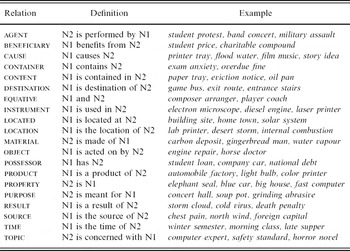
Vanderwende (Reference Vanderwende1994) presented one of the very first attempts to automatically interpret the semantics of NCs based on a discrete set of SRs. She used semantic information automatically extracted by analysing definitions in an online dictionary, and interpreted the NCs through the semantics of verbs corresponding to each relation. One drawback was that the system employed handwritten rules, making it labor-intensive and hard to repurpose to new domains or relation sets. Barker and Szpakowicz (Reference Barker and Szpakowicz1998) developed a larger, more general-purpose set of SRs (detailed in Table 1), and evaluated a semi-automatic NC interpretation method over instances from the technical repair domain. More recent work on SR-based interpretation has focused on fully automatic methods, over a broad range of different SR sets (Fan et al. Reference Fan, Barker and Porter2003; Girju Reference Girju2007; Ó Séaghdha Reference Ó Séaghdha2009; Tratz and Hovy Reference Tratz and Hovy2010).
The semantic relation set of Barker and Szpakowicz (Reference Barker and Szpakowicz1998) (N1 = modifier, N2 = head noun)

Some research on NC interpretation has focused specifically on compound nominalizations (Isabelle Reference Isabelle1984; Hull and Gomez Reference Hull and Gomez1996; Lapata Reference Lapata2002; Grover, Lapata and Lascarides Reference Grover, Lapata and Lascarides2004), that is NCs where the head noun is a deverbal noun such as animation (derived from animate). Lapata (Reference Lapata2002) proposed a fully automatic method for interpreting compound nominalizations based on the assumption that the modifier is interpretable as either the subject (e.g. child behaviour) or object (e.g. car lover) of the base verb expressed by the head noun. Grover et al. (Reference Grover, Lapata and Lascarides2004) and Nicholson and Baldwin (Reference Nicholson and Baldwin2005) extended this work in considering a wider selection of interpretation types, based around preposition selection.
In order to bound the set of NCs and SRs, some previous work has focused on NC interpretation in specific domains. Rosario and Hearst (Reference Rosario and Hearst2001) used hierarchical tagged nouns from biomedical texts, and classified them according to a domain-specific set of SRs using neural networks. Grover et al. (Reference Grover, Lapata and Lascarides2004) performed compound nominalization interpretation over biomedical data. Nakov and Hearst (Reference Nakov and Hearst2006) also focused on the biomedical domain, using verb semantics based on a web corpus.
Moldovan et al. (Reference Moldovan, Badulescu, Tatu, Antohe and Girju2004) and Girju et al.(2005) proposed methods for open-domain NC interpretation using the pairing of word senses of the component words. Later Girju (Reference Girju2007) integrated cross-lingual features from five Romance languages into the same method and showed that cross-lingual information enhances NC interpretation accuracy. Kim and Baldwin (Reference Kim and Baldwin2005) used a method based on the nearest-neighbour classification over the union of senses of the modifier and head noun that forms the basis of this paper. In a separate work, Kim and Baldwin (Reference Kim and Baldwin2006) also proposed a method for interpreting NCs via verb semantics. Nastase et al. (Reference Nastase, Sayyad-Shirabad, Sokolova and Szpakowicz2006) used WordNet to retrieve the senses and hypernyms of components as well as the context-based word senses based on grammatical collocations over 20 SRs, grouped into five superclasses. Ó Séaghdha and Copestake (Reference Ó Séaghdha and Copestake2007) used context and lexical/relation similarity to classify NCs, and developed an SR set intended to specifically address the unbalanced distribution of NCs across SRs in other SR sets. Ó Séaghdha (Reference Ó Séaghdha2009) later extended this work using kernel methods. Nulty (Reference Nulty2007) investigated the effectiveness of three different learning algorithms for NC interpretation at the token level. More recently, Tratz and Hovy (Reference Tratz and Hovy2010) proposed a method based on semantic similarity and patterns with a large set of Boolean features such as synonyms, hypernyms and suffix type.
In research closely related to this work, Turney and Littman (Reference Turney and Littman2005) proposed a method for measuring the relational similarity between a pair of nominal phrases for use in analogical reasoning. For example, the noun pair cat:meow is analogous to the pair dog:bark, because both represent an animal and the sound it makes. Their model is based on distributional similarity using a vector space model, and was developed based on experiments over NCs. They query the web for paraphrases of a given NC using prepositions and other connectives (e.g. bark of dog and dog for bark in the instance of dog bark), and classify instances based on the number of results for each of 128 paraphrase patterns, using a nearest-neighbour approach.
There has also been research on NC interpretation for languages other than English. Johnston and Busa (Reference Johnston and Busa1996) used qualia structure from the Generative Lexicon (Pustejovsky Reference Pustejovsky1995) to interpret NCs in Italian. Utsuro et al. (Reference Utsuro, Shime, Tsuchiya, Matsuyoshi and Sato2007) learned the SRs of Japanese compound functional expressions by projecting them onto dependency relations. Zhao et al. (Reference Zhao, Liu and Lu2007) used paraphrase patterns and web statistics to interpret Chinese nominalizations similar to Lapata and Keller (Reference Lapata and Keller2004). Sumita and Iida (Reference Sumita and Iida1991) used a similar approach to translate Japanese phrases of form N1 no N2 into English.
2.2 Disambiguating syntactic ambiguity: bracketing
In addition to NC interpretation, a great deal of research has focused on the task of NC bracketing (Marcus Reference Marcus1980; Lauer Reference Lauer1995; Lapata and Keller Reference Lapata and Keller2004; Nakov and Hearst Reference Nakov and Hearst2005; Vadas and Curran Reference Vadas and Curran2008). NC bracketing is the task of disambiguating the internal structure of an NC made up of three or more component nouns. For example, the ternary (i.e. 3-ary) NC computer science department is most naturally interpreted as a department of computer science, corresponding to the ‘left bracketing’ structure ((computer science) department). On the other hand, linguistics graduate program is most naturally interpreted as a graduate program of linguistics, corresponding to the ‘right bracketing’ structure (linguistics (graduate program)), although the left bracketing interpretation of a program for linguistics graduates (i.e. (linguistics graduate) program))) is also available.
To disambiguate the syntactic structure of ternary or higher order NCs, Marcus (Reference Marcus1980) proposed the ‘adjacency model’. That is, with a given ternary NC (N1 N2 N3), the model compares the relative frequency of (N1 N2) and (N2 N3) in binary NC data. In the case that (N1 N2) is more frequent than (N2 N3), the method selects a left bracketing analysis, and in the case where (N2 N3) is most frequent, it selects a right bracketing analysis. Note that adjacency model does not distinguish between the left and the right model since the probability is based on adjacent terms. Lauer (Reference Lauer1995) argued that the ‘dependency model’ is a more accurate representation of the underlying syntax, and demonstrated that it is empirically superior to the adjacency model. For a given NC (N1 N2 N3), the dependency model compares the frequency of (N1 N2) with that of (N1 N3), based on the observation that the two dependency tuples in the left bracketing case are (N1 N2) and (N2 N3), while those in the right bracketing case are (N2 N3) and (N1 N3). Thus, in the instance that (N1 N2) is more frequent than (N1 N3), the model prefers a left bracketing analysis, and in the converse case, the model prefers a right bracketing analysis. State-of-the-art results for NC bracketing use web n-grams, combined adjacency and dependency features, and features such as whether the component words collapse into single words (Nakov and Hearst, Reference Nakov and Hearst2005; Bergsma, Pitler and Lin, Reference Bergsma, Pitler and Lin2010). The relevance of NC bracketing to this paper is that we explore the hypothesis that NC interpretation predictions can enhance NC bracketing.
3 Semantic relations
Noun compound interpretation has a long history in both theoretical and computational linguistic research (Downing Reference Downing1977; Levi Reference Levi1978; Finin Reference Finin1980; Vanderwende Reference Vanderwende1994; Barker and Szpakowicz Reference Barker and Szpakowicz1998; Rosario and Hearst Reference Rosario and Hearst2001; Lapata Reference Lapata2002; Moldovan et al. Reference Moldovan, Badulescu, Tatu, Antohe and Girju2004; Kim and Baldwin Reference Kim and Baldwin2005; Girju Reference Girju2007). Conventionally, SRs are used to describe how the components of a given NC interact with each other. SRs specify the underlying relation between a head noun and its modifier(s) in the form of a directed binary predicate. For example, family car involves the semantic relation possessor, which describes the ownership of car (head noun) by a family (modifier). On the other hand, GM car contains the relation make, which represents the fact that GM (modifier) produces the car (head noun).
Various sets of SRs have been proposed in linguistics for interpreting NCs. Levi (Reference Levi1978) defined nine coarse-grained SRs for NCs. Finin (Reference Finin1980) defined a large number of SRs, but went on to claim that the number of SRs required to interpret an arbitrary NC is unbounded. Downing (Reference Downing1977) argued that the SR interpretation of an NC differs depending on pragmatic and contextual information. Vanderwende (Reference Vanderwende1994) defined thirteen SRs based on a combination of WH-questions and syntactico–semantic roles such as Subject, Locative and Caused-by. Rosario and Hearst (Reference Rosario and Hearst2001) focused on the medical domain and claimed that pre-existing general-purpose sets of SRs did not fit the medical domain well. They went on to define a new set of thirty-eight SRs, of which they used eighteen in their experiments.
In this research, our focus is not on deriving a new set of SRs, but to compare different interpretation techniques relative to a fixed set of SRs. As such, we use the set of twenty SRs proposed by Barker and Szpakowicz (Reference Barker and Szpakowicz1998), as it is relatively well established in Natural Language Processing research and was found to adequately capture the dataset used in this paper. Table 1 details the twenty SRs.
4 Motivation and approach
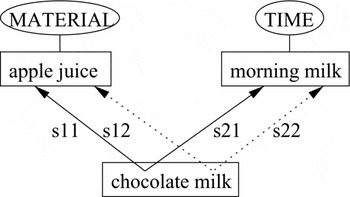
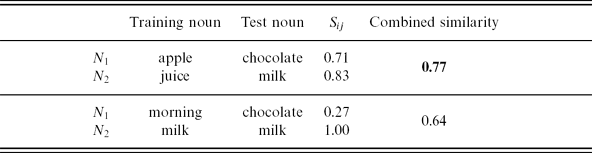
The intuition behind this work on NC interpretation is the observation that NCs which contain similar words in corresponding positions tend to share the same semantics. To illustrate how the method works, let us consider chocolate milk as a test instance, which we will attempt to interpret based on the training instances apple juice and morning milk. The SR of apple juice is material, while that of morning milk is time. As shown in Figure 1, we compare the test instance with each of the training instances in a nearest-neighbour approach. That is, we calculate the word similarity between the nouns in corresponding positions in the test and each of the training instances, i.e. compare the modifier noun to each of the modifier nouns in the training data, and the head noun to each of the training head nouns.
Similarity between test NC chocolate milk and training NCs apple juice and morning milk.

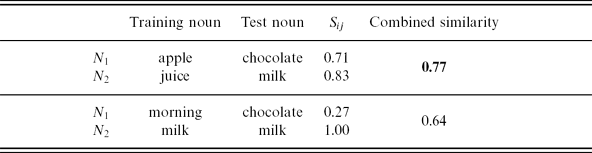
Table 2 shows the component-wise similarity (modifier = N 1 and head noun = N 2, respectively) between the test instance and each of the training instances. Note that Combined Similarity is the weighted sum of the component word similarities. The word similarities Sij are computed based on the WUP measure (Wu and Palmer Reference Wu and Palmer1994) (detailed in Section 5.2), as implemented in WordNet::Similarity (Patwardhan, Banerjee and Pedersen Reference Patwardhan, Banerjee and Pedersen1994).Footnote 1 Based on this, the combined similarity of chocolate milk with apple juice is 0.77, and that for morning milk is 0.64 (see below for details). Since the similarity with apple juice is higher, the SR for chocolate milk is resolved to material, the correct prediction in this case.
WordNet-based similarities for component nouns in the training and test data
Unlike methods which use explicit sense information (e.g. Moldovan et al. Reference Moldovan, Badulescu, Tatu, Antohe and Girju2004; Nastase et al. Reference Nastase, Sayyad-Shirabad, Sokolova and Szpakowicz2006), and which are hence susceptible to the unavoidable noise associated with word sense disambiguation, word similarity makes no direct use of sense information. Instead, it models word similarity by the union of the senses of each word, and averages across the word pairings. As a result, our approach is not directly exposed to any sense ambiguity of the component words. That is not to say, of course, that we believe that context-sensitive word sense information (e.g. from a hypothetical high-accuracy word sense disambiguation method) would not boost the accuracy of our method, or that our simplistic assumption of a word being represented by the union of its senses is cognitively plausible. Rather, the focus of the paper is on empirically demonstrating that our simplistic method – which does not make use of context-sensitive word sense information – is remarkably adept at disambiguating the semantics of NCs.
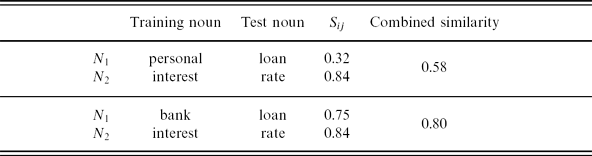
The ability of our method to deal with the effects of word sense ambiguity can be seen in Table 3, where our training NCs are personal interest and bank interest (corresponding to SRs possessor and cause/topic), and our test NC is loan rate. Note that both training instances contain the head noun interest, but with different semantics: ‘a diversion that occupies one’s time and thoughts’ in the case of personal interest, and ‘a fixed charge for borrowing money’ in the case of bank interest. Despite this, our approach resolves the SR for the test instance loan rate correctly as cause/topic based on the semantic similarity between different modifier pairings, i.e. the fact that loan is more similar to bank than personal.
The effects of polysemy on the similarities between nouns in the training
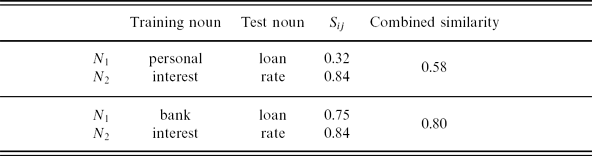
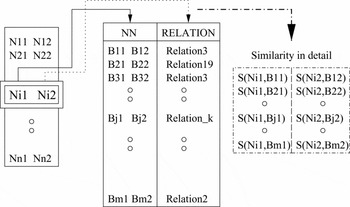
Figure 2 shows the architecture of the constituent similarity method for interpreting NCs, where (N i1N i2) is a test instance and each (B j1B j2) is a training instance. S(N i1, B j1) and S(N i2, B j2) are the similarity between modifiers and head nouns, respectively, for (N i1N i2) and (B j1B j2)
Similarity between the ith NC in the test data and jth NC in the training data.

The first step is to compute the similarities between the pair of modifiers and pair of head nouns for a given test and training instance (S(N i1, B j1) and S(N i2, B j2)). The second step is to compute the combined similarity of modifiers and head nouns as a weighted average ((1)).
Formally, S is the similarity between NCs (N i,1, N i,2) and (B j,1, B j,2):
 \begin{eqnarray}
S((N_{i,1},N_{i,2}),(B_{j,1},B_{j,2}))={\alpha S1 + (1-\alpha ) S2}
\end{eqnarray}
The final SR is determined by:
 \begin{eqnarray}
rel(N_{i,1},N_{i,2}) & = & rel(B_{m,1},B_{m,2})
\end{eqnarray}
 \begin{eqnarray}
m &=& \mathop {\rm argmax}_j S((N_{i,1},N_{i,2}),(B_{j,1},B_{j,2}))
\end{eqnarray}
5 Data and resources
5.1 Data collection
In order to perform the experiments, we first collected two- and three-term NCs from The Wall Street Journal, based on simple part-of-speech (POS) tag sequence data. We excluded NCs containing proper nouns, as on the one hand, proper nouns tend to occur with a reduced set of SRs (potentially simplifying the task) and on the other hand, the coverage of proper nouns in WordNet is poor (potentially complicating the task for our method).Footnote 2 Based on this methodology, we collected a total of 2,169 unique two-term NC types and 1,571 unique three-term NC types.
Two trained human annotators then individually bracketed the three-term NCs, arrived at an agreed bracketing for each NC and subsequently tagged all the three-term NCs for the outermost SR. That is, the human annotators tagged each three-term NC via the outermost two-term NC, based on the bracketing information.Footnote 3 For example ((N1 N2) N3) is considered as (N2 N3), while (N1 (N2 N3)) is considered as (N1 N3). The annotators were also asked to annotate all of the two-term NCs. In both cases, annotators were allowed to annotate a given NC with multiple SRs in instances of genuine ambiguity. Any disagreements in the original annotations were resolved based on discussion between the annotators.
From the disagreement data, we observed certain SR pairings that commonly caused problems, including source and cause (e.g. debt cost), purpose and topic (e.g. customer service), and object and topic (e.g. price reduction).
The initial agreement over the SR annotation task was 52.31 percent for the two-term NCs and 49.28 percent for the three-term NCs. Note that the inter-annotator agreement over three-term NCs is slightly lower than that over two-term NCs. We hypothesize that the reason for this was the syntactic ambiguity of three-term NCs: despite the NCs being provided with manual bracketing, the annotators sometimes indicated that their preferred interpretation was based on the alternate bracketing, an effect which was exacerbated by lack of context.
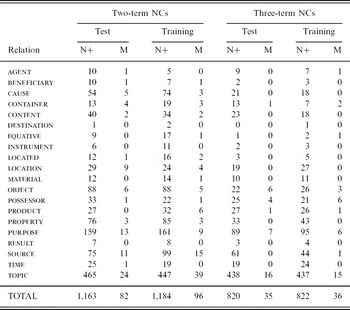
Finally, for evaluation, we randomly selected roughly 50 percent of the instances as our test data and the remainder as our training data. The breakdown of the data across different SRs is presented in Table 4. Here the numbers in each ‘N+’ column represent the instances labelled with the given SR (and possibly other SRs), and the ‘M’ columns represent the number of instances of the given SR and also other SRs. For example, in the set of two-term NCs, ten NCs are labelled with agent, among which one NC is also labelled with some other SR. The number of unique test and training instances was 1,081 and 1,088 for two-term NCs, and 785 and 786 for three-term NCs, respectively. The final dataset is available for download from http://www.csse.unimelb.edu.au/research/lt/resources/ncompound/ncompound.tgz.
Distribution of semantic relations in two- and three-term NCs in our dataset (N+ = the number of instances labelled with the given SR [and possibly other SRs]; M = the number of instances of the given SR and also other SRs)

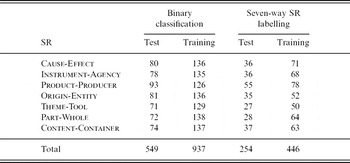
For direct comparison, we followed Kim and Baldwin (Reference Kim and Baldwin2008) in repurposing the semantic relation dataset from SemEval-2007 (Girju et al. Reference Girju, Nakov, Nastase, Szpakowicz, Turney and Yuret2007), interpreting each noun pair as an NC and reusing the original annotation. Note that although Task 8 at SemEval-2010 (Hendrickx et al. Reference Hendrickx, Kim, Kozareva, Nakov, Ó Séaghdha, Padó, Pennacchiotti, Romano and Szpakowicz2009) used a larger dataset for the same task, the dataset does not provide word senses for NCs (as required by the competitor methods detailed below). Thus, we chose to experiment only with the dataset from SemEval-2007. The original SemEval-2007 task was, for a given test instance, to judge whether a pre-determined SR applies or not. In addition to this style of binary classification, we generated a variant of the original dataset where all positive training instances were pooled together into a single classification task across all seven SRs, made up of 446 training and 254 test instances as detailed in Table 5.
Breakdown of the SemEval-2007 data across SRs in terms of the original binary classification and the repurposed SR label dataset used in this research

We, in addition, reimplemented the methods of Moldovan et al. (Reference Moldovan, Badulescu, Tatu, Antohe and Girju2004) and Nastase et al. (Reference Nastase, Sayyad-Shirabad, Sokolova and Szpakowicz2006). The Moldovan et al. (Reference Moldovan, Badulescu, Tatu, Antohe and Girju2004) method is called semantic scattering and is based on statistical affinity between particular word senses and relations. The Nastase et al. (Reference Nastase, Sayyad-Shirabad, Sokolova and Szpakowicz2006) method performs NC interpretation based on word sense and hypernym information in a memory-based learner.Footnote 4
5.2 WordNet::Similarity
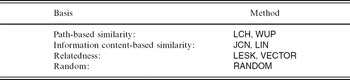
To compute the semantic similarity between two nouns, we used the WordNet:: Similarity open-source package to compute word similarities (Patwardhan et al. Reference Patwardhan, Banerjee and Pedersen2003).Footnote 5WordNet::Similarity was developed at the University of Minnesota, and provides various methods to measure the similarity or relatedness between a pair of concepts or word senses. It contains implementations of a variety of lexical comparison methods, split across three basic types: similarity, relatedness and random. The similarity methods are categorized into two groups: path-based (LCH (Leacock and Chodorow Reference Leacock, Chodorow and Fellbaum1998) and WUP (Wu and Palmer Reference Wu and Palmer1994)) and information-content-based (RES (Resnik Reference Resnik1995), JCN (Jiang and Conrath Reference Jiang and Conrath1998) and LIN (Lin Reference Lin1998)).
Path-based methods compute the shortest path length between senses of two nouns in WordNet. LCH calculates the shortest path between two target concepts (c 1 and c 2) in the WordNet a is-a hierarchy, and computes the similarity as follows:
 \begin{eqnarray}
Similarity_{lch}(c_{1}, c_{2}) = -\log {\left(\frac{p}{2 \times depth}\right)}
\end{eqnarray}
On the other hand, WUP uses the path length to the root node from the least common subsumer (LCS) of the two concepts, as follows:
 \begin{eqnarray}
Similarity_{wup}(c_{1}, c_{2}) = \frac{2 \times p3}{p1 + p2 + 2 \times p3}
\end{eqnarray}
RES, JCN and LIN augment the calculation of path length with the information content (IC) of the LCS, calculated as follows:
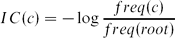 \begin{eqnarray}
IC(c) = -\log {\frac{freq(c)}{freq(root)}}
\end{eqnarray}
RES calculates the similarity of two concepts by the information of their LCS:
 \begin{eqnarray}
Similarity_{res} = IC(lcs(c_{1}, c_{2}))
\end{eqnarray}
JCN is an extension of RES, where the path length between the two concepts is included in the calculation, based on
 \begin{eqnarray}
Similarity_{jcn} = IC(c_{1}) + IC(c_{2}) - 2 \times IC(lcs(c_{1}, c_{2}))
\end{eqnarray}
LIN is a further variant of RES, based on the Dice coefficient:
 \begin{eqnarray}
Similarity_{lin}(c_{1}, c_{2}) = \frac{2 \times IC(lcs(c_{1}, c_{2}))}{IC(c_{1}) + IC(c_{2})}
\end{eqnarray}
WordNet::Similarity also includes implementations of a number of ‘relatedness’ measures which make use of relations such as has-part, is-made-of, is-an-attribute-of, in addition to is-a relations. There are three relatedness measures: HSO, LESK and VECTOR. LESK is based on the weighted word overlap of different pairings of synset glosses, over a variety of relation types.
VECTOR is a corpus-based measure. Each word is represented as a multi-dimensional vector of co-occurring words. The similarity of a word pair is measured by the cosine similarity of the two vectors. In (10),  $\overrightarrow{v_{1}}$ and
 $\overrightarrow{v_{2}}$ are the vectors of the two target words:
 \begin{eqnarray}
Relation_{vector}(c_{1}, c_{2}) = \frac{\overrightarrow{v_{1}} \times \overrightarrow{v_{2}}}{||\overrightarrow{v_{1}}|| \times ||\overrightarrow{v_{2}}||}
\end{eqnarray}
Finally, as a baseline approach, we use the RANDOM method, which randomly assigns a score for each noun pair (with all occurrences of the same noun pair receiving the same score).
Table 6 lists different similarity and relatedeness measures used in this work.
WordNet::Similarity methods used to score noun pairs

For the purposes of evaluation, we used the WUP and LCH path-based similarity measures, the JCN and LIN information content-based similarity measures, LESK and RANDOM.
6 Evaluation
We evaluate our proposed method under various experimental settings. The first experiment (Section 6.1) is based on the basic version of our method (1-NN, with uniform weighting of the modifier and head noun, and only the provided training instances) as applied to our own dataset and also the SemEval-2007 data. In the second experiment, we experiment with different weightings of the two components of the NC in our interpretation methodology (Section 6.2). In the third experiment (Section 6.3), we apply the method to three-term NC interpretation. Finally, we use the NC interpretation method to perform NC bracketing in Section 6.4.
6.1 Experiment I: automatic NC interpretation
We first present results for our two-term NC dataset of 1,088 training and 1,081 test instances, as detailed in Section 5. The baseline for this experiment is majority class classification, that is, assigning the topic SR to all test instances.
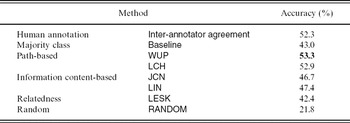
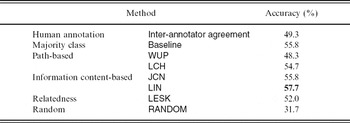
Table 7 shows that the WUP method achieves the highest NC interpretation accuracy, well above the baseline and marginally above the inter-annotator agreement (a nominal upper bound for the task). Among the four measures of similarity used in this first experiment, the path-based similarity measures have higher accuracy than the information content-based methods. We also include results for two lexical relatedness methods for completeness, both of which are found to be markedly less accurate than all of the similarity-based methods. Based on these results, we use the WUP method exclusively for the remainder of the paper, except where noted.
Accuracy of NC interpretation for different WordNet-based scoring methods over our two-term NC dataset

The methods of Moldovan et al. (Reference Moldovan, Badulescu, Tatu, Antohe and Girju2004) and Nastase et al. (Reference Nastase, Sayyad-Shirabad, Sokolova and Szpakowicz2006) both require sense data, which is not included in our dataset. We thus move on to experiment with the SemEval-2007 data, including comparison with these competitor methods, as detailed in Table 8 for seven- and two-way classification tasks.
NC interpretation accuracy over SemEval-2007

Our system surpassed the method of Moldovan et al. (Reference Moldovan, Badulescu, Tatu, Antohe and Girju2004) over both task settings, but was inferior to the method of Nastase et al. (Reference Nastase, Sayyad-Shirabad, Sokolova and Szpakowicz2006). However, we note that both benchmark systems require manual word sense information, whereas we do not require this. Given this stringent requirement, the relative empirical superiority of the method of Nastase et al. (Reference Nastase, Sayyad-Shirabad, Sokolova and Szpakowicz2006) is modest.
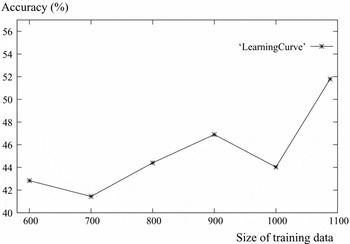
Lastly, we tested the impact on test data accuracy of differing amounts of training data. As with any supervised method, the amount of training data is expected to impact the accuracy of our method. Figure 3 shows the learning curve for our method as we increase the amount of training data. As the curve shows, our method clearly benefits from more training data, and is showing no sign of plateauing, suggesting that access to extra training data should lead to appreciable gains in accuracy.
Learning curve with respect to the size of the training data.

We, in addition, experimented with a k nearest neighbour (k-NN) approach for varying values of k, but found the results to be slightly lower than those for the original 1-NN method, except for the less competitive relatedness-based measures of VECTOR and LESK, where the overall results improved very slightly. The results are omitted from the paper because ultimately they do not shed any extra light on the task of NC interpretation.
6.2 Experiment II: relative contribution of head noun and modifier
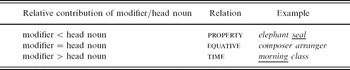
We next move on to investigate the relative contribution of the head noun and modifier in semantic interpretation. We expect that, for different SRs, the head noun and modifier will potentially have different impact in determining the overall similarity of the NC. For example, the head noun intuitively is the greater determinant of similarity with the property SR (e.g. fairy penguin). Conversely, the modifier appears to be the primary semantic contributor for the time SR (e.g. winter coat). Table 9 shows a selection of SRs, where we predict that the head noun and modifier make different relative contributions to the overall interpretation.
Predicted contribution of head noun and modifier for different semantic relations

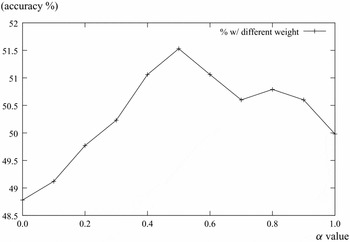
Based on these intuitions, in our second experiment, we explore the relative contribution of NC components to NC interpretation by testing the relative impact of α weight in (1) to overall performance. Figure 4 shows the overall accuracy for SR interpretation as we modify the value of α. We tested values of α in the range (0.0, 1.0) in increments of 0.1. For example, when the weight of the head noun is 0.3, that of modifier is 0.7. The best overall performance is achieved for α=0.5, i.e. when the head noun and modifier contribute equally to the determination of the SR.
Classifier accuracy at different α values.

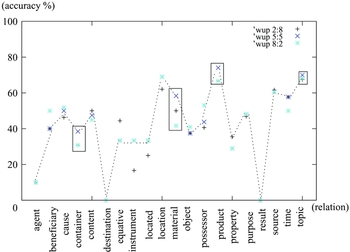
Figure 5 shows the accuracy for different SRs at different α values (α∈0.2, 0.5, 0.8). First, we noted that some SRs have a strong correlation between the target SR and either the modifier or the head. For example, some SRs such as cause and possessor are more heavily influenced by the modifier, while SRs such as content and property are affected more by the head noun, as predicted. Contrary to our expectations, the head noun seems to be a stronger determinant of the SR than the modifier for equative NCs, and both nouns seem to play an equal role for time NCs. The results show that despite localized biases for individual SRs, the overall performance is the best when the components have equal say in the prediction of SR. Based on this finding, we use α=0.5 exclusively for the remainder of this paper.
Classification accuracy for each semantic relation at different α values (‘*’ = higher weight on the modifier; ‘×’ = equal weighting on the modifier and head noun; ‘+’ = higher weight on the head noun).

6.3 Experiment III: interpretation of three-term NCs
In this experiment we test our approach over three-term NCs. To the best of our knowledge, these are the first reported results for NC interpretation over three-term NCs.
The experiment is divided into two parts. In the first sub-experiment we test our method using all three components of the NCs, and multiply all three component similarities together. Note that despite using all three components, our goal is to interpret only the top-level dependency tuple, not both two-term NCs that make up the three-term NC.
In the second sub-experiment, we use two-term NCs extracted from three-term NCs based on gold-standard bracketing information, that is (N2 N3) is extracted from ((N1 N2) N3), and (N1 N3) is extracted from (N1 (N2 N3)), and it is only these two components that are used by our method.
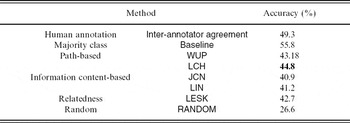
Tables 10 and 11 show the accuracy of our method over three-term NCs using all three components in the first case, and only a single two-term NC extracted from the three-term NC in the second case. Comparing the two NC representations we find that our method performs better when it has access to all three components of the NC. This suggests that all the NC components contribute to determine the SR to some degree. Interestingly, whereas the path-based methods were the strongest performers in the two-term NC case, with three-term NCs, information content-based methods perform the best. While error analysis did not unearth a clear reason for this reverse trend, we hypothesize that the differing level of information contained in two- and three-term NCs is captured differently by the two families of semantic similarity measure. Overall, the results for the three-term NCs were lower than those for the two-term NCs, but equally, the inter-annotator agreement was slightly lower, and the results for all lexical similarity and relatedness methods are actually close to or above the level of agreement.
Accuracy of NC interpretation for different WordNet-based similarity measures over three-term NCs (full)

Accuracy of NC interpretation for different WordNet-based similarity measures over three-term NCs (binarised)

6.4 Experiment IV: noun compound bracketing using semantic relations
Existing methods for bracketing (Nakov and Hearst Reference Nakov and Hearst2005; Bergsma et al. Reference Bergsma, Pitler and Lin2010) rely on a large amount of data to compute lexical probabilities. Unfortunately, however, a large amount of data is not always available, e.g. for specialist domains. Here we test the utility of SRs in bracketing three-term NCs based on the dataset described in Section 5. The basic intuition behind the method is that the SR prediction for the outermost two-term NC from the correct bracketing should agree with the SR prediction for the three-term NC (without bracketing). For example, given the NC automobile production target, we would expect the SR for production target to be the same as for the overall three-term NC, whereas we would not have the same expectation for automobile target (derived from the alternative bracketing hypothesis).
We use the WUP similarity measure to interpret NCs since it produced the highest accuracy, and test bracketing using various similarity thresholds. For example, if the SR for the outermost two-term NC (based on the dependency model) agrees with for the overall three-term NC, both calculated at a similarity value greater than or equal to 0.5, then we use the SR predictions for bracketing. Otherwise, we ignore the SR predictions and fall back on a simple lexical model.
To disambiguate the syntactic structure in three-term or higher term NCs, we use lexical probabilities based on a limited amount of data collected from three corpora: the British National Corpus, The Wall Street Journal and the Brown Corpus. SRs are calculated for the original three-term NC and its two-term NCs based on a dependency model analysis of the components (Lauer Reference Lauer1995).
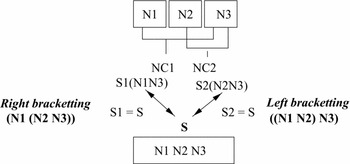
Figure 6 depicts our method for identifying the syntactic structure of a three-term NC using SRs and the two-term NCs extracted from the three-term NC. In Figure 6 we extract the two outermost two-term NCs (N1 N3) and (N2 N3) from the three-term NC (N1 N2 N3) corresponding to a right bracketing and left bracketing analysis, respectively. We then classify the SR for each of (N1 N3), (N2 N3) and (N1 N2 N3) (in the latter case, based on the three-component model without bracketing information), and if the SR for only one of the two two-term NCs agrees with that for the overall three-term NC, then this gives us our bracketing prediction. For example, physics winter school, with SR topic, is associated with the two-candidate two-term NCs of physics school (i.e. (N1 N3)) and winter school (i.e. (N2 N3)). Since the SR of the first two-term NC (topic) is the same as the three-term NC, while that for the second NC (time) is different, we can disambiguate the three-term NC as (physics (winter school)) (right bracketing).
Overview of the proposed NC bracketing method.

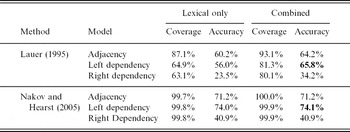
Analysis of our method showed that it had limited coverage due to its reliance on WordNet to calculate lexical similarity. We hence decided to combine our proposed bracketing method with a lexical probabilistic model. That is, we first attempt to determine the bracketing using the probabilistic model, and if the model does not provide an answer due to data sparseness (i.e. if we do not have any instances of both word pairs), then we back off to our SR-based model. Note that we also tested using the lexical model than applying the probabilistic model, but found the results to be uncompetitive and omit them from this paper. As our probabilistic model, we used adjacency and dependency from Lauer (Reference Lauer1995) (described in Section 2.2), using the combination of our three corpora – the Brown Corpus, The Wall Street Journal and the British National Corpus– to compute lexical probabilities. Also, to compare the method with the current state-of-the-art, i.e. Nakov and Hearst (Reference Nakov and Hearst2005), we used Google web data to compute the probabilities. Table 12 shows the coverage (i.e. proportion of instances where we are able to make a prediction) and accuracy of the probabilistic model in isolation, and also the combined model.
Complementing existing bracketing methods with semantic relation-based disambiguation

Bracketing using only the probabilistic models also suffers from data sparseness and does not achieve 100 percent coverage even with web data. When we combine the probabilistic model with our semantic relation method, both the coverage and the accuracy increase in all cases. The best performance for each of the corpus- and web-based methods was achieved with the left-dependency model. Over web data, the increment in coverage and accuracy is tiny due to the majority of instances being disambiguated by the probabilistic model. However, even here, by combining it with the semantic relation method, we are able to increase accuracy marginally.
From Table 12 we can clearly see that when SR-based bracketing resolves the syntactic ambiguity over instances which are untagged by the probabilistic method, the accuracy is higher than for the probabilistic method in isolation, and also higher than for the SR-based bracketing method over all NCs. This suggests that the SR-based bracketing method complements the lexical probability method over our dataset for both the Lauer (Reference Lauer1995) and Nakov and Hearst (Reference Nakov and Hearst2005) methods. This result is highly significant in showcasing an application where the underlying SR interpretation method boosts coverage and accuracy if only modestly for the web-based method of Nakov and Hearst (Reference Nakov and Hearst2005). Given the relative impact of NC bracketing on overall parser accuracy (Vadas and Curran Reference Vadas and Curran2008), this finding potentially suggests a novel research direction in improving parsing with lexical semantic features in the vein of Agirre, Baldwin and Martinez (Reference Agirre, Baldwin and Martinez2008) and others.
7 Conclusion
In this paper we have proposed an automatic method for interpreting the semantics of NCs with SRs. Our method uses an instance-based learning approach based on lexical similarity between each of the test instance and the corresponding components of training NCs using WordNet. We applied the method to both two- and three-term NCs using the SR set of Barker and Szpakowicz (Reference Barker and Szpakowicz1998). Overall, we found that our method did better over two-term NCs at a level nearing inter-annotator agreement over the task. Finally, we proposed an NC bracketing method based on our NC interpretations, and demonstrated that we were able to boost the accuracy and coverage of standard NC bracketing methods based on lexical probabilities.
Acknowledgments
NICTA is funded by the Australian Government as represented by the Department of Broadband, Communications and the Digital Economy and the Australian Research Council through the ICT Centre of Excellence program.