Introduction
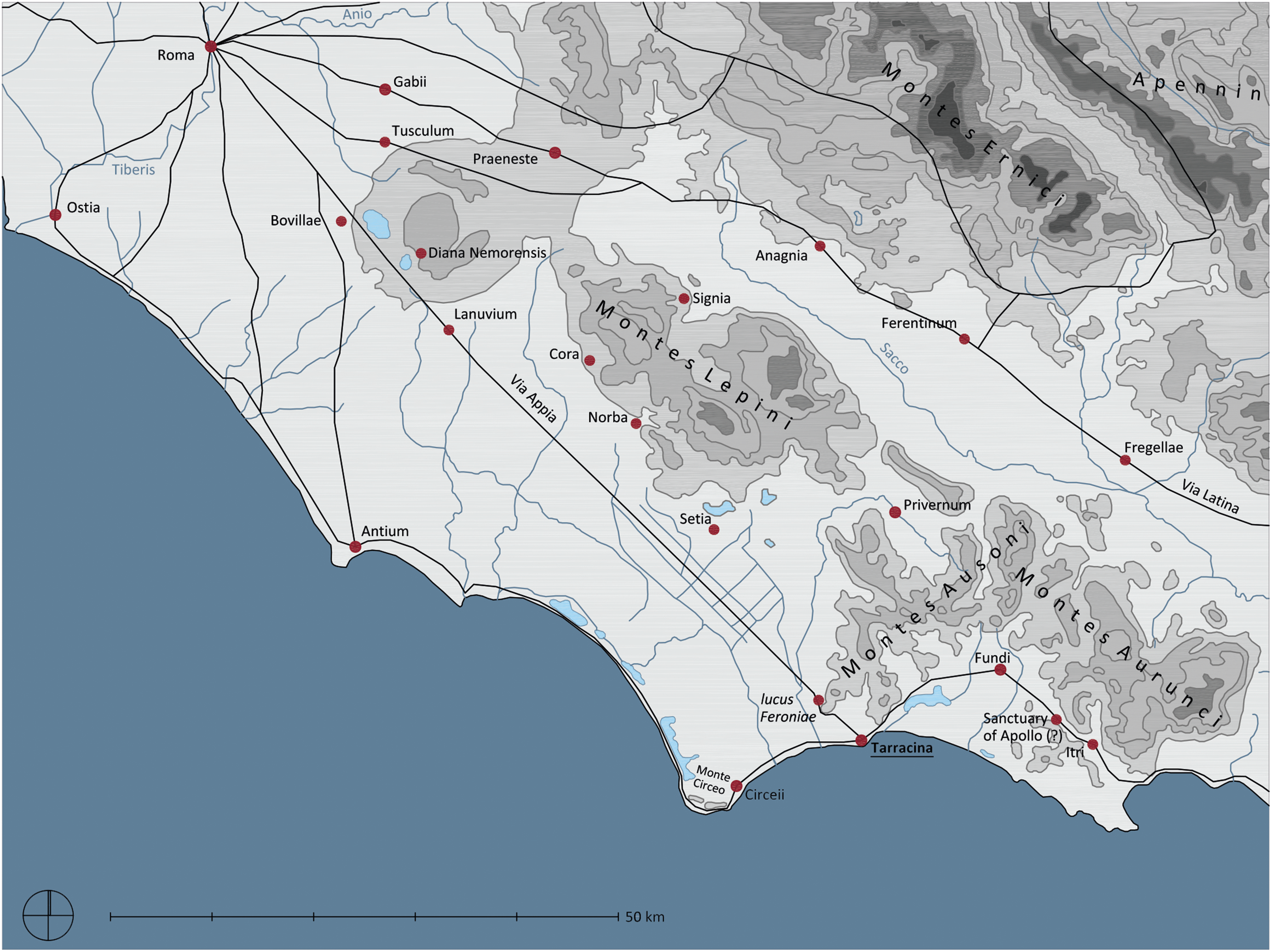
The harbor city of Terracina is located 100 km south of Rome along the Tyrrhenian Sea. In antiquity, it became a crucial center in the southern region of Latium, situated at the edge of the Pontine Marshes (Fig. 1). Due to its strategic location in the foothills of the Monti Ausoni, it earned the moniker “Thermopylae of Italy”Footnote 1 and was referred to as a “gateway city.”Footnote 2 The Roman city, which was initially founded as a colonia maritima in 329 BCE,Footnote 3 was named Tarracina. Footnote 4 This colony was established in the Volscian settlement of Anxur, as reflected in the name of the main god and patron of the Roman city: Iuppiter Anxur.
Map of southern Latium with ancient cities and sanctuaries mentioned in the text. (Map by Julia Kammerer and the authors.)

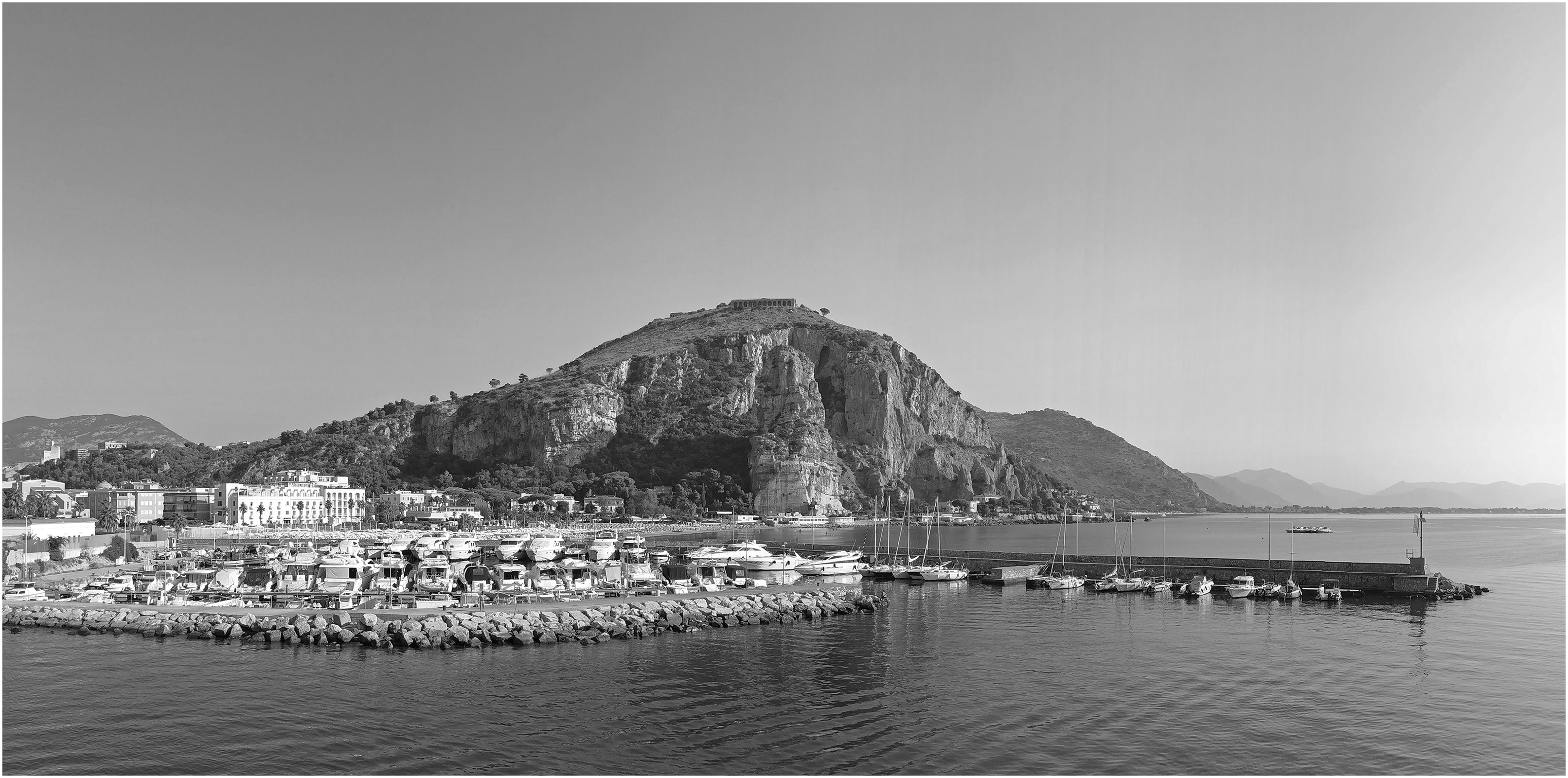
This youthful Jupiter is described in ancient sources as the god “who never needed to shave”Footnote 5 and was renowned for overseeing a sanctuary “gleaming in the ocean waves.”Footnote 6 His cult was located amidst the spectacular architectural scenery at the top of Monte Sant’Angelo (Fig. 2), as well as in the ancient city of Terracina. Yet even though the cult of Jupiter Anxur and his temple have been a topic of investigation for over 150 years, their precise location remains unidentified to this day.
View of Monte Sant’Angelo from the modern harbor of Terracina. The substructures of Terrace C, with its 12 arches, are visible at the top of the mountain. (Photo by Paul Scheding.)

Long before systematic investigations, depictions of the sanctuary on Monte Sant’Angelo appeared in paintings and sketches, and it was referenced in numerous travelogues.Footnote 7 But the first substantive scientific research on the sanctuary began in the late 19th c. Large-scale excavations were conducted by Pio Capponi,Footnote 8 with a specific focus on the southern terrace (one of three) belonging to the sanctuary. Throughout the documentation process, various small additional trenches were excavated on the summit.Footnote 9 In 1926, Giuseppe Lugli published his detailed work on the history and archaeology of the city of Terracina and its surroundings.Footnote 10 Then, in the 1950s, initial extensive groundwork was undertaken on the summit of the mountain. Following the almost complete excavation of the sanctuary of Praeneste, an excavation campaign was also initiated on Monte Sant’Angelo, aiming to facilitate comparative studies of these two monumental terrace-sanctuaries.Footnote 11 Based on these results a ground plan was published in 1976,Footnote 12 which depicted the exposed remains of the summit and is still used in archeological research. In 1988, comprehensive restoration work was conducted by the Soprintendenza per il Lazio, with a primary focus on the western and northern areas of the sanctuary.Footnote 13 The most recent studies in the sanctuary were conducted in 1999–2000, focusing on the architectural history of the area surrounding the Great Temple.Footnote 14
Since 2021, a team from Ludwig-Maximilians-Universität (LMU) in Munich has expanded its ongoing research on Monte Sant’Angelo to include the summit of the mountain.Footnote 15 Through stratigraphic excavations and architectural documentation, the objective has been to elucidate the genesis, transformation, and function of the sanctuary. Due to its monumental scale, exceptional state of preservation, and impressive topography overlooking the coast of Latium, the sanctuary of Terracina features in numerous handbooks on Roman architecture.Footnote 16 Over the decades, many contributions have explored specific questions about the sanctuary’s layout, its chronology, and the gods worshipped there. The site has also long played a key role in discussions of so-called terrace-sanctuaries and the reception of Hellenistic architectural forms in Italy, and it has informed related questions about the possibilities afforded to Italian builders by new caementa technologies.Footnote 17 The present research aims to provide insights, for the first time, into the development of the entire sanctuary and its significance as a representative example of the dynamic transmission and adaptation of Hellenistic architecture in Italy.
Framing the mountain: the architecture of Terrace A and its Hellenistic façade
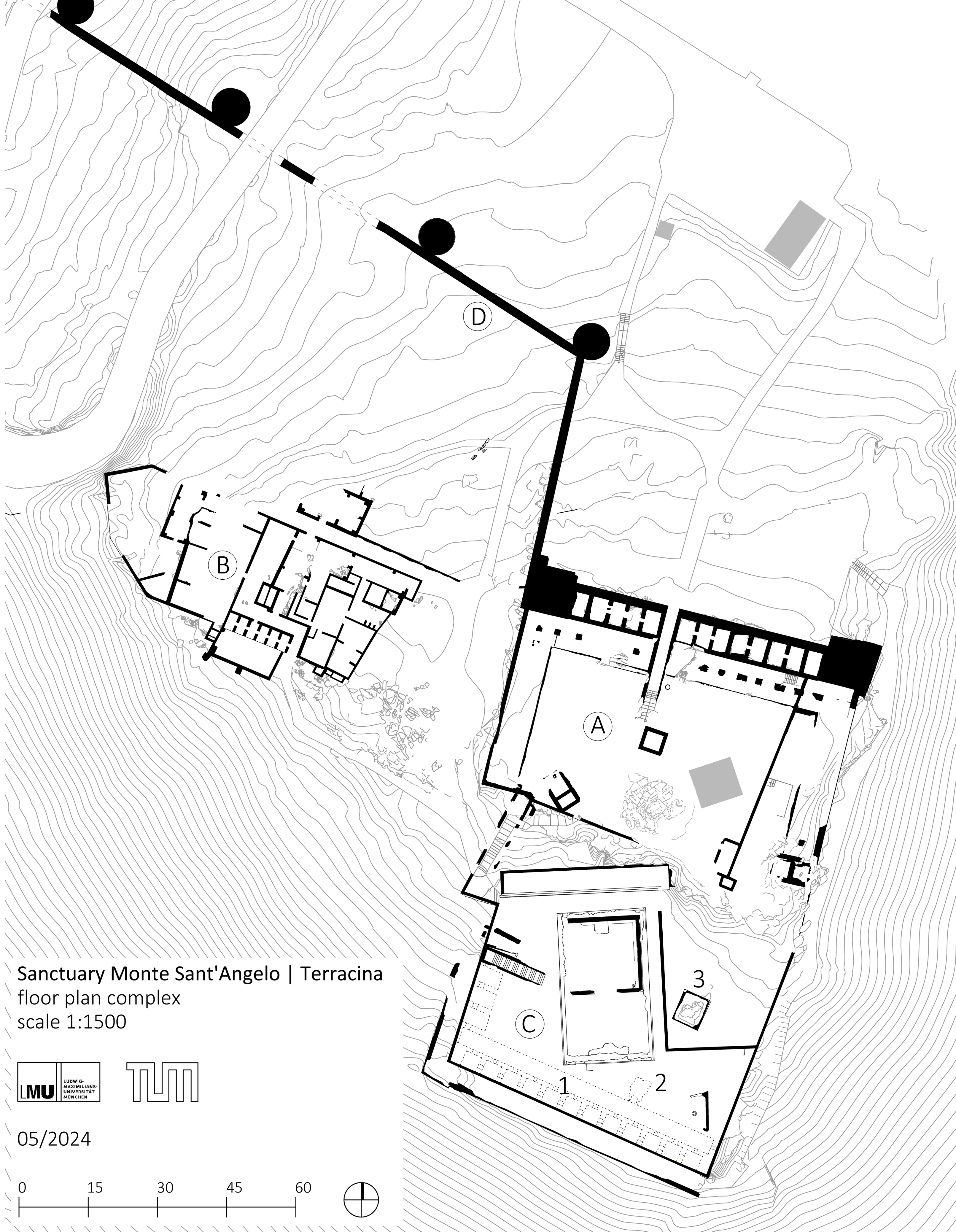
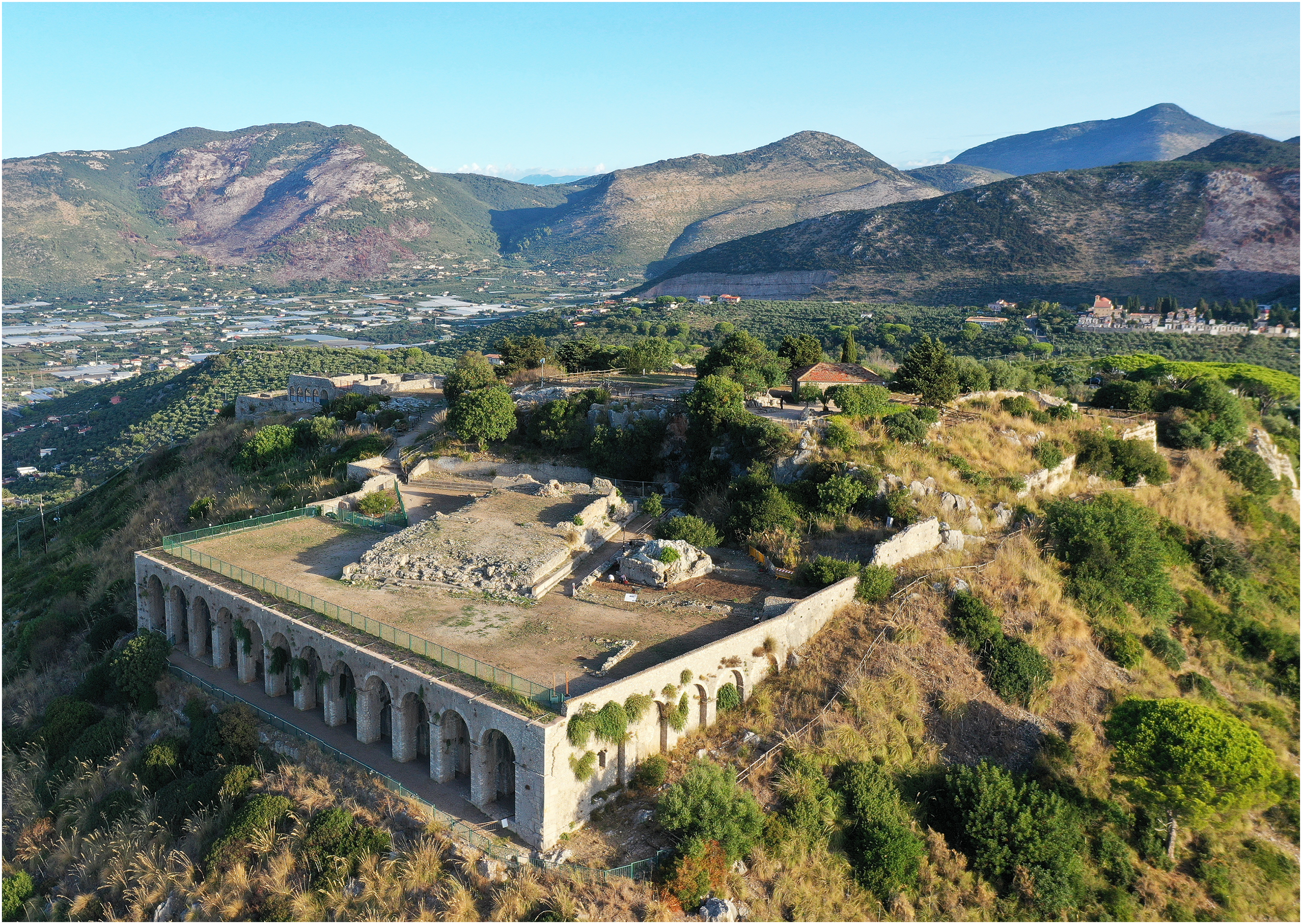
The Roman sanctuary situated on Monte Sant’Angelo comprises three separate terraces (Fig. 3). The south-facing section has been labelled Terrace C. It houses the Great Temple and is characterized by substructures still visible today from the seashore (Fig. 4). It has been studied and reconstructed several times.Footnote 18 Terrace B, situated in the northwestern area, is home to the Small Temple and provides a panoramic view of the Pontine Marshes and the ancient city of Terracina. The recent LMU excavations have enabled a revised reconstruction of this terrace’s orientation and dimensions, as well as, for the first time, those of the temple.Footnote 19 The third expanse is Terrace A, the northern plateau and summit of the mountain, also known as the Campo Trincerato. The western corner of this area is connected to Fortified Wall D, which extends for almost 1 km and features nine round towers. This wall descends from Monte Sant’Angelo, establishing a link between the sanctuary and the city of Terracina.Footnote 20 Since the 19th c., Terrace A has been understood to be a Roman military camp. The origins of this reconstruction can be traced to a misinterpretation of the ruins at the beginning of the archaeological investigations.Footnote 21 The fragmented architectural layout in the northern parts of Terrace A led to its initial characterization as the barracks of a Roman military fort, referred to as the “logement des soldats.”Footnote 22 Today, this interpretation can be refuted, as there is neither archaeological nor architectural evidence supporting the notion that the site functioned as a military camp during the Roman era.
The Sanctuary of Monte Sant’Angelo. Black: Archaeological remains. Grey: Modern buildings. A: Terrace A and highpoint of the mountain; B: Terrace B with the Small Temple, later occupied by a medieval monastery (8th–12th c. CE); C: Terrace C with cryptoporticus (1), grotto (2), and oracle (3). (Map by Miriam Knechtel and Technical University of Munich.)

The three terraces, viewed from the southeast. In the foreground is Terrace C, with Terrace B on the left and Terrace A at the top. (Photo by Dario Monti.)

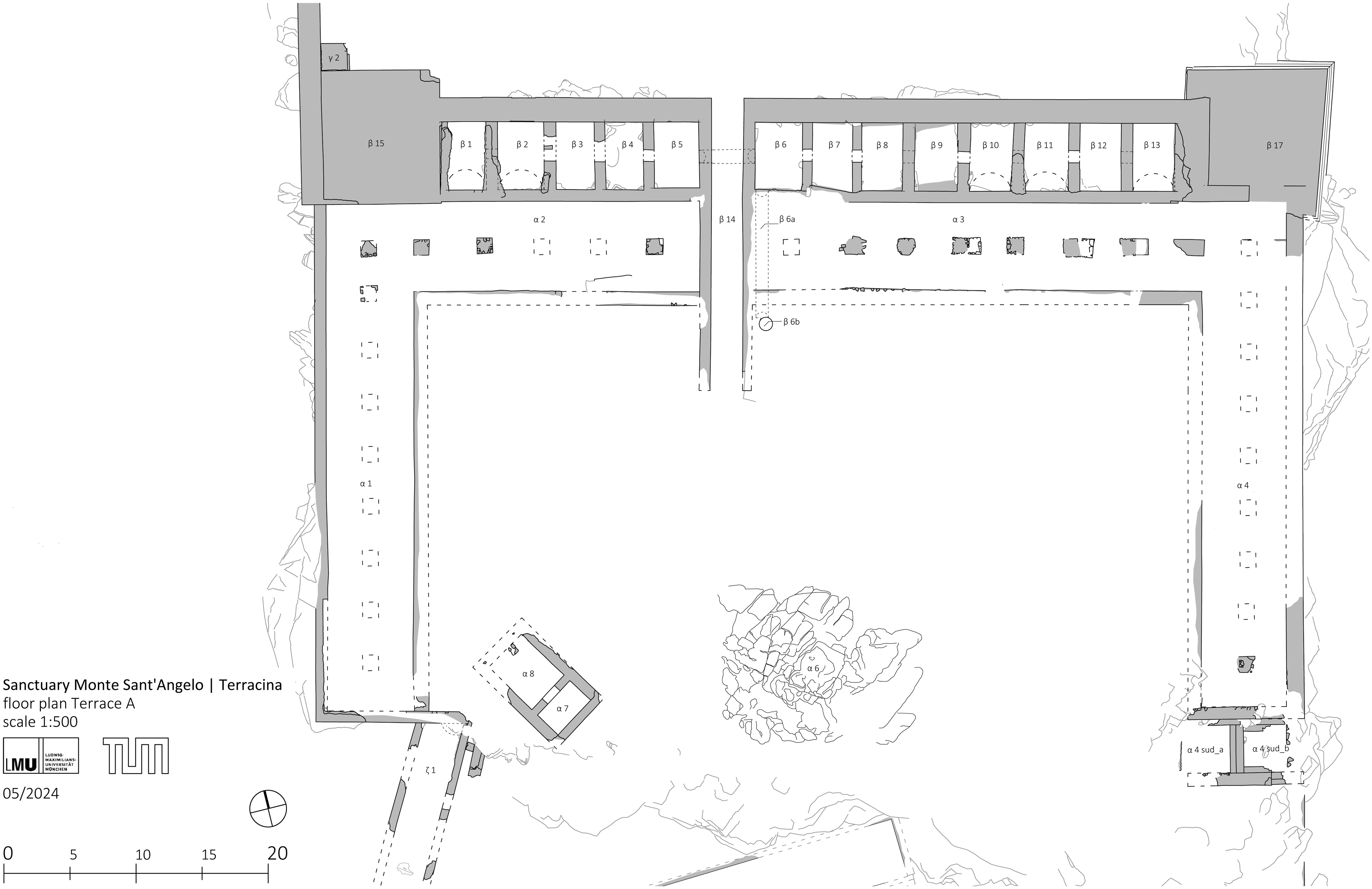
Terrace A features an open platform measuring 58 × 31 m (Fig. 5). This area was intentionally leveled to 222.7 m above sea level, as evidenced by wedge-hole-shaped cuts on the surface. This points to the substantial removal of major parts of the Monte Sant’Angelo hilltop. The quarried stone material was utilized in the construction of substructures and walls as an integral component of the building project. In the northern and western parts, minimal backfilling of the terrain was necessary to attain a uniform floor level; in the eastern area, a notable raising of the ground level was required. Significantly, the northern side of the terrace underwent expansion through a monumental substructure, effectively enlarging the natural terrain of the mountain top by an additional 7 m. This substructure, however, was not constructed with open arches to the front, as observed in Terrace C, but instead with a flat-planed face.
The Sanctuary of Monte Sant’Angelo. Ground plan of Terrace A with indications of areas mentioned in the text (α 1 – ζ 1). Α 6: the outcrop. (Ground plan by Miriam Knechtel.)

The substructure comprises 13 vaulted chambers (Fig. 5, β 1–13) framed at the eastern and western ends by two squared avant-corps.Footnote 23 It is divided into two sections by a narrow ramp leading from the north to the walking level of Terrace A (Fig. 5, β 14); this functioned as the primary entrance to the sanctuary and is still in use within the Archaeological Park. The arrangement is characterized by a slight westward offset, with five chambers (Fig. 5, β 1–5) aligned to the west and eight to the east (Fig. 5, β 6–13). Nevertheless, the two sections are interconnected by a low vaulted tunnel, approximately 1.4 m in height, situated beneath the main entrance ramp. The chambers themselves have small arched passageways of various heights connecting them. The sole known link to the chambers from the upper level of Terrace A is a 1 m-wide circular shaft in the north of the square (Fig. 5, β 6 b). This opening, with a depth of 3.5 m, leads to a vaulted corridor that connects the shaft to the chambers of the substructures (Fig. 5, β 6 a). However, the absence of any traces of staircases makes its function within the sanctuary unknown.
Rooms β 1–13 have been consistently interpreted as a cistern.Footnote 24 However, despite certain aspects of the architectural layout, this can be refuted by several arguments. The chambers’ walls exhibit numerous open joints and holes, and the floors are made predominantly of bedrock with a highly irregular surface. Archaeological excavations have revealed the absence of wall plaster, floor covering, and, notably, hydraulic mortar in any of the chambers.Footnote 25 This lattermost absence is particularly noteworthy as hydraulic mortar is the distinctive feature of Roman cisterns, crucial not only for sealing the reservoirs but also for their maintenance and cleaning.Footnote 26 Consequently, the chambers were not primarily designed for a specific use but rather served as a substructure for expanding the architecture on the walking level of the upper platform.Footnote 27
The plaza of Terrace A is enclosed by a Pi-shaped architecture. Square foundations are systematically positioned at regular intervals parallel to their outer walls. Within the northern wing, 10 of these foundations have been preserved, as have two in the west and one in the east wing.Footnote 28 Excavations of these foundations have yielded ceramic materials, dating the construction of this architecture to the second half of the 2nd c. BCE.Footnote 29 Contrary to its previous interpretation as military barracks, this architecture must be redefined as a porticus triplex, a three-winged portico open to the south (Fig. 5, α 1–4).Footnote 30 The regularly spaced square foundations in the central area confirm that it is a two-aisled hall. Drawing parallels with similar structures in 2nd-c. Greece or Italy, such as the porticus in the sanctuary at Monte Rinaldo,Footnote 31 the outer row of columns must have been of the Doric order, while the inner row would have been of the Ionic order. An Attic base discovered on Terrace B may have belonged, considering its dimensions, to one of the inner columns of the hall.Footnote 32 Based on the in situ foundations in the center, the three-winged portico consisted of 32 inner columns. By doubling the quantity of columns compared to the inner row, 58 outer columns can be proposed.Footnote 33 Fragments of a Doric frieze were found on the hilltop of Monte Sant’Angelo and may have been part of this columned hall.Footnote 34 The configuration of a three-winged portico with two aisles is recognized as a common feature in (terrace) sanctuaries in central Italy, particularly in the 2nd c. BCE, as exemplified by sanctuaries such as Fortuna Primigenia at Praeneste.Footnote 35 By opening to the south, the portico at Terracina offered a luminous and expansive architectural framework for the center of the sanctuary, defining the plaza it enclosed.
The reconstruction of the northern façade of the building, which adjoins the Pi-shaped portico and is situated atop the 13 barrel-vaulted chambers, presents a significant challenge. Comparative studies of ground plans featuring a long rectangular central section flanked by two square avant-corps from 3rd- and 2nd-c. BCE Greece and Italy strongly indicate that the structure was a columned hall. This hypothesis is supported by well-documented examples from Megalopolis and the island of Delos,Footnote 36 where columned halls with symmetrical avant-corps at the corners are preserved. They enhanced the architectural coherence and visual impact by framing the viewer’s gaze onto the space in front of them, directing attention to the main entrance of the sanctuary.
However, a “hall-façade-architecture” in Terracina raises two critical questions. First, the hall itself would have been accessible only from the rear, as it is elevated on a podium approximately 4.5 meters high. This design suggests that the hall was not intended for practical use but rather served as a representative façade, emphasizing the visual dominance of the structure within its environment. Second, the relationship between the columned hall and the adjoining Pi-shaped portico remains unclear. The integration of these architectural elements is uncertain, particularly how the hall might have been spatially and functionally connected to the portico south of it.
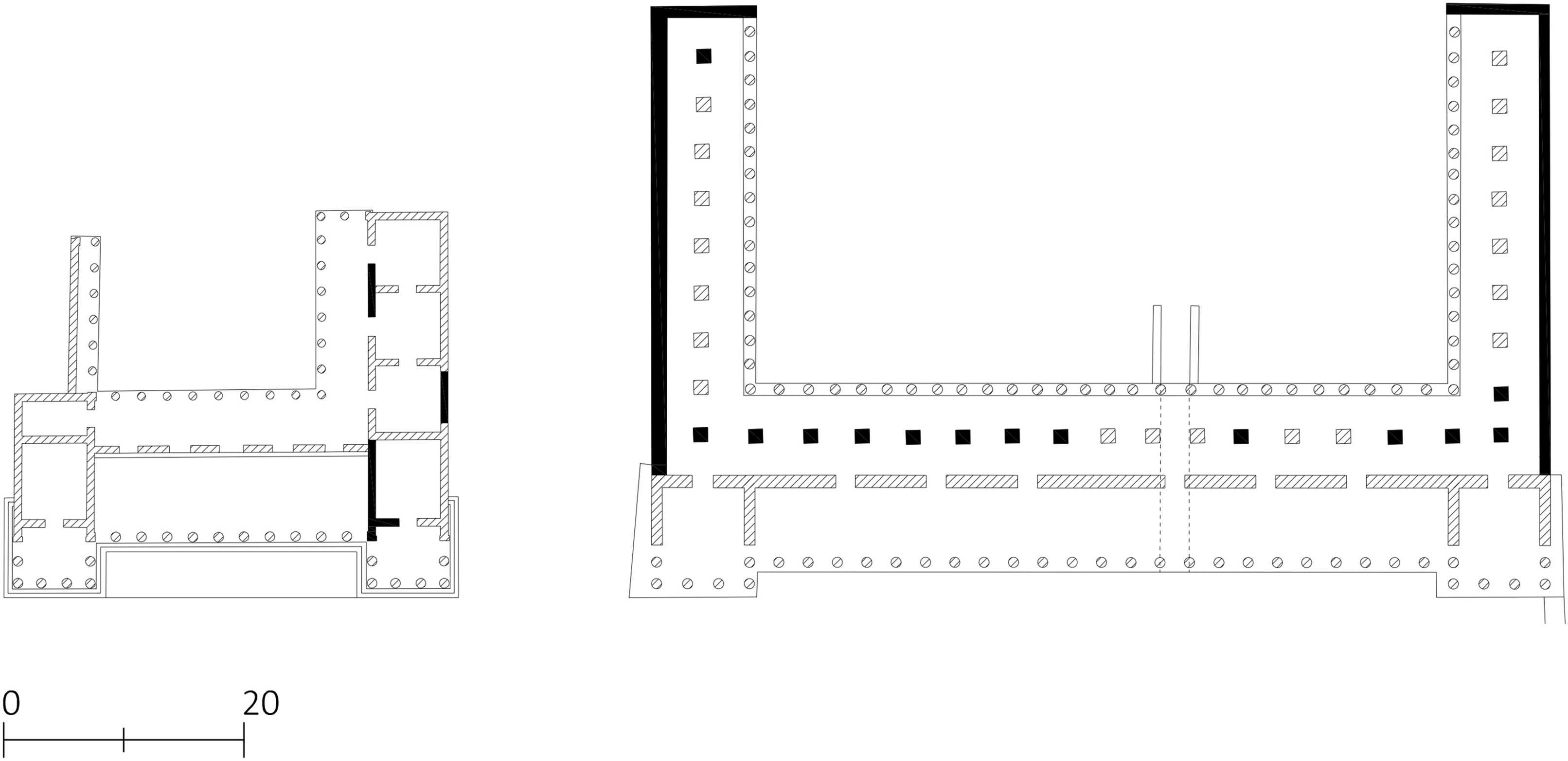
The sanctuary of Athena Lindia in the ancient city of Lindos on Rhodes presents itself as a potential model for the reconstruction of the northern façade in Terracina.Footnote 37 Erected in the first half of the 3rd c. BCE and continuously altered during the Late Hellenistic period, this portion of the sanctuary in Lindos provides access to the highest point of the mountain, where the temple of Athena is situated.Footnote 38 There are especially significant parallels in the main layout of the so-called propylaea in the sanctuary of Athena (Fig. 6). Similar to the structure at Terracina, it features two corner avant-corps and a main entrance that pierces the façade. Elevated on a substantial podium as well, the façade constitutes a monumental hall, boasting 22 columns.Footnote 39 To the south and directly linked to the propylaea, a rear porticus frames the main plaza of the sanctuary. These conceptual similarities between the two sanctuaries make it plausible to reconstruct a comparable columned façade on the hilltop of Terracina, offering a new perspective on the architectural layout of the North side of Terrace A. The architecture of the sanctuary on Monte Sant’Angelo provided monumental façades facing not only the sea (Fig. 4) and the city, but also the northern stretch of the Appian Way. This produced an equally impressive long-distance view of the main entrance of the Hellenistic sanctuary.
Comparison of the ground plan of the entrance to Terrace A in Terracina (right) and the propylon of the sanctuary of Athena Lindia at Rhodes (left). Hatched area: hypothetical reconstruction. (Ground plans by the authors.)

The outcrop and the mountain: a new sacred building on Monte Sant’Angelo
Framed by the Pi-shaped portico, the remnants of two monuments have been preserved: an outcrop at the center of the southern edge (Fig. 5, α 6) and a small rectangular structure in the southwestern section of the square (Fig. 5, α 7–8). This rectangular structure measures 8.8 × 5.3 m and was made with opus caementicium directly on the bedrock. It includes a base in a central position at the rear, which probably held a statue. While the ground plan suggests a temple, the absence of a podium raises doubts, making it more plausible to interpret the structure as a shrine.Footnote 40 The presence of an Ionic capital found within the sanctuary, which matches the dimensions of the building, supports its characterization as a shrine in antis in the Ionic order.Footnote 41 Remarkably, it faces southeastward precisely towards the so-called oracle rock on Terrace C below (Fig. 3, 3).Footnote 42 The construction technique and architectural context of Terrace A suggest that the shrine was erected during the monumentalization of the complex around the mid-2nd c. BCE.Footnote 43 Adjacent to the shrine, there are traces of a descending staircase (Fig. 5, ζ 1). This passage provides direct access from the summit of the mountain to the lower walking level of Terrace C.
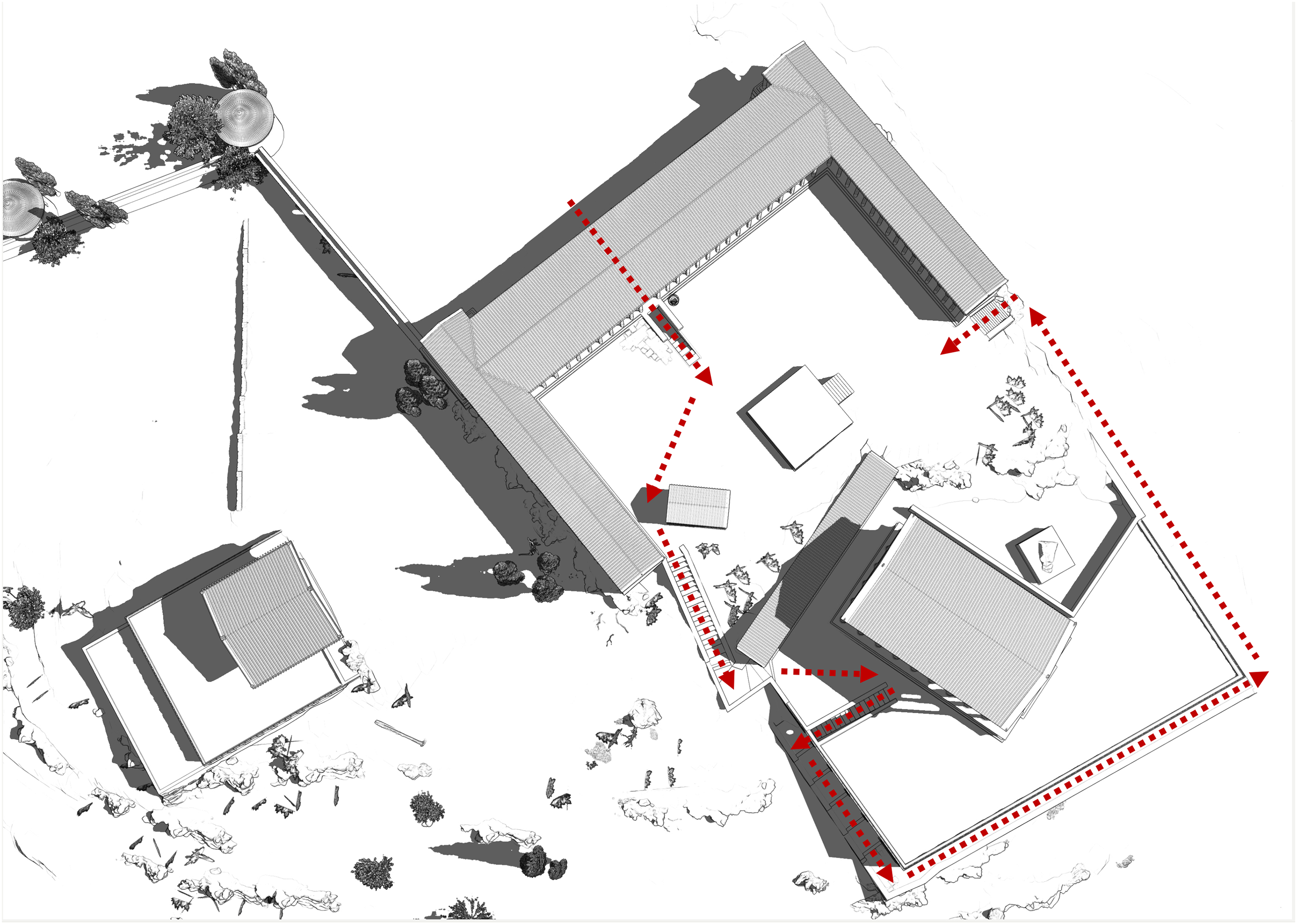
In proximity to the eastern portico of Terrace A, two parallel walls ca. 3.6 m apart extend in an east–west direction (Fig. 5, α 4 sud).Footnote 44 Like the southwestern access to Terrace C (Fig. 5, ζ 1), this feature is a monumental staircase, with a gradient estimated to be between 34° and 38°, which bridges the elevation difference of 6.5 m between Terrace A and a path running along the Eastern slope. This would have created a circular pathway through the sanctuary by connecting the summit of Terrace A and the cryptoporticus and grottos of Terrace C (Fig. 7).Footnote 45 The signs of ramps and staircases in the sanctuaries in Latium during the 2nd and early 1st c. BCE are a distinctive architectural phenomenon. These elements played an important role in cultic practices by facilitating travel via prescribed pathways through architectural space, particularly during ritual processions.Footnote 46 The combination of ramps and staircases helped to guide the observer’s gaze towards specific locations within the architecture, and especially towards the main cult place of the sanctuary.Footnote 47
The Sanctuary of Monte Sant’Angelo. Reconstruction of a pathway connecting Terrace A and Terrace C as part of a possible sacred procession. (Reconstruction by Georg Hyza.)

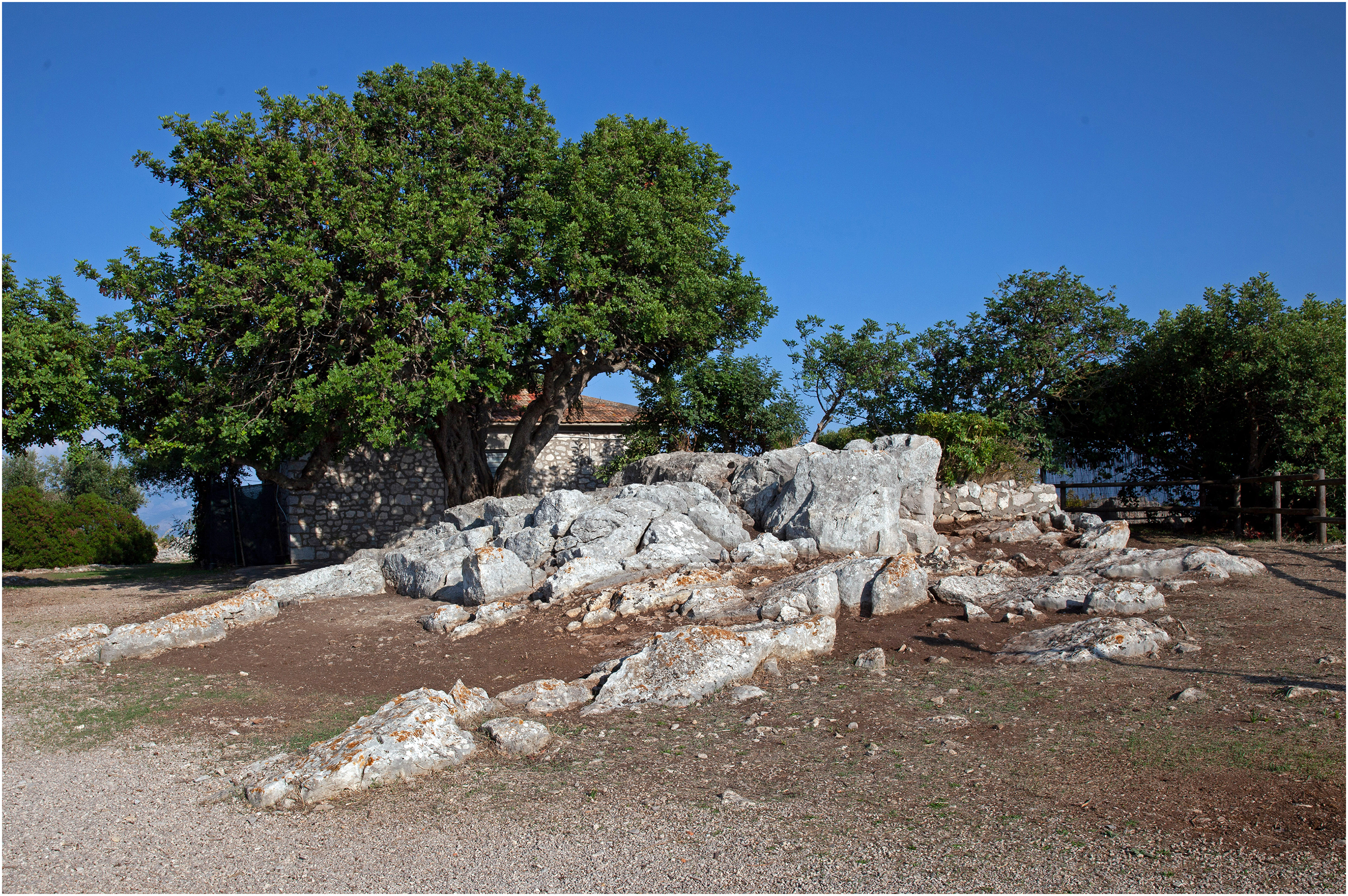
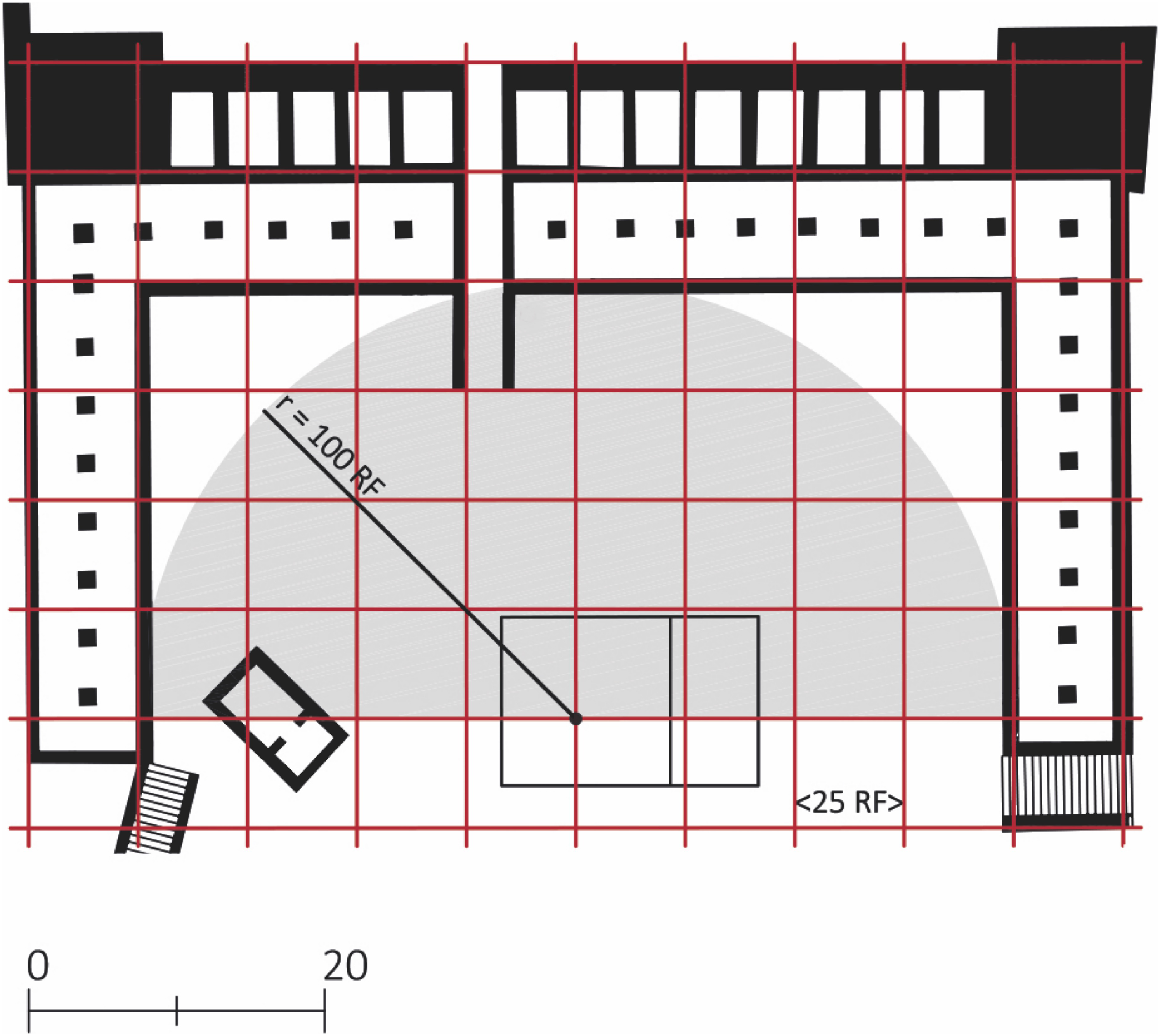
The most intriguing structure on Terrace A is an outcrop located in the south of the plateau that rises up to 1.75 m (Fig. 5, α 6 and Fig. 8), making it the highest point of the whole mountain. This structure held paramount importance within the sanctuary.Footnote 48 The architectural study of the area indicates that it was the key point for the overall layout of the upper terrace, in terms not only of its function, but also of its architectural design and construction (Fig. 9). The plaza can be inscribed as a semicircle with a radius of 100 Roman feet (29.6 m), whose center is exactly located at the highest part of the mountain, the outcrop. The north–south axis that runs through this point thus forms the central axis of the square. The semicircle’s center is also the starting point of a square grid with an axial dimension of 25 Roman feet (7.4 m).Footnote 49 Therefore, this high point was not only decisive from a conceptual point of view but also played a significant role in the realization of the building concept. All measurements required to mark the positions of the walls that were erected on the construction site must have been taken from this point.Footnote 50 On this assumption, it must also have served as the primary reference point for the construction-work of the entire structure in the latter half of the 2nd c. BCE.Footnote 51
The Sanctuary of Monte Sant’Angelo. The outcrop on Terrace A. (Photo by Paul Scheding.)

Ground plan of Terrace A, with the design grid originating from the highest point of Monte Sant’Angelo. (Ground plan by Miriam Knechtel.)

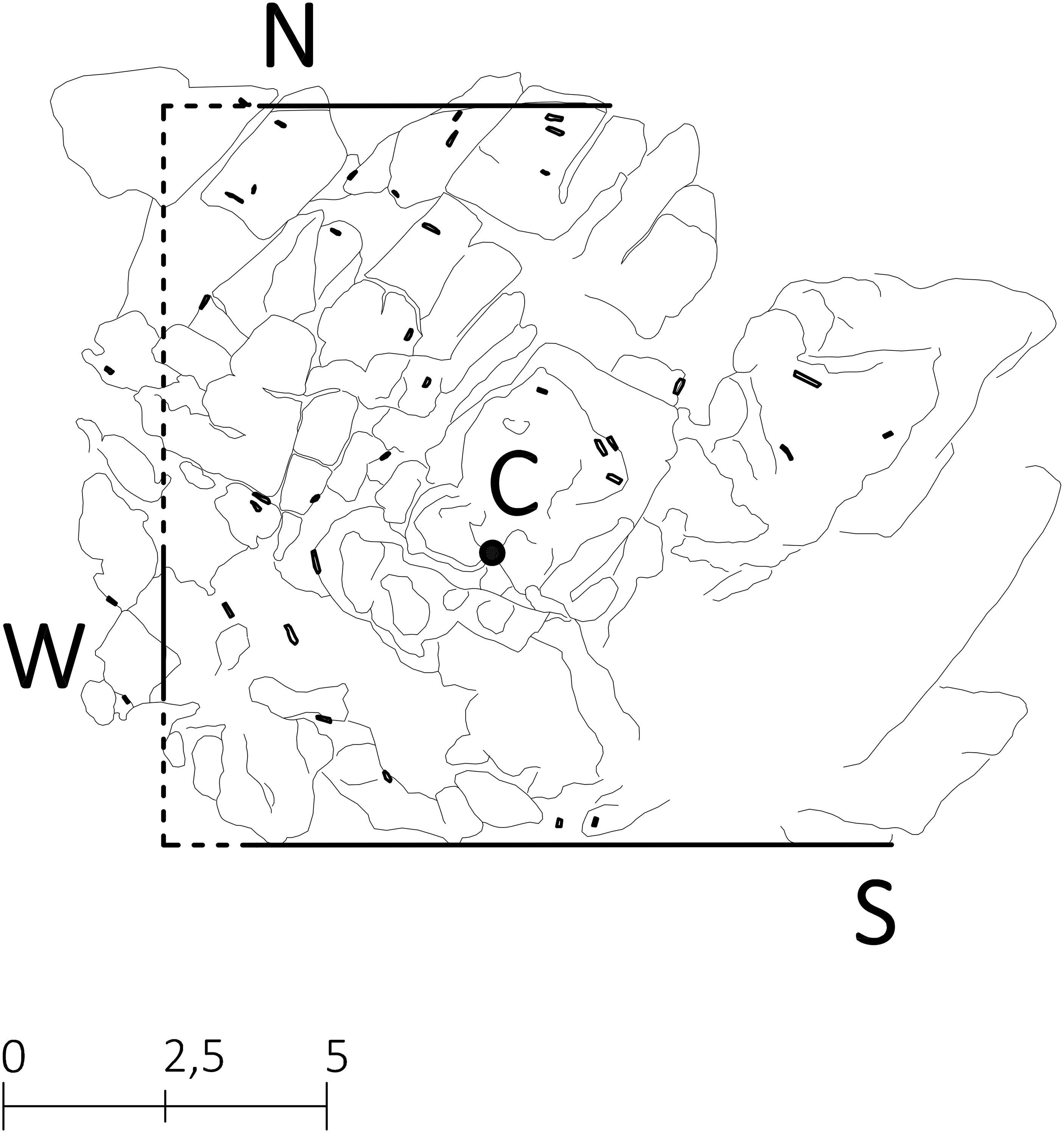
The outcrop itself exhibits various traces of stone-working (Fig. 10), including wedge-hole-shaped cuts distributed over it, ranging in length from 11 cm to 25 cm. Vertically worked surfaces on the northern edge, which run in an east–west direction, and carved lines running north–south in the western parts of the outcrop are proof of deliberate modifications to the rock bed.
Ground plan of the outcrop with traces of stone-working. N: worked surface; W: carved lines on the floor; S: limiting axis; C: Highpoint and central point of semi-circle. Wedge-shaped cuts are distributed over the outcrop. (Ground plan by Miriam Knechtel.)

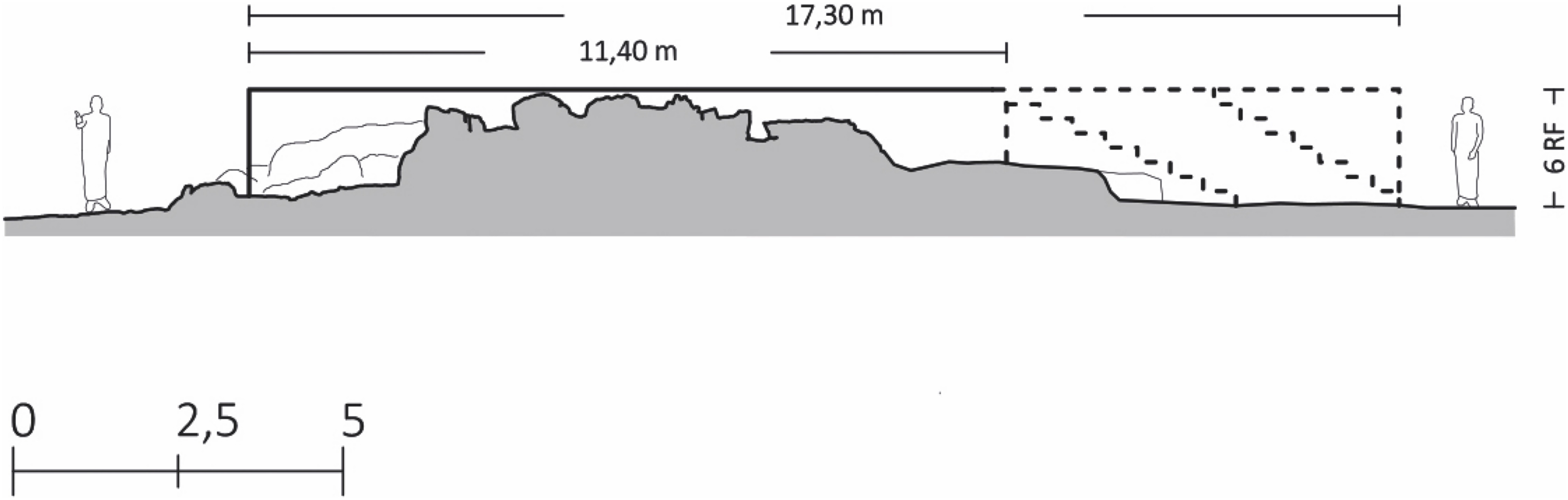
Moreover, traces of mortar were uncovered during the examination of the area, confirming the presence of an architectural framework for the outcrop. The extensive leveling of the rock spur’s surface to a maximum height of approximately 1.75 m (6 Roman feet) indicates its function as a platform, integrating the natural rock with artificial architectural enhancements (Fig. 11).Footnote 52 The dimensions of the architectural structure can be obtained from the remaining parts of the bedrock. Based on the walking level of Terrace A, it can be inferred that most parts of the mountain exceeding this level were part of the architecture.Footnote 53 With significant evidence of the western, southern, and northern boundaries of this architecture, a rectangular or square-shaped design can be proposed. The formation of the outcrop in general and the position of the highest horizontal flattened surface in the western area suggests that access to the platform of the podium must have been from the eastern side of the structure (Figs. 8 and 11).Footnote 54 Situated at the center of a Pi-shaped portico, serving as the reference point for the building complex, and occupying the highest point of the mountain, this structure can be regarded as the “central monument” of the sanctuary. Two interpretations of this platform are proposed below.
East–west section of the outcrop with schematic reconstructions of the platform (square and rectangular). (Reconstruction by Miriam Knechtel.)

First, during the examination of the outcrop and the excavations on Terrace A, two small fragments of a column were uncovered. The larger fragment, measuring 37 × 30 cm, was found in the immediate vicinity of the podium. It consists of three flutes and can be reconstructed as a column with a diameter of 98 cm and 24 flutes. Due to its substantial dimensions, this column was clearly not part of either the portico or the small shrine to the west of the plaza on Terrace A and could therefore be attributed to the rectangular reconstruction of the podium.Footnote 55 The architecture would have been a temple of approximately 17.30 × 11.40 m, on a high podium with four columns in the front (eustylos).Footnote 56 The façade facing east aligned with the newly discovered eastern staircase of Terrace A, making an impressive appearance at the end of the circuit of Terrace C (Fig. 7).Footnote 57
A second possible reconstruction is a square-shaped structure which, due to its dimensions would have been positioned almost exactly at the center of the Pi-shaped portico.Footnote 58 Based on the traces of the rock cuts, its ground plan would measure 11.40 × 11.40 m and include a staircase on the eastern side. If this is the case, the column fragments must belong to a different, as yet unidentified structure. These dimensions are comparable to Etruscan altars of the so-called “T”-shaped type,Footnote 59 which could have similarly monumental dimensions. Altar D at the acropolis of Marzabotto in Etruria, measuring 9.20 × 9.10 m with a 2.8 m-deep staircase in the south, provides a useful comparison.Footnote 60 A square-shaped platform at the highest point of an acropolis, or arx, can also be found in other Roman colonies from the 3rd c. BCE. For instance, the summit of the hilltop site of Cosa in Tuscany features a square-shaped structure that marks the high point of the mountain and is on the arx of the Roman colony.Footnote 61 The structure at Cosa, known as a templum, was also aligned, like the one at Monte Sant’Angelo, in a formal relationship with the surrounding architectural grid system.Footnote 62
The god(s) of the mountain: Iuppiter Anxur and the sacred landscape of Monte Sant’Angelo
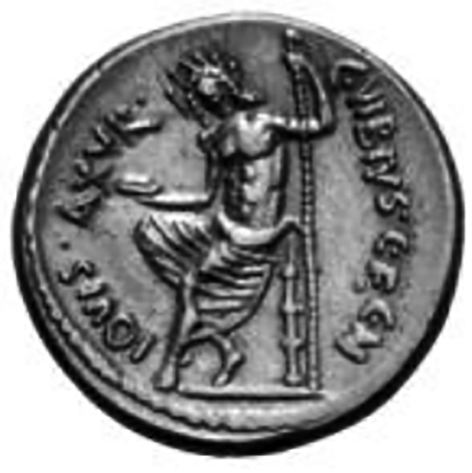
After 150 years of research, the location of the cult place of the patron of Roman Tarracina, Iuppiter Anxur, remains a matter of debate.Footnote 63 The only iconographic representation of the Terracina Jupiter is found on a denarius minted by Gaius Vibius Pansa Caetronianus in 48 BCE (Fig. 12).Footnote 64 There, the god is portrayed as young, muscular, and beardless, with long hair upon which an oak leaf crown is placed. The legend Iovis Axur(is) appears alongside the seated, semi-draped god, who holds a long scepter in one hand and a patera in the other. The 4th-c. CE grammarian Servius refers to the young god in a number of comments,Footnote 65 which have greatly influenced modern interpretations of the archaeological remains. Even though Anxur was the ancient name of Terracina, Servius states that the Jupiter worshipped in this city was a puer (“a child”) whose epithet Anxurus is derived from the Greek phrase ἄνϵυ ξυροῦ (“without a razor”), which alludes to the fact that he was too young to shave his beard. The idea that a childlike Jupiter was worshipped in Terracina arose in the 19th c.Footnote 66 and derives from this folk etymology provided by Servius.Footnote 67 One possible explanation for the scholiast’s description is that he somehow mixed Tarracina’s Iuppiter Anxurus with Praeneste’s Iuppiter Puer, son of the goddess Fortuna.Footnote 68
Coin of Gaius Vibius Pansa Caetronianus (RRC 449/1a–1c; 48 BCE) showing “Iovis Axur(is)”. (Photo from Amela Valverde Reference Amela Valverde2020.)

However, the tradition of a child-Jupiter worshipped in Terracina is based on false premises. His particular local iconography, in which Jupiter is young and beardless, differs from the tradition that became established in Rome from the 6th c. BCE onwards in the wake of Etruscan influence.Footnote 69 The juvenile Jupiter of Terracina resembles the traditional image of Apollo more than that of Jupiter of the Capitoline triad; this is because he is an Italian deity similar to the infernal JupiterFootnote 70 known in the Etruscan, Italian, and Sicilian religion,Footnote 71 to Veiove, who is a young chthonic Jupiter worshipped in Rome and Bovillae,Footnote 72 and to Soranus of Mount Soratte c. 45 km north of RomeFootnote 73 (all of them similar to Apollo).
The cult of Iuppiter Anxur in Tarracina is in fact much older than the founding of the Roman colony, as his epiclesis also shows. Fundamental to comprehending the characteristics of this Iuppiter is to understand his name. In ancient sources, Virgil calls him Anxurus, Servius calls him Anxyrus, and Pseudo-Acron calls him Anxur.Footnote 74 In local epigraphy, we know of an altar to Iovi Axuri that recently came to light in the theater near the Forum,Footnote 75 where, unsurprisingly, a laurel wreath and two swans are depicted (referring more to the iconography of Apollo than to that of Jupiter). Iuppiter Axur also appears in the denarii of Vibius Pansa, mentioned above, and a collegium of cultores Iovis Axorani is also attested in nearby Ulubrae.Footnote 76 The inhabitants of Terracina called themselves coloni Axurnates in two Augustan-era dedications found in the theater,Footnote 77 but in public inscriptions they more frequently used, in the 1st c. CE, colonia Tarracinensis Footnote 78 or, even later, simply Tarracinenses, Footnote 79 between the 2nd and 3rd c. CE, res publica Tarracinensium,Footnote 80 and, in the late 4th c. CE, civitas Tarracinensium. Footnote 81
Anxur is the Volscian name for the city,Footnote 82 so the Virgilian term Anxurus is indeed an epiclesis of Jupiter that refers to him by his territorial affiliation: the Jupiter of Anxur. According to Massimiliano Di Fazio, however, Anxurus would have been the Volscian name of the deity,Footnote 83 which became a toponym, then only in Roman times would have been assimilated to Jupiter. In Horace and Martial, the choice to call the city Anxur instead of Tarracina may have been motivated by metrical needs,Footnote 84 but we can note that in these texts the term is masculine and not feminine, as the names of cities normally are. More specifically, Horace describes Anxur as “set on rocks that whiten from afar.”Footnote 85 Lucan also writes of a steep arx Anxuris,Footnote 86 and the scholiasts on his works explain that the toponym Anxur refers to the mountain of Terracina, on which a beardless Jupiter called Iuppiter Anxurus was worshipped.Footnote 87 The Volscian name for Terracina, Anxur, would seem in this case to have been preserved as a toponym for Monte Sant’Angelo, partly due to the fact that Iuppiter Anxurus was worshipped on its summit.
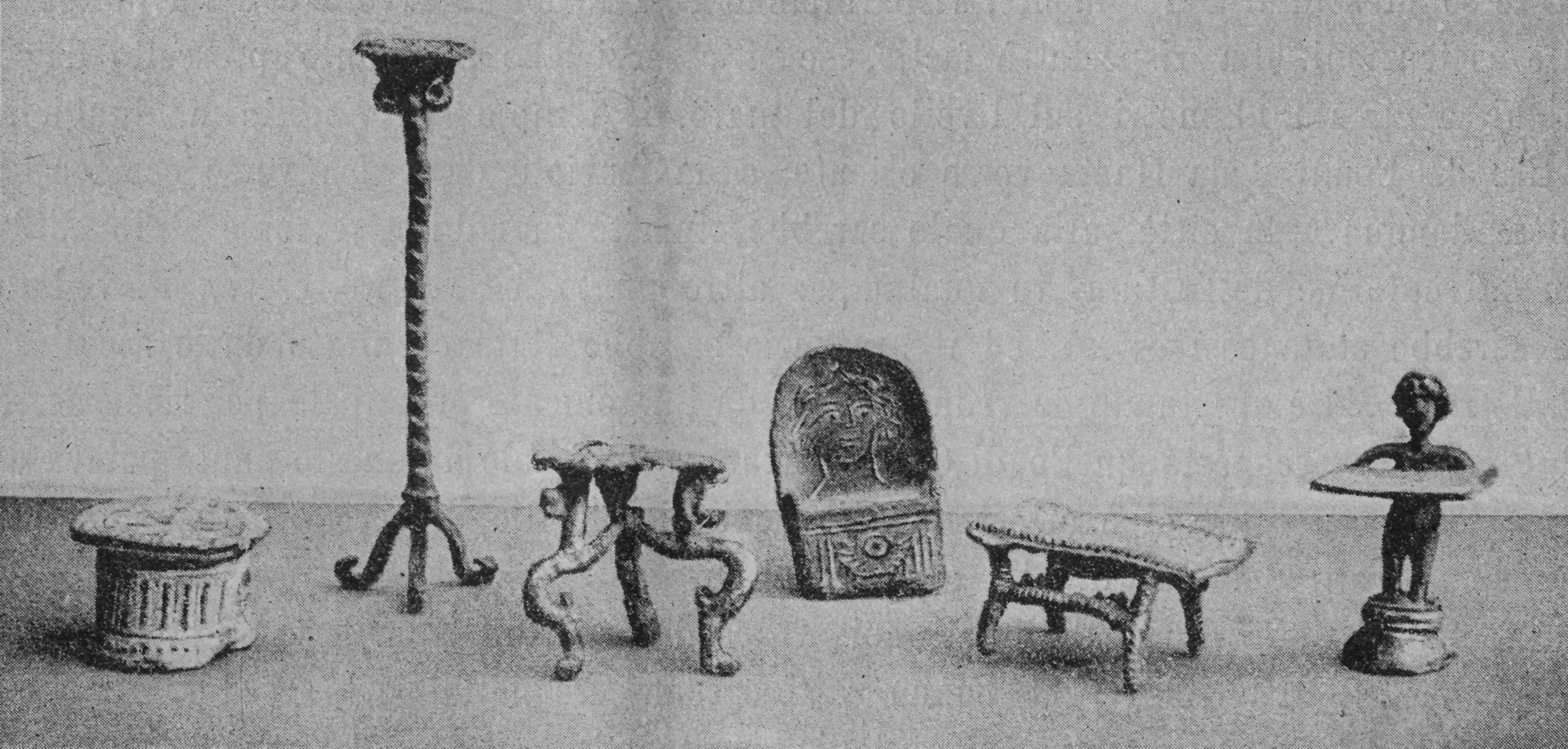
We must therefore ask where exactly on the three Terraces of Monte Sant’Angelo the ancient cult site for the patron of Tarracina was located. The oldest hypothesis locates the temple of Jupiter on Terrace C, with its Great Temple.Footnote 88 This terrace is the most imposing and best-preserved structure in Monte Sant’Angelo and has always been visible and recognizable in the landscape, even from a great distance. Pio Capponi’s 1894 excavations were the first to bring its original sacred nature to light once again.Footnote 89 In the course of his archaeological activities, a concentration of miniature lead objects were found (Fig. 13)Footnote 90 and interpreted as a votive deposit to the main deity. The fact that some of these objects were small led to their identification as toys and, consequently, to the recipient of these gifts as a juvenile, almost childlike deity, confirming the already implicit attribution of the Great Temple to Iuppiter Anxur.Footnote 91
Miniature lead objects found on Terrace C in 1894. (Photo: Borsari Reference Borsari1894.)

A more recent hypothesis attributes the Great Temple to Venus and places Jupiter on the acropolis at Colle San Francesco,Footnote 92 where remains of ancient buildings have been found.Footnote 93 This is affirmed because two inscriptions relating to Venus came from the temple’s surroundings.Footnote 94 Di Fazio also proposes that the votive deposit found on Terrace C was connected to the worship of Venus.Footnote 95 Moreover, it has been convincingly argued that the Great Temple was constructed in the early 1st c. BCE.Footnote 96 The monumental podium temple was accessible via a grand staircase from the south and afforded a striking façade that was visible from the sea as it welcomed ships entering the harbor of ancient Tarracina. Filippo Coarelli has hypothesized that the construction of the Great Temple was an initiative of the gens Memmia,Footnote 97 who were active in the maritime trade that was linked above all in Terracina to the export of wine.
The placement of temples dedicated to Venus overlooking the ports of their respective cities is a characteristic trait of Hellenistic Italian urban centers. A comparable scenario is observed in Circeii, situated 20 km west of Tarracina (Fig. 1). Slightly below this ancient city lies a monumental terrace known as the “Villa dei Quattro Venti,”Footnote 98 which oversees its harbor. Recent scholarship has suggested that this area was not a Republican villa, but rather a terrace sanctuary to Venus dating back to the early 1st c. BCE.Footnote 99 Drawing from these parallels and the presence of the two inscriptions, it seems very likely that the Great Temple on Terrace C was dedicated to Venus.
Furthermore, the attribution of the Small Temple on Terrace B to the goddess Feronia is now virtually confirmed, thanks in part to recent archaeological discoveries and to the literary sources.Footnote 100 Excavations on Terrace B (Fig. 3, B),Footnote 101 the so-called Small Temple, have shown that it is indeed a sacred complex built on two levels.Footnote 102 Having been constructed on an even older structure, the monumentalization of the temple in the early 2nd c. BCE represents the birth of one of the first terrace sanctuaries in southern Latium. The temple’s façade was oriented west, overlooking Terracina and the Via Appia crossing the fields of the colony. In literary sources, the most important deities mentioned in connection with Terracina are the married couple of Jupiter and Feronia. The oldest text to mention them is the Aeneid, where Virgil writes, “those whose cultivated fields Jupiter Anxurus oversees and Feronia who delights in the green woods.”Footnote 103 Jupiter is described with the adjective Anxurus and is placed on high as a deity who protects cultivated fields; Feronia is placed in a lucus, a clearing within a sacred forest. This lucus is traditionally located at the foot of Monte Leano.Footnote 104 Coarelli has also convincingly argued that there was an aedes to the goddess on Monte Sant’Angelo,Footnote 105 based on a description of the temple of Feronia given by Pliny.Footnote 106 In his report, Pliny mentions that lightning struck towers placed between the aedem Feroniae and the city of Tarracina. The presence of a wall with towers (Fig. 3, D) connecting the arx of Terracina – that is, Colle San Francesco – with the summit of Monte Sant’Angelo also led Coarelli to place a temple of Feronia on the latter site, identifying it with the Small Temple on Terrace B.Footnote 107
A second text supporting the association of Feronia with Terrace B and the Small Temple is provided by Tacitus.Footnote 108 In 69 CE, Vitellius, during his war with Vespasian, established a military camp apud Feroniam in order to besiege Terracina. To date, this camp has always been placed at Punta di Leano.Footnote 109 However, the soldiers of Vitellius, who were led by a fugitive servant of Verginius Capito, are said to have conquered the vacua arx (“unoccupied citadel”) by night and then the city by descending from the top of the mountains. It seems quite probable that Vitellius’s troops were quartered at the temple of Feronia at Monte Sant’Angelo and from there they descended to conquer first the uninhabited acropolis of Colle San Francesco and then the town.Footnote 110 From Monte Sant’Angelo it was possible to control Terracina, the main road routes, and the port from above, while remaining protected within the Republican walls of the sanctuary. By contrast, a military camp at Punta di Leano, besides there being little room for its construction given the marshy terrain, lacked a good view of the surrounding area.
The question of the location of the temple of Iuppiter Anxur was destined to remain unresolved until the recent excavations conducted by the LMU, which revealed the presence of an additional cult site on the highest rock peak of Monte Sant’Angelo, in the area of Terrace A. The central highpoint of the mountain is precisely beneath the suggested podium area. This phenomenon finds parallels on the arx of CosaFootnote 111 and in the Temple of Athena at Lindos, which was constructed around 300 BCE.Footnote 112 At Lindos, an inscription indicates that the cult image within the naos was positioned around a semnós skópelos (“sacred lookout”).Footnote 113 It is evident that this particular location held religious significance from protohistoric times, leading to the construction of the sanctuary of Athena and its renowned Hellenistic terraces around the highpoint of the mountain. This choice resulted in the temple’s deviation from the symmetry observed in the monumental façades of the sanctuary.Footnote 114
A comparable phenomenon may be observed on the hilltop of Monte Sant’Angelo, where the deity of the cult site is closely associated with the summit of the mountain. As the geometric center of the upper square and the surrounding architecture, and as the highest natural part of the entire sanctuary, the summit held special symbolic significance to the god. The outcrop in particular served as a distinctive feature, illustrating the reciprocal connection between architecture and the mountain’s topography.Footnote 115 Although the significance of this mountain location dates back to protohistoric times, it persisted into the Hellenistic period. The ancient cult site of Jupiter Anxur is endowed with an architectural character reflective of the 2nd c. BCE, which originated at the most crucial and highest point of the mountain. Moreover, when Livy reports that the aedes of Jupiter at Tarracina was damaged by lightning in 207 BCE and again in 179 BCE,Footnote 116 this could be interpreted as the event that initiated the monumentalization of Terrace A from the mid-2nd c. BCE onwards.
The recent investigations have also brought to light evidence of older phases of the Hellenistic sanctuary, relating not only to the period of the colony’s foundation or the previous Volscian center but also to even earlier eras.Footnote 117 They confirm that a city was already established at the end of the 6th c. BCE, as is known from the first treaty between Rome and Carthage, in which Tarracina appears as a city friendly to Rome on the southern Latium coast.Footnote 118 The cult of Jupiter was, then, settled on Monte Sant’Angelo, overlooking the marshy landscape and the surrounding sea, in the archaic period and was respected both by the Volscians and by the later Roman colony. This not only maintained this earlier cult but confirmed it as a significant landmark through its monumentalization.
Thanks to the recent studies, the place of worship for the beardless Iuppiter Anxur can be convincingly identified on Terrace A, at the summit and highest point of Monte Sant’Angelo. The cult area dedicated to the god was located on the rocky peak of the mountain, likely featuring a temple or altar in a central position, surrounded by a Pi-shaped portico with a columned façade to the north. The architectural complex of Terrace A was constructed shortly after the mid-2nd c. BCE, elevating a preexisting sanctuary into a monumental space. The aedes of Feronia, located further down the slope, faced the city of Tarracina and the Appian Way. It represents the earliest construction within the sanctuary in the Late Hellenistic period, dating to the first half of the 2nd c. BCE.Footnote 119 Finally, the best-preserved part of the complex, the Great Temple was added to the sanctuary in the early 1st c. BCE, and hosted the cult of Venus alongside those of Feronia and Iuppiter Anxur, patron of Tarracina.
The diversity of the three deities is brilliantly reflected in the architecture of the sanctuary. Unlike at Praeneste, the Hellenistic design of the three terraces provided not just a single façade but three distinct ones, each offering a monumental vista: one facing the Via Appia to the north, another overlooking the city of Tarracina and the Pontine Marshes to the west, and a third oriented towards the sea in the south. This serves as a prime example of how cities in ancient Latium, during the 2nd c. BCE, selectively adopted various Hellenistic architectural forms. This intentional choice highlights the distinctive character of the sanctuary at Tarracina.
Acknowledgments
Since 2019, excavations conducted by Ludwig-Maximilians-Universität in Munich (LMU) have taken place in Terracina, Italy. Since 2021, the investigations have been funded by the Deutsche Forschungsgemeinschaft (DFG), the LMU, and the Archäologische Untersuchungen und Ausgrabungen zur antiken Urbanität at the Bayrische Akademie der Wissenschaften (BAdW). The project is being carried out in cooperation with the Soprintendenza Archeologia Belle Arti e Paesaggio per le province di Frosinone e Latina, the Comune di Terracina, the Università di Bologna, Dipartimento di Storia Culture Civiltà, the Chair of Engineering Geodesy and Building History at Technical University of Munich (TUM), and the German Archaeological Institute in Rome. We would like to express our sincere gratitude to the city of Terracina, the former director of the Museum I. Bruni, and the staff of the Archaeological Park, especially M. Spena and P. Avelli, for their enormous efforts during the excavations. We would also like to thank the anonymous peer reviewer for their valuable feedback, which has significantly improved the text. J. Griffith skillfully corrected our English; all remaining mistakes are our own.