Introduction
There is a relatively limited body of literature that examines patient presentations to on-site health services provided at prolonged mass gatherings. This article aims to add to this body of work by analyzing the presentations seen at World Youth Day 2008 (WYD08), with the hope that health planners will be able to tailor appropriately their plans for future mass gatherings based on lessons learned from past events.
New South Wales Health has a rich, although relatively recent, history of planning health services (including ambulance, medical, public health, mental health, and health communications) to support major events such as the Sydney 2000 Olympic Games, the Rugby World Cup 2003, the Asia-Pacific Economic Cooperation Leaders’ Week 2007, and WYD08. Experience from past events was invaluable during planning for WYD08, despite the event's unique nature.
Unlike those attending a one-day sporting event or music festival, most WYD08 participants did not return to their homes or hotels at the conclusion of the day's activities, but instead remained in temporary group accommodations. Despite the fact that many participants were not able to rest at home during the day or seek medical care through their usual providers when unwell, WYD08 participants were able to access health care through a number of different avenues—first-aid stations and medical units at event venues; primary care services within the community; emergency care from the Ambulance Service of NSW (ASNSW) and public hospitals.
World Youth Day is a Catholic youth festival held in different countries around the world every two to three years since 1986.1 World Youth Day 2008 was held in Sydney, Australia, from July 15-20, 2008 and attended by Pope Benedict XVI as well as domestic and international participants, or “pilgrims.” “Days in the Dioceses,” a precursor to the main event, was held around Australia and New Zealand during the preceding week. Official statistics from the Catholic Church's event organizer, World Youth Day 2008, indicate that 223,000 pilgrims registered for the event (113,000 domestic and 110,000 international).2
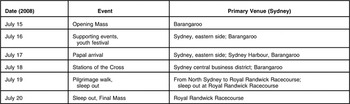
While pilgrims were accommodated across the Sydney Basin (the area surrounding the city of Sydney), the main festival events took place in four major precincts in relatively close proximity across Sydney: (1) Royal Randwick Racecourse; (2) Sydney's central business district and eastern side; (3) North Sydney/Sydney Harbour Bridge; and (4) Barangaroo (East Darling Harbour). An overview of WYD08 events is provided in Table 1.
Overview of WYD08 Events. Ancillary events such as national gatherings and the youth festival were held throughout Sydney during the week, largely in the Sydney central business district precinct.

Methods
Risk Assessment
Comprehensive risk assessments of the events and venues were undertaken prior to WYD08 by NSW Police, NSW Health, other governmental and nongovernmental agencies, and the event organizer. Infectious disease outbreaks and hypothermia were identified as the most important risks to the health system, and significant effort was put into mitigation actions for both.
Infectious disease outbreaks were a concern as the event was held during the winter; involved a very large number of pilgrims from around the world in close contact with each other; and accommodations largely consisted of group sites that were not designed for boarding and had a limited number of showers and toilets. Numerous outbreaks of infectious disease, primarily influenza, did occur.Reference Blyth, Foo and van Hall3 Public health surveillance officers were included in each on-site medical unit team and were part of “roaming teams” at each venue in order to identify any unusual clusters of illness or other public health concerns. Intelligence reported by public health surveillance officers also informed likely usage of medical units for subsequent days of the festival.
Hypothermia was of concern primarily during the sleep out at Randwick Racecourse on the night of July 19-20. It was fortunate that the weekend weather was dry; should it have rained, tens of thousands of participants would have been without shelter on a wet, chilly night. The minimum and maximum mean July temperatures at Sydney Airport, approximately five km from Randwick Racecourse, are 7.1°C (45°F) and 17.0°C (63°F), respectively.4
To mitigate against the risk of widespread hypothermia, government agencies worked with the event organizer to develop a contingency plan: those pilgrims identified as being at risk for developing hypothermia would have access to “re-warming” centers throughout the evening of July 19. Two re-warming centers were established: (1) on-site at Randwick Racecourse; and (2) at a university adjacent to Randwick Racecourse. Pre-event communication advised pilgrims of the importance of bringing warm clothes and sleeping equipment (sleeping bag, ground cover, sleeping mat) suitable for Sydney's winter nights.
Health Services
On-site health services at WYD08 events were offered by St John Ambulance Australia (NSW) and NSW Health, including the ASNSW (part of NSW Health). Each organization had human and equipment resources deployed specifically to support the event and worked closely together during both the planning and operations phases to ensure that the transition between services was seamless. Health services were provided at major event venues to encourage participants to seek timely treatment, and to mitigate against any significant increase in demand on the hospital emergency departments in the Sydney Basin.
Research from previous major events supports the premise that event participants are most likely to seek assistance within an event venue if health services are visible, conveniently accessible, and if presenting for assistance does not involve forgoing participation in the event by leaving the venue.Reference Arbon5
Participants were able to access clinical care at major venues on three tiers: (1) first-aid support (St John Ambulance posts located throughout event areas); (2) paramedic assessment and treatment (provided by the ASNSW); and (3) medical care with public health assessment (NSW Health and St John Ambulance). The ASNSW and St John Ambulance transported patients within venues, and ASNSW transferred patients requiring hospital assessment to nearby public hospitals. Paramedics with ASNSW also provided dedicated medical coverage for Pope Benedict XVI.
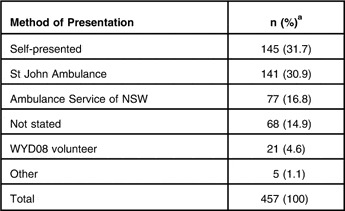
It was expected that most event attendees seeking medical assistance would present initially to first-aid posts and then be escorted, as needed, to on-site medical units. All the on-site medical units were located in restricted access or “back-of-house” areas in order to limit the number of “walk-ins.” However, many more participants than expected self-presented directly to the on-site medical units, as demonstrated in Table 2. This meant that the range of services sought included a larger proportion of minor treatments than anticipated as some patients did not initially present to first-aid stations.
Means by Which Patients Presented to On-site Medical Units

aPresenting data not recorded for eight patients.
On-site Medical Units
The most appropriate provision of medical services by NSW Health at WYD08 venues was discussed and a strategic plan was developed. Following a review of past mass gatherings in Sydney, it was determined that temporary facilities staffed by clinicians with an appropriate skill mix should be established in the key event hubs.
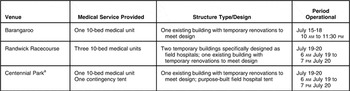
Where possible, existing structures were used and remodelled with temporary walls or dividers, as needed. Temporary buildings (with full plumbing and electricity) were placed in venue areas that did not have suitable structures. The temporary buildings were all identical (24 m x 6 m) and required very detailed planning to ensure that they would be appropriate as short-term health facilities. Further descriptions of the facilities are presented in Table 3.
New South Wales Health Temporary Medical Facilities at WYD08 Venues

aCentennial Park was not needed as an overflow venue as expected; assigned medical teams were redeployed during the weekend to Randwick venues.
The on-site medical units were designed with consistency in mind, as many staff worked multiple shifts in different venues. Each unit had a 10-bed ward, a procedures room, a staff break area, a triage and waiting area, an office, and a supply room. The “Teahouse” on-site medical unit at Randwick Racecourse had a separate upstairs patient rest area. This was used heavily, especially during the overnight hours of July 19-20, by pilgrims who did not require medical supervision in the on-site medical unit, but who were exhausted by the week's activities, or were too cold to sleep outside. Despite the advice, some pilgrims were unprepared to sleep outside and sought refuge inside. Fortunately very large numbers of pilgrims did not seek care and the re-warming centers were not used.
Scope of Services
Extensive consultation with end-users, clinicians, and health partners (St John Ambulance and ASNSW) led NSW Health planners to determine that on-site medical units would provide primary care with resuscitation capability. Event participants could receive first-aid, intravenous therapy, oxygen therapy, and wound care. Medications could be prescribed and administered, and clinicians were able to write referrals to specialists or allied health services. Airway, breathing, and circulation management and hemorrhage control were available to anyone requiring resuscitation; there were no resuscitation requirements at any WYD08 venues.
Clinical guidelines for cardiac arrest, eye injuries, flash burns, abdominal pain, anaphylaxis, asthma, burns, chest pain, emergency contraception, head injury, hypoglycemia, hyperglycemia, hypothermia, lacerations, poisoning, seizures, and sexual assault were developed and provided to on-site medical unit team members prior the start of the event. Team members also were provided with instructions for accessing health care interpreters by telephone to assist non-English-speaking patients.
Cases requiring hospital care could be transported rapidly to a nearby hospital. Public hospital emergency departments were located ≤1 km from both Barangaroo (Sydney Hospital) and Randwick Racecourse (Prince of Wales Hospital), with other major public hospitals located within a short distance of the primary and ancillary venues.
All on-site health services were provided free of charge. Ambulance transfers from an event venue to a public hospital emergency department were charged to an insurer.
Team Composition
Health teams at the on-site medical units consisted of four registered nurses, two medical officers, one public health surveillance officer, and one administration officer. Team members were selected through a merit-based recruitment process. Expressions of interest announcements were lodged with NSW Health's jobs database, as well as professional clinical associations in NSW. Successful applicants attended a full-day training session prior to the onset of WYD08. Training was designed primarily to familiarize the teams with the nature of the event and accompanying risk profile, event communication channels (including radio use), and standard operating procedures within the on-site medical units.
Each team member received a specific role designation: medical team leader, medical officer, senior nurse, triage nurse, procedures nurse, ward nurse, public health surveillance officer, or administrative support officer. Job action cards for each position were developed and distributed to individuals at pre-shift briefings.
Team members were provided with a uniform (collared T-shirt and fleece jacket) and received official WYD08 accreditation to allow venue access. The uniforms were a simple yet effective way to build a sense of camaraderie among health team members, most of whom had not worked together previously.
Results
On-site Medical Unit Presentations
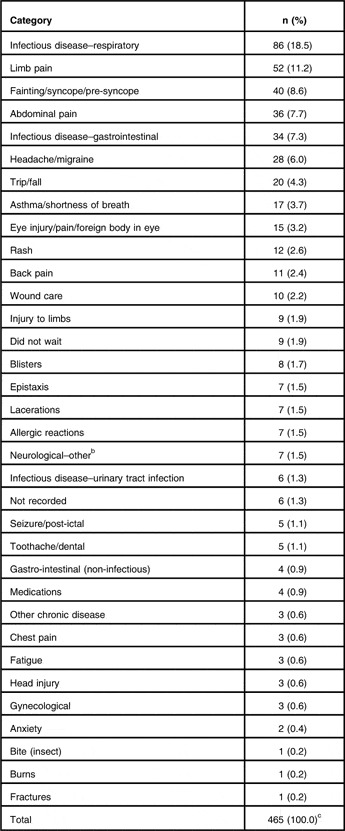
A list of presenting problems by category to on-site medical units is in Table 4. An individual patient record folder with 11 forms (medical record, observations chart, progress notes, discharge letter, intravenous orders chart, patient medication chart, referral letter, prescription pad, medical certificate, medical consent form, and mental health triage form) was developed for use in the on-site medical units. A post-event review of 465 records yielded data useful in determining triage priority, common presenting problems, how patients presented, patients’ discharge histories, and general demographics.
Presenting Problem by Category: WYD08 On-site Medical Unitsa

aRates of illness and injury per number of participants were not generated due to the fluid nature of crowd participation over several days.
bSuch as numbness in hands and feet, leg weakness.
cActual total is 99.8% due to rounding.
Each on-site medical unit also was equipped with laptop computers and access to a real-time, online bed monitoring and patient-flow prototype system called the “Bed Board.” Patient data were entered into the Bed Board system at the time of presentation to allow personnel in the on-site Emergency Operations Center to appropriately direct ambulances to on-site facilities. The Bed Board system also allocated to each patient a unique patient record number.
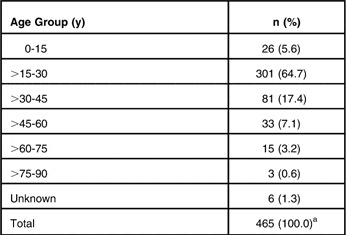
Patients ranged from 8-81 years of age. It is not surprising that the bulk of patients were between 16 and 30 years of age, and, therefore, representative of the larger pilgrim body. It is interesting to note that there were a number of presentations from other age groups, including 18 for those >60 years. A complete list of presentations by age group is presented in Table 5.
On-site Medical Unit Presentations by Age Group

Abbreviation: y, years
aActual total is 99.9% due to rounding.
Discussion
A review of the major presenting problems abstracted from the on-site medical unit medical records reinforced what health planners had identified during the planning period as likely common presentations. Infectious respiratory symptoms, which are expected during the winter season, especially among large groups of people, were the most common presenting health problem. This also reflected the outbreaks of influenza that occurred at some of the mass accommodation centers at WYD08.Reference Fizzell and Armstrong6
An analysis of the types of presentations to the on-site medical units reinforces the need to include medical officers and nurses with primary care experience among teams providing on-site health services at mass gatherings. Depending upon the event's characteristics, health planners may wish to consider including both general practice and emergency care specialists among response teams. Recruitment for health team members for WYD08 was open to both medical officers within the public hospital system and those working in general practice. This practice would be supported again for future events.
Post-event analysis of data was made more difficult because free-text fields were used to describe patients’ presenting problems on medical records and the online Bed Board system. Having only free-text fields resulted in a wide variety of very similar and potentially overlapping complaints that logically could have been included in one category. For example, a patient who tripped and injured his ankle may have been listed as “trip/fall,” “injury to limb,” or “injury to ankle,” depending upon the interpretation by the triage nurse. Presenting problems were grouped during the medical records review for the purpose of analysis.
To facilitate post-event evaluation, health planners should consider providing pre-determined categories on the medical records, along with an “other” free-text field for the minority of presentations that do not fit into an identified group. The Bed Board system, while still in an early stage of development at the time of WYD08, was a very useful tool, and its use during future events, especially where coordination between multiple medical units is required, is recommended.
It is also beneficial to examine the types of presentations that were not seen in the on-site medical units (Table 4). Drug and alcohol-related presentations, which often feature at mass gatherings (music festivals, sporting events, etc.) were virtually non-existent at WYD08. This also was true in the emergency department presentations at hospitals in Sydney during WYD08.Reference Thackway, Churches, Fizzell, Muscatello and Armstrong7 Anecdotally, event organizers indicated to health planners prior to the event that this had been the experience at previous WYD events, but health planners still found the accuracy of the prediction remarkable. Heat-related illnesses, which have presented regularly in mass gatherings held during summer months, did not occur at WYD08, which was held in winter.Reference Grant, Nacca, Prince and Scott8, Reference Arbon, Bridgewater and Smith9
Another factor influencing on-site medical unit presentations was the immediate transfer criteria developed by NSW Health and ASNSW planning teams. Any patient considered to have life-threatening injuries or illnesses (according to pre-existing ASNSW protocol), cardiac chest pain, or fractures was transported immediately from the venue to a public hospital, bypassing the on-site medical units.
Some of the presentations in the “infectious disease–respiratory” category consisted of patients who were moderately unwell and, under normal circumstances, might have stayed home from work or school, but would not have sought medical treatment for their conditions. However, the feeling of a shared experience is very important to many WYD attendees, and virtually all organized activities take place in pre-arranged groups. In many cases, participants have travelled great distances to attend WYD, and they are very reluctant to remove themselves from group activities, even if they are feeling unwell. It is interesting that in one study of pilgrims at the Hajj, just over 40% of outpatient presentations to one large clinic providing care to Hajj pilgrims (seeing just over 5,000 patients in two days of the pilgrimage) had upper respiratory tract symptoms—suggesting that URTI may be a significant burden upon medical services at similar events, and reinforcing the need to promote influenza vaccination in attendees.Reference Balkhy, Memish, Bafaqeer and Almuneef10
According to WYD08 final statistics, many pilgrims were accommodated either in schools (the event was held during a school holiday period) and parishes (100,000), or through a home-stay program (40,000).2 For these pilgrims, “taking a day off” was not as straightforward as it would be normally; many venues were locked during the day for security reasons, and there were limited options for alternate venues to support mildly unwell pilgrims. The event organizer did coordinate drop-in day centers, but the logistics of accessing these centers were such that some pilgrims opted to continue partaking in the day's planned activities and thus, in some cases, allowed their conditions to worsen and later require treatment at an on-site medical unit. The Sydney West Area Health Service coordinated the deployment of two community health nurses for overnight shifts at Sydney Olympic Park, the largest of the temporary accommodation venues, from July 11-24. These nurses provided a valuable primary care function and supported services provided at major event venues.
Recognizing the “shared experience” component of WYD events reinforces the important role of public health officers in on-site health services at mass gatherings. During WYD08, public health officers in each on-site medical unit had an important dual function: (1) undertake public health surveillance (reporting any unusual patterns or cluster of disease to the Public Health Emergency Operations Centre) and (2) assist with disease control through the coordination of health and well-being packs.Reference Fizzell and Armstrong6 These packs were provided to patients with symptoms of infectious disease and contained infection control supplies such as facial tissue and alcohol-based hand cleanser, along with information fact sheets about appropriate hand and respiratory hygiene. Public health officers also assisted with data entry into the online Bed Board system, which indicated the need for additional administrative support officers.
Recommendations
Australia's mass gathering planning guide, Safe and Healthy Mass Gatherings, advises planners to prepare for 0.5-1.5% of the crowd to present for medical assistance.11 The World Youth Day 2008 experience suggests that in temperate weather, <1 in 10,000 people will require mid-level (ie, not first-aid or hospital) medical care. The planning guide also suggests that injuries, burns, and sunstroke may be significant contributors to attendances. The 2008 experience suggests that during prolonged gatherings, infectious diseases also should be considered as an important likely contributor to presentations at medical units, and that on-site medical units should be prepared to recognize and treat these conditions, and have appropriate patient education and infection control materials to distribute in an effort to prevent further spread of disease.
Conclusion
Prolonged mass gatherings with characteristics similar to WYD08 warrant the provision of on-site medical services. Medical services provided at major events serve multiple functions: (1) a service for a temporary and transient population, many of whom are away from their usual health/support systems; (2) an important mitigating factor in reducing avoidable demands on local emergency departments; and (3) a response structure to support a disaster contingency.
The majority of presentations seen at on-site medical units were reflective of a population that was fatigued, living among large groups, and experiencing a general mix of health care concerns.
Health planners for mass gatherings must consider the composition of deployed health teams. In many cases, including medical officers and nurses with primary care expertise on the team, in addition to emergency specialists, may provide the appropriate skill mix for patients who present with illnesses or injuries.
Abbreviations
- ASNSW:
Ambulance Service of NSW
- NSW:
New South Wales
- WYD08:
World Youth Day 2008
Acknowledgements
The authors thank members of the NSW Health Counter Disaster Unit for their assistance with the post-WYD08 review of medical records from on-site medical units.