INTRODUCTION
Reading disabilities are common, with prevalence estimates ranging from 5 to 15% of the school-age population, depending on how the disability is defined (Pennington, Reference Pennington2009). Dyslexia is the most common form of reading disability, defined by difficulties with accurate and/or fluent word reading and spelling (Fletcher, Reference Fletcher2009; Lyon, Shaywitz, & Shaywitz, Reference Lyon, Shaywitz and Shaywitz2003; Snowling, Reference Snowling2000). Dyslexia has been reliably associated with impairments in phonological processing, particularly phonological awareness, and naming speed (Vellutino, Fletcher, Snowling, Scanlon, Reference Vellutino, Fletcher, Snowling and Scanlon2004).
There is considerable support for the link between phonological processing and poor reading skills in dyslexia (Fletcher, Reference Fletcher2009; Liberman & Shankweiler, Reference Liberman, Shankweiler, Rieben and Perfetti1991; Snowling, Reference Snowling2000; Vellutino et al., Reference Vellutino, Fletcher, Snowling and Scanlon2004). However, phonological processing is not the only problem children with dyslexia display. Many have comorbid attention and mathematics difficulties (Willcut, Pennington, Olson, Chhabildas, & Huslander, Reference Willcutt, Pennington, Olson, Chhabildas and Huslander2005), some have motor impairments that lead to the appearance of clumsiness (Denckla, Rudel, Krieger, & Chapman, Reference Denckla, Rudel, Krieger and Chapman1985), while others have pervasive language and/or spatial cognition difficulties (Pennington, Reference Pennington2009). Because of this heterogeneity, other hypotheses have been advanced to explain the difficulties of children with dyslexia, including low level visual and auditory processing, difficulties with peripheral vision, auditory-visual integration, directional confusion, and cerebral dominance (Benton, Reference Benton and Friedlander1975). However, none of these theories has accumulated much support because they fail to explain the core deficit of dyslexia (i.e., word reading difficulties) (Vellutino et al., Reference Vellutino, Fletcher, Snowling and Scanlon2004).
CEREBELLAR HYPOTHESIS
More recently, Nicolson and Fawcett (Reference Nicolson and Fawcett1990, Reference Nicolson and Fawcett2005, Reference Nicolson and Fawcett2007) have advanced a cerebellar deficit hypothesis which stipulates that the cerebellum is active during early stages of skill learning, but less active when the skill becomes automatized (Nicolson & Fawcett, Reference Nicolson and Fawcett1990). According to this theory, skill automatization in individuals with dyslexia is reduced because of cerebellar dysfunction, which is why some children with dyslexia also appear clumsy and have motor impairments. Several studies report impairment on cerebellar functions in individuals with dyslexia (Nicolson & Fawcett, Reference Nicolson and Fawcett2005, Reference Nicolson and Fawcett2007). However, it has long been established that children with dyslexia perform more poorly than controls on many neuropsychological functions (Doehring, Reference Doehring, Benton and Pearl1978). A more salient question is how much variance is accounted for by specific neuropsychological functions in a multivariate context, suggesting that the cerebellar hypothesis should be tested in relation to other cognitive skills related to dyslexia (e.g., phonological processing, rapid naming).
Several studies have performed these kinds of comparisons. Ramus, Pidgeon, and Frith (Reference Ramus, Pidgeon and Frith2003) found no evidence of time estimation deficits in children with dyslexia and no relations between motor function and reading skills. They found a strong relation of phonological processing and reading abilities. Ramus, Rosen et al. (Reference Ramus, Rosen, Dakin, Day, Castellote and White2003) compared low level auditory and visual processing, phonological processing, and cerebellar motor functions in children identified with dyslexia and controls. They did not find that poor reading was associated with sensorimotor difficulties, but did report a strong link between phonological processing and reading ability. Savage et al. (Reference Savage, Frederickson, Goodwin, Patni and Smith2005) found that, if phonological processing was in a regression model, measures of balance did not contribute unique variance to reading and spelling outcomes. Wimmer, Mayringer, and Raberger (Reference Wimmer, Mayringer and Raberger1999) compared balancing abilities of children with dyslexia and age-matched controls. When controlling for the presence of comorbid Attention- Deficit/Hyperactivity Disorder (ADHD), groups did not differ on balancing performance. These findings were replicated by Raberger and Wimmer (Reference Raberger and Wimmer2003), who also reported no relation between rapid naming skills and balance.
In contrast, neuroanatomy studies associate cerebellar anomalies with dyslexia. In a small post mortem series, Finch, Nicolson, and Fawcett (Reference Finch, Nicolson and Fawcett2002) reported abnormalities in the medial posterior cerebellum and unexpected cerebellar cell distributions among individuals with dyslexia. In a quantitative magnetic resonance imaging study, Eckert et al. (Reference Eckert, Leonard, Richards, Aylward, Thomson and Berninger2003) found that individuals with dyslexia differed from controls in the right anterior lobe of the cerebellum. Brambati et al. (Reference Brambati, Termine, Ruffino, Stella, Fazio and Cappa2004) and Rae et al., (Reference Rae, Harasty, Dzendrowskyj, Talcott, Simpson and Blarmire2002) also reported cerebellum differences, but in different regions. More recently, Laycock et al. (Reference Laycock, Wilkinson, Wallis, Darwent, Wonders, Fawcett, Eden and Flowers2008) reported that white matter volumes were larger in adults with dyslexia even when adjusted for total cerebellum volumes. Kibby, Francher, Markanen, Lewandowski, and Hynd (Reference Kibby, Francher, Markanen, Lewandowski and Hynd2003) found small differences in cerebellum volumes between children with dyslexia and typically achieving children. However, cerebellar volumes were not related to reading ability.
CEREBELLAR DEFICITS AND INTERVENTION
Cerebellar deficits have also formed the basis of controversial interventions that stimulate the cerebellum with repeated, individualized practice drills purported to remediate cerebellar deficits and prepare the brain to learn to read (Dore, Reference Dore2006). Reynolds, Nicolson, and Hambly (Reference Reynolds, Nicolson and Hambly2003) initiated a controversial (Bishop, Reference Bishop2007) intervention study using measures from a dyslexia screening test (DST) specifically designed to identify children with or at risk for dyslexia based on the cerebellar hypothesis. Thirty-six middle school children, matched on age and DST scores, were randomly assigned to either a six month intervention involving cerebellar exercises or no-exercise. Relative to pretest, the intervention group improved on word reading (d = .35), bead threading (d = 1.26), and semantic fluency (d = .75). However, the intervention group was more impaired in reading at baseline and the no-exercise group did not control for the attention and effort devoted to the experimental group (Bishop, Reference Bishop2007; Snowling & Hulme, Reference Snowling and Hulme2003; see response by Reynolds & Nicolson, Reference Reynolds and Nicolson2008). Much of the controversy involves the use of the DST composite score to identify participants. The composite combines measures of word reading, cognitive, and sensorimotor functions, which is why the groups were not comparable in baseline reading levels.
CEREBELLAR DEFICITS, IQ, AND INADEQUATE RESPONSE TO INSTRUCTION
In the manual for the DST-Junior (DST-J), Fawcett and Nicolson (Reference Fawcett and Nicolson2004, p. 15) identified postural stability as “the test that has been shown to be one of the best predictors of resistance to remediation and is typically found in dyslexic children rather than slow learners.” Thus, not only are cerebellar functions hypothesized to relate to instructional response, they are more associated with “specific” reading disability, typically operationalized as a significant discrepancy of reading ability relative to IQ (Nicolson & Fawcett, Reference Nicolson and Fawcett2005).
The latter hypothesis is interesting in that a meta-analysis of cognitive variables comparing poor readers who were discrepant and not discrepant relative to IQ found only a small aggregated effect size difference (.30) favoring the IQ-discrepant group, but even smaller differences (< .10) on cognitive variables strongly related to reading proficiency (Stuebing et al., Reference Lyon, Shaywitz and Shaywitz2003). However, the three studies that assessed gross and fine motor skills yielded a small effect size difference (.27) showing better performance in poor readers who met IQ-discrepancy. Savage et al. (Reference Savage, Frederickson, Goodwin, Patni and Smith2005) found no relation of cerebellar functions with IQ using an approach that differentiated poor readers according to levels of IQ, not a discrepancy formula.
No study has evaluated relations of cerebellar functions to inadequate responders to reading interventions. However, another body of recent research has focused on the neuropsychological characteristics of inadequate responders to reading instruction. In a meta-analysis of 30 studies, Nelson, Benner, and Gonzalez (Reference Nelson, Benner and Gonzalez2003) identified multiple cognitive variables that differentiated adequate and inadequate responders, ranked in the order of effect size differentiation: rapid naming (.51), phonological awareness (.42), letter knowledge (.35), memory (.31), and IQ (.26). More recent studies are consistent with these meta-analytic findings. Stage, Abbott, Jenkins, & Berninger (Reference Stage, Abbott, Jenkins and Berninger2003) compared children who responded “faster” or “slower” to a grade 1 intervention. Faster responders had higher scores on phonological and orthographic awareness, and rapid naming. Verbal IQ and discrepancies of verbal IQ and reading achievement did not contribute uniquely to responder status. Al Otaiba and Fuchs (Reference Al Otaiba and Fuchs2006) reported that inadequate responders to kindergarten and grade 1 instruction performed lower on morphology, vocabulary, rapid naming, and sentence repetition, but not phonological awareness. Vellutino, Seanlon, Small, & Fanuele (Reference Vellutino, Scanlon, Small and Fanuele2006) found strong relations of phonological processing and other verbal abilities and instructional response, but IQ and nonverbal processing were weakly related to inadequate instructional response.
STUDY PURPOSE AND RESEARCH QUESTIONS
In the present study, we asked whether cerebellar-related skills were related to reading skills, instructional response, and “specific” reading disability relative to assessments of phonological processing and other cognitive skills. Although the proponents of the cerebellar hypothesis focus on explanations of the decoding deficits in children with dyslexia and relate them to procedural learning difficulties mediated by the cerebellum and its role in automaticity (Nicolson & Fawcett, Reference Nicolson and Fawcett2007), fluency deficits are also ubiquitous in children with dyslexia and have been used as the primary criteria for selecting children in some studies of cerebellar functions (Wimmer et al., Reference Wimmer, Mayringer and Raberger1999). Thus, because the cerebellum is related to automaticity of skills, we included children who inadequately responded using criteria that identified children with both decoding and fluency problems as well as children with only fluency problems, because the latter group is impaired primarily in automaticity of reading skills. We hypothesized (1; strength of association) that assessments of bead threading ability and postural stability would be significantly associated with reading and other academic abilities; (2; comparison of responder groups) that cerebellar measures would contribute significantly to the discrimination of adequate and inadequate responders relative to measures of phonological awareness or rapid automatized naming; and (3; IQ-achievement discrepancy) that inadequate responders with reading scores below expectations for IQ would show poorer performance on cerebellar tasks than inadequate responders whose low reading scores are more consistent with IQ.
METHOD
Participants
All research was conducted in compliance with the committees for the protection of human research participants at the University of Houston and University of Texas-Austin. This study involved a subsample of children (n = 680) screened for reading problems in September of grade 1 in nine elementary schools. Children identified as at-risk were monitored until mid-year to identify false positives. Struggling readers (n = 273) were randomly assigned to one of three treatment groups that varied in intensity. Children in each condition received the same supplemental small group reading intervention, which included explicit instruction in phonics, key vocabulary words, daily reading practice, and the identification of story structure components for narrative text or main ideas and supporting details for expository text. An evaluation of treatment effectiveness showed that all three groups improved significantly, with no differences in outcomes (Denton et al., Reference Denton, Fletcher, Cirino, Barth, Vaughn and Francis2009).
The sample for this study was 174 struggling readers and 62 typically developing readers (Typical group). Of the 273 struggling readers originally randomized to the intervention described above, 99 children were excluded, including 51 not treated because they were withdrawn by the school or parents (n = 20) or had scheduling conflicts (n = 31). Twenty-six moved before (n = 7) or during (n = 19) the intervention. Sixteen children had incomplete data. Three children could not be classified as adequate or inadequate responders and 3 were outliers and excluded from the analysis. The Typical group was a subset of 84 children randomly selected from those who were not at risk in September. Twenty-two children not included consisted of 6 who performed below the responder cut points, 9 who moved during the year, 5 with missing data, and 2 outliers.
Procedures
Based on their response to intervention, struggling readers (n = 174) were divided into three groups: (1) Adequate responders, (2) Inadequate responders with both decoding and reading fluency problems (DF group), and (3) Inadequate responders with reading fluency problems (RF group). Adequate responders (Responder group, n = 82) had standard scores on the Woodcock-Johnson III (WJIII; Woodcock, McGrew, & Mather, Reference Woodcock, McGrew and Mather2001) Basic Reading Skills decoding composite and the Test of Word Reading Efficiency (TOWRE; Torgesen, Wagner, & Rashotte, Reference Wagner, Torgesen and Rashotte1999) Sight Word Efficiency subtest > 92. Inadequate responders with both decoding and fluency problems (DF; n = 36) had WJIII Basic Reading Skills decoding composite and TOWRE Sight Word Efficiency scores < 93. Inadequate responders, with reading fluency problems (RF; n = 56) had deficits in reading fluency (i.e., TOWRE < 93) but not in decoding (i.e., WJIII Basic Reading > 92). All typically developing readers (n = 62) had WJIII Basic Reading and TOWRE Sight Word Efficiency scores > 92. A cutoff score of 93 was used because it takes into account the measurement error associated with the test and ensures that most children at-risk for academic failure (i.e., below the 25th percentile) are identified for additional services.
Children were assessed by examiners who completed an extensive training program. Assessments were completed in quiet locations in the children’s schools. In December (pretest) the following measures were administered: WJIII Letter Word Identification, Word Attack, Spelling, and Passage Comprehension, Continuous Monitoring of Early Reading Skills (CMERS; Mathes & Torgesen, Reference Mathes and Torgesen2008), Sentence Writing Fluency (R.K. Wagner, personal communication, May 12, 2009), Dyslexia Screening Text-Junior (DST-J; Fawcett & Nicolson, Reference Fawcett and Nicolson2004) Bead Threading, Comprehensive Test of Phonological Processing (CTOPP; Wagner, Torgesen, & Rashotte, Reference Wagner, Torgesen and Rashotte1999) Blending Words, Elision, and RAN-Letters, Kaufman Brief Intelligence Test-2 (KBIT-2; Kaufman & Kaufman, Reference Kaufman and Kaufman2004) Verbal Knowledge, and Spatial Working Memory (Cirino, Reference Cirino2009). In March (posttest 1), TOWRE Sight Word Efficiency was administered. In May (posttest 2), WJIII Letter Word Identification, Word Attack, Spelling, and Passage Comprehension, CMERS, Sentence Writing Fluency, KBIT-2 Matrices, and DST-J Postural Stability were administered.
The Postural Stability measure was piloted in December. Although internal consistency was high, we were not satisfied with the reliability of the calibration procedures. After consultation with the developer, administration procedures were modified for the May assessment. First, one tester was trained per site to ensure consistency of calibration procedures. Second, to calibrate the balance tester, digital scales replaced standard 5 Kg kitchen scales. Third, the balance tester was recalibrated before testing each child. Fourth, children were tested within 3 days to control for differential growth in height and weight. The pattern of results reported below is not different if the December pilot data are used.
For the primary analyses, groups were formed using posttest achievement measures. The cognitive measures were collected at pretest, except for KBIT-2 Matrices. Data from multiple occasions were used to estimate sample specific reliabilities to determine if poor reliabilities within the sample constrained validity coefficients.
Measures
To evaluate the cerebellar deficit hypothesis, cerebellar tasks from the Dyslexia Screening Test-Junior and alternative assessments of constructs represented in the DST-J were evaluated. Although the norming sample is large, the reliability and validity data are based on 32 children 6–12 years of age, so we administered tests of constructs assessed by the DST-J, but with reliability and validity data on a larger sample of children (a) CTOPP Rapid Automatized Naming-Letters replaced DST-J Rapid Naming, (b) CMERS Passage Fluency replaced DST-J One Minute Reading, (c) CTOPP Elision and Blending Phonemes replaced DST-J Phoneme Segmentation, (d) a researcher developed test of Spatial Working Memory replaced DST-J Backward Digit Span, (e) a curriculum-based measure of Sentence Writing Fluency replaced DST-J One Minute Writing, and (f) KBIT-2 Verbal Knowledge replaced DST-J Vocabulary. Additional measures were administered to determine group membership (WJIII Basic Reading Skills composite and TOWRE Sight Word Efficiency), assess academic achievement (i.e., WJIII Spelling and WJIII Passage Comprehension), and nonverbal IQ (i.e., KBIT-2 Matrices). A more detailed description of the measures and assessment schedule can be found at www.texasldcenter.org/outcomes.
Measures to Determine Student Group Membership
Woodcock-Johnson III Test of Achievement
(Woodcock et al. Reference Woodcock, McGrew and Mather2001). The Letter-Word Identification subtest assesses children’s ability to read real words; Word Attack assesses children’s ability to read phonetically correct nonsense words. The Basic Reading score is a composite the two subtests. Among children in this study, the test–retest reliability coefficient for the Basic Reading composite was 0.95, internal consistency for the Letter Word Identification subtest was 0.92, and internal consistency for the Word Attack subtest was 0.85.
Test of Word Reading Efficiency
(Torgesen et al., Reference Torgesen, Wagner, Rashotte, Rose and Lindamood1999). For the Sight Word Efficiency subtest, the participant is given a list of words and asked to read them quickly and accurately. The number of words read correctly within 45 s is the primary dependent variable. Among children in this study, the test–retest reliability coefficient was 0.92.
Measures of Academic Achievement
Woodcock-Johnson III Test of Achievement
(Woodcock et al., Reference Woodcock, McGrew and Mather2001). The Spelling subtest, adapted for this study for group administration, involves writing orally dictated words and assesses encoding skills. Test–retest reliability coefficient for this sample is 0.87. Passage Comprehension uses a cloze procedure to assess sentence level comprehension, requiring the student to read a sentence or short passage and fill in missing words. Among children in this study, the test–retest reliability was 0.91 and internal consistency was 0.87.
The Continuous Monitoring of Early Reading Skills
(Mathes & Torgesen, Reference Mathes and Torgesen2008). Oral Reading Fluency subtest measures children’s ability to read connected text accurately and quickly. Children read two stories orally for 1 min while an examiner records errors. The raw score represents the total number of words read correctly in 60 s averaged over the two stories. Among children in this study, the test–retest reliability of the CMERS was 0.94 and internal consistency for the two passages was 0.94.
Sentence Writing Fluency
The Sentence Writing Fluency task was adapted by R.K. Wagner (personal communication, May 12, 2009) and is similar to a task developed by Berninger (Reference Berninger1998). It assesses how quickly and accurately children can write a sentence prompt. The raw score is the number of words written correctly in 60 s. Among children in this study, test–retest reliability is 0.53.
Cerebellar Measures
Dyslexia Screening Test-Junior
(Fawcett & Nicolson, Reference Fawcett and Nicolson2004). For Bead Threading, the student is given a basket of 15 round wooden beads and a cord. Children hold the cord in their “writing hand” and thread as many beads as possible in 30 s. The raw score is the number of beads threaded in 30 s minus three beads threaded during practice. The DST-J reports a test–retest reliability of 0.76 (Fawcett & Nicolson, Reference Fawcett and Nicolson2004).
Postural Stability is measured using a balance-testing mechanism. The balance tester is a plastic device with a collar that slides on a cylindrically shaped shaft from one end to the pommel. A felt washer adjusts the collar to different resistance levels. The examiner stands behind the student, places the pommel end on the student’s back, approximately two vertebrae above the waist. The collar is pushed the length of the balance tester stopping before meeting the pommel, with a force of 2.5 Kg. The degree of “sway” displayed by the student is rated using a six point scale for four trials. For trials 1–2, the student stands erect with arms at his/her side; for trials 3–4, the students extends his/her arms in front at a 90 degree angle to the floor. The raw score is the sum across the four trials. The DST-J reports a test–retest correlation of 0.72 (Fawcett & Nicolson, Reference Fawcett and Nicolson2004).The internal consistency for this sample of 236 children was 0.85. For trials 1–2, the internal consistency was 0.80; for trials 3–4, the internal consistency was 0.76.
Cognitive and Language Measures
Comprehensive Test of Phonological Processing
(Wagner et al., Reference Wagner, Torgesen and Rashotte1999). Blending Words measures children’s ability to combine sounds they hear to form whole words. For this sample, the internal consistency was 0.88. Elision asks an individual to say a word, and then identify what remains after deleting sounds from the word. For this sample, the internal consistency was 0.88. These two subtests were averaged to form a composite phonological awareness variable. The Rapid Letter Naming subtest measures the speed with which the student can name a sequence of letters arranged in a 9 × 4 format. The raw score represented the total number of letters identified divided by the total time to identify all items. Coefficient alpha is 0.70 to 0.89 in this age range.
Kaufman Brief Intelligence Test-2
(Kaufman & Kaufman, Reference Kaufman and Kaufman2004). The KBIT-2 is an individually administered intellectual screening measure. The Verbal Knowledge subtest assesses receptive vocabulary and general information (e.g., nature, geography). The internal consistency for the Verbal Knowledge subtest is 0.86 to 0.89 for children age 5 to 8 years. The Matrices subtest requires children to choose a diagram from among five or six choices that either “goes with” a series of other diagrams, completes a series, or completes a 2 × 2 or 3 × 3 analogy. For this sample, the internal consistency was 0.87.
Spatial Working Memory
(Cirino, Reference Cirino2009). The Spatial Working Memory test assesses the recall of the location of a series of symbols while completing a secondary task of determining whether each symbol is or is not a star. The number of correctly recalled sequences is the dependent variable. Previous research with beginning readers (Cirino, Reference Cirino2009) demonstrates an adequate internal consistency of 0.73. For this sample (which is significantly more at-risk), the internal consistency was 0.51.
Analytic Plan
To address the hypothesis 1 correlations among cerebellar, cognitive, language, and academic measures were evaluated. In addition, multiple regression models related academic outcomes to age, Bead Threading, Postural Stability, RAN-Letters, spatial working memory, phonological awareness, and vocabulary.
To address hypothesis 2, a Group by Task multivariate analysis of variance (MANOVA) was computed to determine whether the groups (DF, RF, Responder, and Typical) could be differentiated from one another on the six cognitive variables. Any significant interactions or main effects were followed by six planned comparisons. First, as a test of the hypothesis that the DF group is the poorest of the four groups because of impairment in all reading domains, the DF group was compared with the RF, Responder, and Typical groups. Second, the RF group was compared with the Responder and Typical groups. Third, the Responder and Typical groups were compared. The alpha per comparison was 0.008 and eta square was computed.
To address hypothesis 3, children within the inadequate responder groups (DF and RF groups) who met a 1.0 standard error discrepancy definition based on the KBIT-2 composite score and the TOWRE Sight Word Efficiency score were identified. TOWRE was used because all inadequate responders were deficient in fluency and the WJIII Basic Reading Skills composite and TOWRE correlated 0.88 in this sample. We assumed a population correlation of 0.58 for IQ and reading because population data for KBIT and TOWRE are not available and this value approximates the population value (Fletcher et al., Reference Fletcher, Shaywitz, Shankweiler, Katz, Liberman and Stuebing1994). Two groups of inadequate responders were formed, one with TOWRE scores discrepant with IQ and one with TOWRE scores consistent with IQ.
RESULTS
Preliminary Analyses
We evaluated distributional data at pretest and posttest both statistically and graphically for skewness, kurtosis, and normality, finding few violations. The distributions for CMERS and Sentence Writing Fluency exhibited skewness or kurtosis more than |1| and were transformed using log transformations. Five children were not included because values exceeded 3 SD around the mean.
Demographic Comparisons and Descriptive Data
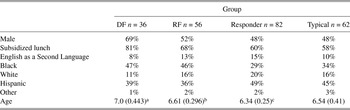
Table 1 summarizes demographic variables by group. There were no significant differences in gender, subsidized lunch, English as a Second Language status, or race/ethnicity: χ2 (3, N = 236) = 5.36; p = .15; χ2 (15, N = 235) = 19.26; p = .20; χ2 (6, N = 197 = 3.42; p = .75; χ2 (12, N = 236) = 14.32, p = .28, respectively. Although the groups differed significantly in age, F(3,232) = 31.44; p < .0001 (see Table 1), results of group comparisons were similar with and without age as a covariate. For regression analyses, models controlled for age.
Demographics by group

Note
DF = children with decoding and oral reading fluency problems; RF = children with oral reading fluency problems; Responder = children who responded to intervention; Typical = typically developing readers.
a The DF group is significantly older than RF, Responder, and Typical groups.
b The RF group is significantly older than Responder and Typical groups.
c The Responder group is significantly younger than the Typical group.
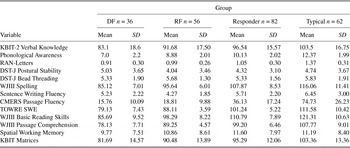
Table 2 presents means and standard deviations for academic and cognitive measures. Note that the pattern of means on the academic measures is consistent with expectations based on the criteria for group assignment.
Performance by group on language, cognitive, cerebellar, and academic variables

Note
KBIT = Kaufman Brief Intelligence Test- 2; CTOPP = Comprehensive Test of Phonological Processing; DST-J = Dyslexia Screening Test- Junior; CMERS = Continuous Monitoring of Early Reading Skills; WJIII = Woodcock- Johnson Tests of Achievement- III; TOWRE SWE = Test of Word Reading Efficiency Sight Word Efficiency subtest; Phonological Awareness = Average standard score of CTOPP Blending Phonemes and CTOPP Elision. Standard scores (M = 100; SD = 15) used for KBIT-2 Verbal Knowledge, Phonological Awareness, WJIII Basic Reading, WJIII Passage Comprehension, WJIII Spelling. Raw scores used for RAN-Letters, DST-J Postural Stability, DST-J Bead Threading, CMERS Passage Fluency, and Spatial Working Memory.
Strength of Association
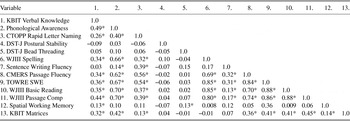
To address hypothesis 1, Table 3 reports the correlations among all variables. The DST-J Postural Stability and Bead Threading measures were not significantly correlated with most variables (p > .05), with the exception of the correlation between Bead Threading with Spatial Working Memory, where the relation was significant but weak. In contrast, the correlations between phonological awareness and achievement measures were strong and positive. The correlations among rapid naming and achievement measures were weaker, but positive.
Correlations of cognitive and academic measures

Note
n = 236. *p < 0.05. KBIT = Kaufman Brief Intelligence Test- 2; CTOPP = Comprehensive Test of Phonological Processing; DST-J = Dyslexia Screening Test- Junior; CMERS = Continuous Monitoring of Early Reading Skills; WJIII = Woodcock- Johnson Tests of Achievement- III; TOWRE SWE = Test of Word Reading Efficiency Sight Word subtest; Phonological Awareness = Average standard score of CTOPP Blending Phonemes and Elision.
Predicting Academic Outcomes
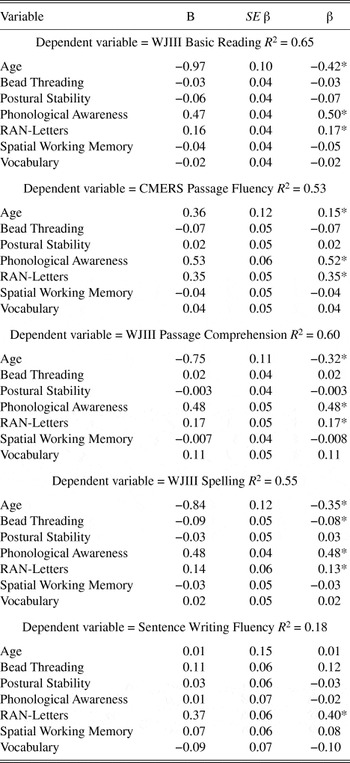
The regressions conducted to evaluate hypothesis 1, show that Basic Reading Skills, Passage Fluency, and Passage Comprehension were significantly predicted by age, phonological awareness, and RAN-Letters (see Table 4). Sentence Writing Fluency was only predicted by RAN-Letters. Bead Threading accounted for significant variability only for Spelling. Postural Stability did not contribute to variance in academic performance.
Summary of regression analysis for variables predicting academic outcomes

Note
n = 236. Bead Threading = DST-J Bead Threading subtest; Postural Stability = DST-J Postural Stability subtest; Phonological Awareness = Average standard score of CTOPP Blending Phonemes; RAN-Letters = CTOPP Rapid Automatized Naming-Letters and CTOPP Elision. *p < .05
Comparison of Groups
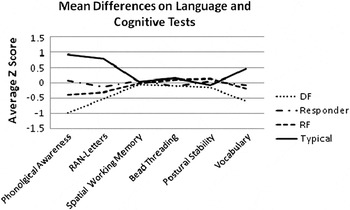
The MANOVA conducted to test hypothesis 2 yielded a significant Group X Task interaction, F(15,630) = 7.34; p < .001; η2 = 0.11. To interpret this interaction, Figure 1 plots Z-scores on the six cognitive abilities for the four groups standardized for the entire sample. The significant interaction is evident in the lack of parallelism in the profiles across groups. Visually, these profiles show that the Typical and Responder groups performed at higher levels than the DF and RF groups on the phonological awareness composite, RAN-Letters, and KBIT-2 Verbal Knowledge. However, the groups performed similarly on the Postural Stability, Bead Threading, and Spatial Working Memory tasks.
Mean differences (Z-Scores) on cognitive tests by group [inadequate responders poor in decoding and fluency (DF), inadequate responders poor in fluency (RF), adequate responders (Responder), and typically achieving readers (Typical)].

Across all planned comparisons, the direction of group differences for a significant comparison was always DF < RF < Responder < Typical. Table 5 shows that all pairwise contrasts were significant for the phonological awareness composite. Thus, children in the DF group had significantly lower scores on the phonological awareness composite than children in the RF, Responder, and Typical groups. Children in the RF group had significantly lower scores on this measure than the Responder and Typical groups, and the Responder group had significantly lower scores than the Typical group. For RAN-Letters, the DF, RF, and Responder groups scored significantly less well than the Typical group. Effect sizes for nonsignificant comparisons were negligible. For KBIT-2 Verbal Knowledge, the DF and RF groups had significantly lower scores than the Responder and Typical groups. Effect sizes were small for some of these contrasts but were large for the contrast between RF and Typical groups. No contrasts involving the cerebellar processing or spatial working memory tasks achieved the critical level of alpha, with effect sizes uniformly in the negligible range.
F values, p values, and η 2 for each contrast across language/cognitive measures

Note
n = 236. DF = children with poor response to reading intervention, with deficiencies in both decoding and reading fluency at the end of grade 1; RF = children with poor intervention response with year-end deficiencies in reading fluency at the end of grade 1; Responder = children who responded adequately to intervention with no demonstrable year-end deficiencies in decoding or reading fluency at the end of grade 1; Typical = children who did not present deficiencies in decoding or reading fluency at the beginning or end of grade 1 and did not receive intervention. When differences are significant, the first group is significantly lower than the second group in the comparison.
IQ- Achievement Discrepancy
To address hypothesis 3, univariate comparisons within the inadequate responder groups for IQ-discrepant (n = 29; 39% DF) and low achieving readers (n = 66; 25% DF) yielded no significant differences on Bead Threading, t(93) = −0.22, p = .38; Postural Stability, t(93) = −0.16; p = .87; or, for comparison purposes, phonological awareness, t(93) = 1.69; p = .09.
DISCUSSION
Proponents of the cerebellar hypothesis have hypothesized that cerebellar deficits are associated with poor reading and spelling abilities and may be responsible for inadequate instructional response in children with dyslexia. In a sample of children who demonstrated inadequate response to grade 1 reading intervention, we found little evidence associating reading proficiency or inadequate instructional response with cerebellar functions. Exceptions were predictions of Sentence Writing and Spelling, where Bead Threading had a weak relation, possibly because of the shared motor component. In contrast, measures of phonological awareness, rapid naming, and lexical knowledge were more strongly related to instructional response and reading proficiency. Most important are the results for children with both decoding and fluency problems because they meet contemporary definitions of dyslexia and demonstrate inadequate response to intervention (Fletcher, Lyon, Fuchs, & Barnes, Reference Fletcher, Lyon, Fuchs and Barnes2007).
These results parallel other studies that fail to show an association of cerebellar functions and reading and spelling (Kibby, Francher, Markanen, Lewandowski, & Hynd, Reference Kibby, Francher, Markanen, Lewandowski and Hynd2003; Ramus, Pidgeon, & Frith, Reference Ramus, Pidgeon and Frith2003; Savage et al., Reference Savage, Frederickson, Goodwin, Patni and Smith2005). Although other studies have found differences in cerebellar functions between individuals with and without dyslexia, these differences have been small and generally accounted for by other factors, such as ADHD (Raberger & Wimmer, Reference Raberger and Wimmer2003; Wimmer et al., Reference Wimmer, Mayringer and Raberger1999) or phonological awareness abilities (Ramus, Rosen et al., Reference Ramus, Rosen, Dakin, Day, Castellote and White2003; Savage et al., Reference Savage, Frederickson, Goodwin, Patni and Smith2005; Wimmer et al., Reference Wimmer, Mayringer and Raberger1999). Nonetheless, some individuals with dyslexia do have sensorimotor deficits (Nicolson & Fawcett, Reference Nicolson and Fawcett2005; Ramus, Reference Ramus2003). Anatomical studies associate abnormalities of the cerebellum with dyslexia, but these studies tend to be characterized by small samples and implicate different regions of the cerebellum (Fletcher et al., Reference Fletcher, Lyon, Fuchs and Barnes2007). These deficits may be important in terms of understanding brain dysfunction in children with dyslexia; however, there is little evidence relating cerebellar deficits to reading and spelling performance.
Comparisons of IQ-discrepant and low achieving poor readers showed no differences in cerebellar functions, which are not consistent with claims that cerebellar deficits are characteristics of children with “specific” reading disabilities (Nicolson & Fawcett, Reference Nicolson and Fawcett2005). Consistent with Savage (Reference Savage, Frederickson, Goodwin, Patni and Smith2005), IQ is not significantly correlated with cerebellar measures (Table 3). Findings are consistent with meta-analytic assessments of differences in academic and cognitive functions between IQ- discrepant and low achieving poor readers, which show small effect sizes despite an average of 1 SD difference in IQ (Stuebing et al., Reference Stuebing, Fletcher, LeDoux, Lyon, Shaywitz and Shaywitz2002).
The cerebellum mediates a broad a range of cognitive functions, including precise motor timing, time estimation, automaticity, and procedural learning (Strick, Dum, & Fietz, Reference Strick, Dum and Fietz2009). Although cerebellar deficits have been hypothesized to affect the automaticity of reading skills, DST-J Bead Threading and Postural Stability were unrelated to rapid naming or to reading fluency. This is consistent with other research (Raberger & Wimmer, Reference Raberger and Wimmer2003). As Ramus (Reference Ramus2003) indicated, some individuals with dyslexia may also have significant cerebellar problems potentially related to adaptive functions other than reading. So, continued investigations of cerebellar structure and function in individuals with dyslexia may be warranted. However, it is important for such studies to address the comorbidity of dyslexia and ADHD as there is consistent evidence linking ADHD with cerebellar functions (Kieling, Goncalves, Tannock, & Castellanos, Reference Kieling, Goncalves, Tannock and Castellanos2008). Additionally, a broader range of cerebellar functions could be studied in children with inadequate response to reading intervention; however, such measures weakly discriminate good and poor readers.
It is also possible that the measures from the DST-J are inadequate assessments of the cerebellar constructs they are designed to measure. Although the construct validity of the DST-J has not been determined, the measures have adequate reliability. Given this adequate reliability, their low correlations with other measures suggest possible floor or ceiling effects or low variability. However, in our study, distributions were adequate and Table 3 shows variability around the means. We found a correlation of 0.05 between Bead Threading and Postural Stability. Nonetheless, the DST-J manual reports a correlation of −0.197 (in a sample of 32 children), which is similarly small. The null results of this study cannot be explained by reliability or sampling issues, especially because other cognitive measures more robustly differentiated the responder groups and were strongly associated with reading proficiency.
The present study does not support claims made regarding the sensitivity of the DST-J to intervention response (Fawcett & Nicolson, Reference Fawcett and Nicolson2004), and it remains questionable whether the composite score from the DST-J should be used to screen or identify individuals with dyslexia (Bishop, Reference Bishop2007). Dyslexia is most commonly defined as a disorder of single word reading and spelling (Fletcher, Reference Fletcher2009; Lyon et al., Reference Lyon, Shaywitz and Shaywitz2003; Pennington, Reference Pennington2009). Confounding identification with “cerebellar” assessments does not adequately test hypotheses of linkage between dyslexia and cerebellar functions because a child with no academic problems could be identified as “dyslexic.” The use of the DST-J composite in assessing the effects of cerebellar-based exercise treatments on reading is problematic as this composite includes measures of both motor function and academic skill (Bishop, Reference Bishop2007).
The literature on interventions for reading disabilities contains many examples of null results for interventions that primarily focus on nonacademic skills (Mann, Reference Mann1979; Rouse & Krueger, Reference Rouse and Krueger2004; Vellutino, Reference Vellutino1987). Yet there continue to be many examples of such interventions marketed for children with reading disabilities. Exercise training based on the cerebellar hypothesis may represent another example (Dore, Reference Dore2006). It is axiomatic in intervention studies for individuals with learning disabilities that generalization to academic skills will not occur in the absence of a component that includes reading and writing (Vellutino et al., Reference Vellutino, Fletcher, Snowling and Scanlon2004). It may be beneficial for children to improve perceptual skills, low level auditory processing, or cerebellar functions, but this kind of training is unlikely to generalize to improved academic outcomes. It is important for researchers and practitioners to thoroughly explain this issue to parents who consider investing in these types of activities, particularly when this may divert resources that might be applied to academic interventions. There are well established interventions for improving reading in children with dyslexia (Fletcher et al., Reference Fletcher, Lyon, Fuchs and Barnes2007). If other forms of training are considered, they should be considered as “add-ons” that address other areas of adaptive functions in children, such as improved motor functioning. Treatment plans should always consider the problem with reading and spelling as the primary area requiring intervention.
ACKNOWLEDGMENTS
This research was supported in part by grant P50 HD052117 from the Eunice Kennedy Shriver National Institute of Child Health and Human Development (NICHD). The content is solely the responsibility of the authors and does not necessarily represent the official views of the NICHD or the National Institutes of Health.