Introduction
The central issue of the present article is the analysis of phrasal verbs (hereafter termed multiword verbs [MWVs]) from the perspective of construction grammars (Goldberg, Reference Goldberg1995; Suttle and Goldberg, Reference Suttle and Goldberg2011). As is well known, English MWVs present special challenges to L2 learners due, among other things, to the shapelessness of their conceptual components and the ensuing impossibility to arrive at equivalent word-meaning correspondences (mappings) in the learners’ mother language (see Gillette et al., Reference Gillette, Gleitman, Gleitman and Lederer1999). This brings us to the first theoretical claim of this paper – namely, that MWVs (also termed phrasal verbs, verb-particle collocations, verb-particle combinations etc.) are lexical chunks that can be retrieved by speakers either as wholes, without special recourse to syntactic parsing, or as verb-particle semantic associations (Cappelle et al., Reference Cappelle, Shtyrov and Pulvermüller2010). This idea is combined with the notion that MWVs inherit their syntax-semantics from prototypical Argument Structure Constructions (Goldberg, Reference Goldberg2013a) within Verb Argument Constructions (VACs) frames. VACs are thus associated with prototype verbs like ‘go‘, ‘come’, ‘get’, ‘put’, etc., to project their meaning upon less-frequent verbs occupying a V-slot frame (a verbal position). It follows that MWVs function as hyponyms that express specific semantic nuances not available in prototype verbs. For example, in the sentence ‘Arya scooped up a rock and hurled it at Joffrey's head’ (George R. R. Martin, A Game of Thrones [1996]), the verb scoop up suggests a caused motion usually conveyed by the verb LIFT, i.e. the prototype of the simple transitive Verb Argument Construction. From this vantage, it is suggested that a way to activate the weak verb-object interfaceFootnote 1 is through its assignation to specific prototypes bootstrapping (providing an initial basis for) both the conceptualisation of the MWVs and their potential mapping to specific words (which I term inherited surface forms).
Defining multiword verbs
I define multiword verbs as verb-particle sequences (or collocations) formed by the interaction of a lexical verb (LV) and a particle (a spatial adverb, a preposition or both). Depending on whether these collocations admit an intervening object between the lexical verb and its associated particle, MWVs can be further classified as either continuous or discontinuous lexical sequences. Moreover, these chunks are deemed to inherit their semantics from prototypical verbs within specific Verb Argument Constructions (VACs). Therefore, it is suggested that these verbs become accessible to L2 learners through long-term strengthening of contextualised language practice.
A classification of MWVs
According to Quirk et al. (1985: 1150) MWVs can be divided into three major categories: phrasal verbs (transitive and intransitive), prepositional verbs, and phrasal prepositional verbs. An additional category (lexicalised sequences) comprises verbs associated with particles other than adverbs or prepositions.
Intransitive phrasal verbs
These verbs are composed of a lexical verb (LV) plus either a spatial adverb (ADV) or a preposition (PREP). Their structure can be rendered as in the formula: LV + ADV/PREP:
(1)
a. ‘Then I stood up abruptly’. (James Joyce, Dubliners)
b. ‘Above Jukes’ head a few stars shone into a pit of black vapours’. (Joseph Conrad, Typhoon)
Transitive phrasal verbs
Transitive phrasal verbs take a direct object (Od) that can either precede or follow the particle: LV + Od+ ADV, or LV + ADV+ Od
(2)
a. Phrasal verb (continuous): ‘Inside were a few small, unclaimed packages, old station logbooks and records, and a cashbox. The robber scooped upthe box [Od] and counted outthe contents [Od]’. (Clive Cussler, Night probe [1981])
b. Phrasal verb (discontinuous): ‘Grinning, Steve shook his head. “One guy almost carvedme [Od] up with a rapier, but someone interrupted us”’. (Isaac Asimov, Invader [1994])
Free combinations
It is important not to confuse transitive phrasal verbs with ‘free combinations’ (Quirk et al., Reference Quirk, Greenbaum, Leech and Svartvik1985: 1152). In free combinations, the lexical verb preserves its individual meaning thereby allowing for a substitution of the particle (adverb):
(3) ‘Alvar headed OUT the huge armored door of Room 103, DOWN the corridor of the Terraforming Center, OUT the double doors that led to the outside, and INTO the morning’. (Isaac Asimov, Utopia [1996])
Moreover, in free combinations, the particle can be topicalisedFootnote 2:
(4) ‘So OUT went the candle, and we were left darkling'. (William Shakespeare, King Lear)
Prepositional verbs
Structurally speaking, prepositional verbs are composed of a lexical verb plus a preposition that is lexically or semantically associated with it:
Type 1: LV+ PREP + (prepositional object) Op
(5) ‘Kildare's formulas raced throughmy mind [Op]’. (Winter Ramos, Game Over [2013])
Type 2: LV+PREP + Oi+PREP + Op
(6) ANNE HATHAWAY: ‘“Vanilla” image has robbedme [Oi] ofsex appeal’ (Op). (Daily Telegraph, Thursday 21 February 2013)
Phrasal prepositional verbs
Phrasal prepositional verbs consist of a lexical verb followed by two particles, an adverb and a preposition. These verbs are restricted to informal English (Quirk et al., Reference Quirk, Greenbaum, Leech and Svartvik1985: 1160): LV+ADV +PREP+Od
(7) ‘“Professor, we need the code. Can you speak?” Harrington's gaze found Jason's face. Fear shone there but not for himself. Those eyes flickered up toward the distant substation, toward his daughter’. (James Rollins, The 6th Extinction: Sigma Force [2014])
Lexicalised verbal forms
These type of MWVs are made up of a lexical verb plus particles other than adverbs or prepositions: LV+ADJ+PREP+Op
(8) ‘Don't play dumb withme [Op], missy! Lucy called me. I know the whole story!’ (Emily Giffin, The One and Only [2014])
MWVs as constructions
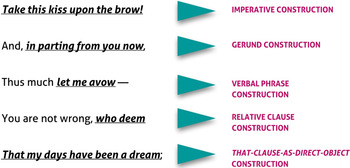
Constructionist approaches to language acquisition claim that language development draws on form-function pairings termed constructions (Goldberg, Reference Goldberg1995, Reference Goldberg2003, Reference Goldberg2006, Reference Goldberg2013a, Reference Goldbergb, Reference Goldberg, Nash and Samvelian2016 [in press]), i.e. concrete-abstract instances of concepts (form-meaning pairings) that are learned by way of general cognitive mechanisms. As Goldberg (Reference Goldberg2013b: 479) points out, ‘the ability to categorize exemplars, share information, cooperate, and anticipate upcoming events by making various types of predictions are all clearly directly advantageous to the individual or group and so may plausibly have evolved (…)’. These constructions include ‘morphemes, words, idioms, partially lexically filled and fully general linguistic patterns’ (Goldberg, Reference Goldberg2003: 219). Furthermore, ‘[c]onstructions specify the morphological, syntactic and lexical form of language and the associated semantic, pragmatic, and discourse functions’ (Ellis and Ferreira-Junior, Reference Ellis and Ferreira-Junior2009: 370). (See Figure 1 for a summary of constructions).
A partial list of constructions in Edgar Allan Poe's A Dream within a Dream

Finally, the determinants of construction learning are (i) the frequency of specific forms in the input (Zipfian distribution), (ii) the prototypicality of meaning of most the constructions (their function), and (iii) the interaction of frequency and meaning for the emergence of form-function mappings.
MWVs and Argument Structure Constructions
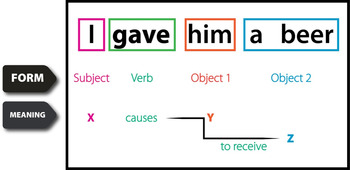
Although MWVs exhibit complex syntax-semantics relations (determined by the lexical verb-particle interaction) their function as linguistic constructions does not condition the interpretation of more complex constructions. Consequently, regardless of their form or semantics, all verbs combine with specific super-constructions, called Argument Structure Constructions (ASCs) (Goldberg, Reference Goldberg1995, Reference Goldberg2003, 2013a) to yield up meaning. Argument Structure Constructions (e.g. intransitive, transitive, ditransitive, resultative, etc.) are defined as ‘form-function pairings that relate abstract meanings with arrays of grammatical relations’ (Goldberg, Reference Goldberg2013a:437). For example, the ditransitive ASC subject+verb+object construction has the meaning X causes Y to receive Z (an illustration is given in Figure 2):
The ditransitive ASC

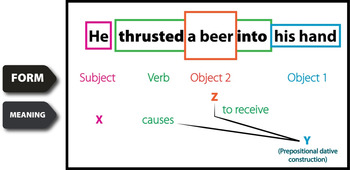
In this example, we can identify the verb give as a prototype inheriting its meaning from the ditransitive ASC. Alternately, it is possible to identify the ditransitive ASC even in prepositional dative constructions (Figure 3):
The prepositional dative construction

As is clear from Figure 3, a prepositional dative construction can be used to paraphrase the ditransitive ASC when the recipient (Y) is inanimate, a phenomenon termed ‘recipient animacy constraint’ (cf. Year and Gordon, Reference Year and Gordon2009), and that occurs because ASCs ‘do not specify phrase structure trees or word order directly’ (Goldberg, Reference Goldberg2013a: 453; emphasis in original).
MWVs and Verb Argument Constructions (VACs)
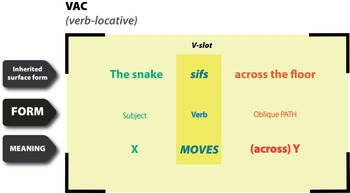
To reiterate the previous point, no construction contributes an absolute meaning conditioning the structure of the utterance it appears in. In particular, the interpretation of specific verbs is the result of our experience with basic level prototypes acquired through repeated exposure to different kinds of input (i.e. the language accessible to a learner during the language acquisition process). It follows that users of English (native and non-native) can interpret novel utterances such as ‘The snake sifs across the floor’ or ‘The teacher furths the student the book’. Although we do not know exactly what the jabberwocky verbs ‘sif’ and ‘furth’ mean , we can interpret ‘sif’ as a verb of motion and ‘furth’ as a verb involving the transfer of something (the book) from a donor (the teacher) to a recipient (the student) (cf. Ellis, Brook-O'Donnell and Römer, Reference Ellis, Brook-O'Donnell and Römer2013). What we identify then is not the meaning of a particular verb ‘projecting exclusively from its semantics’ (see Johnson and Goldberg, Reference Johnson and Goldberg2013a), but the underlying verb argument constructions (VACs) (events requiring a participant). Crucially, the frequency patterns of verbs occupying particular VACs are Zipfian (Zipf, Reference Zipf1935, Reference Zipf1949), since meaning within most VACs is inherited from prototypical verbs (cf. Ninio, Reference Ninio2006). As reported by Ellis and ferreira-Junior (Reference Ellis2009: 373), the frequency distribution of verb types in the VL construction is Zipfian. Thus, the verb go is twice more frequent than the second most frequent token in a list of verbs (come), three times as frequent as the third verb in the rank (get), etc. It should be noted, however, that Zipfian distributions ‘are not required for category learning’ (Boyd and Goldberg, 2009: 426).
MWVs as hyponyms
Although specific verb-argument constructions (VACs) exist independently of particular verbs filling V-slots in a sentence (cf. Ellis and Ferreira-Junior, Reference Ellis and Ferreira-Junior2009:371), some highly occurring verbs can be said to project their meaning onto other verbs occupying the same V-slots within usage-driven inheritance networks. It is unsurprising then that the nonsense verbs sif and furth bear traces of the meaning of move and give respectively (see Figures 4–5).
The verb-locative VAC

The transfer VAC

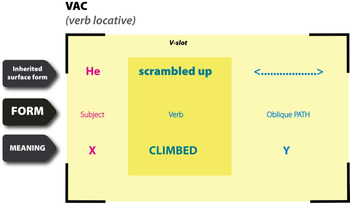
Therefore, the apparently complex syntax-semantics interface represented by MWVs accounts for how verbs map to events. For instance, the phrasal verb scramble up occupies the VAC (intransitive motion) of the verb climb (Figure 6).
The MWV locative VAC

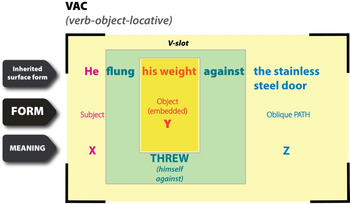
As shown in Figure 6, the packaged manner of the action in English is expressed in the form of a hyponym of climb. In other words, the MWV scramble up expresses a more specific manner of climbing. The same holds for caused-motion VACs following the VOL pattern (Figure 7).
The MWV object locative VAC

In this case, the prepositional verb fling against is a hyponym of throw.
Most tellingly, the above account reveals a relationship between MWVs (functioning as hyponyms of certain prototype verbs) and hypernyms, i.e. common verbs from which more specific verbs inherit their semantics. In this sense, verb-particle collocations point to a variety of metaphorical instances used to extend a prototype verb's semantics and the way verbs relate to (virtual) objects. Ultimately, verbs acquire new meanings when combined with newly coined nouns.
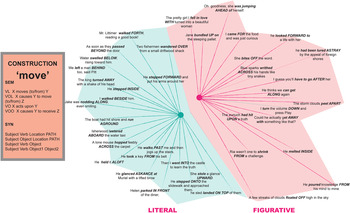
What this tells us is that basic-template verbs can conform MWV hypernym families. By way of example, the verb move groups within inheritance networks some of the MWVs inheriting their meaning from this verb within specific VACs (see Figure 8).
A hypernym family featuring some of the MWVs associated with the prototypical verb MOVE. As shown, even figurative verb-particle collocations evoke, through their syntax-semantics, the verb move within a usage-driven inheritance network

As shown in Figure 8, my interpretation of the move-construction is expressed through the verb's semantics (SEM) and syntax (SYN) within several VACs. ‘Move’ thus projects its prototypical semantics onto all the verbs occupying its corresponding V-slot. Crucially, regardless of whether a MWV is literal or figurative, a hypernym family can be posited. This basically goes to the idea that a better comprehension of, say, the manner of an action embedded within a MWV, can be accessed when the underlying hyponym-hypernym relation is made explicit (see a subsequent section).
The MWV-VAC interface
In this section I shall analyse three VACs in relation to MWVs: (i) the Verb Locative Construction (VL), (ii) the Verb Object Locative construction (VOL), and (iii) the Ditransitive Construction (VOO).
The Verb Locative Construction (VL) implies an intransitive motion, i.e. X moves (to/from) Y (someone/something moves from one place to another or in a new direction):
(9) ‘Right! I pull over TO the curb just before a traffic light and storm out OF the car’. (E.L. James, Fifty Shades Darker [2012])
The Verb Object Locative construction (VOL) projects a caused motion, i.e. X causes Y to move (to/from) Z (someone/something causes someone/something to move to a new place or direction):
(10)
a. ‘With his free hand Jack took the jar OFF the top shelf of the refrigerator’. (Steve Martini, The List [1997])Footnote 3
b. ‘The handmaid coming out to open the gate for him, he quietly pulls off his hat as a parting salute, and goes AWAY with no greater show of agitation than is visible in the effigy of Mr. Sapsea's father opposite’. (Charles Dickens, The Mystery of Edwin Drood)
Finally, the ditransitive construction (VOO) profiles three participant roles: an agent (Subject), a given theme (Direct Object) and a prepositional dative or an animate recipient (Indirect Object): X causes Y to receive Z:
(11) ‘That would have made this arrangement perfect, but he'd settle for her running out tomorrow morning and picking him UP a fresh coffee cake from Mary Lou's’. (Julie Metz, Perfection [2009])
Parsing the Inherited Surface Form
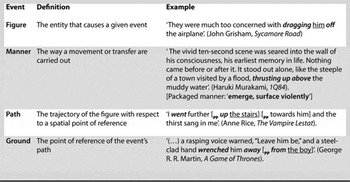
Though VACs account for the MWV syntax-semantics interface, the semantic components of (motion) events (Talmy, Reference Talmy and Greenberg1978, Reference Talmy2000) must be taken into account in order to analyse the way MWVs map events onto inherited surface forms (Four of these events are plotted in Table 1).
Semantic components of (motion) events

As shown in Table 1, not only manner is encoded in English MWV verbs: Particles lexicalise path and ground, and objects serve as figures for grounds. This tightly knit interaction of MWVs with other constructions in an utterance circumscribes inherited surface forms in terms of complex construction interaction (cf. Goldberg, Reference Goldberg, Nash and Samvelian2016, in press).
Modelling MWV input
Let me now briefly explain how interactionally modified input can be introduced in the EFL classroom. Although the language acquisition hypothesis driving the present account is interactionist in nature - i.e. it relies on the analysis of the way instructor-peer or peer-peer modes of interaction in specific contexts can be used to improve L2 acquisition - the main focus here is not on a single pattern of interaction, namely the native-non-native speaker paradigm (see for example Torres-Martínez, Reference Torres-Martínez2014, for a complete description). Furthermore, unlike most interactionists working in the SLA field, I do not embrace the native speaker baseline as a means to explain non-native speakers’ L2 acquisition (e.g. Long, 1981).
Importantly, as we shall see in in the next Section, corpus-driven language learning activities, such as data-driven learning (DDL) and paper-based data-driven learning (PbDDL) should hinge on task-based language teaching (TBLT) design principles whereby ‘meaning is primary; there is a relationship to the real world; task completion has some priority; and the assessment of task performance is in terms of task outcome’ (Skehan, 1996:8). By the same token, paper-based tasks should encompass both attention to form and function that facilitate the transition from input (its consciously noticed features) into intake Footnote 4 (Schmidt, Reference Schmidt1993). This, of course, presupposes a sort of pedagogical intervention in the form of both focus on forms (FonFs; Long, Reference Long, de Bot, Ginsberg and Kramsh1991) in which learners’ primary attention is guided towards linguistic forms, and focus on form (FonF, Long, Reference Long, de Bot, Ginsberg and Kramsh1991; Long and Crookes, Reference Long and Crookes1992) in which meaning (message processing) is the main focus with an occasional shift to language form. The main theoretical framework behind FonFs is Anderson's skill acquisition theory for support (Reference Anderson1983) and DeKeyser's process of transformation of declarative knowledge into procedural knowledge (Reference Dekeyser2007). Declarative knowledge consists in the definition of specific constructions (form-function pairings) transformed through practice into procedural knowledge in communicative tasks. FonF, on the other hand, seeks to enhance learning through the combination of two constructs, namely negotiation of meaning and negotiation of form during collaborative communicative tasks, thereby inducing both noticing and noticing the gap. It should be noted, however, that learners’ self-generated behaviour for the noticing of input should also be taken into consideration in L2 acquisition. One of the most comprehensive characterisations of learners’ input processing tendency is Van Patten's (Reference VanPatten2004). He defines the process as ‘[those] strategies and mechanisms learners use to link linguistic form with its meaning and/or function’ (2004:1).
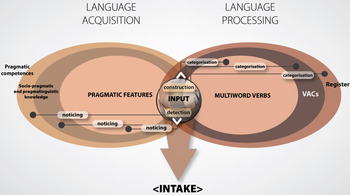
As is given in Figure 9, the modelling of relevant MWV input within a constructionist framework stems from the convergence of several stages associated with both language acquisition and language processing. Therefore, the combination of both noticing tasks (based on pattern detection, involving pragmatic features, sociopragmatic knowledge, and pragmatic competences) and categorisation tasks (drawing on explicit instruction of MWVs associated with specific VACs and registers) are deemed to promote both grammatical and pragmalinguistic knowledge. Intake can thus be said to emerge from the selection of relevant input combining usage-based information with syntax-semantics relations. This process entails the integration of FonFs and FonFs leading to intake. Furthermore, a clear distinction between production tasks (like discourse completion tasks [DTCs], computer-mediated communication [CMC], etc.) and non-production tasks (judgement tasks, like rating, sorting, interpreting, etc.), should be made (cf. Bardovig-Harlig, Reference Bardovi-Harlig and Trosborg2010). The type of task-based learning invoked here should encompass meaningful input fostering the production of context-relevant language, as well as positive forms of feedback both direct (metalinguistic corrections) and indirect (like recasts, i.e., reformulations) (cf. Ellis, Reference Ellis2009), and, not least, the development of ad hoc materials that incorporate ‘the application of theory to practice and practice to theory’ (Tomlinson, Reference Tomlinson2012: 146).
MWV input leading to intake within a constructionist framework

A MWV-VAC acquisitional framework
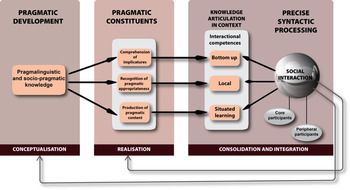
The instructional road to the acquisition of MWVs as related to specific verb-argument constructions (VACs) is deployed in three phases: (i) the conceptualisation phase, (ii) the realisation phase, and (iii) the consolidation-integration phase. An illustration of the model is given in Figure 10. It can be seen that during the conceptualisation phase, the focus of instruction is on the development of both pragmalinguistic and sociopragmatic knowledge, i.e. instruction on rules of use (pragmatic development). Importantly, instruction is not viewed as an individual, one-way construct, but as the result of social interactions conducive to the development of syntactic structure (cf. Hatch, Reference Hatch and Hatch1978: 404). Since, there is a connection between interaction and learning (Gass and MacKey, Reference Gass, MacKey, VanPatten and Williams2007: 176), the involvement of both core participants (teachers and learners) and peripheral participants (the extended community onto which the pedagogical action is projected) is crucial for the articulation of knowledge in context. This presupposes the construction of a set of highly situated, localised and bottom-up interactional skills. The realisation phase is thus accomplished when several pragmatic constituents are in place: (1) the comprehension of implicatures (of context-oriented language use), (2) the recognition of the pragmatic appropriateness of MWVs, and (3) the production of pragmatically-relevant content. The process just depicted is, of course, non-linear. Moreover, invisible variables such as interactionally-driven performance are acknowledged. As Yano (Reference Yano2013: 26) points out, ‘learning and teaching performance should not be attributed to individual causes, such as students’ personality and capability [but] understood as highly collective phenomena among teachers and students’.
The MWV acquisitional framework

The consolidation of an ecological learning environment also entails a number of socio-cognitive adjustments that promote the emergence of interactional models (cf. Torres-Martínez, Reference Torres-Martínez2014: 25–27).
Constructions in the classroom
Just as the previous sections laid out the foundation for a comprehension of MWVs from a constructionist perspective, this section analyses the implementation of constructions with views to their actual classroom exploitation. To this end, I explore two corpus-oriented approaches to MWV instruction: (1) Data-driven learning (DDL) and (2) paper-based data-driven learning (PbDDL).
Data-driven learning
Data-driven learning is defined as L2 learners’ direct consultation of corpora for language acquisition purposes (Johns, 1991). According to this definition, language instruction is not based on the overt presentation of rules, but on noticing, i.e. the identification of patterns among large amounts of language samples. This constructivist approach to language learning is deemed to be ‘natural’ in that it provides learners with a space to engage in hands-on corpus consultation to detect linguistic rules. Thus, for traditional DDL, explicit teaching of rules is considered an artificial intellectual activity that fails to promote ‘noticing and consciousness-raising leading to greater autonomy and better language learning skills in the long term’ (Boulton, Reference Boulton2010: 535). For the purposes of this paper, the conceptual framework of traditional DDL is problematic in four aspects: (1) DDL is defined as a fits-all-sizes approach that conflates the processing power of computers (to identify large amounts of language samples quickly) with relevant pedagogic input; (2) explicit grammar instruction is avoided, leaving out characterisation tasks (a necessary complement to noticing); (3) the computer skills necessary to use a concordancer and extract relevant information are taken for granted; (4) there is no clear link between descriptive linguistic analyses and principled pedagogical exploitation.
Using the concordancer
One of the advantages of direct corpus consultation is the possibility to gain access to large amounts of information in terms of frequency, surface, and semantic properties. Nevertheless, the task of unpacking the meaning of MWVs requires the development of basic consultation skills. Consequently, before dealing with what learners can do with a concordancer, it is necessary to define how they can do it. Indeed, this process entails:
(1) The selection of a suitable concordancer.
(2) The selection of the concordancer functions to be used.
(3) The instruction into how to compile a corpus.
(4) The instruction in the techniques to launch relevant searches.
(5) The definition of the best practice in the interpretation of the results.
(6) The definition of the extent to which this information can be linked to specific learning goals.
With regard to the first two steps, it becomes apparent at this point that some basic logics for the analysis of corpus data must be in place. For example how to use the KWIC (key word in context) display mode available in most concordancers (see the next Section), the procedure for the extraction of information from the spans, as well as the ability to compare/contrast the different linguistic contexts provided by the concordance lines.
For ease of explanation, I selected the Corpus of Contemporary American English (COCA; Davies, Reference Davies2008), a freely-available corpus created by Mark Davies. The search functions for the analysis of MWVs in the COCA vary depending on whether we are looking for continuous or discontinuous MWVs, i.e. those allowing the placement of a direct object between the verb and the particle. For instance, in the case of prepositional verbs like go on, we first select the KWIC display mode, then the register (for example, spoken English), and simply type ‘go on’ to launch a search. The list of results (concordance lines) is displayed on the central panel providing contexts for comparison in terms of frequency, surface, and semantic functions. For discontinuous MWVs, a three-step procedure must be applied in order to facilitate the retrieval of results relevant to the analysis of MWVs. Such a procedure is summarised as follows:
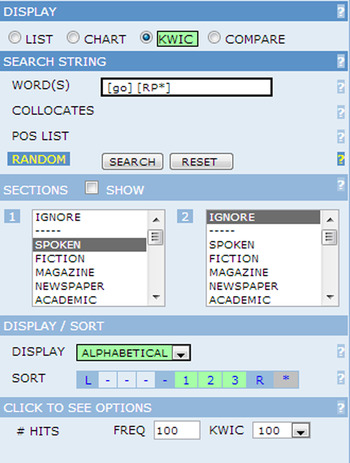
1. For prepositional verbs, enter the verb lemma [lexical verb] plus [RP*]. For example, if we want to search for the verb go plus all the particles associated with it, we type [go] [RP*] (the wildcard* stands for any particle, see Figure 11). For other instances of go, we simply type ‘going’, ‘went’, or ‘gone’ in the lexical-verb slot:
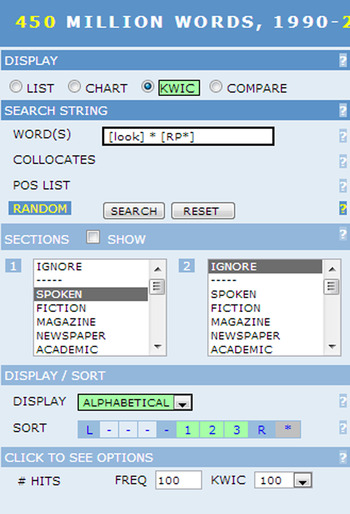
2. When searching for the tokens of a phrasal verb with one intervening word, we type [verb]* [RP*] (see Figure 12). As the reader may have inferred, the wildcard stands for any word placed between the lexical verb and its particle.
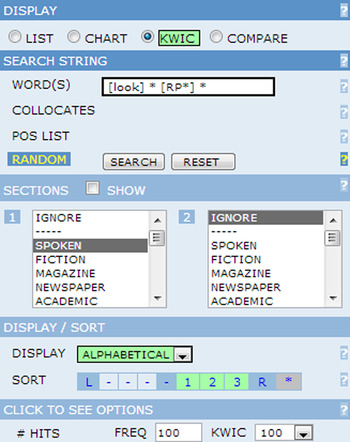
3. For phrasal prepositional verbs taking both a direct object and a prepositional object, the search looks like this: [verb] * [RP*] * (see Figure 13).
The prepositional-verb search in COCA (KWIC display)

Phrasal-verb search in the COCA (KWIC display)

Phrasal-prepositional verb search in the COCA (KWIC display)

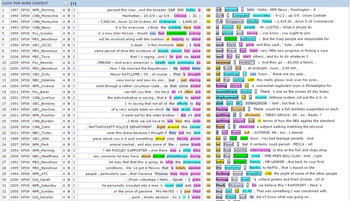
It is important to note that the COCA search mode for MWVs may yield false positives, especially when the number of intervening words is up to three (see Garner and Davies Reference Gardner and Davies2007: 344–345). Alternatively, the COCA can be queried for MWV by simply typing a particle (up, off, down, in, on, etc.). (See Figure 14).
Particle search in the COCA (KWIC display)

Paper-based DDL (PbDDL)
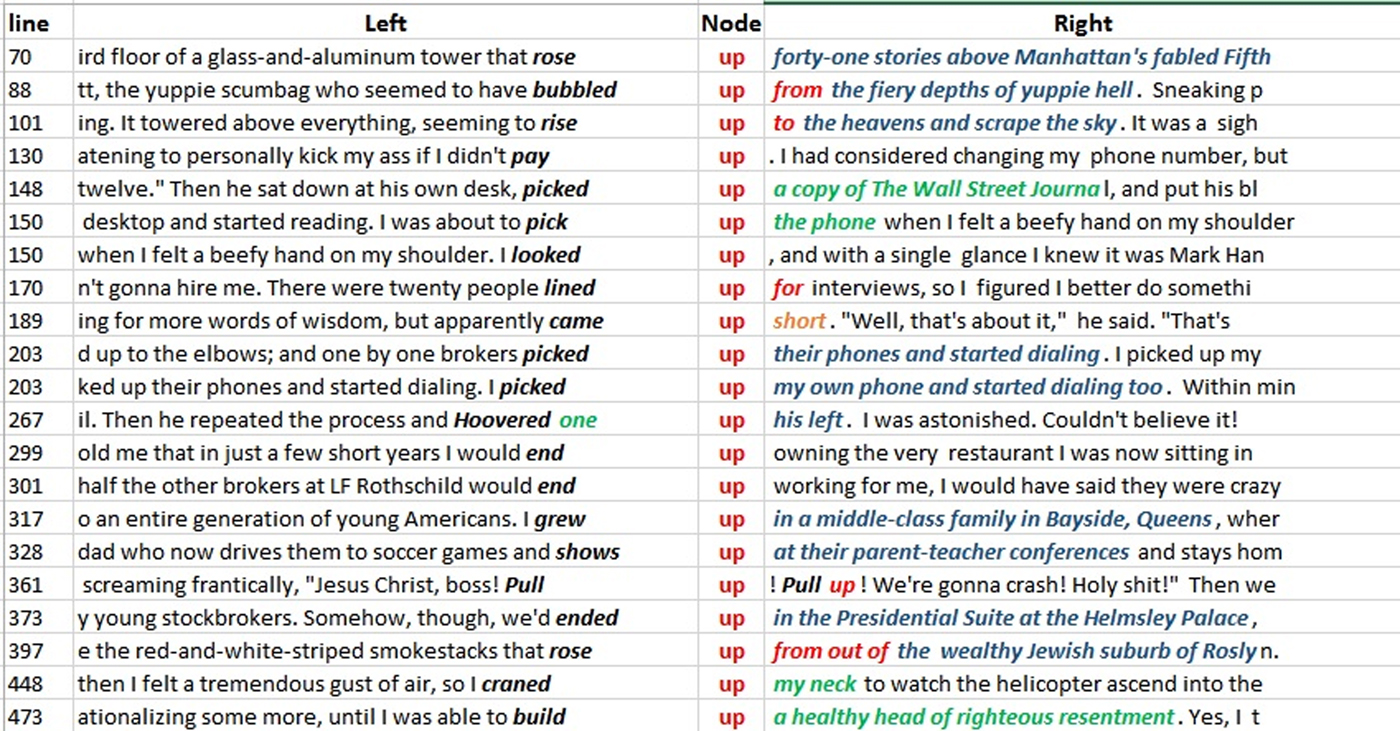
Paper-based DDL is a variation of computer-assisted DDL. Basically, it draws on printed concordance lines (exported from the concordancer to a word processing software) to detect patterns of language usage. Concordance lines are displayed in KWIC (Key word in context) mode, i.e. with target structures aligned vertically to the centre. The KWIC display mode is a concordance function used to determine lexicogrammatical patterns based on position patterns on a span to the right and to the left of a node item. This is illustrated in Figure 15 which shows a set of concordance lines for the particle UP. As shown, the lexical verb is placed on the left span with the particle placed at the centre of the concordance lines (the node). On the left span, we can also find all the objects placed between the lexical verb and the particle. The right span complements the information by displaying other particles associated with the lexical verb as well as prepositional objects or adverbials.
Concordances from Jordan Belfort's The Wolf of Wall Street. The concordance lines were extracted using KWIC 5 (http://www.chs.nihon-u.ac.jp/eng_dpt/tukamoto/kwic_e.html), a freeware corpus analytical tool, and exported to an Excel Spreadsheet for the linguistic analysis
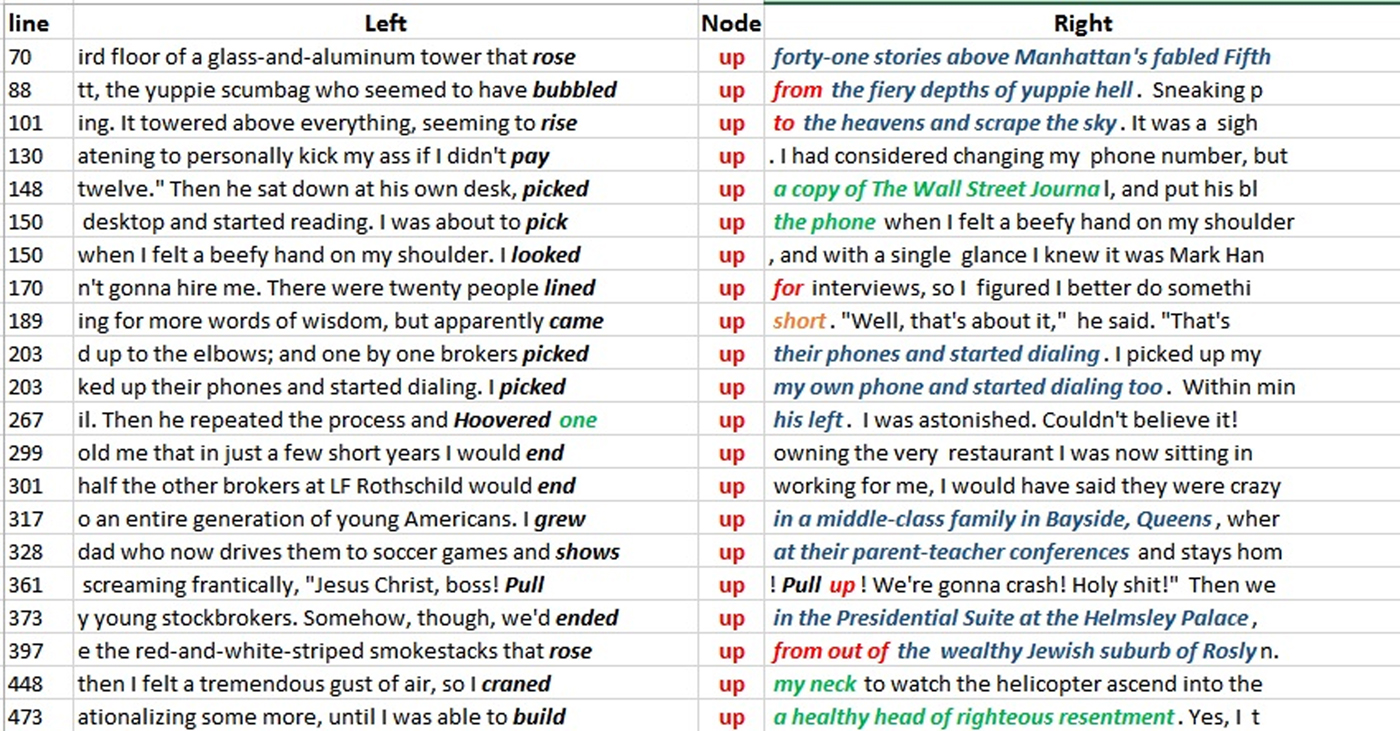
As can be seen from Figure 15, this type of reading is supportive of a development of noticing skills that may allow learners to zero in on collocational patterns of particular linguistic forms. It goes without saying that noticing tasks must be guided, have clear pedagogical objectives, and be supported by characterisation tasks, involving the categorisation of linguistic forms (cf. Torres-Martínez, Reference Torres-Martínez2014: 31). KWIC mode is therefore useful in the identification of collocation, colligation, semantic preference, and association. As regards the techniques to extract relevant, non-redundant information from a KWIC type of display in a concordancer, Sinclair (Reference Sinclair, Halsegård and Oksefjell1999) suggests a 25-line focus, that is, the analysis of the first 25 concordance lines in terms of surface (collocation and colligation) and meaning patterns. From a corpus linguistic perspective this may yield relevant results. However, the technique of analysing iterations of 25 lines at a time (until no novel information can be extracted) does not square well with a pedagogical mindset. Especially in DDL tasks (computerised, non-paper-based) in which students interact directly with the concordancer, it is unrealistic to suppose that students will understand a given grammatical structure after exposure to a 25-line iteration and without the guidance of the instructor. Indeed, it is recommended that teachers chart a pedagogical territory for students by creating a meaningful link between frequency surface patterns, interpretation, and language learning objectives. An example is shown in Figure 16.
An opinion-exchange paper-based DDL task. The task typology (see Pica, Kanagy and Falodun, Reference Pica, Kanagy, Falodun, Gass and Crookes1993:19), utilizes concordance lines (in this case from the movie Hunger Games: Catching Fire) to provide learners with either one-way or two-way interactional possibilities.

Conclusion
In evaluating the present effort to gain some purchase on the problem of conceptualising MWVs within a constructionist framework, we must bear in mind that no linguistic issue can be tackled prescriptively. Nevertheless, the constructionist framework counts prominently among the multiple approaches to MWV conceptualisation in that it successfully accounts for form and meaning within a usage-based context in which functional motivations defuse a priori linguistic constraints (cf. Goldberg, Reference Goldberg2013b, Goldberg, Reference Goldberg, Nash and Samvelian2016 [in press]). Therefore, the crux of the MWV-VAC interface presented in this paper is to incorporate meaning, form, and context as determinants of exemplar learning ’without appeal to mysterious stipulations’ (Goldberg, Reference Goldberg2009:219). This is posited also to underlie the theoretical avoidance of a suggestion that MWVs condition the semantics of the utterances they appear in, a contention that would militate against their teachability.
For EFL, the task is therefore couched in terms of the need to make these underlying relations salient to students. The ecological circuit drawn in this paper for the benefit of learning centers therefore on the participants’ interaction around tasks modelled upon specific input-to-intake criteria. As suggested, corpus-driven language learning tasks, such as DLL and PbDDL may provide learners with sufficient exposure to form and meaning, which can be further elaborated in the form of communicative activities.
Putting all this together, the task of learning a MWV is not so different from that of learning one-word verbs. Both processes entail the identification of participants and arguments as a part of the broader process of making generalisations about form and meaning (Goldberg, Casenhiser and White, Reference Goldberg, Casenhiser and White2007). As a way to overcome the difficulties of associating a lexical verb with a particle, MWVs should be then analysed as chunks occupying specific VACs. Furthermore, the comparison across the events depicted by both hypernyms and hyponyms should be emphasised in order to increase the imageability Footnote 5 of MWVs.
 SERGIO TORRES-MARTÍNEZ holds a PhD in Applied Linguistics. He has created a number of tools designed to bridge the gap between technology and language teaching in Colombia. Among his main interests are interaction design, construction grammars, multimodality, translation semiotics, Content and Language Integrated Learning (CLIL), English for Academic Purposes (EAP) curricula design (English, French and German) and the definition of best practices in the teaching of conversational grammar. Email: surtr_2000@yahoo.es