


Introduction
Social anxiety disorder (SAD) is a debilitating disorder characterized by intense and recurring fear of being negatively evaluated in one or more social situations (American Psychiatric Association, 2013). SAD associates with impairments in an individual’s psychosocial functioning, causing sufferers either to avoid social interactions or to tolerate them with considerable discomfort (American Psychiatric Association, 2013; Wittchen and Fehm, Reference Wittchen and Fehm2003). The typical age of onset for SAD is between 13 and 15 years of age (de Lijster et al., Reference de Lijster, Dierckx, Utens, Verhulst, Zieldorff, Dieleman and Legerstee2017), and its prevalence in this age group is 3–9% (Burstein et al., Reference Burstein, He, Kattan, Albano, Avenevoli and Merikangas2011; Ranta et al., Reference Ranta, Kaltiala-Heino, Rantanen and Marttunen2009; Wittchen et al., Reference Wittchen, Stein and Kessler1999). SAD tends to be chronic if left untreated (Beesdo-Baum et al., Reference Beesdo-Baum, Knappe, Fehm, Höfler, Lieb, Hofmann and Wittchen2012) and frequently associates with educational under-achievement (Vilaplana-Pérez et al., Reference Vilaplana-Pérez, Pérez-Vigil, Sidorchuk, Brander, Isomura, Hesselmark, Kuja-Halkola, Larsson, Mataix-Cols and Fernández de la Cruz2020), poor peer relationships (de Lijster et al., Reference de Lijster, Dieleman, Utens, Dierckx, Wierenga, Verhulst and Legerstee2018) and decreased quality of life (Stein and Kean, Reference Stein and Kean2000).
Disorder-specific cognitive behavioural therapy (CBT) has proven effective in treating adolescents with SAD with large pre–post-treatment effect sizes in clinical (g=0.97) and school (g=1.55) settings (Scaini et al., Reference Scaini, Belotti, Ogliari and Battaglia2016). Youths with SAD seem less likely to benefit from transdiagnostic CBT treatments for anxiety disorders compared with those with other primary anxiety disorders (Evans et al., Reference Evans, Clark and Leigh2021). Previously, multiple disorder-specific group CBT treatment models have demonstrated efficacy for treating adolescents’ SAD (Albano et al., Reference Albano, Marten, Holt, Heimberg and Barlow1995; Baer and Garland, Reference Baer and Garland2005; García-López et al., Reference García-López, Olivares, Turner, Beidel, Albano and Sánchez-Meca2002; Masia Warner et al., Reference Masia Warner, Klein, Dent, Fisher, Alvir, Albano and Guardino2005). Disorder-specific group CBT may offer greater benefits in enhancing functioning among adolescents with SAD compared with individual CBT (Xian et al., Reference Xian, Zhang and Jiang2024). Treating SAD in a group format activates peer support and enables practice with peers in a natural context (Albano et al., Reference Albano, Marten, Holt, Heimberg and Barlow1995; Fjermestad et al., Reference Fjermestad, Wallin, Naujokat, McLeod, Silverman, Öst, Lerner, Heiervang and Wergeland2025). In addition, group-format treatment delivery may be more cost-effective, as it requires less therapist time (Gould et al., Reference Gould, Buckminster, Pollack, Otto and Yap1997). There is conflicting evidence whether individual CBT is more beneficial for adolescents with SAD compared with group CBT, regarding both disorder-specific and transdiagnostic treatment models (Ingul et al., Reference Ingul, Aune and Nordahl2013; Wergeland et al., Reference Wergeland, Fjermestad, Marin, Haugland, Bjaastad, Oeding, Bjelland, Silverman, Öst, Havik and Heiervang2014).
Recently, treatments based on the cognitive model of SAD (Clark and Wells, Reference Clark, Wells, Heimberg, Liebowitz, Hope and Schneier1995), which explains the persistence of SAD with specific maintaining factors (i.e. negative beliefs about oneself, self-focused attention and safety-seeking behaviours) have been modified for adolescents with promising results (CT-SAD-A; Leigh and Clark, Reference Leigh and Clark2016; Leigh et al., Reference Leigh, Creswell, Stallard, Waite, Violato, Pearcey, Brooks, Taylor, Warnock-Parkes and Clark2021).
Adolescence is marked with a heightened focus on the self and an ongoing identity development (van der Cruijsen et al., Reference van der Cruijsen, Blankenstein, Spaans, Peters and Crone2023). Negative self-concept, negative self-beliefs, and negative self-image are associated with social anxiety and SAD in adolescence (Di Blasi et al., Reference Di Blasi, Cavani, Pavia, Lo Baido, La Grutta and Schimmenti2015; Leigh et al., Reference Leigh, Percy, Clark, Creswell and Waite2023; van der Cruijsen et al., Reference van der Cruijsen, Blankenstein, Spaans, Peters and Crone2023). According to Moscovitch (Reference Moscovitch2009), individuals with SAD make negative self-attributions, experiencing the self as deficient. They hold negative, persistent, and holistic beliefs of oneself as flawed, either regarding their personality, social skills, physical characteristics, or their ability to control and hide signs of anxiety. Individuals with SAD attempt to hide these flaws through self-concealment and safety-seeking behaviours (Moscovitch, Reference Moscovitch2009). Targeting identity, negative self-beliefs and experienced self-deficiencies in the treatment of SAD in adolescents may be beneficial (Chiu et al., Reference Chiu, Falk and Walkup2016; Moscovitch, Reference Moscovitch2009).
The school environment presents a natural context for youth SAD interventions (Masia Warner et al., Reference Masia Warner, Colognori, Brice, Sanchez, Ranta, La Greca, Garcia-Lopez and M. Marttunen2015). Delivery of CBT in schools may enhance access to care for young people and increase acceptance of treatment among them and their parents (García-López et al., Reference García-López, Olivares, Turner, Beidel, Albano and Sánchez-Meca2002; Ryan and Masia Warner, Reference Ryan and Masia Warner2012). Additionally, limited resources to delivery of mental health interventions in the school and the relatively high prevalence of SAD in this age group call for high cost-efficiency.
The most widely studied school-based treatment program for adolescents with SAD is the Skills for Academic and Social Success (SASS; Masia et al., Reference Masia, Beidel, Albano, Rapee, Turner and Morris1999). SASS consists of 12 weekly group sessions with two additional booster sessions and individual sessions. It has proven effective in reducing levels of social anxiety among adolescents (Fisher et al., Reference Fisher, Masia Warner and Klein2004) and superior to a school-based attention control intervention (Masia Warner et al., Reference Masia Warner, Fisher, Shrout, Rathor and Klein2007). SASS appears at least as effective as SAD interventions designed and delivered in clinical settings, both showing moderate to high effect sizes (Scaini et al., Reference Scaini, Belotti, Ogliari and Battaglia2016). In a randomised controlled trial study, method-trained school counsellors reached comparable outcomes to clinical psychologists as intervention providers (Masia Warner et al., Reference Masia Warner, Colognori, Brice, Herzig, Mufson, Lynch, Reiss, Petkova, Fox, Moceri, Ryan and Klein2016).
Encouraged by these results gained from the research on SASS and the individual-format CT-SAD-A, a novel developmentally sensitive, group-format treatment for adolescents with SAD delivered in a school setting was developed. In the present study we examine the feasibility and preliminary effectiveness of a brief, 10-session Developmentally Oriented Cognitive Therapy for Social Anxiety Disorder (DOCT-SAD) implemented in the school environment. Adding to the current research on treatment programmes developed for SAD among adolescents, DOCT-SAD emphasises supporting a young person’s positive identity development by addressing and countering their negative self-beliefs through normalisation and peer support (Albano and DiBartolo, Reference Albano and DiBartolo2007), by restructuring experienced self-deficiencies (Moscovitch, Reference Moscovitch2009), as well as by developing self-compassion to decrease self-criticism and shame (Gilbert and Irons, Reference Gilbert and Irons2008; Henderson, Reference Henderson2011). The preliminary benefits of DOCT-SAD among young people with SAD has previously been examined in a university-based pilot study, where DOCT-SAD was found feasible in treating young people with SAD and resulted in 60% (6/10) diagnostic remission at post-treatment (Lampela et al., Reference Lampela, Monthan, Marttunen, Minkkinen and Ranta2022). Prior Finnish implementation research (Parhiala et al., Reference Parhiala, Ranta, Gergov, Kontunen, Law, La Greca, Torppa and Marttunen2020) and the stepped care organisation of services for young people (Finnish Ministry of Social Affairs and Health, 2018) indicate that brief treatments need to be prioritized in school services in order to maximise odds of successful implementation.
This study will report first results from a larger project which will include a randomised controlled intervention trial (ClinicalTrials.gov ID NCT06489639) on school-based treatment of SAD with DOCT-SAD. Our specific aims were:
-
(1) To examine feasibility and acceptability of DOCT-SAD for students aged 13–17 years, their parents, and school psychologists as treatment providers recruited from Finnish public schools.
-
(2) To study preliminary effectiveness of DOCT-SAD when delivered in a school setting.
Method
Participants
During the Spring semester of 2023, 11 participants (9 girls, 2 boys) were recruited from the mandatory middle schools and the first-year course of secondary level educational units (high schools and vocational schools) in the city of Tampere, Finland. Participants’ mean age at baseline assessment was 15.8 years (SD=1.0, range 14.1–17.5). All participants had primary SAD according to DSM-5. Six out of 11 adolescents had had prior contact with a School Health and Welfare Service (SHWS) professional (i.e. school psychologist, nurse or a social worker). Five students were directly referred by parents and had no prior treatment contact at all. Three students reported being either assessed or treated in child/adolescent psychiatric services previously. According to protocol, none of the participants received any other psychological treatment during the intervention period.
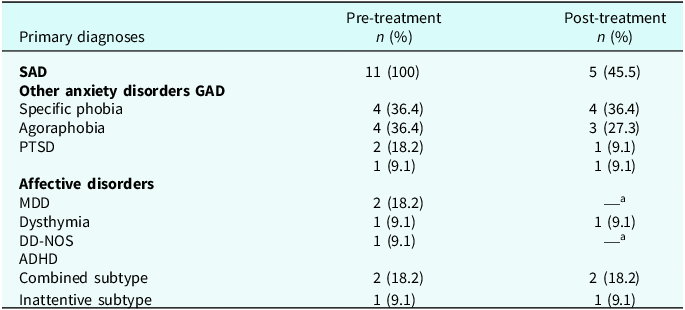
Of the participants, 45.5% suffered from a co-morbid other anxiety disorder and 36.4% suffered from co-morbid affective disorder and 27.3% had co-morbid ADHD (see Table 1 for description of all assigned co-morbid disorders). Participants’ socioeconomic composition was defined by the professional level of parents (ISCO-08), the Finnish adaptation (Central Statistical Office of Finland, 2010). Family caregiver occupational statuses were skill level I (n=0), skill level II (n=2), skill level III (n=6) and skill level IV (n=3). Of the participants, 10 were Caucasian, one with parents from Middle East/Finland. All reported Finnish as their first language.
DSM-5 diagnoses assigned to participants at pre- and post-treatment (n=11)

Table 1. Long description
The table compares the number and percentage of participants with various diagnoses before and after treatment. It includes primary diagnoses, other anxiety disorders, affective disorders, and ADHD. The table has 11 rows and 3 columns. The columns are labeled Pre-treatment, Post-treatment, and Primary diagnoses. The row labels include SAD, Other anxiety disorders GAD, Specific phobia, Agoraphobia, PTSD, Affective disorders, MDD, Dysthymia, DD-NOS, ADHD, Combined subtype, and Inattentive subtype. Each row shows the number and percentage of participants with each diagnosis before and after treatment. For example, SAD had 11 participants pre-treatment and 5 post-treatment. Other anxiety disorders GAD had 4 participants pre-treatment and 4 post-treatment. Specific phobia had 4 participants pre-treatment and 3 post-treatment. Agoraphobia had 2 participants pre-treatment and 1 post-treatment. PTSD had 1 participant pre-treatment and 1 post-treatment. Affective disorders had 2 participants pre-treatment and none post-treatment. MDD had 1 participant pre-treatment and 1 post-treatment. Dysthymia had 1 participant pre-treatment and none post-treatment. DD-NOS had 1 participant pre-treatment and none post-treatment. ADHD had 2 participants pre-treatment and 2 post-treatment. Combined subtype had 1 participant pre-treatment and 1 post-treatment. Inattentive subtype had 1 participant pre-treatment and 1 post-treatment.
SAD, social anxiety disorder; GAD, generalised anxiety disorder; PTSD, post-traumatic stress disorder; MDD, major depressive disorder; DD-NOS, depressive disorder not otherwise specified; ADHD, attention deficit hyperactivity disorder. One participant may have more than one other anxiety disorder diagnosis. Of all participants, 45.5% suffered from co-morbid one or more other anxiety disorder and 36.4% from co-morbid affective disorder.
aNo participant reached the diagnostic limit.
Procedure
A two-stage professional co-working model was used to detect students with possible SAD in schools. SHWS professionals detected students with possible SAD in the SHWSs and informed them of the intervention and the study. Alternatively, families who were interested in participating in the study and the treatment, contacted the SHWSs after receiving an advertisement message disseminated via an electronic communication platform used by the schools. In the first stage of detection, all SHWS professional groups (i.e. school psychologists, social workers and nurses) participated in the screening of SAD with the aid of a SAD detection toolkit. The toolkit consisted of (1) the SPIN questionnaire for assessment of SAD symptoms; (2) the treatment suitability evaluation checklist (TSEC), which stated the main intake and exclusion criteria; and (3) a pictorially enhanced information leaflet presenting main differences between hallmark features of anxiety and depression. A concise, 1-hour live/remote training pertaining to the utilisation of the toolkit was delivered to all SHWS professionals.
In the second stage, five consulting school psychologists, all method-trained in DOCT-SAD and in recognition of SAD among youth, re-evaluated students screened positive in the first stage. The inclusion criteria in our study were: a primary SAD diagnosis, age between 13 and 18 years (participant must be under 18 years old at the time of treatment referral) and a capacity to understand the contents in the treatment sessions (e.g. sufficient language skills). The exclusion criteria were: autism spectrum diagnosis, acute suicidal symptoms, psychotic symptoms, substance abuse problems, severe malnourishment, major learning difficulties, adolescent’s or parent’s lack of motivation to participate, severely impaired functioning or unstable family environment requiring child protection measures. The exclusion of young people with ASD, while retaining those with ADHD, was justified by the distinct differences in social cognitive abilities and social motivation typically associated with ASD, but to a lesser degree among those with ADHD (Bölte, Reference Bölte2025).
After reaching their decision on whether the adolescent fulfilled the inclusion criteria and did not meet any exclusion criteria, the consulting school psychologists made a referral to the research team. In total, 22 adolescents were referred to the research team by the consulting school psychologists. Of these 22, three were evaluated as not eligible for treatment. One participant took part in the diagnostic interview by the research team but decided to continue the ongoing individual sessions with a school psychologists, one was deemed not suitable in the second stage telephone interview with a consulting school psychologist, and the third one did not have primary SAD according to the telephone contact prior the diagnostic interview. Of the remaining participants, 11 were randomised to treatment.
Diagnostic assessment
The research team first ascertained that intake criteria were likely met by a mobile phone contact with the parent and the adolescent. The adolescents and one/both parents were then invited to a face-to-face diagnostic interview at the university, consisting of the ADIS-5 interview to detect DSM-5 anxiety disorders and the K-SADS-PL for DSM-5 interview to detect co-morbid non-anxiety disorders. Adolescents and parents were informed of the study and gave their informed consent to participate in the study by signing a research consent form approved by The Regional Ethics Committee of the Expert Responsibility area of Tampere University Hospital. If the adolescent did not meet all of the inclusion criteria or fulfilled any exclusion criteria, they did not proceed to treatment. Instead, the family received feedback and guidance to contact SHWSs for appropriate treatment. Post-treatment interviews were also conducted by the research team with the young person and parent(s). According to procedure, parents were involved in the diagnostic assessment and two of the intervention sessions. However, especially among the older participants, the degree and way of arranging parental involvement could be agreed individually respecting the young person’s wishes. Parents could also be interviewed separately from the young person, although this was not encouraged.
Intervention training and delivery
Training in the use of the DOCT-SAD intervention was provided by the Department of Psychology at Tampere University. The method training was delivered by an expert cognitive therapy trainer responsible for development of the program in a workshop consisting of two 16-hour days in the beginning of 2023. The method training covered the treatment modules session-by-session, including psychoeducation of SAD during adolescence, practical exercises and learning the core components of DOCT-SAD. DOCT-SAD was delivered in the schools by four school psychologists. The mean age of school psychologists providing the treatment at the time of the intervention was 38.75 years (SD=8.5, range 30–47) and their clinical experience was on average 12 years (SD=5.72, range 5–18). They were supervised weekly for approximately 1.5 hours per supervision session by the method developer for the length of the whole intervention. The case-focused supervision sessions were conducted in groups.
Intervention
The DOCT-SAD is a brief 10-session treatment program for adolescents with SAD. The intervention is largely based on the cognitive model of SAD (Clark and Wells, Reference Clark, Wells, Heimberg, Liebowitz, Hope and Schneier1995). It uses several key therapeutic techniques from the CT-SAD and CT-SAD-A programs, targeted at maintenance of symptoms in SAD (Clark et al., Reference Clark, Ehlers, McManus, Hackman, Fennell, Campbell, Flower, Davenport and Louis2003; Leigh and Clark, Reference Leigh and Clark2016).
Therapeutic components and techniques of DOCT-SAD are designed and expanded to challenges specific to the developmental phase of adolescence. Development of an acceptable and positive self-identity is regarded essential for adolescents (Harter, Reference Harter2012). The second main influence of DOCT-SAD, David Moscovitch’s theory of the experienced self-deficiencies in SAD (Moscovitch, Reference Moscovitch2009), is reflected in the psychoeducational materials with focus on normalisation of peer affiliation, dysfunctionality of maintenance factors, group exercises and behavioural experiments, using self-exposures in addition to planned behavioural experiments. The DOCT-SAD program makes use of original materials guiding therapists and adolescents to work on restructuring dysfunctional thoughts and emotions related to social anxiety in the context of experienced self-image. The third main influence of DOCT-SAD is the use of self-compassion exercises partially based on the previous work of Henderson (Reference Henderson2011) to counter self-criticism in social anxiety (Gilbert and Irons, Reference Gilbert and Irons2008; Cunha and Paiva, Reference Cunha and Paiva2012).
DOCT-SAD consists of 10 weekly sessions, including four individual and six group sessions. One session is 1.5 hours long and the group sessions consist of four to six participants and two school psychologists. The combination of individual and group sessions enables working with adolescents’ individual core fears as well as peer support and normalisation (Albano et al., Reference Albano, Marten, Holt, Heimberg and Barlow1995). The overall aim of the treatment is to enhance adolescents’ development from being dependent on others’ opinions towards being their authentic self in social interactions. This is achieved by first recognising and abandoning safety-seeking strategies and self-concealment in social interactions (shelter-seeking self). Secondly, the adolescents are encouraged to practise their authentic self in various spontaneous interactions exercises in the group sessions, field practices and at home. Thirdly, they are trained to express self-compassion towards their authentic self.
The intervention begins with two individual sessions, where the emphasis is on building trust and alliance, motivating the young person and parents and establishing individual formulation of participants’ SAD symptoms. The third and fourth individual sessions are located towards the end of the treatment (sessions 7 and 9). Session 7 includes imaginary rescripting of traumatic social events and cognitive restructuring of negative self-beliefs. Session 9 includes work on self-criticism and self-compassion exercises, a series of behavioural experiments with a previously unknown interaction partner to acquire other-person feedback and psychoeducation. Parents take part in the first and third individual sessions.
In the six group sessions, adolescents perform repeated spontaneous interaction exercises in pairs with other group members, where they abandon the shelter-seeking self (e.g. self-concealment). Behavioural experiments are conducted with the group, enabling peer modelling and support. In addition, the group sessions include psychoeducation, sharing experiences, self-compassion exercises, experiential exercise on the consequences of safety behaviours and attention training. Young people are instructed to carry out individually planned homework assignments in between sessions, to extend practised skills into real-world situations. A total of three self-compassion exercises are included in the treatment, building the ability of supporting self in anxiety-provoking situations.
Measures
Feasibility interviews
To determine the feasibility of DOCT-SAD for young people and their parents, the research team interviewed them about the acceptability, appropriateness and perceived usefulness of the intervention as a part of the post-treatment assessment. The young person and their parents were interviewed together. This interview consisted of eight open-ended questions, with questions 1, 2, 3, 6 and 7 also including a request to assign a numerical rating related to the main content of the question with values ranging from 0 to 10. In these questions, 0 represents the lowest and 10 the highest value. The questions were:
Q1 Experience of general wellbeing after the intervention (0–10).
Q2 Experience of the suitability of the intervention for the adolescent (0–10).
Q3 Adolescent’s and parent’s experienced co-operation with the therapist (0–10).
Q4 Elements of the intervention the adolescent/parent perceived beneficial.
Q5 Elements of the intervention the adolescent/parent perceived challenging/difficult.
Q6 Experienced usefulness of exercises done during sessions (0–10).
Q7 Experienced usefulness of exercises done in between sessions (0–10).
Q8 Experienced need for additional help after the intervention.
To determine the feasibility of DOCT-SAD for school psychologists, the research team conducted a structured interview with them after the intervention. They were asked about the usability, appropriateness and perceived usefulness of the intervention. Interview questions 1, 3, 4, 5 and 8 were asked about each participant individually. The questions were:
Q1 Give your experience of the general wellbeing of the adolescents after the intervention (0–10).
Q2 Give your general experience of the DOCT-SAD intervention as a professional (0–10).
Q3 Give your experience of the functionality of your co-operation with the young person (0–10).
Q4 Which factors or elements of the treatment did you perceive as beneficial for the young person?
Q5 Which factors or elements of the treatment did you perceive as not beneficial for the young person?
Q6 Give your experience of the functionality and usefulness of the exercises done during sessions (0–10 + qualitative answers).
Q7 Give your experience of the functionality and usefulness of the exercises done between the sessions (0–10).
Q8 Give your experience of whether you felt the adolescent needs additional treatment after DOCT-SAD.
Averages and standard deviations were calculated from feasibility interview questions 1, 2, 3, 6 and 7. Additionally, a content analysis (Krippendorff, Reference Krippendorff2018) was conducted from young people’s and parents’ answers to qualitative feasibility questions 2, 4, 5 and 8, as well as treatment providers’ answers to questions 4, 5, 6 and 8.
School psychologists’ time allocation
School psychologists (n=4) answered four questions regarding their time allocation during the 10-week intervention period retrospectively after the intervention. They were asked to estimate time spent on (1) direct beforehand planning of DOCT-SAD sessions, (2) DOCT-SAD sessions, (3) tasks after session (e.g. statistical reporting for organisational purposes, wrap up) and (4) method supervision. In addition, they were asked to report how many adolescents were present in each intervention session.
Primary outcome measures
Social Phobia Inventory (SPIN)
SPIN is a 17- item self-report instrument for the assessment SAD symptoms (Connor et al., Reference Connor, Davidson, Churchill, Sherwood, Weisler and Foa2000). It evaluates three domains of SAD symptoms as stated by DSM-IV/DSM-5: avoidance, physiological arousal, and social fears over the preceding 2 weeks. SPIN appears to be a reliable valid measure of SAD among Finnish adolescents, and the clinical cut-off point for symptomatic remission was set as total score under 24 points, which is the clinical benchmark established on prior research outcomes (Ranta et al., Reference Ranta, Kaltiala-Heino, Rantanen, Tuomisto and Marttunen2007).
The ADIS-5 and CSR
Participants’ presenting anxiety disorders at baseline and post-treatment were assessed with the Anxiety and Related Disorders Interview Schedule for DSM-5, Child and Parent Version (ADIS-5; Silverman et al., Reference Silverman, Albano and Kerns2024). The clinician severity rating (CSR) scale of ADIS-5 was used to determine symptom severity of anxiety disorders. CSR employs a scale ranging from 0 to 8 for each disorder according to symptom presentation and associated functional impairment. The primary anxiety disorder diagnosis is assigned on the basis of the highest rating. A score of 4 points is indicative of symptoms at the clinical threshold for diagnosing SAD/other anxiety disorder, scores 4–5 suggest a moderate level of severity, 6–7 points depict symptoms as severe, and score 8 signifies very severe symptom level.
K-SADS-PL DSM-5 version
The Kiddie Schedule for Affective Disorders and Schizophrenia for School Aged Children Present and Lifetime (K-SADS-PL DSM-5 version; Kaufman et al., Reference Kaufman, Birmaher, Axelson, Perepletchikova, Brent and Ryan2016) is a semi-structured diagnostic interview, used in this study to determine adolescents’ co-morbid mental health disorders aside from anxiety disorders. Based on DSM-5, the K-SADS-PL was used to determine current and lifetime presence of main mental health disorders other than anxiety disorders among participants. K-SADS-PL has demonstrated high test–retest reliability and inter-rater reliability among children and adolescents (Kaufman et al., Reference Kaufman, Birmaher, Brent, Rao, Flynn, Moreci, Williamson and Ryan1997).
Other outcome measures
Subtle Avoidance Frequency Examination (SAFE)
SAFE is a 33-item self-report measure for assessing the frequency of an individual’s use of safety-seeking behaviours in social situations (Cuming et al., Reference Cuming, Rapee, Kemp, Abbott, Peters and Gaston2009). SAFE has demonstrated good internal consistency, construct validity and showed ability to differentiate between levels of safety-seeking-behaviours between clinical SAD and non-clinical controls among adults (Cuming et al., Reference Cuming, Rapee, Kemp, Abbott, Peters and Gaston2009). SAFE has demonstrated adequate internal consistency, relates positively to other measures of adolescent social anxiety, and differentiates clinical from non-clinical controls in adolescent samples (Qasmieh et al., Reference Qasmieh, Makol, Augenstein, Lipton, Deros, Karp, Keeley, Truong, Racz and De Los Reyes2018; Thomas et al., Reference Thomas, Daruwala, Goepel and De Los Reyes2012).
Child Anxiety Life Interference Scale for Child (CALIS-C) and Parent (CALIS-P)
CALIS-C (9 items) and CALIS-P (16 items) are questionnaires for the child and the parent to measure experienced life interference and impairment from the child’s worry and anxiety. Both questionnaires have demonstrated good psychometric properties for measuring life interference and impairment due to anxiety among 6- to 17-year-old children (Lyneham et al., Reference Lyneham, Sburlati, Abbott, Rapee, Hudson, Tolin and Carlson2013).
Patient Health Questionnaire (PHQ-9)
PHQ-9 is a 9-item self-report measure for measuring symptoms of major depressive disorder (Kroenke et al., Reference Kroenke, Spitzer and Williams2001). It displays a good level of sensitivity and specificity for screening depression among both adolescents and adults (Richardson et al., Reference Richardson, McCauley, Grossman, McCarty, Richards, Russo, Rockhill and Katon2010).
Young Person’s CORE (YP-CORE)
YP-CORE is a 10-item self-report tool for assessing general well-being and has shown good internal as well as test–retest reliability (Twigg et al., Reference Twigg, Barkham, Bewick, Mulhern, Connell and Cooper2009). This measure exhibits adequate psychometric properties when evaluating the wellbeing of Finnish adolescents (Gergov et al., Reference Gergov, Lahti, Marttunen, Lipsanen, Evans, Ranta, Laitila and Lindberg2017). According to Twigg and colleagues (Reference Twigg, Cooper, Evans, Freire, Mellor-Clark, McInnes and Barkham2016) reliable change in YP-CORE from pre- to post-intervention is more than 8.0 points (male, 14–16 years and female, 11–13 years) and 7.4 points (female, 14–16 years). Additionally, for clinical change the cut-off points are: 10.3 (male, 11–13 years), 14.1 (male, 14–16 years), 14.4 (female, 11–13 years) and 15.9 (female, 14–16 years; Twigg et al., Reference Twigg, Cooper, Evans, Freire, Mellor-Clark, McInnes and Barkham2016).
Statistical analyses
The statistical analyses were made with IBM SPSS version 29. Due to the small sample size (n=11), the data were not normally distributed. Therefore, the non-parametrical Wilcoxon signed ranks test was used (Cleophas and Zwinderman, Reference Cleophas, Zwinderman, Cleophas and Zwinderman2016). Effect size r was used to calculate the effects of changes in outcome measures (Rosenthal, Reference Rosenthal1994). The quantitative feasibility questions were examined with means and standard deviations. In addition, reliable change index (RCI) scores were calculated to determine clinically significant change in SPIN scores. RCI helps to identify, whether change in test scores is due to actual change in symptoms or measurement error, and scores with magnitude of 1.96 or greater are considered statistically significant (p<.05) (Jacobson and Truax, Reference Jacobson, Truax and Kazdin1992).
Results
Feasibility of DOCT-SAD for young people and parents
Young people rated the DOCT-SAD treatment as suitable for them (mean=8.7, SD=1.0), on a scale of 1 to 10. Parents’ general experience of the DOCT-SAD treatment was overall positive (mean=8.9, SD=0.7). Mean answers and standard deviations to feasibility questions Q1, Q2, Q3, Q6 and Q7 from young people and parents are presented in Table 2.
Feasibility for young people (n=11) and parents (n=14): rating means and standard deviations to numerical feasibility questions Q1, Q2, Q3, Q6 and Q7

Table 2. Long description
A table with five rows and three columns comparing young people and parents' mean ratings and standard deviations on feasibility questions. The columns are labeled 'Question', 'Young people mean (SD)', and 'Parent mean (SD)'. The questions are labeled Q1 to Q7. Row 1: Q1, Experience of general wellbeing after the intervention (0-10), Young people mean (SD) 7.2 (0.8), Parent mean (SD) 7.2 (1.0). Row 2: Q2, Experience of the suitability of the intervention for the adolescent (0-10), Young people mean (SD) 8.7 (1.0), Parent mean (SD) 8.9 (0.7). Row 3: Q3, Adolescent's and parent's experienced co-operation with the therapist (0-10), Young people mean (SD) 8.7 (0.9), Parent mean (SD) 8.9 (0.7). Row 4: Q6, Experienced usefulness of exercises done during sessions (0-10), Young people mean (SD) 8.7 (0.5), Parent mean (SD) 8.9 (0.6). Row 5: Q7, Experienced usefulness of exercises done in between sessions (0-10), Young people mean (SD) 8.5 (0.8), Parent mean (SD) 9 (0.8).
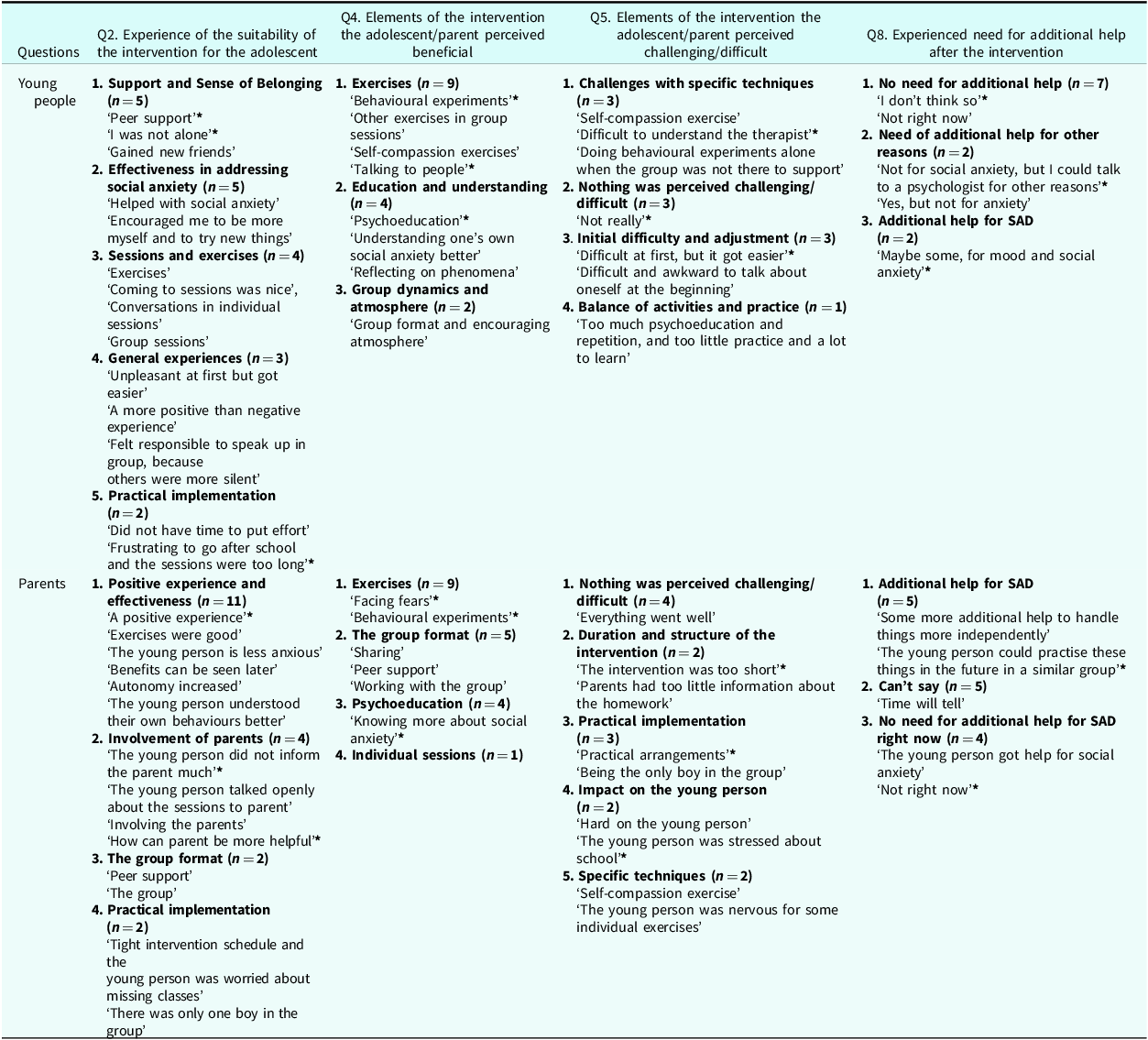
Young people’s qualitative feedback from the intervention was overall good. They reported that the intervention helped with their social anxiety and mentioned some specific exercises that they thought were helpful (e.g. behavioural experiments, self-compassion exercises). According to them, the group format was also found beneficial and most of them reported no need for additional help for SAD after DOCT-SAD. Parents reported similar positive experiences from the intervention. They found intervention exercises and peer support from the group beneficial. Content analyses of young people’s and parents’ answers to feasibility questions Q2, Q4, Q5, and Q8 with example quotes for each theme are presented in Table 3.
Feasibility for young people (n=11) and parents (n=14): content analysis of questions Q2, Q4, Q5 and Q8, with some example quotes within the themes. Numbers (n) after each theme represent the number of participants mentioning the theme

Table 3. Long description
The table presents a content analysis of questions Q2, Q4, Q5, and Q8, focusing on the feasibility of an intervention program for young people (n=11) and parents (n=14). It includes themes and the number of participants mentioning each theme, along with example quotes. The table is divided into sections for young people and parents, with specific themes and quotes provided for each. For young people, themes include support and sense of belonging, effectiveness in addressing social anxiety, sessions and exercises, general experiences, and practical implementation. For parents, themes include positive experience and effectiveness, involvement of parents, the group format, and practical implementation. Each theme is accompanied by the number of participants mentioning it and example quotes.
*Answers from young people with co-morbid ADHD.
Acceptability
All 11 participants completed the DOCT-SAD treatment, and therefore the drop-out rate was 0%. Attendance rate in sessions across all participants was 95.5%. Four adolescents were absent from single group sessions and one from an individual session.
Feasibility of DOCT-SAD for the school psychologists
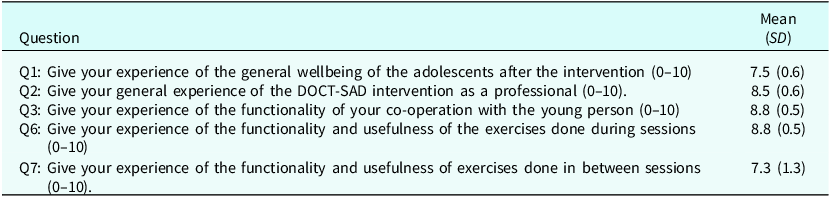
School psychologists rated their general experience of the treatment good (mean=8.5, SD=0.6), on a scale of 0 to 10. Mean answers and standard deviations to feasibility questions Q1, Q2, Q3, Q6 and Q7 from school psychologists are presented in Table 4.
Feasibility for school psychologists (n=4): rating means and standard deviations to numerical feasibility questions Q1, Q2, Q3, Q6 and Q7

Table 4. Long description
A table with five rows and three columns. The columns are labeled Question, Mean, and SD. The rows are labeled with different questions and their corresponding mean and standard deviation values. Row 1: Question Q1, Mean 7.5, SD 0.6. Row 2: Question Q2, Mean 8.5, SD 0.6. Row 3: Question Q3, Mean 8.8, SD 0.5. Row 4: Question Q6, Mean 8.8, SD 0.5. Row 5: Question Q7, Mean 7.3, SD 1.3.
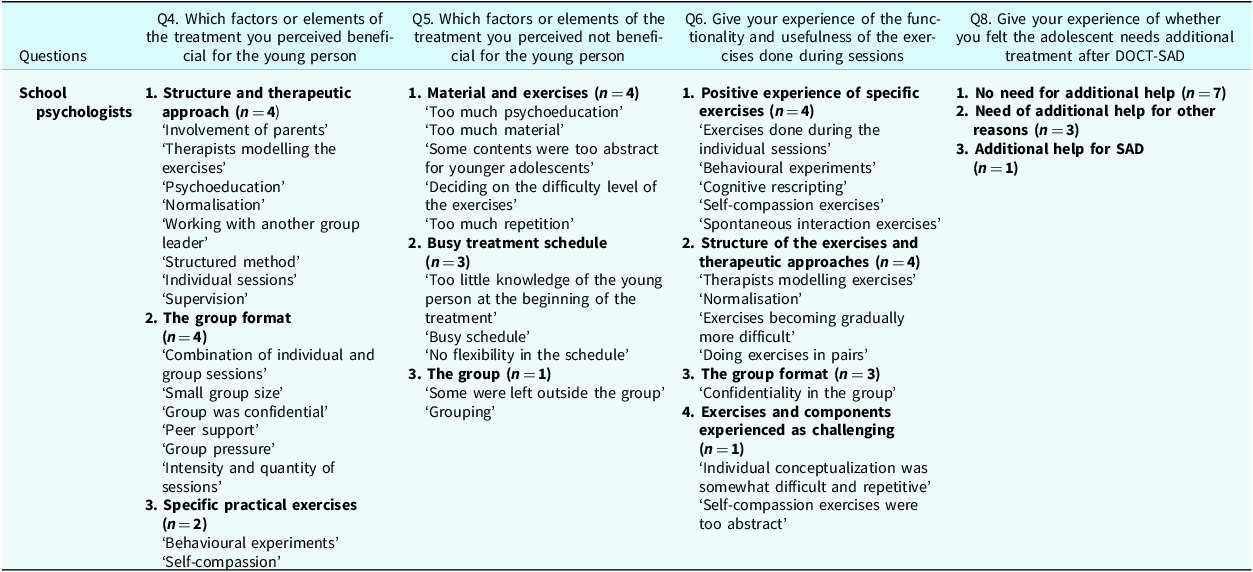
The four school psychologists experienced the therapeutic approaches and the structure of the intervention as suitable for young people. The combination of individual and group sessions was perceived as beneficial. Some criticism was raised concerning the amount of material in the treatment, the busy treatment schedule and having too much psychoeducation and repetition. Content analyses of school psychologists’ answers to feasibility questions Q4, Q5, Q6 and Q8 with example quotes for each theme are presented in Table 5.
Feasibility for school psychologists (n=4): content analysis of feasibility questions Q4, Q5, Q6 and Q8, with some example quotes within the themes. Numbers (n) after each theme represent the number of school psychologists mentioning the theme. In Q8, the answers were given for each adolescent (n=11)

Table 5. Long description
The table presents the feedback from four school psychologists on the therapeutic approaches and structure of an intervention for young people. It is organized into four columns: Questions, School psychologists, and responses to Q4, Q5, Q6, and Q8. The table has multiple rows detailing specific factors or elements perceived as beneficial or not beneficial, experiences of functionality and usefulness, and the need for additional treatment. Each row includes themes and the number of school psychologists mentioning the theme, along with example quotes. The table captures the structured feedback and critical points raised by the school psychologists.
School psychologists’ time allocation
The four school psychologists reported time spent on sessions during the intervention as 15 hours on average per psychologists, with not much variance. Time spent on planning sessions had larger variance across treatment providers, with an average of 17 hours of planning sessions during the whole intervention period. The school psychologists reported on average 7 hours, with some variance, for time spent on additional tasks (e.g. statistical reporting for organizational purposes, wrap up). School psychologists’ time allocation is presented in Table 6.
Time allocation for school psychologists (n=4) across all participants in hours during DOCT-SAD

Table 6. Long description
A table with four rows and four columns comparing time allocation for school psychologists across different tasks. The columns are labeled Mean (SD), Median, and Range. The rows are labeled Time spent on sessions, Time spent on planning sessions, Time spent on supervision, and Time spent on additional tasks. Row 1: Time spent on sessions, Mean (SD) 15.4 (0.9), Median 15, Range 15-16.7. Row 2: Time spent on planning sessions, Mean (SD) 16.9 (9.0), Median 18.8, Range 5-25. Row 3: Time spent on supervision, Mean (SD) 15.6 (2.6), Median 15.8, Range 13.5-18. Row 4: Time spent on additional tasks, Mean (SD) 7.7 (3.8), Median 7.9, Range 3.3-11.7.
Pre–post change in primary outcome measures
Change in self-reported social anxiety symptoms
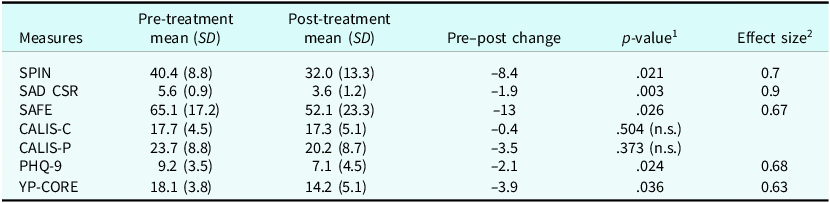
The pre–post effect size for SPIN was large r=0.7 (Z=–2.31, p=.021). Five out of 11 participants (45.5%) were in remission (i.e. scored 24 points or less) according to SPIN at post-treatment. Additionally, five out of 11 adolescents had reliable change in their pre–post SPIN – scores according to RCI (p<.05). Four out of five participants who reached remission according to SPIN had reliable change in their SPIN scores according to RCI. The descriptive statistics of the pre- and post-treatment scores from SPIN and other outcome measures are presented in Table 7.
Self-report scale at pre- and post-treatment scores

Table 7. Long description
The table presents pre-treatment and post-treatment mean scores and standard deviations for various measures, along with the pre-post change, p-value, and effect size. The measures include SPIN, SAD CSR, SAFE, CALIS-C, CALIS-P, PHQ-9, and YP-CORE. The table has 8 rows and 6 columns. Column headers are Measures, Pre-treatment mean (SD), Post-treatment mean (SD), Pre-post change, p-value, and Effect size. Row 1: SPIN, Pre-treatment mean (SD) 40.4 (8.8), Post-treatment mean (SD) 32.0 (13.3), Pre-post change -8.4, p-value .021, Effect size 0.7. Row 2: SAD CSR, Pre-treatment mean (SD) 5.6 (0.9), Post-treatment mean (SD) 3.6 (1.2), Pre-post change -1.9, p-value .003, Effect size 0.9. Row 3: SAFE, Pre-treatment mean (SD) 65.1 (17.2), Post-treatment mean (SD) 52.1 (23.3), Pre-post change -13, p-value .026, Effect size 0.67. Row 4: CALIS-C, Pre-treatment mean (SD) 17.7 (4.5), Post-treatment mean (SD) 17.3 (5.1), Pre-post change -0.4, p-value .504 (n.s.), Effect size. Row 5: CALIS-P, Pre-treatment mean (SD) 23.7 (8.8), Post-treatment mean (SD) 20.2 (8.7), Pre-post change -3.5, p-value .373 (n.s.), Effect size. Row 6: PHQ-9, Pre-treatment mean (SD) 9.2 (3.5), Post-treatment mean (SD) 7.1 (4.5), Pre-post change -2.1, p-value .024, Effect size 0.68. Row 7: YP-CORE, Pre-treatment mean (SD) 18.1 (3.8), Post-treatment mean (SD) 14.2 (5.1), Pre-post change -3.9, p-value .036, Effect size 0.63.
SPIN, Social Phobia Inventory; CSR, Clinical Severity Rating for SAD; SAFE, Subtle Avoidance Frequency Questionnaire; CALIS-C, Child Anxiety Life Interference Scale-Child’s version; CALIS-P, Child Anxiety Life Interference Scale-Parent’s version; PHQ-9, Patient Health Questionnaire; YP-CORE, Young Persons Clinical Outcomes in Routine Evaluation. 1Wilcoxon signed ranks test; 2 r.
Change in diagnostic status of SAD and in clinical severity of SAD
Six out of 11 participants (54.5%) no longer fulfilled DSM-5 criteria for SAD at post-treatment. Three out of six participants in diagnostic remission reached reliable change in their SPIN scores according to RCI.
Change in the clinical severity of SAD symptoms assessed with the CSR scale of the ADIS-5 interview schedule
The effect size for pre- and post-treatment CSR scores was large (r=0.9, Z=–2.97, p=.003).
Change in secondary outcome measures
As seen in Table 7, changes in all other self-report outcome measures were significant, except for CALIS-C and CALIS-P. One (9.1%) CALIS-P questionnaire was missing 50% of items and was therefore removed from the analyses. Scores in YP-CORE decreased significantly from pre- to post-treatment (r=0.63). However, according to the clinical and reliable change criteria (Twigg et al., Reference Twigg, Cooper, Evans, Freire, Mellor-Clark, McInnes and Barkham2016), only one participant reached clinical and reliable change in their YP-CORE scores.
Discussion
The first goal of this study was to evaluate feasibility and acceptability of the DOCT-SAD programme using a school-based delivery for young people, their parents and school psychologists as treatment providers. Our second goal was to examine the preliminary effectiveness of school-based DOCT-SAD for reducing SAD symptoms, to induce diagnostic remission, and for reducing co-morbid symptomatology. We found that DOCT-SAD was feasible and well accepted by both adolescents and parents, as well as by the school psychologists. Promising preliminary outcome results were found for school-based DOCT-SAD.
Young people and their parents evaluated the DOCT-SAD treatment program positively. Both their numerical ratings and verbal feedback affirmed generally high satisfaction to treatment and increase in adolescents’ general well-being. The overall positive feedback from adolescents (e.g. ‘I gained new friends’, ‘Encouraged me to be more myself and to try new things’ and ‘Helped with social anxiety’) suggests that DOCT-SAD was beneficial in reducing their social anxiety symptoms and helped them become more self-oriented and step out of their comfort zone. It is possible that the developmental aspects of the treatment (e.g. normalisation and peer support) increase these experiences among young people. As seen from Table 4, some feedback from participants with co-morbid ADHD revealed stress about combining school and the intervention. Thus, scheduling the intervention earlier during the day and paying attention to session length may be important topics to consider when arranging school-based interventions for young people with SAD and co-morbid ADHD.
Aligned with the positive feedback from young people, parents also rated DOCT-SAD positively (e.g. ‘A positive experience’, ‘The young person is less anxious’ and ‘Peer support’). Additionally, parents reported contradicting experiences on the degree of parental involvement. Most agreed that parents were involved enough, whereas some disagreed that parental involvement was not sufficient. In the future, modifying parental involvement individually for each family according to their needs might be useful.
The feasibility and acceptability results are comparable to those from a pilot study of DOCT-SAD in which trained university researchers provided the treatment (Lampela et al., Reference Lampela, Monthan, Marttunen, Minkkinen and Ranta2022). Additionally, our results seem comparable to those from the SASS program, which have shown support for school-based delivery of SASS for adolescents (Masia et al., Reference Masia, Klein, Storch and Corda2001), high treatment satisfaction and good alliance ratings from young people and their parents (Masia Warner et al., Reference Masia Warner, Fisher, Shrout, Rathor and Klein2007), maintained also in school-based delivery when SASS was delivered by school counsellors (Masia Warner et al., Reference Masia Warner, Colognori, Brice, Herzig, Mufson, Lynch, Reiss, Petkova, Fox, Moceri, Ryan and Klein2016).
None of the 11 adolescents treated with DOCT-SAD dropped out during the programme. In comparison, Masia Warner and colleagues reported a drop-out rate of 6.5% for SASS delivered by school counsellors, and 17% when delivered by clinical psychologists (Masia Warner et al., Reference Masia Warner, Colognori, Brice, Herzig, Mufson, Lynch, Reiss, Petkova, Fox, Moceri, Ryan and Klein2016). Olivares et al. (Reference Olivares, Garcia-Lopez, Turner, Beidel, Albano and Hidalgo2002) compared three SAD treatments (i.e. IAFS, GCBT-A, and SET-C adapted for adolescents) delivered by clinical psychologists in a high school milieu, finding drop-out rates of 17%, 29% and 30%, respectively. Higher drop-out rates were detected in a Norwegian study, in which 41% of adolescents who started SAD-specific group CBT treatment, and 16% of those in individual cognitive therapy for SAD dropped out during the treatment (Ingul et al., Reference Ingul, Aune and Nordahl2013). Additionally, attendance rate in DOCT-SAD sessions was 95.5%. Similar attendance rates were reported for SASS, when delivered by school staff (Masia Warner et al., Reference Masia Warner, Colognori, Brice, Herzig, Mufson, Lynch, Reiss, Petkova, Fox, Moceri, Ryan and Klein2016). It is possible that the specific modification of the DOCT-SAD treatment for young people (e.g. treatment materials and themes were originally constructed with this age group in mind, taking into account factors such as the tendency for social comparison and the need for normalisation), peer support and the involvement of parents throughout the treatment might improve commitment to treatment for young people and result in lower drop-out rates.
The method-trained school psychologists (n=4) rated DOCT-SAD as mostly suitable and useful for adolescents with SAD. Most of them agreed with the main therapeutic approaches (e.g. normalisation and therapist modelling) and thought the combination of individual and group-based sessions was beneficial. However, some school psychologists mentioned in the feasibility interviews that the treatment schedule was too busy and that there was too much material, psychoeducation and repetition. In the future, more attention should be focused on time management during the intervention period and provide school psychologists sufficient time to prepare for intervention sessions.
Overall, young people’s, their parents’ and school psychologists’ answers were positive and mostly aligned. They all rated the DOCT-SAD intervention as beneficial for young people with SAD. Therapeutic alliance was rated as good among all stakeholders. All perceived intervention exercises (e.g. behavioural experiments), the combination of individual and group sessions and peer support as beneficial for young people. The perceived benefit of behavioural experiments aligns with the main theoretical background of DOCT-SAD, the cognitive model of SAD (Clark and Wells, Reference Clark, Wells, Heimberg, Liebowitz, Hope and Schneier1995). Additionally, the perceived usefulness of group sessions further emphasises the importance of peer relationships in adolescence (Albano et al., Reference Albano, Marten, Holt, Heimberg and Barlow1995; Masia et al., Reference Masia, Beidel, Albano, Rapee, Turner and Morris1999). Some of the young people and school psychologists mentioned psychoeducation as being too repetitive and at times challenging. Parents were more concerned about being absent from school during the intervention sessions and the degree of parental involvement.
Time allocation results from the four school psychologists revealed a mean of 15.4 hours spent on sessions during the 10-week treatment period. Aligned ratings from professionals have been reported in a feasibility study of CT-SAD-A in routine health care (Taylor et al., Reference Taylor, Creswell, Pearcey, Brooks, Leigh, Stallard, Waite, Clark, Stephens and Larkin2021). In DOCT-SAD, six out of 10 sessions are carried out in groups, decreasing the time spent on each participant individually. Thus, time spent on each participant individually in DOCT-SAD is shorter compared with CT-SAD-A (Leigh et al., Reference Leigh, Creswell, Stallard, Waite, Violato, Pearcey, Brooks, Taylor, Warnock-Parkes and Clark2021), which consists of 14 weekly individual treatment sessions, 1.5 hours each.
The four school psychologists reported a mean of 15.6 hours spent in clinical method supervision during the 10-week intervention period, which is approximately 1.6 hours per therapist per week. The amount of hours per therapist per supervision session is roughly similar compared to cost analysis study of CT-SAD-A treatment delivered in routine services (Leigh et al., Reference Leigh, Creswell, Stallard, Waite, Violato, Pearcey, Brooks, Taylor, Warnock-Parkes and Clark2021), where the average time a therapist spent per supervision session was 1.2 hours. However, in their study, each therapist attended on average 24 case supervision sessions, compared with 10 supervision sessions in our study. By employing weekly group supervision sessions, we aimed to decrease supervisor and therapist time spent on supervision sessions. Our aim was to make the intervention suitable for school psychologists’ busy work schedule. Furthermore, the weekly supervision sessions were used to ensure school psychologists’ appropriate use of the intervention techniques. DOCT-SAD is a manual-based intervention and treatment providers were encouraged to follow the session modules included in the treatment manual to further ensure therapist fidelity.
The four school psychologists spent on average 16.9 hours (SD=9.0, range 5–25) for direct beforehand planning of DOCT-SAD sessions. Additionally, they reported an average of 7.7 hours (SD=3.8, range 3.3–11.7) for tasks after sessions. Learning a new treatment model and implementing it to a work schedule can be time-consuming at first. The efficiency of treatment providers’ time management may improve with time (Dawson, Reference Dawson2018). This might affect the time spent on planning sessions, additional tasks and supervision for the four school psychologists in our study. It may be that treatment providers with no prior psychotherapy training need more time adopting treatment principles. This should be taken into account when planning future steps in implementation.
The overall improvement of SAD symptoms revealed that the intervention seems beneficial among adolescents with SAD. Findings demonstrated preliminary effectiveness for DOCT-SAD in the school environment by showing statistically significant reduction in SAD symptoms among participants from pre- to post-treatment. Of the participants, five out of 11 (46%) scored below the cut-off score of SPIN at post-treatment. Symptom reduction measured with SPIN in the present study was lower than in Masia Warner et al.’s (Reference Masia Warner, Fisher, Shrout, Rathor and Klein2007) study, where 88% of participants scored below the cut-off score on the SPAI-C- questionnaire after SASS, when delivered by clinical psychologists. With respect to clinical change, 46% of participants had clinically significant decrease in their SPIN scores after DOCT-SAD according to RCI scores. To compare, in Ingul and colleagues’ study, 21% of participants completing group CBT delivered by clinical therapists had RCI scores indicating clinically significant improvement in SAD symptoms at post-treatment (Ingul et al., Reference Ingul, Aune and Nordahl2013).
A total of 54.5% of participants in the DOCT-SAD group no longer met the criteria for SAD at post-treatment. Masia Warner et al.’s (Reference Masia Warner, Klein, Dent, Fisher, Alvir, Albano and Guardino2005; Reference Masia Warner, Fisher, Shrout, Rathor and Klein2007; Reference Masia Warner, Colognori, Brice, Herzig, Mufson, Lynch, Reiss, Petkova, Fox, Moceri, Ryan and Klein2016) studies demonstrated 57% diagnostic remission rates after SASS, delivered by clinical psychologists, and 22% when delivered by school counsellors. For CT-SAD-A, the individual treatment program for adolescents with SAD, the diagnostic remission rate was 64%, when the treatment was delivered by clinical staff in CAHMS (Leigh et al., Reference Leigh, Creswell, Stallard, Waite, Violato, Pearcey, Brooks, Taylor, Warnock-Parkes and Clark2021). In Ingul and colleagues’ study, 53% of adolescents attending the group CBT program were free of their SAD diagnosis at 1-year follow-up (Ingul et al., Reference Ingul, Aune and Nordahl2013).
In sum, the clinical effect of DOCT-SAD delivered by school psychologists seems comparable to group-based SAD treatment programs delivered either in school settings or in clinical settings by various clinical practitioners (Ingul et al., Reference Ingul, Aune and Nordahl2013; Masia Warner et al., Reference Masia Warner, Colognori, Brice, Herzig, Mufson, Lynch, Reiss, Petkova, Fox, Moceri, Ryan and Klein2016). To compare further, 21% of children and adolescents achieved diagnostic remission after a transdiagnostic group CBT program for anxiety, delivered by clinical practitioners in community clinics (Wergeland et al., Reference Wergeland, Fjermestad, Marin, Haugland, Bjaastad, Oeding, Bjelland, Silverman, Öst, Havik and Heiervang2014), with the remission rate for SAD being lower compared with other anxiety disorders.
Scores in the SAFE measure decreased significantly from pre-to post-treatment with a large effect size. The reduction was similar to those gained from the DOCT-SAD pilot trial (Lampela et al., Reference Lampela, Monthan, Marttunen, Minkkinen and Ranta2022), where effect size for the score reduction in SAFE was large. Large reductions in safety behaviours were also detected in a developmental case series among five adolescents with SAD (Leigh and Clark, Reference Leigh and Clark2016). The significant reduction in SAFE might indicate that DOCT-SAD is beneficial in reducing safety behaviours among participants. The DOCT-SAD intervention resulted in diagnostic remission of SAD for 54.5% of participants and concurrently in significant decrease of safety behaviours among the participants. This result supports the role of safety behaviours as one of the key maintaining factors in SAD and its importance in the treatment among adolescents.
Similarly, large pre- to post-treatment effect sizes were achieved in the YP-CORE measure. Our results are concurrent with previous studies examining the quality of life/overall functioning among adolescents with SAD. According to a meta-analysis (Yang et al., Reference Yang, Zhou, Pu, Liu, Cuijpers, Zhang, Zhang, Yuan, Teng, Tian and Xie2019), the quality of life/overall functioning increased with a large effect size in several RCT studies among adolescents and children with SAD. It seems that DOCT-SAD is beneficial in decreasing the overall psychological distress of participants. However, only one participant reached clinical and reliable change in YP-CORE, according to the cut-off scores proposed by Twigg and colleagues (Reference Twigg, Cooper, Evans, Freire, Mellor-Clark, McInnes and Barkham2016). It may be that reliable and clinical changes in experienced quality of life may become visible in further follow-up periods.
Significant, positive changes on all other self-report outcome measures were found from pre- to post-treatment, except for CALIS-C and CALIS-P. The CALIS questionnaires measure overall impairment caused by worry or anxiety in general (Lyneham et al., Reference Lyneham, Sburlati, Abbott, Rapee, Hudson, Tolin and Carlson2013). Among our participants, 45.5% had one or more co-morbid anxiety disorder. This might partially explain the unsignificant change in CALIS scores at post-treatment, given DOCT-SAD is focused on SAD symptoms. However, this result is inconsistent with previous SAD treatments among adolescents (Leigh et al., Reference Leigh, Percy, Clark, Creswell and Waite2023), where significant pre–post change was detected with CALIS. The DOCT-SAD intervention, compared with other disorder-specific SAD treatments, emphasises self-conception and normalisation and the idea of ‘acceptable me’ and development of self-compassion, focusing less on reducing anxiety symptoms per se. In all, 25% of participants reported a need for additional help for other reasons than SAD after the intervention, which might also indicate that all anxiety symptoms could not be addressed in the treatment. The results seem to point that considering the experience of anxiety to a greater degree may be needed when developing the intervention in the future.
PHQ-9 scores decreased significantly from pre- to post-treatment (r=0.68, p=.024). Correspondingly, co-morbid depressive disorders decreased from 36.4% to 9.1% from pre- to post-treatment. This result is parallel with previous findings regarding effects of SAD-specific CBT programs on depressive symptoms of young people (Scaini et al., Reference Scaini, Belotti, Ogliari and Battaglia2016). To compare, adolescents’ self-reported depressive symptoms, measured with the Children Depressive Inventory (CDI), did not decrease significantly after SASS intervention in a clinical trial (Masia Warner et al., Reference Masia Warner, Klein, Dent, Fisher, Alvir, Albano and Guardino2005). Elements of DOCT-SAD, such as targeting negative self-beliefs (Beck, Reference Beck2020) and self-criticism (Zhang et al., Reference Zhang, Watson-Singleton, Pollard, Pittman, Lamis, Fischer, Patterson and Kaslow2019), may be beneficial for adolescents with depressive symptomology.
Findings from this study indicate that DOCT-SAD is feasible and viable to deliver in the school environment. The school-based DOCT-SAD had no drop-outs, and it was rated feasible by school psychologists, further supporting the transferability to schools. Delivered by school psychologists, DOCT-SAD produced similar results as those obtained when the treatment was provided by method-trained clinicians from the Tampere University clinic (Lampela et al., Reference Lampela, Monthan, Marttunen, Minkkinen and Ranta2022). These findings support the transferability of DOCT-SAD to schools and flexibility when delivered by school psychologists with no prior psychotherapy training (Kendall and Peterman, Reference Kendall and Peterman2015). This result is comparable to research on SASS, in which treatment efficiency was found roughly similar when delivered by either school counsellors or trained clinicians (Masia Warner et al., Reference Masia Warner, Colognori, Brice, Herzig, Mufson, Lynch, Reiss, Petkova, Fox, Moceri, Ryan and Klein2016). Given the financial constraints as well as practical reasons, employing external mental health practitioners is often not realistic or feasible for educational institutes.
Strengths and limitations
The DOCT-SAD intervention is modified for adolescents and was well accepted by them. We used structured interviews to assess the presence and severity of anxiety and other disorders. Parents were involved in the diagnostic assessment, increasing the reliability of the assessment (Dulcan, Reference Dulcan2021). In addition to diagnostic evaluation, parents participated partially in two of the treatment sessions. Lastly, feasibility of DOCT-SAD was evaluated by conducting interviews for adolescents, parents and school psychologists.
The results of this study are affected by certain limitations. First, we did not use a validated feasibility measure, rather a modified version of the Client Change Interview (Elliot and Rodgers, Reference Elliot and Rodgers2008). Second, the content analyses for feasibility interview answers were conducted by one rater only, instead of two or more raters. Third, the diagnostic and feasibility interviews were conducted by the research team, and it is possible that social desirability might have affected these results. Fourth, no treatment fidelity rating scale was used to measure treatment fidelity among school psychologists. Lastly, nine out of 11 participants were female, and all had Finnish as their native language, limiting the generalisability of the results to males and to ethnic and religious minorities.
In the future, additional studies are needed with extended baseline assessment phase, larger and more generalisable samples, control groups, follow-up measures, treatment fidelity measurements, and independent diagnostic and feasibility assessors. In this study, we were not able to detect specific elements that may have produced change in DOCT-SAD. Adding session-by-session measurements could provide further insight into the mechanisms that drive change during the intervention. Additionally, further examination of changes in self-compassion and self-beliefs during DOCT-SAD would provide valuable information on the change mechanisms during the intervention. Without an active control group, it is not possible to determine whether the change achieved in the outcome measures during the intervention was due to DOCT-SAD per se, or rather the result of receiving any social anxiety intervention. The next step is to demonstrate efficacy of the school-based DOCT-SAD against standard counselling in schools in an ongoing larger RCT study. On the basis of the feasibility and effectiveness results, a critical examination of the stakeholders’ experiences will guide further implementation efforts and possible modifications to the model. Considering the high co-morbidity of ADHD in this study (27.3%) and its impairing effects on social functioning (Jakobsson Støre et al., Reference Jakobsson Støre, Van Zalk, Granander Schwartz, Nilsson and Tillfors2024), further studies should pay more attention to ADHD co-morbidity among adolescents with SAD and carefully examine feasibility of SAD treatments in this population.
Conclusion and practice implications
Our results present preliminary evidence that DOCT-SAD, a developmentally sensitive, brief SAD treatment, seems feasible and beneficial in treating adolescents with SAD in the school setting. Feasibility and acceptability findings suggest that this treatment can be delivered by school psychologists. The treatment was well accepted by young people, parents and school psychologists. Practical implications of our results illustrate that DOCT-SAD may be successfully transported into Finnish schools. This may improve early access to treatment for socially anxious adolescents. In the future, an RCT study is conducted to examine the efficacy of DOCT-SAD in schools with larger sample sizes, control groups and follow-up measurements. This study further supports the main theoretical background in our treatment programme, the cognitive model of SAD (Clark and Wells, Reference Clark, Wells, Heimberg, Liebowitz, Hope and Schneier1995), and its relevance for young people (Leigh et al., Reference Leigh, Percy, Clark, Creswell and Waite2023). In the future, more research with appropriate measurements is needed to assess the benefits of adding self-deficiency and self-compassion elements and the combination of individual and group sessions in SAD treatments for adolescents. Lastly, given the nature of the treatment, applicability of DOCT-SAD for SAD populations with co-morbid ASD need to be evaluated in future studies.
Key practice points
-
(1) The brief, 10-session, school-based DOCT-SAD intervention seems feasible in treating adolescents with SAD, according to adolescents, their parents and school psychologists, and was successfully transported into Finnish schools.
-
(2) Provided by school psychologists, the school-based DOCT-SAD resulted in similar outcomes as in a previous DOCT-SAD pilot study conducted at the university.
-
(3) This study further supports the cognitive model of SAD, which is the main theoretical background in DOCT-SAD, and its relevance for young people. In the future, more research is needed to assess the benefit of adding self-deficiency and self-compassion elements in SAD treatments for adolescents.
Data availability statement
The data that support the findings of this study are available on request from the corresponding author, S.L. The data are not publicly available due to their containing information that could compromise the privacy of research participants.
Acknowledgements
None.
Author contributions
Siiri Sofia Lampela: Conceptualization-(Equal), Data curation-(Equal), Formal analysis-(Lead), Methodology-(Equal), Writing - original draft-(Lead), Writing - review & editing-(Lead); Mauri Marttunen: Conceptualization-(Equal), Supervision-(Equal), Writing - review & editing-(Equal); Saira Noreen: Writing - original draft-(Equal), Writing - review & editing-(Equal); Pauliina Parhiala: Conceptualization-(Equal), Data curation-(Equal), Writing - review & editing-(Equal); Johanna Lammintakanen: Conceptualization-(Equal), Writing - review & editing-(Equal); Niklas Grano: Formal analysis-(Equal), Methodology-(Equal), Writing - review & editing-(Equal); Outi Linnaranta: Conceptualization-(Equal), Writing - review & editing-(Equal); Klaus Ranta: Conceptualization-(Lead), Data curation-(Lead), Funding acquisition-(Lead), Methodology-(Lead), Project administration-(Lead), Supervision-(Lead), Writing - original draft-(Equal), Writing - review & editing-(Lead).
Financial support
This work was supported by the Strategic Research Council (SRC) established within the Academy of Finland to Imagine Research Consortium (grant number 352700), and to Tampere University (grant number 353048).
Completing interests
The authors declare none.
Ethical standards
The Regional Ethics Committee of the Expert Responsibility area of Tampere University Hospital examined and approved the study (approval code: R22123). This research has conformed to the Declaration of Helsinki. Informed consent was obtained from all participants in the study.



 Open access


Comments
No Comments have been published for this article.