Introduction
Scaphochlamys Baker is a genus of 31 species in the Zingibereae tribe of the Zingiberaceae, distributed from southern Thailand, through Peninsular Malaysia, to northern Borneo and Sumatra. It belongs to a small group of genera that are so similar morphologically that their generic status has long been debated (Holttum, Reference Holttum1950; Smith, Reference Smith1987; Newman, Reference Newman1995). This group, originally referred to as the ‘Kaempferia group’ by Holttum in 1950, included Camptandra Ridl., which was omitted by later authors, Kaempferia L., Scaphochlamys, Boesenbergia Kuntze and Haplochorema K.Schum., which Holttum considered ‘all nearly related’ (Holttum, Reference Holttum1950). This group was further discussed by Smith (Reference Smith1987) who compared and contrasted key inflorescence and floral characters. Her table of characters was updated by Newman (Reference Newman1995) who listed five genera: Kaempferia (c.40 species), Boesenbergia (c.50), Distichochlamys (3), Haplochorema (4) and Scaphochlamys. The newly described genus Myxochlamys A.Takano & Nagam. (Reference Takano and Nagamasu2007) forms a small clade of closely related taxa together with Distichochlamys and Scaphochlamys based on DNA phylogenetic analyses (Takano & Nagamasu, Reference Takano and Nagamasu2007). Each of these genera is defined by a set of morphological characters in combination rather than any single key character. Each of these character traits on its own can be shared by more than one genus, so one has to consider the presence or absence of all these characters together before trying to allocate a species to a genus. As more species are discovered, the boundaries of these genera are likely to be tested, and, in the end, they may need redefining.
The revision of this genus has epitomised many of the taxonomic problems within the family: historical collections are depauperate, flowers are ephemeral and do not preserve well, and much of the literature comprises weakly written descriptions in various languages. Under such circumstances the identification of fresh material can only be frustrating and difficult. I have, to the best of my ability, produced an up-to-date compendium on the genus. The morphology section carefully explains to the non-specialist the structure and terminology of this small, but complex, plant. The key, built upon herbarium specimens, has been kept as simple as possible, primarily using morphological characters (as inspired by Holttum). The descriptions have been based on material seen by the author, and where this has not been possible the original protologues have been utilised (this is indicated where appropriate). I hope that this work will aid those working in the field, and help them to correctly identify the species.
Morphology of Scaphochlamys
The main growth structure is called the rhizome. It tends to grow horizontally either over the ground surface, through the leaf litter, or through the soil, and terminates by growing vertically upwards to form first the peduncle and then the rachis of the inflorescence. The rhizome is a modified ‘stem’ from which both the roots and leaves develop. Two main types of rooting systems are shown by species in this genus: either they produce a thick mat of fine roots or they produce long ‘string-like’ prop roots that appear to act as an anchoring mechanism, helping to keep a surface-growing plant upright and stable (though they are finer than those usually called stilt-roots).
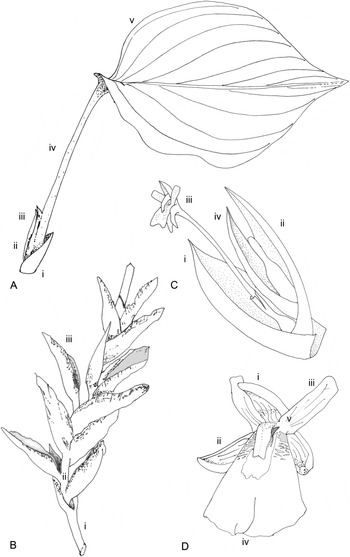
Vegetative growth consists of the development of a series of successive shoots or ‘elements’ (Holttum, Reference Holttum1950) by the continued growth of the rhizome from a bud either at the base of a leaf or at the base of a scale leaf further back on the rhizome. Each element forms an individual shoot that comprises one to several leaves in a clump. The leaf develops straight from the rhizome and is subdivided into clearly defined structures that develop in a set order: sheath, ligule, petiole and lamina. At the very base of the leaf is the leaf-sheath. Recent studies in Borneo have shown the existence of a swelling, or pulvinus, just above the point of emergence of the leaf-sheath from the rhizome (Shafreena, Reference Shafreena2006). More obvious in fresh than dried material, it may be a crucial identification character for sterile material in the field. The leaf-sheath is crescent-shaped in cross-section with two fine, membranous edges. The leaf-sheath terminates in the ligule, which is paired, membranous and delicate and can be several centimetres long (it can also decay very quickly). Above the ligule the petiole is much thinner, without the thin membranous edging, and terminates in the lamina (Fig. 1A). The lamina is characterised by the midrib running its length, with parallel secondary venation leading off the midrib towards the margins. There is a distinct abaxial and adaxial surface. A highly reduced version of the leaf is called a leafless-sheath where only the sheath develops.
General morphology of a ‘typical’ Scaphochlamys plant. A. The leaf with i. a single leafless-sheath at its base, ii. leaf-sheath, iii. paired ligules, iv. petiole, v. lamina. B. Inflorescence with overlapping bracts (e.g. an immature S. erecta): i. peduncle, ii. rachis, iii. bract. C. Stylised image of a dissected cincinnus within a single bract: i. bract, ii. first bracteole (facing 180° to bract), iii. first flower (fully opened), iv. second bracteole encasing a flower bud. D. A typical flower consisting of i. the dorsal petal, ii. 2 lateral petals, iii. 2 lateral staminodes, iv. bilobed labellum, v. downward-bending stamen (not to scale).

The inflorescence is attached to the rhizome by the leafless peduncle which terminates at the first bract, after which the main axis is called a rachis (Larsen et al., Reference Larsen, Ibrahim, Khaw and Saw1999). The bracts are arranged in a spiral pattern up the rachis and each one subtends a structure called a cincinnus of bracteoles and flowers (Fig. 1B). In 1950 Holttum used the terms ‘bracteoles’ and ‘secondary bracts’ interchangeably in his species descriptions. The terminology was clarified in a later paper, however, where a detailed analysis of the morphology of the family was carried out (Holttum, Reference Holttum1974). These days ‘bracteole’ is the more generally accepted term. The first bracteole arises opposite the bract with a single flower in its axis (Fig. 1C). Successive bracteoles arise within and at 180° to the preceding one, again each with its own flower. The inflorescence can build up to consist of many bracts each containing many bracteoles and flowers. On the other hand reduction to one or a few bracts can occur, as well as reduction to one bracteole and flower per bract. In the case of extreme reduction it can be hard to interpret what is bract and what is bracteole.
The floral structures comprise a short tubular calyx and a corolla tube that splits distally into three petals or lobes. The petals tend to be small and hidden. The showy part of the flower is derived from the androecium and is comprised of two lateral staminodes and a labellum (Fig. 1D). Each lateral staminode is derived from a sterile stamen and the bilobed labellum is derived from two fused sterile stamens (Kirchoff, Reference Kirchoff, Leins, Tucker and Endress1988, Reference Kirchoff1991). In the centre is a single fertile stamen that is subdivided into the filament, which is attached to the corolla tube, the two thecae and at the apex a small extension to the back of the anther called the crest. The gynoecium comprises an inferior ovary surmounted by a pair of epigynous glands (or nectaries). The long thin style is held in place between the two thecae and terminates in a small cup-like stigma with a ring of cilia around the rim (Kirchoff, Reference Kirchoff, Leins, Tucker and Endress1988).
Key Diagnostic Characters
It can be hard to distinguish Scaphochlamys from its most closely related genera (Boesenbergia, Distichochlamys, Kaempferia and Haplochorema for example). The following combination of characters defines the boundaries of this genus: leaf-sheath base pulvinate (Borneo only); bract arrangement spiral; flowering mode from base to apex; first bracteole keeled, arising opposite to bract; bracteole split to base; thecae with free basal spurs.
Distribution
Scaphochlamys has a relatively restricted distribution. Four species occur in southern Thailand, three of them being endemic there. Eight species are known from Borneo, where many more may be expected, and one species has been recorded in Sumatra, though this too may be an underestimate. The majority of species are found in Peninsular Malaysia.
Taxonomic History
Scaphochlamys was established by Baker (Reference Baker and Hooker1890) with a single species, S. malaccana Baker. At the same time two other species, now included in this genus, were published as Kaempferia concinna Baker and Curcuma kunstleri Baker. Early publications of species now in Scaphochlamys included Curcuma sylvestris Ridl. and Gastrochilus biloba Ridl. (Ridley, Reference Ridley1893) and Kaempferia anomala Hallier f. (Hallier, Reference Hallier1898). In 1899 Ridley transferred Scaphochlamys malaccana to Gastrochilus Wall., thereby synonymising the genus, but gave it a new and thus illegitimate epithet, Gastrochilus scaphochlamys Ridl. He also combined some of the other Scaphochlamys species in this genus, such as Gastrochilus concinna (Baker) Ridl., and described several new species such as G. biloba Ridl., G. lancifolius Ridl. and G. oculata Ridl. Over the next two decades he went on to name and describe several more Scaphochlamys species in the genus Gastrochilus. Gastrochilus Wall. is a later homonym of Gastrochilus D.Don so all these names are illegitimate. Ridley then decided that several of these species were more ‘Curcuma-like’ and placed them in a new genus Hitcheniopsis (Baker) Ridl., a name he decided to adapt from one of Baker's sections of Curcuma: Curcuma section Hitcheniopsis Baker. Thus Hitcheniopsis kunstleri (Baker) Ridl., H. lanceolata Ridl. and H. sylvestris Ridl. were published (Ridley, Reference Ridley1924). It is worth noting, however, that Curcuma kunstleri Baker had been in Curcuma section Mesantha Horan., not Curcuma section Hitcheniopsis (Baker, Reference Baker and Hooker1890). The confused generic delimitations remained through Schumann's revision of the Zingiberaceae in 1904 and Loesener's in 1930 where different Scaphochlamys species appeared in Curcuma, Kaempferia and Gastrochilus. In 1918 Valeton carried out detailed analyses of representatives of various genera of Zingiberaceae based on living material from the Bogor Botanical Gardens in Java. He developed a better understanding of the inflorescence and floral structures, which he carefully explained. Within a discussion of the salient features of Gastrochilus he made a special note of the Scaphochlamys inflorescence but decided that there were insufficient differences in the floral characters to reinstate Baker's genus. Instead, he defined a ‘Scaphochlamys group’ within Gastrochilus which he managed to squeeze into a rather complicated subgeneric classification based on both inflorescence and anther structures (Valeton, Reference Valeton1918). Valeton's use of fresh material inspired Holttum who in 1950 not only reinstated Scaphochlamys as a genus in its own right but also described nine new species from Peninsular Malaysia. In the 1970s and 1980s extensive taxonomic work was carried out at the Royal Botanic Garden Edinburgh (e.g. Burtt & Smith, Reference Burtt and Smith1972a, Reference Burtt and Smith1972b) and further species were transferred or were newly described from Sarawak (Smith, Reference Smith1987). New species are continually being discovered throughout its range. As it grows in number of species and complexity, the genus is becoming better understood and the relationships with its sister genera are being clarified.
Taxonomic Treatment
Scaphochlamys Baker in Hooker, Fl. Brit. India 6: 252 (1892); Holttum, Gard. Bull. Singapore 13: 82 (1950); Smith, Notes Roy. Bot. Gard. Edinburgh 44: 207 (1987); Larsen et al. in Kubitzki, Fam. Gen. Vasc. Pl. 4: 485 (1998). – Type species: Scaphochlamys malaccana Baker.
Ground-dwelling, perennial, rhizomatous herbs. Rhizome normally horizontally creeping, sometimes obliquely ascending or upright; generally thin and woody, never fleshy or tuberous. Successive shoots either crowded together or widely spaced, composed of 1 to many leaves normally encased by leafless-sheaths, glabrous to densely hairy, often scarious and decaying with age. Leaf-sheath with broad membranous margin, hairy or glabrous. In Bornean species pulvinus base present (see morphology section above). Ligule bilobed, membranous and delicate, generally triangular in shape, occurring anywhere from the base of the leaf hidden among leafless-sheaths up to just below the base of the lamina depending on the species. Petiole thin, canaliculate and occasionally terete, hairy or glabrous. Lamina obovate to oval, ovate, lanceolate or linear, commonly elliptic, symmetric or, more often, slightly asymmetric; base nearly always decurrent, usually attenuate, rounded or cordate; apex acute to acuminate, sometimes mucronulate, or broadly pointed. Upper surface dark green, occasionally with white markings. Lower surface either pale green or flushed with purple, usually hairy or pilose along the midrib. Venation parallel, branching from primary mid-vein (reticulate in Scaphochlamys reticosa). Inflorescence composed of spirally arranged bracts (occasionally distichous) with base to apex (indeterminate) flowering; compact and ovoid or ellipsoid, or lax with rachis visible between the bracts; often elongating with age. Bract broad and pouched to ovate, boat-shaped, spathulate and linear, firm to thin, glabrous to densely hairy, green, red-brown, red, or flushed with purple, not connate laterally, base amplexicaul. First bracteole at 180° to bract, generally boat-shaped to linear, 2-keeled, margins overlapping but never fused, apex acute to trilobed, sometimes tufted, usually just shorter than the bract, glabrous to finely hairy; successive bracteoles decreasing in size. Ovary inferior, trilocular to unilocular, small, creamy-white, glabrous to finely hairy. Epigynous glands 2, fine, needle-like, surmounting ovary; creamy yellow. Calyx tubular, split down one side, apex usually dentate, shorter than first bracteole. Corolla tube slender at base, widening towards apex, sometimes finely hairy; corolla lobes linear, usually white, glabrous, dorsal corolla lobe normally stiff with an acute, hooded apex; the 2 lateral corolla lobes linear with rounded apices; corolla usually white, sometimes pale yellow to yellow or pale green. Lateral staminodes oblong to obovate, with rounded apex, spreading obliquely. Labellum obovate to clawed, flat, usually bilobed (sometimes entire), the lobes often overlapping, white with a yellow median band, this band often flanked on either side by variously coloured markings, for example pink, purple or red, sometimes with strongly coloured blotches near the base, slightly grooved in the middle towards the base, this groove more or less hairy. Fertile stamen bent forward over labellum, facing down; filament broad, pollen sacs 2, linear, with longitudinal dehiscence, each theca terminating in a short spur at the base, apex of anther terminated by a short reflexed rounded to trilobed crest; all androecial members (i.e. staminodes, labellum and back of the anther) sometimes covered with tiny glandular hairs. Style very fine, sometimes held in a groove inside the corolla tube. Stigma held just above apices of thecae, backed by the crest; rounded cup-shaped, the ostiole edged by a single row of cilia of varying lengths and thicknesses. Fruit ellipsoid, thin-walled, enclosed by persistent bracts. Seeds ellipsoid, dark brown to black with a white aril, lacerate to the base.
Key to species
1a. Each shoot consisting of a single leaf; shoots tend to be distinct and widely spaced 2
1b. At least some shoots, and usually all, consisting of more than 1 leaf; shoots tend to be clustered and may be indistinct 19
2a. Bracts distichous 8. S. calcicola
2b. Bracts arranged spirally 3
3a. Inflorescence lax; rachis visible between the bracts 4
3b. Inflorescence compact; rachis not visible between the bracts 7
4a. Leaf-sheath and petiole ≤ 10 cm; peduncle ≤ 6 cm long 5
4b. Leaf-sheath and petiole ≥ 15 cm; peduncle ≥ 9 cm long 6
5a. Bracts ≥ 3 cm with open apex; lamina apex broad and rounded; Malay Peninsula4. S. atroviridis
5b. Bracts < 3 cm with narrow acute apex; lamina apex acuminate and pointed; Borneo 12. S. gracilipes
6a. Lamina apex acuminate with a distinct ‘drip tip’; lamina base strongly cordate; size of largest bract up to 2.2 × 1.2 cm 10. S. cordata
6b. Lamina apex shortly cuspidate; lamina base rounded and shortly attenuate; size of largest bract up to 2.5 × 1.6 cm 17. S. laxa
7a. Single flower in the axis of each bract 5. S. biloba
7b. More than 1 flower per bract 8
8a. Lower lamina surface pale green 9
8b. Lower lamina surface purple 14
9a. Lamina ≥ 12 cm in length; Malay Peninsula 10
9b. Lamina ≤ 12 cm in length; Borneo 11
10a. Lamina narrowly elliptic in shape, ≤ 8 cm wide; peduncle ≥ 4 cm long 1. S. abdullahii
10b. Lamina elliptic to ovate in shape, ≥ 8 cm wide; peduncle < 4 cm long 6. S. breviscapa
11a. Upper lamina surface densely covered with a raised network of reticulate venation 26. S. reticosa
11b. Upper lamina surface with parallel venation, may or may not be raised 12
12a. Lamina oblong to oval in shape; upper surface with prominent silver venation 3. S. argentea
12b. Lamina ovate to lanceolate in shape; upper surface with indistinct venation 13
13a. Leaf-sheath and petiole < 10 cm in length; labellum white with central yellow mark; Kalimantan, Indonesia 2. S. anomala
13b. Leaf-sheath and petiole > 10 cm in length; labellum suffused purple with central yellow mark; Sarawak 24. S. petiolata
14a. Leaf-sheath and petiole ≤ 10 cm long 15
14b. Leaf-sheath and petiole ≥ 10 cm long 16
15a. Lamina broadly elliptic to obovate, upper surface green with white ‘feather-like’ markings either side of the midrib; inflorescence 2 × 1 cm 22. S. pennipicta
15b. Lamina elliptic, upper surface green with a row of silver spots flanking either side of the midrib; inflorescence 4 × 2 cm 27. S. rubescens
16a. Bracts ≤ 2.5 cm, 5–6 flowers per bract; lamina narrowly elliptic 1. S. abdullahii
16b. Bracts ≥ 2.5 cm, fewer than 5 flowers per bract; lamina not elliptic 17
17a. Lamina < 8 cm in width, lanceolate and with distinctive cordate base 9. S. concinna
17b. Lamina ≥ 8 cm in width, ovate and with rounded base 18
18a. Peduncle < 6 cm long; labellum with yellow centre, flanked either side by crimson markings 21. S. oculata
18b. Peduncle > 6 cm long; labellum with yellow centre, flanked either side by violet markings 30. S. sylvestris
19a. Bracts as wide as long or wider forming open pouches on the rachis 20
19b. Bracts always much longer than wide 22
20a. Flowers with burgundy, red or orange coloration 15b. S. kunstleri var. rubra
20b. Flowers pale: yellow or white 21
21a. Flowers overall light to saffron yellow; labellum may also have transverse pink stripes at either side of base 15a. S. kunstleri var. kunstleri
21b. Flowers overall white; labellum with yellow central band and transverse pink stripes at either side of base 15c. S. kunstleri var. speciosa
22a. Inflorescence lax; rachis clearly visible between the bracts 23
22b. Inflorescence compact; bracts overlapping, rachis not clearly visible 30
23a. Inflorescence 15–25 cm long; bracts 1.5–2 cm apart, narrow and closely appressed to the rachis 31. S. tenuis
23b. Inflorescence ≤ 16 cm long; bracts arranged otherwise 24
24a. Leaf-sheath covered in a dense layer of fine hairs; ligule and petiole may or may not also be hairy 14b. S. klossii var. glomerata
24b. Leaf-sheath glabrous; ligule and petiole usually also glabrous 25
25a. Lamina obovate to oblanceolate in shape and more or less symmetric 20. S. obcordata
25b. Lamina elliptic to lanceolate in shape, usually asymmetric 26
26a. Bract edges inflexed to the apex; apex narrowly acute 29. S. subbiloba
26b. Bract edges spreading near the apex; apex broadly pointed to spathulate 27
27a. Each shoot consisting of 1–2 leaves; inflorescence with ≤ 8 bracts 28
27b. Each shoot consisting of 2 to many leaves; inflorescence with ≥ 8 bracts 29
28a. Bracts < 3 cm long and < 1 cm wide; flower labellum with red blotches 28. S. rubromaculata
28b. Bracts ≥ 3 cm long and > 1 cm wide; flower labellum coloured otherwise 18. S. malaccana
29a. Lamina < 16 cm long; bracts ≤ 3 cm long; Borneo 25. S. polyphylla
29b. Lamina > 16 cm long; bracts ≥ 3 cm wide; Malay Peninsula 11. S. erecta
30a. Peduncle ≥ 7 cm long 31
30b. Peduncle < 7 cm long 32
31a. Two flowers per bract; labellum c.5 mm long; Narathiwat Province, Thailand 19. S. minutiflora
31b. Three to four flowers per bract; labellum > 8 mm long; Perak, Terengganu, Malaysia 23. S. perakensis
32a. Leaf-sheath, ligule and petiole glabrous to sparsely hairy 33
32b. Leaf-sheath covered in a dense layer of fine hairs; ligule and petiole may or may not also be hairy 35
33a. Successive shoots comprising 8–10 leaves; labellum with yellow and lilac markings 11. S. erecta
33b. Successive shoots comprising 2–4 leaves; labellum with yellow marking 34
34a. Upper lamina surface with white stripes either side of the midrib; inflorescence < 5 cm long with fewer than 5 bracts 16. S. lanceolata
34b. Upper lamina surface plain green; inflorescence > 5 cm long with more than 5 bracts 20. S. obcordata
35a. Lamina > 30 × 9–10 cm 13. S. grandis
35b. Lamina ≤ 30 × 10 cm 36
36a. Leaf-sheath and petiole > 15 cm long 14a. S. klossii var. klossii
36b. Leaf-sheath and petiole < 15 cm long 37
37a. Elongated inflorescence with 8 to many bracts 14b. S. klossii var. glomerata
37b. Short inflorescence with 5–8 bracts 38
38a. Petiole glabrous; bracts awl-shaped 7. S. burkillii
38b. Petiole densely hairy; bracts lanceolate 14c. S. klossii var. minor
1. Scaphochlamys abdullahii Y.Y.Sam & Saw, Gard. Bull. Singapore 57: 253 (2005). – Type: Peninsular Malaysia, Terengganu, Setiu, Ulu Setiu Forest Reserve, 17 i 2005, Sam, Aidil & Arif FRI 49130 (holo KEP; iso SAN, SING).
Rhizome robust, 5–6 mm in diameter, creeping underground, flesh purple. Successive shoots close together, 1 leaf per shoot, rarely 2. Leafless-sheaths 3, longest sheath 6–10.5 cm, red to brownish red, densely hairy especially when young, drying out with age. Leaf-sheath 1.5–3 cm long; ligule lobes small. Petiole (5.5–)9–29 cm long, terete, channelled only terminally, purplish brown towards the base, glabrous. Lamina upper surface green, lower surface red to purplish-red when young and covered with densely appressed hairs, narrowly elliptic, asymmetric, 12–33 × 3.5–8 cm, base narrowly rounded or decurrent, sometimes oblique, apex narrowly acute. Peduncle 4–13 cm long, covered entirely by leafless-sheath when young. Inflorescence ovoid, 4–8 cm long, bright rosy red when young; rachis 3–5.5 cm in length, bearing 8–25 bracts imbricating and hiding the rachis entirely. Bracts rosy red when young, turning to reddish brown or green, 1.9–2.5 × 1.3–2 cm, decreasing in size up the inflorescence, spathulate, margins thin and slightly wavy, apex reflexed. Bracteoles tinged red, shorter than bract, first bracteole 1–1.6 × 0.5–0.7 cm, apex bilobed and tufted. Flowers 5–6 in each bract, white except calyx. Ovary ellipsoid, trilocular, epigynous glands c.5 mm long. Calyx tinged red, 4–7 mm long, split 2–3.5 mm on one side from apex, apex blunt. Corolla tube 17–25 mm long; dorsal corolla lobe lanceolate, 10–12 × 3–4 mm, apex hooded, tinged red distally; lateral corolla lobes lanceolate, 7–10 × 2–4 mm, apex tinged pink to red. Staminodes slightly yellowish, oblong, 8.5–11 × 2–3 mm, apex blunt. Labellum recurved, linear-oblong, slightly flared towards apex, 13–14 × 7–11 mm, apex bilobed by almost a third, median band yellow, both sides with purple streaks, with fine glandular hairs. Stamen flushed purple, covered with glandular hairs on abaxial surface; filament c.2 mm long; thecae 2.5–4 mm long, yellow; anther crest 1.5–2 mm long, recurved. Seed ellipsoid, 8 × 3 mm, dark brown. (Adapted from Sam & Saw, Reference Sam and Saw2005.)
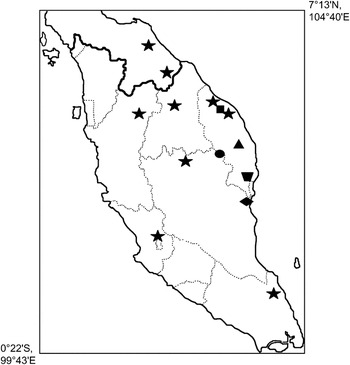
Distribution. Peninsular Malaysia (Terengganu) (Fig. 2).
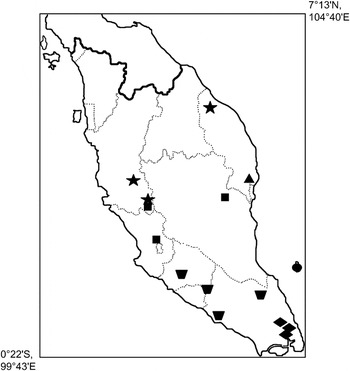
Distribution of Scaphochlamys abdullahii Y.Y.Sam & Saw (▪), S. cordata Y.Y.Sam & Saw (▴), S. laxa Y.Y.Sam & Saw (•), S. biloba (Ridl.) Holttum (★), S. burkillii Holttum (♦) and S. grandis Holttum ( ).

Habitat and ecology. Found at the fringes of lowland forest. Altitude c.40 m.
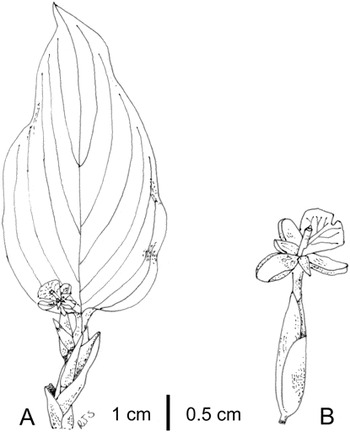
2. Scaphochlamys anomala (Hallier f.) R.J.Searle, comb. nov. – Kaempferia anomala Hallier f., Bull. Herb. Boissier 6: 357 (1898). – Gastrochilus hallieri (Hallier f.) Ridl., J. Straits Branch Roy. Asiat. Soc. 32: 109 (1899), nom. illegit.; Turner, Asian J. Trop. Biol. 4(1): 43 (2000). – Gastrochilus anomalum (Hallier f.) K.Schum. in Engler, Pflanzenr. IV, 46 (Heft 20): 92 (1904); Valeton, Bull. Jard. Bot. Buitenzorg 27: 104 (1918). – Boesenbergia anomala (Hallier f.) Schltr., Repert. Spec. Nov. Regni Veg. 12: 315 (1913); R.M.Sm., Notes Roy. Bot. Gard. Edinburgh 44: 210 (1987). – Type: Cult. Bogor, originally from Borneo [Kalimantan], Hallier s.n. (holo BO, presumed lost (Valeton, Reference Valeton1918)). Lectotype: Figure drawn from Hallier s.n. (holo BO) cult. Bogor, originally from Borneo [Kalimantan], published as t. IX, fig. 3., Bull. Herb. Boissier 6: 357 (1898), designated here. Fig. 3.
Scaphochlamys anomala (Hallier f.) R.J.Searle. A. Habit. B. Inflorescence with a single open flower. Drawing exactly as in Hallier (Reference Hallier1898).

Rhizome creeping, with short internodes, young rhizomes glossy green turning bone white with age; roots thread-like, non-tuberous, white and slightly branched. Successive shoots congested, short, up to 20 cm high, 1–2 leaves per shoot. Outer leafless-sheath short, c.1 cm long, oval, apex acute, scarious (thin, dry and membranous); inner leafless-sheath long, 3 cm long, cylindrical, apex acute, completely green, veins visible as pale parallel lines, opaque, margin pale and membranous; older sheaths paler, becoming scarious, parallel-veined. Petiole 7 cm long, obliquely erect, rigid, slender, semi-smooth, upper surface deeply furrowed, green, sub-opaque, lined with pale parallel veins. Lamina upper surface uniform glossy grass-green, 8 secondary veins, lower surface paler, glaucous–green, thickly covered in minute blue-green spots, covered in a scattering of fine appressed hairs, concentrated towards the midrib, ovate to lanceolate, symmetric, to 11 × 5 cm, base rounded, apex acute, recurved. Inflorescence terminal, sessile within the sheaths, highly reduced with only 3 bracts. Bracts 1.7 cm long, apex acute. Flowers small. Corolla tube slender, 15 × 1 mm, emerging 6 mm above the sheath, white, 3 equal corolla lobes, each 7 × 2–3 mm at the base, lanceolate, hooded, white, semi-transparent with 3 dark parallel veins inside. Lateral staminodes 2, petaloid and small, about half the size of the corolla lobes, 4 × just over 1 mm, lanceolate, curved, papillose, apex acute, green and lined with 3 transparent veins. Labellum slightly above the petals, deeply cleft, claw 4 × 3 mm, lobes c.4 mm long and just as wide, somewhat cuneate with broadly obovate lobes, white with a yellow central mark. Stamen with very short filament, anther obovate and erect, thecae yellow, 3 × 1 mm, the margins wrapped around the style apex, crest truncate. Stigma white, ostiole containing erect cilia. Fruit unknown. (Adapted from Hallier, Reference Hallier1898.)
Distribution. Borneo, Kalimantan, ‘in the jungle at the base of Mt Liang Gagang’ [Bukit Liangkungkam 00°04′01″S, 113°11′00″E?]. With current exploration of the flora of Borneo, it may not be long before this species is rediscovered (Fig. 6).
The above description is taken directly from Hallier who has also provided a clear and detailed drawing of the plant. Together these provide enough evidence to convince me of the position of this species in Scaphochlamys. Gastrochilus hallieri is an illegitimate name because it is homotypic with the name that should have been taken up. To quote Ridley from his 1899 paper, ‘There being nothing anomalous in this plant, I have taken the liberty of altering its specific name as well as its generic one’ – an action that is not considered acceptable.
3. Scaphochlamys argentea R.M.Sm., Notes Roy. Bot. Gard. Edinburgh 44: 209 (1987); Newman et al., Blumea Suppl. 16: 146 (2004). – Type: Borneo, Sarawak, 1st Division, Lundu, near base of G. Perigi, 6 viii 1962, Burtt & Woods B2700 (holo E!).
Rhizome thin, 1–2 mm in diameter when dry, creeping, with long fine trailing roots. Successive shoots 2–3 cm apart, comprising a single leaf surrounded by 3 leafless-sheaths, the longest reaching up to 3.8 cm in length (enclosing the scape), scarious, glabrous with a hairy tuft at the acute apex. Leaf-sheath only a few mm long, the ligule positioned at the base of the leaf; ligule c.5 mm, membranous, bilobed and acuminate. Petiole thin, glabrous, 3–6 cm long. Lamina upper surface green with prominent silver venation, lower surface paler and sparsely hairy along midrib towards the leaf base, oblong to oval, symmetric, 6–10 × 3–4 cm, base subcordate to rounded, apex broadly acute to shortly acuminate (may be tufted). Peduncle 3–5 cm long, slender, almost glabrous. Inflorescence small, round, 2 × 1 cm, with 3–4 tightly congested bracts. Bracts 2.5 × 0.2 cm, long and thin, broadening towards the base, glabrous, apex acute and tufted. First bracteole slightly shorter than the bract, 1.8 cm long, the next shorter. Flowers 2 per bract. Ovary 2 mm long, hairy near the apex, unilocular with few basal ovules. Calyx 8 mm long, with a single split to at least midway down its length, minutely tridentate at the apex. Corolla tube 25 mm long, lightly hairy, lobes pale green, recurved, lateral lobes 10 × 2–3 mm wide, dorsal lobe broader and with a more pointed apex. Staminodes obovate, 5 mm long. Labellum small, rounded, appearing entire (in dried material), 10 × 8 mm wide, clawed, with tiny glandular hairs, white to light mauve, with a pale greenish yellow/yellow central mark. Stamen white, filament very short, thecae to 4 mm long with short free spurs; crest truncate. Style hairy. Stigma cup-like with ciliate margin. Fruit yellow green.
Distribution. Malaysia (Sarawak) (Fig. 6).
Habitat and ecology. Very common on damp forest floor, near streams; has been found on igneous-derived brownish-yellow sandy soil. Altitude c.200 m.
Additional specimens examined. Malaysia.Sarawak: 1st Division, Lundu, viii 1912, Andersen 131 (SING); 1st Division, Lundu, iv 1924, Mjoberg 229 (K, SAR); Lundu, Mt. Gading, 11 ix 1929, Clemens & Clemens 7385 (K, SAR); G. Buri, Ulu Simunian, 15 ix 1975, Chai 36753 (K, L, SAR).
4. Scaphochlamys atroviridis Holttum, Gard. Bull. Singapore 13: 93 (1950); Newman et al., Blumea Suppl. 16: 146 (2004). – Type: Malaysia, Terengganu, Kemaman, Bukit Kajang, 4 xi 1935, Corner SFN 30240 (holo SING!; iso E!, K!, L!, P).
Rhizome thin, horizontally creeping. Successive shoots 1.5 cm or less apart, each with 1 leaf surrounded by 3 leafless-sheaths, the sheaths at most 4–5 cm long, delicate, sparsely hairy and more or less flushed with purple. Leaf-sheath c.1.5 cm long, the ligule broad and positioned near the leaf base. Petiole 5–8 cm long. Lamina dark green on the upper surface, the lower surface paler and sparsely hairy, ovate to elliptic, symmetric, c.16 × 6 cm; base cuneate to narrowly rounded; apex rounded or mucronulate. Peduncle 3–6 cm long, glabrous to semi-glabrous. Inflorescence open with few bracts; rachis 2–5 cm long, quite flexible and supporting a lax inflorescence composed of 2–7 bracts, each bract extending from the rachis at an angle of c.45°. Bracts green, sometimes flushed red, more or less glabrous, 3–3.5 × 1.5 cm, elliptic when flattened; margins not thinned, broadly undulating; base of the bract concave, becoming flatter towards the apex; the apex rounded or obtuse with a minute apiculum covered with hairs. First bracteole 10 mm long, the rest no more than 5 mm long, broadly oblique and apiculate. Flowers 2–5 in the axil of each bract, fragrant, white except for the labellum. Calyx with ovary c.13 mm long, ovary glabrous. Corolla tube to 36 mm long, corolla lobes unequal, 14–15 × 4 mm at the base. Staminodes as long as the corolla lobes, almost oblong, widening slightly from the base towards the rounded apex, maximum width 5 mm just below the apex. Labellum 18 × 15 mm, halfway bilobed, the lobes rounded and overlapping, with a yellow median band, flanked on either side by a lilac stripe, and towards the base, near the insertion of the filament, a pale lilac spot. Stamen with thecae 3 mm long; crest rounded, reflexed, trilobed, the mid-lobe largest, and when flattened is 4 × 4 mm. Fruit ellipsoid, 12 × 7 mm.
Distribution. Peninsular Malaysia (Johore, Terengganu) (Fig. 4).
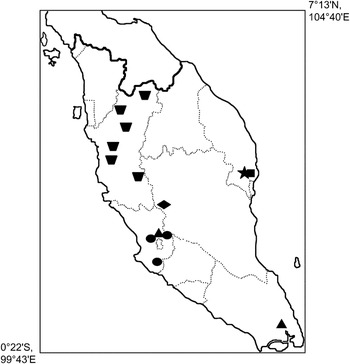
Distribution of Scaphochlamys obcordata Sirirugsa & K.Larsen (▪), S. minutiflora Jenjitt. & K.Larsen (▴), S. rubescens Jenjitt. & K.Larsen (•), S. atroviridis Holttum (★), S. sylvestris (Ridl.) Holttum ( ) and S. erecta Holttum (♦).

Habitat and ecology. Altitude c.150 m.
Additional specimen examined. Malaysia.Johore: Kluang, 23 ix 1970, Shah MS 2164 (SING).
5. Scaphochlamys biloba (Ridl.) Holttum, Gard. Bull. Singapore 13: 89 (1950); Newman et al., Blumea Suppl. 16: 146 (2004). – Gastrochilus biloba Ridl., Trans. Linn. Soc. 3: 379 (1893); Ridl., J. Straits Branch Roy. Asiat. Soc. 32: 116 (1899); Ridl., Mat. Fl. Malay. Penins. 2: 19 (1907); Ridl., Fl. Malay Penin. 4: 251 (1924); Turner, Asian J. Trop. Biol. 4(1): 23 (2000). – Kaempferia biloba (Ridl.) K.Schum. in Engler, Pflanzenr. IV, 46 (Heft 20): 81 (1904). – Boesenbergia biloba (Ridl.) Schltr., Repert. Spec. Nov. Regni Veg. 12: 315 (1913). – Type: Malaysia, Pahang, Kuala Tenok, 26 vii 1891, Ridley s.n. (lecto K!, designated by Holttum, Reference Holttum1950).
Gastrochilus calophylla Ridl., J. Straits Branch Roy. Asiat. Soc. 32: 115 (1899); Turner, Asian J. Trop. Biol. 4(1): 23 (2000). – Kaempferia calophylla (Ridl.) K.Schum. in Engler, Pflanzenr. IV, 46 (Heft 20): 80 (1904). – Boesenbergia calophylla (Ridl.) Schltr., Repert. Spec. Nov. Regni Veg. 12: 315 (1913). – Type: Malaysia, Selangor, Ridley s.n. (n.v.). This species was placed into synonymy by Holttum (Reference Holttum1950). Since then the type has not been seen by anyone.
Gastrochilus biloba Ridl. var. lanceolata Ridl., J. Straits Branch Roy. Asiat. Soc. 54: 102 (1910); Turner, Asian J. Trop. Biol. 4(1): 23 (2000). – Scaphochlamys biloba (Ridl.) Holttum var. lanceolata (Ridl.) Holttum, Gard. Bull. Singapore 13: 90 (1950). – Gastrochilus minor auct. non Baker: Ridl., Fl. Malay Penin. 4: 252 (1924); Holttum, Gard. Bull. Singapore 13: 90 (1950). – Type: Malaysia, Perak, Temango, vii 1909, Ridley 14422 (lecto K!, designated by Turner, Reference Turner2000). Ridley (Reference Ridley1924) identifies Gastrochilus minor Baker with Gastrochilus biloba Ridl. var. lanceolata Ridl., but in fact G. minor Baker is the basionym for Boesenbergia minor (Baker) Kuntze based on a separate specimen.
Scaphochlamys longifolia Holttum, Gard. Bull. Singapore 13: 91 (1950); Larsen, Bot. Tidsskr. 58: 192 (1962); Turner, Asian J. Trop. Biol. 4(1): 24 (2000); Newman et al., Blumea Suppl. 16: 148 (2004). – Gastrochilus longifolia Ridl., Fl. Malay Penin. 4: 252 (1924), nom. illegit., non (Lindl.) Kuntze (1891). – Type: Malaysia, Selangor, Ulu Gombak, xii 1920, Ridley s.n. (holo K!).
Rhizome long, thin, horizontally creeping, 3–4 mm in diameter when dry, yellow. Successive shoots usually 1 cm apart, sometimes 3–5 cm apart in less congested specimens, consisting of a single leaf (2-leaved shoots appear rarely); each shoot usually surrounded by 3 leafless-sheaths ranging from 1 cm, 2–5 cm and 4–10 cm long, the longest often wrapped around the inflorescence. Leaf-sheath generally short, 2–5 cm, ligule only a few mm long, sometimes densely hairy. Petiole slender, length extremely variable even within a population: short-petioled plants range from 2–5 cm long, whereas tall-petioled plants can reach 15(–20) cm in length; glabrous to well covered in long fine hairs. Lamina upper surface dark green, and usually with 2 white bands on each side of the midrib about halfway towards the edge, lower surface from pale green to flushed purple at the tips to dark purple throughout, usually glabrous but hairy along the midrib. Size variable even within a population; in small-leaved specimens 7 × 3 cm, lanceolate to elliptic; in large-leaved specimens 15–25 × 3–8 cm, narrowly elliptic to linear; base cuneate, sometimes narrowly rounded or shortly attenuate; apex acute to broadly pointed. Peduncle almost sessile to very short, 1–5(–7) cm long, slender, usually hairy. Inflorescence small and compact, ovoid, consisting of many tightly packed overlapping bracts, to 4 × 2.5 cm. Bracts reddish-brown, small, thin (and papery in dried material), 1.5–2 × 0.8 cm, narrowly lanceolate; broad-based with involute edges; apex acute to mucronulate, generally glabrous. Bracteoles can be either 0.5 cm shorter or longer than the bracts. Flowers unusual in this genus by having just a single flower and bracteole per bract. Ovary hairy, 3 mm long. Calyx 1.3 cm long, split by 0.5 cm from apex, apex trilobed. Corolla tube 30 mm long, widening towards the apex; dorsal corolla lobe 17 × 3 mm, linear, apex hooded, lateral corolla lobes slightly shorter. Staminodes white, oblong with rounded apex, 15 × 5 mm, covered in minute glandular hairs. Labellum obovate, clawed, deeply bilobed to about half its length, c.21 × 18 mm, usually white with just a pale yellow central blotch, sometimes with pink or crimson coloration towards the throat; covered in minute glandular hairs. Stamen c.8 mm long with filament 3 mm long and thecae 4 mm long with rounded bases; crest only a few mm long, reflexed. Stigma extending just beyond crest. Fruit unknown.
Distribution. The most widespread species within the genus, Scaphochlamys biloba is unusual in having such a large range compared with the very local ranges of the majority of species. It ranges from Pattani and Narathiwat Provinces of Thailand, throughout Peninsular Malaysia to Johore (Fig. 2).
Habitat and ecology. Found in leaf litter of evergreen forest in both deep shade and more open light areas. Altitude 70–1000 m.
Additional specimens examined. Thailand. Narathiwat: S. Kolok, Nikom Waeng, 3 iii 1974, Larsen 32957 (AAU). Pattani: Cultivated, 15 x 1931, Kerr 20572 (K); Bulait, 7 vii 1923, Kerr 7881 (K); Bacho, 14 vii 1923, Kerr 7881A (K); Bacho, 10 vi 1930, Kiah 24293 (K); Bacho National Park, 11 x 1991, Larsen et al. 42331 (AAU).
Malaysia. Johore: Hutan Simpanan Lenggor, Mersing, 4 v 1982, T. & P. KL3346 (K, L, SING). Cultivated material: 95KL47002 (AAU). Kelantan: Sungai Ketil, Henderson 19663 (SING); Sungai Ketil, Md. Nur 12098 (SING). Pahang: G. Tahan, 16 ix 1937, Corner s.n. (SING); Kuala Tenuk, 26 vii 1891, Haniff 8048 (SING). Terengganu: Ulu Setui, F.R. Kg. Buloh, Besut, 3 viii 1977, Lewis 73 (E, K); G. Tebu, 31 v 1974, Shah MS 3275 (SING).
This is a widespread species that has adapted to different habitats and perhaps that is why it is so morphologically variable. In addition to regional variations it also shows great diversity within single populations as seen on individual herbarium sheets (see Larsen, Reference Larsen1962). Subdivision of this species on such morphological characters as petiole or lamina length is untenable, although more detailed study of regional variation may result in a robust infraspecific classification.
6. Scaphochlamys breviscapa Holttum, Gard. Bull. Singapore 13: 95 (1950); Newman et al., Blumea Suppl. 16: 146 (2004). – Type: Malaysia, Terengganu, Kemaman, Ulu Bendong, 29 xi 1935, Corner 30021 (holo SING!; iso BO, E!, L!, K!, P).
Rhizome c.6 mm in diameter when dry, horizontally creeping. Successive shoots quite close together, generally 2–3 cm apart, each consisting of a single leaf surrounded by 3 leafless-sheaths to 14 cm in length, scarious with age. Leaf-sheath short, 2–3 cm long, ligule lobes broadly triangular, 4 mm long with appressed hairs. Petiole 20–30(–35) cm long, sparsely hairy to glabrous. Lamina upper surface green, lower surface paler but never purple, hairy along midrib and thinning towards the apex; elliptic to somewhat ovate, more or less symmetric, 20–26 × 8–12.5 cm; base rounded, somewhat decurrent; apex acuminate. Peduncle 1–3.5 cm long, hidden when young. Inflorescence ellipsoid, compact, c.6 × 2.5 cm, composed of 10–15 densely imbricating bracts. Bracts 2.5–3 × 1.5 cm wide, covered in short spiky hairs, thickening towards the base; margins inflexed, flushed red, spreading towards the apex; apex obtuse when flattened. Bracteole 2.1 × 0.8 cm. Flowers 3 (or 4?) per bract. Calyx with ovary 16 mm long, ovary short, pilose, calyx deeply cleft. Corolla tube to 24 mm long, lobes 12 mm long, white, dorsal lobe 5–6 mm wide at the base, lateral lobes narrower. Staminodes oblong, almost as long as corolla lobes, 5 mm wide with rounded apex. Labellum obovate, 6 mm long, bilobed 1/3 towards the base, the rounded lobes imbricating, a pale yellow streak running down the middle, flanked by lilac streaks on each side. Stamen filament 3 mm long, anther 5 mm long, base of thecae free, acute, connective crest 4 mm wide and reflexed. Fruit unknown.
Distribution. Peninsular Malaysia (Terengganu) (Fig. 5).
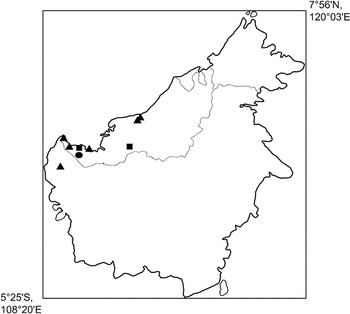
Distribution of Scaphochlamys concinna (Baker) Holttum (▪), S. breviscapa Holttum (▴), S. subbiloba (Burkill ex Ridl.) Holttum (•), S. perakensis Holttum (★), S. malaccana Baker ( ) and S. klossii (Ridl.) Holttum (♦).

Habitat and ecology. ‘Very common on all hillsides, but mostly sterile’ (Corner 30021). Altitude 350 m.
7. Scaphochlamys burkillii Holttum, Gard. Bull. Singapore 13: 102 (1950); Newman et al., Blumea Suppl. 16: 146 (2004). – Type: Peninsular Malaysia, Pahang, Barlok, Bukit Kapis, 21 vi 1913, Burn-Murdoch 210 (lecto SING!, designated here; isolecto K!).
Rhizome 2–6 mm in diameter when dry, occasionally ascending and anchored by vertically growing prop roots. Successive shoots crowded together, each comprising 1–3 leaves with purple outer sheaths. Leaf-sheath 4–6 cm long with thin broad margins covered in long fine hair; ligule lobes broad and short. Petiole 4–5 cm long, glabrous. Lamina 15–20 × 4–7.5 cm, slightly asymmetric, elliptic, both base and apex equally narrow, apex acute (occasionally mucronulate), base cuneate-decurrent, lower surface green (pale purple in young leaves) and sparsely hairy. Peduncle < 2 cm long, hidden within the leaf sheaths. Inflorescence 5–6 × 2 cm wide, ellipsoid, the few bracts held upright and overlapping. Bracts purple, 2.5–3.5 × up to 1.5 cm wide, awl-shaped, the outside almost entirely covered in a scattering of fine appressed hairs, apex narrowly pointed, slightly incurved, acute, margins thin but not crisped. First bracteole to 2.8 cm long, firm, 2-keeled, trilobed, the mid-lobe apiculum covered with 2 mm long fine hairs; subsequent bracteoles 1.1–1.2 cm long. Flowers 4–5 within each bract. Ovary with calyx 16 mm long, apex cleft by 5 mm and short toothed, densely hairy. Corolla tube and lobes white, corolla lobes 16–18 × 4 mm wide at the base. Staminodes shorter than the corolla lobes, blunt and white. Labellum c.20 mm long and wide, obovate, bilobed halfway up the labellum, white with a pale lemon yellow median band, flanked on either side by reddish-purple streaks. Stamen white or faintly purple, filament 3 mm long; thecae 3.5 mm long; crest 4 mm wide, reflexed. Fruit unknown.
Distribution. Peninsular Malaysia (Pahang) (Fig. 2).
Habitat and ecology. Altitude 70–100 m.
Additional specimen examined. Malaysia. Pahang: Beserah, Burkill & Haniff 16133 (SING).
In the protologue Holttum (Reference Holttum1950) cites two specimens as types without clearly defining any one as a holotype. I have lectotypified Burn-Murdoch 210 (SING) here.
8. Scaphochlamys calcicola A.D.Poulsen & R.J.Searle, Gard. Bull. Singapore 57: 29 (2005). – Type: Borneo, southwest Sarawak, 20 vi 2003, Poulsen, Jugah & Clausager 2022 (holo SAR; iso AAU, E!, K, L).
Rhizome robust, c.7 mm in diameter when dried, creeping above the ground, sometimes forking, with well-developed prop roots. Successive shoots 2–20 cm apart, distinctly unifoliate; laminate leaf tightly enclosed by 3(–5) leafless-sheaths, the longest to 18 cm long, cream at base, flushed green towards apex or purple, becoming scarious with age and finally decaying away. Leaf-sheath to 3 cm long, together with ligule hidden by leafless-sheaths, margin thin and densely hairy; ligule membranous, more or less obscure, bilobed, to 5 mm long. Petiole 10–27(–39) cm long, canaliculate. Lamina upper surface plain green, lower surface very pale green and villose (up to 1 mm long, appressed, white hairs scattered throughout the lower surface but most dense near and on the sides of the midrib), broadly elliptic to lanceolate, slightly asymmetric, plicate, 15–37 × 9–18 cm, base rounded to slightly cordate and attenuate, apex distinctly acuminate. Peduncle slender, to 1.5 cm long, glabrous, hidden by the leaf bases. Inflorescence bilaterally flattened, 7–10 × 1.5–2 cm wide and 0.5–0.6 cm deep, tapering towards a pointed apex, with 8–13 distichously arranged bracts each 0.3–0.7 cm apart on an elongated spike. Bracts pale green, 2.5–3.2 × 0.9 cm near the base, held stiffly upright, boat-shaped, edges involute and overlapping, outer surface glabrous or covered in short spiky hairs, and apex acute. Bracteole 2–3.3 cm (first; second and third decreasing in size), 2-keeled, generally longer and opposite the bract, wrapped tightly around the flower, slit to the base, edges overlapping, covered in short spiky hairs. Flowers usually 2, sometimes 3 per bract. Ovary 2 mm long, glabrous; epigynous glands 4–5.5 mm, bilobed, needle-shaped. Calyx with ovary 12–13 mm long, covered in a scattering of short spiky hairs, otherwise glabrous, split 4 mm from apex, with rounded to acute, irregularly tridentate apex. Corolla tube 24–40 mm long, glabrous; corolla lobes white, linear, 15 × 5 mm, apex mucronate and hooded. Staminodes oblong, 12 × 3–4 mm, with minute glandular hairs, apex obtuse. Labellum spathulate, 14–17 × 9–11 mm, apex bilobed (indented 3–4 mm), lobes overlapping, white with pale yellow-green centre. Stamen filament 5–7 × 2 mm, thecae 4–5 × 1.5 mm, not spurred; crest rounded, 2 mm long. Stigma 1 mm across, club-shaped with 2 dorsal knobs, ostiole ciliate and forward-facing. Fruit unknown.
Distribution. Malaysia (Sarawak) (Fig. 6).
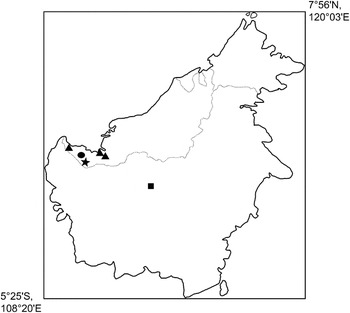
Distribution of Scaphochlamys anomala (Hallier f.) R.J.Searle (▪), S. argentea R.M.Sm. (▴), S. calcicola A.D.Poulsen & R.J.Searle (•) and S. gracilipes (K.Schum.) S.Sakai & Nagam. (★).

Habitat and ecology. Lowland forest; tends to occur at the base or shoulder of limestone hills, on boulders near streams. Altitude 50 m.
This species possesses an unusual set of characters: a distichous inflorescence, a two-keeled bracteole, and lack of thecae spurs, but DNA analysis confirms its placement in Scaphochlamys (Poulsen & Searle, Reference Poulsen and Searle2005).
9. Scaphochlamys concinna (Baker) Holttum, Gard. Bull. Singapore 13: 94 (1950); Newman et al., Blumea Suppl. 16: 146 (2004). – Kaempferia concinna Baker in Hooker, Fl. Brit. India 6: 221 (1890); K.Schum. in Engler, Pflanzenr. IV, 46 (Heft 20): 80 (1904). – Gastrochilus concinna (Baker) Ridl., J. Straits Branch Roy. Asiat. Soc. 32: 116 (1899); Ridl., Mat. Fl. Malay. Penins. 2: 20 (1907); Ridl., Fl. Malay Penin. 4: 251 (1924); Turner, Asian J. Trop. Biol. 4(1): 43 (2000). – Boesenbergia concinna (Ridl.) Schltr., Repert. Spec. Nov. Regni Veg. 12: 316 (1913). – Type: Peninsular Malaysia, Perak, Ulu Bubong, vi 1886, King's collector [Kunstler] 10135 (holo K!; iso SING!).
Rhizome thin, 2–5 mm in diameter when dried, horizontally to obliquely creeping, sending out a tangle of long stringy roots. Successive shoots unifoliate and relatively close together (generally 1 cm apart), each leaf surrounded by 3 leafless-sheaths, longest to 15 cm long, flushed purple and, when dried, brown and papery, glabrous. Leaf-sheath 2–5 cm long; ligule lobes small, obscure. Petiole long, thin, 25–48 cm long, glabrous. Lamina lower surface purple, generally glabrous, except for a scattering of long fine hairs along the midrib, thinning towards the apex, lanceolate, symmetrical, 14–18 × 4.5–6.5 cm, base distinctly cordate, apex narrowly acuminate. Peduncle 8–15 cm long, slender, glabrous, enclosed by the leaf-sheath. Inflorescence compact, tulip-shaped, c.3 × 1.5 cm. Bracts sometimes flushed purple towards the apex, 2.5–3 × c.1 cm, boat-shaped with very thin edges, glabrous, apex acute to narrowly pointed, sometimes tufted, c.6 in number. Flowers 2 within each bract. First bracteole 2.2 × 0.7 cm, second shorter, glabrous. Calyx and ovary 12 mm long, calyx very dark red, waxy, with a bidentate apex. Corolla tube 30 mm long, corolla lobes c.14 mm long. Staminodes 9 × 2 mm, apex rounded. Labellum c.20 mm long, white with 2 dark red stripes towards the throat. Anther crest short and broad, entire and reflexed. Fruit unknown.
Distribution. Peninsular Malaysia (Pahang, Perak, Selangor) (Fig. 5).
Habitat and ecology. Altitude c.100–300 m.
Additional specimens examined. Malaysia. Pahang: Gunong Tapis Ridge, 13 vi 1934, Symington 28813 (K, SING). Selangor: Bukit Ulu Gombak, 14 ix 1974, Willis s.n. (L) & v 1974, Littke s.n. (L). Cultivated material: Selangor, 10 xi 1994, Theilade C55 (AAU).
10. Scaphochlamys cordata Y.Y.Sam & Saw, Gard. Bull. Singapore 57: 256 (2005). – Type: Peninsular Malaysia, Terengganu, Dungun, Jengai Forest Reserve, 17 x 2002, Sam & Mustapa FRI 47155 (holo KEP; iso E, SAN).
Rhizome creeping over ground surface. Successive shoots close together, unifoliate. Leafless-sheaths reddish brown, apex mucronulate, longest sheath 11–17 cm long. Leaf-sheath 1–2 cm long, ligule lobes small, c.1 mm. Petiole slender, 30–60 cm long, terete. Lamina with prominently raised veins on upper surface, lower surface brownish-red when young, densely hairy towards the base, slightly asymmetric, 14–30 × 8–15 cm, base strongly cordate, sometimes with overlapping auricles, apex narrowly acuminate with distinct ‘drip tip’. Peduncle 10–18 cm long, hidden within bladeless sheath when young. Inflorescence slender, lax, with 4–10 bracts 1.5–2 cm apart, rachis 5–9 cm long. Bracts red when young, turning green, 1.5–2.2 × 0.6–1.2 cm when flattened, spathulate, covered with simple hairs towards apex on both surfaces, apex acute and reflexed. Bracteoles shorter than bract, narrowly lanceolate, 6–11 × 1–3 mm with inflexed margin, apex pointed, hairy throughout, first bracteole largest, enclosing subsequent bracteoles and flowers. Flowers more than 15 per bract, small and white except for the calyx. Calyx 7.5–9 mm long, red and hairy, split 2.5–4 mm down one side. Corolla tube 11–14 mm long, dorsal corolla lobe lanceolate with strongly inflexed margin, 6–8.5 × 1.5–2 mm, apex hooded, pinkish distally; lateral corolla lobes lanceolate with strongly inflexed margin, 5–7 mm long, pinkish distally. Staminodes oblong, 3–7.5 × 1–2 mm, apex rounded, with tiny glandular hairs on adaxial surface. Labellum clawed, 7–10 × 5–9.8 mm wide, bilobed, lobes overlapping, cleft c.4 mm from apex, median band faint yellow, purple blotches on both sides. Stamen 3.5–4.3 mm, tinged purple; filament short, 1 mm long; thecae 2.5 mm long; crest short, < 1 × 1.5 mm. Stigma small, cup-shaped, yellowish, papillose. Fruit unknown. (Adapted from Sam & Saw, Reference Sam and Saw2005.)
Distribution. Peninsular Malaysia (Terengganu) (Fig. 2).
Habitat and ecology. Found primarily on ridges. Altitude 80–140 m.
11. Scaphochlamys erecta Holttum, Gard. Bull. Singapore 13: 99 (1950); Newman et al., Blumea Suppl. 16: 147 (2004). – Type: Peninsular Malaysia, Johore, Sungai Sedili, Mersing Road, 30 ix 1936, Corner SFN 31941 (holo SING!; iso BO, E!, K!, L!).
Rhizome erect to semi-erect, anchored by vertically growing prop roots, sometimes creeping step-wise through the accumulating leaf litter. Successive shoots 1.5 cm apart, comprising 8–10 leaves when fully developed, each arising in the axil of a foliar leaf below the inflorescence, originally bearing leafless-sheaths up to 10 cm long. Leaf-sheath 6–9(–15) cm long, glabrous, margins thin; ligule triangular, apparently long, but very frequently damaged. Petiole glabrous, 1–8 cm long. Lamina upper surface green, lower surface paler and glabrous, linear to elliptic, asymmetric, 18–32(–50) × 3–5.5(–7) cm, narrowing gradually towards an acute apex, and to a long, narrow, decurrent base. Peduncle generally 4–5(–15 cm) long, semi-glabrous to glabrous. Inflorescence 5–6 cm long, bearing 8–12 (occasionally to 25) imbricating bracts becoming more elongated and lax with age. Bracts green, 3–4 × 1.2–1.5 cm, linear to boat-shaped, base inflexed, becoming more flattened towards the apex; apex widely acute to apiculate, margins thin and slightly frilled; outer surface glabrous, tufted at the apex, sometimes sparsely hirsute along edge, inner surface hairy. First bracteole 2 cm long, the rest 0.9 cm long. Flowers without scent, white, 2–4 per bract. Ovary unilocular with 3 basal ovules; calyx with ovary 12 mm long, slightly swollen, the apex slightly dentate and glabrous. Corolla tube 28 mm long, slender, widening slightly towards apex, lobes 10 mm long, the dorsal lobe 4 mm wide at base, apex acute, lateral lobes narrower. Staminodes outspreading, 8 × 4 mm, oblong with rounded apex. Labellum obovate, 13 × 12 mm, 1/3 bilobed (rounded imbricating lobes), white with a median yellow band flanked by 2 lilac streaks developing towards the base. Stamen filament 2.5 mm long; thecae 3 mm long, free and pointed at base; crest rounded, reflexed, 2 × 3 mm. Fruit ellipsoid, unilocular, seeds 1–3.
Distribution. Peninsular Malaysia (Johore, Pahang, Terengganu) (Fig. 4).
Habitat and ecology. Primary forest, often near rivers; on granite hillside or sandstone ridges. Altitude 200–300 m.
Additional specimens examined. Malaysia. Johore: Bagan Kijang, Sungai Sedili, 29 i 1933, Corner s.n. (K, SING); Jemakang Road, 14 xii 1935, Corner s.n. (K, SING); Gunung Ledang, Ulu S. Belemang, 14 vii 1969, Whitmore 12288 (K, L). Pahang: Gunung Serudom F.R., 26 x 1975, Shah et al. MS3750 (C, SING). Terengganu: Bukit Bauk F.R., 28 iv 1962, Unknown collector 5058 (K); Sungai Terengganu near Kuala Kerbat, 25 vi 1971, Whitmore 20246 (K, L, SING).
12. Scaphochlamys gracilipes (K.Schum.) S.Sakai & Nagam., Blumea 51: 110 (2006). – Haplochorema gracilipes K.Schum., Bot. Jahrb. 27: 332 (1899); K.Schum. in Engler, Pflanzenr. IV, 46 (Heft 20): 90 (1904). – Boesenbergia gracilipes (K.Schum.) R.M.Sm., Bot. J. Linn. Soc. 85: 43 (1982); R.M.Sm., Notes Roy. Bot. Gard. Edinburgh 44: 221 (1987). – Type: Borneo, Sarawak, 1st Division, Gunung Wah (G. Wan?), xi 1866, Beccari 2839 (holo FI; iso K!, P).
Rhizome thin, c.3 mm in diameter when dried, horizontal to obliquely ascending, anchored by long fine trailing roots. Successive shoots clumping, no more than 1 cm apart, unifoliate. Longest leafless-sheath tightly enveloping when young, but rapidly drying out and decaying with age. Leaf-sheath to 1 cm long, ligule tiny, obscure. Petiole 4–8 cm long, glabrous. Lamina upper surface dark green, lower surface finely hairy along midrib towards apex, elliptic to ovate, symmetric, 11–17 × 4–6 cm, base acute to slightly decurrent, apex acuminate, sometimes mucronulate. Peduncle and inflorescence together to 7 cm long, very slender, the inflorescence becoming more lax as it elongates with age and composed of c.5 spirally arranged bracts. Bracts held at an acute angle and almost imbricating when young, becoming more open as the spike elongates; each bract c.1 cm in length, narrow, linear to boat-shaped, glabrous. Flowers and fruit unknown.
Distribution. Malaysia (Sarawak) (Fig. 6).
The transfer of the basionym into Scaphochlamys by Sakai & Nagamasu (Reference Sakai and Nagamasu2006) is based solely on the type specimen. Other material identified by Rosemary Smith as Boesenbergia gracilipes may still belong within Boesenbergia (see Smith, Reference Smith1987).
13. Scaphochlamys grandis Holttum, Gard. Bull. Singapore 13: 101 (1950); Newman et al., Blumea Suppl. 16: 147 (2004). – Type: Peninsular Malaysia, Terengganu, Kemaman, Ulu Bendong, 30 x 1935, Corner SFN 30030 (holo SING!; iso BO, E!, K!, L!, P).
Rhizome robust, 1 cm in diameter or thicker when dry, obliquely ascending, anchored by long vertically growing prop roots. Successive shoots of 5 or more leaves, each new rhizome element arising in the axil of the second or third foliar leaf below the inflorescence. Longest leafless-sheath to 18 cm long and covered in coarse hairs. Leaf-sheath to 18 cm long, short-haired, with broad, thin margins; ligule lobes broad, 10 mm or longer, triangular. Petiole short or non-existent, covered in woolly hairs. Lamina upper surface green with prominent veins, lower surface pale green, densely hairy both on and alongside the lower surface midrib, becoming finer towards the apex, otherwise sparsely hairy, narrow elliptic shape with straight-sided linear leaves, asymmetric, to 50 × 10 cm, base long decurrent, apex mucronulate. Peduncle to 7 cm long, covered in short woolly hairs. Inflorescence 7–12 cm long, with c.15 spirally arranged bracts, held at an acute angle and imbricating. Bracts green when young, becoming red with age, c.4.5 × 1–1.5 cm near the base, boat-shaped, margins inflexed, not crisped, densely covered in short woolly hairs, apex acute to mucronulate. First bracteole 2–2.5 cm long, densely hairy, the second 8 mm long. Flowers for the most part 2 per bract (occasionally several?). Ovary hairy; calyx with ovary 17–20 mm long. Corolla tube 40 mm long; corolla lobes white, 16 mm long, dorsal corolla lobe no more than 4 mm wide. Staminodes white, as long as the dorsal corolla lobe and 5 mm wide. Labellum 22 mm long, bilobed almost to the middle, lobes generally irregular, wide yellow midband becoming dark lilac-margined with a few lilac streaks spreading towards the base. Stamen filament 3 mm long; thecae 5 mm long; crest pale lilac, strongly reflexed (the apex almost reaching the back of the anthers), the margins stiff, 6 mm wide. Fruit ellipsoid, 16 mm long, shiny. Seeds 2 or 3, black, ellipsoid.
Distribution. Peninsular Malaysia (Terengganu) (Fig. 2).
Habitat and ecology. ‘Very abundant in swamps in stream valleys’ (Corner 30030). Altitude 350 m.
This is the largest species in the genus, reaching almost 1 m in height.
14. Scaphochlamys klossii (Ridl.) Holttum, Gard. Bull. Singapore 13: 100 (1950); Newman et al., Blumea Suppl. 16: 147 (2004). – Gastrochilus klossii Ridl., Mat. Fl. Malay. Penins. 2: 16 (1907); Ridl., Fl. Malay Penin. 4: 248 (1924); Turner, Asian J. Trop. Biol. 4(1): 24 (2000). – Boesenbergia klossii (Ridl.) Loesen. in Engler & Prantl, Nat. Pflanzenfam. ed. 2, 15A: 571 (1930). – Type: Malaysia, Johore, near Gunong Pantai, 1904, Kloss s.n. (holo K!).
14a. Scaphochlamys klossii var. klossii
Rhizome robust, 0.6–1 cm in diameter when dried, horizontal or obliquely ascending, anchored by vertical prop roots. Successive shoots rather close together (0.5–2 cm apart), with more or less 4 leaves per shoot. Surrounding sheaths densely covered in woolly hairs. Leaf-sheath 8–12 cm long, broad and fine, covered in a dense layer of woolly hair; ligule lobes broad, triangular, 6–10 mm long. Petiole almost absent to 15 cm long, covered in a thick layer of woolly hair; combined leaf-sheath and petiole length to 18(–26) cm. Lamina slightly fleshy, upper surface dark green, lower surface pale green and sparsely covered in fine hairs; midrib densely covered in woolly hairs, becoming glabrous towards the apex, elliptic to narrowly elliptic, somewhat asymmetric, 20–30 × 4–10 cm, base narrowly cuneate or shortly decurrent, apex acute (sometimes acuminate). Peduncle 2–6 cm long, hidden among the bases of the leaf sheaths, covered in woolly hair. Inflorescence ovoid when young, commonly 4 × 2 cm, becoming elongated with age, to 8–11 cm long, the many bracts closely imbricating, but never becoming lax. Bracts green, more or less densely hairy all over but especially on the margins, which may, or may not, be thin and crisped, ovate (occasionally narrowly ovate), apex acute or mucronate, c.2.5 × 1.5 cm. Bracteoles oblong-mucronate, 0.6–0.8(–1.2) cm long, sparsely hairy. Flowers 3–8 within each bract. Ovary finely hairy; calyx and ovary 0.8–1.2 cm long. Corolla tube slender, 1.8 cm long, corolla lobes 0.7 × 0.4 cm, dorsal lobe with acute apex. Staminodes about as long as the corolla lobes and 5 mm wide, the rounded ends slightly reflexed. Labellum c.1.2 cm long and wide, almost round, shortly bilobed, with rounded reflexed lobes, white with a median longitudinal pale lemon yellow band, flanked by pale lilac lines especially towards base. Stamen filament broad, 2 mm long; thecae 3 mm long, their basal ends free and acute; crest 2 × 3 mm, reflexed, crisped and slightly lobed. Fruit ellipsoid, 1.2 cm long. Seeds 1–3, ellipsoid with aril laciniate to the base.
Distribution. Peninsular Malaysia (Johore), Singapore (Fig. 5).
Habitat and ecology. ‘Common in the swampy forest round the Sedili and tributaries, generally gregarious in damp hollows’ (Corner, 14 v 1935). Altitude 50–200 m.
Additional specimens examined. Malaysia. Johore: 11 xii 1935, Vesterdal 78 (C); Kota Tinggi District, Gunong Panti, 23 vi 1963, Stone et al. 4806 (L); S. Berassau, Mawai–Jemaluang Road, 14 v 1935, Corner s.n. (SING); S. Berassau, Mawai–Jemaluang Road, 7 ii 1935, Corner 28965 (K); Sungai Kayu Ara, 3 i 1936, Corner 29983 (K, L, SING); Gunung Muntahak, 2 iii 1928, Holttum 19952 (K, SING); Sungai Kayu Sedili, 6 x 1936, Kiah 31963 (K, L, SING); Bandar Tenggara, Lingiu–Sindora Forest, 24 vii 1991, Lesmy 35938 (K, KEP); Kota Tinggi Waterfall area, 22 iv 1978, Maxwell 78-212 (L); Sungai Kayu, 6 x 1936, Ngadiman 31963 (L, SING).
Singapore. Bukit Timah Forest Reserve, Taban Path, 26 xii 1949, Sinclair 6289 (E); 30 xi 1981, Shah et al. MS 4145 (SING).
14b. Scaphochlamys klossii var. glomerata Holttum, Gard. Bull. Singapore 13: 101 (1950); Newman et al., Blumea Suppl. 16: 147 (2004). – Type: Malaysia, Johore, Gunong Panti, west, Corner 30952 (holo SING!; iso E!, K!, L!).
Rhizome slightly thinner than in type variety, 0.5 cm wide when dried. Successive shoots 1–2-leaved, and close together; leafless-sheaths densely hairy. Leaf-sheath 1.5–4.5 cm long, broad, covered in woolly hair; ligule triangular, c.3 mm long. Petiole 2.5–5 cm long, sparsely hairy to glabrous; leaf-sheath and petiole 7–9(–15) cm long. Lamina upper surface pale green, occasionally with a silver band near margin, narrowly elliptic, asymmetric, to 24 × 5 cm, lower surface sparsely covered in fine hairs, becoming glabrous towards apex, base cuneate, apex acute. Peduncle 1.5–4 cm long, hidden within leaf-sheaths, glabrous. Inflorescence small, ovoid when young, the many bracts closely imbricating, appressed to the rachis, becoming slightly more lax as the inflorescences age. Bracts 3–4 cm long, less broad than in type, lightly covered in fine hairs to glabrous, margins thin or not, each subtending c.7 flowers.
Distribution. Peninsular Malaysia (Johore).
Habitat and ecology. Found in drier conditions than the type variety. Altitude 0–50 m.
Additional specimen examined. PeninsularMalaysia. Johore: Gunong Panti, west, Corner 30951 (L, SING).
14c. Scaphochlamys klossii var. minor Holttum, Gard. Bull. Singapore 13: 101 (1950); Newman et al., Blumea Suppl. 16: 147 (2004). – Type: Malaysia, Johore, Ulu Segun, Gunong Panti, 20 i 1936, Corner SFN 30743 (lecto SING!, designated here; isolecto K!).
Rhizome horizontally creeping, 0.5–0.8 cm in diameter when dried. Successive shoots 0.5–1 cm apart; number of leaves per shoot variable, ranging from 1 to 5. Leaf-sheath c.3 cm long, thin-edged, hairy; ligule obscure. Petiole 10 cm long, densely hairy. Lamina elliptic, distinctly asymmetric, to 20 × 5 cm, lower surface covered in fine hairs, densely hairy along midrib, base cuneate, apex acute. Peduncle c.1 cm long. Inflorescence smaller than in type, small, ovoid when young, elongating with age to 7 cm long. Few overlapping bracts each subtending 2–3 flowers; bracts 2.5–3 cm long, densely covered in fine hairs, apex long, thin, pointed and tufted.
Distribution. Peninsular Malaysia (Johore).
Habitat and ecology. ‘Common, often gregarious, in the swamp or on the hillsides’ (Corner 30743). Altitude 0–250 m.
Additional specimen examined. PeninsularMalaysia. Johore: Bukit Tinjau Laut, 5 viii 1937, Ngadiman s.n. (SING).
In the protologue Holttum (Reference Holttum1950) quotes two specimens as types without clearly defining any one as a holotype. Corner SFN 30743 (SING) has been designated as the lectotype.
15. Scaphochlamys kunstleri (Baker) Holttum, Gard. Bull. Singapore 13: 96 (1950); Lim, Folia Malaysiana 2(2): 122 (2001); Newman et al., Blumea Suppl. 16: 147 (2004). – Curcuma kunstleri Baker in Hook.f., Fl. Brit. India 6: 214 (1890); Ridl., J. Straits Branch Roy. Asiat. Soc. 32: 120 (1899); Ridl., Mat. Fl. Malay. Penins. 2: 22 (1907). – Gastrochilus kunstleri (Baker) Valeton, Bull. Jard. Bot. Buitenzorg 27: 104, pl. 14 (1918); Turner, Asian J. Trop. Biol. 4(1): 20 (2000). – Hitcheniopsis kunstleri (Baker) Ridl., Fl. Malay Penin. 4: 252 (1924); Turner, Asian J. Trop. Biol. 4(1): 44 (2000). – Type: Malaysia, Perak, Larut, Gopeng, Kunstler 4413 (neo K!, designated here).
Kaempferia lutea C.H.Wright, Bull. Misc. Inform. Kew 1907: 60 (1907). – Type: Cultivated material: 3 x 1906, Wright 181-03 (holo K!).
15a. Scaphochlamys kunstleri var. kunstleri
Rhizome thick, fleshy, 0.8–1 cm in diameter when dried. Successive shoots closely spaced, to 8 cm apart, each shoot comprising 2 leaves and a terminal inflorescence enclosed by 3 surrounding leafless-sheaths flushed with purple, the longest reaching 20 cm. Leaf-sheath 7.5(–14) cm long; ligule broad and rounded. Petiole 2–7 cm long, terete. Lamina upper surface dark green, lower surface either paler green or dark purple, sparsely covered in fine hairs, oval, symmetric to asymmetric, 30–40(–60) × 17 cm, base cuneate to deeply attenuate, apex with a distinct, abrupt triangular tip 1 cm long. Peduncle 6–10 cm long, glabrous. Inflorescence cylindrical, sometimes greatly elongated, number of bracts ranging from 6 to 60, bracts distinctly pouched in appearance and overlapping (in the larger inflorescences very much like Curcuma, but bracts not connate). Bracts pale green to creamy-yellow, sometimes flushed red, 3–4 cm long, almost as broad as wide (in the larger inflorescences wider than long), glabrous, apex broadly acute to rounded. Bracteole to 2.2 cm long, successively decreasing in size. Flowers 3–6 per bract. Ovary partially trilocular; calyx with ovary 18 mm long; calyx split 5 mm down one side, apex bidentate. Corolla tube 34–36 mm long, corolla lobes 16 × 6 mm, dorsal corolla lobe boat-shaped with small hooded apex, pale yellow to yellow. Staminodes shorter than the dorsal petal, 11 × 4 mm, pale yellow to yellow, linear with rounded apex. Labellum 15–23 × 19 mm, bilobed to about 1/3 of its length, pale yellow to saffron yellow with a clear lemon yellow median band, which may be flanked by reddish-pink streaks towards the throat. Stamen filament white, 3–4 mm long; thecae pale yellow or slightly suffused with pink, 6 mm long; crest very short, fleshy and hardly reflexed. Fruit unknown.
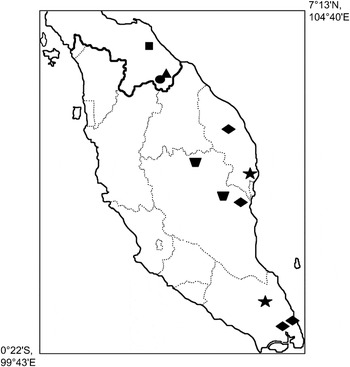
Distribution. Peninsular Malaysia (Perak), Singapore (or these only cultivated?) (Fig. 7).
Distribution of Scaphochlamys tenuis Holttum (▪), S. lanceolata (Ridl.) Holttum (▴), S. oculata (Ridl.) Holttum (•), S. rubromaculata Holttum (★), S. kunstleri (Baker) Holttum ( ) and S. pennipicta Holttum (♦).

Habitat and ecology. Deep shade near streams and on rocky outcrops. Altitude 30–100(–500) m.
Additional specimens examined. Malaysia. Perak: Sungai Siput, Burkill 6323 (SING); Lubok Merbau, Burkill & Haniff 13592 (SING); Kuala Kangsan, viii 1936, Corner 31674 (K, L, SING); Base of Gaa Badak, Leggong, 12 vi 1930, Henderson 23840 (K, SING); Larut, xi 1881, Kunstler 2542 (K); Upper Perak, Wray 3388, 3662, 3702 (SING); Kedah/Perak boundary, vi 1917, Mus s.n. (K); Gunung Tungal, iii 1894, Ridley 7228 (K, SING); Waterloo (Estate), xii 1895, Curtis 2719 (SING).
Singapore. Botanic Gardens, 30 iv 1929, Holttum 7258 (K, SING); in waterfall gardens: 10 xi 1917, Burkill 1299 (SING) & 31 viii 1920, Burkill 6110 (SING). Cultivated material: from Ipoh, 1 x 1969, Bradford C8003 (E).
At Kew, where Baker worked, there are two specimens that were received in 1888 from ‘Herb. Hort. Bot. Calcuttensis Flora of the Malay Peninsula’. The first is Kunstler 2542 from Larut dated November 1881 and the second is Kunstler 4413 from Perak, Larut, Gopeng dated June 1883. In the absence of a specimen dated 1882, cited by Baker, probably mistakenly (Newman, Reference Newman, Lhuillier and Poulsen2004), as being from Pegu, I have decided to neotypify one of the other specimens at Kew that Baker would have seen.
15b. Scaphochlamys kunstleri var. rubra (Ridl.) Holttum, Gard. Bull. Singapore 13: 97 (1950); Lim, Folia Malaysiana 2(2): 123 (2001); Newman et al., Blumea Suppl. 16: 147 (2004). – Curcuma kunstleri var. rubra Ridl., J. Straits Branch Roy. Asiat. Soc. 32: 120 (1899); Ridl., Mat. Fl. Malay. Penins. 2: 22 (1907); Turner, Asian J. Trop. Biol. 4(1): 20 (2000). – Hitcheniopsis kunstleri var. rubra (Ridl.) Ridl., Fl. Malay Penin. 4: 253 (1924); Turner, Asian J. Trop. Biol. 4(1): 44 (2000). – Type: Peninsular Malaysia, Perak: Kuala Dipang, x 1894, Curtis s.n. (lecto SING!, designated here).
Vegetative and floral characters the same as the type variety except in the following: bracts dark pink or creamy-green tinged pink at the edges; corolla cream or white; labellum and staminodes dark red; labellum also dark red with yellow or orange central mark; anther dark red or yellow. (Adapted from Lim, Reference Lim2001.)
Distribution. Peninsular Malaysia (Perak).
Habitat and ecology. Forms abundant colonies in dense damp forest.
Additional specimen examined. Malaysia. Perak: Tapah, Wray 193 (SING).
In the protologue dated 1899 Ridley cites from a specimen ‘Perak. Kwala Dipang, at the base of limestone hills’. The only specimen at SING to which he could be alluding is the above Curtis specimen currently held in the general collection and seen by the author. Therefore as this is generally accepted as the original material I have now designated it as the lectotype. It is also the Curtis specimen quoted by Holttum (Reference Holttum1950) for this variety. The neotypification by Lim (Reference Lim2001) is superfluous as original material is still available.
15c. Scaphochlamys kunstleri var. speciosa C.K.Lim, Folia Malaysiana 2(2): 123 (2001); Newman et al., Blumea Suppl. 16: 148 (2004). – Type: Peninsular Malaysia, Perak, Bintang Hijau Forest Reserve, Lim L4791 (holo KEP; iso SING).
Vegetative and floral characters the same as the type variety except in the following: bracts variable in colour (usually cream but may also be tinged with pink on the upper edges, sometimes red); flowers with white corolla and staminodes; labellum white with central yellow mark and pink transverse stripes at the sides towards the base; bract colours vary independently of floral colours. (Adapted from Lim, Reference Lim2001.)
Distribution. Peninsular Malaysia (Perak).
Habitat and ecology. Forming profuse colonies in wet valleys near streams. Has been found to occur alongside colonies of Scaphochlamys kunstleri var. kunstleri (e.g. the type location). Perhaps more detailed infraspecific studies may shed some interesting light on this species?
16. Scaphochlamys lanceolata (Ridl.) Holttum, Gard. Bull. Singapore 13: 99 (1950); Newman et al., Blumea Suppl. 16: 148 (2004). – Gastrochilus lanceolata Ridl., Mat. Fl. Malay. Penins. 2: 16 (1907); Ridl., Fl. Malay Penin. 4: 250 (1924); Turner, Asian J. Trop. Biol. 4(1): 24 (2000). – Type: Malaysia, Johore, Gunung Panti, xii 1892, Ridley s.n. (holo K!).
Rhizome slender, c.3 mm thick when dried, horizontal to somewhat ascending. Successive shoots close together, 0.5–1 cm apart, comprising 1–2 leaves surrounded by 2–3 leafless-sheaths to 3 cm long, glabrous. Leaf-sheath rather broad, to 3 cm long; ligule lobes triangular, c.4 mm long. Petiole 3.5–7 cm long, glabrous. Lamina upper surface light green with a white stripe running parallel with the mid-vein on each side of the leaf, lower surface paler and sparsely hairy, elliptic, asymmetric, 8–12(–15) × 3–4 cm, apex acute. Peduncle 1–2 cm long, hidden within the leaf-sheaths, glabrous. Inflorescence short, < 5 cm long, bearing 3–5 overlapping suberect bracts. Bracts green, 2.5–3.5 × 0.6 mm, linear to boat-shaped, glabrous, the edges firm, apex apiculate. Bracteole much smaller, 1.5 cm long, linear, glabrous with acute apex. Flowers 2–3 per bract. Ovary with calyx 12 mm long, unidentate and cleft, both glabrous. Corolla tube slender at base, widening towards the apex, 27 mm long; dorsal corolla lobe 10 × 4 mm, hooded; lateral corolla lobes slightly longer, 12 mm, white. Lateral staminodes white, narrowly obovate, 10 × 3 mm, apex rounded. Labellum 15 × 14 mm, deeply bilobed to 7 mm, splash of yellow in centre. Stamen filament broad; thecae long, thin, papillose, 3 × 0.5 mm with free basal spurs; crest broad and reflexed, 1–2 × 3 mm. Fruit unknown.
Distribution. Peninsular Malaysia (Johore) (Fig. 7).
Additional specimens examined. Malaysia. Johore: Cultivated material: iii 1980, C12761 & C8488 (E).
17. Scaphochlamys laxa Y.Y.Sam & Saw, Gard. Bull. Singapore 57: 258 (2005). – Type: Malaysia, Terengganu, Dungun, Jengai Forest Reserve, Sam & Apok FRI 49136 (holo KEP; iso SAN, SING).
Scaphochlamys mat-kilau C.K.Lim, Folia Malaysiana 6(1–2): 43 (2005). – Type: Peninsular Malaysia, Terengganu, Ulu Dungun, Kubu Mat Kilau, Lim L6822 (holo UKMB; iso SING).
Rhizome robust, growth horizontal. Successive shoots 1–3 cm apart, unifoliate, 3 leafless-sheaths red when young, longest sheath to 7–13 cm in length. Leaf-sheath 3–5 cm; ligule obscure. Petiole 13–36 cm long, red when young. Lamina upper surface dark green, sometimes with white bands between midrib and leaf margin, lower surface red when young, turning pale green with age, broadly elliptic or ovate, 13–22 × 10.5–14 cm, base slightly decurrent on the petiole, never cuneate, apex cuspidate. Peduncle 9–12 cm long, red when young. Inflorescence elongate and lax, rachis 6–11 cm long supporting c.5–8 bracts, each bract 0.4–2 cm apart. Bracts dark green, 1.7–2.5 × 0.8–1.6 cm, spathulate and broadly elliptic when flattened, margin hairy when young, apex acute, distally reflexed. Bracteoles smaller than bract, 5–7 × 4.5–6 mm, hairy towards apex. Flowers more than 2 per bract. Ovary 2 mm long, trilocular; 2 epigynous glands 4 mm long, yellow. Calyx tinged red, 6–7 mm long, apex bilobed, split 3–4 mm down one side. Corolla tube 13–17 mm long; dorsal corolla lobe lanceolate, 8–13 × 3–4 mm with inflexed margin, apex hooded and pointed, faintly yellow; lateral corolla lobes narrowly lanceolate with incurved margins, 7–11 × 2–3 mm, apex hooded and pointed. Lateral staminodes oblong, 9–11.5 × 1–3 mm, apex blunt, faint yellow towards apex, papillose on abaxial surface. Labellum flared towards apex, 11.5–22 × 10–20 mm, bilobed, cleft 6 mm from the apex, papillose, with yellow median band and purple streaks on both sides. Stamen with filament 2.5–3 mm long, some with purple blotches; thecae 2–2.5 mm long; crest 0.5 mm, cup-shaped, covered with brown papillae. Fruit unknown. (Adapted from Sam & Saw, Reference Sam and Saw2005.)
Distribution. Peninsular Malaysia (Terengganu) (Fig. 2).
Habitat and ecology. Found on undulating land and slopes of lowland dipterocarp forest under heavy shade. Altitude 65–130 m.
Having compared the protologues of these two new names, it is quite obvious that they refer to the same species – in fact they are so similar they could be describing the same specimen. Scaphochlamys laxa Y.Y.Sam & Saw takes precedence being the first published. It is worth noting at this point that Folia Malaysiana volume 6(1–2) was not available on the library shelves until well into 2006.
18. Scaphochlamys malaccana Baker in Hook.f., Fl. Brit. India 6: 252 (1892); Holttum, Gard. Bull. Singapore 13: 104 (1950); Larsen, Bot. Tidsskr. 58: 196 (1962); Newman et al., Blumea Suppl. 16: 148 (2004). – Gastrochilus scaphochlamys Ridl., J. Straits Branch Roy. Asiat. Soc. 32: 112 (1899); Ridl., Mat. Fl. Malay. Penins. 2: 16 (1907); Ridl., Fl. Malay Penin. 4: 250 (1924); Turner, Asian J. Trop. Biol. 4(1): 27 (2000), nom. illegit. (Scaphochlamys malaccana Baker cited as synonym). – Kaempferia malaccana (Baker) K.Schum. in Engler, Pflanzenr. IV, 46 (Heft 20): 81 (1904). – Boesenbergia scaphochlamys (Ridl.) Schltr., Repert. Spec. Nov. Regni Veg. 12: 317 (1913), nom. illegit.; Loesen. in Engler & Prantl, Nat. Pflanzenfam. ed. 2, 15A: 572 (1930). – Boesenbergia malaccana (Baker) Govaerts, World Checklist Seed Pl. 3: 9 (1999); Lim, Folia Malaysiana 2(3): 206 (2001). – Type: Peninsular Malaysia, Malacca, Guning Ledang, 1863–64, Griffith 5761 (lecto K!, designated here; isolecto AAU!, P).
Gastrochilus lancifolius Ridl., J. Straits Branch Roy. Asiat. Soc. 32: 112 (1899); Ridl., Mat. Fl. Malay. Penins. 2: 16 (1907); Ridl., Fl. Malay Penin. 4: 250 (1924); Turner, Asian J. Trop. Biol. 4(1): 24 (2000). – Kaempferia lancifolia (Ridl.) K.Schum. in Engler, Pflanzenr. IV, 46 (Heft 20): 80 (1904). – Boesenbergia lancifolia (Ridl.) Schltr., Repert. Spec. Nov. Regni Veg. 12: 316 (1913). – Type: Peninsular Malaysia, Johore, Kuala Sembrong, 1892, Lake & Kelsall s.n. (holo K!).
Kaempferia cumingii K.Schum. in Engler, Pflanzenr. IV, 46 (Heft 20): 80 (1904); Larsen, Bot. Tidsskr. 58: 196 (1962). – Type: Peninsular Malaysia, Malacca, Gunung Ledang, 1841, Cuming 2356 (lecto K!, designated here; isolecto E!, L!, P).
Rhizome obliquely ascending, 0.4 cm thick when dried, anchored by vertically growing prop roots. Successive shoots 2 cm apart, usually 2-leaved; longest leafless-sheath long, to 12 cm in length, purple. Leaf-sheath 4–8 cm long, narrow and glabrous; ligule small, rounded, petiole 4–8 cm long; combined leaf-sheath and petiole length 10–15 cm. Lamina with dark green upper surface, pale green lower surface, lower surface sparsely hairy towards the base and alongside midrib, elliptic, asymmetric, c.20 × 4.5 cm, base cuneate, shortly decurrent, apex acute, acuminate, or mucronulate. Peduncle long, flexuous, 4–12 cm long, glabrous or hairy. Inflorescence elongate, 8–16 cm long, the 3–8 bracts widely spaced, 0.7–2.5 cm apart, lax. Bracts large, green, stiff, 3–5 × 1.2–1.7 cm, narrowly elliptic to linear, involute at the base, spreading towards the apex, generally glabrous but sometimes with a fine covering of long fine white hairs, margins not thin. First bracteole 1.2 cm long, the rest much shorter. Flowers fragrant, 3–7 within each bract. Calyx with ovary 10 mm long, apex dentate and split 3 mm on one side. Corolla tube slender at base, widening towards apex, 25 mm long; corolla lobes white, 13 × 4–5 mm at the base, edges inflexed towards the acute apex. Staminodes white, as long as the corolla lobes, oblong with rounded tips, c.4 mm wide. Labellum obovate, bilobed to halfway, to c.18 × 14 mm, white with a yellow median band, sometimes with a pale lilac or purple line on either side of it towards the base, the lobes rounded and slightly overlapping. Stamen filament barely 3 mm long, broad; thecae c.3 mm long, the basal ends free and acute; crest broad, 2.5 × almost 4 mm, rounded, trilobed, the margin somewhat crisped, reflexed. Fruit 10 mm long, 3-seeded.
Distribution. Peninsular Malaysia (Johore, Malacca, Negri Sembilan) (Fig. 5).
Additional specimens examined. Malaysia. Johore: Bukit Muar, x 1892, Fielding s.n. (SING); Gunong Buidong, 3 vi 1923, Holttum 10994 (K). Malacca: Hullett 764 (K); ibid., 1871, Maingay 1579 (K); ibid., 11 xii 1935, Vesterdal 79, 101 (C); Gunong Ledang, Ridley 3141 (SING). Cultivated material: RBGE C8488: raised from plants collected at Johore, Gunung Panti, 1978, Burtt 11692 (E). Negri Sembilan: Senaling–Inas F.R., 28 xi 1922, Holttum 9783 (SING); Gunung Angsi, 24 xi 1923, Nur 11690 (K, SING); Gunung Angsi, ii 1904, Ridley 5761, 9895, 11690 (AAU, SING).
Baker, in the protologue of Scaphochlamys malaccana, lists ‘Cuming, Griffith (K. d. 5761), Maingay (Kew Distrib. 1579), Hullett’ all from Mount Ophir, Malacca. The Cuming syntype is also the type collection for the synonym Kaempferia cumingii K.Schum. Griffith 5761 (K) has been chosen here as the lectotype for Scaphochlamys malaccana Baker.
19. Scaphochlamys minutiflora Jenjitt. & K.Larsen, Nordic J. Bot. 22: 35 (2002); Newman et al., Blumea Suppl. 16: 148 (2004). – Type: Thailand, Narathiwat Province, Hala Bala Nature Reserve, near Chatwarin waterfall, 17 ii 2000, Tiptabiarnkarn 4407 (holo BKF; iso AAU).
Tufted herb to 30 cm high, with short creeping rhizome. Shoot comprising 2–3 leaves surrounded by 2–3 leafless-sheaths. Petiole 12–24 cm long, grooved; ligule bilobed, rounded triangular, 10 × 5 mm, wing-like at base. Lamina upper surface glossy green with grooved mid-vein, lower surface paler green, appressed white hairs along either side of the mid-vein, oblanceolate, 22–35 × 7–11 cm, base cuneate, apex acute. Peduncle up to 15 cm long. Inflorescence with densely imbricating bracts; each bract pale green, 2.7–3.5 × 0.8–1.3 cm, lanceolate-triangular, with thin, wavy margins and acute apex, enclosing 2 flowers; bracteole broadly lanceolate. Ovary ellipsoid, 2 mm long, yellowish, hairy; epigynous glands linear, 2 mm long, yellowish. Calyx c.6 mm long, hairy, apex acute, split from the apex on one side. Corolla tube white, 15 mm long, glabrous; dorsal corolla lobe linear, c.4.5 × 1.5 mm, apex rounded, glabrous; lateral corolla lobes narrowly oblong, 5 × 1.5 mm, apex broadly acute, hooded, white. Staminodes white, narrowly triangular, 1.5–2 × 0.5–0.7 mm. Labellum clawed with a rounded, shallowly bilobed apex, c.5 × 3–5 mm, 2 mm wide at the base, white with a V-shaped, purplish band. Stamen filament c.1 mm long; thecae 3 × 1 mm, white, base spurred with a shallow hole behind the apex of each pollen sac; anther crest 0.5 mm long with rounded, wavy or emarginate apex. Fruit unknown. (Adapted from Jenjittikul & Larsen, Reference Jenjittikul and Larsen2002.)
Distribution. Thailand (Narathiwat Province) (Fig. 4).
Habitat and ecology. Found along a small stream in evergreen forest. Altitude c.200 m.
Although an isotype is said to be deposited at AAU no material has been located there as yet.
20. Scaphochlamys obcordata Sirirugsa & K.Larsen, Nordic J. Bot. 11: 93 (1991); Newman et al., Blumea Suppl. 16: 148 (2004). – Type: Thailand, Narathiwat Province, Budo National Park, Bacho Falls, 8 x 1988, Sirirugsa 1173 (holo PSU, flowers in spirit only). Epitype: Same locality, 18 xiii 1995, Larsen et al. 45778 (epi AAU!, designated here).
Rhizome fleshy, horizontally creeping, white. Successive shoots 5–10 cm apart, each shoot comprising 2 (sometimes up to 4) leaves surrounded by 3 leafless-sheaths, the longest reaching to 9 cm long, pale at the base becoming greener towards the apex, glabrous. Leaf-sheath 6–9 cm long, sparsely hairy to glabrous; ligule membranous, broad, truncate. Petiole 2–4 cm long, sparsely hairy. Lamina upper surface light green, lower surface paler and sparsely hairy, obovate to oblanceolate, asymmetric, 15–30 × 9–12 cm, base shortly attenuate and somewhat rounded, apex acuminate to mucronulate. Peduncle subsessile, no more than 2 cm long. Inflorescence quite large becoming more open towards the apex, rachis 2–6 cm long, with 10–20 overlapping bracts, elongating with age. Bract 5.5 × 1.5 cm, linear to boat-shaped, pink, finely hairy to hairy, apex acute to mucronulate. First bracteole 4 × 1.9 cm, thereafter decreasing in size, linear, sparsely hairy, apex acuminate. Flowers 3–5 per bract. Ovary 6 mm long, glabrous; calyx 28 mm long, hairy, apex bidentate, cleft down one side by 11 mm. Corolla tube 45 mm long, glabrous; dorsal corolla lobe 25 × 7 mm, apex hooded; lateral corolla lobes 21 × 6 mm, apex acute. Staminodes white, oblong, 16 × 5 mm, apex rounded. Labellum obcordate, 28 × 20 mm, apex bilobed almost to the middle, white with a central yellow mark. Stamen filament 2 mm long, thecae 6 mm long, back of stamen covered in distinct glandular hairs; crest 1 × 2 mm, trilobed. Fruit unknown.
Distribution. Thailand (Narathiwat Province) (Fig. 4).
Habitat and ecology. Scattered throughout dipterocarp forest near Bacho Falls. Altitude 100–150 m.
Taxonomic notes. The original holotype material, Sirirugsa 1173 (PSU), has decayed and been lost (pers. obs.) except for some flowers in spirit. According to the protologue, an isotype was deposited at AAU but this seems never to have happened. In response to this lack of type material further material was sought at the type locality and distributed to AAU, BKF, E, K, L, PSU and SING (Larsen, Reference Larsen2001). The specimen at AAU has been chosen here as an epitype.
Additional specimen examined. Cultivated material: 95KL47007 (AAU).
21. Scaphochlamys oculata (Ridl.) Holttum, Gard. Bull. Singapore 13: 92 (1950); Newman et al., Blumea Suppl. 16: 148 (2004). – Gastrochilus oculata Ridl., J. Straits Branch Roy. Asiat. Soc. 32: 117 (1899); Ridl., Mat. Fl. Malay. Penins. 2: 19 (1907); Ridl., Fl. Malay Penin. 4: 251 (1924); Turner, Asian J. Trop. Biol. 4(1): 26 (2000). – Boesenbergia oculata (Ridl.) Schltr., Repert. Spec. Nov. Regni Veg. 12: 316 (1913). – Type: Malaysia, Selangor, Pahang Track, 1500 ft, 1897, Ridley 8484 (lecto K!, designated by Holttum, Reference Holttum1950).
Rhizome thin, 3 mm in diameter when dried. Successive shoots widely spaced, unifoliate, leafless-sheaths to 10 cm long, broad, a light covering of short spiny hairs from the base part way up the sheath. Leaf-sheath short, c.5 cm long, ligule lobes triangular, petiole quite slender, glabrous, to 28 cm long. Lamina lower surface flushed with purple and almost glabrous, ovate, to 23(–25) × 8–12 cm, base rounded to subcordate, somewhat decurrent, apex broadly acute. Peduncle 2–5 cm long, short-haired towards the apex. Inflorescence compact, ovoid, c.4 × 2 cm, including up to 15 closely packed bracts. Bracts 2.5–3.5 × 1.5 cm, oval, slightly spreading but not recurved, with narrow, thin, smooth edges, apex sometimes with a spiky-haired mucronule, otherwise bluntly pointed, glabrous except for a scattering of short spiny hairs towards the apex. First bracteole to 2.5 × 1.2 cm, trilobed and lightly tufted, the rest shorter. Flowers c.3 per bract. Calyx with ovary 15 mm long. Corolla tube 25–30 mm long; lobes 15 mm long, the dorsal corolla lobe 6 mm wide at base, apex hooded, acute. Staminodes white, as long as the corolla lobes, 5 mm wide with rounded ends. Labellum 22 mm long, bilobed nearly halfway to the base, > 15 mm wide, white with yellow centre and 2 crimson patches at the base. Stamen bent forward; thecae hardly 5 mm long and free at the base; crest short and hardly reflexed. Stigma apex densely ciliated. Fruit unknown.
Distribution. Peninsular Malaysia (Johore, Selangor) (Fig. 7).
Habitat and ecology. Reported from ridge forest dominated by Shorea curtisii Dyer ex King. Altitude 250–500 m.
Additional specimens examined. Malaysia. Johore: Gunung Janeng, 20 x 1892, Lake & Kelsall s.n. (SING). Selangor: Selinsing, Machado s.n. (K); Bukit Batu Berinding, Kanching, 2 xi 1937, Nur 34353 (SING); Gunung Sempah, 25 v 1975, Balgooy 2624 (L).
22. Scaphochlamys pennipicta Holttum, Gard. Bull. Singapore 13: 93 (1950); Newman et al., Blumea Suppl. 16: 149 (2004). – Type: Malaysia, Pahang, Fraser's Hill, 30 ix 1923, Md. Nur SFN 11181 (holo SING!; iso K!).
Rhizome thin, 3 mm in diameter when dried, long-creeping, 3–10 cm between successive shoots; shoots unifoliate, leafless-sheaths to 6 cm long, broad, glabrous, rapidly dying away with shoot development. Leaf-sheath short, thin and delicate, 1–5 cm long; ligule lobes triangular, 3 mm long, glabrous and delicate. Petiole 4–8.5 cm long, glabrous; overall length of leaf-sheath and petiole 7–10 cm. Lamina upper surface dark green with feather-like white markings, lower surface flushed reddish purple and glabrous, broadly elliptic to obovate, symmetrical, 15–18 × 7–9 cm, base cuneate-decurrent, apex broadly pointed with tufted mucro. Peduncle 3–6 cm long, slender and glabrous. Inflorescence compact, ovoid, c.2 × 1.2 cm, with c.10 bracts. Bracts thin and papery when dry, c.1.4 × almost 1 cm, ovate, thin-edged, glabrous except for the apex, the apex slightly recurved and ending in a short tufted apicule. Bracteole slender, shorter than the bracts, of which the first is 1.2 cm long. Flowers generally 2 within each bract. Calyx with ovary 10 mm long. Corolla tube 13 mm long; corolla lobes 8 mm long, white. Staminodes white, as long and narrow as the dorsal corolla lobe. Labellum white (possibly with additional yellow or claret colour?), 10 mm long or somewhat longer. Stamen filament very short; thecae 3 mm long; crest short and reflexed. Fruit unknown.
Distribution. Peninsular Malaysia (Pahang) (Fig. 7).
Habitat and ecology. Found on rich soil among rocks in dense jungle. Altitude 1300 m.
Additional specimen examined. Malaysia. Perak: Sine loc., ix 1886, Kunstler 10931 (K).
23. Scaphochlamys perakensis Holttum, Gard. Bull. Singapore 13: 97 (1950), nom. nov.; Newman et al., Blumea Suppl. 16: 149 (2004). – Curcuma lanceolata Ridl., Mat. Fl. Malay. Penins. 2: 22 (1907); Turner, Asian J. Trop. Biol. 4(1): 20 (2000). – Hitcheniopsis lanceolata (Ridl.) Ridl., Fl. Malay Penin. 4: 253 (1924); Turner, Asian J. Trop. Biol. 4(1): 44 (2000). – Type: Malaysia, Perak, Gunung Bujong, viii 1898, Curtis 2522 (holo SING!, iso K! – 2 sheets at each herbarium).
Rhizome robust, c.6 mm in diameter when dry, horizontally creeping. Successive shoots distant, to 12 cm or more apart, consisting of 2 leaves, a terminal inflorescence and surrounded by 3 sparsely hairy leafless-sheaths, of successive lengths: 4, 6 and to 12 cm. Leaf-sheath 9–15 cm long, with a distinct broad thin margin, glabrous to covered with long fine hairs; ligule lobes broadly triangular, to 5 mm long, thin. Petiole 10–30 cm long, also may or may not be hairy; overall leaf-sheath and petiole length to 40 cm. Lamina upper surface dark green, lower surface pale green, either glabrous or covered in long, quite coarse hair, particularly along the midrib, broadly elliptic to oblanceolate, slightly asymmetric, 25–45 × 5–11 cm. Peduncle 7–18 cm long, slender, densely hairy. Inflorescence elongates with age, typically tulip-shaped, although can range from small and ovoid when young to cylindrical when old, usually 3–8 × 2.5 cm; the many bracts congested on the spike, their tips curling open. Bracts green, sometimes with pinkish edges (as in the type), thin, papery when dry, 2.5–3 × 1 cm, boat-shaped, apex acuminate with a tufted apiculum, generally glabrous. First bracteole 1.3–2 cm long, the rest smaller. Flowers 3–4 per bract. Calyx with ovary 1.2 cm long. Corolla tube white, slender, 2 cm or more long, corolla lobes 8 mm long and white. Staminodes shorter than corolla lobes, white, apparently reflexed. Labellum obovate, a little longer than corolla lobes, white with pink markings on either side near the base and a median yellow patch near the apex, or sometimes without the pink markings. Stamen filament short; thecae 4 mm long, with short free acute tips at the base; crest not much wider than anther, ovate-acute and short. Fruit unknown.
Distribution. Peninsular Malaysia (Perak, Terengganu) (Fig. 5).
Habitat and ecology. Altitude 100–200 m.
Additional specimens examined. Malaysia. Perak: Bidor, Sungei Gepai, 4 viii 1936, Corner 31690 (E, K, L, SING); Larut, iii 1884, Kunstler 6788 (K); Tapah, xi 1901, Ridley 14031 (K, SING). Cultivated material: RBGE, ii 1966, Bradford C4962 (E). Terengganu: Gunong Lauit, 12 iii 1975, Shah MS3474 (C).
24. Scaphochlamys petiolata (K.Schum.) R.M.Sm., Notes Roy. Bot. Gard. Edinburgh 44: 210 (1987); Newman et al., Blumea Suppl. 16: 149 (2004). – Haplochorema petiolatum K.Schum. in Engler, Pflanzenr. IV, 46 (Heft 20): 90 (1904); Newman et al., Blumea Suppl. 16: 149 (2004). – Type: Borneo, Sarawak, 1st Division, Gunung Senggi (G. Sengayoh?), 11 xii 1892, Haviland 2026 (lecto K!, designated here; isolecto SAR!).
Rhizome fine, just over 1 mm in diameter when dried, supporting a network of fine roots. Successive shoots unifoliate, clumping, 0.5–1.5(–7) cm apart, each shoot encased by 3 leafless-sheaths, 2.5–3 cm long, tightly appressed against the leaf stem or scape, reddish-brown when young, becoming dry and brown with age, outer surface covered in long fine hairs, apex acute. Leaf-sheath short, 0.5–2 cm long; ligule small, obscure. Petiole 10–20 cm long, more or less glabrous. Lamina small and dainty, 10 × 4–5 cm, lanceolate, symmetric, base rounded, apex acute to mucronulate and tufted, upper surface shiny bright green, lower surface pale green and lightly covered in fine hairs. Peduncle 3 cm long, slender, glabrous. Inflorescence small, greatly reduced, bracts 2–3, hidden within the primary leafless-sheath. Bracts pale, thin and papery when dried, 1.6 cm long, boat-shaped, narrow, glabrous, apex acute (may be tufted), held at a stiff angle. First bracteole as long as bract, the second 1.2 cm long. Flowers 2–3 per bract. Ovary hairy; calyx with ovary 10 mm long; calyx apex truncate and tufted, cleft on one side. Corolla tube white, 22 mm long and covered in upwardly directed fine hairs; dorsal corolla lobe 7 mm long, hooded, apex acute; lateral corolla lobes 6 × 2 mm, linear, bluntly pointed, all lobes a pale translucent yellow colour. Staminodes short, oblong shape, apex blunt, and with a yellow tinge, with tiny glandular hairs. Labellum 6 × 6 mm, clawed, with central yellow mark, surrounded by dark lilac area, the rest of the labellum a pale lilac colour, bilobed up to a third, edges overlapping, with glandular hairs. Stamen overall white; thecae 4 mm long; crest 1–2 mm long, bidentate. Fruit unknown.
Distribution. Malaysia (Sarawak) (Fig. 8).
Distribution of Scaphochlamys petiolata (K.Schum.) R.M.Sm. (▪), S. polyphylla (K.Schum.) B.L.Burtt & R.M.Sm. (▴) and S. reticosa (Ridl.) R.M.Sm. (•).

Habitat and ecology. Kerangas forest, flat area near river. Altitude c.50 m.
Additional specimens examined. Malaysia. Sarawak: 1st Division, Sungei Rayu, 26 iv 2004, Poulsen 2309 (E); West Borneo, 7 xii 1924, Winkler 629 (L). Cultivated material: RBGE acc. no. 20040945, 1 viii 2005, Poulsen C2381 (E).
25. Scaphochlamys polyphylla (K.Schum.) B.L.Burtt & R.M.Sm., Notes Roy. Bot. Gard. Edinburgh 31: 315 (1972); R.M.Sm., Notes Roy. Bot. Gard. Edinburgh 44: 208 (1987); Newman et al., Blumea Suppl. 16: 149 (2004). – Haplochorema polyphyllum K.Schum., Bot. Jahrb. 27: 332 (1899); K.Schum. in Engler, Pflanzenr. IV, 46 (Heft 20): 88 (1904). – Type: Borneo, Sarawak, 1st Division, Lundu, Beccari 2324 (holo FI!).
Gastrochilus bractescens Ridl., J. Straits Branch Roy. Asiat. Soc. 54: 57 (1910); Valeton, Bull. Jard. Bot. Buitenzorg 27: 103 (1918); Turner, Asian J. Trop. Biol. 4(1): 23 (2000). – Boesenbergia bractescens (Ridl.) Merr., Bibl. Enum. Born. Pl. 122 (1921). – Type: Borneo, Sarawak, 1st Division, Lundu, Foxworthy 42 (holo SING!).
Gastrochilus laxiflorum Valeton, Bull. Jard. Bot. Buitenzorg 27: 100, pl. 13 (1918). – Boesenbergia laxiflora (Valeton) Loesen. in Engler & Prantl, Nat. Pflanzenfam. ed. 2, 15A: 572 (1930). – Type: Borneo, Kalimantan, Monterado, Opi Mountains, Teysmann 10916 (holo BO; iso FI!).
Rhizome creeping obliquely or vertical, consisting of short internodes of 0.5 cm. Successive shoots indistinct, tightly clumped together giving a tufted appearance to the plant, 2–6 leaves per shoot. Leaf-sheaths broad, distinct, c.3–4 × 3–4 mm, ligule bilobed, 1.5–2 mm long, membranous, petiole 4–5 cm long, thin, leaf-sheath and petiole together 6–9 cm long, glabrous. Lamina upper surface dark green, lower surface paler, sometimes flushed purple, glabrous to sparsely hairy along the midrib, linear to elliptic, slightly asymmetric, 7–15 × 2–3 cm, base attenuate, apex acuminate and apiculate. Peduncle 2–5 cm long, generally glabrous, sometimes hairy. Inflorescence 9 cm long, with 8–12 bracts, closely imbricating when young, becoming more lax (and glabrous) as spike elongates and ages. Bracts stiff, linear with an inflexed base becoming open towards apex, 2–3 × 0.7 cm, apex acute to mucronulate, sometimes purple, outer surface covered in long fine hairs becoming glabrescent with age; margins thin, slightly crisped, sometimes tinged with purple. First bracteole 1–2 cm long, linear, glabrous, apex acute. Flowers 4 per bract. Ovary 2 mm long, glabrous; calyx 9 mm long, cleft on one side. Corolla tube 12 mm long, corolla lobes 8–9 mm long. Staminodes obtuse, 8 mm long. Labellum 10 mm long, deeply bilobed. Stamen thecae 7–8 mm long; connective crest shortly obtuse. Fruit unknown.
Distribution. Indonesia (Kalimantan Barat), Malaysia (Sarawak) (Fig. 8).
Habitat and ecology. Lowland, kerangas forest on sandy soil, also found on white sandy podsol. Altitude c.20–35 m.
Additional specimens examined. Malaysia. Sarawak: 1st Division: Lundu, Yii & Othman 46244 (K); Lundu, 15 vi 1991, Yahud 61966 (AAU, E, K, L); Rumah Temenggong, S. Begrih, S. Bawan, Balingian, 20 x 1963, Chai S19483 (K); Bako National Park, 14 v 1980, Ching S42269 (AAU, K, L); Selepong Berangan, Sri Aman, 15 viii 1991, Runi 59662 (AAU, E, K); Bako National Park, 17 v 1956, Purseglove 4949 (K, SING).
26. Scaphochlamys reticosa (Ridl.) R.M.Sm., Notes Roy. Bot. Gard. Edinburgh 44: 209 (1987); Newman et al., Blumea Suppl. 16: 149 (2004). – Gastrochilus reticosa Ridl., J. Straits Branch Roy. Asiat. Soc. 44: 195 (1905); Turner, Asian J. Trop. Biol. 4(1): 27 (2000). – Boesenbergia reticosa (Ridl.) Merr., Bibl. Enum. Born. Pl. 122 (1921). – Type: Cultivated Singapore Botanic Gardens, originally from Borneo, Sarawak, 1st Division, Bidi, 22 ix 1904, Ridley s.n. (holo SING!).
Small clumping ground herb, 10 cm tall. Rhizome slender, creeping through the soil. Successive shoots clumping, c.2 cm apart, unifoliate; each shoot encased by 2 leafless-sheaths, the outer 1.5 cm long, the inner reaching 4 cm, both tightly appressed against the leaf stem, pale green when young, becoming scarious with age, glabrous, apex mucronulate. Leaf-sheath 2 cm long, ligule thin and membranous, triangular, 1–2 mm long, but not always visible as it rapidly decays with age, petiole 6–8 cm long, glabrous. Lamina upper surface dark green, mid-vein sunken, all other venation raised, giving the surface a distinctly ridged and reticulate texture, lower surface paler and glabrous, ovate, 6–10 × 4.5–6 cm, base slightly cordate to rounded, shortly attenuate, apex acute, tufted. Peduncle pale green, c.2 cm long. Inflorescence reduced, compact, with 5 imbricating bracts. First bract 1.8 × 0.5 cm, glabrous, open to base, boat-shaped, edges incurving, apex acute. First bracteole 1.5 cm long, 2-keeled, second smaller. Flowers 2 per bract. Ovary and calyx 14 mm long, covered in long fine hairs, calyx apex bidentate and deeply cleft. Corolla tube 18 mm long, white; dorsal corolla petal 7 × 3 mm, with hooded apex; lateral corolla lobes 6 mm long, linear, edges incurling somewhat, apex rounded; lobes pale translucent yellow. Staminodes short, white, 5 × 2 mm, club-shaped, apex rounded, narrowing towards the base, with glandular hairs. Labellum with pale central yellow mark on pale lilac background, 9 × 8 mm, clawed, apex rounded, with cleft 3 mm deep and overlapping, with glandular hairs. Stamen overall white; thecae 4 mm long with rounded bases; crest 1–2 mm long and bidentate. Stigma held just above the thecae, cup-shaped, edge shortly ciliate. Fruit unknown.
Distribution. Malaysia (Sarawak) (Fig. 8).
Habitat and ecology. Found on limestone rocks.
Additional specimens examined. Malaysia. Sarawak: 1st Division, Bidi, 15 vii 1915, Unknown collector s.n. (K). Cultivated material: RBGE acc. no. 20040949, 1st Division, 1 viii 2005, Poulsen C2382 (E).
A small and dainty plant with unusual and striking reticulate veined leaves. This is the only Scaphochlamys species so far found with such distinct venation, although there is a strong likelihood that further reticulate species may still be found in Borneo. Although Turner (Reference Turner2000) indicates that he saw the isotype of this species at K, I was unable to find it despite careful searching.
27. Scaphochlamys rubescens Jenjitt. & K.Larsen, Nordic J. Bot. 22: 37 (2002); Newman et al., Blumea Suppl. 16: 149 (2004). – Type: Thailand, Narathiwat Province, Sukirin, 17 ii 2000, Tiptabiarnkarn 5080 (holo BKF; iso AAU).
Small, densely tufted herb, to 8 cm high with short succulent rhizome. Successive shoots unifoliate, surrounded by 2 reddish leafless-sheaths. Petiole to 8 cm long, canaliculate, ligule not seen. Lamina upper surface dull green with 1 row of silver spots on either side of the midrib, lower surface purple, elliptic, 15–19 × 9.5–13.5 cm, base acute, apex broadly acute. Peduncle to 5 cm long. Inflorescence fusiform to elliptic, to 4 × 2 cm. Bracts white to pale pinkish, each bract subtending 2–4 flowers. Bracteole to 1.4 cm long, broadly ovate, apex trilobed. Ovary pale green, conical to obovoid, 2.5 mm long; epigynous glands linear, 7–8 mm long, cream-coloured to pale yellow. Calyx 12 mm long, glabrous, split on one side, apex unequally bilobed. Corolla tube 20–25 mm long, glabrous, white; dorsal corolla lobe oblong, apex hooded, acute, 8 × 3–4 mm; lateral corolla lobes linear oval, apex broadly acute, shortly hooded, 7.5–8 × 1.5–3 mm and white. Lateral staminodes reflexed, linear, 5 × 1.8 mm, white, with glandular hairs. Labellum obovate, base of labellum triangular, 7–8 × 10 mm, deeply bilobed to 3/4 of its length, white with a yellow band near inner margin of overlapping lobes. Stamen filament c.2 mm long, furrowed, white; thecae 5 × 1 mm, base shortly spurred; crest bilobed, lobes rounded, ciliate. Fruit unknown. (Adapted from Jenjittikul & Larsen, Reference Jenjittikul and Larsen2002.)
Distribution. Thailand (Narathiwat Province) (Fig. 4).
Habitat and ecology. Lowland evergreen forest.
28. Scaphochlamys rubromaculata Holttum, Gard. Bull. Singapore 13: 103, fig. 11A (1950); Newman et al., Blumea Suppl. 16: 150 (2004). – Type: Malaysia, Terengganu, Kemaman, Ulu Bendong, 700 ft, 29 x 1935, Corner SFN 30031 (lecto SING!, designated here; iso BO, E!, K!).
Rhizome 2–5 mm in diameter when dried, obliquely ascending, supported by a dense network of vertical prop roots. Successive shoots short, crowded, 1–1.5 cm apart, with 1–2 leaves. Leafless-sheaths to 12 cm long, glabrous, rapidly dying back with age. Leaf-sheath and petiole together 7–11 cm long, glabrous, ligule not seen. Lamina upper surface pale green, lower surface paler and almost glabrous, elliptic, distinctly asymmetric, 15–20 × 4.5–5 cm, base decurrent, apex acute. Peduncle 4–6 cm long, glabrous to sparsely hairy. Inflorescence somewhat elongate and open, rachis 4 cm long, glabrous to semi-glabrous, slightly flexible with 6–8 bracts. Bracts green, lax, diverging from the rachis at an angle of c.45°, the base clasping round the rachis, but spreading flat towards the apex, 2–2.5 × 0.7 cm, elliptic to linear, glabrous, apex rounded, minutely apiculate, margins not thin. First bracteole 8 mm long, the rest shorter. Flowers 4 (or more) per bract. Corolla tube no more than 20 mm long, corolla lobes 8 mm long, narrow, white. Staminodes white, 6 × 2 mm, spreading and slightly reflexed. Labellum 11 × 8 mm, bilobed by not more than halfway; lobes rounded, imbricating, white with pale yellow median band flanked on both sides towards the base by a blood-red blotch. Stamen filament with thecae c.3.5 mm long, crest reflexed, rounded, 2.5 mm wide. Fruit 12 mm long, ellipsoid with thin pericarp. Seeds 10 mm long.
Distribution. Peninsular Malaysia (Terengganu) (Fig. 7).
Habitat and ecology. Altitude 250 m.
Additional specimens examined. Malaysia. Terengganu: Kemaman, Ulu Bendong, 29 x 1935, Corner 30011 (para E, K, L, SING).
Singapore. Cultivated material: Bukit Timah F.R., 26 xi 1949, Sinclair 6290, 38855 (E, L, SING).
Holttum (Reference Holttum1950) quotes two specimens as types in the protologue without defining either as the holotype. However, on the herbarium specimen, Corner 30031 in SING, he clearly labels it as the type of the species. This specimen, therefore, is designated as the lectotype here.
29. Scaphochlamys subbiloba (Burkill ex Ridl.) Holttum, Gard. Bull. Singapore 13: 105 (1950); Newman et al., Blumea Suppl. 16: 150 (2004). – Gastrochilus subbilobus Ridl., Fl. Malay Penin. 4: 250 (1924); Valeton, Bull. Jard. Bot. Buitenzorg 27: 87 (1918); Turner, Asian J. Trop. Biol. 4(1): 27 (2000). – Type: Malaysia, Johore, Pulau Tioman, Joara Bay, 25 vi 1915, Burkill SFN 1002 (lecto K!, designated by Turner, Reference Turner2000).
Rhizome creeping horizontally, sometimes obliquely, 4–5 mm in diameter when dried. Successive shoots close together, to 1 cm apart, each shoot with 1 or 2 leaves surrounded by 3 leafless-sheaths, the longest sheath to 10 cm long, tinged with red, becoming brown, thin, papery when dried, glabrous but for (usually) hairy margin towards apex. Leaf-sheath to 6(–12) cm long, narrow, ligule small and usually broken. Petiole 3–6 cm long; leaf-sheath and petiole together 6–15 cm, glabrous. Lamina dark green above, lower surface paler, glabrous, elliptic, generally asymmetric, 13–24 × 4–8 cm (longest leaf not always the widest), base cuneate to slightly decurrent, apex acute, sometimes mucronulate. Peduncle 4–6 cm long, rather slender, fine-haired. Inflorescence rachis 5–10 cm long, more or less flexuous, hairy, bearing 5–10 bracts, which are c.1 cm apart and held somewhat upright. Bracts 2.2–2.8 × 0.6–0.8 cm when flattened, stiffly boat-shaped with thin edges inflexed throughout, elliptic, apex long thin acute, sparsely hairy when young, sometimes glabrous when old. First bracteole 1.3 cm long, the others shorter. Corolla tube 2.5 cm long, corolla lobes 1 cm long, white. Staminodes about the same length as the dorsal corolla lobe and about as wide, oblong, white. Labellum a little longer, shortly bilobed, white with a median pale yellow band and no other colour. Fruit unknown.
Distribution. Peninsular Malaysia (Pahang) (Fig. 5).
Habitat and ecology. Deep shade in forest in rocky soil. Altitude 0–400 m.
Additional specimens examined. Malaysia. Pahang: Pulau Tioman: Joara Bay, 25 vi 1915, Burkill 1143 (para K, SING); near Tanah Runto, 12 v 1927, Henderson 18380 (K, SING); Ayer Surin, 18 iv 1929, Henderson 21701 (K, SING).
30. Scaphochlamys sylvestris (Ridl.) Holttum, Gard. Bull. Singapore 13: 91 (1950); Newman et al., Blumea Suppl. 16: 150 (2004). – Curcuma sylvestris Ridl., Trans. Linn. Soc. ser. II, 3: 378 (1893); Ridl., J. Straits Branch Roy. Asiat. Soc. 32: 121 (1899); Ridl., Mat. Fl. Malay. Penins. 2: 22 (1907); Turner, Asian J. Trop. Biol. 4(1): 20 (2000). – Hitcheniopsis sylvestris (Ridl.) Ridl., Fl. Malay Penin. 4: 253 (1924); Turner, Asian J. Trop. Biol. 4(1): 44 (2000). – Type: Malaysia, Pahang, 1891, Ridley 2400 (lecto K, on 2 sheets!, designated by Holttum, Reference Holttum1950).
Rhizome creeping, 6 mm in diameter when dry. Successive shoots c.3 cm apart, unifoliate, surrounded by 2 broad, glabrous, stiff leafless-sheaths to 16 × 2 cm. Leaf-sheath comparatively short, glabrous, 2–7.5 cm long, ligule small, 2 mm long, triangular, petiole 30–45 cm long, glabrous at base, becoming sparsely hairy towards base of lamina; leaf-sheath and petiole together 30–55 cm. Lamina lower surface purple, hairy along the midrib, but otherwise almost glabrous, ovate to narrowly ovate, symmetrical, 18–26 × 8–14 cm, the longest leaf not always the widest, base rounded to subcordate, apex acuminate. Peduncle long and slender, c.15 cm in length, glabrous. Inflorescence ovoid or ellipsoid, 5 × 2.5–3 cm, with up to 15 tightly packed bracts. Bracts short, broad, 2.5–3 × 1.5 cm, glabrous, apex broadly pointed to rounded, sometimes mucronulate, tinged with red, curved outward; edges thin, sometimes slightly crisped. First bracteole 1.8 × 1 cm when flattened, the rest decreasing in size up the rachis. Flowers c.3 per bract. Calyx with ovary 11 mm long. Corolla tube somewhat shorter than bract; corolla lobes 1.2 cm long, white. Lateral staminodes white, about as long as the corolla lobes, oblong with rounded ends. Labellum a little longer than the corolla lobes, oblong to ovate with bilobed apex, white with median yellow patch and violet streaks on either side of it. Stamen thecae 3 mm long with short acute free basal spurs; crest broad, recurved and violet. Fruit unknown.
Distribution. Peninsular Malaysia (Pahang) (Fig. 4).
Habitat and ecology. Altitude 400 m.
Additional specimens examined. Malaysia. Pahang: Gunung Tahan, 16 ix 1937, Corner s.n. (SING); Sungai Teku, 10 xi 1922, Haniff & Nur 8104 (K); Sungai Teku, 18 vii 1936, Kiah 31707 (K); Sungai Teku, 2 ii 1968, Shah MS1385 (K, L, SING); Kuala Teku, 1911, Ridley s.n. (K); Gunung Tapis ridge, near Kuantan, Symington 28813 (SING).
31. Scaphochlamys tenuis Holttum, Gard. Bull. Singapore 13: 98 (1950); Newman et al., Blumea Suppl. 16: 150 (2004). – Type: Malaysia, Terengganu, Kemaman, Sungai Nipa, 22 xi 1935, Corner 30543 (holo SING!; iso BO, E!, L!, K!).
Rhizome robust, creeping horizontally above ground, anchored by vertically growing prop roots. Successive shoots crowded together, c.1 cm apart and for the most part touching, each consisting of 1–2 leaves surrounded by 3 glabrous leafless-sheaths to 12 cm long. Leaf-sheath 3–8 cm long, ligule lobes 3 mm long, triangular and somewhat brittle when dry, petiole 12–18 cm long, leaf-sheath and petiole together to 25 cm long. Lamina entirely green, elliptic, slightly asymmetric, 15–25 × 5–7 cm, base narrowly rounded to cuneate and slightly decurrent, apex acute to acuminate. Peduncle 4–5 cm long, slender, glabrous. Inflorescence greatly elongated, 15–25 cm long, slender, comprising 10–20 bracts, 1.5–2 cm apart, tightly appressed to the rachis; rachis glabrous and flexible. Bracts green, with thin brown edges which are not crisped, 2–3 × 1 cm, apex narrowly acute to apiculate, base amplexicaul, glabrous. First bracteole 1.7 × 0.6 cm. Flowers white, lightly scented, 3–5 per bract. Ovary glabrous, unilocular, sometimes with only a single ovule, calyx with ovary 12–13 mm long. Corolla tube 32 mm long, lobes 10 mm long. Staminodes slightly shorter than the corolla lobes. Labellum 13 mm long, the lobes rounded, imbricating, split nearly halfway to the base, white with a central pale yellow mark, flanked by 2 purple streaks. Stamen filament 2 mm long, thecae 4 mm long; crest short, trilobed, with a slight lilac tint, reflexed. Fruit ellipsoid, 13 mm long, unilocular, sometimes containing a single seed. Seed 11 mm long, ellipsoid.
Distribution. Peninsular Malaysia (Terengganu) (Fig. 7).
Habitat and ecology. Forms large but localised colonies.
Additional specimens examined. Malaysia. Terengganu: 38th mile Besut road, west side, 15 vii 1953, Sinclair 39957 (SING).
Singapore. Cultivated material: Bukit Timah F.R., 26 xi 1949, Sinclair 6291 (E).
Sometimes the bracts may appear regularly two-ranked, but are usually spiral in arrangement (Holttum, Reference Holttum1950).
Unplaced Specimens
Scaphochlamys sp. Holttum: Malaysia. Pahang: Karak Forest Reserve, Bentong, Best SFN 13882 (SING). Although Holttum (Reference Holttum1950) included a morphological description in his revision for this specimen which he referred to as Scaphochlamys sp., he did not feel that he had sufficient floral characters to complete a proper protologue. Perhaps one day further material may be found.
There are a number of specimens from Borneo that have been identified under various names. Because the location of these plants is so far from their normal distribution I feel that quite a few herbarium specimens may belong to new local species which so far have not been properly described and I am disinclined to include them under the current nomenclature system. See list below.
Scaphochlamys breviscapa Holttum: Malaysia. Sarawak: Kampong Segu, limestone hill, 26 v 1975, Burtt 8198 (E, K, L). Although this specimen appears very similar to S. breviscapa Holttum it lies too far from the normal distribution range, in Terengganu in northern Malaysia, for me to be totally convinced of its position in this species.
Scaphochlamys sp. aff. concinna: Malaysia. Sarawak: 1st Division, Lundu, Biawak Rd, 6th mile, in Kerangas forest, 9 v 1981, R. George S.41740 (E, K, SAN). In general morphology very similar to S. concinna (Baker) Holttum, in particular in the strongly cordate lamina base. However, the inflorescence terminates a very short peduncle.
Boesenbergia gracilipes (K.Schum.) R.M.Sm.: Malaysia. Sarawak: 4th Division, Gunung Mulu, National Park, nr Tarikan, 14 iv 1975, Burtt 8281 (E); 5th Division, Gunung Merapok, Native Collector s.n. (UC 316011). Sabah: Crocker Range above Kallang Falls, by stream in primary forest, ii 1985, Lamb 6/85 (E); Tenom Orchid Centre, cult. A. Lamb, 11 vi 1986, R.M. Smith 8/86 (E). Indonesia. Kalimantan: between Long Bawan and Panado, Gunung Paris, 6 vii 1981, Geesink 8934 (L). These specimens are quite variable and were originally determined by R. M. Smith to B. gracilipes (K.Schum.) R.M.Sm. As the basionym is now transferred to Scaphochlamys Baker based on the type specimen the remaining specimens now require further identification.
Scaphochlamys petiolata (K.Schum.) R.M.Sm.: Malaysia. Sabah: Tawau, Sepulut Forest Dev., 17 xii 1984, Aban 107545 (SAN); Ulu Sungei Pinahgah, 17 x 1984, Lideh et al. 107218 (SAN); Telupid, above Sungei Melian, 31 xii 1990, Meijer 98839 (SAN). Brunei. Belait District, Ulu Ingei, Bukit Batu Patam, 8 vi 1986, Boyce et al. 272 (K); Temurong Amo, 15 vii 1993, Cowley 59 (K). Most of the species within this genus have small restricted ranges. Probably potentially new species to be described when fresh material becomes available.
Acknowledgements
I should like to thank the staff of the herbaria of AAU, C, E, FI, K, KEP, L, RNG, SAN, SAR and SING not only for the loan of their collections but also for all the help and kindnesses I have received during my various visits. In particular I wish to acknowledge the support of Professor Kai Larsen, and the invaluable help and support from Mark Newman and Axel Poulsen. Finally I wish to thank the two anonymous reviewers for all their help and advice.
Index of Scientific Names
Accepted names are given in roman script, synonyms in italics and the new combination in bold. The number in parentheses is the number of the accepted taxon.
Boesenbergia anomala (Hallier f.) Schltr. (2)
Boesenbergia biloba (Ridl.) Schltr. (5)
Boesenbergia bractescens (Ridl.) Merr. (25)
Boesenbergia calophylla (Ridl.) Schltr. (5)
Boesenbergia concinna (Ridl.) Schltr. (9)
Boesenbergia gracilipes (K.Schum.) R.M.Sm. (12)
Boesenbergia klossii (Ridl.) Loesen. (14a)
Boesenbergia lancifolia (Ridl.) Schltr. (18)
Boesenbergia laxiflora (Valeton) Loesen. (25)
Boesenbergia malaccana (Baker) Govaerts (18)
Boesenbergia oculata (Ridl.) Schltr. (21)
Boesenbergia reticosa (Ridl.) Merr. (26)
Boesenbergia scaphochlamys (Ridl.) Schltr., nom. illegit. (18)
Curcuma kunstleri Baker (15a)
Curcuma kunstleri var. rubra Ridl. (15b)
Curcuma lanceolata Ridl. (23)
Curcuma sylvestris Ridl. (30)
Gastrochilus anomalum (Hallier f.) K.Schum. (2)
Gastrochilus biloba Ridl. (5)
Gastrochilus biloba Ridl. var. lanceolata Ridl. (5)
Gastrochilus bractescens Ridl. (25)
Gastrochilus calophylla Ridl. (5)
Gastrochilus concinna (Baker) Ridl. (9)
Gastrochilus hallieri (Hallier f.) Ridl., nom. illegit. (2)
Gastrochilus klossii Ridl. (14a)
Gastrochilus kunstleri (Baker) Valeton (15a)
Gastrochilus lanceolata Ridl. (16)
Gastrochilus lancifolius Ridl. (18)
Gastrochilus laxiflorum Valeton (25)
Gastrochilus longifolia Ridl. (5)
Gastrochilus minor sensu Ridl. (5)
Gastrochilus oculata Ridl. (21)
Gastrochilus reticosa Ridl. (26)
Gastrochilus scaphochlamys Ridl., nom. illegit. (18)
Gastrochilus subbilobus Ridl. (29)
Haplochorema gracilipes K.Schum. (12)
Haplochorema petiolatum K.Schum. (24)
Haplochorema polyphyllum K.Schum. (25)
Hitcheniopsis kunstleri (Baker) Ridl. (15a)
Hitcheniopsis kunstleri var. rubra (Ridl.) Ridl. (15b)
Hitcheniopsis lanceolata (Ridl.) Ridl. (23)
Hitcheniopsis sylvestris (Ridl.) Ridl. (30)
Kaempferia anomala Hallier f. (2)
Kaempferia biloba (Ridl.) K.Schum. (5)
Kaempferia calophylla (Ridl.) K.Schum. (5)
Kaempferia concinna Baker (9)
Kaempferia cumingii K.Schum. (18)
Kaempferia lancifolia (Ridl.) K.Schum. (18)
Kaempferia lutea C.H.Wright (15a)
Kaempferia malaccana (Baker) K.Schum. (18)
Scaphochlamys abdullahii Y.Y.Sam & Saw (1)
Scaphochlamys anomala (Hallier f.) R.J.Searle (2)
Scaphochlamys argentea R.M.Sm. (3)
Scaphochlamys atroviridis Holttum (4)
Scaphochlamys biloba (Ridl.) Holttum (5)
Scaphochlamys biloba (Ridl.) Holttum var. lanceolata (Ridl.) Holttum (5)
Scaphochlamys breviscapa Holttum (6)
Scaphochlamys burkillii Holttum (7)
Scaphochlamys calcicola A.D.Poulsen & R.J.Searle (8)
Scaphochlamys concinna (Baker) Holttum (9)
Scaphochlamys cordata Y.Y.Sam & Saw (10)
Scaphochlamys erecta Holttum (11)
Scaphochlamys gracilipes (K.Schum.) S.Sakai & Nagam. (12)
Scaphochlamys grandis Holttum (13)
Scaphochlamys klossii var. klossii (Ridl.) Holttum (14a)
Scaphochlamys klossii var. glomerata Holttum (14b)
Scaphochlamys klossii var. minor Holttum (14c)
Scaphochlamys kunstleri var. kunstleri (Baker) Holttum (15a)
Scaphochlamys kunstleri var. rubra (Ridl.) Holttum (15b)
Scaphochlamys kunstleri var. speciosa C.K.Lim (15c)
Scaphochlamys lanceolata (Ridl.) Holttum (16)
Scaphochlamys laxa Y.Y.Sam & Saw (17)
Scaphochlamys longifolia Holttum (5)
Scaphochlamys malaccana Baker (18)
Scaphochlamys mat-kilau C.K.Lim (17)
Scaphochlamys minutiflora Jenjitt. & K.Larsen (19)
Scaphochlamys obcordata Sirirugsa & K.Larsen (20)
Scaphochlamys oculata (Ridl.) Holttum (21)
Scaphochlamys pennipicta Holttum (22)
Scaphochlamys perakensis Holttum (23)
Scaphochlamys petiolata (K.Schum.) R.M.Sm. (24)
Scaphochlamys polyphylla (K.Schum.) B.L.Burtt & R.M.Sm. (25)
Scaphochlamys reticosa (Ridl.) R.M.Sm. (26)
Scaphochlamys rubescens Jenjitt. & K.Larsen (27)
Scaphochlamys rubromaculata Holttum (28)
Scaphochlamys subbiloba (Burkill ex Ridl.) Holttum (29)
Scaphochlamys sylvestris (Ridl.) Holttum (30)
Scaphochlamys tenuis Holttum (31)