1 Introduction
Phonology concerns itself with two conceptually distinct domains of regularity, cross-linguistic and language-internal. Many linguistic approaches have concerned themselves with cross-linguistic regularity – the observation that some structures and patterns tend to recur in many languages. In some (e.g. Trubetzkoy Reference Trubetzkoy1939, Jakobson et al. Reference Jakobson, Fant and Halle1952, Archangeli & Pulleyblank Reference Archangeli and Pulleyblank1994), this regularity stems from innate limitations on the alphabet of phonological features and their combinatorial possibilities, while others place limitations on the set of possible constraints governing phonological surface forms (Prince & Smolensky Reference Prince and Paul1993). In other approaches, like Evolutionary Phonology (Blevins Reference Blevins2004, Reference Blevins2006b), a great number of cross-linguistic regularities are accounted for as by-products of common pathways of language change.
However, individual languages do not recapitulate the cross-linguistic distribution of existing patterns and structures within their phonologies and lexicons, but instead exhibit some subset of these patterns consistently. For example, while neutralisation of word-final obstruent voicing is a strong cross-linguistic tendency, given languages tend to either neutralise an obstruent voicing contrast word-finally or not. The sources of this kind of strong language-internal regularity will be the subject of this paper. In generative models of phonological competence, regularity ultimately stems from strong limitations in the kind and amount of information that can be stored and manipulated. However, a great deal of research over the last two decades indicates that speakers continually store and use a very broad range of detailed, redundant information in language production and perception (e.g. Hintzman Reference Hintzman1986, Goldinger Reference Goldinger1996, Johnson Reference Johnson, Johnson and Mullennix1997, Alegre & Gordon Reference Gordon1999, Bybee Reference Bybee2002b). These findings in turn suggest a careful re-evaluation of the sources of regularity in phonological systems. In what follows I will argue that positive feedback loops engendered by this ongoing storage and reuse of information provide a plausible mechanism for the development of language-internal patterns of regularity.
In generative models of phonology and many of its precursors, regularity arises from the simplicity and abstractness of stored lexical representations and the operation of general algorithms that modify and enrich this encoded information in the process of production (for a review, see Kenstowicz Reference Kenstowicz1994). In these models, the sound system of each language is held to be built upon a small set of abstract, contrastive features combinatorially arranged in a set of phonemes, which are in turn combined into ordered strings that form a set of sound-meaning units. These abstract lexical entries are informationally much simpler than corresponding speech outputs. The process of production therefore must involve mapping the simple, abstract features of a lexical representation into a more highly detailed motor representation (e.g. Levelt Reference Levelt1989). Despite this complexity, if the lexical representation that acts as a blueprint for the motor representation is built out of a limited set of abstract features, a consistent mapping from one to the other will necessarily result in a set of output forms that is highly stereotyped.
Languages are also characterised by contextually predictable correspondences between sounds in morphologically related forms. For example, in American English, the partially voiced coronal stop corresponding to the phoneme /d/ in the word ride is pronounced as a flap when followed by stressless vowel-initial suffix, as in the derived form rider. This is part of a larger general correlation between context and the realisation of /d/, which is pronounced as a flap whenever it is between two vowels, the second of which is stressless. This pattern is nearly exceptionless, and is immediately extended to novel forms by native speakers. Languages are riddled with regular patterns like this, leading to the hypothesis in generative phonology that an additional stage exists between the lexicon and phonetic realisation, in which a set of algorithms pre-processes the lexical representation, adding, deleting or changing information (see Kenstowicz Reference Kenstowicz1994: chs. 2, 3). In rule systems, these algorithms take the form of rewrite rules, while in constraint systems such as Optimality Theory (OT; Prince & Smolensky 1993), the algorithm takes the form of a system to adjudicate between competing constraints on form. To the extent that the featural patterns recognised by algorithms are found in many different lexical representations, the operation of the algorithm is an additional source of regularity in the set of output forms of a language. In summary, within the generative tradition, both rule and constraint models necessarily produce static regularity and regularity in alternation. This is because they (i) operate over informationally sparse lexical representations composed from a restricted set of abstract elements, and/or (ii) apply general algorithms that recognise a limited set of symbols to derive more complex output forms. The success of these approaches in modelling regularity in phonological behaviour has been taken as support for the hypothesis that linguistic forms are strongly constrained by the alphabet of possible symbols and/or the capabilities of the grammar algorithm that produces outputs in a given language (e.g. Kenstowicz Reference Kenstowicz1994: ch. 2, Hayes & Steriade Reference Hayes, Steriade, Hayes, Kirchner and Steriade2004). Below, I will use the term ‘minimal memory model’ to refer to theories like these that employ minimally detailed lexical entries or symbol sets.
1.1 Exemplars and rich-memory models
A question rarely posed in modern generative work is why the language faculty would have evolved in this way. Why start from a minimal, abstract lexicon, and then obligatorily run lexical forms through a complex mapping algorithm to produce speech? Why not, for example, just memorise lexical forms and produce them directly, or memorise larger phonetic sequences shared by lexical forms and assemble these productively to produce speech, including novel forms? At least in part, the idea that information in the lexicon must be minimised appears to arise from the history of the field of informatics. At the time generative linguistic models were being developed in the 1950s and 60s, memory was thought to be limiting, as in the computers of the time. Limited memory required optimisation of information storage through elimination of all extraneous or redundant detail (for discussion, see Anderson Reference Anderson1985: 134–139). As a consequence, models were developed that shifted as much work as possible from memory to a processor, which functioned to fill in predictable detail. However, as more research is done in areas as diverse as lexical access (reviewed in Luce & Pisoni Reference Luce and Pisoni1998), word-specific phonetics (Pierrehumbert Reference Pierrehumbert, Gussenhoven and Warner2002), group dynamics (Mendoza-Denton 2006) and language change (Bybee Reference Bybee2001), evidence is rapidly accumulating that lexical representations are not solely abstract, but are richly detailed (reviewed in Goldinger Reference Goldinger1996, Johnson Reference Johnson, Johnson and Mullennix1997, Pierrehumbert Reference Pierrehumbert, Gussenhoven and Warner2002). In search of an adequate framework in which to explore these diverse findings, linguists of various stripes have turned to exemplar models.
Exemplar models of categorisation propose that categories are composed of many detailed memories of instances, or exemplars, of that category, rather than, for example, a single prototype or a list of category features (for reviews, see Jacoby & Brooks Reference Jacoby, Lee and Bower1984, Nosofsky Reference Nosofsky1988, Tenpenny Reference Tenpenny1995). As a result, categories can be populated with many differing exemplars of the ‘same’ thing – indeed, the only detail these exemplars must share is the fact of having been placed in the same category. Within exemplar models of language, a linguistic category contains many highly detailed exemplars of previously perceived members of that category. To model the greater influence of more recent memories, the activation level of exemplars is often modelled as slowly decaying over time (Nosofsky Reference Nosofsky1986, Pierrehumbert Reference Pierrehumbert, Bybee and Hopper2001a, Wedel Reference Wedel2006). Production from a given category is generally modelled as activation of some exemplar (or local set of exemplars; Pierrehumbert Reference Pierrehumbert, Gussenhoven and Warner2002, Wedel Reference Wedel2006), followed by mapping from that exemplar directly to a corresponding articulatory plan without the intervention of a grammar algorithm (Pierrehumbert Reference Pierrehumbert, Bybee and Hopper2001a, Reference Pierrehumbert, Gussenhoven and Warner2002, Wedel Reference Wedel2004, Reference Wedel2006). On the perception side, categorisation proceeds by comparison of a percept to actual exemplars (Nosofsky Reference Nosofsky1986), or to generalisations derived from the range of exemplars within a category (Hintzman Reference Hintzman1986, Goldinger Reference Goldinger1996; for a general review of exemplar models of categorization, see Tenpenny Reference Tenpenny1995). Upon identification of a percept with a category, a new exemplar is created in the corresponding category space, or the activation of a previously stored, indistinguishable exemplar is raised. As a consequence, each experience alters the entire category system slightly by changing the range and/or activation of component exemplars.
Experiments have shown that the narrow phonetic details of an utterance can be influenced by the details of recently perceived utterances (Tuller et al. Reference Tuller, Case, Ding and Scott Kelso1994, Kelso Reference Kelso1995: 207–212, Goldinger Reference Goldinger1996, Reference Goldinger, Cutler, McQueen and Zondervan2000, Guenther et al. Reference Guenther, Nieto-Castanon, Ghosh and Jason2004). This finding provides evidence for a production–perception feedback loop in adult speakers, in which non-contrastive phonetic details of what is perceived can be subsequently reflected in the details of what is produced (Pierrehumbert Reference Pierrehumbert, Bybee and Hopper2001a, Oudeyer Reference Oudeyer, Hallam, Floreano, Hallam, Hayes and Meyer2002). The consequences of this production–perception feedback loop for phonological category evolution over time within a community of speakers have been explored in a number of recent papers. These studies suggest that a variety of phonological category change processes such as gradual word-specific lenition, category merger (Pierrehumbert Reference Pierrehumbert, Bybee and Hopper2001a, Reference Pierrehumbert, Gussenhoven and Warner2002, Reference Pierrehumbert2003) and contrast trading (Wedel Reference Wedel2006) can be successfully modelled at a relatively fine-grained, mechanistic level with exemplar-based categories.
The ‘exemplar’ is a metaphor for a mechanism of information storage, and different models vary in their commitment to the details of this metaphor. For example, in models in which the exemplar is the sole unit of information storage, generalisations are proposed to be abstracted on the fly from the existing exemplar set, as needed. Other models assume that exemplar-based memory serves instead as a buffer mediating between experience and a continually updating set of more abstract generalisations (reviewed in Tenpenny Reference Tenpenny1995). Although exemplars form the sole unit of information storage in the simulations presented in this paper, the results are compatible with any similar model in which variation is recorded at some level within categories.
1.2 A rich-memory problem, a rich-memory solution
All fine and good, a minimal lexicon proponent might say, but how can language-internal regularity be explained in a rich-memory model? Such models can account for a broad range of phonological behaviour based on evidence for plentiful storage capacity in the brain, but once this storage capacity is assumed, what prevents rampant irregularity? A minimal-memory, generative model explains regularity with ease, but has to do extra work to explain irregularity. On the other hand, a rich-memory model has the opposite problem: extra work is required to explain why irregularity in sound and word patterns is not the norm. And the fact remains that within a given language, some portion of the phonology and morphology is regular from the standpoint of linguistic analysis, and also productive, implying psychological regularity on the part of the language user.
Here I argue that positive feedback within an evolving linguistic system can serve as a source of the regularity that characterises the form and distribution of words and sounds in a language. Within a rich-memory model of language production and perception, any factor that biases production targets or percepts towards previously encountered, similar structures creates a positive feedback loop, increasing regularity over many cycles of production and perception (Oudeyer Reference Oudeyer, Hallam, Floreano, Hallam, Hayes and Meyer2002, Pierrehumbert Reference Pierrehumbert, Gussenhoven and Warner2002, Wedel Reference Wedel2004). Below I show that in the context of similarity-promoting positive feedback, the rich detail of lexical and sound categories provides evolutionary pathways towards regularity and back again, allowing transitions between relatively stable states over time.
Before modelling emergent regularity in this way, it will be helpful to define more precisely the term ‘regular’ in a rich-memory system where a wide range of variant pronunciations, performance errors, speaker-identity characteristics and other factors relevant to speech can be stored. A working distinction is often made among linguists between ‘phonological’ and ‘phonetic’ patterns: the former are categorical and consistent, and the latter can be gradient and variable. However, within a rich-memory model in which a great deal of stored, possibly contradictory information participates in production and perception events, ‘categorical/consistent’ and ‘gradient/variable’ are more usefully thought of as conceptual endpoints on continua rather than being qualitatively distinct states. (For examples of phonological or morphophonological patterns treated in this way, see e.g. Albright & Hayes Reference Albright, Bendjaballah, Dressier, Pfeiffer and Voeikova2002, Ernestus & Baayen Reference Ernestus and Harald Baayen2003, Wedel Reference Wedel2004.) In a rich-memory system including a production–perception feedback loop, feedback pushes the future behaviour of the system toward the categorical/consistent pole with regard to some dimension, while variation from any source pushes future behaviour toward the gradient/variable pole. For the purposes of this paper, then, the term ‘phonological pattern’ will be used here to refer to any static or relational pattern that holds of many lexical items with relatively high consistency. I will use the term ‘regularity’ in this context to describe a gradient property of consistency, where an exceptionless pattern is an endpoint on a continuum. The question explored here will be how feedback can promote greater regularity, and what factors may influence the patterns of regularity we find in a feedback-driven language system. In the process, I will argue that feedback can potentially contribute to a range of language-internal sound patterns that could be termed ‘regular’, such as patterns in context-dependence of allophones (§3), and stress (§4). I will use simulation as a tool to buttress these arguments.
Simulation is a useful approach for conducting experiments on the ramifications of particular system properties in a more controlled way than is often possible in the actual system of interest. While a simulation cannot prove that a system of interest really functions in a particular way, it can serve as an existence proof to show that a set of properties that the system is thought to have can interact in a particular way to produce a given type of result. Here I use simulations structured in parallel to psycholinguistically supported models of language to show that the ‘attractor’ of regularity set up by positive feedback between similar forms in production and perception creates categorical associations between features and structures qualitatively similar to those found in natural language. For simplicity, change in categorical associations over time is modelled here through error feedback within an idealised individual. Of course, real change of this sort is enabled not only through small incremental changes within an individual, but through the more substantial reanalyses that occur in language transmission (cf. chance and choice within the Evolutionary Phonology programme (Blevins Reference Blevins2004, Reference Blevins2006b); see also Kirby & Hurford Reference Kirby, James, Cangelosi and Parisi2002). However, phonological behaviour can continue to shift over the lifetime of adults in response to changes in input (e.g. Sancier & Fowler Reference Sancier and A. Fowler1997, Harrington et al. Reference Harrington, Palethorpe and Watson2000), suggesting that some of the same mechanisms for linguistic change that operate during acquisition may continue to operate throughout adulthood. In the particular simulations presented here, the total number of exemplars stored by the system is purposely kept low, so that variant exemplars can have an appreciable influence on the evolution of the system within a convenient timescale. In that sense, the simulations can be thought of as modelling an individual permanently held in the early stages of acquisition, where categories have not yet consolidated through long-term experience. Exploring additional patterns that may arise when more realistic cycles of acquisition over generations are modelled remains a task for the future.
Although the results that I present below are themselves consistent with models of language that do not invoke a grammar separate from the lexicon (e.g. MacWhinney Reference MacWhinney1998, Plaut & Kello Reference Plaut, Kello and MacWhinney1999), they are also consistent with models in which a lexicon-independent grammar may exist, developing much of its form in acquisition in response to patterns in the learner's input and to emergent patterns in the learner's own production and perception (discussed in Pierrehumbert Reference Pierrehumbert2003). As a consequence, I will not be arguing that feedback-driven emergence of regular patterns through use itself tells us anything about the existence or non-existence of a modular grammar. I will rather be arguing that these findings should convince us that rich lexical representations, rather than being a problem for an account of phonological regularity, serve instead as a very plausible source of such regularity. Finally, I will argue that because self-reinforcing processes often begin tentatively and only occasionally snowball into categoricity, these results provide the beginnings of a mechanistic account of how initially local, word-associated phonological patterns can transition, into neogrammarian-style, lexicon-wide patterns (see also Bybee Reference Bybee2002a for similar arguments).
§2 provides background on positive feedback loops and how they can produce regular behaviour in a rich memory system. In §3 I introduce a simple, abstract model, and via simulation illustrate the emergence of patterns of regularity from conflicting pressures on form, including patterns that OT attributes to the stipulated mechanism of strict constraint domination. In §4 the workings of the model are illustrated more concretely by simulating the evolution of regular edge-aligned stress patterns. Finally, in §5 I show that the model can account for the development of quantity-sensitive stress systems in which the heavy/light syllable-weight distinction is correlated with the sonorant/obstruent ratio in the coda inventory (Gordon Reference Gordon1999, Reference Hintzman2002).
2 Feedback and the emergence of structure
Within systems composed of many elements that interact with one another repeatedly over time, positive and negative feedback over these interactions can result in the development of unexpectedly complex, long-range order within the system (for a review, see Camazine et al. Reference Camazine, Deneubourg, Franks, Sneyd, Theraulaz and Bonabeau2001). This process has been discovered quasi-independently in many fields over the last century and has correspondingly many names, among them self-organisation, auto-poieisis and cybernetics. Positive feedback refers to a process that is autocatalytic, that is, a process in which a given event makes a similar event more likely in the future. Feedback is negative if a given event makes a similar event less likely in the future. For example, limitations in food supply can produce negative feedback in reproducing populations, where creation of a single additional offspring reduces the probability that any offspring will survive to reproduce.
Many complex patterns in nature are either known or hypothesised to derive from positive and negative feedback interactions over time (Camazine et al. Reference Camazine, Deneubourg, Franks, Sneyd, Theraulaz and Bonabeau2001). Some familiar kinds of patterns include the characteristic shape of thunderstorms, patterns of form in shells and flowers, the social organisation of insect colonies, the schooling behaviour of fish, portions of the human immune system, stock-market trading patterns and so on. Feedback-driven structure is found in so many disparate kinds of systems because the requirements for feedback-driven structure formation are themselves quite simple. In general, feedback-driven accumulation of long-range structure requires that a system contain repeatedly interacting elements, where interactions between elements are non-identical, and where the effect of a particular interaction persists in the system long enough for it to influence the rate or character of future interactions – that is to say, long enough for it to provide feedback. This set of requirements is simple enough that it is likely to be met at some level by many different kinds of systems, and as such it would be very surprising indeed if some kinds of language structure were not found to be influenced by feedback mechanisms (Lindblom et al. Reference Lindblom, MacNeilage, Studdert-Kennedy, Butterworth, Comrie and Dahl1984).
2.1 Positive feedback in language
A growing body of work ranging over the evolution of semantics (e.g. Kirby & Hurford Reference Kirby, James, Cangelosi and Parisi2002, Oliphant Reference Oliphant2002, Steels & Kaplan Reference Steels and Frederic2002, Smith Reference Smith2005), semantics–syntax mappings (e.g. Steels Reference Steels1998, Batali Reference Batali2002, Brighton et al. Reference Brighton, Kirby, Smith and Tallerman2005), morphology (e.g. Hare & Elman 1995, Batali Reference Batali2002, Bybee Reference Bybee2002a), syllable structure (Redford et al. Reference Redford, Chen and Miikkulainen2001) and vowel systems (e.g. Lindblom et al. Reference Lindblom, MacNeilage, Studdert-Kennedy, Butterworth, Comrie and Dahl1984, Joanisse & Seidenberg Reference Joanisse, Mark, G. Shafto and Langley1997, de Boer 2001) suggests that feedback cycles within languages communities can contribute to accounts of a broad range of linguistic patterns. At the same time, work within a generative framework has also provided evidence that a similarity-attraction effect plays a role in generating patterns in the lexicon (e.g. Burzio Reference Burzio, Downing, Hall and Raffelsiefen2005). In this section I provide a brief overview of several mechanistic routes for positive feedback in phonological categories that increase local similarity, using three linguistic phenomena as examples: (i) the observed coherence of sound categories, (ii) sharing of features between sound categories and (iii) segment substitution within words.
At the level of non-contrastive phonetic detail, at least two general mechanisms have been proposed that independently serve to create attractive biases toward frequently encountered variants: motor entrenchment in production, and the magnet effect in perception. Motor entrenchment is a general property of motor systems in which practised routines form attractors which bias future motor execution in relation to similarity (Zanone & Kelso Reference Zanone and Scott Kelso1997; see also Saltzman & Munhall Reference Saltzman and Munhall1989, Kelso Reference Kelso1995). As a consequence, for a given segment or segment sequence, the most frequent motor routine variants should be steadily reinforced, relative to less common variants (Bybee Reference Bybee2002a). This is relevant for the current discussion because, as pointed out earlier, a conceptual issue with a rich-memory model of the lexicon is that it, in principle, allows nearly unlimited variation. If all variant pronunciations of a given sound are stored and then potentially reproduced, a sound category should inexorably broaden over time as it collects variants, and then variants of variants and so on (for further discussion, see Pierrehumbert Reference Pierrehumbert, Gussenhoven and Warner2002). However, sound categories do not broaden over an individual's lifetime; rather, they become steadily more coherent through childhood (e.g. Barton Reference Barton, Yeni-Komshian, Kavanagh and Ferguson1980, Lee et al. Reference Lee, Potamianos and Narayanan1999). Motor entrenchment provides a mechanism to counterbalance the steady accumulation of variation, promoting a steady state level of category coherence.
On the perceptual side, the perceptual magnet effect (Kuhl Reference Kuhl1991, Reference Kuhl, Elenius and Branderud1995) provides another source of positive feedback bias which can act to promote category coherence. The perceptual magnet effect refers to the finding that the perceptual space is warped toward category centres relative to objective stimuli dimensions, such that percepts near category centres are perceived as closer together than they actually are, while percepts near category boundaries are perceived as further apart. The result is that percepts tend to be biased systematically toward the centres of categories relative to the stimuli that gave rise to them. Within models of the perceptual magnet effect in which warping precedes categorisation (Guenther & Gjaja Reference Guenther and Gjaja1996; cf. Kuhl Reference Kuhl, Elenius and Branderud1995, Lacerda Reference Lacerda, Elenius and Branderud1995), this systematic warping pulls similar pronunciations closer together over time through feedback between perception and production (Wedel Reference Wedel2006).
Just as distinct motor routines within a sound category influence one another, motor theory suggests that motor routines belonging to distinct, but similar, segment and segment-sequence categories should influence one another to become more similar over time. Consistent with this, recent evidence suggests that gradient, subsegmental gestural errors creating variously ‘hybrid’ segments do frequently occur (Pouplier et al. Reference Pouplier, Chen, Goldstein and Byrd1999, Wright & Frisch Reference Wright and Frisch2002). If such a hybrid variant is stored as a motor exemplar for a given sound category, it brings the average of that category closer to the other category contributing to the hybrid. Recall that within exemplar models with a production–perception feedback loop, an exemplar stored in a category contributes both to future production events from that category and to identification of percepts with that category. A resulting prediction of these models is that hybrid variants should serve as catalysts providing a pathway for increased sharing of gestures between similar sounds, up to and including full category merger (see Hansson Reference Hansson2007).
Finally, at the level of the segment as an abstract category, full segmental substitution errors are more likely to occur between similar than dissimilar segments (Shattuck-Hufnagel & Klatt Reference Sproat and Osamu1979, Frisch Reference Frisch1996), and appear to be more likely the more frequent the resulting segment sequence (Dell et al. Reference Dell, Reed, Adams and Meyer2000). Long-term feedback over this bias would be expected to produce a lexicon in which licit properties and sequences are not randomly distributed, but are concentrated in islands of local regularity (see e.g. Ernestus & Baayen Reference Ernestus and Harald Baayen2003).Footnote 1
Recording a single variant is unlikely to substantially change the character of a category. However, because every stored exemplar makes production and processing of a similar form more efficient in the future, any variant can occasionally serve as a catalyst for more substantive category change, particularly during language acquisition.
2.2 Similarity-based error biases and the emergence of regularity
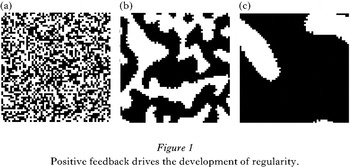
In many models of language change, error provides a significant proportion of the variation that makes up the raw material for reanalysis (e.g. Ohala Reference Ohala, Masek, Hendrick and Miller1981, 1989, Labov Reference Labov1994, Blevins Reference Blevins2004).Footnote 2 Here I will argue that error biases that favour previously encountered forms such as those discussed above provide a mechanism for the development and entrenchment of language-internal regular patterns. Regularity arises in this situation because, under positive feedback, gradient behaviour is unstable over time. To see why this is true, consider a simple simulation starting with a field of randomly distributed squares of two different shades (Fig. 1a). In each round of the simulation, each square checks the shades of the squares immediately surrounding it, and if the majority shade is different, it changes shade to match; if the distribution is equal it has even chances of changing or staying the same. Figure 1b illustrates the distribution of the two shades after several rounds. Note that the distribution has become strikingly more regular, as squares progressively change to match their local neighbourhood. As each round passes, curves and bends in the distribution are straightened out in favour of the locally more densely populated shade, producing progressively larger uniform areas and correspondingly smaller areas of contact (Fig. 1c). The steady reduction of area of contact is driven by the fact that squares at a shade boundary are likely to switch back and forth, while those surrounded by uniform shade do not change. As a boundary shifts back and forth randomly, any change that places a given square in a majority one-shade neighbourhood will be relatively more stable, minimising boundaries over time.Footnote 3 This is an example of how a bias toward local similarity can result in global regularity over time.
Positive feedback drives the development of regularity.

Returning to language, in a rich-memory system in which experience leaves a lasting trace that can influence subsequent production and perception, error biases toward similarity at some level of categorisation should promote the development of crisp boundaries in behaviour at that level of categorisation (Wedel Reference Wedel2004). In the next section, I introduce a simple heuristic model of a production–perception loop that demonstrates the development of regularity under positive feedback, and then turn to more complex regular patterns that arise when multiple contextual biases compete.
3 Modelling positive and negative feedback in the lexicon
A single phoneme category is often made up of multiple relatively distinct, context-dependent allophones.Footnote 4 A range of laboratory results suggest that for many allophones, errors in production or perception are relatively reduced for that allophone in its conditioning context (e.g. Ohala Reference Ohala and F. MacNeilage1983, Reference Ohala, Kingston and Beckman1990). Within a framework for language change that allows for incremental, error-driven modification of categories (e.g. Evolutionary Phonology; Blevins Reference Blevins2004), the accumulation of more stable versions of a sound in a particular context should promote the development of context-conditioned variants within a sound category. For example, many languages exhibit two relatively distinct, context-dependent allophones of /l/, velarised and plain, which differ among other things in the backness of the tongue body (Ladefoged Reference Ladefoged2006). In Georgian, for example, the choice of plain [l] is conditioned by a following front vowel (Tschenkéli Reference Tschenkéli1958). Under this model, the Georgian pattern suggests the hypothesis that plain [l] is more stable in the environment of a following front vowel than velarised [l].
If it turns out to be true that the plain [l] is more stable in this context, shouldn't all languages have plain variants of /l/ associated with following front vowels? How do we explain the observation that there exist languages that seem to only use one [l] variant in all contexts, such as dialects of English that employ only a relatively velarised [l] (Johnston Reference Johnston and Jones1997, Carter Reference Carter, Ohala, Hasegawa, Ohala, Granville and Bailey1999), and others that employ only a relatively plain [l] (Hickey Reference Hickey, W. Schneider, Burridge, Kortmann, Mesthrie and Upton2004)? More puzzling yet, how could we explain the fact that there are other dialects of English that exhibit both allophones of /l/, but conditioned by an entirely different context, namely syllable position (Ladefoged Reference Ladefoged2006: 76)? This is not an isolated problem, of course. A basic finding of phonology is that allophones are regularly associated with some context, specific or default, and that this context can be different in different languages.
Optimality Theory accounts for the language-specific suppression or permission of allophonic variation through language-specific ranking of faithfulness and markedness constraints. However, I will argue that a quite different, evolutionary model can explain this cross-linguistic variation in the patterns of regularity in a more straightforward way. Specifically, I will show here that competition between two kinds of error in the context of positive feedback allows phonological systems to potentially occupy a variety of distinct, stable states. In this model, error at the level of the phonological category in favour of its more frequent variants promotes category uniformity, while context-sensitive error in articulation/perception promotes the development of as many variants as there are biasing contexts. Because positive feedback pushes the system toward global consistency, competition between these two effects results in a tendency for the system to settle on a restricted set of the possible categorical patterns, ranging from the case of a single allophone for a phonological category to a relatively limited set of regularly conditioned variant allophones. Below, I describe a set of simple simulations that illustrate the competition between these two kinds of error and the categorical patterns that result.
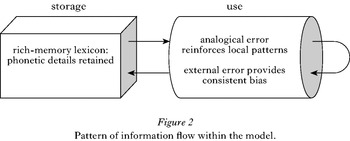
The model of pattern change for the simulations in this paper is built on a simple loop between production and perception (Fig. 2). Because we are not modelling contrast effects that arise in categorisation of percepts, the simulation can be simplified to model just one lexicon interacting with itself.Footnote 5 For the simulations in this section, the ‘lexicon’ consists of entries built from ordered segment categories taken from the set {a, b, c, … , x}. Each of these categories will be treated as containing one average exemplar, with the exception of the category /x/, which will be idealised as a distribution having two stable subcategories, or ‘allophones’ represented by the values ‘+1’ or ‘−1’. In a more complete model, both larger (e.g. segment sequence) and smaller (e.g. allophone) categories would be included, each consisting of a distribution of exemplars.Footnote 6 However, the goal here is not verisimilitude, but rather to illustrate, as clearly as possible, how feedback loops can operate in a rich-memory system to produce regularity. Therefore, in order to keep the pathway of information flow in the simulation as transparent as possible, I only model category-substitution errors here, and show how these kinds of errors alone can produce patterns of interest.
Pattern of information flow within the model.

The production–perception loop proceeds in each cycle by retrieving each entry and re-storing it, replacing the original to mimic the slow replacement of old exemplars with newer ones. Changes in form arise when error intervenes in this loop, changing the value of /x/ in a produced form before it is re-stored. This re-storage of errorfully produced forms – each of which will go on to serve as a model for production in the next cycle – results in error feedback between cycles. As we saw above, positive feedback in and of itself promotes the development of categorical patterns. Here we will be interested in the regularity relationship between individual lexical entries and the lexicon as a whole, rather than the regularity relationship between individual category exemplars within an entry and the lexical entry as a whole (cf. Wedel Reference Wedel2006). As a consequence, the computational shortcut of imposing quantal values on /x/ rather than a distribution of values does not change the relationship that we are modelling at this level of abstraction.
In this model, linguistically relevant patterns arise through the interaction of two conceptually different sources of variation, which I will refer to as analogical error and external error. Analogical error is a cover term for error biased toward common patterns in experience of the sorts described in §2.1 above. Analogical error thus refers to error patterns that are derived from details of development of the system in context, and as such is contingent on the particular history of the larger system. In the simulations presented here, this error is modelled as a bias towards replicating previously encountered associations between the value of /x/ and the category labels /a, b, x/ in proportion to their relative type frequency, as recorded in the current lexicon. Frequency- and similarity-dependent analogical error create positive feedback, because the more such errors reinforce a given association in the lexicon, the stronger the error tendency toward this association becomes. The influence of both similarity and type frequency on a number of language phenomena has been well established; for discussion in a variety of contexts see e.g. Albright & Hayes (Reference Albright, Bendjaballah, Dressier, Pfeiffer and Voeikova2002), Almor (Reference Almor and Arbib2002), Bybee (Reference Anderson2002a) and Ernestus & Baayen (Reference Ernestus and Harald Baayen2003). The algorithm for calculating and applying this error within the simulations presented here is described in the Appendix.
In contrast, the term external error covers less experience-dependent biases toward changing one set of category values toward another. This error is modelled after the kinds of quasi-language-independent factors of physiology, perception and processing that have been proposed to underlie many cross-linguistic regularities (e.g. Ohala Reference Ohala, Egil Breivik and Håkon Jahr1989, Lindblom Reference Lindblom, Hurford, Studdert-Kennedy and Knight1998; see Blevins Reference Blevins2004, Hayes & Steriade Reference Hayes, Steriade, Hayes, Kirchner and Steriade2004 for reviews). This error is held constant within a simulation, and is uninfluenced by patterns in the lexicon (cf. ‘change’ in the framework of Evolutionary Phonology). Of course, it is an oversimplification to split error into these two opposing categories, as experience and context are likely to modulate the likelihood of errors of all types. For example, frequency of use impacts both motor and perceptual accuracy, as discussed in Bybee (Reference Bybee2001). However, for simplicity, no such interaction is modelled in these simulations.
This model has been intentionally kept very schematic for the following reason. As will be seen below, even in simulations of a feedback-driven model with as few ‘moving parts’ as this one, relatively complex patterns can arise. Keeping the model maximally simple and transparent makes it easier to identify the causal relationships within the cycle that underlie the development of these patterns.
3.1 Analogical error promotes uniformity
To illustrate the contribution of analogical error to evolution of the lexicon in this model, let us start by comparing two simulations: a control simulation lacking both analogical and external error, and a simulation that includes analogical error alone. Both simulations include a further random error set at a 1% chance that an /x/ value will flip in any production event. These simulations follow the evolution of a lexicon with 100 lexical entries each containing the category /x/ and a randomly assigned additional category taken from the set {d, e, f, … , w}, which functions to supply additional random similarities and differences between words. At the start, the lexicon is balanced with 50 entries containing [x: +1] and 50 containing [x: −1]. Because the model presented here abstracts away from contrast maintenance to focus on feedback mechanisms promoting development of analogical patterns, no cost is imposed if lexical entries happen to be identical (cf. Wedel Reference Wedel2004, Reference Wedel2006 for simulations of contrast maintenance in a feedback-driven model).
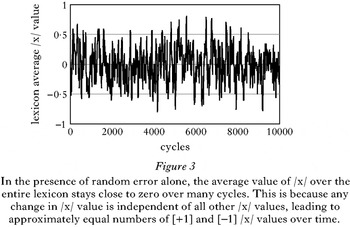
Figure 3 shows the evolution of the average value of /x/ over the entire lexicon for 10,000 cycles in the presence of random error alone. Since the two values for /x/ are coded as [+1] and [−1], a lexicon with equal numbers of each value will show an average /x/ value of zero, while a lexicon with a tilt toward one or the other value will show an average closer to [+1] or [−1] respectively. Note that the lexicon could only rarely ever show an average /x/ value of exactly [+1] or [−1], because some lexical items in any round are likely to be produced with the minority /x/ value.
In the presence of random error alone, the average value of /x/ over the entire lexicon stays close to zero over many cycles. This is because any change in /x/ value is independent of all other /x/ values, leading to approximately equal numbers of [+1] and [−1] /x/ values over time.

In the control simulation lacking analogical error shown in Fig. 3, the mean /x/ value of the lexicon as a whole at any time remains close to 0, as we expect, since every lexical entry is fully independent of every other. When many variables (in this case the values of /x/ in the lexicon) are randomly distributed, the central limit theorem states that the sum will be approximately normally distributed. As a consequence, the probability that the mean value of /x/ will approach the limits of [+1] or [−1] is very low.Footnote 7 This means that within this model, without the action of analogical error the distribution of feature values in the lexicon would tend to maximal non-regularity.
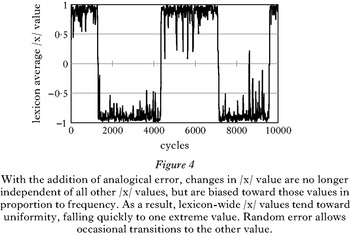
The simulation illustrated in Fig. 4 is the same, except for the inclusion of analogical error. Here we see a strikingly different pattern, as the value of /x/ veers immediately to an extreme and stays there, switching only occasionally to the other extreme over the course of the simulation. This pull to extremes occurs because when a particular /x/ value attains a sufficient majority in the lexicon through random chance, analogical error favouring that value becomes more likely, pulling the entire lexicon further in the same direction. This is conceptually the same as the process we saw above in Fig. 1, where gradience (there in the form of a uniform distribution of shades across the field of squares) is rendered unstable by positive feedback. Within the simulation in Fig. 4, however, continual external error at a rate of 1% per lexical entry per cycle occasionally injects enough of the alternate /x/ value into the lexicon to weaken the direction of analogical error and allow a switch to the alternate value. Note that the push toward categorical behaviour comes entirely from positive feedback in this system – there is no extrinsic bias in favour of either of the two stable states in this system.
With the addition of analogical error, changes in /x/ value are no longer independent of all other /x/ values, but are biased toward those values in proportion to frequency. As a result, lexicon-wide /x/ values tend toward uniformity, falling quickly to one extreme value. Random error allows occasional transitions to the other value.

3.2 Bias conflict and pattern-levelling
Consider the cross-linguistic distribution of velarised and plain /l/ mentioned earlier. There are some languages with only velarised or plain lateral approximants in all contexts. And there are other languages where velarised and plain laterals are variants or ‘allophones’ of the same sound category or ‘phoneme’. In some languages, one variant is associated with a particular phonological context: plain laterals may be restricted to occurring before front vowels, as in Georgian, or only in syllable-onset positions, as in some dialects of English. If one assumes that the context-influenced pathways for development of plain vs. velarised laterals are present to some extent in most languages which have a voiced lateral approximant phone, then two questions immediately present themselves. First, why aren't distinctly velarised and plain [l] present in all languages that have /l/? And second, how does a pattern arise associating one of these variants with one possible conditioning context to the exclusion of other conditioning contexts? For example, how can it be that the distinction in velarisation of /l/ in English is primarily associated with syllable position, while in Georgian it is dependent on the backness of a following vowel? In this section we will see how the pattern-smoothing effect of analogical error competes with the pattern-diversifying effect of external, contextual biases, resulting in a limitation on the number of factors that can condition variation. In the context of positive feedback, this competition can produce a system in which both uniform category exponence and contextually conditioned allophonic variation are stable states. As a result, lexicons under the very same starting conditions can settle unpredictably into one or the other kind of state, depending on small random variations in the initial path taken.
In the simulation shown in Fig. 4, two categorical patterns developed solely through positive feedback, without any extrinsic bias toward one /x/ value or the other. To model the interaction of distinct contextual biases, we set all lexical entries in the simulation to include either the categories /a/ or /b/, and introduce external contextual biases in error for the value of /x/ based on the presence of [a] or [b].Footnote 8 Specifically, the presence of [a] increases the relative probability of error toward [x: +1] to 3%, and the presence of [b] increases the relative probability of error toward [x: −1] to 3%. The context-free random probability of an /x/ value changing remains at 1%. The lexicon consists of 100 entries, 50 of which contain /a, x/ and 50 /b, x/, where the starting value of /x/ is balanced across both sets of entries. Again, an additional random category is appended to each lexical entry, here taken from the set {c, d, e, …, w}. Recall that analogical error can be created by a significant association of /x/ values with any of the category labels included in the simulation, including /a/ and /b/ as well as the added random category. There are four possible major patterns of association that are available as attractors for the system solely through positive feedback: association of the value of /x/ with the category label /x/ itself, resulting in consistent /x/ values of either [+1] or [−1] across the lexicon; or association of a particular value of /x/ with /a/, and the other with /b/ or vice versa. Minor patterns are in principle possible in the association of a particular value of /x/ with the randomly assigned category label in each lexical entry.
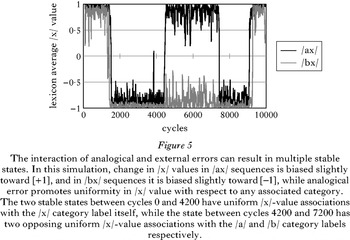
Consistent, divergent error biases for /x/ values conditioned by [a] and [b] encourage the development of a lexicon in which [x: +1] is associated with /a/ and [x: −1] associated with /b/. However, one might also expect global positive feedback between the value of /x/ and its own label /x/ to be able to override these more local patterns and enforce one of the two possible lexicon-wide values of /x/. Looking closely at Fig. 5, we can see that these three patterns in fact emerge. In the initial portion of the simulation through approximately cycle 1000, the average value of /x/ for the entire lexicon ins near [+1], despite the fact that low-level error in production of outputs containing /b/ promotes an /x/ value of [−1] in those outputs. Shortly after 1000 cycles, the value of /x/ flips for the entire lexicon toward [−1], and remains there for another 3000 cycles. Periods such as these, in which /x/ values are consistent across the lexicon, are stabilised by analogical associations between all category labels with one value of /x/ that overrides persistent biases toward association of a particular /x/ value with /a/ vs. /b/.
The interaction of analogical and external errors can result in multiple stable states. In this simulation, change in /x/ values in /ax/ sequences is biased slightly toward [+1], and in /bx/ sequences it is biased slightly toward [−1], while analogical error promotes uniformity in /x/ value with respect to any associated category. The two stable states between cycles 0 and 4200 have uniform /x/-value associations with the /x/ category label itself, while the state between cycles 4200 and 7200 has two opposing uniform /x/-value associations with the /a/ and /b/ category labels respectively.

Near cycle 4500, however, persistent error resulting in /x/ values of [+1] in outputs containing [a] create a sufficient nucleus of /a, x: +1/ entries in the lexicon to support a separate stabilising association between /a/ and /x: +1/, with the result that /x/ values for lexical entries containing /a/ jump up to [+1], leaving those containing /b/ behind. Here, the associations of the category label /x/ with its possible values [+1] and [−1] have become equivalently strong, resulting in no net analogical error bias from this source. The development of the two ‘allophones’ of /x/ here is initially prompted by external contextual biases, but, once in place, the stable pattern is maintained through their consistent associations with /a/ and /b/ within the lexicon. The three stable states that appear in Fig. 5 are parallel to the distribution of allophones of /l/ in language, where we find languages with one [l] variant that remains relatively constant across contexts, and others that have developed two conditioned variants in association with some context.
OT could account for the various output patterns in Fig. 5 through the relative ranking of context-free constraints violated by either value of /x/, and context-sensitive constraints violated by particular values of /x/ in conjunction with [a] or [b]. For example, the uniform output value of [x: +1] in the 1–1000 cycle range could be accounted for by ranking a constraint against [x: −1] above a constraint against [x: +1], while the opposite pattern found in the 2000–4000 cycle range could be accounted for by the opposite ranking. In turn, the pattern of context-dependent variation in /x/ values that emerges in the 5000–7000 cycle range could be accounted for by ranking the two context-sensitive constraints above the context-free ones. The feature of OT that allows these conflicting categorical patterns to emerge from the same general system is the stipulated property of constraint dominance: all of these constraints may be present in the grammar, but in the event of constraint conflict, the higher-ranked constraint wholly determines the outcome. In contrast, in the model simulated here pattern ‘dominance’ arises naturally under the well-supported assumption that production and perception are subject to similarity-based positive feedback. In the next section, we will discuss this feature of the model further in the context of the claim that phonological patterns are often more coarsely grained than the phonetic trends that give rise to them.
3.3 The coarseness of the grammar
It has been noted that statistical regularities in the speech stream seem to be more complex and fine-grained than the phonological generalisations that develop from them (Hyman Reference Hyman and Juilland1976, Pierrehumbert Reference Pierrehumbert2001b, Reference Pierrehumbert2003, Gordon Reference Gordon2002). In a rich-memory model, analogical error minimises diversity of behaviour along some dimension over time, while any sources of variation promote greater diversity in behaviour. Within this model, the competition between these two general tendencies results in the stabilisation of phonological patterns that are on average more coarsely grained than would arise from a straightforward mapping of all external biases onto the lexicon. For example, in the simulation shown in Fig. 5 above, the evolution of a category under the influence of two opposing context-specific biases often still results in relatively uniform category exponence, because positive feedback favours uniformity. In this section, we will see that analogical bias can transform a more complex set of interacting external biases into simpler patterns that would be accounted for in OT through the mechanism of strict constraint domination.
As discussed in the introduction, generative models of phonological competence favour coarse-grained phonological patterns through limitations on the alphabet of underlying symbols and their combinatorial possibilities, and/or on the rules or constraints that govern output forms. Much of OT's ability to account for the coarse-grained nature of grammatical patterns lies in its claim that there is a limited set of universal constraints, and that there is a limited mechanism for their interaction, in particular that the choice of optimal outputs proceeds through satisfaction of constraints in ranked order.
Standard Optimality Theory (Prince & Smolensky Reference Prince and Paul1993) stipulates that the choice of optimal outputs proceeds through satisfaction of constraints in ranked order. The principle of strict domination further specifies that ranking is absolute: no degree of potential violation of lower-ranked constraints can ever compel violation of a higher-ranked constraint. This principle functions to limit the complexity of the patterns that can be generated with an optimality-theoretic grammar. Strict domination can often be found paraphrased informally as ‘lower-ranked constraints can't gang up against a higher-ranked constraint’, but another informal restatement that will be especially useful here can be given as ‘the outcome of multiple constraint conflicts reproduces the outcomes of the component pairwise constraint conflicts’. This way of stating the principle makes it clear that its operation keeps phonological patterns simpler than they would be otherwise. Further, because the set of forms in which two particular constraints conflict must be equal to or larger than the set of forms in which those two plus another constraint all conflict, the principle of strict domination can be seen as a prediction that winning patterns are associated with typologically more frequent constraint conflicts. This limitation allows OT equipped with a particular finite set of constraints to predict that certain complex patterns cannot exist.
However, while strict domination allows OT to accurately describe many phonological systems, it sits uneasily with the notion, increasingly well represented within the field, that constraints on grammatical patterns are directly or indirectly related to phonetic biases based in articulatory and perceptual difficulty (e.g. Donegan & Stampe Reference Donegan, David and Dinnsen1979, Archangeli & Pulleyblank Reference Archangeli and Pulleyblank1994, Blevins & Garrett Reference Blevins and Andrew1998, Hayes Reference Hayes, Darnell, Moravcsik, Newmeyer, Noonan and Wheatley1999, Steriade Reference Steriade1999, Blevins Reference Blevins2004, Reference Blevins2006b, Hayes & Steriade Reference Hayes, Steriade, Hayes, Kirchner and Steriade2004). This unease arises because it is difficult to see how biases with sources outside the grammar, such as physiological constraints on articulation or perception, would not interact additively in some overall performance cost. Within OT, however, the inability of low-ranked constraints to gang up on higher-ranked constraints amounts to a statement that though costs may sum at the level of articulation and perception, they cannot at the level of phonology, unless a specific constraint exists that by itself penalises that combination of costs (as in, for example, a constraint that conjoins a penalty for voicing in obstruents with a penalty for codas to account for syllable-final obstruent devoicing; Ito & Mester Reference Ito and Mester2003). The fact that constraint conjunction has indeed been frequently invoked in optimality-theoretic work suggests that strict domination does not serve as an accurate mechanism to limit the power of OT. It is too strong because independent constraints can show additive effects when operative within particular domains (e.g. Ito & Mester Reference Ito and Mester2003). And when it is weakened by the allowance of constraint conjunction to allow these kinds of additive effects, there is significant overgeneration of unattested systems (discussed in Padgett Reference Padgett2002).
Here we will see that when the interaction of multiple external error biases is simulated within our simple model, regular patterns can evolve that are consistent with the strict domination principle of OT, despite the fact that these interactions do compound in production, as we expect they should. In particular, when multiple patterns potentially conflict in a single output form, we will see that pattern smoothing from analogical error promotes outcomes that follow the individual pairwise outcomes of pattern conflict, just as predicted by the principle of strict domination. Interestingly, we will see that patterns can also arise that violate strict domination (i.e. would require the addition of a new constraint), but only when violations of multiple external biases are associated in a sequence that is typologically frequent in the lexicon.
Here, we will consider the interaction of three external biases: (a) a context-free 5% error bias toward [x: +1] in production, (b) a 3% bias toward [x: −1] conditioned by the presence of [a], and (c) a 3% bias toward [x: −1] conditioned by the presence of [b]. These error biases are summarised in (1).
(1)


Within the simulation, these biases are modelled as independent of one another, as we expect for biases with distinct sources, e.g. those that arise from independent articulators, or those grounded in articulation in contrast to perception. Bias independence is modelled within the simulation by applying multiple biases that apply to one output in random order. To probe the interaction of these biases with each other and with analogical error, we will compare the stable states of three different lexicons containing distinct sets of lexical entries, where each lexicon has 50 categories corresponding to each given combination of {a, b, x}. The three lexicons are given in (2), where, as before, an additional random category is included in each entry.
(2)
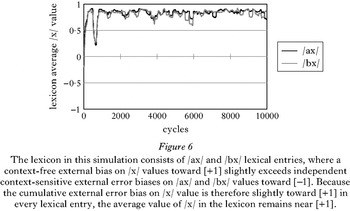
Figure 6 shows a 10,000 round simulation using Lexicon 1, showing that entries for all words containing {a, x} and {b, x} maintain an average /x/ value near [+1].Footnote 9 If we examine the relative strengths of the external biases used, we can see why this is: the tendency to shift towards [+1] provided by /x/ is stronger than the bias towards [−1] provided by [a] or [b], so each lexical entry has a small net bias towards [x: +1] in production.
The lexicon in this simulation consists of /ax/ and /bx/ lexical entries, where a context-free external bias on /x/ values toward [+1] slightly exceeds independent context-sensitive external error biases on /ax/ and /bx/ values toward [−1]. Because the cumulative external error bias on /x/ value is therefore slightly toward [+1] in every lexical entry, the average value of /x/ in the lexicon remains near [+1].

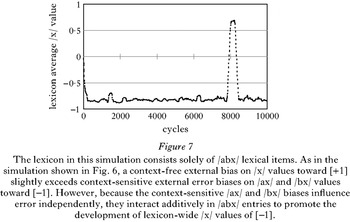
However, when [a] and [b] are present together in the same output, as in Lexicon 2, their independent biases should be able to interact additively, and overwhelm the bias from [x]. This is shown in Fig. 7, where we see that the joint influence of [a] and [b] together on output form is greater than that of [x], leading to a stable lexicon-wide /x/ value near [−1].
The lexicon in this simulation consists solely of /abx/ lexical items. As in the simulation shown in Fig. 6, a context-free external bias on /x/ values toward [+1] slightly exceeds context-sensitive external error biases on /ax/ and /bx/ values toward [−1]. However, because the context-sensitive /ax/ and /bx/ biases influence error independently, they interact additively in /abx/ entries to promote the development of lexicon-wide /x/ value/s of [−1].

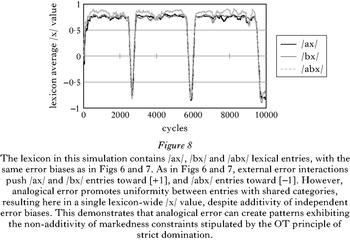
But what happens when the two patterns are put in conflict with one another in Lexicon 3, where all three types of entries are present? All lexical entries contain an /x/ category, and two pairs out of the three sets share an /a/ or /b/ category, so analogical error has a number of similarities over which to pattern-smooth. And as a consequence of this pattern smoothing, in Fig. 8, we see that in the context of /a, x/ and /b, x/ entries, the biases acting on /a, b, x/ entries no longer appear additive at the level of the lexicon, even though at the level of actual error they are in fact additive.Footnote 10 Because the stronger bias on /x/ values in the /a, x/ and /b, x/ entries tends to push these outputs toward [x: +1], the /a, b, x/ outputs are pulled toward [x: +1] as well, through persistent analogical error on the basis of shared internal structure. As a result, the entries of the form /a, b, x/ come to conform to the larger pattern set up by the forms /a, x/ and /b, x/ despite the fact that in production the net error bias for /a, b, x/ consistently pushes in the opposite direction. This pattern conforms to the OT principle of strict domination, without stipulating that the actual biases involved cannot interact additively. In this model, then, a strict domination pattern is not a fundamental property of the grammar, but is an emergent result of positive feedback that tends to arise when lexical forms in which multiple constraints conflict are less frequent than forms in which subsets of those constraints conflict. This property of the model predicts that independent biases targeting distinct features of an output will often fail to pattern as additive unless there is a strong association in the lexicon between those features.
The lexicon in this simulation contains /ax/, /bx/ and /abx/ lexical entries, with the same error biases as in Figs 6 and 7. As in Figs 6 and 7, external error interactions push /ax/ and /bx/ entries toward [+1], and /abx/ entries toward [−1]. However, analogical error promotes uniformity between entries with shared categories, resulting here in a single lexicon-wide /x/ value, despite additivity of independent error biases. This demonstrates that analogical error can create patterns exhibiting the non-additivity of markedness constraints stipulated by the OT principle of strict domination.

4 Modelling edge alignment in stress systems
In the previous section, we saw how positive feedback at the level of a category /x/ favoured consistent outputs from that category, despite conflicting contextual biases toward production of different variants of /x/. In this section, we will make the simulation slightly more complex, so that it can illustrate feedback-driven resolution of a structural conflict that isn't directly created by external bias: initial vs. final edge alignment of stress. To do this, we need to modify the simulation to accommodate entries with ordered stress-bearing units, i.e. syllables.
The lexicon that will be fed to the simulation contains entries consisting of ordered syllables which themselves comprise a set of unordered features. The simulation assumes an intrinsic granularity of articulatory gestures which produces a natural category boundary between ordered unit categories in speech (Goldstein et al. Reference Goldstein, Byrd, Saltzman and Arbib2006). Every syllable at the beginning of a word contains an initial-edge feature /I/, and end syllables correspondingly contain a final-edge feature /F/. Because every word contains an initial and a final edge, they are natural targets for generalisation via analogical error. The feature that is allowed to vary in its value in this simulation is stress, which is limited to the values [Stress: +1] and [Stress: −1], representing ‘stressed’ and ‘stressless’ respectively. Although edges and stress levels are not accorded the status of features in standard phonological feature systems, both of these properties condition myriad phonological patterns, and so must be available at some level to the grammar/pattern-reproduction system. In a rich-memory model such as this, these properties will be recorded at some level in the lexicon even if they are predictable. As before, an additional dummy feature from the set {d, e, f, … , w} is randomly assigned to each syllable to supply additional random similarities and differences between words. For example, a possible word is /[I, d, +1] [k, −1] [F, g, +1]/, where square brackets separate syllables. As before, production and perception are modelled by retrieving the features for a given lexical entry and re-storing them, where analogical or external error may intervene to change the stress value before re-storage. As before, analogical error acts to bias production outputs toward the pattern of other sequences within the lexicon in proportion to similarity and frequency. As a consequence, when a particular stress pattern begins to be consistently associated with other features in the lexicon, analogical error-based feedback will reinforce this tendency until it becomes a regular pattern throughout the lexicon. The algorithm for calculating analogical error in this simulation is described in more detail in the Appendix. The simulation in this section contains only one external bias, operating to promote distinct stress values in adjacent syllables at a rate of 10%. This bias ensures that stress remains alternating.Footnote 11
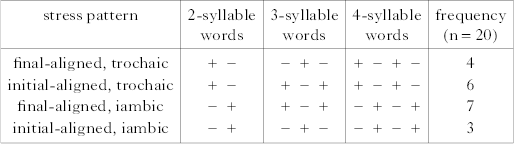
The lexicon that we start with contains 20 each of two-, three- and four-syllable words, starting out with randomly assigned stress values in each syllable. Within this simulation there are four equivalently stable states that this lexicon can reach, corresponding to a particular stress value consistently aligned to the initial or the final edge. Stated in terms of feet type, this corresponds to initial- or final-aligned trochees or iambs.Footnote 12 In 20 independent runs of the simulation, all four predicted stable stress patterns emerged within 1000 cycles, as expected. The stress patterns associated with the four stable states are given below in Table I, where stress value is abbreviated as ‘+’ or ‘−’.
Stress alignment at cycle 1000.
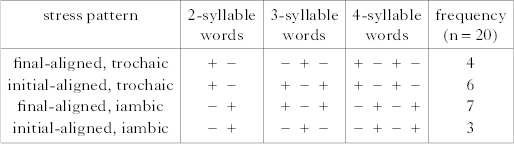
How does this consistent alignment to one edge happen? Analogical error results in the spread and stabilisation of consistent associations between available features. However, conflict develops within the simulation because the lexicon contains both even- and odd-number syllable words, with the result that as long as stress remains alternating, there cannot be a consistent stress value associated with both the initial and the final edge features of all words. As we saw before however, if a given association attains a sufficient foothold in the lexicon by chance, analogical error can kick in, eventually promoting this association throughout the lexicon. In the final-aligned, trochaic system shown in Table I, for example, a negative stress value is strongly associated with the final edge feature, with the result that if random error happens to introduce a stressed syllable at an initial edge in one cycle, it has a good chance of being restored to negative stress in the next. On the other hand, there is no strong association of the initial edge feature with a particular stress value, leaving the bias toward alternating stress as the primary error influencing positions other than the final edge. As a consequence, negative stress remains fixed at the final edge of each word by virtue of positive feedback, and the remaining stresses in the word fall into line from end to beginning through the bias toward alternation.
4.1 Modelling the interaction of edge-aligned stress and syllable weight
Within this model, external biases on the evolution of each lexical entry have a cumulative influence on the evolution of the entire lexicon through feedback. As a result, the frequency of category types and sequences should play a significant role in the evolution of grammatical patterns. Stated slightly differently, this model predicts that, all else being equal, the larger the number of lexical entries a bias potentially applies to, the more likely its effects will come to be reflected in the behaviour of the lexicon as a whole.
Gordon (Reference Gordon1999, Reference Gordon2002) reports precisely such a phenomenon in his work on the relationship between the proportion of sonorants in a language's coda inventory and the likelihood that coda consonants contribute to syllable weight. Out of a sample of 400 languages that display quantity-sensitive stress, Gordon found that the two most common weight distinctions are those that treat (i) CVV but not CVC syllables as heavy, or (ii) both CVV and CVC syllables as heavy. Based on the range of phenomena that are cross-linguistically correlated with weight, as well as results from his own phonetic study, Gordon concluded that total acoustic energy in the rhyme is the most significant phonetic factor associated with a phonological heavy/light distinction for stress. Gordon found that the occurrence of these two weight distinctions was not random, but remarkably predictable on the basis of the relative number of high-energy to low-energy consonants in the coda inventory. Out of a set of 24 languages in which the sonorant/obstruent and voiced/voiceless ratios in the coda inventory were lower than one, 20 languages showed the CVV=heavy pattern, while out of a set of 23 languages in which the sonorant/obstruent and voiced/voiceless ratios in the coda inventory were greater than one, 22 showed the CVV, CVC=heavy pattern. Given that sonorants characteristically have more energy than obstruents, and voiced sounds more than voiceless sounds, this finding is consistent with the distributional data suggesting that acoustic energy in the rhyme is a significant factor influencing the development of quantity-sensitive stress patterns.
But this line of reasoning leaves the following question unanswered. If, for example, as suggested by the influence of sonorant-to-obstruent coda ratio on the probability of having CVC as heavy, sonorant codas make good stressed syllables and obstruent codas make bad ones, why don't languages develop quantity-sensitive stress that targets CVV and CV[+son] syllables, rather than just CVV and CVC? There are languages that display just this sort of split (e.g. Kwakwala and Inga Quechua; Zec 1988), again suggesting that this reasoning is on the right track, but this pattern remains relatively rare. Gordon explains this rarity as a consequence of the pattern's greater phonological complexity and specificity relative to the more general CVV and CVC pattern. In the following section, we will see how these patterns can arise through the feedback-driven mechanism proposed here.
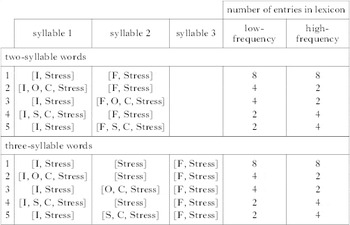
To model the influence of sonorant and obstruent coda consonants on stress patterns, we add to our inventory of features the set /S/ (sonorant), /O/ (obstruent) and /C/ (consonant), and include them in a single syllable of a subset of lexical items in a lexicon containing 20 each of two- and three-syllable words, as illustrated in Table II. In the starting lexicon, each word class contains equal numbers of words with initial- and final-aligned stress. In addition to the external bias toward alternating stress, we include a external bias toward stressing syllables containing the feature /S/ at a rate of 5%. We do not need to specify that any of the additional features are part of a coda, because we do not overtly include vowels or onsets.Footnote 13, Footnote 14
Low-frequency and high-frequency sonorant-coda lexicons.

40% of the words in this lexicon are just like those in the previous simulation, containing no coda of any kind (row 1 in each table). Another 40% contain an obstruent coda (rows 2 and 3), and the remaining 20% contain a sonorant coda (rows 4 and 5). All words contain initial and final edge features (I and F respectively), so just as before, feedback error will promote development of a consistent alignment of a stress value to an edge. Since the sonorant codas are split across the lexicon between syllables 1 and 2, for 10% of the lexicon a constant error bias towards stressing syllables with sonorant codas will act to disrupt any edge-aligned pattern. While the edge-aligned pattern can be stabilised by associations that are present in every word, the only opportunity for a sonorant-coda stressing pattern to be stabilised by feedback is if a consistent association between the feature /S/ and /Stress: +1/ can develop in the 20% of words that contain this feature. This association would also create an incipient association between /C/ and /Stress: +1/ within the words containing a obstruent coda, but because these words are in the minority of all words containing /C/, positive feedback is unlikely to gain a foothold to induce the larger number of words containing an obstruent coda to follow suit. And out of 20 independent runs of this simulation, at 1000 cycles eighteen showed one of the four possible lexicon-wide consistent edge alignments, and two were caught between patterns, indicating that a positive feedback driven association of stress to an edge in all words can overcome a strong external bias toward stressing sonorant codas in a few words.
Given the role of consistency of patterning in promoting positive feedback in this model, this result is not surprising. The constant bias to stress syllables with sonorant codas applies to few words in the lexicon, and these few words share many features with other words that are not affected by this constant bias, meaning that words containing sonorant codas will always be pulled away toward the majority pattern by positive feedback over other associations. Naturally, what we should try next is a lexicon with a greater proportion of words with sonorant codas relative to those with obstruent codas, as shown in the final column of Table II, where the number of lexical entries in rows 2 and 3 has been halved, and that in rows 4 and 5 doubled. As a result, twice as many words now have sonorant codas as obstruent codas, instead of vice versa.
When twenty independent runs of this simulation were run out to 1000 cycles, three different patterns emerged, plus a residue of inconsistently patterned lexicons in transition between states. I will consider each of these patterns in turn.
Four out of the 20 lexicons showed a pattern of stressing all syllables with an /S/ feature, while the syllables without an /S/ feature showed a consistent alignment of a stress value to an edge. Clearly, increasing the number of syllables with sonorant codas in the lexicon to 40%, in conjunction with a strong constant bias toward stressing these syllables, allowed the development of a sufficiently strong association between /S/ and /Stress: +1/ to maintain a separate pattern from the rest of the lexicon, which itself went ahead and aligned consistently to an edge. These outcomes parallel those languages that stress CVV and CV[+son] but not CV[−son]. Interestingly, however, this is not the majority pattern, for another eleven out of the 20 lexicons showed a pattern of stressing all syllables with a coda, without regard to whether that coda was sonorant or obstruent, with the remaining 40% of the words consistently showing one of the four edge alignments. This occurs for two reasons. Recall that of the syllables containing /C/ in the high-frequency sonorant lexicon, 67% also contain /S/, and that at any given time about half of the remaining syllables containing /C/ will also be stressed, because stress is alternating. Consequently, as soon as all sonorant codas are stressed, more than 80% of all syllables containing /C/ are stressed, creating a strong basis for positive feedback to promote the development of stress in all syllables containing /C/. Secondly, as soon as all syllables containing sonorant codas become stressed, the edge-alignment pattern becomes weakened, because half of the words containing sonorant codas will violate any established edge alignment. The combination of weaker positive feedback maintaining alignment to an edge, combined with the strong incidental association of /C/ with /Stress: +1/ allows development of a lexicon in which all syllables with a coda are stressed, even though the actual bias promoting this pattern only applies to a subset of those syllables. Finally, two of the 20 lexicons showed lexicon-wide edge-alignment of stress, and three did not show a clear pattern.
The wide range of patterns arising in this simulation illustrates several issues in a model of a rich lexicon evolving through positive feedback. First, positive feedback that generalises beyond the source pattern must make use of categories, whether present innately or abstracted from the input data (Maye et al. Reference Maye, Werker and Gerken2002, Saffran & Thiessen Reference Saffran and Thiessen2003, reviewed in Gerken Reference Gerken2006). In this case, the fact that the simulation can generalise to codas from sonorant codas requires, as asserted by many featural systems, that a separate category of ‘consonant’ be available which can serve as the basis for generalising positive feedback. Second, the type frequency of categories and category associations in the lexicon matters. Positive feedback is definitionally autocatalytic, such that the ability of a positive feedback mechanism to influence a process is constrained by the ability of an event to catalyse a subsequent event. If an external bias only affects a small proportion of a set of lexical items linked by similarity in a number of features, noise in production–perception operating over the entire set of lexical items will lower the probability that this local bias can initiate a set-wide change. As clear from the simulation above, and from Gordon's empirical findings on the influence of the coda inventory on weight systems, relative frequency of the target for a bias within a similarity set has a significant role in influencing the effect of the bias. As a consequence, this model predicts that a strong bias against a low-frequency combination of features may be less likely to initiate an active phonological pattern than a weaker bias against a higher-frequency combination.
Once entrenched, patterns in the lexicon can be self-sustaining through continuous positive feedback. Given that positive feedback also promotes coarse-grained over fine-grained patterns, this provides a potential explanation for observed divergent allophonic context-dependencies. As an illustration, let us return briefly to the example of context-dependent lateral allophones. Let us assume, for the sake of argument, that there are external biases favouring plain (vs. velarised) laterals in the syllable onset, and that there are independent external biases favouring plain laterals before front vowels. As illustrated above, positive feedback is likely to favour the development of a simple contextual condition for plain allophones of /l/. This means that, all else being equal, a plain allophone is more likely to either appear in onset position (as in English) or preceding a front vowel (as in Georgian), and less likely to appear in a context defined by an interaction of the two independent conditions. Standard Optimality Theory accounts for divergent patterns in different languages by positing the existence and language-specific ranking of innate context-specific constraints. In contrast, the model presented here accounts for such divergent patterns through the operation of positive feedback over external biases targeting distinct contexts.
5 Conclusions
The model described in this paper is intended to contribute to our understanding of how regularity might arise within a rich-memory lexical system without recourse to highly specified, innate restrictions. The model rests on the self-organising interaction of two conceptually distinct sources for error in production and perception to produce regular sound patterns. Analogical error, operating at potentially many levels, results in a tendency to produce and perceive forms with a bias towards previous experienced forms in some relation to similarity and frequency. Because errors of this type increase similarity over time, they push the system toward categorical behaviour even in the absence of any intrinsic or extrinsic bias toward that behaviour.
A second conceptual source of error can be idealised as relatively independent of experience, deriving from more constant facts about the world such as physiological constraints on sound production or perception. In simulations, we saw that external error produces statistical tendencies within the lexicon that can initiate runaway positive feedback from analogical error, resulting in the consistent development of particular kinds of regular patterns across the lexicon. As a consequence, the lexicon tends to evolve under the influence of analogical error to categorically recapitulate the gradient external biases that successfully initiate asymmetries in the first place. However, once a categorical pattern has developed, maintenance of the pattern may become largely independent of external error, and may be extended to similar forms that are not targets of the error that originated the pattern (see e.g. Mielke Reference Mielke2004: 92–140 for discussion and review of this point). Furthermore, this model predicts that any asymmetry in experience, whether prompted by ‘natural’ phonetic factors or not, can serve as a nucleation point for feedback-driven development of a regular pattern. As a result, we expect many languages to share regular patterns that derive from common causes in physiology, but we also expect variously idiosyncratic patterns to arise in response to historically contingent factors. This supports Blevins' conceptual division of patterns into ‘natural’ and ‘unnatural’ classes, where the first derive from lower-level, relatively constant features of human speech production and processing modelled by the external biases in the simulations presented here, and the second from more unusual confluences of events (Blevins Reference Blevins, Frajzyngier, Hodges and Rood2005, Reference Blevins2006a).
It has been frequently noted that phonological patterns appear to be coarser in a number of ways than potentially possible, given the more gradient phenomena that underlie them (e.g. Pierrehumbert Reference Pierrehumbert2001b, Reference Pierrehumbert, Gussenhoven and Warner2003, Gordon Reference Gordon2002, discussed in §3.3 above). Pierrehumbert offers the argument that the relative ‘coarseness’ of phonological patterns results from learnability constraints in the presence of noise: possible phonological constraints that are highly specific in terms of the phonetic cues they refer to will necessarily refer to a smaller set of the material over which induction occurs, and therefore are more susceptible to interference from noise in the signal.
The model used here presents complementary, conceptually similar mechanisms that function to encourage consistency and generality in grammatical patterns. First, external biases that refer to highly specific contexts will target relatively fewer forms, and therefore will be less likely than more general biases to initiate a consistent, productive pattern in the lexicon – even though these highly specific biases may be detectable at a phonetic level. Second, if a pattern does manage to take hold over a small subset within a larger similarity set, it is likely either to extend its pattern to the larger set, thereby becoming more general (as in the extension of stress to syllables with any coda consonant in §4.1 above), or to be reabsorbed into the pattern of the larger set (as in Fig. 4 above). This constant drift toward pattern consolidation through analogical error mitigates the tendency of highly context-sensitive biases in performance to produce ever greater distinctions in lexical form within a rich-memory model of the lexicon. The conflict between the two tendencies should result in a shifting compromise in which the phonology often exhibits fewer and more regular distinctions than are potentially motivated by the phonetics.
This paper focuses on positive feedback as a source of regularity in the lexicon. Considerable evidence suggests that mechanisms of language production and perception create systematic error biases toward increasing similarity between forms. Under the influence of these biases, small asymmetries in the distribution of lexical properties become attractors in subsequent cycles of production and perception, and over longer timescales, in transmission. The initial asymmetries that are exaggerated by feedback may be random, or conditioned by more constant, system-external biases, such as physiological constraints on voicing. The central finding is that under feedback, error biases toward similarity results in emergent regularity of sound patterns across the lexicon. Though the results presented involve simulations, there is growing empirical evidence in the phonetics/phonology literature for feedback systems of this kind. Within the tradition of laboratory phonology, Ohala (Reference Ohala, Masek, Hendrick and Miller1981, Reference Ohala, Egil Breivik and Håkon Jahr1989, Reference Ohala, Kingston and Beckman1990) has stressed the parallelism between common misperception and ‘mini sound changes’. Misperception in the laboratory demonstrates system-external biases which parallel cross-linguistically common regular sound patterns. In the model presented here, these persistent biases in misperception can provide the initial nucleation point for the development of categorical patterns.
Within the tradition of historical and theoretical phonology, there has also been a recent renewal of interest of the role of system-internal attractors in sound change. Though relationships between pre-existing sound patterns and sound change were noted in early work on compensatory lengthening (de Chene & Anderson Reference De Chene and Anderson1979), it is only recently that attempts have been made to integrate these into a more comprehensive theory of sound change (Blevins Reference Blevins2004: 153–155, 247–248, 297–299, 2006c). The results strongly support this programme. For example, as demonstrated by Chitoran & Hualde (Reference Chitoran and Ignacio Hualde2007), there are clear correlations between the shift of hiatus to glide–vowel sequences and the pre-existence of glide–vowel sequences in the lexicons of different Romance languages. System-internal attractors are also clearly in evidence in Austronesian, as argued by Blust (Reference Blust2007), where disyllabic word canons appear to act as attractors for a range of independent sound-change types, including vowel loss between identical consonants. Under this model, synchrony describes the current state of the system. However, given clear evidence that even an adult system is continually modified by experience, the opportunity for feedback renders each current state ‘diachronic’ as soon as new input is encountered. A synchronic grammar must therefore be considered an abstraction, rather than a description of a true steady state. Instead, a grammar appears to be a complex evolving system of competing regularities and generalisations in which change may be rapid or slow, depending on the details of the current system and environment. Modelling sound systems in this way will likely bring us closer to understanding the true nature of sound patterns, and their evolution over time.
6.1 Appendix: Modelling analogical error algorithmically
The algorithm used here is not based on any concrete model of how such an analogical error bias might actually function in language production or perception. Rather, it represents a simple and computationally tractable way to identify common associations between features in the current lexicon, and then accordingly weight the probability of error in the production of a particular lexical item sharing those features. In each cycle, the entire set of associations between all category labels present in all lexical items and the value of /x/ is identified. To do this, within the simulations in §3 the power set of the category labels present in each lexical entry is calculated and each subset (except for the empty set) is associated with the value of /x/ in that lexical entry. For example, for a lexical entry /a, b, x: +1/, the existing associations are:
(3)
The /x/ values of all associations over the entire lexicon that share a lefthand side are added together, resulting in an expression that provides a measure of the consistency of association with a given category label set with a particular value of /x/. For example, if within the lexicon, the label /a/ is strongly associated with [x: +1], the summed associations with the feature sets /a/, /a, b/, /a, b, x/ and /a, x/ will be strongly positive. On the other hand, if the feature /b/ is not associated with any particular value of /x/, there will be about as many associations of /b/ with [x: +1] as [x: −1], and the summed associations that contain /b/ but not /a/ will cluster around zero (see Broe Reference Broe and Sproat1996, Albright Reference Albright, Bendjaballah, Dressier, Pfeiffer and Voeikova2002, Wedel Reference Wedel2004 and Bod Reference Bod2006 for additional examples of the use of the power set of a group of linguistic elements to discover consistent associations between any subsets of the group).
When a lexical entry is produced, analogical error is allowed to influence the output 10% of the time; otherwise, the output is produced with external and random error alone. When analogical error contributes, the summed associations with /x/ for all combinations of labels in the lexical entry under production are themselves summed together. This final sum is a measure over the lexicon of the overall bias of the sequences contained in the lexical entry toward a positive or negative value for /x/. If the resulting value is greater than zero, [x] is set at [+1]; if it is less than zero, [x] is set at [−1]. For strong associations across the lexicon, the total sum representing the lexical-internal bias for particular lexical entries will be consistently positive or negative, while if associations are weak, they will tend to oscillate back and forth from positive to negative, resulting in little net change over time.
For the more complex simulations involving ordered category sets in §4, the algorithm was the same, except that associations were not calculated over an entire entry, but only over the syllable of the /Stress/ value under production and the syllable immediately preceding and following. This limitation was imposed for computational tractability.