Introduction
Patients with somatoform disorders (SFD) often worry about having a serious medical illness despite appropriate medical reassurance (Rief, Heitmuller, Reisberg, & Ruddel, Reference Rief, Heitmuller, Reisberg and Ruddel2006). In the present study, we investigated how deficits in the interpretation of the likelihood of a medical disease may contribute to difficulties in integrating medical reassurance. We hypothesized that patients with SFD are more concerned about low likelihoods of a serious medical disease than patients with major depression and healthy control participants. This hypothesis draws on the rationale that patients with SFD are often subjectively convinced that they have a serious disease, such that they experience a low likelihood for its presence, as indicated by a physician, as a form of invalidation (Linton, Boersma, Vangronsveld, & Fruzzetti, Reference Linton, Boersma, Vangronsveld and Fruzzetti2012). Further, the experience of distressing physical symptoms in the absence of a clear medical explanation is an important source of distress and concerns about the meaning of those symptoms (Barsky et al., Reference Barsky, Ahern, Bailey, Saintfort, Liu and Peekna2001).
Moreover, we examined how the framing of the likelihood of a medical disease influences concerns about it. Based on previous research on risk communication and risk perception (McNeil, Pauker, Sox, & Tversky, Reference McNeil, Pauker, Sox and Tversky1982; O'Connor, Pennie, & Dales, Reference O'Connor, Pennie and Dales1996; Perneger & Agoritsas, Reference Perneger and Agoritsas2011), we first hypothesized that a positive framing approach focusing on the absence of a disease leads to less concern than a negative framing approach focusing on its presence, although both convey the same mathematical likelihood. Second, drawing from research on the interpretation of medical prognoses (Gurm & Litaker, Reference Gurm and Litaker2000; Peters, Hart, & Fraenkel, Reference Peters, Hart and Fraenkel2011), we hypothesized that presenting a likelihood as a natural frequency (e.g. 1:100) leads to more concern than percentages (e.g. 1%), because the former is more concrete and may lead people to think they could be the one who does have a serious illness.
Methods
Transparency and openness
The present study was part of a larger research project. Some data from this project, reporting the results of a manipulation of ‘cognitive immunization’ in the same three samples, have recently been published elsewhere (Kube et al., Reference Kube, Riecke, Heider, Ballou, Glombiewski, Rief and Barsky2023). The present study reports additional results on the interpretation of the likelihood of a medical disease. Participants completed both the part of the project focusing on cognitive immunization and the part focusing on likelihood framings at the same study appointment, with the likelihood part, on which the current article reports, being completed second. While the hypotheses from the recently published article have been pre-registered on ClinicalTrials.gov (NCT04044469), the hypotheses from the current paper have not been pre-registered. Data was collected between October 2019 and December 2021. Originally, it had been planned to recruit 90 patients with SFD, but due to the far-reaching restrictions of the COVID-19 pandemic, the recruiting goal was set down to 60 patientsFootnote †Footnote 1. The data and the analysis code can be made available to researchers upon request. The study was approved by the Institutional Review Board of the University of Koblenz-Landau (reference number 2019_199) and the Philipps-University of Marburg (reference number 2020_17k). The study was conducted in accordance with the ethical standards as laid down in the 1964 Declaration of Helsinki and its later amendments.
Participants
For the sample of patients with SFD, we recruited 60 people (Mage = 44.38 ± 12.03 years, 73.3% female) diagnosed with a somatoform disorder according to DSM-IV or ICD-10, as assessed with a structured clinical interview. Originally, it was planned to base the diagnostic assessment on the Structured Clinical Interview for DSM (SCID) only, but some of the psychotherapy clinics, from which patients were recruited (see online supplement), used other interview types, such as the Composite International Diagnostic Interview (CIDI)) or the German DIPS (‘Diagnostisches Interview bei Psychischen Störungen’). So, we decided to include patients as long as the diagnosis was assured by any structured clinical interview. We included patients based on the DSM-IV criteria of SFD, rather than the new DSM-5 category ‘Somatic Symptom Disorder’, because the (German) SCID interview was not yet adapted to the DSM-5 when data collection for this study began. On average, participants from the SFD sample suffered from high somatic symptom burden according to the SSS-8 (Gierk et al., Reference Gierk, Kohlmann, Kroenke, Spangenberg, Zenger, Brähler and Löwe2014) sum scores (M = 13.17, s.d. = 5.92) and showed very high amounts of disproportionate thoughts, feelings, and behaviors associated with the somatic symptoms, as reflected by the SSD-12 (Toussaint et al., Reference Toussaint, Murray, Voigt, Herzog, Gierk, Kroenke and Löwe2016) sum scores (M = 28.45, s.d. = 9.39).
As a clinical control group, we recruited 33 people with a major depressive disorder (MDD) as diagnosed with the SCID, of whom one person was excluded due to diagnostic failure. This resulted in N = 32 for the clinical control group (Mage = 42.22 ± 9.74 years, 78.1% female). Furthermore, we recruited 38 volunteers for the healthy control group, of whom one person had to be excluded as a statistical outlier (>3 s.d. above the mean), resulting in 37 participants for the healthy control group (M = 41.78 ± 11.26 years, 70.3% female), who did not meet the criteria of any current mental disorder according to the SCID. For the two control groups, the minimum sample size according to the pre-registration was 30 people each, and we decided to recruit a small surplus to have the possibility to exclude participants from the analyses for experimental or statistical reasons, if necessary. Further details regarding the three samples can be found in the online supplement. We included both a healthy and a clinical control group, in order to be able to examine the specificity of possible deficits in interpreting medical likelihoods in SFD. Without an appropriate clinical control group, any difference between a healthy and a clinical population could reflect a general psychopathology factor, rather than a specific feature of the population under scrutiny. Major depression was chosen because it is related to biased cognitive processes (Berg, Feldmann, Kirchner, & Kube, Reference Berg, Feldmann, Kirchner and Kube2022; Kube, Schwarting, Rozenkrantz, Glombiewski, & Rief, Reference Kube, Schwarting, Rozenkrantz, Glombiewski and Rief2020; LeMoult & Gotlib, Reference LeMoult and Gotlib2019) and, specifically, a biased perception of the likelihood of experiencing positive and negative life events (Korn, Sharot, Walter, Heekeren, & Dolan, Reference Korn, Sharot, Walter, Heekeren and Dolan2014; Miranda & Mennin, Reference Miranda and Mennin2007; Zetsche, Bürkner, & Renneberg, Reference Zetsche, Bürkner and Renneberg2019). Therefore, using a sample of patients with MDD as a clinical control group in the present study appears apt in order to make sure that the hypothesized bias in the perception of the likelihood of a serious disease reflects a specific feature of SFD.
Main outcome measure
Participants were instructed to imagine themselves consulting a physician for a potentially worrisome symptom. They were then asked, ‘How concerned would you be if your doctor told you that, based on the results of the diagnostic tests, you (do not) have a serious disease with a likelihood of X?’. Participants of all samples were presented with eight different likelihoods (1: 100 000 v. 1: 10 000 v. 1:1000 v. 1:100 v. 1:10 v. 1:5 v. 1:3 v. 1:2). Participants indicated their degree of concern caused by each likelihood on a numerical analog scale from 0 (‘not at all concerned’) to 100 (‘very concerned’). For five of these likelihoods (1: 10 000; 1:100; 1:10; 1:5; 1:2), participants were subsequently presented with the same likelihoods again, but instead of natural frequencies, participants were presented with percentages, using two different framing approaches: a negative framing approach expressing the likelihood of having the disease (e.g. 1%) v. a positive framing approach expressing the likelihood of not having the disease (e.g. 99%). By doing so, we examined two questions: first, whether the degree of concern differs when focusing on the presence of a disease v. on its absence; and second, whether the degree of concern differs when the likelihood of having a disease (negative framing approach) is presented as a percentage v. as a natural frequency. The order, in which the likelihoods were presented, was as follows: negative framing using frequencies, negative framing in percent, positive framing. Within each presentation form, low likelihoods were successively followed by higher likelihoods. Participants were not informed beforehand about the likelihoods to be rated (nor their order). Other measures that were used in the umbrella project, but were not relevant to the present study, are reported elsewhere (Kube et al., Reference Kube, Riecke, Heider, Ballou, Glombiewski, Rief and Barsky2023).
Statistical analyses
First, differences between the three samples in their degree of concern in response to varying levels of likelihoods were examined in a 3 (sample: SFD v. depression v. healthy) × 8 (likelihood level: 1: 100 000 v. 1: 10 000 v. 1:1000 v. 1:100 v. 1:10 v. 1:5 v. 1:3 v. 1:2) repeated measures analysis of variance (ANOVA) with the degree of concern as the dependent variable. Significant differences between the samples as indicated by the omnibus test of the ANOVA were further explored using pairwise post-hoc t testsFootnote 2. Second, to examine differences between different framing approaches (natural frequencies v. percentages v. positive framing focusing on not having the disease) and possible interactions with the sample (SFD v. depression v. healthy), analyses of variance (ANOVA) were performed, while adjusting the Type-I error level for multiple testing using the Bonferroni-Holm correction (Holm, Reference Holm1979). According to a sensitivity power analysis using G*Power 3.1, the given sample size was sufficient to reveal effect sizes of f ⩾ 0.100 in the first analysis (repeated measures ANOVA, α = 0.05, 1-β = 0.80, three groups, eight measurements, average correlation between measures r = 0.444), and f ⩾ 0.119 in the second analysis (repeated measures ANOVA, α = 0.05, 1-β = 0.80, three groups, three measurements, average correlation between measures r = 0.549), which would be small to medium effects. All analyses were performed using IBM SPSS version 27.
Results
Differences between samples in their concern about different levels of likelihood
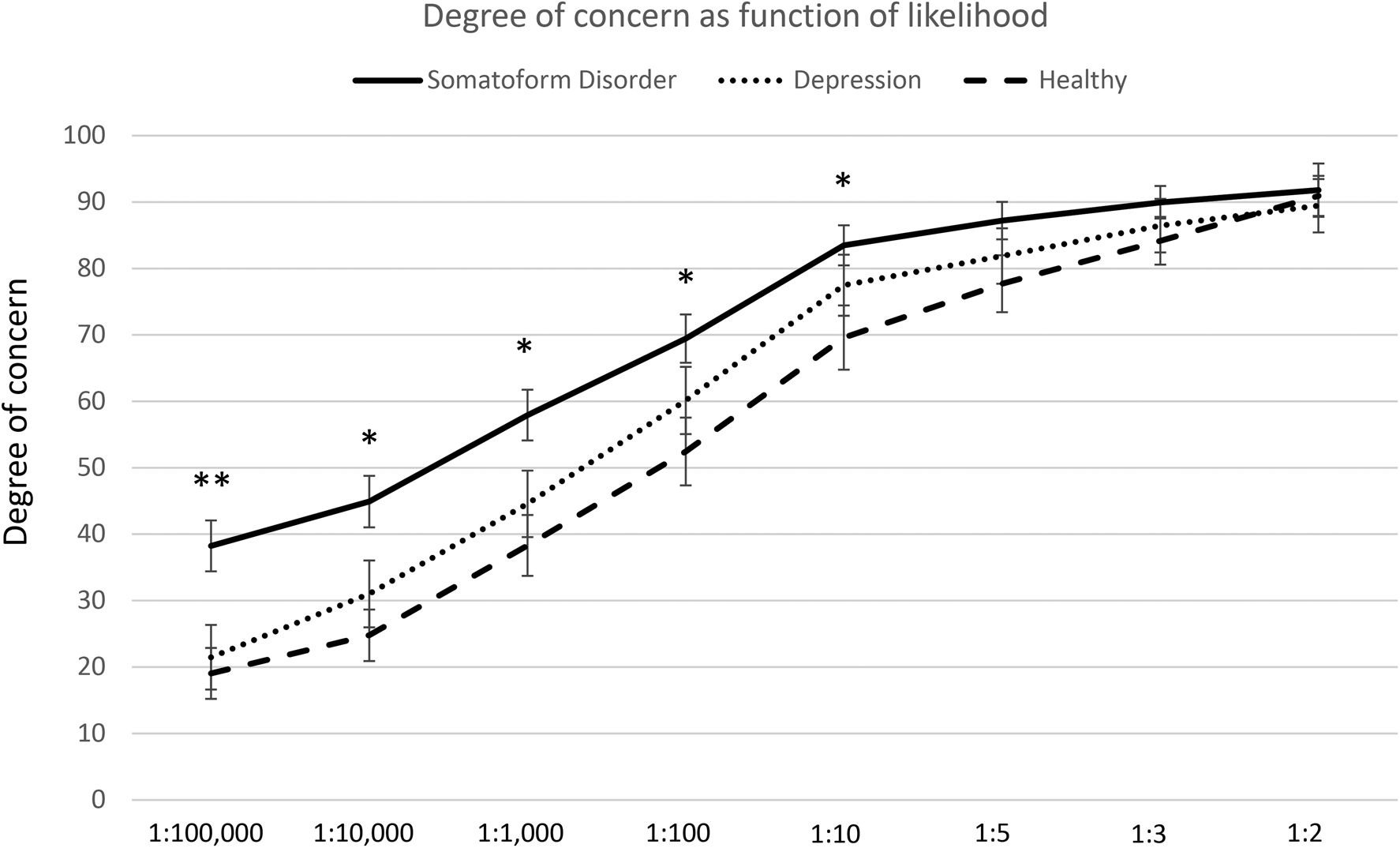
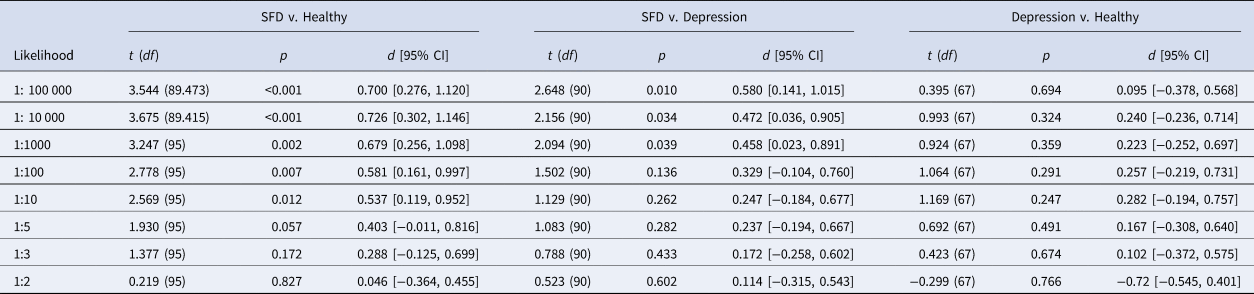
The ANOVA indicated a significant main effect of sample, F(2, 126) = 5.364, p = 0.006, ɳ2p = 0.078, 95% CI 0.007–0.171, with higher levels of concern in the SFD sample (M = 70.37, s.d. = 25.11) than in the MDD sample (M = 61.55, s.d. = 26.01) and the healthy control sample (M = 57.12, s.d. = 25.19). A significant sample by likelihood level interaction (F(3.914, 246.593) = 2.446, p = 0.048, ɳ2p = 0.037, 95% CI 0.001–0.080) indicated that patients with SFD reported higher levels of concern than the two control samples for low likelihoods. Specifically, as presented in Table 1, patients with SFD differed significantly from the control samples as long as the likelihood was ⩽1:10. Above a likelihood of 1:10, all samples were concerned to a similar extent. As illustrated in Fig. 1, the magnitude of the sample differences was the greater the lower the likelihood was.
Results of the sample differences in the degree of concern, depending on the likelihood of a serious medical disease. Patients with somatoform disorders are significantly more concerned than patients with major depression and healthy people for very low likelihoods. Above a likelihood of 1:10, the samples are similarly concerned. ** p < 0.001, * p < 0.05. Error bars reflect the standard error of the mean.

Results of the sample differences in the degree of concern about the presence of a serious disease with varying likelihoods

Note. SFD, Somatoform Disorder; df, degrees of freedom; CI, confidence interval.
Effects of likelihood framing
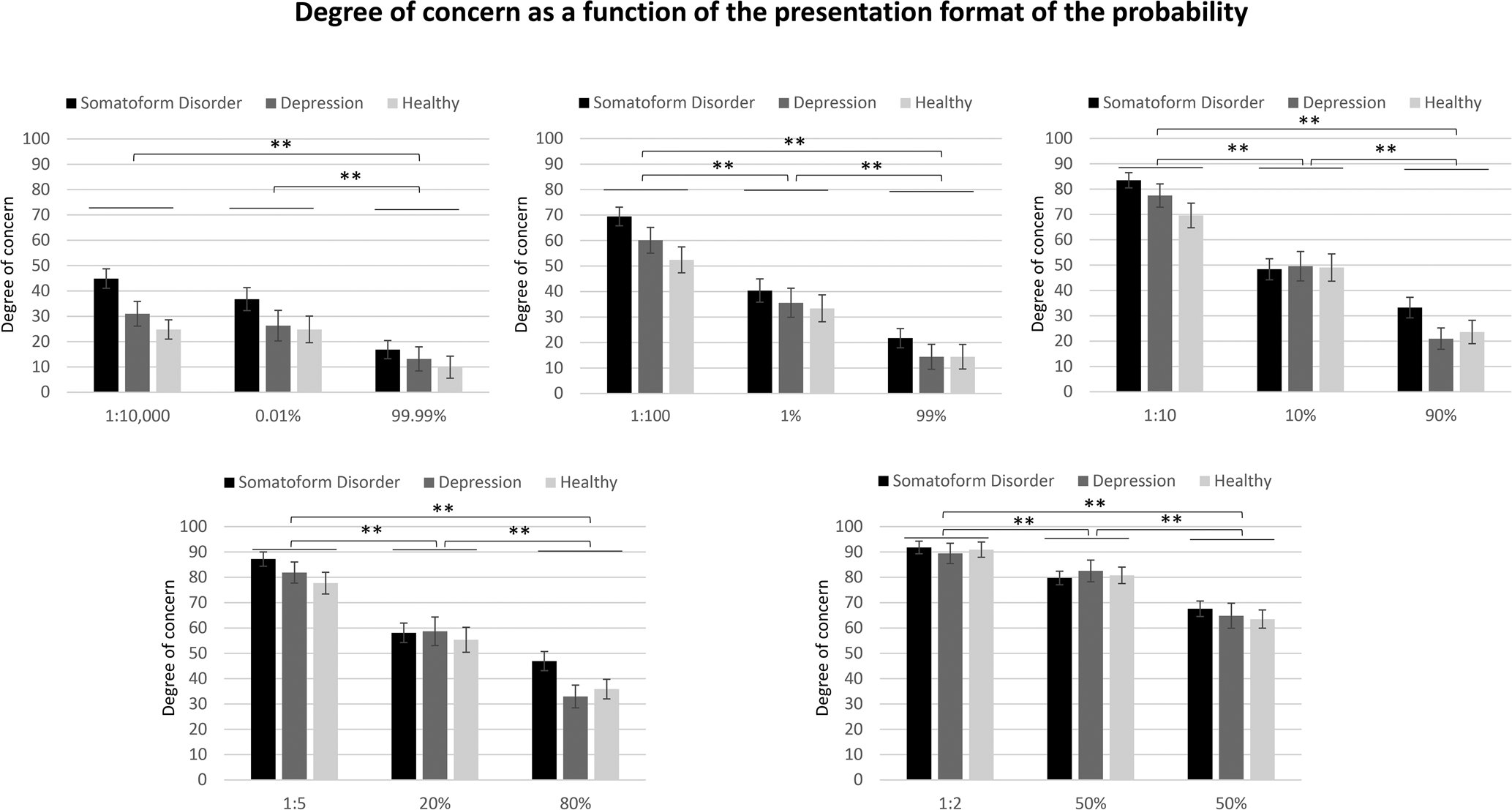
As illustrated in Fig. 2, we found strong evidence for the hypothesis that the same likelihood caused significantly different levels of concern depending on how it was framed, F(2, 252) = 160.992, p < 0.001, ɳ2p = 0.561, 95% CI 0.482–0.620. As detailed in the online supplement, we found that across samples and likelihoods, the degree of concern was lowest for the positive framing approach focusing on not having the disease (average concern: M = 33.03, s.d. = 23.22). Furthermore, we found that the likelihood of having the disease (negative framing approach) led to significantly more concern when expressed as a natural frequency (average concern: M = 70.01, s.d. = 21.26) than as a percentage (average concern: M = 51.00, s.d. = 25.41), with the exception of 1: 10 000 v. 0.01%.
Differences in the degree of concern in response to the likelihood of a serious medical disease, depending on format in which the likelihood is presented. Using natural frequencies (e.g. 1:10) for communicating the likelihood of the presence of a disease evoked more concern than using percentages (e.g. 10%). Positive framing approaches communicating the likelihood of the absence of a disease (e.g. 90%). ** p < 0.001, * p < 0.05. Error bars reflect the standard error of the mean.

Discussion
The present research sought to examine possible differences between patients with SFD, patients with MDD, and healthy people in their response to the likelihood of a serious medical disease. The results revealed two main findings. First, patients with SFD, as compared to patients with MDD and healthy persons, were significantly more worried about very low likelihoods for the presence of a medical disease. The lower the likelihoods were, the more pronounced these differences were between patients with SFD and the two control samples. These findings extend previous research on the effects of (failed) medical reassurance in SFD (Linton et al., Reference Linton, Boersma, Vangronsveld and Fruzzetti2012; Rief et al., Reference Rief, Heitmuller, Reisberg and Ruddel2006) by highlighting that people with SFD show worrisome emotional reactions to the possibility of having a serious a medical disease, even though its actual likelihood is very low. Of note, these sample differences pertain particularly to low likelihoods, because for likelihoods reflecting the realistic possibility of having a disease (i.e. likelihoods ⩾1:5), all samples were similarly concerned. Thus, a clinically relevant problem of patients with SFD appears to be that very low likelihoods of a medical disease are sufficient to trigger worrisome thoughts about being serious ill. Importantly, since patients with depression did not indicate a higher degree of concern than healthy people for any of the likelihoods, these findings suggest that difficulties in adequately interpreting low likelihoods for the presence of a medical disease is a deficit related specifically to SFD, rather than representing a general psychopathology factor.
Second, our results show that the same mathematical likelihood is perceived differently depending on how it is framed. Consistent with previous research on health and risk communication (Barnes et al., Reference Barnes, Faasse, Geers, Helfer, Sharpe, Colloca and Colagiuri2019; Rothman, Bartels, Wlaschin, & Salovey, Reference Rothman, Bartels, Wlaschin and Salovey2006), we found that likelihoods framed in terms of the high likelihood of the absence of a disease led to less concerns than when framed in terms of the low likelihood of its presence. This finding also accords with findings from nocebo research, which show that people report more side effects of a treatment when they are informed about the likelihood of a side effect occurring than when they are informed about the likelihood of it not occurring (Faasse et al., Reference Faasse, Huynh, Pearson, Geers, Helfer and Colagiuri2019; Mao et al., Reference Mao, Barnes, Sharpe, Geers, Helfer, Faasse and Colagiuri2021). In addition, in line with other research (Gurm & Litaker, Reference Gurm and Litaker2000; Peters et al., Reference Peters, Hart and Fraenkel2011), we found that the use of natural frequencies led to more concerns than percentages. With reference to qualitative research on how people interpret prognoses communicated in medicine (Hagerty et al., Reference Hagerty, Butow, Ellis, Lobb, Pendlebury, Leighl and Tattersall2005), this can be interpreted such that natural frequencies more concretely convey the fact that a real person is affected by the disease – and people may be inclined to think that they could be that person. Alternatively, it is possible that people were just more familiar with communicating probabilities in percentages, thus being less concerned when facing them.
Implications
Dealing with risks and likelihoods is an integral part of health communication – and the present study provides some implications for how to communicate them. The results suggest that physicians may consider framing likelihoods in terms of expressing that most likely nothing serious is wrong, rather than emphasizing a low likelihood of having a serious disease. Further, physicians may bear in mind that the likelihood of having a disease is less anxiety-provoking when expressed as a percentage than when expressed as a natural frequency, although other research has shown that natural frequencies are easier understood (Bodemer, Meder, & Gigerenzer, Reference Bodemer, Meder and Gigerenzer2014; Gigerenzer & Galesic, Reference Gigerenzer and Galesic2012; Gigerenzer, Gaissmaier, Kurz-Milcke, Schwartz, & Woloshin, Reference Gigerenzer, Gaissmaier, Kurz-Milcke, Schwartz and Woloshin2007). These findings may also have implications for how the risk of side effects of medications is communicated, as they are often presented as natural frequencies.
Limitations and future directions
A major limitation is the relatively small sample size. Although the sample size was sufficient to reveal significant differences between the three samples because all effect sizes were large, it must be noted that small sample sizes increase the degree of uncertainty related to the results (Kapur & Munafò, Reference Kapur and Munafò2019). In terms of statistical power, it should also be noted that the unequal sample sizes of patients with SFD, MDD, and healthy controls reduced the power, in the sense that the resulting power is based on the smallest sample size (i.e. N = 32 for the MDD sample). Another potential problem resulting from the unequal sample sizes is that for the likelihood 1: 100 000, the assumption of homogeneity of the residual variances was partly not met according to a Levene test. Therefore, the sample differences as revealed by the ANOVA for that likelihood should be interpreted with caution. For the other seven likelihoods, however, the assumption of variance homogeneity was met. Notably, the three samples differed in the distribution of educational degrees and current employment status. Accordingly, it is possible that the presence of higher educational degrees in the healthy control sample and more disabled people in the SFD sample contributed to the different levels of concern. Therefore, future research may consider using a stratification by educational degree and employment status to rule out the influence of the unequal distribution of these factors. Further, in order to more broadly examine the specificity of deficits in interpreting medical likelihoods in SFD, additional clinical control groups would have been beneficial. Specifically, it would have been interesting to examine patients with anxiety disorders as a further clinical control group, since anxiety disorders are related to concerns and an increased sensitivity to threats. Indeed, the exploratory analyses presented in the online supplement indicate that generalized anxiety was moderately associated with elevated concerns about the likelihood of a medical disease. Moreover, the order in which the likelihoods were presented was not randomized; therefore, it is possible that order effects influenced the results to some extent. In terms of the practical implications to be drawn from these results, it should be noted that in a real-life medical scenario, the likelihood of a serious disease as communicated by a physician is embedded in a complex clinical encounter, with additional factors influencing patients’ level of concern.
Therefore, a possible direction for future research might be to compare the effects of different likelihood framings as a part of a full clinical encounter. To pursue this goal, researchers may also consider additional conditions beyond gastrointestinal symptoms to further increase the external validity of the results. Furthermore, it will be important for future research also to examine the effects of positive framing using frequencies, such that both the effects of positive v. negative framing approaches, usage of percentages v. frequencies, and their interactions can be examined. Finally, since the present study investigated only the short-term effects of different likelihood framings, future research may use longer follow-up intervals. This would be particularly important given the tendency of patients with SFD to worry about the validity of the results of diagnostic testing some time after the clinical encounter (Salkovskis & Warwick, Reference Salkovskis and Warwick1986).
Conclusions
This study revealed that patients with SFD, in contradistinction to patients with MDD and healthy people, have difficulty adequately interpreting low likelihoods for having a serious medical disease. Furthermore, all participants were less concerned if likelihoods were presented in terms of expressing a high likelihood for the absence of a disease, rather than a low likelihood of its presence. Relatedly, the use of percentages was perceived as less concerning than the use of natural frequencies.
Supplementary material
The supplementary material for this article can be found at https://doi.org/10.1017/S0033291723001654.