Introduction
A wide range of neuropsychiatric disorders are associated with impairments in social cognition. Particularly prominent deficits in social interaction are seen in schizophrenia and autistic spectrum disorder (ASD). Impaired social function is a key diagnostic feature of schizophrenia in the DSM-IV classification, and has been shown to relate to long-term prognosis (APA, 1994). Similarly, difficulties with social interactions and communication are part of the core pathology of autism and account for much of the disability associated with the disorder (APA, 1994).
Facial expressions are a major cue used in social interactions (Darwin, Reference Darwin1872; Haxby et al. Reference Haxby, Hoffman and Gobbini2002; Adolphs, Reference Adolphs2003). Behavioural studies have demonstrated deficits in social judgement from faces in schizophrenia and ASD. The majority of studies have investigated the ability of affected individuals to identify basic emotional expressions from faces. Patients with schizophrenia have been shown to have deficits in the recognition of negative facial emotions, especially during psychotic episodes (Mandal et al. Reference Mandal, Pandey and Prasad1998; Edwards et al. Reference Edwards, Jackson and Pattison2002; Marwick & Hall, Reference Marwick and Hall2008). Individuals with ASD have also been shown to have impairments in facial emotion recognition, with some studies finding a particular deficit for the emotion of fear whereas other studies report a more pervasive deficit (Hobson et al. Reference Hobson, Ouston and Lee1988; Celani et al. Reference Celani, Battacchi and Arcidiacono1999; Howard et al. Reference Howard, Cowell, Boucher, Broks, Mayes, Farrant and Roberts2000; Adolphs et al. Reference Adolphs, Sears and Piven2001; Pelphrey et al. Reference Pelphrey, Sasson, Reznick, Paul, Goldman and Piven2002).
Fewer studies have investigated the ability of individuals with schizophrenia and autism to make more complex social judgements from faces. The available studies have focused on decisions related to threat, particularly judgements of approachability and trustworthiness from faces. There is evidence that approachability and trustworthiness judgements are abnormal in schizophrenia, an effect that may be more pronounced in paranoid individuals (Hall et al. Reference Hall, Harris, Sprengelmeyer, Sprengelmeyer, Young, Santos, Johnstone and Lawrie2004; Baas et al. Reference Baas, van't Wout, Aleman and Kahn2008b; Pinkham et al. Reference Pinkham, Hopfinger, Pelphrey, Piven and Penn2008). Similarly, individuals with ASD have also been shown to have impairments in rating approachability and trustworthiness from faces (Adolphs et al. Reference Adolphs, Sears and Piven2001), and in labelling complex emotions from images of eyes (Baron-Cohen et al. Reference Baron-Cohen, Wheelwright, Hill, Raste and Plumb2001).
In previous work we have demonstrated deficits in patients with schizophrenia and ASD in making social judgement from faces using a battery of tests covering a range of different social dimensions (Hall et al. Reference Hall, Harris, Sprengelmeyer, Sprengelmeyer, Young, Santos, Johnstone and Lawrie2004; Philip et al. Reference Philip, Whalley, Stanfield, Sprengelmeyer, Santos, Young, Atkinson, Dittrich, Calder, Johnstone, Lawrie and Hallin press). Patients with both disorders showed deficits in social judgement that were not restricted to affective, threat-related decisions (such as approachability) but extended to judgements of intelligence and distinctiveness from faces (Hall et al. Reference Hall, Harris, Sprengelmeyer, Sprengelmeyer, Young, Santos, Johnstone and Lawrie2004; Philip et al. Reference Philip, Whalley, Stanfield, Sprengelmeyer, Santos, Young, Atkinson, Dittrich, Calder, Johnstone, Lawrie and Hallin press). These results suggest that a common system underlying a wide range of social judgements from faces is disrupted in both schizophrenia and ASD (Brothers, Reference Brothers1990; Haxby et al. Reference Haxby, Hoffman and Gobbini2000, Reference Haxby, Hoffman and Gobbini2002; Adolphs, Reference Adolphs2003; Brunet-Gouet & Decety, Reference Brunet-Gouet and Decety2006; Amaral et al. Reference Amaral, Schumann and Nordahl2008; Pinkham et al. Reference Pinkham, Hopfinger, Pelphrey, Piven and Penn2008).
Previous imaging studies of social cognition have implicated several brain regions in social decision making, including the amygdala, medial prefrontal cortex, orbitofrontal cortex and lateral temporal cortex (Winston et al. Reference Winston, Strange, O'Doherty and Dolan2002; Adolphs, Reference Adolphs2003; Amodio & Frith, Reference Amodio and Frith2006; Winston et al. Reference Winston, O'Doherty, Kilner, Perrett and Dolan2007; Baas et al. Reference Baas, Aleman, Vink, Ramsey, de Haan and Kahn2008a). The amygdala in particular has been noted to be activated in relation to potential social threat, and has been hypothesized to act as a reflexive monitor of danger (Dolan & Vuilleumier, Reference Dolan and Vuilleumier2003). However, few studies have investigated the neural basis of less overtly threat-related social decisions, such as judgements of intelligence from faces. To our knowledge, no previous studies have directly compared brain activation during more than one test of social judgement.
In the current study we investigated the neural basis of social judgements for both overtly affective, threat-related social judgements (judgements of approachability) and social judgements that do not relate directly to the evaluation of physical threat (judgements of intelligence), both of which are impaired in schizophrenia and ASD (Hall et al. Reference Hall, Harris, Sprengelmeyer, Sprengelmeyer, Young, Santos, Johnstone and Lawrie2004; Philip et al. Reference Philip, Whalley, Stanfield, Sprengelmeyer, Santos, Young, Atkinson, Dittrich, Calder, Johnstone, Lawrie and Hallin press). We investigated the basis of such judgements in healthy control subjects to help elucidate the neural basis of the cognitive function disturbed in neuropsychiatric disorders such as schizophrenia and ASD, while avoiding the potential confounds of scanning studies of individuals with these disorders (such as differential task performance). We hypothesized that a common set of brain regions would be required for both types of social decision, impairments in which are likely to underlie the deficits seen in social cognition in schizophrenia and autism (Brothers, Reference Brothers1990; Brunet-Gouet & Decety, Reference Brunet-Gouet and Decety2006; Amaral et al. Reference Amaral, Schumann and Nordahl2008).
Method
Participants
Twenty-four right-handed volunteers participated in the study [12 males, 12 females; mean age 29.3 (s.d.=8.3) years; mean IQ 115.3 (s.d.=5.6)]. Exclusion criteria included a history of neurological or psychiatric disorder. All participants gave informed consent as approved by the Local Research Ethics Committee.
Experimental design
Two tests of social cognition were performed comprising judgements of approachability or intelligence from faces (Hall et al. Reference Hall, Harris, Sprengelmeyer, Sprengelmeyer, Young, Santos, Johnstone and Lawrie2004; Santos & Young, Reference Santos and Young2008). In the approachability task, participants had to decide whether faces appeared ‘not approachable’ or ‘very approachable’. In the intelligence task, participants had to decide whether the faces appeared ‘not intelligent’ or ‘very intelligent’. The control condition for each task consisted of categorically rating gender from the same faces, with the stimuli used for this and the main task being counterbalanced across participants.
Facial stimuli were selected as described previously (Hall et al. Reference Hall, Harris, Sprengelmeyer, Sprengelmeyer, Young, Santos, Johnstone and Lawrie2004; Santos & Young, Reference Santos and Young2008). In brief, 1000 pictures of faces derived from media sources, all of non-famous adults, were shown to six volunteer participants and were rated for approachability and intelligence on a scale of 1–7. The faces were highly reliably rated on both social dimensions across all raters (p<0.01, Cronbach's α=0.79 for approachability judgements and 0.75 for intelligence judgements). Faces representing the extremes of each social dimension were selected as stimuli for the neuroimaging task. Notably, there was a low overall correlation (0.26) between decisions made on the approachability and intelligence judgement tasks, suggesting that these tasks test different dimensions of social judgement (Santos, Reference Santos2003).
Two sets of facial stimuli (A and B) were assembled for each task. The sets consisted of 18 male and 18 female faces each. The faces of each sex were selected to maximize the difference across each social dimension examined (for example, in the approachability condition, nine high approachability faces and nine low approachability faces of each gender per set). For each participant one set of faces was used for social judgements and the other set of faces was used for gender judgements. The use of the stimulus sets was counterbalanced across participants such that half the participants made social judgements from stimulus set A and control gender judgements from stimulus set B and half the participants made social judgements from stimulus set B and control gender judgements from stimulus set A.
Both social judgement tasks (approachability and intelligence) were constructed to consist of two runs of six blocks per run. For each task, blocks of the social judgement (‘Social’ condition) were alternated with blocks of gender judgement (‘Gender’ condition) and the order of the blocks was counterbalanced across participants. Each block was 25 s in duration and blocks were separated by a rest period of 12.5 s during which participants were instructed to fixate on a cross in the centre of the screen (‘Rest’ condition). Blocks commenced with a 1 s visual prompt of the nature of the task to be performed (e.g. ‘Approachability’). Six faces were then presented in each block. Each face was presented for 3.5 s separated by a 0.5 s inter-stimulus interval (ISI). Faces were presented in one of four fixed pseudo-random orders, counterbalanced across participants, with the constraint that no more than three faces of one end of the dimension should be presented sequentially. The alternative response choices were shown on the screen throughout the task block (e.g. ‘not approachable’ and ‘very approachable’) and participants had to press one of two buttons to indicate which response they felt was most appropriate for each face shown. Participants were able to respond at any time during the 3.5 s face presentation or during the subsequent 0.5 s ISI. Responses on the social judgement tests were scored according to their agreement with the response most commonly selected in the ratings study, with a maximum score of 36 in each category. Reaction times were recorded for all judgements made in the scanner. Behavioural data from the scanning session were unavailable for one participant due to technical error; however, the participant reported completing the task and this was confirmed by real-time behavioural monitoring during the scanning session and therefore imaging data from this participant were included. The overall order of tasks (intelligence or approachability) was counterbalanced across participants.
Participants were instructed in how to perform the task prior to the commencement of testing and were given a short practice version of the tasks, consisting of a block of each judgement.
Image acquisition
Imaging was performed at the SFC Brain Imaging Research Centre in Edinburgh using a GE 1.5 T Signa scanner (GE Medical, USA). After a localizer scan, participants underwent four functional scanning runs [two runs each of approachability and intelligence tasks; 99 volumes/session; field of view 22 cm; echo time (TE) 40 ms; repetition time (TR) 2.5 s]. Interleaved axial slices were acquired with a thickness of 5 mm and a matrix size of 64×64. The first four echo-planar images (EPIs) in each run were discarded to avoid T1 equilibrium effects.
Image processing and analysis
The EPIs were reconstructed offline in ANALYZE format (Mayo Foundation, USA). Image analysis was conducted using SPM2 (Statistical Parametric Mapping; Wellcome Department of Cognitive Neurology and collaborators, Institute of Neurology, London, UK). Pre-processing consisted of re-orientation of the images and realignment to the mean EPI image, followed by normalisation to the standard Montreal Neurological Institute (MNI) EPI template and spatial smoothing using a Gaussian kernel (8 mm3 full-width at half-maximum). The participant's data were filtered in time using a high-pass filter (150 s cut-off) and temporal autocorrelations were accounted for by using an AR(1) model.
Statistical analysis was performed using the general linear model approach as implemented in SPM2. At the individual participant level the data for each task were modelled with three conditions (Social, Gender and Rest), each modelled by a boxcar convolved with a canonical haemodynamic response function. Parameters representing the participants' movement during the scan were also entered into the model as covariates of no interest. Contrast images were generated for each participant for the principal contrast of interest (Social versus Gender) representing the pair-wise comparison of parameter estimates for the conditions. One contrast image per participant was then entered into a second-level random effects analysis to examine regions of significant activation across the group using a one-sample t test.
A conjunction analysis was performed to determine which areas showed common activation across the two social cognition tasks. This is equivalent to a logical and function. For the conjunction analysis a one-way ANOVA was constructed with task as the grouping variable and one contrast image per task was entered into each group for each participant. t tests were conducted to determine the main effects of each task and conjoint activation across the tasks was determined by inclusive masking of the main effects of one task with the other at a threshold of p<0.001. Identical results were also obtained using the procedure described by Nichols et al. (Reference Nichols, Brett, Andersson, Wager and Poline2005).
All statistical maps were thresholded at a level of p<0.001 uncorrected and regions were considered significant at p<0.05 at the cluster level, corrected for multiple comparisons (cluster correction across whole brain volume as implemented in SPM2). Region of interest (ROI) analysis was conducted for the bilateral amygdala using a small volume correction (SVC) derived from the automated anatomical labelling atlas in WFU_PickAtlas v.2.0 dilated by 1 voxel to incorporate the full extent of the amygdala complex (Tzourio-Mazoyer et al. Reference Tzourio-Mazoyer, Landeau, Papathanassiou, Crivello, Etard, Delcroix, Mazoyer and Joliot2002; Maldjian et al. Reference Maldjian, Laurienti, Kraft and Burdette2003).
Results
Behavioural data
Behavioural data were recorded from participants as they completed the tasks in the scanner. Responses on both tasks showed a high degree of reproducibility across participants. The mean scores (out of 36) on the approachability task were 31.5 (s.d.=4.1) for social judgements and 34.8 (s.d.=1.0) for gender judgements. The mean scores on the intelligence task were 29.3 (s.d.=3.7) for social judgements and 35.1 (s.d.=1.0) for gender judgements. There was no significant difference in performance between the approachability and intelligence tasks (p>0.05). Participants performed the gender judgements more accurately than the social judgements in both tasks (p<0.01 in both cases). The mean reaction times (RTs) during the approachability task were 1316 ms (s.d.=237) for social judgements and 1056 ms (s.d.=182) for gender decisions. The mean RTs during the intelligence task were 1550 ms (s.d.=237) for social judgements and 1072 ms (s.d.=182) for gender decisions. Analysis of the RT data revealed that gender judgements were performed more quickly than social judgements in both tasks (p<0.001 in both cases), with no difference in the RTs for gender judgements between the two tasks (p>0.8). Approachability judgements were made significantly more quickly than judgements of intelligence (p=0.003).
Neural responses during judgements of approachability from faces
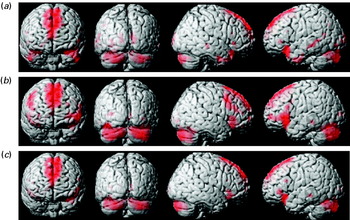
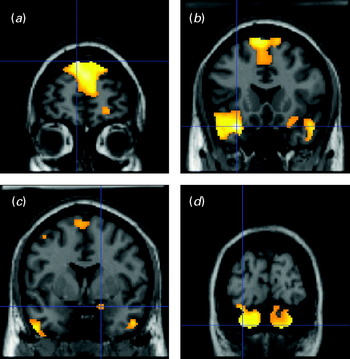
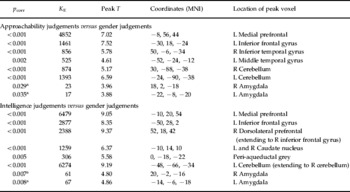
To investigate neural responses related to judgements of approachability, we compared blood oxygen level-dependent (BOLD) activations during approachability to those during judgements of gender [Table 1 and Figs 1(a) and 2]. Notably, the two stimulus sets were counterbalanced across subjects, such that half the subjects made approachability judgements on stimulus set A and gender judgements on stimulus set B and the other half made gender judgements on stimulus set A and approachability judgements in stimulus set B. The contrast of approachability judgements versus gender judgements revealed significant task-related activations in the anterior and superior medial prefrontal cortex bilaterally [Brodmann area (BA) 6 and BA 9], with the peak activation seen on the left. In addition, bilateral activation of the inferior frontal gyrus was seen extending to the insula (BA 45/47), which on the left formed part of a contiguous cluster extending into the inferior temporal cortex. Bilateral activation was present in the posterior cerebellum and the inferior temporal gyrus (BA 20) extending into the temporal poles. Unilateral activation was demonstrated in the left middle temporal gyrus (BA 21). Bilateral activation of the amygdala was observed during approachability judgements (compared to gender judgements), which reached corrected significance within an anatomically defined ROI.
Brain regions activated during social judgement. Statistical maps of task activations rendered on a whole brain image showing: (a) approachability judgements versus gender judgements, (b) intelligence judgements versus gender judgements and (c) conjunction of approachability and intelligence judgements. Images thresholded at p<0.001 uncorrected.

Statistical parametric maps (SPMs) showing peak activations during approachability judgements in (a) left medial prefrontal cortex, (b) left inferior prefrontal cortex, (c) right amygdala and (d) left cerebellum. SPMs thresholded at p<0.001.

Brain regions activated during judgements of approachability and intelligence from faces

L, Left; R, right.
a Within a bilateral amygdala small volume correction (SVC).
Neural responses during judgements of intelligence from faces
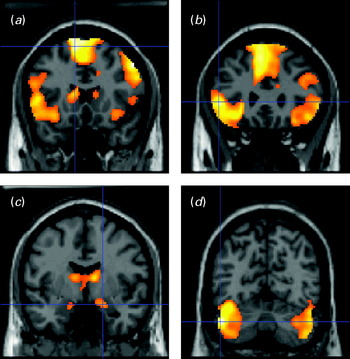
We next investigated brain activation during judgements of intelligence compared to judgements of gender from matched stimuli (Table 1 and Figs 1 b and 3). This contrast revealed significant bilateral activation in the dorsal medial prefrontal cortex (BA 6) extending into the rostral prefrontal cortex (BA 9) with more prominent activation on the left side. Bilateral activation was also seen in the inferior frontal gyrus extending posteriorly to the insula on the left (BA 45/47) and in the posterior cerebellum. No activation was seen in the inferior or middle temporal regions. However, activation was seen in the right dorsolateral prefrontal cortex (BA 9) and bilaterally in the caudate nucleus, areas that were not active during approachability judgements. In addition, there was a significant cluster of activation extending from the midbrain in the region of the peri-aqueductal grey through the amygdala bilaterally and incorporating part of the hypothalamus.
Statistical parametric maps (SPMs) showing peak activations during intelligence judgements in (a) left medial prefrontal cortex, (b) left inferior prefrontal cortex, (c) right amygdala and (d) left cerebellum. SPMs thresholded at p<0.001.

Conjunction analysis
We next investigated whether there was a common network of brain regions showing task-related activation in both the approachability and intelligence tasks. To do this we conducted a conjunction analysis to produce a statistical map of voxels activated at p<0.001 uncorrected in both tasks. We then used this map to identify clusters showing significant activation across the two tasks with a corrected cluster significance of p<0.05. In addition, we looked for conjunctional activation of the amygdala across the two tasks at cluster p<0.05 corrected within a bilateral amygdala ROI.
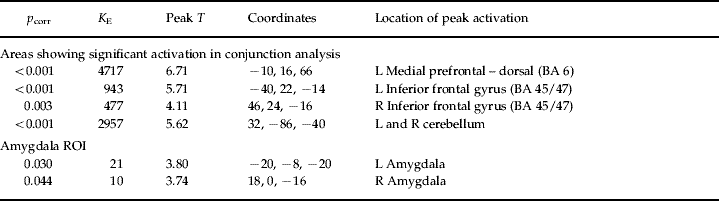
Areas showing a significant conjunction of activation across the two tasks are shown in Table 2 and Fig. 1 c. Common activation was seen in the superior and anterior medial prefrontal cortex (BA 6 and BA 9), bilateral inferior frontal cortex (BA 45/47) extending into the insula on the left, and bilateral posterior cerebellum. ROI analysis also identified significant cluster-level conjunctional activation in both the left and right amygdala.
Brain regions showing significant activation in both social judgement tasks as assessed by conjunction analysis

L, Left; R, right; BA, Brodmann area; ROI, region of interest.
Discussion
Impairments in social cognition are major features of psychiatric disorders including schizophrenia and ASD. We have previously shown that both schizophrenia and ASD are associated with impairments in making a wide range of social judgements, including judgements of approachability and intelligence from faces, using the same tasks behaviourally as used in the current study (Hall et al. Reference Hall, Harris, Sprengelmeyer, Sprengelmeyer, Young, Santos, Johnstone and Lawrie2004; Philip et al. Reference Philip, Whalley, Stanfield, Sprengelmeyer, Santos, Young, Atkinson, Dittrich, Calder, Johnstone, Lawrie and Hallin press). Here we have used functional magnetic resonance imaging (fMRI) to investigate whether there is a common neural system underlying such social judgements in health, impairments in which could account for the deficits seen in these disorders. Our results confirm that there is a common set of brain regions activated during judgements of both approachability and intelligence from faces that includes the amygdala, medial prefrontal cortex, inferior prefrontal cortex and cerebellum.
Bilateral amygdala activation was seen in both tasks. The amygdala has previously been implicated in social judgement, especially for tasks with an explicitly affective nature (Adolphs, Reference Adolphs2003; Adolphs & Spezio, Reference Adolphs and Spezio2006). Lesions of the amygdala result in impairments in judgements of trustworthiness and approachability, and amygdala activation has been demonstrated in functional imaging tasks to faces rated as untrustworthy (Adolphs et al. Reference Adolphs, Tranel and Damasio1998; Winston et al. Reference Winston, Strange, O'Doherty and Dolan2002). Studies of facial emotion processing have also demonstrated a central role of the amygdala in detecting negative emotions such as fear in faces (Adolphs et al. Reference Adolphs, Tranel, Damasio and Damasio1994, Reference Adolphs, Tranel, Hamann, Young, Calder, Phelps, Anderson, Lee and Damasio1999; Breiter et al. Reference Breiter, Etcoff, Whalen, Kennedy, Rauch, Buckner, Strauss, Hyman and Rosen1996; Morris et al. Reference Morris, Frith, Perrett, Rowland, Young, Calder and Dolan1996). Taken together, these results have led to the suggestion that the role of the amygdala in social judgement is to act as an implicit detector of threat or hostility (Dolan & Vuilleumier, Reference Dolan and Vuilleumier2003). The current findings, however, support a broader involvement of the amygdala in social judgement. Activation of the amygdala was seen not only in the approachability task, which is clearly threat related in nature, but also during the intelligence judgement task, which is not primarily related to threat. In addition, greater amygdala activation was seen during social judgements than during gender judgements from the same faces (across subjects), indicating a role of the amygdala in social judgement that extends beyond automatic responding to features of facial stimuli related to threat (Baron-Cohen et al. Reference Baron-Cohen, Ring, Wheelwright, Bullmore, Brammer, Simmons and Williams1999). These results are consistent with a general role of the amygdala in inferring others' mental states (the so-called ‘theory of mind’) (Kling & Brothers, Reference Kling, Brothers and Aggleton1992; Baron-Cohen et al. Reference Baron-Cohen, Ring, Wheelwright, Bullmore, Brammer, Simmons and Williams1999; Fine et al. Reference Fine, Lumsden and Blair2001), a view supported by lesion studies showing that amygdala damage results in impairments in a wide range of social judgements from faces (Adolphs et al. Reference Adolphs, Tranel and Damasio1998; Adolphs et al. Reference Adolphs, Baron-Cohen and Tranel2002; Stone et al. Reference Stone, Baron-Cohen, Calder, Keane and Young2003; Shaw et al. Reference Shaw, Bramham, Lawrence, Morris, Baron-Cohen and David2005) and deficits in non-facial theory of mind tasks (Fine et al. Reference Fine, Lumsden and Blair2001; Stone et al. Reference Stone, Baron-Cohen, Calder, Keane and Young2003).
The medial prefrontal cortex, particularly on the left, has been shown to be activated in tasks testing social decision making and theory of mind judgements (Amodio & Frith, Reference Amodio and Frith2006; Brunet-Gouet & Decety, Reference Brunet-Gouet and Decety2006), leading to the suggestion that this brain region may have a central role in forming higher-level representations about the intentions of others (Amodio & Frith, Reference Amodio and Frith2006). Meta-analyses of neuroimaging studies have confirmed the involvement of the medial prefrontal cortex in emotional and social tasks and have suggested that more rostral regions of the medial prefrontal cortex may be preferentially involved in ‘affective’ tasks whereas more dorsal regions may be selectively activated during more ‘cognitive’ processing (Bush et al. Reference Bush, Luu and Posner2000; Steele & Lawrie, Reference Steele and Lawrie2004). In this regard it is of interest that the peak activation in the intelligence judgement task was more dorsal than that in the approachability task. Conjunction analysis, however, revealed that there was considerable overlap in the regions of the medial prefrontal cortex activated in the two tasks in the current study, demonstrating that a core region of medial prefrontal cortex is activated across different social judgements.
The inferior prefrontal cortex and anterior insula were activated in both tasks and have been shown previously to operate as part of the mirror neuron system (Gallese et al. Reference Gallese, Keysers and Rizzolatti2004; Rizzolatti & Craighero, Reference Rizzolatti and Craighero2004). The pars opercularis is recruited during the execution of an action and the observation of the same action in others, whereas the pars orbitalis and the insula have been shown to play a similar role in representing emotional states in the self and others (Craig, Reference Craig2002; Decety & Chaminade, Reference Decety and Chaminade2003; Gallese et al. Reference Gallese, Keysers and Rizzolatti2004; Singer et al. Reference Singer, Kiebel, Winston, Dolan and Frith2004). Mirror activation in these brain regions is thought to underlie the generation of an internal state in the observer similar to that present in the observed subject (Carr et al. Reference Carr, Iacoboni, Dubeau, Mazziotta and Lenzi2003; Gallese et al. Reference Gallese, Keysers and Rizzolatti2004). Activation of these brain regions has been seen in social judgement tasks (Baron-Cohen et al. Reference Baron-Cohen, Ring, Wheelwright, Bullmore, Brammer, Simmons and Williams1999; Russell et al. Reference Russell, Rubia, Bullmore, Soni, Suckling, Brammer, Simmons, Williams and Sharma2000) and may reflect the generation of a subjective representation of the affective state of others used to guide decision making (Gallese et al. Reference Gallese, Keysers and Rizzolatti2004).
The posterior lobe of the cerebellum showed bilateral activation in both tests of social cognition in the current study and has previously been implicated in theory of mind judgements (Brunet et al. Reference Brunet, Sarfati, Hardy-Bayle and Decety2000; Calarge et al. Reference Calarge, Andreasen and O'Leary2003). Lesions to this brain region result in the cerebellar cognitive affective syndrome, which includes deficits in executive function, personality changes and alterations in social function including inappropriate behaviour (Schmahmann & Sherman, Reference Schmahmann and Sherman1998; Schmahmann, Reference Schmahmann2004). The posterior cerebellum has extensive reciprocal connections through the pons to prefrontal, temporal and limbic regions and may play a role in the coordination of higher cognitive function including social judgement (Schmahmann, Reference Schmahmann2004).
A more limited set of brain regions showed selective activation in only one of the social judgement tasks tested. Activation of the right dorsolateral prefrontal cortex was seen only in the intelligence judgement task. An increased BOLD signal was also seen in the intelligence task in the head of the caudate nucleus, the striatal projection area of the dorsolateral prefrontal cortex. These regions may represent a functional circuit recruited during social judgements of a more cognitive and less affective nature. Lesions of the dorsolateral prefrontal cortex have been shown to result in impairments in the ability of subjects to use social cues to make interpersonal judgements, supporting a functional role of the dorsolateral prefrontal cortex in some forms of social decision making (Mah et al. Reference Mah, Arnold and Grafman2004). Activation of the dorsolateral prefrontal cortex and caudate nucleus may also relate to the overall cognitive load, as the RT data indicate that the intelligence judgement task is more cognitively demanding than the approachability task. By contrast, activation of the inferior temporal cortices extending to the temporal pole and the left middle temporal cortex was only seen in the approachability task. Temporal lobe regions, including the temporal poles and middle and inferior temporal cortices, have been implicated in theory of mind judgements and in assessing and empathizing with facial affect (Carr et al. Reference Carr, Iacoboni, Dubeau, Mazziotta and Lenzi2003; Gallagher & Frith, Reference Gallagher and Frith2003; Kim et al. Reference Kim, Kim, Jeong, Ki, Im, Lee and Lee2005; Vollm et al. Reference Vollm, Taylor, Richardson, Corcoran, Stirling, McKie, Deakin and Elliott2006). Activity in these regions may therefore be required to access mnemonic information used in social judgement, especially in relation to decisions of an affective nature.
The present study represents a large neuroimaging investigation of the neural basis of social judgements; however, some limitations of this study should be noted. First, we used a blocked design comparing social judgements to gender judgements, comparable to tasks in which we have previously shown patient groups to be impaired (Hall et al. Reference Hall, Harris, Sprengelmeyer, Sprengelmeyer, Young, Santos, Johnstone and Lawrie2004; Philip et al. Reference Philip, Whalley, Stanfield, Sprengelmeyer, Santos, Young, Atkinson, Dittrich, Calder, Johnstone, Lawrie and Hallin press). Although this is a statistically powerful method, the design of the task did not enable us to separately investigate stimulus- and task-driven neural responses, or the interaction between these factors. A fuller analysis of these features would require an event-related or mixed blocked and event-related design as used in some previous investigations of social judgement (Winston et al. Reference Winston, Strange, O'Doherty and Dolan2002, Reference Winston, O'Doherty, Kilner, Perrett and Dolan2007; Baas et al. Reference Baas, Aleman, Vink, Ramsey, de Haan and Kahn2008a). Second, although a strength of the current study was the investigation of two different social judgements, practical limitations prevented the investigation of the neural basis of a broader range of social decisions. Third, we cannot entirely exclude the possibility that judgements of intelligence are also to some degree threat related, although previous evidence suggests that there is only a very low correlation between performance on approachability and intelligence judgements (Santos, Reference Santos2003). Fourth, the gender judgements used as the comparison condition themselves represent a form of social judgement; however, gender judgements were performed uniformly more accurately and rapidly than social judgements in the current study, confirming that they represent a constrained but cognitively less demanding control condition. These caveats notwithstanding, the identification of a common brain network involved in both tasks strongly implicated abnormalities in these brain regions, or their coordinated interaction, in the pathogenesis of deficits in social cognition in neuropsychiatric disorders such as schizophrenia and ASD and other conditions in which social deficits feature prominently, including personality disorders (Baron-Cohen et al. Reference Baron-Cohen, Ring, Wheelwright, Bullmore, Brammer, Simmons and Williams1999; Pinkham et al. Reference Pinkham, Penn, Perkins and Lieberman2003; Abdi & Sharma, Reference Abdi and Sharma2004; Brunet-Gouet & Decety, Reference Brunet-Gouet and Decety2006; Amaral et al. Reference Amaral, Schumann and Nordahl2008).
Acknowledgements
The work was funded by the Dr Mortimer and Theresa Sackler Foundation. J.H. is supported by a Medical Research Council (MRC) Clinical Research Training Fellowship and A.McI. is supported by The Health Foundation. H.C.W. and S.M.L. were supported by the Sackler Foundation. Imaging was performed at the SFC Brain Imaging Research Centre in Edinburgh. We thank all the participants.
Declaration of Interest
J.H., A.McI., H.C.W. and S.M.L. have received grants from the Translational Medicine Research Collaboration, a consortium made up of the Universities of Aberdeen, Dundee, Edinburgh and Glasgow, the four associated National Health Service (NHS) Health Boards (Grampian, Tayside, Lothian and Greater Glasgow & Clyde), Scottish Enterprise, and Wyeth Pharmaceuticals.