Many studies have investigated ways of enhancing the effectiveness of second language (L2) grammar learning. One line of investigation has explored this question by comparing different types of learning and feedback conditions, such as types of corrective feedback (Li, Reference Li2010), explicit and implicit treatments (Norris & Ortega, Reference Norris and Ortega2000; Spada & Tomita, Reference Spada and Tomita2010), and comprehension-based versus production-based instruction (Shintani, Li, & Ellis, Reference Shintani, Li and Ellis2013). A relatively unexplored area of research is the effect of distribution of practice in L2 grammar learning: whether different intervals between multiple practice sessions facilitate the retention of the targeted knowledge. A large body of literature in cognitive psychology suggests that the ratio of intersession interval (ISI; the amount of time between the practice sessions) to retention interval (RI; the amount of time between the end of practice and the testing time) influences the skill acquisition process (see Carpenter, Cepeda, Rohrer, Kang, & Pashler, Reference Carpenter, Cepeda, Rohrer, Kang and Pashler2012; Rohrer, Reference Rohrer2015, for review in the psychology literature; see Serrano, Reference Serrano and Munoz2012, for review in second language acquisition [SLA]). In the area of L2 grammar learning, a few empirical studies have investigated whether an optimal ratio of ISI to RI facilitates learning (Bird, Reference Bird2010; Miles, Reference Miles2014). These findings suggest that, even with the same amount of study time, L2 grammar learning can be enhanced by optimal scheduling of practice time. This topic is particularly important in foreign language learning classrooms where the amount of in-class practice is often limited.
As renewed attention has recently been given to cognitive aptitudes for L2 learning (Carroll, Reference Carroll and Diller1981; Granena, Reference Granena2015; Li, Reference Li2015; Linck, Hughes, et al., Reference Linck, Hughes, Campbell, Silbert, Tare and Jackson2013; Skehan, Reference Skehan, Gass and Mackey2012, Reference Skehan2015), an emerging line of investigations has explored how individual differences in cognitive aptitudes moderate the effectiveness of different types of L2 instruction (e.g., Brooks, Kempe, & Sionov, Reference Brooks, Kempe and Sionov2006; Erlam, Reference Erlam2005; Goo, Reference Goo2012; Robinson, Reference Robinson1997; Yilmaz, Reference Yilmaz2013). It has been shown that some L2 instructional treatments are more or less effective for particular individuals, depending on their aptitude profile (Doughty, Reference Doughty, Granena and Long2013). Examining Aptitude × Treatment interactions (ATI) will ultimately inform us about how we can enhance the effectiveness of instruction by matching instruction to the learner's aptitudes (Cronbach & Snow, Reference Cronbach and Snow1977). Furthermore, ATI can potentially unveil the underlying L2 learning processes if certain aptitudes are found to play a different (facilitative/inhibitory) role with different treatments (DeKeyser, Reference DeKeyser2012; Robinson, Reference Robinson and Robinson2002).
Following this line of investigations, the current study aims to explore to what extent individual differences moderate the effectiveness of different levels of distribution of practice. It examines the role of individual differences in the two primary components of aptitudes, language-analytic ability (LAA) and working memory capacity (WMC), on L2 practice distribution. Japanese as L2 learners were trained on an element of Japanese morphosyntax, accompanied with vocabulary learning, in an explicit step-by-step manner, in either distributed practice (7-day interval) or massed practice (1-day interval). To the best of our knowledge, no prior research has examined the distributed/massed practice from an ATI perspective; the current study, exploratory in nature, is a first attempt to better understand this underresearched area.
In what follows, we will review the role of cognitive aptitudes in L2 grammar learning, with a particular focus on the two most researched aptitude components, LAA and WMC. We then point out the relevance of investigating a combination of LAA and WMC for distributed/massed learning and lay out the design of the current study.
LAA AND L2 GRAMMAR LEARNING
One of the most well-known aptitude test batteries is the Modern Language Aptitude Test (MLAT; Carroll & Sapon, Reference Carroll and Sapon1959). Among the components identified in the MLAT, Carroll (Reference Carroll and Diller1981) suggested that two have found to be especially important for L2 grammar learning: grammatical sensitivity and inductive learning ability. Grammatical sensitivity can be measured by a subtest in the MLAT (words in sentences), whereas the MLAT does not have a subtest that specifically targets the inductive learning ability. A more recent aptitude test, the LLAMA test (Meara, Reference Meara2005), for instance, has the Llama_F subtest for measuring the inductive learning ability. In the current paper we consider both components to be measures of LAA, based on Skehan's (Reference Skehan1998) theorization of aptitude. LAA is defined as the capacity “to infer rules of language and make linguistic generalizations or extrapolations” (Skehan, Reference Skehan1998, p. 204).
LAA has been found to play a role in L2 grammar learning (De Graaff, Reference De Graaff1997; Erlam, Reference Erlam2005; Hwu & Sun, Reference Hwu and Sun2012; Li, Reference Li2013; Ranta, Reference Ranta and Robinson2002; Robinson, Reference Robinson1997; Sheen, Reference Sheen2007; Shintani & Ellis, Reference Shintani and Ellis2015; Trofimovich, Ammar, & Gatbonton, Reference Trofimovich, Ammar, Gatbonton and Mackey2007; Wesche, Reference Wesche and Diller1981; Yilmaz, Reference Yilmaz2013). Robinson (Reference Robinson1997) investigated how LAA moderated L2 grammar learning under four types of learning conditions: the implicit condition (participants were told to remember the stimuli and pay attention to the location of some of the words), the incidental condition, the rule search condition, and the instructed condition. LAA was correlated significantly with learning outcomes in all conditions except the incidental condition, suggesting that LAA plays an important role in a learning process where more effortful, formal rule learning is involved.Footnote 1
A similar pattern of findings has been documented in L2 research on feedback. Sheen (Reference Sheen2007) examined how LAA contributed to the L2 acquisition of English articles in two types of corrective feedback in writing: direct feedback and direct feedback plus metalinguistic explanation. LAA was found to be significantly related to learning gains after both types of feedback, but the relationship was stronger for the feedback that included metalinguistic information. This suggests that learners with high LAA benefit more from metalinguistic feedback to improve their accuracy. Consistent with Sheen's (Reference Sheen2007) findings, other studies have found LAA to be particularly important in a learning situation where the learners engage in form-focused learning during feedback (Trofimovich et al., Reference Trofimovich, Ammar, Gatbonton and Mackey2007; Yilmaz, Reference Yilmaz2013).Footnote 2
Overall, LAA plays a significant role in form-focused L2 grammar learning. Because the current study involves explicit form-focused grammar learning, it is conceivable that LAA is related to the learning outcomes regardless of practice distribution. However, if the distribution of practice influences the degree of engagement in explicit form-focused learning in any way, then the contribution of LAA may change in distributed or massed practice conditions.
WMC AND L2 GRAMMAR LEARNING
With recent advancements in understanding various aspects of memory in psychology, the conceptualization of aptitudes has been extended to include WMC as well as other components (Linck, Hughes, et al., Reference Linck, Hughes, Campbell, Silbert, Tare and Jackson2013; Miyake & Friedman, Reference Miyake, Friedman, Healy and Bourne1998; Skehan, Reference Skehan1998, Reference Skehan and Robinson2002). All models of working memory (WM) see it as a limited-capacity system, but the models differ in how they define WMC or conceptualize its limitations (Baddeley, Reference Baddeley2012; Conway, Jarrold, Kane, Miyake, & Towse, Reference Conway, Jarrold, Kane, Miyake, Towse, Conway, Kane, Miyake and Towse2007; Engle, Reference Engle2002). In the present paper, WM is operationalized as a control mechanism that regulates the operation of various cognitive processes such as shifting, updating, and inhibiting (Miyake & Friedman, Reference Miyake and Friedman2012; Miyake et al., Reference Miyake, Friedman, Emerson, Witzki, Howerter and Wager2000). It stores and manipulates immediate information until this information is integrated into the cognitive process (Linck, Osthus, Koeth, & Bunting, Reference Linck, Osthus, Koeth and Bunting2013). Following this operationalization, WMC is typically assessed by complex tasks such as the operation-span (Ospan) task in which participants are asked to execute two tasks at the same time: recalling a list of alphabet letters (storage) while solving math problems (processing). In what follows, we will review research that examined the role of WMC in L2 learning (see Linck, Osthus, et al., Reference Linck, Osthus, Koeth and Bunting2013; Williams, Reference Williams, Gasss and Mackey2012, for review). In these studies, WMC was assessed by a variant of complex tasks (e.g., Ospan, reading-span, and listening-span tasks), all of which taxed both storage and manipulation components.
Accumulating evidence suggests that the effect of WMC is associated with different types of instruction (Brooks et al., Reference Brooks, Kempe and Sionov2006; Goo, Reference Goo2012; Kempe & Brooks, Reference Kempe and Brooks2008; Mackey, Adams, Stafford, & Winke, Reference Mackey, Adams, Stafford and Winke2010; Sagarra, Reference Sagarra and Mackey2007; Sanz, Lin, Lado, Stafford, & Bowden, Reference Sanz, Lin, Lado, Stafford and Bowden2014; Trofimovich et al., Reference Trofimovich, Ammar, Gatbonton and Mackey2007; Yilmaz, Reference Yilmaz2013). Brooks et al. (Reference Brooks, Kempe and Sionov2006) investigated the role of WMC in learning noun gender marking with a miniature version of Russian. They manipulated the type variability (i.e., the amount of vocabulary in inflection categories to be presented). Participants were randomly assigned to three groups: high variability (24 nouns), medium variability (12 nouns), and low variability (6 nouns). The results showed that learning outcomes were superior in the high-variability input condition only among high WMC participants. WMC seems to mediate the acquisition of morphology through the large set of items.
A more recent study investigated how WMC moderated the effects of grammar instruction prior to practice (Sanz et al., Reference Sanz, Lin, Lado, Stafford and Bowden2014). Participants were trained, through input-based practice and explicit feedback, on a morphological system in miniature Latin. They were assigned to either a group with a grammar lesson prior to practice or a group without any grammar lesson. The results showed that WMC played a role in practice without grammar instruction, but it did not moderate the training outcomes when practice was accompanied by grammar instruction. They concluded that providing prepractice grammar explanation reduced the effect of individual differences in WMC. In other words, WMC was related to the outcomes from learning without grammar explanation because practice without an advanced organizer (e.g., grammar explanation) made learning more demanding, taxing WM more.Footnote 3 This pattern seems to fit one of the general findings in ATI research in education that “aptitude becomes more important as the treatment puts more of a burden of information processing on the learners” (DeKeyser, Reference DeKeyser and Robinson2013, p. 29). This suggests that the role of WMC will become more important if either distributed or massed learning conditions place more processing demands on the learning process.
If learning demands are different between distributed and massed practice in the current study, it may be possible to predict the relative contribution of WMC in the learning process. Among several theories that have been proposed to account for the underlying learning mechanisms in spacing effects, two theories appear to predict different learning demands placed on distributed practice and massed practice. Although the current study did not directly attempt to test the validity of these theories (for reviews on the theories, see Serrano, Reference Serrano and Munoz2012; Toppino & Gerbier, Reference Toppino and Gerbier2014), these two accounts are briefly explained to motivate two competing hypotheses regarding how WMC can possibly moderate either distributed or massed practice: (a) the study-phase retrieval account and (b) the discriminative-contrast account.
In the study-phase retrieval account, the successful retrieval of the earlier-learned material at a later time plays a crucial role in better retention (e.g., Toppino & Bloom, Reference Toppino and Bloom2002). As long as people can successfully retrieve the previous item (Karpicke & Roediger, Reference Karpicke and Roediger2007, Reference Karpicke and Roediger2008), greater spacing leads to better retention. Conversely, a longer interval increases the probability of failure in retrieving the previous item. This suggests that learners with low WMC may be at risk of completely forgetting the previously learned items and failing to benefit from distributed practice. If this is a scenario, it is likely that distributed practice (i.e., a longer interval between training sessions) may be more sensitive to WMC than massed practice.
In contrast, the discriminative-contrast account offers a different scenario (e.g., Kornell & Bjork, Reference Kornell and Bjork2008). In a nutshell, it claims that spacing the presentation of learning items helps learners to discriminate the critical features of the items. When time intervals are interspersed between the two study phases, it is more advantageous in discriminating between categories. In other words, massed practice may make it difficult to distinguish the elements, which places more demand on working memory. Because individuals with low WMC suffer from interference from prior similar items more than those with high WMC (Kane & Engle, Reference Kane and Engle2000), WMC may be more crucial when items are presented en masse in a shorter period of time.
APTITUDE COMPLEXES AND L2 GRAMMAR LEARNING
The two aptitude components in the current study have often been examined separately in previous research, and only a few studies have examined the role of both LAA and WMC in the same study design. The idea of using a combination of aptitudes or an “aptitude complex” for different types of instruction has been explored in other fields such as instructional psychology (Cronbach & Snow, Reference Cronbach and Snow1977). Aptitude complexes are a set of cognitive aptitudes that are assumed to be recruited together for different learning processes (Ackerman, Reference Ackerman2003; Snow, Reference Snow, Snow and Farr1987).
In SLA research, Robinson (Reference Robinson and DeKeyser2007) proposed an aptitude complex for explicit rule learning: metalinguistic rule rehearsal and memory for contingent text. These two “ability factors” are further broken down to “cognitive abilities.” Metalinguistic rule rehearsal consists of grammatical sensitivity and rote memory, whereas memory for contingent text (the ability to remember and rehearse written information) is a combination of WM for text and speed of WM. According to Robinson, these cognitive abilities are relevant to learning processes in which learners are given a rule explanation with written examples, remember and rehearse the rule, and apply it for comprehension or production exercises.
Following Robinson's (Reference Robinson and DeKeyser2007) framework as a guide for exploring aptitude complexes for distributed/massed practice, the present study examines the two cognitive abilities, LAA and WMC, simultaneously. Because the learning processes in the current study involve an explicit mode of grammar learning (e.g., learning about a rule and applying it for comprehension and production activities), examining both LAA and WMC is of great relevance and importance for the study. The current study does not measure the same four cognitive abilities as proposed by Robinson above; our approach is exploratory and focuses on LAA (which subsumes grammatical sensitivity) and WMC (which is relevant for remembering and rehearsing grammatical rules for production).
Two empirical studies will be presented that investigated the role of LAA and WMC in L2 feedback treatments.Footnote 4 Both studies involved LAA and WMC as covariates as well as random assignment of participants to two feedback treatment groups. Their studies yielded different patterns of ATI, and they suggest potential ATI patterns that the present study may find by exploring LAA and WMC. Yilmaz (Reference Yilmaz2013) investigated how LAA and WMC interacted with two feedback types in L2 grammar learning. Learners were randomly assigned to either an explicit-correction group or a recast group. The results showed that both LAA and WMC were only related to learning gains in the explicit-correction group and that learning gains in the recast group were not related to the aptitudes. Similarly, Li (Reference Li2013) investigated how the two aptitude components influenced L2 grammar learning under two types of feedback (metalinguistic feedback and recast). A different pattern of the results from Yilmaz (Reference Yilmaz2013) emerged; LAA was the only predictor of the performance after recast, whereas WMC was only related to the performance after metalinguistic feedback.
Findings from Li (Reference Li2013) and Yilmaz (Reference Yilmaz2013) suggest two different patterns of ATI. In Li's study, high-LAA learners benefit most from one treatment (i.e., recast), while high-WMC learners benefit most from the other treatment (i.e., metalinguistic feedback). In Yilmaz’ study, one type of treatment (i.e., explicit correction) is associated with both aptitude components; the other type of treatment (i.e., recast) was not sensitive to either aptitude. The purpose of presenting two studies is not to discuss potential explanations for the divergent findings; rather, we argue that conceptualizing two aptitudes, LAA and WMC, as a set may be useful for distributed/massed L2 grammar learning.
In sum, the present study attempts to advance understanding of an underresearched problem (how an aptitude complex moderates the effects of practice distribution) because retention of skills over a certain time interval is presumably susceptible to individual differences in both LAA and WMC.
THE PRESENT STUDY
The current study aimed to investigate whether the effectiveness of distributed/massed practiceFootnote 5 is moderated by individual differences in LAA and WMC. Forty beginner-level learners of Japanese as an L2 were trained on an element of Japanese morphosyntax (the present progressive form, –te imasu), accompanied by vocabulary learning, under either massed or distributed practice conditions. Their LAA was measured with the Llama_F (Meara, Reference Meara2005), and their WMC was assessed with the automated Ospan task (Unsworth, Heitz, Schrock, & Engle, Reference Unsworth, Heitz, Schrock and Engle2005). The massed practice group performed the same set of training tasks twice at a 1-day interval, whereas the distributed practice group repeated the task set at a 7-day interval.
The current study addressed the following primary research question: do LAA and WMC moderate the learning outcomes in the same way when L2 practice is distributed or massed? Given the novelty in investigating how individual differences mediate the effect of various levels of distribution of practice on L2 learning, the question was rather exploratory, without any commitment to specific predictions, but possible scenarios are delineated below as to how the role of LAA and WMC may play out with distributed and massed practice.
The question was left open as to whether LAA would play a different role under two different distributions of practice. Because LAA is generally associated with explicit grammar learning (Skehan, Reference Skehan, Gass and Mackey2012), it was conceivable that LAA would facilitate L2 grammar learning regardless of practice distribution. Nevertheless, it was also possible that LAA might be more crucial in one of the learning conditions, if the different learning intervals changed the underlying L2 learning processes. Any of these patterns of results would offer an important insight into the learning processes that were facilitated or inhibited by the individual differences in LAA (DeKeyser, Reference DeKeyser2012; Robinson, Reference Robinson and Robinson2002).
Based on the two accounts for spacing effects, two opposite predictions were put forth on the role of WMC in distributed/massed practice. The study-phase retrieval account (e.g., Toppino & Bloom, Reference Toppino and Bloom2002) predicted that distributed practice was problematic for low-WMC learners because the longer interval between the training sessions may tax WMC more than the shorter interval. In contrast, the discriminative-contrast account (e.g., Kornell & Bjork, Reference Kornell and Bjork2008) predicted that massed practice would draw more on WMC because it requires discrimination among the learning items and may place more demand on WMC.
METHOD
Participants
Forty beginner-level Japanese L2 learners participated in the study (25 females, 15 males). Their mean age was 21 (SD = 2.89). The first language of the participants was English, except for two individuals (their first languages were Nepali and Romanian), who were included in the study because they were highly proficient, using English for their undergraduate study. The first group of participants recruited were enrolled in third-semester Japanese courses during the study (n = 29), and another group of participants had taken Japanese courses for two semesters before but were not taking any Japanese courses at the time of study (n = 11). The analyses were conducted separately on the first group only and the two groups combined; similar patterns of results were obtained across the two analyses. Given that the correlational analyses between the aptitude tests and the outcome measures are more stable with a larger sample size, the results presented will be from the analyses conducted on the whole group (n = 40).
Target structure
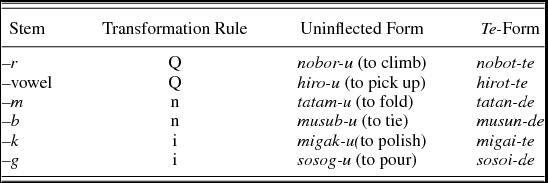
The present study targeted a morphosyntactic structure in Japanese, the –te form of the verb, which is used for expressing the present progressive, as in –te imasu (e.g., Taro wa ki o nobotte imasu; Taro-subject tree-object is climbing). The target structure was introduced in the second semester of Japanese, and all the participants had learned about the –te form before the study, but most of them had not mastered it completely. The focus of the study is on six categories of regular verbs, which involve allomorphic stem changes (Table 1). Three verbs from each of six categories were used for the training session (see Appendix A for all 18 verbs). All the verbs were action verbs and were unknown to participants as shown by the pretest scores.
Conjugation of the te-form

The uninflected form of these verbs is converted to the –te form with either the /te/ or the /de/ allomorph. When the stem ending of a consonant verb is /r/ or /w/, it turns into /Q/ or reduplication of the initial consonant in the –te form (e.g., nobotte for noboru or hirotte for hirou); when the ending is /m/ or /b/, it turns into /n/ (e.g., tatande for tatamu or musunde for musubu); and when it is /k/ or /g/, it turns into /i/ (e.g., migaite for migaku or sosoide for sosogu; Vance, Reference Vance1987).
Research design
The current study involved a between-subject factor (practice distribution) with two covariates, LAA and WMC, as within-subject factors. As shown in Figure 1, there were four individual sessions for each participant. The first author met the participants in a quiet laboratory for the pretests and training session 1 (Time 1), training session 2 followed by posttests (Time 2), posttests and the Ospan task (Time 3), and posttests and the Llama_F test (Time 4). Participants were randomly assigned to a massed practice group (massed, n = 18) or a distributed practice group (distributed, n = 22). The pre- and posttests were administered from Time 1 to Time 4 to measure knowledge of the target grammatical structure (see Pre- and Posttests below).
Research design.

The ISIs (1- vs. 7-day) and RIs (7- vs. 28-day) were determined based on Rohrer and Pashler's (Reference Rohrer and Pashler2007) optimal ratio of ISI and RI. Rohrer and Pashler found that the optimal timing for relearning (i.e., ISI) depends on how far removed delayed testing is from the end of practice (i.e., RI). They suggested that the optimal ISI is approximately 10% to 30% of the RI. The current study set the ISIs and RIs such that the ISI–RI ratios fell within the optimal range of 10% to 30% only in one of the groups at Times 3 and 4. Specifically, an ISI–RI ratio within the optimal range was used for the massed practice group at Time 3 (14%), and for the distributed practice group at Time 4 (25%; see Suzuki & DeKeyser, Reference Suzuki and DeKeyser2015, for details). However, the focus of the study was not on the effectiveness of different ISIs on the outcomes at different RIs. Rather, the primary aim was to examine the role of the aptitudes on the two learning conditions that were different in terms of the ISIs, and by extension to what extent the effect of aptitudes on outcome performance, if observed, would persist in the delayed posttests (i.e., Times 3 and 4).
Training sessions
Each training session consisted of computerized tasks in which learners practiced the use of the present progressive. Participants completed the three-stage practice in an explicit step-by-step manner: vocabulary learning, explicit grammatical explanations, and comprehension and production practice. The set of training tasks took about 45–50 min. All the tasks below were conducted in the same way in Training Sessions 1 and 2.
Vocabulary learning
Eighteen verbs (with object nouns) were learned on the computer screen (see Appendix A). The participants were presented with a picture that represented action verbs and were asked to say the uninflected form of a verb phrase within 5 s (e.g., batto o huru; swing the bat). After these 5 s, they were presented with the Japanese phrase both aurally and visually, in blue letters, along with the written equivalent of the English translation in black. The vocabulary remained on the screen for 5 s, and the next picture appeared automatically. They repeated the set seven times.
Grammatical explanation
After the vocabulary training, participants were presented with a sheet of paper that contained the grammatical explanations about the target forms and the conjugation chart for all six categories (see Appendix B). This sheet was available for reference during the entire practice session. In order to make sure that participants knew the correct conjugation forms, they were given a worksheet in which they transformed the uninflected form of the 18 verbs (accompanied by the pictures from the vocabulary learning task) into the present progressive –te form.
Comprehension and production practice
After the explicit explanation, participants completed the comprehension and production practice by using present progressive sentences one on one with the experimenter. The cards, which had the same pictures as the ones used during the vocabulary training session, were laid out on the table. The experimenter read aloud the sentence that described the action in present progressive form in one of the pictures (e.g., batto o hutte imasu; someone is swinging the bat), and the participant's task was to pick up the corresponding card as soon as possible. Because Japanese is a pro-drop language, the sentence did not mention the subject of the sentence, which is natural. This task was repeated twice. For the practice of producing the sentences, the roles were reversed from those in the comprehension practice. Participants were asked to describe the picture to the experimenter on their own, so that he could pick up the picture that participants described. When participants could not describe the picture, the experimenter described the card for them. This task was also repeated twice. Feedback in the form of recasting was given if participants produced an incorrect form of the verb.Footnote 6 Finally, participants performed a narrative task, describing what a person in a video was doing with the present progressive form. The participants were told to describe the action using the –te form while the silent video clip was played for 10 s. There were 18 video clips describing all the practiced action verbs (no vocabulary list was given). After each video clip, the correct sentence was presented both aurally and visually on the screen for 4 s. As in the case of the two previous tasks, the video narrative task was performed twice to ensure that participants received enough practice on the sentences.
Pre- and posttests
Two types of oral tasks were employed as the pretest and posttests at Time 1 through Time 4: the rule application test, which measured the rule of the –te form conjugations by using nonce verbs, and the picture sentence completion test, which measured the vocabulary and the –te form conjugations. The rule application test was always administered before the picture sentence completion task because the first test assesses narrower knowledge (rules) than the second (rule + vocabulary). No feedback was given throughout the testing phase. The tests were computerized and administered with the DMDX software (Forster & Forster, Reference Forster and Forster2003); the responses were audiorecorded.
At Time 1, the rule application test was administered before the training session to measure the preexisting knowledge of the –te form rules, and the sentence completion test was also conducted to check that participants did not know any of the verb phrases that would be practiced in the training. None of them correctly described any pictures or knew the verb phrases to be practiced (see Results). This ensured that no participants had seen the –te form of those verbs prior to the study. The posttests were administered at three later time points in order to assess the durability of the treatment effects.
The outcome tests assessed two aspects of –te form use: accuracy and speed. Accuracy indicates to what extent participants can use the –te form appropriately in oral production. Speed was measured by the time it took to utter the target construction from the prompt to the end of the utterance.
Rule application test
The purpose of the rule application test was to assess to what extent the participants could use the –te form rules correctly. Eighteen nonce verbs were created based on the practiced verbs, keeping the same initial phoneme and number of moras; different nonce verbs were used in each test to avoid practice effects (e.g., the practiced verb, yaburu, was converted to nonce verbs such as yomaru). Participants were required to convert the sentence with an uninflected verb into one with present progressive by using a nonce verb. After a fixation cross appeared in the center of the screen, an uninflected form of a nonce verb (e.g., yomaru) was presented both in the written and oral modality. Immediately after the end of the word, participants were asked to convert the word into the present progressive form as quickly as possible (e.g., yomatte imasu). They were given 10 s to complete their response. Participants performed a practice session with five unknown pseudoverbs in order to become (re)familiarized with the format of the test every time they took it. It took approximately 3 min to complete the test.
Picture sentence completion test
Whereas the rule application test only targeted the rules for the –te form, the picture sentence completion test assessed to what extent the participants could use the correct –te form of the verbs that they practiced. In the test, participants were presented with a picture in which someone was performing an action, immediately followed by an auditory stimulus, which was the subject of a sentence to be completed (i.e., otokonohito-ga [man], onnanohito-ga [woman], otokonoko-ga [boy], or onnanoko-ga [girl]). Their task was to complete the sentence by describing what the person was doing (e.g., ki o nobotte imasu; [he/she] is climbing the tree). They were given a maximum of 15 s to complete their responses. The 18 verb phrases used were the ones that participants practiced during the training. Four practice items with two basic verbs (i.e., eat a hamburger and watch TV) preceded the actual 18 items. At the pretest, participants were shown pictures to check what each picture meant before they took the picture sentence completion test. It took approximately 5 min to complete the test.
Individual difference measures
LAA was measured by the Llama_F, which is one of subtests of the LLAMA aptitude test (Meara, Reference Meara2005); WMC was measured by the automated Ospan task from Unsworth, Heitz, Schrock, and Engle (Reference Unsworth, Heitz, Schrock and Engle2005).
Llama_F
In the Llama_F, participants were required to induce rules of grammar by looking at pictures and word sequences that described them; in this way, Llama_F can measure LAA independently from participants’ first language (for descriptions of the grammar rules in Llama_F, see Jackson, Reference Jackson, Miller, Eddington, Henery, Miguel, Tseng and Tuninetti2014). In the learning phase, participants were given 5 min to learn a new language by seeing sentences matched with pictures. In the testing phase, the program displayed a picture and two sentences, one grammatical and the other ungrammatical. Their task was to choose the grammatical sentence. The test consisted of 20 items.
Ospan tasks
In the Ospan task, for each item, participants solved a math problem, indicating whether the solution for an equation was correct or incorrect. After each math problem, they were presented with a letter of the alphabet and asked to remember it. After each set of math problems and letters, they were asked to select the letters in the presented order. Successful performance on this task requires temporary updating of incoming information consecutively. There were 15 trials in total: 3 trials for 5 sets with five different sizes each (3–7). The total number of sets was 75.
Scoring and analysis
For all the pre- and posttests, five trained independent raters, native speakers of Japanese, scored and analyzed the speech data, using the sound analysis software Praat. The raters were trained until their coding matched those of the first author, using 15% of data. The two aptitude tests were automatically scored by the software to administer them. See below for reliability data for each test.
Rule application test
Accuracy of the utterances was coded by listening to each item. Minor pronunciation errors were ignored in the scoring, and the accuracy of utterances with repair was determined based on the last utterance. The reliability of the accuracy scores in the rule application test across time was calculated with Cronbach α; and the indices were 0.941 at Time 1, 0.890 at Time 2, 0.892 at Time 3, and 0.916 at Time 4.
The participants’ utterances were also analyzed for speed or response time (RT), measured from the onset of a word to the end of the utterance. In order to exclude responses resulting from different processes than normal responses, three data cleaning procedures were conducted before computing RT for each participant. First, the RTs of responses that contained incorrect utterances were excluded from the analysis. Second, the RT was not calculated for responses with repairs, rephrasing, and/or false starts, because it was impossible to determine whether they were due to a lack of linguistic knowledge or other random sources (e.g., slip of the tongue). Third, we defined outliers as RTs below 500 ms and RTs higher than 3 SD above the grand mean for each participant. These cutoff values were determined after inspection of the data (for a similar approach, see De Jong, Steinel. Florijn, Schoonen, & Hulstijn, Reference De Jong, Steinel, Florijn, Schoonen and Hulstijn2013). The number of outliers identified ranged from 3.7% to 8.7% of the data sets across the tests. In total, the percentages of valid temporal measures retained were 29.7%, 83.2%, 81%, and 80% for Time 1, Time 2, Time 3, and Time 4, respectively. Given the small percentage of valid responses for Time 1, temporal measures of the rule application test at Time 1 were not included in the subsequent analyses. Note that four participants in the distributed practice group were excluded from RT analyses only, due to the low number of valid (correct) responses.
Picture sentence completion test
As in the rule application test, responses in the picture sentence completion test were analyzed in terms of accuracy and speed. Accuracy was scored based on the accuracy of the –te form, and minor pronunciation mistakes in vocabulary were ignored (e.g., sukutte imasu for tsukutte imasu). The reliability of the accuracy scores was calculated with Cronbach α; and the indices were 0.801 at Time 2, 0.862 at Time 3, and 0.875 at Time 4.
The RT was calculated from the onset of a picture to the end of the utterance. The percentage of outliers ranged between 2.3% and 6.2% of the data sets across the tests. The percentages of valid RT data retained were 80%, 62.8%, and 57.4% for Time 2, Time 3, and Time 4. Because the accuracy was 0 for Time 1, no valid RT could be measured at Time 1.
Llama_F
Because the Llama_F program does not automatically record the individual item responses, the beep sounds indicting the correct/incorrect responses were audiorecorded using the freeware software Audacity (http://audacity.sourceforge.net). Each test item was then scored correct or incorrect. One item was excluded due to its negative item-total correlation (r = –.355); the possible maximum score was therefore 19. The internal consistency for Llama_F estimated with Cronbach α was slightly below the acceptable range (α = 0.53) in the present study. This somewhat low reliability estimate for the Llama_F scores might attenuate results of the correlation analyses.
Ospan task
The Ospan task was scored as the sum of all correctly recalled letters in correct positions. In other words, no credit was given unless the set of the letters in a trial was recalled in the right order. If an individual correctly recalled three letters in a set size of five, for example, the score was zero. In order to make sure that the Ospan task was performed appropriately, only participants with high accuracy rates in the math problems are usually recommended for inclusion. The average accuracy rate was 94.29% (SD = 3.93%, range = 83%–100%). In Unsworth et al. (Reference Unsworth, Heitz, Schrock and Engle2005), an 85% accuracy criterion (i.e., a maximum of 12 errors out of the 75 operations) was set for all participants. Two participants scored slightly below the criterion (84% and 83%), but they were retained in the subsequent analyses because the accuracy was still high and it could avoid losing valid data points from the relatively small sample size in the study. Reliability indexed by Cronbach α was satisfactory (α = 0.79).
RESULTS
Descriptive statistics
Pre- and posttests
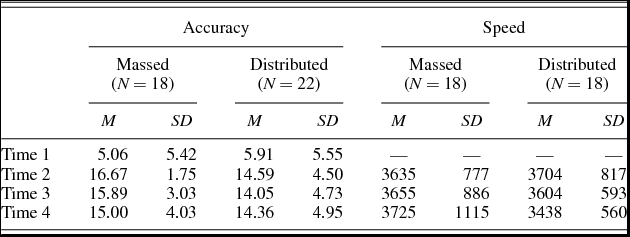
Because the focus of the current study was not on the differences between the outcomes of the two groups, the results for the two outcome tests are compared only briefly between the two groups (see Suzuki & DeKeyser, Reference Suzuki and DeKeyser2015, for details). Table 2 presents the accuracy and speed scores on the rule application test. For accuracy, the massed practice group seems to outperform the distributed practice at the descriptive level, but there were no large differences on either accuracy or speed between the two groups across time. For speed, no systematic differences were found at any time. Of interest to the primary correlational analyses in the study, the standard deviations of accuracy scores were slightly smaller in the massed practice group at Time 2, but there were some variations within each group. The RT variations were also observed on the speed measures in both groups. Note that the two groups did not differ on the mean scores for the rule application test at Time 1, t (38) = –0.49, p = .63, which partially accounts for the equal proficiency between the groups.
Accuracy and speed on the rule application test by group from Times 1 to 4

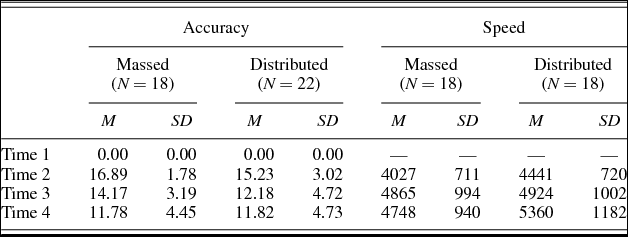
Table 3 presents the accuracy and speed scores on the sentence completion test. In general, advantages were found for the massed practice group, at least descriptively except for the accuracy scores at Time 4; the only significant difference was found on the speed measure at Time 4. As in the rule application test, the standard deviation for accuracy was smaller for the massed practice group at Time 1. There seems, however, to be enough variation in the outcome measures across the two groups to allow us to examine the correlations with the aptitude components.
Accuracy and speed on the sentence completion test by group from Times 1 to 4

Llama_F and Ospan task
The mean score for Llama_F was 16.20 (SD = 2.23, range = 10–19). The mean Ospan score was 50.78 (SD = 16.03, range = 10–75). The Pearson product-moment correlation coefficient between the two was negligible for the massed group (r = .107, n = 18, p = .674), for the distributed group (r = –.021, n = 22, p = .925), and for both groups combined (r = –.011, n = 40, p = .947). These results suggest that the LAA and WMC components were relatively independent, and no difference in their relationship was found between the groups.
Relationship of outcome test scores with LAA and WMC
The primary research question is to what extent the individual differences in LAA and WMC moderate the learning gains in the two groups. In order to investigate the role of LAA and WMC, a series of Pearson r correlation coefficients were computed between the gain scores from the pretest to the posttests and the scores on the Llama_F and Ospan task across groups. We considered using analyses of covariance with LAA and WMC as the covariates, but correlation analyses were chosen due to the small number of participants in the study (see, e.g., Shintani & Ellis, Reference Shintani and Ellis2015, for a similar approach). In the rule application tests, the gain scores for accuracy were calculated by subtracting the score at Time 1 from the subsequent posttests (i.e., Times 2–4); for the speed measures, the RTs at Time 2 through Time 4 were used as gain scores, because no valid RTs were computed at Time 1. Because no participants knew the vocabulary tested on the sentence completion task at Time 1, the gain scores were equivalent to the scores on those tests at Times 2, 3, and 4.
A total of 48 coefficients were computed among LAA, WMC, and learning outcomes under the distributed and massed learning conditions. This usually requires the Bonferroni correction for p values in order to lower the chances of obtaining false-positive results (Type I errors); however, no correction procedure was conducted due to the exploratory nature of the study (Bender & Lange, Reference Bender and Lange2001). The significance values for p (<.05) should be interpreted only as preliminary findings. In other words, the main purpose was not to establish definitive conclusions but to seek potential correlational patterns to help guide the directions of future research. Based on the guidelines for L2 researchFootnote 7 proposed by Plonsky and Oswald (Reference Plonsky and Oswald2014), the coefficient r was interpreted as small-weak (≈.25), medium-moderate (≈.40), or large-strong (≈.60). To supplement the interpretations of r and p values, confidence intervals for r were also reported for correlation coefficients with substantial effects (small-large effect sizes).
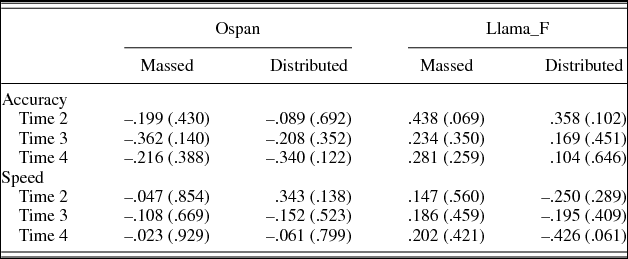
The results of correlational analyses for the rule application test are presented in Table 4 (see Appendices C and D for scatterplots). None of the 24 correlation coefficients produced a large effect, and no consistent correlational patterns were observed across time or condition. In terms of accuracy, moderate positive correlations were only found with Llama_F, for both of the groups, only at Time 2, r = .438 and .358, p = .069 and .102, 95% confidence interval (CI) = [–0.176, 0.787] and [0.013, 0.688]. The correlations of the Ospan scores with the accuracy scores were not significant but negative overall; and the coefficients were small to medium for the massed and distributed practice conditions, respectively, at Time 3, r = –.362 and –.208, p = .140 and .352, 95% CI = [–0.702, 0.132] and [–0.519, 0.173] and at Time 4, r = –.216 and –.340, p = .388 and 122, 95% CI = [–0.636, 0.340] and [–0.597, –0.077]. For the speed measures, a moderate negative relationship was found between the Llama_F score and the speed score at Time 4 only, r = –.426, p = .061, 95% CI = [–0.705, 0.024]. This means that improvement in the efficiency to apply the –te form rules from Time 1 to Time 4 (i.e., faster RT at Time 4 than at Time 1) was associated with LAA. In sum, no clear and consistent correlational patterns were found for the rule application test.
Pearson correlations among scores on the rule application test, Llama_F, and Ospan

Note: Accuracy scores in the rule application tests were gain scores from the pretest at Time 1. The values in parentheses are two-tailed p values.
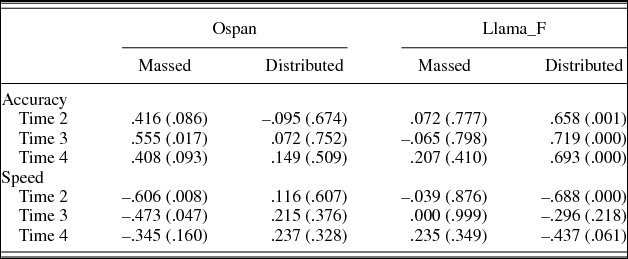
For the sentence completion test, intriguing patterns emerged between the two groups as shown in Table 5. The Ospan scores were consistently related to the learning gains among the massed practice group only: depending on the testing time, the strength of the relationships were weak to strong in absolute values among the massed group (.345 < r < .606), whereas none of the correlation coefficients in the distributed practice group were significant or corresponded to more than small effect sizes (.072 < r < .237, p > .05). For the accuracy measures, in particular, there was a moderate to strong, significant positive correlation between the Ospan scores and the learning gains at Time 3, r = .555, p = .017, 95% CI = [0.119, 0.850], and somewhat smaller, moderate nonsignificant coefficients were observed at Time 2, r = .416, p = .086, 95% CI = [0.042, 0.775] and at Time 4, r = .408, p = .093, 95% CI = [–0.008, 0.734]. For the speed measures, the coefficients with the Ospan scores became gradually smaller at later time points; medium to strong negative correlations were found at Times 2 and 3, r = –.606 and –.473, p = .008 and .047, 95% CI = [–0.820, –0.327] and [–0.762, –0.146], followed by a weaker relationship at Time 4, r = –.345, p = .160, 95% CI = [–0.630, –0.015]. In sum, only half of the six tests indicated significant correlations between the Ospan scores and the outcome measures in the massed practice group, but the overall pattern is consistent. In addition, the CIs for the correlation coefficients were wide; therefore, no definitive conclusions should be drawn.
Pearson correlations among scores on the sentence completion test, Llama_F, and Ospan

Note: The values in parentheses are two-tailed p values.
In contrast, the opposite correlational patterns were observed for LAA. All the correlation coefficients between the outcome measures and the Llama_F scores were consistently higher in the distributed group than in the massed group. Depending on the testing time, the strength of associations with Llama_F in the distributed practice group was weak to strong in absolute values (.296 < r < .719); none of the coefficients in the massed group indicated more than a small effect size (0 < r < .235, p > .05). In particular, Llama_F scores were significantly correlated with accuracy measures in the distributed practice group consistently across three times with large effect sizes: r = .658, p = .001, 95% CI = [0.081, 0.937] at Time 2; r = .719, p < .001, 95% CI = [0.437, 0.898] at Time 3; and r = .693, p < .001, 95% CI = [0.348, 0.884] at Time 4. A similar pattern was also observed for the speed measure in the distributed practice group; the strong negative correlation was found at Time 2, r = –.688, p < .001, 95% CI = [–0.892, –0.397], and weaker but small to moderate negative correlations were observed at Time 3, r = –.296, p = .218, 95% CI = [–0.787, 0.216] and Time 4, r = –.437, p = .061, 95% CI = [–0.750, –0.147]. Scatterplots for the sentence completion test are provided in Appendices E and F. In sum, four of the six tests indicated significant correlations between the Llama_F scores and the outcome measures in the distributed practice group, but the CIs were large due to the small sample size. Again, we should not draw any definitive conclusions from the present findings, but these tentative findings are discussed to inform and guide future ATI research.
DISCUSSION
The present exploratory study attempted to investigate how individual differences in LAA and WMC moderate the effectiveness of distributed and massed practice. When outcomes were measured by the rule application test (rules only), no consistent correlations were observed between the aptitudes and the learning gains. An intriguing asymmetrical pattern, however, emerged for the sentence completion test (lexicon + rules): WMC was more related to the effectiveness of massed practice (i.e., 1-day ISI), whereas LAA exclusively contributed to the effectiveness of distributed practice (i.e., 7-day ISI).
No consistent correlations were observed between the aptitudes and outcomes for the rule application test probably because learning “only” –te form rules might place less demand on learning than learning to integrate new vocabulary with the –te form rules (the sentence completion test). Because the participants had acquired some of the –te form rules (see the pretest scores on the rule application test at Time 1), learning and reviewing rules may have been less taxing for learners. It is conceivable that learning both new verbs and the corresponding –te form rules placed more demands on the aptitudes. This is consistent with the previous research on the ATI in which aptitudes play a more important role when the learning burden is higher (Brooks et al., Reference Brooks, Kempe and Sionov2006; DeKeyser, Reference DeKeyser and Robinson2013; Sanz et al., Reference Sanz, Lin, Lado, Stafford and Bowden2014). Note that learners tended to have more difficulty in retrieving vocabulary rather than in applying the –te form rules based on the high accuracy scores on the rule-application test at Times 2, 3, and 4 (16.67, 15.89, and 15.00 out of 18, respectively). Because the picture sentence completion test not only requires using the –te form rules but also lexical retrieval, the role of lexical learning should be acknowledged as well as grammar learning.
Although no moderate or strong correlations were detected for the rule-application test, a weak but somewhat consistent overall negative pattern appears to exist between the Ospan scores and the accuracy scores at Times 3 and 4. Because these relationships were not significant and weak (–.208 < r < –.362, p > .05), this finding should be interpreted with caution. The negative relations may suggest that learners with high WMC engaged more in memorizing conjugated verb forms, which might have made it more difficult for them to induce the rules and apply them to the nonce verbs. The following discussion will focus on the findings on the sentence completion test, which assessed both lexical and grammatical knowledge.
WMC is associated with learning processes under massed practice
With regard to the role of WMC on the distributed/massed practice, two competing predictions were put forth. The findings in regard to these two predictions should be interpreted with two important notes. First, because the current study is exploratory in nature, the predictions were not intended for testing the theories. Instead, they facilitate interpretations and help establish directions for future research. Second, the current study did not make differential predictions for the two types of outcome measures, accuracy and RTs, because little is known how two measures relate to the two accounts.
The study-phase retrieval account suggested that WMC would be correlated with the performance after the distributed practice in which learners needed to retain the information for a longer period of time. The discriminative-contrast account, in contrast, predicted that WMC would be correlated with the outcomes in the massed practice group because higher WMC would be needed in order to prevent interference from similar learning materials (i.e., inflected verbs; Kane & Engle, Reference Kane and Engle2000). The results in the present study supported the latter prediction: WMC was exclusively related to the outcomes in the massed practice group.
The findings suggest that L2 learners with lower WMC probably suffered from interference from similar vocabulary and grammar rules that are presented in a short period of time. Interference, rather than activation decay over time, may be responsible for the poor performance by learners with low WMC in the massed practice group. In particular, the updating function of WM, tapped by the Ospan task, may be responsible for this effect (Miyake & Friedman, Reference Miyake and Friedman2012; Miyake et al., Reference Miyake, Friedman, Emerson, Witzki, Howerter and Wager2000). The updating function “requires ignoring irrelevant incoming information and also suppressing no longer relevant information” (Miyake et al., Reference Miyake, Friedman, Emerson, Witzki, Howerter and Wager2000, p. 89). This updating or inhibition ability might have played a crucial role in discriminating similar vocabulary and grammar rules in massed practice.
Conversely, distributed practice may involve a similar process of updating memory during the interval between the training sessions. A relatively longer, 7-day interval reduced the interference among similar morphological markers, and the effectiveness of distributed practice became less sensitive to individual differences in the updating function. The time interval for updating measured in the Ospan task is much shorter (i.e., seconds) than the actual interval between the two learning sessions for morphological markings (i.e., days). The updating function should be taxed more intensively when the interval is shorter, as was the case in the Ospan task. However, the learning complexity involved in L2 grammar learning may be as demanding, or possibly more demanding, than retaining alphabet letters in the Ospan task. While the higher demands associated with learning relatively complex morphological structures involved the updating ability more heavily in the massed practice condition, distributed practice lessened the burden on learning.
The current findings did not support the predictions aligned more with the study-phase retrieval account. It may be attributed to the specific ISIs (i.e., 1 day and 7 days) employed in the current study. The interval between the training sessions in the distributed practice (i.e., 7 days) might have been short enough for L2 learners to retain the memory of the verbs and inflections. If distributed practice involved a longer interval, WMC may play a more important role in the distributed practice. Furthermore, because the current study employed the Ospan task, which targets the updating function in WMC, it might have favored the discriminative-contrast account. The results would probably be different if different memory components were assessed.
LAA is associated with learning processes under distributed practice
LAA has been found to be a predictor of L2 grammar learning, such as in the area of effectiveness of corrective feedback (Sheen, Reference Sheen2007; Trofimovich et al., Reference Trofimovich, Ammar, Gatbonton and Mackey2007; Yilmaz, Reference Yilmaz2013) and inductive learning (Erlam, Reference Erlam2005). One could predict that LAA would be related to the learning outcomes regardless of the practice distribution, because both learning conditions involved the exact same step-by-step explicit grammar practice. The novel finding of the present study is that LAA played a particularly important role in distributed practice. It may be assumed that learners with higher LAA were able to understand the rules of the –te form better; therefore, a deeper understanding of language structure might have allowed learners to benefit more from the spacing effects. Better understanding of the rules helped them retain the rule even after a 1-week interval. Having said that, the reason why LAA did not play a systematic role in the massed practice condition is not entirely clear;Footnote 8 further research is needed to examine underlying learning processes in distributed and massed practice.
Conclusions
The current study set out to investigate the role of individual differences in the effectiveness of distributed/massed L2 grammar practice. The preliminary findings demonstrated that LAA and WMC differentially influenced the effects of distributed and massed practice. More specifically, the role of WMC was more important in massed practice, whereas LAA was related to the effectiveness of distributed practice. The current findings should be interpreted cautiously. First, because the current study focused on L2 grammar learning and had a relatively small sample size, larger scale experiments should be conducted in different domains of L2 learning. Second, no control groups were employed that correspond to 1-day ISI and 7-day ISI groups. Third, the notion of distributed/massed practice was limited. In some circumstances, for instance, learners may determine learning intervals for specific items (e.g., delaying the review of remembered items), but the current study uniformly gave the same practice materials at given intervals during the two sessions. Thus, external validity should be further examined by operationalizing distribution of practice differently (e.g., different ISIs or different number of training sessions). Fourth, the current study investigated the acquisition of Japanese morphosyntactic structure, but the training session integrated vocabulary and grammar learning. It is not possible to tease them apart. It is worth asking to what extent vocabulary and grammar learning are differently influenced by distributed/massed practice. Fifth, this study used single tests to measure the two cognitive aptitudes (Llama_F and Ospan task). Different kinds of measurements as well as ours were used in previous research, and the present findings should be further attested using different measures for aptitudes. Finally, the current findings cannot be directly translated to program-level foreign language learning (Serrano, Reference Serrano2011; Serrano & Muñoz, Reference Serrano and Muñoz2007) because the study involved only two 1-hr training sessions in the laboratory environment.
In the meantime, the current study adds to the growing body of ATI research in SLA; its unique contribution consists of revealing differential roles of LAA and WMC under the distributed and massed practice conditions, shedding light on different underlying L2 learning processes. Future research is needed to replicate our findings and nuance their implications.
APPENDIX A
List of verb phrases

APPENDIX B
Explicit information

The –te form of a verb or Japanese verbal gerund works as a linker of two sentences, and generally, corresponding to –ing in English. In order to express an action in progress (e.g., I am doing), “imasu (to exist, to be)” is attached to the –te form, referring to the present moment.
For example,
-
1. Hon o yonde imasu (I am reading a book).
trans Book-o reading be
-
2. Sushi o tabete imasu (I am eating Sushi).
trans Sushi-o eating be


ACKNOWLEDGMENTS
This study was supported by the PhD program of SLA at the University of Maryland. We thank Dr. Steve Ross and Dr. Cathy Doughty for their insightful and constructive advice on this project. We also thank Yumiko Inagaki, Aya Shibasaki, Michiko Terazawa, Buthainah Al Thowani, and Assma Al Thowani for data coding. Many thanks to Ayami Suzuki, Taeko Hosaka, Kota Kato, and Shitaro Akiyama for material development. We are also grateful to Dr. Jaehyon Paik for sharing his manuscript; Shota Momma for his advice on test development; and Ms. Makiko Inoue, Ms. Kumiko Akikawa, and Mr. Carlos Pimentel for participant recruitment. Finally, we express our utmost gratitude to Kei Harata for his help throughout the project.