Global climate change has been proven with clear shreds of evidence, and visible effects, such as global warming, rising sea levels, and shrinking ice sheets, indicate the severity of climate change.Reference Pachauri and Meyer1 Human health is directly linked to climate and weather.2 An increase in the incidence of natural disasters and extreme weather events has been observed around the world since the past few decades.Reference Guha-Sapir, Vos and Below3 India, due to its peculiar geographic and geo-climatic conditions, is vulnerable to many natural disasters.Reference Mohandas4
As the incidence and impact of disasters are on the rise, the preparedness for such calamities and efficient management of the same has to be a priority of the public health system. A culture of resilience should be developed at all levels of the health system. Emergency preparedness right at the grass-root level is essential to manage disasters effectively.5 Local infrastructure and a well-trained human resources available immediately following disasters are key stakeholders in disaster management. The frontline health workers have the main role in disaster management as they are the first contact of the community to the health system, especially in rural areas.6,Reference Walia and Guleria7
Accredited Social Health Activists (ASHAs) in India are a unique workforce of women volunteers permanently residing in the community with basic education and have received basic training in health and health care to manage minor ailments and community health issues. One designated ASHA serves a population of 1000.6,Reference Walia and Guleria7 Availability of such a grounded cadre of health workers could be an opportunity to strengthen the village-level disaster preparedness in the country.
This study attempted to assess the effectiveness of training programs in raising knowledge about the management of disasters among selected ASHAs working in Mysuru district in the Karnataka state of India.
METHODS
A quasi-experimental study was conducted among ASHAs in randomly selected primary health centers in the Mysuru district during July and August 2019. All the ASHAs working in the area were purposively selected for the study, giving a sample size of 40. Those who were not willing to participate in the project were allowed to opt-out.
A training session was arranged in each health center, and a pre-training test was conducted to evaluate the knowledge regarding disaster management. A prestructured, validated questionnaire was used for the assessment. Institutional Ethical Committee clearance was observed, and informed consent was taken from each participant. The demographic details and work profile were collected from each ASHA worker and questions regarding awareness and preparedness were administered by the personal interview method.
Following the test, the workshop and training program was conducted. Hands-on training with the help of adequate audio-visual aids was given for various predisaster preparations, such as situational analysis, hazard analysis, vulnerability analysis, capacity analysis, and risk analysis. The health workers were trained up to the expectations of the National Disaster Management Authority according to the Village Disaster Management Plan.Reference Walia and Guleria7 Basic life support measures and simple emergency medical procedures, such as wound care, fracture immobilization, and triage, were demonstrated to the participants by the resource persons. A mock drill was arranged as part of the program to elaborate on the preparations and actions required during the occurrence of disasters in the village.
All the ASHAs were visited by the research team after 1 mo, and the process of assessment was repeated using the same questionnaire to evaluate the progress in knowledge and disaster preparedness among the ASHAs. The data analysis was performed using Microsoft Excel and a licensed SPSS version 22 software. The total knowledge regarding disaster management was scored at 100. The scores in 4 domains, viz. camp management, first aid, sanitation needs, and mental health management, were converted to a scale of 100 and analyzed separately. The change in scores before and after the training was compared and assessed for significance using the paired t-test. The descriptive data were represented using percentages.
RESULTS
Among the study participants, 4 were from an urban area and 36 were from rural areas. The median years of experience of ASHAs were 10 y (interquartile range: 5.75-10) with a minimum and maximum experience of 2 and 10 y, respectively. Among the participants assessed, 3 ASHAs had experienced a flood 1 y before the study. However, none of the ASHAs had any experience in disaster management. None of the study participants had received any training or mock drills for disaster management/preparedness and nobody was aware of a village disaster management plan or National Disaster Management Authority.
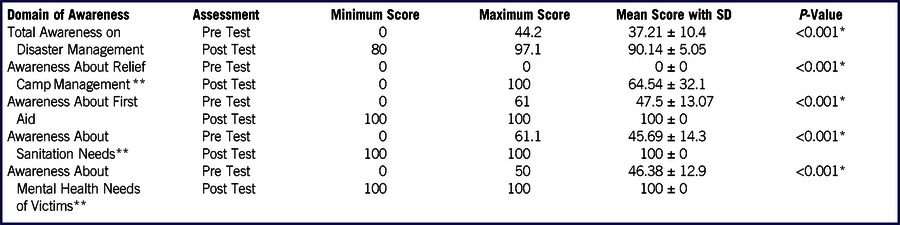
The preparedness for disasters and knowledge about disaster management interventions before and after the workshop were assessed using the same questionnaire. The response was scored on a scale of 100. The mean score obtained by the ASHAs in pretraining assessment was 37.2 (SD: 10.4). Improvement was evident in the knowledge and preparedness of ASHAs 1 mo after the training which showed a mean score of 90.14 ± 5.05. This change in score was statistically significant with a P-value less than 0.001 on performing a paired t-test. No significant relation was observed between scores obtained by ASHAs and localities of working (urban/rural) and years of experience. A significant increase of scores was observed in mean scores of awareness of all domains of disaster management assessed, like relief camp management (0 to 64.54 ± 32.14), first aid (47.5 ± 13.07 to 100), sanitation needs (45.69 ± 14.31 to 100), and mental health management (46.38 ± 12.9 to 100) (Table 1).
Total Score and Scores in Different Domains of Disaster Management Obtained by Study Participants in Pre- and Post-training Assessments

* Paired t-test.
** Scores standardized to out of 100.
During the pretraining evaluation. ASHAs were asked about the places where persons can take shelter during and after disasters according to them. Only 42.5% of respondents were aware that disaster victims should take shelter in relief camps. However, all the ASHAs opined that the victims should necessarily take shelter in temporary disaster relief camps in safe locations during disasters.
DISCUSSION
The study shows a significant improvement in knowledge about the management of disasters among the frontline health workers after the intervention. Similar studies show results consistent with this observation. A study conducted by Cotanda et al. showed that there was a significant improvement in knowledge about the disaster plans, and a significantly higher portion of participants (41.8% vs 15.5%) felt prepared after a disaster training session conducted for health staff in Barcelona in 2014.Reference Cotanda, Martínez and de la Maza8 A group of 2246 students belonging to 13 different health professions also showed a significant improvement in disaster preparedness after a 1-d training in disaster management arranged by The University of South Dakota Sanford School of Medicine.Reference Owens, Buffington and Frost9
A review of 17 studies conducted by Labrague et al. showed that there was an evident improvement in knowledge about disaster management and preparedness for disasters among nurses from different parts of the world after training programs.Reference Labrague, Hammad and Gloe10
This study stands unique as the training was aimed at ASHAs, and much evidence has not developed in the country for the use of such a workforce in disaster management. Based on our observations, ASHAs can be depended upon for village-level disaster management given adequate training. However, the study has limitations as it was done in a smaller area involving a smaller sample size. We recommend multicentric randomized field trials in the subject to generate more solid evidence regarding the involvement of ASHAs in disaster management.
CONCLUSIONS
A significant improvement in the median scores of knowledge about disaster management was observed among frontline health workers in Mysuru district of India 1 mo after a training workshop and mock drill. We recommend such training programs to all community-level health workers in the country in the context of increasing incidence of natural calamities and manmade disasters.
Conflicts of Interest Statement
The authors have no conflicts of interest to declare.