Introduction
The exclusion from the vote of people with cognitive impairment remains the most common form of restriction on the voting rights of adult citizens in democratic societies.Footnote 1 For a long time these restrictions were generally considered as self-evident. However, recent developments signal a growing awareness of the problematic character of regulations that explicitly exclude people from the vote due to their cognitive condition. Most fundamentally, the right of people with cognitive impairments to vote on an equal basis with others is affirmed by the 2007 United Nations Convention on the Rights of Persons with Disabilities (CRPD), Article 29, as well as by the Human Rights Council (2012) and other human rights bodies (Redley et al., Reference Redley, Maina, Keeling and Pattni2012).
Despite this, a majority of the countries in the world today still deny the vote to people with cognitive impairments. A basic problem with legal rules excluding people from the vote on the basis of cognitive status is that they are unlikely to achieve their goals. The nature of this problem is most readily illustrated by reference to constitutions and electoral laws that make use of labels, such as ‘idiots’ or ‘retarded’, in order to identify the group of people denied the right to vote. While these labels may be outdated and offensive, they also risk assuming ‘too much’ about the lack of relevant capacities of individual persons (Schriner et al., Reference Schriner, Ochs and Shields1997: 93; Appelbaum, Reference Appelbaum2000: 849; Karlawish and Bonnie, Reference Karlawish and Bonnie2007: 884). Indeed, evidence from a number of studies indicates that the connection between cognitive diagnosis and capacity to vote is often weak (Appelbaum et al. Reference Appelbaum, Bonnie and Karlawish2005: 2094; Calcedo-Barba et al., Reference Calcedo-Barba, Garcia-Solano, Fraguas and Chapela2007; Hurme and Appelbaum, Reference Hurme and Appelbaum2007). Consequently, laws denying the vote on the basis of cognitive status might be over-exclusive as they exclude from the vote people that should be able to vote according to standards of voting capacity.
The concern with over-exclusion supplements the longstanding issue with legislation affecting people with cognitive impairments: the lack of reliable procedures for the implementation of legal norms in individual cases. At the worst, there are no procedures at all stipulated by law, which may result in arbitrary decisions about the actual voting capacity of individuals with cognitive impairments. Exposure to risk of arbitrary treatment may be exacerbated by the nature of the classifications used in electoral laws and constitutions. When the standards employed are vague and ambiguous the decisions made are more vulnerable to the subjective judgments made by the relevant public officials. The demand for procedural protections are in that sense greater the vaguer and more ambiguous the legal standards to be enforced are (Hurme and Appelbaum, Reference Hurme and Appelbaum2007: 940, Brescia, Reference Brescia2010: 964).
Because the regulatory problem is concerned both with the substance of the law and with the procedures for its implementation, attempts to exclude certain people from electoral participation face legislative as well as administrative challenges. In fact, recent developments in democratic countries illustrate attempts to deal with both. On the one hand, there is a trend towards the complete elimination of legal restrictions on the vote for people with cognitive impairments. Croatia recently (2013) lifted restrictions in response to criticism from the Disability Ombudsman that previous legislation was inconsistent with the CRPD. Other examples include the Czech Republic (2010), the Netherlands (2008) and Slovenia (2006), where restrictions have been abolished in response to judgments by constitutional courts and their equivalents (Vyhnánek, Reference Vyhnánek2010). On the other hand, there is a tendency towards judicalisation of the decisions made in depriving people with cognitive impairments of the vote. The result is that voting rights restrictions for people with cognitive impairments are maintained, albeit administrated by judicial bodies offering ‘individualised justice’.Footnote 2
The question, then, is how the hazards associated with misclassification and arbitrary treatment can be avoided. The approach adopted in this article is that the regulatory problem can be analysed as a case of the more general concern with accuracy in public decision-making (Tucker, Reference Tucker2012; also Diver, Reference Diver1983: 74).Footnote 3 A set of rules regulating access to the vote are ‘accurate’ if they grant the vote to those people, and only those people, who should be able to vote. Accuracy requires that the law is targeting the correct group of people and also that the procedure for the implementation of the law secures non-arbitrary decisions in individual cases.
In this article, the accuracy of restrictions on the vote for people with cognitive impairments in electoral laws and constitutions around the world is evaluated. Legal data were collected from ninety-one nations, representing all major ‘electoral democracies’ in the world as of 2006. The exclusive focus on electoral democracies reflects the assumption that restrictions on the vote are generally less important in countries where political competition is weak or non-existent.Footnote 4 The analysis permits us to evaluate the accuracy of legal restrictions on the vote in all major electoral democracies.
The accuracy of voting rights: two dimensions
The exclusion of people from democratic elections on the basis of cognitive status is typically justified by the claim that a certain capacity to vote is necessary for the right to vote (Dahl, Reference Dahl1989; cf. Nussbaum, Reference Nussbaum2009; Lopez-Guerra, Reference Lopez-Guerra2012). Given these regulatory aims, the challenge facing decision-makers is how to correctly identify people with deficiencies in their capacity to vote by means of the law. In practice, the result has often been a failure, as is indicated by the risk of over-exclusion. Over-exclusion here refers to cases where the justification of the law does not support all cases to which it applies and when some people are in consequence wrongly denied access to the vote.
Whereas over-exclusion obviously undermines accuracy in the regulation of the vote, over-inclusion is also potentially problematic. Over-inclusion corresponds to cases where the law grants some people the vote, who should not vote following the justification of the law (Sunstein, Reference Sunstein1995: 992). The rules regulating access to the vote may, in other words, be either over-exclusive or over-inclusive, and may indeed be both at the same time. In the attempt to deny the vote to people with cognitive impairments, the law would be both over-exclusive and over-inclusive if some people are denied the vote despite them having capacity to vote, whereas others are granted the vote despite them lacking capacity to vote.
Due to the positive connotations of voting rights, a policy wrongly granting some people the vote may seem less objectionable compared to a policy wrongly denying some people the vote. Even so, over-inclusive suffrage must be associated with costs, or else there would be no purpose in restricting the vote at all. If over-inclusion is costless, the risk of over-exclusion is easily avoided simply by enacting rules granting everyone the vote (if everyone is granted the vote, no one is wrongly denied the vote and over-exclusion is zero). There is therefore reason to conclude that the idea of accuracy in the regulation of the vote is premised on the value of avoiding both over-exclusion and over-inclusion.Footnote 5
An additional challenge is to avoid arbitrariness in the implementation of the legal norms defining the right to vote. As noted by John Stuart Mill (Reference Mill1861), citizens run the risk of arbitrarily losing the vote when restrictions are enforced at the discretion of public officials. An example illustrating this point is the provisions of the 1993 Electoral Law of Norway (repealed in 2002). Following Article 41 of this law, the polling officer is authorised to deny a person the vote, by not crossing off the voter's name from the register of electors, in cases where the polling officer believes the voter lacks ‘soundness of mind’ due to ‘insanity or mental disability’. The provision leaves considerable discretionary powers in the hands of the polling officer and therefore makes uncertain the right of individuals with cognitive impairments to vote. The risks involved are even greater in such cases due to the documented prevalence of prejudice and ignorance about people with cognitive impairment (Appelbaum, Reference Appelbaum2000: 89; Brescia, Reference Brescia2010: 964). If want of predictability is part of the definition of arbitrary treatment (Wright, Reference Wright2010: 841) it seems plausible to submit that the voting rights of people with cognitive impairments are often subject to arbitrary treatment.
A preliminary conclusion is that accuracy in the regulation of the vote may fail even when the substance of the law is targeting the relevant group of people. This demonstrates that accuracy is only partly concerned with the legal classifications, and that it depends also on the ability of the administrative system to generate non-arbitrary assessments in individual cases (Sunstein, Reference Sunstein1995, Reference Sunstein2006; Fon and Parisi, Reference Fon and Parisi2007: 148).
As a result, accuracy in the regulation of the vote must be conceptualised as a two-dimensional challenge. The first dimension is concerned with the accuracy of legal classifications; the vote should ideally be neither over-exclusive nor over-inclusive. The second dimension is concerned with the application of the law: the vote should ideally be administrated in ways that avoids arbitrary decisions in individual cases. There is no guarantee that the requirements specified by these dimensions are all satisfied by a specific regulatory model. Given the two-dimensional problem, it is conceivable that error at some level is ‘inevitable’ (Tucker, Reference Tucker2012: 5). Where the purpose of the law is to deny the right to vote to people who lack the capacity to vote, it is possible that one legal model is superior to another in terms of the requirements specified by the first dimension, whereas the reverse holds when the requirements specified by the second dimension are invoked. We should not infer from this observation either that regulatory error is inescapable or that every legal model is just as good as another. Rather, our aim should be to examine when error is least likely to appear and is least harmful when it does.
The framework
As defined above, accuracy in the regulation of the vote occurs when the people entitled to vote are correctly identified by the classifications established by law, and when the procedures assigned for their implementation do not subject individuals to arbitrary treatment. As noted above, there is a possible connection between misclassification and arbitrary treatment. When legal restrictions are vaguely phrased they typically require interpretation in order to be implemented, rendering the application to individual cases unpredictable. On the other hand, even very specific legal restrictions will fail to secure accuracy if the procedures devised for their application leaves too much room for discretionary and subjective judgments.
In order to measure the accuracy of legal restrictions on the vote, we can distinguish between two cases in order to capture the ‘uneasy tension’ between cognitive diagnosis and capacity to vote (Redley et al., Reference Redley, Hughes and Holland2010: 466). The first is when the vote is restricted on the basis of some conception of capacity to vote. Such laws are referred to as ‘capacity-based’. The second is when the vote is restricted on the basis of the declared status of the individual, referred to as ‘status-based’ laws. These include not just restrictions based on the cognitive status of the citizen but also restrictions that make the vote conditional on legal status. Legal rules that do not directly ‘tap’ capacity to vote, but rather some loosely related phenomenon, are likely to be either over-exclusive, over-inclusive, or both.
The second dimension highlights the nature of administrative procedures devised for the implementation of restrictions on the vote. Since the framework used in this article is designed to measure the risk of arbitrary treatment, a simple dichotomy based on the existence or absence of judicial procedures is employed. Where the law stipulates that restrictions are implemented by judicial procedures, it is labeled as such. Otherwise, the restrictions are simply coded as ‘no procedures’. The latter category includes restrictions that are administered at the discretion of either public officials or health professionals and cases where the law does not identify any procedural requirements at all.
Bringing these measures together, it is possible to identify four outcomes. The favoured outcome, in terms of regulatory accuracy, is where restrictions are capacity-based and administrated using judicial procedures. Where restrictions on the vote apply only to people without capacity to vote, the risk of misclassification is eliminated since the rationale for the law is presumed to be exactly to prevent voting by people without the capacity to vote. If such restrictions are also implemented by judicial procedures, we expect the law to offer reasonable safeguards against arbitrary treatment. By contrast, the outcome least hospitable to regulatory accuracy occurs when restrictions are status-based and administered using non-judicial procedures. This is when we have reason to expect over-exclusion, over-inclusion and arbitrary treatment in the allocation of voting rights for people with cognitive impairments.
Voting rights today
Approaching the data, it is first necessary to account for the fact that some democratic nations do not employ any restrictions at all. The most cited previous study (Massicotte et al., Reference Massicotte, Blais and Yoshinaka2004) identified only four countries without any restrictions on the right to vote for people with cognitive impairments (Ireland, Italy, Sweden and Canada). Yet a variety of nations have recently expanded voting rights and abolished restrictions for people with cognitive impairments.
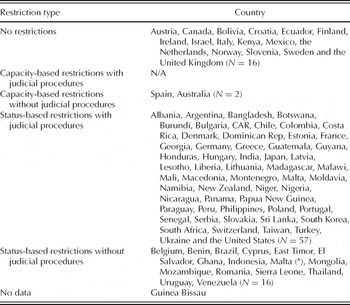
Our findings show that by 2012 there were no restrictions on the right to vote by people with cognitive impairments in sixteen electoral democracies (see Table 1). It is worth noting that this includes countries where the constitution authorises the legislature to enact restrictions on the vote by people with cognitive impairments, but where the legislature has declined to make use of this opportunity (for example, the Constitution of Norway, 1995, Article 53). In all other countries, seventy-six in total, some legal restrictions on the voting rights of people with cognitive impairments apply.
Restrictions on voting rights

Note: Nations with a population below 1 m were excluded from the sample (N = 92).
Status-based restrictions without judicial procedure
Disenfranchisement is status-based when legal restrictions are based on either legal or cognitive classifications. In cases where the attribution of the relevant status is not made by a judicial body, the procedural protections are nevertheless weak. A total of sixteen countries fall into this category. The provision of the 1991 Constitution of Romania adheres to this model, so that according to Article 34, ‘retarded or mentally disturbed persons’ do not have the right to vote. Following this provision, a person is excluded from the vote as a consequence of being ‘retarded’ or ‘mentally disturbed’, a judicial decision affirming this condition is not stipulated as necessary. Similar, broadly framed, stipulations are found in the 1997 Constitution of Thailand (Article 106). Even more blatant are the provisions of the Electoral Law (1993) of Mozambique, according to which the vote is denied anyone ‘commonly known to be insane’.
Where there is no judicial procedure stipulated, decisions made by health professionals may directly affect the political rights of people with cognitive impairments. This is the case in Cyprus, where the authority to decide the voting rights of residents of psychiatric wards is delegated to the psychiatrist in charge (FRA, 2010: 20). Since the decision is up to the psychiatrist, rather than a judge, the restriction is rather arbitrarily implemented in our sense of the term. Although it is conceivable that the psychiatrist makes the decision on the basis of estimated capacity to vote, the law does not exclude the possibility that the decision is based solely on the basis of cognitive status.
The interpretation of suffrage regulations is not always straightforward as there may be borderline cases. An example is found in the Electoral Law (1992) of Mongolia regulating the vote to the Great Hural. Article 2 of the law states that voting shall be denied anyone ‘who have been proved insane by the medical experts and/or court decisions’. Whereas the status-based character of the provision is evident from the fact that it refers to insanity rather than to capacity to vote, it is not clear whether judicial procedures are required or not. After all, the restriction does apply in circumstances where a court has effectively decided that a person is ‘insane’. Yet, it also applies in cases where insanity has been established by ‘medical experts’ alone. There is consequently no guarantee that judicial procedures are followed and we consequently code the Mongolian law as belonging to the category of ‘no judicial procedure’.
Status-based restrictions with judicial procedures
The use of status-based classifications to identify the people denied the vote can also be made dependent on a prior decision concerning the cognitive or legal status of the relevant category of people. Alhough the issue at stake in the prior decision is not itself the capacity of the person to vote, the assumption implicit in the law is that the status attributed to the person constitutes a pertinent proxy to that end. This model offers clear advantages from the point of view of the lawmaker. The extent of the restrictions stipulated by law is delegated to the judicial bodies responsible for determining the status of the person and the restrictions are therefore neither more nor less extensive than what the judicial body has determined. Moreover, no specific procedure is needed for the purpose of investigating the capacity to vote by people with cognitive impairments, as the existence of a prior decision supplies all the relevant information. This is undoubtedly why status-based restrictions on the vote that are implemented by judicial procedures are so common. According to our data, no less than fifty-seven countries fit this category. Among them we should separate three main alternatives, depending on the type of judicial decision invoked.
The first alternative is to deny the vote to people detained in psychiatric wards. This is not very common, with a mere nine countries restricting the vote on the basis of this condition. Only some of those disenfranchise every resident of psychiatric institutions. In Niger, all ‘mental institute patients’ are denied the vote (Electoral Law, 1996, Article 8). The Electoral Law of Argentina (1983) denies the vote to anyone ‘confined in state institutions’, which includes psychiatric institutions. The loss of the vote in these cases follows a factual condition rather than a legal condition as some residents of psychiatric institutions may not reside there because of a judicial decision.
In some countries, people are disenfranchised only if detention in a psychiatric ward is the result of particular circumstances. For example, the Electoral Law of Germany (1997, Article 13) states that a person is disqualified from voting if ‘accommodated in a psychiatric hospital under an order pursuant to Article 63 of the Penal Code’. The relevant section of the Penal Code, in turn, applies to criminal offences where the perpetrator is judged to be in a state of insanity or otherwise found to be of diminished responsibility. Thus, in order to be deprived of the vote, the person must be convicted for a criminal offence and suffer from a cognitive condition as specified by the Penal Code. Latvia employs a similar law, according to which disenfranchisement is triggered by detention in a psychiatric ward only in the case of a criminal offence. In New Zealand, Slovakia, and the Central African Republic, detention in psychiatric wards triggers disenfranchisement also if detention follows a judicial decision motivated by a concern with public health.
The second alternative is to exclude from the vote anyone whose legal status has been restricted by judicial decision. In some places, the trigger for the loss of voting rights is the judicial decision limiting the legal rights of the person. Thus, the Electoral Law of Nicaragua (1996, Article 31) includes the provision that citizens exercising the right to vote must be in ‘full enjoyment of their rights’. By implication, a person subject to a court decision affecting his or her legal status, whatever the basis of the decision, is disenfranchised. The variety of statuses covered by this alternative is indicated by the regulations found in both Serbia and Macedonia. In these countries, the vote is lost if a person is declared by a court to be of less than full ‘business capacity’ (Serbia, Electoral Law 1993, Article 12) or ‘working capacity’ (Macedonia, Electoral Law 1998, Article 4).
The more common versions of this model apply either to the ‘legally incapacitated’ or to the subjects of guardianship. Legal incapacity is equal to the loss of full legal status with various meaning in different jurisdictions but regularly involves revocation of certain legal entitlements and incapacity to enter legally binding contracts. Of course, the status is not unique to people with cognitive impairments but applies equally to infants and children. It is nevertheless clear that only courts are competent to reduce the legal capacity of adult people by reference to cognitive status. Consider, for example, the Polish Constitution (1997), Article 62, according to which the right to vote is denied persons who by ‘final judgement of a court, have been subjected to legal incapacitation’. Not altogether dissimilar are the provisions of the 1996 Constitution of Malta, according to which a person cannot register to vote if ‘incapacitated for any mental infirmity or prodigality [sic]’ by court decision (Section 58).
Legal incapacity is often associated with the institution of guardianship. In France, for example, any adult citizen declared legally incapacitated will be placed under guardianship and thereby deprived of the vote (Electoral Law, 1998, Article 5). Guardianship nevertheless has a legal meaning distinct from legal incapacity, as it implies the transfer of legal rights from the subject to another person who is consequently authorised to act in her or her place. Advocates of disabled peoples’ rights tend to disagree on whether adult people should ever be put under guardianship or whether such decisions are acceptable if adequate safeguards are in place (Carter, Reference Carter2010: 145). The construction of denying the vote to people placed under a guardian is in any case common. The 1995 Constitution of Hungary is a case in point. According to §70 of the Constitution, ‘a person should not have the right to vote if he is placed under guardianship’.
The third and final version of status-based restrictions with judicial procedures is found in legislation where the vote is denied any person legally declared to be either mentally ill or intellectually disabled, but not necessarily legally incapacitated. While the loss of the vote is unrelated to legal status, the vote is denied on the basis of a legal decision concerning cognitive status. The 1996 Constitution of South Africa offers a clear example of this alternative by stating that the vote should be denied, ‘anyone declared to be of unsound mind by a court of the Republic’ (Section 47). In the Philippines, the vote is denied ‘insane or incompetent persons as declared by competent authority’ (Section 118, Omnibus Election Code of the Philippines, 1991). Disenfranchisement in the Philippines may accordingly follow either from legal incapacity or cognitive status.
Capacity-based restrictions without judicial procedures
Rather than focusing on the legal or cognitive status of the citizen, legal restrictions on the vote may seek to identify the relevant capacity to vote as the condition for electoral participation. Yet terminology in this area is sometimes confusing. Legislation applicable to people with cognitive impairments regularly refers either to the ‘competency’ or to the ‘capacity’ of the person, where the meaning of these terms sometimes is coextensive and sometimes is not. Some argue that capacity refers to a functional ability to be established by a medical assessment, whereas ‘competence’ normally refers to a legal status decided by a judicial body (Berg et al., Reference Berg, Appelbaum and Grisso1996: 348). Therefore, a rule denying the vote to people who have been adjudged ‘incompetent’ does not refer to a prior decision about the capacity of these people but to a decision about their legal status. The distinction between capacity and competence is not consistently endorsed though. Electoral laws and constitutions frequently refer to the legal capacity of people with cognitive impairments, by which is meant legal status and not functional ability. Consider, for example, the now revised sections of the 1815 Constitution and the 1989 Elections Act of the Netherlands. Until 2008, Article 54 of the Constitution implied that the vote should be denied anyone ‘deemed legally incompetent’, while Section B5 of the Electoral Law added that the restriction applied to people ‘declared by final decision of a court as lacking legal capacity’. Here, capacity and competence both referred to legal status.
Laws that refer directly to capacity to vote are indeed scarce. Among contemporary democratic nations only Spain and Australia have enacted restrictions on the vote in national elections explicitly for those judged incapable of voting. Following Article 3.1 of the Electoral Law (1985) of Spain, people who are either declared incompetent by a Court of Law or detained in psychiatric wards, are disenfranchised if they are ‘explicitly declared incapable of voting’. Accordingly, people are not excluded from the right to vote either because of legal incapacity or because of psychiatric detention. In order for disenfranchisement to apply, it must also be true that the person lacks the capacity to vote.
A similar but more detailed provision is found in the Commonwealth Electoral Act (1995) of Australia. Article 93 of the act reads as follows:
A person who (a) by reason of being of unsound mind, is incapable of understanding the nature and significance of enrolment and voting . . . is not entitled to have his or her name placed on or retained on any Roll or to vote at any Senate election or House of Representatives election.
This provision is unusual not only because disenfranchisement is conditioned by incapacity to vote, but also because it offers guidance as to what is entailed by this concept. Apparently, the lawmakers of Australia conceive of capacity to vote as the ability to ‘understand the nature and significance’ of elections. Despite this more detailed information, the provision does not specify by what procedure capacity to vote should be investigated. The law remains consistent with a variety of interpretations and potentially arbitrary perceptions of the extent to which the individual citizen is able to ‘understand’ elections.
In the United States of America, a number of states have recently introduced suffrage regulations based on capacity-based classifications. In Washington and Wisconsin, an understanding of ‘the nature and effect’ of voting is a precondition for the vote (Hurme and Appelbaum, Reference Hurme and Appelbaum2007: 961). Terminology in the recently amended electoral laws of the State of Delaware in 2007 is similar, albeit potentially misleading as it also retains reference to cognitive status. According to the law, the right to vote in state elections is denied people with ‘severe cognitive impairment which precludes exercise of basic voting judgment’ (quoted in Kelley, Reference Kelley2010: 381). In terms of accuracy in the regulation of the vote, these statutes represent a considerable step forward despite the fact that they do not identify any determinate procedure for their implementation.
Capacity-based restrictions with judicial procedures
Legal rules restricting the vote to people with cognitive impairments could, in principle, be based on classifications tapping capacity to vote and decisions based on these classifications in individual cases made by judicial bodies. In terms of accuracy, such an approach would be optimal as it would be neither over-exclusive nor over-inclusive and at the same time would minimise the risk of arbitrary treatment. However, no country at present employs restrictions on the vote in national elections based on this model.
In lieu of older standards for the assessment of capacity to vote, the Competence Assessment Tool for Voting (CAT-V) has been proposed. The CAT-V involves a set of questions designed to address the subject's understanding of the nature of voting, the effects of voting and the capacity to make a choice. While the procedure is not yet generally adopted, there are arguments that it will provide a good substitute for the often impressionistic and arbitrary judgments made today (Hurme and Appelbaum, Reference Hurme and Appelbaum2007: 971). The important conclusion from studies testing the CAT-V on groups of patients diagnosed with various forms of cognitive impairment is that correlation is weak between cognitive status and capacity to vote. Recorded cognitive ability turns out be a poor predictor of capacity to vote, as measured by the ability to choose and to understanding the nature of elections (Tiraboschi et al., Reference Tiraboschi, Chitò, Sacco, Sala, Stefanini and Defanti2011: 4). Restrictions on the vote based on the CAT-V test may, in other words, seem to eliminate the risk of misclassification.
Some doubts about the reasonableness of this conclusion are nevertheless called for. The rationale for restricting the vote on the basis of capacity to vote is that people should not be disenfranchised simply because of their cognitive status. But the decision to test for capacity to vote is plausible only on the suspicion that people with a certain cognitive status may not be in possession of the capacity to vote. Hence, CAT-V testing is premised on the tenet that only people with some cognitive impairment should be tested. But once this is admitted, the problem of misclassification re-emerges. In order to identify the class of people to be tested, some classification is evidently required. In the end, people denied the vote following a failed result on tests for capacity to vote are denied the vote also because they are members of the group targeted for testing. Granted that this group can only be identified on the basis of estimated cognitive status, the people eventually excluded from voting would be excluded indirectly because of their cognitive status.
Final discussion
As is clear from our survey of suffrage regulations, a majority of nations restricting the vote do this by invoking status-based rather than capacity-based classifications. While this leaves considerable room for misclassification, these restrictions are more often than not administered by judicial procedures. Only a minority of electoral democracies leave the decision to the discretion of public officers. How, then, do existing restrictions on the vote fare in terms of accuracy of justice?
Clearly, the problem of misclassification appears more substantial because cognitive condition rather than capacity to vote appears more frequently in voting rights regulations. From the perspective of accuracy of justice, the risk of under- and over-inclusion is accordingly significant. The remedy may be to replace status-based restrictions on the vote with capacity-based restrictions. When tests for capacity to vote are introduced, there are no longer any restrictions on the vote based on either cognitive or legal status as such.
However, capacity-testing only for people with cognitive impairments would indirectly reintroduce classifications based on cognitive status. Tests targeting certain classes of citizens may indeed be discriminatory (Redley, Reference Redley2008: 382). These problems could certainly be avoided by universal tests for capacity to vote, affecting every citizen. But this route is no less problematic as it runs ‘perilously close’ to the introduction of literacy tests that would be inconsistent with international law (Schriner et al., Reference Schriner, Ochs and Shields1997: 90; Nowak, Reference Nowak2005; Joseph, Reference Joseph, Baderin and Ssenyonjo2010).
The alternative is to abandon voting rights restrictions for people with cognitive impairments altogether.Footnote 6 Judged from the perspective of accuracy, this may be advantageous even though it exacerbates the problem of over-inclusion. In the absence of restrictions based on either status or capacity, the vote would be accessible to at least some people who are in fact unable to use it meaningfully. The law would hence extend voting to certain individuals who ‘should’ not be able to vote.
This alternative should be compared with the present situation where the vote is frequently restricted on the basis of cognitive or legal status, producing over-exclusion and over-inclusion in the process. If all restrictions were to be abolished, the number of people wrongly included undoubtedly increases, as anyone without capacity to vote would be permitted to vote. At the same time, the number of people wrongly excluded becomes zero as no-one with capacity to vote is denied the vote. Removing all restrictions based on legal or cognitive status consequently equals ‘erring on the side of generosity’ (Goodin, Reference Goodin1985).
Yet, to err due to generosity is still to err. The observation that over-exclusion can be avoided by including everyone consequently does not resolve the regulatory problem. But it would be a mistake to evaluate the alternatives only in terms of over-exclusion and over-inclusion. They should also be evaluated in terms of how well they are able to deal with the second dimension of the regulatory problem: the risk of arbitrary treatment. Once this dimension is taken into account we find that removing all voting restrictions is not just avoiding the problem of wrongful exclusion but is also avoiding the problem of arbitrariness. In sum, when the alternatives are systematically evaluated, we find that a clear improvement in the second dimension of the regulatory problem can be achieved by the complete removal of restrictions on the vote. The general conclusion is consequently that accuracy in the regulation of the vote can be improved considerably, although not fully secured, by extending the vote to all adult citizens irrespective of cognitive status.
Acknowledgements
I am grateful to Livia Johannesson for assistance in collecting the data. Among the many sources used should be mentioned the International Foundation for Election Systems (IFES) and Inter-Parliamentary Union Parline database. I am also grateful for very helpful comments from the anonymous reviewers of this journal as well as from Maria Jansson.
Appendix
List of Constitutions and Electoral Laws quoted.
Constitution of Hungary (1995, repealed in 2011)
Constitution of Malta (1964)
Constitution and the Netherlands (1815)
Constitution of Norway (1814)
Constitution of Romania (1991)
Constitution of Poland (1997)
Constitution of South Africa (1996)
Constitution of Thailand (1997)
Argentina, Electoral Law (1983)
Delaware, Electoral Law (2007)
France, Electoral Law (1998)
Germany, Electoral Law (1997)
Macedonia, Electoral Law (1998)
Mongolia, Electoral Law (1992)
Mozambique, Electoral Law (1993)
Netherlands, Elections Act (1989)
Nicaragua, Electoral Law (1996)
Niger, Electoral Law (1996)
Norway, Electoral Law (1993 repealed in 2002)
Serbia, Electoral Law (1993)
Spain, Electoral Law (1985)