




No CrossRef data available.
Article contents
Performance on the CERAD neuropsychology battery of two samples of Japanese-American elders: Norms for persons with and without dementia
Published online by Cambridge University Press: 11 April 2005
Abstract
Norms for cognitive measures used to assess dementia are scant for minority groups, in particular for older Japanese Americans. Using the Consortium to Establish a Registry for Alzheimer's Disease (CERAD) Neuropsychology Battery, we compared the baseline performance of demented and nondemented Japanese Americans. Participants came from two harmonized epidemiological studies of dementia which were examined separately: the Kame Project, Seattle (350 men and women; 201 nondemented), age 65 and older; Honolulu-Asia Aging Study (HAAS), Hawaii (418 men; 120 nondemented), age 71 and older. The measures examined were Verbal Fluency; abbreviated Boston Naming; constructional praxis; and Word List Learning, Recall, and Recognition. Within each study, the CERAD measures distinguished between nondemented participants and those with mild cognitive impairment. Among persons with dementia, average level of performance decreased as severity of dementia increased. Determinants of score (age, education, language of administration, stage of dementia) varied between the two studies. Among Japanese Americans, the CERAD Neuropsychology Battery distinguished nondemented persons from those with dementia, but was less consistent in distinguishing levels of severity of dementia. This battery is useful for comparative epidemiological studies of dementia in minority populations. (JINS, 2005, 11, 192–201.)
Information
- Type
- Research Article
- Information
- Journal of the International Neuropsychological Society , Volume 11 , Issue 2 , March 2005 , pp. 192 - 201
- Copyright
- © 2005 The International Neuropsychological Society
INTRODUCTION
The worldwide aging of the population will undoubtedly result in an increase in the number and proportion of people with dementia, particularly that caused by Alzheimer's disease (AD). Consequently, serious efforts are being made to identify interventions to prevent this illness, delay its progression, and to understand the risk factors involved in the dementing process. Such efforts depend on accurate and uniform assessment and identification of AD and other dementias, based on tools that are comparable across different populations and settings.
To address this issue, the Consortium to Establish a Registry for Alzheimer's Disease (CERAD) developed a standardized battery of neuropsychology measures for assessment of AD (Morris et al., 1989). This brief battery has been used by tertiary care Alzheimer's Disease Research Centers in the U.S. to determine level and progression of disease, as well as in epidemiological surveys to help identify and diagnose dementia. Most studies using the CERAD Neuropsychology Battery have focused on elderly White populations, for whom both clinical and epidemiology-based norms have been published (Fillenbaum et al., 2002; Ganguli et al., 1991, 1995, 1997; Welsh et al., 1994). Less information is available on minority populations in the U.S., for example, African Americans (Fillenbaum et al., 2001, 2002; Unverzagt et al., 1996; Welsh et al., 1994), those of Hispanic origin, or those of Asian origin (McCurry et al., 2001).
Neuropsychology test performance is known to be affected by education, gender, race, and cultural factors (Ganguli et al., 1995; Manly et al., 1998; McCurry et al., 2001; Unverzagt et al., 1996; Welsh et al., 1994). The CERAD neuropsychology measures have shown susceptibility to such effects also. To compare the presentation of dementing disorders (particularly AD) across cultures, or to determine the impact of therapeutic interventions, information is needed on the performance of different population groups on a uniform set of measures. The present study attempts to address this issue for persons of Japanese ancestry. In this study, we examine data from two concomitant epidemiological studies of Japanese elders with different historical backgrounds, who live on American territory, but reside in different geographic locations (Honolulu, HI; Seattle—King County, WA). Comparable diagnostic criteria and procedures were used in the two studies (Larson et al., 1998). For each study, we present information on level of performance of those who, at baseline, were considered not to be demented, and indicate that level of performance on the measures of the CERAD Neuropsychology Battery may distinguish persons with normal cognitive functioning from those with dementia. We also determine and compare performance at different stages of disease. Such race/ethnicity-focused information should facilitate cross race/ethnicity selection of persons at comparable levels of dementia, aid in determining the natural history of dementia, and facilitate comparison of therapeutic interventions.
Method
Standardization of Assessments
Our data come from two of the three Ni-Hon-Sea studies, studies of the rates and causes of dementia in older Japanese and Japanese-American populations in Seattle, WA (Kame Project) (Graves et al., 1996), older men in Hawaii (Honolulu-Asia Aging Study—HAAS) (White et al., 1996); and two sites in Japan (Larson et al., 1998). To insure comparability across sites, careful steps were taken to standardize methods, instruments, and diagnostic criteria (Larson et al., 1998; White, 1992). All sites used a core set of diagnostic instruments. These included the Cognitive Abilities Screening Instrument (CASI) (Teng et al., 1994), which combines the Mini-Mental State (Folstein et al., 1975) and the Hasegawa Dementia Rating Scale (Hasegawa, 1983), and is used for dementia screening; the Informant Questionnaire for Cognitive Decline in the Elderly (IQCODE) (Jorm & Jacomb, 1989; Jorm, 1994) for use by informants; the CERAD clinical examination protocols for identification of dementia which include an independent set of neuropsychology measures; and the Clinical Dementia Rating (CDR) scale to determine severity of dementia (Morris, 1993). A rating of 0 on the CDR indicates no dementia; 0.5 indicates mild cognitive impairment, questionable, or very mild dementia; while ratings of 1 through 5 indicate mild, moderate, severe, profound and terminal dementia, respectively. In addition, the CERAD Neuropsychology Battery (Morris et al., 1989) was selected. All study instruments were translated into Japanese by a psychiatrist at the Tokyo Metropolitan Institute of Gerontology and bilingual interviewers in Seattle, and back-translated into English by two professional translators (Graves et al., 1996; Larson et al., 1998; McCurry et al., 2001). Training tapes were developed for the CERAD Neuropsychology Battery and physical examination. Identification of dementia was based on DSM-III-R (APA, 1987) criteria and a CDR level of 1 or greater (i.e., mild or more severe impairment). Initial cross-site agreement on diagnosis of dementia at the first standardization workshop was adequate, and improved to excellent agreement at the second workshop. As with other studies, agreement was lower regarding specific diagnosis (Larson et al., 1998). While all data were available to the diagnosis consensus committee (including medical records, neuroimaging, and lab tests not mentioned here), in practice, data from the CERAD Neuropsychology Battery were not explicitly used to make the determination of dementia or stage of dementia, and appear not to have played a significant role in these regards. Rather, focus was on decline in cognitive status that “significantly interferes with work or usual social activities or relationships with others” (Graves et al., 1996; White et al., 1996).
Participants
Kame project (Graves et al., 1996)
Specific details regarding sample selection have been reported previously (Graves et al., 1996). Baseline enrollment occurred in 1992–1994. Potential participants were identified through King County telephone directories, Health Care Financing Administration (now CMS) Medicare-recipient lists, Japanese-American organizational lists, and word of mouth. Of 7720 households listed, 3196 persons were identified who were age 65 or older. Based on 1990 Census data for King County, WA, it was estimated that these 3196 represented ∼90% of Japanese age 65 and older in the area by the enrollment closing date. After attrition largely due to death, 3045 were invited to participate, of whom 1985 accepted (32% refused; 2.6% died, moved or could not be reached) (Graves et al., 1996). All were Japanese-American community and institutional residents of Seattle—King County, WA, 65 years of age and older, of at least 50% Japanese ancestry (96% were 100% Japanese); 1.5% were 95 years of age or older; 17.2%, the majority of whom were women, had been born in Japan, and 21.6% preferred to be tested in Japanese. This group of 1985 eligible persons was screened at baseline (phase I) using the CASI. Stratified selection based on CASI score and age resulted in the selection of 450 participants for further evaluation, 109 of whom were institutional residents. Of these 450, clinical evaluations and the CERAD Neuropsychology Battery were administered to 382 persons (84.9%), and information, including the IQCODE, was also obtained from informants (phase II); 149 persons were identified as demented. Determination of dementia was according to study criteria, and was made by a consensus committee that included two neurologists, a geriatrician, a neuropsychologist, an epidemiologist, and a research nurse. The examining physician determined the CDR score at the time of the evaluation. Of those with dementia at CDR 1 or higher, 54.2% were diagnosed with Alzheimer's disease, 22.4% with vascular dementia, 16.8% had dementia of multiple etiologies, and 6.5% had other dementias.
As far as possible, all neuropsychology measures were administered at the same interview by a trained psychometrician, who also scored them. Scores were independently checked. Neuropsychology data considered here are from the baseline (prevalence) phase of the study. They include all persons diagnosed with dementia who were at CDR stage 1 or higher, as well as persons with a CDR of 0.5. The analytic sample consists of 149 participants, 33 with CDR 0.5, 37 with CDR 1, 33 with CDR 2, and 46 with CDR 3 or greater. Information on 201 cognitively normal participants age 70 and over has been published previously (McCurry et al., 2001), and was abstracted with permission from that publication.
Honolulu-Asia Aging Study (HAAS) (White et al., 1996)
HAAS (enrollment 1990–1993) consisted of Japanese-American men born 1900–1919, living in Oahu in 1965, who had been on the World War II Selective Service Registration file. Of 12,417 possibly eligible men identified at that time (12% of whom had been born in Japan), 8006 (64.5%) participated in the first examination of a longitudinal study on heart disease and stroke (Honolulu Heart Program; Worth & Kagan, 1970). In 1991, at the fourth examination, of 4678 surviving men then 71 to 93 years of age, 3734 (79.8%) agreed to participate in HAAS, and were administered the CASI (phase 1). Based on the CASI score, a stratified sample of 1063 participants was invited to take part in phase II; 948 (89%) agreed. They were readministered the CASI, and underwent a neurological examination and tests of vision and hearing. An informant completed the IQCODE. The sample was then further stratified and selected by CASI and IQCODE scores. Of 507 invited persons, 426 (84%) underwent a full dementia work up, and were administered the CERAD Neuropsychology Battery by a trained interviewer. Scoring on the battery was independently checked. The diagnosis and CDR score were based on study criteria, and determined by a panel consisting of the study neurologist and at least two other physicians with expertise in geriatrics and dementia. Of the 426 who received a full work up, 226 met criteria for dementia and had CDR scores of 1 or greater. Of these, 52.2% had Alzheimer's disease, 35.4% had vascular dementia, 9.7% had dementia of multiple etiologies, and for 2.7% etiology of dementia was undetermined (White et al., 1996). Of the 426 who underwent full evaluation, eight did not receive a CDR score, resulting in an analytic sample of 418 persons. Seven persons with a CDR score of 1 or greater were added to the 226 persons identified with dementia, resulting in a group of 233 persons with CDR scores of 1 or greater (97 with a CDR of 1, 55 with a CDR of 2, and 81 with a CDR of 3 or greater). In addition, of the 418 persons, 65 had a CDR score of 0.5, while the remaining 120 participants had CDR scores of 0 and were diagnosed as not demented. Only HAAS baseline (prevalence) data on persons with a CDR rating are considered in the current analysis.
Measures
Information on demographic characteristics, including citizenship or country of birth, was requested on all persons. Language of administration was recorded. Participants in both the Kame Project and HAAS underwent extensive, standardized, clinical, and neuropsychological evaluations, which included the CERAD Neuropsychology Battery. In the Kame study additional measures were also administered. These included the Shipley Vocabulary Scale (Shipley, 1946), sections of the Wechsler Adult Intelligence Scale–Revised, and Wechsler Memory Scale–Revised (Wechsler, 1981, 1987), Trails A and B (Reitan & Wolfson, 1985), modified calculations, comprehension and similarities test (Kiernan et al., 1987), clock drawing (Spreen & Strauss, 1991), Purdue Pegboard Test (Tiffin, 1968), and finger tapping (Reitan & Wolfson, 1985). The CERAD Neuropsychology Battery was administered in a standardized manner, using the participant's preferred language, English or Japanese.
The CERAD Neuropsychology Battery (Morris et al., 1989; Welsh et al., 1994) includes the following measures, presented in the following order:
Verbal Fluency. The number of animals spontaneously named within 60 s. Scoring range is 0 on up.
15-item Boston Naming Test (Kaplan et al., 1978). Fifteen of the 60 items of the Boston Naming Test, selected so that they represent words of high, medium, and low frequency in the English language. Scoring range 0–15.
10-item Word List Learning Task. Ten common nouns presented consecutively and read aloud by the participant, with a different order used on each of three successive occasions. After each of the three occasions, the participant was asked to recall the nouns that he or she had read. Scoring range is 0–10 for each presentation, or 0–30 for all three presentations combined.
Constructional Praxis (Rosen et al., 1984). Copying a circle, diamond, overlapping rectangles and a cube. Scoring range 0–11.
Word List Recall. Recall of the nouns of the 10-item Word List Learning Task. Scoring range 0–10.
Word List Recognition. The 10 original nouns of the Word List Learning Task were interleaved with 10 new nouns. The participant was asked to indicate for each noun whether it had been presented previously or not. Original and new nouns were scored separately. Scoring range for each was 0–10.
The CERAD Neuropsychology Battery also includes the Mini-Mental State Examination (MMSE), administered after the abbreviated Boston Naming Test. Since the MMSE is an integral part of the CASI, the MMSE was not readministered. Scores on the CASI-derived MMSE are not considered here since, relative to available MMSE norms, they could have been affected by placement within the CASI. The CERAD Neuropsychology Battery also includes recall of constructional praxis, but since this was a later addition, and not administered at both sites, information on this task is omitted from the present study.
Statistical analysis
Descriptive statistics were used to summarize information on the demographic characteristics of participants in each study, to compare those without dementia (CDR 0) to persons with mild cognitive impairment (CDR 0.5), and to compare participants at different levels of severity of dementia as determined by their CDR scores. Since persons at CDR level 3, severe, are rarely able, and those at levels 4 and 5 are unable, to respond to the CERAD neuropsychology measures, information on persons at these CDR levels was combined. For each neuropsychology measure, means and standard deviations were calculated, as well as scores at the 25th, 50th, and 75th percentiles. Since typically scores were very skewed, the score on each measure was then dichotomized at the median. With these dichotomized measures as the dependent variables, logistic regression models were run for each neuropsychology measure, to determine whether scores were influenced by demographic characteristics and also, for those with dementia, by stage of disease. Persons with CDR ratings of 3, 4, or 5 were omitted from the logistic regression analyses since so few could respond to any of the neuropsychology measures. Each model included age (continuous years), gender, education (continuous years), language of administration, and for those with dementia, CDR level (CDR 0.5 and CDR 1 were each compared with CDR 2). Variables were entered into the model simultaneously. Gender was not examined for HAAS participants, since all were men. Since information on the Kame participants who were cognitively intact has already been published, we did not reanalyze these data but have, with permission, copied the results from the original publication (McCurry et al., 2001), and used them in selected comparisons.
Missing data
All participants did not complete all measures. Since it was not always possible to determine the underlying reason for nonresponse (e.g., illiteracy, poor cognition, a handicap such as inadequate vision or hearing, a physical condition that did not permit drawing), we did not try to impute for missing data. Instead, we report the proportion responding and sample size for each measure.
Each study was conducted with permission from the IRB of the supervising institution. The current analyses were carried out under IRB approval from Duke University Medical Center.
RESULTS
Kame Project
Performance on the neuropsychology measures for nondemented persons in the Kame Project has already been published (McCurry et al., 2001). To facilitate comparison, our current procedures follow closely those of the previous study. Table 1 presents basic demographic information on participants. Average age increased, and average score on the CASI decreased, with increase in CDR rating. There was little difference by CDR level in average level of education, but participants at levels greater than CDR 0 tended to have a stronger preference for being tested in Japanese.
Demographic characteristics of Kame Project (Seattle) participants and HAAS (Hawaii) men

Nearly all participants at CDR 0 responded to the individual measures of the CERAD Neuropsychology Battery. The proportion responding declined as CDR level increased, ranging at CDR 0.5 from 0.82–0.97, at CDR 1 from 0.46–0.70, at CDR 2 from 0.21–0.48, and at CDR 3–5 from 0.00–0.22. Thus, levels of performance must be interpreted with caution for persons with more severe impairment. Since CDR performance was not critical to determining the presence or severity of dementia, study members were not pressured to respond.
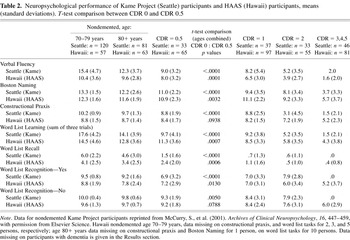
Information on average performance on each of the CERAD measures is given in Table 2. Among the nondemented group, younger persons (age 70–79 years) almost consistently performed better than older persons (age 80+ years). As expected, level of performance declined with increase in stage of dementia, but there was considerable overlap in performance between adjacent stages (e.g., between CDR 0.5 and CDR 1 on Verbal Fluency, constructional praxis, Word List Learning, and Word List Recognition; and between CDR 1 and CDR 2 on Boston Naming, Word List Recall, and Word List Recognition). T-test comparisons for each of the seven measures indicates that performance of those at CDR 0.5 is significantly lower than that at CDR 0. The strongest distinction occurred on Word List Recall, followed by Word List Learning and Verbal Fluency (each p < .0001).
Neuropsychological performance of Kame Project (Seattle) participants and HAAS (Hawaii) participants, means (standard deviations). T-test comparison between CDR 0 and CDR 0.5

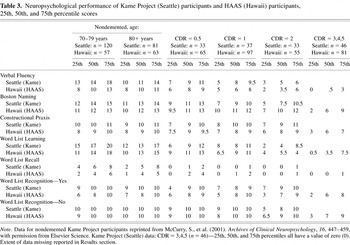
Since the data were skewed, we examined the percentile findings. Table 3 shows that at adjacent levels of cognitive status (e.g., between CDR 0 and CDR 0.5, or between CDR 0.5 and CDR 1) there was overlap, such that a score at the 75th percentile, for instance, might be at the 50th percentile for persons with cognition that was better by one stage. Since stage is an artificial construct imposed on a continuous condition, this finding is to be expected. Some measures, however, discriminated stage of cognitive impairment more poorly than did others. A comparison of cognitively normal (CDR 0) through moderate dementia (CDR 2) showed constructional praxis to be a poor discriminator. The verbal tasks, however (i.e., Verbal Fluency, Word List Learning, and Word List Recall), effectively distinguished mild dementia (CDR 1) from normal cognition.
Neuropsychological performance of Kame Project (Seattle) participants and HAAS (Hawaii) participants, 25th, 50th, and 75th percentile scores

McCurry et al. (2001) showed that, among cognitively normal participants, age and education consistently influenced performance on the neuropsychology measures of the CERAD battery, but gender had an effect only on Word List Learning, and language only on constructional praxis and Word List Learning (Table 4). Among the cognitively impaired, however, logistic regression indicated that performance (above vs. below the median) was not influenced by age, gender, education, stage of dementia, or language of administration (with the exception of Boston Naming, where age was a significant determinant of score). The severely demented (CDR 3–5) were omitted from these analyses since so few gave a scorable response.
Regression models for age, gender, education, language and CDR level on CERAD performance for Kame (Seattle) participants and (with the exception of gender) for HAAS (Hawaii) participants

HAAS
Information on demographic characteristics (Table 1) indicates that these Japanese-American men with dementia tended to be older than those who were not considered to be demented. There was little difference in average level of education by CDR level, but CASI scores declined as CDR levels increased. The majority, regardless of CDR level, preferred to be tested in English.
At least 88% of participants at CDR 0 and 82% at CDR 0.5 responded to the individual measures of the CERAD Neuropsychology Battery. Response rates declined as CDR level increased, ranging at CDR 1 from 0.90–0.98, at CDR 2 from 0.65–0.95, and at CDR 3–5, from 0.21–0.52. In consequence, as stage of dementia increases, scores must be interpreted with increased caution since they are based on a smaller proportion of participants.
As expected, level of performance declined with increase in stage of dementia (see Table 2), but there was considerable overlap in performance between adjacent stages. We carried out t-tests on each of the seven measures, to determine whether level of performance of persons who were cognitively intact (CDR 0) could be distinguished from that of persons with mild cognitive impairment (CDR 0.5). Significant differences were found for all measures except constructional praxis and Word List Recognition of new words.
Examination of the percentiles (Table 3) shows overlap between adjacent levels of cognitive status. The best discrimination between adjacent CDR levels was for Word List Recall, with discrimination poorer for all other measures.
For each measure we examined the effects on performance of age, education, language, and CDR level (for those at CDR 0.5, 1, or 2 only) (see Table 4). Measures were dichotomized at the median because of skew. For HAAS non-demented participants, age was relevant only for Word List Learning and Word List Recognition (original words), and education for Boston Naming and constructional praxis. Language never significantly affected scores. Among participants with dementia, age was relevant for Boston Naming and Word List Recall, while education was relevant for Word List Learning. CDR level was relevant for all measures except Word List Recognition, with distinction generally being between CDR 0.5 and CDR 2. In these controlled analyses, only the Boston Naming Test distinguished between all CDR levels examined.
DISCUSSION
Although the proportion and number of older persons in the U.S., particularly older minority persons, is predicted to increase, there are currently few normed measures available which permit an assessment of cognitive state. Such information is crucial if we are to accurately identify and compare the course of dementia in elderly minority groups, compare them with the majority population, identify and compare risk factors for dementia, include minorities in intervention studies, and assess the outcome.
We examined information from two major surveys of dementia in older Japanese Americans. A unique feature of these studies is that methods to measure and determine the presence of dementia were coordinated and standardized, thus reducing concern regarding diagnostic equivalence. It is therefore possible to focus on the characteristics of these two samples, and the possible relationships of these characteristics to test performance. The CERAD Neuropsychology Battery, the measure used in the two studies considered here, was developed for use among English-speaking persons in the U.S. It has, among other languages, been translated into Japanese, and so is available to assess Japanese speakers uncomfortable with English. Considerable care was taken to insure accuracy of translation. Differences in level of difficulty between the English and Japanese language versions may nevertheless remain, reflecting linguistic or cultural factors. The outline drawings of the Boston Naming Test, for instance, may vary in level of familiarity for speakers of English and Japanese, and the items of the word list tasks may not appear with the same frequency in each language. Unfortunately, the number of persons using the Japanese translation of the CERAD Neuropsychology Battery is too small to permit separate investigation. Data from the multivariable analyses, however, suggest that language of administration did not affect scores. Language affected performance for only one group (Kame Project nondemented persons), and for only two measures, one of which was constructional praxis, which would not appear to involve language.
The CERAD Neuropsychology Battery was originally designed to assess level of cognitive impairment in AD. It was later adopted to help identify the presence of dementia, both in the clinic setting and in epidemiologic studies, because of its comparative brevity (approximately 30″ administration time), sensitivity to the presence of mild dementia (Welsh et al., 1991), and its test–retest and inter-rater reliability (Fillenbaum et al., 2002; Morris et al., 1989). In particular, Word List Recall was found to have high sensitivity (86%) and specificity (94%) in distinguishing CERAD entrants with CDR 0 (no dementia) from those with CDR 1 (mild dementia) (Welsh et al., 1991). This measure also distinguished, but with less discriminability, AD patients with mild dementia (CDR 1) from those with moderate dementia (CDR 2). Other measures of the CERAD Neuropsychology Battery discriminated poorly between stages of disease, possibly because of floor effects (Welsh et al., 1992).
Findings from the Kame Project and HAAS study were comparable to those from CERAD. In the Kame Project, Word List Recall was the most effective, and in the HAAS study it was among the most effective of the measures that distinguished those with intact cognition from those with mild cognitive impairment (CDR 0.5). Indeed, in the Kame Project all the CERAD measures, and in the HAAS study all measures but two, distinguished persons rated as CDR 0 from those rated as CDR 0.5. This comparison is stricter than that used in the original CERAD study. In the current analysis, however, we were unable to control for the increased age of persons at CDR 0.5, which may have contributed to the difference in level of performance. Comparable to CERAD-based findings that other measures discriminated poorly among more severe stages of dementia, in the Kame Project, neither demographic characteristics nor CDR level helped to explain performance on the CERAD measures, but this could also be due to small sample size. In the HAAS study also, scores were rarely affected by demographic characteristics, but were affected by CDR level, with the exception of performance on the Word List Recognition tests. Unfortunately, the sample of men in the Kame Project is too small to permit gender-controlled comparison with the HAAS study. While there are differences in mean level of performance compared with the more highly educated CERAD group, the CERAD measures as a whole perform the same way in these epidemiologically derived samples of older Japanese as they do in a clinic-based sample.
A low response rate on the CERAD Neuropsychology Battery was found on the Kame Project for persons with dementia. The Kame Project is a longitudinal epidemiological study designed to determine the prevalence and incidence of dementia in a carefully defined population. A substantial proportion of those identified with dementia were not only elderly, but also frail, and residents of a nursing home. In testing, the priority was to obtain information critical to identifying the presence of dementia, the primary focus of the study. Gathering supplementary information (e.g., on the CERAD Neuropsychology Battery) was not pursued when the participant did not desire this, expressed or indicated fatigue, or when doing so might affect continued participation in the study. Completion rates on the CERAD Neuropsychology Battery, an incidental measure, were therefore lower than they might otherwise have been had neuropsychological assessment been the focus of the study.
Diagnosis of dementia, and determination of CDR stages 0 (normal cognition), 0.5 (mild cognitive impairment, questionable or very mild dementia) and 1 (mild dementia) were standardized between the two studies to insure consistent identification of dementia. Less attention was paid to standardizing higher CDR stages. The most likely reason, however, for finding that CDR level affected performance among HAAS men with dementia, but not among Kame participants is the issue of power as reflected by sample size. At the more severe stages of dementia there were fewer Kame participants than HAAS participants, and they were less willing to complete the CERAD measures than were HAAS participants.
Readers may ask why, given standardization of assessments and procedures, we have only minimally compared information from the two groups, and did not combine information from the two studies to examine a sample of distinctly larger size. Although these two samples were designed to examine the same issue—the extent of and risk factors for dementia—and have done so successfully (Graves et al., 1996; White et al., 1996), they were not designed to provide norms on the CERAD Neuropsychology Battery. The data obtained on that measure was incidental to the main purpose, and the pressures to respond were undoubtedly different in the two studies. In particular, participation in an epidemiological study was a new venture for one group (for those in the Kame Project), but not for those in the other (HAAS). The Kame Project participants were currently representative of a given population, HAAS participants were all male, and were survivors of a study that began more than two decades earlier. A larger proportion of Kame Project than of HAAS participants were residents of an institution. Further, data from HAAS, being a distinctly larger sample, could have overwhelmed that from the Kame Project. Finally, some notable differences were found between the two groups with respect to their levels of performance on different measures. The results of logistic regression on data from persons with dementia suggest that this decision was appropriate.
Data from the present study indicate that, as might be expected, there are no sharp distinctions between successive stages of dementia. Rather, there appears to be a gradual decline in cognitive functioning. Most of the CERAD measures examined in this study consistently distinguished persons with normal cognition from those with mild dementia. More subtle differentiations to identify stage of disease probably require more sensitive measures, or perhaps, a different approach to testing (Darby et al., 2002). The present study, however, indicates that the CERAD neuropsychology measures may, among Japanese-American elderly, distinguish the demented from the nondemented, and may be sensitive to stage of dementia also, thus corroborating the value of this battery. With norms currently available on Whites and African Americans (Fillenbaum et al., 2001, 2002; Ganguli et al., 1991, 1995, 1997; Unverzagt et al., 1996; Welsh et al., 1994), with data on Hispanics in the U.S. presently under study, and with translations into several languages already available (Heyman & Fillenbaum, 1997), the CERAD Neuropsychology Battery provides a valuable tool to assess the presence and severity of dementia in multiple minority groups.
ACKNOWLEDGMENTS
This study was supported by NIA research grant number R37 AG08937, and AG09769; NIA contract number N01-AG42149; NHLBI contract number N01 HC0510; and by NIA grant number 5P60 AG11268 (Claude D. Pepper Older Americans Independence Center, Duke University). We would like to thank Jama L. Purser, Ph.D., for her contributions.
References
REFERENCES
American Psychiatric Association.
(1987).
Diagnostic and Statistical Manual of Mental Disorders
(3rd ed., Revised).
Washington, DC:
American Psychiatric Association.
Darby, D.,
Maruff, P.,
Collie, A., &
McStephen, M.
(2002).
Mild cognitive impairment can be detected by multiple assessments in
a single day.
Neurology,
59,
1042–1046.CrossRefGoogle Scholar
Fillenbaum, G.G.,
Heyman, A.,
Huber, M.S.,
Ganguli, M., &
Unverzagt, F.W.
(2001).
Performance of elderly African American and White community
residents on the CERAD Neuropsychological Battery.
Journal of the International Neuropsychological Society,
7,
502–509.CrossRefGoogle Scholar
Fillenbaum, G.G.,
Unverzagt, F.W.,
Ganguli, M.,
Welsh-Bohmer, K.A., &
Heyman, A.
(2002).
The CERAD Neuropsychological Battery: Performance of representative
community and tertiary care samples of African American and European
American elderly.
In
F.R. Ferraro (Ed.),
Minority and cross-cultural aspects of neuropsychological
assessment.
Lisse, The Netherlands:
Swets and Zeitlinger.
Folstein, M.F.,
Folstein, S.E., &
McHugh, P.R.
(1975).
“Mini-Mental State”: A practical method for grading the
cognitive state of patients for the clinician.
Journal of Psychiatric Research,
12,
189–198.CrossRefGoogle Scholar
Ganguli, M.,
Ratcliff, G.,
Huff, F.T.,
Belle, S.,
Kancel, M.J.,
Fischer, L.,
Seaberg, E.C., &
Kuller, L.H.
(1991).
Effects of age, gender and education on cognitive tests in a rural
elderly community sample: Norms from the Monongahela Valley Independent
Elders Survey.
Neuroepidemiology,
10,
42–52.CrossRefGoogle Scholar
Ganguli, M.,
Ratcliff, G., &
Dekosky, S.T.
(1997).
Cognitive test scores in community based older adults with and
without dementia.
Aging and Mental Health,
1,
176–180.CrossRefGoogle Scholar
Ganguli, M.,
Seaberg, E.C.,
Ratcliff, G.G.,
Belle, S.H., &
Dekosky, S.T.
(1995).
Cognitive stability over two years in a rural elderly population:
The MoVIES project.
Neuroepidemiology,
15,
42–50.Google Scholar
Graves, A.B.,
Larson, E.B.,
Edland, S.D.,
Bowen, J.D.,
McCormick, W.C.,
McCurry, S.M.,
Rice, M.M.,
Wenzlow, A., &
Uomoto, J.M.
(1996).
Prevalence of dementia and its subtypes in the Japanese American
population of King County, Washington State: The Kame Project.
American Journal of Epidemiology,
144,
760–771.CrossRefGoogle Scholar
Hasegawa, K.
(1983).
The clinical assessment of dementia in the aged: A dementia
screening scale for psychogeriatric patients.
In
M. Bergener,
U. Lehr, &
E. Lang (Eds.),
Ageing in the eighties and beyond (pp.
207–218).
New York:
Springer.
Heyman, A. &
Fillenbaum, G.G.
(1997).
Overview: Clinical sites, case material, and special studies.
Neurology,
49 (Suppl. 3),
S2–S6.CrossRefGoogle Scholar
Jorm, A.F.
(1994).
A short form of the Informant Questionnaire on Cognitive Decline in
the Elderly (IQCODE): Development and cross-validation.
Psychological Medicine,
24,
145–153.CrossRefGoogle Scholar
Jorm, A.F. &
Jacomb, P.A.
(1989).
The Informant Questionnaire on Cognitive Decline in the Elderly
(IQCODE): Sociodemographic correlates, reliability, validity and some
norms.
Psychological Medicine,
19,
1015–1022.CrossRefGoogle Scholar
Kaplan, E.F.,
Goodglass, H., &
Weintraub, S.
(1978).
The Boston Naming Test.
Boston, Massachusetts:
Veterans Administration Medical Center.
Kiernan, R.J.,
Mueller, J.,
Langston, J.W., &
van Dyke, C.
(1987).
The Neurobehavioral Cognitive status Examination: A brief but
quantitative approach to cognitive assessment.
Annals of Internal Medicine,
107,
481–185.CrossRefGoogle Scholar
Larson, E.B.,
McCurry, S.M.,
Graves, A.B.,
Bowen, J.D.,
Rice, M.M., &
McCormick, W.C.
(1998).
Standardization of the clinical diagnosis of the dementia syndrome
and its subtypes in a cross-national study: The Ni-Hon-Sea
experience.
Journals of Gerontology: Medical Sciences,
53A,
M313–M319.Google Scholar
Manly, J.J.,
Jacobs, D.M.,
Sano, M.,
Bell, K.,
Merchant, C.A.,
Small, S.A., &
Stern, Y.
(1998).
Cognitive test performance among nondemented elderly African
Americans and Whites.
Neurology,
50,
1238–1245.CrossRefGoogle Scholar
McCurry, S.M.,
Gibbons, L.E.,
Uomoto, J.M.,
Thompson, M.L.,
Graves, A.B.,
Edland, S.D.,
Bowen, J.,
McCormick, W.C., &
Larson, E.B.
(2001).
Neuropsychological test performance in a cognitively intact sample
of older Japanese American adults.
Archives of Clinical Neuropsychology,
16,
447–459.CrossRefGoogle Scholar
Morris, J.C.
(1993).
The Clinical Dementia Rating (CDR): Current version and scoring
rules.
Neurology,
43,
2412–2414.CrossRefGoogle Scholar
Morris, J.C.,
Heyman, A.,
Mohs, R.C.,
Hughes, J.P.,
van Belle, G.,
Fillenbaum, G.,
Mellits, E.D., &
Clark, C.
(1989).
The Consortium to Establish a Registry for Alzheimer's Disease
(CERAD): Part I. Clinical and neuropsychological assessment of
Alzheimer's disease.
Neurology,
39,
1159–1165.Google Scholar
Reitan, R.M. &
Wolfson, D.
(1985).
The Halstead-Reitan Neuropsychological Test Battery.
Tempe, AZ:
Neuropsychology Press.
Rosen, W.G.,
Mohs, R.C., &
Davis, K.L.
(1984).
A new rating scale for Alzheimer's disease.
American Journal of Psychiatry,
141,
1356–1364.Google Scholar
Shipley, W.C.
(1946).
Institute of Living Scale.
Los Angeles, CA:
Western Psychological Service.
Spreen, O. &
Strauss, E.
(1991).
A compendium of neuropsychological tests: Administration, norms, and
commentary (pp.
276–331).
New York:
Oxford University Press.
Teng, E.L.,
Hasegawa, K.,
Homma, A.,
Imai, Y.,
Larson, E.,
Graves, A.,
Sugimoto, K.,
Yamaguchi, T.,
Sasaki, H.,
Chiu, D., &
White, L.R.
(1994).
The Cognitive Abilities Screening Instrument (CASI): A practical
test for cross-cultural epidemiological studies of dementia.
International Psychogeriatrics,
6,
45–58.CrossRefGoogle Scholar
Unverzagt, F.W.,
Hall, K.S.,
Torke, A.M.,
Rediger, J.F.,
Mercado, N.,
Gureje, O.,
Osuntokun, B.O., &
Hendrie, H.C.
(1996).
Effects of age, education and gender on CERAD neuropsychological
test performance in an African American sample.
Clinical Neuropsychologist,
10,
180–190.CrossRefGoogle Scholar
Wechsler, D.
(1981).
Wechsler Adult Intelligence Scale–Revised.
New York:
Psychological Corporation.
Wechsler, D.
(1987).
Wechsler Memory Scale–Revised.
New York:
Psychological Corporation.
Welsh, K.A.,
Butters, N.,
Hughes, J.P.,
Mohs, R.C., &
Heyman, A.
(1991).
Detection of abnormal memory decline in mild cases of
Alzheimer's disease using CERAD neuropsychological measures.
Archives of Neurology,
48,
278–281.CrossRefGoogle Scholar
Welsh, K.A.,
Butters, N.,
Hughes, J.P.,
Mohs, R.C., &
Heyman, A.
(1992).
Detection and staging of dementia in Alzheimer's disease: Use
of the neuropsychological measures developed for the Consortium to
Establish a Registry for Alzheimer's Disease.
Archives of Neurology,
49,
448–452.CrossRefGoogle Scholar
Welsh, K.A.,
Butters, N.,
Mohs, R.C.,
Beekly, D.,
Edland, S.,
Fillenbaum, G., &
Heyman, A.
(1994).
The Consortium to Establish a Register for Alzheimer's Disease
(CERAD). Part V. A normative study of the neuropsychological
battery.
Neurology,
44,
609–614.Google Scholar
White, L.R.
(1992).
Toward a program of cross-cultural research on the epidemiology of
Alzheimer's Disease.
Current Science,
63,
456–469.Google Scholar
White, L.,
Petrovich, H.,
Ross, G.W.,
Masaki, K.H.,
Abbott, R.D.,
Teng, E.L.,
Rodriguez, B.L.,
Blanchette, P.L.,
Havlik, R.J.,
Wergowske, G.,
Chiu, D.,
Foley, D.J.,
Murdaugh, C., &
Curb, J.D.
(1996).
Prevalence of dementia in older Japanese-American men in
Hawaii.
Journal of the American Medical Association,
276,
955–960.CrossRefGoogle Scholar
Worth, R.M. &
Kagan, A.
(1970).
Ascertainment of men of Japanese ancestry in Hawaii through World
War II selective service registration.
Journal of the American Medical Association,
276,
955–960.Google Scholar

Demographic characteristics of Kame Project (Seattle) participants and HAAS (Hawaii) men
Neuropsychological performance of Kame Project (Seattle) participants and HAAS (Hawaii) participants, means (standard deviations). T-test comparison between CDR 0 and CDR 0.5
Neuropsychological performance of Kame Project (Seattle) participants and HAAS (Hawaii) participants, 25th, 50th, and 75th percentile scores

Regression models for age, gender, education, language and CDR level on CERAD performance for Kame (Seattle) participants and (with the exception of gender) for HAAS (Hawaii) participants
 You have
Access
- 22
- Cited by