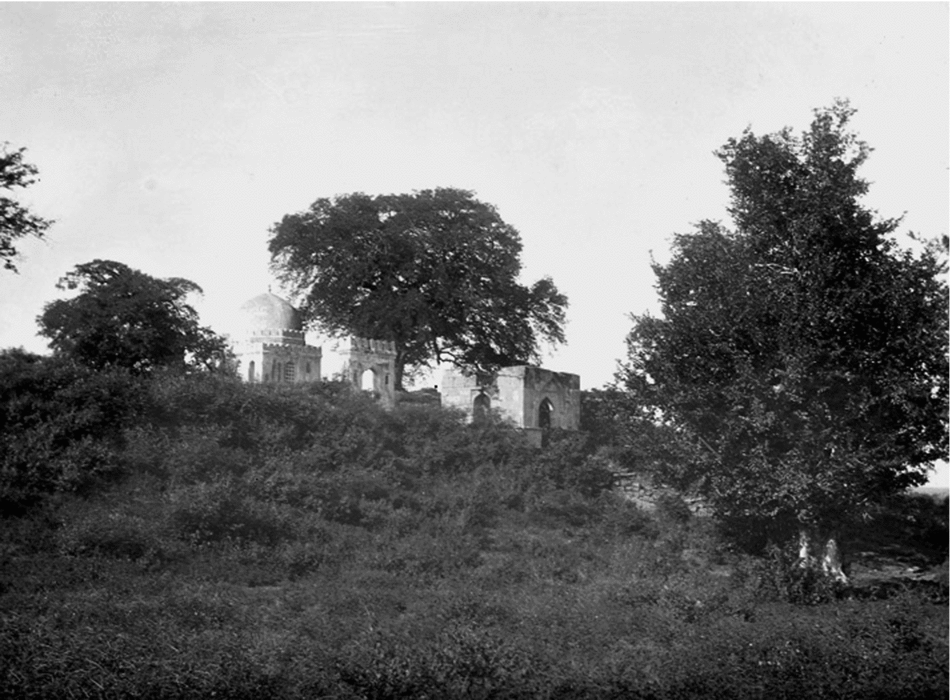
On the ancient ramparts of the city of Dhār, overlooking the moat, is the tomb of a saint called Shaykh Changāl (Fig. 1). The tomb has been rebuilt in recent times, but stands on a high stone platform dating to the fifteenth century. The long staircase up to the tomb has two arched gates. A Persian inscription is placed in the upper gate over the door and is protected nowadays by a metal door. Written in forty-two verses, it is dated ah 859/ 1454–55. The verses were composed in the reign of the Maḥmūd Shāh Khaljī, the Sultan of Mālwā from 1436 to 1469.Footnote 1 The purpose of this essay is to provide the text of this inscription with a new translation and commentary.
General view of the Tomb of Shaykh Changāl from the north east, showing the tomb and mosque mentioned in the inscription. Courtesy of the British Library, photo 430.32 (14).

The Dhār inscription was first published more than a century ago by G. H. Yazdani, together with his translation.Footnote 2 Subsequently, the record was listed in the Annual Report on Indian Epigraphy for 1971–72.Footnote 3 There seems to be no further documentary coverage of the inscription. Interpretive commentary has been minimal, the only work of note being that by Richard Eaton.Footnote 4 He included it in his well-known examination of temple destruction in late medieval India and regarded it as an important text indicating how Muslims constructed their origins in Mālwā. Further study of the inscription therefore needs little excuse. Aside from the record's importance for the themes which Eaton has explored, the Dhār inscription gives insight into the literary culture of the Mālwā Sultanate and documents a tradition of local history in the 1400s. This local history reached back almost two centuries to the time of the Paramāra kings and attests the presence of Islam in Dhār before the region was annexed to the Sultanate in the early fourteenth century by cAyn al-Mulk Mūltānī.Footnote 5
The inscription tells us that the poet responsible for the text was named Maḥmūd, assuming that the last couplet (given below) contains the poet's takhallus or pen-name. He is not mentioned as the author of any other inscriptions at Dhār or Māṇḍū so little is known about him apart from the general statements he makes about himself at the end of the poem. His work reveals him to be an educated man, versed in the Qur'ān and its mystical passages and familiar with the Persian classics composed by Rūmī and Ḥāfiẓ.
Maḥmūd's poem is in a form known as ghazal, with each verse (bayt) having two lines (miṣra). The text is, however, exceptionally long for a ghazal and lacks the erotic qualities characteristic of the form. It is a tribute to Shaykh Changāl who came to central India and converted the people of Dhār to Islam. The Shaykh is reported in the inscription to have come to Dhār after a small community of early Islamic settlers were set upon by a local mob and murdered “with swords and cleavers”, a turn of phrase suggesting a play of words on the ‘city of sword blades’ or Dhārānagara, the ancient name of Dhār.Footnote 6 Shaykh Changāl's arrival is reported to have taken place during the reign of King Bhoja. The historical implications of this are taken up in my commentary below. Maḥmūd's poetic style is elaborate, elevated and intense. Written approximately four hundred years after the events it records, the poem naturally follows the polished style of the fifteenth century and is laboured, not in the sense that the author found it difficult to describe the life of Changāl, but rather that he could not find enough words and ways to celebrate this man of religion and his great deeds.
In the translation I have attempted to retain a poetic style, perhaps at the expense of clear meaning. The poem is cryptic in several places and to explain the metaphors and allusions, I have provided a commentary which I hope explains the author's intention. For those verses where the meaning seems logical or obvious I have let the translation stand without additional remarks.Footnote 7
Translation and Commentary
Shaykh cAbdullāh Changāl – Mercy be upon him!
1. Our Lord Almighty is sublime! This dome of splendour,
Over this grave of purity is like the heavenly house.
The verse, written as a mark of praise and honour, naturally begins with the name of God. Drawing on Arabic, the language of the Qur'ān, it reveals the religious orientation of the poet and, additionally, the patron who commissioned the work. From the onset with words such as  and
 there is no doubt that the poet is presenting himself as pious and educated.
The poet then begins to describe the physical aspects of the shrine. The dome above the grave of Shaykh Changāl is likened to the heavenly house (Bayt al-macmūr) in the seventh heaven. This is believed to be an exact replica of the Kacbah and situated exactly above it, just as the dome of the tomb at Dhār is situated above the grave of Shaykh Changāl. The author's analogies between the dome and its heavenly counterpart are elaborated in the next verse.
2. Perhaps it is a niche for a glass lamp,
Above the star, it is a light upon a light.
Here the poet is drawing on Sūrat al-Nūr in the Qur'ān (24: 35): “God is the Light of the heavens and the earth; the example of His light is like a niche in which is a lamp; the lamp is in a glass; the glass is, as if it were, a star shining, kindled by the blessed olive tree, neither of the east nor of the west – it is so close that the oil lights itself although the fire does not touch it; light upon light; God guides towards His light whomever He wills; and God illustrates examples for mankind; and God knows everything”.
Accordingly, the mortal remains of the saint in the tomb are like a lamp in a niche. The author's choice of words in this verse suggest that the dome over the grave could physically shine – thus giving out light – and that the grave belongs to a holy figure that shines like a star – so also giving out light. Just like the heavenly house which gives out light and is above the holy Kacbah, the placement of the dome above the grave is literally a “light upon light”. The idiom is still current in Farsi, something similar to the phrase “the jewel in the crown” in English. Another interpretation drawing on the Sūrat of Light would be that just as God “is the light of the heavens”, and “guides towards His light whomever He wills”, so this particular dome of light serves as a sign and guide for people to be called to see the tomb and so be guided to God by the holy figure entombed within.
The use of the multiple levels of meaning shows that the poet of this inscription was versed in the mystical literature of Islam, notably that of Rūmī (thirteenth century) and Ḥāfiẓ (fourteenth century). Rūmī, for example, refers specifically to Imām cAlī as a light upon light: “In as much as the moon even without speech shows the way, when it speaks it becomes light upon light”.Footnote 8
3. Or is it the holy valley of Moses itself,
Upon which Mount Sinai gloriously manifests?
The poet continues to use references from the Qur'ān in this verse, a common convention in Indian tombs. Here he has drawn on Sūrat al-Acrāf (7: 171): “And when We raised the mountain [Tūr/Sinai] above them, as if it was a dark cloud and they were certain that it would fall upon them, [God said]: ‘Take what We have given you with determination and remember what is in it that you might fear God'”.
The grave of Shāykh Changāl is thus visualised as the holy valley of Moses and the dome above it as Mount Tūr or Sinai. According to the Qur'ān, when Moses and the children of Israel were at Mount Sinai, the whole mountain was lifted off the ground and floated above their heads. The comparison is invoked to show that the tomb, like the floating mountain, is a miracle. Again the poet is comparing the physical attributes and position of the shrine to scriptural events and images to heighten the importance of both the shrine and the saint. Yet after three verses we still know little of the person buried here: the primary focus is architecture. These praises may thus be read as an indirect tribute to the actions of Maḥmūd Shāh Khaljī who as the patron not only rebuilt the tomb but reconstituted the popular memory of Shaykh Changāl. For the reader, however, all we can guess is that the saint was a great man, worthy of being described using the language of the Qur'ān.
4. Indeed, this shrine is the court of a royal falcon,
Who has trapped the demon in his talons.
In this verse, the poet turns to the saint. Moving from broad comparisons and speculation, he says: “Indeed, this shrine is the court of a royal falcon”, as if to say, in conclusion, that this is the best way to describe Shaykh Changāl and his shrine. He also asserts that Changāl himself is the falcon who has trapped evil in his talons. The author's play on words is evident from the fact that changāl has several meanings and so leaves room for more than one interpretation. Changāl literally means ‘grasp’ or ‘talon’, so evil is trapped in the falcon's talons, i.e. by Changāl. Alternately it is trapped in Changāl himself who, buried in the earth, thus controls evil so it cannot escape and cause harm. This verse also alludes to Rūmī's reference to Imām cAlī in his Masnavī. This is yet another attempt by the poet to discreetly compare his subject to a figure in the Qur'ān: “Say it, O Royal falcon who catches the Anga Bird, O You who vanquished an army all by yourself”.Footnote 9
5. The head of the Abdāl, cAbdullāh Changāl –
What a Changāl – that night and dawn saw him revel.
Here Shaykh Changāl is referred to as the head of the Abdāl – a circle of forty Sufi mystics who stand fifth in the hierarchical ranking of saints. They have seventy followers (nujaba’), are chosen by God and known to him alone. With this statement, the poet introduces his subject directly as an exalted Sufi. It is an attempt to stress his importance not only as a man of religion but also in the cycle of nature. In Sufi thinking, as long as the Abdāl are in existence, the world that revolves around them will continue. If one dies, he will be replaced and the world will go on; if they cease to exist the world will end.Footnote 10 The poet also seems to be injecting his own feelings about the Shaykh and his own mystical inclinations. “What a Changāl”, he declares boldly, “that night and dawn saw him revel”. This refers not to simple celebrations but to the singing, dancing, recitation and trance that is part of Sufi liturgy. The poet is creating the image of a pious man who is close to God and spends his days and nights worshipping Him.
6. His liturgy was the songs and melodies of the nightingales,
His anthem was the calls of birds and bees.
With this verse the initial portrayal of Changāl as a saint at the heart of creation is strikingly elaborated by a representation of him as a man who rejoices in the natural sounds around him. The reference to the Sufi liturgy (samāc) as bird-song suggests the poet knows Farīd al-Dīn's Conference of the Birds, a Sufi classic that enjoyed considerable popularity in India. The poet's choice of the nightingale is significant because it is a recurrent symbol in Persian literature of the lover who sings for his beloved, usually represented as a rose. Here Changāl seems to be the rose for which the nightingales sing. Moreover, nightingales sing at night and at dawn. This echoes the previous verse that “night and dawn saw him revel”, that is, revel in the worship of God.
7. His musky mud (house) was the halva of unity,
His electuary of rapture borrowed the fragrant camphor (of paradise).
8. His wine of delight was in cups and goblets,
His kebab of love was in pots and ovens.
With these two verses the poet invokes, through mixed metaphors, the senses of taste and smell of musk, camphor, wine and kebabs. To begin, I understand the poet describing Shaykh Changāl's residence as being made of mud or adobe, something he compares to halva. The camphor in the next line seems to allude to Qur'ān (76: 5) where the righteous in paradise “will drink from a cup mixed with camphor”. The reference to halva shows the author's familiarity with Rūmī who wrote about it with fondness, saying that God prepared halva for the Sufis and the angels cooked it in the heavenly kitchen. Rūmī says to himself: “Do not talk much of halva!” As Annemarie Schimmel points out, the word reveals a loving union which must be kept secret.Footnote 11 Rūmī also uses halva to write about marriage which is, of course, a metaphor for the loving unity of God with his devotees.Footnote 12
In companionship and happiness,
May you be like milk and honey
In union and fidelity,
Just like sugar and halva.
The essential ingredients of halva and electuary are mixed together to make a unity, just as the Sufi and God are co-mingled to such an extent that the individual identity of the Sufi is lost. The process is necessarily sweet, exhilarating and filled with love. This powerful analogy of religious devotion and worldly love, mixed with the idea of a feast, finds parallels in the revitalised devotional movements of the fifteenth century led by Caitanya, Kabīr and other Indian mystics.Footnote 13
9. Angels salute him at every breath,
Holy maidens greet him at every dawn.
Here the poet appears to make a comparison to Adam. In Sūrat al-Baqarah the angels are told by God to “Prostrate yourselves before Adam”. The idea in the Qur'ān is that after the creation of Adam, God instructed angels and jinns to prostrate before him, not as an act of worship but as a salutation and act of subordination. Therefore the poet is reinforcing the idea, like that of the Abdāl in Verse 5, that Changāl is a holy man, sent by God, to whom other classes of beings are bound to pay respect.
10. This centre became Muslim, initiated first by him,
All the banners of religion were held up and spread by him.
11. It has been said that before him,
Several others had visited this ruin.
With these two verses the poet moves from generalities to the saint's story, asserting two important things about the history of Islam in central India, i.e. that Shaykh Changāl led the establishment of Muslim institutions in the region and that prior to his appearance some Muslims had already settled in central India. Although Islam arrived in Sind in the early eighth century, and perhaps on the west coast of India before that, evidence for Muslims in central India prior to the fourteenth century is scarce. The oldest Islamic inscription at Dhār is dated ah 795/ce 1392–3.Footnote 14 This refers to repairs made to a mosque, probably the one that was built when Dhār was first conquered by Delhi at the opening of the fourteenth century. What the inscription at Shaykh Changāl's tomb is saying is that Muslims were present at Dhār before this time and that Shaykh Changāl was a key pioneer in those early days. There is, of course, a degree of hyperbole in the idea of conversion, and conversion as such, is not actually mentioned in this text.Footnote 15 In Verse 10, the poet is asserting, in essence, that this ‘centre-land’ is a place of first importance, that is, a place which rivals Delhi and Ajmir as a centre for Muslims in India. This importance is based on the early date for the Shaykh, before the political incorporation of Dhār into the Sultanate. Remembering that the poet was writing for a king and kingdom whose chief city was Dhār, these statements can be read as claims for the political independence of Mālwā based on an independent and early line of transmission for the establishment of Islam in the region. The poet is thus writing for his readers in the 1400s who were, primarily, the king and his learned courtiers. The description of Dhār here as a ‘desolate ruin’ could be read as an exaggeration but there is probably some truth in the rhetoric because extended wars between the Parmāra rulers and their neighbours led to Dhār being sacked and destroyed repeatedly.Footnote 16
12. When the muezzin called the morning prayer,
Like a Sufi intoxicatingly sounding his trumpet,
13. Infidels raided from every side,
Each one rushing forward with swords and cleavers.
14. Finally, they pinned those men of religion to the ground,
And after killing them, concealed their bodies in a deep pit.
15. Now, this treasure trove of martyrs is a vestige,
Of those pure and righteous-hearted people.
With these four verses we learn that the first Muslims who settled at Dhār were attacked at the time of prayer and killed. After this murderous act, their bodies were dumped in a deep pit or well (chāh). Michael Willis has visited the location and noted some of the relevant topographical and architectural features.Footnote 17 To the north of the tomb of Shaykh Changāl there is a gap in the old ramparts and traces of a city gate marked by large stones. This would have been a logical place for a community of new immigrants and traders to have settled. Just inside the gate is a large circular well, now silted up and over-grown. Local people point to this as the place where the bodies of the dead were thrown. The murdered are called Chālīs Pīr, that is, the forty holy ones. A low grave for them now stands beside the domed shrine of Shaykh Changāl. The reference to “swords and cleavers” as a likely play on the name Dhārānagara or ‘city of sword blades’ has already been noted in my introduction.
Attacking Muslims at the time of prayer would have been natural. The call to prayer would have been heard in the neighbourhood and those intent on mischief would have known that all the Muslim community would be present. And they probably knew that while praying the congregation would be particularly vulnerable because they would be bowing down together and not, by general prescription, allowed to look back or react to their surroundings. The poet continues to express his themes in mystic terms by comparing the muezzin to an intoxicated Sufi sounding a trumpet. This is not simple drunkenness, of course, but the state of ecstasy induced by divine worship. Sufis are known for their inclination towards music and musical instruments. Rūmī, for example, wrote about reeds on numerous occasions and even dedicated a whole poem to the wind instrument in the Song of the Reed.
With Verse 15 the poet briefly breaks the narrative to reflect on the place as a “treasure trove of martyrs” and as a “vestige” of the righteous, a comment which presages the restoration and development of the site described below.
16. When time came for the sun of truth,
To shine on this winter solstice,
17. This lion-hearted man came from the centre of religion,
To this ancient temple with his group of men.
18. He destroyed the images of the idols,
And transformed the temple into a place for prayer.
Returning to the narrative, the poet describes Shaykh Changāl's arrival at Dhār and his overturning of idols and the transformation of the temple into a mosque. How the rhetoric of this claim can be understood has been explained by Richard Eaton.Footnote 18 In addition to the points Eaton has explored, I would like to comment on some of the allusions used in these verses. The winter solstice, firstly, is an important time of year in Persian culture, known as Shab-e yaldā or Shab-e chelleh. The longest and so darkest night of the year, it was often used by poets such as Sa'dī, Ḥāfiẓ and Rūmī to symbolise separation, loneliness and longing for the beloved. There is, of course, hope that better days will come. Sa'dī writes: “The sight of you each morning is a new year; any night of your departure is the eve of yalda”. In a similar vein Rūmī asks: “How long must I burn in this solstice of separation, candle-like?”. The point here is that Shaykh Changāl comes to end the darkness as the ‘sun of truth’. The poet purposefully chooses the word ‘lion’ to describe Changal's bravery. This alludes to Imām cAlī, such as found in the writing of Rūmī: “In bravery you are the lion of the Lord: in generosity who indeed knows who you are?”. And further: “Know that the lion of God, cAlī was purged of all deceit”.Footnote 19
Changāl is said to have come from the “centre of religion”, a point of special interest. The cultic centre of the Islamic world is, of course, Mecca and Medina, with Jerusalem standing as the third most-holy place in Islam (see Qur'ān, 17: 1). To say Changāl came from “the centre of religion” seems to project a claim that Dhār supercedes Delhi and Ajmir because its spritual fountainhead is not in Delhi but the very heartland of the Islamic world. This was anticipated already in Verse 11 in which the Islamic history of Dhār was asserted to pre-date the Sultanate conquest.Footnote 20
19. When Rai Bhoj saw this, through wisdom,
He became a Muslim, along with all the warriors.
This is one of the most interesting verses in the inscription and one which has been commented on by the writers mentioned at the beginning of this article. Before turning to the identity of Rai Bhoj, I would like to briefly note the word sūr used by the poet. This is an exclusively Indo-Persian term meaning ‘hero’ or ‘warrior’ and its use in the context of Rai Bhoj's conversion along with his troops is carefully studied. The main historical problem remains the identity of Rai Bhoj nonetheless. The most famous Bhoja ruled in the first half of the eleventh century and was so celebrated that later kings claimed to be direct incarnations of him.Footnote 21 As noted by Eaton, the chronological position of Bhoja (cira 1000–55) rules him out as the king being referred to in this inscription, while it seems unlikely that the conversion of the second Bhoja, a minor historical figure, would be celebrated 150 years after his time.Footnote 22 This second Bhoja of the Parmāra dynasty seems to have ruled sometime after 1275.Footnote 23 However, the existence of this Bhoja is based solely on the Hammīramahākāvya of Nayacandra Sūri, a text of the fifteenth century, and the assertion of H. V. Trivedi that this poetic work can be read as “a very reliable account” of events.Footnote 24 The problem, such as it is, is explained by the fame of Bhoja in literary sources in the early Sultanate period. Merutuṅga, who completed his Prabandhacintāmaṇi in the opening years of the fourteenth century, celebrated Bhoja's achievements as did the Simhāsanadvātriṃśikā, a work composed in the Deccan about the same time.Footnote 25 Bhoja's rising reputation after this is shown by the Bhojacarita composed by Rājavallabha in the mid-fifteenth century, i.e. the same period as the Dhār inscription.Footnote 26 What the Dhār inscription shows, therefore, is that Bhoja's reputation as a cultural hero was sufficiently important for it to draw the attention of a poet working in Persian at the court of the Mālwā Sultanate. Not only does this show that our poet was aware of Bhoja's story in contemporary Indian writing, but that the myths were important enough for them to be assimilated into an Islamic narrative.
20. This region became illuminated with the light of the true law,
And the customs of idolatry were rejected and made extinct.
21. Now, this garden grove, since the days of yore,
Has been a holy place of pilgrimage.
22. Because the graves are so old, they have become flat,
No mound remains on any grave.
23. There was no other place for quiet retreat,
For dervishes in distress to find comfort.
24. Therefore the great king of the world,
Commanded that they rebuild this Top of Tur [=Sinai].
Verses 20–24 note that idolatry was displaced and a new dispensation introduced at Dhār. The place where the martyrs died became a shrine and place of pilgrimage. However, by the fifteenth century the graves had all but disappeared, reduced to traces, as suggested already in Verse 15. Then, without introduction, the poet turns to the rebuilding of the shrine by the ‘great king’. This is none other than king Maḥmūd mentioned in the following verses. I have rendered the word tūr in this verse as ‘holy mountain’. It could be a dome, but the previous verses make clear that almost nothing remained apart from a grove of trees and vestiges of the graves. As a result, I think the poet is describing the large mound on which the tomb stands and that his use of words is a deliberate reference to this. It is also an echo of the phrases describing the finished tomb that appear at the start of the inscription.
25. A king of graceful countenance, Sultan of the world,
Visitors bowing at his door step were the Great Khan and the Emperor of China.
The poet is using metonymy here:  means region and horizon. The plural of both would mean the world in general. So here the poet is emphasising the fact that he is such an admirable man that he exceeds the Great Khans and the Emperor of China.
26. cAlā’ al-Dīn wa'l-Dūnyā Abū’l-Muẓaffar,
Triumphed over his enemies with the help of God,
27. So in that era, with Maḥmūd as the king of the world,
The world flourished like heaven, thanks to his justice.
28. It was he who made this ancient land prosper,
And rebuilt this house all over again.
29. Because there was empty space above his tomb,
This dome confined and protected it.
30. A dome and several chambers to the north,
Built for praying and worshiping God,
Verses 26 to 30 present a straightforward account of the king and his construction work at the site. Verse 30 records the building of a mosque, most probably the one which stands to the north of Shaykh Changāl's tomb beside the staircase up the hill. The mosque has been entirely rebuilt but a few old carved stones and the original miḥrāb have been retained. The old photograph illustrated here in Figure 1 shows that the shell of the mosque was still standing in the early twentieth century.
31. A delightful hospice facing the direction of prayer where travellers from far can rest.
This verse records that a frontier hospice was also built, perhaps a continued description of the structure just mentioned.
32. Perhaps one day a pious person will come to this place and be happy for a moment.
33. He can spend some time in peace,
And a while with a holy friend, away from grief.
34. He may drink from the cup poured by the invisible cup-bearer,
And from that moment be intoxicated and transported.
The invisible cup-bearer in this verse is a reference to God. The poet is saying that the unseen has the power to transport worshippers to a higher realm through worship. To drink from God's cup means to be able to ascend this material world through prayer and forget ordinary worries, a common practice for the pious and mystics alike.
35. For others like us, thirsty-hearted from the pain,
He might pour a drop in the mouths of those deprived.
Continuing the idea of God as the invisible cup-bearer, the poet here speaks of deprivation and thirst, that is, deprivation from religious truth. This is a common image across many traditions, made more intimate and immediate by the use of the words “like us”.
36. Let us also pray for the benevolent builder!
May God keep him safe until the sounding of the trumpet.
37. May his existence and his kingdom be everlasting,
May all his efforts and good deeds be appreciated.
38. O God! As long as the world exists,
Preserve this, the king's edifice of beneficence, until the sounding of the trumpets of the Day of Judgement.
39. From the clouds of his bounty he bestows bounty on the world,
The same way that the creator of light gave his light to all.Footnote 27
40. From the Hijra it was 833 years,
The date of which was written anew.
41. A beggar of the king's court and of the door of the Shaykh,
Strung these hidden pearls.
42. Perhaps in the list of beggars,
Maḥmūd, the weary hearted, may be mentioned.
In the final two verses, the reader is at last given some information about the poet Maḥmūd who humbly mentions that he is the author of this text. Although he says that he is a beggar at the court and at the shrine, the use of “hidden pearls” to describe the verses is an interesting choice because pearls are valuable, beautiful and scarce. Therefore, although Maḥmūd seems to be depreciating himself, his words suggest that he sees himself as a jewel that has not yet been discovered or appreciated.