I. Yeni Cami 937
Manuscript production in the celebrated library of the Timurid prince, Bāysunghur Mīrzā (1399–1433), has attracted ample scholarly attention for more than a century.Footnote 1 However, there are still several examples of the Herat School that have not been properly identified or introduced. One such manuscript is preserved in Istanbul, Suleymaniye, Yeni Cami, no. 937.Footnote 2 I will describe some significant codicological features of the codex before turning to the identity of the scribe, Saʿd Mashhadī, and his association with Prince Bāysunghur's court.Footnote 3
This previously neglected codex, containing the Kunūz al-wadīʿa min rumūz al-ẕarīʿa ilā makārim al-sharīʿa and a translation of al-Faraj baʿd al-shidda wa al-żīqa, was copied by Saʿd al-Mashhadī in a neatly-written early nastaʿlīq script and is dated 833/1430.
It is unillustrated and contains 475 ruled folios, each with 25 lines per page. The codex is decorated with Bāysunghur's ex libris inscribed within two illuminated medallions (shamsas), one at the beginning of each work, on f. 1r and f. 185r. It also includes four sumptuous illuminated headings (sarlauḥs), on ff. 1v, 9v, 185v and 195v.
The binding
The 600-year history behind the codices produced at Bāysunghur's atelier that have survived to our time is sufficient to explain why they are seldom found in their original bindings, especially considering the fact that the output of the royal atelier was moved and plundered several times after the prince's death. Thomas Lentz believed that at least five original bindings executed for Bāysunghur are still extant: Kalīla-u Dimna (833), Kalīla-u Dimna (834), Tārīkh-i Iṣfahānī (834), Tārīkh-i Ṭabarī (833), and Chahār maqāla (835). Although I have argued elsewhere that the binding of the Tārīkh-i Iṣfahānī (Tārīkh sinī al-mulūk al-ʿarż wa'l-anbiyāʾ of Ḥamza Iṣfahānī) is from a later period,Footnote 4 I would add two further original bindings to Lentz's list, including that of our manuscript.
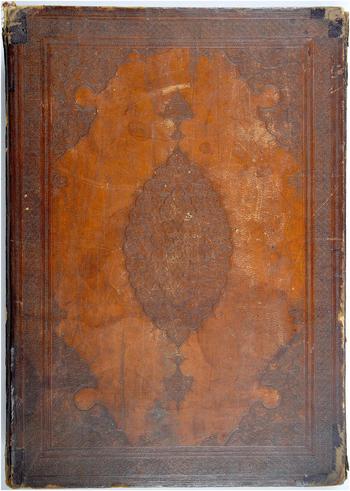
The binding of the Yeni Cami codex is in medium and light brown leather with an envelope flap and has been restored at some point. Although not in pristine condition, I believe the binding includes much of the Bāysunghurī original. The binding was evidently damaged along the spine and edges, and during the course of restoration the cover was carefully remounted and the main spine replaced. The doublures and the inside of the flap show limited tooling, but the cover is decorated with very fine patterns tooled on a border, framing a decorated cusped oval (turanj) with two small pendants and four corner pieces. The outer spine of the flap is similarly tooled with the same decorative motifs, and is exceptional in that it encompasses an inscription in thulth script, which reads:
«اللهم خلّد دولة السّلطان الاعظم * بایسنغر بهادرخان خلّد  مملکته »Footnote 5
The apparent age of the leather, the delicate tooling, decorative motifs and design all indicate that the cover at least is a Bāysunghurī production, and the inscription with the name of Bāysunghur further suggests that much of the original binding has survived (Fig. 1). Among productions of the prince's atelier, the only other manuscript that now carries the name of Bāysunghur on its binding is the Kalīla-u Dimna (834/1430–31), in the Topkapi Palace Library (H. 362), where his name appears in kufic on the decorated cartouches on the upper and lower doublures.
(Colour online) Binding. Kunūz al-wadīʿa & (tr.) al-Faraj baʿd al-shidda, no. 937, Yeni Cami, Suleymaniye Library Istanbul.

Yet another contemporary binding
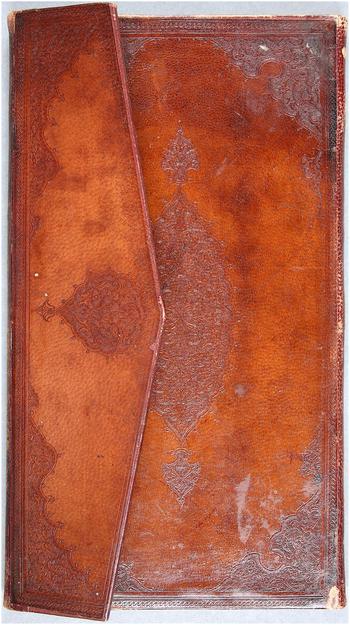
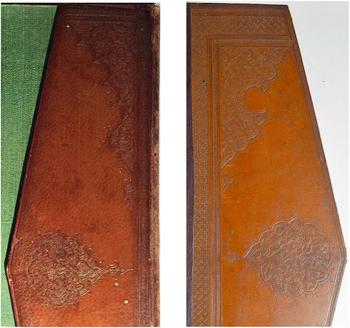
The second binding I would add to the list of extant original bindings is that of the Naṣā’iḥ-i Iskandar, preserved in Dublin, Chester Beatty Library, Ar. 4183. That manuscript was copied by Jaʿfar Bāysunghurī in 829/1425–26, and its binding is close to the Yeni Cami's in materials, technique and design (Fig. 2). In much the same way, components of the original were saved and remounted during restoration. However, in this case, the flap spine was replaced and there is no sign of an inscription. The binding is of medium brown leather of the finest quality with very similar decorative motifs and the same subtle technique of tooling and pressure molding. These similarities support the argument that the binding of the Naṣā’iḥ-i Iskandar is likewise contemporary to the manuscript (i.e. 829H) despite its remarkably good condition (Fig. 3).Footnote 6
(Colour online) Binding. Naṣā’iḥ-i Iskandar, Ar. 4183 (829/1426) © The Trustees of the Chester Beatty Library, Dublin

(Colour online) Details of the flaps. No. 937 (833/1430), Yeni Cami (right) and Ar. 4183 (829/1426), CBL (left) © The Trustees of the Chester Beatty Library, Dublin

The texts
The first text in the Yeni Cami codex is the Kunūz al-wadīʿa min rumūz al-ẕarīʿa ilā makārim al-sharīʿa which is a Persian translation of the Arabic book, al-Ẕarīʿa ilā makārim al-sharīʿa (“The Path to Virtue”) by Abu'l-Qāsim Ḥusayn b. Muḥammad b. Mufażżal, known as Rāghib Iṣfahānī (d. c. 402/1008–9), written in the 10th century.Footnote 7 It was first translated into Persian by Ibn Ẓāfir (b. Shams al-Dīn Ḥasan) in 768/1367.Footnote 8 The main subjects of the book are ethics and mysticism. It is divided into seven chapters on taming carnality, particularly by controlling lust and anger. The author employs Qur'anic verses and hadith as well as poems and proverbs.Footnote 9 A number of scholars have favourably compared al-Ẕarīʿa to the Akhlāq-i Nāṣirī.Footnote 10 According to the Kashf al-ẓunūn, al-Ghazālī praised al-Ẕarīʿa and carried it with him always.Footnote 11
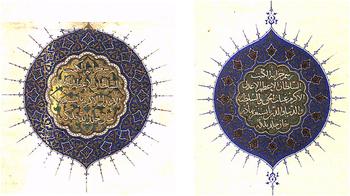
The Kunūz al-wadīʿa begins on f. 1v, following (on the reverse) the first shamsa, which is decorated with palmettes and arabesque vines and bears the inscription of Bāysunghur's ex libris in riqāʿ script, which reads:
«برسم خزانة الکتب السّلطان الاعظم و الخاقان الاعدل الاکرم بایسنغر بهادر خان خلد ملکه »Footnote 12
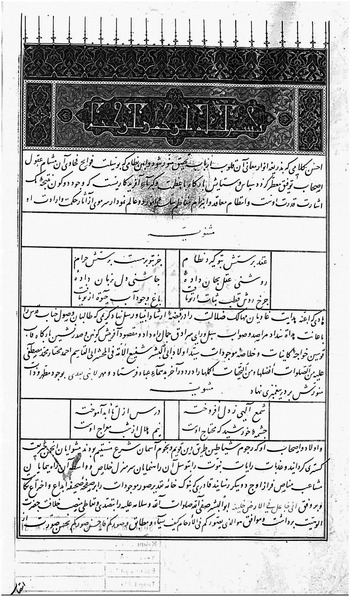
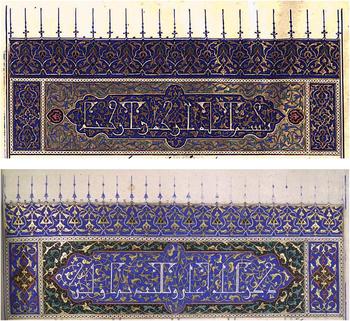
The text begins with a preface following an illuminated sarlauḥ with a white kufic bismillah on an ultramarine blue (lapis) ground, decorated with delicate arabesque vines (Fig. 4). The body of the work begins with a table of contents (seven chapters) following a second illuminated sarlauḥ on f. 9v. The kufic inscription here reads:
«بسم الرحمن الرحیم و به نستعین »
Sarlauḥ. Kunūz al-wadīʿa, f. 1v, no. 937, Yeni Cami library

The Kunūz al-wadīʿa concludes on f. 184r where the colophon provides the completion date of late Shawwāl 833/July 1430.Footnote 13
The second work, al-Faraj baʿd al-shidda wa al-żīqa (“Relief after Difficulty and Distress”), was once again originally a 10th century Arabic work, in this case by Qāżī Abū ʿAlī Muḥassan b. ʿAlī Tanūkhī. It contains anecdotes of the heroic and moral behaviour of people suffering hardships who finally find relief and wellbeing.Footnote 14 According to the scribe, the book was copied from a copy of the second Persian translation, composed in the 13th century by Ḥusayn b. Asʿad b. al-Ḥusayn al-Dihistānī.Footnote 15 The text begins on f. 185r, where the second ex libris appears within another exquisite illuminated shamsa. It reads:
«برسم خزانة الکتب السّلطان الاعظم الاعدل الاکرم غیاث الحقّ و السّلطنة و الدّنیا و الدّین بایسنغر بهادر خان خلد ملکه »Footnote 16
Folio 185v is adorned with an illuminated sarlauḥ with a white kufic inscriptionFootnote 17 followed by the preface to the second text. That includes a table of contents with a list of chapters and anecdotes (ḥikāya). The body of the text of al-Faraj baʿd al-shidda wa al-żīqa is marked by another illuminated sarlauḥ of the same style on f. 195v.
The second text concludes on f. 472v where the second colophon appears. It provides the date of completion as 28 Rabīʿ al-ākhir 833/24 January 1430, and the name of the scribe as Saʿd al-Mashhadī.Footnote 18
According to the colophons' dates, the second text was copied prior to the first. But there is no reason to believe these two were rebound in the current order. On the contrary, the fact that the scribe signs his name only at the end of the text with an earlier date (within a separately ruled frame) suggests that the current order is the original.
Visual features
The codex comprises two mystic-didactic works, both written in the 10th century. They did not lend themselves to illustration, but the care given to producing them in such a lavish manner is an indication of the importance attached to their content.
Bound in one volume, the beginning of each work carries an elaborate shamsa, as described above. By the year 1426, shamsas with the prince's ex libris began to serve as the emblem of Bāysunghurī manuscripts and were a mark of a distinctive royal quality. The first dated example of such an ex libris is seen at the opening of the Tāj al-maʾāthir, completed on 25 Shawwāl 829/1426 (St Petersburg, State University, no. 578).Footnote 19 The Bāysunghurī style of illumination – characterised by high precision and meticulous rendering of palmette motifs and fine arabesques vines – is seen in the decorations of the Yeni Cami dual-text codex. The first shamsa of our manuscript resembles several examples found in Bāysunghurī productions, with regard to the script, design and pattern, such as the shamsa of the Gulistān of Saʿdī (830/1427),Footnote 20 and those of the Kulliyyāt of ʿImād al-Dīn Faqīh Kirmānī (834/1431),Footnote 21 the Tārīkh-i Iṣfahānī (834/1431),Footnote 22 and the translation of Tārīkh-i Ṭabarī (20 Jumādā II, 833/16 March 1430).Footnote 23 A chain of palmettes on a lapis band enclosing the ex libris inscription in riqāʿ is usually set upon a gold ground with green arabesque vines. However, there are always minor differences in the colour scheme and the complexity of the patterns. The second shamsa of the Yeni Cami manuscript is similar to that of the Chahār maqāla (834/1431),Footnote 24 which boasts the same composition and complexity (Fig. 5).
(Colour online) Shamsas. Kunūz al-wadīʿa, f. 1r (left) and (tr.) al-Faraj baʿd al-shidda, f. 185r (right), no. 937, Yeni Cami

The patterns, design and the characteristics of the kufic script used in the ornamentation of the sarlauḥs are closest to the Bāysunghurī manuscript of the Malek Library (no. 6031) produced in the same year 833/1430, which contains the Shāhnāma of Firdausī and the Khamsa of Niẓāmī, copied by Muḥammad Muṭahhar (Fig. 6).Footnote 25
(Colour online) Sarlauḥs. Kunūz al-wadīʿa, f. 1v (above), no. 937, Yeni Cami; and Khamsa of Niẓāmī, 833/1430, p. 893 (below), no. 6031, Malek National Library, Tehran

Beyond the initial ornamentation of shamsas and sarlauḥs, the remaining folios are enlivened only by changes in the ink colour used for Qur'anic verses or rubrics.
II. The scribe Saʿd Mashhadī
As noted above, the colophon of our manuscript gives the name of the scribe as Saʿd al-Mashhadī. He was also responsible for copying the Tārīkh-i Jahāngushāy of ʿAtā-Malik Juvaynī, which he signed and dated Rabīʿ I 834/December 1430.Footnote 26 That is, he completed the Tārīkh-i Jahāngushāy less than six months after the Kunūz al-wadīʿa. Given the size of the Tārīkh-i Jahāngushāy (279 folios) it is likely he worked on both manuscripts in parallel, after completing a different Tārīkh, which is yet another manuscript not previously recognised as a work in Saʿd's hand.
The ʿArża-dāsht and a Tārīkh by Maulānā Saʿd al-Dīn
When Jaʿfar Tabrīzī was appointed as head of the royal atelier (kitābkhāna) he was responsible not only for supervising courtly projects, but also for reporting the progress of the workshop's activities to the prince. One extant folio of such a report is a document, originally written in the form of a scroll, widely known as the ʿArża-dāsht, in which Jaʿfar itemises the manuscripts in production at the time of writing and the artists or scribes working on them.Footnote 27 He does not mention anyone by the name of Saʿd Mashhadī. However, Jaʿfar refers to the activities of a Maulānā Saʿd al-Dīn under three items:
Khwāja ʿAtā, the ruling maker, has finished Maulānā Saʿd al-Dīn's Tārīkh and the Dīvān of Khwājū, and is busy with the Shahnāma.
Khwāja ʿAtā has finished the [decorative] elements of the Gulistān, and has done the groundwork for two out of the three lauḥs in the Tārīkh that Maulānā Saʿd al-Dīn has copied.
Maulānā Saʿd al-Dīn has finished the lid of the Begum's chest and one side of it is ready for the final touches, and the door panel that had remained will be completed in fifteen days.
Thomas Lentz considered two possibilities for the ‘Tārīkh-i Maulānā Saʿd al-Dīn’. First, it might refer to an “unknown” Tārīkh copied by a scribe named Maulānā Saʿd al-Dīn and Lentz noted (erroneously) that Dūst Muḥammad had stated that a Maulānā Saʿd al-Dīn Tabrīzī was a Bāysunghurī calligrapher. It would appear that Lentz was unaware of the 834 Tārīkh-i Jahāngushāy. Second, Lentz wondered whether Saʿd al-Dīn could have been the name of the author rather than the scribe. He suggested a few possible authors, none of whom are known to have written a Tārīkh.Footnote 28 By contrast, Thackston, did suggest that the tārīkh mentioned by Jaʿfar must be the Tārīkh-i Jahāngushāy copied by Saʿd al-Mashhadī and dated 834.Footnote 29
However, it is unlikely that the Tārīkh referred to by Jaʿfar was that suggested by Thackston, as the Tārīkh Jaʿfar mentioned had been copied in its entirety at the time the ʿArża-dāsht was written, which I argue is 830.Footnote 30 We also know that the scribe went on to copy the dual-text Yeni Cami manuscript which he completed in 833, yet that codex is not mentioned in the ʿArża-dāsht. I argue that the Tārīkh mentioned by Jaʿfar in 830 was very likely the initial copy of the Zubdat al-tawārīkh, a work that was composed by Ḥāfiẓ Abrū, in four quarters from 826 to 830, at the command of Prince Bāysunghur. The first two quarters are extant and bound together in St Petersburg, National Library of Russia, Dorn 268. Although undated and unsigned the manuscript was probably completed in 829/1426.Footnote 31 A comparison of the hand, the orthography of individual letters and their composition convince me that the manuscript was penned by the scribe of Yeni Cami 937, Saʿd al-Mashhadī.Footnote 32 Everything points to him being the scribe of the Tārīkh whom Jaʿfar names as Maulānā Saʿd al-Dīn.
Having established the identity of the scribe(s) Saʿd al-Mashhadī and Maulānā Saʿd al-Dīn, what else can be known about his involvement in the court and kitābkhāna of Bāysunghur Mīrzā?
Saʿd Mashhadī little remembered as a scribe
Saʿd Mashhadī does not figure in either contemporary or later sources as a prominent calligrapher. There is only indirect evidence of a homonymous figure. In the famous preface to the Safavid album prepared for Bahrām Mīrzā, Dūst Muḥammad refers to two Maulānā Saʿd al-Dīns in the lineages of prominent calligraphers:
Khwāja ʿAbd Allāh Ṣayrafī instructed his nephew Shaykh Muḥammad Bandgīr, who instructed Maulānā Saʿd al-Dīn Tabrīzī, [who instructed] Maulānā Shams al-Dīn Qaṭṭābī, who inscribed himself as Shams Sūfī. He [instructed] the Unique Master of the Age, Maulānā Farīd al-Dīn Jaʿfar Tabrīzī, who, in the time of his late majesty Bāysunghur Mīrzā, the son of the late emperor Shāhrukh Bahādur, was held in the greatest of respect, and because of his calligraphy, acquired indescribable fame.
Maulānā Maʿrūf was a student of Maulānā Saʿd al-Dīn ʿIrāqī, who was a student of Pīr Yaḥyā Ṣūfī.Footnote 33
In his book on calligrapher and painters, Gulistān-i hunar, Qāżī Aḥmad Qumī does not mention any Saʿd or Saʿd al-Dīn in any lineage, but taking into consideration his account of Pīr YaḥyāFootnote 34 and the date of Ṣayrafī’s death (d. after 1345–46)Footnote 35, neither of the two Saʿd al-Dīns in Dūst Muḥammad's preface could be contemporary with Bāysunghur, even disregarding the discrepancies in their places of origin: ʿIrāqī or Tabrīzī, rather than Mashhadī.
David Roxburgh mentions a scribe named Ḥāfiẓ Saʿd Shīrvānī to whom a specimen of calligraphy is ascribed in the first part of the calligraphy album prepared for Bāysunghur (Topkapi Palace Library, B. 411), which includes specimens by other well-known calligraphers who worked in the prince's atelier. I will return to this having demonstrated a link between Saʿd Mashhadī and a poet named Ḥāfiẓ Saʿd who is known by various nisbas (none of which is Shīrvānī).Footnote 36
A poet by the name of Saʿd Mashhadī
While searching for information on the calligrapher Saʿd Mashhadī in art historical sources, I came across a very brief reference to a poet named Saʿd Mashhadī, with two verses attributed to him, who was remembered as “one of the well-natured men (khush-ṭabʿān)”.Footnote 37 This I found in the Taẕkira-yi ʿarafāt al-ʿāshiqīn va ʿaraṣāt al-ʿārifīn of Taqī al-Dīn Muḥammad Auḥadī Balyānī (973–1040/1565–1630), a work completed in 1024/1615 which contains information on almost 3,500 poets.Footnote 38
It is striking that in the significantly longer entry immediately prior to that on Saʿd Mashhadī, one of these two verses is also attributed to a poet by the name of Ḥāfiẓ Saʿd.Footnote 39 Although Auḥadī did not identify the two men (or provide all his sources), it seems quite possible they were the same person and that the poet Ḥāfiẓ Saʿd was also known under the name of Saʿd Mashhadī. This presents an intriguing possibility: could it be that the poet Ḥāfiẓ Saʿd is one and the same person as the Bāysunghurī scribe, Saʿd Mashhadī?
III. Ḥāfiẓ Saʿd
In the words of Auḥadī, Ḥāfiẓ Saʿd was “a star in the heavens of eloquence and oratory”.Footnote 40 Auḥadī refers to ‘the author of the Majālis' and repeats Amīr ʿAlīshīr Navāʾī’s account in the Majālis al-nafāyis (completed in 1491), which is the earliest taẕkira to mention Ḥāfiẓ Saʿd. After describing the intense relationship of Ḥāfiẓ Saʿd with Qāsim Anvār, a famous Sufi in Herat who died in 837/1433, Navāʾī quotes the same verse Auhadī will attribute to both Ḥāfiẓ Saʿd and Saʿd Mashhadī, and five other verses, including a riddle. In his account of Ḥāfiẓ Saʿd, Auḥadī adds nine verses to five of the six found in Navāʾī’s work.Footnote 41
In Taẕkira-yi Haft Iqlīm, written in 1018/1609, Amīn Aḥmad Rāzī presents Saʿd Gul, a poet from Shiraz, whose poems are “fresh like Kashmir's waters”. Rāzī attributes to Saʿd Gul five verses, four of which we find Navāʾī attributing to Ḥāfiẓ Saʿd.Footnote 42 With minor variations, the same information about Saʿd Gul is repeated in Safīna-yi Khushgū (1734). Later, Ḥusaynī Sunbuhlī in Taẕkira-yi Ḥusaynī (1875) and Muḥammad Ṣādiq Ṣadīq Ḥasan Khān in Shamʿ-i anjuman (1876) each have an entry for Saʿd Gul with two verses not found in Rāzī.Footnote 43 None of these later authors equate Saʿd Gul with Ḥāfiẓ Saʿd, but on the basis of the ghazal attributed to both men in different sources we can speculate that they were the same person.
Other taẕkiras further complicate the picture. Taẕkira-yi Rūz-i Raushan (1880) by Muḥammad Muẓaffar Ḥusayn Ṣabā and Dānishmandān-i Āẕarbāyjān (1935) by Muḥammad ʿAlī Tarbīyat, quote some verses and biographical information found in Navāʾī and Auḥadī but use different names for the poet: Ḥāfiẓ Saʿd Allāh Tabrīzī and Maulānā Jalāl al-dīn Ḥāfiẓ Tabrīzī, known as Saʿd Allāh, respectively. Ṣabā only quotes the common ghazal, but Tarbīyat lists the key verse (see note 38) as well as two verses from the common ghazal. Later in this article, I will mention yet another variant name, Maulānā Ḥāfiẓ Saʿd Bukhārī. In his taẕkira, Naṣrābādī uses that name and quotes two riddles, which I find in manuscripts of the Dīvān of Ḥāfiẓ Saʿd.Footnote 44
Ḥāfiẓ Saʿd seems to be the best known of all the various names for this poet and the simplest, least problematic way of referring to him.
Ḥāfiẓ Saʿd and Qāsim Anvār
Ḥāfiẓ Saʿd certainly lived in the same time and place, as the Bāysunghurī scribe, Saʿd Mashhadī. In Majālis al-nafāyis, ʿAlīshīr Navāʾʾī (1441–1501) reports that at one time Ḥāfiẓ Saʿd was one of the followers of Qāsim Anvār (757–837/1356–1433): “Saʿd's behaviour caused his expulsion from Anvār's circle of intimates. That brought him immense affliction and torment, and he died in that state”.Footnote 45 According to Navāʾī, Qāsim Anvār ordered the destruction of Saʿd's chamber and even the removal of its soil. If Saʿd's expulsion took place in Herat this must have occurred in 830/1427 or earlier. For after Aḥmad Lur's unsuccessful attempt on Shāhrukh's life in that year, Shāhrukh who was already wary of Qāsim Anvār's fame and the large number of followers he had in Herat, had a pretext for executing or exiling many intellectuals and Sufis.Footnote 46 Either he or Bāysunghur exiled Qāsim Anvār from Herat later that year.Footnote 47
Saʿd's Dīvān is dominated by poems expressing his love of the now departed Qāsim Anvār, so it quite plausible to conjecture that Saʿd stayed on in Herat and lived a productive life there before dying tormented by the absence of his beloved as Navāʾī has it. As I discuss below, there is strong evidence in his Dīvān that Saʿd enjoyed a closed relationship with Bāysunghur's court and atelier, and he may have been exchanging riddles with ʿAlī Yazdī in 832/1429.Footnote 48 I find nothing to contradict the hypothesis that the poet Ḥāfiẓ Saʿd was the scribe Saʿd Mashhadī who penned three manuscripts for Bāysunghur, the Zubdat al-tawārīkh in 829, the dual-text Yeni Cami manuscript in 833, and the Tārīkh-i jahāngushāy in 834.
The Dīvān of Ḥāfiẓ Saʿd
In search of confirmation of the verses taẕkira writers have attributed to Ḥāfiẓ Saʿd, I turned to the latter's Dīvān. There is no edition of the Dīvān of Ḥāfiẓ Saʿd but I was able to consult three manuscripts. One Dīvān was certainly made in Shiraz for Pīr Budāq, and it seems evident that this is true of a second also. The earlier of the two is housed in the British Library, Or. 11846 (henceforth, BL) and is beautifully illuminated. The colophon states that the manuscript was copied by Shaykh Maḥmūd Pīr Budāqī, in Ṣafar 864 (December 1459) in Shiraz. It bears the ex libris of Pīr Budāq (d. 870/1466) which appears in an illuminated shamsa. The inscription reads: “For the treasury of the Shadow of God the Beneficent, refuge of the Khaqans of the age, Abu'l-Fatḥ Pīr Budāq Bahādur Khān, may God support him with victory and favour”.
«برسم خزانه ظل المنان ملاذ خواقین الزمان ابوالفتح پیر بوداق بهادر خان ایده بالنصر و الاحسان »
The manuscript includes an illustration on f. 148r, portraying Pīr Būdāq and his courtiers in a bazm, celebrating the reception of the completed manuscript.Footnote 49 This was added subsequently (probably in the 19th century) at the end of Saʿd's rubāʿiyyāt (quatrains).Footnote 50
I find evidence that the scribe Mahmūd had been attached to Bāysunghur's atelier early in his career, signing his name as Maḥmūd Jaʿfarī. This occurs in Astan Quds Library, no. 10399, which is an anthology of poetry, dated 833/1430, which includes poems by Bāysunghur's court poets, among them Ḥāfiz Saʿd.Footnote 51
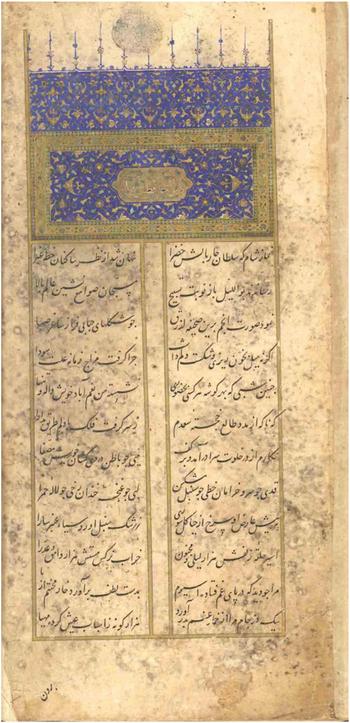
The second copy of the Dīvān of Ḥāfiẓ Saʿd, is kept in the Tehran Majles Library (no. 13159), copied by Maḥmūd ibn Muḥammad ibn Maḥmūd Khumārī, dated Shawwāl 864/July 1460 (henceforth, ML).Footnote 52 The inscription on the shamsa (f. 1r) is damaged and illegible, but on f. 1v, the inscription of the sarlauḥ reads: Dīvān-i Ḥāfiẓ Saʿd, with no nisba or indication of his origin. Although the colophon provides no reference to the location, and the patron is not named, it seems certain that this also was made for Pīr Budāq, on account of the date and the scribe. According to Bayānī, Khumārī worked as a copyist at the court of Pīr Budāq Qara-Qoyunlu, in Shiraz.Footnote 53 I know of another manuscript penned by him in the same year, 864, which bears an intact ex libris for Pīr Budāq, namely Suleymaniye, Fatih 3777.Footnote 54
Both manuscripts of the Dīvān of Ḥāfiẓ Saʿd contain 185 folios and both were completed in the same year (864) and very probably in the same place. Comparing their frontispieces, they also share a similar page layout, illumination motifs and colour scheme in the sarlauḥs (Fig. 7).Footnote 55 Although BL is more elaborately illuminated, the vacant spaces in ML corroborate the idea that it was intended to be decorated in a similar fashion, but was left incomplete for some reason. All these details point to the fact that they were commissioned by the same patron, Pīr Būdāq, who probably encountered Saʿd's Dīvān while in Herat at the time of the Qara-Qoyunlu capture of city in 1458.Footnote 56
(Colour online) Sarlauḥ. Dīvān of Ḥāfiẓ Saʿd, 864/1460, f. 2v, no. 13159, Majles Library, Tehran

Pīr Būdāq was the eldest son of Jahānshāh Qara-Qoyunlu, who came back to Shiraz in 864/1460 after helping his father to quash his brother's rebellion in Azarbayjan.Footnote 57 He then ordered the repair and fortification of the city walls, before rebelling against his father. Eventually, he had to escape to Shūshtar, when Jahānshāh sent an army to repel him in the spring of 865/1461, and then sent him to Baghdad the following year.Footnote 58 Jahānshāh appointed Pīr Budāq's brother, Mīrzā Yūsuf, to the governorship of Shiraz.Footnote 59 This would probably explain the incomplete decoration of the Majles manuscript, which was transcribed around seven months after the BL manuscript and on the eve of Pīr Budāq's revolt.
I located a third Dīvān manuscript (undated, c. 16th century) in the Central Library of the University of Tehran (no. 225/2). This copy includes only 360 verses of Saʿd poems in 61 ghazals (of his total 426 ghazals), while the other two codices include more than 4,700 verses.Footnote 60 Intriguingly, the poet is named in this manuscript as Saʿd Bukhārī. Ṣidāqat Ḥusaynī found that the poetry in this manuscript is all found in the Majles Dīvān of Ḥāfiẓ Saʿd.Footnote 61 The only taẕkira I know of with an account of Ḥāfiẓ Saʿd Bukhārī is the Taẕkira-yi Naṣrābādī (1072/1662), which attributes two riddles to him, both of which I find in the BL/ML copies of the Dīvān.Footnote 62
To summarise, I have located in manuscripts of the Dīvān of Ḥāfiẓ Saʿd nearly all the verses and riddles attributed to ‘Saʿd’ in the scattered biographical dictionaries. This further indicates that they were all referring to the same poet, Ḥāfiẓ Saʿd. The content of the Dīvān, makes clear not only that he was once an intimate of Qāsim Anvār (as recorded in the taẕkiras) but also that he was familiar with many members of Bāysunghur's court and atelier. The evidence for this lies in a remarkable collection of riddles.
Riddles
Writing riddles became very popular in the 15th century.Footnote 63 The Risāla-yi mufradāt dar fann-i muʿmmā is a treatise by ʿAlīshīr Navāʾī with instructions on writing and decoding riddles. Navāʾī records a number of riddle-writers in his taẕkira, among whom Maulānā Badīʿī, ʿAlī Yazdī and Jāmī wrote their own treatises on the principles of riddles.Footnote 64 Here is an example from ʿAlī Yazdī’s Ḥulal-i muṭarraz on how to interpret and decode a riddle. The riddle reads:
در شصت عدد کار تمام است ولی
یک با سی اگر در آن بین باشد
With the number (ʿadad) 60, the work is complete, but
only if 1 and 30 come in between
The decoder of the riddle needs to know that in the abjad system each letter is associated with a numerical value:
60 stands for س
1 stands for الف
30 stands for ل
Thus, according to the riddle, placing 60 = س beside عدد will give the answer, provided that ال is put in between. The encoded sequence of letters is: س عد ال د. So the name behind the riddle must be Saʿd al-Dīn.Footnote 65
IV. Ḥāfiẓ Saʿd's association with Bāysunghur's court and atelier
The final chapter of Saʿd's Dīvān is devoted to Muʿammiyyāt (riddles). It comprises ff. 148r–185r in ML and ff. 148v–185v in BL. In this section, each title name (the solution) is followed by a single verse riddle containing clues to the person's identity. The title names are very similar in both manuscripts, with only minor variations.
The names featuring in this chapter reveal the extent of Saʿd's connection to Bāysunghur's court. The personages from the house of Timur who have at least one riddle written for them are indicated in the following table (the names are given as they appear in BL).

There are many other names that cannot be definitively identified, and may or may not be connected to Bāysunghur's court. But a significant number correspond to the artists named in the ʿArża-dāsht as staff active in Bāysunghur's atelier. The table below lists all the names in the ʿArża-dāsht indicating where parallels occur among the riddle names in the Dīvān of Ḥāfiẓ Saʿd.

As this table shows, only 3 of the 22 names of the ʿArża-dāsht are without a parallel in the Muʿammīyyāt. Although some names were very common, like ʿAlī and Hājjī, others such as Ustād Qavām al-Dīn strongly support our argument. The data presented in these tables leaves little doubt about Ḥāfiẓ Saʿd's presence at Bāysunghur's court and his familiarity with the atelier personnel.
There are also riddles on the names of other known court characters, such as: Faṣīḥ al-Dīn (the name of Bāysunghur's historian, Faṣīḥ Khwāfī), ʿAbd al-Qādir (the name of his famous musician and singer ʿAbd al-Qādir Marāghī), Luṭf Allāh, Valī and Shāhī (the names of three court poets, Maulānā Luṭfī Nishābūrī, Maulānā Valī, who both contributed to the Jung-i Marāthī, and Amīr Shāhī Sabzavārī), Shihāb al-Dīn (the name of his famous chronicler, Ḥāfiẓ Abrū) and Maulānā ‘Abd al-Raḥmān (perhaps the poet ‘Abd al-Raḥmān Jāmī who would have been young in the time of Bāysunghur).Footnote 66
Hāj Aḥmadīpūr Rafsanjānī has studied the poetry of Ḥāfiẓ Saʿd and identified references to royal and court personages in other sections of the Dīvān. For example, among the rubāʿiyyāt there is a chronogram for the taking up of office by Abū Saʿīd on Monday, 5th Shaʿbān 832/10th May 1429.Footnote 67 This surely refers to the son of Qarā Yūsuf (Qarā Quyūnlū) who was appointed by Shāhrukh as governor of Āẕarbāyjān in that year, and ruled there until 835. There is also a reference to ʿAlāʾ al-Dīn ʿAlī in a ghazal (and similar names in several riddles) which I agree is likely to be ʿAlā al-Dīn ʿAlī Shaghānī, Shāhrukh's vizier. Another ghazal mentions Firūzshāh who could be Shāhrukh's senior commander (until 848/1444), Jalāl al-dīn Firūzshāh b. Arghūnshāh. Similarly, Ghiyāth al-Dīn (in a qaṭʿa and a riddle) could be Pīr Aḥmad Khwāfī (d. 857/1453), who was vizier for Shāhrukh from 820 (and there is also a riddle on the name Khwāja Pīr Aḥmad). A famous Bāysunghurī musician is celebrated in a qaṭʿa: Yūsuf Andakānī under the name of Khwāja Yūsuf. In this case we can be certain about the identification since the poet praises Yūsuf's song compositions (taṣnīf).
Ḥāfiẓ Saʿd and ʿAlī Yazdī
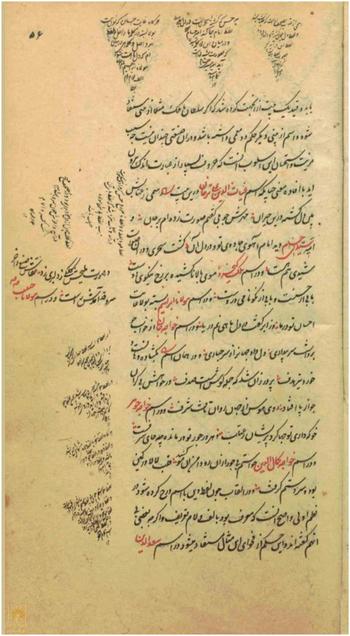
As mentioned above, Sharaf al-Dīn ʿAlī Yazdī (d. 1454), the author of the Ẓafarnāma, was another prominent riddle-writer. He completed his treatise, al-Ḥulal al-muṭarraz fi al-muʿammā wa al-lughaz, in 832/1429 and dedicated it to Abu'l-Fatḥ Ibrāhīm Sulṭān.Footnote 68 It is a comprehensive treatise on the subject, with riddles on many different names, some of which can be connected to contemporary figures (Fig. 8). Apart from his own name, Sharaf, which is used both as his takhalluṣ (pen name) and the subject for many riddles, he has verses for the names of both Saʿd and Saʿd al-Dīn, one of which I presented above.
(Colour online) Riddles. al-Ḥulal al-muṭarraz, 1068/1658, f. 56r, F. 2612/1, Majles Library, Tehran

Ḥāfiẓ Saʿd's mu'ammiyyāt include riddles for his own name, too: Saʿd and Saʿd al-Dīn. Although it is debatable whether Saʿd and Saʿd al-Dīn both refer to the author (Ḥāfiẓ Saʿd) —after all, the name Saʿd al-Dīn was not rare —we can be more certain about less common names. Surely it is significant that he composed several riddles on ʿAlī Yazdī’s name: Sharaf al-Dīn ʿAlī, Sharaf al-Dīn, and Sharaf. It is even possible that an exchange was taking place between the two outstanding riddle-writers of the time, or even that there was a kind of intellectual competition between the courts of the two Timurid brothers.Footnote 69
V. Conclusion
This paper has identified a previously neglected manuscript issuing from the atelier of Bāysunghur Mīrzā, significant partly for the evidence of its original binding bearing a dedication to the prince, and partly for providing another example of the calligraphy of the enigmatic scribe, Saʿd Mashhadī.
Already known for the Tārīkh-i jahāngushāy in St Petersburg, National Library of Russia, PNS. 233, and now for the Yeni Cami codex, I have also identified a third large manuscript in his hand. This I believe to be the Tārīkh mentioned by Jaʿfar in the ʿArża-dāsht as having been copied by Maulānā Saʿd al-Dīn, namely the Zubdat al-tawārīkh in St Petersburg, National Library of Russia, Dorn 268. So we now know Saʿd Mashhadī was active as a scribe in Bāysunghur's atelier in the period 829–834/1426–1431.
In this paper, I have also situated a poet by the name of Ḥāfiẓ Saʿd in the same period and milieu. Ḥāfiẓ Saʿd was a Sufi devotee of Qāsim Anvār as his Dīvān makes very clear, as do the brief accounts found in biographical dictionaries. There is no edition of the Dīvān, and it has been little studied, although two early royal manuscripts are extant.Footnote 70 Yet the Dīvān contains a collection of over 600 riddles which I have found to be of great historical interest.
There is much confusion in the biographical dictionaries over the identity of Ḥāfiẓ Saʿd. What led me to investigate him in the first place was a pair of entries in Auḥadī’s Taẕkira-yi ʿarafāt al-ʿāshiqīn in which a single verse is attributed both to Ḥāfiẓ Saʿd and to a poet by the name of Saʿd Mashhadī. The poet and the scribe are significant in their own right but I have uncovered further evidence that they might even be the same person. The strongest evidence in favour of that hypothesis is the set of riddles in Ḥāfiẓ Saʿd's Dīvān which, when viewed alongside the list of names mentioned in the atelier report known as the ʿArża-dāsht, reveals the poet's familiarity with the personnel of Bāysunghur's atelier.
The title ‘Ḥāfiẓ’, was a common epithet for people who had learned the Qur'an by heart. In the case of Saʿd, this can be verified from the opening shamsa of the British Library Dīvān where the inscription describes him as: ‘ṣāḥib al-furqān’ (master in the Qur'an) al-mushtahar bi (known as) Ḥāfiẓ Saʿd. When serving as a scribe he would not necessarily use that in his colophons. A convenient example of this is Jaʿfar Tabrīzī who only used the title Ḥāfiẓ in manuscripts he transcribed before joining Bāysunghur's kitābkhāna.Footnote 71
Being an accomplished poet and a memoriser of the Qur'an, we would expect Ḥāfiẓ to be well versed in calligraphy as well. It is hardly necessary to recall that poets were often adept in calligraphy and that many calligraphers also wrote poetry. The Jung-i marāthī, which contains elegies on Bāysunghur's death, is a good example: it shows that not only court poets, but also artists who were involved in royal projects in the kitābkhāna could express their loss through poetry.Footnote 72
We have evidence the poet was active in 832 and the scribe in 834. The fact that Ḥāfiz Saʿd does not feature in the list of contributors to the Jung-i marāthī could be a weak indication that he may have died before 837 and the lack of rulers after the Timurids in the riddle names in his Dīvān makes it unlikely he survived much beyond 850/1446.Footnote 73
Finally, I mentioned earlier a specimen of calligraphy in the album Topkapi Palace Library B. 411 ascribed to Ḥāfiẓ Saʿd Shīrvānī. If the calligrapher were one and the same as the scribe Saʿd Mashhadī and the poet Ḥāfiẓ Saʿd, then the nisba Shīrvānī further underlines the remarkable uncertainty there has been over Saʿd's origin—variously Mashhadī, Shīrāzī, Bukhārī, Tabrīzī and perhaps even Shīrvānī.