Introduction
The institutionalization of the regulatory state in Europe entailed new modes of governance and new technologies of regulation after liberalization, privatization, and re-regulation (Majone, Reference Majone1996b; Coen and Heritier, Reference Coen and Heritier2005; Levi-Faur, Reference Levi-Faur2005; Gilardi, Reference Gilardi2008; Héritier and Eckert, Reference Héritier and Eckert2008). Particularly since the 1990s, following the regulatory approach promoted by the European Union (EU) and the global trend of agencification, numerous independent regulatory agencies (IRAs) were established in member countries and at the EU level to regulate economic and social issues, such as banking and finance, telecommunications, civil aviation, railway services, food safety, the pharmaceutical industry, electricity, environmental protection, and personal data privacy (Thatcher, Reference Thatcher2002c, Reference Thatcherd; Pollitt et al., Reference Pollitt, Tablot, Caufield and Smullen2004; Yesilkagit, Reference Yesilkagit2004; Christensen and Yesilkagit, Reference Christensen and Yesilkagit2006; Christensen and Laegreid, Reference Christensen and Laegreid2006a, Reference Christensen and Laegreidb, Reference Christensen and Laegreid2007; Gilardi, Reference Gilardi2008; Laegreid et al., Reference Laegreid, Roness and Rubecksen2008). These agencies consist of structurally disaggregated public sector organizations with their own budgets, defined as legal entities by public law, directed by management boards headed by appointed chairpersons, and disposing of secretariats in charge of day-to-day regulatory tasks (Verschuere et al., Reference Verschuere, Verhoest, Meyers and Peters2006). They enjoy considerable public authority and they cumulate key regulatory and policy-making competencies such as rule-making, monitoring, sanctioning, and adjudication (Maggetti, Reference Maggetti2009b), so that they epitomize a mode of governance in line with the observation that ‘the real work of running democracies is now carried out by the unelected’ (Vibert, Reference Vibert2007). In fact, they are ‘neither directly elected by the people, nor directly managed by elected officials’ (Thatcher and Stone Sweet, Reference Thatcher and Stone Sweet2002). This apparent imbalance between power and responsibility led to the identification of a ‘democratic deficit’ in the European regulatory state (Majone, Reference Majone1999, Reference Majone2002; Roberts, Reference Roberts2001; Follesdal and Hix, Reference Follesdal and Hix2006). Whereas the diagnosis of the intensity of this deficit may vary, it has been observed that governments can delegate regulatory authority to independent regulators, but not their democratic legitimacy, leading to a ‘net loss’ of democratic legitimacy for the political system (Majone, Reference Majone1999, Reference Majone2001a, Reference Majone2005; Maggetti, Reference Maggetti2009a, Reference Maggetti and Gilardi2010).
In response to these considerations, it was argued that ‘majoritarian standards’ of legitimacy are not appropriate for independent regulators (Majone, Reference Majone2002). Their legitimacy should instead be appreciated with reference to alternative standards, especially through the revivification of the concept of ‘accountability’. Majone points repeatedly to the need for a ‘multi-pronged system of controls’ to keep regulatory bodies accountable (Majone, Reference Majone1996a, Reference Majone2002). This system consists of a variety of control mechanisms, such as (1) specification of clear and narrow objectives; (2) oversight by governmental and parliamentary committees; (3) procedural requirements like hearings and reporting duties; (4) judicial review; (5) professionalism and peer review; and (6) transparency and public participation. Academic research has focused so far on the first four points, which refer to traditional accountability arrangements between bureaucracy and other branches of the state (Schedler, Reference Schedler1999; Mulgan, Reference Mulgan2000, Reference Mulgan2003; Lodge, Reference Lodge2004; Verschuere et al., Reference Verschuere, Verhoest, Meyers and Peters2006; Busuioc, Reference Busuioc2009), and, to a lesser extent, to the fifth mechanism, which is distinctive of independent bodies (Maggetti and Gilardi, Reference Maggetti and Gilardi2010). Conversely, the last solution has been either neglected or dismissed as scarcely relevant, because direct public participation in regulatory governance is considered empirically negligible and even normatively undesirable (Sosay, Reference Sosay2006). In particular, it is believed that the participation of an increased heterogeneous number of actors would undermine the decision-making capacity of IRAs, that is, their raison d’être (Majone, Reference Majone1999).
The goal of this paper is to examine another, indirect, possible venue for securing transparency and responsiveness with regard to independent regulators, that is, their media coverage (Arnold, Reference Arnold2004; Voltmer, Reference Voltmer2010). In this context, a specific question is explored: can the media help to hold independent regulators accountable, in line with the observation that ‘in many countries, the media are fast gaining power as informal forums for political accountability’ (Bovens, Reference Bovens2007)? The next two sections discuss the relevance of media scrutiny for the accountability of regulators and, respectively, present some exploratory expectations about the frequency and tone of media coverage. Then, these expectations are operationalized for two contrasted cases: the British and Swiss competition commissions. The empirical analysis and conclusions follow. The main findings indicate that the media coverage of agencies corresponds to that of the most relevant policy issues and follows approximately the regulatory cycle. Furthermore, a systematic negative or positive bias in media coverage can be excluded.
Accountability and the media
Thomas Jefferson, in the spirit of the first amendment to the United States’ Constitution, famously stated that ‘the functionaries of every government have propensities to command at will the liberty and property of their constituents. There is no safe deposit for these but with the people themselves, nor can they be safe with them without information. Where the press is free, and every man able to read, all is safe’ (Thomas Jefferson to Charles Yancey, 1816. ME 14:384). In this vein, recent studies have shown that mass media are ‘by far the most important’ source of information about officials’ performance (Arnold, Reference Arnold2004), representing a ‘necessary condition’ for the existence of democratic government (Dahl, Reference Dahl1989) and a precondition for accountability (Coglianese and Howard, Reference Coglianese and Howard1998; Lee, Reference Lee1999; Besley and Burgess, Reference Besley and Burgess2001; Besley et al., Reference Besley, Burgess and Prat2002; Voltmer, Reference Voltmer2010). The media can play a key role in enabling citizens – who have imperfect information about government activities – to monitor the actions of ministers and civil servants, leading to a government that is more accountable and responsive to its citizens (Besley and Burgess, Reference Besley and Burgess2001; Besley et al., Reference Besley, Burgess and Prat2002; Besley and Prat, Reference Besley and Prat2006) and rendering elected politicians more accountable (Roberts, Reference Roberts2002; Strömberg, Reference Strömberg2004; Louw, Reference Louw2005; Snyder and Strömberg, Reference Snyder and Strömberg2008).Footnote 1 In particular, active and persistent media coverage encourages the formation of an informed public opinion (O'Donnell, Reference O'Donnell1998), whereas press criticism and support are considered crucial for obtaining justifications from governments and civil service (Meyer, Reference Meyer2004). The media could theoretically provide an ‘accountability forum’ (Bovens, Reference Bovens2007) that is particularly suitable for IRAs, constituting ‘one element of a complex accountability system’ (Hodge and Coghill, Reference Hodge and Coghill2007), which would not hinder their independence (Majone, Reference Majone1996a, Reference Majone2002).
Accountability means that an actor who is in a position of responsibility in relationship with the interests of another actor is required to give an account of the conduct of his duties, whereas the second actor can either reward or sanction the former (Schedler, Reference Schedler1999; Castiglione, Reference Castiglione2006). Bovens underlines the fact that accountability should be conceptualized as a social relationship between an actor and its ‘accountability forum’, which can be an individual or a collective actor through whom the first actor is held accountable (Bovens, Reference Bovens2007). Following Bovens, in many countries, the media are fast gaining power as informal forums for political accountability (Bovens, Reference Bovens2007). The media might constitute a particularly relevant accountability forum for IRAs for two reasons. First, public communication is a requisite for the accountability of political institutions (Sarcinelli, Reference Sarcinelli1987; Dahl, Reference Dahl1989), which is particularly important when policy-making takes place behind closed doors and scarce democratic responsiveness exists (Voltmer and Eilders, Reference Voltmer and Eilders2003). In fact, the media do guide opinion formation and perception (de Vreese et al., Reference de Vreese, Banducci, Semetko and Boomgaarden2006), especially when they cover issues that are overly technical or with which individuals are less familiar (Zaller, Reference Zaller1992; Vogel, Reference Vogel1996; Bryant and Zillmann, Reference Bryant and Zillmann2002). This is the case of independent regulators, whereby citizens derive most of what they know about the issues dealt with from the media, and in turn, the media might help to ‘extend’ the accountability of these bodies (Scott, Reference Scott2000).
Second, the media represent a venue for policy-makers for the appraisal of regulatory outcomes, performing a ‘fire-alarm’ function (McCubbins et al., Reference McCubbins, Noll and Weingast1987). Because the political principals suffer from a structural informational disadvantage vis-à-vis independent regulatory agencies, they must rely on external sources of information to monitor whether the agency is acting according to the predefined notion of the ‘public interest’ before eventually deciding to engage in costly political-oversight activities (Hopenhayn and Lohmann, Reference Hopenhayn and Lohmann1996). As such, media coverage constitutes an important ‘linkage mechanism’ between regulatory agencies and policy-makers (Waterman et al., Reference Waterman, Rouse and Wright1998; Waterman and Rouse, Reference Waterman and Rouse1999; Carpenter, Reference Carpenter2002), by playing a key role in communicating policy ideas and framing issues (Coglianese and Howard, Reference Coglianese and Howard1998). At the same time, the media affect the setting of the political agenda (Walgrave et al., Reference Walgrave, Soroka and Nuytemans2008), given that decision-makers, for instrumental reasons, look for regulatory policies that reflect so-called public opinion (Stimson et al., Reference Stimson, MacKuen and Erikson1994).
Therefore, the accountability of IRAs before the media can be examined by operationalizing the two components of the definition outlined above: on the one hand, (1) the extent to which the media give an account of IRAs’ conduct can be measured with the amount of media coverage with reference to the official goals of delegation, that is, the expected credibility of regulators associated with their supposed independence, and the aspiration of enhancing decision-making efficiency thanks to their technical expertise (Majone, Reference Majone1994b, Reference Majone1996b, Reference Majone1997a, Reference Majoneb; Gilardi, Reference Gilardi2002; Moran, Reference Moran2002; Thatcher, Reference Thatcher2002a, Reference Thatcherb, Reference Thatcherc; Elgie and McMenamin, Reference Elgie and McMenamin2005; Levi-Faur, Reference Levi-Faur2005). Policy credibility is the expectation that an announced policy will be properly carried out (Drazen and Masson, Reference Drazen and Masson1994) to create credible policy commitments vis-à-vis stakeholders (e.g. investors), consumers, and citizens (Shepsle, Reference Shepsle1991). It is considered a crucial condition for solving the time-inconsistency problem related to the political cycle (Kydland and Prescott, Reference Kydland and Prescott1977; Barro and Gordon, Reference Barro and Gordon1983). Decision-making efficiency refers to the resource-saving implementation of predetermined goals (Blühdorn, Reference Blühdorn2006). That is, it involves reducing decision-making costs by taking advantage of agencies’ expertise, while avoiding the enactment of policies that are different from those preferred by the political decision-makers (Epstein and O'Halloran, Reference Epstein and O'Halloran1999; Bendor et al., Reference Bendor, Glazer and Hammond2001; Majone, Reference Majone2001c).Footnote 2 On the other hand, (2) the positive or the negative tone of media coverage relating to agencies’ credibility and efficiency can be considered an important symbolic sanction or reward, both of which have crucial consequences on their activeness, effectiveness, and prospects for survival.Footnote 3 In fact, ‘not only performance but also the perceived appearance of performance […] challenges the organisation's legitimacy and potential survival’ (Lodge, Reference Lodge2002).
Expectations about the media accountability of agencies
It has been noted that political communication is increasingly ‘mediated’: political actors depend on the mass media to reach and mobilize citizens (Manin, Reference Manin1996), and citizens ever more frequently form their political opinions based on what they learn from the news media (Swanson and Mancini, Reference Swanson and Mancini1996; Gerber, Reference Gerber1999; Hallin and Mancini, Reference Hallin and Mancini2004). Furthermore, it has been observed that the media can act as a partially autonomous actor that shapes political institutions and informs the public with growing independence from governments, parties, and interest groups (Mazzoleni and Schulz, Reference Mazzoleni and Schulz1999; Kepplinger, Reference Kepplinger2002; Strömbäck and Esser, Reference Strömbäck and Esser2009). However, one should recognize that the media are not necessarily impartial when evaluating agencies’ functioning. On the one hand, politicians and representatives of organized groups can try to use the media strategically to convey their points of view. On the other hand, they also follow their commercial and/or ideological goals. Therefore, the media are neither neutral evaluators reflecting reality nor mere channels of communication for political actors (Strömbäck and Esser, Reference Strömbäck and Esser2009). They are indeed involved in the process of constructing reality and impose their views on the story (Swanson, Reference Swanson1981; Mazzoleni, Reference Mazzoleni1987; Altheide and Snow, Reference Altheide and Snow1988). In addition, media are selective, that is, they do not cover everything that political actors do, but do focus on those issues that have ‘the most direct impact on the public’ (Coglianese and Howard, Reference Coglianese and Howard1998) and on ‘important and interesting news’ (Cook, Reference Cook1998). Whether the media can, however, provide the minimal conditions to render IRAs accountable – notwithstanding the above-mentioned shortcomings and variations in institutional settings, political-administrative factors, varieties of media systems, and agencies’ characteristics – constitutes the main empirical question of this article, similar to previous research on the media coverage of the US congress (Arnold, Reference Arnold2004).Footnote 4
As anticipated in the previous section, the first component of media accountability corresponds to evidence of regular media scrutiny of IRAs with reference to their official goals, credibility, and efficiency, consistent with the ideal account of media as watchdogs of the political process (Besley et al., Reference Besley, Burgess and Prat2002; Curran, Reference Curran2005). However, establishing an absolute benchmark for the level of media coverage would be arbitrary. Instead, it can be appraised with the following three indications, which are in line with previous research on media accountability (Arnold, Reference Arnold2004; Voltmer, Reference Voltmer2010): (1) the average frequency of news regarding IRAs’ credibility and efficiency should be roughly comparable to that of other politically relevant issues; (2) given the growing role of independent regulators, the frequency of media coverage, at an aggregated level, should follow a positive trend; and (3) media attention is expected to follow the regulatory cycle: news is expected to peak around events that are relevant for the investigated IRAs, such as the opening of a new important inquiry or the publication of the annual report.
The other component of accountability is even trickier to detect. The solution adopted in this article is to consider that media do apply symbolic sanctions and rewards when they consistently use a negative or a positive tone in news stories that have an evaluative focus regarding the credibility and efficiency of IRAs. Three minimal expectations regarding the tone of media evaluation can be mentioned: (4) the evaluation of agencies’ credibility should vary across cases and not be systematically conditioned by a positive bias, which could stem from the widespread perception of the independent regulator as a ‘taken for granted’ organizational model and ‘socially valued’ solution for creating credible commitments (Gilardi, Reference Gilardi2005); (5) whereas it has been observed that political news that explicitly evaluates performance is typically negative in tone (Kepplinger and Weißbecker, Reference Kepplinger and Weißbecker1991; Lee, Reference Lee1999; Clark, Reference Clark2005), the consistent evaluation of agencies’ efficiency requires the media to avoid an unconditional negative bias; and (6) because the media are simultaneously the most important channel of communication for agencies and its most attentive observer (Coglianese and Howard, Reference Coglianese and Howard1998; Lee, Reference Lee1999; Besley and Burgess, Reference Besley and Burgess2001; Besley et al., Reference Besley, Burgess and Prat2002; Voltmer, Reference Voltmer2010), the media coverage is expected to frame IRAs’ credibility and efficiency as typical issues of general interest and thus focus on the topics that are considered relevant for the public.
Methodology
Case selection and the logic of the comparison
Following the idea that ‘one strategy for explanation […] would be to select administrative systems that differ most and, from the research into those systems, develop propositions that appear to hold true regardless of the vast differences that may exist among the research locales’ (Peters, Reference Peters2004), this examination of media coverage aims to explore two cases for which IRAs share a medium-high level of factual independence from politicians (Maggetti, Reference Maggetti2007) – given that effective delegation is a necessary precondition for the analysis – but that ideally diverge in the other macro- and meso-conditions that might influence the media evaluation of agencies. The aforementioned expectations can be validated or dismissed by comparing two cases that are situated at the two extremes of a continuum of the expected media evaluation of credibility and efficiency: a ‘most likely’ and a ‘least likely’ case (Gerring, Reference Gerring2007a, Reference Gerringb). In this way, it is possible to examine whether the media can function as an accountability forum despite variations in political-administrative factors, institutional settings, media systems, and agencies’ characteristics. The application of this research design also allows the drawing of conclusions based on a counterfactual case-oriented logic. For instance, if a theory is disconfirmed even for the ‘most likely’ case, this can be considered a strong argument against that theory. Similarly, when a theory is confirmed even for the ‘least likely’ case, it means that this theory deserves further attention and consideration (Gerring, Reference Gerring2004, Reference Gerring2007b; Seawright and Gerring, Reference Seawright and Gerring2008).
According to this logic, two IRAs are selected: the British competition commission (CC) and the Swiss competition commission (ComCo), both established at the beginning of the years 2000 with the official purpose of promoting ‘non-majoritarian’ regulatory governance (Wilks and Bartle, Reference Wilks and Bartle2002; Maggetti et al., Reference Maggetti, Afonso and Fontana2011). Competition policy is a politically salient regulatory issue for electorally sensitive politicians (Elgie and McMenamin, Reference Elgie and McMenamin2005), when the functionalist logic of delegation is strong (Christensen and Yesilkagit, Reference Christensen and Yesilkagit2006), for which media coverage of credibility and efficiency should be particularly accurate. In addition, media coverage is examined for a commensurable period of time that is sufficiently long to avoid any potential bias because of contingent phenomena: the years 2006 and 2007.Footnote 5 It is worth stressing that the decisive argument for selecting this timeframe is reminiscent of the regulatory issues under investigation in the two countries. A similar, huge issue was examined in both cases: high concentration in the grocery market, which also represents a topic that is fairly ideologically neutral on the left–right divide.Footnote 6 Two particular features of this study shall be mentioned. First, this contribution does not deal with the reception, political impact, or organizational reactions to media evaluation. Second, the IRAs examined in this article are among the most media-savvy regulators in Western Europe, whereas the contribution of media coverage to their accountability is plausibly inferior for IRAs that work far from the media spotlight. Therefore, the scope of the analysis is purposely limited to the media coverage of powerful, independent, mediatized regulators in Western Europe, which are the most important IRAs and those for which this type of accountability could be particularly relevant. The rest of this section shows how the British CC and the Swiss ComCo represent, respectively, a ‘most likely’ and a ‘least likely’ case in terms of the outcomes of media evaluation in the population of West European IRAs.
To begin, these two IRAs are embedded in political-administrative systems that are exceedingly dissimilar. Despite some recent trends towards the devolution of political competencies, the British political system is considered the ideal type of a majoritarian polity (Dunleavy and Margetts, Reference Dunleavy and Margetts2001). The electoral system provides each major political party the opportunity to contend for governmental positions, with no need for grand coalitions. Once a candidate is in office, there are few political and institutional checks and balances. Therefore, the government relies on its majority to pass its legislative programmes and to make and implement decisions (Norris, Reference Norris2001; Armingeon, Reference Armingeon2002). The Anglo-Saxon style of public administration traditionally emphasizes management rather than legalism in the performance of public tasks, a contractualist and market-oriented logic, and a career-based professionalized civil-service system (Peters, Reference Peters2004). The new public management (NPM) reforms implied both the reinforcement of market-oriented structures and the creation of quangos, semi-public organizations, and semi-autonomous agencies responsible for operational management (Hood et al., Reference Hood, Rothstein and Baldwin2001). At the same time, a tendency emerged towards the centralization of control and the use of performance assessment and oversight procedures (Knill, Reference Knill1998; Moran, Reference Moran2003).
Conversely, the Swiss political system typically follows a consensual model, traditionally selecting a multi-party concordance government. The decision-making process is open, inclusive, and strongly shaped by the pre-parliamentary phase, in which expert committees play a crucial role and political parties, interest groups, and cantons are extensively consulted by the federal administration (Papadopoulos, Reference Papadopoulos2008). The participation of organized interests in policy formulation and collective negotiations is institutionalized, according to neo-corporatist logic (Armingeon, Reference Armingeon2002; Katzenstein, Reference Katzenstein2003). According to the federal structure and the related principle of subsidiarity, political competencies are entrusted to the lowest possible level, especially regarding implementation (Braun, Reference Braun2003). In addition to this vertical dimension, the fragmentation of the system is increased horizontally by frequent reliance on non-professional administrators, extra-parliamentary commissions, and quasi-state organizations (Varone, Reference Varone2007). NPM was introduced to impose a greater degree of responsibility and to evaluate the results of public actions. However, it produced contradictory injunctions for civil servants, resulting in an increased ‘institutional selfishness and one-purpose specialization’ that produced even greater fragmentation, less cooperation, and poorer coordination (Emery and Giauque, Reference Emery and Giauque2004; Widmer and Neuenschwander, Reference Widmer and Neuenschwander2004).
Besides these structural differences, it is important to deal with the meso-level variables that might have a direct impact on the media evaluation of agencies to operationalize the comparison of a ‘most likely’ and a ‘least likely’ case. The conditions that follow will systematically predict a better media evaluation of the British CC, in terms of credibility and/or efficiency, compared with the Swiss ComCo. First, the British CC could enjoy more positive coverage, as it is formally more independent than the Swiss ComCo (Gilardi, Reference Gilardi2008). Second, the United Kingdom is a member of the EU, which is said to have a positive impact on agencies’ activism through the promotion of a strong regulatory approach to sustain the economic integration and the common market (Majone, Reference Majone1996b). On the contrary, because it operates in a non-member state, the Swiss ComCo receives at best only indirect support from the EU. Third, the use of ex-post mechanisms to monitor and evaluate the quality of regulatory outcomes, such as oversight control tools and the application of procedures of regulatory impact assessment, might improve the agencies’ media evaluation for regulatory efficiency. These instruments are consistently adopted in the United Kingdom, whereas they remain comparatively underdeveloped for Swiss IRAs (Widmer and Neuenschwander, Reference Widmer and Neuenschwander2004; Radaelli and De Francesco, Reference Radaelli and De Francesco2007).
Fourth, the British CC is considered one of the world's leading antitrust authorities (GCR, 2006; Wilks, Reference Wilks2007). Furthermore, its analytical skills and capacities are highly rated by peer agencies, experts, and stakeholders, according to the survey enquiries of the Global Competition Review (five out of five stars). This might enhance its media evaluation for both credibility and efficiency. Conversely, the Swiss ComCo is relatively poorly rated (three out of five stars). Moreover, international experts frequently criticize it for its supposed lack of effectiveness (OECD, 2005). Fifth, the type of political economy may also have an impact on the institutional appropriateness of the action of regulators (Hall and Soskice, Reference Hall and Soskice2001). Again, the media evaluation for credibility and efficiency should be higher for the British regulator, given that the CC operates within a liberal market economy. Instead, the Swiss ComCo has the task of regulating a coordinated market economy, for which the internal market is traditionally strongly cartelized. This situation could lead to interest groups and private actors that hassle the new wave of regulation-for-competition to challenge the regulatory activity of the competition commission by undermining its reputation.
Sixth, the structure of the media field might influence media perceptions of credibility and efficiency. Media industry concentration appears to be higher in Switzerland, producing incentives for the national media to be more critical towards ComCo, because the press industry might feel threatened by the regulator (Doyle, Reference Doyle2002). On the contrary, in the United Kingdom, the press market is larger and more pluralist, segmented, and quite dynamic. Because there are fewer pressures for regulatory interventions, one can exclude any enduring bias against the CC for this reason. Finally, unlike ComCo, the CC has a strong and active department of press communication and public relations, plausibly doing its best to enhance agencies’ media evaluations of credibility and efficiency. In general, the human and financial resources of the British CC are significantly higher than those of the Swiss ComCo (Maggetti, Reference Maggetti2007). All these factors increase the chances that the former agency will perform better than the latter in terms of media evaluation of credibility and efficiency.
The assessment of media evaluation
The empirical analysis focuses on the so-called quality press. Quality newspapers are indeed considered crucial because they influence other media, thus directly or indirectly impacting the public (Coglianese and Howard, Reference Coglianese and Howard1998). It is widely recognized that the elite press reaches a much larger segment of the public by determining issues and perspectives for the news coverage of all types of media (Kepplinger et al., Reference Kepplinger, Donsbach, Brosius and Staab2004).Footnote 7 Editorials and commentaries are particularly important in shaping the symbolic environment, although they are unfortunately quite neglected in media coverage studies (Voltmer and Eilders, Reference Voltmer and Eilders2003). In fact, they become increasingly more essential as they respond to the people's need for orientation (Voltmer, Reference Voltmer1998), especially concerning ‘non-obtrusive’ issues such as the action of regulatory agencies that cannot be experienced in everyday life (Lang and Lang, Reference Lang and Lang1984). Moreover, editorials are the articles in which the media's own positions are most openly and legitimately expressed (Eilders, Reference Eilders2000; Eilders, Reference Eilders2002). Therefore, a focus on editorials, commentaries, and interviews would allow for the examination of press articles that include an explicit evaluation of the agency in a transparent and direct manner. To investigate how the media evaluate independent regulatory agencies and their regulatory action, a measure of ‘media favourableness’ will be created. For each newspaper, each article that mentions the investigated agency corresponded to an observation and it was preliminarily coded as an editorial (‘e’), comment (‘c’), or interview (‘i’). In addition, the day of the publication was recorded. News items in which the agency was marginally cited and ordinary articles in which the journalist referred to the agency without any judgement or comment were excluded from the sample. Then, each article was considered according to the explicit evaluation of two distinct elements that represent the ‘official goals’ of delegation: the credibility and the efficiency of the related agency (Majone, Reference Majone1996a, Reference Majone2000; Franchino, Reference Franchino2002; Gilardi, Reference Gilardi2002; Braun and Gilardi, Reference Braun and Gilardi2006).
Each element was evaluated using four criteria: (1) autonomy from politicians, (2) predictability of decisions, (3) status of board members, and (4) autonomy from regulatees, with regard to credibility; and (1) public-good orientation, (2) uniqueness of the solution, (3) organizational capability, and (4) cost–benefit gains, with regard to efficiency. These criteria referred to a number of empirical measurements of organizational reputation that were derived and adapted from the literature dealing with organizational credibility and efficiency (Peters et al., Reference Peters, Covello and McCallum1997; Brunetti et al., Reference Brunetti, Kisunko and Weder1998; Blinder, Reference Blinder1999; Deephouse, Reference Deephouse2000; Maeda and Miyahara, Reference Maeda and Miyahara2003; Blühdorn, Reference Blühdorn2006; de Jonge et al., Reference de Jonge, van Trijp, Jan Renes and Frewer2007; Kim et al., Reference Kim, Bach and Clelland2007; Radaelli and De Francesco, Reference Radaelli and De Francesco2007). Accordingly, each criterion can be considered as ‘constitutive’ of the related element (Goertz, Reference Goertz2006).
Further, the code for each single criterion was assigned a place on a three-point scale by considering whether the article explicitly referred to that criterion in a positive, a negative, or a neutral tone (i.e. no evaluation present; not all editorials were clearly evaluative; some were characterized by a neutral and diagnostic tone). A positive reference to one criterion was coded a ‘1’; a negative evaluation was coded a ‘−1’; and a neutral evaluation was coded a ‘0’. In turn, each element was nominally evaluated as positive, negative, or neutral according to the positive, negative, or neutral value of the sum of the four criteria defining that element. Following this approach, an article that positively evaluates IRAs’ autonomy from politicians constitutes an instance of positive evaluation of credibility. More than one indicator can be simultaneously present in a news article. The coding procedure is consistent across newspapers. This information can be summarized by calculating ‘c’, the coefficient of media favourableness (Deephouse, Reference Deephouse2000). According to Deephouse, ‘c’ measures the relative proportion of favourable to unfavourable articles while controlling for the overall volume of articles. Consistent with prior research, each article is given equal weight in the measure. The formula for calculating ‘c’ is
 $$c\, = \,\left\{ {\matrix{ {({{f}^2} {\rm{ - }}fu)/{{{({\rm{total}})}}^2}, \ {\rm{if}} \ f\, \gt \,u;} \hfill\cr {0,\,{\rm{if}} \ f= u;} \hfill\cr {(fu{\rm{ - }}{{u}^{\rm{2}}} )/{{{({\rm{total}})}}^2}, \ {\rm{if}} \ u\, \gt \,f} \\\end\right$$
where f = the number of favourable recording units for an agency in a given time period; u = the number of unfavourable recording units for the agency in that time period; and total = the total number of recording units for the agency in that time period. The range of this variable is −1 to 1, where 1 indicates all favourable coverage, −1 indicates all unfavourable coverage, and 0 indicates a balance between the two over the time period.
Empirical analysis
The dataset encompasses all editorial articles, comments, and interviews in the daily broadsheet newspapers on the national competition commissions, during the years 2006–2007. The selected newspapers represent the so-called quality press, as usually defined in Switzerland and the United Kingdom.
Data
• Case 1: United Kingdom (325 articles): The Daily; Telegraph (63 articles), The Financial Times (70 articles), The Guardian (62 articles), The Independent (64 articles), The Times (66 articles).
• Case 2: Switzerland (214 articles): 24 Heures (11 articles), Basler Zeitung (28 articles), Der Bund (23 articles), Neue Zuercher Zeitung (54 articles), Tages Anzeiger (55 articles), Le Temps (31 articles), Tribune de Genève (12 articles).
Before the analysis, the consistency of the coding procedure was examined through the recoding of a random sample of articles by another researcher to establish intercoder reliability with Krippendorff's Alpha (Krippendorff, Reference Krippendorff2004), using the SPSS macro developed by Hayes (Hayes and Krippendorff, Reference Hayes and Krippendorff2007). The result was a satisfactory level of intercoder reliability that was representative of the population at 95%: K-ALPHA = 0.7194.Footnote 8 Then, a principal component analysis (PCA) was used to explore the structure of the dataset and to examine whether the aforementioned four criteria were adequate for measuring credibility and efficiency.Footnote 9 It appears that the selected criteria, although fundamentally unrelated, as expected, tend to cluster into groups that correspond approximately to the dimensions of credibility and efficiency as identified previously.
Results
The empirical analysis focused on six issues, in accordance with the theoretical expectations outlined above, which correspond to the minimal prerequisites to consider the media as a potential accountability forum for IRAs. The first three items illustrate to what extent the media give an account of agencies’ regulatory actions; the other three indicate the positive or the negative tone of media coverage as a form of symbolic reward or sanction. The systematic study of a ‘most likely’ and a ‘least likely’ case as regards news coverage – the British and Swiss competition commissions – allows enhanced analytical leverage in the comparison and explores the cross-case validity of prospects regarding agencies’ media accountability.
1) Frequency in comparison with other issues. Calculations based on data from Pfetsch et al., allow the illustration of the annual average number of editorial comments per newspaper regarding seven relevant policy issues: monetary politics, agriculture, immigration, troop deployment, retirement/pensions, education, and European integration; that is, 12.04 for the United Kingdom and 7.25 for Switzerland (Pfetsch et al., Reference Pfetsch, Adam, Berkel and Medrano2004). In comparison, the average annual coverage of the UK competition commission corresponds to 21.70 editorial comments per newspaper, and, respectively, to 13.00 related to the Swiss competition commission. These averages represent levels comparable to those of the most salient policy issues, such as European integration.
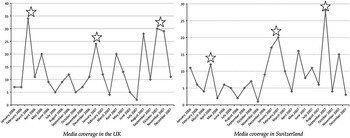
2) Trend. There was an overall increase in the frequency of articles evaluating the two competition commissions under investigation: from 137 news items in 2006 to 188 in 2007 on the UK CC, and from 70 to 142 on the Swiss ComCo (Figure 1). More precisely, the average quarterly growth of news coverage was 12.28% in the United Kingdom and 20.36% in Switzerland during the time period investigated. This trend is remarkable in comparison with the activity of the media on the seven salient policy issues studied by Pfetsch et al., which remained fairly constant over time (Pfetsch et al., Reference Pfetsch, Adam, Berkel and Medrano2004). When the type of article is considered, it appears that, on average, from 2006 to 2007, the increase is 71% for comments, 78% for editorials, and 32% for interviews.
Figure 1Media coverage of the British Competition Commission and the Swiss Competition Commission.

3) Regulatory cycle. The trend in news coverage roughly follows the agencies’ regulatory agenda, as it tended to cluster in relation to specific regulatory issues by peaking significantly around important events, such as the beginning of an investigation, a crucial decision, or the publication of the annual report. As indicated by the white stars in Figure 1, 13 articles were published in the United Kingdom when a full competition inquiry into the dominance of large British grocers was announced (10 March 2006). The publication of another 15 articles corresponded to the unveiling of the initial findings of the CC's investigation on the grocery market (24 January 2007). Eighteen articles included a sensible CC report on the large supermarkets’ dominance (1 November 2007). In Switzerland, meanwhile, 5 articles were published after ComCo's decision to sanction the country's leading telecommunications company for abusing its dominant position (11 April 2006). A total of nine articles were published before the disclosure of the initial position of the Swiss ComCo on an exceptional merger in the grocery market (17 February 2007). In addition, 13 articles reported and discussed the decision made by ComCo relative to that issue (5 September 2007). At the same time, the average tone was not decisively contingent upon specific events, but positive or negative evaluations of regulatory actions by the investigated competition agencies followed comparable patterns across issues (when also controlling for newspaper type).
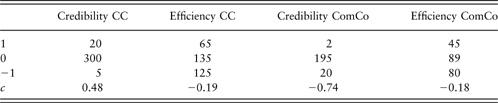
4) Media bias for credibility. The last row of Table 1 presents the coefficients of media favourableness.Footnote 10 According to media coverage, credibility was considered significantly more positive for the British CC (a coefficient of media favourableness of 0.48 or a differential between positive and negative cases of +5 percentage points) than for the Swiss ComCo (a coefficient of −0.74 or a differential of −8%). As regards credibility, coefficients of media favourableness display absolute values that are distant from zero, indicating that media evaluations of agencies are consistent over news articles. In addition, Table 1 shows a good deal of ‘neutral’ articles, which is as expected according to the coding procedure.
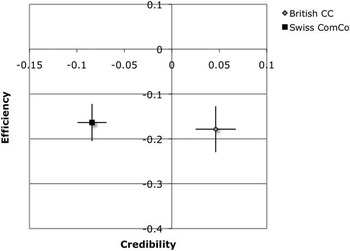
5) Media bias for efficiency. The tone of the evaluations of the agencies’ efficiency was almost identical in the United Kingdom and in Switzerland. In both cases, there were more negative articles than positive ones. The coefficient of media favourableness was −0.19 in the United Kingdom (−19%) and −0.18 (−16%) in Switzerland; therefore, the CC was evaluated slightly more negatively than the ComCo on this dimension (but both coefficients are quite close to zero). Figure 2 displays a scatterplot showing where the two IRAs are situated according to the mean values of their media evaluations of credibility and efficiency (the small bars represent the standard errors).Footnote 11 This scatterplot allows a comprehensive comparison of media evaluations of the two agencies. As regards efficiency, the tone of media coverage is similar in both cases, and constantly negative; instead, credibility is positively evaluated for the British agency but negatively evaluated in the Swiss case.
Figure 2The tone of the media coverage of the British Competition Commission and the Swiss Competition Commission.
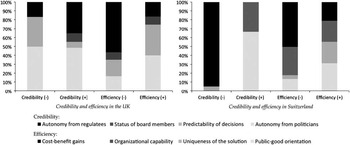
6) Content. The element that received the most intensive media coverage by far was ‘efficiency’ in both cases. Among all articles referring to credibility or efficiency, 88% evaluated the efficiency of the British CC and 85% evaluated the efficiency of the Swiss ComCo, respectively. Figure 3 illustrates the relevance of each criterion of the coding for the aggregated evaluation of credibility and efficiency, respectively. Concerning the British CC, the analysis shows that the positive evaluation of credibility is predominantly because it is perceived as being largely separated from politicians and organized interests. On the other hand, its negative reputation for efficiency stems largely from a harmful evaluation of cost–benefit gains. Pertaining to the Swiss ComCo, it appears that the negative evaluation of credibility is almost entirely because it is perceived as having scarce autonomy from those being regulated, whereas its perceived poor efficiency derives principally from a negative evaluation of organizational capabilities (i.e. human and financial resources) and from the perception of low cost–benefit gains.
Figure 3The criteria for credibility and efficiency of the British Competition Commission and the Swiss Competition Commission.


Media favourableness
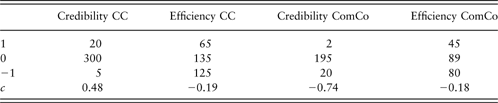
CC = British Competition Commission; ComCo = Swiss Competition Commission.
Discussion
The expectation that the media can function as an ‘accountability forum’ (Bovens, Reference Bovens2007) for IRAs finds support in the cases of the British CC and the Swiss ComCo. To begin with, these agencies seem to be consistently scrutinized by the media, which give account of their regulatory activities quite regularly. (1) The coverage of the agencies in terms of the average annual number of editorial comments per newspaper is well above the average in both countries, in comparison with other relevant policy issues and (2) such coverage tends to increase over time. More importantly, (3) media coverage appears roughly in line with the regulatory cycle, with news peaks around crucial events for the IRAs under examination: the opening of new inquiries, the publication of the results of previous investigations, and key decisions such as important sanctions on regulated industries.
Pertaining to the application of symbolic rewards and sanctions, the results are also mostly in line with expectations. First, (4) a systematic positive bias for credibility can be dismissed, given that the British CC benefits from an excellent media evaluation of credibility, whereas the Swiss ComCo has a negative media evaluation of credibility. Similarly, (5) the existence of a negative bias as regards efficiency is improbable because, although persistently negative, the coefficients of media favourableness are quite close to zero, indicating a good balance between negative and positive evaluations. However, the fact that the average tone for efficiency is clearly negative, even for the ‘most likely’ case of the CC, where one would expect a greater number of positive evaluations, is quite surprising and deserves further investigation. Finally, (6) the content of media coverage is largely in harmony with those topics that can be considered of general interest to the public: namely, the ‘autonomy’ of agencies as regards credibility and their ‘cost–benefit gains’ as regards efficiency.
These results are not only relevant for the literature on regulatory governance but also indicate the analytical relevance of the concept of ‘mediatization’ (Mazzoleni and Schulz, Reference Mazzoleni and Schulz1999; Kepplinger, Reference Kepplinger2002; Strömbäck and Esser, Reference Strömbäck and Esser2009), according to which the media are becoming social institutions that operate according to their own logic and have an autonomous impact on political actors and political phenomena (Mazzoleni and Schulz, Reference Mazzoleni and Schulz1999; Kepplinger, Reference Kepplinger2002; Strömbäck and Esser, Reference Strömbäck and Esser2009). Following this perspective, it seems that the growing importance of IRAs is recognized by the news media, which report IRAs’ activity and mediate their communication, with increasing frequency and evaluating them according to the ‘official goals’ of delegation, in terms of credibility and efficiency, eventually making ordinary citizens potentially more aware of what IRAs do. Before concluding, it is fair to note that these findings are expected to account for cases presenting similar characteristics, that is, powerful, independent, mediatized regulators in Western Europe, and that they hold within the context of the quite limited research goal of this article, that is, the exploration of the role that media can play as a necessary but insufficient component in a ‘multi-pronged’ accountability system for independent regulatory agencies (Majone, Reference Majone2002).
Conclusion
The purpose of this article was to assess whether the media can function as an ‘accountability forum’ (Bovens, Reference Bovens2007) for IRAs. With this aim, it explored the media's coverage of IRAs according to the official rationales that justified decisions to delegate public authority from governments to this type of non-majoritarian institutions: the enhancement of regulatory credibility and the improvement of decision-making efficiency. This approach is relevant not only because public communication is a requisite for the responsiveness of political institutions towards citizens but also because the media represent a venue for policy-makers for the appraisal of regulatory outcomes. The two components of accountability – to give an account and to reward and sanction – are examined through the comparison of a ‘most likely’ and a ‘least likely’ case among Western European regulators (i.e. the British CC and the Swiss ComCo, respectively). During the period investigated (2006–2007), media attention pertaining to the regulation of competition in both countries was primarily directed towards market concentration in the grocery sector. This quite exceptional situation allowed the endogenizing of the possible effects of issue-specific conditions.
The main results can be summarized as follows: IRAs seem accountable to the media, given that the average annual coverage of the Swiss and UK competition commissions corresponds to the level of the most salient policy issues, and, in addition, follows a positive trend. Moreover, media attention is approximately in line with the regulatory cycle of agencies. Concerning symbolic rewards and sanctions by the media, the findings corroborate expectations concerning the tone of editorial comments. Evidence indeed confirms the absence of a systematic positive bias on credibility or a negative bias on efficiency when evaluating IRAs. Nevertheless, the case of the CC shows that even well-endowed IRAs do not necessarily benefit from a positive media evaluation on efficiency. It is impossible at this stage to say whether this result stems from a misrepresentation of this particular dimension or whether it is connected to substantial underperformances by those IRAs under scrutiny. However, if supported by further research, these results might defy the popular ambition of designing a structure of delegation that simultaneously enhances regulatory credibility through independence and decision-making efficiency through the simultaneous application of ‘ex-ante’, ‘ex-post’, or ‘ongoing’ control mechanisms. Furthermore, in line with other research studies, this article confirms that IRAs can be formally independent and yet be considered under control (Laegreid et al., Reference Laegreid, Roness and Rubecksen2008), with the application of the appropriate ‘ex-post’ accountability mechanisms (Busuioc, Reference Busuioc2009).
These exploratory findings are relevant not only for the burgeoning literature on the spread of regulatory capitalism and the functioning of IRAs (Levi-Faur, Reference Levi-Faur2006a, Reference Levi-Faurb; Gilardi, Reference Gilardi2008) but also for the discussion regarding the accountability of regulatory governance and the role of media in regulatory policy-making, especially regarding the so-called democratic deficit of the regulatory state. This article offers both good and bad news to the proponents of media scrutiny as an alternative procedure for making independent regulators accountable and perhaps enhancing their legitimacy, following the inappropriateness of traditional forms of upward and downward accountability for institutions that lack input legitimacy by design (Majone, Reference Majone1994a; Scott, Reference Scott2000; Lodge, Reference Lodge2004; Maggetti, Reference Maggetti2009a; Maggetti, Reference Maggetti2010). On the one hand, the media can possibly act as a proper accountability forum that provides the public with consistent evaluations of agencies’ work. On the other, whereas a positive media evaluation of credibility has proven attainable under specific conditions, the corresponding evaluation of efficiency seems chimerical for IRAs, even in the ‘most likely’ case, potentially compromising the reputation of (some) independent regulators in the eyes of ordinary citizens.
Acknowledgements
Helpful comments have been received from Dietmar Braun, Fabrizio Gilardi, Yannis Papadopoulos, Claudio M. Radaelli, and three anonymous referees. This research is part of the NCCR Democracy (http://www.nccr-democracy.uzh.ch/) and is funded by the Swiss National Science Foundation.