The development of the College of William & Mary, its Law School, and the law library spans more than three centuries. As in most law schools, the history of the law library closely tracks the development of the school. And the history of the law school tracks the development of the College – and the Colony and Commonwealth of Virginia. There also are many similarities in the development of the law programs at Oxford – the first law school in the English-speaking world, and William & Mary, America's first law school.
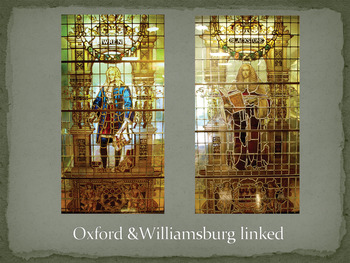
The Law School's connection with Oxford is obvious when one comes upon the “Oxford Windows” in the building's lobby. Two stained glass panels that depict Sir William Blackstone and Sir Christopher Wren were created in London in the 1890's and removed from a hall at Oxford on the eve of the Second World War. The windows were donated in 1980 by the Warden and the Faculty of Laws at All Souls College to celebrate the Law School's 200th birthday one year earlier. But let's go even further back in time, to the early 17th Century.
Oxford and Williamsburg: the Oxford Windows

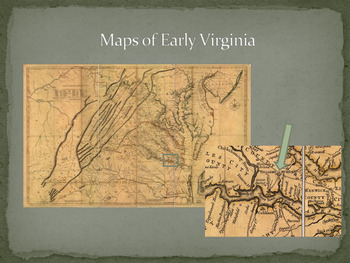
Maps of early Virginia

THE FOUNDING STAGE
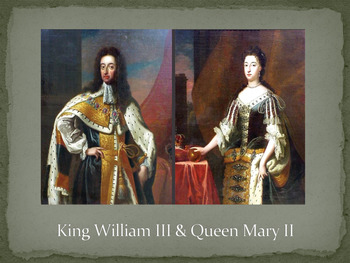
When John Smith and 213 other Virginia Company explorers landed at Jamestown Island in 1607, they established the first permanent English settlement in the new world. Jamestown was the capital of the Virginia Colony until 1699, at which time the government was moved ten miles away to less swampy Middle Plantation. The village was renamed Williamsburg, more in keeping for the new capital of the Colony. Besides fewer mosquitoes, a major attraction in moving was The College of William & Mary. Chartered in 1693 by King William III and Queen Mary II, William & Mary is the second oldest college in America, preceded only by Harvard. William & Mary is where three of the first five, and four of the first ten, United States presidents were educated: George Washington, Thomas Jefferson, James Monroe, and John Tyler.
King William III and Queen Mary II

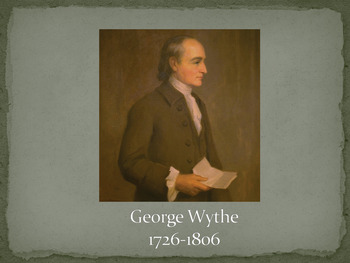
George Wythe

We can break down the history of the law school and its library into four distinct stages. The “Founding Stage,” from 1779 until the commencement of the Civil War in 1861, shows gradual growth for the young law program. The “Stage of Decline” lasted from the closing of the College in 1861 to the reinstitution of the study of law at William & Mary in the early 1920's. The next 50-year period, what I will call the “Struggling Revival Era”, begins when law classes reemerged in the early 1920's and continued through the 1970s. During this time William & Mary's law school and law library suffered from inadequate financial resources, dismal facilities, and deficient staffing. Finally, the “Modern Era” begins in 1980 with the completion of the present law building, and, in the last five years, a new law library facility. This period show maturation and growth for both the law school and the law library.
We begin with the Founding Stage. There was no formal training of lawyers in Colonial America. One could study at the Inns of Court in London, educate himself by reading law books, or apprentice with a lawyer. (The Inns of Court actually did little to educate lawyers, and after 1829 English lawyers also had to serve apprenticeships). Because law books were very expensive in the Colonies, reading law was an option for few would-be lawyers. The apprenticeship route, then, was most common, and the most prominent trainer of lawyers in Colonial Virginia was Williamsburg lawyer and judge George Wythe.
Wythe apprenticed dozens of would-be lawyers at his home. One such apprentice was Thomas Jefferson, who in the early 1760's had been a student of Wythe's at William & Mary. When Jefferson was elected governor of Virginia in 1779, he also joined the College's Board of Visitors. Jefferson understood the need to educate citizen lawyers for a new nation, and at his urging, the Board created a professorship of Law and Police (in those days “Police” meant political science or government). The first law professor in America would be Jefferson's teacher and mentor, Mr. Wythe.
Soon thereafter, Wythe started teaching undergraduate students at William & Mary – there were no graduate students at that time – in the College's first building, whose design has been attributed to Sir Christopher Wren. Wythe began teaching only twenty-one years after Sir William Blackstone was confirmed as Vinerian Professor of English Law at Oxford. Wythe was very well-qualified. He was at that time a member of the Virginia High Court of Chancery, and had been a member and clerk of the House of Burgesses. He also had been a member of the Continental Congress, and signed the Declaration of Independence.
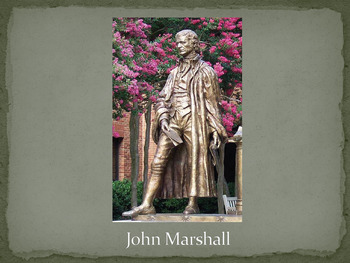
One of Wythe's earliest students was John Marshall. Known in America as The Great Chief Justice, Marshall established the primacy of the United States Supreme Court in interpreting the Constitution and declaring statutes unconstitutional – what we call Judicial Review – in Marbury v. Madison in 1803. But not many people know that twenty-one years earlier it was Marshall's mentor, George Wythe, who proclaimed the authority of a court to nullify a legislative act.
The issue in Commonwealth v. Caton, 8 Va. 5 (1782) was whether the Virginia House of Delegates, acting alone without the Virginia Senate, could pardon three men convicted of treason. The well-read Wythe averred to contests in England between the House of Commons and the Crown relative to impeachments, where the King would frustrate the prosecution by pardoning the offender. In nullifying the act of the Virginia House of Delegates, Wythe wrote that it was his power,
“to protect one branch of the legislature, and consequently, the whole community, against the usurpations of the others … . [If] the whole legislature … should attempt to overleap the bounds prescribed to them by the people, I, in administering the public justice of the country, will meet the united powers, at my seat in this tribunal; and pointing to the constitution, will say to them, here is the limit of your authority; and hither shall you go, but no further.”
John Marshall

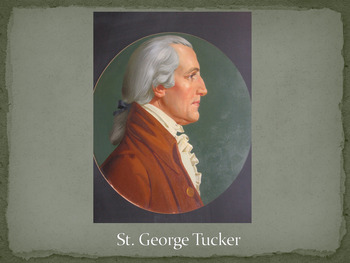
St. George Tucker

Wythe established a varied curriculum. In addition to having his students study court decisions, he assigned them readings from his large personal library. He relied heavily on Matthew Bacon's New Abridgement of the Law, Blackstone's Commentaries on the Laws of England, and the Virginia Acts of Assembly. His students also read books on government and philosophy.
Wythe's students could rely little on William & Mary's library. The College charged students ten shillings for the support of the library, with two thirds of the proceeds for buying books. (10 shillings in 1780 would be about £50 in 2012, or about $80 US). Little of that early funding went to buy law-related materials, however, and there would be no separate law library at William & Mary until well into the 20th Century.
There also was a practical side to Wythe's teaching, and he borrowed from England the concept of a moot court. But rather than have students watch the barristers, as was done in England, Wythe's students argued the cases while he and other lawyers and judges served as judges for the moot court. Wythe also introduced a moot legislature, he serving as speaker and his students as legislators. The moot court and legislature were held in the courtroom and legislative chamber of the Colonial Capital building in Williamsburg, which had been abandoned when the capital was moved to Richmond in 1780.
In 1789 Wythe resigned his position at William & Mary and moved to Richmond because of his duties as Chancellor of the High Court. All told, he taught law to perhaps 200 men, including a delegate to the Continental Congress (John Brown); two Presidents (Jefferson and Monroe) and a Vice President (John Breckenridge) of the United States; a Secretary of State and the first U.S. Attorney General (Edmund Randolph); U.S. Senators (John Breckenridge and John Brown), a Chief Justice (Marshall) and Associate Justice (Bushrod Washington) of the U.S. Supreme Court; state and federal court judges (Spencer Roane and St. George Tucker), a foreign minister and Governor of Virginia (Jefferson); members of the legislatures of Kentucky, North Carolina and Virginia; and a president of William & Mary (The Rev. James Madison).
Wythe was replaced in 1790 by St. George Tucker, who himself had studied under Wythe. At his introductory lecture, the modest judge told his students that he had little to add beyond what his students could get by reading the works of Blackstone, Bacon (Bacon's Abridgement), Sir Henry Finch (Nomotexnia, or “Finch's Law”), and Sir Matthew Hale (A History and Analysis of the Common Law of England, and Historia Placitorum Coronæ, or “The History of the Pleas of the Crown”. Tucker's students also read Locke's Essay on Civil Government, Coke's Institutes, William Sheppard's Touchstone, James Burgh's Political Disquisitions, and Jean Louis de Lolme's Constitution d' Angleterre, titles one might expect to find in an early 19th Century lawyer's library.
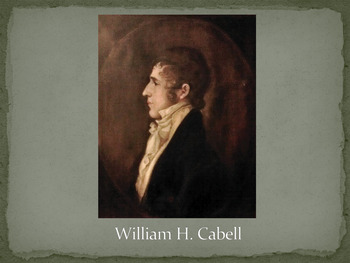
It was during Tucker's tenure that the first earned law degree was granted in America when, in 1793, the College conferred a bachelor of law degree on William H. Cabell. Cabell later served as Governor of Virginia, and in 1811 became a member of the Court of Appeals (Virginia's highest court), where he served for 41 years.
During his lectures, Tucker supplemented readings from Blackstone's Commentaries with how British law was changing in America, particularly in Virginia. This culminated in 1803 with the publication of what we call “Tucker's Blackstone”, the most influential early 19th Century American legal treatise. When Tucker resigned his professorship that same year after a disagreement with the William & Mary Board of the entire college already was in a serious decline. For the next thirty years the law program was led by a series of local judges. Stability was achieved from 1833–1850 when Nathaniel Beverly Tucker, St. George Tucker's son, directed the law program. But the decade preceding the Civil War, where the program had several directors, was anything but stable.
William H. Cabell

The crest of The Drapers' Company

THE STAGE OF DECLINE
The “Stage of Decline” begins in 1861 when the College closed its doors at the commencement of the American Civil War. It would not reopen until 1888, with about 100 total students. Eighteen years later, in 1906, William & Mary became a state-supported university, which it still is today. The law program, however, would not re-appear until 1920, which takes us to the “Struggling Revival Era.”
By 1920, legal education in America had changed in three significant ways. First, there were many more law schools. In 1850 there were only 18 law schools in the U.S., all within respected universities. In 1900 there were 96 law schools. And in 1920 there were 140 – many of which were not affiliated with universities.
Second, the Socratic method of teaching using court decisions, credited to Harvard's Christopher Columbus Langdell, had gained a firm toehold. Legal education no longer had a practical component, and statutory law was virtually ignored.
Third, there were more rigid requirements to be able to practice law. In England, examinations in law were first set by an 1850 statute. In Virginia, an 1896 Act required the Virginia Supreme Court of Appeals to license future Virginia attorneys only after they passed a written bar exam. But it wasn't until 1934 that Virginia required every bar applicant to either have a law degree from an ABA-accredited law school or two years of undergraduate study. Two years later, at the urging of the state bar association, the requirements were made stiffer; an applicant without a law degree had to have two years of college, and also had to read law for two years under a lawyer.
STRUGGLING REVIVIAL ERA
Even after the first law courses were re-introduced in 1920, then President J.A.C. Chandler (1919–1934) did not consider William & Mary to have a genuine “law school”, as the College offered only two years of law courses. The College's Board of Visitors solved this problem when they agreed on a third year of law beginning in 1923–24 and renamed the program the School of Jurisprudence – 50 years after Oxford's School of Jurisprudence was established.
Under the direction of law professor Oscar Lane Shewmake, the School of Jurisprudence struggled on with few students, a small faculty, and limited facilities. Amidst the Great Depression, 1932 was a very notable year. First, the law school separated from the government department. Second, the College hired its first librarian, John Latane Lewis, to supervise the small law collection of less than 7,000 volumes. It was shelved on the top floor of the college's library, comparable to Oxford's shelving its law collection in a law reading room a decade earlier. Most important, that year the law school secured accreditation by the American Bar Association. Four years later, in 1936, the law school was accredited by the Association of American Law Schools.
To get an idea of how small the law school was in the 1930's, the School of Jurisprudence shared space on two floors in Marshall-Wythe Hall (later renamed James Blair Hall) with the departments of Economics, Government, History, and Sociology. In the thick of the Depression, the legal collection at William & Mary was nothing to gloat about. In 1936, there were fewer than 8,000 volumes in the law collection, and less than $2,000 was spent to buy law materials.
Notwithstanding the ABA (1932) and AALS (1936) accreditations, as well as the granting of the first law degree to a woman (Virginia Mister in 1937), in 1938 William & Mary President John Stewart Bryan (1934–1942) convinced the College's Board of Visitors to downgrade the School of Jurisprudence to the Department of Jurisprudence. A special committee composed of Board members was then charged to study the law program, which had bestowed only twenty-three degrees since its revival eighteen years earlier. Following the special committee's recommendation, in May of 1939 the Board of Visitors announced plans to abolish the law school.
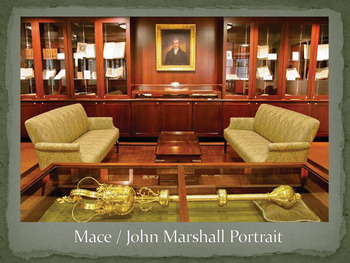
The Law School Mace and John Marshall Portrait

Surprised by the outcry from current law students and law alumni, the Board reversed its action only a week later. It announced not only that it would retain the law school, but that it would strengthen it. The new decade gave birth to escalated interest in the law program and an increase in the number of students studying law at William & Mary. By 1941, enrollment in the Department of Jurisprudence jumped from 79 to 140. The law collection, still housed in the main library and with five part-time staff, began to receive regular and sustained use.
But then the progress of the law program was interrupted by World War II, which also led to a series of rapid changes and instability in the library's leadership. From 1943–1950 the law library had four different law librarians. Lewis went off to war in April of 1943 and did not return to that position. Charles Harper Anderson became law librarian in the fall of 1946 after graduating from William & Mary, but he held that position only until 1947 when he joined the law faculty. Anderson was followed by Virginia Blanche Till, the College's first female law librarian, who served until the end of 1949. Chester Stoyle Baker, Jr. managed to stabilize the position, serving from 1950 until 1959.
There was a major change in 1953 when the Department of Jurisprudence split from the School of Government and Citizenship. Under the dynamic leadership of Dean Dudley Warner Woodbridge, it became the Marshall-Wythe School of Law. The school consolidated offices, classrooms, and the law collection in Bryan Hall. The establishment of an endowed chair in taxation reflected the addition to the curriculum of a Master of Law and Taxation, the first degree of its kind in the United States. By 1954, the entire law collection of about 21,000 volumes had been moved from the main library and consolidated in the law library in Bryan Hall.
The excitement was short-lived, however. Yet another threat to the law school was on the horizon, when in 1956 the Virginia General Assembly created the State Council of Higher Education to, in part, recommend elimination of duplicative programs in the state-supported colleges and universities. Davis Y. Paschall, a William & Mary alumnus who would later become president of the College, had only days earlier been appointed Superintendent of Public Instruction for the Commonwealth of Virginia. At his first State Council meeting, Paschall learned that the Council listed the William & Mary Law School as its number one priority slated for elimination. Paschall believed that the General Assembly would approve the Council's recommendation if it saw it.
In a passionate speech, Pascall told the Council that “[t]o abolish the law school that Jefferson established would be like removing the very heart of a College that is, indeed, a ‘Pearl of Great Pride' to this Commonwealth.” He cautioned that abolishing the law school “… would be a gross and callous disregard of the Biblical admonition: 'Remove not thy ancient landmark, which thy fathers have set.' (Proverbs 22:28). It would constitute an unforgivable betrayal of a priceless heritage, and its perpetrators would be silhouetted in infamy.” Heeding Pascall's words, the Council agreed to hold in abeyance its recommendation to abolish the law school, and did not send it to the General Assembly.
The law school had survived another scare, and two years later, in 1958, its connections to England were further strengthened with the establishment of The Drapers’ scholarship. Each year the Drapers’ Company of London provides a scholarship for a just-graduated William & Mary law student to enroll at Queen Mary College to take law courses at any of the colleges of the University of London. William & Mary, in turn, gives a scholarship to a British student to study law for a year in Williamsburg.
As for the law library, Anna Booth Johnson replaced Baker as law librarian in 1960, becoming the law school's first full-time librarian. Like her predecessors, Johnson remained under the joint supervision of the College librarian and the law school dean. The law library soon began receiving a much needed infusion of funds from the College, including private support in the form of two significant endowments. One, a gift from Charles Phineas Sherman, Lecturer Emeritus in Roman, Canon and Civil Law, enabled the library to build a collection of Roman law materials. The other gift, from Marie Estaire Baumert in the name of her brother Guillermo Butler Sherwell, also would be used to buy law books. Both endowments continue to the present.
While funding improved, space became a severe problem for the entire law school. In 1960 the law school had fewer than 50 students. By 1969, it had nearly quadrupled in size to 190 students. Through most of the 1960's the law library was housed in several different buildings, including the basements of two halls. The law school was able to address some of its problems in 1968 when it moved into a building vacated by the university library. It was renamed the Marshall-Wythe Building for Chief Justice John Marshall and his teacher, George Wythe. The facility was adequate for a time, but it filled up quickly with post-war baby boomers; enrollment ballooned from 190 students in 1969 to 459 students in 1973.
Anna Booth Johnson stepped down as law librarian in 1971 and was followed by J. Madison Whitehead, the first to hold a law degree. Sometime between 1970 and 1972 – it's not exactly clear – the law library became totally autonomous from the College's main library. But gaining autonomy brought neither more funding for materials nor additional personnel. The small staff of seven – two librarians and five clerical – could not address the massive increase in the use of the library, which in 1975 acquired its 100,000th volume. Poor facilities compounded the problems, for the law library operated in three different buildings: the main collection and library administrative offices were housed in the Marshall-Wythe Building, additional seating and space for duplicate materials were located in the Wren Building, and incoming books were processed on the third floor of James Blair Hall.
The dismal facilities, along with inadequate staffing and support, put the entire law school at risk. After the ABA inspected the law school in 1975, its Consultant on Legal Education criticized both the law school and its library. He wrote that “[t]he Law School has possibly the most inadequate physical plant of any ABA approved law school in the country.” As for the law library, the Consultant wrote “[i]t is my opinion that the current physical setting and support level for the library limits the academic aspirations and goals of the Marshall-Wythe School of Law.”
The ABA's criticism began a turning point when William B. Spong was appointed dean of the law school in 1976. Spong, a prominent and politically well-connected Virginian, had earlier served for ten years as a Virginia State Senator, and then a term as a United States Senator. He convinced the Virginia General Assembly to allocate a large increase in funding for the law library collection, and staffing needs were addressed by transferring two university librarians to the law library.
Spong also changed the law library's administration when Whitehead was replaced by Caroline Chandler Heriot. Heriot quickly transformed the library, expanding the hours it was open and banning smoking, food, and drinks in the library. The law faculty adopted her proposal that new courses could not be approved absent a library impact statement. In that same year, the law library received a significant endowment from Louis Ellenson, a 1950 graduate of the law school, for the purchase of law books.
Most significantly, Spong secured funds for a new law school building one-half mile from the main campus, adjacent to land where the National Center for State Courts planned to build its new headquarters. Heriot spent most of her time planning and overseeing construction of the library portion of the new law school building, which opened in the fall of 1980. The law library also moved into the electronic age later that year when it acquired its first Lexis terminal. Almost immediately after moving into the new building, the law school was admitted as a chapter of the Order of the Coif, one of 57 schools so honored at the time.
THE MODERN ERA
Heriot died in December 1981, and Associate Law Librarian Ed Edmonds was promoted to director in 1983. The law library passed the 200,000 volume mark in 1985, a doubling in the size of the collection from ten years earlier. The law library continued its slow move into the digital age in 1987 when it subscribed to Westlaw and inaugurated its online catalog. More good news was in store that year when Pearl Jones, who had served as private secretary to five William & Mary presidents, gave the law library a $500,000 endowment to purchase books for its collection.
Edmonds departed William and Mary in 1988, and was succeeded by James Heller. After receiving funds to hire an additional reference librarian – which brought to five the number of professional staff – the four dual-degree librarians began teaching the legal research component of the law school's innovative Legal Skills program. The law library saw significant budget increases for both staffing and collections during the mid-1990's, and acquired its 300,000th volume in 1993. After adding yet another dual-degree librarian, the library began offering evening reference services and advanced legal research courses.
As for funding, state support for higher education throughout the United States began dwindling before the bursting of the dot-com bubble in 2000 and the housing bubble in 2007. In 1980, Virginia funded 43% of William & Mary's operating budget. In 2012 it was 13% for the entire College, and 8% for the Law School. Diminished state support has been in part made up by increasing enrollment. William & Mary's Law School had fairly constant enrollment of about 525 students during the first two decades of the modern era, 1980 to 2000, but it expanded significantly in the first decade of the new century. Enrollment breached 600 students in 2005, and 650 in 2011, which included over two-dozen LLM candidates from other countries.
As was the case in the 1970's, the need for a larger and better facility became more acute. The library physical plant was showing its age, both esthetically and functionally. The facility problem was addressed by a total renovation and expansion of the law library. When completed in 2007, the new facility – renamed The Wolf Law Library – had 568 total seats, twelve group study rooms, two computer labs, and impressive Reading Rooms on the main and top floors. A year after opening, the law library acquired its 400,000th volume.
The library's impressive Nicholas St. George Rare Room features a portrait of John Marshall that was once owned by his son, and also the John Marshall family bible, with writings from Marshall and his wife, Polly Amber. The Law School Mace, a 19th Century replica of those used in Parliament, offers evidence of our British roots. One of the special collections displayed in the Rare Book Room – donated by the Armistead Family, four generations of whom practiced law in Williamsburg – offers a glimpse into the law books used by 18th and 19th Century Virginia lawyers.
Two of the law library's major collection-related projects reflect the past, present, and future of the Law School. As for the past, the library actively collects books that were used by America's first law professor, George Wythe. Wythe, also a classics scholar, had a personal collection of nearly 500 titles, and the law library has about one-third of those titles. As for the present and future, in 2010 the law library created the William & Mary Law School Scholarship Repository, an open access digital archive that includes the Law School's faculty publications, five law reviews, and numerous other documents relating to the unique history of the nation's first law school. In May, 2012, less than two years after it began, the Repository broke 1 million downloads. The library will continue to add to the repository so that future generations will have access to student and faculty legal scholarship and the law school's rich history.
From its distinguished beginnings as America's first law school, it's closing in 1861 at the outset of the Civil War, the Struggling Survival Period from the 1920's into the 1970's, and the modern period that began in the last quarter of the 20th Century, William & Mary's Law School mirrors the ups and downs of the Commonwealth of Virginia and the nation. Fortunately, both the College of William & Mary and its Law School are well-positioned to meet whatever challenges and opportunities that will occur during the next three centuries.