Introduction
The illegal wildlife trade is among the most profitable illicit activities in the world (Destro et al. Reference Destro, Pimentel, Sabaini, Borges and Barreto2012; Hughes Reference Hughes2021; Lawson and Vines Reference Lawson and Vines2014; Mozer and Prost Reference Mozer and Prost2023; Rosen and Smith Reference Rosen and Smith2010), with birds being one of the most targeted taxonomic groups (Ribeiro et al. Reference Ribeiro, Reino, Schindler, Strubbe, Vall-llosera and Araújo2019). Psittacidae birds are highly sought targets of the illegal pet trade worldwide due to their vibrantly coloured plumage and ability to imitate the human voice (Fitzgerald Reference Fitzgerald1989; Hardie Reference Hardie1987; RENCTAS 2001). The high local and global demand for these animals as pets (Aloysius et al. Reference Aloysius, Yong, Lee and Jain2020; Bush et al. Reference Bush, Baker and Macdonald2014; Chan et al. Reference Chan, Poon, Wong and Sin2021; Daut et al. Reference Daut, Brightsmith, Mendoza, Puhakka and Peterson2015; Romero-Vidal et al. Reference Romero-Vidal, Rojas, Herrera, Hiraldo, Díaz and Blanco2025; Sánchez-Mercado et al. Reference Sánchez-Mercado, Asmüssen, Rodríguez, Moran, Cardozo-Urdaneta and Morales2020a, Reference Sánchez-Mercado, Blanco, Sucre-Smith, Briceño-Linares, Peláez and Rodríguezb) has contributed to severe population declines (Pires et al. Reference Pires, Olah, Nandika, Agustina and Heinsohn2021). People often decide to keep parrots as pets due to their desire for companionship, entertainment, and admiration of the animals’ beauty, intelligence, and vocal abilities (Engebretson Reference Engebretson2006; Tella and Hiraldo Reference Tella and Hiraldo2014). Brazil has among the highest diversity of Psittacidae in the world (Sick Reference Sick1997), and they are heavily targeted by the illegal pet trade in the country, with hundreds arriving annually at government wildlife rescue centres (Alves et al. Reference Alves, Lima and Araújo2013; Marques Reference Marques2020).
Parrots are culturally desired as pets in Brazil (de Oliveira et al. Reference De Oliveira, de Faria Lopes and Alves2018; Neto et al. Reference Neto, Fraga and Schiavetti2022) and are often taken from nature to meet commercial demand (Sánchez-Mercado et al. Reference Sánchez-Mercado, Ferrer-Paris, Rodríguez and Tella2021). Raising wild birds is a widespread practice rooted in traditional culture in several regions of the country, including the north-east, where it is common to remove psittacine chicks from nests (Fernandes-Ferreira et al. Reference Fernandes-Ferreira, Mendonça, Albano, Ferreira and Alves2012). Overall, poachers collect parrots, whether adults or chicks, using mist-nets or manually removing the birds from the nest (Pires et al. Reference Pires, Schneider, Herrera and Tell2016). Consequently, local extinctions have already been reported (Olmos et al. Reference Olmos, Silva and Albano2005). Globally, traders often capture parrots in the wild and transport them under cruel conditions, and most die during the journey or soon after arriving at rescue centres (de Oliveira et al. Reference De Oliveira, Borges, de Faria Lopes, Vasconcellos and Alves2020; Howell Reference Howell, Leader-Williams and Tibanyenda1996; Milpacher Reference Milpacher2014; Yuri Marinho Valença, personal observation). The parrot trade is a common practice in Brazil, with many people involved in capturing and distributing the animals to various parts of the country (Alves et al. Reference Alves, Nogueira, Araujo and Brooks2010, Reference Alves, Lima and Araújo2013). Despite national and international media attention directed towards the wild bird trade, there is limited information on the extent of this illegal activity (Gama and Sassi Reference Gama and Sassi2008). Nevertheless, there seems to be a pattern in which parrot poaching may respond to local demand (Tella and Hiraldo Reference Tella and Hiraldo2014).
In particular, the trade of Blue-fronted Parrots Amazona aestiva deserves particular attention in Brazil. They are highly intelligent and possess primate-like cognitive capacities (de Mendonça-Furtado and Ottoni, Reference de Mendonça-Furtado and Ottoni2008; Godinho et al. Reference Godinho, Marinh and Bezerra2020; Pepperberg Reference Pepperberg2002; Schuck-Paim et al. Reference Schuck-Paim, Borsari and Ottoni2009). They naturally occur from Northeast Brazil, eastern Bolivia, and Paraguay to northern Argentina (Sick Reference Sick1997). Despite their broad distribution, the species is listed as ‘Near Threatened’ by the International Union for Conservation of Nature (IUCN) due to the rapid decline of its natural populations (BirdLife International 2019). It is targeted in Brazilian conservation action plans (MMA 2010). To better understand the scale of poaching of Blue-fronted Parrots, we analysed data from the Brazilian Institute of the Environment and Renewable Natural Resources (IBAMA) and the Pernambuco Environmental Agency (Agência Estadual de Meio Ambiente de Pernambuco –CPRH) to identify this activity in Pernambuco, Northeast Brazil. We investigated data from 2016 to 2024 on admission of parrots into the Tangara Wildlife Rescue Centre (Tangara WRC) and analysed monthly and interannual changes in the entry of different species of parrots. We identified the proportion of Blue-fronted Parrots seized compared with other parrot species, seizure locations, entry routes, annual and monthly seizure patterns of adults and chicks, and mortality rates following rescue of the target species. We believe our research will provide valuable insights for policymakers and conservationists working to protect Blue-fronted Parrots and other species threatened by poaching in Northeast Brazil.
Methods
We collected data on parrot entry routes from the archives of Tangara WRC, which belong to the Pernambuco State Environmental Agency in Northeast Brazil. We reviewed all the physical, hand-filled forms detailing the entry of animals and compiled information relevant to this study. This centre has been responsible for rescuing wild animals from the illegal pet trade and their rehabilitation for potential reintroduction into the wild since 2015. The present study considered the Tangara WRC database, which has compiled information on all rescued parrots assisted by the centre from 2016 to 2024.
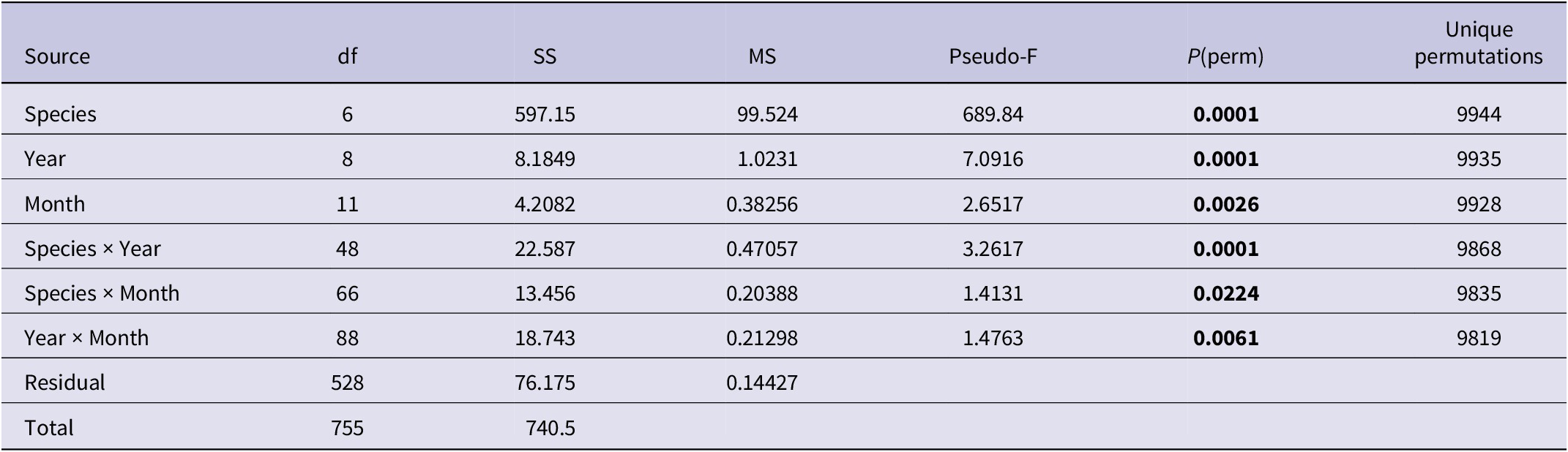
To map the municipalities for the parrot trade, we considered data from seizure reports and voluntary deliveries of Blue-fronted Parrots into Tangara WRC. There were four entry routes into Tangara WRC: seizures (i.e. inspections by environmental agencies to seize the illegally possessed animal), voluntary surrender (i.e. an individual or legal entity voluntarily surrendered the animal), rescues (i.e. encountering the animal at risk in the wild, requiring treatment at Centros de Triagem de Animais Silvestres – CETAS, e.g. animals that had been run over) and others (i.e. transfers from other centres for release in the biome from which they originated or closure of breeding sites – no data were available on how these animals entered the places before transfer to Tangara WRC). We conducted a Permutational Analysis of Variance (Permutational-ANOVA) (Andersen and Braak Reference Anderson and Braak2003) using species, month, and year as discrete independent variables or factors to evaluate their effects on the number of animals entering Tangara WRC between 2016 and 2024. The Permutational-ANOVA analysis uses a distance matrix based on Euclidean distances between observations. The use of distance matrices enables the analysis of data where the relationship between observations is more important than their individual values, and the permutation technique is an approach where errors are not assumed to be normally distributed, yet exact tests are achieved (Andersen and Braak Reference Anderson and Braak2003). Data were transformed before analysis (log10(x+1)) to reduce overdispersion and enable all species to contribute reasonably to distances, since species had strong differences in rescued numbers, with many data points being zero for most species. When permutational unique values were low, particularly in pairwise post hoc tests, Monte Carlo P values were used instead of unique permutational P values. We also performed Permutational-ANOVA to investigate separately (since adult stage and chick stage entries are obviously different, chicks mainly resulting from collection from the wild up to approximately five months old) whether adult and chick Blue-fronted Parrot arrivals varied according to year and month between 2016 and 2024. We used years and months as discrete independent variables. We used the software PRIMER 7 with PERMANOVA+ to perform these analyses. We conducted Pearson correlation analyses, after testing both for variables’ normality, using Jarque–Bera with Monte Carlo probabilities due to the small sample sizes, and for temporal autocorrelation, to verify whether the number of individuals entering via seizures was correlated with the number of individuals entering via voluntary surrender, rescue, and others (transfers). We also conducted Pearson correlation analyses to verify if mortality numbers were correlated to the numbers of Blue-fronted Parrots entering Tangara WRC via the four entry routes. Pearson correlation and normality analysis were performed using the software PAST5.2. Significance was attained when P <0.05 for all tests.
Results
Rescued parrot species
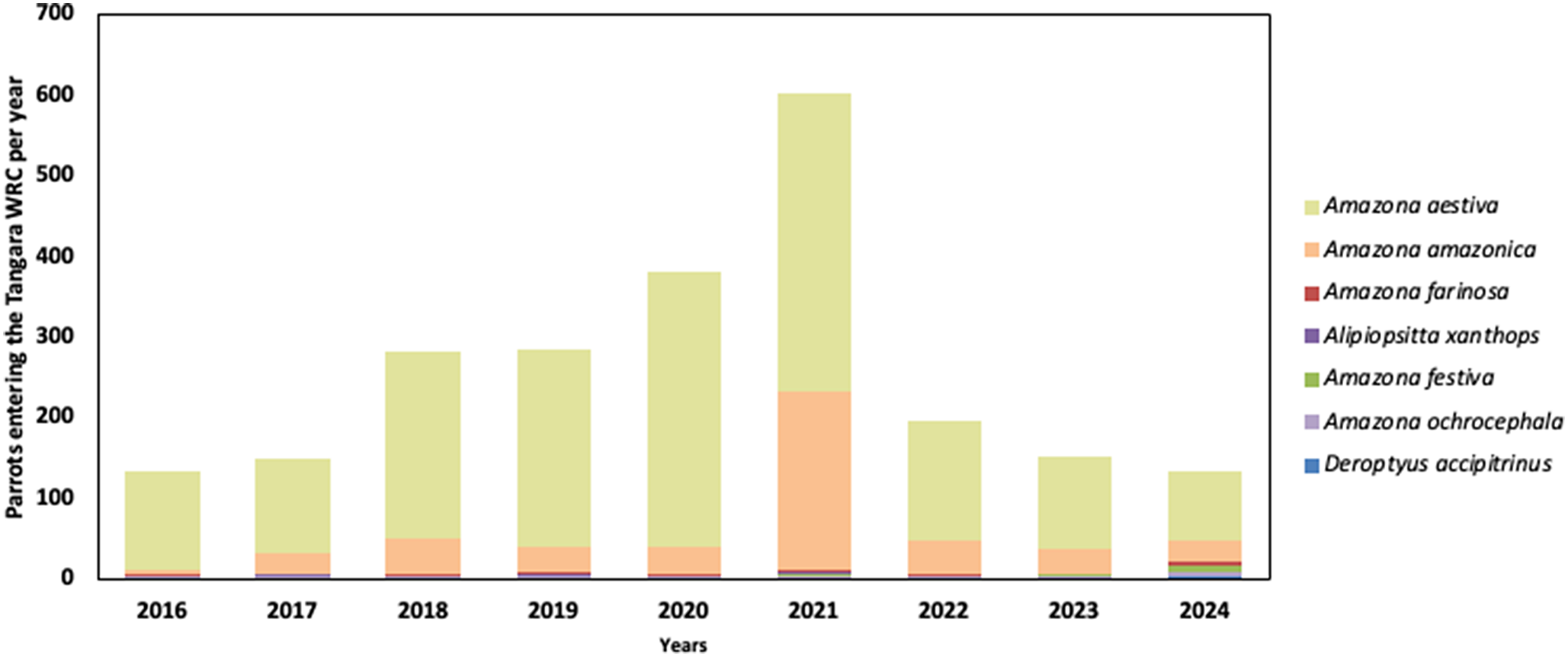
A total of 2,253 parrots arrived at Tangara WRC between 2016 and 2024. We found seven species of parrots. Most individuals were Amazona aestiva (78.3%), followed by A. amazonica (20.3%), A. farinosa (0.4%), A. ochrocephala (0.4%), A. festiva (0.3%), Alipiopsitta xanthops (0.2%), and Deroptyus accipitrinus (0.1%) (Figure 1). Permutational-ANOVA showed that species, year, and month influenced arrivals between 2016 and 2024 (Table 1). Pairwise comparisons revealed differences in the number of arrivals between some species, years, and months (Supplementary material 1).
Number of individuals of each parrot species entering the Tangara Wildlife Rescue Centre in Pernambuco, Northeast Brazil, between 2016 and 2024.
Summary of the results of a Permutational-ANOVA investigating whether there are differences in the number of parrot arrivals according to species, year, and month between 2016 and 2024 in the Tangara Wildlife Rescue Centre in Pernambuco, Northeast Brazil
Mapping seizures for Blue-fronted Parrots
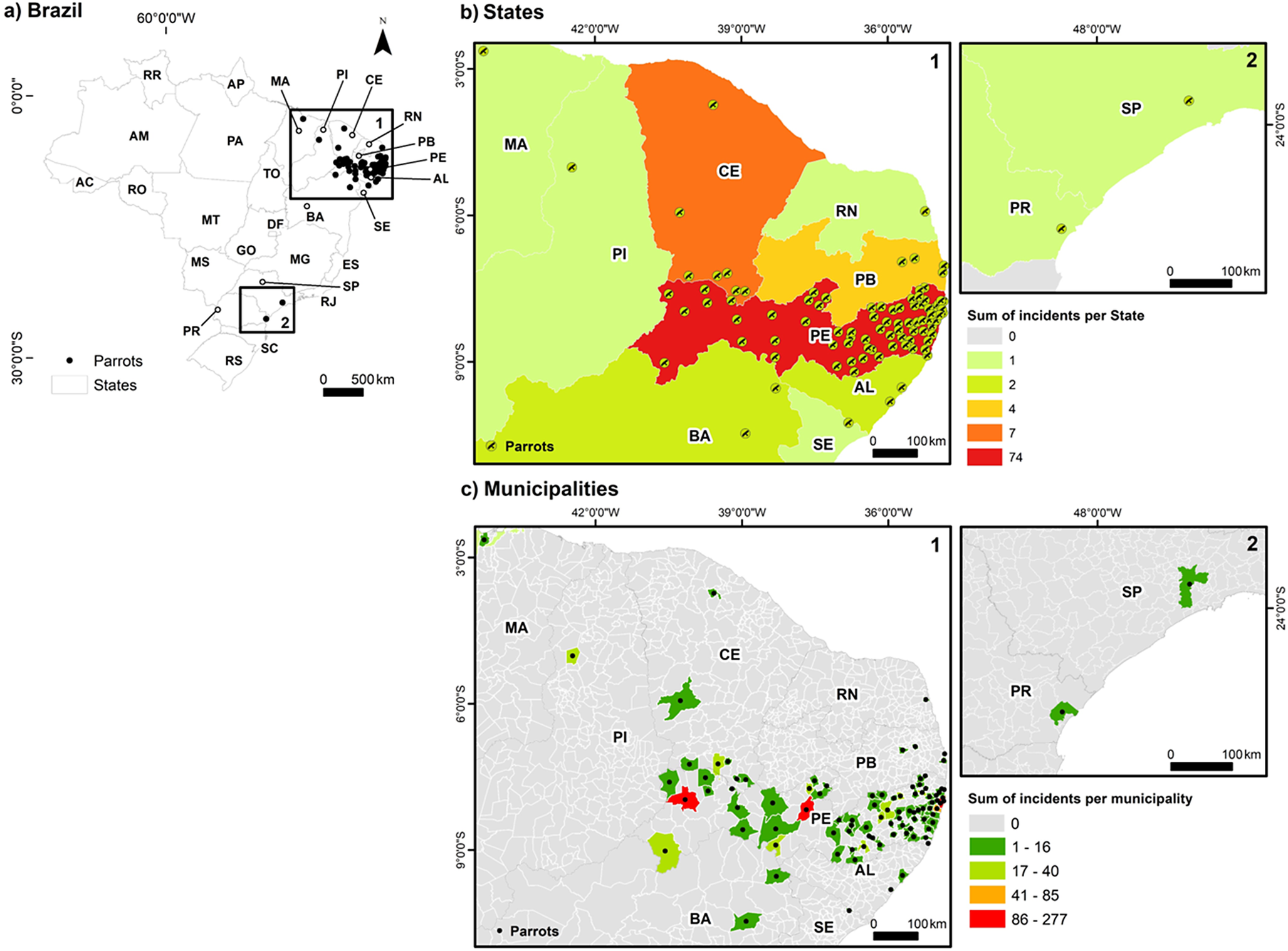
Our data revealed seizures of Blue-fronted Parrots in 95 municipalities distributed across 11 states in Brazil. Most of the municipalities occurred in Pernambuco, accounting for 75 municipalities (Figure 2). Custódia, Ouricuri, and Recife in Pernambuco accounted for the highest numbers of individuals seized (277, 157, and 149, respectively) between 2016 and 2024. Nevertheless, these seizures were not evenly distributed throughout the years. For instance, Recife had individuals seized yearly, whereas Custódia and Ouricuri had one major seizure event each, accounting for most of the seized individuals in these locations (Supplementary material 2). There were several apprehension events in other locations, but they did not necessarily contribute to the greatest number of individuals arriving at the rescue centre.
Municipalities where the parrots were seized before arriving at the Tangara Wildlife Rescue Centre in Pernambuco, Northeast Brazil. States: MA: Maranhão; CE: Ceará; RN: Rio Grande do Norte; BA: Bahia; PE: Pernambuco; PB: Paraíba; RJ: Rio de Janeiro; SP: São Paulo; MG: Minas Gerais; PR; Paraná; PI: Piauí; AL: Alagoas.
Entry routes, age variation, and mortality rate for Blue-fronted Parrots
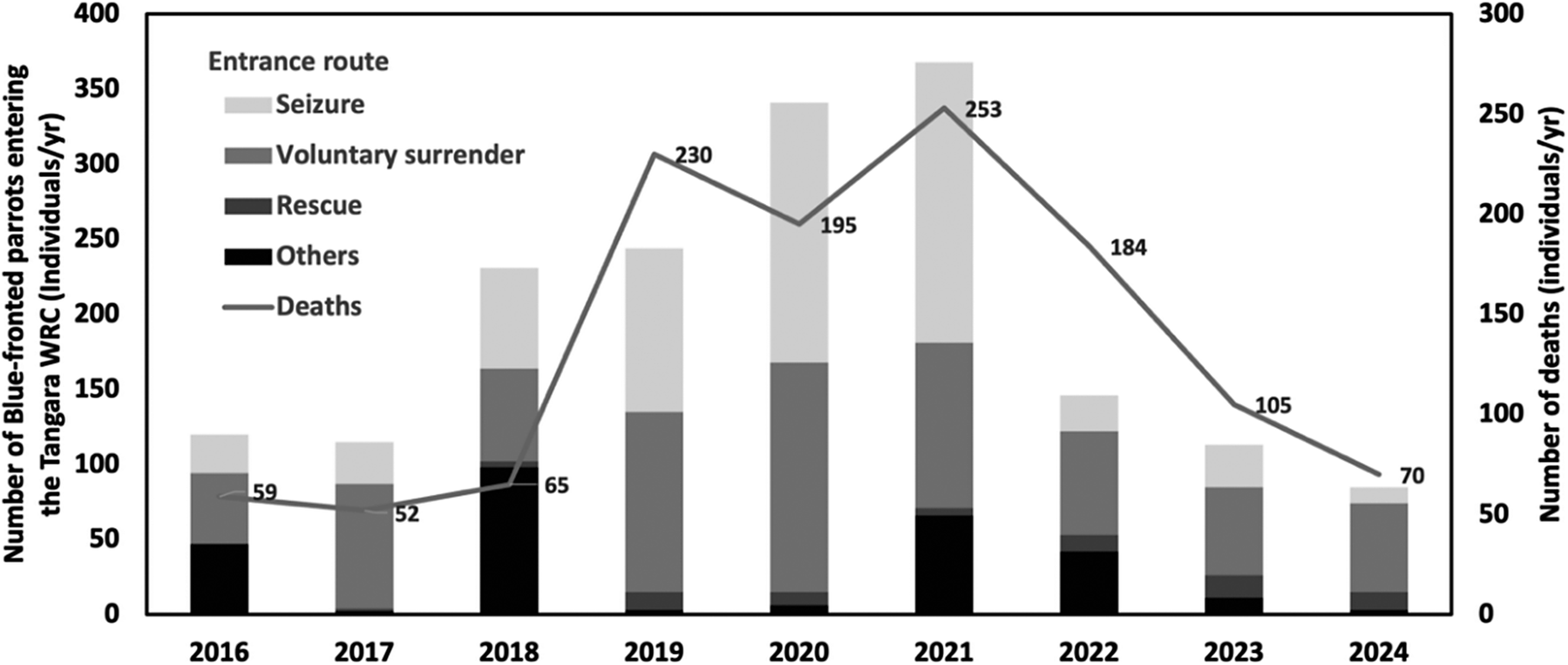
Blue-fronted Parrots entered Tangara WRC primarily via voluntary surrender and seizures over the years (Figure 3). We found that entry via seizures correlated positively with voluntary surrenders (Pearson correlation: r = 0.8586; df = 7; P = 0.0032) but not with rescues (Pearson correlation: r = -0.04929; df = 7; P = 0.8998) or others (Pearson correlation: r = 0.1457; df = 7; P = 0.7083).
Number of individuals of Blue-fronted Parrots entering the Tangara Wildlife Rescue Centre in Pernambuco, Northeast Brazil, via four routes (i.e. seizures, voluntary surrender, rescue, and others) and number of deaths between 2016 and 2024. For some years, some birds that had entered in previous years were still on site and died in subsequent years, resulting in more bird deaths than new entries.
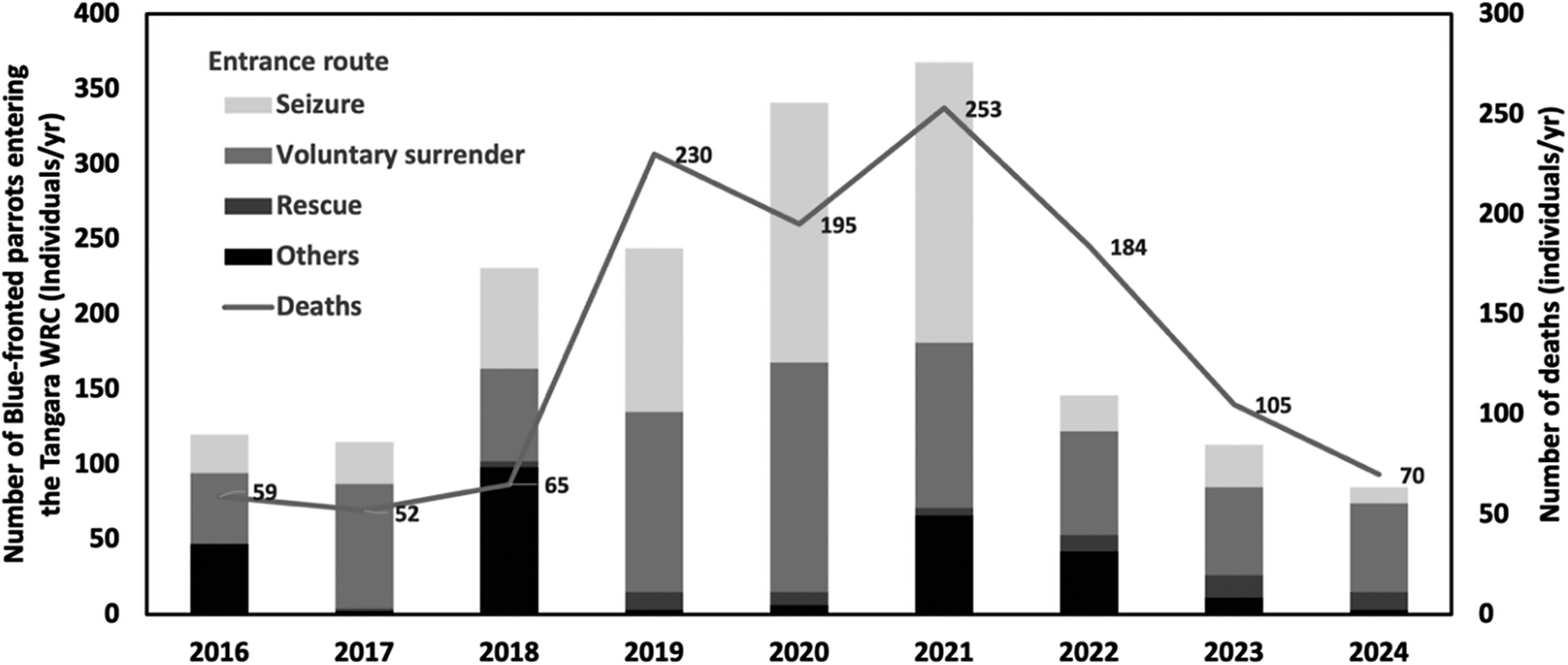
Mortality numbers were positively correlated with the number of individuals entering Tangara WRC via seizures (Pearson correlation: r = 0.7699; df = 7; P = 0.0152) and voluntary surrender (Pearson correlation: r = 0.733; df = 7; P = 0.0246), but not via the other routes (rescues – Pearson correlation: r = 0.3443; df = 7; P = 0.3643; others – Pearson correlation: r = -0.0257; df = 7; P = 0.9477) (Figure 3). A total of 1,213 parrots died at Tangara WRC between 2016 and 2024.
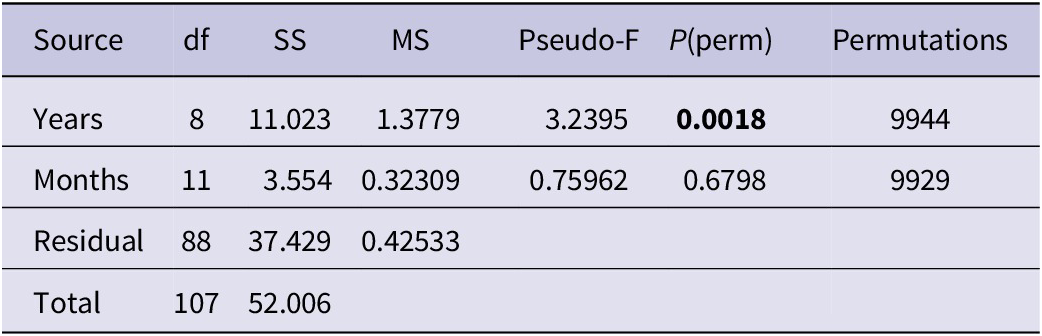
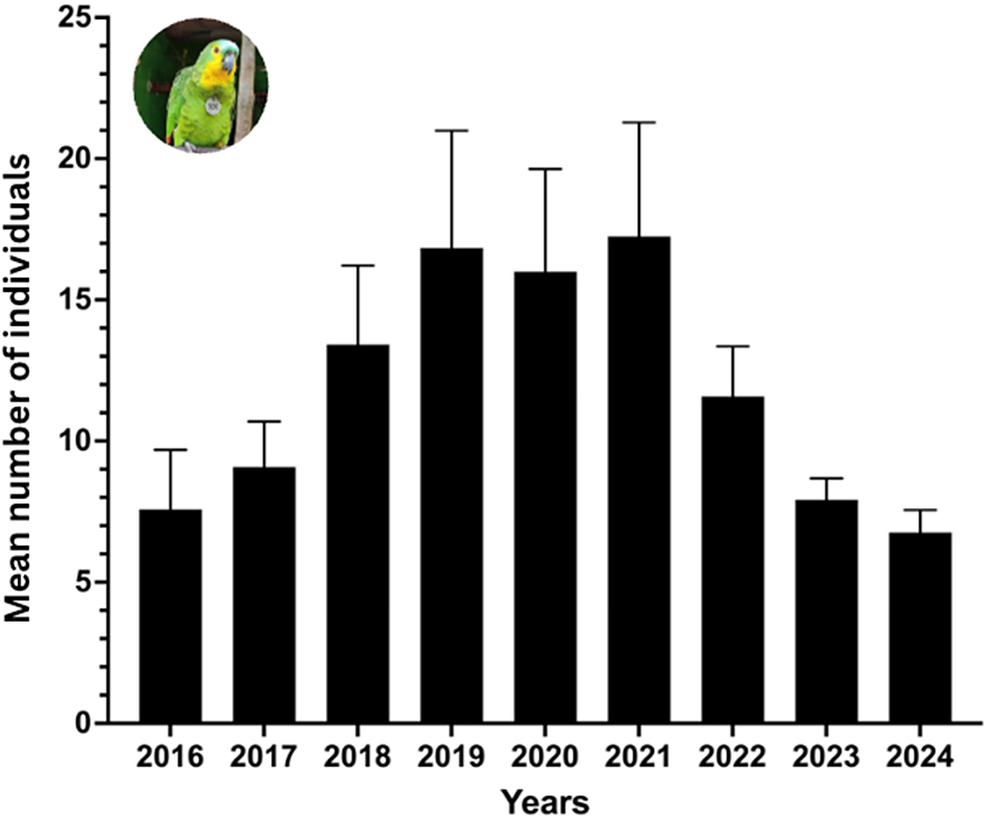
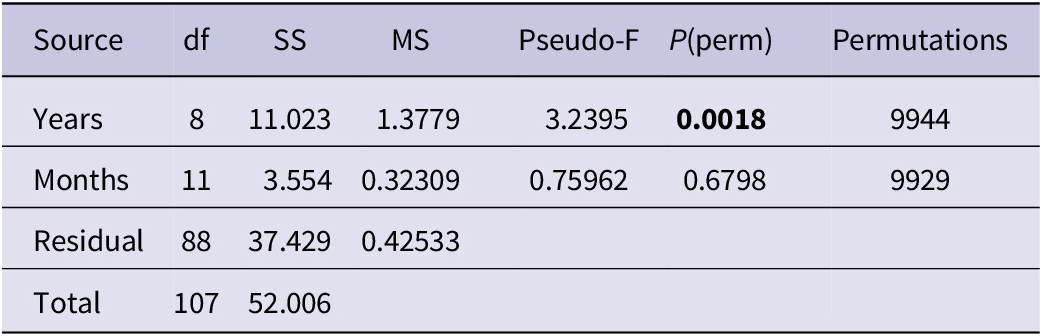
Permutational-ANOVA showed that the number of Blue-fronted Parrot adults entering Tangara WRC varied according to the year of entry (Figure 4) but not the month (Table 2). However, not all years differed in the a posteriori pairwise comparisons (Supplementary material 3).
Adult Blue-fronted Parrots entering the Tangara Wildlife Rescue Centre in Pernambuco, Northeast Brazil, per year between 2016 and 2024. Data are presented as means ± standard error.
Summary of the results of a Permutational-ANOVA investigating whether there are differences in the number of adult Blue-fronted Parrot arrivals according to year and months between 2016 and 2024 in the Tangara Wildlife Rescue Centre in Pernambuco, Northeast Brazil
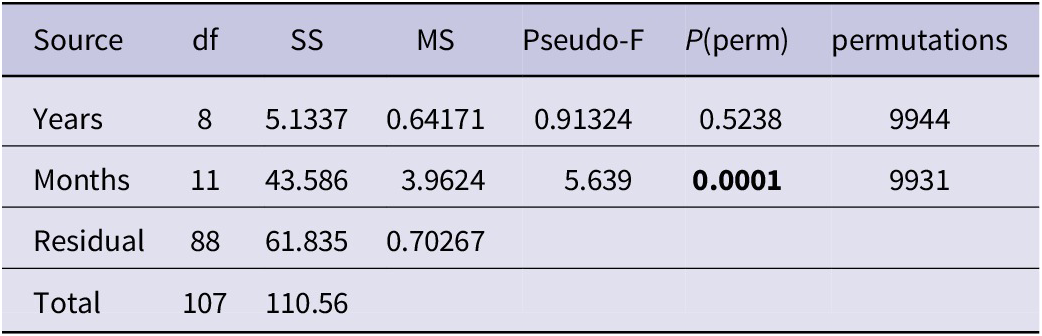
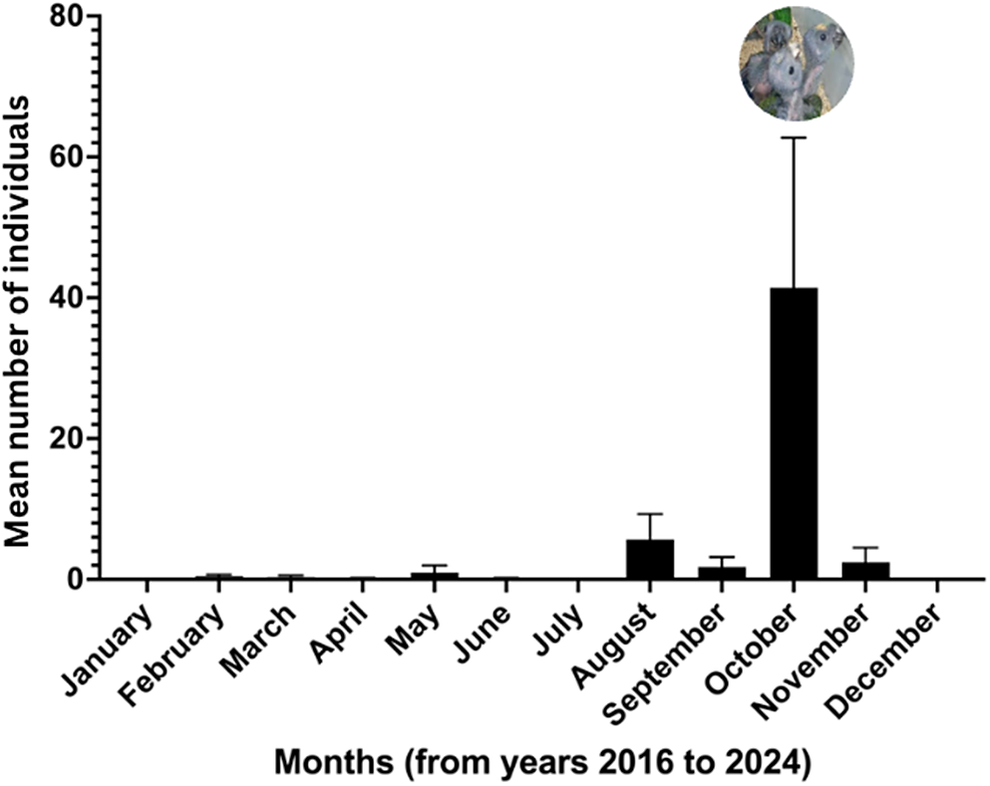
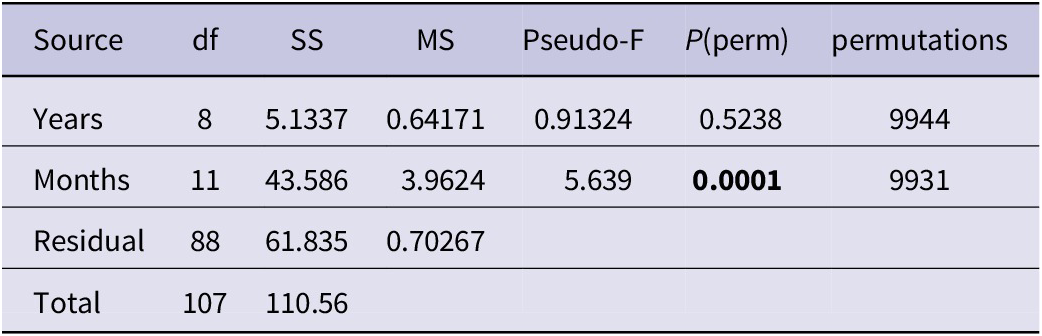
Permutational-ANOVA showed that the number of Blue-fronted Parrot chicks entering Tangara WRC varied according to the month of entry (Figure 5) but not the year (Table 3). October had the highest number of chicks arriving at the centre and differed from all other months except August (Supplementary material 4).
Chicks of Blue-fronted Parrots entering the Tangara Wildlife Rescue Centre in Pernambuco, Northeast Brazil per month between 2016 and 2024. Data are presented as means ± standard error.
Summary of the results of a Permutational-ANOVA investigating whether there are differences in the number of arrivals of chicks according to year and months between 2016 and 2024 in the Tangara Wildlife Rescue Centre in Pernambuco, Northeast Brazil
Discussion
Our study revealed a concerning outcome of parrot poaching in Northeast Brazil. Tangara WRC entry data from 2016 to 2024 revealed over 2,000 parrots seized and 7 parrot species involved in this trade. Entries into the rescue centre varied according to species, years, and months over this period. Blue-fronted Parrot was the most representative species (~78%) and was seized in 95 municipalities distributed in 11 Brazilian states. Most of the municipalities were in Pernambuco, with reports from the metropolitan region and the countryside. Custódia, Ouricuri, and Recife provided the highest number of individuals entering the centre. While demand and opportunity appear to drive the parrot trade in other places, such as Indonesia (Pires et al. Reference Pires, Olah, Nandika, Agustina and Heinsohn2021), our findings suggest that in Pernambuco, Northeast Brazil, the strong preference for Blue-fronted Parrots (accounting for 78% of seized parrots) is likely a key factor influencing the poaching pattern in the region. Although recent studies indicate that other parrot species are preferentially poached (Romero-Vidal et al. Reference Romero-Vidal, Hiraldo, Rosseto, Blanco, Carrete and Tella2020, Reference Romero-Vidal, Toledo-Gonzalez, Bunn, Blanco, Hiraldo and Bermúdez2023), the Blue-fronted Parrot is still one of the most exploited birds by legal and illegal trades globally and locally (Alves et al. Reference Alves, Lima and Araújo2013; Bush et al. Reference Bush, Baker and Macdonald2014; Chan et al. Reference Chan, Poon, Wong and Sin2021; Charity and Ferreira Reference Charity and Ferreira2020; Destro et al. Reference Destro, Pimentel, Sabaini, Borges and Barreto2012; Sánchez-Mercado et al. Reference Sánchez-Mercado, Ferrer-Paris, Rodríguez and Tella2021). Nevertheless, the wildlife rescue centre from where we obtained the data receives the vast majority of its birds from the state of Pernambuco, where only two species of Amazona birds are found (Farias et al. Reference Farias, Pereira and Silva2008), i.e. Amazona aestiva and A. amazonica (Orange-winged Parrots) – the latter being the second most common parrot species arriving at Tangara WRC. This trend is reflected in the current population decline observed for Amazona species (BirdLife International 2019). Blue-fronted Parrots and Orange-winged Parrots are poached in the wild as chicks and adults, subjected to inhumane treatment and brutal transportation conditions that inflict physical harm, stress, and mortality. These species nest in tree cavities, which may make them more vulnerable to nest hunting by poachers (Melo et al. Reference Melo, Ferreira, Leal, Souza, de Loures-Ribeiro and Sousa2014; Seixas and Mourão Reference Seixas and Mourão2022). In addition to poaching, habitat loss and fragmentation contribute to population decline (Charity and Ferreira Reference Charity and Ferreira2020; Herrera and Hennessey Reference Herrera and Hennessey2007; RENCTAS 2001).
In Brazil, the Psittacidae family comprises 27 genera (14 parrot species of the genus Amazona) and 87 species of macaws, parrots, and parakeets (Pacheco et al. Reference Pacheco, Silveira, Aleixo, Agne, Bencke and Bravo2021). Our data showed that Blue-fronted Parrot was the most common species of the genus Amazona to arrive at the rescue centre between 2016 and 2024. Similarly, an analysis by SAVE BRASIL (2017) showed that Blue-fronted Parrots were the most common species to arrive at the Centro de Recuperação de Animais Silvestres (Wild Animal Recovery Center) and Centro de Manejo e Conservação de Animais Silvestres (Center for the Management and Conservation of Wild Animals), representing the first and second place, respectively, in the list of parrots received between 2003 and 2012 in these rescue centres in São Paulo, Southeast Brazil. In our study, the higher percentage of Blue-fronted Parrots, compared with other species, may reflect: (1) cultural preferences at the species’ level of attractiveness in these regions (Tella and Hiraldo Reference Tella and Hiraldo2014) as observed in other South American countries (e.g. Colombia, Peru, and Ecuador; Romero-Vidal et al. Reference Romero-Vidal, Hiraldo, Rosseto, Blanco, Carrete and Tella2020, Reference Romero-Vidal, Toledo-Gonzalez, Bunn, Blanco, Hiraldo and Bermúdez2023); recent work shows that most parrots kept as pets in the Neotropics (including Brazil and Blue-fronted Parrots; see Romero-Vidal et al. Reference Romero-Vidal, Blanco, Barbosa, Carrete, Hiraldo and Pacífico2024, Reference Romero-Vidal, Rojas, Herrera, Hiraldo, Díaz and Blanco2025) are not necessarily trafficked (i.e. they do not enter commercial chains to be sold at markets but are often captured locally by the pet owners themselves); (2) the potential ease of obtaining Blue-fronted Parrot individuals due to their broad geographical distribution (although a wide distribution range does not necessarily make a species easy to obtain, as it may be scarce in certain areas and individuals may be sourced from various locations), or (3) an already reduced number of individuals of other species in the wild (although less preferred species may remain abundant in the wild and absent from seizures due to lack of demand). Future studies should address these factors, potentially through ‘poached parrot surveys’ as used by Romero-Vidal et al. (Reference Romero-Vidal, Hiraldo, Rosseto, Blanco, Carrete and Tella2020, Reference Romero-Vidal, Toledo-Gonzalez, Bunn, Blanco, Hiraldo and Bermúdez2023) in Colombia, Peru, and Ecuador.
We found annual differences in the numbers of adult Blue-fronted Parrots received by the rescue centre between 2016 and 2024 and monthly differences for chicks, which may reflect variation in demand (Pires et al. Reference Pires, Olah, Nandika, Agustina and Heinsohn2021), possibly dubious and/or poor-quality inspections (Destro et al. Reference Destro, Pimentel, Sabaini, Borges and Barreto2012) or variations in the reproductive season and availability of chicks (Seixas and Mourão Reference Seixas and Mourão2022). These animals usually arrive at rescue centres suffering from nutritional deficiencies and illnesses such as chlamydiosis and candidiasis (de Freitas Raso et al. Reference De Freitas Raso, Godoy, Milanelo, Souza, Matushima and Araujo-Júnior2004), which strongly compromise their survival. The parrots arrived via seizures, voluntary surrender, rescue, and other means (i.e. transfers). Seizures and voluntary surrender were the primary arrival routes, which align with the findings of other wildlife rescue centres in Brazil (Santos et al. Reference Santos, Gomes, Lima, Santos, Santos and Cerqueira2021). The process of voluntary surrender is strongly influenced by media appeals and educational campaigns aimed at encouraging these surrenders, suggesting that they serve as a conservation tool for this and other species in Brazil (Ortiz-Von Halle Reference Ortiz-Von Halle2018). Pressure from police or other authorities may also influence voluntary surrenders (Alencar and Fonceca Reference Alencar and Fonceca2024; Ortiz-Von Halle Reference Ortiz-Von Halle2018). Major seizures tend to gain media attention, which may influence people’s decision to voluntarily surrender their parrot pets to rescue centres; thus, numbers arriving via seizures and voluntary surrender were correlated. Behavioural and health factors also play a role in voluntary surrenders. In many cases, people surrender their animals when they begin to present with health problems or behavioural issues to distance themselves from the problem. For example, animals with nutritional issues, behavioural stress, and illnesses associated with incorrect rearing (Siqueira et al. Reference Siqueira, de Lucena, Cavalcanti, de Lima Luna, de Oliveira Firmino and Guerra2016) are often voluntarily surrendered at rescue centres. Our study also found records of the voluntary surrender of animals previously kept by elderly people who had died and whose families did not wish to keep the animal (Y.M. Valença, unpublished data).
A substantial number of chicks were seized in October, although seizures occurred mainly from August to November throughout the study period. This coincides with the nesting season of Blue-fronted Parrots in the Cerrado (August–October; Marini et al. Reference Marini, Borges, Lopes, Sousa, Gressler and Santos2012), Pantanal (July–October; Seixas and de Miranda Mourão Reference Seixas and de Miranda Mourão2002), and Caatinga (August–November; Y.M. Valença et al. unpublished data). The nesting period of Blue-fronted Parrots across these biomes is reflected in the influx of chicks at the centre between 2016 and 2024. The species’ broad distribution likely facilitates the acquisition of both chicks (primarily during the breeding season) and adults throughout the year in Brazil.
Mortality numbers correlated with seizures and voluntary surrender rates across the years. The animals often arrive in poor condition, and the overload of animals at once may limit the caring capacity of the rescue centre. It is possible that mortality is related to factors typical of ex situ rearing since the upkeep of birds in captivity creates favourable circumstances for spreading infectious diseases such as chlamydiosis (Mattes et al. Reference Mattes, Consiglio, Almeida, Guido, Orsi and Silva2005; Raso et al. Reference Raso, Godoy, Milanelo, de Souza, Matuschima and Araújo Júnior2004). Furthermore, it is important to reinforce that birds kept as pets and/or trafficked usually experience poor housing, diet, feeding, and hygiene conditions, as well as inadequate management and situations of extreme stress (Corrêa et al. Reference Corrêa, Flores, Schneiders, Pereira, Brito and Lovato2013; Weston and Memon Reference Weston and Memon2009), which can affect their health following their rescue (Saidenberg et al. Reference Saidenberg, Zuniga, Melville, Salaberry and Benites2015; Siqueira et al. Reference Siqueira, de Lucena, Cavalcanti, de Lima Luna, de Oliveira Firmino and Guerra2016). Vanstreels et al. (Reference Vanstreels, Teixeira, Camargo, Nunes and Matushima2010) observed that Blue-fronted Parrots, frequently taken in (to a municipal zoo) from illegal trade-related origins, had a considerably lower life expectancy and higher mortality rate in the first year of captivity. A report from Mexico revealed that transportation is a significant contributor to parrot mortality, accounting for an average of 31% of deaths (Guzman et al. Reference Guzman, Sánchez Saldaña, Grosselet, Weston, Memon and Gamez2007). However, in some cases, transport-related mortality can be catastrophic, reaching 100% (Guzman et al. Reference Guzman, Sánchez Saldaña, Grosselet, Weston, Memon and Gamez2007). Furthermore, it is estimated that mortality rates remain alarmingly high, with approximately 77% of parrots dying before reaching the customer in this illegal trade in Mexico, and 45% of the ones that reach rescue centres also die (Guzman et al. Reference Guzman, Sánchez Saldaña, Grosselet, Weston, Memon and Gamez2007). This is also a reality in Northeast Brazil, as reflected in the high mortality rate following arrival at the rescue centre in our study. The Pernambuco State release programme connected to the Papagaio da Caatinga project released nearly 700 Blue-fronted Parrots between 2013 and 2023 (Papagaio da Caatinga project, unpublished data), which may somehow help to counteract the impacts of illegal trade (RENCTAS 2001; Vanstreels et al. Reference Vanstreels, Teixeira, Camargo, Nunes and Matushima2010). However, accurate data on correlated entry routes, age, and year of entry of all these released animals are not currently available. To improve conservation efforts and their ex situ management strategies, we recommend that Tangara WRC implements a data-tracking system to capture this information for all species, enabling more accurate assessments and informed decision-making for the State of Pernambuco’s animal release programme.
Our study showed that out of the seven parrot species, the Blue-fronted Parrot was the most common species to arrive at Tangara WRC. Here, we detected 95 municipalities (Supplementary material 2) where Blue-fronted Parrots were seized. National and state governments could target these areas to direct media and environmental education campaigns and punitive measures to deter poaching. We suggest that it is urgently necessary to establish public policies to resolve this problem at source, i.e. the areas where animals are seized. While enforcement measures such as programmed seizure campaigns and monitoring are essential, reinforcing area protection actions is also necessary to reduce the impacts of trade on species, despite still being one of the least cited measures in the literature (Sánchez-Mercado et al. Reference Sánchez-Mercado, Ferrer-Paris, Rodríguez and Tella2021). For example, Wright et al. (Reference Wright, Toft, Enkerlin-Hoeflich, Gonzalez-Elizondo, Albornoz and Rodríguez-Ferraro2001) observed a difference of almost 70% in nest poaching rates between protected and unprotected sites for four species of Amazon parrots. Blue-fronted Parrots’ nesting periods in three biomes overlap and coincide with the months when most chicks arrive at Tangara WRC, making their supposedly higher availability over this period appealing for illegal trafficking demands. Thus, active inspections of areas aiming to stop poaching should consider the reproductive seasons of the parrots in the biomes where they occur. Despite efforts to rehabilitate the rescued animals, the high mortality rate implies population declines. As such, despite the broad geographical distribution of Blue-fronted Parrots, these pressures reinforce the need to reassess the threat category of this species at both national and international levels.
In summary, to help protect parrots from becoming victims of poaching, we recommend targeted education campaigns for potential buyers and owners, collaborations with social media influencers to promote responsible pet ownership, and strengthening anti-poaching laws with stricter penalties. Additionally, enhancing law enforcement capacity, implementing standardised data collection protocols in rescue centres, and establishing publicly available databases are crucial for informed policy decisions. Furthermore, we advocate improved rescue centre facilities with adequate staffing, a national parrot rehabilitation programme, and community-based ecotourism initiatives that support parrot conservation and provide alternative livelihoods.
Supplementary material
The supplementary material for this article can be found at http://doi.org/10.1017/S0959270926100422.
Acknowledgements
We thank the staff at Centro de Triagem e Reabilitação de Animais Silvestres Tangara (CETRAS-Tangara) in Pernambuco, an organisation belonging to the State Environmental Agency of the State of Pernambuco (CPRH), for their support during data collection in the centre’s archives. YMV, LM, and ALM were supported by the Coordination for the Improvement of Higher Education Personnel (CAPES, Financial code 001). BB and the study were supported by FACEPE (APQ-1230-2.05/22; BCT-0667-2.04/22; BFT-0021-2.05/24) and CNPq (312512/2023-6).