Introduction
The emergence of controlled, Maastricht Category III, non-heart-beating organ donation (NHBD) programsFootnote 1 has the potential to greatly increase the supply of donor solid organs by increasing the number of potential donors. Category III donation involves unconscious and dying intensive care patients whose organs become available for transplant after life-sustaining treatments are withdrawn, usually on grounds of futility. The shortfall in organs from heart-beating organ donation (HBD)Footnote 2 following brain death has prompted a surge of interest in NHBD.Footnote 3 In a recent editorial, the British Medical Journal described NHBD as representing “a challenge which the medical profession has to take up.”Footnote 4
Criticism of controlled NHBD programs has mostly focused on the criteria used for determining death, the potential for conflict of interests to arise for the treating physician in managing the dying patient, and the possibility that clinicians might violate the Dead Donor Rule (DDR) by hastening the death of the patient through the administration of drugs or interventions in treatment.Footnote 5 We believe there is a more fundamental ethical concern with controlled NHBD.Footnote 6 We hold that the DDR is violated not just by donation practices that bring about the death of the patient but whenever clinicians treat living donors as though they were dead. In controlled NHBD, because of the need for haste in salvaging organs before lack of circulation of oxygenated blood irreversibly damages them, there is a strong incentive to initiate surgical and/or institutional procedures to facilitate donation before death occurs. We argue that these medical procedures, which “treat” one patient for the benefit of another, represent a significant departure from the ethical practice of medicine. That the patient is likely to remain unaware of these interventions does not change this; the idea that it does, we suggest, relies on a surreptitious—and false!—claim that the patient is, for all intents and purposes, dead already. Controlled NHBD will therefore usually require violating the DDR.
The conclusion that NHBD will often violate the DDR is, perhaps, not as damning of the procedure as first appears, given recent criticism of the DDR by a number of eminent medical ethicists. It is possible that premortem interventions might be justified with reference to the patient's—or an appropriate surrogate decision maker's—consent to organ donation. However, reminding ourselves that the patients involved in NHBD are “not dead yet” should draw our attention to significant implications of this fact for the level and nature of consent that is appropriate before these procedures can be undertaken ethically. Moreover, if the cost of embracing controlled NHBD is abandoning the DDR, we believe that ethical debate about NHBD should be conducted in full awareness of this fact and not be foreclosed by any attempts to redefine death or by naive appeals to utilitarian considerations.
Non-Heart-Beating Organ Donation: Background and Practice
Unsurprisingly, when transplantation first became a viable option, the American Medical Association (AMA) insisted that vital organs should only be harvested from patients who were already dead. The “Dead Donor Rule” requires that the patient be dead—and be declared dead by a physician without any possible conflict of interest—before vital organs are harvested for donation.Footnote 7 Prior to the acceptance of brain death, cadaveric donations were from patients who had been declared dead by traditional cardiopulmonary criteria. The damage suffered by organs deprived of the circulation of oxygenated blood when the donor's heart stopped beating was a significant barrier to successful transplantation from such donors. However, the recognition of brain death as a criterion of death made it possible to source organs from persons who could be declared legally dead even though their hearts were still beating.
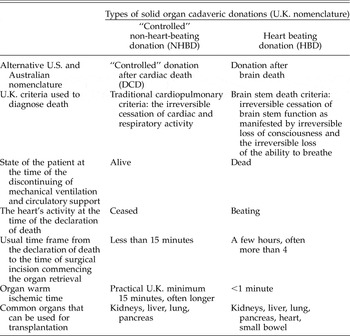
Recently, because of a shortage of organs for transplantation, there has been renewed interest in NHBD. Table 1 sets out the differences between controlled NHBD and HBD.
Cadaveric Organ Donation Today

Two features of this comparison are especially important in relation to donation practices in NHBD. First, controlled non-heart-beating donors have their mechanical ventilation and circulatory support withdrawn while they are still alive, whereas in HBD discontinuation occurs after the declaration of death. Second, NHBD involves greatly increased warm ischemic time compared to HBD, because cardiopulmonary failure must precede organ donation.Footnote 8
Attempts to improve the outcomes of transplants from NHB donors, therefore, for the most part, focus on reducing the length and degree of warm ischemic time. These attempts can be divided into two broad categories: those procedures that are initiated before the patient's heart has stopped beating and death has been declared and those that take place postmortem.Footnote 9
A number of means may be used to minimize warm ischemic time after the patient's heart has stopped beating. Most obviously, the time between this moment and the cold perfusion of organs may be reduced by minimizing the time between cessation of blood circulation and the declaration of death. This is achieved by using cardiopulmonary death criteria that require that the pulse be absent for only a very short period of time before death can be declared.Footnote 10 Once death has been declared, intravenous medications to reduce damage to organs may be administered or the organs perfused with cold fluids while still in the body via a femoral catheter. Rarely, external heart compression and extracorporeal oxygenation may be initiated, in order to maintain organ function, right up to the time of organ retrieval.Footnote 11
The desire to reduce warm ischemic damage to the donor organs has led to a much-compacted time frame for determining death in NHBD, which may, in some circumstances, introduce significant uncertainty in the diagnosis of death.Footnote 12 However, this is not our main concern here, which is the nature and ethical significance of those interventions that occur before death.
The nature of premortem interventions in NHBD varies between nations.
In the United States premortem intervention is the norm. Life-sustaining treatment is usually withdrawn in the operating theater instead of the intensive care unit in order to minimize the time between the declaration of death and organ retrieval. To enhance organ viability, intravenous medications may be administered and/or the patient cannulated while the patient is still alive so that the organs can be perfused with appropriate preserving fluids immediately after death is declared.Footnote 13
The U.K. Intensive Care Society (ICS) rejects the U.S. practice for premortem physical intervention. The ICS guidelines for NHBD insist that once a decision to withdraw life-sustaining care has been reached,
It is inappropriate to escalate current treatment, add new therapies (e.g. inotropes, heparin, hormone replacement) or to undertake invasive interventions (e.g. vascular cannulation before death for cold perfusion) to improve organ viability. … Withdrawal of active treatment should usually take place within the critical care unit. In exceptional circumstances treatment may be withdrawn within the theatre complex (e.g. an anaesthetic room, recovery area). This should be undertaken only as a way of meeting the patient's and relatives’ wish to donate organs and not simply as a means of reducing warm ischaemic time.Footnote 14
The justification for this policy is not stated in the ICS guidelines, but it is likely to be that premortem physical interventions are problematic because they offer no medical benefit to the patient—a view with which we are obviously in sympathy.Footnote 15
Premortem interventions in the United Kingdom are more subtle and take the form of organizational and attitudinal changes to the dying process. To reduce warm ischemic time in controlled NHBD, withdrawal of life-sustaining treatment in the intensive care unit will typically not commence until preparations for donation have been completed and the surgical team is in readiness. The timing of the withdrawal of treatment is chosen to maximize organ viability and not for the benefit of the donor. Similarly, the preferred method of mechanical ventilation discontinuation is to remove the breathing tube from the patient, a method known as terminal extubation, in order to promote a rapid demise, despite the fact that this increases the risk that the patients’ relatives will be distressed by the process of their dying.
The Ethical Significance of Premortem Interventions
Most discussions of the implications of the DDR interpret this rule as prohibiting interventions that bring about the death of the patient in order to harvest a vital organ and, in particular, those interventions that might bring about the death of the patient by removing a vital organ. That is to say, they interpret the DDR as prohibiting the killing of patients in order to harvest their organs.Footnote 16 We believe that this is an artificially narrow reading of the DDR. In an important discussion of the DDR, Arnold and Youngner distinguished between two components of the rule, a prohibition on killing and a prohibition on using living patients solely as a means to an end. This second component of the DDR, which should be understood as affirming the respect due to living persons by demanding that donors must be dead before their organs can be removed to advance the ends of others,Footnote 17 is equally as important as the first. Thus, for instance, in a recent New England Journal of Medicine “Perspective Roundtable” on “Organ Donation after Cardiac Death,” Arthur Caplan answers the question “What is the dead donor rule?” by saying
[t]he dead donor rule says we take organs, vital organs, only from those who've been clearly, unequivocally pronounced dead. So nothing will happen in terms of procurement, requests, anything, until you've got a team that establishes death [our emphasis].Footnote 18
Similarly, we hold that the DDR is breached whenever procedures to harvest vital organs are initiated while the patient is still alive.
In practice, controlled NHBD will usually violate the DDR. The premortem procedures that are initiated to minimize warm ischemic time in NHBD, such as cannulation, and organizational and attitudinal changes that involve the patient being viewed primarily as an organ donor rather than an unconscious intensive care patient, treat a living person as a means to the ends of others. Importantly, these breaches of the DDR are necessary to maximize the chance of successful NHBD, whereas in HBD all donation preparation can await the declaration of death.
It might be objected that we have overstated the significance of the premortem interventions involved in NHBD. In the United Kingdom, at least, the changes in the treatment of potential donors involve only organizational and administrative matters, which arguably do not impinge on the welfare of the patient. Even the more robust physical interventions practised in the United States have no impact on the subjective experience of the patient, who is unconscious. It is our impression that the claim that the changes in the care of patients are trivial is the most common response from those working in donation to criticism of controlled NHBD programs.Footnote 19
Yet, ethical medical practice consists in not just what patients experience but how they are treated—even if they are absent or unconscious. As both Kantian and virtue ethics insist, attitudes can be morally significant.
One way of bringing out the troubling nature of the attitudinal changes involved in NHBD is to imagine the logical extension of the premortem interventions that are currently employed to facilitate organ salvage. With appropriate anesthesia, it would be possible to reduce warm ischemia even further by surgically exposing the organs to be salvaged before life support was withdrawn. As long as the patient's heart stopped beating as the result of life-sustaining treatment being withdrawn rather than as a result of the preparations for donation, then this procedure would be compatible with an interpretation of the DDR that only prohibited killing the patient. Yet, it is clear that, in this scenario, we would be flagrantly violating the ordinary standards of ethical medical practice. Moreover, the real source of the violation here is the fact that we are treating a living patient as though he or she were dead rather than the details of the particular surgery. This shift in attitude toward the patient is also characteristic of current practices of premortem intervention to facilitate NHBD; it is for this reason that we believe these practices violate the DDR.
Consent and the Best Interests of the Patient
That controlled NHBD will usually violate the DDR need not be a decisive objection to it. A number of authorities have previously canvassed the idea that we should abandon the DDR, in part because of the barrier it poses to organ donation.Footnote 20 Abandoning the DDR would shift the burden of establishing that a particular organ salvage is ethically permissible to the question of consent.
We are prepared to entertain the possibility that premortem interventions in the care of a controlled NHB donor may be legitimate if we have informed consent to such interventions from the patient or an appropriate surrogate, that is, consent—either current or prior—that is informed, voluntary, and provided by a competent agent.Footnote 21 However, an unconscious intensive care patient has no current capacity to consent to such procedures. In the absence of prior—or surrogate—consent, that means that doctors must act in a patient's best interest.
All of the U.K. policies we reviewed for this paper allow for controlled NHBD to commence on the absence of objections from the family and/or registration on the Organ Donor Register (ODR). Indeed, under the U.K. Human Tissue Act (HTA), presence on the ODR is defined as legal consent for organ donation.Footnote 22 The use of this standard in NHBD means that the “consent” process for NHBD is exactly the same as used in HBD—another indication that controlled NHBD treats the potential NHB donor as effectively dead already.
More importantly, it is clear that the process of registration with the ODR falls well short of that required to establish informed consent.Footnote 23 The educational materials associated with the ODR consist of information designed to encourage donation, with no mention of possible negative consequences of participation in donation; nor is there an opportunity for potential donors to have their individual questions about donation answered. Given these limitations of the ODR, registration should not be held to constitute informed consent to premortem interventions to facilitate NHBD.Footnote 24
In countries that allow for surrogate consent, there may well be more opportunity to gain appropriate consent for NHBD. A full discussion of the role of surrogate consent in the treatment of incompetent patients is beyond the scope of this article. However, we would note that surrogate decision makers are typically held to be under the obligation to make decisions that are in the patient's best interest and that accord with that person's prior expressed views. Allowing surrogates to consent to treatments that have no medical benefit for the patient would involve a significant shift in the role of such decision makers, which should be (very) ethically controversial. A possible exception would be where the patient has previously expressed strong views about his or her willingness to undergo particular medical procedures. However, the mere fact of registration with the ODR is insufficient evidence of the existence of such views.
In the absence of clearly expressed prior consent to premortem interventions, might there nevertheless be a case to be made that, where patients have registered on the ODR, such interventions are in their best interest? If we adopt an account of well-being that focuses on the satisfaction of agents’ preferences, then it may be in their interests to undergo premortem procedures to facilitate donation if their preference was to donate. As DeVita said in challenge to the known UK objection to premortem intervention at the Third International Meeting on Transplantation from Non-Heart-Beating Donors in London, “If you [the organ donor] do want to donate organs you don't want to donate bad organs.”Footnote 25
However, there are number of reasons to be cautious about this approach as a solution to the ethical problems involved in NHBD. First, preference satisfaction accounts of well-being are controversial and subject to a number of well-known objections.Footnote 26 Second, there is a certain amount of intellectual strain involved in thinking of premortem interventions in the care of a patient designed to facilitate NHBD as motivated by a concern for the best interests of the donor. They are more naturally understood as driven by a concern for the best interests of potential organ recipients. This is not to say that donation and the procedures necessary to facilitate it might not also be in the donor's best interests. However, the strong interests of other parties in the donation process lend weight to the suspicion that the account of well-being supposed here has been chosen for the support it lends to NHBD rather than on its own merits. Third, even according to a preference satisfaction account of well-being it is unlikely that the satisfaction of a patient's every preference will be in his or her best interests. Instead, the extent of the satisfaction of his or her strong or considered preferences will determine a patient's well-being. Yet, as we observed above, registration with the ODR is an unreliable indicator that donors have a strong preference to undergo particular procedures. Moreover, fourth, there are good reasons to believe that many patients might object to interventions that treat them as though they were already dead and that may involve assaults on their physical integrity and dignity and/or prove psychologically distressing to their loved ones. In the absence of compelling evidence that a particular patient had strong preferences to allow intervention in the dying process in order to facilitate donation, then, it is inappropriate to judge it to be in a patient's best interests to undergo procedures that are more naturally described as benefiting other people.
Of course, if the salvage of vital organs while the patient is still alive can be justified by securing consent, then the question arises of why we should continue to put such stock in the distinction between withdrawing treatment and actively euthanizing patients. If we are prepared to violate the DDR by beginning the removal of vital organs before death occurs, as long as we have appropriate consent, should we not also be prepared to violate it by killing the patient in the course of doing so—or, indeed, in order to do so? Posing the question in this blunt form highlights the challenge that controlled NHBD poses to the ethical practice of organ salvage and donation.
Redefine Death?
An alternative response to concerns about violations of the DDR in the course of controlled NHBD is to claim that the unconscious and dying intensive care patient is, in all relevant senses, dead already and therefore that it is entirely appropriate for them to be treated in the same way as those who are brain dead.Footnote 27 If we are prepared to distinguish between the death of the person—the center of conscious experience that is worthy of moral regard—and the death of the human organism, then we may be able to claim that, sometimes, although the organism is still alive the person may be dead. If personhood is any of the following: perceiving oneself as existing over time, rationality, possession of preferences, or goal setting; then it might be argued that the unconscious and dying intensive care patient has died prior to donation.Footnote 28 According to this line of thought, controlled NHBD does satisfy the DDR after all.
Whether this distinction is a plausible one and the consequences for medical practice of adopting criteria of death that focused on “death of the person” are questions too large for us to settle here.Footnote 29 In this context it will suffice to note just how radical a change in our notion of death such a move would involve.Footnote 30 As a number of philosophers have argued, infants are not persons in the sense outlined above, as they lack both future-regarding preferences and a sense of themselves as persisting through time.Footnote 31 Similarly, in this account, many individuals at the end of life, particularly those suffering advanced dementia, will be dead for long periods of time before their bodies expire. Indeed, the “person” may have “died,” albeit perhaps only temporarily, whenever a patient is unconscious. Insisting that death involves the irreversible loss of the capacities listed above does not entirely resolve these anomalies (e.g., it cannot explain why it would be directly wrong to kill an infant before he or she had formulated the desire to stay alive) and has the further consequence of rendering the answer to the question as to whether a patient is dead or not hostage to future events. As Singer has argued, this “revised” concept of death, shaped to fit a very particular—if widely shared—set of philosophical commitments, is so implausible an account of death that we can only account for it being contemplated at all as a consequence of the desire to make more organs available for transplant, possibly because of utilitarian concerns of the sort we consider below.Footnote 32 Short of this radical revision of our concept of death, NHBD patients are clearly still alive until they have suffered brain death or their hearts have stopped beating.
The Utilitarian Case for NHBD
There is, of course, a utilitarian justification for controlled NHBD programs, which argues that any negative impacts of violations of the DDR or of breaches of consent are outweighed by the great benefits provided to the recipients of organs from these programs. We suspect that a vivid awareness of the situation of those awaiting the availability of organs for transplantation, along with the belief that any harms to the donors involved in NHBD, if not trivial, are not of the same order as those confronting potential recipients, serves to justify NHBD programs in the eyes of many of those involved in them.
However, this utilitarian argument is—as is so often the case with utilitarian arguments—much too powerful and would justify policies that are clearly unethical by current standards. For example, Harris's notorious “survival lottery,” wherein the organs of randomly selected healthy persons would be confiscated and redistributed to the needy sick, can be justified on utilitarian grounds.Footnote 33 The ease with which repugnant conclusions can be justified using utilitarian arguments suggests that we should be extremely cautious about abandoning long-held principles of ethical medicine, such as respect for patient autonomy and concern for the best interests of each and every individual under our care, in response to the demands of a utilitarian calculus.Footnote 34
If proponents of NHBD wish to justify premortem interventions without consent in NHBD with reference to a utilitarian calculus, then it would be best if this were done explicitly and not (mis)represented as a claim about the nature or significance of death. Society would then be able to make a clear choice about whether or not to permit such interventions.Footnote 35 We believe that an honest acknowledgment of the fact that, where it involves premortem interventions, controlled NHBD involves taking organs from living patients and must be justified—if, indeed, it can be justified—by reference to the consent of the donor is an essential first step in the debate about the ethics of these practices.
Conclusion
Controlled NHBD offers tremendous opportunities: It also offers new ethical challenges. In practice, NHBD will usually violate the DDR by beginning the procedures to remove vital organs well before the patient is dead. Abandoning the DDR shifts the burden of the argument for ethical NHBD onto the question of consent. We argue that the appropriate consent for medical procedures to be carried out while the patient is still alive is informed consent and that registration with an organ donor registry is itself insufficient to justify premortem interventions in the care of NHBD patients. There may be some scope for ethical premortem intervention in NHB donation where prior consent has been given or where surrogates are capable of drawing on reliable knowledge of a potential donors’ own preferences. However, again, the mere fact of registration for organ donation should not be taken to establish the existence of a preference to undergo premortem interventions. The argument that premortem procedures to facilitate donation are in a patient's best interest is tendentious and, in practice, is also likely to founder on difficulties in demonstrating that NHB donors had strong preferences to undergo such procedures. Although there may be a utilitarian case to be made for NHBD, any such argument is likely to suffer from the familiar failings of utilitarian arguments: that they sanction the instrumentalization of persons and can be used to justify intuitively repugnant policies. It is, therefore, our conclusion that current moves toward more widespread NHBD can only be justified if we are prepared to abandon the Dead Donor Rule.