Introduction
Cumulative evidence has highlighted the role of non-cognitive factors in educational attainment, a status with wide-ranging and long-term consequences, including occupational and earning attainment (Farkas, Reference Farkas2003; Heckmann et al. Reference Heckmann, Stixrud and Urzua2006). Among these non-cognitive factors are behavioral disturbances. An association between educational attainment (i.e. the amount of schooling young persons have completed) and early psychiatric and behavior problems has been reported in recent studies (Kessler et al. Reference Kessler, Foster, Saunders and Stang1995; Fergusson et al. Reference Fergusson, Lynskey and Horwood1997; Miech et al. Reference Miech, Capsi, Moffitt, Wright and Silva1999; McLeod & Kaiser, Reference McLeod and Kaiser2004; Breslau et al. Reference Breslau, Lane, Sampson and Kessler2008). Persons with early onset psychiatric disorders fail to graduate from high school, enroll in college or complete college if they had enrolled more frequently than persons with no history of early disorders. One way in which early disturbances might adversely affect educational attainment is by impeding the acquisition of the basic academic skills necessary for efficient mastery of the sequentially more complex school curriculum. Educational attainment is dependent in large part on academic success during the period of school attendance. In that regard, some types of behavioral or emotional disturbance may be more important than others in predicting educational attainment. An extensive cross-sectional literature has established that attention problems and hyperactivity, as well as attention deficit hyperactivity disorder (ADHD), are associated with academic underachievement, even after taking into account co-occurring learning disabilities (for one review, see Hinshaw, Reference Hinshaw1992). Less information has been available on the longitudinal course of these relationships and on the importance of attention problems relative to other behavioral and emotional problems for success in school.
Duncan et al. (Reference Duncan, Dowsett, Claessens, Magnuson, Huston, Klebanov, Pagani, Feinstein, Engel, Brooks-Gunn, Sexton, Duckworth and Japel2007), using data from six longitudinal, non-experimental studies, have documented the association of attention problems (measured dimensionally) at school entry (in addition to cognitive skills) with subsequent academic achievement. Disruptive behaviors and emotional problems had no bearing on subsequent school performance, once attention problems were taken into account. The longitudinal studies that provided the data for the analysis published by Duncan et al. did not follow-up children beyond elementary school. We have recently extended the longitudinal evidence on the association of attention problems at school entry with subsequent math and reading up to the conclusion of high school (Breslau et al. Reference Breslau, Miller, Breslau, Bohnert, Lucia and Schweitzerin press). Using data from a longitudinal study that followed up children from age 6 to age 17, we found that teachers' ratings of attention problems at age 6, just a few months after school entry, predicted academic achievement in math and reading at age 17, controlling statistically for children's IQ, socially disadvantaged community, maternal education and single-parent status, and taking into account the correlation of attention problems with externalizing (disruptive) behaviors and with internalizing (emotional) problems. Externalizing and internalizing problems at age 6 had no significant association with academic achievement at age 17, when considered together with attention problems, using the same set of statistical controls (Breslau et al. Reference Breslau, Miller, Breslau, Bohnert, Lucia and Schweitzerin press).
The goal of this report is to build on our previous work on the attention problems – academic achievement link by probing the relationship between change in attention problems during the first years of school, from age 6 to age 11, and change in math and reading achievement from age 11 to age 17. For this purpose, we use additional data that were not employed in the previous analysis, which focused on attention problems at age 6 and achievement at age 17 (Breslau et al. Reference Breslau, Miller, Breslau, Bohnert, Lucia and Schweitzerin press). The additional data come from assessments conducted when the children were 11 years old. At that time, we obtained teachers' ratings of attention problems (as we had done when the children were 6 years old) and implemented the first assessment of academic achievement in math and reading. (This longitudinal study included three assessments, at ages 6, 11 and 17 years, as described in the Method section below). Teachers' ratings of attention problems at age 6 measure early development through experiences prior to school entry; teachers' ratings of attention problems at age 11 (when treated as changes from ratings at age 6) measure change in behavior during the early school years, chiefly through experiences in the classroom. Although attention and impulsivity can be detected in pre-schoolchildren, they continue to develop during the first years of school (Olson et al. Reference Olson, Sameroff, Kerr, Lopez and Wellman2005).
Performance on academic achievement tests is relatively stable throughout the school years, although some change does occur (Pungello et al. Reference Pungello, Kupersmidt and Burchinal1996; Kowelski-Jones & Duncan, Reference Kowelski-Jones and Duncan1999; Duncan et al. Reference Duncan, Dowsett, Claessens, Magnuson, Huston, Klebanov, Pagani, Feinstein, Engel, Brooks-Gunn, Sexton, Duckworth and Japel2007). Little is known about factors that influence change in academic achievement, except for interrelated characteristics of aggregates, such as disadvantaged minority status, poverty and growing up in the inner city (Phillips et al. Reference Phillips, Crouse, Ralph, Jencks and and Phillips1998; Breslau et al. Reference Breslau, Chilcoat, Susser, Matte, Liang and Peterson2001, Reference Breslau, Dickens, Flynn, Peterson and Lucia2006). It was previously proposed that attention problems might be a mechanism responsible for the observed declines in academic achievement among poor schoolchildren during the period of school attendance (Pungello et al. Reference Pungello, Kupersmidt and Burchinal1996). The possibility that attention-related problems might contribute to a decline in academic achievement among schoolchildren has not been empirically examined. Furthermore, a problem that has not been previously addressed is whether changes in attention problems during the early school years have an independent association with the later course of academic achievement, beyond the effect of attention problems at school entry. Building on our previous work, we test whether change in children's attention problems from age 6 to age 11, as rated by teachers, is related to change in achievement in math and reading from age 11 to age 17. A negative linear association would indicate that increases in attention problems during the early school years predict declines in achievement scores from age 11 to age 17, whereas decreases in attention problems predict gains.
Methods
Sample and data
Data are from a longitudinal study of low birthweight (LBW) and normal birthweight (NBW) children assessed at ages 6, 11, and 17. Complete information on the population, sampling, and assessment is presented elsewhere (Breslau et al. Reference Breslau, DelDotto, Brown, Kumar, Ezhuthachan, Hufnagle and Peterson1994, Reference Breslau, Dickens, Flynn, Peterson and Lucia2006) and is summarized briefly here. We identified and assessed random samples of children from two socioeconomically disparate populations. We targeted the 1983–1985 birth-year cohorts of newborns who were aged 6–7 years in 1990–1992, the scheduled period of the initial field work. Two major hospitals in southeast Michigan, one in the city of Detroit and the other in a middle-class suburb, were selected. In each hospital, random samples of LBW and NBW newborns were drawn from hospital discharge records. Children with severe disabilities, identified at birth or at age 6, were excluded. Of the target sample, 823 (75%) participated. The samples from the two sites differed markedly in racial composition, maternal educational attainment and the proportion of mothers who were single at the time of the child's birth; differences between LBW and NBW children within each site were small (Breslau et al. Reference Breslau, DelDotto, Brown, Kumar, Ezhuthachan, Hufnagle and Peterson1994). The urban sample was predominantly black; ∼25% of the mothers had not completed high school, and more than one half were single at the time the child was born. In contrast, the suburban sample was predominantly white; only 7% of the mothers failed to complete high school, and ∼10% were single.
The second assessment was in 1995–1997, with children in each birth-year cohort assessed after they passed their 11th birthday. Of 823 children assessed at age 6, 32 (3.9%) had moved out of state by age 11; funding limitations did not permit bringing children in from out of state at this assessment. Of the 791 children remaining in the Detroit area, 717 (90.6%) were reassessed at age 11 (87.1% of the initial sample). In 2000–2002, we assessed the sample a third time, with children in each birth year cohort assessed after they passed their 17th birthday. Of 823 assessed at age 6, three (0.4%) were in residential detention/training facilities, one (0.1%) was a runaway, one (0.1%) was in foster care, and two (0.2%) were on parole/probation out of state. Of the 49 children who had moved out of state, 30 returned to Michigan for the age-17 assessment. A total of 713 children were assessed, 86.6% of the initial cohort of 823, including 56 children of the original cohort who were not assessed at age 11. The Institutional Review Boards of the participating institutions from which the samples were drawn and of Michigan State University, where the analysis of the existing data was conducted, approved the study.
Assessment of academic achievement
The Woodcock–Johnson Psycho-Educational Battery –Revised (WJ-R; Woodcock et al. Reference Woodcock, Johnson and Mather1990) was administered at ages 11 and 17. The Word Identification and Word Attack tests of the WJ-R measure basic reading and the Calculation and Applied Problems tests measure broad math. These measures were used in this analysis to measure academic achievement in the two core school subjects, reading and arithmetic. The WJ-R tests are age-standardized and have a mean of 100 (s.d.=15) in the general population. Testers were blind to the results of previous assessments as well as to other data gathered contemporaneously on the children and mothers. The correlations of WJ-R test scores at ages 11 and 17 were 0.80 for math and 0.87 for reading, respectively.
Assessment of attention problems and other behavior disturbances
Children were rated by their teachers at ages 6 and 11, using the Teacher's Report Form (TRF), which parallels the Child Behavior Checklist (CBCL) in its content and asks teachers to rate the child based on observations of classroom behavior during the preceding 2 months (Achenbach, Reference Achenbach1991a, Reference Achenbachb). It consists of 118 items rated from 0 to 2 [0=‘not true (as far as you know)’, 1=‘somewhat or sometimes true’, and 2=‘very true or often true’]. The items form eight empirically derived scales, based on factor-analytic approaches. The behavioral domain of key interest in this study is the attention-related problems, measured by the TRF attention scale. The CBCL and TRF have been widely used and methodological studies conducted by their authors have reported good test–retest reliability and validity (Achenbach, Reference Achenbach1991a, Reference Achenbachb). The 15-day test–retest reliability of the TRF attention problems scale in these methodological studies was 0.95 (Achenbach & Rescorla, Reference Achenbach and Rescorla2001). The focus on attention problems in relation to academic achievement is based on our previous findings and those of others that neither the externalizing nor the internalizing scales had independent associations with subsequent math and reading scores when their correlation with attention was taken into account (Duncan et al. Reference Duncan, Dowsett, Claessens, Magnuson, Huston, Klebanov, Pagani, Feinstein, Engel, Brooks-Gunn, Sexton, Duckworth and Japel2007; Breslau et al. Reference Breslau, Miller, Breslau, Bohnert, Lucia and Schweitzerin press). Attention problems have direct relevance to learning, whereas disruptive behaviors, which are correlated with attention problems, might not have (Duncan et al. Reference Duncan, Dowsett, Claessens, Magnuson, Huston, Klebanov, Pagani, Feinstein, Engel, Brooks-Gunn, Sexton, Duckworth and Japel2007). The TRF attention scale measures inattention as well as some of the other cardinal symptoms of ADHD (e.g. fails to finish things he/she starts; cannot concentrate, cannot pay attention for long; cannot sit still; fidgets; daydreams or gets lost in his/her thoughts; difficulty following directions; impulsive or acts without thinking; messy work; inattentive, easily distracted; fails to carry out assigned tasks). We use the label given to the scale by the authors of the CBCL and TRF, i.e. attention problems, although the scale also contains items on hyperactivity and impulsivity. The TRF externalizing broad-band scale combines two subscales, aggressive and delinquent.
TRF scale scores are standardized (T scores) based on age and sex distributions of normative samples (Achenbach, Reference Achenbach1991a, Reference Achenbachb). In this study, the correlation between teachers' ratings of the 20-item attention problems scale at age 6 and five years later, at age 11, was 0.34. The corresponding correlation of the 34-item externalizing scale was 0.44.
Statistical analysis
To estimate change in academic achievement from age 11 to age 17 in relation to change in teacher ratings on the attention scale from age 6 to age 11, we use ordinary least squares (OLS) multiple regression, modeling achievement scores at age 17 adjusted for age-11 scores:

where Y age17=achievement score at age 17, Y age11=achievement score at age 11, X 1=attention score at age 6, X 2=attention at age 11, and X 3 to X 9 are the covariates, LBW (v. NBW), urban (v. suburban), child's IQ at age 6, maternal education (coded as three dummy variables, with <high school as reference) and single mother (v. married). Achievement at age 17 (Y), adjusted for age 11, estimates the change in achievement from age 11 to age 17. The coefficient β2 (change in attention from age 6 to age 11) is an estimate from which age-6 attention and all covariates are partialled out.
The covariates LBW (v. NBW) and urban (v. suburban) represent features of the sampling design, described above. IQ is a key factor in children's academic achievement. We included IQ as a covariate, because of the possibility that attention problems and academic achievement might be mutually determined by cognitive competence (Hinshaw, Reference Hinshaw1992). Maternal education is used as an index of social class and maternal marital status is included as an indicator of whether the mother was single or married at the time of the child's birth. Single mothers are more likely to lack social and financial support of a partner.
Results
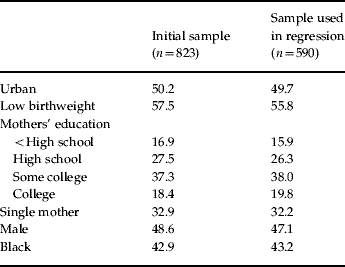
Although the follow-up completion rates across assessments were high, as described above, available data for this analysis are limited by missing teachers' data on the TRF at either age 6 or age 11. Complete data for this analysis are available on 590 participants, 72% of the initial sample. A comparison of the initial sample with the subset with complete data reveals trivial differences in the distribution across key characteristics of the sample (Table 1). A comparison of the subset with complete data and the subset with incomplete data that was not included in the analysis (n=233) detected no significant differences on any of the variables in Table 1 at α=0.10.
Characteristics of the initial sample and the subset used in this study
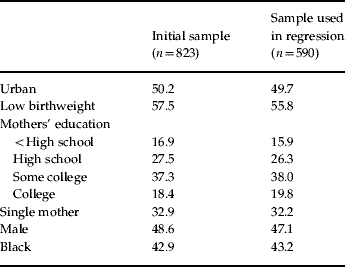
Values given are percentages.
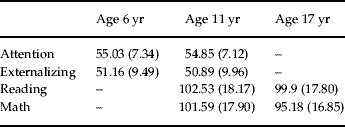
Teachers' ratings of attention problems and externalizing, on average, changed little from age 6 to age 11 (Table 2). The means of WJ-R math and reading at age 11 were 101.6 and 102.5, respectively, and at age 17, 95.2 and 99.9, respectively. On average, children declined in both academic areas, although the decline was larger in math (−6.4; 95% CI −5.6 to −7.1) than in reading (−2.9; 95% CI −1.9 to −3.4). Both declines are significant (p<0.0001) and the estimates are significantly different from one another, because their confidence intervals do not overlap (Table 2).
Means and standard deviations (s.d.) of teacher-rated attention and externalizing problems at ages 6 and 11 and reading and WJ-R math achievement scores at ages 11 and 17 (n=590)
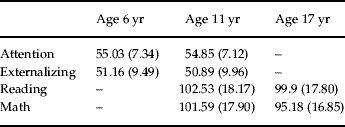
WJ-R, Woodcock–Johnson Psycho-Educational Battery – Revised.
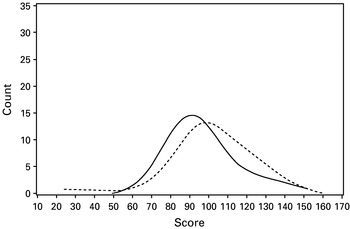
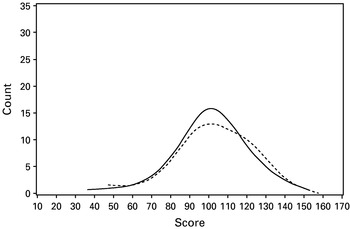
To illustrate the changes in test scores across the entire sample, we display in Figs 1 and 2 the frequency plots at ages 11 and 17 for math and reading, respectively. The figures give descriptive information on the change in math and reading from age 11 to age 17 that is not conveyed by the difference in means. Fig. 1 shows that, although the few very low scorers in math at age 11 have shifted upward, the lower mean at age 17, compared to age 11, reflects a downward shift among high scorers, i.e. those scoring 105–140 at age 11. Fig. 2 shows that the small mean difference in reading is mostly a reflection of a downward shift among students who at age 11 scored in the middle range, 90–110.
Frequency plots of Woodcock–Johnson Psycho-Educational Battery – Revised math scores at ages 11 (- - -) and 17 (–––) years.

Frequency plots of Woodcock–Johnson Psycho-Educational Battery – Revised reading scores at ages 11 (- - -) and 17 (–––) years.

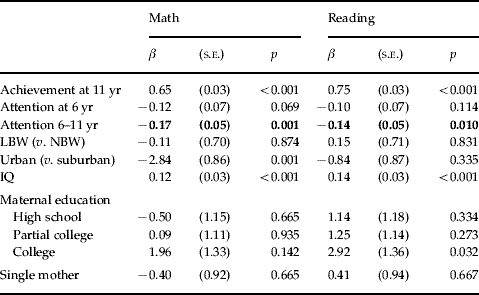
Table 3 presents the results of change in academic achievement tests from age 11 to age 17 in relation to earlier change in teachers' ratings of attention problems. Change in academic achievement is modeled by adjusting achievement at age 17 for achievement at age 11. The results show that change in attention during the early years of school was negatively associated with subsequent change in academic achievement in math and reading, after adjusting for covariates (Table 3, bold values). That is, decreases in attention problems from age 6 to age 11 were followed by gains in math and reading achievement from age 11 to age 17, whereas increases in attention problems were followed by declines. The initial level of attention problems, from which change from age 6 to age 11 is partialled out, was not significant. The results also show that the change in academic achievement from age 11 to age 17 estimated in this model was associated significantly with IQ, but not with maternal education and single- mother status.
Achievement scores at age 17 adjusted for age 11 and change in attention problems from age 6 to age 11
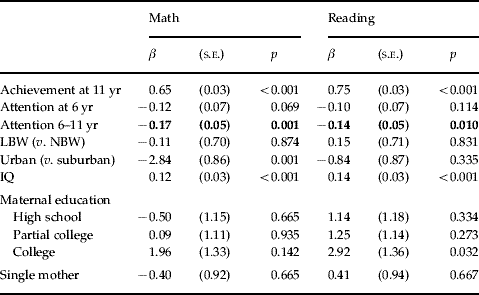
Partial coefficients and standard errors (s.e.) from multiple regression.
LBW, Low birthweight; NBW, normal birthweight; reference for maternal education is <high school; reference for single mother is married.
In additional analyses, we included teachers' ratings of externalizing behaviors at age 11 in the multivariable equation, given the substantial correlation between teachers' ratings of attention and externalizing problems (0.60). The results showed no significant partial association between externalizing at age 11 and changes in academic achievement in math or reading. For math, partial β=−0.03, s.e.=0.04, p=0.519. For reading, partial β=−0.05, s.e.=0.04, p=0.296. Further, analysis of change in externalizing from age 6 to age 11 failed to detect significant association with the achievement outcomes. The association of change in attention with change in math and reading remained nearly the same. For math the coefficient of change in attention was −0.14 and for reading, −0.10.
Discussion
In this longitudinal study we examined the association of change in teachers' ratings of children's attention problems during the early years of school with change in achievement from age 11 to the end of high school. The results show that change in math and reading scores from age 11 to age 17 was predicted from change in attention problems during the first 5 years of school, from age 6 to age 11. The negative linear relationship between change in attention and subsequent change in achievement means that an increase in attention problems during the early school years predicted a decline in math and reading scores from age 11 to the end of high school. Conversely, a reduction in attention problems was followed by gains in math and reading later on. Externalizing behavior problems at age 11 (or change in externalizing from age 6 to age 11) was not significantly associated with change in math and reading, when considered together with change in attention.
We have previously reported that components of attention mature at different rates, with important changes occurring between the ages of 6 and 9 (Huang-Pollock et al. Reference Huang-Pollock, Carr and Nigg2002). Further, clinical attention problems continue to be identified during the early school years, the period during which we assessed their change. Problems with inattention in particular may not stabilize until later in childhood (Lahey et al. Reference Lahey, Pelham, Loney, Lee and Willcutt2005); peak prevalence of ADHD treatment is at around age 10 years (Burd et al. Reference Burd, Klug, Coumbe and Kerbeshian2003). The elementary school period during which changes in attention-related problems were measured in this study therefore might be strategic for evaluating the influence of attention problems on subsequent academic performance.
A comment about the general decline in academic test scores between ages 11 and 17 observed in these data (see Table 2) is warranted. The decline was observed across subsets of children in our sample, LBW and NBW, urban and suburban (Breslau et al. Reference Breslau, Paneth and Lucia2004). Examination of recent data from the National Assessment of Educational Progress (NAEP) results, summarized in the Nation's Report Card (Santapau, Reference Santapau2001; Grigg et al. Reference Grigg, Donahue and Dion2007), suggests that the decline between ages 11 and 17 in our sample might not be an anomaly. US schoolchildren are tested on the NAEP at 4th, 8th and 12th grades and the tests had remained unchanged between 1990 and 2000. The NAEP data show a steady rise in scores during the 1990s in 4th and 8th graders but not in 12th graders. Instead, the data show a decline in scores of 12th graders from 1996 to 2000. Students in 4th and 8th grades continued to improve up to 2005. A comparison of the WJ-R scores of the same students tested when they were aged 11 (around 1996) and when they were aged 17 (around 2001) (as we have done here) would be expected to show a decline in line with the data on the NAEP for 12th graders in 2000. Flynn (Reference Flynn2007) provides a pertinent analysis of comparative data on subtests of Wechsler IQ across generations. He shows that recent cohorts in the early grades have an advantage (relative to early generations), which is lost when the students near the completion of high school.
The results strengthen the plausibility of a causal interpretation of previous findings on the role of early attention problems in predicting subsequent academic achievement by showing that change in attention problems was followed by change in academic achievement. The findings of the previous studies suggest that attention problems in the beginning of school foreshadow students' performance in math and reading at the conclusion of elementary school and up to the conclusion of high school. The findings of this analysis suggest additionally that, to the extent that students' attention in the classroom improves in subsequent years, their potential for academic achievement might be improved as well.
A limitation of the findings and their interpretation is that we cannot rule out competing explanations for the observed association between change in attention and subsequent change in math and reading. Failure to account for unmeasured variables that might be correlated with children's early behavior problems as well as with the course of academic performance might have biased the results. This longitudinal study, as other longitudinal, non-experimental studies, does not guarantee that the sequence of measurements represents what we intended: the independence of the hypothesized cause from its effect. We observed naturally occurring change in attention and subsequent change in academic performance; we did not induce the change in attention experimentally.
Small numbers do not allow a statistical test of the impact of ‘incidence’ cases falling above the subclinical/clinical cut-off on the TRF attention scale at age 11 but not at age 6 and ‘remitted’ cases, with the reverse pattern. We explored this question and found that the 35 ‘new incidence cases’ from age 6 to age 11, on average, declined in math from age 11 to age 17 by 4 points, whereas the 42 ‘remitted cases’, on average, declined by 2.4 points. Given the overall decline in math observed in the study, a larger mean decline for the ‘incidence cases’ (compared to ‘remitted cases’) is consistent with our key finding of a negative linear association of change in TRF attention score with subsequent change in math. Similar but smaller differences were observed for reading. That is, the pattern observed in comparisons of subgroups with extreme change in TRF attention corroborates our findings using change in dimensional variables.
The study builds on previous research that has employed similar measures of behavior problems as dimensional variables (e.g. Fergusson & Lynskey, Reference Fergusson and Lynskey1998; McLeod & Kaiser, Reference McLeod and Kaiser2004; Duncan et al. Reference Duncan, Dowsett, Claessens, Magnuson, Huston, Klebanov, Pagani, Feinstein, Engel, Brooks-Gunn, Sexton, Duckworth and Japel2007). It should be noted, that the measure of change is based on assessment of attention problems by 1st-grade teachers at age 6 and 5th-grade teachers at age 11. As such, it has a methodological advantage over measures based on mothers' assessments (a commonly used method), in that it is free of correlated informant bias. Further, we used academic achievement tests that are independent of teachers' evaluations, uncontaminated by teachers' knowledge about children's behaviors and attitudes. We include as a covariate children's IQ scores to control for the possibility that cognitive competence accounts for the attention–achievement association. Controlling statistically for IQ also addresses the possibility that teachers' ratings of attention might have been biased by teachers' perception of children's cognitive competence.
The findings underscore the need for research to illuminate the natural course of attention problems during the early school grades and identify factors, both inside and outside the classroom, that play a part in this development. Additionally, they suggest that studies to evaluate interventions designed to address attention problems and enhance children's ability to focus on classroom work are well worth doing.
Acknowledgements
This research was supported by grant R01 MH44586 (to N.B.) from the National Institute of Mental Health, Bethesda, MD, USA.
Declaration of Interest
None.