




No CrossRef data available.
Article contents
Leaders and followers in adolescent close friendships: Susceptibility to peer influence as a predictor of risky behavior, friendship instability, and depression
Published online by Cambridge University Press: 10 February 2006
Abstract
Adolescents' susceptibility to peer influence was examined as a marker of difficulties in the general process of autonomy development that was likely to be related to deficits across multiple domains of psychosocial functioning. A laboratory-based assessment of susceptibility to peer influence in interactions with a close friend was developed and examined in relation to corollary reports obtained from adolescents, their mothers, and close peers at ages 13 and 14. As hypothesized, observed susceptibility to peer influence with a close friend predicted future responses to negative peer pressure, but it was also related to broader markers of problems in functioning, including decreases in popularity, and increasing levels of depressive symptoms, over time. Susceptibility to peer influence was also linked to higher concurrent levels of substance use, externalizing behavior, and sexual activity. Results are interpreted as reflecting the central role of establishing autonomy with peers in psychosocial development.
This study was supported by grants from the National Institute of Mental Health (R01-MH44934 and R01-MH58066).
Information
- Type
- Research Article
- Information
- Copyright
- © 2006 Cambridge University Press
Although peer relationships provide an essential context for adolescent social development, adolescents' conformity to negative peer norms appears as a major risk factor linked to negative outcomes ranging from delinquency and substance abuse to risky sexual behavior (DiIorio et al., 2001; Hops, Andrews, Duncan, Duncan, & Tildesley, 2000; Prinstein, Boergers, & Spirito, 2001; Urberg, Degirmencioglu, & Pilgrim, 1997). Beyond adolescence, problems in relating to peers have been linked to a range of outcomes including depression, conflictual marital relationships, and even an increased likelihood of early death (Klerman, Weissman, Rounsaville, & Chevron, 1984; Miller, Smith, Turner, Guijarro, & Hallet, 1996).
A large, robust literature now documents the development and potential negative effects of peer influences in adolescence (Berndt, 1979; Brown, 1999; Santor, Messervey, & Kusumakar, 2000). Despite all that we have learned about the relevance of peer influences, however, we still know virtually nothing about which adolescents are most likely to be particularly susceptible to these influences. Existing research has focused almost entirely upon assessing either broad developmental trends (Loevinger, 1976), or the extent to which individuals are exposed to peer pressure, but not how individual adolescents handle this pressure (Berndt, 1979; Brown, 1999; Santor et al., 2000). Research to date thus leaves unaddressed the developmentally critical question about the degree to which individual adolescents differ in their levels of susceptibility to peer influence. Given evidence that an extreme orientation toward peers in early adolescence is predictive of later problematic behaviors (Fuligni, Eccles, Barber, & Clements, 2001), the question of individual susceptibility is fundamental to linking the broader normative literature on peer influences to an understanding of the developmental psychopathology underlying the disturbed peer relationships of certain adolescents.
This study examines the overarching hypothesis that individual differences in adolescents' handling of peer influences can be viewed as a reflection of their progress in the broader developmental process of establishing autonomy in social interactions. Autonomy in social relationships encompasses a number of different traits, including the ability to assert and think for oneself, as well as the ability to direct one's own behavior (Collins, 1990). This study examines one facet of autonomy development: an adolescents' ability to maintain and successfully advocate for their own viewpoint in a dyadic discussion with their closest friend. In family studies, an adolescent's ability to develop this type of autonomy in disagreements while maintaining positive relationships with parents has been viewed as a critical task of social development (Allen, Hauser, Bell, & O'Connor, 1994). This study examined the proposition that adolescents' handling of this facet of autonomy development with peers will be an equally critical developmental task, with implications not only in terms of peer pressure and deviant behavior, but also in terms of broader patterns of development and functioning.
Given the normative increase in deviant behavior during this age period, virtually all early adolescents are exposed to significant levels of problematic behavior within their broader peer groups (Moffitt, 1993), even though most teens acknowledge and respect the values their parents hold regarding such behavior (Smetana & Asquith, 1994). Research has now shown that among youth who have been identified as at risk for delinquent behavior, peers can strongly support the development of each other's deviance in part by entraining one another in deviant behavior patterns (Dishion, Poulin, & Burraston, 2001; Dishion, Spracklen, Andrews, & Patterson, 1996). Further, within any peer interaction, influences are potentially bidirectional in nature, and may have different valences for different parties in the interaction, in part reflecting the complex blend of friendship and dominance factors ongoing in any friendship (Brown, 1999; Furman & Simon, 1998). We know, for example, that if a nondeviant adolescent is exposed to a deviant peer, that adolescent may tend to become more deviant (Capaldi, Dishion, Stoolmiller, & Yoerger, 2001). Conversely, however, the deviant adolescent in this case may also be influenced by their nondeviant peer to become less deviant over time. The obviously critical factor in determining outcomes of such interactions is the degree to which any given adolescent is susceptible to influence by their peers. Research by Vitaro, Tremblay, Kerr, Pagani, and Bukowski (1997) has found that adolescents who had moderate (as opposed to high or low) levels of behavioral disturbance were most likely to become more delinquent when around disturbed peers. These findings indicate the potential promise in assessing individual differences in susceptibility to influence by peers.
Given the extent to which at least low levels of deviant behavior and values supporting this behavior become increasingly normative in early adolescence (Allen, Weissberg, & Hawkins, 1989; Moffitt, 1993; Roeser, Eccles, & Freedman-Doan, 1999), it seems likely that teens who are highly susceptible to peer influence will tend to also display higher concurrent levels of such peer-sanctioned deviant behavior. Unfortunately, no research to date has directly assessed such susceptibility as a concurrent marker of adolescents' deviant behavior or responses to peer pressure.
If autonomy with peers truly reflects a broader developmental process, then we would also expect critical facets of it, such as the ability to successfully argue one's viewpoint in the face of a disagreement, to be concurrently linked to other aspects of development, such as friendship formation and maintenance. Recent theories of adolescent autonomy development in the family suggest that autonomy-related behaviors are best seen as developing in the context of strong, connected relationships (Allen, Hauser, Bell, et al., 1994). Rather than a sense of relatedness or connection to others being in opposition to autonomy development, it may be a precondition for it. Similarly, a long line of research suggests that when one's social status and relationships are uncertain, there is a far greater likelihood of seeking validation from others even at the cost of one's own autonomy, in an effort to maintain or bolster one's social status and relationships (Costanzo & Shaw, 1966; Goethals & Darley, 1977; Steinberg & Silverberg, 1986). This leads to the hypothesis that adolescents who had the least strong and least stable peer relationships would be most likely to display difficulty maintaining their autonomy in discussions with peers.
From a developmental perspective, difficulties asserting one's autonomy with peers would not only be concurrently associated with negative behaviors and lower quality friendships, but would also be likely to predict the future emergence of other difficulties as development unfolds and as autonomy becomes increasingly valued within adolescent peer culture. In the short term, lack of assertiveness and willingness to go along with peers may smooth over some problems in peer relationships. In the longer term, however, as peers increasingly gain in social sophistication and are able to recognize this lack of autonomy for what it is, adolescents who are highly susceptible to peer influence seem likely not only to have less stable friendships, but also to become less, not more, popular with their peers. Thus, lack of autonomy with peers would be expected to predict decreasing popularity over time. Similarly, as the peers of a teen become increasingly autonomous with development (and increasingly eager to assert their new autonomy in peer contexts), a teen's susceptibility to peer influence might lead that teen to experience more pressure from their increasingly assertive peers.
Finally, failure to establish autonomy in handling disagreements in important peer relationships appears likely to lead to depressive symptoms related to increasingly doubting oneself and one's capacity to take one's place within an emerging social world. These problems may be relatively minor in early adolescence, when peer relationships are just beginning to take on a more central role, but are likely to become more pronounced as adolescence progresses and the role of peer relationships increases. Just as difficulty establishing autonomy with parents has been linked to adolescent depression (Allen, Hauser, Eickholt, Bell, & O'Connor, 1994), difficulty establishing autonomy with peers might ultimately be expected to lead to an increase in depressive symptoms. This may occur both as the adolescent struggles to appropriately assert him or herself within important relationships (Price, Sloman, Gardner, Gilbert, & Rohde, 1994), and as the developmental need to establish autonomy in this regard becomes increasingly pressing.
Given the dearth of measures of susceptibility to peer pressure, and the complete absence of measures of this charged topic relying upon other than self-report, the current study developed a laboratory-based task to assess the degree to which adolescents were susceptible to influence by a close friend in a neutral context. This task involved strategic and moral questions about a hypothetical dilemma, and resembles commonly occurring adolescent discussions of hypothetical future events. Although these discussions are hypothetical, they are believed to tap a fundamental process by which adolescents develop their future norms for behavior (Hill & Holmbeck, 1986). These hypothetical discussions do not, however, involve issues of problematic behavior, nor of the adolescent's current social situation or functioning, and thus avoid the problem in much extant research of confounding peer influence with propensity to engage in deviant behavior (Berndt, 1992).
Our overarching hypothesis was that adolescents who were easily swayed by their peers in a hypothetical discussion would also be more vulnerable to a broad array of negative behavioral and psychological outcomes. Conversely, we hypothesized that adolescents who displayed relative immunity to peer influence in these situations or who were effective at influencing their friends would likely be buffered against negative effects of peer influence processes in early adolescence.
We assessed the relationship of susceptibility to peer influence to psychosocial functioning in two respects. First, we hypothesized that susceptibility would serve as a marker of concurrent levels of problematic behavior, specifically examining the notion that susceptibility to influence by one's peer may be part of the same processes that produce heightened levels of substance use, precocious sexual activity, and general patterns of externalizing behavior in early adolescence. Second, we assessed the relations of susceptibility to peer influence to relative changes in a number of behavioral and psychosocial outcomes over a 1-year period, controlling for baseline levels of functioning. It was hypothesized that whereas susceptibility to peer influence might have short-term beneficial effects within the peer group and thus may not be linked to concurrent problems with peers (e.g., agreeableness may have its benefits), eventually as peers become aware of this susceptibility and the lack of autonomy it implies, they will be less likely to be accepting of it. Thus, susceptibility was expected to be associated with decreasing popularity and greater friendship instability over time. Third, given the difficulties in establishing autonomy that are implied by high levels of susceptibility to peer influence and the prior association in the literature of these difficulties with depressive symptoms, high levels of susceptibility to peer influence were also predicted to lead to increasing levels of depression over time. All assessments focused on a 1-year period in early adolescence, during which issues of peer pressure and peer influence are believed to be at their peak in salience.
Methods
Participants
This report is drawn from a larger longitudinal investigation of adolescent social development in familial and peer contexts. Participants included 177 seventh and eighth graders (83 male, 94 female; age: M = 13.36, SD = 0.66) and their parents, 154 of whom were followed with complete data collection the 1 year later (age M = 14.26, SD = 0.78). The sample was racially/ethnically and socioeconomically diverse: 101 adolescents identified themselves as Caucasian, 52 as African American, and 24 as being from other and/or mixed minority groups. Adolescents' parents reported a median family income in the $40,000–$59,999 range, which was within the same range as reported norms for the community as a whole.
At each wave, adolescents were also asked to nominate their “closest friend” of the same gender to be included in the study as well as an additional peer who was within the circle of “their four closest friends.” Close friends were defined as, “people you know well, spend time with and who you talk to about things that happen in your life.” For adolescents who had difficulty naming close friends, it was explained that naming their “closest” friends did not mean that they were necessarily very close to these friends, just that they were close to these friends relative to other acquaintances they might have. In all cases, adolescents were able to name at least one close friend using these criteria. In four cases, they were not able to name additional friends to complete their initial circle of four closest friends; these teens were excluded from this study.
Close friends (N = 177) reported that they had known the adolescents for an average of 4.09 years (SD = 3.05) at the first wave and an average of 4.46 years (SD = 0.75) at the second wave. At the second wave of data collection 11 adolescents could not be rescheduled and an additional 12 had close friends who could not be scheduled to come in (N = 154 at Wave 2). Attrition analyses indicate that individuals who did not have complete data for the second wave of data collection were at Wave 1 slightly more likely to be higher in externalizing behavior, lower in close friendship competence, and to be members of a racial/ethnic minority group. In addition, for the one analysis involving the extended friendship group (friends from within the circle of close friends, other than the closest friend) additional friend data (i.e., data from friends other than close friends) were available only for 106 adolescents. There was more missing data for these less close friends because the incidence of the friend (or friends' parents) refusing to participate was higher for this group than for the group of the target teen's best friends.
Adolescents were recruited from the seventh and eighth grades at a public middle school drawing from suburban and urban populations in the Southeastern United States. Students were recruited via an initial mailing to all parents of students in the school along with follow-up contact efforts at school lunches. Adolescents who indicated they were interested in the study were contacted by telephone. Of all students eligible for participation, 63% agreed to participate either as target participants or as peers providing collateral information. Adolescents provided informed assent and their parents provided informed consent before each interview session. Interviews took place in private offices within a university academic building.
At the first wave of data collection, adolescents came in for two visits: the first with their parents, and the second with their named closest peer. In the second wave of data collection, approximately 1 year later, adolescents again came in for two visits, the first with just the adolescent and the second with the person who they named as their current closest peer in the Wave 2 individual interview. Parent data were not obtained in this wave. Usage of measures at each wave is indicated in parentheses below. In addition, at each wave, an additional person in the adolescent's circle of the four peers to whom she or he was closest also came in (without the adolescent) to complete measures about their own behavior and their relationship to the target adolescent. Parents, adolescents, and peers were all paid for their participation.
Measures
Susceptibility to peer influence (Wave 1)
Susceptibility to peer influence was measured by presenting adolescents and their close friends separately with a hypothetical dilemma in which they were asked to decide which 7 out of a possible 12 fictional characters stranded on another planet should be selected for an emergency trip back to earth (Pfieffer & Jones, 1974). Adolescents were told that after making their decisions separately, they and their close friends would be brought together and told of their differences and asked to “decide together which 7 characters should be selected” (Strodtbeck, 1951). Each party then typically described their choices and reasons for selecting them. Susceptibility to peer influence was assessed as the percentage of instances where the target adolescent and their best friend disagreed about a choice initially, in which the target adolescent changed his or her initial answer to match that of his/her peer in order to arrive at a consensus answer (ranging = 0–100% changed answers). The mean number of disagreements for a dyad was 4.62, with only five dyads having fewer than two disagreements (these dyads were excluded from analyses). Across the entire sample, target adolescents changed their positions 51% of the time (and correspondingly, their friends changed their position 49% of the time), as would be expected given that both parties were on equal footing in the disagreement. Although adolescents could take up to 8 min for the entire discussion, most discussions were resolved in 3 min, indicating that adolescents were changing their positions relatively quickly.
Externalizing behavior (Wave 1)
Target adolescents' mothers reported on adolescents' externalizing behaviors using the short form of the externalizing scales from the Child Behavior Checklist (Achenbach, 1991; Achenbach & Edelbrock, 1981; Lizotte, Chard-Wierschem, Loeber, & Stern, 1992). A short-form version of the externalizing scale is created by summing item scores from the shortened versions of the original aggression, delinquency, and hyperactivity item sets for a total of 21 items, using a 0–2 scale for responding to each item. This approach has been validated using a large sample of delinquent youth where these subscales reliably predicted externalizing behavior similarly to the full scales (Lizotte et al., 1992). Cronbach's alpha for the scale of all externalizing items was 0.89. This measure was not repeated in Wave 2, as parent data were not obtained in this wave.
Target teen drug/alcohol use (Waves 1 and 2)
This four-item measure was used to assess the extent to which alcohol and substance abuse caused problems for the target adolescents. Adolescents used a 4-point scale (ranging from 1 to 4), modeled after the Self-Perception Profile for Adolescents (Harter, 1988) to reduce response bias, to rate how much their drinking and substance use caused problems for them. For example, “Some teens often get out of control drinking alcohol.” Cronbach's alpha for this measure was 0.83.
Peer drug/alcohol use (Wave 1)
Assessments were obtained regarding whether the closest peer and the one additional participating peer within the circle of four closest peers reported having previously used either alcohol or marijuana. The resulting dichotomous answers as reported by the closest friend and additional participating peer regarding these two drugs across two peers yielded a single 4-point scale reflecting the degree of experimentation with alcohol and marijuana within the target adolescent's close peer circle.
Sexual experience (Waves 1 and 2)
Using a computer-assisted interviewing procedure so that the interviewer would not be aware of their answer, target adolescents were asked to simply report on whether or not they had previously engaged in consensual sexual intercourse.
Negative peer influence (Waves 1 and 2)
A seven-item questionnaire was used to assess the extent to which each close friend reported actually influencing the target adolescent to engage in negative behaviors, including to pick fights, smoke, get bad grades and cut class, and make fun of other kids. Each question was rated on a 4-point (1–4) scale, for example, “I am [select answer] of the reason my friend makes fun of other kids” rated from a big part to not at all a part. Cronbach's alpha for this measure was 0.70 and .72 at Waves 1 and 2, respectively, which is reasonable given the intent of the measure to inventory pressure toward a range of different types of behaviors rather than focusing on assessing pressure regarding a single type of behavior.
Popularity (Waves 1 and 2)
Adolescent popularity was assessed using a limited nomination sociometric measure. Each adolescent, their closest friend and two other target peers named by the adolescent were asked to nominate up to 10 peers in their grade with whom they would most like to spend time on a Saturday night, and an additional 10 peers in their grade with whom they would least like to spend time on a Saturday night. This study used grade-based nominations (e.g., students could nominate anyone in their grade at school) rather than classroom-based nominations due to the age and classroom structure of the school that all participants attended. As a result, instead of friendship nominations being done by 15–30 children in a given classroom, each teen's nominations were culled from among 72–146 teens (depending on the teen's grade level), although unlike the classroom nominations, these nominators comprised approximately 38% of the entire student population in these grades. Nevertheless, the large number of raters for each teen (in essence, each teen received a yes/no nomination from each nominator in his/her grade) means that this subsample of nominators is likely to yield fairly reliable estimates of popularity for each teen. Preliminary analyses of the stability of popularity ratings over time (indicating a 1-year stability coefficient of r = .75, p < .0001) further suggest that this procedure was indeed reliably capturing the popularity of the teens in our study. The raw number of nominations each teen received was standardized within grade level before being added to the main data set following the procedure described in Coie, Dodge, and Coppotelli (1982).
Close friendship competence (Wave 1)
At the first wave of data collection, target adolescents rated their close friendship competence using the close friendship scale from the Self-Perception Profile for Adolescents (Harter, 1988), a five-item scale (with each item receiving scores ranging from 1 to 4) assessing their ability to establish and maintain strong close friendships. In addition, close friends rated the target adolescents' close friendship competence using a version of this instrument that was modified to serve as a peer-report measure of close friendship competence (Levine, Pollack, & Comfort, 2001). These two scales were then combined to yield a single overall measure of adolescents' close friendship competence in the context of their best friendship. Cronbach's alpha for this combined scale was 0.60, which is reasonable given that it contains items from two different lay raters. Because the actual best friend serving as a reporter changed across waves, this measure was not deemed appropriate for repeated measures, change analyses.
Close friendship stability (Waves 1 and 2)
Close friendship stability over a 12-month period was assessed simply by determining whether the target adolescent chose to and was able to recruit the same person to come in as their “closest peer” in the second wave of the study as had come in during the first wave. Although we did not track the degree of fluidity in the overall membership of the school that teens' attended, within our population of target teens who were primary participants in the study, only 1 out of 177 left the city school system (and thus moved to a different school) from Wave 1 to Wave 2, thus suggesting that geographical movement would not have been a major contributor to any observed close friendship instability. Over 95% of teens who did not bring in the same best friend at Wave 2 did so because the Wave 1 best friend dropped in their Wave 2 ranking of friendships. In the other 5% of cases, the friend was unwilling to return; these were also considered as unstable friendships, as they often reflected the Wave 1 best friends' changing appraisal of the friendship (treating these as missing values instead did not alter any findings appreciably).
Depressive symptoms (Waves 1 and 2)
Adolescents reported the degree of their depressive symptoms using the Child Depression Inventory (Kovacs & Beck, 1977). This well-validated, 27-item inventory (with each item rated on a 0–2 scale) is based on the Beck Depression Inventory, and has been positively correlated with poor self-esteem, hopelessness, and negative cognitive attributions (Kazdin, 1990). Cronbach's alpha was 0.84.
Results
Means and standard deviations for all variables of substantive interest are presented in Table 1. Initial analyses examined the role of gender, racial/ethnic minority status, and family income on the primary measures examined in the study. Family income and participant minority status each had slight correlations with primary measures in the study in several instances. As a result, family income and participant minority status were entered into analyses whenever they were significantly related to any other variable in the analysis. Because adolescent–peer groupings were automatically segregated by gender (participants could only bring in same-gender friends), gender was entered routinely as a covariate in all analyses. We also examined possible moderating effects of all of these demographic factors on each of the relationships described in the primary analyses below. No such moderating effects were found, indicating that the results described below did not differ significantly across participant gender, family income level, or race/ethnicity.
Means and standard deviations of primary measures and demographic variables

Correlational analyses
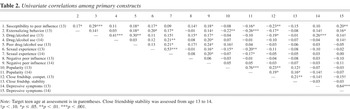
For descriptive purposes, Table 2 presents simple correlations among all primary constructs, including the marker of susceptibility to peer influence. These analyses indicate numerous simple correlations between susceptibility to peer influence and indices of youth functioning, which are explored further below. These analyses also indicate that the indices of youth functioning being considered are for the most part relatively independent of one another, and thus provide largely nonredundant tests of the utility of the susceptibility measure in predicting important aspects of psychosocial functioning.
Univariate correlations among primary constructs

Primary analyses
Hypothesis 1: Susceptibility to peer influence will be linked to higher levels of drug/alcohol use, early sexual behavior, and externalizing behavior.
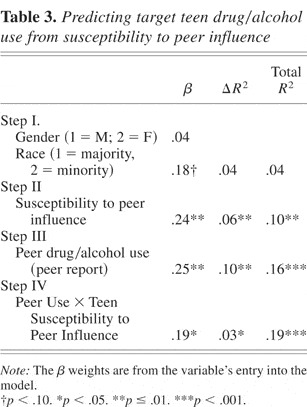
Analyses first examined the relation of susceptibility to peer influence to adolescents' drug/alcohol use, sexual activity, and overall patterns of deviant behavior. Table 3 presents results of a hierarchical linear regression equation predicting adolescents' problems with drug/alcohol use after accounting for gender and racial/ethnic minority status (given that non-White adolescents had slightly lower levels of drug/alcohol use). Initial main effects findings indicate that higher levels of susceptibility to peer influence were associated with greater problems with drug/alcohol use.
Predicting target teen drug/alcohol use from susceptibility to peer influence

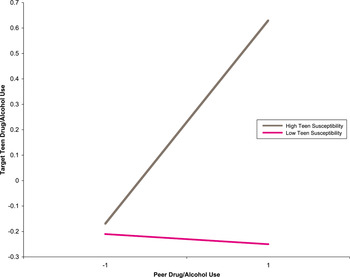
Follow-up analyses (Step IV in Table 3) examined whether susceptibility to peer influence might interact with peers' levels of substance use in accounting for teen difficulties with substance use (e.g., would substance use problems be higher for teens who were both susceptible to peer influence and who had peers with higher levels of substance use). This interaction was significant and the results are depicted, using standardized scores for all variables, in Figure 1. These results indicate that adolescent drug use difficulties are linked to peer experimentation with alcohol and marijuana. More significantly though, the strength of this association was moderated by teens' susceptibility to peer influence, such that more susceptible teens were likely to have problems with drug/alcohol use that more closely mirrored the levels of use of their peers, whereas for less susceptible teens there was little relation between their own and their peers' substance use. Thus, peers' levels of experimentation with drugs were predictive of teens' own problems with drug/alcohol use but only for those teens who were particularly susceptible to peer influence.

The interaction of peer substance use and teen susceptibility to peer influence predicting teen substance use. (All variables are in standardized form.)
Logistic regression was used next to assess whether susceptibility to peer influence was linked to likelihood of an adolescent having been sexually active as of the time of the initial assessment, after accounting for the effects of gender. Higher levels of susceptibility were linked to a greater likelihood of having been sexually active (β = .43, χ2 =5.76, p < .02). Examination of the odds ratios derived using standardized data indicate that an adolescent who was 1 SD above the mean in susceptibility to peer influence was 2.2 times more likely to have been sexually active than an individual at the mean in susceptibility.
Analyses next examined the relation of susceptibility to peer influence to adolescents' externalizing behaviors, as reported by their mothers. Results indicate that after controlling for demographic effects, adolescents with higher levels of susceptibility to peer influence were reported by their mothers to engage in higher levels of externalizing behavior (β = .18, p < .03, ΔR2 = .03, total R2 = .05).
Although the individual relationship of each of these behavioral outcomes to susceptibility was the primary focus, follow-up analyses also were conducted to assess the extent to which the three problem behavior assessments examined jointly operated in predicting susceptibility to peer influence, as one marker of whether or not susceptibility was predicting a single common aspect of the three variables above. A hierarchical regression entered externalizing behavior, drug, and alcohol use, and history of sexual activity into a model predicting susceptibility, after first entering youth gender. This model was highly significant (R2 = .11, multiple R = .33, p = .001). Externalizing behavior and drug/alcohol use both significantly added to predictions, and sexual history displayed a trend-level contribution to variance explained (p = .07). These findings indicate that several different facets of adolescents' problematic behavior were independently related to susceptibility to peer influence.
For behavioral constructs that were assessed repeatedly (i.e., drug/alcohol use, and sexual behavior) regression analyses predictions of change over time were assessed using a hierarchical regression, in which levels of drug/alcohol use, for example, at Time 1 were entered first, followed by demographic covariates related to depression at Time 1, followed by susceptibility to peer influence. This approach of predicting a future level of a variable, such as depression, while accounting for predictions from initial levels (e.g., stability) yields one marker of change in that variable: increases or decreases in its final state relative to predictions based upon initial levels (Cohen & Cohen, 1983). No predictions of change over time in levels of drug/alcohol use or sexual behavior were found.
Hypothesis 2: Susceptibility to peer influence will be linked to lower friendship quality and will predict friendship instability and relative decreases in popularity over time.
To test this hypothesis, analyses next examined the relation of susceptibility to the competence of the adolescent as a close friend (as reported by both the adolescent and the close friend), and to the actual future stability of the specific close friendship that was assessed in the experimental paradigm. Results indicate that susceptibility to peer influence was clearly linked to overall lower competence in close friendships after accounting for effects of gender and family income (β = −.24, p < .003, ΔR2 = .05). Separate post hoc analyses, in which the close friendship competence variable was decomposed into the self- and peer-report components, indicated that each component was also significantly related to susceptibility to peer influence when the components were considered separately. This suggests that the observed relation of susceptibility to peer influence to lower close friendship competence did not appear to have been due solely to one party's report of the teen's close friendship competence. No concurrent relation of susceptibility to teen's popularity was observed.
Analyses next examined predictions to the assessments of peer relationship competence for which repeated measures were available (i.e., friendship stability and changing levels of popularity). Logistic regression analyses assessed the relation of susceptibility to peer influence to the likelihood of the target adolescent recruiting the same person to come back in to our lab as their closest peer in the following year's assessment (β = −.23, χ2 = 5.79, p < .02). These analyses indicated that adolescents who were 1 SD above the mean in susceptibility to peer influence were only 65% as likely to have the same person as their closest peer the following year as were teens who were at the mean on the measure of susceptibility to peer influence. Given that the baseline level of friendship stability for the sample as a whole was 31%, adolescents who were 1 SD above the mean in susceptibility would, on average, have only a 20% chance of displaying friendship stability over a 1-year period (31 vs. 65%).
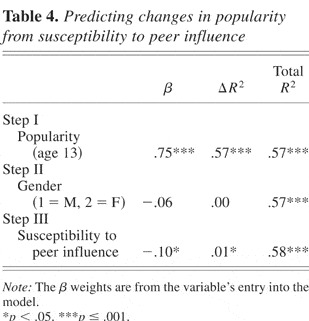
Assessment of susceptibility to peer influence as a predictor of changing levels of popularity was accomplished using the hierarchical regression approach described above in which popularity at Time 2 was predicted after accounting for popularity at Time 1 and gender. These analyses, presented in Table 4, indicate that susceptibility to peer influence at Time 1 predicted relative decreases in adolescents' popularity over the following year.
Predicting changes in popularity from susceptibility to peer influence

Hypothesis 3: Susceptibility to peer influence will predict relative increases in levels of negative peer influence of target teen behaviors over time.
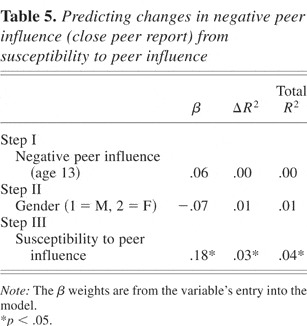
No concurrent relationship between observed susceptibility to peer influence and actual negative influence (as reported by peers) was observed. However, regression analyses examining the prediction of change in levels of peer-reported negative influences over the course of the following year, presented in Table 5, indicated that higher levels of susceptibility at baseline were associated with peer reports of more actual future influence upon the problematic behaviors of our target adolescents, after accounting for baseline levels of negative peer influence. Because many (69%) of the close peers brought back in the following year were different from those in the initial assessment, moderator analyses also examined whether this factor might have influenced the findings. This was tested by examining the interaction between susceptibility and the presence versus absence of the same close peer at the follow-up visit in predicting the outcome. No moderator effect was found, indicating that the link between susceptibility and peer reports of actual negative peer influences did not depend upon who was reporting on this behavior at the follow-up visit.
Predicting changes in negative peer influence (close peer report) from susceptibility to peer influence

Hypothesis 4: Susceptibility to peer influence will predict relative increases in levels of adolescent depressive symptoms over time.
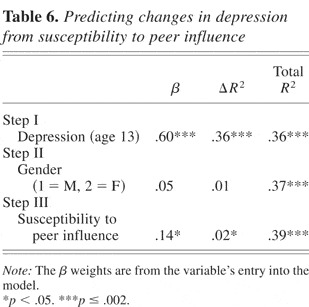
In concurrent analyses controlling for gender, observed susceptibility to peer influence was not related to concurrent depressive symptoms. Regression analyses next sought to determine whether susceptibility also would predict an increase in depressive symptoms from Time 1 to Time 2. This was done using a hierarchical regression, in which levels of depressive symptoms at Time 1 were entered first, followed by demographic covariates related to depression at Time 1, followed by susceptibility to peer influence. These analyses, presented in Table 6, indicate that susceptibility to peer influence at the baseline assessment did, in fact, predict an increase in depressive symptoms over time.
Predicting changes in depression from susceptibility to peer influence

Post hoc analyses
Because the measure of susceptibility to peer influence was created in such a way that very low scores (below 50%) indicate not only low susceptibility, but also a high degree of influence upon one's peers (e.g., that a teen persuades their peer to change their mind in more than 50% of arguments), this raised the possibility that the two ends of the scale might to some extent capture different phenomena and behave differently. Extended exploratory analyses were conducted to determine whether the findings described above might be attributable primarily to just part of the distribution of susceptibility scores (e.g., susceptibility might only have relations to other variables when it ranged from average to high levels, but not when it ranged from low to average levels). These analyses examined whether two truncated susceptibility variables (representing the top and bottom half of the distributions, respectively) would yield significantly different results from the single susceptibility variable used in this study. These analyses consistently found that splitting the susceptibility variable into two different components did not significantly change the primary findings reported above (e.g., the findings from each part of the “truncated” variable were always in the same direction and of similar magnitude). This suggests, for example, that although being very high in susceptibility could be interpreted as being linked to risk of a range of problem behaviors, it was also the case being very low in susceptibility (e.g., high in influence exerted upon one's peer), was linked to avoidance of these problem behaviors.
In addition, analyses also examined whether nonlinear (i.e., quadratic relations) might exist between levels of susceptibility and observed outcomes. These were assessed by adding a quadratic term for susceptibility following the linear term in the models described above. In no case did this term significantly add to the variance explained in the model, thus suggesting there was no evidence of the presence of a quadratic nonlinear effect in these data.
Finally, analyses were conducted to assess whether results regarding adolescent susceptibility to peer influence were affected by the number of places where a dyad disagreed. Inclusion of the number of disagreements in the analyses above did not alter any substantive findings regarding susceptibility to peer influence.
Discussion
This study found that adolescents' susceptibility to peer influence, observed in interactions with a close friend, were predictive not only of future responses to negative peer pressure, but also to broad markers of difficulties in psychosocial functioning, including declining popularity and increasing depressive symptoms over time, and to concurrent measures of deviant behavior and substance abuse. The relations observed were obtained across methods and raters, employing a newly developed laboratory-based behavioral approach to assessing susceptibility to peer influence and linking it to outcomes as assessed by mothers, peers, and the adolescents themselves. Notably, our assessment of susceptibility to peer influence was constructed such that although high scores indicated high susceptibility to peer influence, low scores reflected high levels of influence exerted upon one's close friend. This means that adolescents who were more successful in asserting their influence with their close friends (i.e., who were leaders in the interactions) displayed lower levels of problematic behavior and adaptational difficulties. Overall, these findings suggest that establishing autonomy with peers, similar to the task of establishing autonomy with parents, may be a primary task of adolescent social development.
Adolescents who were more susceptible to being influenced by their peers at age 13 were more likely to experience negative forms of peer pressure, as reported by peers, over the course of the following year. This indicates that the same process of susceptibility to peer influence identified in our lab-based task predicted peer reports of actual behavior in the face of pressure one year later at age 14. The lack of a concurrent correlation between susceptibility to influence and peer reports of teens' succumbing to negative peer pressure is most likely due to the developmental immaturity of 13-year-olds as reporters in a task requiring somewhat complex perspective-taking skills (i.e., recognizing that a friend is giving in to pressure by others, possibly including oneself). Such perspective-taking abilities are just in the process of coming online at this age (Selman, 1980), and adolescents are also gaining increasing experience in recognizing instances of peer pressure, both of which may account for adolescents being more capable of sensitively detecting a friends' susceptibility to negative peer pressure at age 14 than they were at age 13. This lack of relation to self-report measures at age 13 (together with predictions of future self-report indices) also suggests the potential unreliability of self-report approaches to assessing susceptibility to peer pressure very early in adolescence.
It is most important for the overarching hypotheses of this study that observed susceptibility to peer influence had implications well beyond reported experience in peer interactions. Susceptible adolescents were not only more likely to be increasingly pressured to engage in negative behaviors in the future, they also actually engaged in higher levels of concurrent problematic behavior, including general patterns of externalizing behavior and an increased incidence of precocious sexual activity. Unlike prior research in this area, the relations observed in this study were obtained by assessing susceptibility to peer influence in a neutral task, which did not in any way reference or tap attitudes toward problematic behaviors. This is an advance over prior research that has confounded susceptibility and willingness to engage in problem behaviors, in that it shows that susceptibility to peer influence is linked to problematic behavior even when the susceptibility is conceived and assessed broadly, and not just in the context of specific peer influences regarding problematic behaviors (Berndt, 1979, 1992; Santor et al., 2000). This approach thus presents some of the best evidence to date that susceptibility to peer influence, although relevant to adolescent deviant behavior, may in fact reflect one aspect of a far more general process of adolescent autonomy development. Together these findings suggest a reliable concurrent linkage between susceptibility to peer influence and a variety of the problem behaviors that are most likely to occur in a peer context in adolescence, suggesting that the same processes may in part give rise to both observed susceptibility and to adolescent problem behaviors.
In terms of deviance, prior research has identified general processes by which individuals at risk for deviant behavior may entrain each other in such behavior (Poulin, Dishion, & Haas, 1999). This study complements research on general peer entrainment processes by now identifying specific susceptible individuals who are most likely to receive peer pressure to engage in negative behavior and to also engage in such behavior themselves. One explanation is that susceptible adolescents may have more difficulty making their own judgments about problematic behaviors and may, instead, need to go along with the perceived judgments of their larger peer group. At age 13 adolescents are moving into a peer culture in which engaging in negative forms of behavior receives at least mild approval from some peers as a marker of relative maturity (Moffitt, 1993). Susceptible adolescents may have particular difficulty in charting an autonomous course through these peer norms. This explanation receives the greatest support with respect to experimentation with alcohol and marijuana. Although adolescent susceptibility was related to higher levels of alcohol and marijuana use in general, this relationship was particularly strong for susceptible adolescents whose close peers had experimented with these drugs. This is notable in part because the relatively low levels of experimentation in this young, community sample suggest that some susceptible adolescents may not have been exposed to significant levels of peer alcohol and drug use. Thus, it is notable that although susceptible adolescents were somewhat more likely to engage in higher levels of alcohol and drug use overall, the extent to which they did so was directly related to the extent to which their peers experimented with these substances. The alcohol and drug usage of adolescents who were below average in susceptibility, in contrast, was not related to the usage levels of their peers, suggesting that their verbal autonomy in our lab-based interaction task may have tapped into their more general patterns of behavioral autonomy in real-life interactions with peers.
In addition to difficulties with problematic behavior, easily influenced adolescents also appeared both less competent within their close friendships (as rated by both themselves and their close friend) and less likely to return to our study in the following year with the same close friend, suggesting a degree of inherent instability in the quality of their friendships. These susceptible adolescents also demonstrated relative declines in popularity from age 13 to age 14 compared to less susceptible adolescents. These findings suggest a parallel with emerging findings in studies of adolescent–parent relationships that autonomy is most adaptively established in the context of a supportive and positive relationship (Allen, Hauser, Eickholt, et al., 1994; Allen, Hauser, O'Connor, & Bell, 2002; Allen, Marsh, et al., 2002). It may be that insecurity about the quality of close peer relationships holds back the adolescent in his or her efforts to establish autonomy with close peers, perhaps out of fear of losing the friendship. Alternatively, lack of self-assertion may itself limit one's availability to fully participate in a close friendship and may contribute to difficulties in these friendships. In either case, these findings suggest that a lack of autonomy and a lack of relatedness may be closely connected in early adolescent friendships just as they are in adolescents' relationships with their parents.
Susceptibility to peer influence also appeared linked to adolescents' future psychological well being, as adolescents who were highly susceptible to peer influence were also likely to experience increases in depressive symptoms over the following year. One explanation is that adolescents who were observed to be easily influenced in our experimental task may well also have been having significant difficulties interacting assertively with their peers more generally so as to get their own needs met in relationships. Such difficulties are seen as likely to lead to depression, consonant both with the principles from interpersonal theories of depression that link it to self-assertion difficulties (Coyne, 1976a, 1976b; Price et al., 1994), and with parallel evidence from parent–adolescent interactions that difficulties establishing autonomy are linked to higher levels of depressive symptoms (Allen, Hauser, Eickholt, et al., 1994).
Finally, it is important to note that while the findings of this paper have largely been interpreted in terms of susceptibility to peer influence, the converse perspective also applies: the capacity to influence one's peers was associated with numerous positive outcomes. Specifically, adolescents who took leadership roles in their friendships were less likely to be pressured to engage in negative behaviors, less likely to actually engage in a range of risky behaviors, and ultimately less likely to be depressed. They were also rated as being better at handling close friendships and were more likely to increase in popularity over time. Overall, adolescents who are able to successfully establish autonomy, and even leadership roles, in close friendships with peers appear to be progressing along a positive developmental trajectory associated with a range of positive psychosocial outcomes.
These findings suggest that although some peer influences may be negative during adolescence, the adolescents who take leadership roles in interactions with their closest friends are not necessarily the sources of these negative influences. In this study, the more socially competent adolescents tended to take the leadership role in best-friend interactions, and this study was not able to identify any negative facets of that role. Similarly, the adolescents who were leaders in these best-friend interactions were actually less likely to engage in problematic behavior, which implies that the most destructive influences in peer interactions may not always come from the most influential teens. It should be noted, however, that leadership roles in this study were only assessed within close friendships. Leaders within close friendships may not be the same individuals as those who tend to dominate larger group interactions. For example, research has found that broader leadership roles in larger groups of peers may not be associated with entirely positive traits, encompassing elements of dominance and even of aggressive behavior (Parkhurst & Hopmeyer, 1998). Leader and follower roles may well have quite different meanings within the intimate confines of a best friendship than they do in larger peer groups, and further research will be needed to sort out these distinctions.
It should also be noted that this study assessed only one facet of adolescents' developing autonomy with peers. Although the ability to maintain one's initial position in a dyadic discussion marks aspects of self-reliance, self-confidence, and assertion that are important facets of autonomy, other aspects are important as well and were not assessed. For example, Allen and colleagues (1994) have argued that being truly persuaded by another's reasoning to change one's mind reflects an autonomous resolution of a disagreement. Unfortunately, the measure used in the present study, while having the advantage of being a face valid measure of susceptibility to influence, does not allow for distinctions to be made based on whether adolescents were internally persuaded in changing their minds versus simply caving in to influence. Similarly, some adolescents may have been depressed or apathetic, and hence unwilling to pursue disagreements.
It may be that in terms of negative peer influence and difficulties in the peer group, the fact of a teen's overall susceptibility may be more important than whether that susceptibility was based on openness to persuasion, fear of pressure, or apathy. Further research, however, might productively explore the sources of this susceptibility as it is manifest in different ways (e.g., as apathy, persuadeability, submissiveness, etc.) and even the possibility that some aspects of susceptibility to peer influence might have correlates to positive indices such as sociability. It is also possible, however, that whatever the sources, teens' susceptibility to peer influence may place them at some degree of risk for the types of problematic outcomes examined in this study. If antisocial teens are indeed working hardest to coerce others into joining them in their behavior, as some childhood research suggests (Dishion, Duncan, Eddy, Fagot, & Fetrow, 1994), then any susceptibility to influence may be important, regardless of how it comes about. Even if one is truly “persuaded” to engage in antisocial behavior by the insistent reasoning of a coercive peer, the outcome is still problematic. Given that many teen peer groups display heterogeneity in the levels of functioning of their members, exposing their members to both positive and negative role models, this study suggests one method that can be used to explore which individuals will be more versus less susceptible to negative influences from peers. Alternatively, it may be that the relative brevity of the interactions around disagreements in our task was such that changing one's mind as a result of true persuasion was actually quite rare, and that susceptibility to influence as we observed it primarily reflected a lack of autonomy in all senses of the term. In support of this interpretation, it is notable that what might seem like an ideal middle ground for some purposes (accepting and rejecting 50% of a partner's choices in disagreements), was not ideal in this instance, as the relationship of susceptibility to outcomes was linear: more susceptibility was associated with less positive outcomes across the entire range of levels of susceptibility assessed.
There are several limitations to these data that should be kept in mind in interpreting the findings. First, even longitudinal data obtained from multiple, independent sources are not sufficient to demonstrate causal relationships and many of the findings reported herein were observed only in concurrent data. Thus, these findings could be consistent with a range of explanations: that susceptibility to peer influence may cause an increased risk of problematic behavior; that susceptibility may result from such a risk; that susceptibility may reflect underlying developmental difficulties that produce both susceptibility and problematic outcomes; or that susceptibility may result from a combination of these processes. Further research is now needed to understand the sources of such susceptibility and its exact relation to future problematic behaviors.
Second, although the finding that susceptibility displayed consistent links to many different outcome markers assessed via multiple methods indicates that the phenomenon being examined is robust and likely to be part of a broader developmental process, the modest links to any single outcome also make it clear that susceptibility to peer influence is only one of a multitude of potential contributors to critical adolescent outcomes. This study supports a consistent role for susceptibility in understanding a broad array of negative adolescent outcomes, but should not be taken as suggesting that it is the sole or even primary factor in understanding these outcomes.
Third, this study deliberately assessed susceptibility to peer influence in one highly specific and ecologically relevant context (a current close friendship). Adolescents obviously select their close friends, and the nature of this relationship and of the friend selected will undoubtedly affect the degree of susceptibility observed. From this perspective, susceptibility to peer influence should not be viewed as a personality trait that exists in a psychosocial vacuum any more than any other critical social–interactional characteristic. Rather, this study considered susceptibility to peer influence as one potentially important aspect of the developing person within the social context matrix of behavioral responses of the adolescent. Future research will be needed to understand the extent to which the susceptibility within a primary peer relationship observed in this study reflects a more generalized pattern of susceptibility to influence by other peers. Fourth and finally, this study focused entirely upon early adolescence, a period during which peer pressure is believed to be still increasing sharply. Whether and how these findings might generalize to other phases of adolescent development clearly warrants consideration in future research.
References
REFERENCES
Achenbach, T. M.
(1991).
Manual for the Youth Self-Report and 1991 profile:
Burlington, VT:
University of Vermont.
Achenbach, T. M., &
Edelbrock, C. S.
(1981).
Behavioral problems and competencies reported by parents of normal
and disturbed children aged four through sixteen.
Monographs of the Society for Research in Child Development,
46,
1–82.Google Scholar
Allen, J. P.,
Hauser, S. T.,
Bell, K. L., &
O'Connor, T. G.
(1994).
Longitudinal assessment of autonomy and relatedness in
adolescent–family interactions as predictors of adolescent ego
development and self-esteem.
Child Development,
65,
179–194.CrossRefGoogle Scholar
Allen, J. P.,
Hauser, S. T.,
Eickholt, C.,
Bell, K. L., &
O'Connor, T. G.
(1994).
Autonomy and relatedness in family interactions as predictors of
expressions of negative adolescent affect.
Journal of Research on Adolescence,
4,
535–552.CrossRefGoogle Scholar
Allen, J. P.,
Hauser, S. T.,
O'Connor, T. G., &
Bell, K. L.
(2002).
Prediction of peer-rated adult hostility from autonomy struggles in
adolescent–family interactions.
Development and Psychopathology,
14,
123–137.CrossRefGoogle Scholar
Allen, J. P.,
Marsh, P.,
McFarland, C.,
McElhaney, K. B.,
Land, D. J.,
Jodl, K. M.,
et al.
(2002).
Attachment and autonomy as predictors of the development of social
skills and delinquency during midadolescence.
Journal of Consulting and Clinical Psychology,
70,
56–66.CrossRefGoogle Scholar
Allen, J. P.,
Weissberg, R. P., &
Hawkins, J. A.
(1989).
The relation between values and social competence in early
adolescence.
Developmental Psychology,
25,
458–464.CrossRefGoogle Scholar
Berndt, T. J.
(1979).
Developmental changes in conformity to peers and parents.
Developmental Psychology,
15,
608–616.CrossRefGoogle Scholar
Berndt, T. J.
(1992).
Friendship and friends' influence in adolescence.
Current Directions in Psychological Science,
1,
156–159.CrossRefGoogle Scholar
Brown, B. B.
(1999).
Measuring the peer environment of American adolescents. In
S. L. Friedman &
T. D. Wachs (Eds.),
Measuring environment across the life span: Emerging methods and
concepts (pp.
59–90).
Washington, DC:
American Psychological Association.
Capaldi, D. M.,
Dishion, T. J.,
Stoolmiller, M., &
Yoerger, K.
(2001).
Aggression toward female partners by at-risk young men: The
contribution of male adolescent friendships.
Developmental Psychology,
37,
61–73.CrossRefGoogle Scholar
Cohen, J., &
Cohen, P.
(1983).
Applied multiple regression/correlation analysis for the
behavioral sciences.
Hillsdale, NJ:
Erlbaum.
Coie, J. D.,
Dodge, K.A., &
Coppotelli, H.
(1982).
Dimensions and types of social status: A cross-age
perspective,
Developmental Psychology,
18,
557–570.Google Scholar
Collins, W. A.
(1990).
Parent–child relationships in the transition to adolescence:
Continuity and change in interaction, affect, and cognition. In
R. Montemayor,
G. R. Adamas, &
T. P. Gullotta (Eds.),
From childhood to adolescence: A transitional period? Advances in
Adolescent Development
(Vol. 2, pp.
85–106).
Newbury Park, CA:
Sage.
Costanzo, P. R., &
Shaw, M. E.
(1966).
Conformity as a function of age level.
Child Development,
37,
967–975.CrossRefGoogle Scholar
Coyne, J. C.
(1976a).
Depression and the response of others.
Journal of Abnormal Psychology,
85,
186–193.Google Scholar
Coyne, J. C.
(1976b).
Toward an interactional description of depression.
Psychiatry: Journal for the Study of Interpersonal Processes,
39,
28–40.Google Scholar
DiIorio, C.,
Dudley, W. N.,
Kelly, M.,
Soet, J. E.,
Mbwara, J., &
Potter, J. S.
(2001).
Social cognitive correlates of sexual experience and condom use
among 13- through 15-year-old adolescents.
Journal of Adolescent Health,
29,
208–216.CrossRefGoogle Scholar
Dishion, T. J.,
Duncan, T. E.,
Eddy, J.,
Fagot, B. I., &
Fetrow, R.
(1994).
The world of parents and peers: Coercive exchanges and
children's social adaptation.
Social Development,
3,
255–268.CrossRefGoogle Scholar
Dishion, T. J.,
Poulin, F., &
Burraston, B.
(2001).
Peer group dynamics associated with iatrogenic effects in group
interventions with high-risk young adolescents. In
D. W. Nangle &
C. A. Erdley (Eds.),
The role of friendship in psychological adjustment. New directions
for child and adolescent development, No. 91 (pp.
79–92).
San Francisco, CA:
Jossey–Bass.
Dishion, T. J.,
Spracklen, K. M.,
Andrews, D. W., &
Patterson, G. R.
(1996).
Deviancy training in male adolescents friendships.
Behavior Therapy,
27,
373–390.CrossRefGoogle Scholar
Fuligni, A. J.,
Eccles, J. S.,
Barber, B. L., &
Clements, P.
(2001).
Early adolescent peer orientation and adjustment during high
school.
Developmental Psychology,
37,
28–36.CrossRefGoogle Scholar
Furman, W., &
Simon, V. A.
(1998).
Advice from youth: Some lessons from the study of adolescent
relationships.
Journal of Social and Personal Relationships,
15,
723–739.CrossRefGoogle Scholar
Goethals, G. R., &
Darley, J. M.
(1977).
Social comparison theory: An attributional approach. In
J. M. Suls &
R. L. Miller (Eds.),
Social comparison processes: Theoretical and empirical
perspectives.
Washington, DC:
Hemisphere/Halstead.
Harter, S.
(1988).
Manual for the self-perception profile for adolescents.
Denver, CO:
University of Denver.
Hill, J. P., &
Holmbeck, G. N.
(1986).
Attachment and autonomy during adolescence.
Annals of Child Development,
3,
145–189.Google Scholar
Hops, H.,
Andrews, J. A.,
Duncan, S. C.,
Duncan, T. E., &
Tildesley, E.
(2000).
Adolescent drug use development: A social interactional and
contextual perspective. In
A. J. Sameroff &
M. Lewis (Eds.),
Handbook of developmental psychopathology
(2nd ed., pp.
589–605).
New York:
Kluwer Academic/Plenum Press.
Kazdin, A. E.
(1990).
Childhood depression.
Journal of Child Psychology and Psychiatry and Allied
Disciplines,
31,
121–160.CrossRefGoogle Scholar
Klerman, G. L.,
Weissman, M. M.,
Rounsaville, B. J., &
Chevron, E. S.
(1984).
Interpersonal psychotherapy of depression.
New York:
Basic Books.
Kovacs, M., &
Beck, A. T.
(1977).
An empirical clinical approach toward a definition of childhood
depression.
New York:
Raven Press.
Levine, J. A.,
Pollack, H., &
Comfort, M. E.
(2001).
Academic and behavioral outcomes among the children of young
mothers.
Journal of Marriage and the Family,
63,
355–369.CrossRefGoogle Scholar
Lizotte, A. J.,
Chard-Wierschem, D. J.,
Loeber, R., &
Stern, S. B.
(1992).
A shortened Child Behavior Checklist for delinquency studies.
Journal of Quantitative Criminology,
8,
233–245.CrossRefGoogle Scholar
Loevinger, J.
(1976).
Ego development.
San Francisco, CA:
Jossey–Bass.
Miller, T. Q.,
Smith, T. W.,
Turner, C. W.,
Guijarro, M. L., &
Hallet, A. J.
(1996).
A meta-analytic review of research on hostility and physical
health.
Psychological Bulletin,
119,
322–348.CrossRefGoogle Scholar
Moffitt, T. E.
(1993).
Adolescence-limited and life-course-persistent antisocial behavior:
A developmental taxonomy.
Psychological Review,
100,
674–701.CrossRefGoogle Scholar
Parkhurst, J. T., &
Hopmeyer, A.
(1998).
Sociometric popularity and peer-perceived popularity: Two distinct
dimensions of peer status.
Journal of Early Adolescence,
18,
125–144.CrossRefGoogle Scholar
Pfieffer, J. W., &
Jones, J. E.
(1974).
The 1974 annual handbook for group facilitators.
La Jolla, CA:
University Associates Publishers.
Poulin, F.,
Dishion, T. J., &
Haas, E.
(1999).
The peer influence paradox: Friendship quality and deviancy training
within male adolescent friendships.
Merrill–Palmer Quarterly,
45,
42–61.Google Scholar
Price, J.,
Sloman, L.,
Gardner, R.,
Gilbert, P., &
Rohde, P.
(1994).
The social competition hypothesis of depression.
British Journal of Psychiatry,
164,
309–315.CrossRefGoogle Scholar
Prinstein, M. J.,
Boergers, J., &
Spirito, A.
(2001).
Adolescents' and their friends' health-risk behavior:
Factors that alter or add to peer influence.
Journal of Pediatric Psychology,
26,
287–298.CrossRefGoogle Scholar
Roeser, R. W.,
Eccles, J. S., &
Freedman-Doan, C.
(1999).
Academic functioning and mental health in adolescence: Patterns,
progressions, and routes from childhood.
Journal of Adolescent Research,
14,
135–174.CrossRefGoogle Scholar
Santor, D. A.,
Messervey, D., &
Kusumakar, V.
(2000).
Measuring peer pressure, popularity, and conformity in adolescent
boys and girls: Predicting school performance, sexual attitudes, and
substance abuse.
Journal of Youth and Adolescence,
29,
163–182.CrossRefGoogle Scholar
Selman, R.
(1980).
The growth of interpersonal understanding: Developmental and
clinical analyses.
New York:
Academic Press.
Smetana, J. G., &
Asquith, P.
(1994).
Adolescents' and parents' conceptions of parental
authority and personal autonomy.
Child Development,
65,
1147–1162.CrossRefGoogle Scholar
Steinberg, L., &
Silverberg, S. B.
(1986).
The vicissitudes of autonomy in early adolescence.
Child Development,
57,
841–851.CrossRefGoogle Scholar
Strodtbeck, F.
(1951).
Husband–wife interaction over revealed differences.
American Sociology Review,
16,
463–473.CrossRefGoogle Scholar
Urberg, K. A.,
Degirmencioglu, S. M., &
Pilgrim, C.
(1997).
Close friend and group influence on adolescent cigarette smoking and
alcohol use.
Developmental Psychology,
33,
834–844.CrossRefGoogle Scholar
Vitaro, F.,
Tremblay, R. E.,
Kerr, M.,
Pagani, L., &
Bukowski, W. M.
(1997).
Disruptiveness, friends' characteristics, and delinquency in
early adolescence: A test of two competing models of development.
Child Development,
68,
676–689.CrossRefGoogle Scholar
Means and standard deviations of primary measures and demographic variables
Univariate correlations among primary constructs
Predicting target teen drug/alcohol use from susceptibility to peer influence
The interaction of peer substance use and teen susceptibility to peer influence predicting teen substance use. (All variables are in standardized form.)
Predicting changes in popularity from susceptibility to peer influence
Predicting changes in negative peer influence (close peer report) from susceptibility to peer influence
Predicting changes in depression from susceptibility to peer influence
 You have
Access
- 175
- Cited by