INTRODUCTION
Assessing the feeding habits of marine mammals is important to define their ecological role, and determine their position within food webs (Pauly et al., Reference Pauly, Trites, Capuli and Christensen1998). There are various methods of studying feeding habits in marine mammals (see Barros & Clarke, Reference Barros, Clarke, Perrin, Würsig and Thewissen2009). The analysis of food remains present in scats, dead animal stomach contents, and in live animal vomits, represents traditional methods which have still been widely used (Barros & Clarke, Reference Barros, Clarke, Perrin, Würsig and Thewissen2009). Several other methods have been used, for example stable isotopes (e.g. Newsome et al., Reference Newsome, Clementz and Koch2010), fatty acids (e.g. Iverson et al., Reference Iverson, Field, Don Bowen and Blanchard2004; Budge et al., Reference Budge, Iverson and Koopman2006), molecular identification (e.g. Symondson, Reference Symondson2002; Deagle et al., Reference Deagle, Tollit, Jarman, Hindell, Trites and Gales2005), the use of crittercams (e.g. Iverson et al., Reference Iverson, Field, Don Bowen and Blanchard2004) and bioacoustics (e.g. Madsen et al., Reference Madsen, Johnson, Aguilar de Soto, Zimmer and Tyack2005; Benoit-Bird et al., Reference Benoit-Bird, Gilly, Au and Mate2008). Identifying and measuring items in vomits, scats and stomach contents have several disadvantages. Cephalopod beaks and fish otoliths remain in the gastrointestinal tracts of marine mammals during different periods of time, therefore the food remains found in one stomach cannot be considered from the same meal. There is also the possibility of contamination with the prey stomach contents. Besides that, prey lacking hard parts may be underrepresented (Fitch & Brownell, Reference Fitch and Brownell1968; Clarke, Reference Clarke, Bryden and Harrison1986). Even considering these disadvantages, the analysis of food remains provides more information at a considerably lower cost than other methods, and could not be replaced effectively by any other method until now (Barros & Clarke, Reference Barros, Clarke, Perrin, Würsig and Thewissen2009). The structures used in prey identification are more resistant to digestion and usually present variation in shape and size among species. Considering stomach content analysis, the most commonly used structures are fish otoliths and cephalopod beaks. Otoliths and beaks enable investigators to estimate the size and weight of the consumed prey (see Clarke, Reference Clarke1962, Reference Clarke, Bryden and Harrison1986; Fitch & Brownell, Reference Fitch and Brownell1968; Jobling & Breiby, Reference Jobling and Breiby1986). Through the size and weight of the prey it is possible either to investigate characteristics on the spatial distribution of predators, providing possibilities to monitor alterations in the predator feeding habits, or to investigate the dynamics between prey and predator.
In the western South Atlantic, the knowledge about small cetacean feeding habits comes mainly from studies based on the stomach content analysis. The Guiana dolphin, Sotalia guianensis (Van Benéden, 1864), has been the focus of several studies since the 1960s (e.g. Carvalho, Reference Carvalho1963; Borobia & Barros, Reference Borobia and Barros1989; Schmiegelow, Reference Schmiegelow1990; Barros & Teixeira, Reference Barros, Teixeira, Perrin, Donavon and Barlow1994). In the past ten years, a considerable amount of studies had contributed to the knowledge about the diet of this species, mostly in south-eastern Brazil (e.g. Zanelatto, Reference Zanelatto2001; Santos et al., Reference Santos, Rosso, Santos, Lucato and Bassoi2002; Gurjão et al., Reference Gurjão, Neto, Santos and Cascon2003; Oliveira, Reference Oliveira2003; Di Beneditto & Ramos, Reference Di Benedito and Ramos2004; Cremer, Reference Cremer2007; Daura-Jorge, Reference Daura-Jorge2007; Di Beneditto & Sciciliano, Reference Di Beneditto and Siciliano2007; Rosas et al., Reference Rosas, Marigo, Laeta and Rossi-Santos2010). A total of eight investigations had carefully evaluated 180 stomachs collected in south-eastern Brazil from 1963 to 2005. Information on S. guianensis feeding habits is spatially scattered and should be joined together to better understand its role in trophic interactions. The Brazilian south-eastern coast is inserted in the range of S. guianensis along the coasts of South and Central America (Flores & Da Silva, Reference Flores, Da Silva, Perrin, Würsig and Thewissen2009). This species is categorized as ‘data deficient’ by the IUCN Red List of Endangered Species (IUCN, 2010). Throughout its range, human impacts, such as incidental captures in fishing operations, boat traffic, noise pollution, and habitat degradation, have been threatening several populations (see Siciliano, Reference Siciliano1994; Santos & Rosso, Reference Santos and Rosso2007; Azevedo et al., Reference Azevedo, Lailson-Brito, Dorneles, Van Sluys, Cunha and Fragoso2008; Nery et al., Reference Nery, Espécie and Simão2008). It is deemed important to evaluate the main prey items of the quoted populations, as well as to compare such items that are economically important along its distribution.
Based on the described scenario, the present study aims to evaluate the stomach contents of 18 individuals collected on the Brazilian south-eastern coast from 2003 to 2009, and to present a comparative review on the knowledge about S. guianensis feeding habits in this area.
MATERIALS AND METHODS
Field work and study area
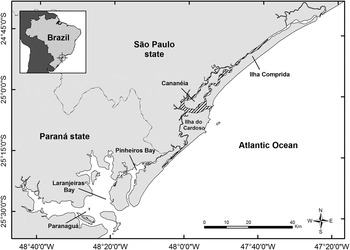
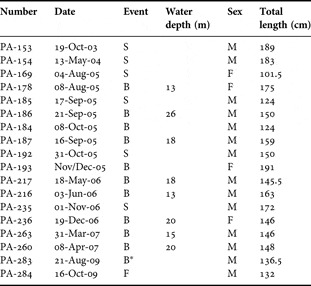
Cananéia (25°00′S and 47°55′W) is located on the southern coast of São Paulo State, Brazil (Figure 1). The Cananéia gillnet fleet had been monitored to evaluate cetacean incidental captures from 2004 to 2007. Boat operations had been surveyed by the crew captain, who had been engaged to fill charts on the following data: GPS position where nets were set, net dimensions, water depth, soaking time, list of captured fish species and number of cetacean incidental capture events. When the cetacean incidental capture had been detected, the individual(s) was/were identified following a log-book and, when possible, was/were brought to land to the research team for natural history studies. Part of the analysed stomachs (N = 10) was recovered from coastal waters by the fishing fleet. Other samples (N = 8) were recovered from dead stranded or floating dolphins, both found in inner waters of the Cananéia estuary. All samples had been recovered from 2003 to 2009 (see Table 1).
Sites where Guiana dolphins analysed in the present study were obtained. The individuals considered to be found in inner estuarine waters were the ones obtained in the striped area around Cananéia Island. The individuals considered to be found in coastal waters were the ones incidentally captured in fisheries on the southern coast of São Paulo and northern coast of Paraná.

List of Guiana dolphins, Sotalia guianensis, collected from 2003 to 2009. The field number of each specimen, date and source of event (S, stranding; B, by-catch; F, found floating in the estuary), water depth (m) of incidental capture, sex and total length (cm) of each are presented.

*, bottom longline in inner waters of the Cananéia estuary; M, male; F, female.
Laboratory analyses
Stomach contents were screened using 200 µm mesh sieves. Fishes, cephalopods and crustaceans, whole or fragmented, fish otoliths and cephalopod beaks were selected and stored. Otoliths were dried stored, cephalopod beaks in 1:1 solution of glycerin and 70% alcohol, and the fragments and whole preys were kept in 70% alcohol, after 24 hours in a solution of 10% formalin.
The otoliths were used to identify consumed teleost fishes. Prey identification was made through several catalogues (e.g. Bastos, Reference Bastos1990; Abilhôa & Corrêa, Reference Abilhôa and Corrêa1992–1993; Corrêa & Vianna, Reference Corrêa and Vianna1992–1993; Lêmos et al., Reference Lêmos, Corrêa and Abilhôa1992–1993, Reference Lêmos, Corrêa and Pinheiro1995a, Reference Lêmos, Corrêa and Pinheirob). Measurements were taken using a stereomicroscope with metric precision of 0.1 mm. The total length of each otolith was the greatest longitudinal distance toward the groove. The otolith which was used either for identification or for the measurements was the sagitta, also used to estimate the number of fishes consumed by each species. In the genus Stellifer, lapillus otoliths were also found in stomach contents, though these otoliths were neither used to identify species nor to estimate the total number of preys in order to avoid overestimating fishes belonging to this genus. The number of consumed fishes was estimated through the highest number between right or left sagitta otoliths.
Cephalopod beaks were identified using the collection of the ‘Centro de Pesquisa e Gestão de Recursos Pesqueiros do Litoral Sudeste e Sul do Instituto Brasileiro do Meio Ambiente e dos Recursos Renováveis (CEPSUL/ICMBIO)’. The measurements of lower rostral length (LRL) and upper rostral length (URL) were taken using a stereomicroscope with ocular micrometer and precision of 0.1 mm to estimate the mantle length (ML, in mm) and weight (WT, in g) of squids. When beaks were found, those with highest number (upper or lower) were used to estimate the number of consumed cephalopods and their respective length and weight. Crustaceans were identified by using the identification key of Costa et al. (Reference Costa, Fransozo, Melo and Freire2003).
Regression equations
Based on the identified food items found in the present study, samples of fishes with different sizes were obtained in the local market. Fishes were measured, weighted and had their otoliths extracted. Only one otolith sagitta of each individual (right or left) was measured. Standard length (SL) is the distance from the anterior tip to the insertion of caudal fin. The SL was used due to the fact that the majority of species had their caudal fin damaged during the capture, making the total length measurement impossible. When a fish species was not available in adequate numbers, equations gathered in other areas were used (see Bassoi, Reference Bassoi2005; Conceição et al., Reference Conceição, Ribeiro and Silva2005; Bittar, Reference Bittar2007). In the case of cephalopods, equations were compiled from Santos (Reference Santos1999) and CEPSUL/ICMBIO.
Prey importance
Index of relative importance (IRI) was calculated based on the following formula:
 $$\hbox {IRI = (N+W)} \times \hbox {F},$$
where N is the numerical percentage, W is the estimated weight percentage and F is the frequency of occurrence percentage. The numerical, estimated weight and frequency of occurrence percentages and the IRI were analysed separately for fish and cephalopods, since cephalopod beaks remain in cetacean stomachs for a longer period of time than otoliths (Clarke, Reference Clarke, Bryden and Harrison1986).
Review on the knowledge about S. guianensis diet in south-eastern Brazil
Using the 18 samples of this study and nine from a previous one (Santos et al., Reference Santos, Rosso, Santos, Lucato and Bassoi2002), a comparison of food items surveyed from dead dolphins recovered in ‘inner estuarine’ (N = 12) and ‘coastal’ waters (N = 15) was conducted using the IRI. The sites considered as ‘inner estuarine’ and ‘coastal’ are presented in Figure 1. In order to compare the differences between the lengths of fishes and cephalopods found as prey of S. guianensis from both sites, the Mann–Whitney U-test was used. Cephalopods and fishes were analysed separately since they represent preys with different characteristics.
Published studies, theses and dissertations about Guiana dolphin feeding habits in south-eastern Brazilian were revised. Abstracts presented in conferences were not considered. The main food items were evaluated to investigate potential habitat preferences of Guiana dolphin. Also, a comparison between main preys of S. guianensis and species known to be the most commercially valuable was conducted. Only studies that showed IRI or F and N were considered.
RESULTS
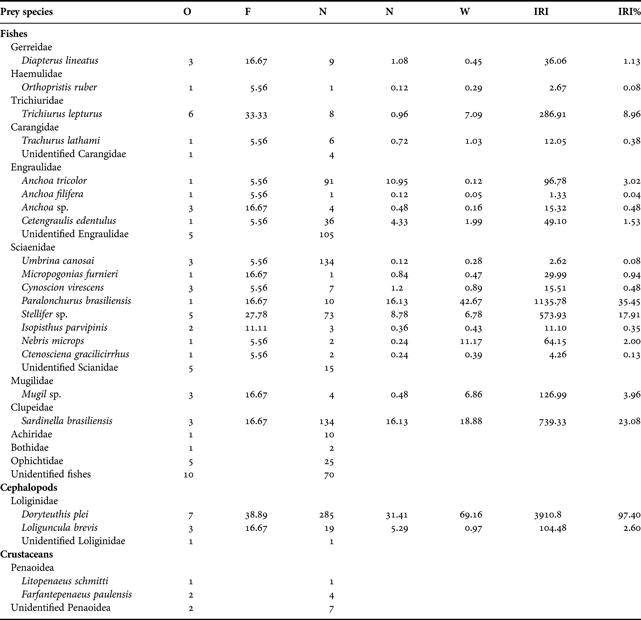
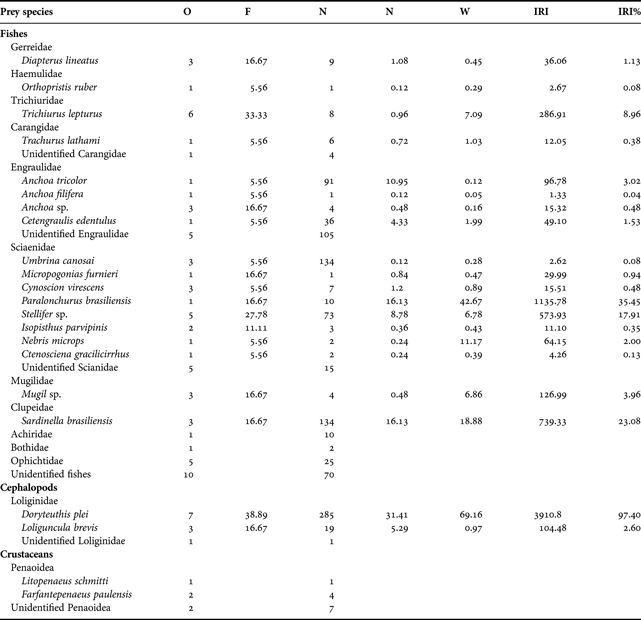
From the 18 analysed stomachs, 39% had only fish remains, 11% only cephalopod remains, 28% fish and cephalopod remains, 17% fish and shrimp remains and about 5% fish, cephalopod and shrimp remains. A total of 1414 otoliths and 538 cephalopod beaks were found in the stomachs of Sotalia guianensis. From all otoliths, 130 were lapillus from the genus Stellifer and therefore were not used to estimate the total number of prey. Twelve shrimps, 305 cephalopods and 757 fishes were estimated to be ingested by the dolphins. Prey species recorded for S. guianensis are presented in Table 2. Guiana dolphins preyed on at least 19 different fish species, two species of cephalopod and two species of shrimp. The fish minimum length was 1.86 cm and the maximum length was 95.16 cm. The cephalopod ML range was from 1.99 cm to 38.45 cm.
List of prey items of 18 stomach contents of Guiana dolphins (Sotalia guianensis) found dead in south-eastern Brazil from 2003 to 2009. The number of stomachs in which prey items were found (o), frequency of occurrence percentage (F), number of each prey found (n), numerical percentage (N), estimated weight percentage (W), index of relative importance (IRI) and IRI percentage (IRI%) are shown.
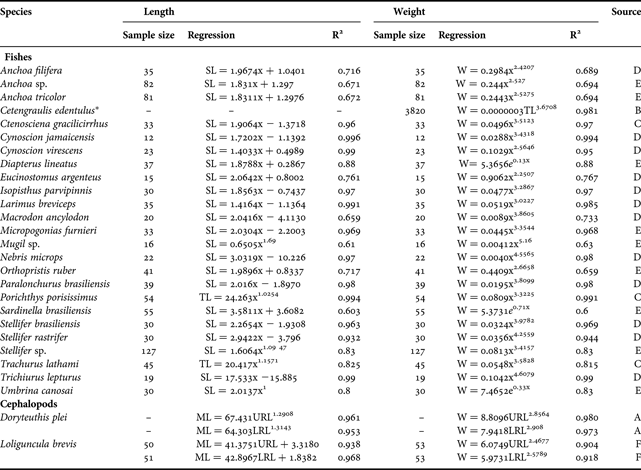
Regression equations used to estimate fish standard length (SL) or total length (TL), cephalopod mantle length (ML) and fish and cephalopod weight (W). Sample size, R2 and sources are shown. Otolith length is represented by ‘x’, lower rostral length of cephalopod beaks by ‘LRL’ and upper rostral length of cephalopods beaks by ‘URL’.
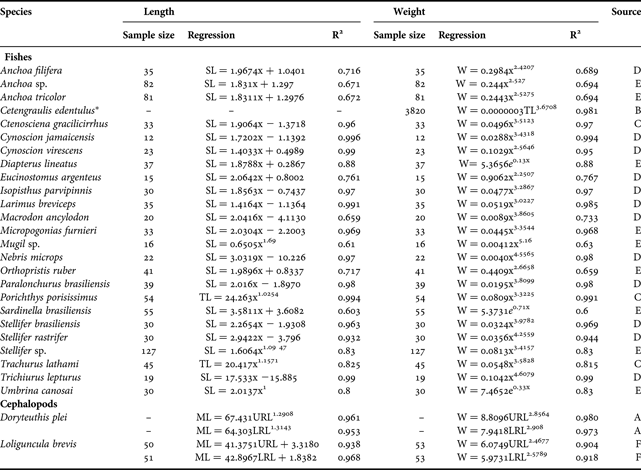
*, Cetengraulis edentulus found in the stomach contents were not digested and therefore were measured and had their weight estimated from the total length. Sources: (A) Santos (Reference Santos1999) (ML in ‘mm’ and W in ‘g’); (B) Conceição et al. (Reference Conceição, Ribeiro and Silva2005) (TL in ‘mm’ and W in ‘g’); (C) Bassoi (Reference Bassoi2005) (TL in ‘mm’ and W in ‘g’); (D) Bittar (Reference Bittar2007) (SL in ‘cm’ and W in ‘g’); (E) present study (SL in ‘cm’ and W in ‘g’); (F) Reference collection of CEPSUL/IBAMA (ML in ‘mm’ and W in ‘g’).
The following preys were reported for the first time as food items of S. guianensis in south-eastern Brazil: rough scad, Trachurus lathami, mojarra, Diapterus lineatus and the families Ophictidae and Bothidae. The regression equations to evaluate the weight and length of fishes, and weight and ML of squids are described in Table 3. From 58 equations, 18 (31.03%) are presented for the first time in the study area.
Fishes with higher importance in this study were the banded croaker, Paralonchurus brasiliensis, the orangespot sardine, Sardinella brasiliensis and the rake stardrum, Stellifer sp. (Table 2). The most commonly reported family was Sciaenidae. It is also important to consider the high F value found for the Atlantic cutlassfish, Trichiurus lepturus (Trichiuridae) (see Table 2). Doryteuthis plei was the most common cephalopod, due to its higher values of F, N, W and IRI when compared to Lolliguncula brevis. Litopenaeus schmitti and Farfantepenaeus paulensis were the reported shrimp species.
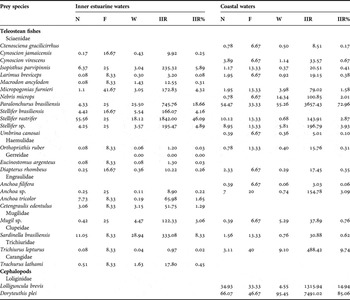
Stellifer rastrifer was the most important fish species, followed by P. brasiliensis and S. brasiliensis, when considering samples from inner estuarine waters (Table 4). Only one cephalopod species was recorded in inner estuarine waters: L. brevis. Paralonchurus brasiliensis was the most important fish species found in the stomach of dolphins collected in coastal waters. It was followed by T. lepturus. From the two species of cephalopods found in the coastal dolphin diet, D. plei was the most important item.
Numerical percentage (N), frequency of occurrence percentage (F), estimated weight percentage (W), index of relative importance (IRI) and IRI percentage (IRI%) of preys observed in the stomachs of Guiana dolphins (Sotalia guianensis) recorded in inner estuarine and coastal waters of south-eastern Brazil. Sources: Santos et al. (Reference Santos, Rosso, Santos, Lucato and Bassoi2002) and present study.

Prey specimens were larger in the coastal dolphin diet, with significant differences between fish lengths and cephalopod MLs of prey specimens found in stomach contents of dead dolphins in inner estuarine waters (1.86 cm to 28.1 cm; mean ± standard deviation (SD) = 7.56 ± 3.73 cm) and in coastal waters (3.21 cm to 95.16 cm; mean ± SD = 11.87 ± 8.28 cm) (fishes: U (α=0.05) = 45065.00; P = 0.0001/cephalopods: U (α=0.05) = 13691.00; P = 0.0001).
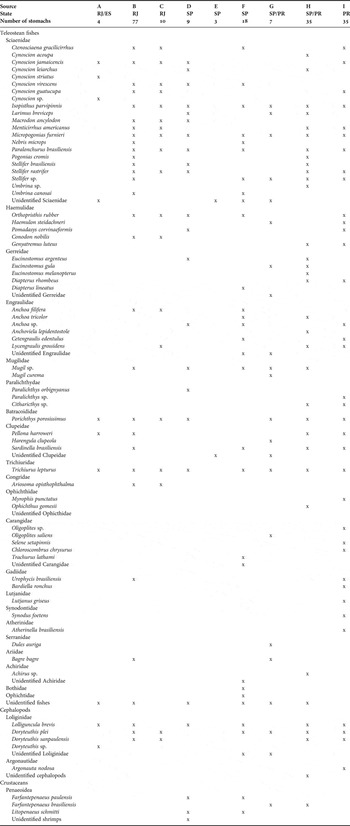
The species observed in this study as the most important preys were also reported in the majority of the studies regarding S. guianensis feeding habits (see Table 5). However, among the different sites few differences were observed. For instance, in the studies conducted in the State of Rio de Janeiro north coast (~22oS), the Atlantic cutlassfish was the most important prey (see Di Beneditto & Ramos, Reference Di Benedito and Ramos2004; Di Beneditto & Siciliano, Reference Di Beneditto and Siciliano2007). On the other hand, in the majority of the studies conducted in the south of São Paulo State and north of Paraná State (~24 to 25oS), fishes from the genus Stellifer were the most important prey (see Schimegelow, 1990; Santos et al., Reference Santos, Rosso, Santos, Lucato and Bassoi2002; Oliveira, Reference Oliveira2003; present study).
List of preys consumed by Guiana dolphins (Sotalia guianensis) found dead in south-eastern Brazil. Sources, location where dolphins were found (RJ, Rio de Janeiro; SP, São Paulo; PR, Paraná), and number of stomachs used in each study are presented.

Sources: (A) Borobia & Barros (Reference Borobia and Barros1989); (B) Di Beneditto & Ramos (Reference Di Benedito and Ramos2004); (C) Di Beneditto & Siciliano (Reference Di Beneditto and Siciliano2007); (D) Santos et al. (Reference Santos, Rosso, Santos, Lucato and Bassoi2002); (E) Carvalho (Reference Carvalho1963); (F) present study; (G) Schmiegelow (Reference Schmiegelow1990); (H) Oliveira (Reference Oliveira2003); (I) Zanelatto (Reference Zanelatto2001).
The species of cephalopods reported as S. guianensis prey items were mainly squids from the family Loliginidae, except for one octopus, Argonauta nodosa, reported by Zanellato (2001). In the majority of the studies, based on the comparison of the IRI, F and N values, D. plei corresponded to one of the most important cephalopods in the Guiana dolphin diet (see Zanelatto, Reference Zanelatto2001; Oliveira, Reference Oliveira2003; Di Beneditto & Ramos, Reference Di Benedito and Ramos2004; Di Beneditto & Siciliano, Reference Di Beneditto and Siciliano2007; present study).
On the coast of of Rio de Janeiro State, when considering the most important commercial fish species such as S. brasiliensis, Cetengraulis eduntulus, Katsuwonus pelamis, Micropogonias furnieri, Scomber japonicus and Balistes spp. (see Da Silva & Vianna, Reference Da Silva, Vianna and Vianna2009), only M. furnieri was recorded as one of the five most important Guiana dolphin preys (see Di Beneditto & Ramos, Reference Di Benedito and Ramos2004; Di Beneditto & Siciliano Reference Di Beneditto and Siciliano2007). In south São Paulo and north Paraná, S. brasiliensis, M. furnieri, Cynoscion jamaiscensis, Anchoa spp., Anchoviella spp., Lycengraulis grossidens and Menticirrhus spp. were listed among the most important commercial fishes (see Da Silva & Vianna, Reference Da Silva, Vianna and Vianna2009). When considering four studies conducted in the area (Zanelatto, Reference Zanelatto2001; Santos et al., Reference Santos, Rosso, Santos, Lucato and Bassoi2002; Oliveira Reference Oliveira2003; present study), just a few items such as M. furnieri, Anchoa sp. and S. brasiliensis were listed among one of the five most important Guiana dolphin preys in at least one of the studies.
DISCUSSION
The present study introduced new food items to the knowledge about the Guiana dolphin diet, even working with a number of stomachs that could be considered small when analysing cetacean feeding habits. It also presented new regression equations to evaluate the weight and standard length of fishes found as Guiana dolphin preys. This is useful information either for predator–prey studies in general, or other studies such as population management and archaeology (Harvey et al., Reference Harvey, Loughlin, Perez and Oxman2000). For the first time, items recovered from stomach contents of dead dolphins found in inner estuarine waters were compared to the ones recovered from coastal dolphins, showing evidences of differences in prey sizes. This study also provided a review of the knowledge about Guiana dolphin diet in south-eastern Brazil, comparing most prey items with the main targets of fisheries.
Considering the 18 analysed stomachs, the fish family with highest species richness in Sotalia guianensis feeding habits was Sciaenidae. This family is commonly found in shallow waters near the coast and some species present great importance in fishery (Menezes & Figueiredo, Reference Menezes and Figueiredo1980). The large representation of Sciaenidae fish in the Guiana dolphin diet has been recorded in previous studies conducted in Brazil (see Table 5). Paralonchurus brasiliensis and Stellifer sp. are demersal fishes associated with sandy or muddy bottoms. Comparing the presented information with a previous study conducted in the same area (Santos et al., Reference Santos, Rosso, Santos, Lucato and Bassoi2002) there was apparently no shift in fishes consumed by S. guianensis over the past ten years. Though, due to the samples size, caution must be taken when reaching conclusions about the changes in the dolphin feeding habits over time.
The IRI analysis of individuals found in inner and coastal waters showed differences in their feeding habits, this last also applied to prey on larger items. Maciel (Reference Maciel2001) observed that Stellifer rastrifer, the most common prey from dolphins found in inner estuarine waters, was the most abundant species collected by bottom trawling in the Cananéia estuary. The Atlantic cutlassfish (Trichiurus lepturus) did not represent an important species in the feeding habits of Guiana dolphins found in inner estuarine waters. However, it was the second prey in importance for the individuals found in coastal waters. Trichiurus lepturus is distributed from coastal waters to 300 m of depth (Magro, Reference Magro, Cergole, Ávila-Da-Silva and Rossi-Wongtschowski2005). The observation of smaller preys in estuarine dolphins could be related to the common presence of juvenile fishes in the estuary, which is an important breeding area for several fish species (Besnard, Reference Besnard1950; Schaeffer-Novelli et al., Reference Schaeffer-Novelli, Mesquita and Cintrón-Molero1990).
The only cephalopod species reported from the individuals found in inner estuarine waters was Loligunculla brevis; meanwhile this species and Doryteuthis plei were reported for coastal dolphins. Doryteuthis plei occurs at depths of up to 370 m and is not common in estuaries (Roper et al., Reference Roper, Sweeney and Nauen1984). This squid also corresponds to one of the most common cephalopod species on the Brazilian coast (see Perez et al. Reference Perez, Gasalla, Aguiar, Oliveira, Marques, Tomás, Cergole, Da Silva and Wongtschowski2005; Haimovici et al., Reference Haimovici, Costa, Santos, Martins, Olavo, Costa, Olavo and Martins2007; Rodrigues & Gasalla, Reference Rodrigues and Gasalla2008). Lolliguncula brevis corresponds to a coastal species found at depths up to 20 m. It tolerates salinities as low as 8.5 ppm for brief periods, and is particularly abundant in shallow bays and estuaries (Roper et al., Reference Roper, Sweeney and Nauen1984). The significant difference in the estimated consumed cephalopods size could also be related to the differences between the two species consumed. Lolliguncula brevis is a small squid with 12 cm maximum ML for females and 8 cm for males, and D. plei is larger, with 35 cm maximum ML for males and 22 cm for females (Roper et al., Reference Roper, Sweeney and Nauen1984). Doryteuthis plei was observed only for individuals found in coastal waters and, therefore, this surveyed Guiana dolphin group presented larger MLs in their stomachs. The difference between the consumption of cephalopods by coastal and inner estuarine waters dolphins may represent a difference in feeding site. The absence of D. plei beaks in stomachs of inner estuarine Guiana dolphins may represent that this group had not fed in coastal waters for some time before they were found, since cephalopod beaks remain for long periods in stomach contents. Even with such compelling evidences, caution must be taken when reaching conclusions about differences between feeding habits of individuals found in inner estuarine and coastal waters, because the location where individuals were found stranded does not necessarily represent the place they fed. Thus, more studies using stomach content analysis and also other techniques should be deployed for evaluating differences in feeding habits regarding Guiana dolphins in inner and coastal waters.
All the most important prey species in S. guianensis diet are abundant in the studied areas, which represents evidence of opportunistic feeding habit. The difference among the species composition reported in diverse studied areas reflects the different biota composition in those sites. When considering the studies presented in Table 4, the most representative fish family was Sciaenidae, which is predominantly demersal (Menezes & Figueiredo, Reference Menezes and Figueiredo1980). Most of the species found as important preys of S. guianensis are associated with the sea bottom. Even species such as T. lepturus and D. plei, which also present pelagic habits, may be associated with the bottom based on their vertical migration. Large adults of Atlantic cutlassfish usually feed near the surface in daytime and migrate to the bottom at night; meanwhile juveniles form schools near the bottom during the day and feed near the surface at night (Figueiredo & Menezes, Reference Figueiredo and Menezes2000). Doryteuthis plei concentrates near the bottom during the day, but disperses into the water column at night (Roper et al., Reference Roper, Sweeney and Nauen1984). Considering the applied methodology, it is not possible to describe in which day period, and, therefore, where S. guianensis consumed these two preys. Thus, coastal and estuarine substrates seem to be important to Guiana dolphins’ feeding activities. Disturbances that affect the sea bottom (e.g. estuarine mouth dredging and bottom trawling) may decrease prey availability and possibly affect the feeding activity, one of the vital processes for this species’ survival.
It is also important to consider that the overlap between Guiana dolphin preys and fisheries’ main targets appears not to occur when fishes are taken into consideration. Sciaenidae, the most representative family in S. guianensis diet, is abundant and is commercially important (Souza, Reference Souza2004). Notwithstanding, the species which were found to be more frequently ingested by Guiana dolphins (e.g. Stellifer sp. and P. brasiliensis) did not represent the most important target species from the commercial fishery (see Menezes & Figueiredo, Reference Menezes and Figueiredo1980; Mendonça, Reference Mendonça1998; Mendonça et al., Reference Mendonça, Pires, Calasans, Xavier and Sena2003, Reference Mendonça, Pires, Casalans, Xavier, Hoff and Sena2004; Da Silva & Vianna, Reference Da Silva, Vianna and Vianna2009), even though they are frequent in bottom trawl fisheries by-catch. Trichiurus lepturus is commercially important around the world, but in Brazil it still has low commercial values (Bittar, Reference Bittar2007).
In Rio de Janeiro State, the overlap between the Guiana dolphin diet and fishery targets had been observed when considering Micropogonias furnieri (see Di Beneditto & Siciliano, Reference Di Beneditto and Siciliano2007). Nevertheless, M. furnieri presented a low value of the IRI when compared to the four most important species in that study (T. lepturus, Cynoscion guatocupa, Isopisthus parvipinnis and Porichthys porosissimus). These four species corresponded to 86.3% of the total biomass reported, 74.3% of all the preys consumed and each species was reported in at least 30% of the analysed stomachs, suggesting that M. furnieri has a lower importance in Guiana dolphins’ feeding habits. In south São Paulo and north Paraná, the situation was similar to the one observed in Rio de Janeiro. Even though listed among the five most important species, Sardinella brasiliensis (present study) and M. furnieri (Santos et al., Reference Santos, Rosso, Santos, Lucato and Bassoi2002) appear not to be of greatest importance in Guiana dolphins’ feeding habits. In the present study, S. brasiliensis was reported as an important prey due to one individual that consumed 130 of 134 reported orangespot sardines. Micropogonias furnieri presented a higher value of F (44.4%) in the study of Santos et al. (Reference Santos, Rosso, Santos, Lucato and Bassoi2002), but presented an extremely low value of N (1.1%).
When considering the cephalopods alone, the overlap with fisheries had been observed, D. plei has a high commercial value (Perez et al., Reference Perez, Gasalla, Aguiar, Oliveira, Marques, Tomás, Cergole, Da Silva and Wongtschowski2005). Though, when considering the general importance in fishery, this species does not represent one of the ten most import products in the south-eastern Brazilian fishery (see Da Silva & Vianna, Reference Da Silva, Vianna and Vianna2009).
The feeding habit studies enhance our knowledge about marine mammals in the ecosystems, hence contributing to information for future conservation issues. Currently, the S. guianensis studies in Brazil have been concentrated mostly in the south-eastern region. Therefore, studies in other areas along the Guiana dolphin distribution are necessary to better understand either its trophic interactions, or its interaction with commercial fishery. The use of different available techniques (e.g. stable isotopes and fatty acids) to evaluate long-term diet and energy consumption would also provide complementary information to better understand the Guiana dolphin diet along its distribution, and perhaps between different stocks.
ACKOWLEDGEMENTS
Logistic support was provided by the Instituto Oceanográfico da Universidade de São Paulo. Fishes used in the regressions were supplied by ‘Peixaria do Jura’, ‘Cabeça Pescados’, ‘Miami Comércio, Exportação de Pescados LTDA’ and ‘M. PREY Comércio de Pescados’. Jocemar Tomasino Mendonça (Instituto de Pesca de Cananéia) helped in shrimp identification. Helinho and Ricardo Prey kindly allowed the monitoring study of their fishing operations. The authors dedicate this manuscript to the memory of Dr Nélio Barros, who left an important contribution to the knowledge about cetacean trophic interactions. Earthwatch Institute, Cetacean Society International and PROBIO (Projeto de Conservação e Utilização Sustentável da Diversidade Biológica Brasileira—Ministério do Meio Ambiente, with the support BIRD/GEF, and CNPq (2004–2005)) supported the studies of Guiana dolphins in the Cananéia estuary. Marcos Santos received grants from Fundação de Amparo à Pesquisa do Estado de São Paulo (FAPESP) to conduct his doctoral studies (process number 01/05128-8) and received grants from ‘Programa Jovem Pesquisador–FAPESP’ (process numbers 05/59439-5 and 05/54149-9). Xênia Moreira Lopes received grants from Fundação de Amparo à Pesquisa do Estado de São Paulo (FAPESP) (process number 08/55617-4).