INTRODUCTION
The common octopus, Octopus vulgaris Cuvier, 1797 is a benthic cephalopod distributed on rocky, sandy and muddy bottoms, from the coastal waters to the edge of the continental shelf (Mangold, Reference Mangold and Boyle1983). This species has long been considered cosmopolitan, in tropical and temperate waters, but a recent molecular study restricted its distribution in the Mediterranean, eastern and western Atlantic and north-western Pacific (Warnke et al., Reference Warnke, Söller, Blohm and Saint-Paul2004).
In the Mediterranean basin, this species constitutes an important fraction of the commercial landings of trawlers operating on the continental shelf and is subject to intense fishing activity, carried out mainly by traps, pots, fyke nets and set nets (Belcari et al., Reference Belcari, Cuccu, González, Srairi and Vidoris2002).
During the last decades, different aspects of its biology and fishery statistics have been intensively studied (e.g. Guerra, Reference Guerra1979; Mangold, Reference Mangold and Boyle1983; Villanueva, Reference Villanueva1995; Katsanevakis & Verriopoulos, Reference Katsanevakis and Verriopoulos2006; Otero et al., Reference Otero, Gonźalez, Pilar-Sieiro and Guerra2007, Reference Otero, Álvarez-Salgado, González, Miranda, Groom, Cabanas, Casas, Wheatley and Guerra2008, Reference Otero, Álvarez-Salgado, González, Gilcoto and Guerra2009; Perales-Raya et al., Reference Perales-Raya, Bartolomé, García-Santamaría, Pascual-Alayón and Almansa2010; Prato et al., Reference Prato, Portacci and Biandolino2010; González et al., Reference González, Barcala, Pérez-Gil, Carrasco and García-Martínez2011). In particular, with regards to ageing studies, several methods have been used to estimate age and growth rates indirectly through modal progression analysis on length–frequency data (e.g. Guerra, Reference Guerra1979; Dia, Reference Dia1988) and biochemical indices of instantaneous growth rate (Houlihan et al., Reference Houlihan, McMillan, Agnisola, Trara Genoino and Fori1990). The direct methods have been through laboratory culture (e.g. Mangold & Boletzky, Reference Mangold and Boletzky1973; Smale & Buchan, Reference Smale and Buchan1981; Villanueva, Reference Villanueva1995), mark–recapture studies (Nagasawa et al., Reference Nagasawa, Takayanagi, Takami, Okutani, O'Dor and Kubodera1993; Domain et al., Reference Domain, Jouffré and Caverivière2000; Mereu et al., Reference Mereu, Masala, Maccioni, Stacca, Cau and Cuccu2010), histological quantification of lipofuscin in the optical gland of the brain (Sobrino & Real, Reference Sobrino and Real2003) and counting of periodic growth increments on eye lens (Gonçalves, Reference Gonçalves1993), stylets (e.g. Barratt & Allcock, Reference Barratt and Allcock2010; Hermosilla et al., Reference Hermosilla, Rocha, Fiorito, González and Guerra2010), statoliths (Young, Reference Young1960) and beaks (Raya & Hernández-González, Reference Raya and Hernández-González1998; Hernández-López et al., Reference Hernández-López, Castro-Hernández and Hernández-García2001; Perales-Raya et al., Reference Perales-Raya, Bartolomé, García-Santamaría, Pascual-Alayón and Almansa2010).
To the best of the authors' knowledge, the most common and successful method for estimation of age and growth in cephalopods is to count the periodic growth increments in hard structures (Perales-Raya et al., Reference Perales-Raya, Bartolomé, García-Santamaría, Pascual-Alayón and Almansa2010). In particular for the Octopus vulgaris from the Atlantic the analysis of the beak has revealed an easy method for age estimation (Hernández-López et al., Reference Hernández-López, Castro-Hernández and Hernández-García2001; Perales-Raya et al., Reference Perales-Raya, Bartolomé, García-Santamaría, Pascual-Alayón and Almansa2010). It has been validated for the paralarval animals (Hernández-López et al., Reference Hernández-López, Castro-Hernández and Hernández-García2001).
Taking into account that octopus ageing studies for the Mediterranean Sea are still scanty (Guerra, Reference Guerra1979; Mereu et al., Reference Mereu, Masala, Maccioni, Stacca, Cau and Cuccu2010), the aim of this paper is to estimate the age of a wild population of O. vulgaris from Sardinian waters (central western Mediterranean Sea) through the analysis of growth increments in the beaks correlating them with the reproductive status.
MATERIALS AND METHODS
The study was performed on a population of Octopus vulgaris inhabiting the neritic waters of central western Sardinia. Among the 663 specimens sampled, 445 were collected during monthly sampling carried out by trawl from August 2008 to August 2009 at depths of 25 to 60 m using a bottom otter with 20 mm cod-end mesh size. In addition, 218 individuals were obtained by a small scale fishery using crab traps from June to September 2008 (N = 95, 4 hauls) and from May to August 2009 (N = 123, 4 hauls) at a depth of 20 to 40 m.
All fresh specimens were analysed in a laboratory where the following measurements were recorded: dorsal mantle length (ML, to the nearest mm), ventral mantle length (VML, to the nearest mm), total weight (TW, to the nearest 0.1 g) and gonad weight (GW, to the nearest 0.01 g).
Sex was determined and maturity stages established using the scale adopted by Dia (1, immature; 2, maturing; 3 mature) (Dia, Reference Dia1988), adding the spent/post-spawning stage, for both sexes. Afterwards, the beak of each specimen was removed and stored in 70% ethyl alcohol.
The gonadosomatic indices (GSIS) (GSI = GW*100/TW) were calculated for both sexes at each maturity stage and were compared within each sex using the Kruskal–Wallis test. The size (length) at maturity (ML50%) was estimated by fitting the mantle length–frequency distribution of the proportion (Pi) of mature and spent specimens (Stages 3 and 4), grouped in 10 mm ML classes, to the logistic model:
 $$\hbox {P}_{\rm i} = 1/\lsqb 1 + \hbox{exp}\lpar \!\!-\!\alpha + \beta \hbox{ML}_{\rm i}\rpar \rsqb$$
where ML50% = −α/β
Total weight at maturity (TW50%) was also estimated following the same procedures, grouped in 100 g TW classes.
Two hundred and seventy beaks (160 males and 110 females) were randomly sampled to determine the animals' age by counting concentric rings daily deposited in the lateral wall of the upper beak (Raya & Hernández-González, Reference Raya and Hernández-González1998; Hernández-López et al., Reference Hernández-López, Castro-Hernández and Hernández-García2001).
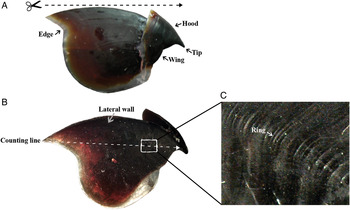
According to Hernández-López et al. (Reference Hernández-López, Castro-Hernández and Hernández-García2001) upper beaks were sectioned sagittally in two symmetrical half beaks (see Figure 1) on which, the concentric rings present in the lateral wall were counted from the rostral tip area to the opposite end by using a stereoscopic microscope. The ring count was performed at least three times by the same person, and those with less than two identical counts were rejected from analysis. The number of rings counted from males and females was compared by analysis of variance (ANOVA).
Octopus vulgaris: upper beak (A), sagittal section of upper beak (B) and detail of growth rings in the lateral wall (C).

RESULTS
Maturation and size at maturity
The sample of Octopus vulgaris analysed consisted of 361 males (14.0–250.0 mm of ML and 20.0–5850.0 g of TW) and 302 females (14.0–238.9 mm of ML and 20.0–4661.0 g of TW).
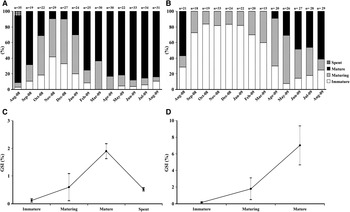
Mature males were present all year round but were most readily caught from February to August. Immature and maturing males appeared mostly from October to January while the presence of spent specimens was recorded in August (Figure 2A).
Octopus vulgaris: monthly frequency (%) of maturity stage (A, B) and development of gonadosomatic index (GSI) (C, D) in males (left) and females (right).

Mature females were present exclusively from April to August whilst immature and maturing specimens were caught throughout the year, mostly from September to March and from February to April, respectively. Any spent females were collected during the surveys (Figure 2B).
The gonadosomatic index mean value ranged from 0.12 to 1.90 and from 0.15 to 7.02 respectively in males and females.
The development of GSI showed a gradual increase for males while, for females an abrupt increase from maturing to mature condition was observed. Significant differences within each sex occurred between maturity stages (P < 0.01) (Figure 2C, D).
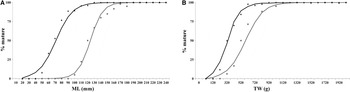
The smallest mature specimens sampled were 45 mm ML and 190 g TW in males, and 90 mm ML and 310 g TW in females. The ML50% was 70 mm for males and 120 mm for females, while TW50% was 320 g and 520 g for males and females, respectively (Figure 3).
Octopus vulgaris: sizes at 50% maturity (size (length) at maturity (ML50%) and total weight at maturity (TW50%)) for males (N = 361) and females (N = 302) from all lines in 10 mm length-classes (A) and 100 g weight-classes (B). Black triangle, male specimen; grey circle, female specimen; black lines, male logistic curves; grey lines, female logistic curves.

Beaks analysis
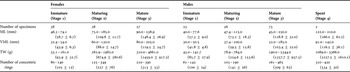
The internal lateral walls of the upper beaks of 128 males (40.0–250.0 mm ML and 45.0–5344.0 g TW) and 93 females (46.3–238.9 ML and 35.1–4661.0 g TW) at different maturity stages showed the presence of concentric rings (or increments) from the rostral tip to the opposite margin of lateral wall, parallel to the edge (Table 1; Figure 1). The rings were more clearly distinguishable along the counting line than in the rostral area due to the high pigmentation of this zone.
Octopus vulgaris: parameters collected for males and females at different maturity stages.

ML, dorsal mantle length; VML, ventral mantle length; TW, total weight; in parentheses mean ± standard deviations.
The number of concentric rings on male beaks varied from 61 (51.7 mm ML, 63.0 g TW) to 142 (75.0 mm ML and 132.7 g TW) and from 103 (53.0 mm ML and 91.8 g TW) to 190 (115.0 mm ML and 794.0 g TW) respectively in immature and maturing individuals. From 161 (45.0 mm ML and 190.0 g TW) to 465 (210.0 mm ML and 5344.0 g TW) rings were observed in mature males and from 310 (125.0 mm ML and 1089.0 g TW) to 420 rings (210.0 mm ML, 3366.0 g TW) in post-spawning (spent) specimens.
In immature females, the number of rings ranged from 80 (60.7 mm ML and 62.4 g TW) to 142 (62.8 mm ML and 143.5 g TW) and in maturing specimens from 125 (90.0 mm ML and 282.9 g TW) to 349 (135.0 mm ML and 1258.0 g TW). The number of rings varied from 210 (90.0 mm ML and 310.0 g TW) to 390 (238.9 mm ML and 4661.0 g TW) in mature females.
No significant differences in the ranges of the number of rings counted between males and females have been found (ANOVA, F = 0.02, P = 0.8776).
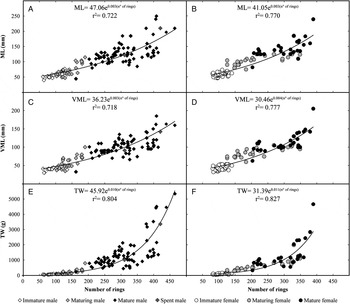
Overall, the number of rings observed in both sexes showed a good relation between the size (VML and ML) and weight (TW) of the specimen (Figure 4).
Octopus vulgaris: plot of the number of rings counted in the upper beak versus dorsal mantle length (ML) (A, B), ventral mantle length (VML) (C, D) and total weight (TW) (E, F) for males (N = 128) and females (N = 93) at different maturity stages. Black curves, regression lines, equations above.

Maturation versus age
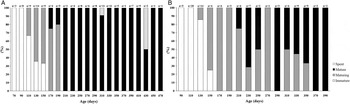
Reproductive development showed a relationship with age for both genders (Figures 4 & 5). In particular, immature specimens were exclusively present in the age-classes 70–150 days in males, and, 90–150 in females, with the higher frequency (100%) in the classes 70–90 and 90–110, respectively (Figure 5).
Octopus vulgaris: proportion of males (A) and females (B) at different maturity stage from the research line in each 20-days age-class.

Males were found to be in the maturing stage from 110 to 170 days old, a narrower range of age (110–170 days) than females (130 to 350 days old). Males became mature from 170 to 470 days old, at a younger age than females (210–390 days old). Spent males were found in the age-classes 310 and 430 days (Figure 5).
DISCUSSION
Reproductive data obtained in this study for Octopus vulgaris from Sardinian waters show a pattern more or less similar to that already known for the species as from related literature.
The presence of mature males all year round, a seasonal maturation of females and the variability in size at maturity with males precociously mature at a smaller size than females, are common characteristics reported also for other Mediterranean areas (e.g. Guerra, 1975; Mangold, Reference Mangold and Boyle1983).
According to the fact that environmental constraints could have a strong influence on the duration of the early stages of embryonic development, slight differences in the spawning period of the species have been reported by other authors for the western Mediterranean (Mangold & Boletzky, Reference Mangold and Boletzky1973; Sánchez & Obarti, Reference Sánchez, Obarti, Okutani, O'Dor and Kubodera1993; González et al., Reference González, Barcala, Pérez-Gil, Carrasco and García-Martínez2011). However, considering also our results, we can speak about a strong only spawning peak in spring–summer for the entire western Mediterranean basin. Instead for the eastern Mediterranean Sea (Katsanevakis & Verriopoulos, Reference Katsanevakis and Verriopoulos2006) and for the Gulf of Cadiz (Silva et al., Reference Silva, Sobrino and Ramos2002) and Canary Islands (Hernández-García et al., Reference Hernández-García, Hernández-López and Castro-Hernández2002) two spawning peaks are known to occur, a main one during the late winter–spring and a secondary one during the late summer–early autumn.
The development of GSI for both sexes during the maturity process has shown a greater reproductive investment in females, as already observed in other studies (e.g. Rodríguez-Rúa et al., Reference Rodríguez-Rúa, Pozuelo, Prado, Gómez and Bruzón2005; Otero et al., Reference Otero, Gonźalez, Pilar-Sieiro and Guerra2007).
Octopuses, as well as other cephalopod species, are considered highly dynamic organisms, they grow and mature with high individual variability, influenced by many factors such as temperature, feeding and genetic differences (e.g. Mangold, Reference Mangold and Boyle1983; Semmens et al., Reference Semmens, Pecl, Villanueva, Jouffre, Sobrino, Wood and Rigby2004; Leporati et al., Reference Leporati, Pecl and Semmens2008). Octopus vulgaris becomes sexually mature at very different sizes, and our results represent, with regards the size at maturity (females: 120 mm and 520 g; males: 70 mm and 320 g) the lowest values considering the Mediterranean and Atlantic data.
Concerning the analysis of growth increments on the lateral walls of the upper beaks, made for the first time on a wild Mediterranean population of O. vulgaris, the positive relationship observed between size (both length and weight) and estimated age (number of rings) suggests that the rings are laid down regularly during the entire growth period. Our data also confirm a high individual variation for the growth parameter, in agreement with the Atlantic results (Raya & Hernández-González, Reference Raya and Hernández-González1998; Domain et al., Reference Domain, Jouffré and Caverivière2000; Hernández-López et al., Reference Hernández-López, Castro-Hernández and Hernández-García2001).
According to a daily deposition of the rings starting one day after hatching, as suggested by Hernández-López et al. (Reference Hernández-López, Castro-Hernández and Hernández-García2001), males could become mature at a younger age (161 days) than females (210 days). A clear distinction between the age of immature and mature specimens was observed in both sexes, but not between maturing and mature specimens, especially in females. Consequently, the sexual development in Octopus vulgaris could be primarily size-dependent with a secondary role played by the age, albeit this is found to be stronger in males than females. Therefore, a young female (i.e. 210 days) may have already reached full sexual maturity while an older female (i.e. 349 days) could be still maturing; on the contrary, a male of 200 days is always mature.
The largest individuals analysed (female of 4661 g and male of 5344 g) could have an age of 390 and 465 days, respectively. Specimens over 4 kg are extremely ‘rare’, and if we consider the ‘common’ weight to be around 2–3 kg, using the growth curves obtained in this study we can estimate a very similar lifespan for the two genders, approximately 377–418 days for males and 378–415 days for females. In addition, if we consider that the two ‘spent’ males at the end of their lives were 310 and 420 days old respectively, we could suggest that in our area the lifespan of O. vulgaris could be about 1 year, including the time that females spend looking after the eggs prior to their death (30–40 days: authors, personal observations).
These results are similar to those found for the Canary Islands (Hernández-López et al., Reference Hernández-López, Castro-Hernández and Hernández-García2001: 12–13 months) and those for the area off the coast of north-west Africa (21–26°N) (Raya & Hernández-González, Reference Raya and Hernández-González1998: 10–12 months) obtained by counting rings in the upper beak and also for the Senegalese waters (Domain et al., Reference Domain, Jouffré and Caverivière2000: 12–14 months) by tagging studies.
A lifecycle of about one year appears to be confirmed by the seasonality of the octopus catches in Sardinian waters, with important yields every year during the same period (i.e. late spring–summer) (Cuccu et al., Reference Cuccu, Campisi, Follesa, Murenu and Sabatini1999; Belcari et al., Reference Belcari, Cuccu, González, Srairi and Vidoris2002), the only period of the year where females are fully mature (present results).
This study has supplied the missing factor (age) in our understanding of the population dynamics of O. vulgaris in the Mediterranean Sea, in fact it is the first investigation into the relationships between reproductive development and age/size in a wild population of Octopus vulgaris.
Our results on development, size and age at maturity and lifespan of O. vulgaris in Sardinian waters, could be a useful tool for integral fishing management (e.g. gender-specific size restriction on catch and temporary fishing closures) in order to contribute to eco-sustainable fishing of this species in the area.
ACKNOWLEDGEMENT
This research received no specific grant from any funding agency, commercial or not-for-profit sectors.