Introduction
Compulsive buying behavior refers to the phenomenon of irresistible and irrational buying and shopping. It is characterized by unremitting and excessive buying, constant preoccupation with buying and shopping, and poor control over the behavior.Reference Müller, Mitchell and de Zwaan 1 People with compulsive buying tend to purchase, on a given occasion, surplus items that they do not require and are hard to afford.Reference Hoyer and Macinnis 2 Also, unlike need-based shopping, where the motivation is brief and centers on procuring a specific item at a particular time, in compulsive buying, the sense of well-being associated with the process of shopping and buying is the chief drive and not getting the product.Reference Solomon, Russell-Bennett and Previte 3 Regarding online compulsive buying, buyers prefer this shopping mode because of exhaustive offers and immediate positive feelings. Participants with online compulsive buying were found to spend significantly more money and more time in online shopping than those without compulsive buying.Reference Duroy, Gorse and Lejoyeux 4
There has been an increase in compulsive buying in recent decades, as evidenced by a meta-analysis of studies showing a prevalence of 4.9%.Reference Maraz, Griffiths and Demetrovics 5 Ongoing research has tried to decipher the risk factors and causes underlying this behavior. Rose et al.Reference Rose and Dhandayudham 6 proposed a conceptual model to predict online shopping addiction. The model comprised seven variables including low self-regulation, negative emotional state, low self-esteem, enjoyment, female gender, social anonymity, and cognitive overload. Compulsive buying concurs with a negative emotional state. Evidence points to a significant association of depression and loneliness with satisfaction related to online shopping.Reference Tian, Zhang and Wu 7 Individuals with negative emotional states are likely to resort to buying to cope with their negative mood. Dysfunctional coping has also been proposed to be contributing to compulsive buying. Emotion-focused coping was shown to mediate the association between distress and compulsive buying.Reference Kovács, Katzinger and Yi 8 In addition, common psychiatric disorders, including depression and anxiety, are found in higher proportions in people with compulsive buying. Perceived stress is also reported to be significantly higher in affected population.Reference Harvanko, Lust and Odlaug 9 Loneliness, anxiety, depression, and reduced self-esteem foster engagement with virtual space rather than in-person interactions. Those with features of Internet addiction tend to be more engaged with online Compulsive Buying.Reference Suresh and Biswas 10 Excessive Internet use in people with compulsive buying also stems from the fear of missing out.Reference Suresh and Biswas 10 However, Duroy et al.Reference Duroy, Gorse and Lejoyeux 4 , did not find a significant association between online compulsive buying and Internet addiction.
Online shopping platforms use strategies to engage the buyers in feedback and reward systems, making it more lucrative and convincing than conventional shopping.Reference He and Zhu 11 Artificial intelligence-powered platforms used by e-commerce companies use push notifications and targeted advertisements more efficiently, making people with impulsiveness more vulnerable to shopping behavior.Reference Wang, Chen and Xiao 12 An impulse purchase is significantly influenced by personality attributes as well. Impulsive shoppers are more likely to experience obsessive–compulsive disorders, have low self-esteem, and experience high levels of anxiety, melancholy, and a bad mood. A study in Paris with 233 psychology students as participants reported significantly higher mean trait domain scores (assessed using Personality Inventory for DSM-5-Brief Form) for negative affect, detachment, and disinhibition in those with compulsive buying.Reference Duroy, Sabbagh and Baudel 13 However, some studies reported deficient inhibitory control and attentional bias to not influence the buying–shopping behavior.Reference Vogel, Trotzke and Steins-Loeber 14
Multiple factors including the sociodemographic, affective, sensory, genetic, psychological, social, and cultural components, may influence compulsive buying behavior. The available evidence is not conclusive about the role of stress and impulsivity in moderating the buying behavior. Also, the level of uncertainty brought on by the global epidemic and the ensuing economic crisis has impacted people’s buying behavior.Reference Sheth 15 In the backdrop of the COVID pandemic, how the stress, anxiety, depression, and impulsivity affect buying behavior needs to be assessed. Thus, this study aims to identify the association between compulsive buying behavior and emotional distress, depression, and impulsiveness in general population.
Methodology
This was an online, cross-sectional survey conducted from June 2021 to August 2021. The estimated minimum sample size (using the online sample size calculator, iface)Reference Glaziou 16 was 385 (95% confidence level and 5% margin of error). The convenience and snowball sampling methods were used to recruit the participants. People aged 18–60 years, able to understand Hindi or English, with access to smartphones and Internet, and consenting to participate in the survey were included. People with a known history of mental illness were excluded from the study. The Institutional Ethics Committee approved the study (Ref.code:110th ECMII IIA/P7).
Data collection tools
Sociodemographic and clinical details form
This semi-structured form created by the authors enquired the participants about the following information—age, gender, educational qualification, occupation, relationship status, number of children, residence (state of residence), type of family, daily Internet use duration (in hours), the preferred mode of shopping, and history of use of any psychoactive substance (in last 30 days).
Pathological Buying Screener
The Pathological Buying Screener (PBS) is a self-report scale used to evaluate compulsive buying behavior. That consists of items related to emotion regulation, loss of control, preoccupation/desire, buying things that are not needed, hiding purchasing behavior from others, financial problems, effects on other areas of life, efforts to resist the behavior, and the degree of the suffering caused by the behavior.Reference Müller, Trotzke and Mitchell 17 The scale consists of two subscales: loss of control/consequences (10 items) and excessive buying behavior (3 items), scored using a 5-point Likert-type scale (1: never, 5: very often). The minimum score is 13, and the maximum score is 75. A higher score indicates greater pathological buying behavior. A cutoff point was calculated using two standard deviation (SD) above the mean, which yielded a cutoff value of ≥29.
Depression, anxiety, and stress scale—21 Items
The Depression, Anxiety and Stress Scale – 21 (DASS-21) is a set of three self-report scales designed to measure the emotional states of depression, anxiety, and stress. Each of the three DASS-21 scales contains seven items, divided into subscales with similar content. The depression scale assesses dysphoria, hopelessness, devaluation of life, self-deprecation, lack of interest/involvement, anhedonia, and inertia. The anxiety scale assesses autonomic arousal, skeletal muscle effects, situational anxiety, and subjective experience of anxious affect. The stress scale is sensitive to levels of chronic nonspecific arousal. It assesses difficulty relaxing, nervous arousal, being easily upset/agitated, irritable/over-reactive, and impatient. Scores for depression, anxiety, and stress are calculated by summing the scores for the relevant items.Reference Henry and Crawford 18
Barratt Impulsiveness Scale–Brief
The Barratt Impulsiveness Scale – Brief (BIS-Brief) is an 8-item questionnaire designed to assess general impulsiveness or the lack of future planning and forethought.Reference Steinberg, Sharp and Stanford 19 This brief tool was derived from 30-item Barratt Impulsivity Scale (BIS). It is a valid and reliable tool. The estimated Cronbach’s alpha for the device was 0.78.Reference Steinberg, Sharp and Stanford 19
The survey has questions/items in both English and Hindi. Translation and back-translation method was used for PBS. DASS 21 translation in Hindi is validated for use in Indian population. The items of BIS-Brief are derived from BIS, which is validated for Indian population. The tools are permitted for unrestricted use and distribution provided the original authors and source are credited. We have duly credited the authors and source.
Procedure
This was an open survey, where the investigators utilized their personal, social, and professional networks to circulate the survey questionnaire. The survey was also posted on social media platforms (LinkedIn and WhatsApp) for interested people to participate. The questionnaire consisted of sociodemographic data form, details of buying behavior, PBS, DASS-21, and BIS-Brief. The survey was carried out using online Google Forms. The individuals who agreed to participate in the study were informed about it and asked to provide their informed consent. Those agreeing to participate were required to submit their responses after completing the questionnaire. On assessing the questionnaires in Google Form, the participants had to mention whether they had any psychiatric illness (diagnosed by a doctor) or not. If the participants responded yes to the question, the survey was completed there. If the respondent had a no response, subsequent survey questions got displayed on the screen. It took participants around 12–15 min to complete the survey. Participant forms that were complete were included for final analysis. The survey did not use any personal identifiers during the study or publishing of the results. No incentive was given to participate in the survey.
Measures
Statistical analysis
The data were analyzed using the SPSS software program for Windows, version 25.0 (IBM Corp., 2017). The descriptive statistics for categorical variables are expressed as frequency (percentage, %), whereas continuous variables as mean and SD. Kolmogorov–Smirnov test was used to test the distribution of data. Accordingly, the chi-square (χ2) test and t-test were used to compare categorical and continuous variables. Pearson correlation was used to test the association among the variables. Further, a multiple linear regression analysis was done. In all the analyses, two-sided P < .05 was considered statistically significant.
Result
A total of 432 people participated in the study after excluding 11 participants with diagnosed psychiatric illnesses (current or past). However, only 426 responses were found valid after data cleaning. We were not able to estimate the response rate, as we were not aware of the number of individuals, who had access to the questionnaire as the questionnaire was circulated through social media platforms. The average age of the participants was 26.43(6.23), and the majority were females (62.7%). Two participants chose not to reveal their gender. Participants were predominantly students (61.7%). Ten (2.3%) participants were unemployed.
On PBS, 169 (39.7%) participants scored ≥29, while 257 (60.3%) participants scored <29. A comparison between the participants with pathological buying (PBS score ≥ 29) and participants with no pathological buying (PBS score < 29) revealed no significant differences in terms of age, gender, level of education, type of occupation, residence, family type, and relationship status. Also, there were no differences in time spent on the daily use of Internet, the preferred mode of shopping, and substance use patterns. However, the two groups differed with respect to DASS-21 scores and BIS-Brief scores. The pathological buying group scored significantly higher in both (Table 1).
Comparison of Clinical and Demographic Profiles Between the Participants with Pathological Buying (PBS score < 29) and Participants with no Pathological Buying (PBS Score ≥ 29)

Abbreviations: BIS-brief, Barratt impulsiveness scale—brief; DASS-21, depression, anxiety and stress scale—21; PBS, pathological buying screener.
*Significant at P-value of <.01.
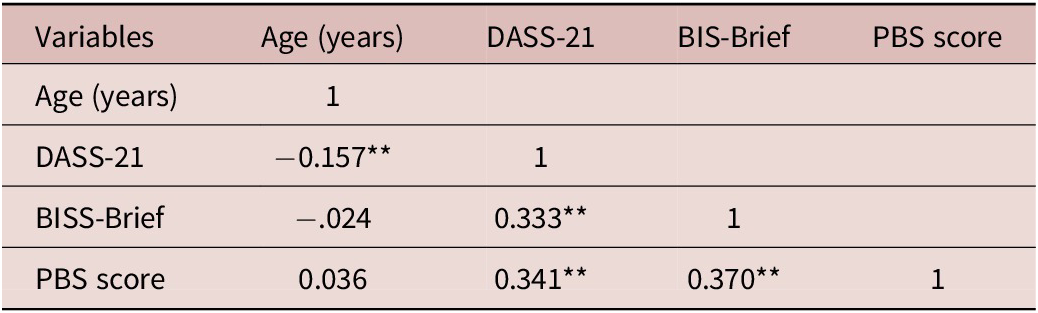
The correlation analysis among various clinical variables revealed a significant correlation among PBS, BISS brief, and DASS-21. Also, the age of participants was negatively correlated with DASS-21. Further, a multiple linear regression was calculated to predict the PBS score of participants based on DASS-21, BIS-Brief score, and their age. A significant regression equation was found (F (3,422) = 34.55, P < .001), with an R 2 of 0.197. Participants predicted PBS score is equal to 10.849 + 0.635 (BIS-Brief) + 0.089 (DASS-21). Participants PBS score increased by 0.635 points for each point increase in BIS-Brief, and 0.089 for per unit increase in DASS-21 total score. Both BIS-Brief and DASS-21 total scores were significant predictors (Table 2).
Correlation between Participant Age, DASS, BIS Brief, and PBS

Abbreviations: BIS-brief, Barratt impulsiveness scale—brief; DASS-21, depression, anxiety and stress scale—21; PBS, pathological buying screener.
**Correlation is significant at the .01 level (2-tailed).
Discussion
Pathological buying behavior is an emerging phenomenon that is catching attention. The recent COVID-19 pandemic witnessed multiple instances of pathological buying behavior across the globe.Reference Arafat, Kar and Marthoenis 20 – Reference Arafat, Kar and Menon 22 Pathological buying is associated with several other major psychological issues.Reference Dikbaş, Acartürk and Akyunus 23 We measured psychological distress (depression, anxiety, and stress) and impulsivity in association with pathological buying behavior, as these factors may influence the buying behavior significantly.
We found the prevalence of pathological buying (score on PBS, more than equal to 29) to be 39.7% in the general population. Male and female prevalence was 37.6% and 41.2%, respectively. It indicated that females are more involved in pathological buying behavior than males. A recent meta-analysis found that the pooled prevalence of compulsive buying behavior was 4.9%.Reference Maraz, Griffiths and Demetrovics 5 This meta-analysis suggests that pathological buying is more common among university students and young females.Reference Maraz, Griffiths and Demetrovics 5 In our study, students (61.7%) and females (62.7%) form the major group of participants; hence, the prevalence of pathological buying may be higher in the general population compared to the findings of the meta-analysis. Another factor contributing to this inflated figure may be the data collection period. During the period the second wave of COVID-19 was occurring in India, it is known that panic buying behavior is more pronounced during the disasters.Reference Arafat, Kar and Menon 21 Considering the seriousness of the second wave of COVID-19, pathological buying behavior is expected to happen among people.
In the rural areas, pathological buying behavior was seen in 43.75% of participants, whereas in the urban areas, the prevalence was 38.22%. This difference may be due to scarcity of essential goods in rural areas and COVID-19-related restrictions resulting in a reduced supply of goods to rural areas.
Participants involved in pathological buying have a significantly higher level of psychological distress (total DASS score; P < .01) and impulsivity (P < .01). Higher psychiatric comorbidities are reported among people involved in pathological buying.Reference Müller, Mitchell and de Zwaan 1 , Reference Christenson, Faber and de Zwaan 24 , Reference Nicolai and Moshagen 25 It was noticed that pathological buying closely resembles the phenomenology of obsessive–compulsive disorder and impulse control disorder.Reference Christenson, Faber and de Zwaan 24
This study reported moderate to extremely severe depression, anxiety, and stress in 38.5%, 48.8%, and 20% of participants, respectively. The findings align with other studies where high comorbid psychiatric illnesses were reported with pathological buying.Reference Müller, Mitchell and de Zwaan 1 , Reference Christenson, Faber and de Zwaan 24 Evidence suggests that pathological buying behavior is associated with higher anxiety, depression, stress, hostility, obsessive–compulsive features, and somatization.Reference Villardefrancos and Otero-López 26 Additionally, these individuals have lower life satisfaction, lower self-esteem, and a poor level of optimism.Reference Villardefrancos and Otero-López 26 A significant association of pathological buying was reported with impulsivity (P < .0001) and psychological distress (P < .0001), which indicates that a higher level of impulsivity and psychological distress is associated with pathological buying behavior. Though it is difficult to ascertain the causality of pathological buying in a cross-sectional study design; however, it can be said that psychological distress and impulsivity have some moderating effect on pathological buying behavior. Evidence suggests that individuals with pathological buying behavior have a higher level of impulsivity than healthy controls,Reference Zander, Claes and Voth 27 and impulsivity is also associated with negative affect.Reference Nicolai, Darancó and Moshagen 28
Researchers did not find any relevance or evidence of the effectiveness of pharmacological and psychological interventions in treating pathological buying behavior.Reference Müller, Mitchell and de Zwaan 1 However, the psychiatric comorbidities associated with pathological buying behavior need to be treated adequately and aggressively, which might minimize the pathological buying behavior. Pathological buying may be considered a phenotypic marker of possible underlying psychiatric illness, and individuals with pathological buying behavior may be screened for the presence of any syndromal psychiatric illness.
This study has several limitations. The study’s limitations can also be attributed to the use of convenient sampling techniques and the online Google Form survey method since the study sample that was gathered may not be representative of the intended study population (general population). As the survey was conducted during the late part of the second wave of the COVID-19 pandemic, the fear and anxiety of COVID-19 might affect the psychological distress, impulsivity, and buying behavior of the general population. Hence, a study without such disasters may give better insight into pathological buying behavior. For conditions that fall within the behavioral addiction continuum (prone to denial among sufferers), using simply self-reported and quantitative methods without any confirmation or one-on-one interviewing might also be a constraint.
Conclusion
Pathological buying behavior is reported in more than one-third of the general population during the late phase of the second wave of the COVID-19 pandemic. While psychological distress and impulsivity have been found to predict buying behavior, the capital lost owing to pathological buying eventually adds to the psychological distress and the vicious cycle continues. Addressal of psychological distress and impulsivity might be a target in controlling pathological buying behavior.
Authors Contributions
Concept and Writing: First three authors; editing manuscript: All authors.
Disclosure
Sudha Mishra, Amit Singh, Sujita Kumar Kar, and Srinivasan Ganesan do not have anything to disclose.
Supplementary Materials
To view supplementary material for this article, please visit http://doi.org/10.1017/S1092852922001109.