It is widely accepted that higher education institutions have the potential to play a crucial role in inspiring and motivating students to embrace the sustainability challenges faced by contemporary societies (Cortese, Reference Cortese2003; Harris, Reference Harris2009; Jones, Trier, & Richards, Reference Jones, Trier and Richards2008; McNamara, Reference McNamara2010). In this context, Harris (Reference Harris2009) highlights the important role that a close association with academic staff plays in enabling students to address sustainability issues. In this article, we analyse how university tutors, referred to here as student-facilitators, contributed towards their students’ engagement with sustainability. We use the term ‘student-facilitator’ to describe a person who is: (1) currently enrolled at the Australian National University (ANU) as a student at an undergraduate or Masters level; and (2) currently employed by the ANU to run tutorial discussions and mark student assessment pieces.
This research is based on our experience as both students and student-facilitators in sustainability courses at the Fenner School of Environment and Society (FSES) of the ANU. Through an autoethnographic approach, we explore the question: ‘How effective is a “student-facilitator” approach for sustainability education within a higher education context?’ We identify key practices that characterise our role as student-facilitators, in terms of what we consider a good learning environment, and highlight the importance of a non-expert facilitator for sustainability education. We discuss the use of game-based activities as a tool for achieving learning outcomes, and highlight the broader role that student-facilitators play in a community of social learning at the FSES. Throughout, we argue that student-facilitators play an important role in achieving effective sustainability education at the FSES.
Along with highlighting the value of student-facilitators, this article directly challenges guidelines established in 2011 by the Tertiary Education Quality and Standards Agency (TEQSA) specifying that university tutors must be ‘qualified to at least one Qualification Standards level higher than the course of study being taught or with equivalent professional experience’ (TEQSA, p. 16). If these guidelines were strictly adhered to, many of the student-facilitators in FSES would not be employed. We contend that such a hierarchical approach to teaching threatens the valuable contribution that student-facilitators can make in sustainability education.
Background
ANU's FSES is a higher education institution that focuses on the complexities of sustainability issues. It is a place ‘where economists and hydrologists, historians and ecologists, foresters, geographers and climatologists work together on the big environmental problems facing contemporary society’ (FSES, 2012, para.1). Educators at the FSES are engaged in developing effective ways to motivate and engage students in addressing sustainability issues. This has been both through interdisciplinary curriculum approaches and innovative approaches to promote student engagement within courses (Baker & Lupton, Reference Baker and Lupton2003; Dyball & Carpenter, Reference Dyball, Carpenter, Leal Filho and Carpenter2006). While noting that student-facilitators do not exist across all courses, we contend that student-facilitators, as developed at the FSES, are an innovative approach to formal university teaching.
The existence of student-facilitators at the FSES has developed organically over time and is far from being institutionalised. In our experience, of the many tutors at the FSES there have been up to eight student-facilitators employed for any one semester across a variety of FSES courses. Since 2010, we have collectively tutored 16 courses in geography and human ecology at the FSES. These courses have included first year and later year courses, with enrolments ranging from 60 to 130 students. Tutorial sizes range from 12 to 18 students and usually run for between 1 and 2 hours. Specifically, our experience has focused on the social science and integrative streams of the FSES curriculum. Two of the authors were employed by FSES during their undergraduate degrees while the other was employed during his Masters degree. At the time of writing, two of the authors were Honours candidates, while the other was about to commence his Masters dissertation.
The process of becoming a student-facilitator has been an informal one. Generally, potential candidates are identified through communication between the course-convenors and student-facilitators, both within the same and between different courses. Students who have demonstrated an ability to engage critically with course material, facilitate discussion and interact positively with their peers are identified as potential future student-facilitators. Existing student-facilitators are often actively engaged in the process of identifying potential future student-facilitators, and communicate their views to course convenors. Formal applications for tutoring positions also exist; however, it is common to select a candidate through an informal process before turning to the more institutionalised process.
All university tutors are provided with some formal training by the ANU. In addition, student-facilitators at the FSES receive training in the context of the specific course they are engaged with. This includes close collaboration with other student-facilitators previously or currently engaged with the course and with the course-convenor. These interactions also provide an ongoing support network. The active role that the course staff play in communicating with each other over issues related to the course is a characteristic that is discussed later in this article.
Tutors at the FSES, including student-facilitators, are formally evaluated twice per semester. First, a mid-semester course review is undertaken by the FSES to address any issues that might have emerged in the early part of the course. Individual reviews are carried out at the end of each semester through the ANU's Student Evaluation of Teaching (SET) framework (ANU, 2012). This provides student-facilitators with anonymous student feedback on their performance in tutorials. SET feedback is integrated into our discussion and analysis throughout this article. We now present a theoretical context for the article, before exploring the methods and discussing the effectiveness of student-facilitators in sustainability education.
Literature Review
The United Nations Decade of Education for Sustainable Development (2005–2014) has led UNESCO to propose that in order to live sustainably, society needs to learn its way out of current social and environmental problems (UNESCO, 2010). Underlying this is the contention that this learning will need to take place with an understanding of sustainability and requires a rethink of the societal and economic systems that have contributed to present day sustainability woes (Harris, Reference Harris2009). As sustainability suggests a transformation in thinking about the world's modus operandi, the notion has been labelled as normative (Sterling, Reference Sterling2011). This type of rethink requires the development of critical thinking skills, which allow individuals to not only question the fundamental ideas and values that underlie a particular problem, but also engage in ongoing self-awareness and self-reflective processes (Bailey, Reference Bailey and Bender2012).
Higher education can contribute towards the transformative shift in thinking and action required by society to work towards sustainability (Cortese, Reference Cortese2003). It is noted that universities have the potential to question the status quo, challenge norms and openly practise new ways of living, thinking, teaching and learning (Moore, Reference Moore2005). Such spaces offer great potential for sustainability education. This potential has been broadly noted with the integration of sustainability into curricula expanding throughout the world (for example, see Corcoran & Wals Reference Corcoran and Wals2004). In this respect, Orr (Reference Orr1992) places the responsibility for facilitating this transformation in thinking on educational institutions. However, despite the commitments made by universities to promote sustainability thinking and practice, barriers to change in education systems still exist (Leal Fhilo, Reference Leal Fhilo2011; Wright, Reference Wright2002). In this context, Moore (Reference Moore2005) questions whether current university structures and systems are capable of shifting and incorporating new forms of knowledge construction and social action.
In light of the changes in thinking required, transformative learning has emerged as a way of conceptualising and practising types of education that allow individuals to explore deep and alternative understandings of the world (Moore, Reference Moore2005; Sterling, Reference Sterling2011; Taylor, Reference Taylor1997, Reference Taylor2008; Warburton, Reference Warburton2003). Transformative learning was largely framed by Mezirow (Reference Mezirow1997) as a process of effecting change through challenging a frame of reference. Experiences lived by individuals create frames of reference; that is, ways of understanding the world (Mezirow, Reference Mezirow1997; Moore, Reference Moore2005). Transformative learning requires individuals to challenge such understandings through critical reflection and experience (Moore, Reference Moore2005; Sterling, Reference Sterling2011). In doing so, transformative learning allows individuals to identify their worldview, rather than merely seeing through it, allowing them to evaluate original thought processes (Bawden & Packham, Reference Bawden and Packham1993; Sterling, Reference Sterling2011). As sustainability requires a shift in thinking, the critical nature of transformative learning is of great relevance to sustainability education. Working towards transformative learning in higher education institutions can present an opportunity for shifts in worldviews and establishment of a foundation for action.
Transformative learning is difficult to facilitate and judge (Sterling, Reference Sterling2011). Throughout this article, we will discuss how student-facilitator approaches reflect two key components of transformative learning. First, the focus on critical thinking follows the argument made by Fear, Rosaen, Bawden, & Foster-Fishman (Reference Fear, Rosaen, Bawden and Foster-Fishman2006) that critical thinking and reflection are important components of transformative learning. Second, an emphasis on grounding this learning in meaningful experience reflects Warburton's (Reference Warburton2003) contention that it is crucial for sustainability education and the questioning of existing understandings of the world. Throughout this article we highlight how student-facilitators at the FSES play an important role in creating spaces for critical thinking, reflection and meaningful experiences, thus contributing towards the process of transformative learning.
The literature presented notes that an effective approach to sustainability education must include a learning environment where students can meaningfully experience changes to their original conceptions and understandings of the world. In order to create spaces for students to challenge pre-existing understandings of the world, our article focuses on the important role that academic staff, specifically student-facilitators, play in enabling and motivating students to work towards sustainability (Harris, Reference Harris2009).
Critical Reflexivity
The notions of transformative learning, as practised at FSES and presented throughout this article, are based on our collected narratives and complemented by SET feedback. Due to the personal nature of our approach, throughout the paper we engage in personal critical reflexivity. This is a process by which self-conscious scrutiny of our work and the social nature of the research is carried out (Hay, Reference Hay2008). Ulrich (Reference Ulrich2001) argues that ceasing self-criticism is easy to do; however, researchers must ensure their ongoing critical engagement with their methodologies, methods and overall research process. Following these insights, we critique our own discussions and arguments, noting the barriers and limitations of the approach we propose. Such critical engagement allows us to offer insights to readers who may wish to apply such an approach in their own courses.
Methods
The process of using personal experience to understand a social phenomenon is known as autoethnography (Wall, Reference Wall2006). Such a process seeks to ‘systematically analyse (graphy) personal experience (auto) in order to understand cultural experience (ethno)’ (Ellis et al., Reference Ellis, Adams and Bochner2011, p. 1). The approach was appropriate in that it allowed us to explore and reflect on our experiences as student-facilitators at FSES. Autoethnographic approaches are normally carried out over an extended period of time (Duncan, Reference Duncan2004; Ellis, Adams, & Bochner, Reference Ellis, Adams and Bochner2011). However, this article presents emerging themes from a shorter study, carried out over a 2-month period. Although short study periods are not common in the autoethnography literature, our experiences and understanding are derived from a much longer experience: 6 years as students and 3 years as student-facilitators.
The approach we employed involved the following steps:
1. Each author individually wrote a personal narrative focused on why the education they experienced at the FSES was effective for them, and how they have tried to recreate this as a student-facilitator.
2. Personal narratives were used as a point of discussion and group reflection to identify key practices considered important for being a student-facilitator and the benefits this brings in teaching and learning sustainability.
3. The practices from Step 2 were discussed with students, student-facilitators and course-convenors. Our research was critiqued on two different occasions at the Human Ecology Forum (an informal, interdisciplinary gathering of scholars at the ANU including mainly academic staff and postgraduate students).
4. Drafts of our analysis were circulated to current and former student-facilitators, former students and course-convenors to review (and comment upon) our claims.
Although autoethnography is a well-recognised research method, criticisms exist. While autoethnographies embrace the researcher as a valid source of information, there is an array of ways in which it can be employed (Ellis et al., Reference Ellis, Adams and Bochner2011; Wall, Reference Wall2006). These range from experimental in-depth personal narratives, to conservative and descriptive journal style writing (Duncan, Reference Duncan2004). Wall (Reference Wall2006) suggests that the method faces the risk of the author becoming self-centred and fails to provide guidance and methodological rigour. Despite these criticisms, autoethnographic approaches can be used effectively where the approach suits the question that the researcher is seeking to answer, and the researcher clearly explains the method (Duncan, Reference Duncan2004; Ellis et al., Reference Ellis, Adams and Bochner2011; Wall, Reference Wall2006). Our autoethnography addresses a clear research question and follows the steps outlined above. To complement and enhance discussion around the emerging themes from the autoethnographies, we draw upon anonymous student feedback received through ANU's SET framework.
Collective Themes from the Narratives
Through sharing our individual narratives, we identified that there were similar reasons for valuing student-facilitators as beneficial for sustainability education. Two major commonalities emerged across all three narratives.
First was the realisation that the approach to sustainability studies at FSES was different to other disciplines we had experienced as students. Originally having diverse disciplinary interests, we all took introductory courses at FSES. In these, we found that the opportunities we had as students to be innovative and critical were supported by course convenors and student-facilitators in a way not experienced elsewhere. The opportunity to learn and challenge our existing understandings of the world inspired us all to reorient our university degrees to focus on the social dimensions of sustainability at the FSES.
Second was the ability of the FSES social and integrative science courses to generate a sense of purpose beyond solely obtaining a university degree. The issues that were of concern in the FSES reflected those that concerned us in our daily lives. Realising the possibilities for action and relevance of theoretical understandings of sustainability encouraged us to pursue our interests through becoming student-facilitators.
The similarities between our personal narratives illustrate how we developed an interest in sustainability education. Our experiences as students with open critical thinking spaces at FSES, along with practical application of our learning, encouraged us to attempt to motivate incoming students through our role as student-facilitators. The innovative and practical facilitation styles experienced at FSES motivated us to commit to designing tutorial spaces that we feel maximise the students’ ability to critically engage with sustainability issues.
Results and Discussion
We identified a number of key practices that are central to the role we play as student-facilitators. Drawing on SET feedback and academic literature, this section outlines some key practices and highlights why they form part of an effective approach to sustainability education. Throughout we also engage in critical reflexivity and discuss the limitations and challenges associated with the role of student-facilitators.
What a Tutorial Space Should Be
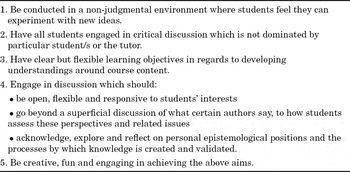
Through our narratives we identified that we learned best in what we call a collaborative, open space for discussion and learning (see Table 1).
Qualities That Constitute What a Tutorial Space Should Be

These qualities may not be exclusively important to sustainability education. However, they are relevant as they establish a learning environment where students can comfortably and critically engage with new material which encourages them to critique their frames of reference and understandings of the world (Mezirow, Reference Mezirow1997; Moore, Reference Moore2005; Sterling, Reference Sterling2011). In this respect, we contend that the development of a collaborative, open space for discussion and learning fits with Wals and Corcoran (Reference Wals, Corcoran, Holmberg and Samuelsson2006, p. 107), who emphasise that sustainability education ‘above all, means the creation of space for transformative social learning’.
Beyond focusing on our autoethnography, student feedback demonstrates the importance of such a space:
The teaching was relaxing and fun, which encourages a good discussion atmosphere. (SET, 2011a)
[The student-facilitator] was a great tutor and . . . made the tutorials fun to attend, and taught us a lot. (SET, 2011b)
These tutorials were friendly and relaxed, allowing me to participate and learn in an effective manner that I am yet to experience in other classes. Thanks! (SET, 2011c)
As reflected above, the type of tutorial space that students experienced was seen as positive for their learning, as it provided them a learning environment in which they could comfortably participate. However, we openly question whether a ‘relaxing and fun’ space can lead to the required disorientation to challenge one's frame of reference. If the space is comfortable for students because it lacks the challenging element, there will be limited capacity for critical thinking and self-assessment to occur. This highlights the challenge of balancing the need for a comfortable learning environment, where students feel they can actively participate, ask questions of each other and challenges different perspectives, and a tutorial space which breeds academic complacency.
Facilitation-Based Learning
As student-facilitators, we frame our primary role in the tutorial as facilitators of discussion. In this respect we present ourselves to the student body as non-experts. Pragmatically, this is a reflection of our own limitations in so far as many student-facilitators have not had the opportunity to build content-related expertise in the course area beyond the course materials themselves. Student-facilitators rely — as do the students — on lectures and associated course readings as the key means through which content-based knowledge is developed and shared. These course materials are constructed by the course-convenor, who can be considered to have an expert understanding of the subject matter. The role of student-facilitators is in the specific context of the tutorial, as a forum for dialogue, critique and the expansion of understanding of course material, as highlighted above.
Student-facilitators’ potential lack of formal qualification is not a reflection of their lack of comprehension regarding the material relevant to the course they are part of. On the contrary, through recently being a high-performing student in the course and then being employed to tutor, reflects how they have an excellent understanding of the course material. Through solid preparation and a close working relationship with other course staff, including other student-facilitators and course-convenors, the student-facilitators develop a comprehensive understanding of course material and its interpretation in relation to the course learning goals and outcomes. In this context, we contend that the strength of student-facilitators is that they can relate more abstract material to the lived experience of students, though their role as facilitators of learning rather than sources of knowledge. Through this, the student facilitators can effectively serve as a bridge between course ‘experts’ with extensive content knowledge and the lived experience of the student body.
The importance of such a facilitative approach to sustainability education is emphasised in the literature. For example, Thomas (Reference Thomas2005) contends that critical facilitation is an important tool in sustainability education. Similarly, Huckle (Reference Huckle, Corcoran and Wals2004) argues that knowledge should not be transmitted, but rather by posing practical questions, students and teachers are given an opportunity to reflect on their current understandings. A discussion space where facilitation of students’ perspectives is emphasised provides an environment conducive to critical discussion of issues raised in the course. Doing so can lead students to challenge their frame of reference, contributing towards the process of transformative learning (Mezirow, Reference Mezirow1997). Asking good questions is imperative in sustainability education, as it complements an iterative learning process. We propose that the role of student-facilitators initiating and facilitating discussion in a tutorial context is an essential component of the school's approach to sustainability education.
Student feedback further suggests that student-focused tutorials allowed for an open discussion space to be generated, drawing heavily on the students’ understanding of an issue:
[The student-facilitator] was able to assist us well in learning things on our own by stimulating thought and asking questions. (SET, 2011a)
[The student-facilitator] excelled in engaging the whole class in discussions and allowed conversations to flow rather than trying to control them (SET, 2011c)
Beyond this, student feedback noted that an emphasis was placed on their perspectives of an issue:
[The student-facilitator] created a very comfortable space for discussion; in [their] friendly attitude but also by keeping [their] own point of view in the background, so I never felt like I would be judged for giving the ‘wrong’ answer. (SET, 2011c)
Clearly [the student-facilitator was] well prepared . . . [but they] did not assume that others in the class could not provide a fresh perspective, and . . . actively sought this. That is a very good strategy. (SET, 2011c)
While there are benefits associated with the positioning of student-facilitators as described above, a number of challenges also emerge. As previously noted, two of the authors started tutoring when they were still undergraduate students. This can be a problem when students are older, or undertaking postgraduate study, and take issue with being taught by the student-facilitator who might be considered junior. In this context, student-facilitators’ inexperience can generate questions over the extent to which they are capable of fulfilling their responsibilities as university tutors. For example, this has been raised as an issue in terms of their ability to assess students’ work.
Potential challenges also emerge in the context of the tutorial itself. For example, undergraduate student-facilitators may have limited experience in dealing with difficult situations in the classroom. Similarly, with weekly small group tutorials throughout the semester, it is common that students and student-facilitators will build quite close relationships. Student-facilitators are usually of a similar age and life experience to students and do not have the level that authority of course-convenors have. There is a risk that students become too comfortable with the student-facilitator and opt to do less critical preparation and work for and during the tutorial. This has similar implications to that of a complacently comfortable tutorial space which could restrict the individual student's capacity to challenge their frame of reference.
It is important to emphasise that steps were taken to mitigate these risks and challenges. For example, for the assessment of students’ work, rigorous moderation processes are in place to ensure consistency. Additionally, as will be discussed later, a close collaborative working relationship with other course staff can assist in preventing or overcoming difficult classroom situations. However, it is also important to acknowledge that the student-facilitator, so far as we have described them above, may not be appropriate for all courses at FSES, particularly those where more advance technical knowledge is required.
Games-Based Activities
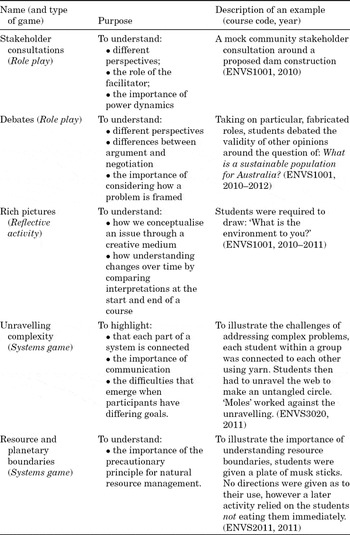
Our narratives highlighted a variety of ways in which a collaborative, open space for discussion and learning can be generated, one of which is game-based activities. Designed in collaboration with course convenors to ensure relevance to course content and learning outcomes, game-based activities are a creative way of exploring a particular issue or concept. They are a means to illustrate particular concepts in an ‘experience’ and are intended to encourage students to adapt creative ways of thinking. Table 2 highlights some of the game-based activities used by student-facilitators across different courses.
Game-Based Activities at FSES

It has been outlined that grounding students’ interest in sustainability in their own experience is crucial for that interest to be maintained (Warburton, Reference Warburton2003). Dieleman and Huisingh (Reference Dieleman and Huisingh2006) contend that experiential learning, such as game-based activities, allows students to relate to the material in a more emotional way than may be achieved through discussion alone. Such a process can challenge students’ frames of reference and enhance their critical thinking capabilities, thus contributing to the process of transformative learning (Fear, Rosaen, Bawden, & Foster-Fishman, Reference Fear, Rosaen, Bawden and Foster-Fishman2006; Mezirow, Reference Mezirow1997).
For example, when discussing the processes of stakeholder consultation, a student-facilitator may try to convey the idea that ‘the chairperson holds power over who is heard in a consultation’. Such a discussion can be enhanced by using a role play (Table 2) to demonstrate this. Through the student-facilitator acting as a biased chairperson, the marginalisation of certain stakeholders can be made to feel real for the participants. In debriefing on this activity, students have reflected that they had felt frustrated and angry at the way they were marginalised, thus reaching a much more tangible understanding of the power that a chairperson can wield when facilitating a stakeholder discussion. Debriefing after the activity is a fundamental requirement, as challenging preconceived understandings of the world can be a confronting experience for students (Sterling, Reference Sterling2011). Game-based activities cannot stand alone without a thorough debrief where students explore what took place during the activity and the relevance of this regarding course content and learning aims.
The learning outcomes of the course should be core elements when designing the game-based activities. However, there needs to be inbuilt flexibility to allow a space for students to discuss any unexpected interpretations that may emerge. This follows the contention that the process of learning is as important as the outcome (Jones et al., Reference Jones, Trier and Richards2008) and the emphasis of embracing contextual factors around learning (Warburton, Reference Warburton2003). However, finding an appropriate balance between planned and unexpected outcomes can be difficult. As one student reflected:
. . . sometimes you don't have to explain ideas behind activities so much, just let them run their course and see what we take from them. Achieving outlined learning goals is important, but sometimes other, less tangible things will also be achieved. (SET 2011a)
It is also important to note that not all students respond well to game-based activities. While this is a reflection of different learning styles among students, it is an issue to be aware of and it is important to use these activities appropriately. In this respect, we propose that the use of game-based activities can allow for a different way of learning and understanding an issue, however they can also challenge students’ perceptions of what a tutorial space should be. In this respect, game-based activities must be used in a way that is appropriate to the specific tutorial group.
Building Relationships for Collaboration
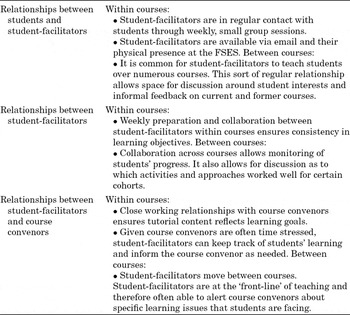
Our experiences as both students and student-facilitators have shown us that a community exists within the FSES that is actively engaged in developing effective approaches for sustainability education. Defining factors in this community are the social and professional relationships that exist between students, student-facilitators and course-convenors. These relationships have already been alluded to throughout the paper and exist both within and between courses, and over time. Table 3 outlines a number of these relationships and the benefits they can generate.
Three Types of Collaborative Relationships Student-Facilitators Participate In

In addition to the formal opportunities for course related collaboration outlined above, there are additional informal benefits these collaborative relationships produce.
1. Opportunities for Improving Quality of Practice
Communicating with convenors from other social science and integrative courses at the FSES creates an opportunity for ongoing learning between sustainability educators. By working closely with course convenors, student-facilitators can learn from their extensive experience in sustainability education. Similarly, the student-facilitators can learn from and support one another, particularly student-facilitators with different levels of experience. Such interactions facilitate ongoing reflection on ways to improve our teaching practices.
The positive relationships that exist among sustainability educations within FSES also contribute towards addressing some of the challenges previously outlined. If a student-facilitator is faced with a situation they are uncomfortable with, the support network is well established and allows course convenors to intervene and offer advice. The collaborative group also offers extensive support to incoming student-facilitators, as the more experienced student-facilitators share their experiences and insights into how to manage particular concepts and classroom situations.
2. Student-facilitators are Well Placed to Engage Actively in Their Students’ Learning
In our experience as students, we drew inspiration from course convenors and student-facilitators who were actively engaged in our learning. Now as student-facilitators we hope to have engaged effectively in our students’ learning both in and outside of courses. We have often undertaken the same courses as students just 2 or 3 years earlier, so our understanding of the potentially transformative nature of these courses is fresh. Complementing this, student-facilitators are often close in age and life experience to their students. While this can present some challenges from our experience this makes student-facilitators a good point of contact for students who are experiencing the emotional challenges associated with sustainability education. Within courses, this sentiment is strongly represented in student feedback:
[The student-facilitator] was interested in everyone's learning including [their] own and broke down barriers between us and [them]. (SET, 2010)
[The student-facilitator] was always there if we had questions. Even outside class hours I was able to ask [them] questions. [The student-facilitator] was always prepared to help us. (SET, 2011d)
Social Learning Between and Outside of Courses
In reflecting on our position in the FSES community, we feel we have strong relationships both with our own student-facilitators from our student years and our past students. Our ability to communicate with students and other student-facilitators has contributed to a broader community of social learning that goes beyond the ‘formal’ education context. This community is shared by a network of students and student-facilitators who identify with a common interest in sustainability issues.
To go some way towards describing this community, we have participated in: informal field trips to local farms and water management systems, informal discussion sessions organised by students, and the ongoing extracurricular reading groups. Such a community experience does not resonate with every student, or indeed, every student-facilitator, but for us it has been a powerful and meaningful experience as it has embedded notions of sustainability into our everyday lives. Linking the critical capabilities developed in university courses to real-life action forms part of the essential processes of rethinking the societal systems that are needed to meet the challenges associated with sustainability.
We do not want to give the impression that the FSES community is a united group with a shared vision for sustainability education. We each hold different research interests, understandings about the achievability of sustainability and different visions of what a sustainable society looks like. However, it is precisely this diversity that makes it essential that we communicate to understand each other's perspectives and broaden our own understandings. As Harris (Reference Harris2009, p. 190) contends: ‘At its peak, university teaching is about meeting with students and beginning a journey together, creating new knowledge, sharing experiences and envisioning new worlds’. We contend that student-facilitators can play a role in contributing to such an experience, as they have already done in our experience at the FSES.
Challenges
There are several challenges associated with a student-facilitator approach. There is a fine line between a tutorial space that allows for critical discussion and one that could perpetuate complacency among students. We also outlined the challenges associated with being a non-expert in terms of a lack of formal qualification and highlighted the need to use certain activities appropriately depending on students’ learning styles. In addition to those challenges, the close relationships that student-facilitators build with their students may possibly limit genuine critical feedback. For example, the lack of criticism in the SET feedback presented throughout this article was not a result of them being strategically excluded, but rather their absence in feedback we received. This is a significant barrier as it limits the extent to which student-facilitators can improve their practices based on more critical feedback. To address this issue, a follow-up inquiry to this article could be arranged. Such an enquiry, arranged by an independent person, could take the form of key stakeholder interviews within the FSES and the ANU, including students and other teaching staff. This type of exploration would provide greater insight into the contributions of a student-facilitator approach and help identify valuable feedback for how to improve our teaching practice.
Throughout, we have noted the need for steps to be undertaken to minimise and address the severity of these challenges, particularly clear communication with students and a collaborative working relationship with other student-facilitators and course convenors. While the challenges have been noted, they do not significantly undermine the contribution that student-facilitators can make for effective sustainability education within the social science oriented sustainability courses at the FSES.
Future Research
Future research into the role of student-facilitators in sustainability education in Australian universities is required. Pragmatically, such research is necessary in order to critique and explore alternatives to the hierarchical model of university education that TESQA is advocating and its implications for sustainability education. In 2009, the Australian Government proposed a transformative approach to education, with the aim of ‘achieving a culture of sustainability in which teaching and learning for sustainability are reinforced by continuous improvement of campus management’ (Department of the Environment, Water, Heritage and the Arts, 2009, p. 5). If this link between lived experience and transformative change is to occur, then the issues with the hierarchical nature of TESQA need to be explored. Additionally, there is scope to explore whether other comparative approaches exist across institutions and whether such an approach as the one we have described here would be appropriate for other disciplines.
Conclusion
The academic literature emphasises that both grounding student learning in experience and emphasising the process of learning are crucial for sustainability education (Dieleman & Huisingh, Reference Dieleman and Huisingh2006; Jones et al., Reference Jones, Trier and Richards2008; Warburton, Reference Warburton2003). In this article, we asked the question: ‘How effective is a “student-facilitator” approach for sustainability education within a higher education context?’ This article has described and analysed the role of the student-facilitator in the context of sustainability education. Through an autoethnographic approach, some key practices of the student-facilitator approach at the FSES have been identified. We find that by facilitating students in open discussions with a non-expert orientation, and through the use of game-based activities, the student-facilitator directly contributes to the development of critical thinking and learning from action. Specifically, they can facilitate the achievement of elements of a transformative learning process through promoting critical reflection by students and grounding that in meaningful experiences (Fear et al., Reference Fear, Rosaen, Bawden and Foster-Fishman2006, Warburton, Reference Warburton2003). While noting the challenges that currently exist for student-facilitators, and the need to be proactive in addressing them, we have noted how a student-facilitator approach can contribute to effective sustainability education.
Complementing the formal role that student-facilitators can have in effective sustainability education, we have shown from our experience that they can also be part of a broader community of social learning for sustainability. The facilitation of transformative learning requires relevance and grounding of sustainability issues in everyday lives. This is part of fostering ‘a learning system through which they can encourage others to explore epistemic change as a collaborative inquiry’ (Sterling, Reference Sterling2011, p. 27). However, although we have shown that student-facilitators can play an effective role in sustainability education, it is important to reflect that such an approach is threatened by the TEQSA guideline outlined in the introduction of this article. This highlights the future need to explore the place that non-hierarchical approaches to sustainability education have in Australian higher education institutions and how they can be encouraged and enhanced, not eliminated.
Acknowledgments
Thanks to the two anonymous reviewers for their helpful feedback on an earlier manuscript. A special thanks to Richard Baker, Steve Dovers, Robert Dyball, Denise Higgins and Lorrae van Kerkhoff for looking at previous drafts. Additionally, thanks to all the people (students, student-facilitators and course convenors) who have been supportive of us during the writing of this article.
Author Biographies
Thomas Sloan has been a student-facilitator at the Fenner School of Environment and Society at the Australian National University since February 2010. He is in the final stages of completing a Bachelor of Interdisciplinary Studies (Sustainability) with Honours from the same school. His research interests range from sustainability education through to climate change governance from local to international levels.
Federico Davila has been a student-facilitator at the Fenner School of Environment and Society at the Australian National University since June 2011. He holds a Bachelor of Interdisciplinary Studies (Sustainability) and a Master of Environment (Research) from the same School. His interdisciplinary research is part of the School's Human Ecology program, seeking to explore sustainability issues from an interdisciplinary perspective. He is currently exploring notions of food security and food sovereignty through the lenses of international institutions and consumer behaviour, and remains engaged with undergraduate teaching at the school.
Eleanor Malbon has been a student-facilitator at the Fenner School of Environment and Society at the Australian National University since February 2011. She holds a Bachelor of Arts and Bachelor of Science and completed her Honours in critical pedagogy in human ecology. Her broader academic interests are in philosophy and human ecology.