In the middle of the twentieth century biblical scholars claimed the unity of the human person as the core of biblical anthropology.Footnote 1 The Hebrew term  , “life,” “person,” was no longer to be translated as “soul,” and the best English equivalent for the Greek ψυχή was “person.” In the seventies and eighties, on both sides of the Atlantic, the pendulum swung even further, to the point of favoring the body. In Paris, in the École Pratique des Hautes Études, Pierre Geoltrain offered a lecture course on the “body” in several texts of the New Testament, while in the United States Dale Martin worked on his book published under the title The Corinthian Body.Footnote 2 In Geneva, where expression corporelle had become a form of instruction in dance and eurhythmic practice at the Institut Jaques-Dalcroze, some New Testament scholars incorporated bodily experience into their understanding of biblical passages.Footnote 3 It was also this time that saw—in the secular realm—the creation of “body shops” and the continuous care of one's own body. With Merleau-Ponty we can say that this recent period witnesses a rediscovery of the body.Footnote 4
I hope my many colleagues who have classes or publications that include the word “body” in their titles will forgive me today if I respond on behalf of the soul against what I consider to be an inflation of the body. My reaction is not meant to imply that we must neglect the study of the body as the locus of social practices and the expression of power relations. It is, however, meant to imply that an obsession with the body, that is, with what is visible, may reflect an absence of the divine—of the invisible—in an outrageously secular society.
My approach is to work backwards in time, that is, to deal first with several church writers of late antiquity and then in Part Two move to Origen, Tertullian, Irenaeus, and other Christian authors of the third and second centuries C.E. I shall then concentrate in a third part on the promise of eternal life in the Gospel of John and Paul's epistles, including one of Jesus— sayings. My last part will suggest a path for spiritual experience for today.
Late Antiquity
Eustratios
Eustratios, a priest of Hagia Sophia, disciple of Eutychios, patriarch of Constanti-nople, at the end of the sixth century, wrote a polemical essay entitled On the condition of souls after they have departed from the body.Footnote 5 Eustratios does not have to prove the existence of the soul or its survival after death, for this was commonly accepted in his day. Instead, he attacks the opinion of those who claim that the souls of the departed sleep until the resurrection. He himself is convinced that the soul lives actively in the after world, and his defense has a biblical foundation, beginning with Abel's blood crying out to the Lord from the ground (Gen 4:9).Footnote 6 The soul can intercede for the living even as the living in their liturgical prayers can alleviate the suffering of the dead. Eustratios's position represents a defense of the cult of saints, and it may be considered quite different from the apostle Paul's terminology of the sleep of the departed. Still, as late as the sixth century there were those who continued to think in the archaic terms of Paul's epistles: that the dead should be compared to people who are asleep, being neither dead nor really alive.Footnote 7 We know that Christian authors of Syria preserved this archaic perspective on the dead.Footnote 8 I am pleased to mention that Louis Demos, a doctor of theology here, has recently defended a dissertation on that church author.Footnote 9
Augustine
Turning to the end of the fourth and beginning of the fifth century C.E., we note that in Book 22 of his City of God Augustine is concerned with eternal beatitude in the divine city: “But in that city all the citizens shall be immortal, human beings now for the first time enjoying what the holy angels have never lost.”Footnote 10 This will be, he emphasizes, the fruit of God's gracious will,Footnote 11 as referred to in Isa 26:19; Isa 65:17–19; and Dan 12:1–2.Footnote 12 He then proposes both a rational and an affective argument to support his own view of survival of the person. His rational argument: if God at each human birth can join a soul to a body, he will be powerful enough at the end of time to add a body to a soul.Footnote 13 His affective argument: the resurrection, it is true, is difficult to believe, but through faith and love we believe two events have already occurred, namely Christ's own resurrection and the success of the Christian mission. Jesus— resurrection is not only a spiritual event: Christians believe and know that Jesus was raised from the dead in his physical person. The resurrection of the dead is the consequence of Jesus Christ's resurrection.Footnote 14
Jerome
While Augustine's argument represents a synthesis on the resurrection, Jerome's witnesses to the variety, the tensions and the controversies of four centuries of Christian inquiry. Jerome, as a biblical scholar, in his Epistula CXIX ad Mineruium et Alexandrum, bases his discussion of the resurrection on 1 Cor 15, particularly verse 51, where the apostle Paul reveals the “mystery” of the resurrection. The mystery is particularly complex to understand (Jerome knows), for the text of First Corinthians is not certain at this point. Some Greek manuscripts render the verse: “All of us will die, but not all of us will be changed.” But others state: “All of us will not die, but all of us will be changed.”Footnote 15 This texual difference reflects the hesitation of theologians and scribes over several centuries.
In his long letter,Footnote 16 Jerome presents first an eloquent status quaestionis. Diodorus of Tarsus, probably reading the first variant, claims that as for universal death incorruptibility will follow for all, but transformation (probably into a glorious body) will be reserved for the just or elect. Didymus of Alexandria and Acacius of Caesarea insist on the mystery, but ultimately their interpretation is close to Diodorus's.
The second form of the text, Jerome explains, was championed by, among others, Theodorus of Heraclia and Apollinaris of Laodicea, but following two diverging interpretations. Those who “will not die” can be those who are still alive on the day of the parousia or—more interestingly—they may be the believers referred to in John 11:25–26, where it is stated that to believe now is to cross the boundary of death and go from mortality to immortality.Footnote 17
After this long review, Jerome chooses a solution close to Augustine's position, claiming that the death of the body is not the end of the human person. But the variety of patristic interpretations as well as the instability of the biblical text make it clear that the problem of immortality, the destiny of the soul, and the hope for a bodily resurrection were still burning issues, well into Christian centuries.Footnote 18
Gregory of Nyssa
Let us consider now a Greek theologian of fourth-century Christianity. Gregory of Nyssa's On the Soul and the Resurrection was written within days of the death of his brother Basil the Great, and as his sister Macrina lay mortally ill.Footnote 19 Sometimes called the Christian equivalent to Plato's Phaedo, because of its dialogical genre and topic, Gregory deferentially attributes to his sister the role of Socrates, the wise teacher, and modestly takes for himself the role of pupil. Platonic in its defense of the immortality of the soul and its spiritual nature, the work is Aristotelian in asserting the simultaneous birth of both the soul and the body and in denying any migration of the soul. What interests me here is Gregory's first concern: the search for a definition of the soul, establishing a parallel between the invisible God and the spiritual soul. Gregory's second concern is to harmonize the dissolution of the body after death with belief in the resurrection of the flesh. Thus sins such as anger and desire, even if connected to the soul, are not part of the human person.
Nor does Gregory see the continuity of the person after death in the physical presence of relics or in the almighty care of God but in the memory that the soul preserves of all the details of her brother the body. The parable of the Rich Man and Poor Lazarus (Luke 16:19–31) does not confront resurrected bodies in Hell and Paradise but souls who remember their bodily counterparts. Gregory considers life after death—strangely more presupposed than described—not as a static period of reward and punishment but, under the influence of Origen,Footnote 20 as a long process of training and education in a sort of moral rehabilitation. This optimistic perspective confirms Gregory's main goal: to find consolation in the face of death—not an easy consolation, such as the billige Gnade (“cheap grace”) chastised by Dietrich Bonhoeffer, but a real consolation.
Third and Second Centuries
Origen
Turning to the third century C.E., in the De principiis of Origen we find the skill of a biblical scholar and the sophistication of a theologian.Footnote 21 Even though he will be condemned by some as early as the fourth century for his eschatology and spiritualization, his interpretation of immortality and resurrection will become highly influential. All spiritual life seeks to become similar to God. If God has created human beings in his image (imago) at the creation, then at the resurrection the saved will be reestablished in a status even closer to God (similitudo).Footnote 22 While the final transformation will be the matter of an instant in Jerome's thinking, it is a long process, a process of spiritual education, in the mind of Origen.
In another passage of De principiis, Origen meditates on punishment and reward.Footnote 23 In his effort to explain who will face the final judgment, he eagerly reacts against what he calls the heretics who limit survival to the soul, insisting that it will be our souls and our bodies both that will inherit eternal life. This continuity is important to Origen: it will be in our own bodies that the resurrection will take place. On the other hand, he criticizes the simple believers who expect only a revival of their present fleshly body. Our risen bodies will be, he insists, spiritual in nature, for as the apostle Paul says, “flesh and blood cannot inherit the kingdom of God” (1 Cor 15:50). We will inhabit our spiritual body and abandon our animal body. As Caroline Bynum has opposed the two metaphors, one—dangerous—is the reconstruction of the body as a house and the other—more useful—is the transformation of the seed into a plant.Footnote 24 Origen, like Paul, prefers the metaphor of the seed. The glorified body will be both continuous and discontinuous with the natural body. It will be similar and different, just as a plant is continuous with the seed even though it looks quite different. The change will be the work of the grace of God, but through the spiritual exercise of their souls over their bodies believers cooperate in this divine effort.
Tertullian
Tertullian wrote his De anima in 210 or early in 211.Footnote 25 The difficulty of interpreting this very complex work begins with the question: Why does Tertullian write on the soul? Two things are clear: Tertullian does not write for the sake of clarifying his own thought, and he does not face one major opponent but many. He opposes Pythagoras and his view of the migration of souls, which he, Tertullian, describes as unstable souls going and coming without a rest (§ 28). He opposes Plato, reproaching him for the spiritual nature of his soul (§§ 4, 9, and 24). He opposes what he calls the solution of the magicians, who claim victory over death through magical formulae and tricks (§ 57). For Tertullian, the soul is bodily. Philosophically speaking, he is the closest to the Stoic thinkers, except that for him the soul is the fruit of a creation by the transcendent, true, and unique God.
The long list of Tertullian's Christian opponents witnesses to the melting pot of Christian views in the second century. He is shocked by Saturninus's view that at death the soul will simply fly home directly to heaven (§ 23). He dislikes particularly metempsychosis and metensomatosis, two Greek terms he uses for reincarnation, thus refuting Carpocrates and, before him, Simon Magus. He cannot agree with Apelles, Marcion's disciple, who separates male and female souls. He disagrees finally with Menander, who had preserved an archaic formulation of the Gospels and believed that the afterlife can be called a life and not death. Endowed with a good dose of mauvaise foi, Tertullian ridicules Menander, saying that he was refusing to die.
Against all these adversaries, Tertullian builds an intellectual defense: he trusts the Christian religious tradition and not philosophical wisdom. He believes from Scripture that the soul is created by the Spirit of God (§ 1). The soul has a beginning (§ 4), and her birthday coincides with the body's birthday. The parable of the Rich Man and Poor Lazarus (Luke 16:19–31) proves that the soul after death is bodily (§ 7) and possesses a certain form (an effigies animae; § 9).Footnote 26 Death constitutes the separation of body and soul, the temporary suspension of what Tertullian calls societatem carnis atque animae (“company of body and soul,” § 37). The soul after death does not climb triumphantly to heaven, as we have seen, but goes to the realm of the dead (apud inferos). Tertullian visualizes this space very concretely while Gregory of Nyssa refuses to interpret Hades as a place. For the Cappadocian it is a quality of survival. But for Tertullian apud inferos is a liminal space, the place of a transition between life and resurrection. One therefore does not have to wait for the Middle Ages to celebrate the birth of purgatory.Footnote 27 The reality, without the term, is present in the works of Tertullian and the writings of Origen and Gregory of Nyssa. All these theologians of late antiquity expect the period between death and the resurrection to be a time of reeducation, temporary punishment, and first rewards.Footnote 28
Irenaeus
Besides presenting his own position, Irenaeus mentions the position of his adversaries.Footnote 29 In this way he bears witness to the existence of a spiritual interpretation that we find in several authors of the second century. There are “heretics” (from Irenaeus's point of view), who neglect the flesh and claim that, released from the burden of the body, the elect at their death obtain direct access to God. Irenaeus adds here an interesting comment: all his adversaries, he says, rely on Paul's statement in 1 Cor 15, that “flesh and blood cannot inherit the kingdom of God” (v. 50), to support their position. But in book 5 of Adversus haereses, where Irenaeus defends his own position, we find that he uses the very same authority and source, 1 Cor 15, to support the opposite doctrinal position (particularly v. 44). The battle for interpretations, a topic dear to Paul Ricœur,Footnote 30 is well engaged in the second century.
But we must be fair to Irenaeus: the bishop of Lyon is not just the champion of the resurrection of the flesh. He qualifies his position with the following contrast: just as Adam was marked by natural breathing (πνοή), Christ was connected with the divine Spirit (πνεῦμα). Similarly, after their natural life, human beings will rise from the dead in a body, but it will be a transformed, spiritual body.Footnote 31
Other Second-Century Christian Authors
The second century was for Christians a period of uncertainty and conflicted opinions. Compared to writers of the Second Sophistic, Christians appear naïve and amateurish in their writings. Compared to the Stoics and other philosophers, Christians present inconsistent anthropological views. Their usage of terms such as “soul,” “mind,” and “spirit” is often loose. Above all, there is hesitation concerning the afterlife. Some underscore the involvement of the flesh in the resurrection process, while others are satisfied with the spiritual aspect of the resurrection. This diversity of opinion reflects the ambiguities of the early Christian documents that will become the stock of authoritative writings, particularly 1 Cor 15, and the lack of intellectual training among many Christians. But even more it reflects the early Christian preoccupation with the message of salvation: what really mattered for the Christians of that time is not a definition of the soul or a philosophical distinction of the parts of the self but the hope of an afterlife and a relationship of hope and love with the deity. The clearer the promise of eternal life, the more vague the definition of the self.
Such is the evidence in early Christian poetry, particularly the Odes of Solomon, where anthropology appears simply in the form of the first person pronoun “I,” and soteriology shines in a wide variety of poetic expressions: The Son has loved me and I love him. I shall become “son” or “daughter” myself: “For he who is joined to him who does not die will also be immortal” (Odes Sol. 3.8).Footnote 32 Such is the teaching of the Spirit of the Lord (Odes Sol. 3.10).Footnote 33 The Lord opened my heart to his light and “caused his immortal life to dwell in me” (Odes Sol. 10.2).Footnote 34 “I drank—and became drunk—immortal water” (Odes Sol. 11,7 [Greek]).Footnote 35 “I put on imperishability by his name and took off perishability by his grace. Death was annihilated before my face and the realm of the dead [Sheol] destroyed by my word” (Odes Sol. 15.8–9).Footnote 36
The apologists Athenagoras, Pseudo-Justin, and the author of the so-called Third Epistle to the Corinthians defend a doctrine of the resurrection of the flesh, but for them the soul remains important.Footnote 37 The flesh helps bridge the gulf between death and the resurrection, but the soul is even better than a bridge.Footnote 38 This becomes evident when reading the newly discovered Prayer and Apocalypse of Paul, which I was fortunate to edit with Bertrand Bouvier for the first time.Footnote 39 This apocalypse depicts the opposite destinies of the sinner and the elect at the moment of death and during the long stay in the realm of death while awaiting the final resurrection. Typically for early Christian and Byzantine scenarios, we hear two dialogues between the soul and body, one in the sinner and one in the just. In the case of the just, the soul thanks and congratulates the body for their harmonious life together, like two affectionate siblings. The noble ethical attitude of both in this life has secured the unity of their person on the day of resurrection. Therefore they can separate at the hour of death with the hope of being reunited at the end of time.
The question arises: In their efforts to give life to the soul after death, what function did Christians attribute to the body? As with the soul, various—often contradictory—opinions are offered. A very common response was to praise the future fate of the soul as an escape from the body, which was considered a prison (here of course the influence of the Platonic tradition is tangible). Even if careful distinctions must be made, this is the solution of several so-called gnostic texts,Footnote 40 particularly The Exegesis of the Soul (NHC II.6) and the Letter to Rheginus or Treatise on the Resurrection (NHC I.4).Footnote 41 To be sure, we also find anthropological reflections in texts such as the Gospel of Mary.Footnote 42 In this document the author connects matter with the passions and the vision of the Lord with the mind, which is a part of the self distinct from the soul and the human spirit. But here also soteriology is the core of the reflection and among the two mentioned tendencies—spiritual and corporal salvation—it clearly chooses the spiritual. Chapter 9 of the Gospel of Mary describes the ascent of the soul.
A second solution underscores the unity of the person in the knowledge of different fates reserved for his or her parts. Although the dying body is distinct from the living soul, the destiny of the soul in the afterlife depends on the ethical commitment of the body in this life, and a reunion of both, soul and body, is expected on the day of resurrection. This is the orthodox vision thaywe find in Origen's treatise on Martyrdom and in several Apocalypses.Footnote 43
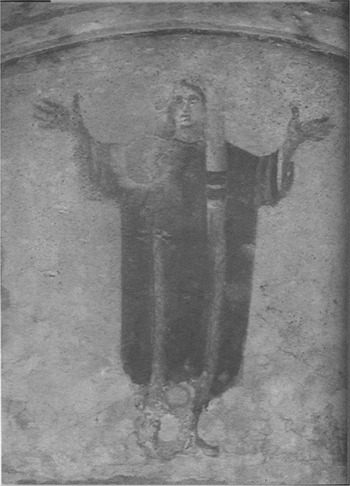
There is a particular version of this respect for the human person, visible in the body, as the image of God. This positive evaluation of the body irradiates the whole person, the soul in particular. Indeed, the body becomes a metaphor for the soul. This is the option selected by early Christian artists and their commanditaires or patrons. In art, whose preserved witnesses are most often funerary, the representation of the body may become the image of the soul or—put differently—the image of the post mortem existence of the self. The picture of the orant, the praying woman with arms outstretched, is perhaps the metaphor of the departed soul. To paint this figure or to sculpt it, quoting Émile Mâle, is to express faith in immortality: “Les peintures les plus anciennes des catacombes respirent cette douceur et traduisent cette foi dans l—immortalité et il est peu de chefs d—œuvre qui nous touchent autant que ces pauvres fresques à moitié effacées.”Footnote 44
Praying woman, orant. Rome, Catacombs of Santa Priscilla, Cubiculum of the “veiling.”

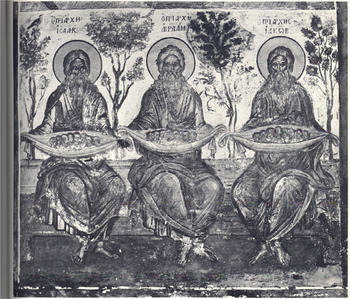
The patriarchs Isaac, Abraham, and Jacob hold the souls of the blessed. Fresco by Theophánes the Cretan, 1512. Mount Athos, Great Lavra, Trápeza.

John's Gospel, Paul, and Jesus
Why have I entitled this lecture “The Soul's Comeback”? In any case I do not mean the immortality of the soul, Plato's idea, in opposition to the resurrection of the body, the Christian tradition. No, I mean the Christian hope of an afterlife for the self as opposed to today's obsession with the body in a framework of life limited by death as the final perspective. Two quotations help me convey my emphasis. The first is from John Calvin in his comments on Matt 10:28: “Do not fear those who kill the body but cannot kill the soul; rather fear him who can destroy both soul and body in hell.” Calvin writes, “For how comes it that the dread of men prevails, in the struggle, but because the body is preferred to the soul, and immortality is less valued than a perishing life?”Footnote 45 I found the second quotation reading with students the Greek text of Origen's treatise on Martyrdom: “For, created in the image of God, it [the soul] is worthier than all bodies.”Footnote 46 This is what we find in nuce in first-century Christianity, in the Gospel of John and in the Pauline epistles, to which we now turn.
The Gospel of John
The Gospel of John, written around the end of the first century C.E., is the best witness to my thesis that priority was given to soteriology over anthropology in the early Christian communities.Footnote 47 At no layer in the slow process of this Gospel's composition is special attention given to anthropological terminology. What counts to the authors and to the Johannine community is not a definition of the human being but the salvation offered (“eternal life”) and the Son of God as the source of that salvation. John 3:14–16 compares the Son to the bronze serpent who, lifted up in the wilderness, brought healing to the sick Israelites (Num 21:6–9). When humans look up to the Son, as the Israelites did toward the serpent, they will receive eternal healing.Footnote 48
Explaining at the end of The City of God what “eternal blessedness” means, Augustine claims that the adjective “eternal” does not simply describe an everlasting period.Footnote 49 On the contrary, it implies an extraordinary quality. This is especially true in the Gospel of John: eternal life is not just an indefinite period of time that begins at the death of believers. It is the quality of relationship with Christ, the depth of love between God and God's children, and an existence that begins at the moment of redemption (according to a christological and not an anthropological chronology). It is independent of natural life, so that we will live even if we shall die (see John 5:24–29 and 6:68).Footnote 50
Paul
Writing four or five decades before John, Paul uses the anthropological terms found in the Septuagint, the Greek translation of the Hebrew Scriptures.Footnote 51 He uses terms such as “heart,” “flesh,” “soul,” and “spirit” in a loose way, except when contrasting the “flesh” and the “spirit.”Footnote 52 As sinful existence begins with wrong desire (ἐπιθυμία), develops into sin (ἁμαρτία), and ends with death (θάνατοϛ) (Rom 7:7–25), redeemed existence, described as “righteousness,” is life in the Spirit, not meaning an especially spiritual or mystical existence but a life guided by the Spirit of God, active in concrete love for one's neighbor and intense love for the deity.
Active in the old life, the new life can be described by Paul as a sacrifice of our bodies and the renewal of our minds (Rom 12:1–2). The source of hope for the self comes from divine grace; and the ethical dimension of body and soul can only result from the decision of faith, the human response to the divine affirmation of love.Footnote 53
There is a clear harmony between the Epistle to the Romans and the First Epistle to the Corinthians. Eternal life begins already in the here and now, but the present participation in this eternal life happens in our mortal bodies and conforms itself to the cross of Christ.Footnote 54 Future participation—in continuity with the present—will coincide with Jesus— resurrection. It is therefore of vital importance to affirm that there is a resurrection (1 Cor 15:12).
As a Jew, but also as a native Greek speaker, Paul cannot imagine a self outside the body, an existence without a body. But what will the final body be? Certainly it will be in continuity with the present life (to be sure that this is the same person), but there will also be discontinuity, since the quality of the resurrection will be completely different from natural existence. Therefore Paul creates the expression σῶμα πνευματικόν, “spiritual body,” using σῶμα (“body”) for the continuity and πνευματικόν (“spiritual”) for the discontinuity, for the newness (1 Cor 15:44). Wielding this metaphor, understandable to both Jews and Greeks, he compares our present suffering and our future glorious self to the destiny of a seed, sown physically but reborn spiritually, according to ancient standards and beliefs.Footnote 55 We not only look like the risen Christ but also participate in Christ's existence: “Just as we have borne the image of the man of dust, we will also bear the image of the man of heaven” (1 Cor 15:49). “For this perishable body must put on imperishability, and this mortal body must put on immortality” (1 Cor 15:53).Footnote 56
Jesus
If we search for Jesus— view on this matter using a Greek concordance and the term ψυχή (“soul,” “life,” or “person”),Footnote 57 we find in particular a reference to the most important saying regarding our topic, for it presumes the survival of the person in one way or another after death; it underscores the importance of the “soul” along with the reality of the “body”; it gives strength and hope to all Christians in times of persecution or distress, and it is the saying explained by John Calvin mentioned earlier in this lecture. Knowing that fear can overwhelm anyone in many different circumstances, Jesus says: “Do not fear those who kill the body but cannot kill the soul; rather fear him who can destroy both soul and body in hell” (Matt 10:28).Footnote 58 Here we find that Jesus believes and presupposes that human life does not stop at the moment of death, and what he calls “soul” can survive after departure from the body. This saying confirms also the serious ethical dimension of eternal life: Christian redemption is not just a sweet promise of eternal delight, but the gift—not without requirements—of resurrection and immortality in the framework of faith and perseverance.Footnote 59
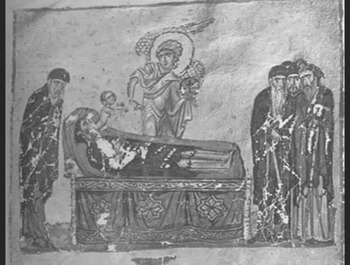
An angel wresting the soul of a monk from his corpse. From a Psalter, Dionysiou 65. Mount Athos, Dionysiou.

Spiritual Experience Today
This voyage backwards from late antiquity to the time of Jesus compels me to plead in favor of the soul as the most precious gift given to humankind. But I do not wish to define the soul, as AristotleFootnote 60 or Tertullian did. I do not wish to speculate, as DescartesFootnote 61 did. I do not dare to explain the relationship between the body and the soul or embodiment, as Merleau-PontyFootnote 62 does. My only purpose is to avoid attributing a disappointing limitation to the body and to draw attention to the danger of academic skepticism with respect to the afterlife. It sounds like a sermon, and in some measure it is. Some may refuse to accept this religious tradition, but intellectually they cannot deny the existence of the voice of hope and faith as it is echoed in Origen's opinion that the soul is worthier than all bodies.Footnote 63
Now that we have seen the relevance that Christians of the first centuries attributed to the soul, what do we do with the recent reflections on the body by Maurice Merleau-Ponty, Michel Foucault, Hannah Arendt, Pierre Hadot, and Peter Brown?Footnote 64 I would like to use this impressive amount of research first as an invitation to underscore human responsibility in this life and in this world. In doing so, I introduce an expression that theologians have created: “eschatological reservation.” To understand this notion, it is necessary to look at Paul's epistle to the Romans. While Paul says in Romans 6 that we have been crucified with Jesus Christ, he does not dare say that we have been raised again with him.Footnote 65 Sensitive to the eschatological reservation, he says that from now on we can live in newness of life, but not yet in full resurrection. In conformity with the apostle, early Christians did not flee from their bodies but accepted their insertion into this life. They strove to respect their ethical duty.Footnote 66
The recent emphasis on the body urges us not to return to the type of spirituality proclaimed by the publisher Henri-Louis Mermod (who was trying to educate the young student that I was at that time) by shouting: “We are all of us Platonists, aren—t we?”Footnote 67 This attitude is no longer appropriate, for our soul is intimately dependent on our body and our body on our soul. This is a second positive result of the current interest in the body. In my view, however, there is in the human person an element of mystery, of irreducible subjectivity that the term “soul” preserves. This portion is as light as the ancient definition of the soul as a butterfly recalls. And it is exceedingly thin, as a recent Ph.D. graduate from Harvard University (Department of History), Gregory Smith, underscores in the title of his dissertation: Very Thin Things: Toward a Cultural History of the Soul in Roman Antiquity.Footnote 68 The soul escapes from one's hand like a thin sheet, as it does in the death of the partriarch recorded in the Testament of Abraham.Footnote 69 But being so thin, it is a part of us that refuses all laws of contingency and mortality.
Recently I enjoyed reading Drew Leder's The Absent Body, which Michael Jackson had mentioned to me.Footnote 70 Both Merleau-Ponty and Leder refuse to consider the body as an object of study. Both also participate in the philosophical reaction against the all-too-easy tendency since Plato to prefer disembodiment.Footnote 71 While Merleau-Ponty, in his Phénoménologie de la perception, examined the external body, Leder has been attentive to the internal body, to the visceral part of our being. Leder's main thesis, that Merleau-Ponty still ignores, is exciting: when we use it, when everything is fine, we forget our body. The body is absent. Engaged in a sports competition, I concentrate exclusively on the game. And Leder remarks correctly that we remember our body only at the moment something is going wrong, which he calls “dysfunction.” Therefore a third positive result of the recent passion for the body is a reminder of the self, a reminder of our fragile—and not heroic—constitution.Footnote 72
Conclusion
I read in the early Christian witnesses a special interest in the soul and its immortality, strongly related to their faith in the resurrection itself. Immortality was not for them an anthropological given but a christological gift. It was for them the fruit of redemption and not the result of an immanent process. Different from many observations today, their concern for the body, even for the flesh (in the framework of the resurrection of the dead), went hand in hand with the continuity of the person in a way that we can call the soul. They were interested in the body as it related to their hope in the resurrection and to their reflection on the incarnation of the Son. They preferred the first person singular “I” to the impersonal third person “she” or “he.” Using the German distinction, they preferred Leib rather than Körper. They claimed a holistic view of the person, with ethical embodiment now and the risen person tomorrow, and suggested the preservation of the person (between the two) through the existence of the soul and the care and memory of their God.