Dye design through changing the conjugation order has emerged as a strategy for improving the solar absorbance of simple, easy-to-make molecules.[Reference Manzhos, Nakazaki, Segawa and Yamashita1–Reference Manzhos, Komatsu, Nakazaki, Segawa and Yamashita5] Specifically, the position of the methine unit has been shown to influence the spectral peak position of thiophene-containing molecules by controlling the quinoidization.[Reference Manzhos, Nakazaki, Segawa and Yamashita1, Reference Manzhos, Komatsu, Nakazaki, Segawa and Yamashita2, Reference Manzhos, Segawa and Yamahsita4, Reference Manzhos, Komatsu, Nakazaki, Segawa and Yamashita5] However, the standard density functional theory (DFT) + time-dependent density functional theory (TDDFT) approach for simulating molecular electronic spectra fails when the order of conjugation rather than its extent is changed, thwarting a computational molecular design.[Reference Manzhos, Nakazaki, Segawa and Yamashita1–Reference Manzhos, Segawa and Yamahsita4]
In Refs. Reference Manzhos, Segawa and Yamahsita4,Reference Manzhos, Komatsu, Nakazaki, Segawa and Yamashita5, we have introduced a computational procedure capable of simulating the main spectral peak's position and width for organic molecules differing in conjugation order.
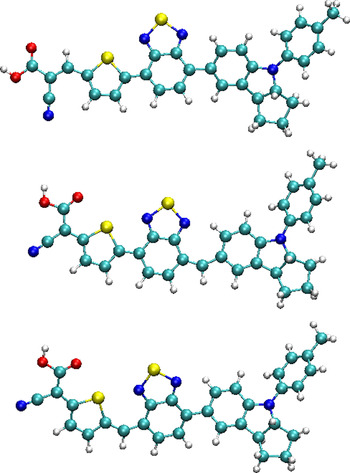
The indoline dye WS-2 (Fig. 1) has been shown to provide one of the highest efficiencies in organic dye-based dye-sensitized solar cells (DSSCs)—up to 9%.[Reference Zhu, Wu, Wang, Li, Chen, Wang and Tia6, Reference Wu, Marszalek, Zakeeruddin, Zhang, Tian, Graetzel and Zhu7] Its peak absorption is in the green part of the spectrum (500–600 nm). There is therefore potential for improving DSSC current and efficiency if peak absorption is shifted to the red part of the spectrum.
The structures of the dyes (top to bottom) WS-2, WS-2.1, and WS-2.2. Atom color scheme: C—cyan, S—yellow, N—blue, O—red, H—grey.
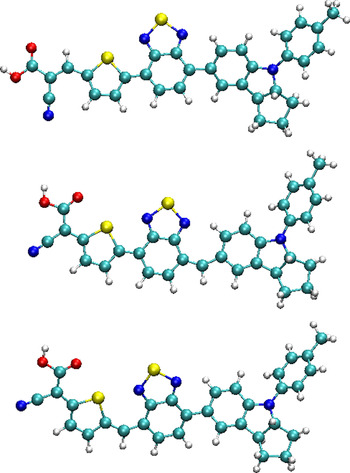
The new derivative dyes WS-2.1 and WS-2.2 shown in Fig. 1 are expected to have a significant red shift compared with WS-2 by inducing the thiophene unit's quinoidization by interaction with the electron-withdrawing cyano-acrylic group.[Reference Manzhos, Segawa and Yamahsita4]
As happened in the case of Ref. Reference Manzhos, Segawa and Yamahsita4, calculations using DFT + TDDFT with both hybrid (B3LYP) and range-separated (CAM-B3LYP) functionals fail to show a significant red shift of the visible band of WS-2.1 and WS-2.2 compared with WS-2, see Tables I and II; in fact, a blue shift is predicted in vacuum with CAM-B3LYP. These calculations do predict higher absorption intensities for the new dyes, from about 20% to 65% higher compared with WS-2 depending on the computation scheme, the molecule, and the solvent (see Tables I and II).
Transition energies (E exc, nm) and oscillator strengths (f) of the strongest peak in the electronic spectrum of the dyes WS-2, WS-2.1, and WS-2.2 computed at equilibrium geometry in vacuum, using B3LYP and CAM-B3LYP functionals, the HOMO–LUMO overlap Λ, and the corrected peak positions E corr, in nm. The last column lists predicted excitation energy averaged over nuclear vibrations, 〈E corr〉.

aExperiment: 546 nm in CH2Cl2, 533 nm in CHCl3:CH3OH = 4:1 (Ref. Reference Zhu, Wu, Wang, Li, Chen, Wang and Tia6).
Transition energies (E exc, nm) and oscillator strengths (f) of the strongest peak in the electronic spectrum of the dyes WS-2, WS-2.1, and WS-2.2 computed at equilibrium geometry in acetonitrile, using B3LYP and CAM-B3LYP functionals, the HOMO–LUMO overlap Λ, and the corrected peak positions E corr, in nm. The last column lists the predicted excitation energy averaged over nuclear vibrations, 〈E corr〉.

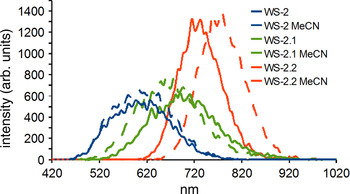
We have applied the correction scheme we developed in Refs. Reference Manzhos, Segawa and Yamahsita4,Reference Manzhos, Komatsu, Nakazaki, Segawa and Yamashita5 to the B3LYP TDDFT excitation energies. First, the match of the corrected excitation energies of WS-2 with the published spectra in low-polarity solvents[Reference Zhu, Wu, Wang, Li, Chen, Wang and Tia6, Reference Wu, Marszalek, Zakeeruddin, Zhang, Tian, Graetzel and Zhu7] is much improved (Table I). More importantly, the dyes WS-2.1 and WS-2.2 are now predicted to have a strong red shift compared with WS-2, with the peak absorption for WS-2.2 computed to occur at about 709 nm in vacuum (or nonpolar solvents) and at 753 nm in acetonitrile (the most common DSSC solvent).
Looking at the HOMO–LUMO overlaps also given in Tables I and II (see also Fig. S1), we confirm that similar to the case treated in Refs. Reference Manzhos, Segawa and Yamahsita4,Reference Manzhos, Komatsu, Nakazaki, Segawa and Yamashita5, we have here dyes with transitions having a mild charge-transfer character, where the errors in TDDFT are expected to be small (of the order of 0.1 eV)[Reference Peach, Benfield, Helgaker and Tozer8] but different among the three molecules (see Fig. S1), which ultimately leads to the failure of TDDFT to predict the change in the spectrum upon changing the conjugation order.
Molecular dynamics (MD) simulations in vacuum at 300 K were used to predict the absorption peak's shape and width, which were taken from the distribution of the HOMO–LUMO gap during the trajectory. We have previously shown that this reproduces well the relative changes in energy even when transitions have a charge-transfer character and also when conjugation order is changed.[Reference Manzhos, Segawa and Yamahsita4]
In Fig. 2, the simulated spectra of the three molecules are shown, where the excitation energy at equilibrium is taken from the corrected energies of Tables I and II, the intensities are taken from CAM-B3LYP calculations (to account for the charge transfer character of the transition), and the spectral shapes are taken from the MD trajectories.
The main peak in the visible absorption spectra of dyes WS-2 (blue), WS-2.1 (green), and WS-2.2 (red) computed in vacuum (solid lines) and in acetonitrile (dashed lines).
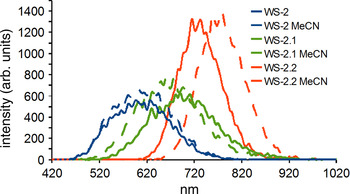
There is a noticeable effect of nuclear motions on the spectrum: the excitation energy averaged over MD trajectories of WS-2.2 is red shifted by about 25 nm compared with that at equilibrium geometry, whereas for WS-2 and WS-2.1, the difference reaches 40–50 nm from the equilibrium value. This dynamic effect was ignored in most theoretical analyses.
We thus predict that the dye WS-2.2 will have a significantly lower transition energy and a higher extinction coefficient than the original WS-2 dye. That is, it will have a much improved solar absorbance.
The red shift in both WS-2.1 and WS-2.2 compared with WS-2 is due to the simultaneous lowering of the LUMO energy and the increase of the HOMO energy, consistently in different DFT calculations (with Gaussian 09 and SIESTA codes and B3LYP, CAM-B3LYP, and PBE functionals, see Table SI of the ESI) in vacuum and MeCN. B3LYP calculations in Gaussian 09 in MeCN showed a small decrease in HOMO levels compared with WS-2, but this scheme is expected to be in a large error when dealing with quinoidization (see Tables I and II and Ref. Reference Manzhos, Segawa and Yamahsita4). In any case, the computed increase in the HOMO by up to 0.14 eV compared with WS-2 is not expected to have any serious effect on dye regeneration by iodide–triiodide in dye-sensitized cells, and the largest computed decrease in LUMO by up to 0.21 eV compared with WS-2 is not expected to prevent electron injection into TiO2 given the large kinetic redundancies of the parent dye for both injection and regeneration.[Reference Zhu, Wu, Wang, Li, Chen, Wang and Tia6, Reference Wu, Marszalek, Zakeeruddin, Zhang, Tian, Graetzel and Zhu7]
In summary, we have presented the computational design of two organic indoline dyes with an improved solar absorbance using a recently proposed computational technology.[Reference Manzhos, Segawa and Yamahsita4, Reference Manzhos, Komatsu, Nakazaki, Segawa and Yamashita5] We compute a large red shift upon changes in the conjugation order of the parent WS-2 dye, which is missed by the conventional DFT + TDDFT approach using either hybrid or long-range corrected functionals. We also compute a significant (dozens of nm) red shift due to nuclear motions. We propose a new dye, WS-2.2, with a strong broad absorption in the red part of the spectrum and with energy level matching suitable for use in dye-sensitized cells.
Acknowledgments
This work was supported by the Ministry of Education of Singapore through Tier 1 AcRF grant (R-265-000-430-133).
Supplementary materials
For the supplementary material for this article, please visit http://dx.doi.org/10.1557/mrc.2012.34