The study of relational aggression in middle childhood has burgeoned in recent years (e.g., Crick & Grotpeter, 1995; Crick, Grotpeter, & Bigbee, 2002; Crick & Werner, 1998; French, Jansen, & Pidada, 2002; Rys & Bear, 1997; Werner & Crick, 2004; Zalecki & Hinshaw, 2004). Relational aggression, defined as using the removal or threat of removal of relationships as the vehicle of harm, includes behaviors such as spreading malicious lies, gossip or secrets, ignoring or giving the silent treatment, and directly or covertly excluding a peer from an activity (see Crick et al., 1999). Despite clear advances in the study of the causes and correlates of relational aggression, the field is lacking a clear understanding of change in relational aggression during middle childhood. In particular, we do not know if relational aggression use increases in frequency over time or whether short-term relational aggression trajectories are similar for girls and boys. In addition, it is unclear whether changes in relationship factors such as intimate exchange with friends is associated with increases in relational aggression. Finally, researchers have not yet examined whether growth in relational aggression over time is dynamically associated with maladaptive problems such as internalizing symptoms. The present study was designed to address mean change in relational aggression over the course of 1 year in middle childhood and to explore potential gender differences in relational aggression growth using a large, multimethod longitudinal sample.
Although some mixed findings have been reported (Henington, Hughes, Cavell, & Thompson, 1998), researchers have generally found that girls are more relationally aggressive than boys in middle childhood (for reviews see Crick et al., 1999; Tomada & Schneider, 1997; for discussion regarding related constructs such as indirect or social aggression, see Bjorkqvist, Lagerspetz, & Kaukianen, 1992; Galen & Underwood, 1997). Contrary to the common belief that boys are more aggressive than girls, studies that include measures of both physical and relational aggression report almost equal proportions of aggressive boys and girls (Crick & Grotpeter, 1995; Rys & Bear, 1997). For example, Crick and Grotpeter (1995) found that although children identified more physically aggressive boys than girls in their classroom (16% of boys but only 0.4% of girls), relationally aggressive girls outnumbered relationally aggressive boys (17% of girls but only 2% of boys). Overall, then, evidence suggests that relational aggression is more common among girls during elementary school. Given these gender differences in use of relational aggression, it is important to explore the trajectories of relational aggression in middle childhood so that social experiences particularly salient among females of this age may be examined.
In recent years, developmental scholars have begun to address fundamental questions related to the growth trajectories of both boys' and girls' aggressive behavior (e.g., Pellegrini & Long, 2002). Evidence suggests that the frequency of physical aggression use changes during middle childhood. For example, longitudinal studies indicate a steady decline in physical aggression during the first decade of life, with the largest drop occurring during the transition from the early to middle childhood periods (Tremblay et al., 1996). Examining trajectories of aggressive behavior is particularly important given the theorized association between chronic externalizing problem pathways and psychopathology (Moffitt, 1993; Patterson, 1982).
Given the developmental changes in physical aggression use and the association of such trajectories with psychopathology, it is important to consider how the frequency of relational aggression may change over time. Previous research has documented moderate to high levels of individual stability for relational aggression during a 6-month period among elementary school children; thus, there is some evidence that relationally aggressive behaviors may continue over time during this developmental period (Crick, 1996). However, it is unclear whether use of relational aggression increases or decreases during late middle childhood. To date, little work has explored the developmental trajectories of relational aggression. In the one prior study to investigate growth in relational aggression, the authors revealed that relationally aggressive behaviors among adolescents decreased over time (sixth to eighth grade; Pellegrini & Long, 2003). However, little research has examined whether elementary school children exhibit increases or decreases in their relationally aggressive behavior.
Given the many cognitive and social changes occurring during late elementary school (i.e., fourth and fifth grade), we hypothesized that relational aggression may actually become more common during this developmental period. Indeed, as children acquire language skills (Bonica, Yeshova, Arnold, Fisher, & Zeljo, 2003) and other social–cognitive capacities (e.g., perspective taking, emotion regulation, memory) during early childhood and into middle childhood, they may be more able to learn and effectively use sophisticated and in some cases covert relationally aggressive behaviors (Bjorkqvist, 1994; Crick et al., 1999). In particular, increased cognitive capacities allow children to recall specific relationship history information and to retaliate in response to behaviors that were conducted in the past (Crick et al., 1999).
In addition, social changes emerging in middle childhood may provide fertile ground for relational aggression use. Indeed, given the definition of relational aggression as intentionally harmful behaviors that use the manipulation of relationships as the vehicle of harm, it is likely that relational aggression use will change depending on children's relationship context. For instance, the emerging importance of intimacy among friends during late middle childhood may make this developmental period a salient time for investigating growth in relational aggression (Berndt, 1996; Bukowski & Kramer, 1988). Indeed, researchers have found that children tend to use relationally aggressive behaviors against their close friends and high levels of intimacy and exclusivity within the friendship dyad are associated with relational aggression use (Grotpeter & Crick, 1996). As such, as close, intimate friendships with others emerge and as children spend more time with their friends in middle childhood (Higgins & Parsons, 1983), relational aggression use may correspondingly increase.
Moreover, trajectories of relational aggression may differ for boys and girls. Given the gender differences typically observed in cross-sectional studies of relational aggression, it is possible that, by the fourth grade, girls are already exhibiting higher levels of relational aggression than boys. In addition to intercept differences, it is possible that boys and girls exhibit different growth patterns in relational aggression. In the context of gender-segregated peer interactions typical among elementary school children (Maccoby, 1990), boys' and girls' growth in relational aggression may look quite different. Research has established that the relationship contexts of boys and girls are rather distinct at this age; girls tend to be involved in intimate friendships with a few close peers whereas boys tend to participate in larger friendship groups (Degirmencioglu et al., 1998; Maccoby, 1990). In addition, there is evidence that girls and boys differ in the quality of their friendships; for instance, girls' friendships are characterized by greater levels of intimate exchange than boys' (Parker & Asher, 1993), which in turn, has been associated with increased involvement in relational aggression (Grotpeter & Crick, 1996). Finally, girls are more likely to adopt a relational orientation (Crick & Zahn-Waxler, 2003; Cross & Madsen, 1997) and to report distress when involved in relational conflicts with peers (Crick, 1995). Given that relational aggression is often used in the context of close relationships (Grotpeter & Crick, 1996), girls' friendship structure may provide a developmental context for emerging relationally aggressive behaviors. As a result, girls' use of relationally aggressive strategies may increase at faster rates than boys' over this developmental period.
Thus, the first goal of the present study was to investigate whether there were increases in relational aggression over time, and whether such change differed for elementary school girls and boys. In particular, we examined whether relational aggression exhibited linear growth over the course of 1 calendar year, whether girls started at a higher initial level than boys (i.e., an intercept difference), and whether this growth during middle childhood was moderated by gender (i.e., gender differences in linear change).
Given our hypothesis that changing relationship contexts (e.g., increasing importance of intimate friendships) may set the stage for increases in relational aggression over time, the second goal of this study was to empirically investigate whether growth in intimacy within the context of close friendships was associated with increases in relational aggression. Grotpeter and Crick (1996) propose that high levels of disclosure by friends may provide relationally aggressive children with ammunition for aggressing. Indeed, it is intimate sharing by friends that is associated with children's relational aggression rather than the children's own self-disclosure to their friends (Grotpeter & Crick, 1996). Having intimate knowledge of others may increase relationally aggressive children's opportunities to manipulate others with relationship-damaging tactics such as gossip (e.g., “I'll tell Ryan that you like him if you don't do what I say”).
Intimate exchange with friends may be especially predictive of relational aggression among girls. Girls tend to report greater emotional distress when facing relational provocation by peers (Crick, 1995), suggesting that experiences such as having personal secrets shared with others is more threatening for girls than for boys. Moreover, the relatively high levels of intimacy in girls' friendships may make intimate exchange with friends an especially salient factor in girls' use of relational aggression. In addition, it has been proposed that girls' attempts to inflict interpersonal harm focus predominantly on manipulating dyadic relationships, whereas boys' attempts instead focus on harm to membership and status within the larger peer group (Rudolph, 2002). Thus, the knowledge gained through friend intimate exchange may be more closely aligned with the relational aggression goals of girls than those of boys. The second goal of the present study was to investigate whether friend intimate exchange was associated with relational aggression use over time, particularly among girls.
In addition to its relation to high levels of friend intimacy, relational aggression has been shown to be associated with various forms of maladaptive functioning, including an increased prevalence of psychopathology (e.g., depressive symptoms, borderline personality disorder features, attention-deficit/hyperactivity disorder, problematic eating patterns, etc.; see Crick et al., 1999; Crick & Zahn-Waxler, 2003) and social–psychological adjustment problems (e.g., asocial behavior, loneliness, hostile attribution bias, peer exclusion, peer rejection, and a lack of prosocial behavior; see Crick, 1996; Crick et al., 1999; Ostrov, Woods, Jansen, Casas, & Crick, 2004). Some findings suggest that relationally aggressive behaviors are more salient and associated with more adjustment problems for girls (Blachman & Hinshaw, 2002; Leff, Costigan, Eiraldi, & Power, 2001; Ostrov et al., 2004; Sebanc, 2003; Zalecki & Hinshaw, 2004), although relationally aggressive boys may also exhibit social–psychological problems (e.g., peer rejection, loneliness, depressed affect), especially when they are frequent aggressors (Crick, 1997). Thus, growth in relational aggression may be associated with gender differences in trajectories of psychopathology, a topic that has increasingly captured the attention of researchers in the field of developmental psychopathology (Cicchetti & Sroufe, 2000).
Relational aggression has been particularly associated with an increased incidence of internalizing problems (e.g., depressive and anxious symptoms) during middle childhood for both boys and girls (Crick, 1997; Crick & Grotpeter, 1995). Previous longitudinal research has found that externalizing behaviors can predict internalizing problems (Capaldi, 1992; Kiesner, 2002), perhaps due to failing social relationships and school problems resulting from aggressive and delinquent conduct (Kiesner, 2002; Masten et al., 2005). Although externalizing problems include a variety of difficulties such as attention problems, hyperactivity, and impulsivity (Keenan & Shaw, 1997), the conduct problems typical of externalizing problems may include both physical and relational aggression. For example, Crick and Zahn-Waxler (2003) propose that relational aggression may be a more typical manifestation of conduct problems for girls. Like other aspects of externalizing problems, childhood relational aggression may be related to internalizing symptoms over time.
Moreover, longitudinal work may indicate that relational aggression is more strongly associated with internalizing problems for girls than for boys. Interpersonal stressors have often been identified as important in the development of internalizing problems (such as depression) among children and adolescents (e.g., Garber & Flynn, 2001; Panak & Garber, 1992). For instance, children diagnosed with depression are more likely than their peers to be rejected, to report a negative self-appraisal of their social competency, and to exhibit a diminished social problem-solving capacity (see Hammen & Rudolph, 1996). Moreover, it has been suggested that, based on their strong interpersonal orientation (e.g., Cross & Madsen, 1997) and ruminative style, girls may experience increased vulnerability to internalizing symptoms in the context of interpersonal stress and conflictual peer relationships (e.g., Crick & Zahn-Waxler, 2003; Nolen-Hoeksema & Girgus, 1994). Thus, the strained peer interactions associated with relational aggression may be particularly problematic for girls; that is, relationally aggressive girls may be more likely to exhibit internalizing symptoms than their male counterparts. To date, few longitudinal studies have examined the association of relationally aggressive behavior with internalizing symptoms. Therefore, the third goal of the present study was to explore whether internalizing problems would be dynamically associated with relational aggression over time and to examine whether this association was stronger for girls than for boys.
To address the three goals of the present study, we used hierarchical linear models (HLM). The use of HLM has numerous advantages over traditional methods (repeated measures analysis of variance [ANOVA]) when analyzing longitudinal data (see Byrk & Raudenbush, 1992; Long & Pellegrini, 2003; Verbeke & Molenberghs, 2000). For example, HLM procedures are more robust to violations of the assumptions of repeated-measures ANOVA and permit more parsimonious models than traditional methods, which in turn, yield higher power in the testing of effects (Long & Pellegrini, 2003; Verbeke & Molenberghs, 2000). In addition, these techniques are capable of modeling dynamic (time-varying) longitudinal predictors (see Long & Pellegrini, 2003; Pellegrini & Long, 2002). Thus, in the present study, HLM techniques were used to estimate the growth in relational aggression over time for a relatively large sample of girls and boys (for a detailed explanation of this procedure, see Long & Pellegrini, 2003) and to test the dynamic association of friend intimate exchange and internalizing problems with relational aggression.
In the first study of the growth of relational aggression during middle childhood, we made several predictions based on prior theory and research. First, we believed that there would be significant change in relational aggression over time, and that relational aggression trajectories would differ for boys and girls. Specifically, we hypothesized that there would be significant linear growth in relational aggression based on past work demonstrating the increased salience and sophistication of relational aggression during middle childhood (see Crick, 1996; Crick et al., 1999). Moreover, based on findings that suggest that levels of relational aggression are higher for females than males in middle childhood (e.g., Crick & Grotpeter, 1995; French et al., 2002), we hypothesized that a significant intercept difference would emerge, with girls starting at higher levels of relational aggression than boys. Finally, we hypothesized that relational aggression growth would be conditional on (i.e., moderated by) gender; in particular, given that these behaviors tend to be more common among girls during this period, and given that girls' social contexts may promote relational aggression use, we expected that girls would increase at a faster rate than boys (Crick, 1996; Crick & Grotpeter, 1995; Grotpeter & Crick, 1996).
Second, based on the contention that friend intimate disclosure provides children with ammunition for relationally aggressive behaviors (Grotpeter & Crick, 1996), we expected that changes in relational aggression would be dynamically associated with friend intimate exchange such that increases in friend intimacy would be associated with time-dependent increases in relational aggression. In addition, given girls' relatively high levels of intimate exchange and interpersonal orientation, we predicted that the dynamic association between relational aggression and friend intimate exchange would be especially strong among girls. Third, we hypothesized that relational aggression would be a significant dynamic covariate of internalizing symptoms. That is, as relational aggression increases, we predicted that internalizing problems would significantly increase as well. In keeping with past findings suggesting that interpersonal stress may be a particularly salient predictor of depressive symptoms among females, we expected that internalizing symptoms and relational aggression would be associated more strongly for girls than for boys.
Methods
Participants
Participants were part of a short-term longitudinal study examining the relation between aggression and adjustment. A total of 604 fourth graders were recruited from 41 public elementary school classrooms (in 16 schools) in a large midwestern city. In the present sample, there was a relatively high attrition rate (the relational aggression scores of only 64% of the original sample was assessed at all three time points). The vast majority of children who were not assessed at Time 2 or Time 3 were not included because they had moved out of participating elementary schools or the participating school districts. Only participants with complete relational aggression data were included in the present analyses (N = 385; 48% female). Thus, the sample in the present study included a total of 385 participants. Of these 385 participants, approximately 35% of the sample was European American, 27% was African American, 15% was Asian American, 13% was Latino, 4% was Native American, and 6% represented other ethnic groups.
Analyses indicated that individuals who participated in the study at all three assessment periods did not differ from their peers who dropped out in their initial relational aggression scores, F (1, 603) = 1.75, ns, initial internalizing symptoms, F (1, 603) = .14, ns, initial friend intimate exchange scores, F (1, 569) = .32, ns, or gender, χ2 = 1.50, ns. However, analyses revealed that attrition did differ based on race, χ2 = 24.99, p < .001, with African American, Latino, and Asian American participants dropping out at greater rates than expected. HLM techniques can accommodate missing data (see Long & Pellegrini, 2003), and analyses were run with both the full sample and including only those participants with complete data. The significant findings from the subsample of participants presented here were confirmed with the entire sample.
The socioeconomic status of the sample was estimated to be lower class to middle class based on school demographic information. Each participant had parental consent to participate; the average consent rate at the first assessment period was 73% of all students in participating classrooms.
Procedure
Participants' aggressive behavior, friendship intimacy, and internalizing symptoms were assessed at three times: Time 1 (the fall of Grade 4), Time 2 (the spring of Grade 4), and Time 3 (the fall of Grade 5). Measures were completed near the end of each semester so that children and teachers would be familiar with one another and thus able to rate each other's behavior. The spacing between assessment periods was approximately 4–6 months. A widely used peer nomination instrument was used to identify children's use of relational aggression, participants' internalizing symptoms were assessed using standard teacher reports, and friend intimate exchange was assessed with a self-report measure. Thus, the analyses from the present study relied on different informants regarding children's behavior, friendship experiences, and adjustment.
Peer assessments
Children's relational aggression levels and best friend relationships were identified by a traditional peer nomination task (Crick & Grotpeter, 1995). Peer reports of relational aggression were chosen for the analyses for three reasons. First, the only study to date exploring growth in relational aggression using HLM procedures used limited nomination peer reports of children's aggressive behavior (Pellegrini & Long, 2003). Thus, peer reports were selected in an effort to make the results of the present study comparable to this prior research. In addition, the majority of relational aggression research during middle childhood and adolescence has employed these reliable peer report measures because it has been suggested that occurrences of relational aggression may be more apparent or visible to peers than to other informants (e.g., relational aggression on the school bus; Crick et al., 1999; Leff, Kupersmidt, Patterson, & Power, 1999). Finally, with relatively large samples, these techniques are more efficient and cost effective than observational or individual interview methodologies.
All participating children with informed parental consent and who provided assent participated in a classroom-administered assessment period. In the assessment session, peer nomination procedures were used to assess children's relational aggression use. Participating children were provided with a class roster and a trained research assistant read aloud five items describing relationally aggressive behaviors (e.g., “people who let their friends know that they will stop liking them unless the friends do what they want them to do”), which was part of a larger battery of instruments for purposes of a different study. Participants were asked to select up to three male or female students in the class who fit the description of each item (Crick et al., 1999; Leff et al., 1999; Terry & Coie, 1991). The number of nominations each participant received for the relational aggression items was summed and divided by the number of participating students in the classroom to yield a relational aggression score for each student.1
Researchers generally standardize children's number of nominations within classroom to yield relational aggression scores (e.g., Grotpeter & Crick, 1995). However, given that the goal of the present study was to explore mean change over time, standardized scores could not be used (i.e., because standardized scores have, by definition, a mean of 0). Thus, in the present study, the number of nominations a child received was divided by the number of participating students in his or her classroom in order to yield relational aggression scores. This method allowed exploration of mean changes over time while still controlling for varying class sizes. Given the possibility that class size may be a biasing factor in our analyses, we reran all analyses with class size entered as a covariate. All findings were replicated with this control. Thus, we believe that our results are not an artifact of changing class size.
Self-reports
A self-report measure was used to assess friend intimate exchange. Specifically, participants completed the intimate exchange II—friend toward subject subscale of the Friendship Quality Measure (Grotpeter & Crick, 1996) as a part of a number of self-report instruments used for a different study. Participants were assigned a best friend to report on during the self-report session and asked to rate how true items describing friend intimate disclosure (e.g., “She can tell me her secrets”; three items) were of their friend on a scale of 1 (not at all true) to 5 (almost always true). Participant's responses were summed to yield a total friend intimate exchange score. Best friend assignments were made based on information gathered during the peer report session; in particular, efforts were made to have participants report on reciprocated best friends (i.e., best friends who had nominated the child as one of their best friends; Parker & Asher, 1993). The majority of children (>78% at each assessment period) were assigned a reciprocated best friend. Analyses including only children with reciprocated best friends did not differ from those reported here; thus, we included all participating children in the present analyses. The internal reliability of the friend intimate exchange measure at all three time points was acceptable (all Cronbach αs > .76).
Teacher assessments
Teacher reports of participants' internalizing symptoms were assessed using the Teacher Report Form of the Child Behavior Checklist (TRF; Achenbach & Edelbrock, 1991). Teacher reports were selected because they avoid self-serving biases found with self-reports of such experiences during this developmental period (Crick, 1997). As part of the larger teacher report battery, at each assessment period, teachers were presented with items describing symptoms of anxiety, depression, withdrawal, and somatic complaints (e.g., “Unhappy, sad, or depressed”). Teachers rated how true each item was of participants on a scale from 0 (not true) to 2 (very true or often true). Students' scores were summed across three subscales (anxious/depressed, withdrawn, and somatic complaints) including a total of 36 items (the item assessing suicidal ideation was dropped for ethical reasons). The internalizing scale of TRF exhibited acceptable internal consistency at all three time points in the present sample (all Cronbach αs > .85). Teachers were provided with a payment in the amount of $150 for their extensive time in completing study packets for the children in their classrooms.
Results
Modeling growth in relational aggression over time
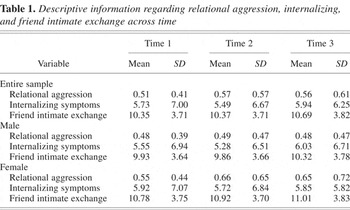
The first goal of this study was to model the mean trajectory of relational aggression over time and to explore whether these trajectories differed for boys and girls. Examination of the mean relational aggression scores across the three assessment periods (see Table 1) suggested potential change in relational aggression over time.
Descriptive information regarding relational aggression, internalizing, and friend intimate exchange across time

Analyses exploring potential quadratic change in relational aggression (not shown) indicated that there was not significant quadratic change in relational aggression. As such, a linear model was adopted.2
When analyses included individuals without complete data, the quadratic term did reach statistical significance,

, F (1, 408) = 6.11, p < .05. Given the high level of attrition in the present study, the integrity of these findings is questionable. However, it is possible that relational aggression may depend in part on the social context of the school given that relational aggression is often used in the context of close relationships (Grotpeter & Crick, 1996). For instance, when a new school year begins, children must once again form social relationships with their peers; thus, a drop in relational aggression may occur. Additional research is necessary to examine whether quadratic change is present in relational aggression over time, and, if so, whether such contextual effects are a contributing factor.
HLMs can be conceptualized and presented as multilevel models exploring individual and group-level change over time. In the first analysis, the individual-level model explores within-person growth in relational aggression. The equation expressing this individual change is

where yij is the ith person's relational aggression score at the jth time point and lj is the term used to model the linear trend across time. In this analysis, lj = 0, 1, and 2 for Time 1, Time 2, and Time 3, respectively, so that the intercept value in the analyses would reflect children's relational aggression at the first assessment period (see Byrk & Raudenbush, 1992). In addition, β0i is the person-specific intercept, β1i is the person-specific slope, and eij are the residuals.
The equations for group-level change incorporated gender parameters so that gender differences in children's relational aggression at Time 1 (i.e., intercept) and growth in relational aggression (i.e., slope) could be explored. To explore group-level change in relational aggression over time, the following set of equations were used:


where γ00 is the group intercept, γ01 is the index of the gender effect on intercept, gi is the participant's gender (−1 = male, 1 = female), and u0i is the residual indicating deviations from the group intercept. In addition, γ10 is the group slope, γ11 is the index of the gender effect on slope, and u1i is the residual indicating individual deviations from the group slope. Combining the individual and group-level equations, the HLM used to estimate the conditional HLM analysis was

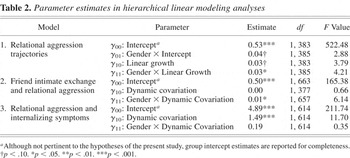
This equation demonstrates that the model of growth in relational aggression includes group level change (i.e., average change in relational aggression over time, captured by γ00 and γ10, and individual deviations from those trajectories, captured by u0i, u1i, and eij). In addition, this analysis allowed us to explore whether males and females differed in their relational aggression intercepts (as indexed by γ01) and linear trajectories (as indexed by γ11) over time. The SAS Proc Mixed syntax used to test all models are included in Appendix A. The results of the analysis are presented in Table 2.
Parameter estimates in hierarchical linear modeling analyses
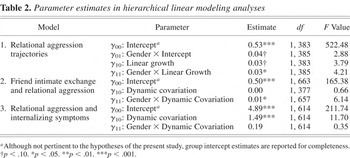
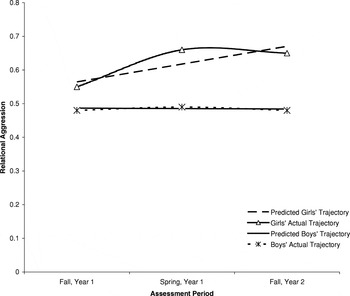
Results indicated that the linear increase in relational aggression over time approached statistical significance. In addition, the gender difference in relational aggression at the first assessment period approached statistical significance, with girls exhibiting greater relational aggression than their male peers. Finally, the interaction between gender and linear growth was significant, suggesting that increases in relational aggression were exhibited among girls only. The actual relational aggression scores at each time point and the predicted relational aggression trajectories of males' and females' are presented in Figure 1.
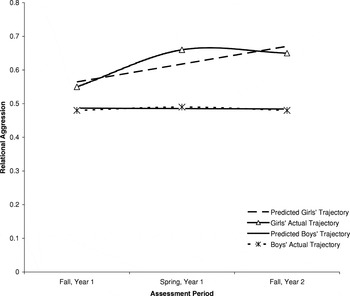
Predicted relational aggression trajectories and actual relational aggression scores for males and females.
Friendship intimacy and growth in relational aggression
To address the second goal of this study, analyses were conducted to explore whether change in friendship intimacy was associated with time-dependent growth in relational aggression. We expected that children who had friends that increasingly disclosed personal information to them would exhibit increases in relational aggression over time. Consistent with previous work, girls in the present study reported greater intimate exchange in the friendship context than did boys. Specifically, a one-way ANOVA examining gender differences in friend intimate exchange at Time 1 indicated that girls reported more intimate exchange than boys, F (1, 366) = 4.92, p < .05 (see Table 1). Given the relatively high levels of intimacy in girls' friendships, we examined whether the association between friendship intimacy and relational aggression was particularly strong for girls.
For this analysis, relational aggression served as the dependent variable and intimate disclosure by a friend toward the participant served as the independent variable. The equation for individual-level change in this analysis was

where yij is the ith person's relational aggression score at the jth time point, ieij is the participant's level of intimate exchange from a friend at the jth time point, β0i is the predicted relational aggression score if the participant's friendship intimacy score is 0, β1i is the strength of the longitudinal relationship between relational aggression and friendship intimacy, and eij are the residuals.
To model group-level change, the following equations were used:


where γ00 is the group intercept of relational aggression when friendship intimacy scores are 0, u0i is the residual indicating deviations from the group intercept, γ10 is the average covariation between relational aggression and friendship intimacy across subjects, γ11 is the gender difference in the covariation of relational aggression and friendship intimacy, gi is the participant's gender (−1 = male, 1 = female), and u1i is the residual indicating individual deviations from the group covariation.
Combining the multilevel equations yields the equation used to estimate the parameters:

We expected that relational aggression and friendship intimacy would be related such that increases in self-disclosure of a close friend over time would predict increases in children's relational aggression use. The results of this analysis are presented in Table 2. Results indicated that, overall, children's relational aggression trajectories were not associated with growth in friend intimate exchange. However, the interaction between gender and friend intimate exchange was significant, indicating that increases in intimate disclosure by a close friend were associated with increases in relational aggression use for girls only.
One concern that arises when using friendship quality measures is that there may be dependence in that data. In particular, when each member of a dyad reports on their friendship experiences, the data will not be independent. For the present study, some participants reported on a friend who reported on them as well (i.e., reciprocal reporting), and others reported on a friend who did not report on them in return. We reran this analysis excluding dyads who reported on one another at any of the three time points. Results indicated that the estimate for the interaction between gender and the dynamic association between friend intimate exchange and relational aggression did not change. In addition, this interaction approached statistical significance (p < .08) even though the sample size was reduced to 104. Thus, we believe that dependence in the data does not account for the present findings.
Relational aggression and growth in internalizing symptoms
To address the third goal of this study, a dynamic covariate analysis exploring the covariation of relational aggression and internalizing symptoms across time was conducted. In this model, relational aggression served as the dynamic predictor of change in internalizing symptoms. In other words, this analysis allowed us to explore whether children whose involvement in relational aggression increased over time exhibited time-dependent increases in internalizing symptoms. In this model, internalizing symptoms were conceptualized as the dependent variable, with relational aggression use serving as the dynamic predictor of growth in internalizing symptoms over time. The equation for individual-level change in this analysis was

where yij is the ith person's internalizing score at the jth time point, rij is the participant's relational aggression score at the jth time point, β0i is the predicted internalizing score if the participant's relational aggression score is 0, β1i is the strength of the longitudinal relationship between relational aggression and internalizing symptoms, and eij are the residuals.
To model group-level change, the following equations were used:


where γ00 is the group intercept of internalizing symptoms when relational aggression scores are 0, u0i is the residual indicating deviation from the group intercept, γ10 is the average covariation between relational aggression and internalizing across time, γ11 is the gender difference in the covariation of relational aggression and internalizing symptoms, gi is the participant's gender (−1 = male, 1 = female), and u1i is the residual indicating individual deviations from the group covariation.
Thus, the HLM equation used to estimate the parameters for this analysis was

We expected that relational aggression and internalizing symptoms would be related such that increases in children's relational aggression over time would predict increases in their internalizing symptoms. The results of this analysis, presented in Table 2, indicated that children's relational aggression trajectories were positively associated with growth in internalizing symptoms. In other words, an increase over time of relational aggression was positively associated with an increase in internalizing symptoms. However, the results of this analysis indicated that this association was equally strong for males and females (i.e., gender did not moderate this relation).
Discussion
The present study was designed to advance the extant peer relations literature in several ways. This large and diverse longitudinal sample was used to assess hypotheses related to growth of relational aggression: specifically, we examined mean-level change in relational aggression occurring over time and the moderating role of gender concerning children's aggression trajectories over the course of 1 year. In addition, using sophisticated statistical procedures, we tested for the time-dependent associations between friend intimate exchange and relational aggression. Finally, we examined the dynamic association between relationally aggressive behavior and internalizing problems.
The present findings suggest that, consistent with our first hypothesis, relational aggression appeared to increase over the course of the study. This finding is consistent with past theory suggesting that as children acquire more social–cognitive capacities and spend more time with close, intimate friends, we would predict more sophisticated and frequent displays of relational aggression (see Bjorkqvist, 1994; Crick et al., 1999; Pellegrini & Archer, in press). However, increases in relational aggression over time were exhibited by girls only. This finding supports the idea that the social contexts of girls (e.g., intimate friendships) during this developmental period may facilitate the use of relationally aggressive strategies over time. In addition, a gender difference in boys' and girls' relational aggression at the first assessment period (i.e., intercept difference) approached statistical significance, with girls exhibiting greater involvement in relational aggression than boys. This finding is consistent with research reporting gender differences in relationally aggressive behaviors among young children (Crick et al., 1999; Ostrov & Keating, 2004; Ostrov et al., 2004). Overall, the results of the present study suggest that relational aggression becomes an increasingly common behavior during late elementary school for girls.
Of interest, the findings of the present study differ from those reported by Pellegrini and Long (2003). In particular, these researchers found a negative linear trend for relational aggression growth. It is important to note that Pellegrini and Long (2003) were exploring growth in relational aggression among adolescents. One possible explanation of these different findings is that relational aggression may peak in the late elementary school years and then become less and less common. Alternatively, perhaps adolescents' use of relational aggression is less evident to the peer group as a whole than relational aggression among elementary school children. As children become involved in romantic relationships, relational aggression may be often used in the context of these close, exclusive relationships (Linder, Crick, & Collins, 2002). Moreover, as children spend increasing amounts of time alone with romantic partners during adolescence, peer observation of relational aggression against romantic partners may become more difficult. As such, peers may be less likely to observe relational aggression during this developmental period. We believe that longer term longitudinal studies are warranted to replicate this decrease in growth as children transition into adolescence, and propose that such studies would benefit from multiple informants of relational aggression, including romantic relationship partners.
In support of our second hypothesis, increases in friend intimate exchange were associated with time-dependent increases in relational aggression for girls. This finding is consistent with the proposition that increasing knowledge of close others may provide ammunition for relationally aggressive conduct. Of interest, growth in friend intimate exchange predicted increases in relational aggression among girls only. This finding is provocative, and may reflect differences in the friendship structure of boys and girls in middle childhood. For example, girls tend to report high levels of intimacy within their friendships and to place a greater emphasis on close relationships (Maccoby, 1990; Parker & Asher, 1993). Moreover, the relational aggression goals of girls may be more likely to involve disruption of dyadic relationships (Rudolph, 2002), perhaps making intimate exchange an especially salient factor in relationally aggressive conduct among girls.
Consistent with our third hypothesis, relational aggression significantly tracked with internalizing symptoms over time. That is, children's relational aggression trajectories were positively associated with growth in internalizing problems. These findings bolster the existing literature, suggesting that interpersonal stress is associated with depressive disorders (Garber & Flynn, 2001; Hammen & Rudolph, 1996; Nolen-Hoeksema & Girgus, 1994). However, contrary to our predictions, the relation between internalizing symptoms and relational aggression was not moderated by gender, and instead was of equal strength for girls and boys. Thus, relational aggression appears to be dynamically associated with harmful problems for both girls and boys (for a review, see Crick & Zahn-Waxler, 2003).
The findings of the present study have a number of important implications regarding relational aggression research and applications. First, the finding that relational aggression increases in frequency over the late elementary school years among girls suggests that relationally aggressive behaviors may be particularly salient experiences among girls of this age. Indeed, despite the abundance of research examining physical aggression and its correlates during the late elementary school years (for a review, see Coie & Dodge, 1998), physical aggression is actually decreasing in frequency during this time (Tremblay et al., 1996). In contrast, the present work indicates that relational aggression is becoming increasingly common for girls. Thus, when attempting to understand the use of harmful behaviors during this developmental period, especially among girls, our findings suggest that relational aggression is an essential piece of the puzzle.
Second, the present findings have important implications regarding interventions aimed at reducing relationally aggressive behavior. In particular, interventions may benefit from targeting girls in the late elementary school years given the increasing emergence of such behaviors across this developmental period (in contrast to, e.g., adolescence, when relational aggression may be less frequent; Pellegrini & Long, 2003). In addition, efforts to reduce relationally aggressive behavior should be sensitive to the possibility that intimate knowledge of friends may be used in a maladaptive manner. For example, relationally aggressive children may benefit from training regarding the appropriate use of intimate knowledge of friends.
Third, the findings of the present study indicate that children's relational aggression trajectories were dynamically associated with internalizing problems for both girls and boys. This suggests that research and interventions should explore the negative correlates of relational aggression in children of both genders. Moreover, this work does not support the contention that, during the elementary school years, girls are relatively problem free (Keenan & Shaw, 1997). Instead, girls do exhibit problem behaviors such as relational aggression at this age, and these behaviors are, in turn, dynamically associated with maladaptive problems such as internalizing symptoms.
The results of the present study offer a number of avenues concerning future work exploring growth in relational aggression over time. First, the use of HLM statistical procedures permitted an investigation of both growth in relational aggression and associations with both static (i.e., gender) and dynamic covariates (e.g., friend intimate exchange) over time. The successful use of these methods during both middle childhood and adolescence suggests that future research should continue to use these techniques across developmental periods. For example, it would be beneficial to explore relational aggression trajectories over middle childhood and into adolescence and adulthood.
Second, although this study used peer reports of relational aggression, future work should include relational aggression from other informants, such as teachers, parents, siblings, self-reports, and observations. Indeed, relational aggression can occur in many relationship contexts, including sibling–sibling, parent–teacher, teacher–child, coach–athlete, friendships, and mutual antipathies. Because the present study used peer reports of relational aggression, it likely captured the frequency of such behaviors in the school context in general and within peer relationships in particular. As a result, future work would benefit from the inclusion of relational aggression from multiple sources, as these informants may be privy to behaviors unique to particular contexts or relationships. Indeed, it is possible that the developmental trajectories of relational aggression differ depending on the context in which they are examined (e.g., relational aggression at school and between peers could be increasing at the same time that relational aggression among siblings and within the home is decreasing).
Additional measures of relational aggression may be particularly useful in exploring changes in relational aggression because such instruments often directly assess the frequency of aggressive behavior. In contrast, peer nominations assess the number of peers who consider each participant to be aggressive (i.e., participants with more nominations are considered more aggressive than their peers). In the present study, participants who are increasingly nominated as aggressive by increasing numbers of peers over time are considered to exhibit increases in aggressive conduct. However, it is possible that such increases reflect, for instance, increases in the diversity of contexts in which individuals exhibit relationally aggressive behavior or increases in children's ability to discern aggression in their peers, perhaps due to increasing familiarity. Thus, future work including more direct tests of frequency of aggression (e.g., teacher ratings using a scale to explicitly rate the frequency of aggressive conduct) use over time is warranted. Third, the results of the present study support the hypothesis that relational aggression increases during late elementary school for girls and these girls also experience time-dependent increases in friend intimate exchange. Future work would benefit from directly assessing additional social and cognitive changes (e.g., perspective taking abilities) and to explore their dynamic association with relational aggression use.
An important extension of the present study would be research that addresses causal relations between friend intimate exchange, growth in relational aggression, and internalizing trajectories. Indeed, one limitation of the present research is that causal conclusions are not possible. For example, we demonstrated that increases in relational aggression were dynamically associated with growth in internalizing symptoms. We proposed that relational aggression may serve as an interpersonal stressor, which in turn, increases children's likelihood of exhibiting internalizing problems. However, an alternative interpretation is that children exhibiting symptoms of anxiety and depression may engage in relational aggression as a result. Consistent with this idea, Devine, Kempton, and Forehand (1995) found evidence indicating that depressive symptoms in adolescence predicted externalizing problems in early adulthood. Similar tests with relational aggression outcomes are warranted. In addition, it is possible that another factor, such as strained parent–child relationships, may place children at risk for the development of both internalizing symptoms and relationally aggressive conduct. Thus, future research would benefit from examining the association between early relational aggression trajectories and future internalizing problems to address causal, prospective relations between these variables.
Fifth, future studies should include additional measures of adjustment found to be relevant in past concurrent studies of relational aggression. It is possible that children's relational aggression trajectories track with a number of important developmental indices of adjustment in addition to internalizing symptoms. Cross-sectional studies have revealed that relational aggression is associated with problems such as problematic eating patterns, self-harm, and attention problems (see Blachman & Hinshaw, 2002; Crick et al., 1999; Zalecki & Hinshaw, 2004). An important extension of this cross-sectional research is the examination of whether these experiences track dynamically with relational aggression over time.
Sixth, in the present study, teachers rated children's internalizing symptoms. There is evidence suggesting that teachers are reliable informants of depressive and anxious problems during middle childhood (Achenbach & Edelbrock, 1991; Briggs-Gowan, Carter, & Schwab-Stone, 1996; Crick, 1997), but there is a substantial body of research that relies on self-reported measures of depressive symptoms (e.g., Kovacs, 1985; Nolen-Hoeksema & Girgus, 1994). It is possible that the teachers' responses were based on gender biases (Condry & Ross, 1985; Leff et al., 1999; Ostrov, Crick, & Keating, 2005), and thus our findings must be replicated using multiple informants. In a similar vein, friendship intimate exchange was assessed with self-reports in the present study. This method was chosen because self-reports were used in previous work with this age group examining the quality of relationally aggressive children's friendships (i.e., Crick & Grotpeter, 1995). However, additional studies replicating our findings using alternative measures (e.g., friends' reports of intimate exchange in the friendship context) would bolster the findings of this study.
It would also be important for future research to include multiple years and seasons (Fall to Spring) to model expected changes across the school year. In addition, replicating these findings in other cultures (e.g., Japan, Indonesia) that are more collectivistic and display interdependent self-views (see French et al., 2002) would be helpful to begin to explicate the role of context and self-construal (Cross & Madsen, 1997) in the development of relational aggression. For example, interpersonal stress resulting from relational aggression may be more strongly related to adjustment problems in collectivistic cultures where social harmony and relationships are emphasized.
Conclusion
In conclusion, the present study advances in the field in several ways. This short-term longitudinal study reveals that relationally aggressive behavior increases over time, but only for girls during middle childhood. In addition, increases in friendship intimacy were associated with a time-dependent increase in relational aggression, which supports the hypothesis that close voluntary dyadic relationships may fuel relationally aggressive behavior in some contexts. Finally, relationally aggressive behavior tracked over time with symptoms of anxiety and depression during middle childhood. Collectively, these findings indicate that we must continue to explore how relational aggression is impacted by and affects change in both typical (i.e., friendship formation) and atypical (i.e., internalizing problems) developmental processes.
Appendix A
SAS PROC MIXED syntax for models
Trajectories of relational aggression for boys and girls
proc mixed data = work.file method = reml ic covtest;
class id wave;
model ragg = linear gender linear*gender/intercept solution;
random intercept linear/type = un subject = id g gcorr v vcorr;
repeated wave/type = simple subject = id r;
title “linear growth in relational aggression conditional on gender”;
run;
Dynamic association between friend intimate exchange and relational aggression
proc mixed data = work.file method = reml ic covtest;
class id wave;
model ragg = ie ie*gender/intercept solution;
random ie/type = un subject = id g gcorr v vcorr;
repeated wave/type = simple subject = id r;
title “friend intimate exchange and relational aggression”;
run;
Dynamic association between relational aggression and internalizing symptoms
proc mixed data = work.file method = reml ic covtest;
class id wave;
model int = ragg gender*ragg /intercept solution;
random ragg/type = un subject = id g gcorr v vcorr;
repeated wave/type = simple subject = id r;
title “relational aggression and internalizing”;
run;
Key:
id, child identification number; wave 1, 2, and 3 for T1, T2, and T3, respectively; ragg, relational aggression; linear 0, 1, and 2 for T1, T2, and T3, respectively; ie, friend intimate exchange; int, internalizing symptoms.