


INTRODUCTION
The common bean (Phaseolus vulgaris L.) is one of the most important cultivated grain legumes and a major source of protein for human consumption in Latin America, Africa and parts of Asia (Farid and Navabi, Reference Farid and Navabi2015; Worku, Reference Worku2014). However, a large part of common bean production in these regions takes place on small farms, ranging from 1 to 10 ha in size, with low soil nitrogen (N) content (Hungria et al., Reference Hungria, Campo and Mendes2003). They are cultivated by resource-poor farmers with minimal inputs, in areas considered marginal for agriculture (Pimentel, Reference Pimentel, Singh, Shankar and Jaiwal2006), where the yield of common bean is low without a correct fertilization. Therefore, the introduction of a low-cost advanced technology, such as biological nitrogen fixation (BNF), in addition to N fertilization (Hungria et al., Reference Hungria, Campo and Mendes2003), is essential to improve the yield and production of common bean in these marginal agricultural areas, particularly where there is a rapid increase in population (Pimentel, Reference Pimentel, Singh, Shankar and Jaiwal2006).
Like other legumes, the common bean can benefit from BNF through symbiosis with nitrogen-fixing rhizobia (Hungria and Kaschuk, Reference Hungria and Kaschuk2014). Thus, an adequate supply of N for the plant through BNF in addition to N fertilization should increase N leaf content, photosynthesis and yield (Hungria et al., Reference Hungria, Campo and Mendes2003; Pimentel, Reference Pimentel, Singh, Shankar and Jaiwal2006) as more than 50% of N in leaf soluble protein content (LSPC) is ribulose-1,5-bisphosphate carboxylase/oxygenase (Rubisco) and this enzyme is responsible for CO2 fixation for carbohydrate synthesis (Long et al., Reference Long, Zhu, Naidu and Ort2006). Therefore, N content of the source leaf for the harvested sink is a useful trait with high heritability for breeding and improve yield (Pimentel, Reference Pimentel, Singh, Shankar and Jaiwal2006). If plants have high LSPC at the pollination stage, when photosynthesis is maximal, they will have a high-yield potential (Pimentel et al., Reference Pimentel, Laffray and Louguet1999).
Unfortunately, common bean plants generally have a low nitrogen fixing capacity relative to other legume crops, such as soybean (Farid and Navabi, Reference Farid and Navabi2015). Accordingly, biotechnology research should aim to provide strategies to improve the efficiency of BNF for beans by selecting more efficient genotypes and rhizobial strains for symbiosis (Remigi et al., Reference Remigi, Zhu, Young and Masson-Boivin2016). The usual field recommendation is only the inoculation of seeds with Rhizobium strains at sowing, with an additional fertilization of 20 to 40 kg N ha−1 at 25 days after emergence (DAE), as stated by Vieira et al. (Reference Vieira, de Paula Júnior and Borém2006). Nova-Franco et al. (Reference Nova-Franco, Íñiguez, Valdés-López, Alvarado-Affantranger, Leija, Fuentes, Ramírez, Paul, Reyes, Girard and Hernández2015) showed that sowing N fertilization together with seeds inoculation with Rhizobium strains reduced the nodule number per plant (NN) formed in common bean, even though the specific activity of nitrogenase (i.e., the BNF per nodule mass) increased, generating a significant complementation of N.
Consequently, to achieve a high common bean yield, even at high cost, sowing N fertilization could be recommended to initiate N supply and growth, until the infection, nodulation and fixing processes occur and plants begin to produce N by BNF (Vieira et al., Reference Vieira, de Paula Júnior and Borém2006). While excessive sowing N fertilization can reduce BNF, sowing N fertilization in small doses seems to improve common bean yield (Cardoso et al., Reference Cardoso, Hungria and Andrade2012; Hungria et al., Reference Hungria, Campo and Mendes2003). Therefore, we aimed to evaluate the effect of the interaction of BNF potential with sowing N fertilization on growth and yield of common bean.
MATERIALS AND METHODS
Site and climate description
To evaluate the effects of the interaction between seed inoculation with Rhizobium and sowing N fertilization in Phaseolus vulgaris L., two experiments were conducted in the field, at the Experimental Station of the Department of Crop Science at the Federal Rural University of Rio de Janeiro (Universidade Federal Rural do Rio de Janeiro, UFRRJ), Brazil. The climate in the region is classified as Aw, according to Köppen, with a rainy summer and dry winter (22°45′S, 43°41′W, altitude of 40 m). The soil type in the experimental field was a Kanhapudalf soil with the following composition at a depth of 0.2 m: pH 5.8, 1.5 cmolc dm−3 of Ca, 1.4 cmolc dm−3 of Mg, 0.0 cmolc dm−3 of Al, 0.6 cmolc dm−3 of H+ Al, 65 mg dm−3 of P, 115 mg dm−3 of K and 10.7 g kg−1 of organic matter. The first experiment was installed during the rainy season (October, 2013). During the experiment, total precipitation was 331.9 mm, total evaporation was 301.8 mm and the mean maximal and minimal air temperatures were 29.4 °C and 18.9 °C, respectively. The second experiment was conducted during the next rainy season (October, 2014) and the total precipitation was 297.8 mm, total evaporation was 311.5 mm and the mean maximal and minimal air temperatures were 28 °C and 17.9 °C, respectively, during the plant cycle.
Crop management
The cultivar Carioca is one of the most used and studied cultivar in Brazil, developed by the Agronomic Institute (Campinas SP, Brazil). It has an indeterminate growth type III, flowering at 30 to 35 DAE with an intermediary cycle (85 DAE) and seeds are beige with brown strips (Vieira et al., Reference Vieira, de Paula Júnior and Borém2006). For both experiments, the cultivar Carioca was cultivated under three treatments in the first year of cultivation: only fertilized with 20 kg N ha−1 at sowing and with 40 kg N ha−1 at 25 DAE (F); only inoculated with Rhizobium at sowing and fertilized with 40 kg N ha−1 at 25 DAE (I+N); and inoculated and fertilized with 20 kg N ha−1 at sowing and with 40 kg N ha−1 at 25 DAE (IF). An additional treatment was done only in the second year of cultivation: Plants were inoculated with Rhizobium with no N fertilization at any phase (I−N), as shown in Supplementary Material Table S1 (available online at http://dx.doi.org/10.1017/S001447971600065X). All the treatments were fertilized with 30 kg P2O5 ha−1 (simple superphosphate) and 45 kg K2O ha−1 (potassium chloride) with the additional 40 kg N ha−1 at 25 DAE, except for the treatment with inoculation without N in the second season – the usual field recommendation (Vieira et al., Reference Vieira, de Paula Júnior and Borém2006). For inoculation, the common bean inoculant from EMBRAPA (Brazil) was used, which is prepared with Rhizobium tropici strain SEMIA 4080. The strain SEMIA 4080 of Rhizobium tropici was isolated in soils of the state of Paraná (Brazil) and common bean plants inoculated with this strain have yields up to 4000 kg ha−1, being such microorganism recommended by the Brazilian Government as inoculant (Hungria et al., Reference Hungria, Campo and Mendes2003). Following inoculation (50 g of inoculants per 50 kg of seeds), seeds were maintained in shade to dry before sowing. Seeds were sown manually in row and thinned to 12 plants m−1. During the experiments, the experimental area was maintained free from weeds by manual control and irrigation was provided when necessary.
At 32 and 33 DAE (i.e., the pollination stage) for the first and second experiments, respectively, when biomass is maximal (Vieira et al., Reference Vieira, de Paula Júnior and Borém2006), three plants were collected per plot with maximal care to recover all roots. The nodules were separated from roots, counted and dried at 65 ˚C for 72 h, as also done for shoot and roots. When physiological maturation was achieved at 85 and 83 DAE (first and second year, respectively), all plants of the two central rows were collected from each plot to evaluate the crop yield components: number of pods per plant, number of grains per pod, 100 grain matter and seed matter per exploited area, i.e., yield. In addition, the central leaflet of the youngest fully expanded leaf of three plants per plot was collected to quantify leaf soluble proteins using the Bradford method (Bradford, Reference Bradford1976). LSPC was evaluated at four growth stages, as described by Vieira et al. (Reference Vieira, de Paula Júnior and Borém2006): vegetative (20 DAE), before N fertilization at 25 DAE; pollination (32 and 33 DAE); flowering (37 and 39 DAE) and grain filling (63 and 65 DAE) for the first and second year of cultivation, respectively. For the second year of cultivation, the leaf starch (LSC), soluble sugar (LSSC) and free amino acid (FAAC) contents were measured in the central leaflet of the youngest fully expanded leaf of three plants per plot, following the same procedure adopted for sampling leaf tissues used for soluble protein. Samples of 100 mg of leaf fresh matter were collected and wrapped in aluminium foil and stored immediately in liquid nitrogen. LSSC and LSC were assayed as proposed by Farrar (Reference Farrar, Hall, Scurlock, Bolhàr-Nordenkampf, Leegood and Long1995) and FAAC was determined according to Yemm and Cooking (Reference Yemm and Coocking1955), using a spectrophotometer (Spectronic 20, Milton Roy, USA).
For the growth analysis, three plants were collected on the second line of each side of the plot, weekly from 14 DAE until physiological maturation. The leaf area was measured with a portable area meter LI-3000C (LICOR, USA) and shoot and root dry matter were obtained after drying at 65 ˚C for 72 h. The primary data for dry matter (DM) and leaf area were converted to DM per soil area. Leaf area index (LAI) was estimated by considering the number of plants per m2 of explored soil area. The data of DM per area were used to calculate the crop growth rate (CGR), which associated with the LAI data gives the net assimilation rate (NAR) according to Hunt (Reference Hunt1978).
Experimental design and statistical analysis
The experimental design used for the two experiments was in randomized blocks, with three treatments in the first year and four treatments in the second year, and four replications (blocks). Each plot consisted of six rows of 5 m spaced 0.5 m apart, with a total area of 12.5 m2 per plot. Data were submitted to analysis of variance (ANOVA) and the means were compared and segregated by the Tukey test when significance was detected (p < 0.05).
RESULTS
Plant dry matter and leaf area accumulation
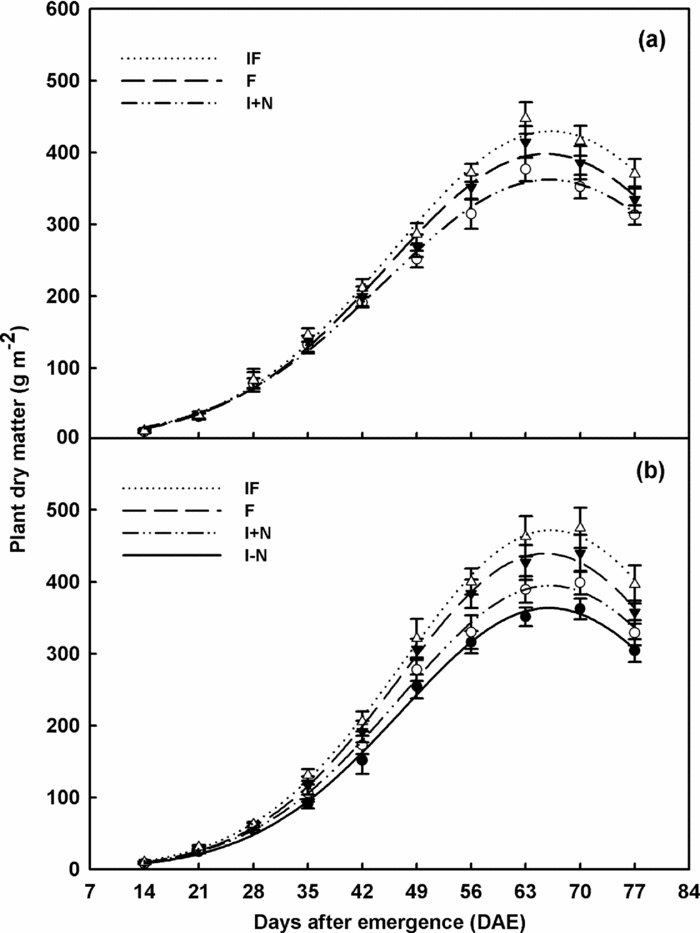
Growth analysis was performed by monitoring plant (shoot and root) dry matter (PDM) (Figure 1) and leaf area accumulation over time (data not shown). There were significant differences in PDM among the treatments for both years. In the first year of cultivation, differences in PDM among treatments were observed from 21 DAE (Figure 1a), such that the PDM in IF and F treatments was significantly higher than in I+N from 56 DAE until the last sampling (77 DAE). The maximal PDM occurred at 63 DAE in the first year (Figure 1a). In the second year (Figure 1b), differences in PDM were observed from 42 DAE (Figure 1b), such that values for IF and F were significantly higher than the other two treatments until 77 DAE. The maximal PDM values occurred at 70 DAE in the second year.
Plant dry matter (PDM) of common bean cultivar Carioca cultivated during two rainy seasons, under three treatments in the first year: only inoculated with Rhizobium, with 40 kg N ha−1 at 25 DAE (I+N); only fertilized with 20 kg N ha−1 at sowing with 40 kg N ha−1 at 25 DAE (F); and inoculated and fertilized with 20 kg N ha−1 at sowing, with 40 kg N ha−1 at 25 DAE (IF); and a fourth treatment, included in the second year of cultivation: only inoculated with Rhizobium with no additional N (I−N).

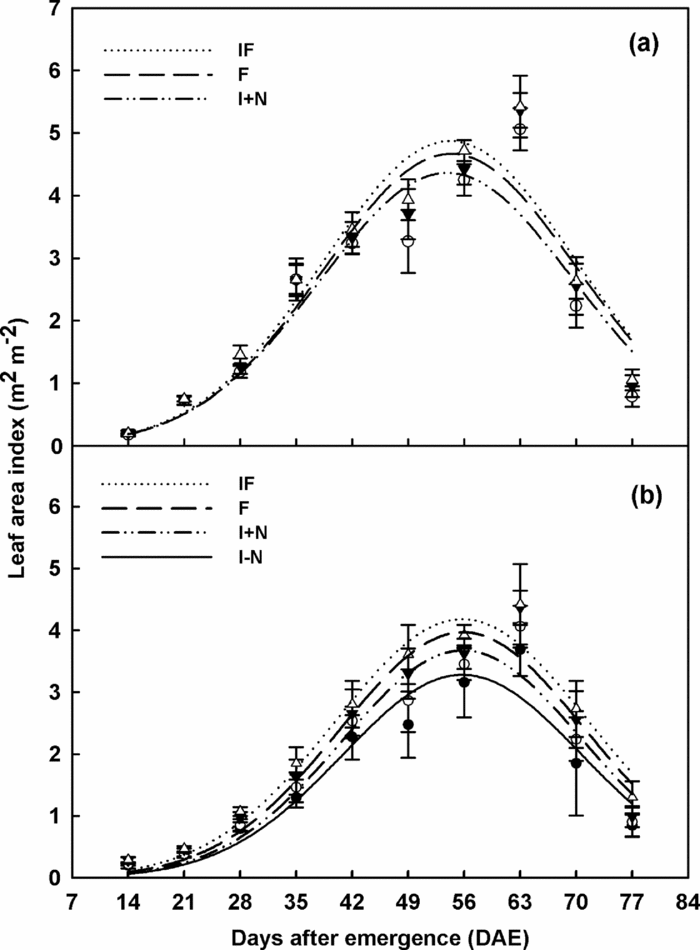
The LAI was significantly different among the treatments in both years of cultivation (Figure 2). The maximal LAI occurred during the pod filling stage in both years. In the first year, the LAI in IF and F treatments was greater than that in I+N for virtually all the reproductive stages, particularly between 49 and 70 DAE (Figure 2a). In the second year, the differences were accentuated and occurred for virtually the entire experimental period, with the LAI in IF and F treatments being significantly higher than in the other two treatments.
Leaf area index (LAI) of common bean cultivar Carioca cultivated during two rainy seasons, under three treatments in the first year: only inoculated with Rhizobium, with 40 kg N ha−1 at 25 DAE (I+N); only fertilized with 20 kg N ha−1 at sowing with 40 kg N ha−1 at 25 DAE (F); and inoculated and fertilized with 20 kg N ha−1 at sowing, with 40 kg N ha−1 at 25 DAE (IF); and a fourth treatment, included in the second year of cultivation: only inoculated with Rhizobium with no additional N (I−N).

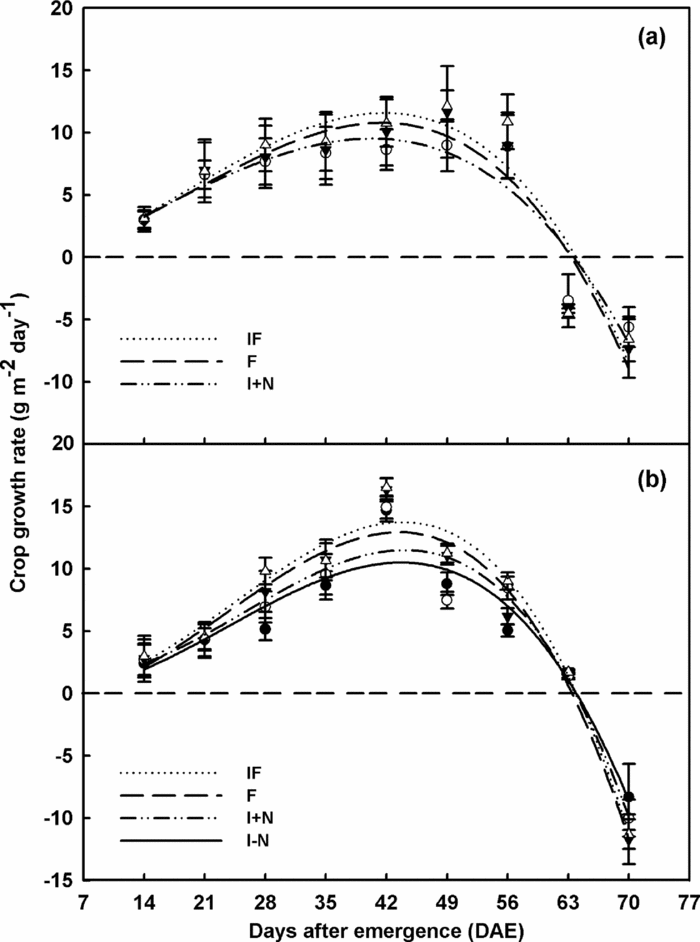
Concerning PDM accumulation per unity of soil area and time, i.e., the CGR, the maximal rate occurred during the end of the flowering stage in both years, at 42 and 49 DAE, respectively (Figures 3a and b). In the first year, there were significant differences among the treatments only at 49 DAE, when IF caused higher CGR than I+N (Figure 3a). In the second year, both IF and F treatments increased CGR as compared to I+N and I−N from 28 DAE to 63 DAE (Figure 3b).
Crop growth rate (CGR) of common bean cultivar Carioca cultivated during two rainy seasons, under three treatments in the first year: only inoculated with Rhizobium, with 40 kg N ha−1 at 25 DAE (I+N); only fertilized with 20 kg N ha−1 at sowing with 40 kg N ha−1 at 25 DAE (F); and inoculated and fertilized with 20 kg N ha−1 at sowing, with 40 kg N ha−1 at 25 DAE (IF); and a fourth treatment, included in the second year of cultivation: only inoculated with Rhizobium with no additional N (I−N).

The relation of CGR generated by leaf area (NAR) was maximal at 14 DAE diminishing until the end of the plant cycle in both years of cultivation (Figure S1). Treatments did not cause any significant change in NAR.
Biological nitrogen fixation potential and plant dry matter at the pollination stage
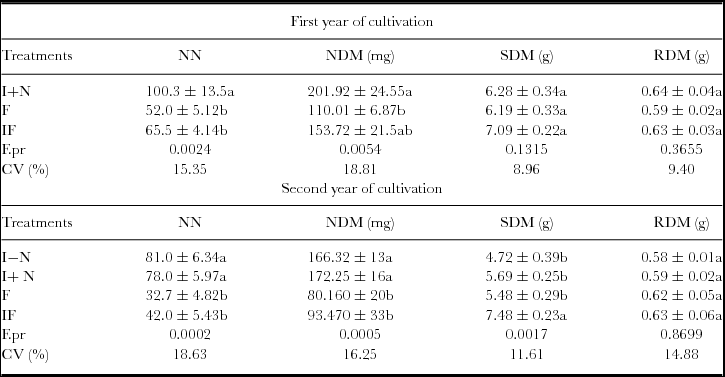
The BNF potential was evaluated by NN and nodule dry matter (NDM), whereas plant growth by SDM and RDM at the pollination stage, i.e., 32 and 33 DAE in the first and second years, respectively. There were significant differences for NN among treatments in both years (Table 1), such that I+N in the first year and I+N and I−N in the second year caused higher NN than F and IF. In the first year, I+N and IF caused very similar NDM values. In the second year, NDM was higher in I+N than in IF (Table 1). SDM and RDM were not affected by treatments in the first year. In the second experiment, SDM was higher in IF treatment than in the others (Table 1).
Number of nodules (NN), nodule dry matter (NDM), shoot dry matter (SDM) and root dry matter (RDM) per plant of common bean cultivar Carioca, at the pollination stage, cultivated during two rainy seasons under three treatments in the first year: only inoculated with Rhizobium, with 40 kg N ha−1 at 25 DAE (I+N); only fertilized with 20 kg N ha−1 at sowing with 40 kg N ha−1 at 25 DAE (F); and inoculated and fertilized with 20 kg N ha−1 at sowing, with 40 kg N ha−1 at 25 DAE (IF); and a fourth treatment, included in the second year of cultivation: only inoculated with Rhizobium with no additional N (I−N).

±Standard error of mean values.
Mean values within a column followed with the same letters are not significantly different by Tukey test p < 0.05. F.pr = F probabilities.
Leaf soluble protein, free amino acids, starch and soluble sugars contents during ontogeny
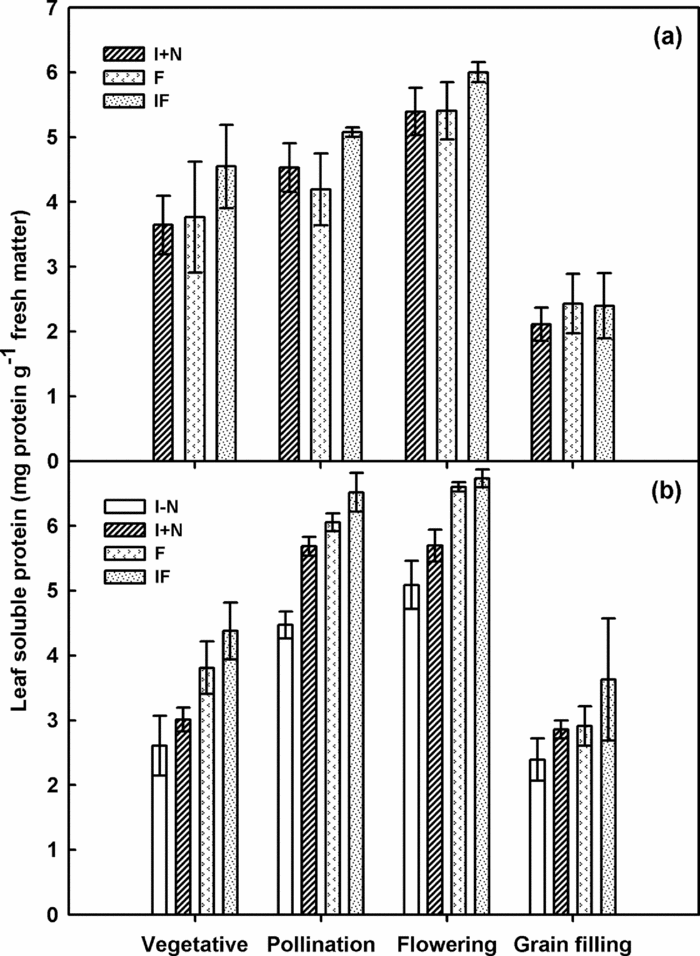
For both years of cultivation, there were significant differences in LSPC among the treatments for some of the four stages evaluated. In the first year, at the vegetative stage (20 DAE), before additional fertilization with 40 kg N ha−1, there were no significant differences in LSPC among treatments (Figure 4a). In the second year at the vegetative stage, LSPC was significantly greater for IF and F as compared with I+N and I−N (Figure 4b). At the pollination stage (32 and 33 DAE, for the first and second years, respectively), there were significant differences among treatments for both years and LSPC was significantly greater in IF treatment when compared with the other treatments (Figure 4). At the flowering stage (37 and 39 DAE, for the first and second years, respectively), LSPC was significantly greater in IF than in the other treatments in the first year (Figure 4a). In the second year, IF and F caused higher LSPC than I+N and I−N (Figure 4b). In the last sampling at the grain filling stage (63 and 65 DAE, for the first and second years, respectively), there were no significant differences among treatments for both years (Figure 4). The treatments did not cause any delay in the cycle of common bean for both years.
Leaf soluble protein content (LSPC) of common bean cultivar Carioca cultivated during two rainy seasons, under three treatments in the first year: only inoculated with Rhizobium, with 40 kg N ha−1 at 25 DAE (I+N); only fertilized with 20 kg N ha−1 at sowing with 40 kg N ha−1 at 25 DAE (F); and inoculated and fertilized with 20 kg N ha−1 at sowing, with 40 kg N ha−1 at 25 DAE (IF); and a fourth treatment, included in the second year of cultivation: only inoculated with Rhizobium with no additional N (I−N).

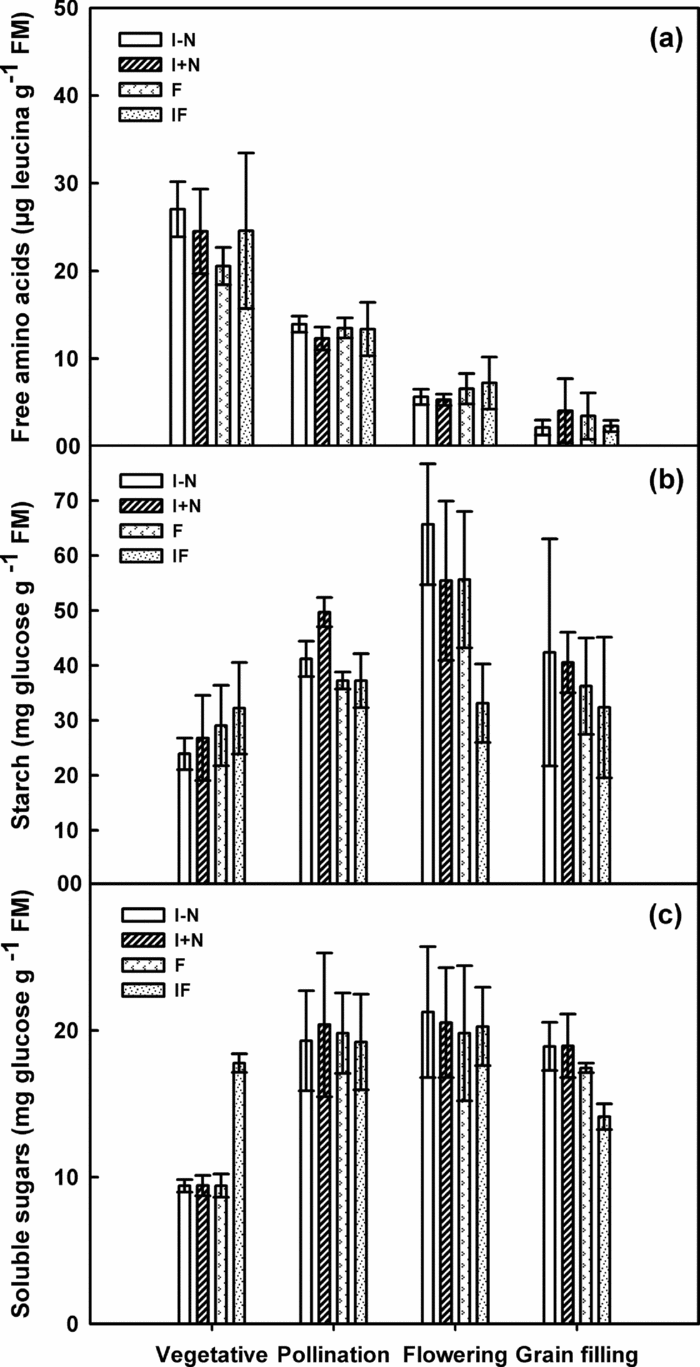
During the second experiment, the LSC, LSSC and FAAC were assayed at the vegetative, pollination, flowering and grain filling stages (Figure 5). For FAAC, there were no significant differences among the four treatments at all stages (Figure 5a); however, the values of FAAC were higher at the vegetative stage (20 DAE) when compared to the other stages. LSC also showed no differences among the treatments (Figure 5b) at the vegetative stage (20 DAE); however, LSC was significantly higher in I+N than in the other treatments at the pollination stage (33 DAE). At the flowering stage (39 DAE), the LSC in IF was significantly lower than in the remaining treatments (Figure 5b). At the grain filling stage (65 DAE), there were no significant differences among treatments. The LSSC in IF was significantly higher than the remaining treatments at the vegetative stage (Figure 5c). At the pollination and flowering stages, there were no significant differences among the treatments for LSSC, while I+N, I−N and F caused higher LSSC than IF at the grain filling stage, (Figure 5c).
Leaf free amino acids (FAAC), leaf starch (LSC) and soluble sugars (LSSC) contents of common bean cultivar Carioca cultivated during two rainy seasons, under three treatments in the first year: only inoculated with Rhizobium, with 40 kg N ha−1 at 25 DAE (I+N); only fertilized with 20 kg N ha−1 at sowing with 40 kg N ha−1 at 25 DAE (F); and inoculated and fertilized with 20 kg N ha−1 at sowing, with 40 kg N ha−1 at 25 DAE (IF); and a fourth treatment, included in the second year of cultivation: only inoculated with Rhizobium with no additional N (I−N).

Yield components
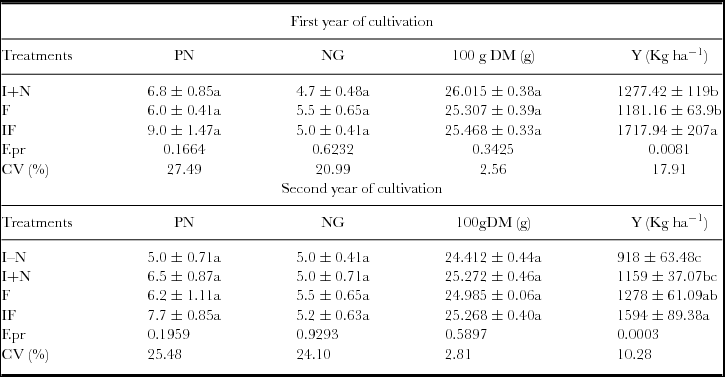
Once physiological maturation was achieved, the yield components, pod number per plant (PN), number of grains per pod (NG), 100 grains dry matter (100 g DM) and grain yield (Y), i.e., dry matter of grains per hectare, were determined in both years of cultivation (Table 2). For PN, NG and 100 g DM, no significant differences were verified among the treatments for both years. However, Y was higher in IF treatment than in the other two treatments in the first year (Table 2). In the second year of cultivation, Y was increased again by IF treatment, with a similar effect being found in F treatment (Table 2).
Pod number per plant (PN), number of grains per pod (NG), dry matter of 100 grains (100 g DM) and yield (Y) of common bean cultivar Carioca, at maturation, cultivated during two rainy seasons, under three treatments in the first year: only inoculated with Rhizobium, with 40 kg N ha−1 at 25 DAE (I+N); only fertilized with 20 kg N ha−1 at sowing with 40 kg N ha−1 at 25 DAE (F); and inoculated and fertilized with 20 kg N ha−1 at sowing, with 40 kg N ha−1 at 25 DAE (IF); and a fourth treatment, included in the second year of cultivation: only inoculated with Rhizobium with no additional N (I−N).

±Standard error of mean values.
Mean values within a column followed with the same letters are not significantly different by Tukey test p < 0.05. F.pr = F probabilities.
DISCUSSION
In the first year of cultivation, there were three treatments (IF, F and I+N) and a forth treatment (I−N) was evaluated in the second year of cultivation, with no N fertilization during the entire cycle to provide a total control treatment without N fertilization. As fertilization with 20 to 40 kg N ha−1 is recommended at least at 25 DAE (Vieira et al., Reference Vieira, de Paula Júnior and Borém2006), I−N is a treatment not used by farmers.
Plant dry matter and leaf area accumulation
The growth analysis of common bean in the field showed significant differences for PDM among the treatments in both years, with IF treatment inducing higher values (Figure 1). Furthermore, LAI peaks occurred at the beginning of the grain filling stage in both years (Figures 1 and 2). Similar to PDM, significantly higher LAI values were verified for IF in both years (Figure 2). The LAI in IF treatment was significantly higher than the remaining treatments in several samplings (Figure 2), supporting the highest yield in both years (Table 2). The highest LAI values in IF treatment were correlated with high PDM (Figures 1 and 2), probably increasing plant photosynthesis and then yield (Table 2). In fact, peaks of PDM and LAI occurred at the grain filling stage, when plants require high photosynthetic rates to supply photoassimilates and support high yield (Pimentel et al., Reference Pimentel, Laffray and Louguet1999). Our data show that fertilization with 20 kg N ha−1 of N at sowing increased PDM and LAI at the end of the cycle, supporting the high yield of this treatment.
The maximal CGR occurred at the end of the flowering stage in both years of cultivation (Figure 3), just before the peaks of PDM (Figure 1) and LAI (Figure 2). After the maximal CGR, the growth of plants was reduced but PDM continued increasing more slowly up to the grain filling stage in all treatments (Figure 1). In the first year, there were significantly differences for CGR only at 49 DAE, when IF was significantly higher than I+N but was very similar to F (Figure 3). In the second year, CGR for IF and F was significantly higher than in I+N and I−N from 28 DAE to 63 DAE. Thus, the sowing N fertilized treatments promoted higher PDM, LAI and CGR probably due to the starter dose of N before nodule formation and the initiation of BNF (Hungria and Kaschuk, Reference Hungria and Kaschuk2014), which would increase N leaf content earliest and improve photosynthesis and final yield. The NAR indicates the biomass produced per leaf area, another important index determining crop yield. However, NAR was not affected by treatments and then was not correlated with the high yield induced by IF treatment (Figure S1).
Biological nitrogen fixation potential and plant dry matter at the pollination stage
At the pollination stage (32 and 33 DAE in the first and second year, respectively), the stage with maximal photosynthetic rates during the bean cycle (Pimentel et al., Reference Pimentel, Laffray and Louguet1999), plant needs high leaf N content for Rubisco synthesis and activity (Pimentel, Reference Pimentel, Singh, Shankar and Jaiwal2006). Thus, the BNF potential was evaluated at this stage through NN and NDM (Table 1). There were significant differences for NN among treatments for both years (Table 1), with I+N in the first year, and I+N and I−N in the second showing the highest NN values. NDM showed a similar pattern of response as NN (Table 1). Our data revealed that the starter dose of N before nodule formation and the initiation of BNF reduced but did not inhibit nodulation, increasing SDM production, as shown by Hungria et al. (Reference Hungria, Campo and Mendes2003).
Leaf soluble protein, free amino acids, starch and soluble sugars contents during ontogeny
A higher LSPC, which is proportional to Rubisco content, would lead to enhancements in photosynthesis and, consequently, in yield (Long et al., Reference Long, Zhu, Naidu and Ort2006). Thus, LSPC was evaluated at four developmental stages (Figure 4): at the vegetative stage, before additional N fertilization; at the pollination stage, when leaf N content and photosynthesis are maximal (Pimentel et al., Reference Pimentel, Laffray and Louguet1999) to ensure leaf photoassimilates exportation and maintain grain embryo growth (Pimentel, Reference Pimentel, Singh, Shankar and Jaiwal2006); at the flowering stage, when the embryos are growing; and at the grain filling stage. In the first year of cultivation, at the vegetative stage and before additional fertilization with 40 kg N ha−1, the LSPC was significantly higher in IF than in I+N and I−N (Figure 4a). In the second year, no differences were verified at this stage (Figure 4b). At the pollination stage, LSPC was again significantly higher in IF than the remaining treatments for both years (Figure 4), as found for SDM (Table 1). Such high LSPC would ensure high photosynthesis and carbohydrate accumulation for following reproductive growth. At the flowering stage, IF caused higher LSPC than the other two treatments in the first year (Figure 5a), being such response found in both IF and F treatments in the second year (Figure 5b). At the grain filling stage, there were no significant differences among treatments for both years (Figure 5) probably due to an increase in leaf senescence (Gomes et al., Reference Gomes, Araújo, Rossiello and Pimentel2000; Vieira et al., Reference Vieira, de Paula Júnior and Borém2006).
In the second year, LSC, LSSC and FAAC were also evaluated at the same four stages as the LSPC measurements. There was no significant difference for FAAC among the treatments (Figure 5a), with high values (around 25 µg amino acid g−1 of leaf fresh matter) in the vegetative stage (20 DAE) and decreases towards the following stages in parallel to PDM increases. At the pollination stage (33 DAE), LSC in IF and F treatment was significantly lower than for I+N, but very similar to I−N (Figure 5b). At the flowering stage (39 DAE), only the LSC of IF was lower than the other three treatments (Figure 5b) and the values of LSC at the flowering stages (Figure 5b) were increased compared with the remaining treatments (Figure 5b). The low LSC of IF and F treatments can be due to an increase in sugars export to supply and energy and carbon skeletons for DM production (Pimentel, Reference Pimentel, Singh, Shankar and Jaiwal2006). The LSSC was significantly higher in IF than in other treatments at the vegetative stage (Figure 5c). However, LSSC showed no differences among the treatments at the pollination and flowering stages and it was higher in I+N and I−N treatments at the grain filling stage (Figure 5c). The low LSC and LSSC values caused by IF treatment (Figure 5b and c) contrast with the high LSPC (Figure 5b), which is probably due to sugar remobilization, inducing starch hydrolysis and soluble sugar exportation from the leaf to sustain embryo growth starting at the pollination stage (Pimentel, Reference Pimentel, Singh, Shankar and Jaiwal2006).
Yield components
Regarding the crop yield components, no significant differences for PN, NG and 100 g DM were verified (Table 2). Only yield was significantly different among the treatments, with IF producing the highest Y in both years (Table 2). Thus, the sowing N fertilization associated with inoculation supported the highest yield and this index was the only one able to discriminate the effects of the treatments. PN was not correlated to higher Y in both years (Table 2) and then it cannot be considered a good trait for revealing the response to management practices. In the second year, I−N caused the lowest Y among treatments. For both years of cultivation, the fertilization with 20 kg N ha−1 at sowing sustained LAI and caused high LSPC, allowing higher yield, the best trait for discrimination of common bean performance.
In both experiments, the treatment inoculated and fertilized with 20 kg N ha−1 at sowing and with 40 kg N ha−1 at 25 DAE (IF) induced high PDM and yield, which was associated with high CGR and LAI. As nodulation and then BNF were not inhibited by N fertilization, we would expect increases in plant N content in IF treatment. However, NAR was not increased by IF treatment and null NAR values were found at grain filling stage, when photoassimilate supplying is mandatory for grains growth. On the other hand, leaf soluble protein content was higher in IF treatment at flowering stage, being associated with crop yield.
CONCLUSIONS
In both years, the highest yield was found in plants inoculated and fertilized with 20 kg N ha−1 at sowing and with 40 kg N ha−1 at 25 DAE, being an option for bean cultivation with high technology. On the other hand, inoculation with Rhizobium at sowing and fertilization with 40 kg N ha−1 at 25 DAE had the same yield as the treatment using 20 kg N ha−1 at sowing and with 40 kg N ha−1 at 25 DAE and would be an alternative for a low-cost technological cultivation employed by small farmers. However, more studies are required with other cultivars and sites, before recommending these agronomic practices of inoculation with or without sowing N fertilization to improve common bean yield in the rainy season.
Acknowledgements
We acknowledge a grant from the National Council for Research (CNPq, Brazil) and Dr Jerri Édson Zilli for providing the Rhizobium sp. strains. R.L.N. Barros and L.B. de Oliveira acknowledge PhD fellowships from the National Council for the Improvement of Higher Education (CAPES) and a grant from Crop Science Graduated Research Program from UFRRJ.
SUPPLEMENTARY MATERIAL
For supplementary material for this article, please visit http://dx.doi.org/10.1017/S001447971600065X.