Introduction
Ample research shows that immigrants have less favourable labour market outcomes than natives across the industrialised world, even after accounting for socio-economic characteristics (Adsera and Chiswick Reference Adsera and Chiswick2006; Büchel and Frick Reference Büchel and Frick2004; Lancee Reference Lancee2012). Additionally, previous scholarship documents that ethnic gaps vary considerably across Western societies (Büchel and Frick Reference Büchel and Frick2005; Fleischmann and Dronkers Reference Fleischmann and Dronkers2010; Heath and Cheung Reference Heath and Cheung2007; Kogan Reference Kogan2006). Today, however, the problem of ethnic inequality is no longer confined to the working-age population because the immigrants that arrived in Europe in the 1960s and 1970s have mostly exited the labour market. According to Eurostat, there were almost seven million foreign-born persons aged 65 or older in countries of the European Union (EU) in 2013. Research has yet to adapt to these changing realities: evidence about the relative economic position of immigrants once retired remains scant (Warnes et al. Reference Warnes, Friedrich, Kellaher and Torres2004). In particular, we know virtually nothing about cross-national differences in the disadvantages faced by immigrants in old age.
A small number of single-country studies suggest that ethnic inequality in later life is substantial in Britain (Evandrou Reference Evandrou2000; Vlachantoni et al. Reference Vlachantoni, Feng, Evandrou and Falkingham2015), Germany (Hochfellner and Burkert Reference Hochfellner and Burkert2013) and the United States of America (USA) (Hogan and Perrucci Reference Hogan and Perrucci2007). Interesting as they are, these findings are difficult to compare because of varying income concepts, definitions of immigrant status and methodological differences. The first objective of this paper therefore is to document the immigrant/non-immigrant gap in retirement income in 16 Western European countries using comparable micro data. We focus on the retirement income gap (RIG) between immigrants from non-EU countries and native-born men and women aged 65 and older.
Our second objective is to advance towards explaining cross-national variation in the RIG, something that, to our knowledge, has not been done before. We focus on the role of the welfare state, adopting a broad conception of social rights that is not restricted to social protection, but also includes labour market regulation and integration policy (Sainsbury Reference Sainsbury2006). Understanding how the welfare state shapes ethnic inequality in old age is crucial for developing policies that curb ethnic inequality and prevent marginalisation of retired minorities.
Our empirical analysis uses data from the European Union Statistics on Income and Living Conditions (EU-SILC) from the years 2004–2013. The sample comprises 510,992 retirement-age (65+) men and women, including 11,251 non-EU immigrants in 16 Western European countries. We focus on the relative income gap between immigrant and native-born retirees. We investigate the role of welfare state institutions using a two-step procedure. In the first step, we regress retirement income on immigrant status and other socio-economic characteristics to obtain adjusted RIG estimates for each country. In the second step, we model the relationship between the estimated RIGs and measures of national institutional context.
We find that income gaps are smaller in countries where the pension system is more redistributive. This is consistent with the idea that progressive pension systems benefit economically vulnerable groups such as immigrants. We further show that stricter access to long-term residence is associated with smaller RIGs, at least for men. This is in line with the argument that stricter immigration regimes result in more positively selected immigrant populations. We find no clear evidence that immigrants’ access to social security programmes, welfare state transfers to working-age households or the strictness of employment protection legislation are systematically related to the size of the RIG.
Ethnic inequality in old age
Previous work suggests that ethnic inequality in old age is substantial. For example, in the USA, the racial income gap appears to be even larger in retirement than during working life (Hogan and Perrucci Reference Hogan and Perrucci1998). Evandrou (Reference Evandrou2000) found that in Great Britain at least half of older people of Indian, Pakistani or Bangladeshi origin are situated in the bottom quintile of the income distribution. In a Canadian study that specifically looked at pension income, Marier and Skinner (Reference Marier and Skinner2008) estimated immigrant/non-immigrant gaps of approximately 50 and 35 per cent for men and women, respectively. In Germany, public pension entitlements of immigrants have been reported to be about 20 per cent lower than those of the native-born population (Hochfellner and Burkert Reference Hochfellner and Burkert2013; Mika and Tucci Reference Mika and Tucci2006).
RIGs are partly a consequence of ethnic disadvantage during working life (Bratsberg, Raaum and Røed Reference Bratsberg, Raaum and Røed2010). Immigrants who migrate when they are of working age have less time to accumulate pension entitlements in the destination society (Ginn and Arber Reference Ginn and Arber2001; Vlachantoni et al. Reference Vlachantoni, Feng, Evandrou and Falkingham2015). In most pension systems, there is a close link between lifetime earnings and retirement income, suggesting that delayed entry into the destination-country labour market translates into lower retirement income. Furthermore, due to compositional differences in education, occupational sector and other characteristics – and probably also because of discrimination – immigrants face greater risks of involuntary unemployment and earn lower wages than the native born (e.g. Büchel and Frick Reference Büchel and Frick2005; Heath and Cheung Reference Heath and Cheung2007; Kogan Reference Kogan2006). Previous studies on ethnic disparities in retirement income confirm the importance of immigrants’ disadvantage during working life for countries as diverse as the United Kingdom (UK) (Ginn and Arber Reference Ginn and Arber2001), Switzerland (Bolzman Reference Bolzman2012) and Germany (Mika and Tucci Reference Mika and Tucci2006).
For these reasons, we control for individual socio-economic characteristics when estimating immigrant/non-immigrant RIGs at the country level. In the following section, we discuss five possible explanations of how the welfare state affects ethnic inequality in later life.
Explaining cross-national differences in the retirement income
The pension system
One potential source of cross-national variation in ethnic inequality in retirement is the pension system. Pension systems are complex institutional arrangements that differ with respect to the public–private mix, whether participation in the different schemes is mandatory and other factors (Ebbinghaus Reference Ebbinghaus and Ebbinghaus2011). Previous research suggests that pension systems affect the extent to which working-age inequalities persist after retirement. For example, Brown and Prus (Reference Brown and Prus2004) find that income inequality in old age is smaller in countries where pensioners draw a larger portion of their income from public sources. Public pension schemes tend to be more progressive in the sense that workers with low lifetime earnings receive higher replacement rates than higher-earning workers (O'Rand and Henretta Reference O'Rand and Henretta1999). Beveridgean systems are more beneficial for low-wage earners than Bismarckian systems (Meyer, Bridgen and Andow Reference Meyer, Bridgen and Andow2013). Relatedly, Möhring (Reference Möhring2015) maintains that basic and targeted pension schemes, which guarantee a basic pension to everyone who meets minimal requirements, mitigate disadvantages from discontinuous employment careers. Price et al. (Reference Price, Glaser, Ginn and Nicholls2016) show that non-means-tested disability benefits can be crucial in keeping otherwise poor social groups above the poverty line. Existing research has also stressed the role of private pensions for RIGs (Ginn and Arber Reference Ginn and Arber2001).
One important aspect that affects the progressivity of a pension system is the extent to which benefit criteria penalise short employment histories. Most public pension schemes require a minimum contribution period for pension eligibility. Furthermore, while some systems consider only short periods of time for benefit calculation (e.g. it used to be the final five years in Greece), others calculate the relevant earnings measure as a lifetime average (Whitehouse Reference Whitehouse2006). Regulations of the latter type likely are detrimental to immigrants, who tend to have shorter contribution periods, partly because of their later entry into the destination country's labour market and partly because of their higher unemployment risks compared to the majority population.
Given that immigrants tend to have lower lifetime earnings and more fragmented careers than the native-born population, the redistribution hypothesis posits that immigrants benefit from equalising pension systems:
• Hypothesis 1: Ethnic inequality in retirement income is smaller in countries with more redistributive pension systems.
Integration policy
The term ‘integration policy’ broadly refers to policies that regulate the rights and opportunities of immigrants in the destination country (Helbling Reference Helbling2013). Integration policies comprise cultural, political and citizenship rights, on the one side, and policies for equal opportunities on the labour market and the welfare state, on the other (Koopmans Reference Koopmans2013). For immigrants’ pension incomes, important policies are those that govern access to social insurance programmes and especially to public pension schemes and means-tested benefits for older people (Sainsbury Reference Sainsbury2006). If eligibility to these programmes is tied to country of birth, citizenship status or length of residence in the host country,Footnote 1 immigrants will have only limited access, which should depress their retirement income (Dörr and Faist Reference Dörr and Faist1997). The access to social security hypothesis therefore expects the following relationship:
• Hypothesis 2: Ethnic inequality in retirement income is smaller in countries that grant immigrants full access to social security and public pensions.
Immigration policy
A more pessimistic view on immigrant-friendly policies stresses the risk of adverse selection: generous immigration regimes, the argument goes, attract less productive immigrants. It is well-established that the composition of immigrant populations differs across countries (Büchel and Frick Reference Büchel and Frick2005; Koopmans Reference Koopmans2013). According to the selective immigration perspective, easy access to permanent residence, especially if combined with generous welfare arrangements (see below), attracts immigrants with low human capital, low motivation and other unfavourable characteristics (Koopmans Reference Koopmans2010). Thus, liberal residence regulations would attract immigrants with weaker labour market opportunities who will eventually receive low pension benefits, resulting in larger RIGs. By contrast, strict residence requirements positively select immigrants, raising average attainment levels and old-age incomes. We hence formulate the following selective immigration hypothesis:
• Hypothesis 3: Stricter long-term residence requirements are associated with smaller retirement income gaps between immigrants and non-immigrants.
Social spending
A related argument claims that generous welfare state transfers attract less-productive immigrants and, once arrived, give them little incentive to invest in human capital and ‘work hard’ in order to improve their labour market prospects. As Nannestad (Reference Nannestad2007: 519) puts it: ‘if the difference between income earned from working and income from social transfers is not enough to outweigh the individual immigrant's cost of integration, the rational choice … is not to integrate and work but to live off social transfers’. According to this line of reasoning, generous welfare states exacerbate ethnic inequalities during working life, which eventually spill over into retirement, resulting in larger RIGs.
Adverse selection and moral hazard effects could conceivably also emanate from more redistributive pension systems and other transfer programmes for older people (which would work against confirmation of Hypothesis 1). However, one would expect moral hazard to be much stronger for benefits that are available to working-age individuals, because it is in this phase of the lifecourse when migration decisions and career choices are made. Thus, the moral hazard hypothesis reads as follows:
• Hypothesis 4: Higher public spending on social transfers to working-age individuals is associated with larger retirement income gaps between immigrants and non-immigrants.
Labour market rigidity
Kogan (Reference Kogan2006) argues that strict employment protection exacerbates ethnic penalties on the labour market by increasing hiring/firing costs and making employers more risk averse. Employers would therefore ‘more readily act on prejudices’ (Kogan Reference Kogan2006: 699) and (statistically) discriminate against immigrants. In a sample of Western European countries, Kogan (Reference Kogan2006) indeed found immigrants’ relative unemployment risk to be positively related to employment protection legislation (EPL), suggesting that strict employment protection fosters insider–outsider divides between immigrants and the majority population. However, for immigrant youth in Western Europe, Lancee (Reference Lancee2016) did not find an association between EPL and relative unemployment risk. If EPL negatively affects the labour market prospects of immigrants, their continued disadvantage on the labour market should accumulate over the working life and amplify the RIG. Thus, the labour market rigidity hypothesis posits the following relationship:
• Hypothesis 5: Immigrants’ retirement income disadvantage is larger in countries with stricter employment protection.
Data and methods
Data and sample
We use the EU-SILC for the years 2004–2013. EU-SILC is the main data source for the EU to monitor poverty and social inclusion. It has a large sample size and contains detailed information on pension incomes. Our analytic sample consists of all persons who are 65 years or older. We analyse men and women separately because of marked country differences in female labour force attachment and gender-specific retirement behaviour (Radl Reference Radl2013). Following most of the literature on immigrant penalties, we concentrate on non-EU immigrants because they tend to be (much) more disadvantaged than EU immigrants (Adsera and Chiswick Reference Adsera and Chiswick2006). Moreover, integration and immigration policies primarily regulate the rights of non-EU immigrants. We thus exclude immigrants born in EU member states from our analysis. The final sample consists of 5,311 male and 5,940 female immigrants born in non-EU countries and of 227,144 native-born men and 272,597 women in 16 Western European countries.
For about 17 per cent of our sample, we lack information on at least one of the variables. To fill in these missing values we apply multiple imputation (ten imputations) via chained equations (Royston Reference Royston2004). For details on the imputation procedure, see section S1 in the online supplement.
Analytic strategy
We measure RIGs in Western Europe and relate their size to institutional factors. We proceed in two steps. In the first step, we estimate the immigrant/non-immigrant RIG by fitting a Generalised Linear Model of retirement income with a log link and Gaussian error distribution to each of the 16 country samples. The coefficients on a dummy variable for immigrant status provide our estimates of the RIG (in log points). The models control for survey year, age, education, occupational status (in the last or current job), being self-employed or not in the last or current job, and a dummy for never having worked. All estimations use the provided survey weights. For easier interpretation, we sometimes convert coefficient estimates into percentage terms by applying the transformation (eb– 1) × 100, where b denotes the coefficient estimate.
In the second step, we regress the estimated RIGs on country-level predictors. This two-step procedure is an alternative to hierarchical (mixed-effects) linear models (Heisig, Schaeffer and Giesecke Reference Heisig, Schaeffer and Giesecke2017). It readily accommodates more flexible analyses in the first, within-country step and allows the coefficients of all lower-level variables to vary across countries. Because of differences in sample sizes and other factors, the reliability of the estimated income gaps varies across countries. We therefore estimate the country-level regressions using a Feasible Generalised Least Squares approach that gives greater weight to more reliable estimates (Lewis and Linzer Reference Lewis and Linzer2005).
Individual-level variables
Our dependent variable is retirement income (‘old-age benefits’ in EU-SILC; variable PY100G/PY100N), which ‘cover[s] benefits that: provide a replacement income when the aged person retires from the labour market, or guarantee a certain income when a person has reached a prescribed age’ (Eurostat 2013: 327). Old-age benefits include all public (first-pillar) and, if applicable, occupational (second-pillar) benefits that are not means-tested (for further details, see Goedeme Reference Goedeme2015). To limit the influence of outliers, we cap observations at the 99th percentile.
For all but four countries, income is reported in gross (i.e. pre-tax) terms. In France, Greece, Italy and Sweden, retirement income is recorded net of income tax and social security contributions. Because income taxation tends to be progressive, RIGs are likely somewhat smaller after taxation.Footnote 2 For the 12 countries that recorded retirement income in gross terms, the estimated gaps might therefore slightly overstate inequalities relative to post-tax (disposable) income. However, the country-level associations that we find are robust when accounting for these differences (see the section ‘Sensitivity analysis’).
The focal predictor in the first-stage regressions is immigrant status which takes the value 1 if a respondent was born in a non-EU country and 0 if he or she was born in the survey country.Footnote 3 We additionally include the following controls: survey year; age (four groups: 65–69, 70–74, 75–79, 80+); educational attainment (a coarsened version of the 1997 International Standard Classification of Education, ISCED: 0–2, 3–4, 5–6); occupational status (last/current job's score on the International Socio-Economic Index of Occupational Status; Ganzeboom, De Graaf and Treiman Reference Ganzeboom, De Graaf and Treiman1992); an indicator for self-employment in the last/current job; an indicator for never having worked.
Due to anonymisation, EU-SILC data do not allow us to further differentiate non-EU immigrants by their country of origin. However, by controlling for education and occupational status, we account for differences in the socio-economic composition of different immigrant groups.
Country-level variables
Pension redistribution index
The pension redistribution index is constructed by standardising and summing two indicators. The first, from Whitehouse (Reference Whitehouse2006), refers to the degree of distribution implied by benefit rules for the first (public) pillar and any mandatory second (occupational) pillar. Higher values indicate more redistribution in the sense that the link between lifetime earnings and retirement benefits is weaker. In particular, ‘a pure basic scheme [with flat-rate pensions] scores 100 per cent and a pure insurance scheme [with pensions being proportional to earnings], zero’ (Whitehouse Reference Whitehouse2006: 296). The measure assumes a 3.5 per cent return rate and a full working career (from labour market entry at age 20 in 2002 until the standard retirement age in each country). It therefore does not reflect country differences in penalties for short careers, which are captured by the second indicator extracted from the Organisation for Economic Co-operation and Development (OECD) Pension Calculator: the reduction in net pension wealth (as a percentage) for a worker who enters the labour market in 2006 at age 30 rather than age 20 and works until retirement age (OECD 2015b). It is important to stress that this measure refers to the benefit reduction associated with having fewer years of contributions for a worker retiring at the full retirement age. It does not capture penalties for early benefit take-up (i.e. before the standard retirement age), which have been raised substantially in many countries during recent decades. Larger reductions imply larger penalties for short contribution histories (less redistribution), so we reverse-code this measure for the composite index. For men and women, we separately calculate the penalty measures for workers earning 50, 100 and 150 per cent of the national average and average the three values.
While the measures underlying the pension redistribution index are the most appropriate we could find, they are not ideal. In particular, there is a mismatch between the birth cohorts that we study and the considerably younger birth cohorts that the pension measures refer to. Fortunately, while most countries have reformed pension policy quite substantially during recent decades, none of the countries that we study has, to our knowledge, dramatically modified the overall extent of progressivity, with many changes essentially being across-the-board benefit cuts. To the extent that reforms have altered the extent of redistribution, they have largely worked in the same direction. As the OECD (2013: 13) concludes: ‘While future pensions will decline across the earnings range, most countries have protected the lowest earners from benefit cuts; everywhere, except in Sweden, pension reforms will hit the highest earners most’. Thus, while our measure might overstate the extent of progressivity for the birth cohorts that we study, this bias likely is similar across countries. This suggests that the redistribution index accurately captures country differences in the extent of progressivity for the cohorts that we study, which is sufficient for estimating the relationship between progressivity and the RIG.
Equal access to social security
This measure is a sub-dimension of the Migrant Integration Policy Index (MIPEX; Niessen, Huddleston and Citron Reference Niessen, Huddleston and Citron2007), which measures whether non-EU nationals have equal access to unemployment benefits, old-age pensions, invalidity benefits, maternity leave, family benefits and social assistance (based on expert ratings). A score of 100 indicates equal treatment of nationals and non-EU nationals. Scores of 50 and 0 mean that treatment is unequal in one or more than one area, respectively. MIPEX provides values for 2007 and 2010. We differentiate between countries that received scores of 100 in both years (‘full access to social security’) and countries that received a score of 0 or 50 in at least one of these years (‘less than full access to social security’). This is a relatively crude measure of access to social security, especially since it is partly based on access to programmes that are not (primarily) targeted at older people. However, no better measure is available. The detailed expert comments underlying the scoring suggest that it does capture relevant country differences, albeit likely with some error.Footnote 4
Strictness of residence requirements
To measure the selectivity of immigration policies we use another MIPEX indicator entitled ‘conditions for acquisition of long-term residence status’. This indicator comprises detailed expert scores on language requirements and accounts for whether tests are conducted by specialists. It also covers requirements for economic resources (in particular, whether employment is a precondition for long-term residence) and the cost and length of the application procedure. We average scores from 2007 and 2010, with higher values indicating stricter conditions.
Public spending on social programmes
This variable is total public expenditure on unemployment/family/housing as a percentage of a country's Gross Domestic Product (GDP) (Adema, Fron and Ladaique Reference Adema, Fron and Ladaique2011). We include spending on housing and family benefits because their effect on work incentives is arguably similar to that of unemployment benefits. To capture spending patterns when the cohorts that we study were working-aged, we use values from 1980 or the earliest available later value.Footnote 5
Employment protection index
This measure is taken from the OECD database on EPL. We use the index measuring protection against individual dismissals for workers with permanent contracts. Because we are interested in labour market regulation when persons in our sample were working-aged, we use the 1985 value for all countries except Luxembourg, where the first available value refers to 2008.
Age at immigration
To account for cross-national differences in migration history, all country-level regressions control for average age at immigration for the immigrant population under study (i.e. men or women aged 65+, who were born in a non-EU country). It is not possible to include this covariate at the individual level, because EU-SILC only provides it from 2010 onward. Unavailability of age at immigration for earlier waves also leaves very few cases for estimating the average age. Hence, applying the same definitions and sample restrictions, we also calculated average age at immigration using the European Social Survey (2002–2013) and the EU Labour Force Survey (2008–2012). For each gender, we calculate the final variable as the average (weighted by sample size) of the values from the three sources.
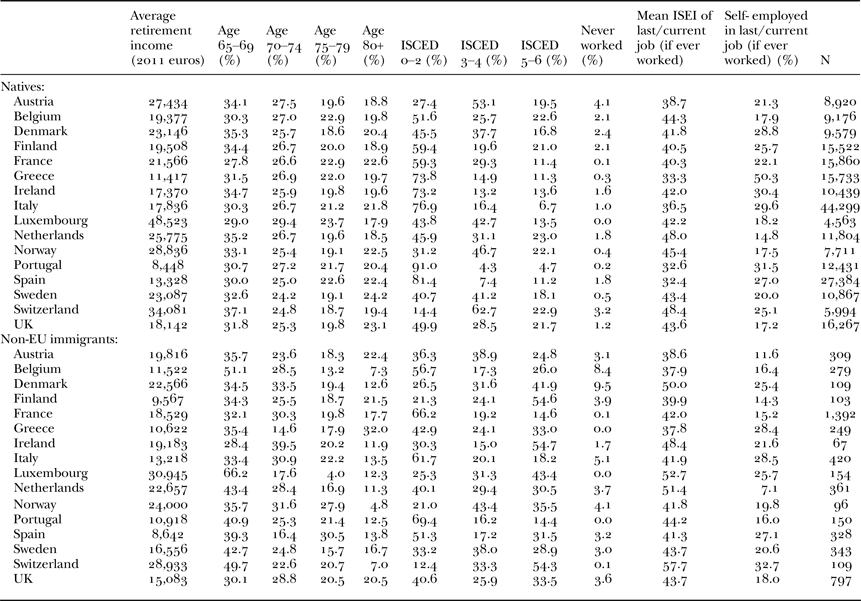
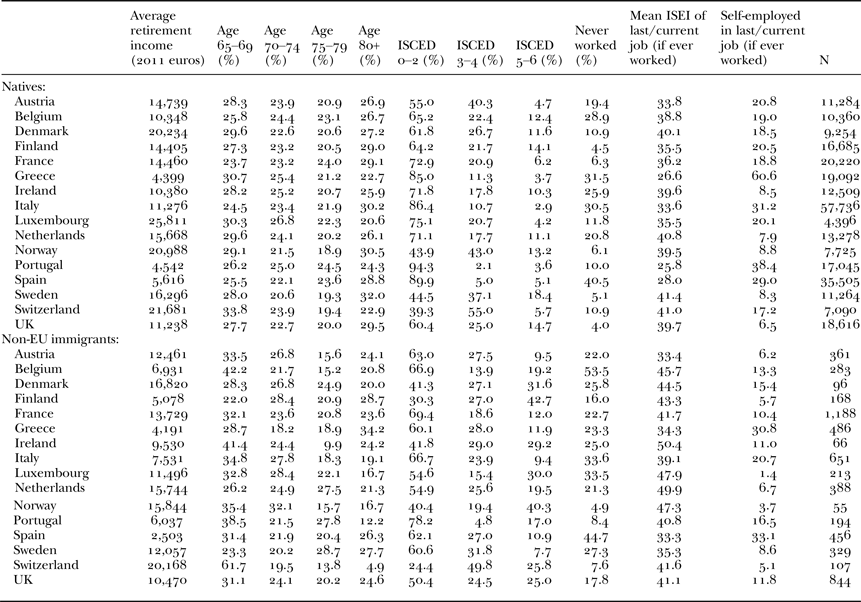
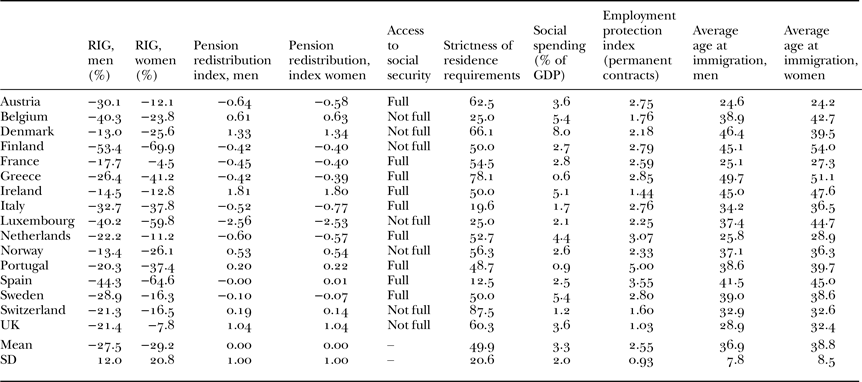
Tables 1 and 2 show individual-level descriptive statistics for men and women, respectively. Table 3 displays the values of the country-level variables.Footnote 6
Individual-level descriptive statistics, men aged 65+

Notes: Values are averages across ten imputations. ISCED: International Standard Classification of Education. ISEI: International Socio-Economic Index of Occupational Status. EU: European Union. UK: United Kingdom.
Individual-level descriptive statistics, women aged 65+
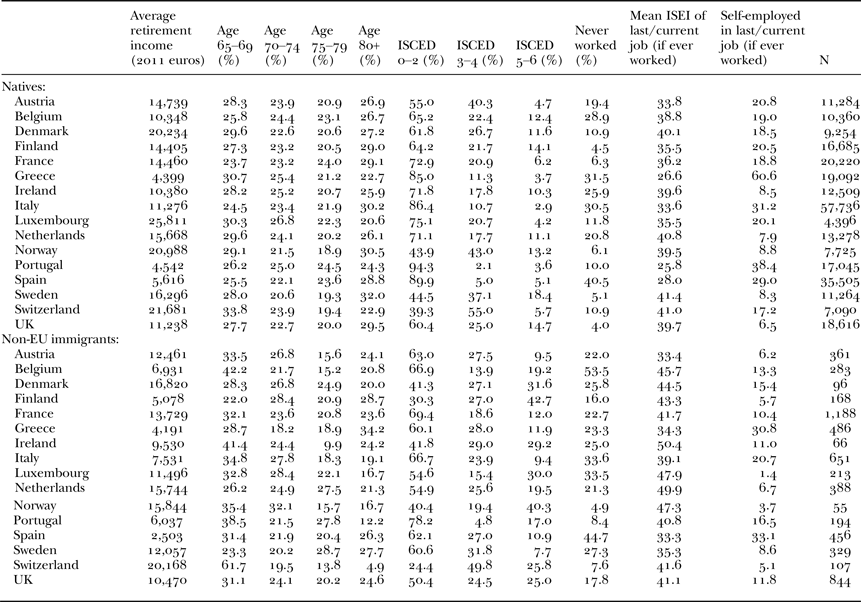
Notes: Values are averages across ten imputations. ISCED: International Standard Classification of Education. ISEI: International Socio-Economic Index of Occupational Status. EU: European Union. UK: United Kingdom.
Country-level measures
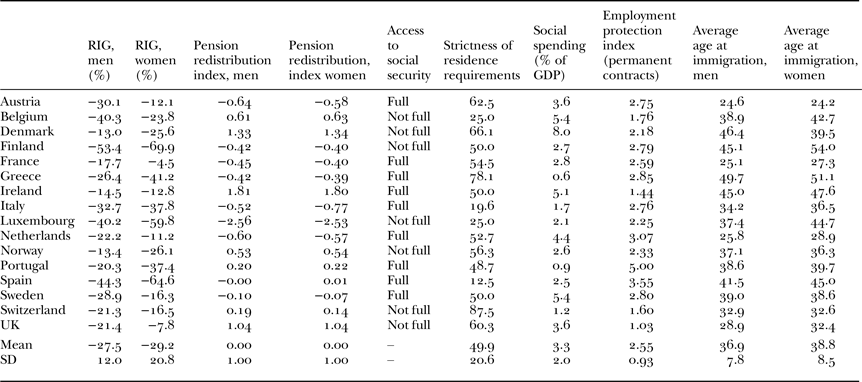
Notes: Retirement income gap (RIG) is based on gender- and country-specific regressions that adjust for age, level of education, never having worked, occupational status (last/current job), self-employment (last/current job) and survey year. GDP: Gross Domestic Product. UK: United Kingdom. SD: standard deviation.
Results
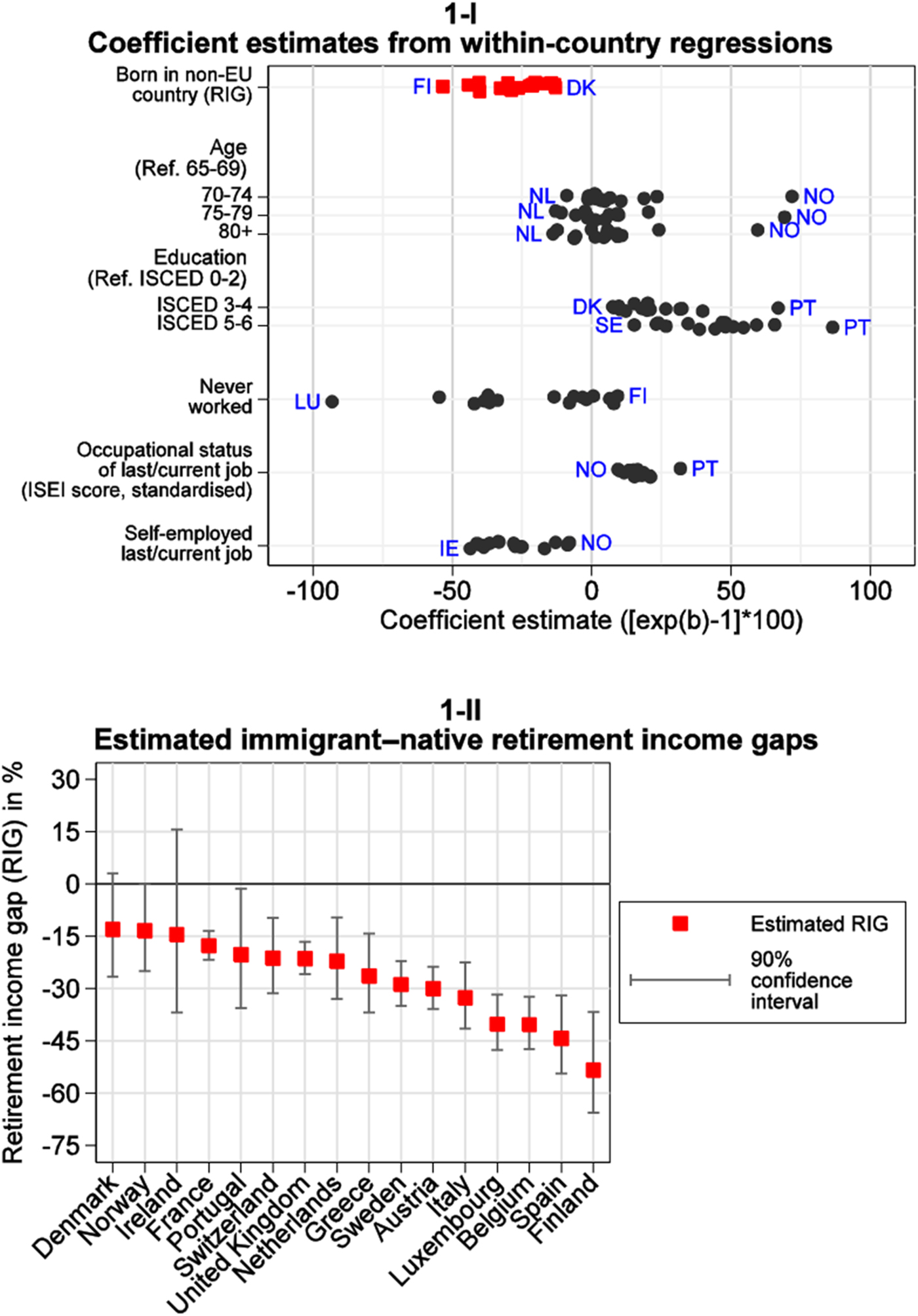
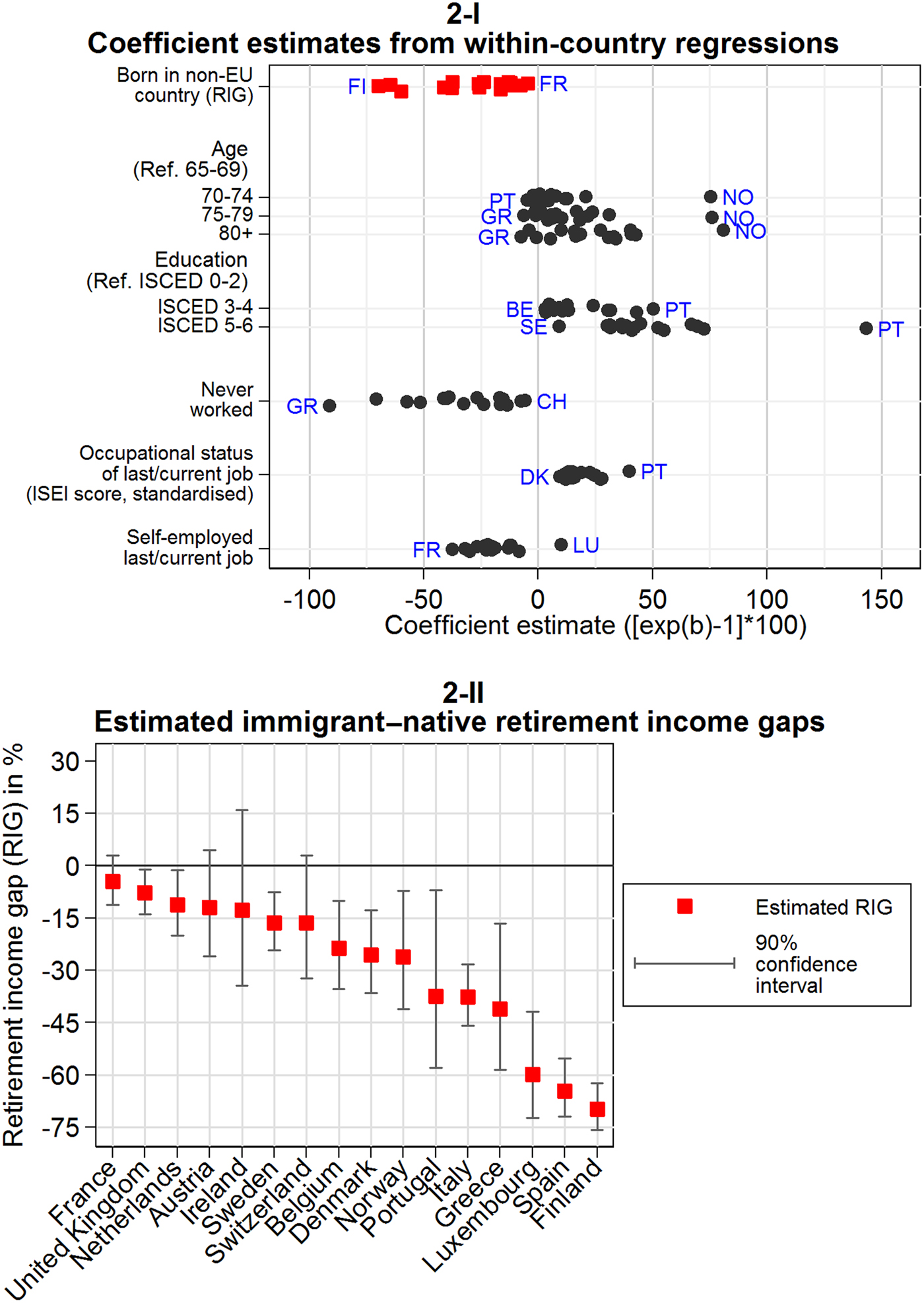
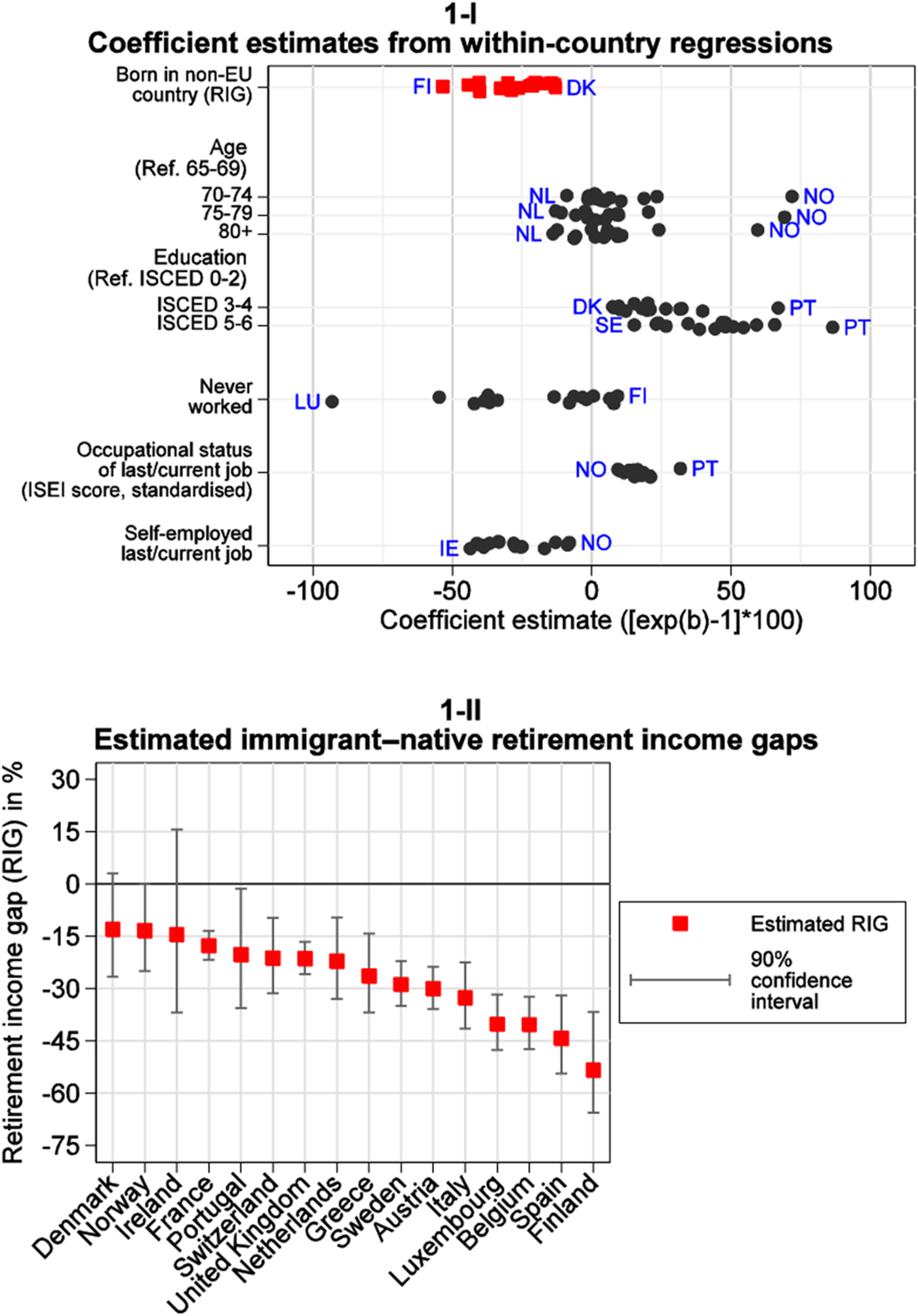
Panel 1-I in Figure 1 summarises the country-specific first-stage regressions for men; panel 2-I in Figure 2 shows the same for women.Footnote 7 The main purpose of these models is to obtain country-specific RIG estimates, adjusted for socio-economic characteristics. For easier interpretation, we present all coefficient estimates in percentages.
Individual-level covariates predicting retirement income in 16 countries, men aged 65 + .
Individual-level covariates predicting retirement income in 16 countries, women aged 65 + .
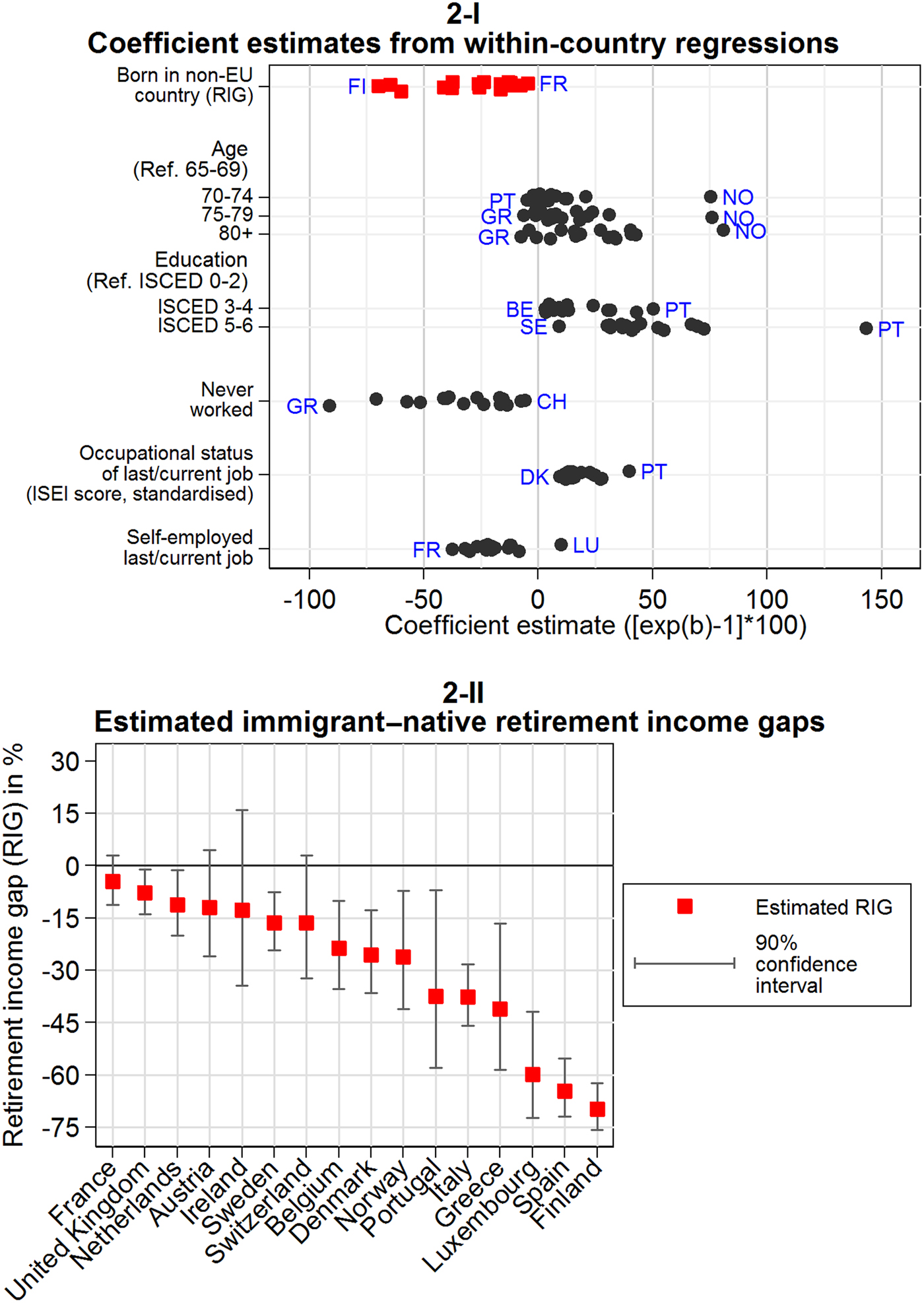
Point estimates for the individual-level variables are largely in line with existing research (Blossfeld, Bucholz and Kurz Reference Blossfeld, Bucholz and Kurz2011; Hogan and Perrucci Reference Hogan and Perrucci1998; Möhring Reference Möhring2015). Before we turn to the RIGs, we briefly discuss the control variables. The age dummies mostly show positive effects of belonging to an older age group as compared to age 65–69; this may reflect cohort differences in working careers and/or pension generosity (Heisig Reference Heisig2015). Cross-national variation in the age effect likely also captures differences in (statutory) pension ages; which would explain the large coefficients obtained for Norway that has historically had high pensionable ages. The positive effects of both educational attainment and occupational status are consistent with a standard earnings equation. Former self-employed workers have lower old-age incomes (except for females in Luxembourg). Given that our outcome variable mostly comprises public pension benefits, this seems straightforward. As one would expect, the effect of never having worked is negative for women; for men, the pattern is more erratic, partly reflecting the rareness of these cases.
Altogether, panels 1-I and 2-I largely show the expected results for all covariates.Footnote 8 Considerable cross-country variation in the magnitude of coefficients underpins the need for an estimation procedure that accommodates such variation. This is one of the virtues of our two-stage regression approach (Heisig, Schaeffer and Giesecke Reference Heisig, Schaeffer and Giesecke2017).
Panels 1-II and 2-II visualise estimated RIGs in greater detail. Squares depict the difference (as a percentage) in mean retirement income between immigrants and native-born individuals, controlling for the variables listed in the top panel and for survey year. Vertical bars represent 90 per cent confidence intervals. Figure 1-II shows that male immigrants have lower retirement income than native-born men in all 16 countries. The gap is statistically significant (at the 10% level or better) in 13 of the 16 countries. The average gap equals 28 per cent, but cross-national variation is substantial: it is largest in Finland, Spain, Luxembourg and Belgium (with gaps greater than 40 per cent) and smallest (and statistically insignificant) in Denmark, Norway and Ireland. Figure 2-II shows a similar picture for women. Immigrant women have lower retirement income in all countries, and the difference is statistically significant in all but four countries. The average gap amounts to 29 per cent. With values above 50 per cent, gaps are largest among females in Spain, Luxembourg and Belgium. Disparities are smallest (<15%) in France, the UK, the Netherlands, Ireland and Austria. In sum, Panels 1-II and 2-II indicate that non-EU immigrants aged 65 and older have substantially lower retirement income than comparable native-born individuals in most Western European countries.
The size of the ‘immigrant penalty’ varies considerably across countries. There is no obvious regional or welfare regime clustering, although gaps tend to be large in Southern European countries, especially for women. We now explore if the institutional factors discussed above can account for cross-country differences in the size of the immigrant penalty.
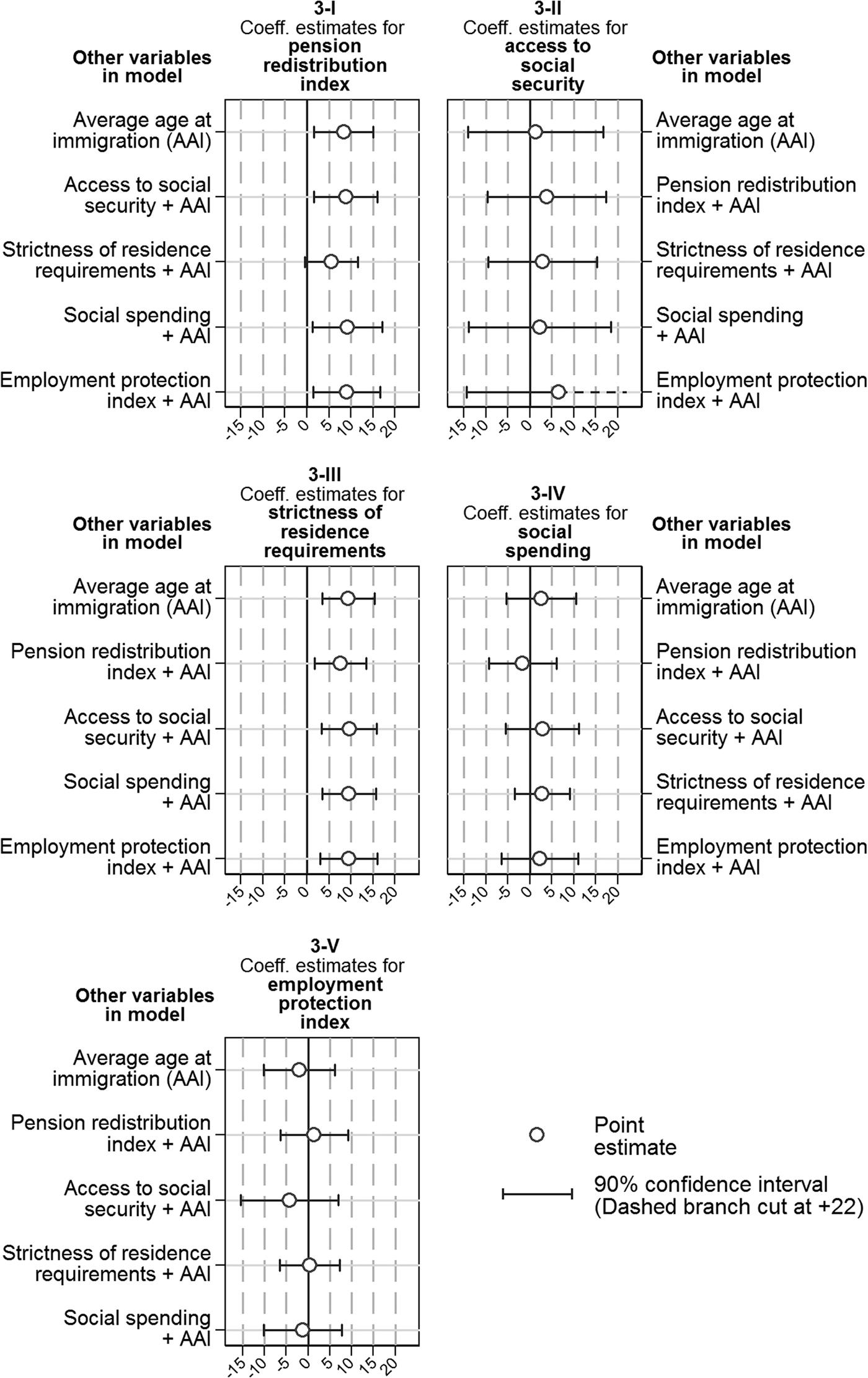
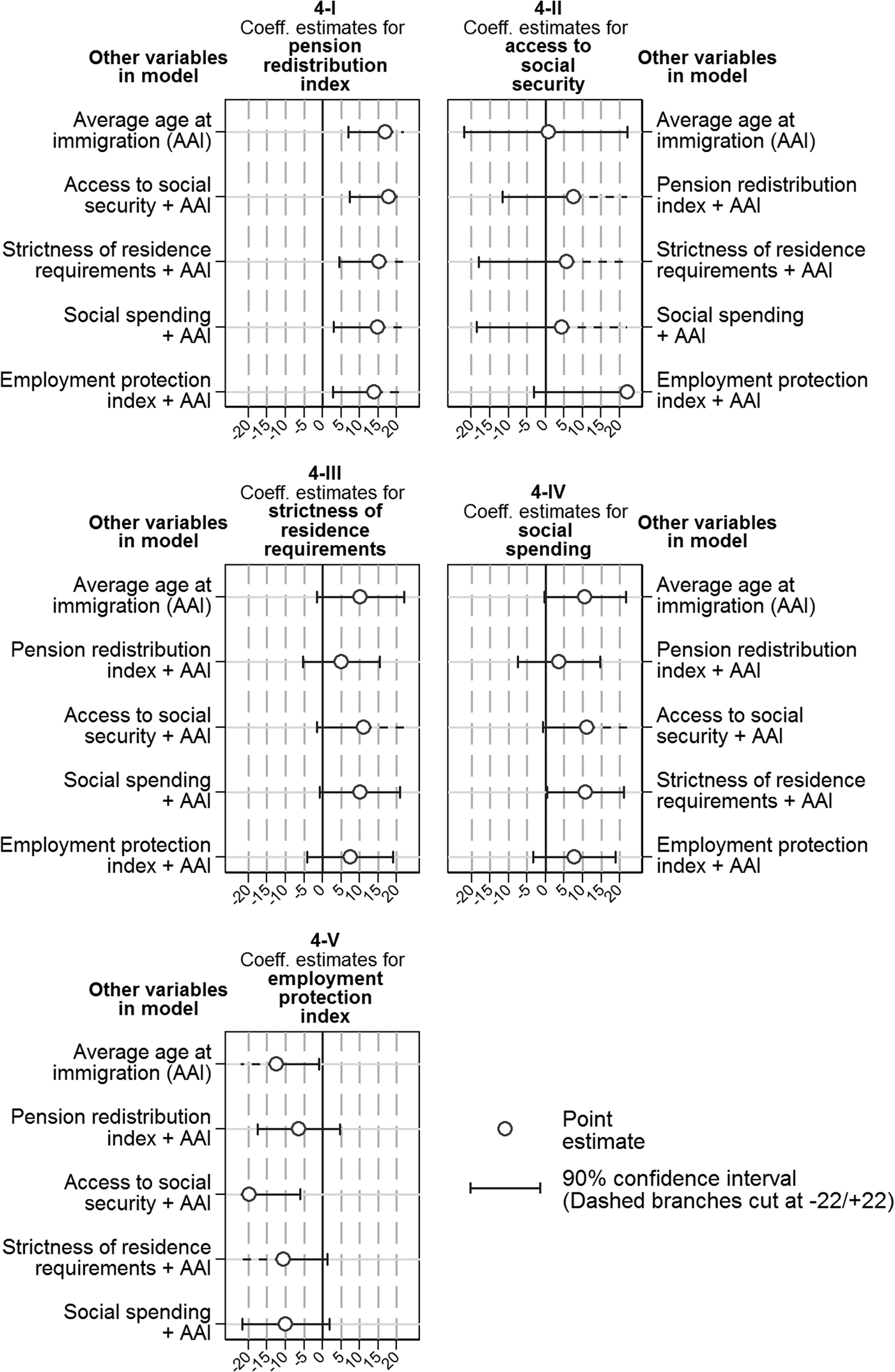
Figures 3 and 4 present the results of the country-level regressions. The corresponding coefficient estimates can be found in the online supplement. Each panel focuses on one country-level predictor and contains five coefficient estimates. The first specification only controls for average age at immigration (AAI); the next four contain the focal predictor together with one of the other covariates and AAI. All country-level predictors except the dichotomous variable for full access to social security are standardised (mean of 0, standard deviations of 1). Estimates thus give the predicted change in the RIG (in log points)Footnote 9 associated with a standard deviation increase in the focal predictor. Negative coefficients imply that a variable is associated with lower retirement income among immigrants compared to the native-born population (i.e. with a larger gap). Positive coefficients indicate that the gap narrows as the covariate increases.
Welfare state characteristics predicting retirement income gaps (RIGs) in 16 Western European countries, men aged 65 + .

Welfare state characteristics predicting retirement income gaps (RIGs) in 16 Western European countries, women aged 65 + .

Figure 3 presents results for men. Panel 3-I shows coefficient estimates for the pension redistribution index. As predicted by Hypothesis 1, redistributive pension systems are associated with smaller RIGs. In most specifications, the coefficient is statistically significant at the 10 per cent level or better. According to the point estimates, the RIG decreases by approximately 9 log points as the progressivity index increases by one standard deviation. The one exception is the model that additionally includes strictness of residence requirements. Here, the effect of the redistribution index is smaller (but remains substantial at 5.6 log points) and just off significance at the 10 per cent level.
Figure 3 reports coefficient estimates from the country-level regressions where the dependent variable is the RIG in log points. For an easier interpretation of the effect sizes, we also calculated the predicted RIG as a percentage for different values of the pension redistribution index, with all other country-level predictors in the model set to their means (continuous predictors) or to the reference category (access to social security).Footnote 10 For example, when only the average age at immigration is additionally included in the model, the predicted RIG for men shrinks from −27.9 to −16.2 per cent as the redistribution index increases from its sample mean of 0 (corresponding with Spain) to its maximum value of 1.8 (Ireland).
Returning to Figure 3, panel 3-II provides no clear evidence that the RIG is systematically associated with access to social security for non-EU nationals. Thus, there is no support for Hypothesis 2. Panel 3-III indicates that the difficulty of obtaining long-term residence rights is positively associated with immigrants’ relative income position in old age. This is consistent with Hypothesis 3, supporting the idea that stricter residence requirements lead to a positively selected immigrant population. All point estimates are statistically significant. Depending on the specification, they imply that the RIG declines by 8–10 log points for each standard deviation increase in strictness of residence requirements. Again using the model with average age at immigration as the only further predictor, this corresponds to a decrease from −28.2 per cent when the strictness index is at its mean of 49.9 (close to the Finnish, Irish and Portuguese values) to −15.0 per cent when it is at its maximum of 87.5 (Switzerland). Note that this effect is substantial, even though the selectivity of the immigrant population is partly captured by adjusting for socio-economic characteristics in the first-stage regressions (see also Büchel and Frick Reference Büchel and Frick2005). Indeed, estimated effects are even larger, when the first-stage regressions only adjust for age and survey year.Footnote 11
Spending on social transfers to working-age individuals for men does not engender the moral hazard effects hypothesised in Hypothesis 4; most estimated coefficients do not even point in the expected direction (panel 3-IV). Likewise, the effect of employment protection legislation is small in size and statistically insignificant (panel 3-V). An explanation for these null findings could be that by controlling for education and especially occupational status, we adjust for the main channel through which these factors operate, namely ethnic inequalities during working life. However, there is still no clear support for either hypothesis when we only adjust the RIG for age and survey year in the first-stage regressions (for the exact estimates, see Table S4 in the online supplement).
In Figure 4, we follow the same estimation strategy for women's RIGs. As in the case of men, the effect of the pension redistribution index is positive. For women, estimated effects are even larger and mostly significant at the 5 per cent level: depending on the specification, a standard deviation increase is associated with a reduction in the RIG by 14–18 log points.Footnote 12 This unambiguously indicates that, consistent with Hypothesis 1, older immigrants are less disadvantaged in countries with markedly redistributive pension systems. As with men, there is no clear support for Hypothesis 2: point estimates for the full access to social security dummy (panel 4-II) have the expected sign, but are imprecise.
Hypothesis 3, which expects smaller RIGs in countries with stricter immigration policies, is not empirically supported for women: while coefficient estimates in panel 4-III generally have the expected sign, they are not statistically significant. Again, however, one should be aware that the selectivity of the immigrant population is partly controlled in the first-stage regressions. When the first-stage regressions do not adjust for education or occupational status, strictness of residence requirements is mostly statistically significant (for the exact estimates, see Table S5 in the online supplement).
In contrast to what the moral hazard hypothesis predicted (Hypothesis 4), all coefficient estimates of social spending are positive (panel 4-IV), herewith clearly rejecting Hypothesis 4. Finally, there is partial empirical support for the labour market rigidity hypothesis (Hypothesis 5, panel 4-V), with two specifications showing the hypothesised negative effect of employment protection legislation. However, the effect is considerably weaker in Model 4, which also includes the pension redistribution index, the most consistent predictor of the RIG.
Sensitivity analysis
We have carried out extensive sensitivity analyses to assess the robustness of the country-level results presented in Figures 3 and 4. We briefly describe these checks and how they affected the estimated country-level relationships. The complete results are reported in the online supplement.
In a first analysis, we only adjust for age and survey year in the first-stage regressions (Tables S4 and S5 in the online supplement). The substantive conclusions remain the same as in the main analysis. If anything, these estimates provide stronger support for the selective immigration hypothesis: once we do not control for compositional differences in terms of education and occupational status (which should be endogenous to the selectivity of immigration policies), the effect of the strictness of residence requirement is larger.
Second, we use a more comprehensive income measure (augmented non-earned income) that also incorporates private pension income, capital income and public transfers other than pensions (Tables S6 and S7 in the online supplement). This sensitivity check addresses concerns regarding the harmonisation of the EU-SILC pension benefit variable that we use in the main analysis (cf. Goedeme Reference Goedeme2015). The more comprehensive income measure likely also incorporates potential pension income from other countries, which may not be included in the EU-SILC pension income variable. Reassuringly, results based on augmented non-earned income are qualitatively similar to those from the main analysis.
Another concern is that using net rather than gross income for four countries might influence the estimated country-level relationships. We therefore estimate the country-level regressions reported in Figures 3 and 4 with an additional dichotomous variable indicating the 12 countries where we used gross income (Tables S8 and S9 in the online supplement). Results are similar to those from the main analysis.
We also reran the analysis based on complete cases only, dropping the (multiply) imputed incomplete cases from the analysis (Tables S10 and S11 in the online supplement). Again, all coefficient estimates are similar to the main analysis.
Given our small country-level sample, our final robustness check addresses concerns about potential influential outliers. More specifically, we estimate the country-level regressions with one country omitted at a time. Results suggest that our main findings do not hinge critically on one of the country cases (Figures S3–S6 in the online supplement).
Discussion and conclusions
The objective of this study was to describe and explain how ethnic inequality in later life varies across Western European countries. Our first key finding is that the immigrant penalty in retirement income is substantial: averaging across the 16 countries in our sample, retirement income of men born in non-EU countries is 28 per cent lower than for their native-born counterparts, after adjusting for key individual characteristics, including educational attainment and occupational status. For women, the average gap is similar, at 29 per cent. This highlights a social problem that is bound to grow in importance as Europe's population continues to age.
Our second objective was to relate cross-national differences in the retirement income gap (RIG) to welfare state characteristics. While our results are based on a cross-sectional country-comparative design and should not readily be given a causal interpretation, they do suggest that welfare states shape the immigrant penalty in retirement income through both social and immigration policies.
There is robust support for the redistribution hypothesis (Hypothesis 1): for both men and women, the immigrant penalty in old-age income is smaller in countries with more progressive pension systems. Because, on average, non-EU immigrants earn less than the native-born population (Büchel and Frick Reference Büchel and Frick2005), they benefit from pension systems that provide higher replacement rates for low-wage earners. Furthermore, immigrants usually have shorter employment careers in the host society, because many immigrate when they are of working age (and their same-age native-born counterparts have already entered the labour market) and because their careers are more frequently interrupted by job loss (Ginn and Arber Reference Ginn and Arber2001). Our findings suggest that redistributive public pension systems that favour low-wage earners and do not heavily penalise atypical employment careers – like the Beveridgean systems of Ireland and the UK – reduce ethnic inequality in later life. This finding is in line with research on the UK showing that although the lion's share of redistribution occurs across people's lifetime, the British state pension system also reduces intra-cohort interpersonal inequality (Crawford, Keynes and Tetlow Reference Crawford, Keynes and Tetlow2014). The results also square well with research highlighting the benefits of redistributive pension systems for other economically vulnerable groups, such as women with non-standard employment histories (e.g. Möhring Reference Möhring2015).
While this study suggests that progressive pension schemes are an effective means for reducing ethnic inequalities in retirement, it is evident that stronger redistribution requires either higher public expenditure or lower replacement rates for higher earners. In many advanced economies, high levels of public debt limit the scope for increasing spending on pensions. This is especially problematic, as expenditure on pensions is bound to grow because of demographic ageing – albeit less than many observers seem to think, with a projected increase from 9.0 to 10.1 per cent of GDP in the OECD area from 2010–15 to 2050 (OECD 2015a: 183). However, if benefits are reduced for individuals with higher wages and pensions, progressive pension schemes could also be achieved at zero cost. Therefore, an important question is to what extent voters are willing to support redistributive policies, especially if they disproportionately benefit immigrant populations (or at least are perceived to do so). While not fully conclusive (e.g. Brady and Finnigan Reference Brady and Finnigan2014), there is some evidence that immigration erodes support for redistributive policies (e.g. Schmidt-Catran and Spies Reference Schmidt-Catran and Spies2016).
The moral hazard hypothesis (Hypothesis 4) claims that generous welfare states undercut incentives for immigrants to work hard and integrate, thereby depressing their socio-economic achievement and exacerbating ethnic inequality in old age. Our results provide no empirical support for such an association. Support was also weak for the labour market rigidity hypothesis (Hypothesis 5), which argues that strong employment protection creates dualistic structures where non-majority groups such as immigrants get trapped in insecure, low-quality jobs in a secondary labour market. Only for women is there some tentative evidence that restrictive firing legislation harms immigrants’ old-age incomes.
As for the citizenship dimension of welfare states, we found consistent evidence that immigration policies have long-term effects on ethnic inequality among older men (results for women point in the same direction, but are less conclusive). As predicted by the selective immigration hypothesis (Hypothesis 3), RIGs are lower in countries with strict residence requirements compared to countries with more liberal immigration criteria. Countries with lenient conditions for acquiring long-term residence – such as Spain, Italy and Belgium – are characterised by larger immigrant penalties. One of the reasons likely is that they grant residence to immigrants with lower (average) earnings capacity. By contrast, the gap between immigrant and native-born pensioners is smaller in countries that have more restrictive residence requirements such as Switzerland, Denmark or the UK. The policy implications of this result are not straightforward: immigrants with low earnings capacity who migrate to a country with generous residency conditions might be worse off relative to the native-born population in the destination country – but they might still fare much better than they would have if they had not left their origin country. Note, furthermore, that the immigration policies analysed here do not include regulation regarding refugees, which are beyond the scope of this study.
Finally, we found no clear support for the notion that older immigrants are financially better off in countries that grant non-EU nationals full access to social security (Hypothesis 2). However, this finding might change if better measures were available, which highlights the need for continued efforts to produce and refine relevant policy indicators.
The size of the immigrant–native gap in retirement income does not conform to standard welfare regime typologies. However, comparative studies of labour market outcomes among prime-aged immigrants do not find clear regime patterns either (Adsera and Chiswick Reference Adsera and Chiswick2006; Heath and Cheung Reference Heath and Cheung2007; Kogan Reference Kogan2006; Pichler Reference Pichler2011). Thus, rather than welfare regime typologies, future research could consider additional contextual variables. Our study suggests at least two relevant institutional characteristics: redistribution in the pension system and immigration policy. In this study, we have focused on individual pension income. However, redistribution takes place within households, too. Future research could thus be targeted at studying ethnic disparities in household pension income.
Our study inevitably has limitations. First, as noted above, our analysis is cross-sectional. This makes it impossible to address empirically concerns about unobserved heterogeneity and reverse causality. The observed relationships should therefore be interpreted with caution. Second, we are unable to observe immigrants who return to their country of origin when retired (for a discussion, see Warnes and Williams Reference Warnes and Williams2006). Although our population of interest is immigrant retirees who remain in the destination country, return migration may be selective. The scholarly literature is not univocal about the dominant patterns of selection (Borjas and Bratsberg Reference Borjas and Bratsberg1996; Van Hook and Zhang Reference Van Hook and Zhang2011). Our data exhibit a surprisingly favourable socio-economic profile of older immigrants in Western Europe that possibly reflects negative selection of return migrants (Figures S7 and S8 in the online supplement).
Return migration of immigrants with low pensions would bias our RIG estimates downwards, implying that the values in Figures 1 and 2 are lower-bound estimates. In other words, ethnic inequality in old-age incomes would likely be even larger if there were no retirement remigration. It is important to note, however, that return migration would have to be systematically related to our country-level predictors to put our comparative findings into question. In this respect, there are even reasons why it might render our hypothesis tests conservative. Specifically, one might expect selective return migration of low-income immigrants to be particularly pronounced in less redistributive pension systems where the resultant low benefits and the comparatively lower cost of living in most origin countries would make a return especially attractive. Underestimation of the RIG due to selective return migration would then be concentrated in less redistributive countries (where we expect to find larger gaps), suggesting that the effect of redistribution may be understated in the presented analyses.
A third limitation is the crude measure of immigrants’ origin. Because we cannot differentiate between countries of origin beyond EU versus non-EU, we cannot properly control for the composition of immigrant populations in terms of countries of origin. By adjusting for socio-economic composition, we partly account for important correlates of country of origin – e.g. immigrants from more affluent countries tend to have higher levels of education – but this is only a second-best solution. As Zubair and Norris (Reference Zubair and Norris2015) rightly argue, despite stark internal differences within the heterogeneous group of third-country nationals, too often cultural homogeneity in ‘otherness’ is assumed. Unfortunately, Eurostat's strict data anonymisation policy forces us to disregard this issue. While the magnitude of income disadvantages may vary across ethnic groups, our results have to be interpreted as average effects for immigrants born outside the EU.
Finally, due to data limitations, we could not incorporate all potentially relevant institutional factors as we would have liked to. One aspect where high-quality comparative data are lacking almost completely, especially with regard to non-EU countries, is the portability of pensions across borders (Holzmann and Koettl Reference Holzmann and Koettl2015; Meyer, Bridgen and Andow Reference Meyer, Bridgen and Andow2013). Moreover, we had to accept a certain mismatch between some of the macro-level predictors and our analytic sample. In particular, the pension and immigration policy measures refer to relatively recent points in time and may not perfectly capture the regulations affecting the cohorts under study. While we are confident that this issue does not compromise our findings, better and more fine-grained macro indicators, including retrospective measures, would be desirable and warrant considerable data production efforts. Not only would such data be helpful in minimising measurement error, they would also provide an additional source of variation – namely within-country variation over time – that could be exploited to better understand the role of institutional factors and infer policy implications.
In virtually all Western societies, the consequences of immigration represent a key topic on the public agenda. The evidence presented in this paper demonstrates that ethnic inequality in later life is substantial. With pension replacement rates bound to decline across European welfare states over the next decades, this likely makes older immigrants a group facing considerable risks of old-age poverty. Recent reforms that seek to reward long work careers (as have been enacted, for example, in France) may further erode the relative position of older immigrants who tend to accumulate fewer years of eligible employment due to late entry into the destination country's labour market and to non-employment.
Ethnic inequality in retirement has not received enough attention so far, possibly because the issue is located at the intersection of ageing, immigration and stratification research. As a recent policy report points out, integration policies may not be effective when implemented as stand-alone programmes (Collet and Petrovic Reference Collet and Petrovic2014). Progressive pension systems have potential for ‘mainstreaming’, that is, for addressing ethnic inequality with general rather than targeted – and potentially stigmatising – social policies. Collet and Petrovic (Reference Collet and Petrovic2014: 29) conclude that: ‘one of the biggest challenges for policymakers is generating evidence that mainstreamed approaches are actually achieving their goals of better outcomes for immigrants’. This study provides evidence that an inclusive approach may be successful at reducing ethnic inequality in old age.
Acknowledgements
This study is based on data from Eurostat, EU-SILC, 2004-2013. The responsibility for all conclusions drawn from the data lies entirely with the authors. The study was made possible thanks to funding from three sources: the Netherlands Organisation for Scientific Research (NOW; grant 451-13-10), the Spanish Ministry of Economy and Competitiveness (National Programme I + D+I; grant CSO2012-38521) and the European Commission (grant H2020 649255).
Supplementary Material
To view supplementary material for this article, please visit https://doi.org/10.1017/S0144686X17000332