Frequently the status of pre-modern ‘statehood’ is ascribed to Byzantium with regard to Constantinople's surrounding lands and sea lanes. Absolute sovereignty, ever a consistent element of imperial aspiration, is similarly taken for granted by many modern specialists of the time and place. While there is relatively little debate about the power of the eleventh-twelfth century emperors in the capital, in the provinces of the oikoumene there is far less consensus. Within the imperial Black Sea periphery, where distance from the capital frequently coincides with local autonomy, it is worth considering the cases of Cherson and Trebizond, whose elite families frequently operated within their respective localities as imperial agents or, perhaps equally frequently, as holders of personal fiefdoms.Footnote 1 In this paper, I will examine the eleventh-twelfth century cases of the families of the Gavrades of Trebizond and the Tzouloi of Cherson, primarily using textual mentions, sigillography and numismatics. The de facto peripheral autonomies of these kinship networks may imply that our conception of Byzantium, Rus’, or any other heretofore assumed ‘state’ in between, was, amongst other realities, an amalgamation of contested loyalties, at the peripheries of which lay autonomous local lords and their kin, who did not conceive of ‘statehood’ per se, but primarily of allegiance.
The Gavrades in narrative sources, seals and coins
To study the Gavrades in eleventh-century Trebizond is essentially to chart the story of a family of ‘incorrigible rebels,’Footnote 2 who eventually ‘brought to the Crimea the innate tendency of all the family to struggle against Byzantium,’Footnote 3 in a gradual course leading to the independence of Trebizond in 1204.Footnote 4 For the present purposes, we will concern ourselves with the preponderance of Gavrades in Pontic, eastern and central Anatolia in the eleventh century specifically.
The family history begins with three references to Gavrades in John Skylitzes’ Synopsis of histories.Footnote 5 Notably, Skylitzes’ first mention of a member of the Gavras clan of Chaldia (16:6) is in 979 CE with a certain Constantine Gavras who took part in Bardas Skleros’ failed Anatolian rebellion against the emperor Basil II, which drew much support from Monophysites and other peripheral dynatoi.Footnote 6
Skylitzes’ second mention of a Gavras clan member (16:43) comes in 1019 CE, albeit without a first name. Nevertheless, Skylitzes specifically identifies this Gavras in Thessalonike as an archon, patrikios, and a co-conspirator in a plot with another man named Elinagos, who ‘sought to restore the Bulgar ascendancy [. . .] Gabras had already fled his homeland [Trebizond]; he was arrested and blinded. . .’.Footnote 7 It is worth noting that this mention in Skylitzes is attributed to Theodore Gavras, the late-eleventh-century doux of Trebizond, by Cheynet, et al.,Footnote 8 although this is not stated specifically in Skylitzes’ text and there is no indication in any other source that Theodore Gavras was present in Thessalonike. It may be a valid question to ask, how he could have been blinded in 1019 and yet have lived until the 1090s. While some had previously postulated that this Gavras did not even belong to the same clan, instead, Bryer, et al.Footnote 9 seem to suggest that this Gavras was part of the same clan as Theodore of Trebizond, but an earlier member.
Finally, Skylitzes’ third mention of a Gavras comes in the year 1040 CE, when a certain Michael Gavras is revealed as having participated in an insurrection:
At that time there was an attempted insurrection against the emperor led by Michael Keroularios, John Makrembolites and several other citizens, who were likewise deprived of their goods and exiled. There was another mutiny, this one against the grand domestic, Constantine, at Mesanacta. When this was reported to him [the domestic], Michael Gabras, Theodosios Mesanyktes and many other officers in charge of units lost their eyes. And as for the patrician Gregory Taronites, Constantine completely enclosed him in a fresh ox skin with only a sufficient opening to see and breathe through (this because he was said to have been instigator of the mutiny) and sent him to the Orphanotrophos.Footnote 10
The family story continues in the person of the remarkable St. Theodore Gavras, the late-eleventh-century ruler of Trebizond mentioned in Anna Komnene's Alexiad, in what is perhaps the single most important textual reference to the man along with other members of his clan.Footnote 11 According to Anna Komnene, in the mid-late 1080s,
When Theodore Gabras was living in Constantinople, the Emperor who had remarked his violent and energetic nature, wished to remove him from the city and therefore appointed him Duke of Trapezus, [Trebizond] a town he had some time ago recaptured from the Turks. This man had come originally from Chaldaea and the upper parts, and gained glory as a soldier, for he surpassed others in wisdom and courage, and had practically never failed in any work he took in hand, but invariably got the better of his enemies; and finally after he had captured Trapezus and allotted it to himself, as if it were his special portion, he was irresistible.Footnote 12
The family story continues after Theodore Gavras, branching off into many clan members of the twelfth century and later, known from narrative sources and sigillography, on whom there have already been many scholarly studies.Footnote 13
The case of the Gavrades is remarkable in that available narrative sources, such as those listed above, frequently match both seals and coins. We know that the Gavras family, perhaps not so dissimilar from other contemporary families, functioned as a corporate entity.Footnote 14 Gavras kinsmen formed a network whose communications, attested in seals, have survived along with narrative evidence and coins, unlike other powerful families of the eleventh-twelfth century Black Sea region. Effectively, Theodore can be seen as a scion of this clan, whose rise was enabled by the service of his own kinsmen to the empire. We know of several Gavrades before the time of Theodore, whose seals have been dated by sigillographers to earlier in the eleventh century. For example, seals of a certain Marinos Gavras,Footnote 15 as well as of a Leo Gavras,Footnote 16 have been dated to the twelfth century. Other Gavrades’ seals date to later in the eleventh century, such as that of a certain Nikephoros Gavras,Footnote 17 and a certain Zacharias Gavras.Footnote 18 However, the eleventh-century coins and seals of Theodore Gavras provide a deeper understanding of theGavrades clan as a provincial institution, usually, although not always, in the Black Sea thema of Chaldia.
To the well-known Theodore, who is recognised to have ruled Trebizond (where there was a mint, imperial or otherwise) as his private domain, have been attributed specific coins during his rule (ca. 1092–1098 CE), marked by his namesake St. Theodore.Footnote 19 This was despite Eugenios being the patron saint of the city,Footnote 20 which as Dunn argues, ‘was in fact a considerable sign and gesture of independence, which would have been easily grasped by Theodore's contemporaries.’Footnote 21
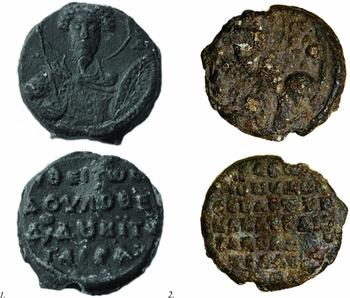
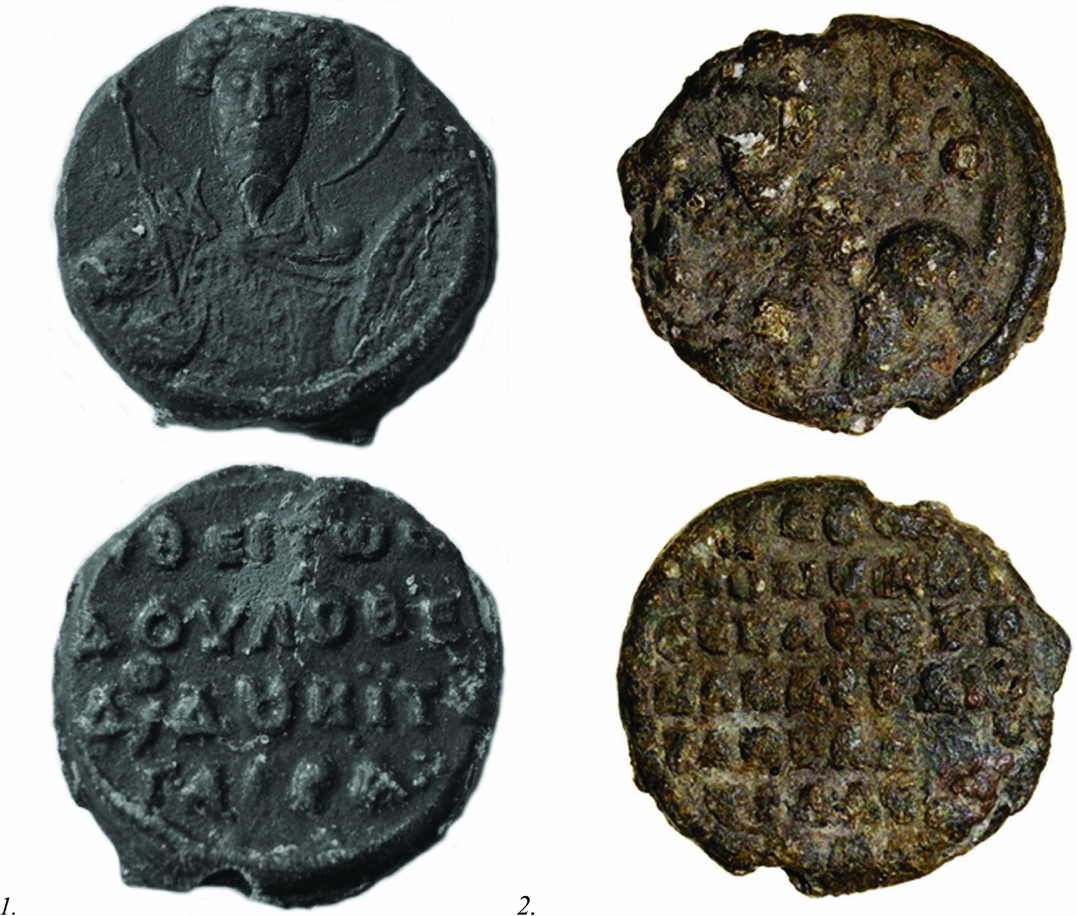
Like the seals and coinage of the Kievan prince Jaroslav the Wise (r. 1019–1054), which frequently matched in design and legend,Footnote 22 the Trapezuntine coinage of St. Theodore in military attire, bears a remarkable resemblance to Theodore Gavras’ personal seals,Footnote 23 which also bear the bust of St. Theodore in military attire (see the accompanying fig. 1–2).Footnote 24 Therefore, while neither Anna Komnene's text nor the Trapezuntine coins directly reveals Theodore's sense of autonomy, a careful study of the sigillography completes our picture of the subtleties of allegiance and autonomy in the eleventh-century Black Sea littoral.
Left (fig. 1), reproduced with permission from J-C. Cheynet, V. Gökyıldırım and T. Bulgurlu, Les Sceaux Byzantins du Musée Archéologique d'Istanbul (Istanbul 2012) cat. no. 2.206: the seal of Theodore Gavras, which is read as: [Κ(ύρι)ε βοήθ]ει τῷ σῷ [δ]ούλο Θεο[δ]ώ(ρῳ) δουκὶ τῷ [Γ]αβρᾶ.
Right ( fig. 2), reproduced from the University of Birmingham, Barber Institute of Fine Arts, cat. no. SL0006 (via webpage: http://mimsy.bham.ac.uk/detail.php?t=objects&type=all&f=&s=Gabras&record=0 ): the seal of Theodore Gavras. Archie Dunn reads the seal as: + Σὸν [ὁ]μόνυμον σεβαστ(ὸν) τρ(ισ)μάκαρ τ(?) δ(ού)κ(α) Γαβρᾶν [Ἅ(γιε)] [φ]ί[λ]ατ(τ)ε/ [φ]ί[λ]άτ(τοις) (?). A. W. Dunn, personal communication, 5 August, 2016.
The Tzouloi of Crimea
The only textual reference to a member of the Tzoulas clan belongs to Skylitzes (dated to 1016 CE):
The emperor returned to Constantinople in January, AM 6524 [CE 1016], and sent a fleet against Chazaria under the command of Mongos. . . with the cooperation of Sphengos, the brother of Vladimir and brother-in-law of the emperor, he subdued the region and actually captured its governor, George Tzoulas, in the first engagement.Footnote 25
Nevertheless, as in the case of the eleventh-century Gavrades, there are other sources attesting to the importance of the family in local Crimean politics, or as it was known in Constantinople after 849 CE, the thema ton Klimaton.Footnote 26 Even changes in coinage have been linked to the aforementioned Georgios Tzoulas, the so-called ‘governor’ of Khazaria, and the events of 1016 as described by Skylitzes.Footnote 27 These changes in local Chersonite coinage have been explained by the numismatist Anokhin as otherwise ‘unknown’ between 989–1016 CE. For Anokhin, only after the death of Tzoulas was Cherson ‘outright incorporat[ed] into the composition of the empire.’Footnote 28
However, the sigillography of the Tzoulas family permits us to view Byzantine Crimea, not as a simple extension of the empire, but as a locally autonomous region/entity. This clan's seals have already been included in a large number of publications on the sigillography of Cherson, the most prominent of which have been the works of Nikolaj Alekseienko.Footnote 29 That Crimea was a notoriously autonomous, if not downright rebellious periphery of the Byzantine oikoumene should by now come as little surprise.Footnote 30 In fact, it is worth noting that even before 1204, in the 1190s, a branch of the Gavras family had ‘established themselves in Crimea.’Footnote 31 Therefore, in this subsection, I will posit that the Tzoulas family of Crimea [ta Klimata], similarly to the Gavrades of Chaldia, occupied a central role in eleventh century local affairs, as de facto rulers both on the imperial behalf, and also on their own behalf. This is reflected by their name often appearing alone on seals, its ubiquity throughout the Crimea, and its frequent identification not only with protospatharioi, but most notably with the title proteuon, which more often than not connoted local potentates and nobility in Cherson who ruled the thema ton Klimaton autonomously.Footnote 32
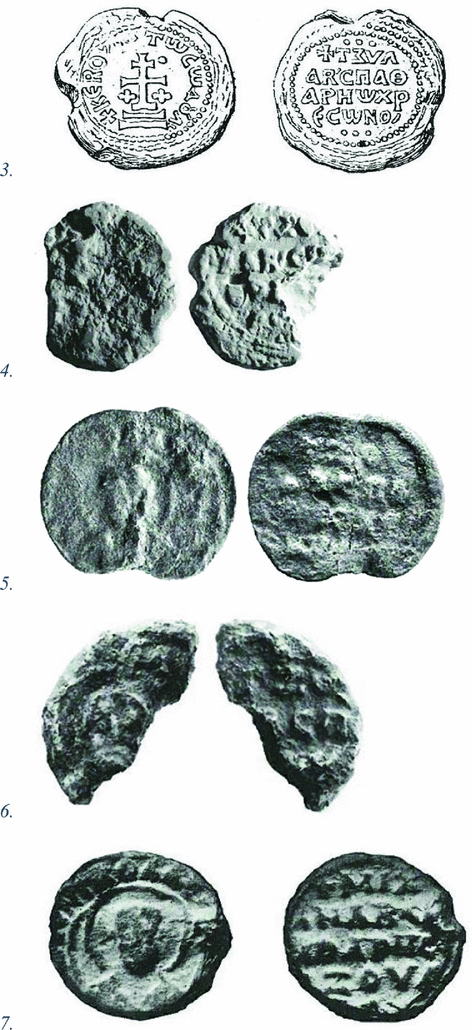
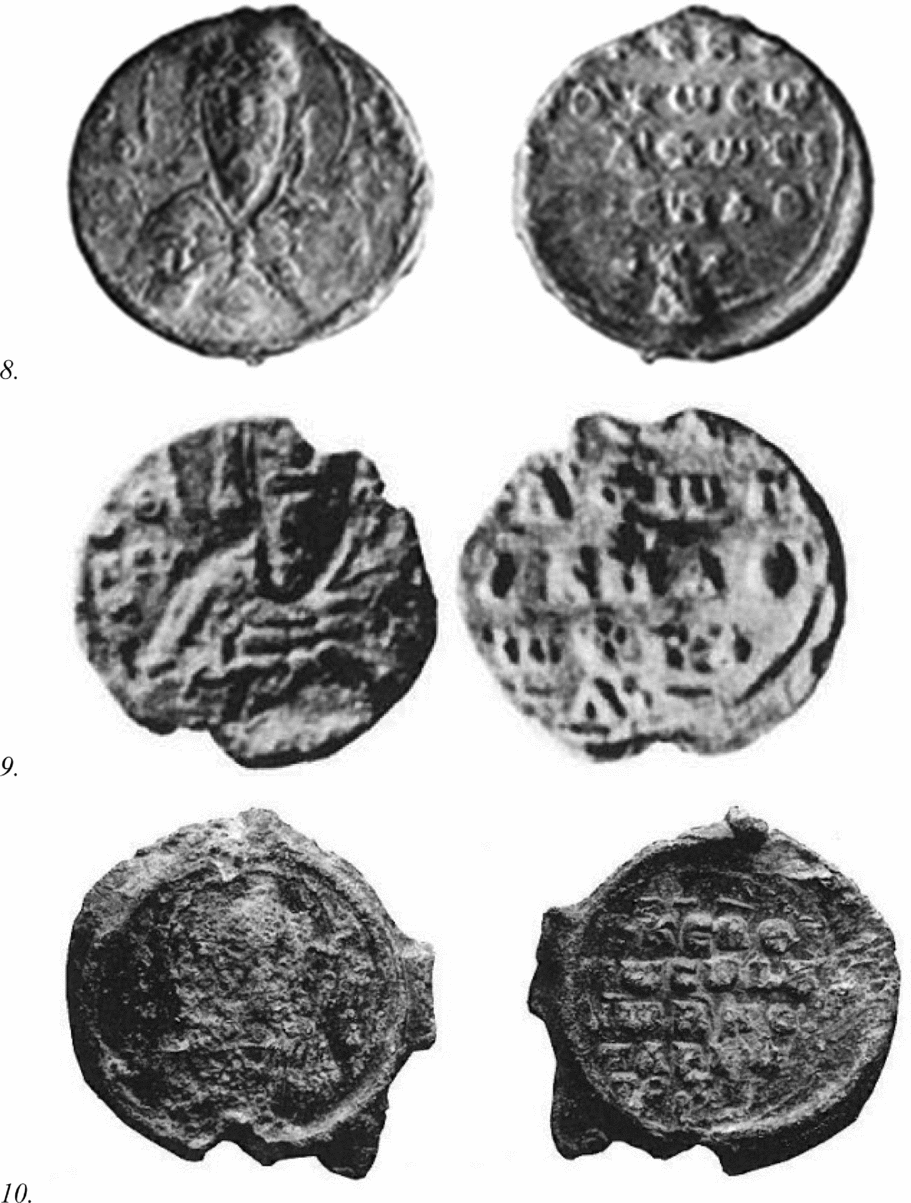
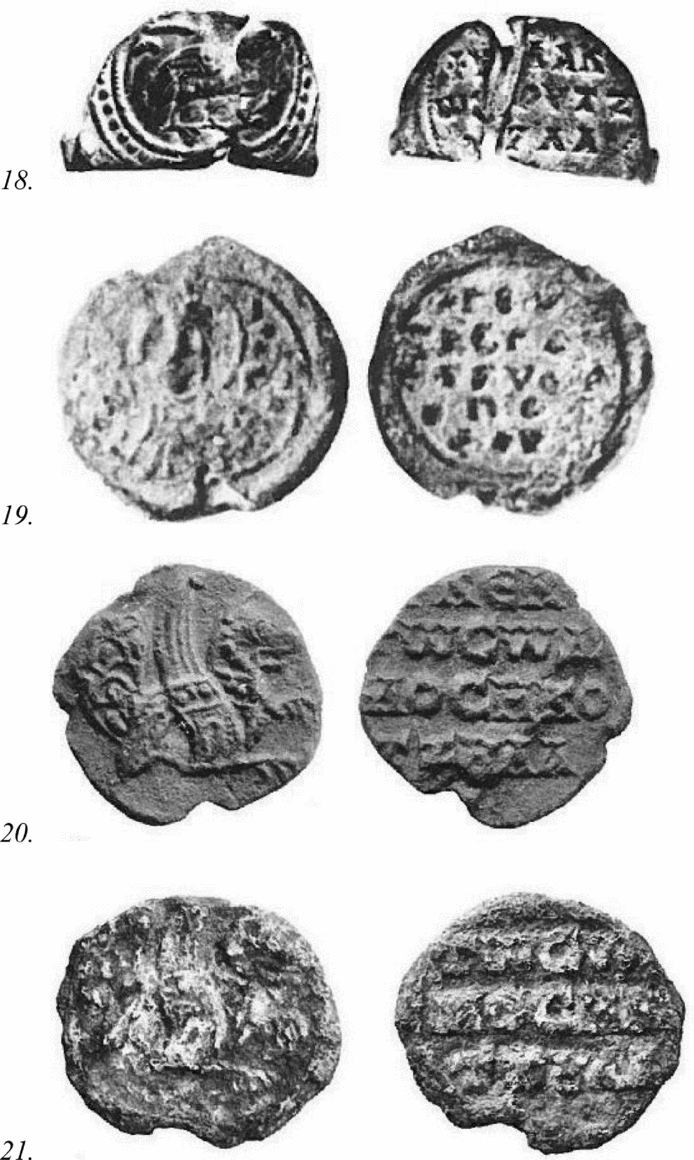
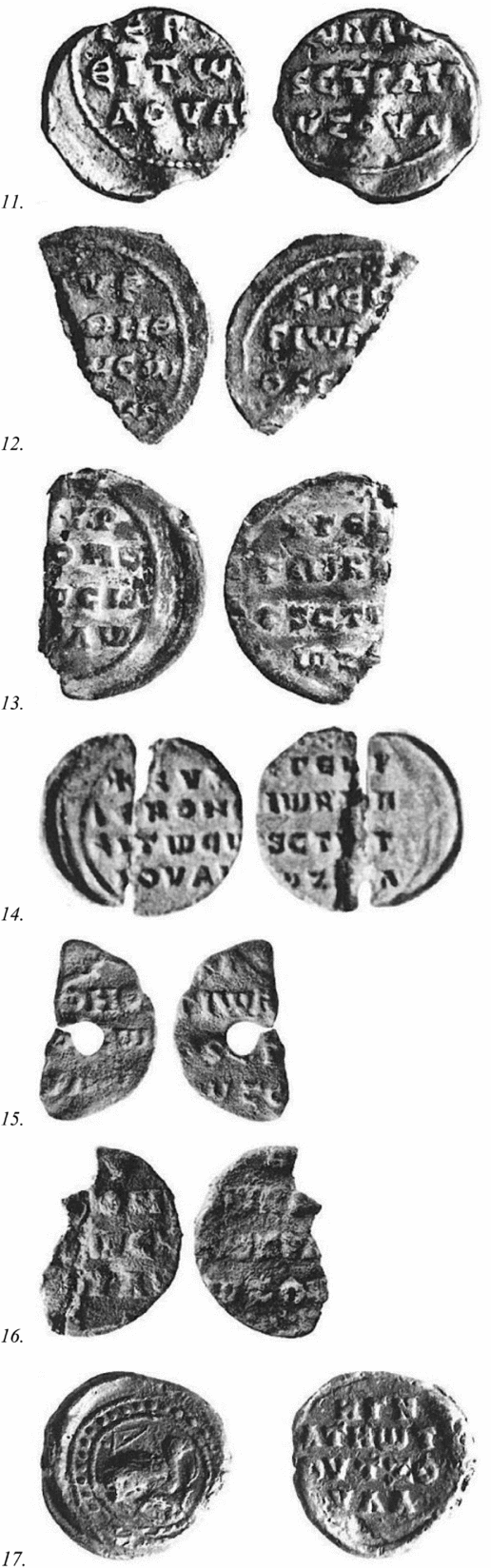
Firstly, it is striking to note that on a few seals, the name Tzoulas appears alone, and on other seals which bear both forenames and the Tzoulas surname, no title or office appears. With respect to the first type, one seal out of a total of four examples identifies a certain Tzoulas, imperial spatharios of Cherson (and nothing else), dated to the late tenth century. The other three seals bear a similar legend, but evoke St. Nicholas on the obverse side (see figs. 4–6)Footnote 33 whereas the former example bears only an Orthodox cross on three steps (fig. 3).Footnote 34 Another seal, that of a certain Ioannes Tzoulas, like the previous example, connects the family name to another imperial office, the notarios (fig. 10).Footnote 35 On other seals, it seems that simply the name Tzoulas was a significant enough indicator of status to render the inclusion of titulature unnecessary.Footnote 36 For example, it is notable that the seals of Ignatios Tzoulas (fig. 17),Footnote 37 Theophylaktos Tzoulas (fig. 18),Footnote 38 and Mosekos Tzoulas (figs. 20–21),Footnote 39 do not reveal any particular title or office, or even a saint's evocation, but, instead, prefer zoological depictions of what appear to be partridges, or in the latter case, a lion. Whether or not they were imperial office or title holders, it seems as if their name was the most important element to record on their seals.
Reproduced from Alekseienko, L'administration byzantine de Cherson: catalogue des sceaux (Paris 2012) cat. nos. 151–153, (231-233): the Tzoulas family, of Cherson and elsewhere in the 10–11th-c. Crimea. Above, seals of a Tzoulas family member described as an ‘imperial spatharios of Cherson’ another unnamed Tzoulas family member also described as an ‘imperial spatharios of Cherson’ and, in Alekseenko's reading, a certain Michael Tzoulas, described as an ‘imperial protospatharios of Cherson.’
Fig. 3 (cat. no. 151): + Κ(ύρι)ε βο[ή]θει τῷ σῷ δούλ(ῳ) Τζύλᾳ β(ασιλικῷ) σπαθαρήῳ Χρεσῶνο(ς).
Figs. 4–6 (cat. no. 152): + Ἅγιε Νικόλαε βοήθ(ει) Τζούλᾳ β(ασιλικῷ) σπαθ(α)ρίῳ Χερσόνος.
Fig. 7 (cat. no. 153): + [Ἅγιε] Νικόλα[ε βοήθει τῷ σῷ δούλῳ] Μιχαὴλ β(ασιλικῷ) (πρωτο)σ[π]αθαρηộ [τῷ Τ]ζούλ[ᾳ Χ]ε[ρς(ῶνος). It should be noted, however, that the reference to the city of Cherson on the final line of the reverse of this seal is hardly preserved, and is therefore a rather tentative reading, with respect to this seal's connection of the name Tzoulas and the city of Cherson.

Reproduced from Alekseienko, L'administration byzantine de Cherson, cat. nos. 154–155, (233-234): the 10–11th-c. seals of other members of the Tzoulas clan, Photios/Photeinos, a ‘protospatharios’ and Ioannes, an ‘imperial notarios.’
Figs. 8–9 (cat. no. 154): Ὁ Ἅ(γιος) Εὐστράτ(ιος) + Κ(ύρι)ε βοήθ(ει) τῷ σῷ δούλ(ῳ) Φοτίῳ/Φοτ(ε)ί(ν)ῳ (πρωτο)σπαθαρίῳ τῷ Τζούλ(ᾳ).
Fig. 10 (cat. no. 155): + Κ(ύρι)ε β(οή)θ(ει) τῷ σῷ δού(λῳ) Ἰω(άννῃ) β(ασιλικῷ) νοταρίῳ τộ Τζού[λ(ᾳ)].

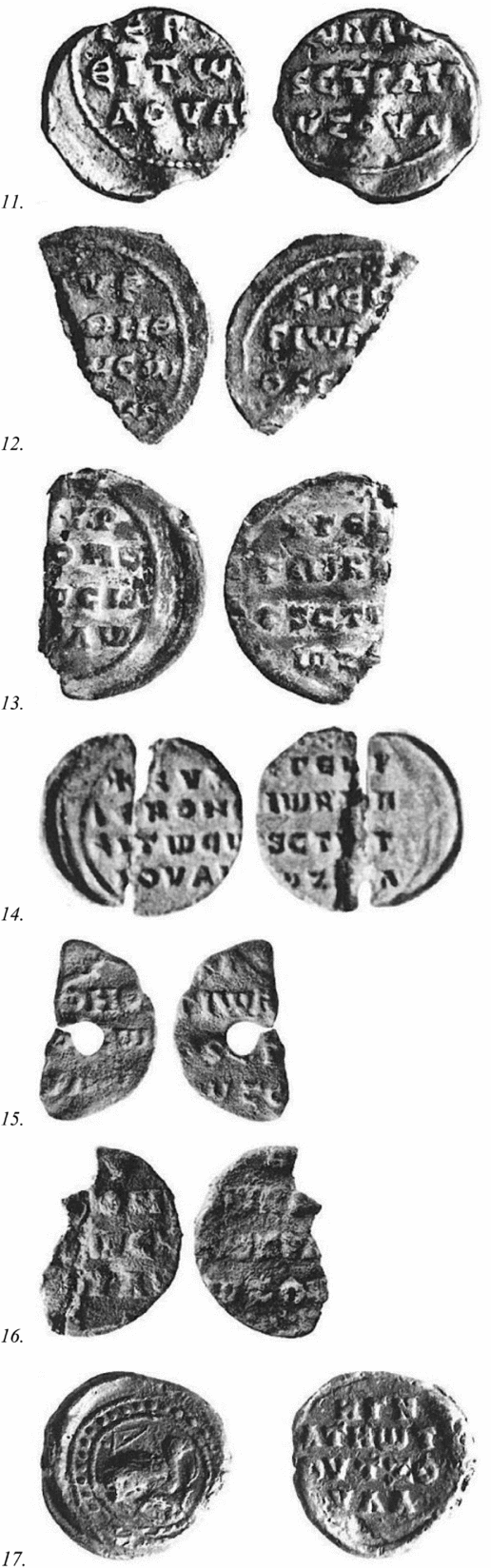
Reproduced from Alekseienko, L'administration byzantine de Cherson, cat. nos. 156–157, (234-236): the 10–11th-c. seals of other members of the Tzoulas clan, featuring a number of different seals of a certain Georgios Tzoulas described as an ‘imperial protospatharios and strategos’ and another member of the family, Ignatios Tzoulas.
Figs. 11–16 (cat. no. 156): + Κύριε βοήθει τῷ σῷ δούλῳ Γεογρίῳ β(ασιλικῷ) (πρωτο)σπαθ(αρίῳ) (καὶ) στρατ(ηγῷ) τῷ Τζούλ(ᾳ).
Fig. 17 (cat. no. 157): + Ηγνατήῳ τοῦ Τζουλα.
Reproduced from Alekseienko, L'administration byzantine de Cherson, cat. nos. 158–160, (237-238): the 10–11th-c. seals of other members of the Tzoulas clan, featuring a Theophylaktos Tzoulas, a Georgios Tzoulas, ‘imperial protospatharios of Bosphoros’ (modern Kerch), and Mosekos (Moses) Tzoulas, with what appears to be a griffin.
Fig. 18 (cat. no. 158): + [Θεο]φυλάκ[τ]ῳ [τ]οῦ Τζούλα.
Fig. 19 (cat. no. 159): + Γεω[ρ]γ(ίος) (πρωτο)σπα[θ(αρίος)] ὁ Τζ(ο)ύ[λ]α τοῦ Ποσφόρ(ου).
Figs. 20–21 (cat no. 160): + Κ(ύρι)ε β(οή)θ(ει) τῷ σῷ δ(ούλῳ) Μοσηκõ (τῷ) Τζούλ(ᾳ).

Secondly, we may notice that the name Tzoulas appears not only in Cherson, but also in Bosphoros, at the opposite end of Crimea, modern Kerch. Two seals are known which belong to two men named Georgios Tzoulas, both dated to the early eleventh century and both clearly sharing much overlap with the Georgios Tzoulas mentioned by Skylitzes and referenced above.Footnote 40 While momentarily resisting the reasonable temptation to imagine they may have belonged to the same individual, it is significant that one seal clearly relates that its owner resided in Bosphoros (fig. 19),Footnote 41 while the other, of which we have no less than six examples, does not clarify where its owner was resident, although it does state that this Georgios Tzoulas was a strategos. Since five of the six examples were originally found in Cherson, we may reasonably suppose that he resided in Cherson (fig. 11–16).Footnote 42 That members of the Tzoulas clan are clearly identified not only in Cherson, but also in Bosphoros, and two were imperial protospatharioi,Footnote 43 should serve as a significant marker that members of the Tzoulas family were both prominent and active throughout the thema ton Klimaton.
Examining the seals of other members of the family such as Michael Tzoulas (fig. 7),Footnote 44 and Photios/Photeinos Tzoulas (fig. 8–9),Footnote 45 presumably confined to Cherson, we can see that the imperial title of protospatharios was repeatedly evoked, although it remains unclear if it was inherited. That said, the seniority of the title and its significance for peripheral lords,Footnote 46 who were frequently granted the same honours as strategoi, should come as little surprise. Furthermore, since seals show that the strategoi and the notoriously autonomous proteuontes of Cherson were often the same individuals,Footnote 47 this suggests that the recommendation of the De Administrando Imperio to appoint strategoi for Cherson from Constantinople itself,Footnote 48 was not always followed.Footnote 49 Moreover, even when it was followed, the strategoi of Cherson did not always receive imperial salaries, but, rather, ‘gratuity’ from the thema itself,Footnote 50 similar to the case of Trebizond in Chaldia, where the income of the strategoi derived from the kommerkion, or the tax revenue collected by the kommerkiarioi of Chaldia.Footnote 51 So it is that, as in the case of Chaldia, seals demonstrate the importance of the autonomy of local families to understanding contemporary events in Crimea.Footnote 52
Therefore, to return to Skylitzes’ mention of Georgios Tzoulas it should come as little surprise that a Tzoulas was imputed as a ‘Khazarian governor’ leading the uprising of 1016 in Crimea. It appears that whoever he was, whatever titles or offices he held, he was not so much ‘Khazarian’ as a member of a local prominent family, proteuontes of Cherson, with a tendency for autonomy and rebellion.Footnote 53 Much like Theodore Gavras, Georgios Tzoulas was the scion of a prominent local family to which Constantinople gave ‘recourse’ in the tenth-twelfth centuries and later.Footnote 54
Having considered two case studies of local noble families of the Black Sea littoral in the eleventh century by means of narrative sources, coins, and, primarily, seals, it would seem reasonable to conclude that despite nominal homage paid to the emperor through the use of court titles on the seals of some peripheral notable families, imperial authority was not as absolute as we might suppose. The unity of the eleventh-twelfth century Byzantine ‘state,’ as it has often been imagined, was not as hypostatic as has often been conjectured, and scholars are becoming more aware of the conditionality of Byzantine ‘statehood’ at its peripheries.Footnote 55 This is particularly apparent in the Black Sea regions furthest from Constantinople, namely Crimea and Chaldia, where imperial sovereignty was hardly absolute, and allegiances were almost always negotiable at the local level.