Implications
Phytoestrogens of flaxseed affect the estrogen metabolism of hens reducing the 17β-estradiol without any effect on the egg deposition rate. Hens fed 10% flaxseed produce eggs with higher n-3 fatty acids level and also enriched in lignans. Accordingly, these eggs could be considered a functional food, not only on account of the n-3 enrichment but also of phytoestrogen levels. Further research should analyze the interaction between flaxseed lignans and isoflavones and how these compounds affect the physiology and health of hens’ reproductive apparatus.
Introduction
There has been increasing interest in the use of flaxseed (Linum usitatissimum L.) to improve the nutritional quality of human food (Oomah, Reference Oomah2001). Flaxseed is also used in animal feed as the main source of α-linolenic acid (ALA), which is the precursor of important n-3 derivatives (EPA and DHA). Moreover, flaxseed contains a considerable amount of phytoestrogens, mainly lignans (Meagher and Beecher, Reference Meagher and Beecher2000), known to influence hormone metabolism, enzymes, protein synthesis, growth factors, malignant cell proliferation and angiogenesis (Mousavi and Adlercreutz, Reference Mousavi and Adlercreutz1992; Carreau et al., Reference Carreau, Flouriot, Bennetau-Pelissero and Potier2008). The lignans in question are pinoresinol, lariciresinol and matairesinol; however, the most abundant lignan is the secoisolariciresinol diglucoside (SDG), which is stored in the hull of the seed (Meagher and Beecher, Reference Meagher and Beecher2000).
Following ingestion, lignans are deglucosylated and then converted into enterolignans by intestinal microbiota (enterodiol (END) and enterolactone (ENL)) largely responsible of health benefits (Setchell et al., Reference Setchell, Brown and Lydeking-Olsen1981). Several studies of mammals (Prasad and Jadhav, Reference Prasad and Jadhav2016) have also shown that SDG reduces total and low-density lipoprotein-cholesterol of plasma and increases high-density lipoprotein-cholesterol. The structural similarity of END and ENL to estradiol, the most active estrogen in the body, allows these enterolignans to bind to estrogen receptors and exert weak estrogenic or anti-estrogenic effects (Carreau et al., Reference Carreau, Flouriot, Bennetau-Pelissero and Potier2008) depending on dose and the physiological state of animals. Like humans, poultry possess both α- and β-estrogen receptors and, thus, can efficiently bind the END or ENL (Jenkins et al., Reference Jenkins, Kendall, Vidgen, Agarwal, Rao, Rosenberg and Griffin1999) provided by dietary flaxseed metabolism.
Another class of phytoestrogens contained in flaxseed, the isoflavones, is similar in function and metabolic pathway to lignans. Daidzin, genistin, daidzein (the aglycone of daidzin) and genistein (the aglycone of genistin), although less abundant than in soybeans (Setchell et al., Reference Setchell, Brown and Lydeking-Olsen1981), are also found in flaxseed. An important metabolite of daidzein, produced by intestinal bacteria in some, but not all, humans is equol. It is thought that about 20% to 30% of Americans and Europeans, who consume less soy than Asians, have the ability to produce equol (Setchell et al., Reference Setchell and Cole2002). Equol possesses antioxidant properties (Kładna et al., Reference Kładna, Berczyński, Kruk, Piechowska and Aboul‐Enein2016) but its main benefits lie in its binding to estrogen receptor, thus offering the favorable effects of estrogen without the negative ones (Setchell et al., Reference Setchell and Cole2002).
Considering that of all foods of animal origin eggs are what people around the world eat most of, and that is quite easy to modify their nutritional composition (Vaghefi, Reference Vaghefi2002), the aim of the study is to assess the long-term effect of dietary flaxseed on the fatty acids, cholesterol, isoflavones and lignans of hen eggs. Productive performance and metabolic status of the hens were also investigated.
Material and methods
Reagents
All chemicals were analytical grade of highest purity or HPLC grade and purchased from the Sigma Chemical Company (St. Louis, MO, USA).
Diets
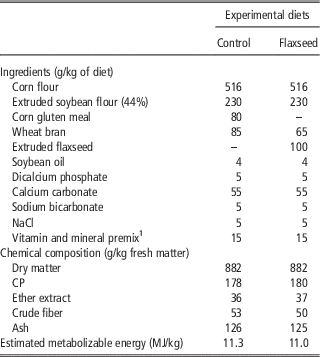
The diets were formulated according to the recommended nutrient requirements of hens (National Research Council, 1994). The control diet was a standard corn–soybean diet; in the flaxseed diet the corn gluten meal and part of wheat bran were replaced by 10% extruded flaxseed. Each diet was enriched with oyster shells in order to supply a suitable level of Ca. The two diets were isonitrogenous and isocaloric; details of the ingredients and the nutrient content are summarized in Table 1.
Ingredients and nutrient composition of control and flaxseed diets of laying hens

1 Provided per kilogram of diet: vitamin A, 12 500 IU; cholecalciferol, 3000 IU; dl-α-tocopheryl acetate, 60 mg; vitamina B1, 2 mg; vitamina B2, 6 mg; vitamina B6, 4 mg; pantothenic acid, 8 mg; PP, 30 mg; folic acid, 0.50 mg; vitamin B12, 0.02 mg; vitamin K, 2 mg; choline, 750 mg; Fe, 35 mg; Zn, 42 mg; I, 0.5 mg; Co, 0.5 mg.
Study design
In this study, 40 Hy-Line hens, 10 months old and from the same hatch were randomly assigned to the two dietary groups (n=20 birds/group):
-
∙ Control;
-
∙ Flaxseed.
Feed and water were provided ad libitum for 23 consecutive weeks. The birds were housed in individual cages and maintained under the same photoperiod (16 h light/8 h dark), temperature and humidity. The study was carried out at the animal experimental section of the University of Perugia (Italy). All procedures involving the care and handling of animals met the National Guidelines for Animal Care.
The hens were weighed at the beginning and at the end of the study. Feed intake and feed/weight conversion rate were calculated for each group. The baseline laying performance of the hens was measured for 2 weeks before their random separation into the two dietary groups. All the eggs were collected, counted and weighed daily. The actual egg yield for each dietary group was determined by multiplying the egg production×egg weight. Feed efficiency was assessed by dividing total feed consumption by total egg mass. The percentage of egg laying was calculated by dividing the number of laid eggs by the number of animals. Approximately, 5 ml of blood was obtained at the end of the study when the hens were electrically stunned (110 V; 350 Hz) and slaughtered as normally happens to commercially raised hens. The blood was collected into ethylenediaminetetraacetic acid-coated tubes and samples were centrifuged at 2500 rpm for 15 min and the plasma was separated and stored frozen at −80°C for later analysis.
Analytical methods
Egg characteristics
In total, 20 eggs/dietary group were randomly collected every week for the determination of egg composition. The percentages of albumen, yolk and shell were calculated relative to whole egg weight. Albumen consistency was tested by calculating the Haugh unit (HU) value of each egg defined as follows: HU=100 log [H−g 0.5 (30W 0.37−100)/100+1.9], where H is the maximum height of thick albumen in millimeters, W the weight of the egg in grams and g a constant (32.2) related to the constant of gravitation. Yolk color intensity was established using the Roche color fan scale (1 to 15) (Vuilleumier, Reference Vuilleumier1969). The composition of egg yolks (n=20 eggs/group per week) was determined using the procedures of the Association of Official Analytical Chemists (1995).
Fatty acid profile of diets and egg yolks
The fatty acid profile was determined by gas chromatography (GC) following lipid extraction according to the method described by Folch et al. (Reference Folch, Lees and Sloane-Stanley1957). In particular, 1 ml of lipid extract was evaporated under a stream of nitrogen and the residue was derived by adding 3 ml of sulfuric acid (3% in methanol). Following incubation at 80°C for 1 h, the methyl esters were extracted with petroleum ether and 1 µl was injected into a GC (Mega 2 – HRGC; Carlo Erba, Milan, Italy) equipped with a flame ionization detector. The fatty acid methyl esters (FAMEs) were separated with an Agilent (J&W) capillary column (30 m×0.25 mm I.D; CPS Analitica, Milan, Italy) coated with a DB-wax stationary phase (film thickness 0.25 mm). The operating conditions used during the column injection were as follows: the temperatures of the injector and detector were set at 270°C and 280°C, respectively, and the detector gas flows were H2 at 50 ml/min and air at 100 ml/min. The oven temperature was programmed to provide good peak separation as follows: the initial oven temperature was set at 130°C; this temperature increased at a rate of 4.0°C/min to 180°C and was held for 5 min; the temperature was then increased at a rate of 5.0°C/min to 230°C; the final temperature was held for 5 min. Helium was used as a carrier gas at a constant flow rate of 1.1 ml/min. Individual FAMEs were identified by referring to the retention time of FAME authentic standards. For the quantitative analysis C19:0 methyl ester, added before extraction was used as the internal standard. The concentration of the individual fatty acids was expressed as g/kg of feed and mg/g of yolk.
Lignans and isoflavones in diets, plasma and egg yolks
The composition of the diets was determined by reverse-phase HPLC-electrospray ionization/mass spectrometry as described by Setchell and Cole (Reference Setchell, Borriello, Gordon, Lawson, Harkness, Morgan and Axelson2003). The extraction of lignans, isoflavones and their metabolites (END, ENL and equol) was performed on 1 ml of sample (feed and plasma) or 1 g of lyophilized yolk; proteins were removed by precipitation and subsequent centrifugation. N-hexane was added to the supernatant for liquid/liquid separation. β-glucuronidase was added to the aqueous residue after correction of the pH of the solution to 5. The sample was left overnight at 37°C; after which the extraction of the lignans and isoflavones was performed by two extractions with ethyl acetate. The two solutions extracted were unified and dried, then added to 1 ml of deionized water for the subsequent purification by silica gel dispersion chromatography. The eluate obtained from the purification was dried again and derivatized for analysis by GC/MS (Varian MS Saturn 2000, ion trap detector; Varian, Palo Alto, CA, USA). Identification of individual constituents of the fraction was made by direct comparison of mass spectra obtained from our samples with those of pure standards and with the mass spectra in NIST92 and Wiley5 libraries.
Cholesterol content of plasma and egg yolk
The total plasma cholesterol concentration was determined by HPLC. All samples were mixed with 8 ml of chloroform:methanol (2 : 1, v/v) (Folch et al., Reference Folch, Lees and Sloane-Stanley1957) and subjected to ultrasound at 30% of intensity for 10 s (IKA® U50, IKA®, Werke Staufen, Germany). The mixture was vortexed and filtered through Whatman paper (No. 1) (Sigma-Aldrich, Darmstadt, Germany) to eliminate cell debris. Next, 1.5 ml of distilled water containing 0.6% of NaCl was added and the mixture was vortexed and allowed to stand at room temperature for 1 h before centrifugation at 500×g for 10 min. The upper layer was suspended in 8 ml of chloroform : methanol : water containing NaCl (86 : 16 : 1, v/v/v) and re-extracted. The chloroform extracts were pooled and dried under a flow of nitrogen. The residue was dissolved in 200 µl of mobile phase (acetonitrile : isopropanol, 70 : 30, v/v) and injected into the HPLC system (pump PU-1580, auto-sampler AS 950-10; Jasco, Kyoto, Japan) on a Waters Spherisorb C18 reversed phase analytical column (ODS-2, 5 μm particle size, 250×4.6 mm internal diameter; CPS analitica). The mobile phase was released at a flow rate of 1.5 ml/min. Cholesterol was indentified using a UV detector (Jasco 2075 Plus, Tokyo, Japan) set at 210 nm and was quantified by using external calibration curves prepared with increasing amounts of pure standard solution in isopropanol (range 0.25 to 2.5 mg). The recovery was >89% and the volume of injection was 20 μl.
Total cholesterol of eggs yolk was determined by HPLC with the same procedure as plasma. About 0.1 g of lyophilized yolk was incubated at 50°C for 60 min in KOH (2% in ethanol) solution. After extraction with n-hexane, the upper layer was dried under a stream of nitrogen and the residue was reconstituted in 1 ml of mobile phase, and then 50 μl was injected in HPLC.
Plasma estradiol and oxidative status
The 17β-estradiol concentration (E2) in plasma was assayed using a commercial 125I RIA kit (ICN Pharmaceuticals Inc., Diagnostic Division, Costa Mesa, CA, USA). The limit of detection was 0.8 pg/ml and the intra- and inter-assay coefficients of variation were <6% and <10%, respectively.
The reactive oxygen substances (ROS) of the plasma were evaluated with a commercial kit (Diacron, Grosseto, Italy) and are expressed as μmol H2O2/ml.
The antioxidant power of plasma (AOP) was measured with a commercial kit (Diacron) that evaluates the ability of plasma to oppose the massive oxidative action of HClO solution. The AOP of the samples are expressed as nmol of neutralized HClO/ml.
Statistical analysis
The effect of the diets on egg production performance, lignans, isoflavones, cholesterol fatty acid profile and on egg quality were analyzed by one-way ANOVA and significant differences were determined using the post hoc Bonferroni test at the level of P<0.05 (STATA, 2015).
Results
Fatty acid profile, lignan and isoflavone content of diets
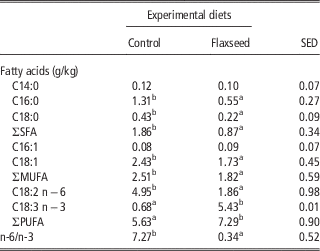
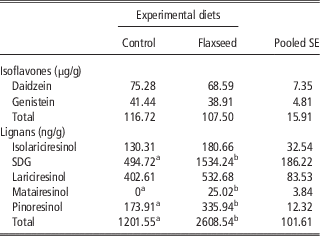
The fatty acid profile of the diets is reported in Table 2. The control diet was richer in saturated fatty acid, polyunsaturated fatty acid (PUFA) and n-6 PUFA than the flaxseed one; whereas the main fatty acid of flaxseed, the ALA, was almost eight-fold higher than in control diet. In the control diet, the content of total lignans was 1201.55 ng/g (Table 3) mainly represented by lariciresinol and SDG. The flaxseed diet had approximately twice the content of lignans of the control diet (2608.54 ng/g). The relative proportion of isolariciresinol and lariciresinol was roughly the same in both the diets, whereas SDG was higher in the flaxseed diet (1534.24 v. 494.72 ng/g). The isoflavone concentration was the same in the two diets.
Main fatty acid profile of control and flaxseed diets of laying hens

ΣSFA=sum of saturated fatty acids; ΣMUFA=sum of monounsaturated fatty acids; ΣPUFA=sum of polyunsaturated fatty acids.
Each value represents the mean of five samples per diet.
a,bValues within a row with different superscripts differ significantly at P<0.05.
Main isoflavones, lignans and fatty acids of the control and flaxseed diets

SDG=secoisolariciresinol diglucoside.
Each value represents the mean of five samples per diet.
a,bValues within a row with different superscripts differ significantly at P<0.05.
Egg-laying performance and chemical characteristics of eggs
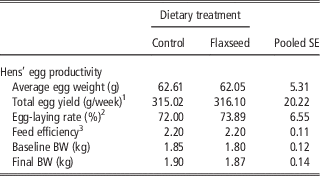
The baseline laying performance was about 72%. During the trial, the dietary groups showed the same egg-laying performance and final BWs of hens (Table 4).
Effect of dietary treatment on productive performance of laying hens (n=20/group per week)

1 (Total number of laid eggs)×(egg weight (g)).
2 (Total number of laid eggs)×(100/(length of experiment in days))×(number of hens).
3 (Total feed consumption (g)/total egg yield (g)).
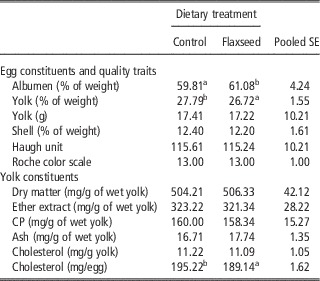
The composition and the nutritional content of the eggs from each group are summarized in Table 5. Major differences were found in the egg fractions (albumen and yolk) of the two experimental groups. Eggs produced by the flaxseed group had a higher percentage of albumen and a lower one of yolk, compared with controls, whereas the shell percentage, was similar. The chemical composition, the quality of albumen and the yolk color were similar in the two dietary groups (Table 5). The cholesterol concentration (mg/g yolk) was not affected by dietary treatment, and the mg cholesterol per egg of flaxseed group was slightly lower (P>0.05) than controls (189.14 v. 195.22 mg/egg, respectively) mainly due to the lower proportion of yolk.
Effect of dietary treatment on egg constituents and quality traits of eggs (n=20/group per week)

a,bValues within a row with different superscripts differ significantly at P<0.05.
Main biological compounds (lignans, isoflavones, cholesterol, estrogen) and oxidative status (reactive oxygen species and antioxidant power) of plasma
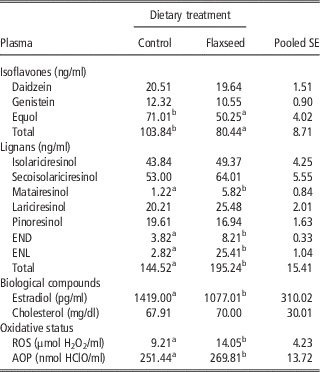
The isoflavone concentration in plasma of flaxseed hens was lower than in controls (80.44 v. 103.84 ng/ml; Table 6). This was mainly due to the lower amount of equol, as the daidzein and genistein values were similar. Dietary supplementation of flaxseed resulted in higher level of plasma lignans tan in the controls (195.24 v. 144.52 ng/ml). In both groups, the plasma lignans have much higher levels than normal circulating levels of endogenous estrogen (~1 ng/ml). The most abundant lignans were secoisolariciresinol and isolariciresinol followed by lariciresinol. Enterolignans (END and ENL) were two and nine times higher in flaxseed than in the control group. The plasma cholesterol concentration of flaxseed hens was the same as in the controls, whereas the estradiol was lower (1077.01 v. 1419.00 pg/ml). ROS and total antioxidant capacity were higher in hens fed flaxseed (14.05 v. 9.21 µmol H2O2/ml; and 269.81 v. 251.44 nmol HClO/ml, respectively).
Effect of dietary treatment on the main biological compounds and the plasma oxidative status of laying hens (n=20/group)

END=enterodiol; ENL=enterolactone; ROS=reactive oxygen species; AOP=antioxidant power of plasma.
a,bValues within a row with different superscripts differ significantly at P<0.05.
Lignans, daidzein and equol in egg yolk
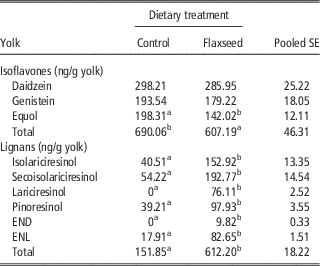
The major isoflavone of the eggs was daidzein and its concentration was similar in the two groups (Table 7). However, equol and total isoflavones were lower in the eggs from the flaxseed group than controls. The concentration of total lignans was higher in hens of the flaxseed group. In particular isolariciresinol, secoisolariciresinol and pinoresinol were three times higher, whereas matairesinol is totally absent in both groups. Lariciresinol was not detectable in controls but was 76.11 ng/g yolk in the flaxseed group. The enterolignans (END and ENL) showed a similar trend to lignans with almost 10 times as much END and four times as much ENL in the flaxseed group.
Effect of dietary treatment on isoflavones and lignans concentration of eggs (n=20 eggs/group per week)

END=enterodiol; ENL=enterolactone.
a,bValues within a row with different superscripts differ significantly at P<0.05.
Fatty acid profile and thiobarbituric reactive substances (TBARS) of egg yolk
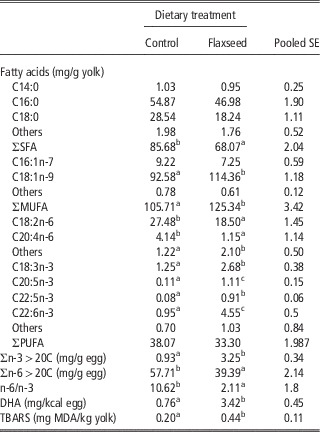
In Table 8 the fatty acid profile of egg yolk is reported. The monounsaturated fatty acids proportion was higher in the control group due to the higher amount of oleic acid. The total PUFA was the same in the two groups, however, the amount of the two series (n-6 and n-3) was different. The amount of n-6 PUFA was higher in controls than the flaxseed group and, as expected, the flaxseed enriched the egg yolk in ALA and n-3 PUFA. The long-chain derivatives of ALA (EPA and DHA) were almost 10 and five times higher, respectively, when flaxseed was administered. Thus, the n-6/n-3 ratio was lower in the flaxseed group (2.11 v. 10.62, respectively). The amount of mg DHA/kcal of egg was higher in the flaxseed group than the controls (3.42 v. 0.68 mg/kcal egg), as was the TBARS value of egg yolk.
Effect of dietary treatment on fatty acid profile, nutritional indexes and thiobarbituric reactive substances (TBARS) of egg yolk (n=20 eggs/group per week)

ΣSFA=sum of saturated fatty acids; ΣMUFA=sum of monounsaturated fatty acids; ΣPUFA=sum of polyunsaturated fatty acids; MDA=malondialdehyde.
a,b,cValues within a row with different superscripts differ significantly at P<0.05.
Discussion
Our study showed that dietary supplementation of 10% flaxseed to mature hens had no effect on egg production, egg weight and the main components of the yolk. Scheideler and Froning (Reference Scheideler and Froning1996) stated that up to 15% dietary flaxseed can be safely added to layer diets without any detrimental effects on egg production. Many of the discrepancies obtained in laying performance depend on the dose, flaxseed cultivar and age of hens. Indeed, flaxseed should not be used for young birds due to the potential anti-nutritional effects of mucilage, linatine and linamarin. Several studies have demonstrated that feeding flaxseed can potentially reduce feed intake, BW and egg production when administered to young hens in the early stages of production (Van Elswyk, Reference Van Elswyk1997). Bean and Leeson (Reference Bean and Leeson2003) confirmed that feeding 10% flax did not impact egg production if the flaxseed diet gradually started at 28 weeks of age.
Flaxseed is a rich source of phytoestrogens, mainly lignans and isoflavones, plant substances which possess, to a greater or lesser extent, functional similarity to the 17β-estradiol (Morton et al., Reference Morton, Wilcox, Wahlqvist and Griffiths1994). In our trial, the plasma estradiol concentration of hens fed flaxseed was lower than in the controls. Different mechanisms have been proposed to explain the effect of lignans on estradiol. One potential explanation is the competitive inhibition exerted by ENL on the binding of estradiol at the nuclear estrogen (Mousavi and Adlercreutz, Reference Mousavi and Adlercreutz1992). An alternative mechanism is the inhibition of aromatase, the enzyme responsible for converting androgens into estrogens (Evans et al., Reference Evans, Griffiths and Morton1995), exerted by enterolignans (Brooks and Thompson, Reference Brooks and Thompson2005). Another possible way to explain how lignans reduce estrogen involves steroid hormone-binding globulin. Lignans are known to stimulate the production of this globulin in the liver, resulting in a reduction of free circulating estradiol (Shultz et al., Reference Shultz, Bonorden and Seaman1991). It is also reported that flaxseed affects the catabolism of 17β-estradiol (2 and 16-hydroxyestrone) as well as the expression of the estrogen metabolizing enzymes (Cyp3A4, Cyp1B1) and reduces estrogen receptors in the ovaries (Dikshit et al., Reference Dikshit, Drião Gomes Filho, Eilati, McGee, Small, Gao, Klug and Buchanan Hales2015).
Morton et al. (Reference Morton, Wilcox, Wahlqvist and Griffiths1994), measuring plasma lignans in response to dietary isoflavones or lignans (flaxseed), found that enterolignans were higher in the flax group and the plasma concentration of ENL was 5 to 20 times that of the estradiol. In our study, the ENL/17β-estradiol ratio changed from 2 to 25 suggesting a strong antagonism between these molecules (Morton et al., Reference Morton, Wilcox, Wahlqvist and Griffiths1994). Despite this ‘down-regulation’ of flaxseed on the release of body estrogens and probably on their metabolism, the flaxseed group showed a good laying activity.
To our knowledge no studies have specifically analyzed this relationship in flaxseed fed hens. However, indirect evidence that the lowering of 17β-estradiol produced by 10% flaxseed can promote hormone balance and reproduction functions can be deduced from studies with other aims on other species. In aged hens, which can naturally develop ovarian cancer, dietary flaxseed improves the health of the reproductive apparatus by modulating inflammation mediators and estrogen metabolism (Speckman et al., Reference Speckman, Hales and Hales2012) and reduces the progression of carcinogenesis. Studies of women with normal ovulatory cycles, confirm that flaxseed addition (10 g/day) lengthens the luteal phase, increases the ratio of progesterone/estradiol and reduces the number of anovulatory cycles (Phipps et al., Reference Phipps, Martini, Lampe, Slavin and Kurzer1993). Petit and Twagiramungu (Reference Petit and Twagiramungu2006), found that flaxseed in milking cows, reduces embryo mortality and improve corpus luteum size and progesterone synthesis.
Concerning the increase of the egg albumen and the decrease of the yolk observed in the flaxseed group, Novak and Scheideler (Reference Novak and Scheideler2001), showed similar results in Hy-Line hens fed flaxseed-based diets (10%). Probably, the increase of albumen percentage in flaxseed fed hens was due to the induction of ovalbumin synthesis mediated by phytoestrogens. Palmiter et al. (Reference Palmiter, Oka and Schimke1971) found that estrogen administration to chicks increases the incorporation of 3H-uridine and SH-lysine into oviduct magnum RNA and protein, respectively, and then enhance albumin synthesis; whereas when the estrogen receptors were blocked this effect was lacking.
In agreement with Scheideler and Froning (Reference Scheideler and Froning1996) flaxseed did not affect egg cholesterol. In other mammalian species, several authors reported a reduction in serum cholesterol in animals fed a flaxseed-enriched diet (Prasad and Jadhav, Reference Prasad and Jadhav2016). The scant effectiveness of dietary strategies to reduce egg yolk cholesterol probably depends on the homeostatic mechanism to maintain an adequate level of cholesterol in the yolk for assuring the survival of the developing of embryo (Milinsk et al., Reference Milinsk, Murakami, Gomes, Matsushita and Desouza2003). Sometimes, the modulation of egg cholesterol, associated with a dietary plan, is a side effect due to a change in the deposition rate and thus to dilution/concentration of egg constituents (Mattioli et al., Reference Mattioli, Dal Bosco, Martino, Ruggeri, Marconi, Sileoni, Falcinelli, Castellini and Benincasa2016).
Flaxseed increased the plasma lignans, especially secoisolariciresinol and isolariciresinol followed by lariciresinol, pinoresinol and matairesinol; also enterolignans (END and ENL) were two and nine times higher in flaxseed than in the control group. It is reported that human consumption of flaxseed linearly increases the excretion of END, ENL and total lignans, but not matairesinol (Dikshit et al., Reference Dikshit, Drião Gomes Filho, Eilati, McGee, Small, Gao, Klug and Buchanan Hales2015). Human studies have suggested that END is synthesized from secoisolariciresinol, lariciresinol, isolariciresinol and pinoresinol by facultative anaerobes in the colon and can be further oxidized by the microflora to ENL, whereas matairesinol is converted directly into ENL (Meagher and Beecher, Reference Meagher and Beecher2000). We showed that hens are able to convert lignan into enterolignans. Few studies are available on such topics: Kennedy (Reference Kennedy1997) showed that the poultry cecal microflora is able to convert lignans to END and ENL though with a lower efficiency than in human.
The concentrations of equol, as well as the daidzein and genistein of hens fed flaxseed, were lower than in the control group, both in plasma and egg yolk. Equol is the main metabolite of daidzein, which is the main isoflavone of the soybean, a standard ingredient of poultry feed, whereas genistein is not involved in equol metabolism (Setchell et al., Reference Setchell and Cole2002). In the control diet the phytoestrogen intake came from soybean meal, and thus, equol was the main phytoestrogen detected.
Murray et al. (Reference Murray, Kang, Astheimer and Price2007) suggest a competition for the tissue uptake of isoflavones when lignans are concomitantly administered in the diet: co-administration of SDG with isoflavones (60 mg/kg) modulates the metabolism of these substances increasing END and decreasing daidzein concentration. Such competition could be the reason for less equol in the flaxseed group. Indeed, the preferential conjugation of some blood enzymes of the isoflavones compared with END and ENL could result in a minor proportion of equol (Murray et al., Reference Murray, Kang, Astheimer and Price2007). Aside from the reduction in equol, the lignans (isolariciresinol, lariciresinol and pinoresinol) and the main metabolic derivatives (secoisolariciresinol, ENL and END) are higher in the egg yolk of hens fed flaxseed. This study shows for the first time that the lignans of flaxseed increase ENL and END in the egg. Such a result could be desirable in order to enrich the egg with compounds considered beneficial for human health (Setchell et al., Reference Setchell, Brown and Lydeking-Olsen1981 and Reference Setchell and Cole2002).
It is reported that flaxseed has antinflammatory and antioxidant properties (Oomah, Reference Oomah2001; Kładna et al., Reference Kładna, Berczyński, Kruk, Piechowska and Aboul‐Enein2016). Part of this effect is probably due to isoflavones and part to n-3 fatty acids, which affect energy metabolism and disease prevention. Jenkins et al. (Reference Jenkins, Kendall, Vidgen, Agarwal, Rao, Rosenberg and Griffin1999) reported that the consumption of flaxseed can reduce protein thiol groups, which suggest an increased in oxidative activity. Although in our trial, the lignans of flaxseed were a source of phenolic antioxidant (Kładna et al., Reference Kładna, Berczyński, Kruk, Piechowska and Aboul‐Enein2016), as demonstrated by an increase of AOP, they were unable to counteract the serum ROS value, probably due to the increase of long-chain PUFA (3.25 v. 0.93 mg/g of yolk).
In this study, the eggs of hens fed the control diet provide 0.68 mg/kcal egg of DHA, whereas an egg of hens fed 10% flaxseed, contain almost four times as much. These results are a consequence of the higher ALA intake due to flaxseed administration. This essential fatty acid has been efficiently converted into long-chain derivatives by the hens’ metabolism and transferred into the egg, where they furnish an important nutrient for the chick, and also for human consumption.
However, there are negative reports regarding the enrichment of PUFA levels in food due to the development of abnormal flavors/aromas associated with lipid oxidation (Galobart et al., Reference Galobart, Barroeta, Baucells and Guardiola2001). As mentioned above, in this study the yolk TBARS was higher in the flaxseed group, probably due to the higher concentration of PUFA, which can easily oxidize if not adequately protected. Moreover, Cherian and Hayat (Reference Cherian and Hayat2009) feeding flaxseed to laying hens observed an increase in TBA-reactive substances in plasma, liver and eggs. In of this view, the level of vitamin E used in this trial (60 mg/kg feed) should be further increased to protect hens’ body and eggs from oxidation.
Conclusion
Dietary supplementation with 10% flaxseed does not affect the yolk concentration of cholesterol or the chemical characteristics of egg and productive performance. Flaxseed in laying hens is mainly employed for improving the fatty acid profile of eggs (n-3 PUFA) and, beside n-3 enrichment, this paper also highlighted relevant changes in the phytoestrogen content of eggs. The eggs of flaxseed fed hens had a higher content of lignans and enterolignans, whereas the lower amount of equol suggests a probable competition for tissue uptake when these compounds are simultaneously present in the diet. The effect of flaxseed on the whole phytoestrogen metabolism and on the reproductive health of laying hens should be further investigated.
Acknowledgments
The authors thank Giovanni Migni, for their technical skills in managing and monitoring productive performance of hens and for their help in the evaluation egg quality.
The authors also thank Dr Ann Henderson for her help with the English.