

Introduction
On August 8, 1792, a conflict ignited between the citizens of Bruck an der Leitha and peasant farmers from neighboring Parndorf, when five men from Parndorf crossed the border to drive their livestock onto the city’s heath land. The contested grassland, the Haidwiesen, lay within the municipal boundaries of the city Bruck and bordered the community Parndorf to the South. When Bruck’s pasture warden observed the Croatian farmers from Parndorf, he approached them to seize their livestock as punishment for letting them pasture illicitly. The farmers came prepared and welcomed the warden hurling stones at him. When the warden reached for his pistol to fire off a warning shot, the Parndorf peasants fled while screaming “you German dog.” Afterward, the five men drove their livestock to a nearby oat field, where the horses continued to eat a dozen sheaves of harvested oats, until the warden finally managed to chase them away.
This incident marks just one of many grazing disputes between the citizens of Bruck an der Leitha and the peasantry of Parndorf, documented on an almost annual basis throughout the eighteenth and nineteenth century. The city’s magistrate exercised jurisdiction over the illegal border crossings committed by the Parndorf peasantry and usually seized the perpetrator’s livestock until any grazing damage was compensated. A long-term solution of the conflict was ultimately in the hands of the landlords ruling both communities, the counts Harrach. Since the sixteenth century the counts were endowed with the Manor Bruck, which encompassed both the city Bruck an der Leitha and the parish Parndorf, as well as a third community, the parish Neudorf. The Manor Bruck was located in a strategically important chokepoint near the capital Vienna at the intersection of the Alps and the Pannonian plain. Both villages, Parndorf and Neudorf, were situated in the sweeping Pannonian steppe, which provided ample grazing for many centuries. Regardless of the abundant grassland, the constant disputes suggest farmers in Parndorf were under pressure to assure ample fodder for their livestock. The necessity and willingness of Parndorf farmers to drive their cattle on the neighboring heath, thereby risking conflicts year after year, points at an even more pressing problem. Their inability to sustain livestock with their own resources implies the sustainable functioning of their agro-ecosystems was somehow compromised. What is the reason behind this and how far does forage scarcity relate to manorial sheep rearing?
This article elucidates the biophysical roots of social conflict, exploring the societal and ecological factors impairing the economic viability of peasant agricultural systems and asks if there is a link between the competition for agricultural resources and ecological degradation. The economic struggles and sustainably challenges faced by peasant farmers will be discussed in light of the social stratification of feudal society, that is the unequal distribution of resources in manorialism, and the unequal appropriation of common pool resources (commons) in the open-field system of the Manor Bruck, Austria, from the mid-eighteenth century until the abolishment of feudalism in 1848. The goal is to understand how unequal factor endowment and manorial surplus allocation entailed in manorial land tenure impacted peasant farmers’ ability to reproduce their livelihoods while maintaining the sustainable functioning of their agro-ecosystems. In addition, research seeks to elucidate the potential of commons and collective land uses as socioecological buffer providing a certain degree of equity and a means for agro-ecosystem sustainability.
When assessing the sustainability of preindustrial agro-ecosystems, soil fertility comes to the fore. Maintenance of soil fertility was the most challenging sustainability issue of early modern agriculture because the potential of farmers to replenish it was largely bound up in the social relations determining access to knowledge, technology, and the appropriation of land resources (Schneider and McMichael Reference Schneider and Philip2010; Winiwarter Reference Winiwarter, Brigitta and Bernd2003). Land-use rights regulating manorial land tenure as well as the access to and use of commons are quintessential factors when exploring the potential of landlords and peasants to actively cycle soil nutrients through agricultural landscapes, for example through nutrients transferred from common pastures onto cropland by grazing livestock. Conflicts emerging from the competition over the commons point to specific environmental challenges and bottlenecks faced by the different actors. The biophysical approach underpinning this research is based on the conceptual framework of socioecological metabolism, which empirically examines material exchanges between society and the environment. The article adopts the metabolism approach to scrutinize patterns of resource use among agricultural actors and to empirically investigate soil fertility management through analysis of nutrient cycling in peasant and manorial agro-ecosystems by establishing nutrient balances.
Conceptual Approach and Research Aims
The contrasting relationship between landlords and their peasant subjects is a pedestal in historical studies dealing with agrarian and social change (Aston and Philpin 1985). A long-standing discourse among economic historians tackles the question whether seigneurial farming systems or smallholder economies triggered a transition toward an advanced organic economy (Allen Reference Allen1992, Reference Allen1999, Reference Allen2005; Overton Reference Overton1985, Reference Overton1996). Research suggests the unequal distribution of natural resources in manorial societies may be both a major driver as well as a bottleneck for agrarian change and social conflict (Borras Reference Borras2009; Byres Reference Byres1996). A biophysical approach that specifically addresses the impact of inequality in landlord–peasant relationships on the sustainable functioning of peasant agro-ecosystems and the social tensions deriving from the challenges faced by environmental degradation has of yet scarcely been conducted in historical studies (Tello et al. Reference Tello, Jover, Murray, Fullana and Soto2018). González de Molina and Toledo (Reference González de Molina and Toledo2014) and Gizicki-Neundlinger et al. (Reference Gizicki-Neundlinger, Gingrich, Güldner and Krausmann2017) argue inequality in a socioeconomic setting may induce sustainability problems and overexploitation of the natural resource base. This article explores a similar hypothesis, which links unsustainable farming practices causing degradation of agro-ecosystems to the unequal distribution of resources and access to commons. Inequality may induce the risk of a steepening downward spiral under exceeding economic and population pressure, which then causes further deterioration of the agro-ecosystem’s ability to properly provide resources and services, resulting in the impoverishment of peasant economies and thus increasing pressure on their resource base, including the commons. Mitigation of the negative effects of inequality required increased inputs of labor and capital and the diffusion of new technologies. Research presented here discusses the socioecological impact of inequality and collective land uses against the background of Boserup’s (Reference Boserup1965) theory of agrarian change and the works of Ostrom (Reference Ostrom2015) and others on the sustainable management of commons (cf. Netting Reference Netting1993). Empirical studies support Boserup’s argument that preindustrial farming systems experiencing population growth successfully intensified production through technological change and increased labor inputs (Fischer-Kowalski et al. Reference Fischer-Kowalski, Krausmann, Mayer and Schaffartzik2014). The article argues, however, that inequality in past and present smallholder farming communities acts as both a driver for unsustainable farming and for agrarian change (cf. Gliessmann Reference Gliessman2007; Sahu Reference Sahu2011). Boserupian intensification pathways, that is the endogenous diffusion of land-sparing and labor-intensive strategies, may thus be considered a response by farmers to counter the negative environmental impact of inequality such as deterioration of agricultural resources due to overexploitation. Furthermore, the article suggests that communal land-use systems were an important feature of smallholder and peasant farming communities counteracting as “socioecological buffer” to alleviate inequality and the related environmental degradation. Commons helped replenish crucial resources removed with the harvest on cropland. In this article, commons take center stage, as all agricultural actors in the Manor Bruck relied equally on commons as a source of nutrients, yet usage of and access to this resource was not equal. The aim is to elucidate, whether the landlords’ surplus allocation and their grasp on commons increasingly challenged the peasantry to maintain a functioning resources base with increasing production.
The empirical research draws from the analytical framework of socioecological metabolism (Haberl et al. Reference Haberl and Winiwarter2006), which assumes that every socioeconomic system maintains biophysical exchange processes with its natural environment to reproduce itself. In this context, economies are the means with which people organize their relationship with the natural environment and with other people. Socioecological metabolism empirically investigates this relationship, accounting for all exchange flows of materials and energy between society and nature. All exchange flows are considered both coupled and regulated by socioeconomic and ecological processes. Agrarian and preindustrial societies maintained a basic or organic metabolism in which all energy consumed by society derived from plant biomass, which was used for food, feed, and fuels (Fischer-Kowalski and Haberl 1997, Reference Fischer-Kowalski, Helmut, Fischer-Kowalski, Haberl, Walter, Harald, Heinz, Verena and Helga2007). Reliance on the ability of plants to utilize solar energy consequently limited preindustrial societies to the capacity of local agro-ecosystems to provide plant biomass (Sieferle Reference Sieferle2006). Sustainable management of the basic agro-ecosystem funds (e.g., soil fertility, biodiversity), which provided reproductive and productive services, required farmers to recirculate large shares of biomass within the agro-ecosystem (Guzmán et al. Reference Guzmán, Eduardo, Roberto, Eva, David, Juan and Manuel González2018). Mixed farming was a strategy found throughout Europe to ensure a stable flow of energy and nutrients while maintaining the functioning of the agro-ecosystem. Farmers dedicated some share of their land to intensive land uses (e.g., cropland) while using the rest in an extensive way (e.g., woodland, rough grazing). Human-mediated transfers of resources from extensive land-use systems onto intensively used land permitted a continuous extraction of resources from the latter. Alternating land uses as a strategy to conserve agro-ecosystems has been denoted as “land costs of sustainability” (Guzmán Casado and González de Molina Reference Guzmán, Gloria and Manuel González2009). In this article “land cost” refers to the area of extensive land uses dedicated, required respectively, to sustain soil fertility in intensive land uses by replenishing the nutrients extracted by harvests through transfers. For example, to sustain the fertility of cropland soil, farmers dedicated some agricultural land to fallowing and grazing livestock to produce manure for fertilization. Preindustrial societies faced socioeconomic pressures and ecological perturbations that impaired equilibria between land uses. Erosion and depletion of soil fertility were among the most important factors in the destabilization of agro-ecosystems and, consequently, society (González de Molina Reference González de Molina2010). This article builds on the hypothesis that social equity has a major relevance in preventing these perturbations while social inequality is a driver inducing imbalances in the land-use system and disturbances in agro-ecosystem functioning. A single social group could trigger the overexploitation of land resources through accumulation of materials and energy available to society in a given territory. For example, surplus allocation by the seigneury could push a feudal society to expand their agricultural frontier, breaking the equilibrium between land uses, creating instability of the socioecological metabolism and triggering the overexploitation or an ecological collapse of the agro-ecosystem (González de Molina and Toledo Reference González de Molina and Toledo2014). To test this assumption, the article reconstructs the socioecological metabolism of the Manor Bruck to assess whether the peasantry met the land costs to sustain soil fertility or if the competition with the manorial economy for extensive land resources such as common grassland impaired the sustainable functioning of their agro-ecosystems.
Methods and Sources Used
Research utilizes the socioecological metabolism concept to analyze agro-ecological flows of nitrogen (N) and phosphorus (P) in manorial and peasant farming systems, which are among the most relevant macronutrients in preindustrial farming. It builds on an analytical segregation of the agro-ecosystems between land-use compartments (cropland, meadows, common pastures, etc.) and socioeconomic compartments (livestock, storage, processing, etc.). Natural- (biogeochemical) and human-induced nutrient flows circulate between these compartments through transfer and recycling processes. All intercompartmental nutrient exchanges, including flows between the natural environment and society, constitute the agro-ecosystem’s nutrient cycle. Accounting all input and output flows of a land-use compartment composes a nutrient balance that serves as an indicator to assess the impact of agricultural practices on plant-available soil nutrients. A deficit implies mining of soil resources, while a surplus indicates an increase in nutrient stocks.
Quantifying nutrient flows requires various methods. The biogeochemical exchanges of nitrogen and phosphorus between the agro-ecosystem and the environment are reconstructed using agro-ecological and environmental accounting methods. The natural supply of phosphorus and nitrogen comprises inputs from atmospheric deposition, nonsymbiotic fixation of nitrogen and the symbiotic fixation of nitrogen from legume cultivation, which the article calculates using methods detailed in Garcia-Ruiz et al. (Reference García-Ruiz and de Molina2012) and data available from Zechmeister-Boltenstern (Reference Zechmeister-Boltenstern1989), Papastylianou and Danso (Reference Papastylianou and Danso1991), Jørgensen et al. (Reference Jørgensen, Jensen and Schjoerring1999), and Jensen et al. (Reference Jensen, Peoples and Henrik2010) including data sourced from the Austrian Central Institution for Meteorology and Geodynamics. Nutrient output to the environment comprises gaseous losses of nitrogen (e.g., denitrification, ammonia volatilization) and is calculated following IPCC guidelines (Dong et al. Reference Dong, Mangino and McAllister2006), Vinther and Hansen (Reference Vinther and Hansen2004), and data provided by the Austrian Soil Information System. Nitrogen and phosphorus are lost to the environment through erosion, leaching, and surface runoff. Region-specific values for nutrient losses from wind and surface-water erosion, including estimates on leaching, come from Götz and Zethner (Reference Götz and Gerhard1996). Surface runoff was calculated according to Bouwman et al. (Reference Bouwman, Beusen and Gilles2009). Socioeconomic nutrient flows comprise the nitrogen and phosphorus in biomass harvested and grazed by livestock, and in seed and manure applications. The calculations use historical nutrient coefficients for plant and animal biomass from Hitschmann (Reference Hitschmann1891). The article reconstructs manure availability and nutrient content of manure using livestock feeding balances. The mass balance approach discounts nutrients retained by the animals, including livestock products, from the nutrients taken up by livestock. Data on nutrient retention comes from Güldner et al. (Reference Güldner, Krausmann and Winiwarter2016) and the U.S. National Research Council (2001).
Manorial records provide socioeconomic and land-use data. The estate’s administration used a diligent and elaborated bookkeeping system to record all the Manor Bruck’s administrative, economic, and juridical activities. Numerous accounting books, registers, and files held in the Austrian State Archives contain data on the manorial economy (OeStA 1746–1848). The records encompass information on manorial crop and livestock production, trade, feed supply, cultivation schedules, land-use surveys, and so forth both in physical and monetary terms. Data on peasant economies encompasses registers on socage (tributes in kind) and corvée (compulsory labor) services and waged labor. The administrative files of the Manor Bruck, along with the weekly correspondence of the estates with the seigneury and with the county’s authorities give detailed insights into the everyday life of the peasantry. Additional data on peasant farming systems (crop production, livestock numbers, land use) comes from tax records, official statistics, and cadastral land surveys held in federal and county archives in Austria and Hungary (BEV 1830–1906; GML 1773–1848, 1786–89; NÖLA 1786, 1830).
Land, Labor, Livestock: Socioecological Features of Manorialism
Feudalism prevailed as the dominant social system in preindustrial Austria until its abolition following the liberal revolution of 1848. Its equivalent legal form in agriculture was manorialism, a system of land tenure based on the landlord’s disposition over all agricultural land in a manor that was leased to tenant serfs, that is the peasants (Brunner Reference Brunner1981). The landlords enjoyed several rights and obligatory contributions inclined in peasant land tenure. Such were tributes in kind, compulsory labor services, and various taxes. A vertical stratification based on the tributary relationship between the landlords and their peasant subjects defined rural society. The land-use system expressed the dichotomous landlord–peasant relationship. Most manors in eighteenth- and nineteenth-century lowland Austria featured an open-field system, divided amongst the agricultural actors. Attached to a manorial estate and typically cultivated through compulsory and waged labor was the demesne, agricultural land under direct control of the landlords. Peasant land tenure comprised rustic land, that is all land uses attached to the peasant farmsteads. The third category composed commons and collective land uses. Alpine Austria, however, featured dispersed settlements consisting of solitary farmsteads sharing communal wood and alpine pastureland. Alpine valleys and basins hosted nucleated villages that practiced more intensive cropping systems, including open-field farming (Hoffmann Reference Hoffmann1978). Structural differences constituting rural and peasant farming communities were accompanied by various forms of manorial lordship. Landlords focusing on an increase in physical and monetary rent exchange characterized the predominant form. These landlords aimed at appropriating surplus produced by peasants both in physical and monetary terms, while manorial farming played a secondary role. Another form of manorial lordship was the “demesne lordship,” which refers to a manorial economy focusing on the peasantry’s obligation to perform labor and the allocation of tribute in kind, both utilized by the seigneury to improve agricultural performance on the demesne (Feigl Reference Feigl1998).
The feudal agrarian constitution of ancien régime Austria remained intact until the eighteenth century. The enlightened absolutists Maria Theresa and Joseph II lay down a legal framework to encourage agricultural growth and modernization of the rural society (Feigl Reference Feigl1982). Peasant smallholders, particularly in alpine Austria, largely benefitted from the mercantile policies, the abolition of serfdom, land reforms, and division of large landowning lordships. As a result, farmers in Austria generated rising yields, but harvests stagnated until the second half of the nineteenth century due to the lack of liberal reforms, tributary burdens, and a relatively expensive domestic servant system (Sandgruber Reference Sandgruber1978b). The goals of establishing a land-based tax and reforming the tributary landlord–peasant relationship by replacing it with a system of land leases similar to the English model failed, due to the resistance of the nobility (Sandgruber Reference Sandgruber1978a). In the post-Napoleonic era, the enthusiasm to reform shifted toward a spirit labeled “conservative modernization” (Bruckmüller Reference Bruckmüller1977; Langthaler Reference Langthaler2004). The main structures of peasant and family smallholdings prevailed in pre- and postrevolutionary, nineteenth-century Austria. The Austrian rulers abandoned the English and Prussian path of agrarian modernization, inclining the radical restructuring of the rural landscape (privatization, enclosure, and land consolidation), and thus rural society. While the legal status of farmers improved following the emancipation of the peasantry in 1848, significant growth and a noticeable agrarian modernization including early industrialization was achieved by the large entailed estates that emerged from the manorial and demesne lordships (Sandgruber Reference Sandgruber1978a). The estates in lowland Austria benefitted from cheap day laborers, reforms, and market incentives tailored to their needs, as well as a growing railway system.
The case study presented here, the Manor Bruck, resembles a demesne lordship, which transitioned into an entailed estate following the abolishment of feudalism. The manor was situated in the Little Hungarian Plain 70 kilometers southeast of Austria’s capital, Vienna. The steppe hinterland exhibits a unique agricultural landscape, which emerged as an agricultural and strategic frontier due to its border with Hungary. The river Leitha running through the Manor Bruck marks one of the most enduring borders on the European continent, separating the crown lands of Austria from those of the Hungarian crown. Since at least the ninth century, the plain witnessed a great many battles and raids, causing much despair among the local population and leading to the desertion of medieval villages, as was the case in the Manor Bruck. The reoccurrence of economic depression, pests, and continuous warfare allowed only a small number of the deserted and destroyed medieval villages to be newly endowed by the manorial lords while the steppe retook large areas of abandoned cropland (Ernst Reference Ernst1953). Ecological succession resulted in secondary steppe grasslands, an anthropogenic heath with Pannonian flora suitable for rough grazing. Without any peasantry to work the fertile black soil the heath became an integrated part of the landlord’s demesne.
Since the Late Middle Ages, the heath played an essential role as grazing ground for large herds of Hungarian Grey cattle crossing in tens of thousands from the Hortobágy in Eastern Hungary to the urban centers of Western Europe (Hoffmann Reference Hoffmann2006; Pickl Reference Pickl1973). With the decline of the cattle drive in the sixteenth century, the landlords of the Manor Bruck invested in extensive sheep rearing on the heath to replace lost rents from passing Hungarian cattle with revenues from wool trading (Brettl Reference Brettl2009). In the 1550s, shortly before the counts Harrach rose to power as lords of the Manor Bruck, the villages Parndorf and Neudorf were newly endowed and colonized by tenants from Croatia and Bosnia, turning large shares of the fertile heath into arable land. The remaining heath continued to be part of the landlord’s demesne and for an annual fee the seigneury shared the vast grassland as a common pasture for rough grazing and hay making with the peasants of Neudorf and Parndorf.
Figure 1A shows the location of the Manor Bruck in today’s Austria. Neudorf and Parndorf are situated southeast of the river Leitha, in the former Kingdom of Hungary. Together with the city of Bruck an der Leitha lying to the northwest in the archduchy Austria, these communities constituted the Manor Bruck. The agro-ecosystems of each community featured an open-field system divided into demesne, rustic, and common lands (figure 1B). Demesne land occupied a large share of the manor, comprising cropland, meadows, pastures, and woodland.
(A) Location of the historical Manor Bruck in today’s Austria, Europe, (B) land tenure in the Manor Bruck, and (C) land use in the Manor Bruck ca. 1840.
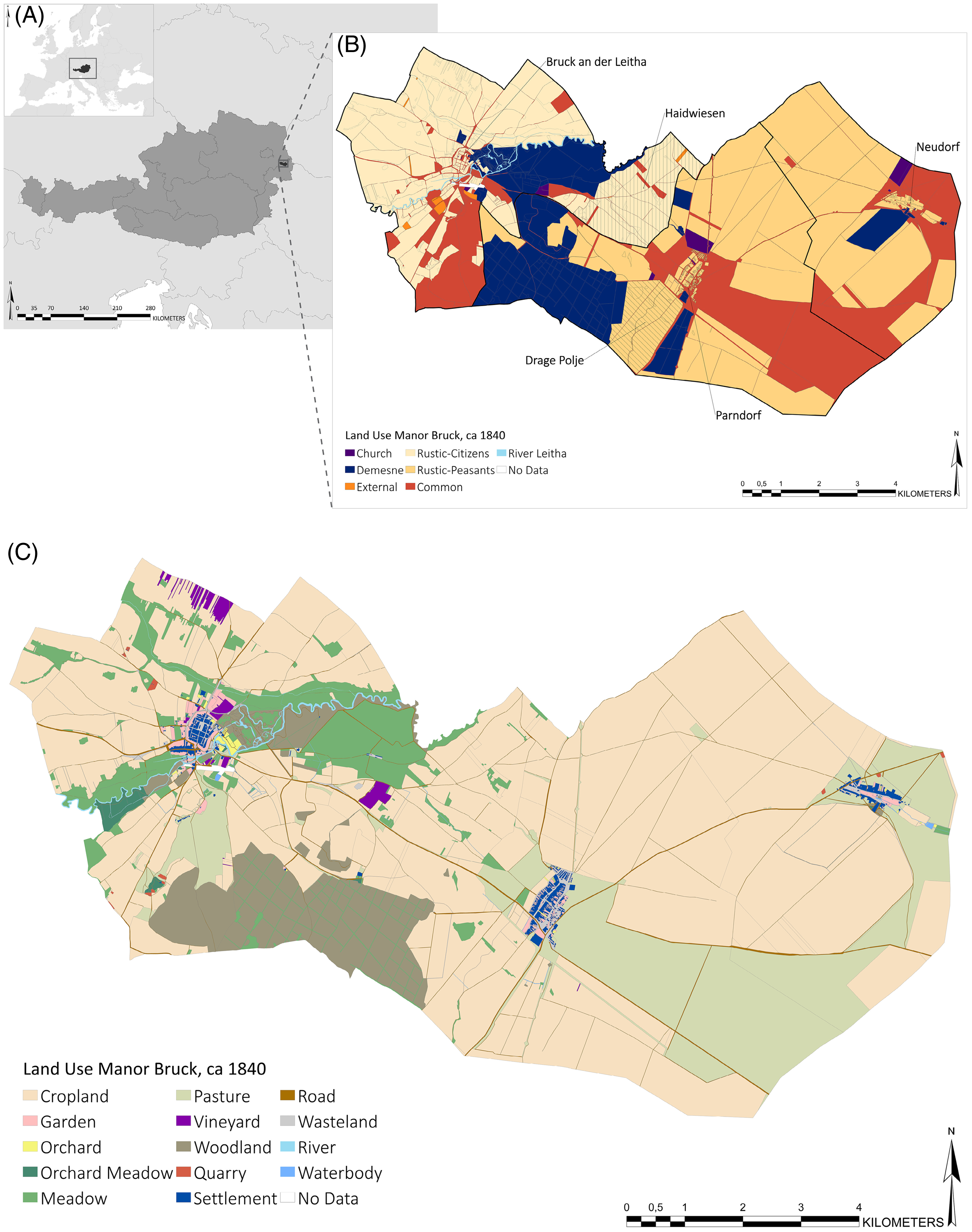
The counts Harrach managed to realign the boundaries of their demesne into relatively adhesive clusters, assigned to three manorial farming estates, one in each community. The estate in Bruck an der Leitha occupied the largest share of cropland and fertile meadows, focusing on crop cultivation and cattle rearing. Parndorf and Neudorf hosted estates with a sizeable flock of sheep grazing the common pastures. Figure 1C shows the diffusion of land uses in the Manor Bruck around 1840. During the study period from 1787 to 1845, the extent of the major land-use classes did not change significantly except for an expansion of cropland into pastures (table 1).
Land use Manor Bruck

Notes: BK = Bruck, ND = Neudorf, PD = Parndorf.
Rustic land held by Parndorf and Neudorf peasants comprised mainly cropland, vegetable gardens, and a few hay meadows. The rustic land cultivated by the citizens of Bruck an der Leitha was more diverse, with land devoted to cash cropping (gardens, orchards, vineyards) and vast meadows. The citizens and the seigneury exclusively owned woodland. The so-called Flurzwang strictly regulated crop rotation in the open-field system and compelled collective coordination of crop cultivation within a three-field rotation cycle. Crop production in the three-field rotation system obliged farmers to stick to a triannual sequence of alternating spring grains (rye or wheat) and winter grains (oats or barley) on two-thirds of cropland with one-third of arable land left fallow, which served as temporary communal grazing ground for livestock. In addition, commons in the Manor Bruck comprised a few hectares of cropland and meadows cultivated by the community. The heath in Parndorf and Neudorf—while technically demesne grassland—made up the largest share of communal land to benefit each farm household. By the end of the eighteenth century, the remnants of the heath comprised roughly 1,400 hectares utilized as common pasture (table 1).
Tribute in kind in the Manor Bruck comprised sheaves (both grains and straw) harvested on rustic cropland. Not all rustic land was equally dutiable, and some 30 percent was even exempted from any dues. Land tenure on one-half of the dutiable rustic land usually amounted to either the ninth or the tenth sheaf of every 10 sheaves harvested. On the other half of the dutiable land both the ninth as well as the tenth sheaf—one-fifth of total harvest—were appropriated by the seigneury. The “farm citizens” of Bruck an der Leitha were no peasants, but free men and women, who were not legally bound to compulsory labor and instead only paid taxes and tribute in kind. Tribute in kind on the city’s cropland was confined to cropland north of the Leitha and such leased from the seigneury (roughly 440 hectares) and consisted of the tenth sheaf only. Land tenure by the peasantry in Parndorf and Neudorf included corvée and socage services, which a register issued in 1776, the Urbarium, strictly regulated according to farm size. The labor duties claimed by the manorial economy in Parndorf and Neudorf were slightly lower than the limit set by the respective Urbarium. On average, the estates utilized up to 10,000 days of draught services from the peasant farmers, which the estates could alternatively redeem for an equivalent of some 20,000 days of manual labor. Peasants’ labor duties covered a third of the necessary tasks on the estates’ farmland (ploughing, mowing, harvesting, etc.), day laborers carried out another third, and servants did the remaining work.
Table 2 summarizes plant biomass extraction in the Manor Bruck, showing annual averages for the periods 1787–89 and 1840–45 in plant dry matter (DM). The estates reached relatively high cereal yields for eighteenth-century Austria, amounting to 1,010 kg ha−1.y−1 of sown cropland. The average cereal yield in the years 1787–89 in Parndorf amounted to 663 kg ha−1.y−1 and 659 kg ha−1.y−1 in Neudorf, respectively. In the eighteenth century both the manorial and rustic farming systems practiced the three-field rotation cycle. Starting in the late eighteenth century the manorial estates steadily transitioned into what economic and environmental historians have labeled “advanced organic agriculture” (Cussó et al. Reference Cussó, Garrabou and Tello2006; cf. Wrigley Reference Wrigley2006). This new method of farming required diversification of the agroecosystem with complex crop rotation cycles. The estates achieved intensification of land use by intercropping cover crops such as legumes and root crops between summer and winter cereals, thereby replacing or significantly reducing fallow. Cereal yields on the estates’ cropland steadily increased to an annual average of 1,156 kg ha−1.y−1 in the years 1840–45. Compulsory crop rotation in the three-field system prohibited peasant economies from introducing a comparable crop rotation until 1840. Crop yields in Parndorf remained relatively stable around 605 kg ha−1.y−1, Neudorf experienced a 27 percent decline in cereal production. Livestock keeping was a staple throughout the region. Peasants primarily kept livestock for draught and transportation services, which they offered to local merchants and businesses (Horváth Reference Horváth2011). Table 2 shows peasant livestock composed a good share of horses utilized for long-distance travel and transportation between local markets and Vienna. Sheep rearing was a pedestal of the manorial economy generating significant revenues from wool trade. Since around 1740, the seigneury had monopolized sheep rearing by prohibiting the peasantry from keeping any themselves. In the nineteenth century, the manorial economy focused on raising a heavier and high-yielding race of Spanish Merino sheep, which replaced the smaller, traditional breeds.
Livestock and biomass production Manor Bruck

Note: DM = dry matter, LSU = livestock unit (average size of 500kg).
The manorial economy had access to lush meadows in the alluvial plains of the river Leitha, yielding between 1,298 and 1,607 kg DM of hay ha−1.y−1. The largest share of hay harvested by the peasantry originated from the common pasture. Total hay harvested from rustic meadows and orchards was low, yet yields were similar compared to the demesne’s meadows (table 2). Common pastures had low hay yields, amounting to 232 kg DM ha−1.y−1 in Neudorf and 160 kg DM ha−1.y−1 in Parndorf. Starting with the intensive rearing of large flocks of sheep in the late seventeenth century the manorial estates became increasingly dependent on a steady entry of biomass from the peasant economies to sustain their growing flock. Consequently, Parndorf peasants had to make use of every resource available to nurse its livestock such as fallow and stubble-grazing on cropland, including the neighboring Haidwiesen.
Contested Heathland: The Biophysical Roots of a Social Conflict
The heath Haidwiesen succeeded the devastation of a medieval village sometime in between the eleventh and fifteenth century (Hillinger Reference Hillinger2012). The secondary heath was initially part of the Manor Bruck’s demesne and later purchased by the city of Bruck an der Leitha as a civic estate (see figure 1B), while the landlords reserved the joint grazing right with Bruck’s citizens. Since 1556, sources report the seigneury granted Parndorf farmers the right to use the neighboring Haidwiesen from Michaelmas (September 29) to Saint George’s Day (April 23). In the subsequent centuries, the citizens of Bruck responded to population growth by dividing the Haidwiesen and turning most of the heath into arable land. Only a few meadows and pastures remained in the late eighteenth century. The grazing right, however, stayed intact and Parndorf farmers kept using it. Parndorf farmers could use only remnants of the grassland, roaming their livestock on the cropland for fallow and stubble grazing after harvest. During stubble grazing, livestock regularly trampled down winter seeds in neighboring fields damaging future crops. If Bruck’s pasture wardens observed such malpractice, they usually seized and stabled the livestock until Parndorf farmers paid compensation for any losses and the expenses for housing the animals. In the eighteenth century most seizures occurred from April to August rather than when the joint grazing right was issued in winter. Seizures during summer months became almost routine, when Parndorf farmers illegally crossed the border to feed their cattle on the Haidwiesen. Most incidents were isolated and peacefully settled cases. The previously mentioned incident in August 1792 stands out due to the usage of firearms. Tensions between the neighbors had risen in the previous year. On April 24, 1791, after nightfall, a band of Parndorf peasants counting 50 heads snuck into the city’s stables to release their impounded livestock. Bruck’s guards took up arms, attacking the unarmed peasants with sabers, inflicting severe injuries to a dozen men from Parndorf. Peasants in turn occasionally assaulted Bruck’s farmers and pasture wardens, when caught grazing on the Haidwiesen in summer. The reoccurrence and persistence of these conflicts, both in winter and summer, hints at a scarcity of forage all year round.
Compiling a feeding balance for Parndorf’s livestock is a useful tool to test this assumption. The mass balance approach measures the livestock’s annual demand of plant biomass, distinguished in feed demand during winter stabling and summer grazing. Comparing total dry matter demand with the fodder available during the winter-feeding period from November to April shows a significant shortage of forage in Parndorf (table 3). Forage supply consisting of oats, straw, vetches, and hay amounted to 957 tons and did not suffice to feed livestock adequately. Based on the average straw and hay yields in the years 1787–89, almost a third of the required feed (578 tons) was missing in winter. The shortage situation gave Parndorf farmers little room to sustain their livestock in winter without winter grazing on the common pasture and cropland. Repeating harvest fluctuations and harvest losses could exacerbate the already prevailing scarcity.
Livestock Feeding Balance, 1787–89

Note: DM = dry matter.
A multitude of social and ecological factors come to mind, when exploring the reason for the shortage. Grassland productivity in Central European steppe ecosystems is severely restricted by climatic factors (mainly precipitation). Summer droughts as well as the mechanical degradation of grassland are root causes for low grassland productivity. The competition with the manorial economy for grassland was another factor for a lack of forage in winter. As mentioned previously, the secondary heath in Parndorf and Neudorf was utilized as common pasture and jointly grazed by peasant and manorial livestock. The appropriation of biomass was, however, not equally distributed among the actors. The estates had some 3,500 sheep grazing on commons and rustic cropland fallow. The article assumes equal stocking density of all manorial livestock on the common pastures in Neudorf and Parndorf, thus an equal distribution of grazing pressure. During summer and a few weeks in winter, manorial livestock grazed up to 853 tons DM from demesne and common pastures. Grazing on Parndorf’s common pasture provided manorial sheep with roughly 439 tons DM; the equivalent to one-third of the biomass taken up by the peasantry’s livestock on the common pasture. While manorial livestock was stabled and fed in winter, peasant livestock took up 1,244 tons DM grazing the common pasture all year round. Accounting for hay harvests by the peasantry, the common pasture in Parndorf provided both manorial and peasant livestock with 1,846 kg of DM ha−1.y−1 (cf. table 2). Grazing pressure by manorial and peasant livestock pushed the heath to the limits of its carrying capacity, leaving no room for harvesting sufficient hay for winter feeding. Biomass productivity of Pannonian grassland, according to Smit et al. (Reference Smit, Metzger and Frank2008), amounts to 1,900 kg DM ha−1.y−1 annually. Comparing grazing pressure with the potential grassland productivity indicates that the competition for grassland biomass between manorial and peasant livestock caused the overexploitation of the common pasture, underpinning the necessity of peasants to roam livestock on rustic cropland, including the neighboring Haidwiesen. Because competition for biomass was significant on the common pasture, peasant livestock received one-third of the total biomass grazed from pasturing demesne and rustic cropland. During winter grazing, Parndorf livestock appropriated some 36 of the required 578 tons DM from pasturing on the Haidwiesen.
But why would peasants simply not reduce livestock numbers to adequately feed their herd and why would they not oppose the seigneury? To answer the first question, the article considers the importance of both livestock and grasslands in preindustrial agriculture.
Livestock and the Unequal “Land Costs” to Sustain Soil Fertility
All agricultural land provides plant biomass, the single most important source of energy (food, feed, and fuel) in feudal societies. People can only directly harness the caloric energy of biomass suitable for human consumption (e.g., cereals) and to provide heat (e.g., wood fuel). Livestock, however, allows people to harness the energy in biomass humans cannot directly consume such as grass and crop by-products. Farm animals became crucial assets of preindustrial agriculture. Not only did they convert inedible plant biomass into goods and food, but also livestock served as “bio-converters” for biomass, providing labor energy as well as energy and nutrients in manure that had to be reinvested in agro-ecosystems to maintain the biophysical flow of energy and materials (Galán et al. Reference Galán, Padró and Marco2016). The long-term stability and capacity of agro-ecosystems to maintain healthy plant growth rested on farmers’ abilities to replenish the nutrients exported with the harvest and livestock provided the means to actively control the cycling of nutrients throughout the agricultural landscape. A complex system of on-farm nutrient cycling sustained soil fertility. It comprised two major soil-plant-livestock pathways: recycling of crop by-products and nutrient transfers from extensive land uses. Crop by-products comprised mainly of straw, which farmers fed to livestock during winter feeding or used as litter. Recycling these by-products of crop production helped replenish considerable amounts of nutrients removed with harvests. Grazed biomass and hay, fed during winter, appropriated a large share of nutrients contained in livestock manure from grasslands.
Grasslands among other extensive forms of land use, such as shrubland and woodland, provided an ecological buffer against the continuous export of nutrients from intensively used cropland and horticultures. Any sustainable metabolism of an agrarian society hinged on a balanced equilibrium between intensively and extensively (“extractively”) used land. Robert Shiel (Reference Shiel, Campbell and Mark1991) proposed a 15 percent ratio of cropland over grazing area as sufficient land cost to ensure proper soil fertility replenishment. However, farm communities did not always meet the required ratio, or the nutrient transfers exceeded the regenerative capacities of extractively used land. One strategy of communities to maintain an equilibrium of land uses was to establish institutional arrangements (set of rules) that governed the collective use and management of extensive land as common pool resources (cf. Netting Reference Netting1993; Ostrom Reference Ostrom2015). Commons aimed at providing equity and a certain degree of socioecological resilience, serving as buffer against nutrient imbalances in cropland thus maintaining the sustainable functioning of the agro-ecosystem, while providing a certain elasticity to rising pressures (cf. Turner et al. Reference Turner, Beckett and Afton2003). Theoretically, Parndorf and Neudorf featured a favorable ratio between common pastures and cropland to meet land costs to maintain soil fertility. Farm size regulated the number of peasant livestock allowed to pasture on the commons, whereas the estates enjoyed unregulated access. Stocking densities thus differed greatly between the manorial and peasant economies and, with it, grazing pressure and the potential to transfer nutrients from the common pastures onto cropland.
In addition to pasturing commons, all cropland was accessible for collective fallow and stubble grazing by livestock of all the different actors due to the communal organization of the open-field system (cf. Flurzwang). Parndorf and Neudorf peasants were granted access to demesne cropland for stubble and fallow grazing. Likewise, the manorial flock of sheep partially fed on grazing rustic cropland from early summer until late fall. Peasant subjects could draw little benefit from grazing on the relatively small demesne cropland with their large herd of cattle and horses, in contrast to the estates roaming a comparatively large flock of sheep on the extensive rustic cropland. The unequal appropriation of resources between the manorial and peasant economies is expressed by the low ratio of cultivated farmland to grazed area enjoyed by the estate as well as its high livestock density per km2 of cultivated demesne farmland (see tables 1 and 2). The impact of the landlord’s dominance in governing and appropriating the commons on peasants’ ability to establish a land-use equilibrium to cycle and replenish nutrients sustainably remains to be seen.
Figure 2 visualizes the flows of nitrogen in the agro-ecosystems of Parndorf and Neudorf and the three manorial estates as a single entity. The nitrogen cycle resembles not a single loop, but rather a complex network of intercompartmental flows of nutrients. Tracing the flows of nitrogen across the social crossroads in figure 2 reveals the estates appropriated relatively more nutrients from communal stubble and fallow grazing. The manorial flock consumed roughly 1.5 tons N from rustic cropland (10 percent of grazed biomass) while peasant livestock fed on 646 kg N (3 percent of grazed biomass) from demesne land. The same disproportionate appropriation of biomass by the estates as a single actor was true for nutrients transferred from the common pastures. The manorial flock foraged roughly 11.7 tons N from the common pastures in Parndorf and Neudorf, compared to the 26.5 tons N taken up by peasant livestock (cf. table 3). The competition for plant biomass and nutrients was not confined to grazing commons. By allocating tributes in kind (both grain and straw), the manorial economy tapped into the recycling flows of peasant farmers, in effect exploiting a portion of rustic cropland to meet the land costs of sustaining soil fertility in demesne cropland. Moreover, additional straw from tithes allowed keeping larger flocks of sheep, which increased grazing pressure on common pastures by manorial livestock.
Nitrogen cycle of the Manor Bruck comprising the manorial estates (upper part) and the two peasant villages Parndorf and Neudorf.
Notes: The model considers the most important agricultural land, comprising the land-use compartments “cropland,” “hay meadows,” and “common pastures” (all other minor land-use categories represented in table 1 are neglected for reasons of clarity). The flow-model includes all relevant socioeconomic compartments participating in the flow of nutrients: the manorial and rustic livestock sectors as well as the respective practices, labeled as “storage and processing” and “manure storage.”

How did the competition for plant biomass on commons and the surplus allocation of the estates impact on peasantry’s abilities to restore cropland soil fertility? In other words, how did the accumulation of nutrients by the manorial economy affect peasant nutrient cycling? The article conducts nitrogen and phosphorous nutrient balances for cropland and common pastures to evaluate the effect of unequal resource distribution and manorial surplus extraction on the sustainable functioning of the nutrient cycle, by accounting all human-mediated and natural input and output flows entering or exiting the land-use compartments. The balances in figure 3A indicate ecological processes, such as the natural supply of nitrogen and phosphorus from the atmosphere, replenished only a small share of nutrients taken up by crops. Human-mediated process, like manure application and nutrient inputs using seeds, primarily sustained soil fertility on rustic cropland. Despite best efforts, both Parndorf and Neudorf lacked considerable amounts of manure to counter the continuous removal of nutrients from crop harvests and grazing on fallow. The balance of rustic cropland shows a significant deficit of −12.7 kg N ha−1.y−1 in Neudorf and −8.6 kg N ha−1.y−1 in Parndorf, respectively. Phosphorus deficits appear much lower and almost balanced; however, any balance needs to be interpreted in relation to the total of flows. The deficit of −1.4 kg P ha−1.y−1 in Neudorf, for example, is almost equivalent to the human-managed phosphorus inputs, whereas the nitrogen deficit greatly surpasses nitrogen inputs by farmers. The nutrient deficits in the balances indicate a general lack of manure fertilizer. Because the forage shortage forced Parndorf farmers to let their cattle roam freely during most of winter, a significant share of manure was unavailable to them, which they could otherwise collect during winter livestock stabling. Figure 3B indicates that nutrients derived from straw comprised the largest share in manure. Nutrient transfers from common pastures and fallow were thus too small to effectively replenish cropland nutrient losses. Given the ratio of grazing grounds to cropland in Parndorf and Neudorf, peasants should have been able to meet the land costs to sustain cropland soil fertility. The estates’ appropriation of roughly a third of the biomass grazed on common pastures interfered with peasant nutrient transfers onto cropland, rendering peasants incapable of replenishing soil fertility in rustic cropland. The nutrient balances of the common pastures display large deficits both for nitrogen and phosphorus, indicating overgrazing due competition for biomass. The budgets in figure 3A indicate a deficit of −10.5 kg N ha−1.y−1 and −2.3 kg P ha−1.y−1 in Neudorf and −12.3 kg N ha−1.y−1 and −2.7 kg P ha−1.y−1 in Parndorf.
Nitrogen (N) and phosphorus (P) balances of rustic cropland (CL) and common pastures (CP).
Notes: (A) Annual averages for the years 1787–89. Bar plots represent the sum of all input and output flows of phosphorus and nitrogen in kg per hectare. Points indicate the average budget of all flows in kg per hectare and year for the respective land-use systems. (B) Origin of nutrients contained in manure of peasant livestock. Fractions indicate the proportion of nitrogen and phosphorus in livestock manure deriving from plant biomass. Plant biomass is divided between forage deriving from the demesne (dem.) and from rustic (rust.) land.

Figure 4A shows the estates, while obtaining significantly higher cereal yields, successfully replenished nitrogen and phosphorus removed with crop harvests. Their application of large quantities of manure achieved positive nitrogen (1.8 kg N ha−1.y−1) and phosphorus (2.4 kg P ha−1.y−1) balances for cultivated cropland. Interestingly the balance for fallow cropland shows fallowing was not necessarily restoring soil fertility as implied by the negative nutrient budgets (−7.2 kg N ha−1.y−1 and −2.1 kg P ha−1.y−1). Fallowing was a strategy to release plant available nutrients for the subsequent harvest through plowing the fields repeatedly thus promoting the mineralization of nutrients from soil stocks. Total demesne cropland was in an almost equilibrium state for nitrogen and phosphorus with −1 kg N ha−1.y−1 and 1 kg P ha−1.y−1, respectively. Nutrient recycling and transfer processes in the demesne’s agro-ecosystem were similar to the peasants’, however, nutrients originating from demesne grassland, including the common pastures and peasant fallow land, comprised the largest share of nutrients contained in manure (see figure 4B).
Nitrogen (N) and phosphorus (P) balances of demesne cropland.
Notes: (A) Annual averages for the years 1787–89. Cropland balances are decomposed in cultivated cropland (CC), cropland fallow (CF), and total cropland (CL) area. (B) Origin of nutrients contained in manure voided by manorial livestock. See figure 3 and text for explanation.

The estates maintained high yields by replenishing cropland soil fertility through nutrient transfers from demesne grassland, recycling crop by-products, and appropriating nutrients from grazing common pastures and rustic cropland, as well as receiving tributes in kind. Almost a third of the forage fed to manorial livestock came from tributes in kind from Bruck’s citizens and the peasantry in Parndorf and Neudorf. Externalizing the land costs to sustain soil fertility virtually multiplied the area of the estates, which figure 5 illustrates through reconstructing the nitrogen imprint of the manorial economy in rustic cropland (cf. Billen et al. Reference Billen and Garnier2012). The imprint is based on the amount of nitrogen appropriated on rustic cropland by fallow and stubble grazing and from tributes in kind. Geographically explicit data in line with the results from nutrient flow analysis highlights the intensity of nitrogen appropriated by the estates, measured in kg nitrogen per hectare. The map shows the demesne, in addition to the 1,400 hectares of common pasture, required nutrients appropriated from 4,200 hectares of rustic cropland to sustain demesne cropland fertility.
The map shows the “nitrogen imprint” of the manorial economy by quantifying the nutrients transferred from the peasants’ dutiable land with the tributes in kind, which includes nutrient appropriation from stubble and fallow grazing.

Feeding balances show grazing competition put considerable pressure on the dry steppe grassland, pushing it to the limits of its carrying capacity. Compiling nutrient balances for Parndorf’s and Neudorf’s common pastures reveals a similar image because neither community was able to maintain an equilibrium state for phosphorus and nitrogen (see figure 3A). Rough grazing in preindustrial farming systems in Central Europe was traditionally practiced without proper fertilization of grasslands, thus reducing long-term ecosystem productivity (Kapfer Reference Kapfer2010). Ecological replenishment processes could not meet with the uptake and transfer of nutrients off grassland using livestock. Furthermore, high grazing pressure in dry steppe ecosystems promotes nutrient loss through erosion. Nutrient depletion in combination with overgrazing certainly led to the degradation of the heath. Historical records support the conclusion that Parndorf famers bewailed overgrazing by the seigneury and campaigned against its grasp onto the common pasture as an attempt to prevent further degradation and enclosure of the heath.
In a 1770 lawsuit, Parndorf peasants complained about the enclosure of large parts of the heath by the manorial economy and the heavy grazing pressure caused by manorial flock of 3,000 sheep. The estates saw no wrongdoing in the enclosing parts of the heath and herding a large flock. On the contrary, the seigneury defended its lawful right to exploit the heath because the heath was always in its uncontested possession prior to its colonization by tenants from Croatia and Bosnia. The seigneury thus rejected the peasantry’s request to reduce the flock, adding the joint grazing right was only a token of mercy offered by the seigneury to the newcomers. The estates consequently dismissed all allegations as being naïve and false, claiming the actual flock was merely 2,000 head. Table 2 indicates there were indeed more than 3,500 sheep, but the flock was distributed proportionally to Neudorf (one-third) and Parndorf (two-thirds). The seigneury finally settled the lawsuit, noting it mercifully allowed its subjects to graze pastures belonging to the demesne and it was not worth acting against the rights of the seigneury in this way, leading to a limitation of the rights of the subjects. During this trial, the estates successfully defended the enclosure of roughly 85 hectares of the heath by arguing the peasantry in the early eighteenth century enjoyed the similar right of converting an extensive area of 168 hectares into arable land to grow mainly buckwheat. Furthermore, the seigneury complained about the ongoing, unauthorized expansion of cropland by the peasants and the bad state of the heath. At this time, several roads came into existence from driving on the heath, to avoid the usual route on the toll road to Vienna. The seigneury reported the grassland took severe damage, especially in muddy conditions, from carts passing through the heath and was worried ongoing damage of the heath would make it impossible to feed livestock in future.
Enclosures and Clover: Liberal Land Reforms and the Abolishment of Feudalism
By no means does this article accuse the counts Harrach of being tyrants, who exclusively sought the exploitation of their subjects to finance their life of the higher nobility at the emperor’s court in Vienna. In historiography, the name Harrach is associated with the enlightened nobility. The family distinguished itself as promoters of popular (Czech) culture and language (Raptis Reference Raptis2017). The counts Harrach stand out as agrarian capitalists who regarded themselves as supporters of liberal agrarian reforms, underpinned by the new scientific enlightenment, to unleash peasant economics. Interpretation of the counts’ stance must therefore consider their contrasting position as feudal landlords and agrarian capitalists, aiming to maximize profits from their demesne lordships, while also having the welfare of their peasant subjects in mind, which built the staple of their wealth. A task that contradictory interests often undermined.
This conflict of interest came to the fore, when Parndorf farmers attempted to grow forage crops despite compulsory crop rotations. Since 1786 peasants cultivated fallow in the so-called Drage Polje fields with vetches, a leguminous forage crop, to deal with the extreme shortage of forage and their livestock’s poor nutrition. Drage Polje translates to “good field,” testifying to favorable soil conditions. While a runlet meandering through the fields kept the Drage Polje moist during summer, the remaining arable land was less suited for the cultivation of this heat-sensitive vetches (see figure 1C). Growing some 168 tons DM of vetches on 53 ha significantly reduced the shortage of forage in 1787–89 (see tables 2 and 3). Legumes were expensive to acquire and labor intensive to grow, yet they offered versatile uses, such as forage for livestock and foods for people, while also possessing soil-improving properties because they fixed atmospheric nitrogen. The cultivation of vetch in Parndorf challenges the conservative notion of an agrarian dualism in ancien régime Europe, specified by historians as a comparative “backwardness” of East-Central European demesne lordships and their “suppressed” peasantry in contrast to the modernization experienced by rural societies of Western Europe (Cerman Reference Cerman2012). The case of Parndorf parish demonstrates peasants of demesne lordships were perfectly capable responding to pressures from food or forage scarcities by intensifying land use through endogenous innovation and the diffusion of techno-managerial strategies. Also, the open-field system was flexible enough for the collective intensification of fallow, as Parndorf farmers acted contrary to the rigid dictate of compulsory crop rotations in the three-field system that prohibited noncollective cultivation of fallow (cf. Allen Reference Allen1992). Traditional Austrian historiography considers open-field farming and collective land uses a major obstacle for the modernization of preindustrial farming systems and rarely describes peasant economies introducing these innovations on a large scale prior to the estates, which were regarded as pioneers of agrarian modernization acting as beacons of the enlightened world in an otherwise backward countryside (cf. Drobesch Reference Drobesch2013; Langthaler Reference Langthaler2004).
The case of Parndorf tells a different story. The estate’s administrator raged against the “selfish” actions of the peasantry and urged count Harrach to prohibit the cultivation of the fallow. The administrator feared a major drawback for the manorial economy because Parndorf peasants mowed vetches as green forage, thus eluding tributes in kind and expelling manorial livestock from fallow grazing. Furthermore, the administrator argued forage production would deprive already emaciated soils, reducing crop production and thus tributes in kind for the manorial economy; a false view that underlines the estate’s missing experience with growing legumes. Count Harrach dismissed the administrator’s request, stating that he would not prevent his subjects from growing vetch.
The estates grew clover and vetches probably long before the 1760s, but only on a few hectares of sown meadow, in gardens, or on cropland most suitable for legume cropping. It took until 1786 for the count to mandate replacing pure stands of fallow with seeded fallows. The rise of the advanced organic economy on the estates prolongated until the early nineteenth century. Enclosures of demesne land accompanied the transition. In 1821 and 1834, for example, the estate arranged the exchange of a substantial proportion of its demesne with equal shares of rustic cropland. The goal was to realign the demesne in adhesive clusters. It granted the estates the opportunity to practice new crop rotations comprising five to six cycles with forage crops interspersed between winter and summer cereals. The new rotations with seeded fallow for forage production became an intrinsic part of advanced organic farming. This land-use intensification strategy implied breaking with the communal use of cropland because it exempted the demesne from the compulsory rotation and joint grazing on fallow. The estates’ administration dismissed a complaint by Neudorf and Parndorf community leaders and presented the renunciation of the joint grazing right to them in a “very understandable way.” The estates continued grazing on rustic land.
The positive synergies of advanced organic farming are well described in literature, yet empirical research on its environmental impact is still scarce (Allen Reference Allen2008; Corbacho Reference Corbacho2017). Nutrient recycling and transfers rates on the estates increased by 30 percent for nitrogen and 41 percent for phosphorus, productive performance grew accordingly with yields rising from 1,010 to 1,156 kg DM ha−1.y−1 (cf. Güldner and Krausmann Reference Güldner and Fridolin2017). Legumes were a key element because they introduced additional plant nutrients through the symbiotic fixation of atmospheric nitrogen. This nitrogen was bound in the roots and aboveground biomass of legumes. Farmers plowed down fixed nitrogen in roots and stubble while livestock turned nitrogen contained in aboveground biomass into manure used as cropland fertilizer. Figure 6A indicates legume cultivation improved livestock production and thus on-farm nutrient cycling through manure application and nitrogen fixation, raising nitrogen budgets of cropland to 1.6 kg N ha−1.y−1 (cultivated cropland: 1.8 kg N ha−1.y−1; cropland fallow: 1.4 kg N ha−1.y−1). A feedback loop was, however, impossible to achieve for phosphorus because it was only recovered from biomass recirculating or from soil stocks. Thus, preindustrial farming systems practicing advanced organic agriculture gradually faced new sustainability challenges once they met their nitrogen demands (Güldner and Krausmann Reference Güldner and Fridolin2017). Comparing the annual phosphorus balance for demesne cropland for 1787–89 (1 kg P ha−1.y−1; see figure 4A) with the 1840–45 balance (−1 kg P ha−1.y−1; see figure 6A) indicates new phosphorus bottlenecks in demesne farming. While legume intercropping caused unintended side-effects for phosphorus, nitrogen inputs on demesne cropland increased by a quarter even though demesne cropland expanded by three-quarters (see table 1). Annual averages between 1840 and 1845 show the share of nitrogen from symbiotic nitrogen fixation grew to a third of total nitrogen inputs into cropland, while fixed nitrogen and phosphorus from legumes comprised another third of the nutrients contained in manure (see figure 6B).

The diversification of the demesne’s agro-ecosystems with forage crops intensified nutrient cycling without additional land costs. Considering the rigid land costs to sustain soil fertility on demesne and rustic cropland, grassland was already overused and failing to buffer nutrient removals, preventing further cropland expansion to increase production. Intensification within the three-field system was thus unsustainable in the long run without additional land resources to transfer nutrients onto cropland. Clover, vetches, and other legumes provided additional nitrogen from the atmosphere, without the need to colonize new land. Net nitrogen fixation by vetch on 1 hectare of cropland (roughly 32 kg N ha−1.y−1) was equivalent to the amount of nitrogen transferred in manure originating from livestock grazing on 18 hectares of pastures or the equivalent amount of hay mowed on 3 hectares of meadows. Legume cultivation loosened the rigid area limitations of nutrient cycling in traditional farming by “virtually” expanding land resources.
The nutrient imbalances of Parndorf and Neudorf show soil mining in cropland commenced in the nineteenth century. Phosphorus mining in cropland soils remained at the same level of magnitude amounting to roughly −1 kg P ha−1.y−1 (cf. figures 3A and 7A). However, the nitrogen deficit in rustic cropland in Parndorf in the 1840s significantly improved compared to the annual imbalance from 1787–89. The annual deficit on cropland between 1840 and 1845 dropped to −4.8 kg N ha−1.y−1, owing to an expansion of legume intercropping and the additional supply of nitrogen deriving from symbiotic fixation and nutrient-rich manure (see figure 7A and 7B). Probate inventories of farmers show an increase in legume cultivation in Parndorf following the liberal land reforms. Between 1837 and 1841, the peasantry strived to consolidate their widely dispersed plots of land and sought the partition of the common pasture between the estates and the communities. While land consolidation freed peasants from compulsory crop rotations, the partition of the heath (the landlords received 9 parts out of 17) had varying impacts in the communities. Parts of the common pasture were allotted to peasant farmsteads and cultivated, while the largest share of the pasture remained as common grazing grounds. The grasslands in Parndorf retained their role as a nutrient source for rustic cropland without proper fertility replenishment (−11.7 kg N ha−1.y−1 and −2.6 kg P ha−1.y−1; see figure 7A). Overuse of grasslands forced Parndorf farmers to expand forage production to prevent a further increase in grazing pressure. With an almost equivalent ratio of cultivated to grazed area, Parndorf peasants hardly met forage demand nor established sufficient nutrient transfers to replenish soil fertility. The manorial economy, despite the partition of the common pasture, still boosted a ratio of five hectares of grazed land to cultivated cropland. Diversification of rustic cropland with forage crops on an estimated 140 hectares of fallow in Parndorf was a response to forage scarcity and ecosystem degradation rising from the unequal land costs rather than a deliberate act of modernization in response to market and population pressures. Furthermore, the positive side-effects of legume cultivation on soil fertility helped alleviate decades of soil mining in cropland. Prior to the large-scale diffusion of vetch in 1841, Parndorf farmers lacked forage and thus nutrient-rich manure. Insufficient fertilization in Parndorf caused harvests to decline between 1761 and 1847 (see figure 8). In the years 1840–45 crop yields had already dropped below the eighteen-century average (see table 2).
Nitrogen (N) and phosphorus (P) balances of rustic cropland (CL) and common pastures (CP).
Notes: (A) Annual averages 1840–45. (B) Origin of nutrients contained in manure voided by peasant livestock. See figure 3 and text for explanation.

Crop harvests in the Manor Bruck (cereal yields) 1761–1847.
Notes: Data points show annual crop harvests per hectare; lines represent linear trend in yields.

Neudorf farmers faced a similar trend in declining harvests and yield fluctuations. Evidence for forage intercropping in Neudorf is missing. In the absence of advanced organic farming techniques, soil mining in Neudorf commenced with an annual decrease of −10.3 kg N ha−1.y−1 and −0.9 kg P ha−1.y−1 (see figure 7A). One explanation for the missing legume cultivation could be less competition with the manorial flock for grassland. Biomass uptake around 1787–89 by livestock in Neudorf met the carrying capacity of Pannonian grassland. The division of the common pasture in 1841, however, increased grazing pressure by peasant livestock, greatly widening the nutrient deficit in the years 1840–45 to −20.1 kg N ha−1.y−1 and −2.7 kg P ha−1.y−1, respectively.
The unequal distribution and competition for resources had a long-term negative impact on nutrient cycling on peasant farms, culminating in soil nutrient mining, an eventual loss of soil fertility and a decline in yields. Despite land consolidation and the partition of the common pasture, the economic situation for farmers remained precarious and years of malpractice left the sustainable functioning of peasants agro-ecosystems compromised. Trespassing on the neighboring Haidwiesen continued throughout the 1840s. The citizens of Bruck grew tired of seizing livestock and damage inflicted on their crops. An attempt by the magistrate of Bruck to finally resolve the dispute with Parndorf failed due to the landlord’s reluctance. The citizens offered to depart with 121 hectares of the Haidwiesen in exchange for agreeing to annul the joint grazing right. The landlord, however, refused to cooperate because he would also lose the joint grazing right without gaining any benefits. Resentment toward manorialism spread in the 1840s. In 1843, Parndorf and Neudorf peasants refused to show up for labor duties, foreshadowing the liberal revolution of 1848 that led to the abolishment of feudalism. Peasants even threatened and drove away the field surveyor in charge of the land consolidation project. In an 1845 letter to the manorial forestry office, the anonymous author found more drastic words to express resentment against feudal lordship, threatening the administrator to never step on rustic land again, or they will not leave the fields unharmed.
Conclusion
The case of Manor Bruck allows for some general conclusions on the socioecological impact of inequality and the importance of commons for the sustainable functioning of preindustrial agro-ecosystems. Commons and collective land uses were viable management strategies to sustain key reproductive functions of peasant agro-ecosystems. A sustainable usage of common pool resources by all actors was, however, depending on the communal arrangements and rules laid down to govern the (equal) access to and collective management of these resources. Parndorf and Neudorf parishes’ strict obligations to limit livestock numbers per household in accordance with farm size and the means to feed livestock in winter should prevent overuse and grassland degradation, while still granting individual farmers enough resources to supply their livestock and cropland soils with forage and nutrients. The estates had much more latitude than the communities, facing little to no restrictions on utilizing the commons, therefore threatening to destabilize the balance between land uses. Manorial rule and possession of commons undermined self-governance and collective management of the common pastures in Parndorf and Neudorf. The estates disproportionately appropriated biomass and nutrients from the common pastures, acting in their best interest but without the communities’ welfare in mind, thus creating a severe perturbation for the peasants’ ability to sustain their livestock.
The repeated trespasses by Parndorf farmers onto the neighboring Haidwiesen resulted from drought-related forage shortages underpinned by ecological degradation due to competition between landlord and peasantry. Competition between manorial and peasant economies restrained peasant farmers from properly utilizing grassland to buffer nutrient imbalances in their cropland without overgrazing of the commons. Manorial resource appropriation from rustic land and common pastures negatively impacted the peasants’ ability to cycle nutrients in their agro-ecosystems, which drained soil resources in cropland and reduced yields in the long run. Furthermore, high stocking densities for livestock and overgrazing of common pastures caused degradation of grassland through erosion and loss of soil fertility. Common pastures throughout Europe often lacked sufficient nutrient replenishment from natural processes. The few remaining “poor grasslands” and rough grazing grounds in Europe are testimony that commons often served as nutrient sources, which farmers continuously tapped through grazing livestock for more intensive land uses acting as nutrient sinks.
This study shows that commons and collective forms of land use in the Manor Bruck became a vessel to further deepen the unequal appropriation of the resources between peasants and landlords (cf. Curtis Reference Curtis2006). In case of Manor Bruck, traditional institutions regulating commons and collective land uses that once were providing a certain degree of equity became an obstacle for the elimination of disequilibria in resource allocation. This in turn highly motivated the peasantry in anticipation of latent gains to induce institutional change (cf. Kopsidis Reference Kopsidis2006). At the same time, the interests of the landlords who benefited from maintaining the status quo became threatened, which turned them into obstacles for economic development. The introduction of new institutions was delayed due to the resistance of the potential loser, that is the landlords of Manor Bruck. The gains and costs resulting from technical and institutional change were thus not distributed among all members of society. Advanced organic farming techniques were primarily introduced on the estates. The peasantry in the Manor Bruck, however, struggled until 1840 to abolish collective coordination of cropping in the open-field system and liberalize the institutions ruling the commons, finally allowing them to introduce new cropping patterns.
Agrarian intensification in societies limited by the availability of land is correlated to the suspension of compulsory rotations, which prohibited agro-ecosystem diversification, notably the introduction of rotations without fallowing. While land consolidation and privatization of commons were popular strategies for land-use intensification, research on Manor Bruck reveals that the open-field system was still flexible enough to adopt collectively integrate forage cultivation into cropping patterns for mutual gain. Intercropping vetches by Parndorf farmers has shown that population and economic pressure are not the only incentives to diversify cropping systems. Intensification may also indirectly aim to sustain livestock and soil fertility and thus the farmer’s agro-ecological funds. Furthermore, intensification through organic farming methods does not necessarily imply the sustainable use of soil resources, as the case of phosphorus mining due to forage intercropping demonstrated.



