In Western Australia, students from refugee backgrounds are placed in Intensive English Centres (IECs) for up to 24 months prior to mainstream schooling, to help them successfully settle into the education system. There is now evidence, albeit limited, that many students from African refugee backgrounds experience great difficulties in settling into mainstream classrooms, and in many cases become aggressive following their transition into these contexts from an IEC (Brown, Miller, & Mitchell, Reference Brown, Miller and Mitchell2006; Hillier, Reference Hillier2002; Jackson, Reference Jackson2007). It may be, as argued by Due and Riggs (Reference Due and Riggs2010) and Sam and Berry (Reference Sam, Berry and Berry2006), that these young individuals have to re-establish their lives and adapt to new concepts, and examine their original values and cultural beliefs and modify them as a result of integrating within the host culture.
In an eloquently argued article, Amoah (Reference Amoah2014) posited that children of African immigrant families face confusion about who they are, because they are expected to behave as their country of origin expects, but at the same time compete and succeed as their new country of settlement dictates. A successful settlement involves acculturation, which has been variously described as a process that involves one culture trying to adapt to another, usually the dominant culture (Kim & Abreu, Reference Kim, Abreu, Ponterotto, Casas, Suzuki and Alexander2001); as culture change that can affect both or either of the groups who come into contact, or as the meeting of cultures and the resulting changes (Berry, Reference Berry2005), although in practice it induces more changes in one group rather than the other (Berry, Reference Berry1997). According to Grant (Reference Grant2007), there is a differentiation in identity, which social identity theory argues becomes stronger for the immigrant when there is a perception of threat and insecurity.
It may be in the case of African adolescent high school–aged students that the transition from the stability of the IEC to the mobility of the mainstream school context is where identity differentiation occurs. Specifically, in the IEC there is a common social identity among students from African refugee backgrounds who share similar goals. On transition to mainstream classes, however, where there is increased movement and exposure to others (teachers and students) there is a need to examine their original values and cultural beliefs and modify them through involvement in socially conforming or non-conforming activities.
Although there is research demonstrating that newly arrived people and families into Australia (and elsewhere) experience severe difficulties in adapting to their new homes (and this appears to be particularly true for people from African countries: see Due & Riggs, Reference Due and Riggs2010), there has been scant research examining how adolescent students from African refugee backgrounds adapt in schools (Poppitt & Frey, Reference Poppitt and Frey2007). This is somewhat puzzling given the increasing concerns being expressed over the emotional and behavioural problems of students from African refugee backgrounds who arrive in Australia (Brown et al., Reference Brown, Miller and Mitchell2006; Lloyd, Reference Lloyd2006; Milner & Khawaja, Reference Milner and Khawaja2010; Poppitt & Frey, Reference Poppitt and Frey2007; Ziaian, Anstiss, Antoniou, Baghurst, & Sawyer, Reference Ziaian, de Anstiss, Antoniou, Baghurst and Sawyer2012). Indeed, most adolescent students from African refugee backgrounds have experienced severely interrupted (or no) schooling and have very limited knowledge of school routines (Brown et al., Reference Brown, Miller and Mitchell2006). Consequently, 63% with more than 2 years of interrupted schooling, and 90% with no prior schooling, fail to complete Year 12 in Australia (Earnest, Housen, & Gillieatt, Reference Earnest, Housen and Gillieatt2007).
Nevertheless, it remains the case that school represents the setting where many of the hopes of adolescent students from African refugee backgrounds materialise (Earnest et al., Reference Earnest, Housen and Gillieatt2007), and many of these young people place a high priority on education and have high expectations of the education system (Cassity & Gow, Reference Cassity and Gow2005). Earnest et al. (Reference Earnest, Housen and Gillieatt2007) conducted six separate focus groups with 45 adolescent students from African refugee backgrounds from IECs and found that the career aspirations they expressed were to be: journalist, nurse, scientist, doctor, computer expert, pilot, lawyer, engineer, electrician and teacher. However, many students commented that they became discouraged during their time in the IEC and even more so later when in mainstream school when it became apparent that their career aspirational outlook was somewhat forlorn. While this research is important for advancing our knowledge and understanding, it appears to focus on career goals, and did not examine how goals might change as individuals transitioned to mainstream education.
Goals are generally organised around matters of social and personal identity, education, career, sport and leisure, and material development (for a comprehensive review of these goals see Carroll, Houghton, Durkin, & Hattie, Reference Carroll, Houghton, Durkin and Hattie2009). Furthermore, adolescents rarely pursue only one goal, rather they have multiple goals (Louro, Pieters, & Zeelenberg, Reference Louro, Pieters and Zeelenberg2005). Whether this is the case with adolescent students from African refugee backgrounds during their time in an IEC and beyond is yet to be resolved. Gaining this kind of information is important as there is a strong relationship between goals and behaviour (i.e., a person's choice of goals, their motivation to achieve the goals, and the likelihood that the goals are achieved; Carroll, Houghton, Durkin, & Hattie, Reference Carroll, Houghton, Durkin, Hattie and Levesque2012; Carroll, Hattie, Durkin, & Houghton, Reference Carroll, Hattie, Durkin and Houghton2001; Li & Wright, Reference Li and Wright2014; Locke & Latham, Reference Locke and Latham1990).
To account for the motivational and social determinants of behaviour, Carroll, Houghton, Hattie, and Durkin (Reference Carroll, Houghton, Hattie, Durkin and Columbus2001) developed Reputation Enhancing Goals Theory (REG; see Carroll et al., Reference Carroll, Houghton, Durkin and Hattie2009, for a comprehensive description). This posits that adolescents seek a specific reputation or social identity and there is a purpose to the seeking of reputations, a form of goal directedness and striving that accounts for the mission, and a deliberateness that many adolescents display that leads them to act, in some cases with vigour. Two major types of goals based on academic and/or social goals, the latter of which can be further divided into conforming or non-conforming social goals, are evident. Critical in the orientation, development, and management of adolescents’ peer reputations is the choice of these academic, conforming social, and/or non-conforming social goals (Carroll et al., Reference Carroll, Houghton, Durkin, Hattie and Levesque2012). Individuals deliberately choose the particular social identity they wish to present to their audience and endeavour through attainment of their goals to enhance and sustain this reputation (Emler, Reference Emler, Maher and Maher1984). During the high school years there is an increased and routine contact with like-minded peers and it is this contact that provides the necessary audience by which to enhance a reputation. It is also a time where a dissonance may occur between the cultural (origin) identity and that required for the new social group within the school (Sam, Reference Sam2000). However, research demonstrates that adolescents who are connected to school will adopt the school's values, norms and expectations, and for this reason will refrain from engaging in behaviours that are inconsistent with the school's expectations (see Lopukas & Pasch, Reference Lopukas and Pasch2013). Indeed, school connectedness, which has been defined as students’ experiences of belonging and closeness with others at school (Resnick et al., Reference Resnick, Bearman, Blum, Bauman, Harris, Jones and Udry1997), may be a protective factor because those who are connected are likely to have good quality interpersonal relationships with teachers (Whitlock, Reference Whitlock2006).
In summary, there is no doubting that during adolescence, important processes of identity formation, decisions about educational opportunities, the consolidation of developing social values, and the construction of plans for one's future are all very salient. Directions taken here have long-term implications (Durkin, Reference Durkin1995; Salmela-Aro, Aunola, & Nurmi, Reference Salmela-Aro, Aunola and Nurmi2007). While it is known that similarities and differences exist between the relative importance of different goals and reputations to delinquent, at-risk, and not-at-risk adolescents (Carroll et al., Reference Carroll, Houghton, Durkin, Hattie and Levesque2012), little, if anything is known about the goals and reputational orientations of adolescent students from African refugee backgrounds. Given that these young people face a multitude of problems associated with acculturation and being assimilated into a new culture, understanding how their goals change as they move from the relatively supportive stable environment of the IEC to the more mobile mainstream high school setting where the level of support is limited, is imperative. The inclusion of students with additional support needs in mainstream schools is enshrined within Australian and international law (Boyle, Scriven, Durning, & Downes, Reference Boyle, Scriven, Durning and Downes2011). There is a legal obligation on schools to make reasonable adjustments to ensure that the needs of all students are met within the school system. Of course, whether satisfactory resources are available to support students, such as those discussed in this article, is a moot point. Thus, the present study examines the types of goals that adolescent students from African refugee backgrounds set while in the IEC and following their transition to mainstream schooling, the reputation/social identity they seek to attain through these goals, the behaviours in which they indulge to achieve their goals, and the levels of connectedness to school and teachers they report.
Method
Participants and Settings
The participants were 60 high school adolescent students from African refugee backgrounds (Liberia, Sudan, the Congo, and Ethiopia) aged from 12 to 15.4 years (M = 13.2, SD = 1.1 years. All attended one state senior high school in Perth, the capital city of Western Australia, which is responsible for the IEC enrolment of students from refugee backgrounds. The school is situated in a low socio-economic status area as indexed by its postal code in the Socio-Economic Indexes for Areas within Western Australia (Australian Bureau of Statistics, 2008).
In Western Australia, students from refugee backgrounds attend the IEC for a period of approximately 24 months prior to transitioning to a mainstream school setting. The function of these centres is to enable students (the majority of whom have minimal to no history of formal education) to become more familiar with the English language and become accustomed to general Australian school routines. For the purpose of the present study, the participants were assessed on two separate occasions; namely, on entry to the IEC, and again 6 months following their transition to mainstream schooling.
Instrumentation
The following instruments (with their internal reliabilities for the present study [Cronbach alphas] shown in parentheses) were administered:
Goal Types Scale (Carroll, Reference Carroll1995)
This scale requires participants to list up to eight life goals and then rank them in order of importance. These goals are then assigned to previously established goal categories (Carroll, Reference Carroll1995; Carroll et al., Reference Carroll, Houghton, Durkin and Hattie2009); in the case of the present sample these were Educational (α = .83), Interpersonal (α = .78), Freedom/Autonomy (α = .76), Reputation (α = .80), Traditional family (α = .83), Sport (α = .75) and Delinquency (α = .78). In addition, the number of goals set by participants is recorded.
Importance of Goals Scale (Carroll, Durkin, Hattie, & Houghton, Reference Carroll, Durkin, Hattie and Houghton1997)
For this scale, participants are presented with 43 items distributed across the eight goal categories in the Goal Types Scale and asked to rate how important each goal item is to them using a 6-point Likert type response scale (anchored with the descriptors not at all important [a score of 1], a little bit important, somewhat important, fairly important, very important, and extremely important [a score of 6]). Extensive research (which is described in detail in Carroll et al., Reference Carroll, Houghton, Durkin and Hattie2009) demonstrates The Importance of Goals Scale has eight factors (educational, career, interpersonal, delinquency, freedom/autonomy, self-presentation, status, and physical goals) that reflect a Social Image and an Academic Image. (The overall α = .87).
Goal Commitment Scale (Hollenbeck, Williams, & Klein, Reference Hollenbeck, Williams and Klein1989)
This is a nine-item self-report scale to which participants respond using a 4-point format ranging from strongly disagree (a score of 1) to strongly agree (a score of 4) to indicate how committed they feel towards attaining their most important (main) goal. Responses are subsequently averaged over the nine questions to create a mean commitment score for each participant's primary goal. (The overall α = .90.) In addition, participants were asked ‘How long will it take you to achieve your goal?’ to which they could respond: one week, one month, one year, more than one year. A second item then enquired, ‘How much control do you have in achieving this goal?’ to which participants responded either no control at all, some control, a lot of control, total control.
Reputation Enhancement Scale (RES; Carroll, Houghton, Hattie, & Durkin, Reference Carroll, Houghton, Hattie and Durkin1999)
This is a 150-item, self-report scale with five major dimensions assessing group affiliation, admiration for law abiding and law-breaking activities, self-perception and ideal public self, self-description and ideal private self, and communication of events. Three dimensions were used in this present research: (a) the 32-item Social Desirability scale, (b) the 30-item Social Identity scale, and (c) The Self-Identity scale. The 32-item Social Desirability scale examines admiration of law-abiding and law-breaking activities. It has a 6-point response format consisting of the following points: not at all, very little, somewhat, quite a bit, very much, and completely. It comprises four subfactors that separately measure male and female perceptions: Girls’ self-perceived social deviance norms (α = .83); Girls’ self-perceived social conformity norms (α = .79); Girls’ evaluative reactions to others social deviance (α = .88); Girls’ evaluative reactions to others social conformity (α = .82); Boys’ self-perceived social deviance norms (α = .90); Boys’ self-perceived social conformity norms (α = .82); Boys’ evaluative reactions to others social deviance (α = .88); and Boys’ evaluative reactions to others social conformity (α = .86). The 30-item Social Identity scale measures participants’ self-perception and how they would ideally like others to view them. It uses a 6-point Likert–like scale with anchors never, hardly ever, occasionally, sometimes, often, and always. This Social Identity component has four subfactors: Non-conforming self-perception (α = .84); Conforming self-perception (α = .78); Non-conforming ideal public self (α = .88); and Conforming ideal public self (α = .78). The Self-Identity scale consists of two sets of 12 semantic differentials measuring how participants describe themselves and how they would ideally like to be described in terms of power (i.e., strong-weak; tough-soft) and activity (i.e., mean-kind; nasty-friendly) attributes. This uses a 6-point scale, with semantic differential anchor points ranging from one extreme of a relevant variable (e.g., ‘I think I am a leader’) to the other extreme (e.g., ‘I think I am a follower’) and has four subfactors: Activity self-description (α = .78); Power/evaluation self-description (α = .78); Activity ideal private self (α = .84); and Power/evaluation ideal private self (α = .76).
Adapted Self-Report Delinquency Scale (ASDS; Carroll, Durkin, Houghton, & Hattie, Reference Carroll, Durkin, Houghton and Hattie1996)
This is a self-report scale containing 41 items covering a wide spectrum of frequently occurring delinquent activities (from minor infractions to more serious offences) in Australia, with wording consistent with adolescent usage. Participants report the frequency in which they engaged in delinquent acts during the last 12 months, using a 6-point scale (never, 1–3 times, 4–6 times, once a month, more than once a month, and more than once a week). Exploratory and confirmatory factor analyses have consistently revealed seven internally consistent subscales (Carroll et al., Reference Carroll, Houghton, Durkin and Hattie2009 provide a comprehensive review of the ASDS development). Internal reliabilities for the subscales in the present study were: Abuse of Property (seven items, α = .87); Hard Drug-Related Offences (five items, α = .74); Physical Aggression (three items, α = .88); Stealing Offences (five items, α = .80); School Misdemeanours (seven items, α = .86); Soft Drug (five items, α = .84); and Vehicle-Related Offences (nine items, α = .88).
Adolescent Scale of Aggression (ASA; Tan, Reference Tan2011)
This is a brief, 20-item self-report inventory that uses a 4-point response option, with higher scores indicating higher levels of aggression. Response options are anchored with the descriptors definitely not true (score 0) to definitely true (score 3). The ASA has sound psychometric properties, with the most recent research (Tan, Reference Tan2011) showing four distinct dimensions. In the present research, internal reliabilities were: Physical-Proactive Aggression (six items, α = .88), Verbal-Proactive Aggression (five items, α = .86), Verbal-Reactive Aggression (five items, α = .80) and Physical-Reactive Aggression (four items, α = .84). The overall α = .92.
California Healthy Kids Survey and Protective Factor Scale (CHKS; see Austin & Duerr, Reference Austin and Duerr2004)
This is a 56-item self-report instrument built around a core assessment module of items covering a variety of health-related behaviours, together with risk factors, attitudes, beliefs, perceived peer norms, and demographics. The CHKS has excellent psychometric properties (Gilreath et al., Reference Gilreath, Astor, Estrada, Johnson, Benbenishty and Unger2014; Sharkey, You, & Schnoebelen, Reference Sharkey, You and Schnoebelen2008). In the present research only the five items of the School connectedness subscale (items B1–B5, α = .86) and the six items from the School assets subscale (B6–B11: relationships with teachers, α = .80) were administered. Responses to both subscales are given using a 5-point Likert scale anchored with the descriptors strongly disagree to strongly agree.
Procedure
Approval for the research was obtained from the Human Research Ethics Committees of the administering institution and the relevant gatekeepers. The senior metropolitan high school that enrols students from African refugee backgrounds in the IEC prior to transitioning to a mainstream school setting was approached to ascertain its willingness to participate in the research. The principal of the school met with the researchers and agreed to participate. An information sheet explaining the purpose and nature of the research along with an invitation to participate and a consent form and an assurance of confidentiality was then sent to the parents of all IEC students from African refugee backgrounds. In addition to the letter, the parents of the African students attended an information session at which the first author explained the research and answered any questions that they might have. Interpreters were also present at this session so that any language difficulties could be addressed.
A total of 75 information letters were sent to the parents of students from African refugee backgrounds and a positive return of 60 (80%) was achieved. Mutually convenient times were then arranged for the administration of the instruments in the IEC (Time 1). All of the instruments were then readministered to the students (n = 60) 6 months following their transition from the IEC into mainstream schooling (i.e., Time 2). All instruments were administered to participants in small groups of two, three or four students by homeroom teachers; each administration was between 45 and 60 minutes duration. At T1 and T2 the questions were read verbatim to participants to address any potential language and literacy issues. An interpreter was also present during these sessions to cater for any unexpected instances of poor literacy or language understanding.
Results
According to Hair, Black, Babin, Anderson, and Tatham (Reference Hair, Black, Babin, Anderson and Tatham2006), the t test assesses the statistically significant difference between two independent sample means for a single dependent variable, and works with small group sizes. In the present study, paired samples t tests were conducted to determine whether there were significant differences in group means on each of the dependent variables from T1 (IEC) to T2 (transition to mainstream schooling) using SPSS version 20.0. To ensure that the probability of one or more Type I errors was controlled, Bonferroni adjusted alpha levels were utilised for each of the dependent variables, respectively. Multiple testing and its impact on the Type I (and Type II) error rates have been frequently discussed in the research literature and a range of views are available on Bonferroni adjustments (e.g., Field, Reference Field2009; Hochberg, Reference Hochberg1988; Holland & Copenhaver, Reference Holland and Copenhaver1987, Reference Holland and Copenhaver1988; Hommel, Reference Hommel1988, Reference Hommel1989; Mundford, Perrett, Scaffer, Piccone, & Roozeboom, Reference Mundford, Perrett, Scaffer, Piccone and Roozeboom2006; Olejnik, Li, Supattathum, & Huberty, Reference Olejnik, Li, Supattathum and Huberty1997; Rom, Reference Rom1990). All are in agreement, however, that the Bonferroni adjustment is one of the most commonly used methods for adjusting the significance levels of individual tests when multiple tests are performed on the same data (Mundford et al., Reference Mundford, Perrett, Scaffer, Piccone and Roozeboom2006).
In the present research, the Bonferroni adjustment was derived by dividing the nominal significance level (α) by the number of tests being performed simultaneously, to prevent the overall level of significance from exceeding the nominal level. Benjamini and Hochberg (Reference Benjamini and Hochberg1995) argued that a strict Bonferroni correction for a number of multiple significance tests at joint level is α/n for each single test, while Mundford et al. (Reference Mundford, Perrett, Scaffer, Piccone and Roozeboom2006) contended that the adjusted level of significance should be used to conduct each of the individual tests. According to Field (Reference Field2009, p. 374) Bonferroni is ‘generally conservative, but if you want guaranteed control of the Type I error rate then this is the test to use’. Furthermore, the correction can also be used to ensure that all confidence intervals will simultaneously contain their target parameters with 95% confidence. (Tables in the present study also show the 95% confidence intervals [CI] and effect sizes.)
Goals: Number, Type, Importance, Commitment, Control, and Time
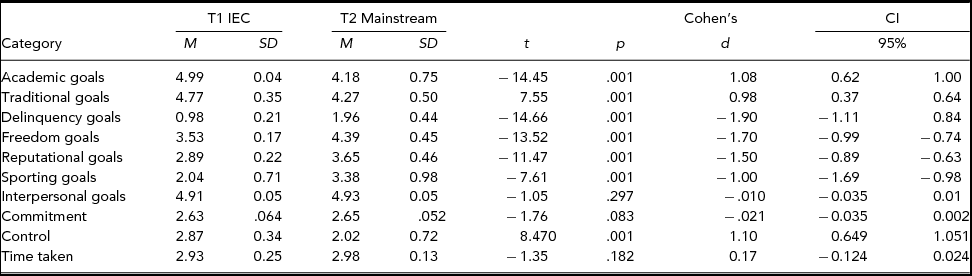
At T1 (IEC) 51 participants set Academic goals, but at T2 (mainstream) this decreased to 24. Conversely, at T2 more participants set Social goals (n = 36) compared to T1 (n = 9). Table 1 shows the mean scores (and standard deviations) at T1 and T2 for the importance that participants attached to goals. Using a Bonferroni adjusted alpha level of <.0625, there were significant reductions from T1 to T2 in the importance attached to Academic goals and Traditional goals. There were also significant increases from T1 to T2 for Delinquent goals, Freedom goals, Reputational goals, and Sporting goals. There was no change for Interpersonal goals from T1 to T2.
Time 1 and Time 2 Observed Means, Standard Deviations, Effect Size and 95% Confidence Intervals for Importance of Goals, Commitment, Amount of Control and Time Taken to Achieve Goal Variables Showing Significant Change

Using Bonferroni adjusted alpha levels of <.01 there was no significant change from T1 to T2 for both goal commitment and time taken to achieve goal. There was, however, a significant reduction from T1 to T2 in the amount of control participants reported having over achieving their main goal (see Table 1).
Self-Reported Delinquency and Aggression
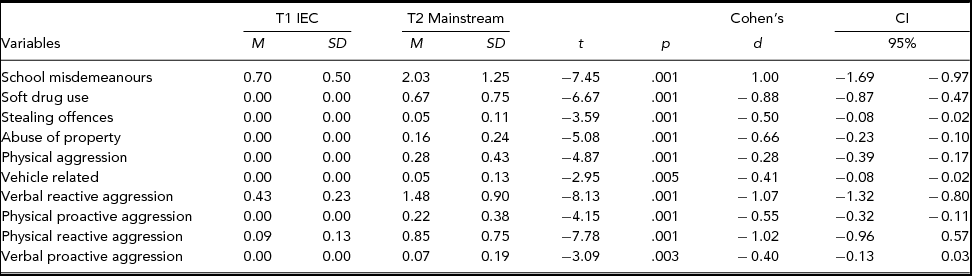
The mean and standard deviations, levels of significance, Cohen's d, and 95% CI for self-reported delinquency (Bonferroni adjusted alpha level of <.007) and aggression (Bonferroni adjusted alpha level of <.0125) are shown in Table 2.
Time 1 and Time 2 Observed Means, Standard Deviations, Effect Size and 95% Confidence Intervals for the Delinquency and Aggression Variables Showing Significant Change
There are many reasons to examine aggression and delinquency separately. Specifically, they show interrelated, but differential developmental paths; and differences in correlates of aggressive and delinquent behaviours have been reported for a number of variables (van der Voort, Linting, Juffer, Bakermans-Kranenburg, & van IJzendoorn, Reference van der Voort, Linting, Juffer, Bakermans-Kranenburg and van IJzendoorn2013). Furthermore, aggression is not a unitary term, and differentiating not only between physical and verbal forms of aggression but also the proactive or reactive nature of these is important because they show different associations with several theoretically important variables (Marsee & Frick, Reference Marsee and Frick2007). Moreover, according to Moffitt (Reference Moffitt1993) specific forms of aggression are associated with severe forms of delinquent behaviour, which further supports their separation.
There were statistically significant increases in six of the seven delinquent activities from T1 to T2. There was no significant difference for hard drug use from T1 (M = 0.00, SD = 0.00) to Time 2 (M = 0.00, SD = 0.00).
For aggression there were statistically significant increases from T1 to T2 in all four types of aggression.
Reputation Enhancement
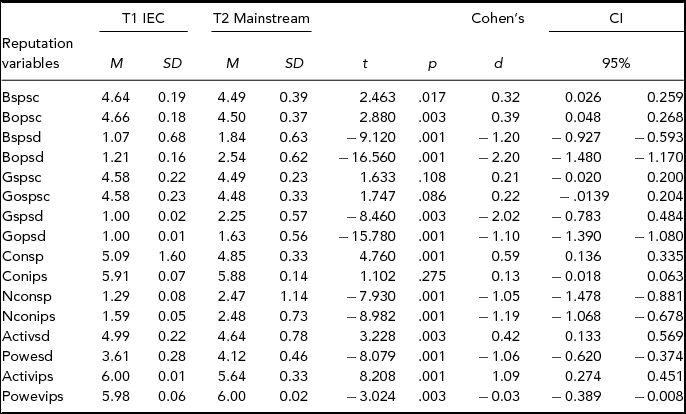
A Bonferroni adjusted alpha level of <.003 was used for the Reputational variables. As shown in Table 3 for Social desirability (i.e., admiration of law-abiding and law-breaking activities) there was a significant reduction from T1 to T2 in the law-abiding variable of Boys’ evaluative reactions to others social conformity (Bopsc). There were also significant increases in the law breaking variables of Boys’ self-perceived social deviance (Bspsd), Boys’ evaluative reactions to others social deviance (Bopsd), Girls’ self-perceived social deviance (Gspsd), and Girls’ evaluative reactions to others social deviance (Gopsd). There were no significant changes from T1 to T2 for the law-abiding variables of Boys’ self-perceived social conformity (Bspsc), Girls’ self-perceived social conformity (Gspsc), and Girls’ evaluative reactions to others social conformity (Gospc).
Time 1 and Time 2 Observed Means, Standard Deviations, Effect Size and 95% Confidence Intervals for the Reputation Enhancement Variables Showing Significant Change
Note: Bspsc: Boys’ self-perceived social conformity; Bopsc: Boys’ evaluative reactions to others social conformity; Bspsd: Boys’ self-perceived social deviance; Bopsd: Boys’ evaluative reactions to others social deviance; Gspsc: Girls’ self-perceived social conformity; Gospc: Girls’ evaluative reactions to others social conformity; Gspsd: Girls’ self-perceived social deviance; Gopsd: Girls’ evaluative reactions to others social deviance; Consp: Conforming self-perception; Conips: Conforming ideal public self; Nconsp: Nonconforming self-perception; Nconips: Nonconforming ideal public self; Activsd: Activity self-description; Powesd: Power/evaluation self-description; Activips: Activity ideal private self; Powevips: Power/evaluation ideal private self.
For Social identity (i.e., participants’ self-perception and how they would ideally like others to view them) there was a significant reduction from Time 1 to Time 2 in Conforming self-perception (Consp). There was no significant change in Conforming ideal public self (Conips). There were statistically significant increases from T1 to T2 in Non-conforming self-perception (Nconsp) and Non-conforming ideal public self (Nconips).
For Self-identity (how participants describe themselves and how they would ideally like to be described in terms of power and activity) there were significant reductions from T1 to T2 in Activity self-description (Activsd) and Activity ideal private self (Activips). There were also statistically significant increases in Power/evaluation self-description (Powesd) and Power/evaluation ideal private self (Powevips).
School and Teacher Connectedness
A Bonferroni adjusted alpha level of <.025 was used for School and Teacher Connectedness. There were statistically significant reductions in both types of connectedness from T1 to T2: School connectedness M = 3.0, SD = 0.01 to M = 2.19, SD = 0.7, t 9.355, p = .001, Cohen's d = 1.20, 95% CI (.587, .906); and Teacher connectedness M = 2.84, SD = 0.17 to M = 2.09, SD = 0.58, t 9.837, p = .001, Cohen's d = 1.27, 95% CI (.781, 1.180).
Discussion
The difficulty with this present study is that to date there appears to be no other study with which meaningful comparisons can be made. This is somewhat surprising because it is now more than 8 years since Brown et al. (Reference Brown, Miller and Mitchell2006) raised the important question of what happens to adolescent students from African refugee backgrounds when they are placed in mainstream classrooms. The present study can provide some answers to Brown et al’s. (Reference Brown, Miller and Mitchell2006) question. In summary, it appears that following transition into mainstream classes from the relative stability of an IEC, they modify the goals they set (from academic to social), remain just as committed towards achieving them, but believe they have less control over attaining them. Furthermore, in line with these goals, they seek to attain a non-conforming reputation and correspondingly become more involved in delinquent activity and aggressive behaviour. Around the same time, levels of connectedness to teachers and school (known protective factors: Whitlock, Reference Whitlock2006) decrease.
The research evidence demonstrating the relationships that exist among reputation, goal setting, and delinquent behaviour in adolescents is extensive (Emler & Reicher, Reference Emler and Reicher1995; Oyserman & Saltz, Reference Oyserman and Saltz1993). Reputation Enhancement Theory (Emler, Reference Emler, Maher and Maher1984) posits that individuals choose a particular self-image they wish to promote before an audience of their peers, and this audience then provides feedback so that the individual develops and maintains this social identity within a community (Carroll et al., Reference Carroll, Houghton, Durkin, Hattie and Levesque2012). The African adolescent students in the present study initially (during their time in the IEC), placed a high priority on academic goals. This was also a finding of Cassity and Gow (Reference Cassity and Gow2005). However, once transitioned to mainstream schooling (T2), social goals assumed greater importance. Furthermore, these goals were primarily non-conforming in nature. The research evidence is clear that at-risk and delinquent adolescents attach greater importance to delinquency and freedom/autonomy goals, goals associated with law-breaking activities, exemption from adult control, and independence. These goals are more related to attaining a social image (Carroll et al., Reference Carroll, Durkin, Hattie and Houghton1997). Therefore, it may be that these African adolescents are in a state of transitory disaffection with school — a time when goals become more aligned to aspects of psychosocial motivation (delinquent, freedom, reputation) and assume much greater importance in their lives (Carroll et al., Reference Carroll, Houghton, Durkin and Hattie2009). Indeed, delinquent activities are a social mechanism through which individuals attain a specific reputation (Buelga et al., Reference Buelga, Musitu, Murgui, Pons and Howard2008; Carroll et al., Reference Carroll, Houghton, Durkin, Hattie and Levesque2012; Emler, Reference Emler, Maher and Maher1984; Emler & Reicher, Reference Emler and Reicher1995).
There is also extensive research showing that the goals which adolescents set are motivated by the desire to present the self to the peer community in a particular way (Emler & Reicher, Reference Emler and Reicher1995; Piehler & Dishion, Reference Piehler and Dishion2007; Toro, Urberg, & Heinze, Reference Toro, Urberg and Heinze2004). Kerpelman and Smith-Adcock (Reference Kerpelman and Smith-Adcock2005) demonstrated reputation enhancement to be a strong and direct predictor of delinquent activities. In IEC (T1) the adolescents reported that they openly admired law-abiding activities and those who were involved in them and wished to be perceived in this way by their peers. They also wished to be perceived as powerful, kind, friendly, hardworking and as a leader. On transition to mainstream schooling (T2), however, these same adolescents still wished to be socially conforming, but now also admired socially deviant or delinquent activities and those involved in them, and wished to be seen in this way themselves. If individuals wish to claim a delinquent identity, they must be seen to break rules and regulations and become deliberately non-conforming (Hopkins & Emler, Reference Hopkins, Emler and Hurrelmann1990). In line with this, the adolescents in this study reported greater involvement in delinquent and aggressive behaviours. Thus, as previous research with adolescents has shown, reputations play a central role in the lives of adolescents, whether in conformity or crime (Buelga et al., Reference Buelga, Musitu, Murgui, Pons and Howard2008; Carroll et al., Reference Carroll, Houghton, Durkin and Hattie2009; Kerpelman & Smith-Adcock, Reference Kerpelman and Smith-Adcock2005; Lopez-Romero & Romero, Reference Lopez-Romero and Romero2010).
School is an ideal context for young people to attain a non-conforming reputation (Houghton & Carroll, Reference Houghton and Carroll1996) because there is an increased and routine contact with like-minded peers and it is this contact that provides the necessary audience by which to enhance a non-conforming reputation (Reicher & Emler, Reference Reicher, Emler and Beloff1986). Not only did these individuals experience movement to a big school, and also from parent to peer relationships (which helps to explain why there is a steep rise in delinquency at this time: Emler, Reference Emler, Maher and Maher1984), but they also had to contend with the additional movement from IEC to mainstream schooling. This latter movement provided additional opportunities for contact with a wider audience. This point is tentatively supported by the reported reduction in connectedness with teachers and school that the adolescents reported. There is little doubt that transition from a specialist provision to that of mainstream schooling is fraught with difficulties, both from the perspective of students aforedescribed in this study, but also from that of teaching staff. The latter group is increasingly tasked with supporting an increasingly diverse student population with, on many occasions in public schooling, a lack of resources to adequately perform this role. A recent study (Boyle, Topping, Jindal-Snape, & Norwich, Reference Boyle, Topping, Jindal-Snape and Norwich2012) demonstrated that peer support among staff was the most important factor for teachers working in an inclusive mainstream environment. If teachers are adequately resourced or at least supported in working with recently transitioned IEC students, then the more negative behaviours may be countered and they can provide better student outcomes.
Adolescents at-risk of or involved in delinquency have higher levels of aggression (Fabrega, Ulrich, & Loeber, Reference Fabrega, Ulrich and Loeber1996) and are more likely to be proactively aggressive (Pulkkinen, Reference Pulkkinen1996) as their peer audience endorses it (Emler, Reference Emler, Maher and Maher1984). The adolescents in the present study self-reported significant increases in all four aspects of their proactive and reactive aggression. It may be, as argued by Emler and Reicher (Reference Emler and Reicher1995), that this non-conforming reputation characterised by delinquent and aggressive acts that adolescents actively seek to attain is a deliberate strategy of self-protection and redress for the individual and for the group; hence, the overt and proactive nature of the aggressive behaviour.
It must be acknowledged that the first data collection point was at entry to the IEC and the second point was 6 months after entry to mainstream classes, and therefore a degree of caution in the interpretation of the findings is warranted. It may be that the students changed their goals (even multiple times) within the IEC and subsequently again after the transition to mainstream classes. Indeed, access to the formalised education structure in the IEC may have been the motivating factor for change, especially given that they were in the IEC for 2 years and mainstream for only 6 months between data collections. However, in a series of follow-up interviews with six of the participants, the first author gathered further information pertaining to this vexing issue. The evidence suggests that transition to mainstream classes played a major part in any change, rather than time spent in the IEC. For example, as one 15-year-old male stated about his academic goals:
In the IEC you have a lot of confidence in learning. The teachers are very helpful; they encourage you and understand you so you feel like you can achieve those goals. But in mainstream it is hard. You realise how behind you are and you get much less help so those goals aren't so important anymore because you don't think that you can achieve them.
Similarly, a 15-year-old female student said her academic goals changed in mainstream because: ‘The hard work (in mainstream) makes you think that becoming a doctor/lawyer is pretty impossible unless you are really, really smart and get very good grades.’
The participants also recounted how transition to mainstream had made them rethink and change the goals associated with the type of reputation they wished to attain. As one 15-year-old male participant stated:
It is important to look and act cool in mainstream. Cool means that you act confident and you can stand up for yourself. If you don't act cool then people will pick on you and you won't be respected.
That these changes occur highlights the need for further research to determine why they occur. Future research should strive, however, to conduct multiple assessments of adolescent students from African refugee backgrounds at different times during their IEC experience so that any changes that do occur can be more specifically pinpointed. While empirical research such as that conducted is important, a qualitative approach can also provide opportunities to gather detailed accounts about the significance of reputation and the role of school connectedness in the everyday lives of students from African refugee backgrounds. Owens, Shute, and Slee (Reference Owens, Shute and Slee2000) argued that qualitative studies are particularly well placed to elicit rich and unique detail about issues relating to students’ non-conforming activities. Moreover, obtaining accounts from the participants themselves is particularly useful in informing prevention and early intervention (see Carroll et al., Reference Carroll, Houghton, Hattie and Durkin2009).
In conclusion, adolescent students from African refugee backgrounds set academic conforming goals in order to pursue a conforming reputation on entry to an IEC. Following transition to mainstream schooling, however, it transpires that a non-conforming reputation becomes a more desired alternative identity for many of these individuals. The goals which these individuals then set themselves and the manner in which they engage in behaviours (public or private) to attain these goals allows them to develop this reputation of choice. That connectedness to school and teachers decreases on entry to mainstream schooling may be a crucial finding because connectedness is known to be a protective factor. Therefore, future research that develops connectedness to school and teachers by showing adolescent students from African refugee backgrounds how to focus on their day-to-day choices and then provides feedback on these choices might be a valuable element in preventing the shift from conformity to non-conformity in a particularly vulnerable population.
Financial Support
This research received no specific grant from any funding agency, commercial or not-for-profit sectors.
Conflict of Interest
None.
Ethical Standards
The authors assert that all procedures contributing to this work comply with the ethical standards of the relevant national and institutional committees on human experimentation and with the Helsinki Declaration of 1975, as revised in 2008.