

1 Introduction
Despite the interest of the early European settlers, commercial wine production in the New World only developed in the late 19th century in response to growing urban demand, improved transportation and new winemaking technologies. By 1914, the industry was well established in a number of countries, and contemporaries noted that it had developed very differently from the situation in the Old World. In particular, the new large-scale wineries were dependent in a way that was not the case in Europe on specialist grape producers. Wine producers were much more involved in marketing, and wines were often sold under brand names. Important differences also existed among New World producers themselves, especially with respect to the marketing and distribution of wine. In California, a handful of large San Francisco merchants cornered the market and created a hierarchical organization, integrating horizontally and vertically and investing heavily in advertising and brands to sell to the East Coast merchants directly. This producers’ organization, the California Wine Association, controlled at one time about 80 per cent of the State's wine sales, making it one of the world's largest wine businesses. By contrast, a British importer, Peter Burgoyne, created a buyer's organization that distributed two-thirds of Australian exports, and attempts by the South Australian government to create a state-led marketing board in London had only limited success. Although the Argentine industry was dominated by a dozen or so wine-makers, they suffered from weak brands as the Italian and Spanish immigrants were much less interested in quality than low prices. These firms, however, sold huge quantities of wine in a market where annual per capita consumption reached 60 litres by 1914, compared with just 2 litres in the United States and five in Australia.
This paper argues that the nature of demand was crucial in explaining the organization of the commodity chain and, with the exception of Australia, this was limited to the domestic market. Section 1 looks at some of the different theories to explain why firms integrate vertically rather than rely on market transactions and the nature and degree of asset specificity found in the wine industry. The next section shows how exogenous changes in the period between 1870 and 1914 changed traditional viti-viniculture and encouraged its rapid growth in the New World. The excellent grape growing conditions led to the appearance of specialist growers in the region, which, together with the growing economies of scale found in winemaking, changed the relative asset specificity of the vineyard and winery. The differences within the New World itself are then explained in the rest of the article. Sections 3 and 4 look at California and Australia, where beer and spirits were more popular among consumers than wine, and section 5 looks at Argentina, which enjoyed New World production conditions and a market with southern European consumer habits.
2 From the Vine to the Glass: Wine's Value Chain
A number of distinct business activities were involved in the creation and sale of wines. Land had to be cleared, vineyards planted and growers had to wait 3 or 4 years before the first harvest. Grapes then had to be collected, crushed and the must fermented. The wines were then usually matured, blended and classified for sale and, when production took place at a distance from where they were to be consumed, transportation and distribution networks were also required.
These different activities made up the «value chain», but the wide diversity of wines produced could result in them being carried out by five or six separate business entities or being integrated into just one or two firms. This paper deals with cheap wines, especially beverage wines (vino común), which, in areas where wine consumption was an integral part of the national diet, such as Argentina, Italy, France or Spain, accounted for at least 90 per cent of production. It ignores the highly specific chains associated with fine table wines such as claret or champagneFootnote 1. The production of vino común was organized very differently across countries. In Europe, grape growing and winemaking was integrated in a single, small family business, and marketing was carried out by merchants. In the New World, by contrast, grape production was a specialist activity, but winemaking and marketing were often integrated in the same firm.
In his classic article, Robert Coase explained organizational differences using what has become known as the transaction cost theory. For Coase, firms exist because the cost of organizing production for the entrepreneur is less than the cost of using the market mechanism (Coase Reference Coase1937; Holmström and Roberts Reference Holmström and Roberts1998, p. 73). The transaction costs associated with using the market relate to problems of information and commitment and, according to Holmström and Roberts (Reference Holmström and Roberts1998, p. 74), «the most influential work during the last two decades on why firms exist, and what determines their boundaries, has been centered on what has come to be known as the «hold-up problem»». This occurs when assets are highly specific and trading partners attempt «to appropriate some of the returns that the assets’ owners expected when they invested in them» (Roberts Reference Roberts2004, p. 91). Vertical integration is predicted to be more likely «when assets are specific, when transactions are complex, and uncertainty is important» (Lafontaine and Slade Reference Lafontaine and Slade2007, p. 653)Footnote 2. Three assets in particular are important for this paper: the vines, the winery and the brand names under which the wine was sold. This led to three areas where activities were either fully integrated or required vertical coordination (or «co-operation» as contemporaries called it): the link between the grape grower and wine-maker; that between the wine-maker and wholesalers; and finally in Australia between the exporter and (British) importer.
The development of commercial wine production in the New World from the 1890s presented small family growers with a major dilemma: whether to specialize in grape production with its associate dependence on the wine-maker, or to invest themselves in winemaking facilities, despite the increasing barriers to entry associated with the capital and knowledge requirements embodied in the new technologies. The possession of small private wineries offered growers some independence, but they faced both higher production costs and produced poorer quality wines than the new commercial wineries. These new wineries had a much larger capacity than the traditional ones and required grapes from the equivalent of perhaps twenty or thirty times what a family vine-grower could produce, presenting their owners with a strategic decision as to whether to integrate backwards into grape production or purchase from independent suppliers.
Selling wines required other organizational decisions. In the first instance, New World producers were located far from a number of their major markets: the East Coast for California; the British market for Australia; and Buenos Aires for Mendoza. Second, in the first two countries, consumers were often unacquainted with wine, and producers had to compete with other alcoholic beverages. Finally, the widespread adulteration and fraudulent labelling of food and beverages in the late 19th century was especially common with wine, which created considerable information asymmetries along the chain.
The question of who controlled and benefited from the value created varied according to the type of wine and the nature of the commodity chain. At one extreme, power in the value chains could be concentrated at two very different points (Gereffi Reference Gereffi1994, p. 104). In agriculture, there are often literally millions of producers, with production carried out in many countries, making it easier for importers to dominate the trade by creating standardized products and investing in branding and marketing. By the late 19th century, a few very large companies dominated a number of food and beverage buyer-driven commodity chains in the British and U.S. markets (Heinz, Quaker Oats, Cadbury, etc.)Footnote 3. By contrast, producer-driven chains are controlled by core firms «at the point of production» and include such products as aircrafts and computers. Producer-driven chains are unusual with agricultural commodities, although the limited supply of top-quality land and high production costs created barriers that allowed a highly specialized producer such as Moët & Chandon to control its chain.
In fact, fine wines in 19th century Europe were branded in a wide variety of ways, including that of the producer (e.g. Château Margaux), the shipper (Sandeman) or the retailer (Victoria Wine Company in the United Kingdom). By contrast, the major differences in quality found over relatively small geographical areas and from one harvest to the next made it almost impossible to create brands to sell cheap table wine in Europe. Instead, it was the retailer's reputation that determined consumer choice. In the New World, however, the much greater homogeneity of grape quality and the new winemaking technologies allowed, in theory, fully fermented quality table wines with similar characteristics to be consistently produced each year in large geographical areas, thus making the branding of ordinary table wines a realistic possibility. Who put the brand and controlled the value chain is discussed in sections 3-5 below.
3 Grape Growing and Winemaking: A Tale of Two Worlds
In the mid-19th century, the wine industry in both Europe and the New World was small scale. By 1914, this was still generally true for Europe but not so in the New World where large industrial wine producers dominated the sector. Four major exogenous events changed the industry during this half century: the integration of national and, to a lesser extent, international markets; the development of new political institutions and the ability of some pressure groups to solve collective action problems and mobilize political power; the appearance of new vine diseases and the production shortages they created; and advances in the knowledge of fermentation processes and development of winemaking equipment that produced economies of scale and allowed cheap table wines to be produced in hot climates. After discussing how each event influenced the business environment, the organization and growth of the New World industry is considered in detail.
Arthur Young (Reference Young1794, pp. 2, 25) noted for France in the late 1780s that the cultivation of the vine depended «almost entirely on manual labour…demanding no other capital than the possession of the land and a pair of arms; no carts, no ploughs, no cattle»Footnote 4. Vines were almost always worked by their owners, as entry costs were low, there were few economies of scale and the vine could be grown competitively on small plots of land marginal to other crops. Wage labour was rarely used because output was very sensitive to the quality and timing of labour inputs, and vines could be easily and permanently damaged if the pruning, plowing and hoeing operations were badly carried out (Galassi Reference Galassi1992, pp. 78-83; Hoffman Reference Hoffman1984)Footnote 5.
In Europe, the weather, pests and vine diseases influenced the size and quality of the harvest, especially in the colder and damper areas of the north. Wine was abundant and excellent one year but scarce or undrinkable the next. Grapes had to be processed quickly because they were easily damaged or diseased, and therefore family growers also made their own wine. Furthermore, although «fine» wines might improve with age, the great majority of table wines had a very short «shelf» life. Those that had been poorly made or stored quickly become diseased and undrinkable. In France, during the second half of the 19th century, there were reportedly 1.5 million growers, but most families dedicated part of their labour and land to other activities because of the risky nature of production.
The demand constraints placed on the industry were significantly reduced during the second half of the 19th century by a combination of cheap transport, urbanization and rising incomes. Railways helped push Europe's wine frontier southwards and allowed growers to specialize in the Midi (France), La Mancha (Spain) and Puglia (Italy), regions long known to contemporaries as being especially suitable for the vine. In France, for example, rising living standards led to consumption per capita increasing from 76 litres in 1850-1854 to 108 litres in 1890-1894 and reaching 168 litres in 1900-1904 (Nourrisson Reference Nourrisson1990, p. 321). As the distance between the producer and consumer increased, so did the economic power of the merchants, who were able to purchase their wines over an increasingly large area. However, the nature of political institutions and the political voice of thousands of small producers also changed and, in France, this enabled them to achieve favourable legislation to establish cooperatives and regional appellations, helping producers to wrest back some of the market power from the merchants (Simpson Reference Simpson2005).
The growth in French consumption was all the more impressive because of the devastation wrought by the vine disease phylloxera, which in time killed most of the world's vines. The only permanent solution involved replanting and grafting European varieties on phylloxera-resistant American rootstockFootnote 6. During the 19th century, France was the country worst affected, and output fell from an average of 57.4 million hectolitres in 1863-1875, to 31.7 million in 1879-1892, before recovering to 52.5 million in 1899-1913. These phylloxera-induced shortages caused higher international wine prices and encouraged growers everywhere to plant vines and increase outputFootnote 7.
Although phylloxera and other vine diseases forced governments to increase expenditure on scientific research, the advances in winemaking were as spectacular as anything achieved in the vineyardsFootnote 8. In hot climates, fermentation had often ended prematurely, leaving sugar in the wines that made them unstable and ruining them. In 1887, Paul Brame successfully devised a system to reduce the temperature by pumping the must through tubes which were immersed in water. The last decade of the 19th century and the first of the 20th saw major investment in new wineries in hot climates incorporating the latest technologies such as refrigeration, continuous presses, aero-crushing turbines, sterilizers and pasteurizers, which helped create economies of scale in a number of important areasFootnote 9. First, considerable skills were required to control the temperature of the must during fermentation, correct its acidity and use cultivated yeasts to produce a dry table wine which would keep. Second, new winemaking technologies and cellar designs helped cut labour costs, an important consideration in high-wage economies such as those found in the New World. Third, more wine was extracted from the grapes. Fourth, merchants demanded large quantities of wines of uniform style that could be repeated each year, which was impossible for small producers to achieve. Finally, some of the large wineries diversified into distilling and the production of brandy and fortified wines where the economies of scale were even greater.
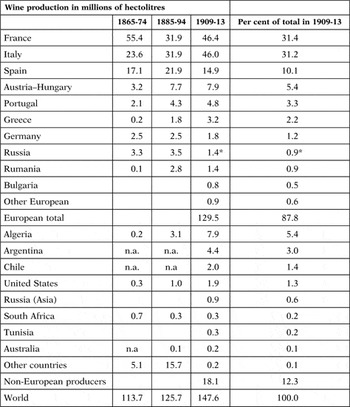
These new winemaking technologies led to a shift in the locus of production of cheap table wines from Europe's centre to its southern periphery. In particular, France's four Midi departments (Aude, Gard, Hérault and Pyrenees Orientales) and Algeria saw their output increase from the equivalent of less than 15 per cent of domestic consumption in the 1820s to 50 per cent by 1910Footnote 10. The new technology was also crucial for the expansion of New World viticulture. In California, wine production increased fourfold between 1891-1893 and 1911-1914, and in Mendoza the area of vines increased from 22,875 hectares in 1904 to 57,764 in 1912, and output jumped fourfold in the decade after 1904 (Table 1). By contrast, in Australia the new technologies helped capture new export markets rather than increase output (Osmond and Anderson Reference Osmond and Anderson1998, p. 41).
LEADING WINE PRODUCING COUNTRIES BEFORE 1914

*Refers to European Russia.
Sources: 1865-74 and 1885-94, Morilla Critz (Reference Morilla Critz1995, p. 303); 1909-13 International Institute de Agriculture: 1913 and 1914 (1915, pp. 110-111); and Mitchell (1995, p. 240). Except Portugal, Lains and Sousa (Reference Lains and Sousa1998, p. 965); Argentina, Boletín del Centro Vitivinícola, various issues and Barrio de Villanueva (Reference Barrio de Villanueva2009, p. 10); Australia, Osmond and Anderson (Reference Osmond and Anderson1998), Table 1; United States: Shear and Pearce (Reference Shear and Pearce1934; Table 10).
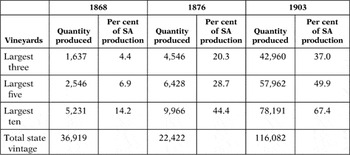
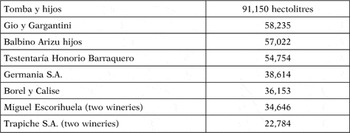
The new wineries required large quantities of grapes and offered the greatest returns to producers in hot climates, which explains why they were rare in much of Europe. As late as 1934, some 86.5 per cent of all French wine production outside the Midi was still found in wineries producing less than 400 hectolitres, a quantity that could be supplied from many family vineyards (Galet Reference Galet2004, calculated in Simpson, forthcoming). By contrast, in the New World, and to a lesser extent in Algeria and some parts of the Midi, large wineries dominated production by the early 20th centuryFootnote 11. Some of the New World wineries had a considerably greater capacity than 10,000 hectolitres. In Mendoza, the ten largest firms produced 445,000 hectolitres or a third of the output, while in South Australia the figure was more than two-thirds, although this was a relatively modest 78,000 hectolitres (Tables 2 and 3)Footnote 12. In Mendoza, the number of firms producing more than 10,000 hectolitres jumped from 18 to 96 between 1900 and 1914 when the three largest firms produced 350,000 hectolitres, requiring grapes from about 6,000 hectares (Barrio de Villanueva Reference Barrio de Villanueva2009, pp. 5-7)Footnote 13. In California, the Italian Swiss Company (owned by the California Wine Association) produced 225,000 hectolitres from eight different wineries in 1911, while the California Wine Association's huge «Winehaven» complex in Richmond had storage for 378,000 hectolitres (equivalent to about 25 per cent of California's output), and it had wine-manufacturing facilities for 140,000 hectolitresFootnote 14.
LEADING WINE-MAKERS IN SOUTH AUSTRALIA, 1868, 1876 and 1903

SA, South Australia.
Quantities in hectoliters.
Sources: Bell (Reference Bell1993; Table 3) and Whitington (Reference Whitington1903, p. 71).
LEADING WINERIES IN MENDOZA, 1903

Source: Diario El Comerico (October 27, 1903, p. 2) cited in Barrio de Villanueva (Reference Barrio de Villanueva2008a, cuadro 1).
There were few economies of scale to be exploited with grape growing, and therefore family producers remained competitive everywhere. However, while in the Old World grape and wine production remained integrated, in the New World they were often specialist activities by 1900Footnote 15. In California, the Pacific Wine and Spirits Review noted that most growers sold their grapes to wine-makers, «except to a limited extent in some of the older districts», whereas previously nearly every vineyard had had its own fermenting house and storage cellar. Thomas Hardy, a leading producer in South Australia, wrote as early as 1882 that «the manufacture of wine is now almost wholly gone into the hands of those who make a business of it, and do not follow it merely as a secondary pursuit»Footnote 16, while in Mendoza producers bought around three-fifths of their needs from specialist grape growers by 1908 (Centro Vitivinícola Nacional 1910, p. 17).
These organizational differences between Europe and the New World can be explained by the nature of and the changes in the asset specificity of vineyards and wineries. In Europe, grapes had to be processed very quickly, especially if they were diseased, and growers could not risk having to find buyers at short notice. By contrast, in the New World climatic conditions made the vines much easier to grow, harvest failures and disease were rare, and the grapes were of a consistent quality with high levels of sugarFootnote 17. Growers in California and Australia sometimes produced the «three way» grape, allowing them to decide after the harvest whether to sell them for wine, raisins or the table, while in Argentina growers could leave their grapes on the vines for 3 or 4 months before selling them (Pacottet Reference Pacottet1911, p. 78).
This suggests that specialist grape growers in the New World were less vulnerable than winery owners to problems of hold-up, despite the fact that the latter frequently colluded to set prices. This was especially true in Australia and California because of the better quality wines they produced, as wine-makers needed a guaranteed supply of adequate grapes when markets recovered. Possibilities of exit were also easier to growers than to wine-makers, as alternative and often attractive employment opportunities were available nearby in the large, diverse economies of San Francisco and Melbourne. Mendoza, by contrast, was a thousand kilometres from Buenos Aires, but the growers here benefited from significantly greater yields because of irrigation, and market downturns, at least prior to 1914, were short so that many growers carried low levels of debtFootnote 18.
The separation of grape growing and winemaking nevertheless created new coordination problems. Market volatility was common in all wine regions because if high prices encouraged the planting of new vineyards, market conditions might be very different when these became productive 3 or 4 years later. The high fixed costs along the commodity chain implied that grape prices in Mendoza, for example, could double or halve from one harvest to the next, while wine prices in Buenos Aires fluctuated much less (La Prensa, 12 abril 1914, p. 11). The fact that grape production and winemaking were usually integrated in a single business in Europe resulted in producers expanding capacity in both areas in response to market upturns. In the New World, growers and winery owners faced different investment incentives. The creation of new vineyards required relatively little capital and smallholders could plant vines working during periods of low seasonal demand for wage labour. By contrast, the high capital cost of the new wineries implied that investment was linked to credit availability. This separate ownership of vines and winemaking facilities often led to unbalanced growth between the two sectors, because if large wineries failed to purchase grapes from independent producers because of low prices, growers could crush them themselves so that aggregate wine supply was not diminished, although quality dropped. Therefore, the new capital-intensive wineries required not just a secure supply of grapes, but also a market for their wines.
Another major problem was fraud. Fraud had always been present in food and beverage markets, but it changed significantly over the second half of the 19th century because of the growing physical separation between producers and consumers and the development of new preservatives that allowed manufacturers to mask food deterioration and lower costs, often making food adulteration imperceptible to consumers. As Marc Law and Gary Libecap note (Reference Law and Libecap2006, p. 321), science increased the complexity of products and «created opportunities for cost-saving deception by some firms through adulteration of their products in ways that consumers could not easily perceive». Firms were naturally reluctant to invest capital in state-of-the-art winemaking facilities, brand names and advertising if they were going to have to compete with «wines» made from a variety of concoctions and sold in «fancy bottles» at considerably lower prices.
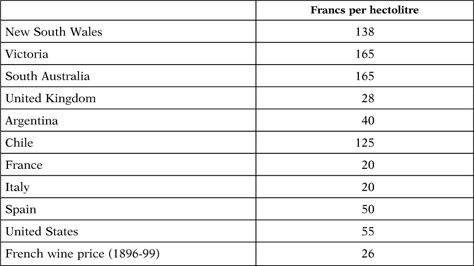
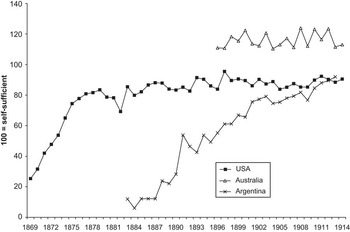
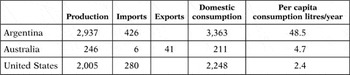
Finally, although the flow of ideas and technology across national borders was increasing in 1900, international wine trade was limited, especially after French growers replanted after phylloxera. As Table 4 shows, tariffs everywhere were high compared with average wine prices in France because taxes on all types of alcohol were a major part of national (and often local) revenue. Most countries preferred to use excise taxes on domestic output rather than encourage imports to provide these revenues, which would also have led to greater competition for domestic producers of alcoholic beverages. The new industries in both Argentina and California were therefore able to benefit significantly from import substitution, although this was not the case in Australia where domestic demand for wine was always very small (Figure 1 and Table 5).
LEVEL OF TARIFFS ON WINE IMPORTS, 1898
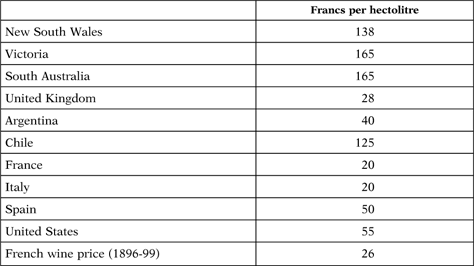
Figures are for ordinary red wine. The French figure ranges from 12 francs for wines of up to 10 degrees alcohol, to 20 francs for those of 15 degrees.
Sources: Cocks and Féret (Reference Cocks and Féret1898, pp. 775-784); for France: Sempé (Reference Sempé1898, p. 196) and France annuaire 1938 (1939, pp. 62-63).
IMPORT SUBSTITUTION AND SELF-SUFFICIENCY IN WINE
Notes: >100, Countries export more than they import; <100, they import more.
Sources: see Table 5.

DOMESTIC PRODUCTION, TRADE AND CONSUMPTION, 1909-13

Figures in thousands of hectolitres, except per capita consumption.
Sources: Argentina and Australia (Table 1); California, Shear and Pearce (Reference Shear and Pearce1934; Table 6).
4 California
There were four major players in the Californian wine industry in the late 19th century: grape producers, wine-makers, San Francisco shippers and the East Coast bottlers and distributorsFootnote 19. The rapid growth of the national market demanded coordination between businesses so that the high levels of capital investment in vineyards and winemaking equipment were not left idle. Faced with falling prices and widespread adulteration of wines, the small wine makers established the California Wine-Makers Corporation (CWMC) in 1894 which entered into a 5-year agreement to sell their wine to the California Wine Association (CWA), another combine created in the same year by the leading West Coast wine dealers. By 1897, the CWMC represented 80 per cent of California's wine-producers while the CWA had 80 per cent of the wine (Peninou and Unzelman Reference Peninou and Unzelman2000, p. 79). However, post-contractual opportunistic behaviour led to a «wine war» between the two organizations, with the CWA supposedly refusing to pay the prices previously agreed and the CWMA selling large quantities of wine directly to a New York merchant rather than through the San Francisco merchants in violation of its contract. After its legal defeat in 1899, the CWMC disappeared, leaving the field to the CWAFootnote 20. According to a recent study, between 1894 and Prohibition the CWA would «cultivate more vineyard acreage, crush more grapes annually, operate more wineries, make more wine and have a greater wine storage capacity than any other wine concern in the world» (Peninou and Unzelman Reference Peninou and Unzelman2000, p. 33)Footnote 21. This was horizontal consolidation and vertical integration — from grape growing to distribution — on a massive scale and led André Simon (Reference Simon1919, p. 105) to write that «in the old world, winemaking is an art; in America, it is an industry».
Consolidations to escape price competition were common in the United States in the capital-intensive, mass-production industries in which «firms were closely matched and in which expansion had been rapid on the eve of the Panic of 1893» (Lamoreaux Reference Lamoreaux1985, pp. 45 and 87). The heterogeneity of wine makes the possibilities of collusion in the wine market difficult, but by integrating forwards and controlling distribution, the CWA was able to guarantee that the wine was not adulterated. This provided not only the necessary market stability for it to invest in brand names but also a guarantee for consumers that the wines were not adulteratedFootnote 22. The objective of the CWA was not to produce fine wines but to develop a mass market for stable and unadulterated ones, which it could sell to American consumers under the protection of high tariffs. As Amerine and Singleton (Reference Amerine and Singleton1976, p. 286) would later write, the company «never sold a bad bottle of wine», but neither did it sell a «great bottle». Percy Morgan, who for many years was the CWA's chairman, noted in 1917 that forward integration helped create new markets for California's wines:
Until the coming of the California Wine Association only a few wineries tried to deliver their original packages direct to the consumer and build up a following for their label. The large dealer almost always sold California wines in bulk to distant jobbers who either bottled them with a domestic or foreign label known to their particular localities, or sold them to retailers who pursued a similar course. Moreover, these distributors and retailers had neither the knowledge not the facilities to age and handle wines properly. Only a large firm with capital could select from millions of gallons, blend to standards, market under labels that could gain the confidence of the public, and stand back of the label wherever sold (cited in Peninou and Unzelman Reference Peninou and Unzelman2000, p. 125).
There is little doubt that the CWA used its market power to fix grape and wine prices, but the rapid growth in the industry between 1894 and 1914 also suggests that all sectors of the industry benefited. Indeed, family growers in California probably suffered less during the turbulent 1900s than any other wine-growing region in the world, and the CWA's dependence on them was recognized by Percy Morgan:
… it is not from these great tracts that the larger portion of the tonnage for wine purposes will be derived. It is from the small vineyardist, cultivating from ten to fifty acres (four to twenty hectares); cultivating and looking after his lands individually, and thereby obtaining from 30 per cent to 50 per cent more tonnage to the acre than is possible from the great vineyard tracts, that the very remunerative results will accrueFootnote 23.
In conclusion, the heavy investment by the CWA in production facilities and brands raised the entry costs for independent wine producers. Limited competition came from a handful of small independent wineries which began to specialize in fine wines in the Napa region, while at the other extreme San Francisco's Italian community sometimes preferred to buy grapes which they used to produce home-made wines, a practice which became even more important under Prohibition, when the area of vines actually doubled (Lapsley Reference Lapsley1996, pp. 67-68; Heintz Reference Heintz1990; Pinney Reference Pinney2005, p. 18)Footnote 24. Competition to the CWA came from the large breweries and distillers rather than from other wine producers. California's wine production increased by a factor of four between 1891-1893 and 1911-1994, but while dessert wine production multiplied ninefold, that of dry table wines rose by just a third (California State Agricultural Society 1915, p. 139). Dessert wines were less likely to deteriorate, whether left on retailers’ shelves or in consumers’ decanters, and because they were often sweet, found greater acceptance among North European immigrants. For the CWA, there were important economies of scale, especially in creating large batches of homogeneous wines to brand and fortifying wines using domestic grape brandy, which avoided the $1.10 a gallon brandy tax. This made fortified wines the cheapest form of alcohol in the market, allowing the CWA to distil their poorer wines profitably and compete with other alcoholic beverages (Seff and Cooney Reference Seff and Cooney1984, p. 418).
5 Australia
The Australian wine industry was the only one in the New World with an important export trade, accounting for about a fifth of national production in the period 1909-1913 and with virtually all being sold to the United Kingdom (Australian Vigneron, March 1902, p. 236). The high quality of these dry, unfortified red wines allowed them to be marketed using brand names, a feature virtually unknown among European producers of vin ordinaire. However, the quantity of wine involved was relatively small, peaking in 1902 at 4.5 million litres, equivalent to just half the output of Argentina's largest producer at this time.
In California, the high entry costs to marketing wines on the U.S. East Coast before Prohibition were reduced by the CWA, as a producer-led commodity chain. By contrast, it was a market-led chain which was created to sell Australian wines in LondonFootnote 25. Australia's high internal tariffs before Federation in 1901 made commercial producers look to the British market some 20,000 kilometres away, even though freight costs were approximately three times greater than those facing French exportersFootnote 26. In addition, the long sea voyage and the extremes in temperature meant that all wines, especially the young ones and those «that have not been thoroughly well made», underwent a «very considerable and detrimental change» (Australian Vigneron, July 1892, p. 47). Imported wines required several months’ rest on their arrival and faulty or young wines were often permanently ruined. These quality changes caused major problems for the trade. One prominent London West End merchant, who reportedly imported sixty hogsheads of South Australian wine because of its growing popularity, claimed it was so «ill-fermented» that he resolved never to import any more direct from Australia (Australian Vigneron, October 1893, p. 114). For this particular late 19th century market to work, trusted agents were required at both ends of the chain: in Australia to check that only well-made wines were shipped; and in London to determine the appropriate remedies to correct the wines on their arrival.
Trade was dominated by two major London houses that specialized in Australian wines: Walter Pownall, and in particular Peter Burgoyne, who claimed in 1900 that over the previous 30 years «fully 70 per cent of the wine exported from Australia to England had passed through his hands» (Australian Vigneron, September 1900, p. 115). In 1893, Burgoyne bought the Mount Ophir vineyard (Victoria), and investment in new wine-making facilities from the turn of the century led one commentator to report that «it would be difficult to find in any part of the world a winery in which California labor saving appliances and the most approved European methods of securing the best treatment of the wine are so completely adopted». Large quantities of grapes and wine were brought also from other producers to be blended to create a standard product that was exported after 19 months. Burgoyne's agents selected wines in Australia, while in London the firm had around 4500 hogsheads of wine in bond and a similar quantity at the Pelham Street premises in 1912. Wines were sold by the cask and the bottle using the Ophir (Burgoyne) and Emu (Pownall) brands. «Burgoyne's Australian Wine» placards were found «on every railway station in England», and the company claimed to have invested £300,000 in advertising. The chain was completed when, from the turn of the century, Burgoyne started a retail trade in Australia itself (Simpson forthcoming).
The rapid advances in these winemaking technologies, the stranglehold enjoyed by Burgoyne over the British market, the slow growth of the industry and the large quantity of poor wines still being producedFootnote 27 led to both the South Australian and Victorian governments holding parliamentary enquiries into how to organize the industry at the beginning of the 20th century. In particular, they discussed the potential advantages of establishing district cooperative wineries for small growers, «central cellars» in Adelaide and Melbourne to blend and create standard wine types, and a London depot to compete directly with Burgoyne. We shall look at each very briefly.
The separation of growing and winemaking activities was less apparent outside South AustraliaFootnote 28. In Victoria, production was small scale, and 2,382 growers cultivated just 1,123 hectares of vines in 1900, with just 72 holdings larger than 20 hectares (Victoria 1900, p. 5). Many of these growers had responded to the State incentives of a £5 bonus payment per hectare to plant vines, but their lack of wine-making skills and capital resulted in poor quality wines being produced. Growers planted vines but did not build cellars and attempts at creating four subsidized district wineries failed, largely because there were few incentives for growers to improve quality. These were not cooperatives where growers provided their own capital and took responsibility themselves for rejecting substandard grapes or wine, as was the case with the Danish dairy cooperatives at the time (Henriksen Reference Henriksen1999). However, while district wineries failed to encourage producers to improve product quality, their presence provided competition to private wine businesses that strongly opposed themFootnote 29.
The control of the British market by Burgoyne was also deeply resented by many, and as early as 1894, the South Australian government created a wine depot in London to provide an alternative outlet for domestic producers. The depot did not legally own the wines, so it could not blend them to create homogeneous products in sufficient volume to brand and instead had to match each individual shipment with a different purchaser. The depot's manager therefore entered into an agreement with a London merchant to sell the wine, which resulted in considerable opposition from Burgoyne and the London trade press and led to a trade boycott by merchants in the United KingdomFootnote 30. Although the depot claimed to have sold South Australian wine to over 4,000 customers by 1900, «including most of the best wholesale houses in London and the provinces, large wine merchants and grocers, as well as a number of high-class restaurants and clubs», and sales increased threefold over 5 years, these remained just a fifth of what Burgoyne handled (South Australia 1901, p. iii). Burgoyne responded to the debates over the depots in 1900 and 1901 by threatening to buy wines only after their arrival in London rather than in Australia, thereby passing more of the risk onto the domestic producers. The leading producers were forced to back down, the South Australia depot was wound up and Victoria's never established. In 1911, Burgoyne (2.7 million litres) and Pownall (750,000) still dominated exports from South Australia and Victoria, although the British retailer Gilbey (625,000) was now in a close thirdFootnote 31. Although just as in California, in the domestic market the large Australian producers became increasingly interested in dessert wines after 1900 because of the production and marketing advantages that they offered.
6 Argentina
The population of Argentina multiplied fivefold to eight million in the half century before 1914, with a high percentage being immigrants or their descendants originating from Italy, Spain or France. Many potential consumers, then, were already accustomed to drinking wine rather than beer or spirits. Growing conditions for grapes in Mendoza, which accounted for four-fifths of the nation's production in 1902-1903, were exceptional. Once the region had been connected by rail with Buenos Aires (1884) and wine-makers had learnt the art of fermenting their wines properly in the hot climate, the possibility of firms selling large quantities of good quality branded wines in a rapidly growing market appeared endless. With the exception of Algeria, Argentina's wine industry grew more and faster than anywhere else in the world between 1885 and 1914. Yet contemporaries found little to praise as the industry suffered two major recessions in a decade in the early 20th century. Wine quality remained poor and per capita wine consumption was less than half the figure found in France.
The 1901-1903 crisis highlighted a number of structural problems facing the industry. Most of the wine produced and consumed in Argentina was strong, young, coarse and inferior to those produced in Australia or CaliforniaFootnote 32. Pioneers of change, such as Eugene Hilgard or George Husmann in California, or Thomas Hardy and Arthur Perkins in South Australia, had no equivalents in Mendoza. However, just as in France, Italy or Spain, Argentina's producers were responding to a different type of market, one in which consumers’ preference was for strong, cheap wines. The industry was dominated by a dozen or two large firms at the time, with the Tomba winery being the largest producing 91,250 hectolitres (almost 7 per cent of Mendoza's total), and equivalent to approximately 1,500 hectares of vines in full production, followed by the Giol y Gargantini winery with 58,255 hectolitres, and Arizu with 57,022 hectolitres. The large wineries reacted to the collapse in demand in 1902 by refusing to buy grapes from small producers, who were forced to open old cellars and sell their wine immediately after fermentation because of their lack of credit and storage facilitiesFootnote 33. As a result, supply was not diminished and the poor quality of many wines made adulteration easy. Unlike producer countries in Europe, a high share of Argentina's production was concentrated in a single geographical area, which resulted in the leading producers having considerable political backing from Mendoza's provincial government, but much less from national politicians. The collapse in prices, the abysmal quality of the wines in 1902 and the threat of some politicians in Buenos Aires to reduce tariffs on Chilean wine imports pushed the large producers and local government into action, and a national commission was created to investigate the industry's problems. It included provisions for inspecting wine cellars and resulted in the destruction of diseased and adulterated winesFootnote 34.
The difficulties facing the industry led to some large producers contemplating not just the creation of an independent regulatory agency to control adulteration, but also a trust that would restrict supply by buying surplus wines when necessaryFootnote 35. However, there were major obstacles to the creation of a wine trust such as California's CWA, not because the institutional regime in Argentina was so different from that in the United States, but rather because wine was considered by national politicians as a basic part of the labourers’ dietsFootnote 36. Opposition to a monopoly therefore came not just from grape growers, but also from politicians in Buenos Aires who from time to time threatened to reduce tariffs on Chilean «pure wines» in exchange for allowing livestock exportsFootnote 37. Higher prices caused by a monopoly would also have threatened Mendoza's comparative advantage because it would have encouraged viticulture in other states, just as Mendoza's high taxation did in the interwar period. Finally, a trust which did not include all the major wineries risked problems associated with public goods and the free rider, namely independent local producers who did not contribute to the costs of regulating the market, increasing their output to benefit from the higher prices. The Argentine industry had low entry barriers because of the poor quality of most wines. By the autumn of 1903, the promise of higher grape and wine prices following the February harvest ended the debates, and the industry enjoyed another decade of rapid growth.
Wine quality undoubtedly improved in the first decade of the 20th century, but producers lacked the market discipline found in Australia and California of having to sell to occasional, rather than habitual, wine drinkers. A handful of firms did begin to sell branded wines before 1900, and the number increased to 36 during the first decade of the new centuryFootnote 38, resulting in a much greater percentage of ordinary table wines being sold under producer names in Buenos Aires than in Paris or Madrid. As one contemporary noted, unlike France there was no strict division between industry and commerce, and Mendoza's large wineries used their own intermediaries to sell their wines directly to consumers in the large centres of consumption (Alazraqui Reference Alazraqui1911, p. 85)Footnote 39.
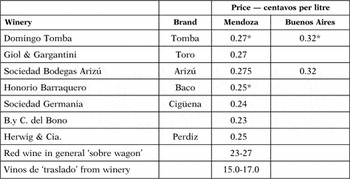
Despite the growing use of brands, contemporaries bemoaned the fact that there was little to distinguish between the wines of the major producers, in part because of the widespread use of the malbec grape varietyFootnote 40. Product uniformity and collusion between the leading producers led to minimal price differences between the leading houses, although brands did offer some guarantee that it would be the consumer, rather than an intermediary, who added the water. Table 6 lists some of the leading wineries and their brands and shows that these were sold in Mendoza for about a third more than the «vinos de traslado». These were wines produced in small wineries by independent growers and sold immediately after fermentation to be blended with the produce of the big houses to meet their orders. The large wineries therefore adjusted their supply to meet the demand for their branded wines in the final market both through grape and wine purchases. Unfortunately, the golondrinas did not drink branded wine in Italy, and they were unwilling to pay a high premium for it in ArgentinaFootnote 41.
SELECTED BRAND NAMES AND WINE PRICES IN JUNE 1910

*New barrels.
Source: Boletín Centro Vitivinícola Nacional (junio 1910, p. 1516).
After a decade of rapid growth, exogenous factors led to a fall in GDP of 10 per cent and the overnight disappearance of credit facilities. Once again, Mendoza's large wine producers failed to buy grapes from independent producers who reopened wineries and flooded the Buenos Aires market with wines that were still «hot» after fermenting, leading to a collapse in prices for both branded and unbranded products. The leading wineries tried to shift the adjustment costs to other sectors. Attempts to control wine prices failed, both because of the problems of free riders, but also because higher wine prices fed back into higher demand for grapes and led to a renewed growth in planting and even greater overproduction a few years later. Instead, leading wineries now colluded to keep grape prices artificially low, at a little more than a peso per 42 kilograms between 1914 and 1919, when in 1912 and 1913 they had been 4.5 and 3.5 pesos, respectively. This price hardly covered variable production costs in the vineyards and thereby reduced the incentives to increase the supply of grapes by new plantingsFootnote 42.
Instead of a trust along the lines of the CWA, the leading producers looked to the Provincial government to stabilize the sector using government fundsFootnote 43. A number of schemes were debated, but the Mendoza law of 1916 (ley 703) was the most controversial. It created a «cooperative» that allowed the leading wineries access to taxes to remove unwanted production from the market. Past attempts to create voluntary organizations to control supply had failed because insufficient producers were willing to participate, so a punitive tax was levied on the production of those who remained outside the schemeFootnote 44. This «cooperative» was run by the large wineries, but its life proved short as the Supreme National Court determined it unconstitutional because a Provincial Government could not create a monopolyFootnote 45.
7 Conclusion
This paper argues that because grape quality was both inferior and highly volatile in Europe, growers could not guarantee a market for their grapes and therefore made the wine themselves. In the New World, this was not the case, and these activities were often carried out by separate entities with wine-makers taking advantage of new technologies which greatly increased the scale of operations. Differences in the organization of winemaking and selling in the New World can be attributable to wine quality and this in turn to consumer demand. Many consumers in California and Australia were not accustomed to drinking wine and producers therefore had to improve and guarantee quality, which was achieved by either a producer-driven commodity chain (CWA) or by a market-driven chain (Burgoyne). By contrast, in Argentina the consumers were accustomed to drinking wine, and producers competed on price rather than quality. The leading producers agreed on compulsory inspections of winemaking and merchants’ properties to establish a minimum, albeit low, standard for quality.
Despite the considerable achievements between 1890 and 1914, the future prospects for the industry on the eve of the First World War were not good. In California, the CWA disappeared with Prohibition after several attempts to reorganize itself. After Prohibition, when the industry effectively had to start again from scratch, integration occurred once more, but this time it was the out-of-state firms that moved into California and bought up the wineries (Lapsley Reference Lapsley1996; Pinney Reference Pinney2005). By contrast, in Australia the narrowness of the domestic market made export performance especially important. Exports peaked as early as 1902 (although a second peak in 1911 was only marginally lower). The growth in British demand for dessert rather than dry table wines in the interwar period was not anticipated by Burgoyne and led to the firm's demise, while large vertically integrated wine companies exported dessert wines through State organized depots (Faith Reference Faith2003). By the 1960s, dessert wines accounted for half of all Australian and Californian production, and it has only been in recent decades that the relative importance of table wines has returned to late 19th century levels. Dessert wines were easier to brand than dry table wines, and by the late 20th century, large-scale vertically and horizontally integrated companies in Jerez or Porto diversified their products, just as Seppelt did in Australia, and the CWA in the United States before Prohibition.
By contrast, in Argentina the industry suffered severely from the 1914 to 1919 crisis. For decades, domestic consumption failed to rise much above 60 litres per person per year, and population growth slowed as immigration declined. Although many of Mendoza's governors were themselves wine producers, the dependence of the Provincial government on wine encouraged it to try to develop alternative sources of revenues, while national politicians threatened to reduce tariffs on imports when they thought that wine companies were colluding or when quality deteriorated because of fraud. In Mendoza and California, the political climate was relatively permissive to big business and trusts, and both regions, with less than 5 per cent of their nation's population, produced around 95 per cent of the domestic wine supply. Unlike California however, wine was a basic commodity in the Argentine diet, and the Buenos Aires government was unwilling to permit a trust or monopoly to manipulate prices, while regulators were much less concerned in the United States. Under Perón, the national policy to supply plentiful cheap wines for the expanding middle and lower classes in urban markets would further restrict profitability (Stein Reference Stein2007, p. 102).