Piracy was rampant in China between 1550 and 1567, during which time the number of pirate attacks topped 30 each year. This followed nearly two centuries when piracy had been rare with about one incident a year.Footnote 1 In these two difficult decades, the Chinese pirates stationed mainly on islands off the southeast coasts raided more than two-thirds of all coastal prefectures and occupied a third of them.Footnote 2 Chinese pirates plundered silk and other popular export items, in the process kidnapping, and even killing were common affairs (So Reference So1975; Geiss Reference Geiss, Twitchett and Fairbank1978; Wills Reference Wills, Spence and Wills1979).Footnote 3 The attacks were severe; they produced massive casualties, and local populations seemingly devoted large resources to defend themselves; for example, by erecting walls.Footnote 4
NUMBER OF PIRATE ATTACKS ON COASTAL CHINA BY YEAR

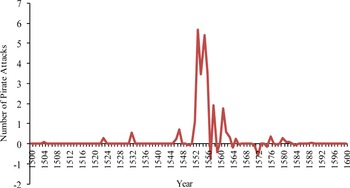
The great wave of piracy has two intriguing features. First, the majority of the pirates had actually been Chinese merchants before turning outlaws (So Reference So1975; Wills Reference Wills, Spence and Wills1979). Second, it waned after 1567 just as suddenly as it had arisen in 1550; henceforth attacks returned to the same low levels that had prevailed before (Figure 1). Local officials and historians have been aware of the fluid boundary between merchants and pirates. Merchants had long carried out trade despite a “sea ban” (haijin) policy enacted by the Ming in 1368. Trade, although technically illegal, was widely tolerated until 1550 when the Jiajing emperor decided to enforce the ban. While hundreds of “smugglers” were killed, others were prevented from making landfall by Ming's coastal defense force; at the same time, coastal inhabitants found to engage in foreign trade were executed. This harsh enforcement thus pushed merchants into becoming pirates (So Reference So1975; Geiss Reference Geiss, Twitchett and Fairbank1978; Wills Reference Wills, Spence and Wills1979; Boxer Reference Boxer1980; Brook Reference Brook1998).Footnote 5 But as soon as the imperial authorities legalized private foreign trade in 1567, the pirates reverted to their previous roles as merchants.
We use a unique panel data set of pirate attacks that covers all 33 coastal prefectures from 1371 to 1640 and examine the effect of this “sea ban” policy on the rise (and fall) of piracy. In particular, as merchant pirates were primarily concerned with maximizing profits, we examine whether prefectures with greater trade (raid) potential actually suffered from greater pirate attacks after 1550 as a result of the Ming authorities’ crackdown on foreign trade. Our primary measure of a prefecture's trade (raid) potential is whether a coastal prefecture in China was a major silk-producing area (silk center). As alternative proxies, we also measure what prefectures had already developed a port for conducting foreign trade prior to the Ming dynasty, as well as their urbanization rate around 1390.
The analysis shows that the rise in pirate attacks in mid-sixteenth-century China was due to the rigorous enforcement of the “sea ban.” Indeed, pirate attacks on a silk-producing prefecture after 1550 were 1.3 times more likely than on a non-silk center, but not before 1550 or after the policy's abolishment in 1567. These results remain robust to controlling for a number of covariates that may also determine the incidence of pirate attacks; these include the number of famines, population pressure, coastal defense (measured by the number of naval garrisons stationed at the coastline), and the number of islands off a prefecture's coastline. Our results are also robust to the use of a restricted sample that limits the time window to only the same emperor, which helps to avoid the confounding effect caused by the possible heterogeneous preferences regarding foreign trade among the different emperors.
However, our key explanatory variable—a prefecture's trade (raid) potential—is clearly endogenous to possible omitted variables that may be correlated with both pirate attacks and trade (raid) potential, such as knowledge of navigation and ships that would facilitate piracy, and economic prosperity more generally given that the pirates may have been aiming at the treasures of the wealthy (e.g., gold, silver, or even stored grains) rather than the products earmarked for trade. To address this concern, we exploit the exogenous variation in trade potential among China's coastal prefectures as our instrumental variable. Premised on the fact that mulberry leaves were a critical input in the upstream production process of sericulture in the historical context of China, we employ the share of land with loamy soil—the texture of which is most suitable for cultivating mulberry trees—to proxy for the suitability of planting this crop to instrument the silk center variable. But since loamy soil is also suitable for planting other staple crops (such as wheat), which were likely closely correlated with the level of income in an agricultural society, it may impact piracy via the channel of economic prosperity rather than trade potential. To allay this particular concern, we control for the percentage of land suitable for planting the major staple crops (wheat, rice, sorghum, soybean, millet, and other minor cereal crops) and the amount of grain tax levied on each prefecture to proxy for the output of staple crops in the Ming dynasty. Our instrumented results remain robust.
Another concern is that the periods selected for our difference-in-differences analysis might be contaminated by the “spillovers” of European trade expansion with China after the Voyages of Discovery (in the late 1490s) and Japanese political turmoil during 1467–1590 (the Warring States period when the lack of centralized political control may have predisposed warlords to prey along the China coast). While our restricted sample which limits the time window to 1522–1572 (that is, within the period of European trade expansion as well as Japan's Warring States period) can address this concern, for robustness we also include two interaction terms—one between trade potential and the number of European ships to Asia, and the other between trade potential and Japan's Warring States period, respectively, as additional controls. The results after adding all these covariates as controls remain robust as well.
Our study has implications for Chinese economic history. If pirate attacks were the unwitting outcome of an autarkic ideology and policy of China's late imperial regimes, their episodic spike foreshadowed a crisis that culminated in the first Opium War of 1839–1842, when China was defeated by Britain and forced to open up to trade.Footnote 6 Our study of early pirate attacks thus contributes to the literature that sees autarky as explaining why China's growth trajectory was so different from those of the West (e.g., Elvin Reference Elvin1973; Hall Reference Hall1986; Landes Reference Landes2006).Footnote 7
HISTORICAL BACKGROUND
Most people who lived on the southeastern coast of China depended heavily on maritime commerce for their livelihood (So Reference So1975). China's maritime trade with Japan, Korea, Southeast Asia, India, and Arabian countries had prospered as early as the seventh century. Historians have noted that China's maritime commerce was already flourishing by the Song dynasty, 960–1279 (Elvin Reference Elvin1973). This prosperity seems to have persisted into the early Ming period as Chinese merchants visited ports in Japan, Southeast Asia, and India frequently (Brook Reference Brook1998; Findlay and O'Rourke Reference Findlay and O'Rourke2007). Moreover, China's commercial prosperity is also borne out by the three hundred or so tributary trips made to the Ming court by ambassadors from about sixty different Asian countries between 1400 and 1500 (Daming huidian (Collected Statutes of the Ming Dynasty) 1502).
After 1500 Europe's trade with China began to rise. Thanks to Vasco da Gama's discovery of the Cape of Good Hope route to Asia in the late 1490s Europeans expanded their trade into China, whose products—particularly silk—enjoyed immense demand in Europe at the time (Elvin Reference Elvin1973; Ma Reference Ma, Flynn, Frost and Latham1998; Brook Reference Brook1998; O'Rourke and Williamson Reference O'Rourke and Williamson2002). As a result, the China coast witnessed a notable influx of European merchant explorers between 1517 and 1550.Footnote 8
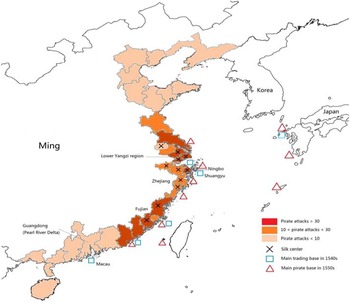
Lured by the growing demand for Chinese goods and the greater profitability of foreign trade, many merchants on the China coast began to trade with both Europeans and other Asians.Footnote 9 By the 1540s maritime trade in China had become very active. Altogether more than one hundred and thirty Chinese merchant groups coexisted at the time, quite a few of them allegedly had a crew of several thousands and were armed (Chen Reference Chen1934). These groups formed a powerful alliance under the leadership of Wang Zhi—the most powerful merchant pirate at the time who allegedly had a fleet that numbered several hundreds and a crew of more than one hundred thousand at his command (Wills Reference Wills, Spence and Wills1979; Chao Reference Chao2005).Footnote 10 To facilitate trade and to escape surveillance, these Chinese merchants established trading bases on the islands off the southeastern coast of China and west of Japan (Figure 2).Footnote 11 These illicit traders would acquire goods along the coast and ship them from their bases to the foreign traders (Wills Reference Wills, Spence and Wills1979; Chao Reference Chao2005). Historians regard such trading between Chinese and foreign merchants as “regular” (Brook Reference Brook1998, p. 124). As a result, some islands off the coastal provinces of Fujian and Zhejiang, which prior to 1517 had been nothing more than sleepy towns, had become bustling metropolises by the 1540s.Footnote 12
Unfortunately, China's expanding foreign trade was hindered by the Ming dynasty's 1368 “sea ban.” This policy prohibited the Chinese people from engaging in foreign or specifically maritime trade. The so-called trade in Ming China was confined to primarily “tributary trade”—a form of limited “commerce” in which China asserted itself as the hegemonic power, with the vassal states making periodic trips of homage to the imperial court to offer gifts to the emperor in exchange for a limited amount of goods (Fairbank Reference Fairbank1968). There are different views regarding the imposition of the “sea ban.” Some suggest the emperor banned trade to avoid coastal unrest due to interactions between the Chinese and the foreigners (Fairbank Reference Fairbank1968; Chao Reference Chao2005). Others see the ban as reflecting an imperial preference for an autarkic economy and a policy that followed the Confucian ideology of “putting agriculture before business (zhongnong qingshang)” (Boxer Reference Boxer1980; Brook Reference Brook1998; Landes 1998).
Until the 1550s the imperial authorities tolerated the budding trade along the China coast.Footnote 13 But then a crackdown began and the Ming armies scuttled more than 1,200 illicit boats and killed hundreds of smugglers in 1548 and 1549 (Wills Reference Wills, Spence and Wills1979; Chao Reference Chao2005). To further curtail smuggling, coastal defense forces now effectively prevented merchants from making landfall, let alone doing business as they had been allowed.Footnote 14 At the same time, the imperial authorities relied on neighborhood pai jia to discourage coastal inhabitants from trafficking with merchants. Every ten households were organized into a single unit of pai; if someone in a pai was caught committing the pertinent crime then all ten households in that pai would be executed (Hu Reference Hu1987; Brook Reference Brook2005).Footnote 15
An unwitting outcome of these draconian measures adopted by the Ming authorities was that they created incentives for the merchants who had settled on the nearby islands to raid China's coastal cities and towns.Footnote 16 They turned to piracy because it was the only way to get access to trade goods and recapture the profits they lost from the ban. As Wang Zhi—the head of the merchant pirate alliance, once declared: “…if [the authorities] resume the customs in the ports of Zhejiang, and permit the people to trade with Japan, the pirates would not come again.…” (Chao Reference Chao2005, p. 196). The rise of pirate attacks along the China coast is demonstrated in Figures 1 and 2. After nearly two centuries of isolated pirate attack, they jumped to 30 a year starting in 1550 and the manufacturing centers of the lower Yangzi region and Fujian Province were their primary targets.
But the imperial authorities’ attempt to suppress piracy “backfired”— to borrow Charles C. Mann's (Reference Mann2011) word—when pirate attacks surged. After a decade and a half, the imperial authorities softened its stance regarding the legitimacy of maritime trade as it became aware of the pirates’ raids and the consequent sharp deterioration in living standard in the distressed coastal communities (Von Glahn Reference von Glahn1996; Brook Reference Brook1998).Footnote 17 Longqing assumed the imperial throne in 1567 and quickly legalized foreign trade by issuing licenses to Chinese junks.Footnote 18 As Figure 1 shows, pirate activities plunged and remained low until the end of the Ming dynasty in 1644.
DATA
To test the hypothesis that the sharp rise in pirate attacks in China in the 1550s was caused by the prohibitions on foreign trade by the Ming authorities, we construct an annual panel data set that ranges over all 33 coastal prefectures from 1371 to 1640.Footnote 19 We begin our analysis from 1371—two years after the founding of the Ming dynasty and end our analysis in 1640—four years before the end of the Ming dynasty. In both cases, the censoring is designed to avoid the unrest associated with dynastic transitions.
Pirate Attacks
Our dependent variable is measured by the annual number of attacks made on a coastal prefecture. An attack occurred when pirates used violence in order to secure goods in the coastal towns and cities of China. The data come from the Ming shilu (Veritable Records of the Ming Emperors), the official record of imperial edicts and official memorials about events of national significance. It provides the time and place of each attack but it only provides further details irregularly.Footnote 20 To curtail smuggling and piracy, the Ming authorities had already set up a vigorous coastal defense system of 450 naval garrisons (weisuo) manned by 100,000 soldiers in the 1380s. In any case, pirate attacks were violent: plundering, looting, and even murder, they were thus hard to miss.
We compared the lists of attacks drawn from the Ming shilu with the Mingdai wokou kaolue (Investigation into Piracy in the Ming Dynasty; Chen Reference Chen1934). The author of this highly specialized publication carefully documented the time and place of each pirate attack based on historical sources different from the Ming shilu.Footnote 21 The two sources are very consistent; the correlation is strong between the two sets of data (0.82, significant at the 1 percent level). The advantage of Maoheng Chen's (Reference Chen1934) work derives from its reliance on a variety of historical sources; this allows the omission by some authors to be amended by others, and thus provides useful cross-referencing. However, Chen's relied heavily on local gazetteers. Since only the more affluent prefectures/counties had the wherewithal to compile local gazetteers, selection bias may be a problem. In the light of these considerations, we base our empirical analysis on the Ming shilu and use Chen's (Reference Chen1934) data for robustness checks.
Trade Potential
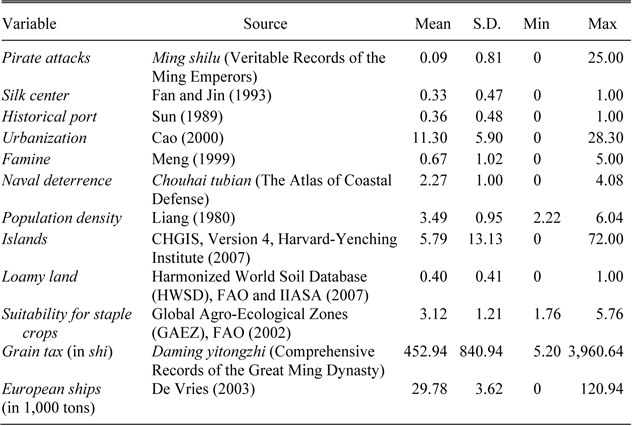
Silk Center. Silk was in high demand abroad during the sixteenth century (Brook Reference Brook1998; Ma Reference Ma, Flynn, Frost and Latham1998). Our empirical analysis exploits the regional variation in the potential for silk trade (or raid in the case of pirate attacks). We do so because silk was the most sought-after good among the pirates: “…the treasure that pirates sought was silk. When they found the workshops of silk production, they jumped for excitement…they even kidnapped Chinese women to secret spots and forced them to weave silk” (Chao Reference Chao2005, p. 192).Footnote 22 We thus employ a dummy variable indicating whether the imperial authorities had set up a silk bureau in that prefecture (as reported by Fan and Jin Reference Fan and Jin1993). Analogous in status to state-owned enterprises in contemporary times, these bureaus produced a variety of silk products for use by royal personnel and government officials and located in centers of local production. Of the 33 coastal prefectures in Ming China, 11 were silk centers. This variable is time-invariant because the geographic distribution of silk production rarely changed over time.
However, since China also exported many other commodities such as porcelain, tea, paper, and sugar (Brook Reference Brook1998), the silk center variable does not fully capture the trade potential of China's coastal prefectures. To address this inadequacy, we employ two additional measures to proxy for trade potential.
Historical Port. Our first alternative measure is a dummy variable that is coded 1 if a prefecture had developed a port for conducting foreign trade during the Song and Yuan dynasties (906–1368)—a time when China's maritime commerce began to prosper. Given that China's pre-Ming overseas trade was concentrated in ports like Quanzhou and Ningbo (in the southeastern region), the potential for foreign trade was likely greater in prefectures with such facilities. In fact, the bulk of trading activities that occurred prior to the advent of the great wave of pirate attacks took place near the ports in Quanzhou (the island of Yuegang, for instance) and Ningbo (the island of Shuangyu). Of the 33 coastal prefectures in total in Ming China, 12 had a historical port.
Urbanization. Another proxy for trade potential is the urbanization rate. As Paul Bairoch (Reference Bairoch1988) and Jan de Vries (Reference de Vries1976) have pointed out, prior to the Industrial Revolution only prosperous areas were able to support dense urban populations. In the absence of reliable GDP figures, urbanization rate is thus a reasonable proxy for the economic prosperity of preindustrial societies. China is no exception: historians of China have indeed found that the urbanization rates were closely correlated not only with the level of commercialization but also with exports (Skinner Reference Skinner1977; Xu and Wu Reference Xu and Wu2000).Footnote 23 We draw the share of the population living in settlements larger than 1,000 inhabitants by prefecture in the 1390s from Shuji Cao (Reference Cao2000). The mean urbanization rate among the coastal prefectures of Ming China is 11.3, with a maximum of 28.3.
Figure 2 shows how many pirate attacks each coastal prefecture suffered between 1550 and 1567 and the locations of silk centers. As one can readily see, pirate attacks were concentrated in silk centers. In sharp contrast, few attacks were observed in north China, where the potential for trade was limited. Note that few pirate attacks occurred on the coast of Guangdong Province or more specifically the Pearl River delta region. While the capital, Guangzhou, had been an important trading port since the seventh century, the coast of the province produced much less silk than either the lower Yangzi region or coastal Fujian Province in the Ming and early Qing period and it was less urbanized. So it is not so surprising that attacks in the Pearl River delta region were less frequent.
PIRACY IN MID-SIXTEENTH CENTURY CHINA

Controls
Famine. There are several social forces that might spur pirate attacks. The first pertains to famine or negative economic shocks, which have been documented to trigger conflict (Miguel, Satyanath, and Sergenti Reference Miguel, Satyanath and Sergenti2004; Bai and Kung Reference Bai and Kung2011). Historians of China have indeed made the case that famine led to piracy in Ming China (So Reference So1975; Brook Reference Brook1998). To control for its possible effect on pirate attacks, we control for the number of famines that had occurred in a prefecture on an annual basis.Footnote 24
Population Density. Population pressure is another potential source of conflict (Malthus Reference Malthus1798; Bruckner Reference Bruckner2010). Chinese historians have documented a rapid increase in population in the latter half of the Ming dynasty (Ho Reference Ho1959; Cao Reference Cao2000). Faced with land scarcity, coastal populations could turn to maritime trade, but were likely compelled to resort to pirate attacks when trade was banned. We thus need to control for China's growing population. The data here are scarcer and we are only able to produce provincial population density for the periods of 1370s–1460s, 1470s–1550s, and 1560s–1640s.Footnote 25
Islands. Pirates used offshore islands to launch attacks on the coasts and to sell the raided goods for export. In fact, the intensity of pirate attacks on Zhejiang and Fujian is partly due to the vast number of uninhabited islands off the coasts of these two provinces.Footnote 26 But islands should not play a decisive role in the rise and fall of piracy, based on the fact that over time pirate attacks had shifted from the eastern and southeastern coasts—for instance, from the coasts of Zhejiang and Fujian Provinces during the sixteenth century—to the Pearl River delta region in the south in the late eighteenth and early nineteenth centuries (Antony Reference Antony2003). To control for the possible influence of islands and their varying effects over time, we employ an interaction term between the number of islands off a prefecture's coastline (islands hereafter) and the pertinent time dummies.Footnote 27
Naval Deterrence. Last but not least, we control for the number of naval garrisons per prefecture, as they were the most direct deterrent of pirate activities.
The definition, sources, and descriptive statistics (mean and standard deviation) of the main variables employed in this analysis are summarized in Table 1.
SOURCE OF VARIABLES AND DESCRIPTIVE STATISTICS

Notes:
See the text.
Sources:
See the text.
EMPIRICAL STRATEGY AND RESULTS
We start with some simple tests of our hypothesis that pirate attacks on prefectures with greater trade potential rose rapidly after the 1550 imperial suppression of export trade, and declined sharply after 1567 upon the removal of the “sea ban” policy. To provide a benchmark, we estimate a fully flexible equation that assumes the following form
![\[
\begin{array}
\[pirac{y_{it}} = T{P_i} \times {\rm{ }}yea{r_t} + X'_{it} + prefectur{e_i} + yea{r_t} + {e_{it}}\]
\end{array}
\](https://static.cambridge.org/binary/version/id/urn:cambridge.org:id:binary:20160927091142808-0862:S0022050714000345:S0022050714000345_eqn1.gif?pub-status=live)
where piracyit stands for the number of pirate attacks on a prefecture in each year, and TPi refers to whether a prefecture was a silk center. X’it is a vector of other covariates (famine, population density, naval deterrence, and the interaction terms between islands and a full set of year dummies); prefecturei denotes the prefecture-fixed effects capturing all time-invariant and prefecture-specific characteristics (such as geography, culture, and historical background); yeart denotes the time-fixed effects controlling for the common shocks to piracy in all the prefectures; and eit is the disturbance term. The set of interaction terms between silk center and a full set of year dummies, viz. TPi × yeart , are the key estimates. These interaction terms are intended to capture the differential intensity of pirate attacks between prefectures that were designated silk centers and those that were not on an annual basis. To the extent that the surge in piracy was caused by the intensified suppression of trade, we expect the coefficients of TPi to be significantly greater in magnitude between 1550 and 1567 but constant before 1550 and after 1567.
The flexible estimation results are reported in Figure 3, in which we plot the coefficients of the interaction term TPi × yeart using silk center as the proxy for TPi . The results using historical port or urbanization are extremely similar. It is striking that, regardless of how trade potential is measured, prefectures with greater trade potential did not experience more pirate attacks until 1551. After 1551 the coefficient of the pertinent interaction term jumps up consistent with the idea the emperor's suppression of foreign trade had forced the merchants into piracy. Equally striking is the differential intensity in pirate attacks between prefectures with varying trade potential disappears at the end of the 1560s.
Next, we estimate the same set of relationships with a structured specification
![\[
\begin{array}
\[pirac{y_{it}} = T{P_i} \times \,Post1550\, + T{P_i} \times \,Post1567 + \,X'_{it} + \,prefectur{e_i} + \,yea{r_t} + \,{e_{it}}\]
\end{array}
\](https://static.cambridge.org/binary/version/id/urn:cambridge.org:id:binary:20160927091142808-0862:S0022050714000345:S0022050714000345_eqn2.gif?pub-status=live)
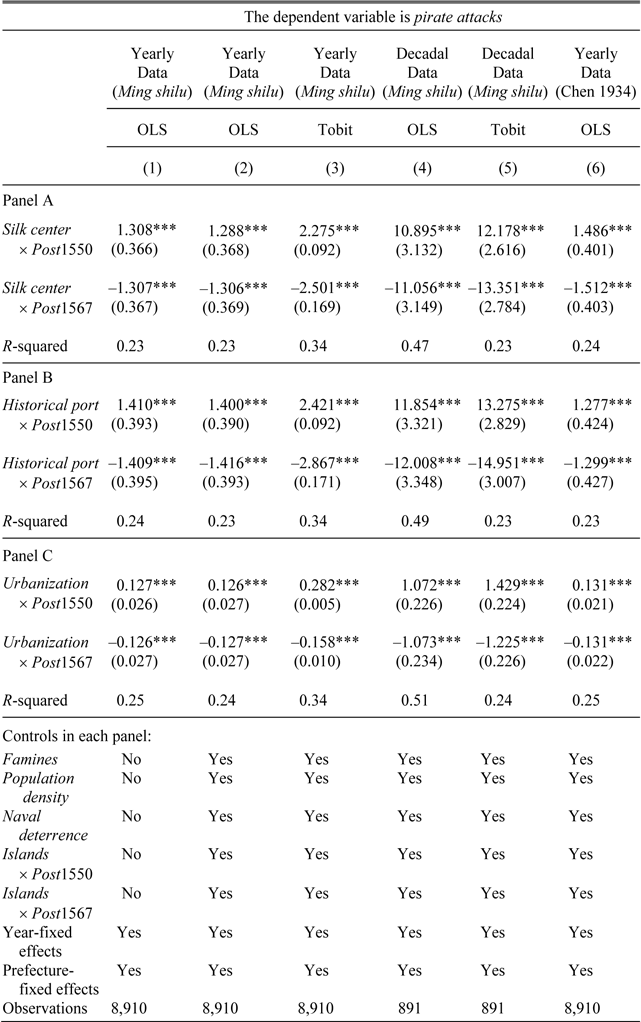
where all variables are defined in the same way as in equation 1. The only difference between equation 1 and equation 2 is that in equation 2 we interact TPi with only the two pertinent time dummies of Post1550 and Post1567 (instead of each year). The main results of equation 2 are reported in Table 2. In Panel A, trade potential is measured by silk center, and in Panels B and C by historical port and urbanization, respectively. In all cases, we control for the prefecture- fixed effects and year-fixed effects, and use robust standard errors clustered by prefecture to control for possible correlation within a prefecture. Reported in column 1, our benchmark OLS estimate shows that pirate attacks on silk centers rose significantly from 1550 to 1567. In terms of magnitude, the size of the pertinent coefficient (of 1.308) indicates that the average number of pirate attacks on the silk centers increased by 1.3 times more than the non-silk centers after the Ming cracked down on foreign trade (i.e., Silk center × Post 1550). Conversely, the significantly negative coefficient of −1.307 for the Post1567 period suggests that after maritime trade was sanctioned pirate attacks on the silk centers returned to the common low prior level.
COMPARISON OF PIRATE ATTACKS ON THE SILK CENTERS AND NON-SILK CENTERS, BY YEAR

In column 2 of Table 2, we include in the regression all other covariates, namely famine, population density, naval deterrence, and the interaction terms between islands and the two policy dummies.
Estimates on the two interaction terms are strikingly similar to those reported in column 1 in terms of both level of significance and magnitude. In addition, given that the dependent variable is left censored (nearly 90 percent of the values are zero), we use a Tobit estimation. Reported in column 3, the results are strikingly similar; this lends greater credence to our baseline results. We also aggregate the data into decades and perform the same estimations in columns 4 and 5 (instead of 1567, 1570 is thus used as the cutoff date of the removal of the “sea ban” policy). To ensure that data obtained from Ming shilu are reliable, we employ Chen's (Reference Chen1934) data on piracy as a robustness check. Reported in column 6, the coefficients match those based on the Ming shilu (columns 1 and 2).
Panels B and C of Table 2 report the estimates using historical port and urbanization as the alternative measures of trade potential, the results of which are also strikingly similar. For example, the the coefficients of historical port are very close to those of silk center in terms of both magnitude and level of significance.Footnote 28 Regarding the effect of urbanization, the estimates in column 2 suggest that after 1550, an additional percentage point of the urbanization rate increases the number of pirate attacks by a 13 percentage points each year, and decreases the number of pirate attacks at the same rate after 1567.Footnote 29 These results lend further support for the finding that the rising incidence of piracy in mid-sixteenth-century China was caused to a much larger extent by the imperial authorities’ crackdown on foreign trade.
CAUSE OF PIRATE ATTACKS: MAIN RESULTS

*** = Significant at the 1 percent level.
Notes:
Robust standard errors are clustered by prefecture and reported in parentheses. In columns 4 and 5, 1570 (instead of 1567) is employed as the year in which the “sea ban” policy was removed.
ROBUSTNESS CHECKS
Instrumented Evidence
Our key explanatory variable—a prefecture's trade potential (TPi )—is the outcome of a complex social process. One might well worry that our estimations is biased by some omitted variables that are correlated with both pirate attacks and trade potential. For instance, it is likely that those living in regions with more maritime trade would more likely possess skills—such as knowledge of navigation and ships—that would facilitate piracy. Another possible omitted variable is level of income. Prefectures with greater trade potential were usually richer. The pirates may have been aiming at the treasures of the wealthy (e.g., gold, silver, or even stored grains) rather than the products earmarked for trade. Should that be the case, our hypothesis of pirate attacks being triggered by the authorities’ suppression of trade would have violated the exclusion restrictions condition. There is also a concern about measurement error. Despite our effort in constructing three measures to proxy for a prefecture's trade potential, it would be unrealistic to expect them to fully capture the variable in question. Hence, the estimates will remain attenuated.
To address these concerns, we exploit the exogenous variation in trade potential among China's coastal prefectures using the suitability of soil for growing mulberry leaves as the instrumental variable for silk center. Until the early 1920s mulberry plantation was an integral part of sericulture. Silkworms, whose cocoons produce the raw silk fiber, grow by eating mulberry leaves. Thus prior to any extensive production of raw silk mulberry trees must be planted. Then during the intensive feeding periods, the leaves must be stripped from the trees so that the worms can get fresh food five or six times a day (Bell Reference Bell1999). Because mulberry leaves are highly perishable they were difficult to transport over any distance, most raw silk production facilities were thus located in sites where it was feasible to plant mulberry on a large scale (Fan and Jin Reference Fan and Jin1993). This depends crucially on the soil.
Mulberry trees need well-drained soils. On the China coast, loamy soil is thus the most suitable for large-scale mulberry plantations (Dai Reference Dai1934). Soil texture is exogenously determined and, although its spatial distribution is likely correlated with mulberry plantation and silk production, it should have no direct correlation with pirate attacks, and hence is a plausible instrumental variable for silk center. We calculate the percentage of loamy land in a prefecture (loamy land hereafter) based on the Food and Agriculture Organization's Harmonized World Soil Database (HWSD). The texture of soil does not change over time (Rowell Reference Rowell1994), so contemporary data on soil texture is thus a valid proxy for soil texture in Ming times.Footnote 30
A drawback of using loamy land as instrument is that this type of land is suitable for cultivating much more than just mulberry trees; including many other (non-exported) staple crops such as wheat, rice, and millet. In an agricultural society like Ming China, the output of these staple crops was closely correlated with the level of income or economic prosperity. As a result, the areas dominated by loamy land may experience more pirate attacks because of their economic prosperity (grains, not merely silk, were there to be plundered). To address this concern, we use two proxies that are likely to control for the impact of loamy soils on prosperity to some extent. The first is land suitability for planting the major staple crops, which is calculated based on the combination of climate, soil, and slope characteristics [Food and Agriculture Organization, 2002 Global Agro-Ecological Zones (GAEZ) database]. The GAEZ data base provides from 0 (very unsuitable) to 9 (very suitable) index of land suitability for all the major staple crops grown in the Ming dynasty: wheat, rice, sorghum, soybean, millet, and other minor cereal crops such as broomcorn millet.Footnote 31 For each prefecture, we take the average of the indices of the six major staple crops outlined above to be our measure of land suitability for these crops.
The advantage of using land suitability for staple crops is that it is exogenously determined (Nunn and Qian Reference Nunn and Qian2011), yet it reveals nothing about the actual output of these crops. As an alternative, we use the volume of the grain tax levied on each prefecture. Indeed taxes were likely correlated with agricultural output. Specifically, we use the amount of grain tax (measured in shi, a volume measure in imperial China; one shi is equivalent to 100 liters) per kmFootnote 2 collected from each prefecture in the 1460s as the pertinent measure. The tax data are obtained from Daming yitongzhi (Comprehensive Records of the Great Ming Dynasty), which was compiled in the 1460s.
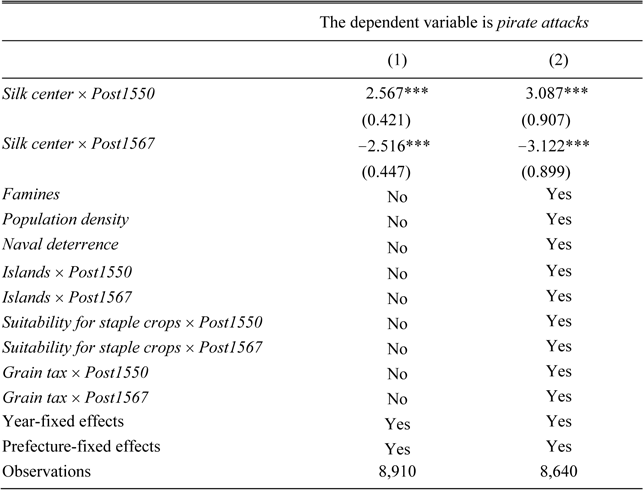
We report the instrumented results in Table 3. Because the endogenous variable is an interaction term between silk center and the time dummies, the instrumental variable should also be an interaction term between loamy land and the same set of time dummies accordingly. We begin our regressions without including any covariates in column 1, and in column 2 we add back all the controls, including land suitability for cultivating the staple crops, amount of grain tax, and their interactions with the specific time dummies. The 2SLS results are consistent with those of the OLS (Table 2) in terms of both direction and level of significance. Moreover, the magnitudes of the instrumented estimates of the two interaction terms are greater than those of the OLS results by about two times, suggesting that the OLS estimates of the effect of silk center on pirate attacks were likely attenuated by omitted variables and measurement error.
Restricted Reference Period
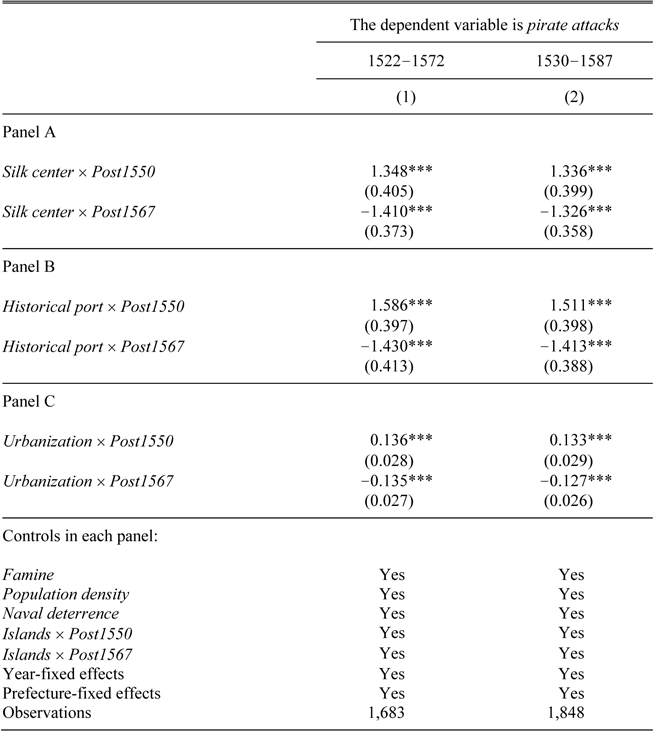
Another concern is that the reference period (1371–1550) in our difference-in-differences analysis is very long. Indeed a total of 12 emperors ruled over China over that time, and each may have had different approaches to foreign trade, and the enforcement of the “sea ban.” We shorten our reference period to 1522–1549 so that it is contained in the same single imperial reign (that of Jiajing) as the treatment period (1550–1567). Likewise, we also exclude the years after 1572, as it was Longqing emperor who abolished the ban in 1567. For robustness reason, we also arbitrarily restrict the sample period to 1530–1587, i.e., only 20 years before the “sea ban” became intensified and 20 years after its eventual abolition. Reported in Table 4, the results based on these two restricted periods do not differ from the main findings—the effect of the “sea ban” policy remains positive and significant.
CAUSE OF PIRATE ATTACKS: INSTRUMENTED RESULTS

*** = Significant at the 1 percent level.
Notes:
Robust standard errors clustered by prefecture are reported in parentheses. The table reports the second-stage results of the 2SLS estimations in which silk center is instrumented by loamy land.
Europe and Japan's Role in Policy Change
Our difference-in-differences estimation requires that there were no other shocks—especially shocks that are correlated with pirate attacks around 1550 or 1567. A possible omitted factor relevant to this period is the unprecedented growth in European demand for Chinese goods. Indeed the number of Europeans arriving in China (stationing near the coast) rose steadily after 1517, and the volume of illicit trade between the Chinese and the Europeans grew even faster. As a result, we cannot assume that the rise in the number of pirate attacks after 1550 was triggered by an intensified “sea ban” policy alone; Europe's insatiable hunger for Chinese goods may also have played a part.
ROBUSTNESS CHECKS USING RESTRICTED SAMPLES

*** = Significant at the 1 percent level.
Notes:
Robust standard errors clustered by prefecture are reported in parentheses.
The rise of European trade does not pose a serious threat to our results, however, because the results of our regressions based on the restricted period of 1522–1572 (or 1530–1587) are fully consistent with those of the full sample. These shorter periods fall within the period of Europe's trade expansion to China. Furthermore, we include the total tonnage of European commercial ships that arrived in Asia after 1490s (European ships) as a proxy in our regressions for a further check of robustness, assuming that the share of Chinese goods in Europe's Asian imports did not decrease over time.Footnote 32 Decadal data on European ships are obtained from Jan de Vries (Reference de Vries, Flynn, Giráldez and von Glahn2003).Footnote 33
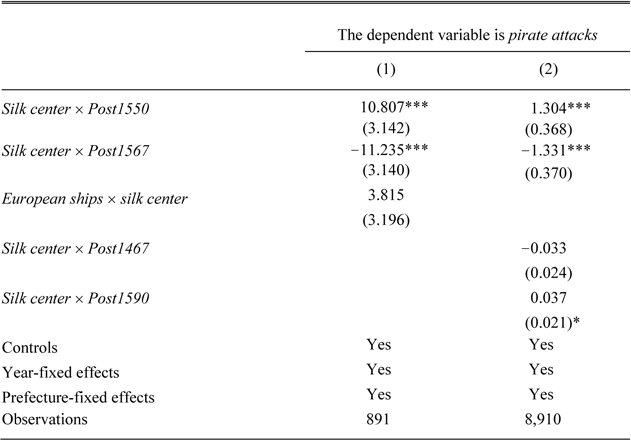
Including this proxy for increasing export demand in the regressions has no effect on the coefficients of interest (see column 1 of Table 5). Not only does the effect of the “sea ban” policy (Silk center × Post1550 and Silk center × Post1567) remain significant, its coefficient also hardly changes (compare with the result in column 4 of Table 2, where Europe's trade demand is not controlled for). These results squarely suggest that the upsurge in pirate attacks between 1550 and 1567 was caused primarily by the intensification of the “sea ban” policy rather than due to Europe's rising trade demand for Chinese goods.
The regression could also be contaminated by the “spillovers” of the political instability in Japan during 1467–1590 (i.e., during the Sengoku or Warring States period). The lack of centralized political control then may have predisposed Japanese warlords and traders to turn to preying along the China coast (Sansom Reference Sansom1961). Again, this should not pose a serious problem because our regression based on the restricted period of 1522–1572 (or 1530–1587) also falls within Japan's Warring States period and that the results of this robustness check are consistent with those of the full sample. To fully address this hypothesis, we add two interaction terms to identify the effect (if any) of this possible Japanese influence. To capture the possible effect of the Japanese political turmoil, we interact silk center with the Post1467 time dummy. By the same token, to capture the effect of Japan's reunification we interact silk center with the Post1590 time dummy.Footnote 34 Reported in column 2 of Table 5 inclusion of Japan's political influence does not change our main results.Footnote 35
CAUSE OF PIRATE ATTACKS: EUROPEAN AND JAPANESE IMPACTS

* = Significant at the 10 percent level.
*** = Significant at the 1 percent level.
Notes:
Robust standard errors are clustered by prefecture and reported in parentheses. In all columns, we have controlled for famine, population density, naval deterrence, and islands. European ships × silk center is included to examine the effect of Europe's changing demand for trade with China on piracy. Silk center × Post1467 and Silk center × Post1590 are included to capture the possible effects of the Japanese political turmoil and the reunification, respectively, on piracy.
CONCLUSION
This article has examined the link between a rigorous suppression of illicit international trade and a spike in piracy in China in the mid-sixteenth century. To do so, we constructed a unique data set based on rich and reliable historical materials to trace both pirate attacks and to proxy a locality's trade (raid) potential. By employing a difference-in-differences regression framework, we show that the geography of pirate attacks was indeed determined by the returns that a coastal prefecture could potentially offer to such violent undertakings.
While a natural extension of our work would be to study the possible long-term effects (if any) of the pirate attacks on economic development, for the time being our finding leads curiously to the larger questions of why various emperors of late imperial China (beginning with the Ming dynasty) were so hostile toward international trade, and what implications this has had for both world and Chinese economic history in the ensuing centuries—especially at the juncture where the growth trajectories of China and Europe began to diverge. This brief episode of Chinese history is important, for it illuminates the conflicts in which China subsequently engaged with the Western powers, conflicts that culminated eventually in the forced abandonment of its long upheld autarkic principle.