INTRODUCTION
Group decision making is an increasingly important challenge in both the public and private sector (Saaty & Peniwati, Reference Saaty and Peniwati2013). The rise of hybrid organisational structures (Killing, Reference Killing2012), strategic alliances (Todeva & Knoke, Reference Todeva and Knoke2005), and collaborative governance (Kettl, Reference Kettl2015) are part of a decadal trend towards more complex decision-making contexts. The best methods for bringing conflicting parties to consensus agreement are still unclear (Rosenhead, Reference Rosenhead2013).
‘Group model building’ (Vennix, Reference Vennix1996; or ‘participatory modelling’, Akkermans, Vennix, & Rouwette, Reference Akkermans, Vennix and Rouwette1993) is an emerging practice for supporting group decision making using system dynamics modelling. Participants work with facilitators to identify variables that most influence their problem setting, explore the dynamics and linkages between those variables, and use this to create a model designed to mimic the behaviour of the problem system under discussion. This system dynamics model is then used to identify and select where best to intervene in the system to achieve desired outcomes. Although group model building can employ a range of different techniques, a variety of system dynamics textbooks describe quite similar methods (e.g., Richardson & Pugh, 1981; Sterman, Reference Sterman2000; Maani & Cavana, Reference Maani and Cavana2007).
The term ‘group model building’ has been chosen in this paper because it is now a more commonly used term (e.g., Richardson, Andersen, Rohrbaugh, & Steinhurst, Reference Richardson, Andersen, Maxwell and Stewart1992; Akkermans & Vennix, Reference Akkermans and Vennix1997; Andersen & Richardson, Reference Andersen and Richardson1997; Vennix, Reference Vennix, Akkermans and Rouwette1999; Rouwette, Vennix, & van Mullekom, Reference Rouwette and Vennix2002; Luna-Reyes, Martinez-Moyano, Pardo, Cresswell, Andersen, & Richardson, Reference Luna-Reyes, Martinez-Moyano, Pardo, Cresswell, Andersen and Richardson2006; Hovmand, Andersen, Rouwette, Richardson, Rux, & Calhoun, Reference Hovmand, Andersen, Rouwette, Richardson, Rux and Calhoun2012). However, ‘participatory modelling’ is perhaps a more precise label, because participants in the modelling process may not be ‘groups’ in the sense usually intended in the literature on social groups (Platow, Grace, & Smithson, Reference Platow, Grace and Smithson2011). Social groups are usually described as collections of people with a collective sense of unity (Turner, Reference Turner1982). The group decision literature uses a broader definition, defining a group decision as one made collectively by more than one person (Forsyth, Reference Forsyth2006), where the ‘group’ need not have a collective identity beyond participation in the decision-making activity. In many group model building activities, the ‘group’ includes different stakeholders (Stave, Reference Stave2003; Antunes, Santos, & Videira, Reference Antunes, Santos and Videira2006; Cavana, Boyd, & Taylor, Reference Cavana, Boyd and Taylor2007; Winz, Brierley, & Trowsdale, Reference Winz, Brierley and Trowsdale2009; Hovmand et al., Reference Hovmand, Andersen, Rouwette, Richardson, Rux and Calhoun2012) and even conflicting parties (Elias, Reference Elias2008; Black & Andersen, Reference Black2012). For the purpose of this article, ‘group members’ and ‘participants’ in the modelling process can be considered interchangeable even if those participants do not necessarily behave as a group outside of the modelling context.
Since 1988, over 200 studies have reported on the use group model building, in which consensus among participants is the most commonly reported outcome (Rouwette, Vennix, & van Mullekom, Reference Rouwette and Vennix2002; Scott, Cavana, & Cameron, Reference Scott, Cavana and Cameron2016a). Despite good evidence of the effectiveness of group model building, it is less clear how and why these effects occur (Scott, 2014b; Scott, Cavana, & Cameron, Reference Scott, Cavana and Cameron2016a). Such a conceptual model could be used to improve group model building methods and applications (Bunge, Reference Bunge2004; Hedstrom & Ylikoski, Reference Hedström and Ylikoski2010; Behn, Reference Behn2014). Many different causal mechanisms have been proposed (Richardson, Andersen, Maxwell, & Stewart, Reference Richardson1994; Vennix, Akkermans, & Rouwette, Reference Vennix1996; Akkermans & Vennix, Reference Akkermans and Vennix1997; Richmond, Reference Richmond1997; Maani & Maharaj, Reference Maani and Maharaj2003; Rouwette, Korzilius, Vennix, & Jacobs, Reference Rouwette2011; Black & Andersen, Reference Black2012; Black, Reference Black and Andersen2013; Scott, Cavana, & Cameron, Reference Scott2014, Reference Scott, Cavana and Cameron2016b). This theoretical paper attempts to reconcile these different proposed mechanisms into a single conceptual model for understanding how and why group model building is effective.
This paper consists of three sections after this introduction. First, group model building is located within the system dynamics tradition. The second section explores the different causal mechanisms proposed in group model building literature, with a focus on the five best-supported hypotheses: the cognitive bias mechanism, the boundary object mechanism, the operator logic mechanism, the argument structuring mechanism, and the persuasion mechanism. This section concludes by combining these five mechanisms into a single overarching conceptual model for how group model building supports consensus and commitment, by creating conditions under which participants mental models are likely to become more aligned. The final section presents a discussion of the implications of this paper for research and practice. This paper is likely to be of specific interest to group model building practitioners and academics, but also of more general interest to researchers interested in tools for supporting group decision making.
GROUP MODEL BUILDING AND SYSTEM DYNAMICS
The field of system dynamics has strong positivist (Giddens, Reference Giddens1974) roots. It began as a quantitative and mechanistic approach to understanding the behaviour of systems over time (Forrester, Reference Forrester1961). The purpose of the modelling process was to understand the nature of a presumed objective reality, for the purpose of making better management decisions. A large section of the system dynamics community continues to use system dynamics in this paradigm (Sterman, Reference Sterman2000). However, there is also a long tradition of involving clients in the model building process to varying degrees; sometimes clients were involved in order to reveal hidden knowledge about the problem setting (Greenberger, Crenson, & Crissey, Reference Greenberger, Crenson and Crissey1976), but on other occasions the purpose was to improve client support for the resulting policies (Stenberg, Reference Stenberg1980). Involving clients in the model building process was subsequently applied across conflicting groups as a way to build consensus and commitment to a decision (Black & Andersen, Reference Black2012; Scott, 2014a).
In their call to add more science to the craft of group model building, Andersen, Richardson, and Vennix (Reference Andersen, Richardson and Vennix1997) suggest that it is important to clarify the intended outcomes of group model building interventions. It seems that two separate perspectives of system dynamics modelling are emerging: the ‘microworld’ and ‘group dynamics’ views (Zagonel, Reference Zagonel2002; Scott, Cavana, & Cameron, Reference Scott2014). The microworld view assumes that the model is a realistic representation of the problem system under discussion, and that system dynamics modelling can help understand and solve complex problems. The group dynamics view considers the model as a socially constructed artefact for building trust and agreement. These are not mutually exclusive phenomenon – there is no reason to believe that a modelling process cannot simultaneously represent reality and negotiate an agreement among participants (Andersen, Vennix, Richardson, & Rouwette, Reference Andersen, Vennix, Richardson and Rouwette2007; Scott, Cavana, & Cameron, Reference Scott2014). Some authors have proposed how these two perspectives may instead rise and fall in importance at different times in the process (Zagonel, Reference Zagonel2002), for example with a social process for designing a simple ‘concept model’ followed by an expert-led process for refining a detailed quantitative model (Howick, Ackermann, & Andersen, Reference Howick, Ackermann and Andersen2006; Richardson, Reference Richardson and Pugh2013). Others assume that one reinforces the other, and groups accept a decision on the basis that it is more likely to be correct because it is informed by a realistic representation of the problem system under discussion (Vennix, Akkermans, & Rouwette, Reference Vennix1996).
Yet, there are reasons to believe that these perspectives can also be separated, or why one may be of more importance in a particular context. Many group model building studies describe working with experts within a single organisation in order to solve a technical problem (e.g., Richardson & Andersen, 1995; Vennix, Reference Vennix1996, Reference Vennix, Akkermans and Rouwette1999; Schwaninger & Groesser, Reference Schwaninger and Groesser2008). In these situations, it is likely that creating better policies is one of the main outcomes desired.
In contrast, when modelling with conflicting parties, group dynamic outcomes may take on greater importance. Scott, Cavana, and Cameron (Reference Scott, Cavana and Cameron2016c) interviewed public servants who frequently commission and conduct group decision processes, to understand which outcomes were most valued. These decision processes often involved reaching a consensus decision between conflicting parties, for example, between environmentalists and industry representatives in negotiating a natural resource management plan. Other decisions required agreement between several government departments, where all participants are ostensibly members of the same broader ‘team’ (all departments involved were part of the unitary legal Crown), but where a lack of shared understanding prevented an agreement on the way to proceed. In each of these cases, those interviewed were primarily interested in reaching agreement between the different participants in the decision-making process. The importance of the durability of these agreements was mentioned several times, illustrated by prior experience where participants had reached apparent agreement through a group process, but then later reversed their agreement (to disastrous consequences) in the months before the agreed actions could be fully implemented. Among those commissioning or conducting these group decision processes, creating better policies was either a secondary concern or not a requirement at all.
When group model building is conducted in such different contexts (between conflicting parties vs. involving participants from the same team), and towards such different outcomes (enduring agreement vs. better policies), it may not be possible to construct a single model of the cognitive and interpersonal dynamics at play. This paper therefore narrows its focus to study the group dynamics view, exploring how group model building supports enduring agreement.
Further, some group model building interventions focus on the decisions made at the conclusion of the modelling process (e.g. Black & Andersen, Reference Black2012; Scott, Cavana, & Cameron, Reference Scott2013), where others equip participants to make future management decisions that are within their individual control (e.g. Andersen, Maxwell, Richardson, & Stewart, Reference Andersen, Maxwell, Richardson and Stewart1994). This paper is focussed on the former context.
The group dynamics effects of participation in a group model building workshop are an unintended side effect from what was designed as a positivist tool for improving policy quality, but these effects are now supported by considerable evidence (Scott, Cavana, & Cameron, Reference Scott, Cavana and Cameron2016a). Many observational studies report an increase in participant consensus and commitment to conclusions following a group model building workshop (see Rouwette, Vennix, & van Mullekom, Reference Rouwette and Vennix2002; Scott, Cavana, & Cameron, Reference Scott, Cavana and Cameron2016a, for a comprehensive review of empirical studies on group model building). Of note, Scott, Cavana, and Cameron (Reference Scott2013) tested participant decision preferences before a group model building workshop, immediately after the workshop, and 12 months later. This study demonstrated that participants’ mental models were altered by their participation to become more aligned to other participants, and that these changes persisted for at least 1 year without reinforcement. Many authors have proposed how and why these changes occur, as discussed in the following section.
PROPOSED GROUP MODEL BUILDING MECHANISMS
Group model building literature contains at least 10 different mechanisms proposed to explain the cognitive and interpersonal outcomes of group model building: design logic, outcome feedback, cue selection, operator logic, system archetypes (each described in Richardson et al., Reference Richardson1994), attitude formation (Vennix, Akkermans, & Rouwette, Reference Vennix1996), shared language (Richmond, Reference Richmond1997), persuasion (Rouwette et al., Reference Rouwette2011), boundary objects (Black & Andersen, Reference Black2012), and cognitive bias (Scott, Cavana, & Cameron, Reference Scott2014). Most have been proposed independently, without attempting to explain how these different perspectives may be reconciled. A previous study (Scott, Cavana, & Cameron, Reference Scott, Cavana and Cameron2016b) used qualitative and quantitative methods to determine which single mechanism was best supported by participants’ stated recollection; implicit in this approach was the assumption that different mechanisms act independently or in isolation.
An alternate view is to consider the different mechanisms as different perspectives of the same phenomena (Greene, Caracelli, & Graham, Reference Greene, Caracelli and Graham1989), which therefore offer complementary perspectives that provide a deeper understanding of group model building (Rossman & Wilson, Reference Rossman and Wilson1985). Hedstrom and Swedberg (Reference Hedström and Swedberg1998) argue explanations of most social states require the integration of multiple mechanisms. This paper attempts to reconcile the proposed mechanisms into a single model that provides a more complete understanding of the cognitive and interpersonal changes involved in group model building in a consensus-building context. This section examines each mechanism in turn, and eliminates five as not applicable. For each of the five that remain, two causal diagrams are presented: (a) one model showing each causal relationship proposed in the literature relating to that mechanism, and (b) a simplified model including only the exogenous (input) variables and any outputs. The simplified models are more easily integrated into a combined model. The polarity of the causal relationships shown in the models are all ‘positive’, that is, when the independent variable increases, then the following values of the dependent variable will be above what they otherwise would have been, and vice versa (Schaffernicht, Reference Schaffernicht2010).
Excluded mechanisms
Richardson et al. (Reference Richardson1994) describe five hypotheses for how group model building works: design logic, outcome feedback, cue selection, operator logic, and system archetypes. This section describes and subsequently excludes design logic, outcome feedback and cue selection as implausible for use in a consensus-building context.
‘Design logic’ describes the participants’ ability to understand and retain the underlying structure producing the system’s behaviour. Subsequent study by several of the same authors (Andersen et al., Reference Andersen, Maxwell, Richardson and Stewart1994) demonstrated this to be impossible for most managers, and therefore this mechanism was excluded.
‘Design logic’, ‘outcome feedback’ and ‘cue selection’ were excluded because they are not applicable to the group dynamics context that is the subject of this paper. ‘Design logic’ describes the participants’ ability to understand and retain the underlying structure producing the system’s behaviour. ‘Outcome feedback’ suggests that participants can learn from knowledge of the results of past decisions, such that their decisions improve over time. ‘Cue selection’ suggests that participants construct their understanding of reality based on subjective cues, and that decision making can be improved by better cue selection. Each of these three mechanisms supports participants to make different or ‘better’ management decisions subsequent to the group model building intervention (e.g., Andersen et al., Reference Andersen, Maxwell, Richardson and Stewart1994), and do not describe situations where conflicting participants come together to reach an enduring agreement (such as those described in Scott, Cavana, & Cameron, Reference Scott2013).
It may be possible that conflicting parties develop more aligned mental models through a group model building process, and that this could lead them to independently make more compatible decisions subsequent to the model building intervention, but this differs from the concept of a fixed and enduring decision made through the process as described by potential clients in Scott, Cavana, and Cameron (Reference Scott, Cavana and Cameron2016c).
The shared language mechanism (Richmond, Reference Richmond1997; Rouwette & Vennix, Reference Rouwette, Vennix and Felling2006; Maani & Cavana, Reference Maani and Cavana2007) suggests that participation in the modelling process allows for the development of a common vocabulary for describing the problem. Shared language was excluded from the integrated model for two reasons: the original papers proposing the shared language mechanism do not describe the causal relationships of the mechanism and therefore it cannot be represented in a causal model; and shared language has been described as a subcomponent of the boundary object mechanism (described as ‘traversing syntactic boundaries’, Franco, Reference Franco2013: 11).
Finally, attitude formation (Vennix, Akkermans, & Rouwette, Reference Vennix1996) has considerable overlap with the persuasion mechanism later proposed by Rouwette et al. (Reference Rouwette2011), including the same conceptual foundation (‘the theory of planned behaviour’, Ajzen, 1991). For this reason they are best considered as related mechanisms and are considered together in this paper.
Cognitive bias mechanism
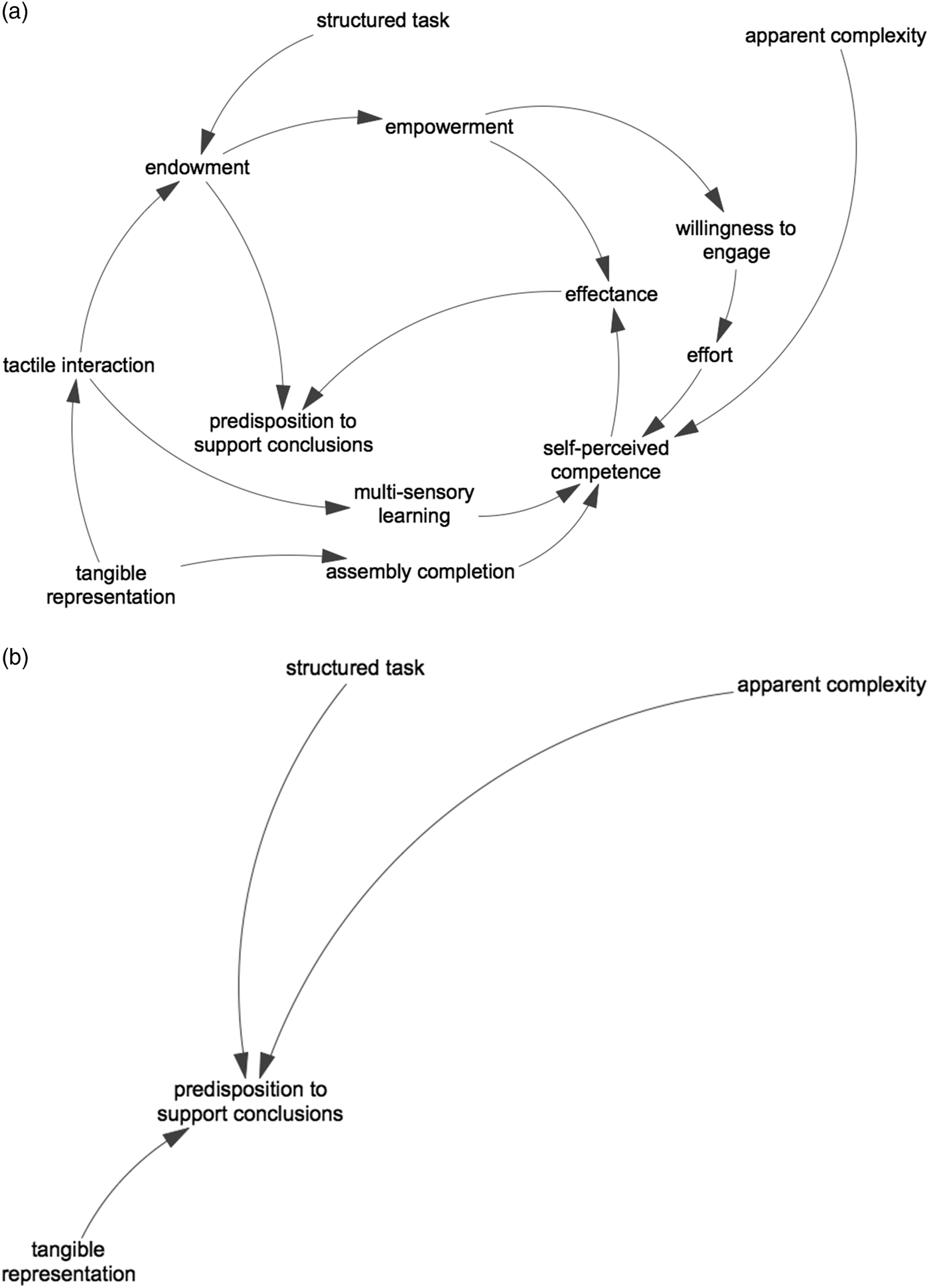
The cognitive bias mechanism (Scott, Cavana, & Cameron, Reference Scott2014) suggests that several aspects of the workshop process act to cause a deviation in judgement that makes participants more likely to support conclusions (Griffiths, Reference Griffiths1994). Group model building begins with entrusting a group to make a decision through use of a structured task (Bußwolder, Reference Bußwolder2015). This may create an endowment effect, where individuals prefer things over which they have been given ownership (Kahneman, Knetsch, & Thaler, Reference Kahneman, Knetsch and Thaler1990; Atladóttir, Reference Atladóttir2011). Transferring ownership increases the power of participants, and this has been shown to support feelings of engagement (‘empowerment leadership’ – Conger & Kanungo, Reference Conger and Kanungo1988).
Group model building may provide conditions for effectance motivation (White, Reference White1959), the desire of individuals to feel effective in the world. Participants collectively build an artefact (the model) related to the problem solving process. The ‘IKEA effect’ is a cognitive bias where individuals place a disproportionally high value on things that they assemble (Mochon, Norton, & Ariely, Reference Mochon, Norton and Ariely2012; Norton, Mochon, & Ariely, Reference Norton, Mochon and Ariely2012; Dohle, Rall, & Siegrist, Reference Dohle, Rall and Siegrist2014). Assembly of an artefact to support the decision process predisposes participants to both agreement (measured as thoughts of positive attributes; Carmon, Wertenbroch, & Zeelenberg, Reference Carmon, Wertenbroch and Zeelenberg2003) and commitment (measured as positive affect and emotional attachment; McGraw, Tetlock, & Kristel, Reference McGraw, Tetlock and Kristel2003). Group model building can be taxing on participants – in a case study described by Scott, Cavana, and Cameron (Reference Scott2014), participants described it as ‘exhausting’ and ‘tiring’. Individuals are likely to have more positive feelings for objects created through great effort (Aronson & Mills, Reference Aronson and Mills1959). Novice participants in group model building workshops are required to learn several new skills through their participation, which may result in a novelty effect, where performance initially improves as a result of increased interest in new techniques (Clark & Sugrue, Reference Clark and Sugrue1988). Causal diagrams (one tool used in system dynamics) can appear foreign and complex; yet can often be created by novice participants. The identification of leverage points for interventions provides a sense of achievement – in Scott, Cavana, and Cameron (Reference Scott2014) participants quickly came to an agreement that emerged mysteriously from the apparent complexity. Individuals place a higher value on experiences where they are able to demonstrate competence (Franke & Piller, Reference Franke and Piller2004), and are more supportive of conclusions that they associate with successful completion of a complex task (Bandura, Reference Bandura1977). Greater (apparent) complexity of the task is associated with greater positive association with the product created (Thompson & Norton, Reference Thompson and Norton2011). Effectance motivation is created by the combination of empowerment and competence (White, Reference White1959).
Paper-based group model building provides the opportunity for interaction with a tangible representation (Black & Andersen, Reference Black2012), and may support a touch bias. The processes described in Scott, Cavana, and Cameron (Reference Scott2013, Reference Scott2014) and Cavana et al. (Reference Cavana, Davies, Robson and Wilson1999, Reference Cavana, Smith, Scott and O’Connor2014) involved the use of sticky labels; participants wrote on and affixed labels to a wall, and then spent a significant portion of the workshop sorting, moving, and refining these labels. Individuals experience a greater sense of ownership and positive affect through physical touch and physical manipulation of an object (Peck & Shu, Reference Peck and Shu2009). The workshop process engaged visual, auditory, and kinaesthetic learning styles (Barbe, Swassing, & Milone, Reference Barbe, Swassing and Milone1979) through the use of visible graphical products, group discussion, and the handling and manipulation of sticky labels by participants. Group processes that engage multiple senses are associated with improved learning outcomes (Dunn, Beaudry, & Klavas, Reference Dunn, Beaudry and Klavas2002; Lujan & DiCarlo, Reference Lujan and DiCarlo2006).
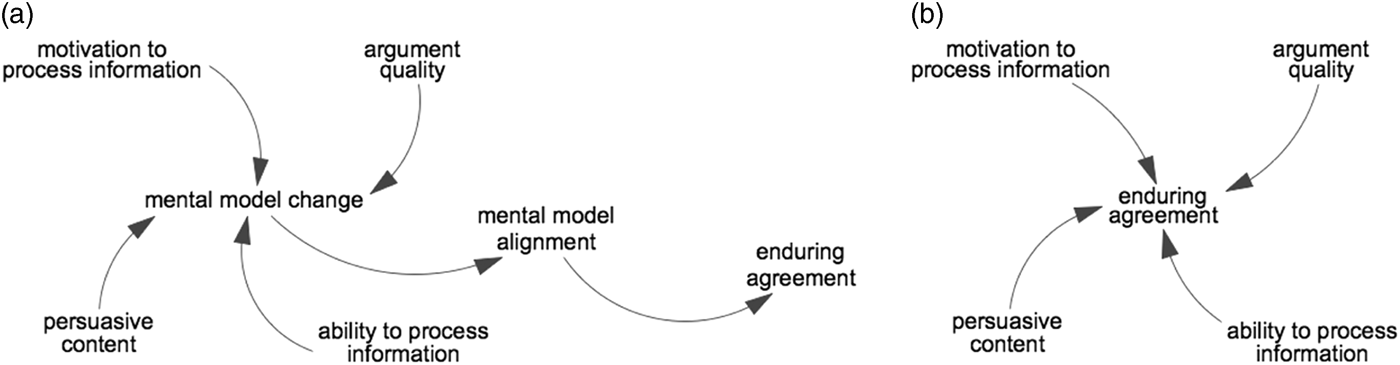
Group model building therefore provides opportunities for endowment, empowerment, assembly completion, effort, competence, effectance, and tactile interaction. Modelling delays the contestation of conflicting solutions, and replaces this with endowment to complete a complex task in the assembly of an artefact. Regardless of whether the model contributes to the quality of the decision, the cognitive bias mechanism suggests that successful collective completion of a complex task creates the predisposition to support the subsequent conclusions (Figure 1a and 1b).
(a) Cognitive biases that predispose participants to support conclusions. (b) Cognitive bias mechanism, simplified model

Boundary object mechanism
Black and Andersen (Reference Black2012) introduce the concept of ‘boundary objects’, a construct from sociology, as an explanation for how group model building encourages participants to trust and agree with each other. The term has gradually evolved over its use, such that the boundary object mechanism as described in group model building literature may not perfectly match the use of the same term in other disciplines (Scott, Cavana, & Cameron, Reference Scott, Cavana and Cameron2016b).
Boundary objects were originally described in the context of multi-site negotiations (Law, Reference Law1987) as abstract or concrete scientific objects that inhabit several intersecting social worlds (Star & Griesemer, Reference Star and Griesemer1989). Key characteristics of this original meaning are that boundary objects satisfy the informational requirements of each social world, are plastic to the needs of the parties using them, and yet are robust enough to maintain a common identity when used by different parties (Henderson, Reference Henderson1991; Spee & Jarzabkowski, Reference Spee and Jarzabkowski2009). The construct was later adapted for use in single-site work (e.g., by Carlile, Reference Carlile2002, Reference Carlile2004; Black & Andersen, 2012; Black, Reference Black and Andersen2013; Franco, Reference Franco2013), where ‘plasticity’ refers not to variability in interpretation between participants, but to the transformability of the object through participation.
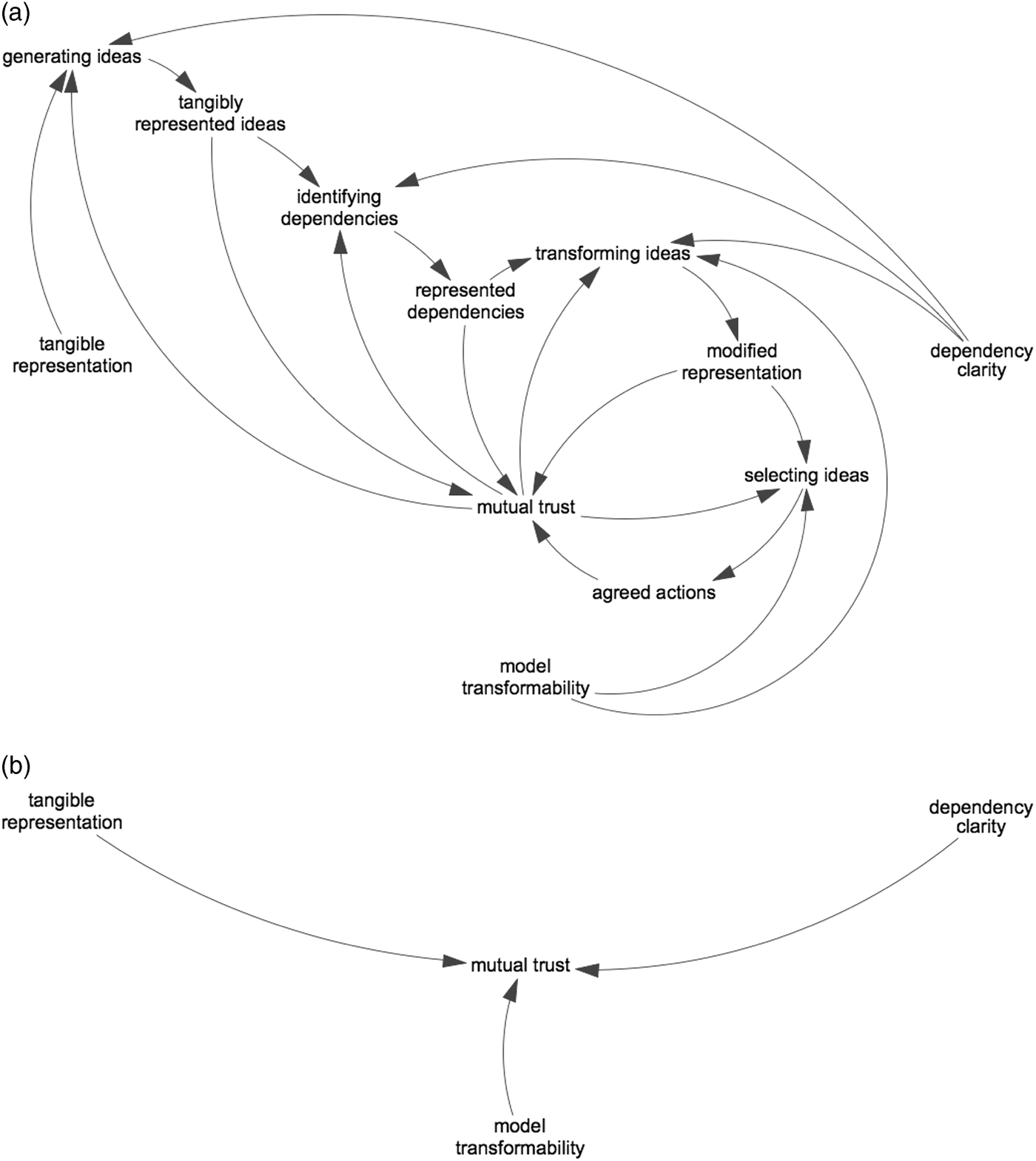
As described in the group model building literature, a boundary object is a shared representation of dependences that participants can modify (Black, Reference Black and Andersen2013). The boundary object mechanism suggests that the (visible) system dynamics models created by participants act as boundary objects to build group members’ mutual trust and agreement. Note that Black and Andersen (Reference Black2012) use ‘trust’ to describe several different (though possibly overlapping) phenomena. At various points in their paper, they describe the importance of trust in the facilitator (pp. 198, 201, 203), trust in the process (pp. 198, 201, 202, 203, 205), and trust in the other members of the group (pp. 201, 202, 203, 204, 205, 206). However, the causal model presented by Black and Andersen (Reference Black2012, Figure 1) describes trust only in the context of ‘members’ mutual trust and agreement’, which appears to refer specifically to participants’ trust in one another and does not seem to directly reference trust in the facilitator or in the process. The use of a tangible representation featuring dependencies allows participants to identify ideas, to feel that those ideas have been heard, and to see connections between different parts of the problem, in order to better understand how each party is affected. The flexibility of the model allows participants to experiment with different possibilities – these possibilities can be shown on the model, and refined through discussion in which the model acts as an aid to clarify what is being proposed. The transformability of the model allows different ideas to be tried, and as the model is improved this creates repeated small victories for the group, which fuels further working together. These ideas are represented below in Figure 2a, adapted from a ‘stock and flow’ model presented by Black and Andersen (Reference Black2012). Figure 2b simplifies this model, by including only the three exogenous ‘input’ variables (tangible representation, dependency clarity, and model transformability) and participants’ mutual trust as the key output. The process to simplify Figure 2a differs from that used in Figures 1, 3–5. In these other figures, the causal diagrams are reduced to their ‘inputs’ and ‘outputs’. In contrast, Figure 2 is as example of ‘closed loop’ causality (Sterman, Reference Sterman2000) in that there is no ‘output’ variable that does not exert some feedback on the overall structure. Black and Andersen (Reference Black2012) describe in the text of their article that the boundary object mechanism consists of sequential stages, and that in the final stage mutual trust allows participants to select ideas and agree to actions, which in turn acts to reinforce mutual trust. It is therefore possible to select any of these three variables as the nominal ‘output’ for the purpose of simplification, and the use of ‘mutual trust’ in Figure 2b should therefore be considered as a simplified representation of this feedback loop. Later in this paper, the boundary object mechanism is integrated into a larger conceptual model, in which participants’ mutual trust supports the selection of ideas and agreement between participants.
(a) Properties of boundary objects that build trust between participants (adapted from Black & Andersen, Reference Black2012: 203, Figure 1). (b) Boundary object mechanism, simplified model

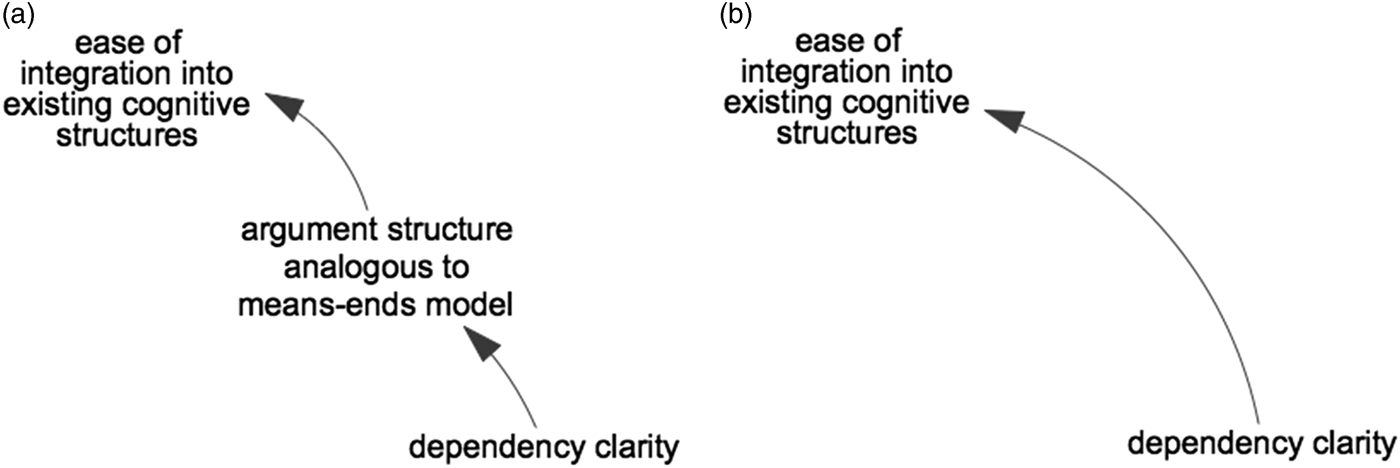
(a) Mental model substitution with operator logic. (b) Operator logic mechanism, simplified model.

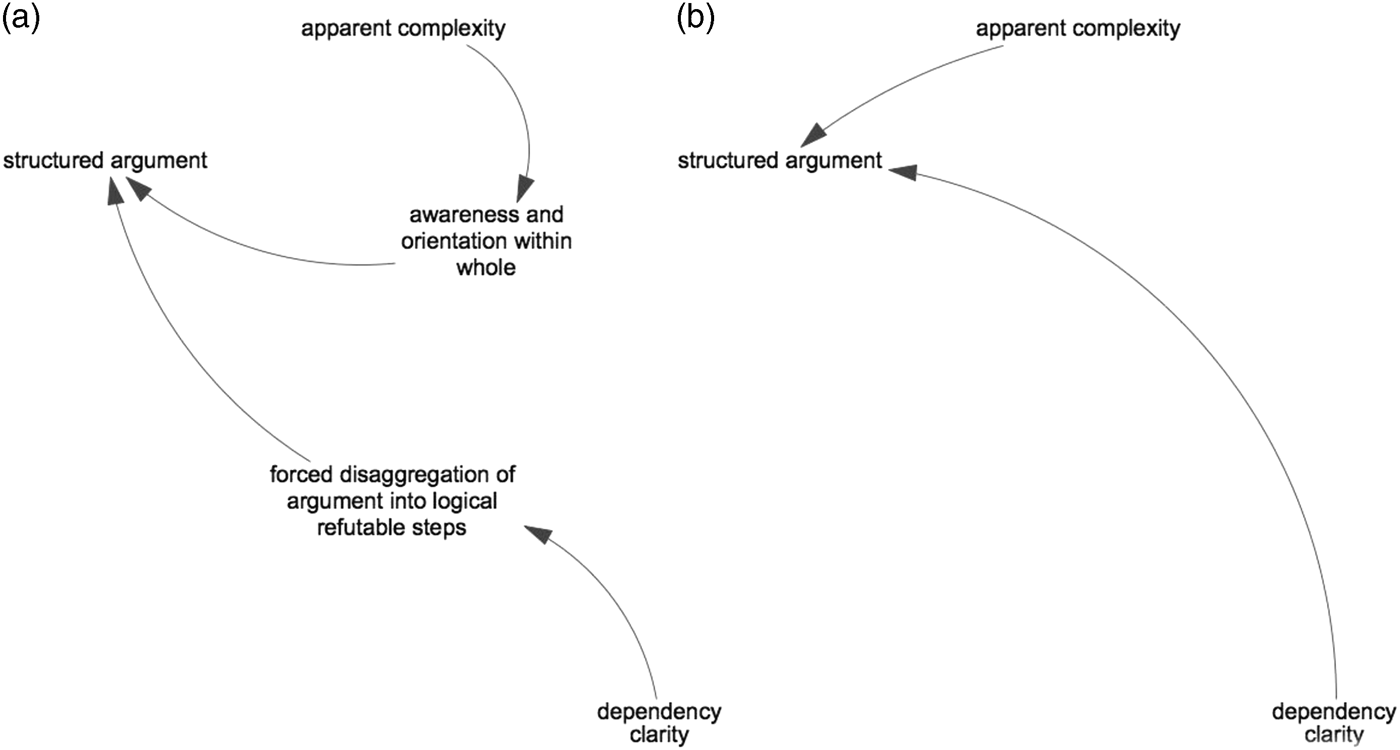
(a) Using models to support the structure of oral arguments. (b) Argument structuring mechanism, simplified model

(a) Conditions under which arguments are likely to be persuasive. (b) The persuasion mechanism, simplified model

Considerable care must be taken to distinguish different sources of participant support for conclusions derived from the model. Bias (described in the previous sub-section) infers a deviation from rationality, in this case arising from participation in the process. For example, the competence bias suggests that participants place a higher value on conclusions associated with a product created through their competent completion of a complex process, because they have positive affect towards things associated with their sense of achievement. In contrast, the boundary object mechanism describes a rational basis for supporting conclusions derived from the model, through a better understanding of dependencies. For example, the boundary object mechanisms suggests that participants may place a higher value on conclusions associated with a complex process, because participating in the process allowed them and other participants to better understand the complexity of the problem system under discussion and therefore be better informed to make subsequent conclusions.
These rational and irrational factors are both proposed to encourage participant support for conclusions derived from the model, and are therefore likely to reinforce each other, and help to explain the strong sense of consensus and commitment to conclusions reported in group model building literature (Rouwette, Vennix, & van Mullekom, Reference Rouwette and Vennix2002; Scott, Cavana, & Cameron, Reference Scott, Cavana and Cameron2016a).
Operator logic mechanism
Mental models are a construct from cognitive science to describe an internal representation of an external reality (Craik, Reference Craik1943). They are small-scale models that the individual believes is analogous to how the world works. Mental models are incomplete (Moray, Reference Moray2004) and represent working models that can be changed (Johnson-Laird, Reference Johnson-Laird1983; Jones, Ross, Lynam, Perez, & Leitch, Reference Jones, Ross, Lynam, Perez and Leitch2011).
Group model building literature has traditionally been interested in a subset of mental models that consider causal relationships, called ‘means-ends models’ (Rouse & Morris, Reference Rouse and Morris1986; Richardson et al., Reference Richardson1994; Moray, 1998, Reference Moray2004; Jones et al., Reference Jones, Ross, Lynam, Perez and Leitch2011). A means-ends model consists of a causal association or ‘dependency’ between two variables (Moray, 1998). The operator logic mechanism suggests that causal links that portray dependencies are easily integrated into existing cognitive structures because they are structurally analogous to the means-ends mental model (Richardson et al., Reference Richardson1994, see Figure 3).
In group model building processes, participants create system dynamics models one dependency relationship at a time (Richardson & Pugh, 1981). Each participant articulates their arguments through proposing individual dependencies, and must defend these arguments against others; in doing so participants may be required to amend or clarify either or both the variables and the causal relationships. They are also exposed to arguments from others (Rouwette et al., Reference Rouwette2011), and these too are in the form of dependencies analogous to means-ends models. Thereby participants are repeatedly exposed, verbally and diagrammatically, to arguments articulated as dependency relationships, which may be easily substituted for existing means-ends models to refine (and more closely align with the group) their internal conception of how the problem setting behaves.
Argument structuring mechanism
Richardson et al. (Reference Richardson1994) propose a ‘systems archetypes mechanism’ where participants recognise and use generic structures (archetypes) to understand the problem system under discussion. Systems archetypes are the underlying structures that explain commonly occurring patterns of behaviour in organisations (Wolstenholme, Reference Wolstenholme1990). The recognition of archetypal patterns has a timesaving benefit for experienced modellers when constructing models (Braun, Reference Braun2002), but is particularly beneficial as narrative devices for explaining system behaviour to clients (Wolstenholme, Reference Wolstenholme2004). They allow for a simultaneous discussion of the overall behaviour of the system, along with a detailed set of refutable means-ends assumptions.
Specific instruction on system archetypes is included in only a portion of group model building interventions (e.g., Kim & Burchill, Reference Kim and Burchill1992), and is not mentioned in any of the empirical studies examined in Scott, Cavana, and Cameron (Reference Scott, Cavana and Cameron2016a). However, the use of system archetypes as a narrative device may represent a subset of a broader phenomenon, ‘argument structuring’ (Schum, Reference Schum1993). Argument structuring may explain why participants in a group model building activity believe they have been exposed to high-quality arguments (Rouwette et al., Reference Rouwette2011).
Argument structuring concerns the sequencing and arranging of logical steps within an argument (Chesñevar et al., Reference Chesñevar, Modgil, Rahwan, Reed, Simari, South and Willmott2006). Initial interest was in the field of juror psychology, to explore different methods by which trial lawyers could break down complex arguments into simpler components (Toulmin, Reference Toulmin1958). Subsequent research revealed limitations in the ability of individuals to comprehend and judge the validity of complex oral arguments (Newman & Marshall, Reference Newman and Marshall1991); oral arguments are a form of storytelling (Gottschall, Reference Gottschall2012) that necessarily include a ‘start’ and an ‘end’, and have difficulty reliably conveying any deviations from a strictly linear sequence (Schum, Reference Schum1993; Seibold & Meyers, Reference Seibold and Meyers2007).
Sterman (Reference Sterman2002) suggests that the structuring of complex causal relationships is one of the distinguishing features of system dynamics modelling. In contrast to the linear sequence of oral argument, models can represent branched (equifinal and multifinal) causality and closed feedback loops. However, these models are not easily read in isolation as readers try and struggle to convert the model into an internal narrative based upon linear argument (Scott, Cavana, & Cameron, Reference Scott2014).
Participation in the creation of a system dynamics model appears to overcome some of the challenges of narrating non-linear arguments. As each causal link is proposed, tested and refined, participants are required to justify only a single logical argument (Scott, Cavana, & Cameron, Reference Scott, Cavana and Cameron2016b). The model emerges as a cumulative effect of these individual links, and thus participants are not required to convert the entire model into a narrative in order to accept the arguments within.
The construction of a complex diagram that is visible to all participants allows each group member to simultaneous view the whole while challenging, considering, and ultimately accepting the validity of each part (see Figure 4).
Persuasion mechanism
Rouwette et al. (Rouwette, Reference Rouwette, Vennix and van Mullekom2003; Rouwette & Vennix, Reference Rouwette, Vennix and Felling2006; Rouwette et al., Reference Rouwette, Korzilius, Vennix and Jacobs2009, Reference Rouwette2011) describe group model building as supporting the conditions under which arguments are likely to be persuasive and cause mental model change. When participants are persuaded by each other and by the model, their mental models become more aligned (Kim, Reference Kim2009). Individuals whose mental models are aligned are more likely to agree (Cannon-Bowers, Salas, & Converse, Reference Cannon-Bowers, Salas and Converse1993), and because mental models are reasonably stable over time (Doyle & Ford, Reference Doyle and Ford1998), these agreements are likely to be enduring (Scott, Cavana, & Cameron, Reference Scott2013). The popular ‘elaboration likelihood model’ (Petty, Cacioppo, & Goldman, Reference Petty and Cacioppo1981) suggests that for arguments to cause mental change, four conditions must be present (see Figure 5): the receiving party must be able to process the information, they must have the motivation to process this information; they must be exposed to high-quality arguments; and the content of these arguments must be persuasive (Petty & Cacioppo, Reference Petty and Cacioppo1984, Reference Petty, Cacioppo and Goldman1986; Chaiken, Giner-Sorolla, & Chen, Reference Chaiken1996). One study reports evidence that group model building supports these conditions (Rouwette et al., Reference Rouwette2011). The following paragraphs further explore each of these four conditions, and their links to other proposed mechanisms.
The ability of participants to process information is a contextual limitation (Rouwette, Reference Rouwette, Vennix and van Mullekom2003), but may be influenced by the format of that information. Group model building integrates and structures the available information (Rouwette et al., Reference Rouwette2011) into discrete logical steps (‘chunks’; Richardson et al., Reference Richardson1994), which are thought to be more easily processed (the operator logic mechanism).
The motivation to process new information is influenced by attitudes towards: the subject or topic, the process, and the group (Petty & Wegener, Reference Petty and Wegener2014). General attitudes towards the workshop subject or topic may be difficult to address, however, several studies report that group model building is effective at building positive affect towards the process and the group (Rouwette, 2011; Scott, Cavana, & Cameron, Reference Scott2014). The cognitive bias mechanism suggests that participants are predisposed to support products created by a group model building process, and the boundary object mechanism suggests that participants will develop positive feelings towards the group. Several studies have shown that individuals are more likely to process information from sources they trust (Chaiken, Reference Chaiken, Giner-Sorolla and Chen1980; Wiener & Mowen, Reference Wiener and Mowen1986).
A high-quality argument is one that subjectively judged by the recipient to be strong and cogent (vs. weak or specious; Petty & Cacioppo, 1986; Areni & Lutz, Reference Areni and Lutz1988). Consequences in a complex system are a result of a large number of interactions (Forrester, Reference Forrester1961; Sterman, Reference Sterman2000), and therefore a high-quality argument relating to causality within a complex system must convincingly explain each important interaction. Argument structuring is the method by which these various interactions are linked and sequenced.
Persuasive content is new and relevant information that supports these arguments (Petty & Wegener, Reference Petty and Wegener1998). While this is limited by the sum of the information known to participants, it is maximised by the extent to which high-quality communication allows this knowledge to be shared. In a controlled comparison with ‘normal’ meetings, group model building has been demonstrated to support greater exchange of hidden knowledge (McCardle-Keurentjes, Rouwette, & Vennix, Reference McCardle-Keurentjes, Rouwette and Vennix2008). The boundary object mechanism (Black & Andersen, Reference Black2012) suggests that mutual trust and the exchange of ideas are mutually reinforcing, supported by the opportunity for all ideas to be visibly represented.
An integrated conceptual model
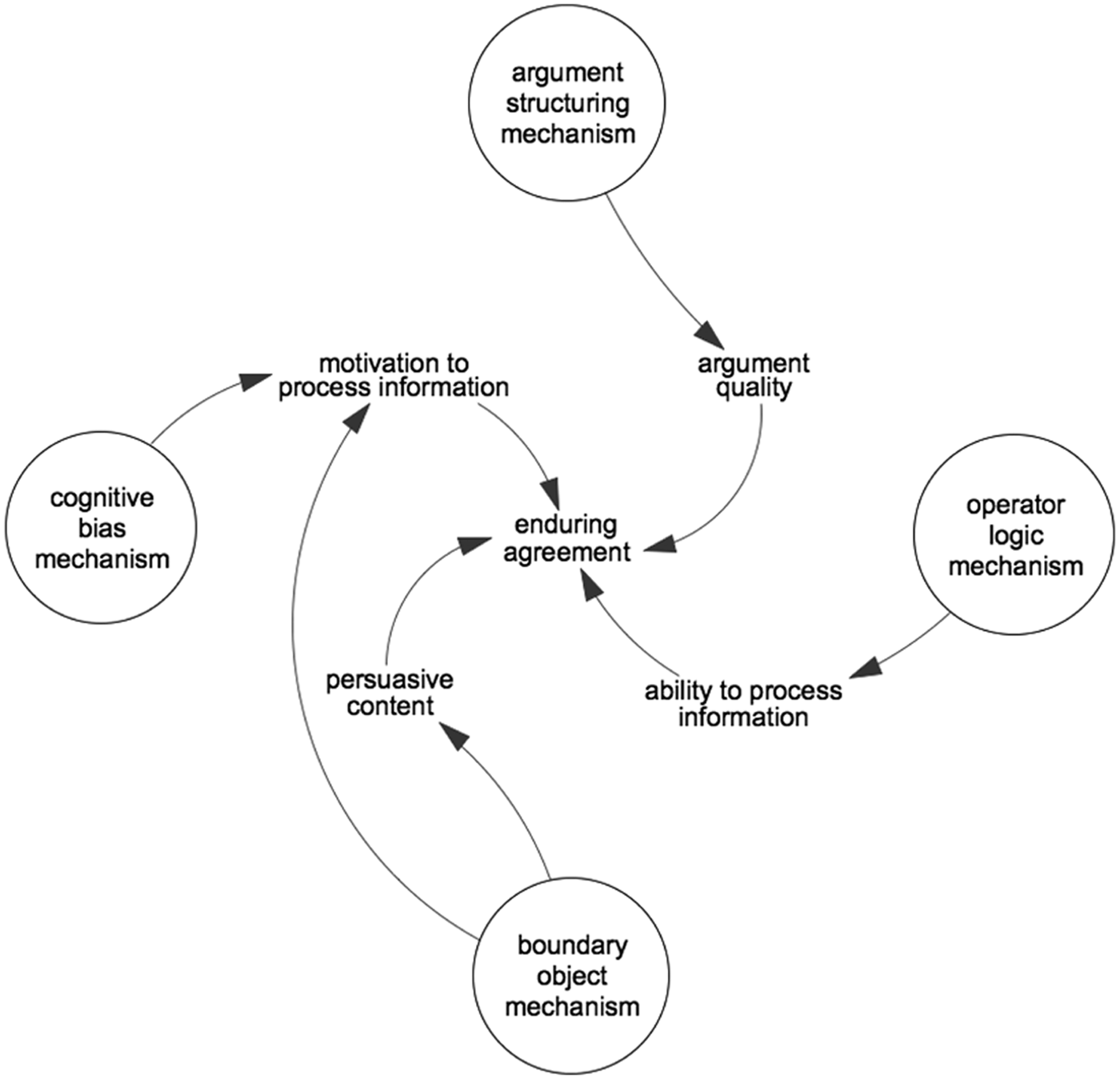
As described earlier in this paper, Scott, Cavana, and Cameron (Reference Scott, Cavana and Cameron2016c) report on contexts where public servants desire enduring agreement as the primary outcome of group decision processes that they commission or conduct. The five mechanisms have therefore been combined to show how they collectively contribute to supporting enduring agreement. This involved linking the outputs of each of the initial four mechanisms with the inputs of the persuasion mechanism, as described above. This is shown diagrammatically in Figure 6.
Links between the persuasion mechanism and other mechanisms

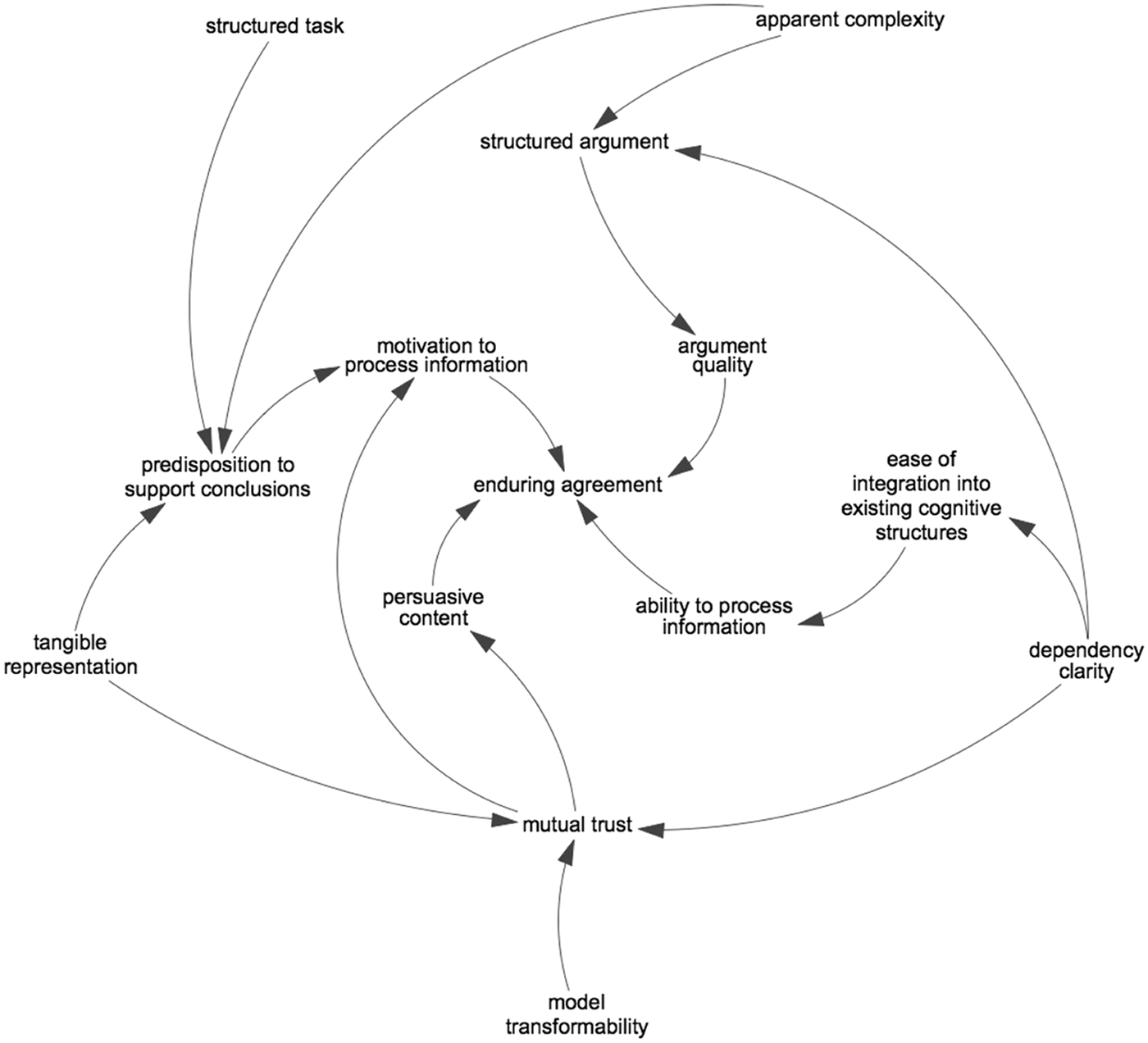
Two relationships have been omitted for simplicity where similar links are already shown: the choice-supportive bias, and the halo effect. The ‘choice-supportive bias’ (Mather & Johnson, Reference Mather and Johnson2000), may directly link the cognitive bias mechanism to the durability of agreement; the memory of participation in a structured and complex decision process supports a tendency to retroactively ascribe positive attributes to the decision made, even when the reasoning has been forgotten (Mather, Shafir, & Johnson, Reference Mather, Shafir and Johnson2000). This link between task structure and apparent complexity, through choice-supportive bias, and to enduring agreement, has been omitted for simplicity as these variables are already linked to enduring agreement through the motivation to process new information. Another potential link, the ‘halo effect’, may further connect the boundary object mechanism to enduring agreement. An individual’s impression of the members of a group influences that individual’s feelings about the decisions of that group (Murphy, Jako, & Anhalt, Reference Murphy, Jako and Anhalt1993). Participants in group model building develop mutual trust and mutual regard, which may spill over into their feelings towards the decision or decisions made. This has been omitted from the integrated model for simplicity as there are already two links between the boundary object mechanism and enduring agreement through the motivation to process new information and the persuasiveness of that information. Figure 7 replaces the mechanism names from Figure 6 with the simplified model for each mechanism as shown in Figures 1b–4b.
Integrated conceptual model for understanding the cognitive and interpersonal effects of group model building in supporting enduring consensus agreement

IMPLICATIONS FOR RESEARCH AND PRACTICE
This paper represents the first attempt at integrating the various proposed mechanisms for explaining how group model building supports enduring consensus agreement. Previous literature aims to explain complex cognitive and interpersonal changes using single mechanisms and drawing from a single strain of literature; this paper began from the perspective that these different mechanisms may occur simultaneously. Subsequently, an integrated model provides a richer story for understanding how these different mechanisms interact with and complement each other. This section describes the specific contribution of the integrated model, above simply considering the different mechanisms to be additive; the importance of a causal theory for group model building; suggestions for further research to test and refine the conceptual model; and implications for group decision-making practice on the assumption that the presented model is accurate.
Benefits of an integrated model
There are several potential implications of simply considering that the five proposed mechanisms are complementary and coexist: adding the proposed mechanisms allows a more extensive list of design features of group model building that contribute to its effectiveness; the different mechanisms can be analysed for common elements or overlaps; and the theoretical basis for group model building is potentially broadened by identifying a wider range of literatures to explore. However, there are certain conclusions discussed in this paper that can only be identified through combining the five proposed mechanisms into a single integrated model. The benefits of an integrated model are discussed briefly below, before the consequent implications are detailed.
The integrated model proposes relationships between the mechanisms. Cognitive bias, argument structuring, operator logic, and boundary object mechanisms are arranged around the persuasion mechanism. The persuasion mechanisms explains how participants are persuaded reach consensus agreement, and the other mechanisms explain how group model building produces each of the preconditions for persuasion.
The ‘output’ variables of the cognitive bias, argument structuring, operator logic, and boundary object mechanisms, can be logically mapped to the ‘input’ variables of the persuasion mechanism. Mutual trust, predisposition to support conclusions, structured arguments, and ease of integration with existing cognitive structures provide an arguably more descriptive set of intermediate variables that support persuasion in a model building context.
Finally, the act of representing the theory diagrammatically clarifies communication between the author and the reader. Roth and Roychoudhury (Reference Roth and Roychoudhury1993) report that combining and exploring interrelationships between different concepts is best accomplished through a combination of diagrams, pictures, and text; Crook (Reference Crook1998) reports that the more abstract the concept, the more helpful it may prove to use diagrammatic representations to facilitate shared understanding. Indeed, the value of visual objects is explored in several the mechanisms described in this paper: dependency portrayals are useful in presenting simple refutable links within a broader equifinal and multifinal context (the argument structuring mechanism described earlier); the act of selecting variable names and drawing causal relationships requires a degree of precision that can be obfuscated in a narrative. The following section describes the implications of the integrated model, based upon the model’s structure.
Implications for group model building theory
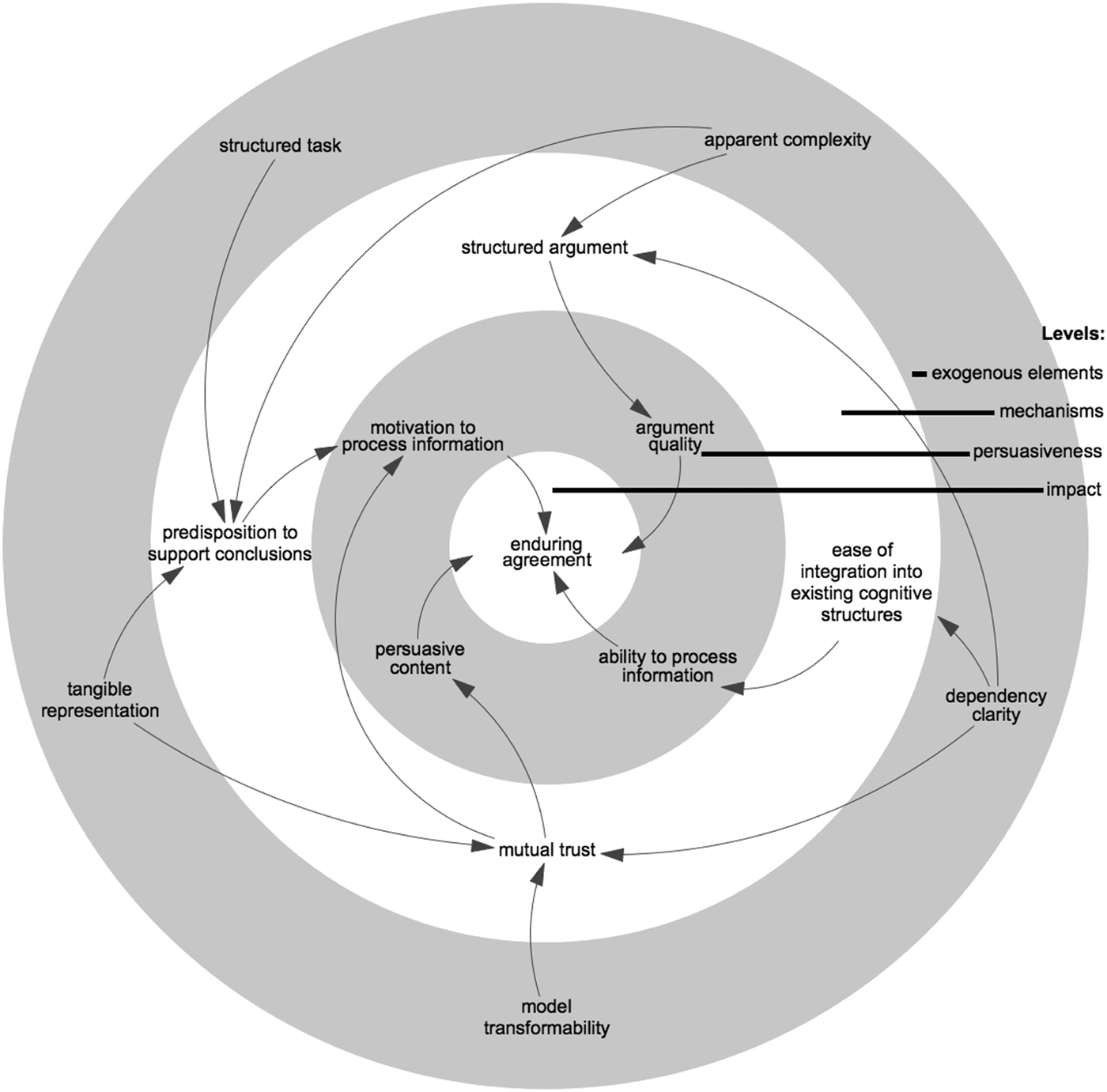
The integrated conceptual model presented in Figure 7 can be understood at four nested thematic levels, each with implications for group model building theory. Figure 8 represents these four levels as concentric rings. The following paragraphs describe the implications of each level on group model building theory.
The integrated conceptual model divided into four thematic levels

The primary benefit from combining multiple proposed mechanisms is to explore complementarity and interrelationship between them. The first (outermost) level of the integrated model identifies five exogenous elements that contribute to group model building success: completing a structured task, producing a tangible artefact, the representation of complexity, the portrayal of dependencies through causal links, and the transformability of the model by participants. Individually, each element could apply to a range of group decision processes. However, collectively they provide a reasonably comprehensive description of the core elements of group model building methods. No one mechanism identified all five exogenous variables, and therefore the model integration allowed for a richer understanding of the necessary conditions through which group model building supports enduring agreement than would be possible using any mechanism alone. Three of these exogenous variables contribute to multiple mechanisms: producing a tangible artefact, the representation of complexity, and the portrayal of dependencies through causal links; when constructs are proposed in multiple independent theories they are likely to have greater validity (Campbell & Fiske, Reference Campbell and Fiske1959). Each of these exogenous variables is within the control of the practitioner (facilitator or process designer) and may therefore be described as design features.
The second and third levels concern the mechanisms themselves; the explanations for why the workshop elements (the outermost level) result in enduring agreement (the innermost level). These causal explanations are important in that they help us to speculate what might work; indeed, this is the underlying motivation for the field of system dynamics. Just as the identification of supporting elements in the outermost level allows practitioners to follow best current practice, good causal explanations aid in the development on new practices. The mechanisms in the second level are supported by several types of theory and evidence: psychology and cognitive science theory; by separate empirical evidence that verifies components of each theory in other contexts; and by the stated recollection of participants’ describing their experience in group model building workshops (Scott, Cavana, & Cameron, Reference Scott, Cavana and Cameron2016b). These mechanisms may allow theorists to suggest what design features might work, and in what contexts group model building may be most effective. For example, the argument structuring mechanism proposes that diagrams portraying dependencies can be useful for narrating non-linear arguments, which in turn suggests that group model building may be particularly useful in problem settings where nonlinear causality is prevalent.
The third level also describes intermediate theory, in this case the conditions for persuasiveness. This has empirical support in the psychology literature (Petty & Cacioppo, Reference Petty, Cacioppo and Goldman1986), evidence from group model building specifically (Rouwette et al., Reference Rouwette2011), as well as participant recollections (Scott, Cavana, & Cameron, Reference Scott, Cavana and Cameron2016b). Implicit in this model is that enduring agreement occurs when individuals are persuaded that a decision is correct, and that agreement is likely to be less enduring when it occurs for other reasons, such as to avoid conflict or to bring the meeting to a more rapid conclusions (Glicken, Reference Glicken2000). This assumption appears to have informed a significant proportion of group model building literature, that has extensively measured agreement with the conclusions of the meeting, with relatively less focus on conflict avoidance or process efficiency (Scott, Cavana, & Cameron, Reference Scott, Cavana and Cameron2016a).
Persuasion is also likely to be more important in situations where participants care deeply about the decision, and will not agree to decisions to avoid conflict or bring the meeting to a conclusion. This has possible implications for selecting contexts in which to apply group model building, and in designing research settings that match realistic applications (see discussion of research in applied settings in Scott, Cavana, & Cameron, Reference Scott, Cavana and Cameron2016a).
The fourth (innermost) level identifies this as a model for explaining how group model building produces enduring agreement. As described in the introduction, group model building is applied in many different contexts and for very different purposes. The model relates to the group dynamics perspective of group model building, as a process for creating an artefact that enables enduring agreement with decisions made collectively by participants. The integrated model does not specifically describe how group model building supports other outcomes, such as improved policy quality (e.g., through facilitating improved knowledge sharing; McCardle-Keurentjes, Rouwette, & Vennix, Reference McCardle-Keurentjes, Rouwette and Vennix2008). Similarly, it does not describe how participants in the group model building process use the insights from their participation in the process to subsequently make improved management decisions outside of the group model building process (e.g., through improved cue selection; Richardson et al., Reference Richardson1994). These alternate contexts and purposes are likely to be explained by a different conceptual model, including different mechanisms or the same mechanisms interacting in different ways.
Limitations and opportunities for refinement
The scope of this paper has been limited by the decision to focus on creating an integrated model for explaining how group model building supports enduring agreement. Further work is required to construct a theoretical model to explain the microworld perspective – how group model building results in improved policy quality – and additionally to explain how group model building supports participants to make improved subsequent management decisions once they return to their regular roles. One possible challenge to this paper is to consider that the microworld and group dynamics perspectives are so closely related and interdependent that it is a mistake to try to separate them; it will be possible to test such a challenge when models have been constructed for these other contexts and purposes and the various models may be compared.
This paper is limited by the conceptual nature of the model. Evidence supports various sub-elements of the conceptual model, as described in preceding sections. However, the overall structure has not been validated empirically, and the behaviour of a system cannot always be anticipated as the sum of its parts (Sterman, Reference Sterman2000). The integrated model can be conceived as a series of falsifiable propositions: the five design features each contribute to the effectiveness of group model building in supporting enduring consensus agreement; deficiencies in any of these design features will make group model building less effective in supporting enduring consensus agreement; deficiencies in any of these design features will affect intermediate outcomes such as mutual trust, predisposition to support conclusions, etc., in the manner predicted by the links in the model. The model could also be refined if and when other design features are identified that contribute to the effectiveness of group model building, or when other mechanisms are identified through which these design features affect the process.
Research methods for testing refining this model have already been proposed in three separate research agendas. Doyle (Reference Doyle1997) proposes a programme to explore the cognitive psychology of group mode building, which would allow deeper understanding of the mechanisms themselves. Andersen, Richardson, Vennix (Reference Andersen, Richardson and Vennix1997) propose a system for understanding the contribution of individual design features to modelling outcomes. Scott, Cavana, & Cameron (Reference Scott, Cavana and Cameron2016a) proposes methods for understanding the effectiveness of group model building in different contexts and compared with alternative methods.
The conceptual model, like all theory, is likely to be incomplete, and will be adapted and augmented as new theory and evidence is presented. In the mean time, it is presented as a working prototype for improving our understanding of group model building workshops and processes. The final section assumes the integrated conceptual model is accurate and valid, and describes practical implications that can be immediately applied by practitioners.
Implications for group decision-making practice
Practitioners make choices in how they design a group decision process, and how they monitor and adapt a process while it is occurring. This section explores how practitioners can ensure that the processes they use include each of the five design elements identified above, and how they may apply the mechanisms within the model to monitor and diagnose their progress. Given the limitations described above, it is worth restating that these implications apply only on the assumption that the conceptual model is accurate and valid.
The conceptual model presented in this paper suggests that group decision practitioners can help support durable consensus agreement by recreating the following five design features (described below): completing a structured task; producing a tangible artefact; the representation of complexity; the portrayal of dependencies through causal links; and the transformability of the model by participants.
From the cognitive bias mechanism, it is possible to infer that any group decision support system may be beneficial because the action of agreeing to complete a structured task (Bußwolder, Reference Bußwolder2015) is in itself a form of agreement. This suggests that it may be preferable to begin a group decision meeting by agreeing to a process, rather than arguing over solutions, as building incremental agreement fuels further working together (Black & Andersen, Reference Black2012). A further implication for practice is that participants may be more supportive of solutions if it is clear at the outset that the decisions generated through completing the process will be implemented (endowment effect).
Different modelling processes may result in an artefact that feels more or less tangible. Physically interacting with the model may provide a touch bias. Computer modelling software is now cheap and easy to use, which may provide a temptation for the model to be completed digitally by the expert. From the cognitive bias mechanism, it is possible to infer that paper-based models may be more useful for supporting a sense of model ownership, at least in the early stages of model development.
Conversely, the boundary object mechanism suggests that models should be easily transformable. Computer models can be reshaped and modified repeatedly, and even offer the option to revert to earlier versions if one path leads to a dead end. Paper-models quickly become messy as lines are crossed out and variables renamed; paper-based modelling frequently involved multiple iterations, where the model is transcribed to a new clean sheet. One compromise may be the use of removable sticky labels attached to a large erasable whiteboard (Scott, Cavana, & Cameron, Reference Scott2013), although iterations may still be required (Black, Reference Black and Andersen2013). Alternately, different media may be more appropriate at different stages of the modelling process (e.g., paper-based modelling to encourage a sense of ownership, followed by computer-based modelling as the model is progressively refined.
Another consideration is the depiction of complexity. Some facilitators may be tempted to support the simplification of models to make them appear less daunting to participants, for example through encouraging the clustering and consolidation of variables before creating the causal diagram. One possible inference of the cognitive bias mechanism is that facilitators should consider maintaining models in complex forms, as participants may benefit from navigating through apparent complexity in order to reach their own answers. The process of persisting through that complexity and coming out the other side appears to support a competency bias to improve predisposition to support conclusions of the process. If the client or facilitator want a simpler model for communication purposes, this can be achieved as a later iteration based upon the new understandings built during completion of the initial complex model. Expert-led modelling processes frequently use ‘concept models’, which are simplified representations used early in the modelling process to test assumptions with a client group in order to improve the quality of the model (Richardson, Reference Richardson and Pugh2013). Concept models are therefore part of the ‘microworld’ view of system dynamics, and may work counter to the interpersonal mechanisms described in this paper.
The argument structuring mechanism suggests that models that show causal links can be used to support the discussion of complex arguments. This shifts the focus from the model to the conversations that it supports. One possible inference from the conceptual model is that facilitators may which to encourage participants to narrate their perspective on how the system works. Tracing causal loops can be used to reduce a complex argument to simple logical steps while still orienting the listener to the whole. Recent group model building research has begun to record and analyse the conversations between participants during the workshop and may begin to shed light on this underexplored aspect of group model building (McCardle-Keurentjes, Rouwette, & Vennix, Reference McCardle-Keurentjes, Rouwette and Vennix2008; van Nistelrooij, Rouwette, Vestijnen, & Vennix, Reference van Nistelrooij, Rouwette, Vestijnen and Vennix2012).
A further benefit of the model to inform practice may be in helping practitioners to understand whether they are on track. Here the second level of the model may be useful: predisposition to support conclusions, use of structured arguments, ease of integration into existing cognitive structures, and mutual trust. If any of these four processes are not occurring, this may be a sign to pay more attention to supporting the associated mechanism, as explained below.
If participants do not appear to have a positive regard and predisposition to support conclusions from the model, the facilitator may wish to examine the conditions that support the cognitive bias mechanism, in particular whether participants committed to the use of a structured process, to represent complexity, in the form of a tangible artefact that they have built.
If participants are not using the model to structure their arguments to highlight refutable dependencies within the context of complexity, the facilitator may wish to encourage participants to do so by tracing causal chains in the model and explaining these relationships verbally to other participants.
If participants appear to be struggling with understanding the problem, the facilitator may want to focus on clarifying participants’ shared understanding of individual causal links (means-ends models). This might involve clarifying the variable name, disaggregating the variable into related but different constructs, and/or revisiting the causality and polarity of the links between two variables. Clarifying means-ends models allows information ‘chunks’ (Richardson et al., Reference Richardson1994) to be more easily integrated into existing cognitive structures.
Finally, consideration must be given to the interpersonal dynamics, and whether participants appear to exhibit mutual trust. If participants do not appear to trust each other, one possible inference of the boundary object mechanism is that the facilitator may wish to look to ensure that: every participants’ contribution can be represented tangibly, the representation shows dependencies, and the representation may be collectively transformed or refined over time.
Through applying these principles, practitioners may be able to better design and implement group model building practices to support group decision making. As the conceptual model continues to be developed and refined, it may be possible to critically review the various ‘scripts’ (Hovmand et al., Reference Hovmand, Andersen, Rouwette, Richardson, Rux and Calhoun2012) that document group model building processes, to further guide the application of group model building for supporting enduring consensus agreement.
Acknowledgements
This paper is based upon doctoral research that was selected as Best Doctoral Dissertation at the 2015 Australia and New Zealand Academy of Management conference. The author would like to thank the Australian and New Zealand Academy of Management, Deakin University, and the Journal of Management and Organization for their involvement in this award. The author would also like to thank Robert Y Cavana (Victoria University of Wellington) and Donald Cameron (University of Queensland) who provided valuable advice and support as PhD supervisors.
Financial Support
This research received no specific grant from any funding agency, commercial, or not-for-profit sectors.
Conflicts of Interest
None.