INTRODUCTION
Occupation is defined as everything people do to occupy themselves, and it is regarded as meaningful when it accomplishes a purpose or goal that is considered personally or culturally important (Law et al., Reference Law, Steinwender and Leclair1998; Townsend & Polatajko, Reference Townsend and Polatajko2013). Engaging in personally meaningful occupations restores a person's sense of meaning and purpose. Having control and freedom of choice in one's everyday occupations is also thought to have a strong influence on a person's sense of well-being (Townsend & Polatajko, Reference Townsend and Polatajko2013). Loss of the ability to perform occupations that are personally important may affect a person's sense of being a capable and healthy individual (Corbin & Strauss, Reference Corbin and Strauss1987; Vrkljan & Miller-Polgar, Reference Vrkljan and Miller-Polgar2001).
Physical disability and a need for assistance in the performance of the activities of daily life is common among people in palliative care (Javier & Montagnini, Reference Javier and Montagnini2011). This affects most aspects of their lives and can lead to loss of control, loss of identity, loss of social role, depression, decreased quality of life, and increased caregiver need (Cheville, Reference Cheville2001; Coyle, Reference Coyle2006; Keesing & Rosenwax, Reference Keesing and Rosenwax2011; Lyons et al., Reference Lyons, Orozovic and Davis2002). Important indicators that affect a person's experience of quality of life when in palliative care include the hours spent in bed, physical strength, and the ability to do what one wants (Javier & Montagnini, Reference Javier and Montagnini2011).
Engagement in meaningful occupation enables people to view themselves as healthy and to maintain a sense of well-being despite their life-threatening illness (Kagawa-Singer, Reference Kagawa-Singer1993; Lyons et al., Reference Lyons, Orozovic and Davis2002; Vrkljan & Miller-Polgar, Reference Vrkljan and Miller-Polgar2001). One study on how people with advanced cancer create meaning and handle everyday life through occupations showed how the participants grappled with thoughts about the future and what was left of their lives. The participants reported that engaging in occupations was a way for them to regain what they had lost due to their illness and helped them express a desire to live and be treated as healthy. In another study (la Cour et al., Reference la Cour, Josephsson and Tishelman2007), participants described how engaging in creative occupations enabled them to confront some of the consequences of their advanced illness, such as the loss of belief in oneself, the loss of hope, and the loss of social relationships. Creative occupations can also be used by persons in palliative care to develop a way to handle and adapt to decreasing physical ability and existential concerns. The social aspect of the occupation also helped participants to develop strategies to manage their life situation.
Rasmussen and Sandman (Reference Rasmussen and Sandman1998) studied how patients in an oncology unit spent their time during hospitalization. They found it to be a lonely experience for patients, almost completely devoid of social interaction or meaningful occupations. Patients spent nearly 75% of their waking time alone in their rooms. Their social interactions consisted mainly of contact with a nurse, with whom they spent an average of 85 minutes during the day and 28 minutes at night. Almost half of that time was devoted to taking medications, giving blood samples, and having cytostatic treatment.
Earlier studies on the meaning of occupation have focused on performance of the activities of daily life in a home environment or on creative occupation in daytime care in a hospital for inpatients and ambulatory care patients with advanced cancer (la Cour et al., Reference la Cour, Josephsson and Tishelman2007; Reference la Cour, Johannessen and Josephsson2009). Many patients in palliative care spent time as inpatients in a hospital during their time of illness without access to organized occupations. According to the World Health Organization's definition, palliative care should include providing a support system to help patients live as actively as possible until death, a support system to help the family cope during the patient's illness, and enhancing the patient's quality of life (WHO, 2002). In reality, patients in palliative care in a hospital spend most of their time lying in bed with limited opportunities to be active, as described by Rasmussen and Sandman (Reference Rasmussen and Sandman1998). Given our awareness of the importance of occupations for a patient's sense of meaning, we would assume that patients would desire more than that for the final stage of their lives. As it appears that no studies on this aspect exist, it would be valuable to investigate patients' attitudes and perceptions regarding occupation during hospitalization.
The concept of occupation employed in our study is understood from the definition given by Law et al. (Reference Law, Steinwender and Leclair1988) as “everything people do to occupy themselves, including looking after themselves, enjoying life, and contributing to the social and economic fabric of their community.” In our study, occupation relates to how hospitalized patients experience what was performed earlier, what is performed now, and what is to be performed in the future.
AIM
Our objective was to describe how patients in palliative care relate to occupation during hospitalization and the meaning it has for them.
METHOD
Participants
The participants were purposefully recruited from three surgical units at a medium-sized city hospital based on the following criteria: enrolled on a surgical unit, diagnosed with a noncurable cancer, not diagnosed during the present hospitalization, and not previously encountered by the first author in her role as occupational therapist. Patients who met the criteria were identified by the nurses in charge of them, who informed the first author. To create the best potential to study the research question from different aspects, the objective was to achieve variation in the sample in terms of gender and age (Malterud, Reference Malterud2009).
Eight participants, five men and three women with various cancer diagnoses, agreed to participate. They were between 53 and 75 years of age, the range for women being 53–64 and for men 61–75 years. Seven participants were married or in common-law relationships and had children, two of whom with children living at home. All of the participants had managed to live at home without home care service before their present hospitalization. Some participants had received some support from their life partners (e.g., with clothing). The duration of participants' hospital admissions before the interview varied from two days to more than a month. The survival time ranged from one to six months from enrollment in the study, except for two participants who were still alive after one year. Four patients declined to participate after they received information about the study, referring to fatigue and an unwillingness to be interviewed.
Procedure
The patients who met the criteria received verbal and written information about the study from the first author and were given time to reconsider their participation before giving a written reply. They were assured that any information given would be reported anonymously and treated in confidence. They were also informed that their participation was optional and that they could withdraw from the study at any time without explanation or without any effect on their future care. The study was approved by the ethics committee of the Faculty of Medicine at Umeå University (archive no. 2011-378-31M).
Participants were interviewed once during their hospital stay. The interviews took place in a private ward at the unit, took 30–60 minutes, were recorded, and were then transcribed verbatim. They were narrative and based on thematic questions that focused on the meaning and performance of occupations during hospitalization and patients' experience of their hospitalization—in terms of roles, environment, and time. The interviews started with the participant being asked to describe a typical day on the unit. The supplementary questions concerned what they had done and their feelings about various aspects of their time at the hospital. All interviews were conducted by the first author, a skilled occupational therapist with experience in palliative care. She consciously endeavored to remain open-minded during the interviews, to perceive any new and unexpected knowledge, and to let all points of view appear.
Data Analysis
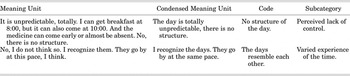
The interviews were analyzed using the steps of qualitative content analysis with an inductive approach and procedures to ensure trustworthiness, as described by Graneheim and Lundman (Reference Graneheim and Lundman2004). The focus on qualitative content analysis was to identify similarities and differences in any texts, so as to be able to discern variations. The analysis deals with manifest and latent context in a text, where the manifest content is often presented in categories and the latent context in themes. The eight transcribed interviews were considered as the unit of analysis. To create a familiarity with the text and a sense of the material as a whole, the text was read through several times. Two content areas were recognized: (1) occupation options and (2) occupation impediments. The text was then divided into meaning units. The meaning units were condensed, abstracted, and labeled with codes. The codes were compared based on similarities and differences and sorted into subcategories and then into categories that united the content into the subcategories. An example of the analysis is shown in Table 1. Finally, a theme was formulated. There was continuous discussion and reflection between the authors during the creation of the meaning units, codes, categories, and themes until consensus was reached, to ensure stringent and trustworthy interpretations.
Examples of meaning units, condensed meaning units, codes, and categories

RESULTS
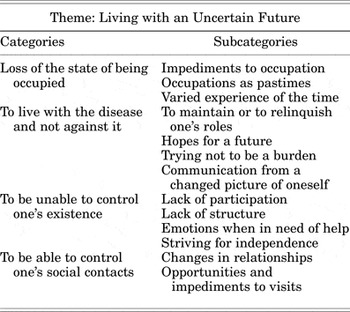
The content of the text is described in 4 categories and 13 subcategories, as shown in Table 2. The overall theme constructed was “living with an uncertain future.” This theme reflects the effect of the disease on the performance of occupations in patients' lives.
Theme, categories, and subcategories

Loss of the State of Being Occupied
Impediments to Occupation
All patients described experiencing impediments to occupation in one form or another. Several said they had no confidence in their abilities, as they had not done much during their hospitalization. Some reported that they could not do anything by themselves, others that the kind of help they required varied from day to day, and some that they did everything by themselves. They expressed disappointment over not being able to do things as they used to and reported having an increased need for assistance in such occupations as going to the bathroom, showering, and getting out of bed. They described such factors as decreased motivation, energy, and strength; increased breathlessness when performing physical activity; decreased cognitive ability; increased pain; and decreased amount of time as impediments to occupation:
I really don't do anything by myself. I'd like to have a shaver and be able to go to the bathroom and shave as much as possible, but I don't have a shaver— There's only the hospital one, and that's an instrument of torture … // … Sometimes I get calls. Today one of my sons called … // … Finally, I had to ask him to stop talking because I didn't have the energy to hold the phone. I'm that bad.
The ability to get up from the bed and leave the room was described as something the patients longed for. Several said that they simply did not have the strength to leave their bed, and if they did, only for a short while. Several reported that they needed help to get out of bed. Once sitting down, they said, the pain would come, forcing them to go back to bed after only a short while. Some had not left their rooms, whereas those in better condition tried to walk to the toilet or out in the corridor whenever possible. Even if mobilization was experienced as trying, patients indicated clearly it was something meaningful that made them feel better.
Being able to take care of oneself, especially in terms of personal hygiene and walking, was expressed as meaningful and important. They described an impediment in the form of decreased strength, which meant that they would need to rest after occupations. For one patient, the need for oxygen was also an impediment. Some who had decreased strength and only left their bed for a short time reported being unable to do almost anything, that they had even stopped reading, as they did not have the strength to hold a book, and they would fall asleep listening to audiobooks.
In terms of their impediments, patients mentioned various functions and occupations they had lost and now longed for. Several referred to a desire to be physically active—and most of all to be outdoors. They were well aware of the long distance to the entrance of the hospital, but for some even the distance from the ward to the dayroom in the department was a problem:
Yes, that's also really disappointing. I think your overall fitness declines— You're in worse condition, and you lose all the muscles in your body. That is probably what I miss the most—being physically active outdoors. That is what I miss.
One patient described how he missed his freedom, saying he had a feeling of being imprisoned because of the lack of common spaces and the fact that patients were always expected to be in their own rooms. Other things the patients missed were daily newspapers, a music room, a menu, and, for those not up to visiting the kiosk, the ability to buy things in the department. Several patients missed having a computer and wanted to be able to borrow or rent one when in hospital. The patient could then use the computer to pay bills, answer e-mails, and watch movies. One described how during her most recent hospital stay she had asked for a computer so she could pay her bills on time, but her request was denied without any clear explanation:
One thing I think they should have is at least one computer, for internet banking and stuff like that … // … You wish they could have one available for the patients. It would be okay to pay a small fee to use it. You really miss having a computer to use, especially when you're stuck here over the turn of the month.
Occupations as Pastimes
Patients talked about the performance of occupations as a pastime, and in some cases, such as listening to music, as a kind of relaxation. The occupations the patients had engaged in during their hospitalization were, first of all, their daily care, reading, watching television, doing crosswords, listening to the radio and to music, and using a computer. Some also mentioned taking care of their business at home, sleeping, and talking on the phone as occupations they employed to pass the time:
So I think books and crosswords are great pastimes, and I enjoy them. A good way to escape it all for a little while.
Several described watching television as something they did not find meaningful but that they would do it in the absence of other occupations they could manage:
I might just as well watch television at home, but … No, for sure it's a pastime. Although it can be hard to concentrate anyway, eh?— You've already got so much to think about.
Varied Experience of Time
The patients' experience of time during their stay varied. More than half reported that the days went by quickly, that they had plenty to do, and that the days closely resembled each other. Sometimes the days passed without their being able to say what they had done; other patients talked about having routines, such as, for healthier patients, a daily walk to the kiosk or outside. The various visits and examinations by hospital staff also helped them pass the time:
Like I say, I've been busy every day. I haven't even had time to start reading the book I brought with me, which I had planned to read.
Other patients, particularly those with a limited ability to engage in any occupation outside their bed or their room, reported that the days were very tedious and that they had nothing meaningful to do:
Yes, it is tedious. You just lie there watching TV and listen for sounds in case you might be getting a visitor.
To Live with the Disease, not Against It
To Maintain or Relinquish One's Roles
When talking about maintaining or relinquishing their roles, the women were prominent. They said they were normally the one who did the planning for the family, the one who kept things together at home—the spider in the web. They now found it most difficult to maintain this role, especially when in hospital. They had to explain to their husbands and children that they were no longer capable of doing everything they used to be able to accomplish:
I'm the hub, right? They all come to me, but I can't quite do it anymore. I tell them they'll have to ask their father about things like getting a lift and about their appointments, and he'll have to do a little planning, shopping, and getting supplies. I haven't been downtown since last summer.
Both at home and when in the hospital, the women had to delegate tasks to other family members. They had to struggle with their feelings about letting go of their family role, as well as with their guilty conscience about the increased burden on others, especially the children. One patient, though, said that she used to serve the other family members too much and that delegating was something she would have had to learn in any event:
I guess I've got used to it. At first, I felt sorry for them somehow. I forced them, all four of them, to have a cleaning weekend …//… but it feels strange, and they're not used to it either, because it's always been me who's done all the indoor work.
Some of the men also described having to struggle with their feelings about relinquishing their family roles. They'd taught their wives to take care of the things they normally took care of—like doing the tax returns, filing documents, and paying bills.
One patient, now in the situation of needing help from the department staff, talked about losing her role and explained how she normally took care of herself and others, at home and at work. She now felt completely out of place, having to bother the staff, say, when she needed help in the bathroom, something she would usually help others with at work:
Until a couple of days ago, I was the type who always took care of myself and have been totally independent, running a home and a family. Suddenly the roles are reversed— I'm glued to an oxygen tube and haven't any stamina. It feels as if, I don't know, as if I've somehow lost hold of what I was supposed to do.
Hopes for a Future
Some patients had positive thoughts about their future, explaining how they had to take one day at the time. One said that he would not walk into a corner and another that she refused to be caught at home. They wanted to use the time that was left to accomplish as much as possible. One patient said he would use any new capacity in a meaningful way. There was a desire to become stronger so that they could continue with the occupations they used to do, such as walking, reading, painting, working, and exercising. Also, being able to practice traditional holidays like Easter and sitting in the garden next summer were occupations the patients spoke of longingly:
I hope to be able to take care of myself more and more, depending on how things progress—being able to walk and so on. It would be wonderful if I felt that I could grab my cane and walk to the bathroom. I would be totally satisfied with that.
Several patients expressed concern about what would happen in the future. They mentioned that it was important, here and at home, that they become healthy, but even so, they were thinking about how long they would have the strength and what fighting the disease would really involve. Some declared that they might never come home again, while others tried to ignore the reality that they would not be as independent the next time they were admitted to the hospital:
Yes, that is actually difficult. I would start to feel like a package then. It's probably the only negative thought I've had—hoping I don't ever end up in that state. And yet, it's going to happen; we repress that.
Trying Not to Be a Burden
Several patients said they wanted to have certain things done before they passed away. This involved things they felt they could not leave to anyone else, such as doing their taxes or cleaning up and organizing their papers. Some expressed relief that it was all done and others worried about not being ready or not yet having everything the way they wanted it to be. They had a lot of thoughts about the future and were worried about their families and how they would manage to take care of everything by themselves. They tried to facilitate as much as they could. One patient also pointed out that he felt that some things had to be saved, even though his children did not always see the value in them:
Clean up. I have tried, in the last month or so, to organize my papers … // … Do they understand what I've got here? I've worried a bit about that, that I haven't really got things perfectly organized.
Communication from a Changed Picture of Oneself
Some patients said that because of the long distance from the hospital to their home, they had no opportunity to have a serious face-to-face talk with family members during their hospital stay. When talking on the phone, they tended to joke and talk about more happy subjects instead. Because of that, one patient explained that she had not yet told her husband and children about recent changes in her condition. She wanted to wait until she got home again.
To people other than their closest family, some patients said they preferred not to share everything, preferring to tiptoe around the actual truth. One patient in particular referred to a feeling she never talked about anything but her disease. She found it hard to be totally honest because she didn't want to be a victim and did not want others to worry about her condition. Yet, she understood that others were talking about her behind her back and reported that she had now accepted this. She also said that her husband thought it would be easier for him if everyone knew what was going on. Another patient said that being open about her disease from the beginning had helped her handle the psychological effects of the disease:
I have a hard time accepting this business of being sick, or rather, I've accepted it, but telling others about it is what I find difficult, very difficult.
Some patients described both the positive and negative effects of the disease on their relationships. One stated that her relationship with her husband had changed in a positive way since she had become sick. Her husband, who normally did not do much at home, now attended her and helped to prepare meals. She attributed the change to their both realizing now that they did not know how much longer they would have each other. Another patient described problems in his relationship owing to a lack of acceptance of his situation by his partner, who did not want to talk about it. The patient did not know what information his partner had received from the staff about his condition, as they had not discussed it:
Yeah, well there is a problem, because my partner doesn't actually want to accept the situation … // … she doesn't really want to see over onto the other side. I asked one of the doctors down there to call her because he had suggested going into one of these conversation rooms, but that was no good— She'd just sit there and cry. Then I'd start crying, and the doctor would feel bad. So I wanted him to call, but I don't know if he did because she hasn't said a word. On the other hand, she has a hard time talking about this.
To Be Unable to Control One's Own Existence
Lack of Participation
Several of the patients expressed a feeling of not knowing what was going to happen next and what plan the doctors had for them. They had not participated in the discussion about their future care to any great extent and said they found that the doctors sometimes would not dare give them all the information about their situation.
Patients reported that they had met a great many doctors during the time of their illness, both in hospital and in primary healthcare. One referred to the difficulty in building a trusting relationship with someone you have only met once:
I don't think I've ever met the same doctor twice. But I guess it's good that they do that and spread knowledge, but they don't coordinate anything, and I don't get unambiguous answers about anything. That must be wrong. And I don't know who has the primary responsibility for me.
One patient was really upset after he was given different answers by different hospitals and doctors about his future care. The day before, he met a doctor he found to be extremely annoying. When the patient asked for answers about his future treatment, he was told that it would be discontinued because it was not helping. He did not pursue any discussion with the doctor at that time, as he was just happy to see the doctor disappear. The incident left the patient with a feeling of anger and a sense of a lack of participation.
Lack of Structure
Some patients talked about a lack of control and structure and a feeling of not knowing what was going to happen during the day. One in particular described a feeling about not being able to control his day and the frustration of not knowing when things would happen. He declared that he had allowed himself to be passive at the hospital because he was no longer able to control anything:
I don't know what I could do during the time here … // … I have no control over anything. Things just happen, and they can happen at any time. There's no structure at all. And my self-determination is apparently not interesting here.
There was also a lack of information for patients about the routines of the department: when meals were served, if it was okay to grab something to eat whenever you felt like it, information about where they could find things, and what was expected from them.
Emotions When in Need of Help
At the time of the interviews, patients' occupation levels varied from independent to being in need of assistance with almost everything. The ones who were independent could only imagine the feeling of being in need of assistance. One described the importance of being able to take care of himself and said he felt unwell if he was in need of assistance. Another, who had been in need of assistance at the beginning of her hospitalization but was now independent, said it felt natural to receive help because she had been so ill at that time that she was not able to take care of herself.
Among the patients in need of assistance, attitudes varied from acceptance on the part of one patient to embarrassment for others. One patient who expressed acceptance said that he did not find it fun being in need of assistance, but he accepted it because of his occupational limitations:
Well, you just have to put up with that. You realize that you have limitations when it hurts. So I don't think I have any problem making it work.
The ones in need of assistance expressed a feeling of embarrassment about being in need and unable to take care of themselves and about being seen by others—for example, when taking care of their hygiene. While they were grateful for the assistance, all expressed a desire to be able to take care of themselves if given the opportunity. The need for assistance was something they had to get used to, but it was described as an impediment that was hard to overcome, particularly the need to accept assistance from people other than their closest relatives.
Some patients also expressed a feeling of being “caught” when needing assistance. One described how in the morning he had to wait for an hour for help with getting to the bathroom and that because of the wait he had gotten to the toilet by himself twice during the night, even though he had been instructed not to do so:
That felt terrific, because there was one evening when I had had to get there on the mobile toilet commode, and that was, well, it wasn't actually horrible. It's a good thing they do come and help, but I have to say, you can feel really embarrassed if you have to ask for it, for such a small thing as going to the bathroom.
Striving for Independence
All of the patients referred to a desire to be able to take care of themselves. They tried to do as much as they possibly could, to be as independent as possible. They described how they felt good not to be needing help all the time. One pointed out that it was important that the staff listen to the patient and his wishes regarding how he wanted to do things. Another reported that he asked for opportunities to do things by himself but that there were variations in what different staff would permit. All patients said that they sometimes went ahead and did things by themselves without staff permission, even though some of them did need help with most occupations:
I ask for it, as a matter of fact. And there's a lot of variation here: some staff are considerate and give help wherever help is needed and let me take care of the rest. Then there's another sort that only goes ahead and does things without asking. There are also those who carefully and a little anxiously do what they need to do to get me to the bathroom, and then they run away as fast as they can, so they're not around in case I fall or something.
Another patient had a discussion with someone on the staff about his right to go to the bathroom during the night, when the night staff had offered him a urine bottle instead. He argued that he did understand their tough work situation but that his situation as a sick person was something that should not be affected by that:
Granted, they ask, can you take a bottle? Certainly, if I were in the military in a trench I could do it, but I don't think it should be necessary within the Swedish medical service.
To Be Able to Control One's Social Contacts
Changes in Relationships
Most patients talked about social interaction with family, friends, staff, and other patients as something positive and meaningful and as something that gets their days going. The social interaction brought them joy, and several reported that visitors as well as other company in their room made them feel calmer:
All visits are so welcome, even if it only concerns taking a blood sugar test or whatever it may be. They are welcome because it is so lonely here—long days.
Visitation from family and close friends was described as something really meaningful that brought an opportunity to share thoughts and someone to laugh with. Visitors brought a feeling of attention and care from family and friends.
Some patients talked about the positive outcomes of mobilization and the opportunity it brought them for social interaction with others in the corridor and the dayroom. One of the patients placed in a private room expressed a desire for company but felt that he could not ask for that. Patients also reported that the length of their hospitalization affected their feeling of loneliness, in that if they had had more time they would have been able to make friends among the staff and with other patients in the department. One described a feeling of being imprisoned because of the lack of freedom but considered the duration of hospitalization and the experience of earlier visits as extenuating circumstances.
While most patients considered social interaction favorable, some aspects of it were referred to as negative. One said that many visitors could be tiring and that, depending on the visitor, there could be a feeling of compulsion to be active during the visit even if the patient did not feel well:
No, it sort of depends a little on who it is, I'd say. So, with the friend who is here almost every day, I can say, “Now I have to rest a while.” But if they're just staying for a half an hour or so, I feel I have to be more active.
Some patients expressed a feeling of wanting to keep certain things to themselves. One reported that during her hospitalization she had not left her room because she was afraid of meeting anyone she knew, and she did not want to answer uncomfortable questions. Also, she hid when visitors called at her home, and she had only been to the store once in the past six months because she was afraid of meeting someone she knew:
If you meet someone, you know you may have to put up with a lot of questions that you find uncomfortable, questions you may not really want to answer, so you prevaricate.
One patient described a sense that people around him had pulled away and that there was less social interaction because others were afraid of the situation the patient was in. He did not find this strange since he had been in similar situations himself with sick friends in the past.
Opportunities and Impediments to Visits
The frequency of visitors varied from none for one patient to several each day for another. Most patients had visitors pretty much every day. The factors influencing the opportunities for receiving visitors included the health of the relatives and, primarily, the distance to the hospital from the homes of family and friends, with some living as far as 150 km from the hospital:
Maybe the first week when I was here, my partner did come and visit, but it is quite difficult because she has to leave the house at around 10:00 in the morning, arrives here at 20 to 1:00, and then has to catch the bus back at 4:30.
DISCUSSION
Our study illuminate the meaning of occupation for patients in palliative care when in hospital. The results indicate the importance of occupation and, especially, the importance of being able to take care of oneself to the degree that is possible, to preserve abilities, and to continue to feel like a whole person. The overall theme reflects the importance for all professional groups of taking a comprehensive approach to meeting with patients in palliative care. It is important to closely consider what aspects are most important and most affected for each individual.
The results show that patients experienced impediments that influenced both their physical and mental capacity in occupations, which resulted in an increased need of assistance for several patients. These findings indicate that it is meaningful and important to be able to take care of oneself, to be able to continue to be active, and to be involved in the occupations that they formerly took part in. A previous study showed that loss of the ability to perform occupations that the person finds important can affect a person's view of themselves as a capable and healthy individual (Vrkljan & Miller-Polgar, Reference Vrkljan and Miller-Polgar2001). Participating in occupations that a person finds meaningful helps them to recapture a sense of satisfaction, which helps to motivate them to get up and get moving. It also serves to distract them from their disease and to reinforce the notion that they are alive, and that life does go on after a diagnosis of a life-threatening illness. People continued to define themselves as healthy with cancer when maintaining occupational patterns despite the limitations imposed by their illness (Kagawa-Singer, Reference Kagawa-Singer1993).
All the patients in our study expressed a desire to be able to take care of themselves. Some nevertheless were in need of assistance with almost everything and found it hard in their present situation to imagine what they would be able to do on their own. A previous study showed that participants seemed determined to do what they could for themselves no matter how little that was (Lyons et al., Reference Lyons, Orozovic and Davis2002). When the participants in another study found that they could no longer do things in the way that they used to before their disease, they changed their attitudes toward how much they believed themselves to be capable of, and also lowered their expectations about how occupations should be performed (Svidén et al., Reference Svidén, Tham and Borell2010). They felt that it was more important to continue to do something as opposed to nothing, and chose more carefully what they found most important to do. The motivation for continued involvement in occupations and for participating in daily life included the experience of pleasure and a feeling of being capable when performing occupations. The feeling of being capable gave participants the experience of being healthy. This reasoning was supported by Fryback (Reference Fryback1993), who found that individuals with a life-threatening diagnosis considered themselves unhealthy when they were incapable of engaging in those occupations they desired to perform, not solely because of their diagnosis.
In hospital settings and in everyday life, people with advanced cancer often experience a reduction in their ability to be in control and perform occupations, which may lead to a diminished sense of self and reduced self-confidence (Rasmussen, Reference Rasmussen1999). This is in line with the results of our study, where it was indicated that patients' experience of a lack of participation and loss of control influenced them in many ways. They reported that decisions had been taken about their future care without their participation, which gave them a feeling of not being in control of their future. A previous study showed that open communication to ensure patients' understanding of their situation is considered a key element of quality in palliative care, as it serves to prepare patients for the end of life (Wentlandt et al., Reference Wentlandt, Burman and Swami2011).
Our results showed that a lack of information and not knowing if and when things are going to happen tend to make patients passive both in terms of occupation and in their participation in planning for future care. The staff's actions also influenced patients' opportunities to be as independent in occupations as they could and wanted to be. The staff affected the patients in ways they may not have been aware—for example, when they were not allowed to make their own decisions or helped them instead of letting them use their own capacity in occupations. Those actions are in line with two of the five master suppression techniques described by Ås (Reference Ås1981): making invisible and withholding information. These master suppression techniques are actions, in most cases unconscious, between persons in different positions of power. The consequences of making people invisible and withholding information must be noticed and discussed, so that staff can be made more aware of the negative impact of asymmetric power relationships, and so that changes can be made.
The staff's actions may also be explained by Kielhofner (Reference Kielhofner2008), who stated that the normal role expectation changes when a person is ill and incapacitated and takes on the role of an invalid, subject to expectations of passivity and compliance. If the patient gets used to the role of being disabled, it can overshadow other aspects of his or her identity and predispose them to allow others to make decisions about their care. The reactions of others can lead to their being overprotective or overly helpful, unnecessarily lowering their expectations or considering the person to be disabled beyond his or her actual limitations. The key to maintaining or improving the capacity of patients in end-of-life management lies in the attitudes and approaches displayed by staff (Eva & Wee, Reference Eva and Wee2010). It is important that staff behavior encourage independence and promote patients' sense of pride and desire not to be a burden. It should support patients' views of themselves as resourceful and worthwhile individuals.
Most patients in our study still had a positive outlook for their future. They considered it important to become healthy and stronger, to be able to do the things they used to do. An earlier study showed that it is important to create new challenges as more and more of the tasks they normally do became too demanding (Svidén et al., Reference Svidén, Tham and Borell2010). It is still important to have goals to attain in everyday life. The satisfaction of achieving a goal, which contributes to the pleasure of doing something, is possible through new challenges and revised goals. Participants stated that maintaining their daily routines and having some little task to do every day was satisfying. The awareness of death may provoke an enhanced need for proximity to life and meaning, which spurs people to engage in occupation through which they narrate a good life in the face of their circumstances (la Cour et al., Reference la Cour, Johannessen and Josephsson2009). Staying active and maintaining a positive outlook allows people to cope with their anxiety about having cancer and about being a burden to their family.
Our results show that patients tried to simplify things as much as possible for their families before they passed away. This is supported by previous studies which found that participants created a legacy to make things easier for their family in the future (Coyle, Reference Coyle2006; Wentlandt et al., Reference Wentlandt, Burman and Swami2011).
The women as well as the men in our study described how they had to let go of some roles and tasks that they normally had done. However, there are still differences in what they described. Where the women described having lost their role as the one who took care of everyone, especially the family, the men more often reported that they had had to let go of certain tasks that they normally did. Both men and women indicated that their place in the family and their identity as a mother/father and wife/husband had been affected. The differences in how men and women described the losses they experienced might be explained by the different expectations they had about their role in the family and their identification with norms and values regarding what is feminine and what is masculine (Öhman, Reference Öhman2009). There were gender differences described where females had a greater level of emotional work and males focused more on doing what was necessary (Seymour-Smith & Wetherell, Reference Seymour-Smith and Wetherell2006).
The patients in our study mentioned such factors as the health of relatives and significant distance from the hospital that affected their ability to have visitors. Some had not seen their friends and relatives for quite some time and kept in touch by phone, and several preferred not to talk about serious topics. There were no alternatives to the telephone in the department for communication with those who were not able to visit. With today's technology, there is a wide range of internet-based communication options, including options that allow the patient and family members to see one another. A previous study showed that this form of technology often provides nonverbal communication and allows family members to get a sense of the patient's clinical condition (Brecher, Reference Brecher2013). Such communication can provide relief from emotional and spiritual suffering for both the patient and family members, and could help strengthen the patient's relationships with their loved ones.
Rasmussen and Sandman (Reference Rasmussen and Sandman1998) stated that the physical environment of the oncology unit in which their study took place did not encourage extensive visits. With most patients in shared rooms, there were little opportunity for privacy, which could affect the ability of patients and families to share experiences. This was supported in our study in terms of visitors. However, sharing a room can also be beneficial, as reported by one patient, who felt lonely in his private room. Instead of a private room, the patients in our study reported that they missed having access to common spaces and felt consigned primarily to their rooms. The ability to walk the halls and visit the dining room in the department represented an important opportunity for social interaction. One patient complained of a loss of social interaction with family and friends because of his disease. This result is in line with other studies which found that participants experienced a sense of being intimidating to others, of being distanced from others, and of no longer being treated in the usual manner, with resulting damage to social relationships (la Cour et al., Reference la Cour, Josephsson and Tishelman2007; Reference la Cour, Johannessen and Josephsson2009).
The participants in our study were inpatients at three surgery departments. They had a wide range of conditions, from common surgical complaints (e.g., appendicitis) to traumatic brain injury and various stages of cancer. This places great demands on all types of professional, who are expected to be knowledgeable in a variety of areas. According to the national medical programs for palliative care, care provided to people during the final stages of life should be permeated with a comprehensive view of the individual person, which requires that the staff be well educated in the relevant area (Regional Cancer Center, 2012). The expertise in palliative care in the departments where our study took place varied in accordance with professional experience. There were no persons with specialist expertise in palliative care, yet there was a palliative consult team to contact if necessary. The demands in terms of staff expertise may have influenced patients' experience of the limitations of the care they received during their time in the hospital. The results of our study might have been different in certain aspects if the study had taken place on an oncology unit or in a hospice, where there is less variation among patients, which would make it possible for the staff to focus more on and attain more expertise in palliative care.
ETHICAL CONSIDERATIONS
There were some ethical considerations about how patients would experience the interviews. Several of the participants expressed gratitude for the opportunity to talk and reflect about their situation and to contribute new knowledge to the field. They sometimes found it hard to express their feelings, but none said that it was hard to talk about these topics or that they wanted to stop the interview process prematurely. Several discovered things that they wanted to do or things that they wanted to resume during the time left to them. It appeared that none of the patients suffered as a result of their participation in our study.
STRENGTHS AND LIMITATIONS
The strength of our study is that it illuminates the meaning of occupation during hospitalization, an aspect that has received little, if any, attention in the research literature. The participants were from a group considered fragile. The fact that they chose to participate in the study despite their frailty indicates a trust in the interviewer and probably in the care they received and the professionals they encountered. Participants were invited to contact the interviewer if there were questions or thoughts that came up, but none of them did so.
It was harder than expected to find participants who fulfilled the inclusion criteria, so that it was not possible to obtain the degree of variation originally planned. During interviews, participants had difficulty separating the performance of occupations at the hospital from performance of occupations at home. It was particularly hard for those who only had been at the hospital a couple of days prior to the interview. In the recruitment of participants, there were no criteria involving length of care, though perhaps there should have been. The participating women were in range younger then the men, and two of them still had children living at home. This, apart from gender, may have influenced the result as regards patients' experience of maintaining or relinquishing roles when they still had a more central role in their children's lives compared with those who had older children.
CONCLUSIONS
Our results demonstrate that patients in palliative care find occupations meaningful when in the hospital. There was a desire among our patients to be able to handle their own needs as much as possible and to retain occupations and abilities for as long as possible. Those desires were affected by staff behavior, by the design of the environment, by the lack of accessible occupations, and by the provisions for receiving visitors. Moreover, our results also pointed to a loss of roles and a perceived loss of control and participation among patients. These findings indicate a need for more knowledge among the staff as regards the meaning of occupations for patients in palliative care and the importance of giving patients ways of remaining as independent as possible. They also indicate the importance of taking a comprehensive approach for all professional groups regarding meeting with patients in palliative care to attend to whatever aspects are most important for that specific person. There is a need for further studies to examine what kind of occupations patients in palliative care find meaningful when in hospital and how organized occupations could affect their experience of being hospitalized.
ACKNOWLEDGMENTS
We are grateful to the participants for their time and to the nurses in the surgery departments for their help in identifying patients who met the criteria for participation. Our study was supported by the Department of Community Medicine and Rehabilitation, Umeå University, Unit of Research, Education, and Development, Östersund, and the Jämtland County Cancer Fund.