Attachment schemas are affect-laden mental representations (Baldwin, Fehr, Keedian, & Seidel, Reference Baldwin, Fehr, Keedian and Seidel1993) and part of a system that regulates distress in childhood (Kobak, Holland, Rayanne, Fleming, & Gamble, Reference Kobak, Holland, Rayanne, Fleming and Gamble1993) and adulthood (Mikulincer & Shaver, Reference Mikulincer, Shaver and Zanna2003). One of the ways that attachment schemas achieve their regulatory function is by guiding processing of emotion and attachment-related information (Bowlby, Reference Bowlby1980; Fraley, Garner, & Shaver, Reference Fraley, Garner and Shaver2000). Much research has accounted for schema-congruent effects at later stages of information processing (e.g., memory, accessibility, inhibition; Baldwin, Keelan, Fehr, Enns, & Koh-Rangarajoo, Reference Baldwin, Keelan, Fehr, Enns and Koh-Rangarajoo1996; Edelstein, Reference Edelstein2006; Mikulincer, Dolev, & Shaver, Reference Mikulincer, Dolev and Shaver2004), yet there is limited information on how attachment schemas influence early stages of emotion and attachment-related information processing when activated (e.g., Dewitte, Koster, De Houwer, & Buysse, Reference Dewitte, Koster, De Houwer and Buysse2007; Edelstein & Gillath, Reference Edelstein and Gillath2008). The present study extends this line of research by directly testing how different conditions of attachment schema activation (subliminal or supraliminal) may affect processing of both attachment-related and more general emotional information.
Attachment Organisation, Regulatory Processes and the Processing of Attachment and Emotion-Related Information
The regulation of physical or psychological threat and emotion is a central feature of the attachment behavioural system. A control theory model has been utilised to explain how the attachment system functions to regulate threat or distress in childhood (Kobak et al., Reference Kobak, Holland, Rayanne, Fleming and Gamble1993) and adulthood (Mikulincer & Shaver, Reference Mikulincer, Shaver and Zanna2003). The main function of the system is the maintenance of felt security via: (a) the monitoring and appraisal of signs of interpersonal or social threat that can activate the system, (b) the monitoring and appraisal of the availability of attachment figure(s), and (c) the engagement of secondary strategies of hyperactivation or deactivation to regulate attachment-related feelings and needs when the goal of the system is not fulfilled (Mikulincer & Shaver, Reference Mikulincer, Shaver and Zanna2003).
In adulthood, situations of personal or interpersonal distress activate attachment schemas with cognitive (Mikulincer & Arad, Reference Mikulincer and Arad1999; Mikulincer, Birnbaum, Woddis, & Nachmias, Reference Mikulincer, Birnbaum, Woddis and Nachmias2000) and affective (Rowe & Carnelley, Reference Rowe and Carnelley2003) consequences. Adults high on attachment anxiety typically adopt hyperactivating secondary strategies in order to regulate the anticipated or felt distress. Individuals with avoidant attachment schemas, on the other hand, deactivate the attachment system (Fraley et al., Reference Fraley, Garner and Shaver2000), with consequences for information processing (Dykas & Cassidy, Reference Dykas and Cassidy2011). For example, avoidance has been consistently associated with suppressing and limiting accessibility to attachment-related emotional memories and thoughts about an event, and the reduction of affective hyper-activation as a result of such memories (e.g., Edelstein, Reference Edelstein2006; Mikulincer et al., Reference Mikulincer, Birnbaum, Woddis and Nachmias2000; Gross & John, Reference Gross and John2003; Rowe & Carnelley, Reference Rowe and Carnelley2003).
One of the contentious issues in the attachment information-processing literature concerns the function and effectiveness of avoidant individuals’ deactivating strategies, with a focus on how information-processing biases are indicative of avoidant emotion regulation strategies, especially under stressful or cognitively demanding conditions. For example, there is evidence that avoidant individuals’ defensive mechanisms fail to circumvent the physiological stress response under high cognitive load or when negative emotions are particularly intense, leaving highly avoidant persons subject to health risks over the long term (Diamond, Hicks, & Otter-Henderson, Reference Diamond, Hicks and Otter-Henderson2006). Despite the theoretical and clinical importance of the matter, there is limited research on how activating conditions of the attachment system may result in avoidant attachment information processing biases for attachment-related and emotion information; the limited existing research had equivocal results (Dewitte, Reference Dewitte2011; Dewitte & De Houwer, Reference Dewitte and De Houwer2008; Dewitte, Koster et al., Reference Dewitte, Koster, De Houwer and Buysse2007; Edelstein & Gillath, Reference Edelstein and Gillath2008; Mikulincer et al., Reference Mikulincer, Dolev and Shaver2004).
One of the earlier studies testing avoidant information deactivating strategies (Mikulincer et al., Reference Mikulincer, Dolev and Shaver2004) examined recall of a painful breakup (supraliminal prime) from a romantic partner followed by instructions to suppress (or not) thoughts regarding the breakup under high or low cognitive load. In a subsequent emotional Stroop task that included separation words, participants high in avoidance demonstrated no interference effects in the low cognitive load suppression condition, and reaction times were relatively low for separation words. Yet, when cognitive load was high, reaction times for the separation words were significantly longer, indicating that avoidant participants’ deactivating strategies are not effective in inhibiting the rebound of previously supressed material in conditions of high cognitive demands.
Further evidence for the deactivating strategies adopted by highly avoidant participants comes from a study that examined whether avoidant individuals inhibit attention to attachment-related versus general positive and negative valenced words and the extent to which the implementation of such biases requires cognitive resources (Edelstein & Gillath, Reference Edelstein and Gillath2008). Avoidant participants inhibited attention (showed less interference) to negative and positive attachment-related stimuli (there was no effect for non-attachment-related general positive and negative stimuli). Importantly, reduced interference to attachment-related material was observed only among those participants who were currently in romantic relationships and only under conditions of low cognitive load, suggesting that being in a relationship serves as a naturalistic (subliminal) prime of the attachment system, a notion supported by other research (Gillath et al., Reference Gillath, Mikulincer, Fitzsimons, Shaver, Schachner and Bargh2006; Kafetsios, Andriopoulos, & Papachiou, Reference Kafetsios, Andriopoulos and Papachiou2014). Therefore, when the attachment system is subliminally activated and the cognitive load is low, avoidant individuals are able to use their deactivating strategies successfully. However, the study by Edelstein and Gillath (Reference Edelstein and Gillath2008) failed to reveal a significant association between avoidance and attachment-related interference in the high-cognitive load condition, either for individuals in a relationship (even though there was a trend for high interference) or for those not currently in a romantic relationship. Based on these findings, Edelstein and Gillath (Reference Edelstein and Gillath2008) argued that avoidant defensive strategies are the product of a secondary, more effortful processing.
Taken together, the results from existing research suggest that mode of attachment system activation may be relevant for the way that attachment and emotion information is processed by avoidant persons. Mikulincer et al. (Reference Mikulincer, Dolev and Shaver2004) found that high avoidants showed significantly more interference for separation words when the attachment system was supraliminally activated. Conversely, Edelstein and Gillath (Reference Edelstein and Gillath2008) failed to evidence interference when the attachment system was subliminally activated with a naturalistic prime (being in a romantic relationship).
The main aim of the current study was, therefore, to test whether avoidant individuals’ information processing biases are automatic or strategic (requiring extra processing capacity), depending on the mode of activating the attachment system. Automatic information processing differs qualitatively from strategic (or controlled) information processing (Fiske & Taylor, Reference Fiske and Taylor2013). Automatic processes: (a) operate outside of awareness or intention; (b) concern early stages of information processing; (c) operate continually and cannot be willfully suppressed, modified or ignored; (d) require consistent training; and (e) require minimal use of cognitive resources and continue to operate under cognitively demanding or highly stressful situations (Beck & Clark, Reference Beck and Clark1997; Hasher & Zacks, Reference Hasher and Zacks1979). Strategic (or controlled processes) on the other hand: (a) are conscious and voluntary; (b) are slow and thus amenable to regulation; (c) utilise higher levels processing involving semantic analysis and synthesis; and (d) require considerable cognitive capacity, thus limiting the person's ability to engage simultaneously in other processes that also require cognitive effort (Beck & Clark, Reference Beck and Clark1997; Hasher & Zacks, Reference Hasher and Zacks1979; Shiffrin & Schneider, Reference Shiffrin and Schneider1977).
Research on adult attachment has examined avoidant information processing biases in an either/or fashion, trying to test whether these biases are automatic or strategic (e.g., Edelstein & Gillath, Reference Edelstein and Gillath2008; Fraley & Shaver, Reference Fraley and Shaver1997); yet, to our knowledge, no research has explicitly tested whether the same (or different) information processing biases operate when the attachment system is active or not. It is possible that avoidant persons utilise automatic processing when the attachment system is deactivated and strategic processing when the system is active.
Previous research addressed this issue only indirectly by employing secondary tasks that increased cognitive load (Edelstein & Gillath, Reference Edelstein and Gillath2008; Mikulincer et al., Reference Mikulincer, Dolev and Shaver2004), therefore not allowing for a clear distinction between automatic and strategic biases. This approach could account for conflicting findings, especially when different cognitive tasks are employed. For example, in contrast to Edelstein and Gillath's (Reference Edelstein and Gillath2008) and Mikulincer et al.'s (Reference Mikulincer, Dolev and Shaver2004) findings mentioned above, Dewitte, Koster et al. (Reference Dewitte, Koster, De Houwer and Buysse2007) investigated selective attention for general as well as attachment-related threat words as a function of attachment style, using the dot-probe task, and failed to find a unique effect of attachment avoidance on selective attention (even though the study found that the interaction between anxiety and avoidance did affect information processing). Yet, as was argued above, it could be the case that avoidant persons use different strategies depending on the activating conditions. Namely, when the attachment system is not active, avoidant persons may use the automatic strategy of turning their attention away from attachment information to avoid encoding preventing, thus the activation of the system. Conversely, when the attachment system is active they may use more controlled strategies such as suppression of thoughts and emotions in order to deliberately deactivate the system.
The Present Study
The present study aimed to test attachment differences in cognitive processing of attachment- and emotion-relevant information, employing different priming methods (subliminal, supraliminal, and no-priming). The specific design compared subliminal activation of the attachment system with supraliminal activation, thus allowing for a distinction between strategic and automatic aspects of information processing (as far as avoidant individuals are concerned; Dewitte, De Houwer, Koster, & Buysse, Reference Dewitte, De Houwer, Koster and Buysse2007). Such a design allowed testing the hypothesis that avoidant individuals’ attachment system is not deactivated automatically but that their defensive strategy is an effortful and conscious one. We could also examine the possibility that when the system is inactive (control condition) more automatic processes are at play.
Another goal of the current investigation was to look at whether the activation of the attachment system specifically affects the processing of attachment-relevant information or whether it generalises to emotional information. Except for Edelstein and Gillath's (Reference Edelstein and Gillath2008) attempt to assess general positive (e.g., ‘heaven’, ‘charity’, ‘pure’, ‘wealth’) and negative (e.g., ‘disease’, ‘disturbance’, ‘ugly’), emotion-related words, we know of no other study that tested whether attachment system activation may generalise to the broader emotion system in a network-like fashion, as suggested by Bower's (Reference Bower1981) classic emotions theory. Attachment scholars have thus far preferred the attachment-specificity hypothesis; yet, there is evidence that the attachment system is associated with broader emotional reactions (Dykas & Cassidy, Reference Dykas and Cassidy2011; Rowe & Carnelley, Reference Rowe and Carnelley2003; Vrtička, Sander, & Vuilleumier, Reference Vrtička, Sander and Vuilleumier2012). In addition, given evidence that individuals exhibit greater interference with mood-congruent stimuli (Gilboa-Schechtman, Revelle, & Gotlib, Reference Gilboa-Schechtman, Revelle and Gotlib2000), the present study controlled for the effects of participants’ affective states on emotion Stroop performance.
The activation was realised by the presentation of the word ‘abandonment’ prior to every stimulus, a method also followed by Mikulincer, Gillath, and Shaver (Reference Mikulincer, Gillath and Shaver2002). Finally, we controlled for participants’ current affectivity. This allowed us to demonstrate that any attachment effects on information processing cannot be accounted for by current mood states, thus pointing to the more cognitive make-up of the attachment-specific schemas (Karademas, Kafetsios, & Sideridis, Reference Karademas, Kafetsios and Sideridis2007). The stimuli used in our study were equated for important lexical properties such as word length, number of syllables, and frequency of occurrence in the Greek language.
The emotional Stroop task (MacLeod, Reference MacLeod1991) is a particularly suited method for the assessment of informational biases towards emotion-laden lexical stimuli. During this task, individuals are asked to match the colour of a word presented to them by placing a choice on the matching colour from the respective colours palette as quickly as possible, while ignoring the semantic meaning of the word. Interference (the semantic content of the emotional words results in difficulty in the subsequent task of selecting the colour label or reading aloud the word) is used as an indicator of attentional and informational bias towards particular emotional stimuli. Thus, the task taps processing of word meanings, producing two simultaneous and highly competitive sources of information.
The traditional interpretation of Stroop effects posits that an interference effect (slower reaction times) in the task is indicative of activation of representation-congruent aspects (schemas) of the selected stimuli (Beck, Emery, & Greenberg, Reference Beck, Emery and Greenberg1986) or that mood-congruent semantic associative networks are in operation (Bower, Reference Bower1981), affecting the processing of the emotional stimuli. However, there is ample evidence suggesting that the emotional Stroop effect cannot be attributed to attentional bias alone and that the observed interference may also result from processes that occur later, and may be unrelated to attention such as cognitive avoidance (an attempt to avoid processing the stimulus because it contains emotional information; DeRuiter & Brosschot, Reference De Ruiter and Brosschot1994; MacLeod, Mathews, & Tata, Reference MacLeod, Mathews and Tata1986). The cognitive avoidance hypothesis is based on the assumption that avoidant strategies require extra processing capacity to inhibit the processing of emotional information (Kyrios & Iob, Reference Kyrios and Iob1998). Accordingly, it was found that repressors — persons characterised by a conscious or subconscious suppression of negative emotions (Weinberger, Schwartz, & Davidson, Reference Weinberger, Schwartz and Davidson1979) — demonstrate greater interference in emotional Stroop tasks, which indicates that their avoidance tendency requires extra processing capacity that slows their performance (DeRuiter & Brosschot, Reference De Ruiter and Brosschot1994). Evidence supporting the avoidance hypothesis also comes from research on coping styles and threat processing, where it has been shown that avoidance coping was associated with greater interference for threat-related words as compared with neutral words (Avero, Corace, Endler, & Calvo, Reference Avero, Corace, Endler and Calvo2003). Even more support stems from obsessive-compulsive disorder patients, who are also characterised by avoidant processing styles (Kyrios & Iob, Reference Kyrios and Iob1998). In sum, there is ample evidence suggesting that Stroop interference is likely to reflect the extra cognitive capacity required to avoid processing of emotion-laden stimuli. In other words, the emotional word stimuli disrupt performance by producing a ‘cognitive threat’ (Dawkins & Furnham, Reference Dawkins and Furnham1989) that divides attention between task-relevant and task-irrelevant self-preoccupying thoughts or processes. The mechanisms underlying cognitive avoidance are not known yet, but looking away (MacLeod & Mathews, Reference MacLeod, Mathews and Martin1991) and distracting thoughts (Bonnano, Davis, Singer, & Schwartz, Reference Bonanno, Davis, Singer and Schwartz1991) are possible ones.
Hypotheses
We expected avoidant individuals to show more interference in the supraliminal priming condition since their ability to use their defensive strategies is compromised (by the constant salient activation of insecurity caused by the abandonment prime). Conversely, in the control condition we predicted that avoidant people would have shorter reaction times. Furthermore, based on recent findings (Vrtička et al., Reference Vrtička, Sander and Vuilleumier2012) indicating that attachment avoidance affects the processing of both positive and negative emotion-laden stimuli, we hypothesised that this interference could also be evident for non-attachment-related general emotion words. We advanced no specific hypotheses for the subliminal activation condition since this is the first study to employ such a method.
Method
Participants
Ninety-seven students (92 females and 5 males; age M = 19.06, SD = 3.51) at a Greek university participated in the study. Participants were recruited in the class and received credit for their participation.
Adult attachment orientation
Global attachment style was measured using the Greek version (Tsagarakis, Kafetsios, & Stalikas, Reference Tsagarakis, Kafetsios and Stalikas2007) of the Experiences in Close Relationships Questionnaire revised version (ECR-R; Fraley, Waller, & Brennan, Reference Fraley, Waller and Brennan2000). The scale comprises 36 questions referring to feelings in romantic relationships in general and measures two fundamental dimensions underlying attachment orientation: avoidant and anxious attachment. According to this model, security corresponds to low scores on the avoidance and anxiety dimensions. Alphas for the avoidance and anxiety dimensions were .81 and .88, respectively.
Emotional Stroop task
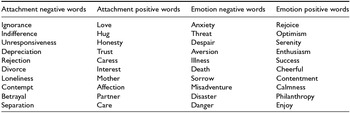
The Genov Modified Stroop task (GMST), developed by Genov, Shay, and Boone (Reference Genov, Shay and Boone2002), was implemented in the present study. The GMST is a recent computerised version of the emotional Stroop paradigm, demonstrated to be valid in previous Stroop studies (e.g., Kirsh, Olczak, & Mounts, Reference Kirsh, Olczak and Mounts2005). It presents words (see Appendix for a list of words used in this study) in the centre of a circular four-colour palette (blue, green, yellow or red). The words appear in one of the four colours in the middle of the circle. After the word is presented, the respondent has to select the correct colour from the palette by using the mouse. Subsequently, the respondent has to click on a small circle in the centre of the screen to initiate the presentation of the next word.
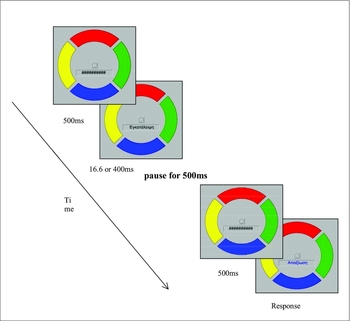
Participants were instructed to indicate the colour of the word presented to them as quickly and as accurately as possible, while ignoring the meaning of the word. Each trial of the task consisted of an array of ### presented for 500 ms, followed by a rapid subliminal -16.60 ms- (or supraliminal -400 ms-) presentation of an attachment-threat word (‘abandonment’), which served as a prime in order to activate the attachment system (in the control group, no such prime was presented). The primes were immediately followed by the presentation of a new array of ### (for 500 ms) because as Mikulincer et al. (Reference Mikulincer, Gillath and Shaver2002) have pointed out, the afterimage may remain temporarily active in the peripheral parts of the visual system even when the prime is presented for a short time. Thus, the second array of ### was used in order to ensure that the subliminal prime could not be recognised. After the primes there was a pause of 500 ms and then the stimuli were presented (see Figure 1). The same latencies have successfully been used in previous studies (e.g., Mikulincer et al., Reference Mikulincer, Dolev and Shaver2004; Mikulincer et al., Reference Mikulincer, Gillath and Shaver2002; Dewitte, Koster, et al., Reference Dewitte, Koster, De Houwer and Buysse2007). The stimulus material for the ES task consisted of five categories of words: positive (α = 0.90) and negative (α = 0.92) emotional words, positive (α = 0.93) and negative (α = 0.92) attachment-related words, and neutral words. Following Edelstein and Gillath's (Reference Edelstein and Gillath2008) methodology, all words were rated by the participants for emotional valence on a scale ranging from 1 (very negative) to 7 (very positive) and attachment relevance on a scale ranging from 1 (not related to close relationships at all) to 7 (very related to close relationships). The ratings were provided by the participants in the first session (see procedure section) of this study, which took place approximately 3 weeks prior to the second session. The selected attachment-related words received significantly higher ratings on attachment relevance (M = 4.08, SD = .69) in comparison to the emotional (M = 3.90, SD = .52) and neutral words (M = 2.36, SD = 1.54), F(1.18, 113.68) = 61.36, p < .001, η2 = .39. The neutral words (M = 4.78, SD = .49) also differed significantly from the emotional words (M = 6.39, SD = .40) and the attachment-related words (M = 6.35, SD = .40) in terms of emotional valence (higher scores show higher emotionality), F(1.37, 131.79) = 632.205, p < .001, η2 = .87. The words did not differ significantly on important lexical properties such as word length, number of syllables and frequency of occurrence in the Greek language (as appeared in the Hellenic National Corpus of the Greek Institute for Language and Speech Processing; http://hnc.ilsp.gr/statistics.asp), all Fs < 1, ps > .49.
The Emotional Stroop Task: Succession of a prime and response trial.

Participants first completed a practice session of neutral words not included in any of the other word lists. The target stimuli in the practice trials were different from those in the experimental trials. Every word appeared once in each one of the four colours. The Stroop task was programmed on DMDX experiment software (Forster & Forster, Reference Forster and Forster2003).
Procedure
The study was run in two sessions. In the first session, participants completed the Greek version of the ECR-R during regular class time. In the second session, which took place 2 weeks later, participants were randomly allocated in one of the three conditions (subliminal priming, supraliminal priming or control). Participants’ positive and negative affect prior to the experiment was assessed with the Positive and Negative Affectivity Schedule (PANAS; Watson, Clark, & Tellegen, Reference Watson, Clark and Tellegen1988). The same day instruction set was used (Cronbach's α = .85 and .83, for the Positive and Negative Affectivity respectively). All participants were individually tested on a PC with an SVGA 15-inch colour monitor. They were informed that they would perform a Stroop task and that they should respond to the colour of the word appearing on the screen as quickly as possible. They were then administered a practice trial of 10 items in order to familiarise with the task and the test trial begun.
Results
Latencies with errors were removed as well as reaction times greater than 2000 ms or shorter than 200 ms, which were considered as outliers. Additionally, reaction times that were three standard deviations above or below the mean of each trial were also excluded from statistical analyses (the total percentage of trials removed was less than 2%; Mikulincer et al., Reference Mikulincer, Gillath and Shaver2002). For each person, colour-naming reaction times for correct responses were averaged according to type of target stimuli.
The Effect of the Different Priming Methods and Word Types
A two-way mixed ANOVA was conducted with priming condition (subliminal, supraliminal, control) as an independent factor and target stimuli (emotion positive, emotion negative, attachment positive, attachment negative, neutral) as a repeated-measures factor.
The analysis revealed a significant main effect for type of target stimuli, F(3.43, 322.46) = 18.60, p < .001, η2 = .165. Participants had slower reaction times to attachment negative words (M = 1010.16) than to neutral (M = 982.89), attachment positive (M = 981.25) or emotion negative words (M = 988.58), according to a Bonferroni post hoc test. This suggests that the manipulation (priming with a distress word signalling abandonment) did indeed activate the attachment system, as expected.
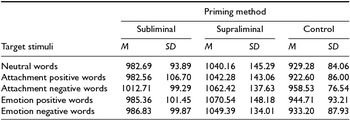
There was also a significant main effect for priming condition, F(2, 94) = 9.07, p < .001, η2 = .162. A Gabriel post hoc test demonstrated that participants in the supraliminal condition (M = 1052.96) had slower reaction times than participants in the control condition (M = 937.66). Finally, there was also a significant interaction between word type and priming condition F(6.86, 322.46) = 2.09, p < .05, η2 = .043. (see Table 1 for descriptive statistics).
Means and Standard Deviations of Reaction Times in the Stroop Task as a Function of Priming Method and Word Type

Attachment Orientation Effects
Five univariate ANCOVAs, one for each type of target stimuli, were conducted, taking into account participants’ negative affectivity, which was included in the analyses as a covariate.
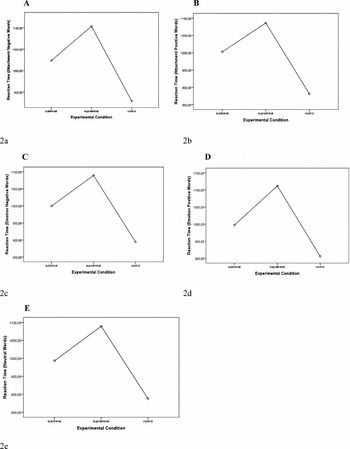
For the attachment negative words, the ANCOVA revealed a main effect of priming condition, F(2, 84) = 4.00, p < .05, η2 = .087, so that participants responded with significantly longer reaction times to these words in the supraliminal (adjusted M = 1049.09) condition in comparison to the control group (adjusted M = 965.04), p < .05, according to Bonferroni post-hoc tests. Reaction times between the subliminal and the control or the supraliminal condition were not significantly different. An interaction effect between priming condition and avoidance (low/high, using median split procedures) was also found, F(2, 84) = 4.08, p < .05, η2 = .09 (see Figure 2a). Simple effects analyses for the interaction between priming condition and avoidance, concerning the attachment negative words, showed that high avoidants in the supraliminal condition had significantly longer reaction times (adjusted M = 1097.01) than high avoidants in the control group (adjusted M = 925.31), F(2, 44) = 7.17, p < .01 (see Table 2 for descriptive statistics of the interactions).
Means and Standard Deviations (in parentheses) of Reaction Times of the Stroop Task as a Function of the Interaction between Priming Condition and Avoidance

Note: Means with differing superscripts (i.e., a and b) within columns are significantly different.
*p < .05, **p < .01, ***p < .001
Attentional biases in the Emotional Stroop Task as a function of attachment avoidance and priming condition for (a) attachment negative words, (b) attachment positive words, (c) emotion negative words, (d) emotion positive words, and (e) neutral words.

For the attachment positive words, a univariate ANCOVA revealed a main effect of priming condition F(2, 84) = 5.34, p < .01, η2 = .11, as well as an interaction between priming condition and avoidance F(2, 84) = 4.85, p < .05, η2 = .10 (see Figure 2b). Participants responded with significantly longer reaction times to these words in the supraliminal (adjusted M = 1027.83) condition in comparison to the control condition (adjusted M = 925.30), p < .01 according to Bonferroni pairwise comparisons. Reaction times between the subliminal condition and the control condition or the supraliminal condition were not significantly different. The interaction was followed with simple effects analyses, which revealed that high avoidants in the supraliminal condition responded with significantly longer reaction times (adjusted M = 1079.30) to the attachment positive words than high avoidants (adjusted M = 877.73) in the control condition, F(2, 44) = 8.48, p < .01.
For the emotion negative words, a univariate ANCOVA revealed a main effect of priming condition F(2, 84) = 4.98, p < .01, η2 = .11, as well as an interaction between priming condition and avoidance F(2, 84) = 5.35, p < .01, η2 = .11 (see Figure 2c). Participants responded with longer reaction times to the emotion negative words in the supraliminal (adjusted M = 1032.66) condition in comparison to the control group (adjusted M = 938.10), p < .01. Simple effects analyses for the interaction between priming condition and avoidance revealed that high avoidants in the supraliminal condition responded with significantly longer reaction times to the emotion negative words (adjusted M = 1083.46) than high avoidants in the control group (adjusted M = 890.41), F(2, 44) = 10.13, p < .001.
For the emotion positive words, a univariate ANCOVA revealed a main effect of priming condition F(2, 84) = 5.98, p < .01, η2 = .12, as well as an interaction between priming condition and avoidance F(2, 84) = 4.58, p < .05, η2 = .10 (see Figure 2d). A Bonferroni post-hoc test showed that participants responded with significantly longer reaction times to emotion positive words in the supraliminal (adjusted M = 1054.73) condition in comparison to the control group (adjusted M = 948.89), p < .01), as well as in comparison to the subliminal condition (adjusted M = 976.16), p < .05). Simple effects analyses for the interaction revealed that high avoidants in the supraliminal condition (adjusted M = 1104.58) responded with significantly longer reaction times to the emotion positive words than high avoidants in the control group (adjusted M = 900.69), F(2, 44) = 8.39, p < .01.
For the neutral words, a univariate ANOVA revealed a main effect of priming condition, F(2, 84) = 4.82, p < .05, η2 = .10, as well as a significant interaction between priming condition and avoidance F(2, 84) = 5.56, p < .01, η2 = .12 (see Figure 2e). Bonferroni pairwise comparisons for the neutral words yielded that avoidant participants responded with longer reaction times to these words in the supraliminal (adjusted M = 1025.64) group in comparison to the control group (adjusted M = 931.76), p < .01. Simple effects analyses for the interaction between priming condition and avoidance, concerning the neutral words, showed that high avoidants in the supraliminal condition responded with significantly longer reaction times (adjusted M = 1082.21) to these words than high avoidants in the control condition (adjusted M = 884.10), F(2, 44) = 8.46, p < .01.
In all the above analyses we also used positive affect as a covariate, but in none of them did we observe a significant change in the results, so positive affect was excluded from further analyses.
Discussion
The present study aimed to examine the information processing strategies used by avoidant persons under different conditions of attachment system activation. The study found that individuals scoring higher on attachment avoidance cognitively avoid processing of attachment-related and emotional (unrelated to attachment) material in the supraliminal activation condition. Importantly, lower avoidance individuals had similar reaction times in all types of words across attachment activation groups, indicating that low levels of avoidance allow individuals to process information freely. Notably, these results cannot be accounted for by participants’ negative affectivity.
The results of the present study suggest that avoidant individuals use both pre-emptive and post-emptive strategies (Fraley et al., Reference Fraley, Garner and Shaver2000) under different attachment system activating conditions. When the attachment system is not activated (as it happened in our control group) then high avoidant persons use their ‘first line of defence’; namely, they focus on the task-relevant processes (colour naming), ignoring the semantic meaning of the words. This leads to lower interference in the Emotion Stroop task, since avoidant adults avoid the encoding of attachment-related and emotion-laden words in order to prevent the activation of the attachment system. Our results suggest that this is a well-rehearsed automatic defensive strategy that taxes no cognitive resources. When the attachment system is activated by a salient prime, however, higher avoidance participants make a strong effort to deactivate it by trying to suppress thoughts and feelings associated with the prime. This effort causes them to avoid processing of all subsequent material (longer reaction times) in accordance with a cognitive avoidance explanation of the Stroop effect (DeRuiter & Brosschot, Reference De Ruiter and Brosschot1994; MacLeod et al., Reference MacLeod, Mathews and Tata1986). Cognitive avoidance could be understood either as a suppression of cognitions and feelings associated with the prime, an effortful strategy that taxes cognitive resources, leading to longer colour-naming times (Bonnano et al., Reference Bonanno, Davis, Singer and Schwartz1991; DeRuiter & Brosschot, Reference De Ruiter and Brosschot1994), or as a delay caused by participants looking away from the task (MacLeod & Mathews, Reference MacLeod, Mathews and Martin1991). This latter view is in line with developmental studies showing that avoidant children were inclined to look away from both negative and positive attachment-related pictures (Kirsh & Cassidy, Reference Kirsh and Cassidy1997), whereas the former view is in line with research evincing that avoidant individuals show longer reaction times in the emotional Stroop task as a result of a rebound of previously suppressed material (Mikulincer et al., Reference Mikulincer, Dolev and Shaver2004). These results are in line with our hypotheses. It therefore seems plausible that avoidant individuals utilise automatic processing of emotional and attachment-related information when the attachment system is deactivated and strategic processing when it has been supraliminally activated by a salient prime that produces a ‘cognitive threat’ (Dawkins & Furnham, Reference Dawkins and Furnham1989).
Results for the subliminal activation condition and avoidant attachment system lay between the supraliminal and control condition as expected; yet, differences among the three conditions were not significant. It is likely that the subliminal priming was not as strong, making it easy for avoidant participants to inhibit processing of unwanted thoughts and feelings. As a result, reaction times in the subliminal condition lay somewhere between those observed in the supraliminal and the control condition. It is also possible that avoidant adults’ secondary defensive strategies are so well-practised that they can operate effectively when a ‘cognitive threat’ is not very salient. This hypothesis is in agreement with previous findings suggesting that avoidant individuals’ defensive strategies are effectual under conditions of low cognitive load (Edelstein & Gillath, Reference Edelstein and Gillath2008; Mikulincer et al., Reference Mikulincer, Dolev and Shaver2004).
Another explanation for the non-findings regarding the subliminal condition could be attributed to carry-over effects. Carry-over effects are a frequent phenomenon in the Stroop task when stimuli are presented in a mixed design where, in addition to the short-lived interference mechanism, there is a long-lasting attentional component that intervenes during stimulus presentation (Bertels, Kolinsky, Pietrons, & Morais, 2011; Frings, Englert, Wentura, & Bermeitinger, Reference Frings, Englert, Wentura and Bermeitinger2010; McKenna & Sharma, Reference McKenna and Sharma2004; Waters, Sayette, Franken, & Schwartz, Reference Waters, Sayette, Franken and Schwartz2005). However, if this explanation was valid, these effects should be evident for participants low in avoidance as well, but this was not true. For what has to do with interference of neutral words though, carry-over effects offer a liable explanation. It is possible that the attachment and emotion words influenced the processing of ensuing neutral words. In future research, different versions of mixed versus blocked designs of the Stroop task should be employed to allow for a distinction between fast (influence of emotional stimuli on the currently to-be-executed response) and slow (influence of the valence of previous events) processes (Frings et al., Reference Frings, Englert, Wentura and Bermeitinger2010).
The present findings may also provide evidence for the processes that are at play in the Emotional Stroop task. It has been argued that the Stroop task assesses both early and later stages of processing (MacLeod, Reference MacLeod1991). It is also known that attentional biases occur in the early stages of information processing whereas cognitive avoidance occurs at later stages (Duncan-Johnson & Kopell, Reference Duncan-Johnson and Kopell1981). Our findings may suggest then that the Stroop task assesses early stages of information processing when there are not any other task-irrelevant processes at play, and later stages when task-irrelevant processes are present (e.g., suppression of cognitions and feelings caused by the prime).
At early stages of information processing, words capture avoidant participants’ attention while at later stages participants make efforts to cognitively avoid further processing, with the consequence of longer colour-naming times. A similar pattern of information processing has been demonstrated for repressors. Namely, they cognitively inhibit responsiveness to threat information while at the same time they have increased awareness of such information (Derakshan, Eysenck, & Myers, Reference Derakshan, Eysenck and Myers2007). This idea is compatible with Bartholomew's (Reference Bartholomew1990) claim that avoidant individuals may have two incompatible sets of working models, an anxious working model operating at early automatic stages of information processing, and another avoidant model operating at later, strategic stages of processing. Indeed, in a study examining dismissing-avoidants’ facial mimicry reactions at different levels of information processing, it was found that dismissing-avoidant persons displayed normal negative emotion contagion to angry faces at an early automatic stage, indicating no suppression of negative emotions. In a later, more controlled level of information processing though, the same individuals showed inverted zygomaticus reactions (smiling) to the angry faces, indicating inhibition of their earlier evoked negative emotional reaction (Sonnby-Borgstrӧm & Jӧnsson, Reference Sonnby-Borgström and Jönsson2004). Our findings suggest then that the anxious working model operates when the attachment system is deactivated, offering avoidant participants the opportunity to be aware of threat information. When the attachment system gets activated though, the avoidant working model assumes control, suppressing any further processing of such information. The use of different cognitive tasks that would allow for a comparison between early and late stages of information processing is essential in future research.
The findings of the present study bear important implications for the interpretation of slowed reaction times in the Stroop task, especially with respect to persons who hold avoidant schemas. Longer colour-naming times may not indicate that avoidant persons’ deactivating strategies fail and that they actually cannot ignore the semantic meaning of the words as the classic translation of the Stroop would suggest. The results of our study suggest that longer reaction times may be a sign of a ‘second line of defence’, namely, cognitive avoidance rather than capturing of attention. Therefore, it is essential for future research to employ tasks other than the Stroop that assess late stages of information processing to further disentangle this issue.
This study is not without limitations. One concerned gender distribution, since most of the participants were women. Prior attachment research has revealed that gender did not moderate attachment styles differences (e.g., Hazan & Shaver, Reference Hazan and Shaver1987), including differences in information processing (Dewitte, Koster et al., Reference Dewitte, Koster, De Houwer and Buysse2007; Mikulincer et al., Reference Mikulincer, Dolev and Shaver2004). Nevertheless, future research could pay more careful attention to gender differences in information processing with regards to avoidant attachment. Another limitation concerns the stimuli used in the Stroop task. The results revealed that the attachment-related words did not differ significantly, in terms of emotional valence, from the emotional words (even though they differed in terms of attachment-relatedness). Previous studies have also found that positive emotional and positive attachment-related words and negative emotional and negative attachment-related words have been comparable in terms of emotional valence (Edelstein & Gillath, Reference Edelstein and Gillath2008). The question then arises whether attachment-related stimuli can be really differentiated from emotional stimuli since words such as ‘mother’, ‘love’, ‘rejection’ or ‘betrayal’, which are obviously related to attachment, seem to be emotionally laden. Future studies should take this into serious consideration.
Concluding, the study presented in this article has provided preliminary evidence for different patterns of avoidant defensive strategies depending on the mode of activation of the attachment system. Our results suggest that avoidant individuals employ both pre-emptive and post-emptive strategies to reach their goal of keeping the attachment system deactivated, by switching from one set of strategies to the other depending on the status of their attachment system. Moreover, these information processing patterns concern attachment and emotion-related stimuli. The present study also indicates that in certain instances in the emotion Stroop task, a cognitive avoidance explanation should be considered as more liable than an attentional explanation.
Words Used in the Emotional Stroop Task