Introduction
Since 1992, the Department of Health has required all local authorities to include the provision of secure services in their strategic and purchasing plans (Department of Health, 1993). This led to the development of a network of psychiatric intensive care units (PICUs) across the country to provide secure health care for violent or difficult to manage patients with psychiatric illness. Such units, referred to as ‘special care wards’, attracted criticism for their bleak environment, perceived isolation and different standard of care from the rest of the hospital (Zigmond, Reference Zigmond1995). Improvements and service standards followed (Department of Health, 2002) together with inter-unit collaboration and the opportunities for continuing development through a national association of psychiatric intensive care units (NAPICU). These facilities were set up to treat adult patients, with no similar provision available for adolescents. In fact, psychiatric provision generally for adolescents has lagged behind adult service developments for many years.
Most epidemiological data on mental illness in young people focuses on emotional and behavioural symptoms. National data has shown that around 10% of 5–15 year olds will suffer from at least one psychiatric disorder during their development. Conduct disorder in 11–15 year olds was found to affect 6.2% of the population with a relative preponderance in boys (8.6% vs 3.8% in girls). These data also highlight the important factors that associate with mental illness in young people, including parental mental illness, low level of parental occupation and income, family dysfunction and the perception of the child as difficult by parents. There is no prevalence data for psychotic and other severe mental illnesses in these major surveys (Meltzer et al. Reference Meltzer, Gatward, Goodman and Ford2000; Green et al. Reference Green, McGinnity, Meltzer, Ford and Goodman2005). Other studies have found that adolescent onset psychosis has a three year prevalence of 5.9 per 100 000 in the general population with social and peer relationship difficulties (Boeing et al. Reference Boeing, Murray, Pelosi, McCabe, Blackwood and Wrate2007). There are strong correlates with neuro-developmental difficulties including enuresis and language impairment (Hollis, Reference Hollis2003).
There is considerable variability in the ethos of the various adolescent in-patient units in Britain. Although the first unit was established in 1940 and a network of units set up in the 1960s (Jaffa, Reference Jaffa1995), there is a tradition of treating adolescent disturbance going back several centuries (Parry-Jones, Reference Parry-Jones1995). Although potentially advantageous, this variability of service model has led to criticisms that adolescent units are idiosyncratic with ‘limited standardisation of interventions and wide variation in assessment and treatment styles’ (Parry-Jones, Reference Parry-Jones1995). Their role has been broadly defined as providing intensive assessment, ensuring safety and managing complex problems that cannot be resolved in out-patient settings. More recently, there have been initiatives to first characterise and then find common ground and common service standards for in-patient units, with the National Inpatient Child and Adolescent Psychiatry Study (NICAPS) (O'Herlihy et al. Reference O'Herlihy, Worrall, Lelliott, Jaffa, Hill and Banerjee2003) and then Quality Network for Inpatient CAMHS (QNIC) which evolved from this. Now, over 100 in-patient units participate in these standards, representing 90% of units in Britain (Solomon et al. Reference Solomon, Thompson and Collins2011).
For many, the most important quality of an adolescent in-patient unit is its ability to accommodate emergency admissions (Gowers et al. Reference Gowers, Symington and Entwistle1991). However, many units find this difficult to achieve in practice, with disruptions to therapeutic programs, undermining of progress of current in-patients and lack of appropriate staffing to facilitate admissions at nights, weekends or other out-of-hours times (Cotgrove & Gowers, Reference Cotgrove and Gowers1999). Due to the variety of units, many are not set up with the aim of managing acute disturbance that requires a level of security, resulting in transfer to alternative NHS facilities or admission to a unit run by the private sector (Hoare & Wilson, Reference Hoare and Wilson2010). In one review, most of these patients transferred to more secure facilities had either longstanding personality difficulties or psychosis. A significant proportion also had post traumatic stress disorder. Over 90% presented a risk of physical aggression, with many also having risk of self harm or presenting with suicidal behaviour (Wheatley et al. Reference Wheatley, Waine, Spence and Hollin2004). The authors of this review concluded that further investment in mental health services for young people who present as dangerous and disturbed is critical and raise concern about the lack of national provision for this cohort of young people, championing the need for medium secure adolescent facilities.
Some individual units around the country have now developed their own bespoke services for managing disturbance. These services are given different names, including psychiatric intensive care, high dependency or low secure. However there is little consensus on what these titles mean, and services with similar names may provide differing levels of service with varying capacity to manage degrees of violence or aggression. Definitions remain unclear and can result in talking at cross purposes when attempting to compare one service with another. We attempt here to define patient populations in need of such services, contrast these with adult services, suggest a nomenclature for defining such services that could be universally adopted and describe our successes in a service defined as adolescent psychiatric intensive care.
Proposed Nomenclature
Adolescent Psychiatric Intensive Care Units (A-PICU)
Wheatley et al.'s (2004) review indicated that most adolescents transferred to secure facilities had longstanding personality difficulties or psychosis. This population needs a contained environment with a strong behavioural ethos to limit ongoing violence. Seclusion facilities may also be required. It is likely that most of these young people will be detained under the Mental Health Act 1983.
The physical environment needs to be robust, yet as comfortable as possible, and staff will need appropriate training in the management of violent behaviour, including restraint procedures. Consideration should be given to the standards developed by the Department of Health in 2002 for adult psychiatric intensive care facilities (Department of Health, 2002).
Adolescent High Dependency Units (A-HDU)
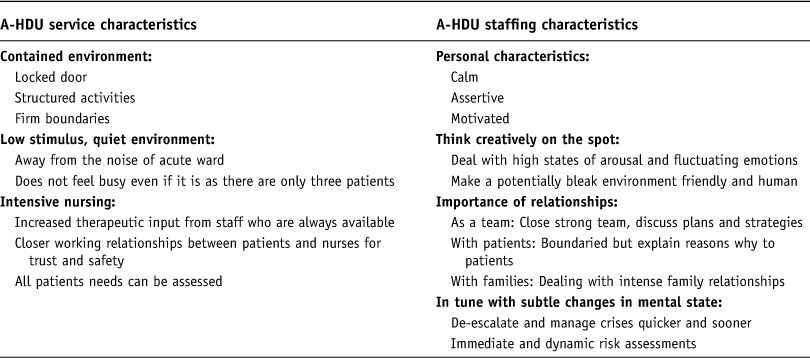
These facilities would be less secure and intensive than A-PICU facilities. The focus would be primarily on providing a low stimulus environment alongside intensive nursing support. The physical environment need not be as restrictive as that set out for A-PICU. Table 1 represents our own survey findings of how a unit can be successful. Anecdotally, the success of this model has been greatest in the management of young people with uncontained mania.
Suggested characteristics of a successful adolescent high dependency unit (A-HDU)

Adolescent Low Secure Units (A-LSU)
We understand that some psychiatric intensive units for adolescents have previously been established in the private sector. Anecdotally, the authors understand that they operate as units providing intensive care and therapy. Their remit is not restricted to the short term with some using the first six weeks of admission as an opportunity for multi-disciplinary assessment. Indeed the review of Wheatley et al. (Reference Wheatley, Waine, Spence and Hollin2004) highlighted that referrers to secure services frequently identify the need for specialist long term secure care.
These units would operate in a fashion closely allied to those of low secure units in adult services. Low secure facilities are defined as providing intensive, comprehensive and multidisciplinary treatment for patients who demonstrate disturbed behaviour in the context of a serious mental disorder and who require the provision of security. Admission, usually involving long term rehabilitation can be for up to two years.
This type of environment could be appropriate for the management of those young people on discharge from a medium secure forensic unit where lower secure facilities are needed to help with transition, rehabilitation and future community re-integration.
Similar environments could also be used for the management of young people with challenging behaviour in the context of intellectual disability. More than other young people, they benefit from a low stimulus environment with strong boundaries and an effective behavioural program to manage their challenging behaviour.
Particular considerations for children and young people
Voluntary vs involuntary admission
For adults, detention via the Mental Health Act is a requirement for admission to secure facilities as admission represents a significant reduction in freedom (Department of Health, 2002). For young people under 18, legal detention is also a viable means of maintaining admission, but other options are also available, including the consent of the young person or the consent of their parents.
Young people can only be admitted to secure facilities with their own consent if they are over 16 and deemed to have appropriate capacity to consent to the admission, according to the capacity criteria delineated in the Mental Capacity Act 2005 (http://www.legislation.gov.uk/ukpga/2005/9/contents).
For those admitted with parental consent, the consent to their admission is seen as falling within the ‘zone of parental control’. This is a term mentioned in the Mental Health Act Code of Practice (Department of Health, 2008, 36.9–36.15) and derives from case law at the European Court of Human Rights. To allow any treatment (including hospital admission), there are two main considerations to the decision: whether the decision is considered to be a usual parenting decision and whether there are indicators that the parents might not be acting within the best interests of the child. This therefore means that if the consent of a parent cannot be relied upon, different ways to afford treatment must be looked at, including detention under the Mental Health Act.
Importantly, known views of a child who had previously been deemed to have decision making capacity should be seen as limiting the zone of parental control. The Mental Health Act Code of Practice (Department of Health, 2008, 36.42–36.44) advises not to rely on parental consent in a situation where a young person, deemed to have capacity to agree to admission, refuses such an admission. For further information, there are helpful resources available from the National Mental Health Development Unit publications (National Institute for Mental Health in England, 2009; National Mental Health Development Unit, 2009).
In both non-detained scenarios, regular assessments of both capacity (in those over 16) and assent (in children 16 and younger) should take place to ensure that the young person is still in agreement with the need for secure admission. If this changes, a Mental Health Act assessment must be arranged to consider the appropriateness of detention in hospital. It is also axiomatic that repetitive physical restraint should not take place without detention. We recommend that Mental Health Act detention be seen as a requirement for admission to A-PICU and to A-LSU but recommended and not essential for admission to A-HDU as there is a lower level of security and less deprivation of liberty.
Daily activities
Given that education is a national requirement for all young people (Education Act 1996, http://www.legislation.gov.uk/ukpga/1996/56/contents) and the multi-disciplinary staffing found in many health care teams, teachers and school facilities need to be available for young people in secure hospital facilities. Most adolescent units have a school or classroom facilities on site, but some young people, particularly those in A-PICU may not be able to attend, as leaving the confines of the ward may increase the risk of violence towards others, or of absconding. Therefore, flexible arrangements need to be made to ensure that teachers are able to visit the ward or ensure that appropriate classroom facilities are available within the ward structure. Similar therapeutic involvement needs to be available without the need to compromise on safety.
Our experiences
Coborn PICU is part of the Coborn Centre for Adolescent Mental Health, the adolescent in-patient unit run by East London NHS Foundation Trust. The Trust covers the boroughs of Tower Hamlets, Hackney, Newham and the City of London, and the unit is jointly commissioned by these local authorities. The Coborn Centre itself is situated itself in Plaistow, close to the local general hospital (Newham University Hospital NHS Trust). The Coborn Centre has three different arms: a 12-bed acute ward; a 3-bed PICU; and a day service for up to 10 day attendees. The unit was established to assess and treat acute and emergency presentations of mental illness that cannot be contained by community management.
As far as we are aware, the Coborn PICU was one of the first adolescent PICUs to be established within the NHS sector. It is affiliated with the National Association of Psychiatric Intensive Care Units (NAPICU) and is the only adolescent facility to be so registered. The Coborn Centre moved to new and expanded premises in 2006. Its remit is to provide a safe environment for those who cannot be managed in an open acute ward. Previous experience of patients with acutely disturbed and aggressive mental states in the smaller Coborn Ward in St Clement's Hospital, Mile End was the impetus for the setting up of the intensive care unit in the new building. There, these patients were contained unsatisfactorily by close observations with two nurses on the open acute ward. This led to increased arousal and aggression. The Coborn emphasis is very much on providing a containing and low-stimulus environment. The staff take a patient centred approach to allow the young person to engage with their care plans with encouragement, negotiation, education and user involvement. There is no use of close observations on PICU. Experience has led the staff to realise that one or two nurses undertaking close observation of an acutely unwell young person has a detrimental effect on the therapeutic rapport and alliance between young people and staff, is economically prohibitive and can also reinforce an already paranoid and persecutory mental state in the young person. Instead, having adequate nursing staff in the unit at all times who can become more or less involved with individual young people as their mental state, risk profile and wishes dictate has led to better relationships between staff and young people, fewer violent incidents towards staff, and reinforces the low stimulus ethos of the unit.
The building was custom-built with guidance from the Department of Health Health building notes series (https://www.gov.uk/government/organisations/department-of-health/series/health-building-notes-core-elements). The PICU has an internal air lock door system, requiring the first door to be closed before the second door can be opened. There is also an external door to allow an acutely disturbed patient to be brought directly to the PICU by ambulance or police escort. The three in-patients have their own bedrooms opening onto a central communal therapeutic space. There is also a separate nursing office and treatment room. See Figure 1 for a plan of the facilities.
Floor plan of Coborn PICU.
Coborn PICU is intensively staffed and is able to offer a full range of multidisciplinary interventions. There are regular therapeutic sessions with psychologists, occupational therapists, music and art therapists and sports instructors. The school and education staff also attend to provide individualised sessions to those too unwell to attend the Coborn school.
Since its inception, there have been 97 admissions to PICU, of which 64 (65%) were male. The mean age at admission is 15.9 years (range 11.03–17.12 years). The mean length of admission is 41.5 days (range 1–345 days). Reflecting the local population, young people admitted to PICU were from diverse ethnic backgrounds. The most common ethnic background was Asian/Asian British: Bangladeshi with 28 (29%) young people. Notable also were high rates of admission of those from Black/Black British African or Caribbean backgrounds, representing 21 (22%). There were 15 (15%) young people from a White British background.
As discussed above, there is variance in the legal status of the young person at the point of admission. A significant minority were originally admitted with their own or parental consent (Fig. 2). This data only represents legal status at admission and does not reflect changes to legal status during the length of the admission.
Legal status of patients on admission to Coborn PICU.
The diagnostic variance is wide for those admitted (Fig. 3). Of note is the large proportion (36 young people, 37.5%) admitted with mood disorder. The ‘Other and unrecorded’ category includes those young people with emerging emotionally unstable personality disorder (5, 5%).
Diagnoses of patients in Coborn PICU.
Which model is Coborn?
Coborn refers to its secure ward as A-PICU, an adolescent psychiatric intensive care unit. Certainly, the physical structure of the environment would suggest this is an appropriate description. However, with reference to our proposed nomenclature, it is likely that it does not fully meet this description all the time and often functions at the level of A-HDU: adolescent high dependency. This is often dependent on the need of the current patients and staffing ratios can be adjusted to meet this need. Importantly, the Coborn Centre remains actively involved in debate and discussion about the use of this secure facility and the difficulties involved in nursing young people that need high dependency care in a facility set up to provide a more secure, intensive care. As a result, there are plans to establish a separate unit to provide intensive care (A-PICU), and to modify the existing facility to provide the high dependency care proposed in our A-HDU model.
The future?
We hope this article will stimulate debate in the field, particularly in reference to the terms that organisations use to define their more secure facilities. At the time of writing, we are aware of two other NHS organisations that are developing more non-forensic, secure facilities for adolescents along with the current provision from several independent sector providers. We hope that our experiences can be shared, leading to more consensus and better care for these adolescents.
Declaration of interest
BK and RS have previously worked at Coborn Centre for Adolescent Mental Health. RR currently works at Coborn Centre for Adolescent Mental Health and is the Lead Clinician there. None of the authors have anything further to declare.